
Violence Prevention & Trafficking Indigenous
PT
Published · 33 slides · 0 views
1 / 1
Description
Violence Prevention Trafficking Indigenous Women, Girls and 2SLGBTQQIA People Key Terms Assimilation: Where individuals or a group of people is encouraged or forced to adopt the culture of a dominant group while losing their own culture.
Related Topics
Share
Embed code
Download this presentation From Below
"Violence Prevention & Trafficking Indigenous" is the property of its rightful owner. Permission is granted to download and print the materials on this website for personal, non-commercial use only, and to display it on your personal computer provided you do not modify the materials and that you retain all copyright notices contained in the materials. By downloading content from our website, you accept the terms of this agreement.
Presentation Transcript
01
Violence Prevention & Trafficking Indigenous Women, Girls and 2SLGBTQQIA+ People<br>
02
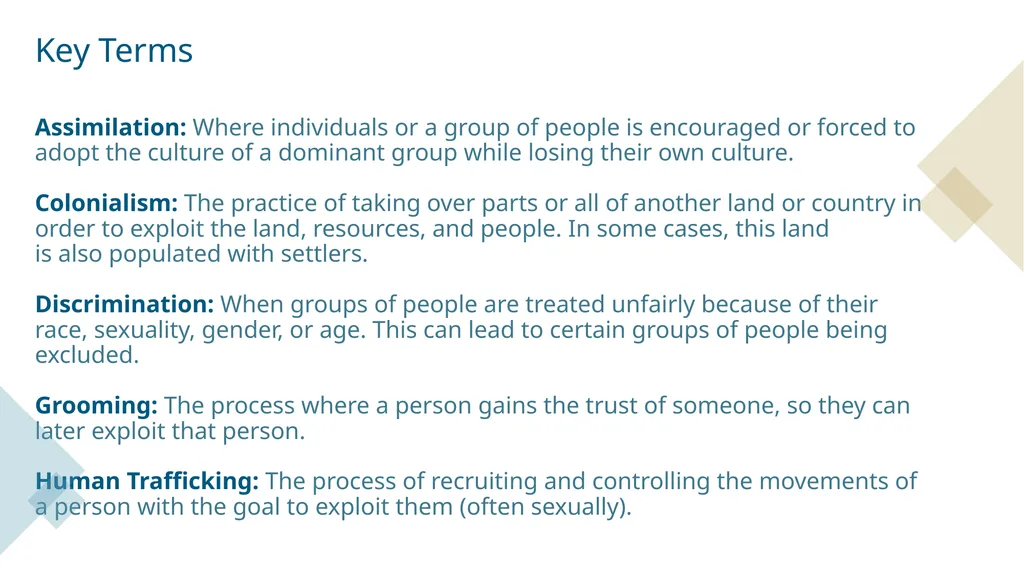
Key Terms Assimilation: Where individuals or a group of people is encouraged or forced to adopt the culture of a dominant group while losing their own culture.
Colonialism: The practice of taking over parts or all of another land or country in order to exploit the land, resources, and people. In some cases, this land is also populated with settlers.
Discrimination: When groups of people are treated unfairly because of their race, sexuality, gender, or age. This can lead to certain groups of people being excluded.
Grooming: The process where a person gains the trust of someone, so they can later exploit that person.
Human Trafficking: The process of recruiting and controlling the movements of a person with the goal to exploit them (often sexually).<br>
Colonialism: The practice of taking over parts or all of another land or country in order to exploit the land, resources, and people. In some cases, this land is also populated with settlers.
Discrimination: When groups of people are treated unfairly because of their race, sexuality, gender, or age. This can lead to certain groups of people being excluded.
Grooming: The process where a person gains the trust of someone, so they can later exploit that person.
Human Trafficking: The process of recruiting and controlling the movements of a person with the goal to exploit them (often sexually).<br>
03
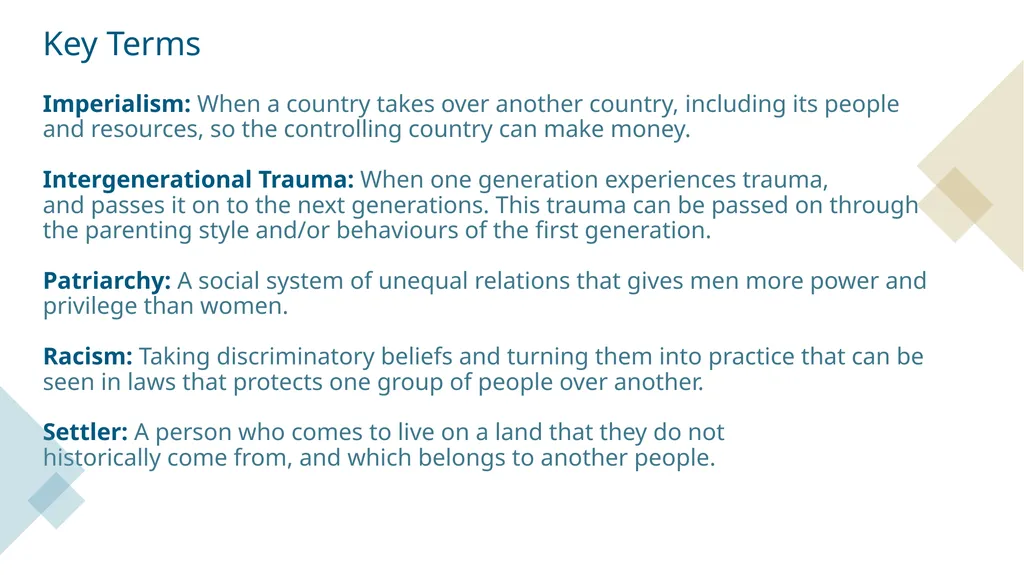
Key Terms Imperialism: When a country takes over another country, including its people and resources, so the controlling country can make money.
Intergenerational Trauma: When one generation experiences trauma, and passes it on to the next generations. This trauma can be passed on through the parenting style and/or behaviours of the first generation.
Patriarchy: A social system of unequal relations that gives men more power and privilege than women.
Racism: Taking discriminatory beliefs and turning them into practice that can be seen in laws that protects one group of people over another.
Settler: A person who comes to live on a land that they do not historically come from, and which belongs to another people.<br>
Intergenerational Trauma: When one generation experiences trauma, and passes it on to the next generations. This trauma can be passed on through the parenting style and/or behaviours of the first generation.
Patriarchy: A social system of unequal relations that gives men more power and privilege than women.
Racism: Taking discriminatory beliefs and turning them into practice that can be seen in laws that protects one group of people over another.
Settler: A person who comes to live on a land that they do not historically come from, and which belongs to another people.<br>
04
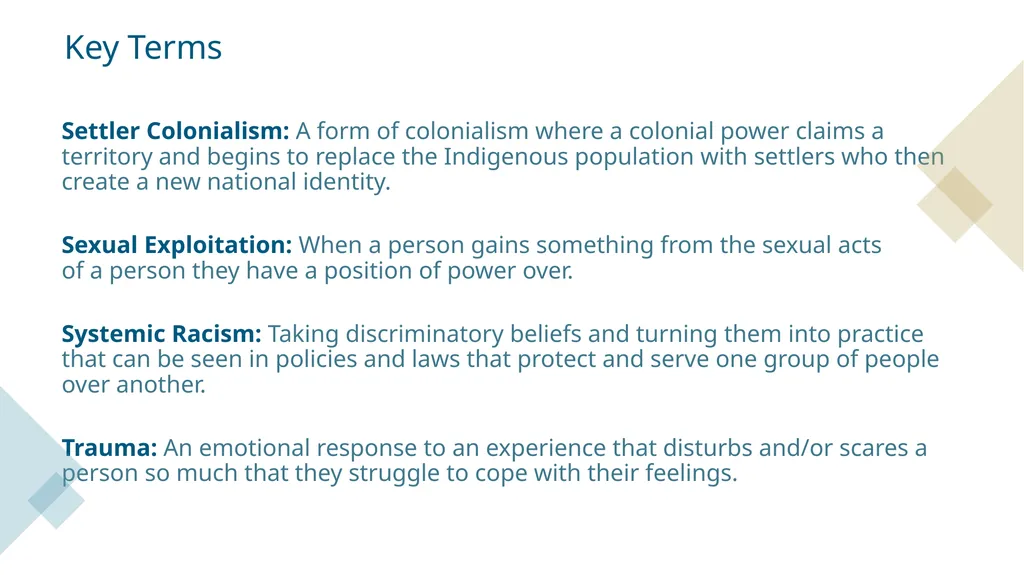
Key Terms Settler Colonialism: A form of colonialism where a colonial power claims a territory and begins to replace the Indigenous population with settlers who then create a new national identity.
Sexual Exploitation: When a person gains something from the sexual acts of a person they have a position of power over.
Systemic Racism: Taking discriminatory beliefs and turning them into practice that can be seen in policies and laws that protect and serve one group of people over another.
Trauma: An emotional response to an experience that disturbs and/or scares a person so much that they struggle to cope with their feelings.<br>
Sexual Exploitation: When a person gains something from the sexual acts of a person they have a position of power over.
Systemic Racism: Taking discriminatory beliefs and turning them into practice that can be seen in policies and laws that protect and serve one group of people over another.
Trauma: An emotional response to an experience that disturbs and/or scares a person so much that they struggle to cope with their feelings.<br>
05
Trafficking Indigenous Women, Girls & 2SLGBTQQIA+ Peoples: A Brief Overview<br>
06
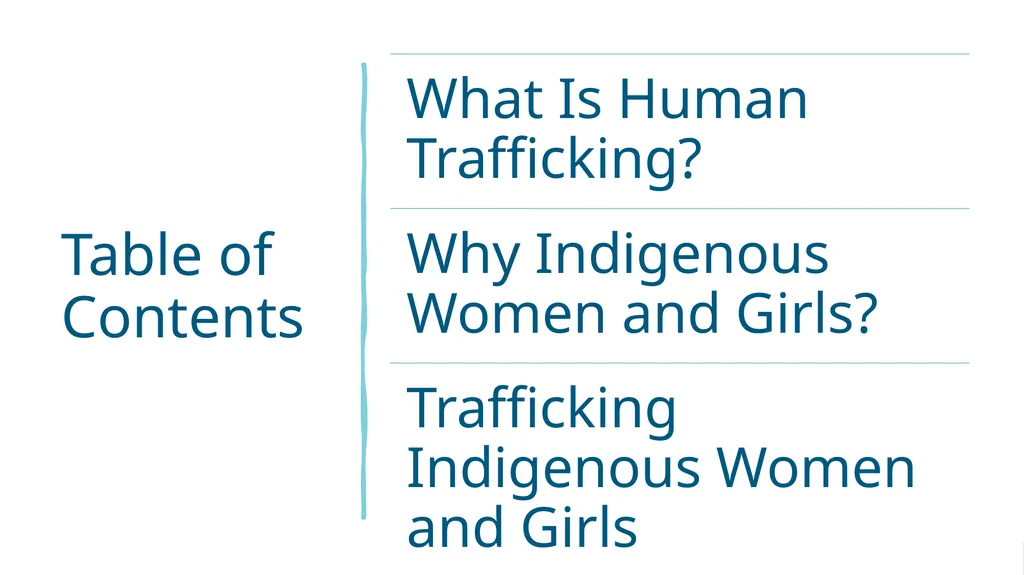
Table of Contents<br>
07
What is Human Trafficking? Human Trafficking
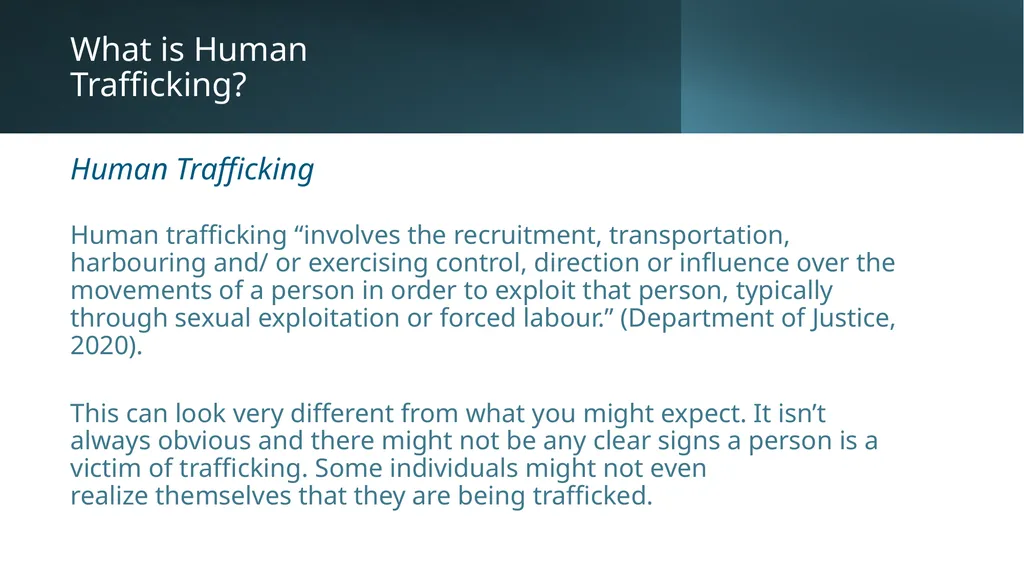
Human trafficking “involves the recruitment, transportation, harbouring and/ or exercising control, direction or influence over the movements of a person in order to exploit that person, typically through sexual exploitation or forced labour.” (Department of Justice, 2020).
This can look very different from what you might expect. It isn’t always obvious and there might not be any clear signs a person is a victim of trafficking. Some individuals might not even realize themselves that they are being trafficked.<br>
Human trafficking “involves the recruitment, transportation, harbouring and/ or exercising control, direction or influence over the movements of a person in order to exploit that person, typically through sexual exploitation or forced labour.” (Department of Justice, 2020).
This can look very different from what you might expect. It isn’t always obvious and there might not be any clear signs a person is a victim of trafficking. Some individuals might not even realize themselves that they are being trafficked.<br>
08
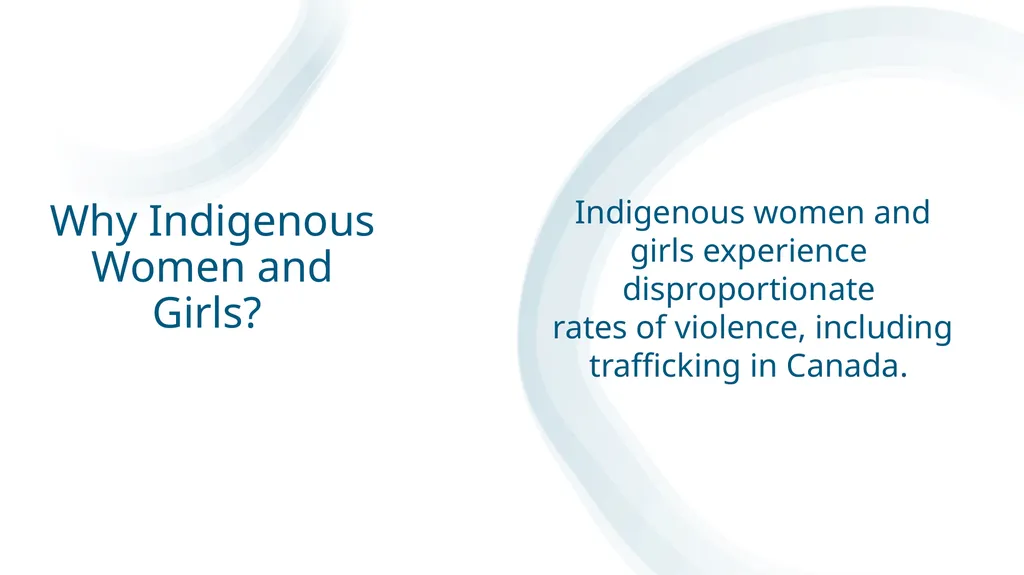
Why Indigenous
Women and Girls? Indigenous women and girls experience
disproportionate
rates of violence, including trafficking in Canada.<br>
disproportionate
rates of violence, including trafficking in Canada.<br>
09
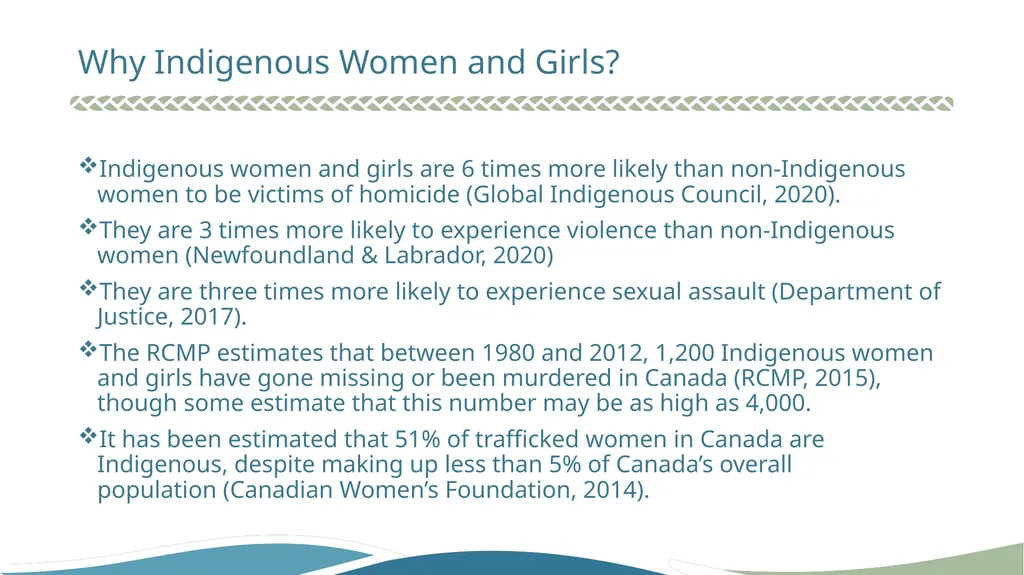
Why Indigenous Women and Girls? Indigenous women and girls are 6 times more likely than non-Indigenous women to be victims of homicide (Global Indigenous Council, 2020).
They are 3 times more likely to experience violence than non-Indigenous women (Newfoundland & Labrador, 2020)
They are three times more likely to experience sexual assault (Department of Justice, 2017).
The RCMP estimates that between 1980 and 2012, 1,200 Indigenous women and girls have gone missing or been murdered in Canada (RCMP, 2015), though some estimate that this number may be as high as 4,000.
It has been estimated that 51% of trafficked women in Canada are Indigenous, despite making up less than 5% of Canada’s overall population (Canadian Women’s Foundation, 2014).<br>
They are 3 times more likely to experience violence than non-Indigenous women (Newfoundland & Labrador, 2020)
They are three times more likely to experience sexual assault (Department of Justice, 2017).
The RCMP estimates that between 1980 and 2012, 1,200 Indigenous women and girls have gone missing or been murdered in Canada (RCMP, 2015), though some estimate that this number may be as high as 4,000.
It has been estimated that 51% of trafficked women in Canada are Indigenous, despite making up less than 5% of Canada’s overall population (Canadian Women’s Foundation, 2014).<br>
10
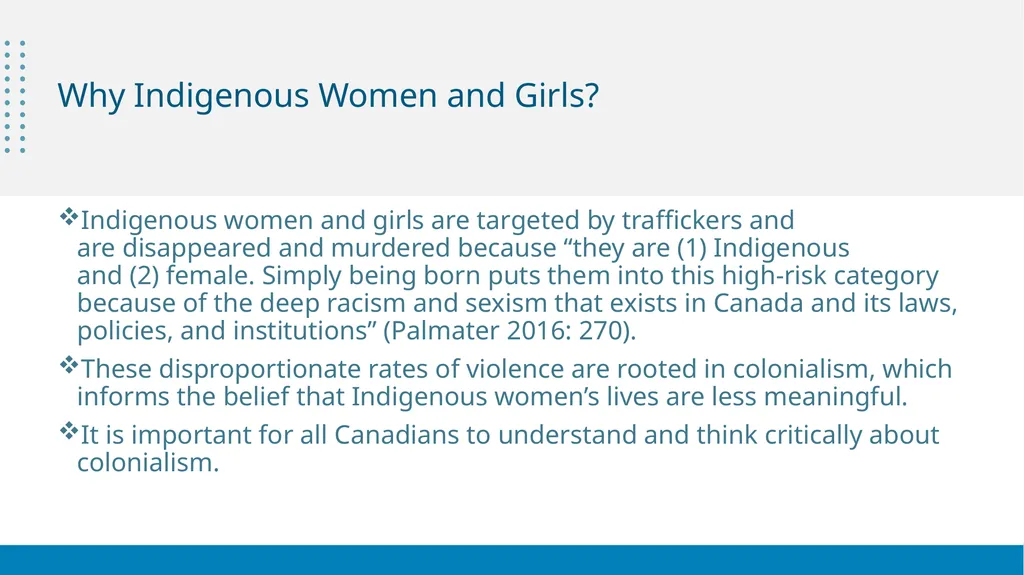
Why Indigenous Women and Girls? Indigenous women and girls are targeted by traffickers and are disappeared and murdered because “they are (1) Indigenous and (2) female. Simply being born puts them into this high-risk category because of the deep racism and sexism that exists in Canada and its laws, policies, and institutions” (Palmater 2016: 270).
These disproportionate rates of violence are rooted in colonialism, which informs the belief that Indigenous women’s lives are less meaningful.
It is important for all Canadians to understand and think critically about colonialism.<br>
These disproportionate rates of violence are rooted in colonialism, which informs the belief that Indigenous women’s lives are less meaningful.
It is important for all Canadians to understand and think critically about colonialism.<br>
11
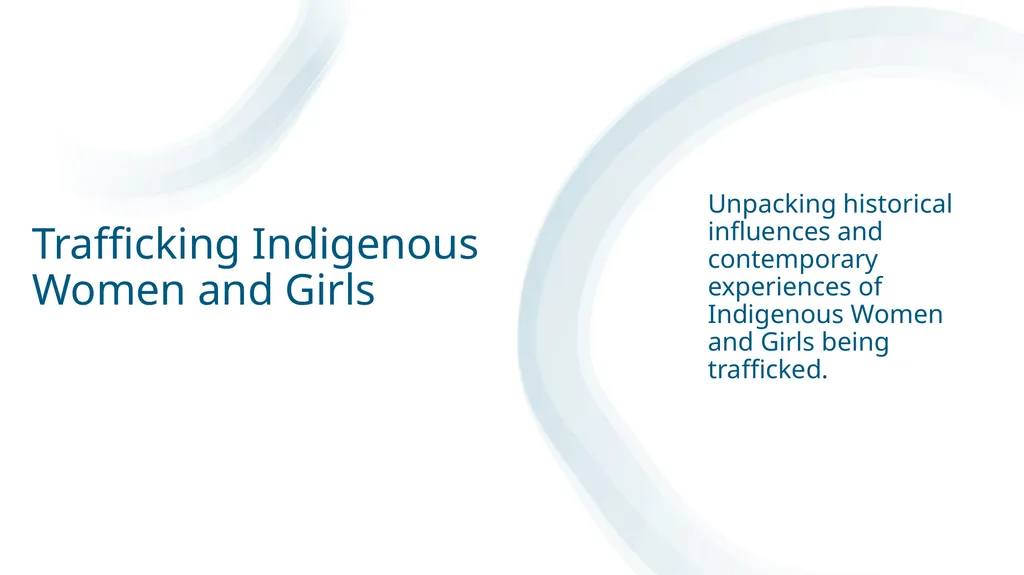
Trafficking Indigenous Women and Girls Unpacking historical influences and contemporary experiences of Indigenous Women and Girls being trafficked.<br>
12
Trafficking Indigenous Women and Girls Colonialism
Colonialism is the practice of taking over parts or all of another land or country in order to exploit the land, resources, and people.
Colonialism remains in effect today.
Colonialism shapes media representations of Indigenous women and girls and informs peoples’ beliefs about their value. It also contributes to the indifference and racism they face.
Indigenous women, girls and 2SLGBTQQIA+ people are treated differently in these systems, which increases their vulnerability and contributes to disproportionate rates of violence, sexual exploitation, and trafficking.<br>
Colonialism is the practice of taking over parts or all of another land or country in order to exploit the land, resources, and people.
Colonialism remains in effect today.
Colonialism shapes media representations of Indigenous women and girls and informs peoples’ beliefs about their value. It also contributes to the indifference and racism they face.
Indigenous women, girls and 2SLGBTQQIA+ people are treated differently in these systems, which increases their vulnerability and contributes to disproportionate rates of violence, sexual exploitation, and trafficking.<br>
13
Trafficking Indigenous Women and Girls Colonialism
The roots of indifference and racism are in colonial narratives, which includes the idea that settlers are superior to, and have the right to take from and rule over Indigenous Peoples.
Europeans portrayed Indigenous Peoples as “subhuman: inferior, backwards, uncivilized, deviant, dirty and inherently worthless to dominant society” (Bourgeois 2015: 1445).
These negative portrayals are further compounded by sexism, homophobia and transphobia.
Indigenous women and girls were historically framed as sexually available objects and placed in the lowest class of society (Sikka, 2010). This colonial hierarchy persists today and influences how Canada’s governments operate.<br>
The roots of indifference and racism are in colonial narratives, which includes the idea that settlers are superior to, and have the right to take from and rule over Indigenous Peoples.
Europeans portrayed Indigenous Peoples as “subhuman: inferior, backwards, uncivilized, deviant, dirty and inherently worthless to dominant society” (Bourgeois 2015: 1445).
These negative portrayals are further compounded by sexism, homophobia and transphobia.
Indigenous women and girls were historically framed as sexually available objects and placed in the lowest class of society (Sikka, 2010). This colonial hierarchy persists today and influences how Canada’s governments operate.<br>
14
Trafficking Indigenous Women and Girls Indigenous Slavery and Prostitution (Historical Context)
Colonial violence against Indigenous women, girls and 2SLGBTQQIA+ people has always been sexual in nature.
It is used to construct an image of Indigenous women as being acceptable, disposable targets for oppression (Razack 2016).
Slavery was also a form of sexualized violence; the “average age of Indigenous slaves in Canada was 14 years old and 57 percent were girls or young women” (Lawrence, 2016).
For two centuries, Indigenous women, girls and 2SLGBTQQIA+ people were seen as property and bought and sold as slaves(Sikka, 2010).<br>
Colonial violence against Indigenous women, girls and 2SLGBTQQIA+ people has always been sexual in nature.
It is used to construct an image of Indigenous women as being acceptable, disposable targets for oppression (Razack 2016).
Slavery was also a form of sexualized violence; the “average age of Indigenous slaves in Canada was 14 years old and 57 percent were girls or young women” (Lawrence, 2016).
For two centuries, Indigenous women, girls and 2SLGBTQQIA+ people were seen as property and bought and sold as slaves(Sikka, 2010).<br>
15
Trafficking Indigenous Women and Girls Indigenous Slavery and Prostitution (Historical Context)
As slavery practices began to decline, a “near universal conflation” of Indigenous women and prostitution emerged (Sikka 2010: 207). Because Indigenous women were seen as ‘unhuman,’ sexual violence against them became normal and was never punished.
The continuation of this violence today is particularly true for Inuit peoples:
The government began relocating Inuit in the 1950s and 1960s, changing people’s names and identifying them with tags, forcing them to new areas, and killing all of their sled dogs so they could not leave or hunt.
Forced into poverty, Inuit were exploited by government and the RCMP. Because these histories of violence are kept hidden, these experiences of trafficking and exploitation are seen as normal.<br>
As slavery practices began to decline, a “near universal conflation” of Indigenous women and prostitution emerged (Sikka 2010: 207). Because Indigenous women were seen as ‘unhuman,’ sexual violence against them became normal and was never punished.
The continuation of this violence today is particularly true for Inuit peoples:
The government began relocating Inuit in the 1950s and 1960s, changing people’s names and identifying them with tags, forcing them to new areas, and killing all of their sled dogs so they could not leave or hunt.
Forced into poverty, Inuit were exploited by government and the RCMP. Because these histories of violence are kept hidden, these experiences of trafficking and exploitation are seen as normal.<br>
16
Trafficking Indigenous Women and Girls Sexual Exploitation and Trafficking as Colonial Violence (Present-Day Context)
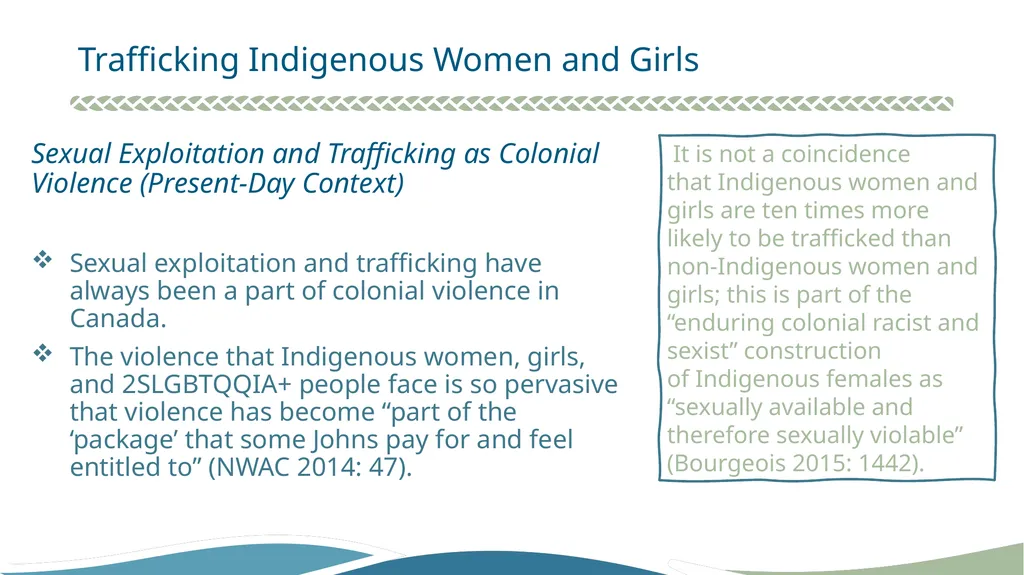
Sexual exploitation and trafficking have always been a part of colonial violence in Canada.
The violence that Indigenous women, girls, and 2SLGBTQQIA+ people face is so pervasive that violence has become “part of the ‘package’ that some Johns pay for and feel entitled to” (NWAC 2014: 47). It is not a coincidence that Indigenous women and girls are ten times more likely to be trafficked than non-Indigenous women and girls; this is part of the “enduring colonial racist and sexist” construction of Indigenous females as “sexually available and therefore sexually violable” (Bourgeois 2015: 1442).<br>
Sexual exploitation and trafficking have always been a part of colonial violence in Canada.
The violence that Indigenous women, girls, and 2SLGBTQQIA+ people face is so pervasive that violence has become “part of the ‘package’ that some Johns pay for and feel entitled to” (NWAC 2014: 47). It is not a coincidence that Indigenous women and girls are ten times more likely to be trafficked than non-Indigenous women and girls; this is part of the “enduring colonial racist and sexist” construction of Indigenous females as “sexually available and therefore sexually violable” (Bourgeois 2015: 1442).<br>
17
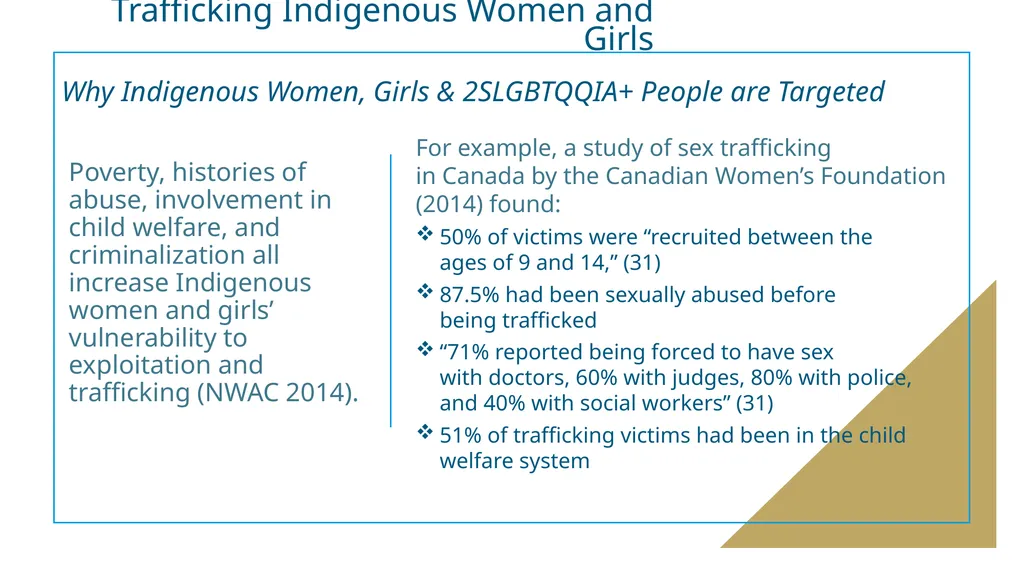
Trafficking Indigenous Women and Girls Poverty, histories of abuse, involvement in child welfare, and criminalization all increase Indigenous women and girls’ vulnerability to exploitation and trafficking (NWAC 2014). For example, a study of sex trafficking in Canada by the Canadian Women’s Foundation (2014) found:
50% of victims were “recruited between the ages of 9 and 14,” (31)
87.5% had been sexually abused before being trafficked
“71% reported being forced to have sex with doctors, 60% with judges, 80% with police, and 40% with social workers” (31)
51% of trafficking victims had been in the child welfare system Why Indigenous Women, Girls & 2SLGBTQQIA+ People are Targeted<br>
50% of victims were “recruited between the ages of 9 and 14,” (31)
87.5% had been sexually abused before being trafficked
“71% reported being forced to have sex with doctors, 60% with judges, 80% with police, and 40% with social workers” (31)
51% of trafficking victims had been in the child welfare system Why Indigenous Women, Girls & 2SLGBTQQIA+ People are Targeted<br>
18
Trafficking Indigenous Women and Girls Why Indigenous Women, Girls & 2SLGBTQQIA People are Targeted
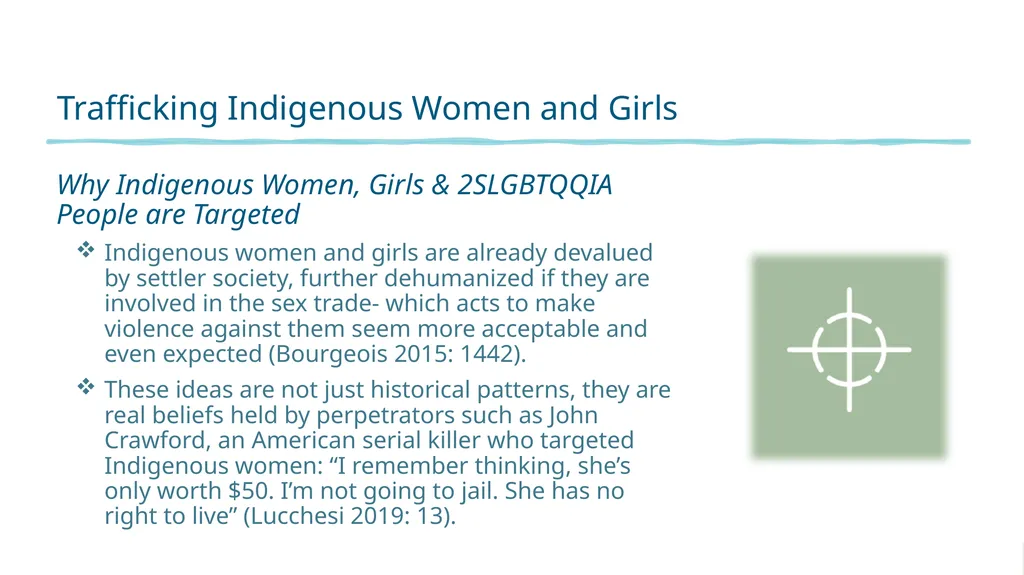
Indigenous women and girls are already devalued by settler society, further dehumanized if they are involved in the sex trade- which acts to make violence against them seem more acceptable and even expected (Bourgeois 2015: 1442).
These ideas are not just historical patterns, they are real beliefs held by perpetrators such as John Crawford, an American serial killer who targeted Indigenous women: “I remember thinking, she’s only worth $50. I’m not going to jail. She has no right to live” (Lucchesi 2019: 13).<br>
Indigenous women and girls are already devalued by settler society, further dehumanized if they are involved in the sex trade- which acts to make violence against them seem more acceptable and even expected (Bourgeois 2015: 1442).
These ideas are not just historical patterns, they are real beliefs held by perpetrators such as John Crawford, an American serial killer who targeted Indigenous women: “I remember thinking, she’s only worth $50. I’m not going to jail. She has no right to live” (Lucchesi 2019: 13).<br>
19
Trafficking Indigenous Women and Girls Victim-Blaming
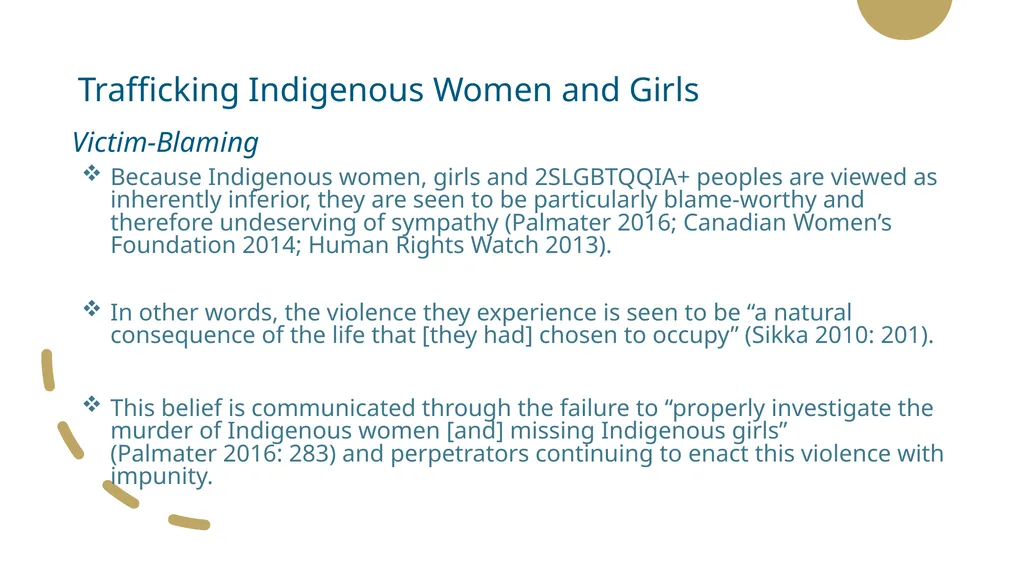
Because Indigenous women, girls and 2SLGBTQQIA+ peoples are viewed as inherently inferior, they are seen to be particularly blame-worthy and therefore undeserving of sympathy (Palmater 2016; Canadian Women’s Foundation 2014; Human Rights Watch 2013).
In other words, the violence they experience is seen to be “a natural consequence of the life that [they had] chosen to occupy” (Sikka 2010: 201).
This belief is communicated through the failure to “properly investigate the murder of Indigenous women [and] missing Indigenous girls” (Palmater 2016: 283) and perpetrators continuing to enact this violence with impunity.<br>
Because Indigenous women, girls and 2SLGBTQQIA+ peoples are viewed as inherently inferior, they are seen to be particularly blame-worthy and therefore undeserving of sympathy (Palmater 2016; Canadian Women’s Foundation 2014; Human Rights Watch 2013).
In other words, the violence they experience is seen to be “a natural consequence of the life that [they had] chosen to occupy” (Sikka 2010: 201).
This belief is communicated through the failure to “properly investigate the murder of Indigenous women [and] missing Indigenous girls” (Palmater 2016: 283) and perpetrators continuing to enact this violence with impunity.<br>
20
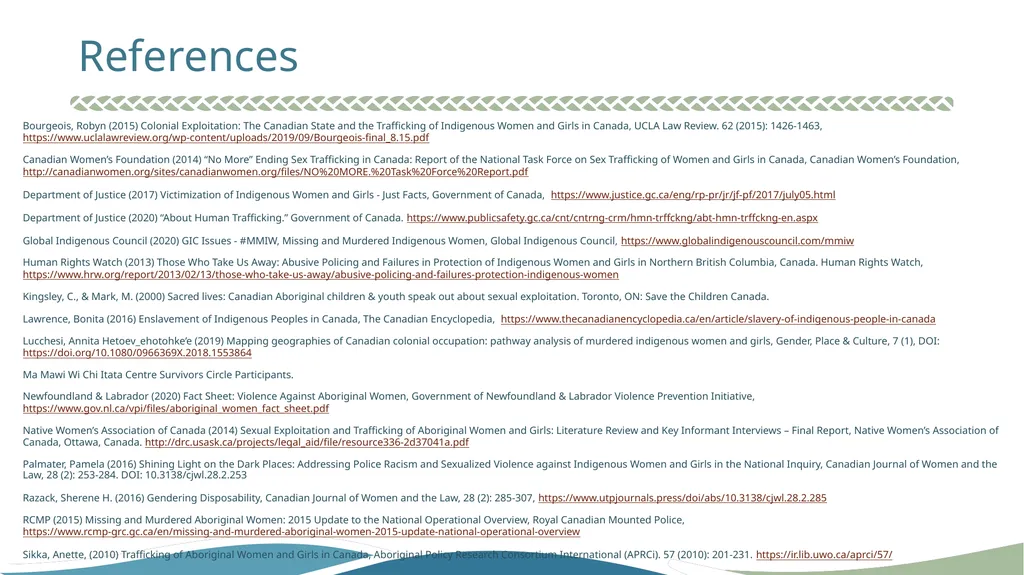
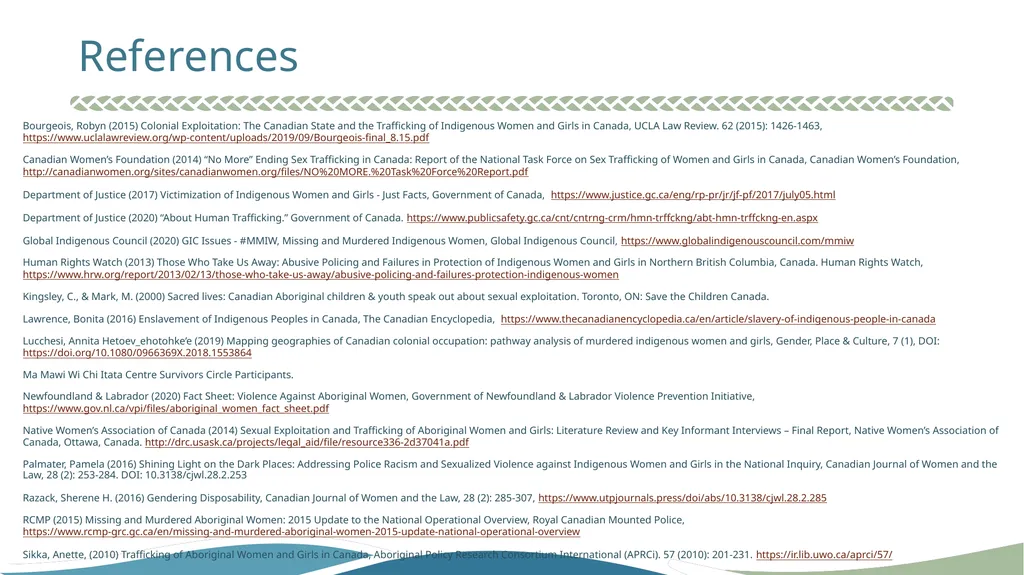
References Bourgeois, Robyn (2015) Colonial Exploitation: The Canadian State and the Trafficking of Indigenous Women and Girls in Canada, UCLA Law Review. 62 (2015): 1426-1463, https://www.uclalawreview.org/wp-content/uploads/2019/09/Bourgeois-final_8.15.pdf
Canadian Women’s Foundation (2014) “No More” Ending Sex Trafficking in Canada: Report of the National Task Force on Sex Trafficking of Women and Girls in Canada, Canadian Women’s Foundation, http://canadianwomen.org/sites/canadianwomen.org/files/NO%20MORE.%20Task%20Force%20Report.pdf
Department of Justice (2017) Victimization of Indigenous Women and Girls - Just Facts, Government of Canada, https://www.justice.gc.ca/eng/rp-pr/jr/jf-pf/2017/july05.html
Department of Justice (2020) “About Human Trafficking.” Government of Canada. https://www.publicsafety.gc.ca/cnt/cntrng-crm/hmn-trffckng/abt-hmn-trffckng-en.aspx
Global Indigenous Council (2020) GIC Issues - #MMIW, Missing and Murdered Indigenous Women, Global Indigenous Council, https://www.globalindigenouscouncil.com/mmiw
Human Rights Watch (2013) Those Who Take Us Away: Abusive Policing and Failures in Protection of Indigenous Women and Girls in Northern British Columbia, Canada. Human Rights Watch, https://www.hrw.org/report/2013/02/13/those-who-take-us-away/abusive-policing-and-failures-protection-indigenous-women
Kingsley, C., & Mark, M. (2000) Sacred lives: Canadian Aboriginal children & youth speak out about sexual exploitation. Toronto, ON: Save the Children Canada.
Lawrence, Bonita (2016) Enslavement of Indigenous Peoples in Canada, The Canadian Encyclopedia, https://www.thecanadianencyclopedia.ca/en/article/slavery-of-indigenous-people-in-canada
Lucchesi, Annita Hetoev_ehotohke’e (2019) Mapping geographies of Canadian colonial occupation: pathway analysis of murdered indigenous women and girls, Gender, Place & Culture, 7 (1), DOI: https://doi.org/10.1080/0966369X.2018.1553864
Ma Mawi Wi Chi Itata Centre Survivors Circle Participants.
Newfoundland & Labrador (2020) Fact Sheet: Violence Against Aboriginal Women, Government of Newfoundland & Labrador Violence Prevention Initiative, https://www.gov.nl.ca/vpi/files/aboriginal_women_fact_sheet.pdf
Native Women’s Association of Canada (2014) Sexual Exploitation and Trafficking of Aboriginal Women and Girls: Literature Review and Key Informant Interviews – Final Report, Native Women’s Association of Canada, Ottawa, Canada. http://drc.usask.ca/projects/legal_aid/file/resource336-2d37041a.pdf
Palmater, Pamela (2016) Shining Light on the Dark Places: Addressing Police Racism and Sexualized Violence against Indigenous Women and Girls in the National Inquiry, Canadian Journal of Women and the Law, 28 (2): 253-284. DOI: 10.3138/cjwl.28.2.253
Razack, Sherene H. (2016) Gendering Disposability, Canadian Journal of Women and the Law, 28 (2): 285-307, https://www.utpjournals.press/doi/abs/10.3138/cjwl.28.2.285
RCMP (2015) Missing and Murdered Aboriginal Women: 2015 Update to the National Operational Overview, Royal Canadian Mounted Police, https://www.rcmp-grc.gc.ca/en/missing-and-murdered-aboriginal-women-2015-update-national-operational-overview
Sikka, Anette, (2010) Trafficking of Aboriginal Women and Girls in Canada, Aboriginal Policy Research Consortium International (APRCi). 57 (2010): 201-231. https://ir.lib.uwo.ca/aprci/57/<br>
Canadian Women’s Foundation (2014) “No More” Ending Sex Trafficking in Canada: Report of the National Task Force on Sex Trafficking of Women and Girls in Canada, Canadian Women’s Foundation, http://canadianwomen.org/sites/canadianwomen.org/files/NO%20MORE.%20Task%20Force%20Report.pdf
Department of Justice (2017) Victimization of Indigenous Women and Girls - Just Facts, Government of Canada, https://www.justice.gc.ca/eng/rp-pr/jr/jf-pf/2017/july05.html
Department of Justice (2020) “About Human Trafficking.” Government of Canada. https://www.publicsafety.gc.ca/cnt/cntrng-crm/hmn-trffckng/abt-hmn-trffckng-en.aspx
Global Indigenous Council (2020) GIC Issues - #MMIW, Missing and Murdered Indigenous Women, Global Indigenous Council, https://www.globalindigenouscouncil.com/mmiw
Human Rights Watch (2013) Those Who Take Us Away: Abusive Policing and Failures in Protection of Indigenous Women and Girls in Northern British Columbia, Canada. Human Rights Watch, https://www.hrw.org/report/2013/02/13/those-who-take-us-away/abusive-policing-and-failures-protection-indigenous-women
Kingsley, C., & Mark, M. (2000) Sacred lives: Canadian Aboriginal children & youth speak out about sexual exploitation. Toronto, ON: Save the Children Canada.
Lawrence, Bonita (2016) Enslavement of Indigenous Peoples in Canada, The Canadian Encyclopedia, https://www.thecanadianencyclopedia.ca/en/article/slavery-of-indigenous-people-in-canada
Lucchesi, Annita Hetoev_ehotohke’e (2019) Mapping geographies of Canadian colonial occupation: pathway analysis of murdered indigenous women and girls, Gender, Place & Culture, 7 (1), DOI: https://doi.org/10.1080/0966369X.2018.1553864
Ma Mawi Wi Chi Itata Centre Survivors Circle Participants.
Newfoundland & Labrador (2020) Fact Sheet: Violence Against Aboriginal Women, Government of Newfoundland & Labrador Violence Prevention Initiative, https://www.gov.nl.ca/vpi/files/aboriginal_women_fact_sheet.pdf
Native Women’s Association of Canada (2014) Sexual Exploitation and Trafficking of Aboriginal Women and Girls: Literature Review and Key Informant Interviews – Final Report, Native Women’s Association of Canada, Ottawa, Canada. http://drc.usask.ca/projects/legal_aid/file/resource336-2d37041a.pdf
Palmater, Pamela (2016) Shining Light on the Dark Places: Addressing Police Racism and Sexualized Violence against Indigenous Women and Girls in the National Inquiry, Canadian Journal of Women and the Law, 28 (2): 253-284. DOI: 10.3138/cjwl.28.2.253
Razack, Sherene H. (2016) Gendering Disposability, Canadian Journal of Women and the Law, 28 (2): 285-307, https://www.utpjournals.press/doi/abs/10.3138/cjwl.28.2.285
RCMP (2015) Missing and Murdered Aboriginal Women: 2015 Update to the National Operational Overview, Royal Canadian Mounted Police, https://www.rcmp-grc.gc.ca/en/missing-and-murdered-aboriginal-women-2015-update-national-operational-overview
Sikka, Anette, (2010) Trafficking of Aboriginal Women and Girls in Canada, Aboriginal Policy Research Consortium International (APRCi). 57 (2010): 201-231. https://ir.lib.uwo.ca/aprci/57/<br>
21
Trafficking Indigenous Women, Girls & 2SLGBTQQIA+ Peoples: Hospitality Industry<br>
22
Trafficking & Hospitality What is the connection, and what can be done?<br>
23
Trafficking & Hospitality How Trafficking and the Hospitality Industry are Connected
Hospitality services provide anonymity, which has only increased with greater reliance on automated services.
Some hotels and motels may be in poorer or ‘red-light’ districts.
Some hospitality operators may turn a blind eye because they make large profits off the hourly rated rooms used by traffickers.
It is important to challenge this apathy. Learning more about trafficking and the roots of violence against Indigenous women, girls, and 2SLGBTQQIA+ can help combat this type of exploitation.<br>
Hospitality services provide anonymity, which has only increased with greater reliance on automated services.
Some hotels and motels may be in poorer or ‘red-light’ districts.
Some hospitality operators may turn a blind eye because they make large profits off the hourly rated rooms used by traffickers.
It is important to challenge this apathy. Learning more about trafficking and the roots of violence against Indigenous women, girls, and 2SLGBTQQIA+ can help combat this type of exploitation.<br>
24
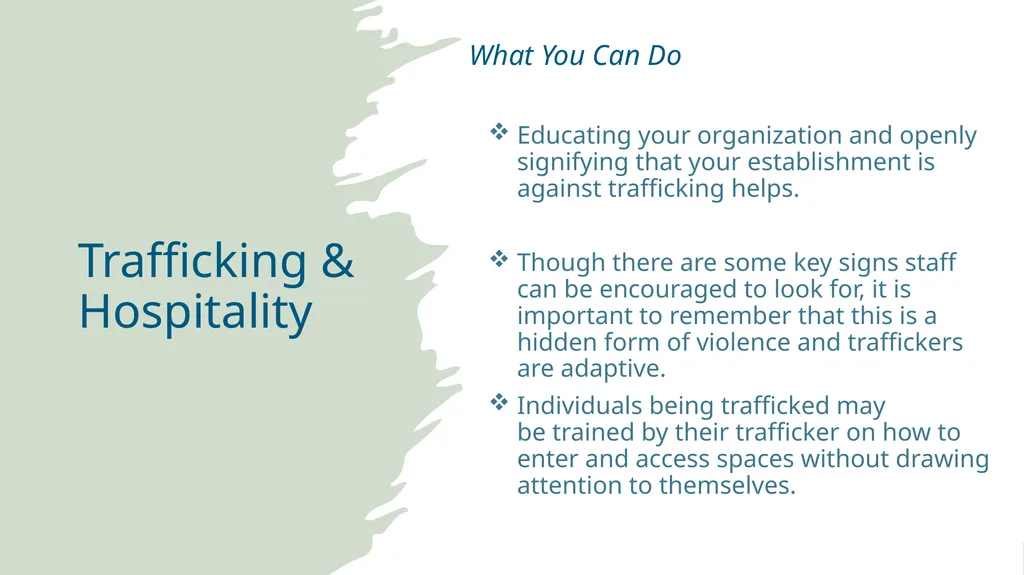
Trafficking & Hospitality What You Can Do
Educating your organization and openly signifying that your establishment is against trafficking helps.
Though there are some key signs staff can be encouraged to look for, it is important to remember that this is a hidden form of violence and traffickers are adaptive.
Individuals being trafficked may be trained by their trafficker on how to enter and access spaces without drawing attention to themselves.<br>
Educating your organization and openly signifying that your establishment is against trafficking helps.
Though there are some key signs staff can be encouraged to look for, it is important to remember that this is a hidden form of violence and traffickers are adaptive.
Individuals being trafficked may be trained by their trafficker on how to enter and access spaces without drawing attention to themselves.<br>
25
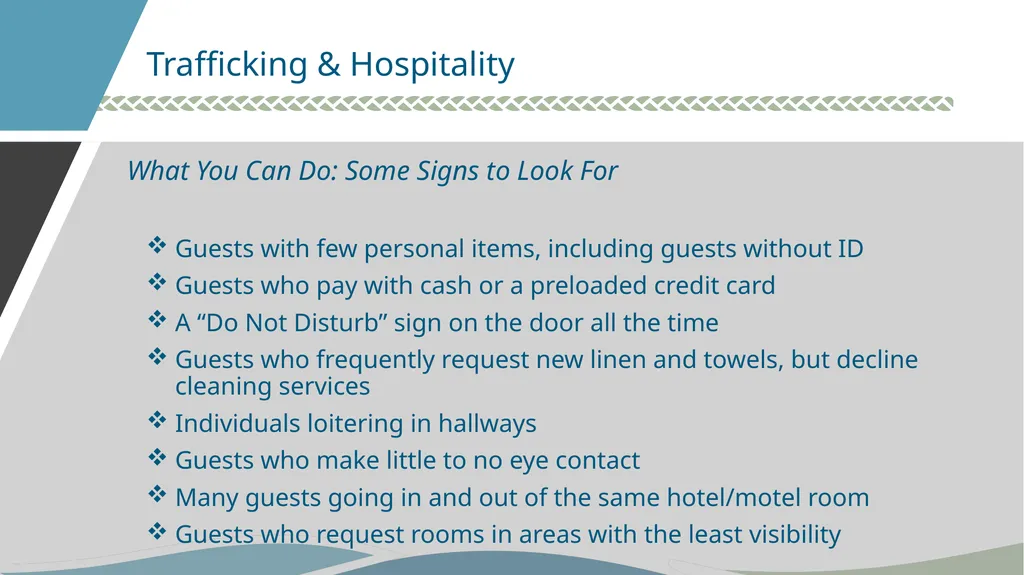
Trafficking & Hospitality What You Can Do: Some Signs to Look For
Guests with few personal items, including guests without ID
Guests who pay with cash or a preloaded credit card
A “Do Not Disturb” sign on the door all the time
Guests who frequently request new linen and towels, but decline cleaning services
Individuals loitering in hallways
Guests who make little to no eye contact
Many guests going in and out of the same hotel/motel room
Guests who request rooms in areas with the least visibility<br>
Guests with few personal items, including guests without ID
Guests who pay with cash or a preloaded credit card
A “Do Not Disturb” sign on the door all the time
Guests who frequently request new linen and towels, but decline cleaning services
Individuals loitering in hallways
Guests who make little to no eye contact
Many guests going in and out of the same hotel/motel room
Guests who request rooms in areas with the least visibility<br>
26
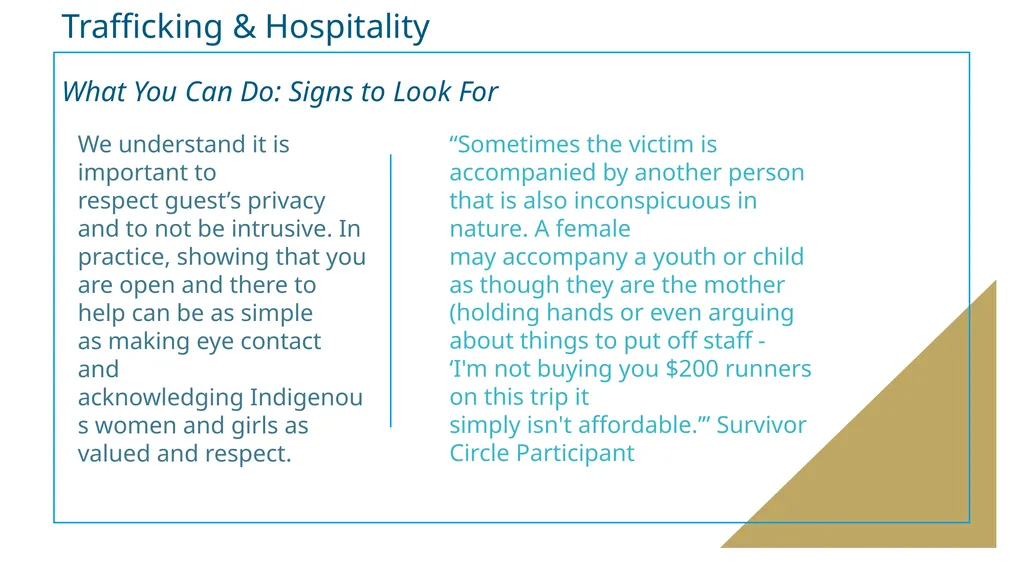
Trafficking & Hospitality What You Can Do: Signs to Look For We understand it is important to respect guest’s privacy and to not be intrusive. In practice, showing that you are open and there to help can be as simple as making eye contact and acknowledging Indigenous women and girls as valued and respect. “Sometimes the victim is accompanied by another person that is also inconspicuous in nature. A female may accompany a youth or child as though they are the mother (holding hands or even arguing about things to put off staff - ‘I'm not buying you $200 runners on this trip it simply isn't affordable.’” Survivor Circle Participant<br>
27
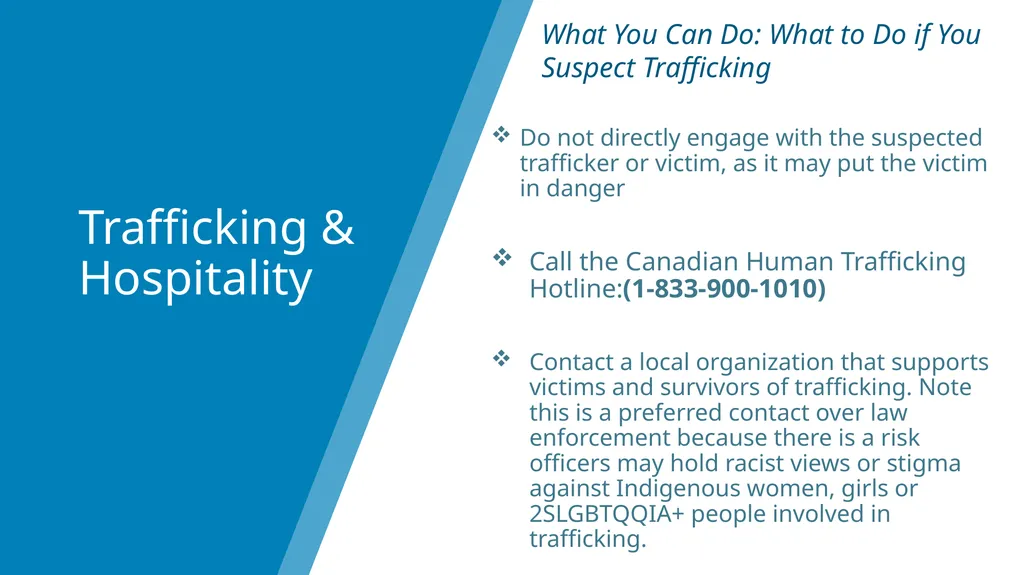
Trafficking & Hospitality Do not directly engage with the suspected trafficker or victim, as it may put the victim in danger
Call the Canadian Human Trafficking Hotline:(1-833-900-1010)
Contact a local organization that supports victims and survivors of trafficking. Note this is a preferred contact over law enforcement because there is a risk officers may hold racist views or stigma against Indigenous women, girls or 2SLGBTQQIA+ people involved in trafficking. What You Can Do: What to Do if You Suspect Trafficking<br>
Call the Canadian Human Trafficking Hotline:(1-833-900-1010)
Contact a local organization that supports victims and survivors of trafficking. Note this is a preferred contact over law enforcement because there is a risk officers may hold racist views or stigma against Indigenous women, girls or 2SLGBTQQIA+ people involved in trafficking. What You Can Do: What to Do if You Suspect Trafficking<br>
28
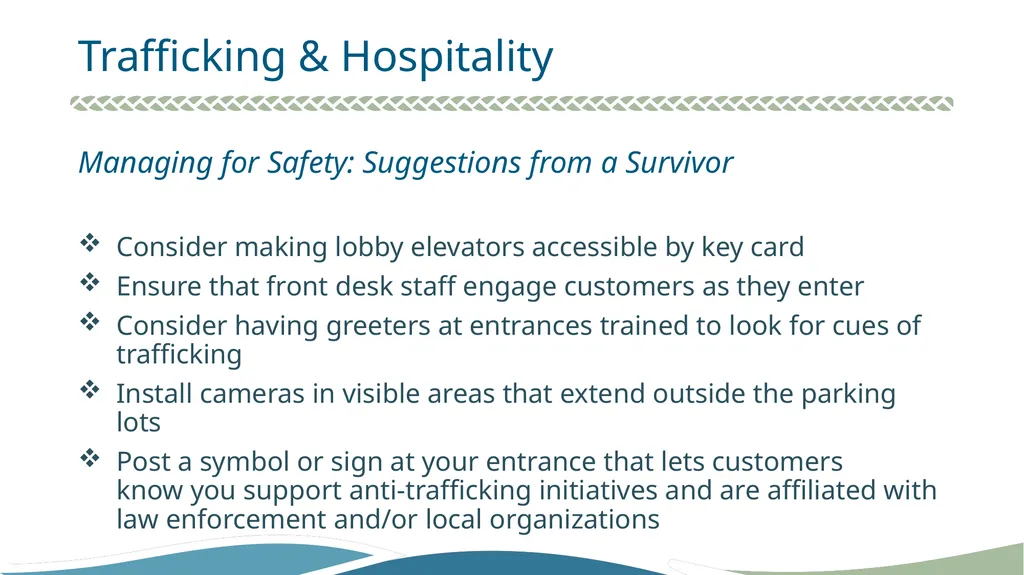
Trafficking & Hospitality Managing for Safety: Suggestions from a Survivor
Consider making lobby elevators accessible by key card
Ensure that front desk staff engage customers as they enter
Consider having greeters at entrances trained to look for cues of trafficking
Install cameras in visible areas that extend outside the parking lots
Post a symbol or sign at your entrance that lets customers know you support anti-trafficking initiatives and are affiliated with law enforcement and/or local organizations<br>
Consider making lobby elevators accessible by key card
Ensure that front desk staff engage customers as they enter
Consider having greeters at entrances trained to look for cues of trafficking
Install cameras in visible areas that extend outside the parking lots
Post a symbol or sign at your entrance that lets customers know you support anti-trafficking initiatives and are affiliated with law enforcement and/or local organizations<br>
29
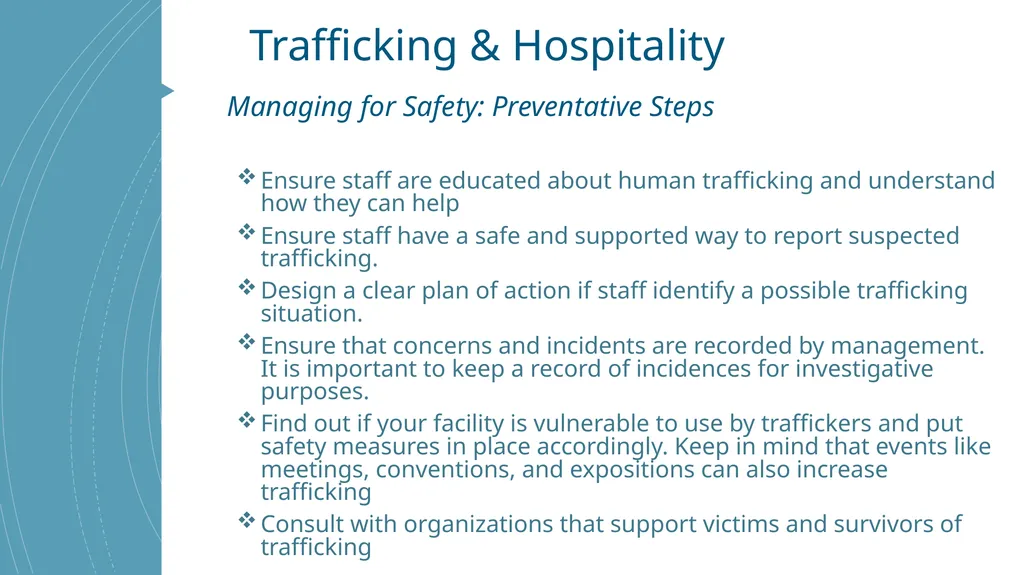
Trafficking & Hospitality Managing for Safety: Preventative Steps
Ensure staff are educated about human trafficking and understand how they can help
Ensure staff have a safe and supported way to report suspected trafficking.
Design a clear plan of action if staff identify a possible trafficking situation.
Ensure that concerns and incidents are recorded by management. It is important to keep a record of incidences for investigative purposes.
Find out if your facility is vulnerable to use by traffickers and put safety measures in place accordingly. Keep in mind that events like meetings, conventions, and expositions can also increase trafficking
Consult with organizations that support victims and survivors of trafficking<br>
Ensure staff are educated about human trafficking and understand how they can help
Ensure staff have a safe and supported way to report suspected trafficking.
Design a clear plan of action if staff identify a possible trafficking situation.
Ensure that concerns and incidents are recorded by management. It is important to keep a record of incidences for investigative purposes.
Find out if your facility is vulnerable to use by traffickers and put safety measures in place accordingly. Keep in mind that events like meetings, conventions, and expositions can also increase trafficking
Consult with organizations that support victims and survivors of trafficking<br>
30
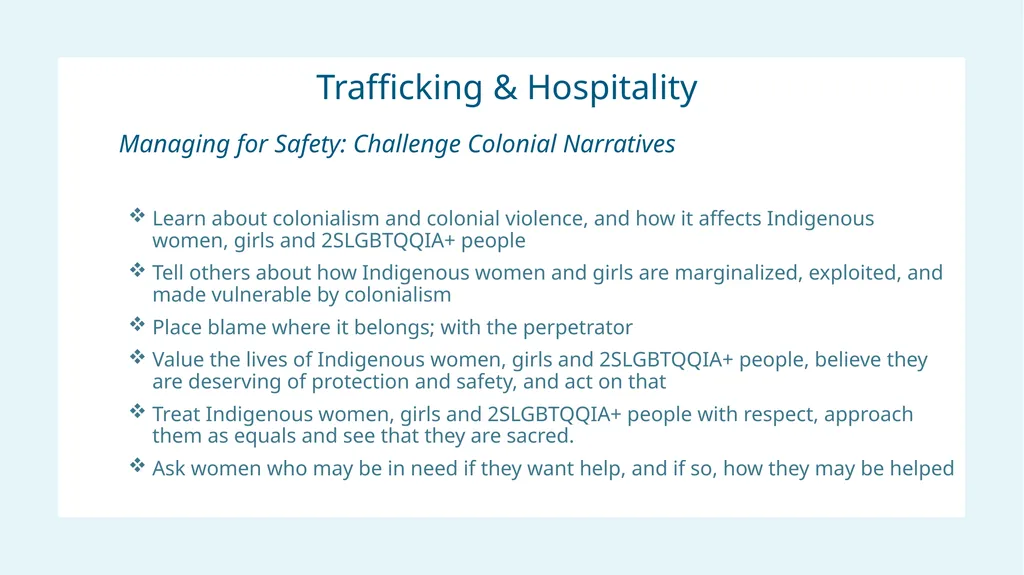
Trafficking & Hospitality Managing for Safety: Challenge Colonial Narratives
Learn about colonialism and colonial violence, and how it affects Indigenous women, girls and 2SLGBTQQIA+ people
Tell others about how Indigenous women and girls are marginalized, exploited, and made vulnerable by colonialism
Place blame where it belongs; with the perpetrator
Value the lives of Indigenous women, girls and 2SLGBTQQIA+ people, believe they are deserving of protection and safety, and act on that
Treat Indigenous women, girls and 2SLGBTQQIA+ people with respect, approach them as equals and see that they are sacred.
Ask women who may be in need if they want help, and if so, how they may be helped<br>
Learn about colonialism and colonial violence, and how it affects Indigenous women, girls and 2SLGBTQQIA+ people
Tell others about how Indigenous women and girls are marginalized, exploited, and made vulnerable by colonialism
Place blame where it belongs; with the perpetrator
Value the lives of Indigenous women, girls and 2SLGBTQQIA+ people, believe they are deserving of protection and safety, and act on that
Treat Indigenous women, girls and 2SLGBTQQIA+ people with respect, approach them as equals and see that they are sacred.
Ask women who may be in need if they want help, and if so, how they may be helped<br>
31
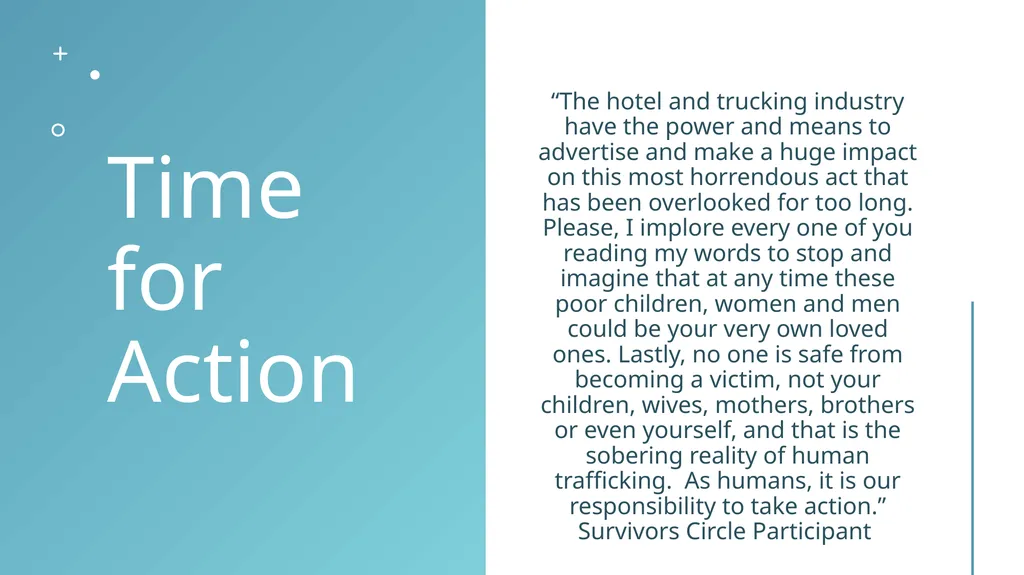
Time for Action “The hotel and trucking industry have the power and means to advertise and make a huge impact on this most horrendous act that has been overlooked for too long. Please, I implore every one of you reading my words to stop and imagine that at any time these poor children, women and men could be your very own loved ones. Lastly, no one is safe from becoming a victim, not your children, wives, mothers, brothers or even yourself, and that is the sobering reality of human trafficking. As humans, it is our responsibility to take action.” Survivors Circle Participant<br>
32
References Bourgeois, Robyn (2015) Colonial Exploitation: The Canadian State and the Trafficking of Indigenous Women and Girls in Canada, UCLA Law Review. 62 (2015): 1426-1463, https://www.uclalawreview.org/wp-content/uploads/2019/09/Bourgeois-final_8.15.pdf
Canadian Women’s Foundation (2014) “No More” Ending Sex Trafficking in Canada: Report of the National Task Force on Sex Trafficking of Women and Girls in Canada, Canadian Women’s Foundation, http://canadianwomen.org/sites/canadianwomen.org/files/NO%20MORE.%20Task%20Force%20Report.pdf
Department of Justice (2017) Victimization of Indigenous Women and Girls - Just Facts, Government of Canada, https://www.justice.gc.ca/eng/rp-pr/jr/jf-pf/2017/july05.html
Department of Justice (2020) “About Human Trafficking.” Government of Canada. https://www.publicsafety.gc.ca/cnt/cntrng-crm/hmn-trffckng/abt-hmn-trffckng-en.aspx
Global Indigenous Council (2020) GIC Issues - #MMIW, Missing and Murdered Indigenous Women, Global Indigenous Council, https://www.globalindigenouscouncil.com/mmiw
Human Rights Watch (2013) Those Who Take Us Away: Abusive Policing and Failures in Protection of Indigenous Women and Girls in Northern British Columbia, Canada. Human Rights Watch, https://www.hrw.org/report/2013/02/13/those-who-take-us-away/abusive-policing-and-failures-protection-indigenous-women
Kingsley, C., & Mark, M. (2000) Sacred lives: Canadian Aboriginal children & youth speak out about sexual exploitation. Toronto, ON: Save the Children Canada.
Lawrence, Bonita (2016) Enslavement of Indigenous Peoples in Canada, The Canadian Encyclopedia, https://www.thecanadianencyclopedia.ca/en/article/slavery-of-indigenous-people-in-canada
Lucchesi, Annita Hetoev_ehotohke’e (2019) Mapping geographies of Canadian colonial occupation: pathway analysis of murdered indigenous women and girls, Gender, Place & Culture, 7 (1), DOI: https://doi.org/10.1080/0966369X.2018.1553864
Ma Mawi Wi Chi Itata Centre Survivors Circle Participants.
Newfoundland & Labrador (2020) Fact Sheet: Violence Against Aboriginal Women, Government of Newfoundland & Labrador Violence Prevention Initiative, https://www.gov.nl.ca/vpi/files/aboriginal_women_fact_sheet.pdf
Native Women’s Association of Canada (2014) Sexual Exploitation and Trafficking of Aboriginal Women and Girls: Literature Review and Key Informant Interviews – Final Report, Native Women’s Association of Canada, Ottawa, Canada. http://drc.usask.ca/projects/legal_aid/file/resource336-2d37041a.pdf
Palmater, Pamela (2016) Shining Light on the Dark Places: Addressing Police Racism and Sexualized Violence against Indigenous Women and Girls in the National Inquiry, Canadian Journal of Women and the Law, 28 (2): 253-284. DOI: 10.3138/cjwl.28.2.253
Razack, Sherene H. (2016) Gendering Disposability, Canadian Journal of Women and the Law, 28 (2): 285-307, https://www.utpjournals.press/doi/abs/10.3138/cjwl.28.2.285
RCMP (2015) Missing and Murdered Aboriginal Women: 2015 Update to the National Operational Overview, Royal Canadian Mounted Police, https://www.rcmp-grc.gc.ca/en/missing-and-murdered-aboriginal-women-2015-update-national-operational-overview
Sikka, Anette, (2010) Trafficking of Aboriginal Women and Girls in Canada, Aboriginal Policy Research Consortium International (APRCi). 57 (2010): 201-231. https://ir.lib.uwo.ca/aprci/57/<br>
Canadian Women’s Foundation (2014) “No More” Ending Sex Trafficking in Canada: Report of the National Task Force on Sex Trafficking of Women and Girls in Canada, Canadian Women’s Foundation, http://canadianwomen.org/sites/canadianwomen.org/files/NO%20MORE.%20Task%20Force%20Report.pdf
Department of Justice (2017) Victimization of Indigenous Women and Girls - Just Facts, Government of Canada, https://www.justice.gc.ca/eng/rp-pr/jr/jf-pf/2017/july05.html
Department of Justice (2020) “About Human Trafficking.” Government of Canada. https://www.publicsafety.gc.ca/cnt/cntrng-crm/hmn-trffckng/abt-hmn-trffckng-en.aspx
Global Indigenous Council (2020) GIC Issues - #MMIW, Missing and Murdered Indigenous Women, Global Indigenous Council, https://www.globalindigenouscouncil.com/mmiw
Human Rights Watch (2013) Those Who Take Us Away: Abusive Policing and Failures in Protection of Indigenous Women and Girls in Northern British Columbia, Canada. Human Rights Watch, https://www.hrw.org/report/2013/02/13/those-who-take-us-away/abusive-policing-and-failures-protection-indigenous-women
Kingsley, C., & Mark, M. (2000) Sacred lives: Canadian Aboriginal children & youth speak out about sexual exploitation. Toronto, ON: Save the Children Canada.
Lawrence, Bonita (2016) Enslavement of Indigenous Peoples in Canada, The Canadian Encyclopedia, https://www.thecanadianencyclopedia.ca/en/article/slavery-of-indigenous-people-in-canada
Lucchesi, Annita Hetoev_ehotohke’e (2019) Mapping geographies of Canadian colonial occupation: pathway analysis of murdered indigenous women and girls, Gender, Place & Culture, 7 (1), DOI: https://doi.org/10.1080/0966369X.2018.1553864
Ma Mawi Wi Chi Itata Centre Survivors Circle Participants.
Newfoundland & Labrador (2020) Fact Sheet: Violence Against Aboriginal Women, Government of Newfoundland & Labrador Violence Prevention Initiative, https://www.gov.nl.ca/vpi/files/aboriginal_women_fact_sheet.pdf
Native Women’s Association of Canada (2014) Sexual Exploitation and Trafficking of Aboriginal Women and Girls: Literature Review and Key Informant Interviews – Final Report, Native Women’s Association of Canada, Ottawa, Canada. http://drc.usask.ca/projects/legal_aid/file/resource336-2d37041a.pdf
Palmater, Pamela (2016) Shining Light on the Dark Places: Addressing Police Racism and Sexualized Violence against Indigenous Women and Girls in the National Inquiry, Canadian Journal of Women and the Law, 28 (2): 253-284. DOI: 10.3138/cjwl.28.2.253
Razack, Sherene H. (2016) Gendering Disposability, Canadian Journal of Women and the Law, 28 (2): 285-307, https://www.utpjournals.press/doi/abs/10.3138/cjwl.28.2.285
RCMP (2015) Missing and Murdered Aboriginal Women: 2015 Update to the National Operational Overview, Royal Canadian Mounted Police, https://www.rcmp-grc.gc.ca/en/missing-and-murdered-aboriginal-women-2015-update-national-operational-overview
Sikka, Anette, (2010) Trafficking of Aboriginal Women and Girls in Canada, Aboriginal Policy Research Consortium International (APRCi). 57 (2010): 201-231. https://ir.lib.uwo.ca/aprci/57/<br>