
Virginia Syndromic surveillance Advisory Group
MJ
Published · 31 slides · 0 views

1 / 1




Description
Virginia Syndromic surveillance Advisory Group Fourth Meeting September 11, 2018 1 Agenda Introductions Background Syndromic Surveillance VSSAG Update on current syndromic projects Data Quality Reports Hurricane Florence Influenza Opioid
Related Topics
Share
Embed code
Download this presentation From Below
"Virginia Syndromic surveillance Advisory Group" is the property of its rightful owner. Permission is granted to download and print the materials on this website for personal, non-commercial use only, and to display it on your personal computer provided you do not modify the materials and that you retain all copyright notices contained in the materials. By downloading content from our website, you accept the terms of this agreement.
Presentation Transcript
01
Virginia Syndromic surveillance Advisory Group Fourth Meeting
September 11, 2018 1<br>
September 11, 2018 1<br>
02
Agenda Introductions
Background
Syndromic Surveillance
VSSAG
Update on current syndromic projects
Data Quality Reports
Hurricane Florence
Influenza
Opioid Overdose
Department of Defense (DoD) data sharing pilot
Rural Health Network data sharing pilot?
Request for (non-VDH) VSSAG pilot users of NSSP ESSENCE
Next Call 2<br>
Background
Syndromic Surveillance
VSSAG
Update on current syndromic projects
Data Quality Reports
Hurricane Florence
Influenza
Opioid Overdose
Department of Defense (DoD) data sharing pilot
Rural Health Network data sharing pilot?
Request for (non-VDH) VSSAG pilot users of NSSP ESSENCE
Next Call 2<br>
03
Introductions Arden Norfleet
Enhanced Surveillance Epidemiologist
Arden.Norfleet@vdh.virginia.gov
804-864-7264
Erin Austin
Enhanced Surveillance Coordinator
Erin.Austin@vdh.virginia.gov
804-864-7548
Em Stephens
Influenza Surveillance Coordinator
Emily.Stephens@vdh.virginia.gov
804-864-7254 3<br>
Enhanced Surveillance Epidemiologist
Arden.Norfleet@vdh.virginia.gov
804-864-7264
Erin Austin
Enhanced Surveillance Coordinator
Erin.Austin@vdh.virginia.gov
804-864-7548
Em Stephens
Influenza Surveillance Coordinator
Emily.Stephens@vdh.virginia.gov
804-864-7254 3<br>
04
Background - Syndromic Surveillance Syndromic surveillance data include visits to emergency departments (EDs) and urgent care centers (UCCs)
Purpose: Improve health of a community through early detection of a public health issue
VDH epidemiologists and communicable disease staff use these data to:
Conduct epidemiologic analyses using ESSENCE tool
Monitor trends over time and geography, identify clusters in symptoms or diagnoses, and detect unusual health events 4<br>
Purpose: Improve health of a community through early detection of a public health issue
VDH epidemiologists and communicable disease staff use these data to:
Conduct epidemiologic analyses using ESSENCE tool
Monitor trends over time and geography, identify clusters in symptoms or diagnoses, and detect unusual health events 4<br>
05
How are Syndromic Surveillance Data Used? Influenza-like illness (ILI) and other seasonal illnesses
Weather-related or natural disaster events (hurricane, heat wave, earthquake)
Mass-gathering events (UCI Cycling World Championships, Presidential Inauguration, Vice Presidential Debate, Unite the Right Rally)
Conditions of public health concern (animal bites, drug overdose, injuries, meningitis, Lyme disease, vaccine preventable diseases)
Emerging health concerns (Zika virus) and outbreaks 5<br>
Weather-related or natural disaster events (hurricane, heat wave, earthquake)
Mass-gathering events (UCI Cycling World Championships, Presidential Inauguration, Vice Presidential Debate, Unite the Right Rally)
Conditions of public health concern (animal bites, drug overdose, injuries, meningitis, Lyme disease, vaccine preventable diseases)
Emerging health concerns (Zika virus) and outbreaks 5<br>
06
What Data are Collected? Facility Name
Visit Information:
Chief Complaint
Discharge Diagnosis
Discharge Disposition
Patient Demographics:
Date of Birth
Sex
Race and Ethnicity
Home Zip Code
Facility-specific patient identifier (often MRN)
Does NOT include direct patient identifiers such as patient name, SSN, or street level address 6<br>
Visit Information:
Chief Complaint
Discharge Diagnosis
Discharge Disposition
Patient Demographics:
Date of Birth
Sex
Race and Ethnicity
Home Zip Code
Facility-specific patient identifier (often MRN)
Does NOT include direct patient identifiers such as patient name, SSN, or street level address 6<br>
07
Strengths and Limitations Strengths:
Data available in near real-time (within 24 hours)
Situational awareness of population health status
Surveillance for a variety of public health issues
Limitations:
Difficulty detecting small scale events – “strength in numbers”
Lack of specificity in early health data
No regulations requiring reporting in VA, but federal incentive programs exist
Proposal submitted w/in VDH 7<br>
Data available in near real-time (within 24 hours)
Situational awareness of population health status
Surveillance for a variety of public health issues
Limitations:
Difficulty detecting small scale events – “strength in numbers”
Lack of specificity in early health data
No regulations requiring reporting in VA, but federal incentive programs exist
Proposal submitted w/in VDH 7<br>
08
Syndromic Surveillance and the CDC CDC created the National Syndromic Surveillance Program (NSSP) to improve nationwide situational awareness using syndromic surveillance
Provide a cloud-based BioSense Platform, contains nationwide syndromic surveillance data and several analysis tools including ESSENCE
VDH participates in sending these data to NSSP
NSSP BioSense Platform exists outside the VDH firewall –> opportunity for data sharing with non-VDH partners 8<br>
Provide a cloud-based BioSense Platform, contains nationwide syndromic surveillance data and several analysis tools including ESSENCE
VDH participates in sending these data to NSSP
NSSP BioSense Platform exists outside the VDH firewall –> opportunity for data sharing with non-VDH partners 8<br>
09
Background - VSSAG Virginia Syndromic Surveillance Advisory Group (VSSAG)
Formed in 2017
Membership includes:
public health
state and federal partners
healthcare associations
academic stakeholders
healthcare facilities
Website: http://www.vdh.virginia.gov/surveillance-and-investigation/syndromic-surveillance/vssag/ 9<br>
Formed in 2017
Membership includes:
public health
state and federal partners
healthcare associations
academic stakeholders
healthcare facilities
Website: http://www.vdh.virginia.gov/surveillance-and-investigation/syndromic-surveillance/vssag/ 9<br>
10
Why was VSSAG formed? VSSAG Goal:
Increase the understanding and utilization of syndromic surveillance data among public health and healthcare partners for situational awareness of issues affecting public health and to inform their business practices. 10<br>
Increase the understanding and utilization of syndromic surveillance data among public health and healthcare partners for situational awareness of issues affecting public health and to inform their business practices. 10<br>
11
VSSAG Objectives Convene at a minimum two (2) meetings annually to facilitate information sharing and collaboration among public health and healthcare partners.
Maintain working group membership which will consist of public health, healthcare, and health data partners who could benefit from syndromic surveillance data sharing.
Define best practices and methodologies for syndromic surveillance data sharing with public health and healthcare partners by VDH.
Improve knowledge of syndromic surveillance among working group members through trainings and use cases.
Provide access to syndromic surveillance data to appropriate working group members through the National Syndromic Surveillance Platform (NSSP) ESSENCE.
Empower working group members to use syndromic surveillance data in their business practice as a situational awareness tool.
Obtain feedback from working group members on the utility and ease of use of syndromic surveillance data and reports provided by VDH.
Evaluate the success of increasing knowledge and use of syndromic surveillance data within the working group. 11<br>
Maintain working group membership which will consist of public health, healthcare, and health data partners who could benefit from syndromic surveillance data sharing.
Define best practices and methodologies for syndromic surveillance data sharing with public health and healthcare partners by VDH.
Improve knowledge of syndromic surveillance among working group members through trainings and use cases.
Provide access to syndromic surveillance data to appropriate working group members through the National Syndromic Surveillance Platform (NSSP) ESSENCE.
Empower working group members to use syndromic surveillance data in their business practice as a situational awareness tool.
Obtain feedback from working group members on the utility and ease of use of syndromic surveillance data and reports provided by VDH.
Evaluate the success of increasing knowledge and use of syndromic surveillance data within the working group. 11<br>
12
Syndromic surveillance
Project Updates 12<br>
13
Project #1 - Data Quality Reports Specific to each healthcare system
To be provided semi-annually
Quarterly visit counts for each facility
Summary Data Quality Measures:
Completeness
Validity
Timeliness 13<br>
To be provided semi-annually
Quarterly visit counts for each facility
Summary Data Quality Measures:
Completeness
Validity
Timeliness 13<br>
14
Project #1 - Data Quality Reports 14<br>
15
Project #2 – Hurricane Florence Prep Provide situational awareness during emergencies
Use storm-specific dashboards and queries in ESSENCE
Assess impact of storm conditions, resulting power loss, and evacuations 15<br>
Use storm-specific dashboards and queries in ESSENCE
Assess impact of storm conditions, resulting power loss, and evacuations 15<br>
16
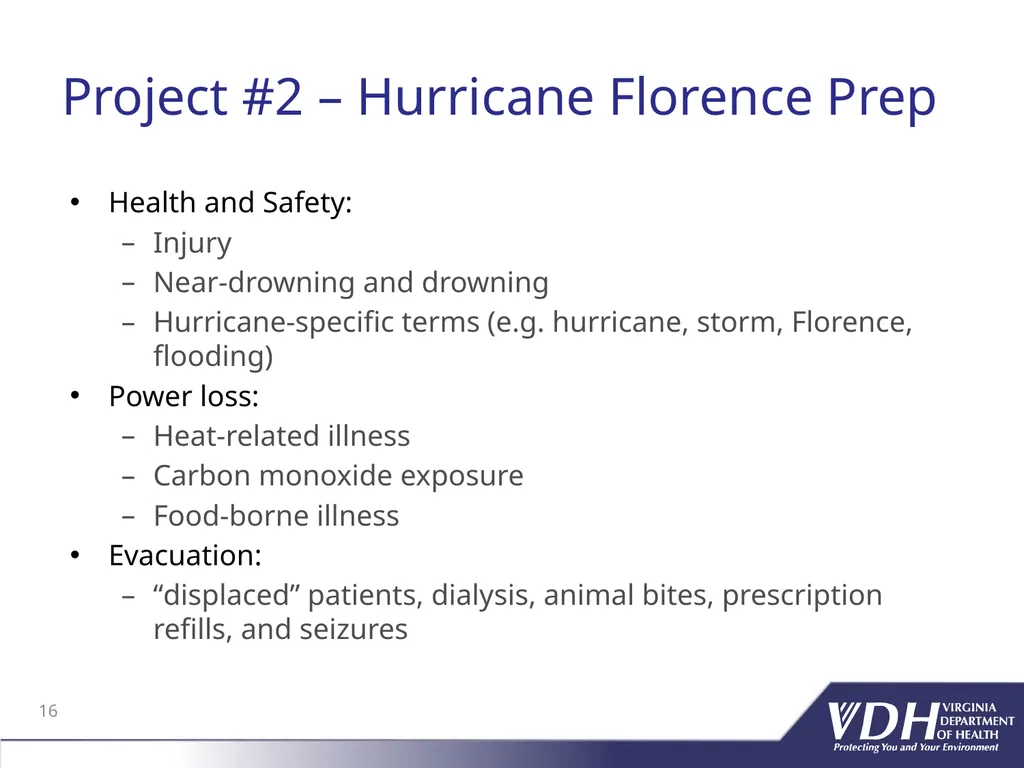
Project #2 – Hurricane Florence Prep Health and Safety:
Injury
Near-drowning and drowning
Hurricane-specific terms (e.g. hurricane, storm, Florence, flooding)
Power loss:
Heat-related illness
Carbon monoxide exposure
Food-borne illness
Evacuation:
“displaced” patients, dialysis, animal bites, prescription refills, and seizures 16<br>
Injury
Near-drowning and drowning
Hurricane-specific terms (e.g. hurricane, storm, Florence, flooding)
Power loss:
Heat-related illness
Carbon monoxide exposure
Food-borne illness
Evacuation:
“displaced” patients, dialysis, animal bites, prescription refills, and seizures 16<br>
17
Project #3 – Influenza Surveillance Syndromic surveillance used to determine burden of influenza-like illness (ILI) during flu season
ILI defined as chief complaint containing fever with either cough or sore throat
Presented as a percentage of total visits
Statewide coverage allows for situational awareness across the state and among age groups
ILI is used in combination with other data sources to determine weekly influenza activity level
Helps determine geographic spread 17<br>
ILI defined as chief complaint containing fever with either cough or sore throat
Presented as a percentage of total visits
Statewide coverage allows for situational awareness across the state and among age groups
ILI is used in combination with other data sources to determine weekly influenza activity level
Helps determine geographic spread 17<br>
18
Project #3 – Influenza Surveillance 18<br>
19
Project #3 – Influenza Surveillance 19<br>
20
Project #4 – Opioid Overdose Report posted monthly to VDH website:
http://www.vdh.virginia.gov/surveillance-and-investigation/syndromic-surveillance/drug-overdose-surveillance/ 20<br>
http://www.vdh.virginia.gov/surveillance-and-investigation/syndromic-surveillance/drug-overdose-surveillance/ 20<br>
21
Project #4 – Opioid Overdose Syndromic surveillance data included in VDH Opioid Addiction Dashboard: http://www.vdh.virginia.gov/data/opioid-overdose/ 21<br>
22
Project #4 – Opioid Overdose VDH syndromic surveillance data sent to CDC to inform national picture: https://www.cdc.gov/drugoverdose/data/nonfatal.html 22<br>
23
Project #5 – DoD Data Sharing Pilot Department of Defense (DoD) and VDH
Aggregate level data sharing via NSSP ESSENCE
Objectives:
More comprehensive view of medical care visits in Virginia among military and civilian populations
Increase communication between DoD public health officials and VDH local health dept
Develop procedures for data sharing, data access & communication 23<br>
Aggregate level data sharing via NSSP ESSENCE
Objectives:
More comprehensive view of medical care visits in Virginia among military and civilian populations
Increase communication between DoD public health officials and VDH local health dept
Develop procedures for data sharing, data access & communication 23<br>
24
Project #5 – DoD Data Sharing Pilot 18 DoD medical facilities participating
Visits include active duty and beneficiaries
7 VDH Local Health Districts (34 facilities):
Chesapeake
Hampton
Norfolk
Peninsula (contains Newport News)
Portsmouth
Prince William (contains Quantico)
Virginia Beach 24<br>
Visits include active duty and beneficiaries
7 VDH Local Health Districts (34 facilities):
Chesapeake
Hampton
Norfolk
Peninsula (contains Newport News)
Portsmouth
Prince William (contains Quantico)
Virginia Beach 24<br>
25
Project #5 – DoD Data Sharing Pilot Currently:
Notifying healthcare facilities in pilot area
Establishing communication protocol
Next steps:
Begin data sharing (late Sept)
2 month pilot - regular weekly communication b/w VDH local epis and DoD contacts
Assess challenges and lessons learned
Expand to rest of state and nationally? 25<br>
Notifying healthcare facilities in pilot area
Establishing communication protocol
Next steps:
Begin data sharing (late Sept)
2 month pilot - regular weekly communication b/w VDH local epis and DoD contacts
Assess challenges and lessons learned
Expand to rest of state and nationally? 25<br>
26
Project #6 – Rural Health Network Preliminary discussions around a second data sharing project through the NSSP
Virginia Rural Health Association (VRHA)
Rural Health Network Development Planning Program grant opportunity through Health Resources and Services Administration (HRSA)
Aim to strengthen rural health care network among Virginia’s critical access hospitals 26<br>
Virginia Rural Health Association (VRHA)
Rural Health Network Development Planning Program grant opportunity through Health Resources and Services Administration (HRSA)
Aim to strengthen rural health care network among Virginia’s critical access hospitals 26<br>
27
Volunteer time! 27<br>
28
Request for VSSAG NSSP Pilot Users Objectives
Grant NSSP data access to pilot VSSAG members
Use syndromic data to inform action within organization
Help VDH finalize the NSSP Virginia User Policy (data usage expectations and data access levels)
Assess successes, challenges, and lessons learned
Looking for VSSAG pilot users to be given NSSP access
1 health care facility user
1 non-healthcare facility user 28<br>
Grant NSSP data access to pilot VSSAG members
Use syndromic data to inform action within organization
Help VDH finalize the NSSP Virginia User Policy (data usage expectations and data access levels)
Assess successes, challenges, and lessons learned
Looking for VSSAG pilot users to be given NSSP access
1 health care facility user
1 non-healthcare facility user 28<br>
29
Request for VSSAG NSSP Pilot Users Expectations
Data access for 1 month (beginning mid-Oct)
Receive NSSP ESSENCE training
Perform surveillance and communication w/in organization (multiple times a week)
ILI surveillance?
Summarize uses, challenges, and lessons learned 29<br>
Data access for 1 month (beginning mid-Oct)
Receive NSSP ESSENCE training
Perform surveillance and communication w/in organization (multiple times a week)
ILI surveillance?
Summarize uses, challenges, and lessons learned 29<br>
30
Next VSSAG Meeting 5th VSSAG meeting: early December
DoD and VSSAG data sharing pilots:
Successes
Challenges
Recommendations for future data sharing
Finalize NSSP user roles and data access rules 30<br>
DoD and VSSAG data sharing pilots:
Successes
Challenges
Recommendations for future data sharing
Finalize NSSP user roles and data access rules 30<br>
31
Questions? Feel free to send questions to the VDH Enhanced Surveillance team at syndromic@vdh.virginia.gov 31<br>