
Virginia Woolf Adeline Virginia Woolf 1882 –1941)
PC
Published · 10 slides · 0 views

1 / 1
Description
Virginia Woolf Adeline Virginia Woolf 1882 1941) was an English writer, who is considered one of the foremost modernist authors of the 20th century and a pioneer in the use of stream of consciousness as a narrative device. . Having been
Related Topics
Share
Embed code
Download this presentation From Below
"Virginia Woolf Adeline Virginia Woolf 1882 –1941)" is the property of its rightful owner. Permission is granted to download and print the materials on this website for personal, non-commercial use only, and to display it on your personal computer provided you do not modify the materials and that you retain all copyright notices contained in the materials. By downloading content from our website, you accept the terms of this agreement.
Presentation Transcript
01
Virginia Woolf Adeline Virginia Woolf 1882 –1941) was an English writer, who is considered one of the foremost modernist authors of the 20th century and a pioneer in the use of stream of consciousness as a narrative device.
. Having been home-schooled for the most part of her childhood, mostly in English classics and Victorian literature, Woolf began writing professionally in 1900.
. Woolf became one of the central subjects of the 1970s movement of feminist criticism, and her works have since garnered much attention and widespread commentary for "inspiring feminism“.
. Her works are widely read all over the world and have been translated into more than fifty languages. She suffered from severe bouts of mental illness throughout her life and took her own life by drowning in 1941 at the age of 59.<br>
. Having been home-schooled for the most part of her childhood, mostly in English classics and Victorian literature, Woolf began writing professionally in 1900.
. Woolf became one of the central subjects of the 1970s movement of feminist criticism, and her works have since garnered much attention and widespread commentary for "inspiring feminism“.
. Her works are widely read all over the world and have been translated into more than fifty languages. She suffered from severe bouts of mental illness throughout her life and took her own life by drowning in 1941 at the age of 59.<br>
02
Virginia Woolf In the late nineteenth century, education was sharply divided along gender lines. Boys were sent to school, and in upper middle class families such as the Stephens, this involved private boys schools, often boarding schools, and university.[49][50][51] Girls, if they were afforded the luxury of education, received it from their parents, governesses and tutors.[52] Virginia was educated by her parents who shared the duty.
between the ages of 15 and 19 she was able to pursue higher education. She took courses of study, some at degree level, in beginning and advanced Ancient Greek, intermediate Latin and German, together with continental and English history .
Woolf came to know Lytton Strachey, Clive Bell, Rupert Brooke, E. M. Forster, Saxon Sydney-Turner, Duncan Grant, Leonard Woolf, John Maynard Keynes, David Garnett, and Roger Fry, who together formed the nucleus of the intellectual circle of writers and artists known as the Bloomsbury Group.
Woolf believed that to break free of a patriarchal society that women writers needed a "room of their own" to develop and often fantasised about an "Outsider's Society" where women writers would create a virtual private space for themselves via their writings to develop a feminist critique of society<br>
between the ages of 15 and 19 she was able to pursue higher education. She took courses of study, some at degree level, in beginning and advanced Ancient Greek, intermediate Latin and German, together with continental and English history .
Woolf came to know Lytton Strachey, Clive Bell, Rupert Brooke, E. M. Forster, Saxon Sydney-Turner, Duncan Grant, Leonard Woolf, John Maynard Keynes, David Garnett, and Roger Fry, who together formed the nucleus of the intellectual circle of writers and artists known as the Bloomsbury Group.
Woolf believed that to break free of a patriarchal society that women writers needed a "room of their own" to develop and often fantasised about an "Outsider's Society" where women writers would create a virtual private space for themselves via their writings to develop a feminist critique of society<br>
03
Virginia Woolf The ethos of the Bloomsbury group encouraged a liberal approach to sexuality, and in 1922 she met the writer and gardener Vita Sackville-West, wife of Harold Nicolson. At the time, Sackville-West was the more successful writer both commercially and critically, and it was not until after Woolf's death that she became considered the better writer. After a tentative start, they began a sexual relationship, which, according to Sackville-West in a letter to her husband, was only twice consummated. However, Virginia's intimacy with Vita seems to have continued into the early 1930s.
Sackville-West worked tirelessly to lift up Woolf's self-esteem, encouraging her not to view herself as a quasi-reclusive inclined to sickness who should hide herself away from the world, but rather offered praise for her liveliness and sense of wit, her health, her intelligence and achievements as a writer.[] Sackville-West led Woolf to reappraise herself, developing a more positive self-image, and the feeling that her writings were the products of her strengths rather than her weakness.[] Starting at the age of 15, Woolf had believed the diagnosis by her father and his doctor that reading and writing were deleterious to her nervous condition, requiring a regime of physical labour such as gardening to prevent a total nervous collapse. This led Woolf to spend much time obsessively engaging in such physical labour.[] Sackville-West was the first to argue to Woolf she had been misdiagnosed, and that it was far better to engage in reading and writing to calm her nerves—advice that was taken.[] Under the influence of Sackville-West, Woolf learned to deal with her nervous ailments by switching between various forms of intellectual activities such as reading, writing and book reviews, instead of spending her time in physical activities that sapped her strength and worsened her nerves.<br>
Sackville-West worked tirelessly to lift up Woolf's self-esteem, encouraging her not to view herself as a quasi-reclusive inclined to sickness who should hide herself away from the world, but rather offered praise for her liveliness and sense of wit, her health, her intelligence and achievements as a writer.[] Sackville-West led Woolf to reappraise herself, developing a more positive self-image, and the feeling that her writings were the products of her strengths rather than her weakness.[] Starting at the age of 15, Woolf had believed the diagnosis by her father and his doctor that reading and writing were deleterious to her nervous condition, requiring a regime of physical labour such as gardening to prevent a total nervous collapse. This led Woolf to spend much time obsessively engaging in such physical labour.[] Sackville-West was the first to argue to Woolf she had been misdiagnosed, and that it was far better to engage in reading and writing to calm her nerves—advice that was taken.[] Under the influence of Sackville-West, Woolf learned to deal with her nervous ailments by switching between various forms of intellectual activities such as reading, writing and book reviews, instead of spending her time in physical activities that sapped her strength and worsened her nerves.<br>
04
Virginia Woolf In 1928, Woolf presented Sackville-West with Orlando, a fantastical biography in which the eponymous hero's life spans three centuries and both sexes. Nigel Nicolson, Vita Sackville-West's son, wrote, "The effect of Vita on Virginia is all contained in Orlando, the longest and most charming love letter in literature, in which she explores Vita, weaves her in and out of the centuries, tosses her from one sex to the other, plays with her, dresses her in furs, lace and emeralds, teases her, flirts with her, drops a veil of mist around her."[] After their affair ended, the two women remained friends until Woolf's death in 1941.
Much examination has been made of Woolf's mental health. Throughout her life, Woolf suffered by periodic mood swings and associated illnesses. She spent three short periods in 1910, 1912 and 1913 at Burley House. The death of her father in 1904 provoked her most alarming collapse and she was briefly institutionalised under the care of her father's friend, the eminent psychiatrist George Savage. Savage blamed her education, frowned on by many at the time as unsuitable for women for her illness.
Woolf is described as having a confrontational relationship with her doctors, and possibly being a woman who is a "victim of male medicine", referring to the contemporary relative lack of understanding about mental illness. Woolf's fiction is also studied for its insight into shell shock, war, witchcraft, class and modern British society.<br>
Much examination has been made of Woolf's mental health. Throughout her life, Woolf suffered by periodic mood swings and associated illnesses. She spent three short periods in 1910, 1912 and 1913 at Burley House. The death of her father in 1904 provoked her most alarming collapse and she was briefly institutionalised under the care of her father's friend, the eminent psychiatrist George Savage. Savage blamed her education, frowned on by many at the time as unsuitable for women for her illness.
Woolf is described as having a confrontational relationship with her doctors, and possibly being a woman who is a "victim of male medicine", referring to the contemporary relative lack of understanding about mental illness. Woolf's fiction is also studied for its insight into shell shock, war, witchcraft, class and modern British society.<br>
05
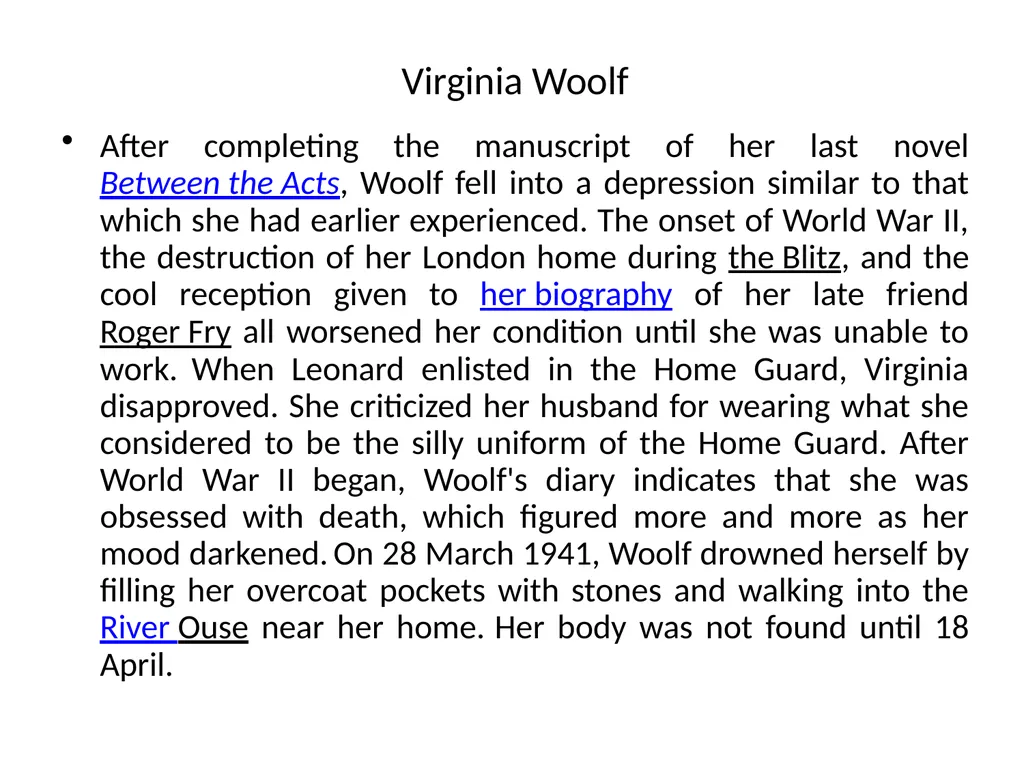
Virginia Woolf After completing the manuscript of her last novel Between the Acts, Woolf fell into a depression similar to that which she had earlier experienced. The onset of World War II, the destruction of her London home during the Blitz, and the cool reception given to her biography of her late friend Roger Fry all worsened her condition until she was unable to work. When Leonard enlisted in the Home Guard, Virginia disapproved. She criticized her husband for wearing what she considered to be the silly uniform of the Home Guard. After World War II began, Woolf's diary indicates that she was obsessed with death, which figured more and more as her mood darkened. On 28 March 1941, Woolf drowned herself by filling her overcoat pockets with stones and walking into the River Ouse near her home. Her body was not found until 18 April.<br>
06
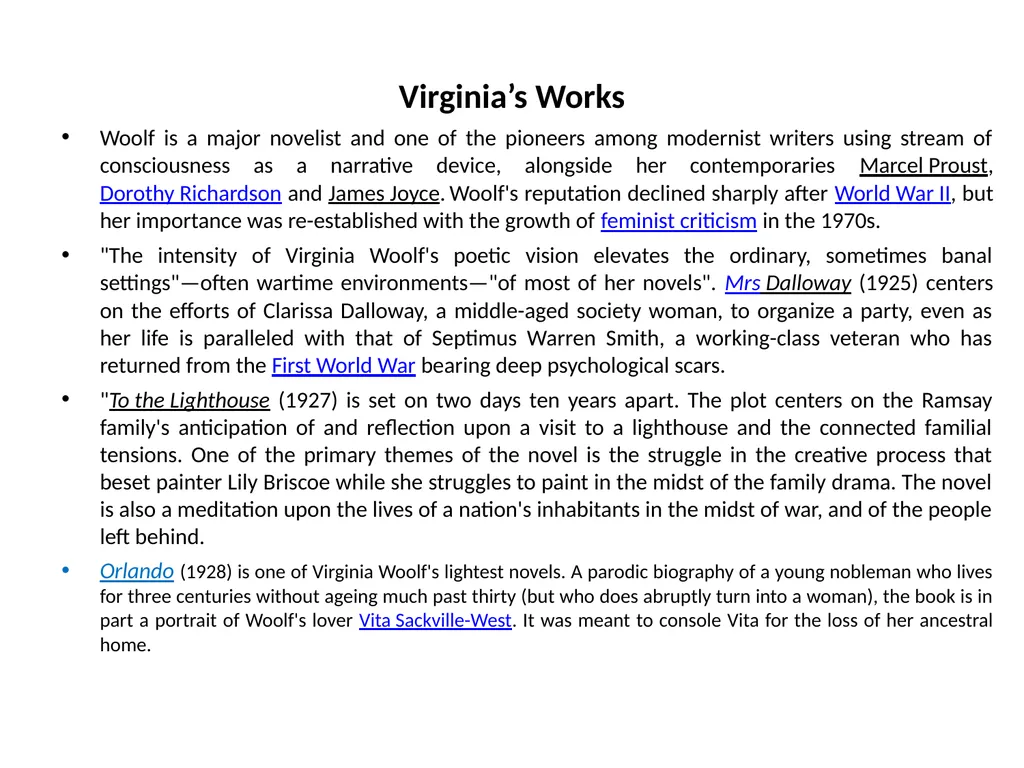
Virginia’s Works Woolf is a major novelist and one of the pioneers among modernist writers using stream of consciousness as a narrative device, alongside her contemporaries Marcel Proust, Dorothy Richardson and James Joyce. Woolf's reputation declined sharply after World War II, but her importance was re-established with the growth of feminist criticism in the 1970s.
"The intensity of Virginia Woolf's poetic vision elevates the ordinary, sometimes banal settings"—often wartime environments—"of most of her novels". Mrs Dalloway (1925) centers on the efforts of Clarissa Dalloway, a middle-aged society woman, to organize a party, even as her life is paralleled with that of Septimus Warren Smith, a working-class veteran who has returned from the First World War bearing deep psychological scars.
"To the Lighthouse (1927) is set on two days ten years apart. The plot centers on the Ramsay family's anticipation of and reflection upon a visit to a lighthouse and the connected familial tensions. One of the primary themes of the novel is the struggle in the creative process that beset painter Lily Briscoe while she struggles to paint in the midst of the family drama. The novel is also a meditation upon the lives of a nation's inhabitants in the midst of war, and of the people left behind.
Orlando (1928) is one of Virginia Woolf's lightest novels. A parodic biography of a young nobleman who lives for three centuries without ageing much past thirty (but who does abruptly turn into a woman), the book is in part a portrait of Woolf's lover Vita Sackville-West. It was meant to console Vita for the loss of her ancestral home.<br>
"The intensity of Virginia Woolf's poetic vision elevates the ordinary, sometimes banal settings"—often wartime environments—"of most of her novels". Mrs Dalloway (1925) centers on the efforts of Clarissa Dalloway, a middle-aged society woman, to organize a party, even as her life is paralleled with that of Septimus Warren Smith, a working-class veteran who has returned from the First World War bearing deep psychological scars.
"To the Lighthouse (1927) is set on two days ten years apart. The plot centers on the Ramsay family's anticipation of and reflection upon a visit to a lighthouse and the connected familial tensions. One of the primary themes of the novel is the struggle in the creative process that beset painter Lily Briscoe while she struggles to paint in the midst of the family drama. The novel is also a meditation upon the lives of a nation's inhabitants in the midst of war, and of the people left behind.
Orlando (1928) is one of Virginia Woolf's lightest novels. A parodic biography of a young nobleman who lives for three centuries without ageing much past thirty (but who does abruptly turn into a woman), the book is in part a portrait of Woolf's lover Vita Sackville-West. It was meant to console Vita for the loss of her ancestral home.<br>
07
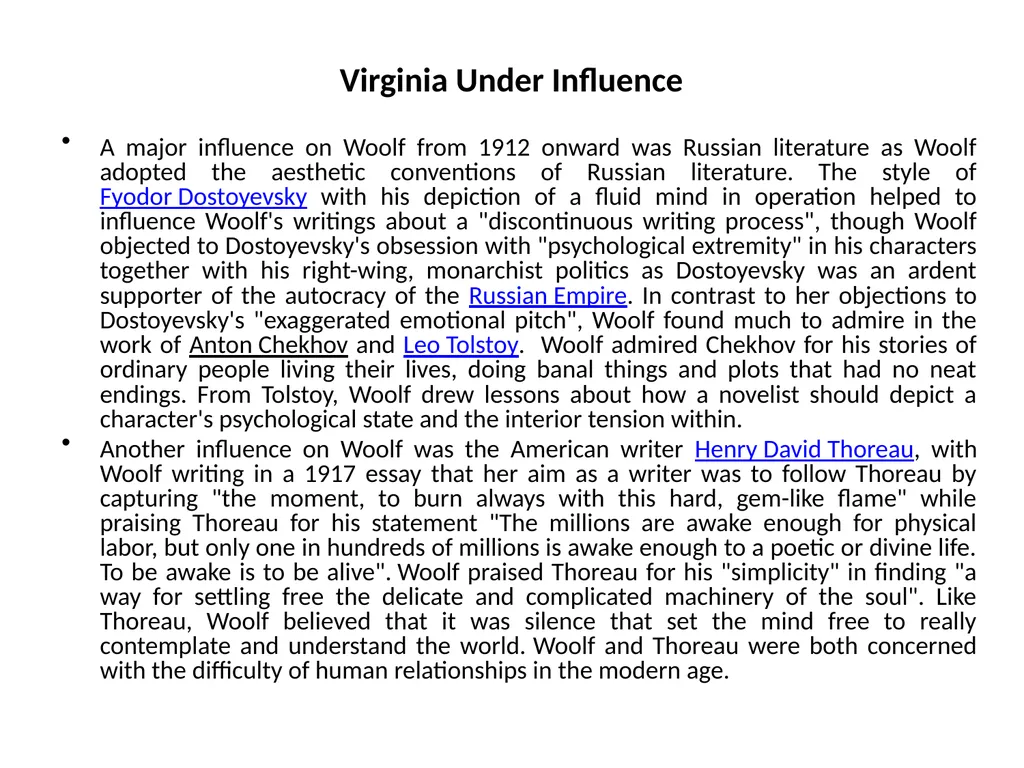
Virginia Under Influence A major influence on Woolf from 1912 onward was Russian literature as Woolf adopted the aesthetic conventions of Russian literature. The style of Fyodor Dostoyevsky with his depiction of a fluid mind in operation helped to influence Woolf's writings about a "discontinuous writing process", though Woolf objected to Dostoyevsky's obsession with "psychological extremity" in his characters together with his right-wing, monarchist politics as Dostoyevsky was an ardent supporter of the autocracy of the Russian Empire. In contrast to her objections to Dostoyevsky's "exaggerated emotional pitch", Woolf found much to admire in the work of Anton Chekhov and Leo Tolstoy. Woolf admired Chekhov for his stories of ordinary people living their lives, doing banal things and plots that had no neat endings. From Tolstoy, Woolf drew lessons about how a novelist should depict a character's psychological state and the interior tension within.
Another influence on Woolf was the American writer Henry David Thoreau, with Woolf writing in a 1917 essay that her aim as a writer was to follow Thoreau by capturing "the moment, to burn always with this hard, gem-like flame" while praising Thoreau for his statement "The millions are awake enough for physical labor, but only one in hundreds of millions is awake enough to a poetic or divine life. To be awake is to be alive". Woolf praised Thoreau for his "simplicity" in finding "a way for settling free the delicate and complicated machinery of the soul". Like Thoreau, Woolf believed that it was silence that set the mind free to really contemplate and understand the world. Woolf and Thoreau were both concerned with the difficulty of human relationships in the modern age.<br>
Another influence on Woolf was the American writer Henry David Thoreau, with Woolf writing in a 1917 essay that her aim as a writer was to follow Thoreau by capturing "the moment, to burn always with this hard, gem-like flame" while praising Thoreau for his statement "The millions are awake enough for physical labor, but only one in hundreds of millions is awake enough to a poetic or divine life. To be awake is to be alive". Woolf praised Thoreau for his "simplicity" in finding "a way for settling free the delicate and complicated machinery of the soul". Like Thoreau, Woolf believed that it was silence that set the mind free to really contemplate and understand the world. Woolf and Thoreau were both concerned with the difficulty of human relationships in the modern age.<br>
08
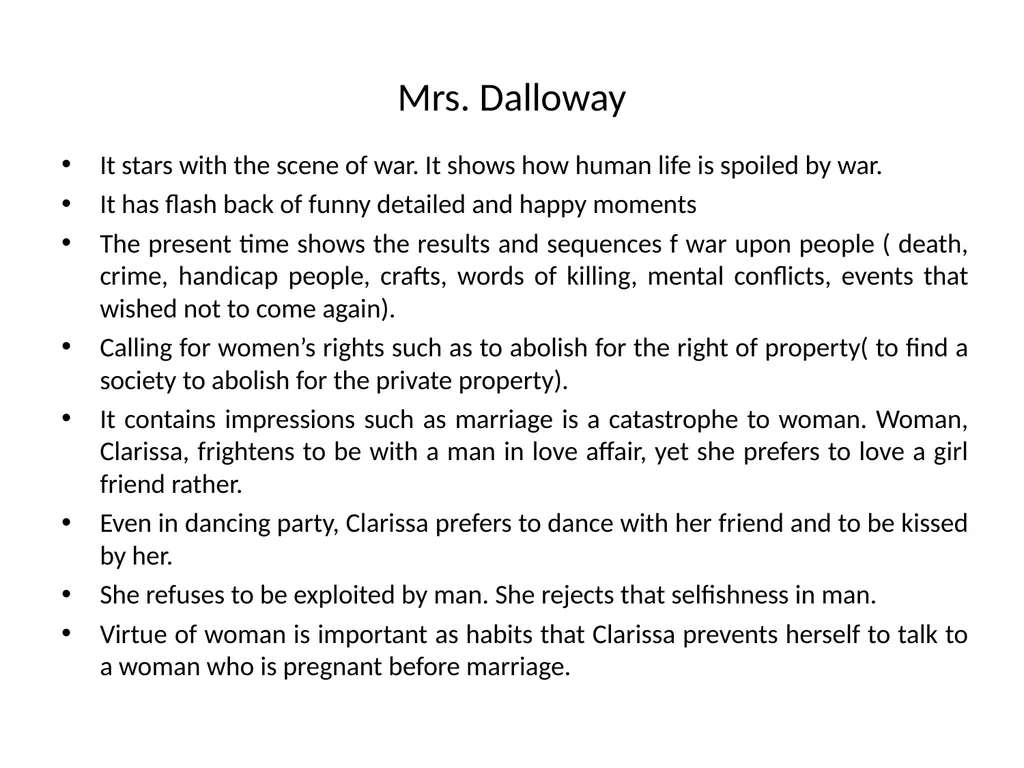
Mrs. Dalloway It stars with the scene of war. It shows how human life is spoiled by war.
It has flash back of funny detailed and happy moments
The present time shows the results and sequences f war upon people ( death, crime, handicap people, crafts, words of killing, mental conflicts, events that wished not to come again).
Calling for women’s rights such as to abolish for the right of property( to find a society to abolish for the private property).
It contains impressions such as marriage is a catastrophe to woman. Woman, Clarissa, frightens to be with a man in love affair, yet she prefers to love a girl friend rather.
Even in dancing party, Clarissa prefers to dance with her friend and to be kissed by her.
She refuses to be exploited by man. She rejects that selfishness in man.
Virtue of woman is important as habits that Clarissa prevents herself to talk to a woman who is pregnant before marriage.<br>
It has flash back of funny detailed and happy moments
The present time shows the results and sequences f war upon people ( death, crime, handicap people, crafts, words of killing, mental conflicts, events that wished not to come again).
Calling for women’s rights such as to abolish for the right of property( to find a society to abolish for the private property).
It contains impressions such as marriage is a catastrophe to woman. Woman, Clarissa, frightens to be with a man in love affair, yet she prefers to love a girl friend rather.
Even in dancing party, Clarissa prefers to dance with her friend and to be kissed by her.
She refuses to be exploited by man. She rejects that selfishness in man.
Virtue of woman is important as habits that Clarissa prevents herself to talk to a woman who is pregnant before marriage.<br>
09
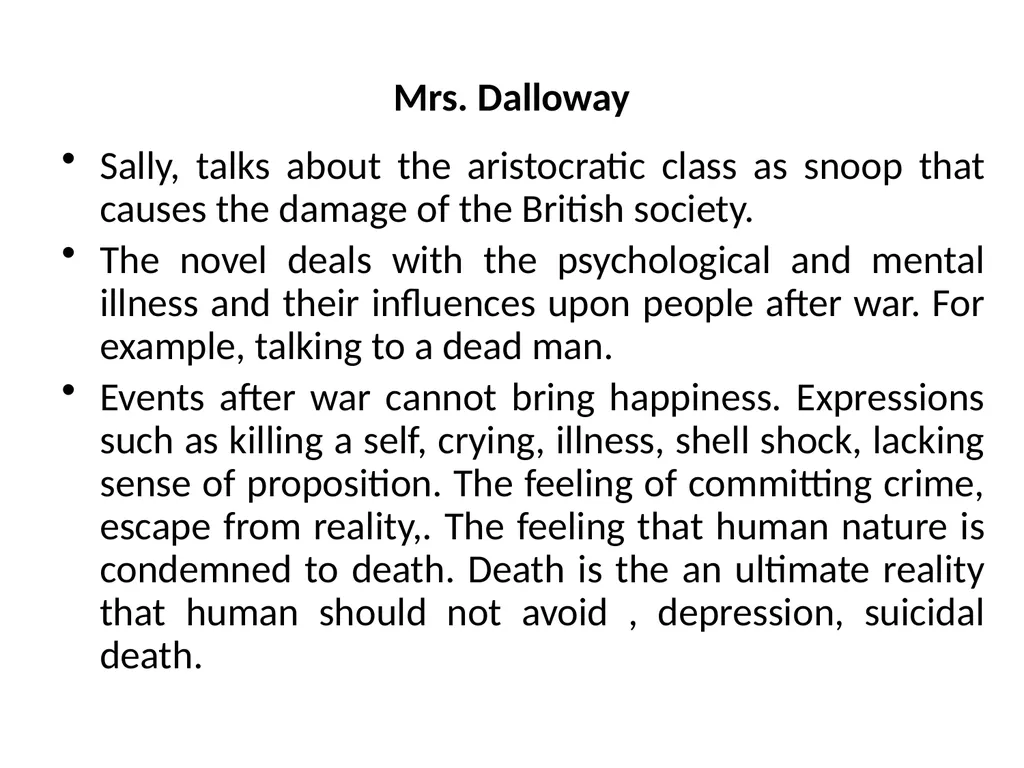
Mrs. Dalloway Sally, talks about the aristocratic class as snoop that causes the damage of the British society.
The novel deals with the psychological and mental illness and their influences upon people after war. For example, talking to a dead man.
Events after war cannot bring happiness. Expressions such as killing a self, crying, illness, shell shock, lacking sense of proposition. The feeling of committing crime, escape from reality,. The feeling that human nature is condemned to death. Death is the an ultimate reality that human should not avoid , depression, suicidal death.<br>
The novel deals with the psychological and mental illness and their influences upon people after war. For example, talking to a dead man.
Events after war cannot bring happiness. Expressions such as killing a self, crying, illness, shell shock, lacking sense of proposition. The feeling of committing crime, escape from reality,. The feeling that human nature is condemned to death. Death is the an ultimate reality that human should not avoid , depression, suicidal death.<br>
10
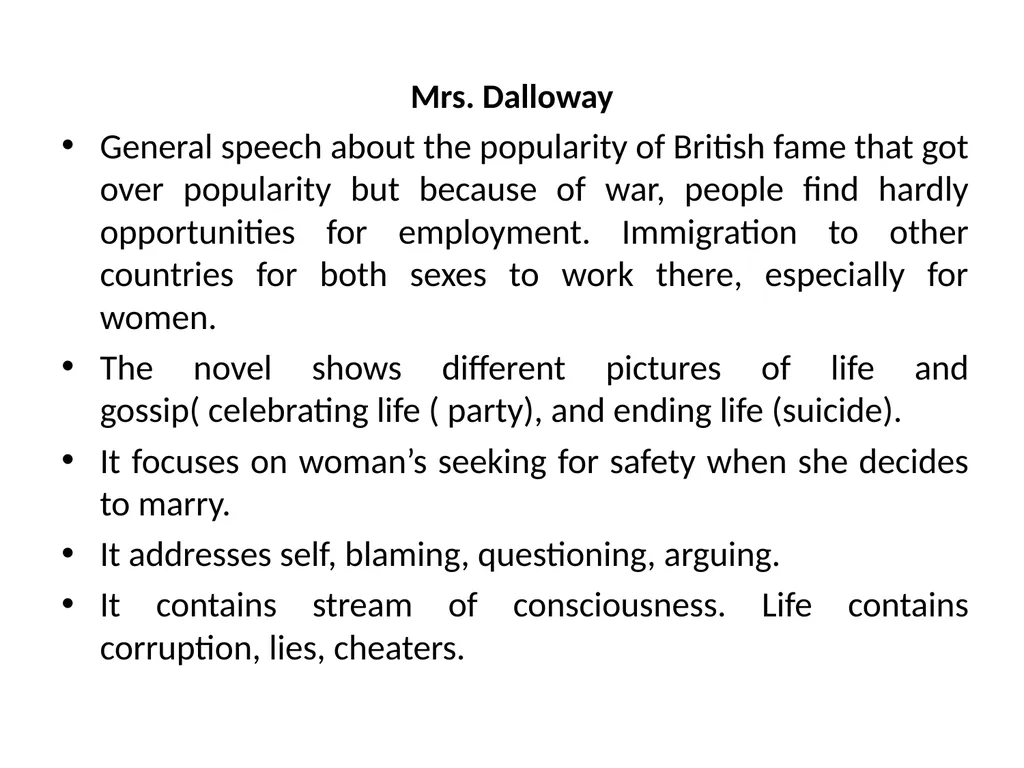
Mrs. Dalloway General speech about the popularity of British fame that got over popularity but because of war, people find hardly opportunities for employment. Immigration to other countries for both sexes to work there, especially for women.
The novel shows different pictures of life and gossip( celebrating life ( party), and ending life (suicide).
It focuses on woman’s seeking for safety when she decides to marry.
It addresses self, blaming, questioning, arguing.
It contains stream of consciousness. Life contains corruption, lies, cheaters.<br>
The novel shows different pictures of life and gossip( celebrating life ( party), and ending life (suicide).
It focuses on woman’s seeking for safety when she decides to marry.
It addresses self, blaming, questioning, arguing.
It contains stream of consciousness. Life contains corruption, lies, cheaters.<br>