Vision: The marine science community will have free access to fully documented, state of the art, user-friendly software for chemical speciation calculations, including uncertainty estimates. WG145: Presentation to SCOR, October 2022 Work
"Vision: The marine science community will have" is the property of its rightful owner. Permission is granted to
download and print the materials on this website for personal, non-commercial use only, and to display it
on your personal computer provided you do not modify the materials and that you retain all copyright
notices contained in the materials. By downloading content from our website, you accept the terms of this
agreement.
Presentation Transcript
01
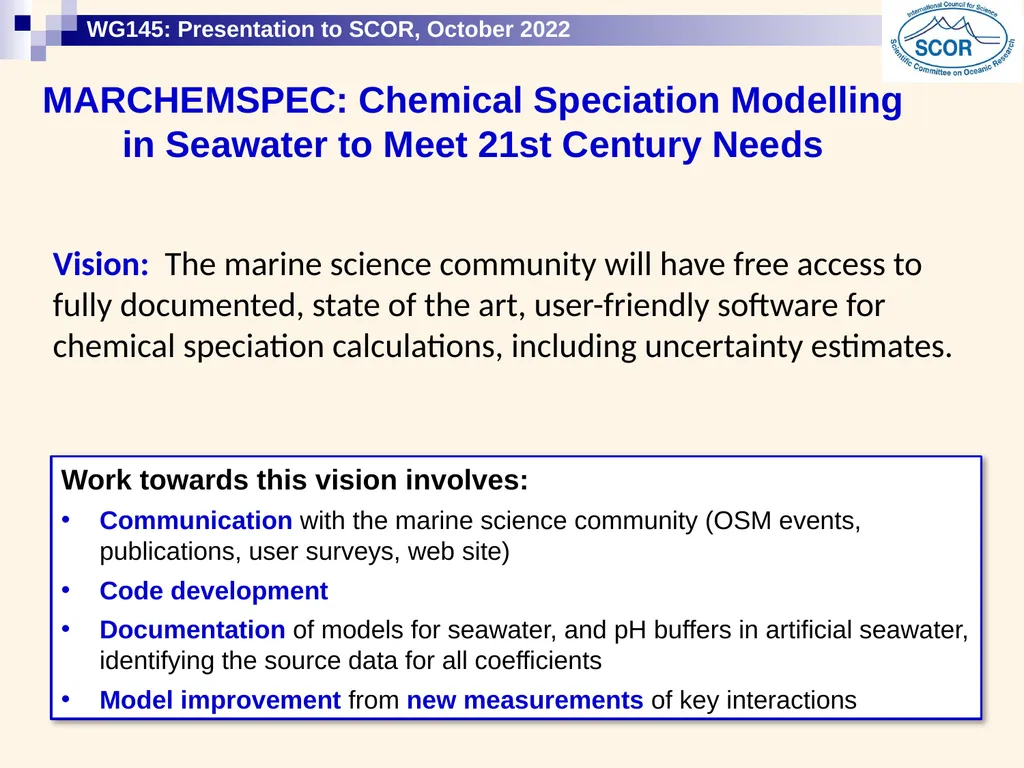
Vision: The marine science community will have free access to fully documented, state of the art, user-friendly software for chemical speciation calculations, including uncertainty estimates. WG145: Presentation to SCOR, October 2022 Work towards this vision involves:
Communication with the marine science community (OSM events, publications, user surveys, web site)
Code development
Documentation of models for seawater, and pH buffers in artificial seawater, identifying the source data for all coefficients
Model improvement from new measurements of key interactions MARCHEMSPEC: Chemical Speciation Modelling in Seawater to Meet 21st Century Needs<br>
02
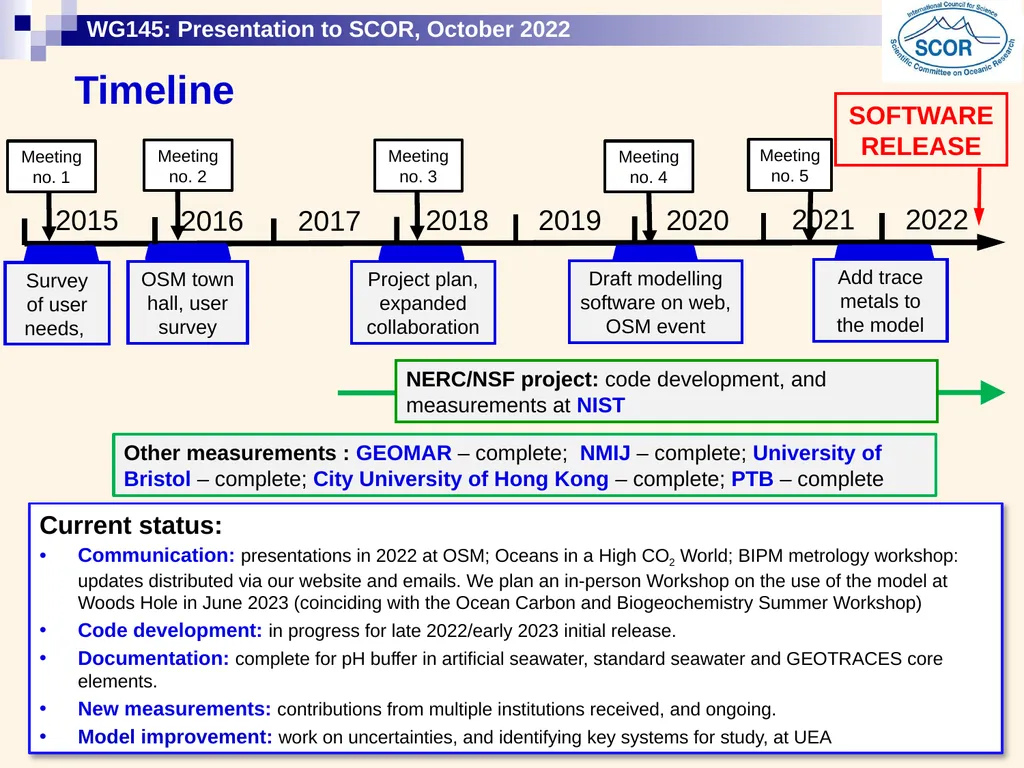
WG145: Presentation to SCOR, October 2022 SOFTWARE RELEASE Current status:
Communication: presentations in 2022 at OSM; Oceans in a High CO2 World; BIPM metrology workshop: updates distributed via our website and emails. We plan an in-person Workshop on the use of the model at Woods Hole in June 2023 (coinciding with the Ocean Carbon and Biogeochemistry Summer Workshop)
Code development: in progress for late 2022/early 2023 initial release.
Documentation: complete for pH buffer in artificial seawater, standard seawater and GEOTRACES core elements.
New measurements: contributions from multiple institutions received, and ongoing.
Model improvement: work on uncertainties, and identifying key systems for study, at UEA Other measurements : GEOMAR – complete; NMIJ – complete; University of Bristol – complete; City University of Hong Kong – complete; PTB – complete Meeting no. 5 Timeline<br>
03
Completed and planned publications WG145: Presentation to SCOR, October 2022 Published
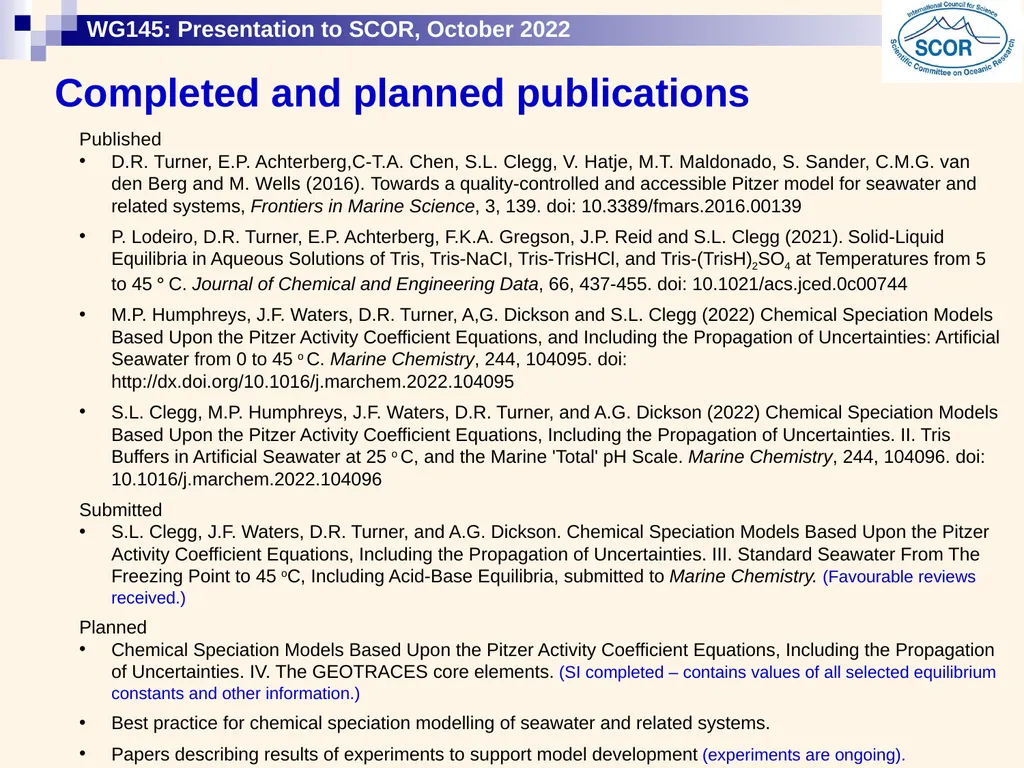
D.R. Turner, E.P. Achterberg,C-T.A. Chen, S.L. Clegg, V. Hatje, M.T. Maldonado, S. Sander, C.M.G. van den Berg and M. Wells (2016). Towards a quality-controlled and accessible Pitzer model for seawater and related systems, Frontiers in Marine Science, 3, 139. doi: 10.3389/fmars.2016.00139
P. Lodeiro, D.R. Turner, E.P. Achterberg, F.K.A. Gregson, J.P. Reid and S.L. Clegg (2021). Solid-Liquid Equilibria in Aqueous Solutions of Tris, Tris-NaCI, Tris-TrisHCl, and Tris-(TrisH)2SO4 at Temperatures from 5 to 45 ° C. Journal of Chemical and Engineering Data, 66, 437-455. doi: 10.1021/acs.jced.0c00744
M.P. Humphreys, J.F. Waters, D.R. Turner, A,G. Dickson and S.L. Clegg (2022) Chemical Speciation Models Based Upon the Pitzer Activity Coefficient Equations, and Including the Propagation of Uncertainties: Artificial Seawater from 0 to 45 o C. Marine Chemistry, 244, 104095. doi: http://dx.doi.org/10.1016/j.marchem.2022.104095
S.L. Clegg, M.P. Humphreys, J.F. Waters, D.R. Turner, and A.G. Dickson (2022) Chemical Speciation Models Based Upon the Pitzer Activity Coefficient Equations, Including the Propagation of Uncertainties. II. Tris Buffers in Artificial Seawater at 25 o C, and the Marine 'Total' pH Scale. Marine Chemistry, 244, 104096. doi: 10.1016/j.marchem.2022.104096
Submitted
S.L. Clegg, J.F. Waters, D.R. Turner, and A.G. Dickson. Chemical Speciation Models Based Upon the Pitzer Activity Coefficient Equations, Including the Propagation of Uncertainties. III. Standard Seawater From The Freezing Point to 45 oC, Including Acid-Base Equilibria, submitted to Marine Chemistry. (Favourable reviews received.)
Planned
Chemical Speciation Models Based Upon the Pitzer Activity Coefficient Equations, Including the Propagation of Uncertainties. IV. The GEOTRACES core elements. (SI completed – contains values of all selected equilibrium constants and other information.)
Best practice for chemical speciation modelling of seawater and related systems.
Papers describing results of experiments to support model development (experiments are ongoing).<br>
04
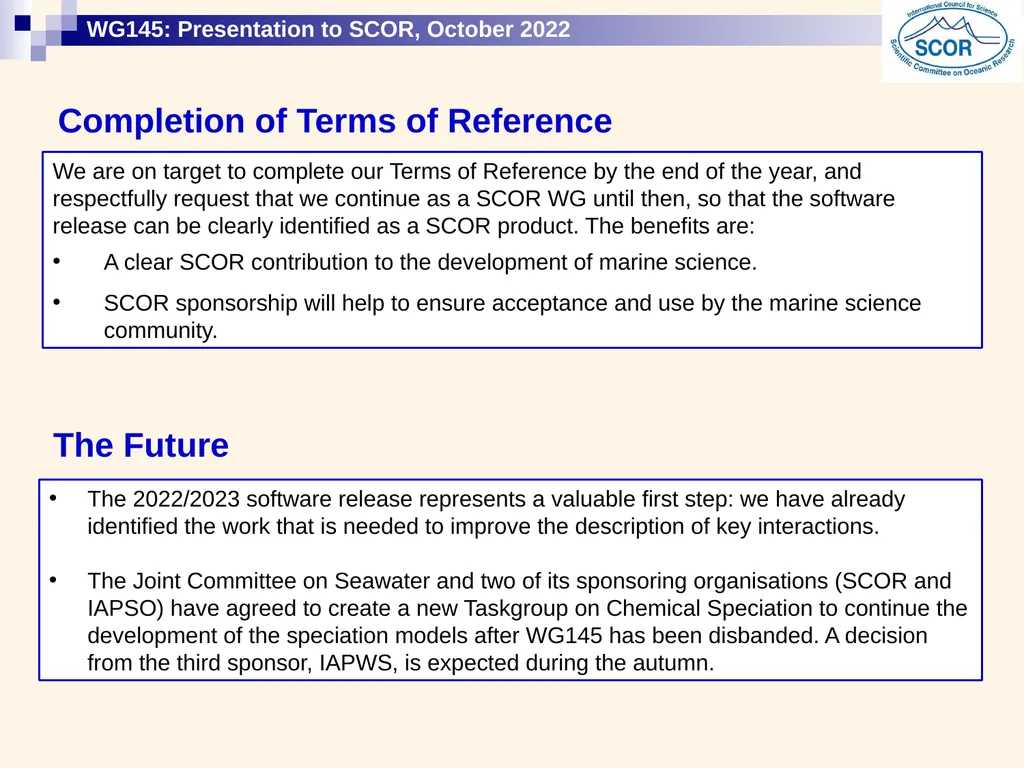
WG145: Presentation to SCOR, October 2022 We are on target to complete our Terms of Reference by the end of the year, and respectfully request that we continue as a SCOR WG until then, so that the software release can be clearly identified as a SCOR product. The benefits are:
A clear SCOR contribution to the development of marine science.
SCOR sponsorship will help to ensure acceptance and use by the marine science community. Completion of Terms of Reference The Future The 2022/2023 software release represents a valuable first step: we have already identified the work that is needed to improve the description of key interactions.
The Joint Committee on Seawater and two of its sponsoring organisations (SCOR and IAPSO) have agreed to create a new Taskgroup on Chemical Speciation to continue the development of the speciation models after WG145 has been disbanded. A decision from the third sponsor, IAPWS, is expected during the autumn.<br>