
VITAMIN DEFICIENCY DISORDERS LESSON-33 BY OMKAR
KB
Published · 32 slides · 0 views

1 / 1



Description
VITAMIN DEFICIENCY DISORDERS LESSON-33 BY OMKAR YADAV INSPPH Upon completion of this lesson you will be able to: 1. Define vitamins and categories them 2. Explain the function, source deficiency disorder of Vitamin A 3. State the
Related Topics
Share
Embed code
Download this presentation From Below
"VITAMIN DEFICIENCY DISORDERS LESSON-33 BY OMKAR" is the property of its rightful owner. Permission is granted to download and print the materials on this website for personal, non-commercial use only, and to display it on your personal computer provided you do not modify the materials and that you retain all copyright notices contained in the materials. By downloading content from our website, you accept the terms of this agreement.
Presentation Transcript
01
VITAMIN DEFICIENCY DISORDERS LESSON-33 BY
OMKAR YADAV
INSP/PH<br>
OMKAR YADAV
INSP/PH<br>
02
Upon completion of this lesson you will be able to:
1. Define vitamins and categories them
2. Explain the function, source & deficiency disorder
of Vitamin A
3. State the deficiency disorder for Vitamin D in
adults & children, its management and symptom
of toxicity
4. List the functions, sources & deficiency disorder
for Thiamin as well as its management OBJECTIVES<br>
03
5. List the functions, sources & deficiency disorder
for Niacin as well as its management
6. List the functions, sources & deficiency disorder
for Vitamin B12 & Folate as well as its management
7. List the functions, sources & deficiency disorder
for Ascorbic acid; adverse effects due to over dosage
and its management OBJECTIVES<br>
for Niacin as well as its management
6. List the functions, sources & deficiency disorder
for Vitamin B12 & Folate as well as its management
7. List the functions, sources & deficiency disorder
for Ascorbic acid; adverse effects due to over dosage
and its management OBJECTIVES<br>
04
II. DEVELOPMENT:
Vitamins are organic substances in food, occurring naturally, which are required in very small amounts and not synthesized in the body.
Vitamins are broadly categorized as -
1. Fat soluble vitamins: A, D, E and K
2. Water soluble vitamins: B complex group
and Vitamin C<br>
Vitamins are organic substances in food, occurring naturally, which are required in very small amounts and not synthesized in the body.
Vitamins are broadly categorized as -
1. Fat soluble vitamins: A, D, E and K
2. Water soluble vitamins: B complex group
and Vitamin C<br>
05
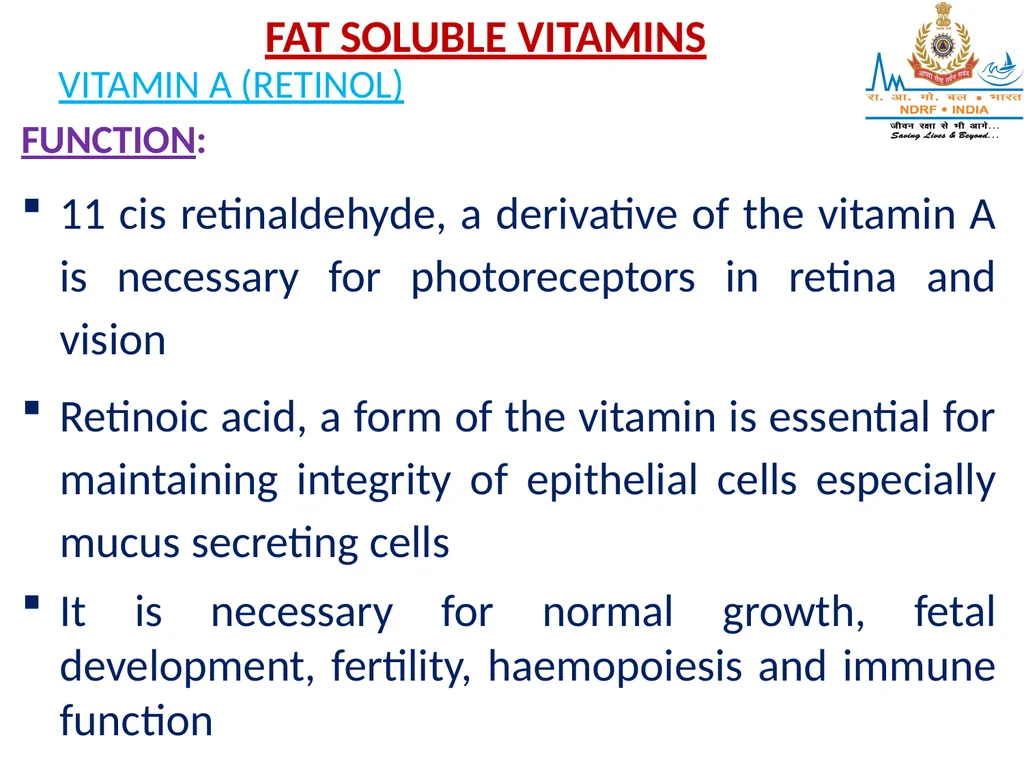
FUNCTION:
11 cis retinaldehyde, a derivative of the vitamin A is necessary for photoreceptors in retina and vision
Retinoic acid, a form of the vitamin is essential for maintaining integrity of epithelial cells especially mucus secreting cells
It is necessary for normal growth, fetal development, fertility, haemopoiesis and immune function FAT SOLUBLE VITAMINS VITAMIN A (RETINOL)<br>
06
SOURCES:
It is found in foods of animal origin – Liver, milk, butter, cheese and fish oils and some small amount in carrots, yellow fruits and green vegetables as carotenes
The recommended daily intake of vitamin A for adults is 600µg<br>
It is found in foods of animal origin – Liver, milk, butter, cheese and fish oils and some small amount in carrots, yellow fruits and green vegetables as carotenes
The recommended daily intake of vitamin A for adults is 600µg<br>
07
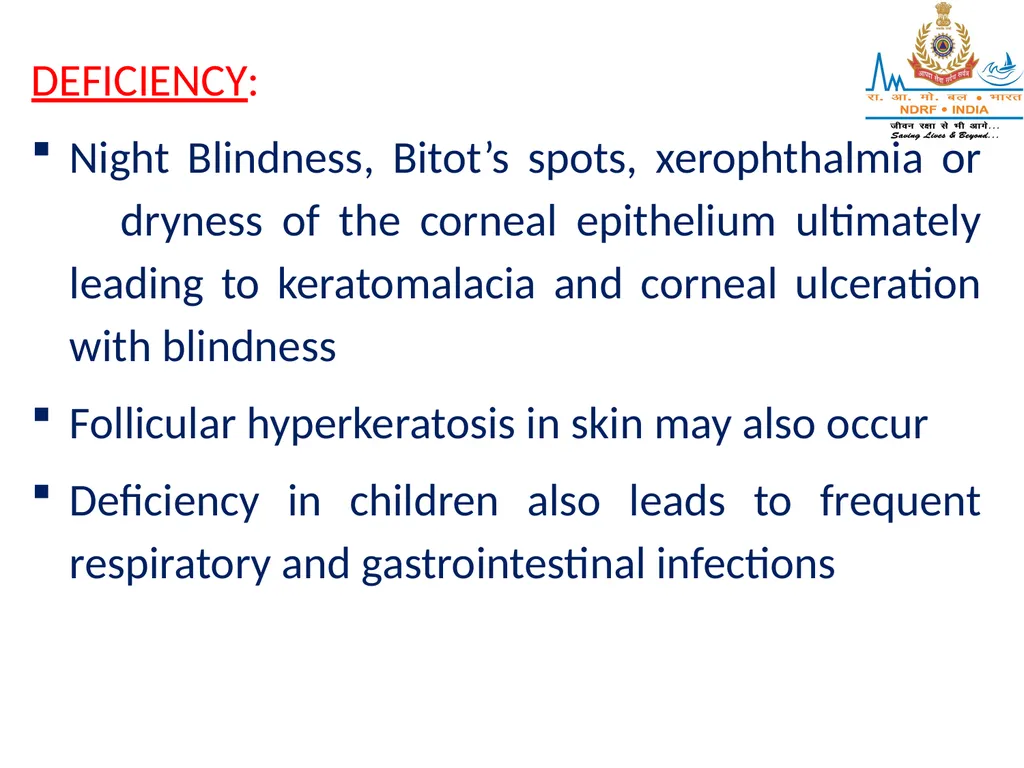
DEFICIENCY:
Night Blindness, Bitot’s spots, xerophthalmia or dryness of the corneal epithelium ultimately leading to keratomalacia and corneal ulceration with blindness
Follicular hyperkeratosis in skin may also occur
Deficiency in children also leads to frequent respiratory and gastrointestinal infections<br>
Night Blindness, Bitot’s spots, xerophthalmia or dryness of the corneal epithelium ultimately leading to keratomalacia and corneal ulceration with blindness
Follicular hyperkeratosis in skin may also occur
Deficiency in children also leads to frequent respiratory and gastrointestinal infections<br>
08
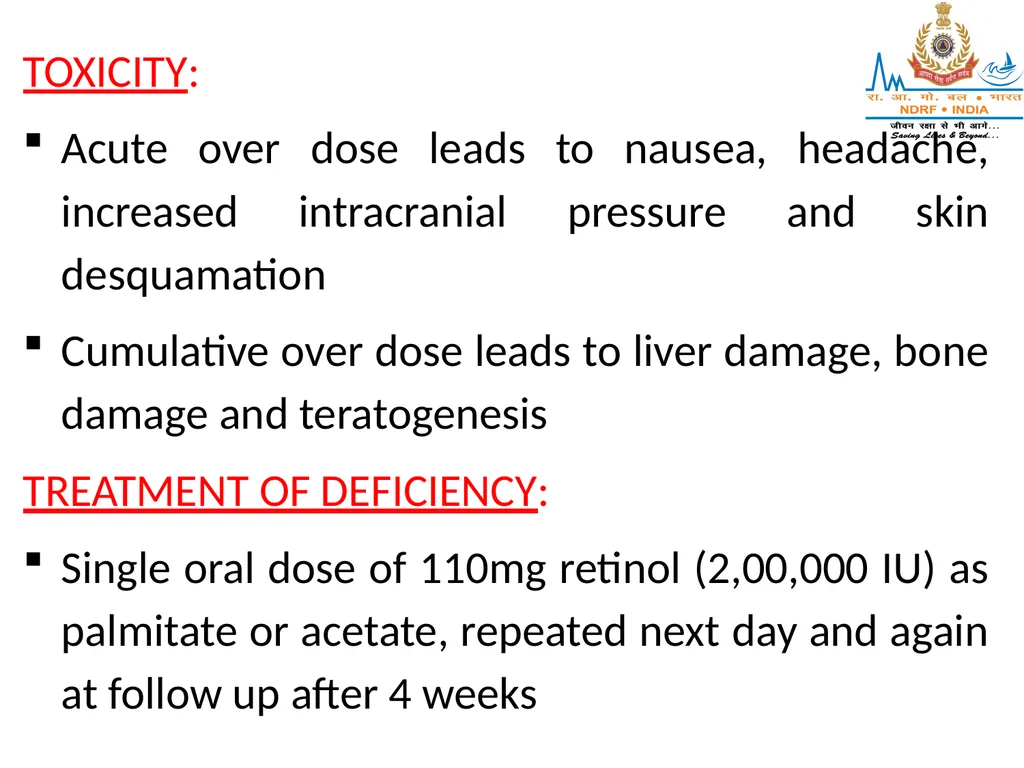
TOXICITY:
Acute over dose leads to nausea, headache, increased intracranial pressure and skin desquamation
Cumulative over dose leads to liver damage, bone damage and teratogenesis
TREATMENT OF DEFICIENCY:
Single oral dose of 110mg retinol (2,00,000 IU) as palmitate or acetate, repeated next day and again at follow up after 4 weeks<br>
09
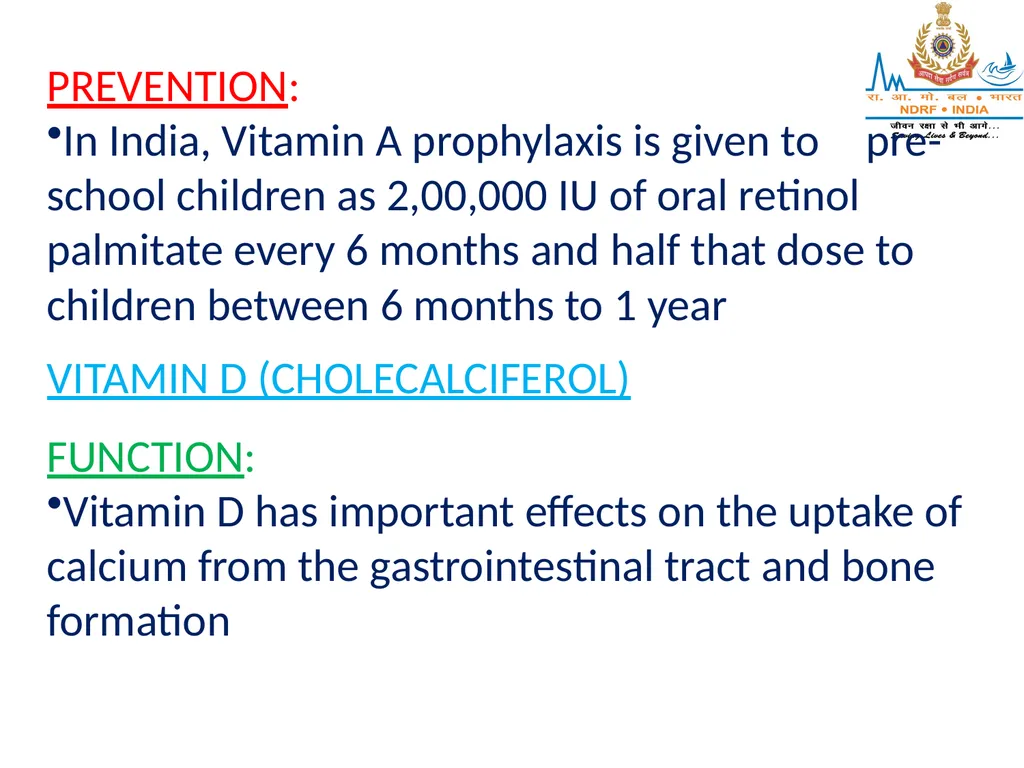
PREVENTION:
In India, Vitamin A prophylaxis is given to pre-school children as 2,00,000 IU of oral retinol palmitate every 6 months and half that dose to children between 6 months to 1 year
VITAMIN D (CHOLECALCIFEROL)
FUNCTION:
Vitamin D has important effects on the uptake of calcium from the gastrointestinal tract and bone formation<br>
10
DEFICIENCY:
Leads to rickets in children between the age of six months and two years and osteomalacia in adults
TOXICITY:
Hypercalcemia can occur, leading to stone formation and renal failure as well as abdominal distress, colic, peptic ulceration, thirst and drowsiness SOURCES:
Mainly formed in the skin by action of UV light on
7 dehydrocholesterol and to some extent in dietary
sources like egg-yolk, milk, butter and fish<br>
11
TREATMENT OF DEFICIENCY & PREVENTIVE MEASURES:
Educating the parents to expose children regularly to sunlight
Periodic dosing of young children with Vit D
Vitamin D fortification of foods especially milk
Oral supplementation to be monitored carefully as the margin of safety between requirement and toxic intake is narrow<br>
Educating the parents to expose children regularly to sunlight
Periodic dosing of young children with Vit D
Vitamin D fortification of foods especially milk
Oral supplementation to be monitored carefully as the margin of safety between requirement and toxic intake is narrow<br>
12
DAILY REQUIREMENT:
Adults: 100IU
Infants and children: 200IU
Pregnancy and lactation: 400IU
VITAMIN E (ALPHA TOCOPHEROL)
FUNCTION:
Vitamin E is an important antioxidant preventing formation of free radicals
It also plays a role in maintenance of cell membrane structure and DNA synthesis<br>
Adults: 100IU
Infants and children: 200IU
Pregnancy and lactation: 400IU
VITAMIN E (ALPHA TOCOPHEROL)
FUNCTION:
Vitamin E is an important antioxidant preventing formation of free radicals
It also plays a role in maintenance of cell membrane structure and DNA synthesis<br>
13
SOURCES:
Vegetable seeds and oils
DEFICIENCY:
Haemolytic anemia and rarely, ataxia. It has a protective role similar to poly-unsaturated fatty acids
DAILY REQUIREMENT:
0.8 mg/g of essential fatty acids<br>
Vegetable seeds and oils
DEFICIENCY:
Haemolytic anemia and rarely, ataxia. It has a protective role similar to poly-unsaturated fatty acids
DAILY REQUIREMENT:
0.8 mg/g of essential fatty acids<br>
14
PROPHYLACTIC TREATMENT:
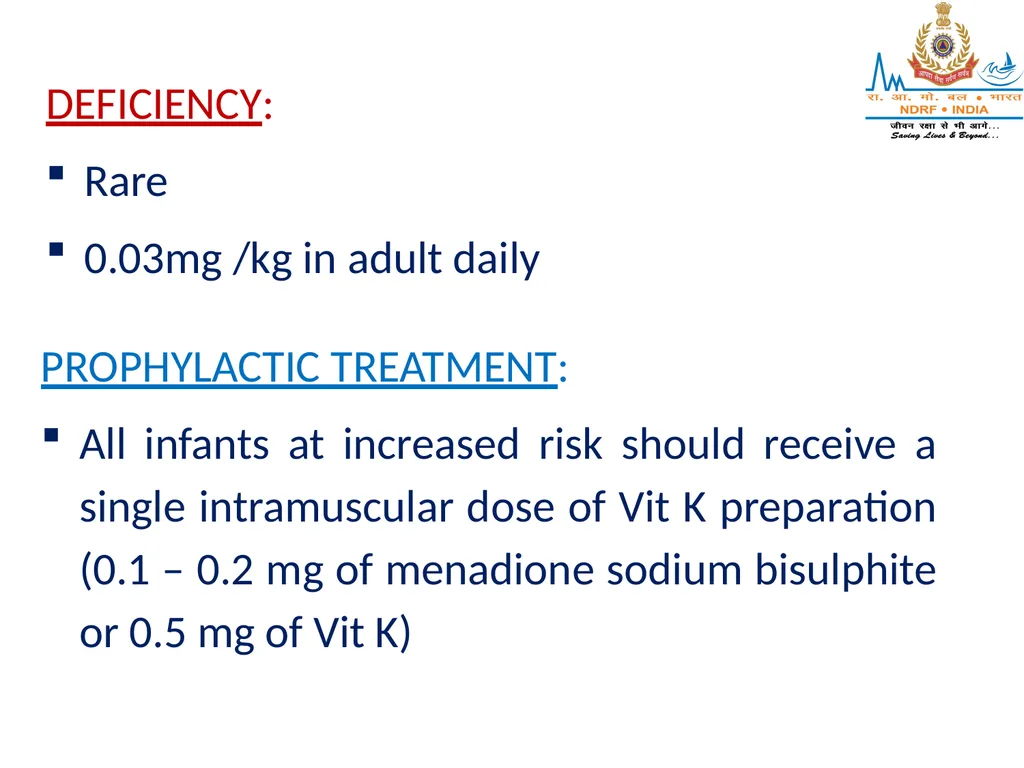
All infants at increased risk should receive a single intramuscular dose of Vit K preparation (0.1 – 0.2 mg of menadione sodium bisulphite or 0.5 mg of Vit K) DEFICIENCY:
Rare
0.03mg /kg in adult daily<br>
All infants at increased risk should receive a single intramuscular dose of Vit K preparation (0.1 – 0.2 mg of menadione sodium bisulphite or 0.5 mg of Vit K) DEFICIENCY:
Rare
0.03mg /kg in adult daily<br>
15
WATER SOLUBLE VITAMINS
THIAMIN (VITAMIN B1)
FUNCTION:
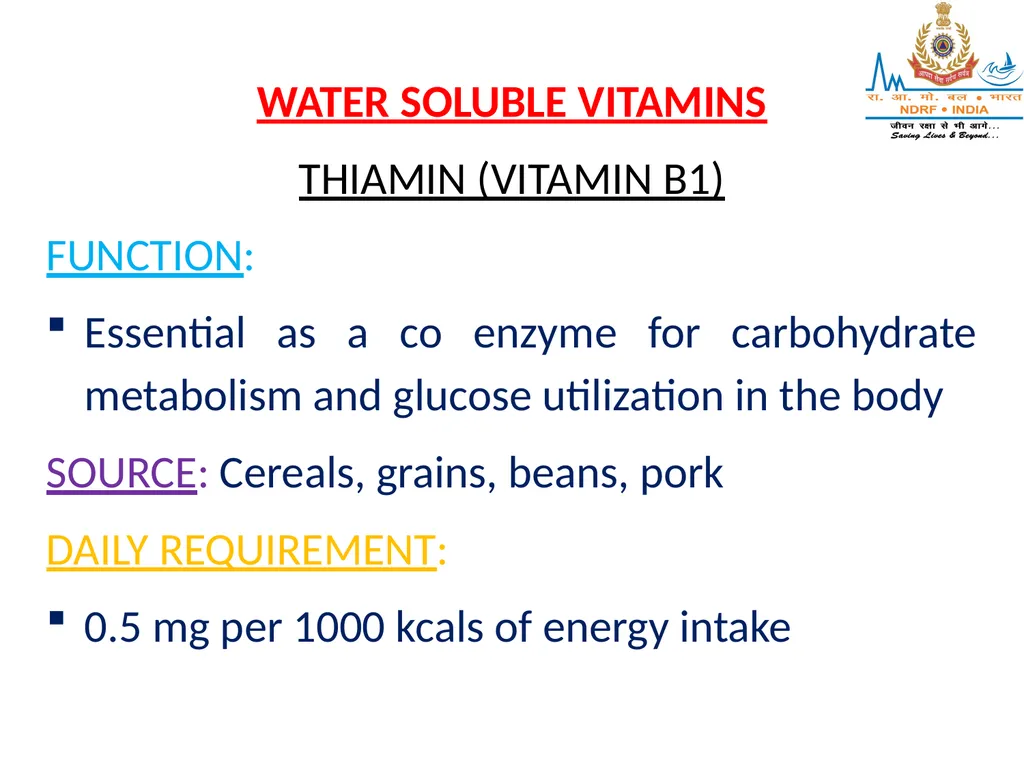
Essential as a co enzyme for carbohydrate metabolism and glucose utilization in the body
SOURCE: Cereals, grains, beans, pork
DAILY REQUIREMENT:
0.5 mg per 1000 kcals of energy intake<br>
THIAMIN (VITAMIN B1)
FUNCTION:
Essential as a co enzyme for carbohydrate metabolism and glucose utilization in the body
SOURCE: Cereals, grains, beans, pork
DAILY REQUIREMENT:
0.5 mg per 1000 kcals of energy intake<br>
16
DEFICIENCY:
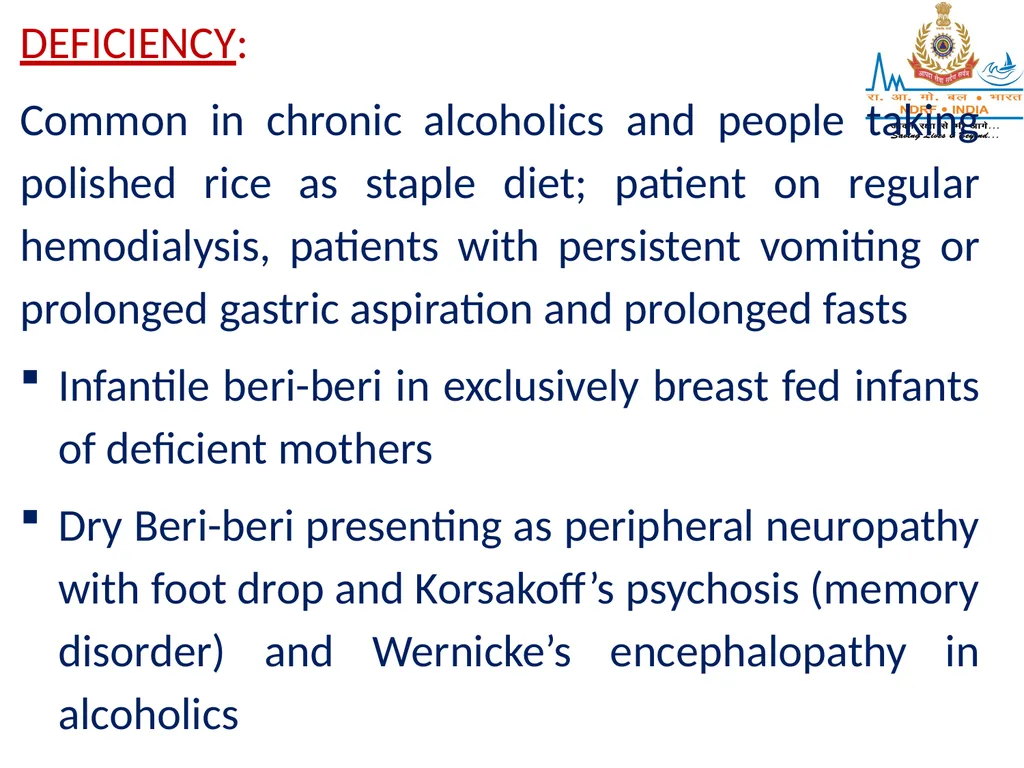
Common in chronic alcoholics and people taking polished rice as staple diet; patient on regular hemodialysis, patients with persistent vomiting or prolonged gastric aspiration and prolonged fasts
Infantile beri-beri in exclusively breast fed infants of deficient mothers
Dry Beri-beri presenting as peripheral neuropathy with foot drop and Korsakoff’s psychosis (memory disorder) and Wernicke’s encephalopathy in alcoholics
Wet Beri-beri with generalized oedema and high output heart failure<br>
17
TREATMENT:
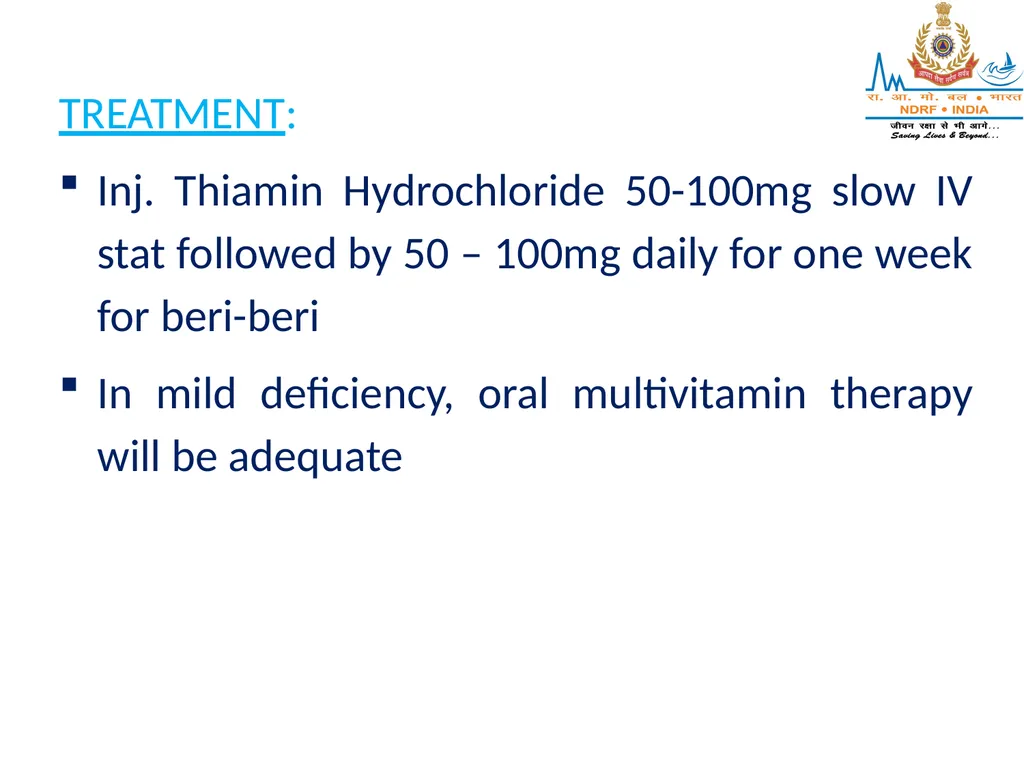
Inj. Thiamin Hydrochloride 50-100mg slow IV stat followed by 50 – 100mg daily for one week for beri-beri
In mild deficiency, oral multivitamin therapy will be adequate<br>
Inj. Thiamin Hydrochloride 50-100mg slow IV stat followed by 50 – 100mg daily for one week for beri-beri
In mild deficiency, oral multivitamin therapy will be adequate<br>
18
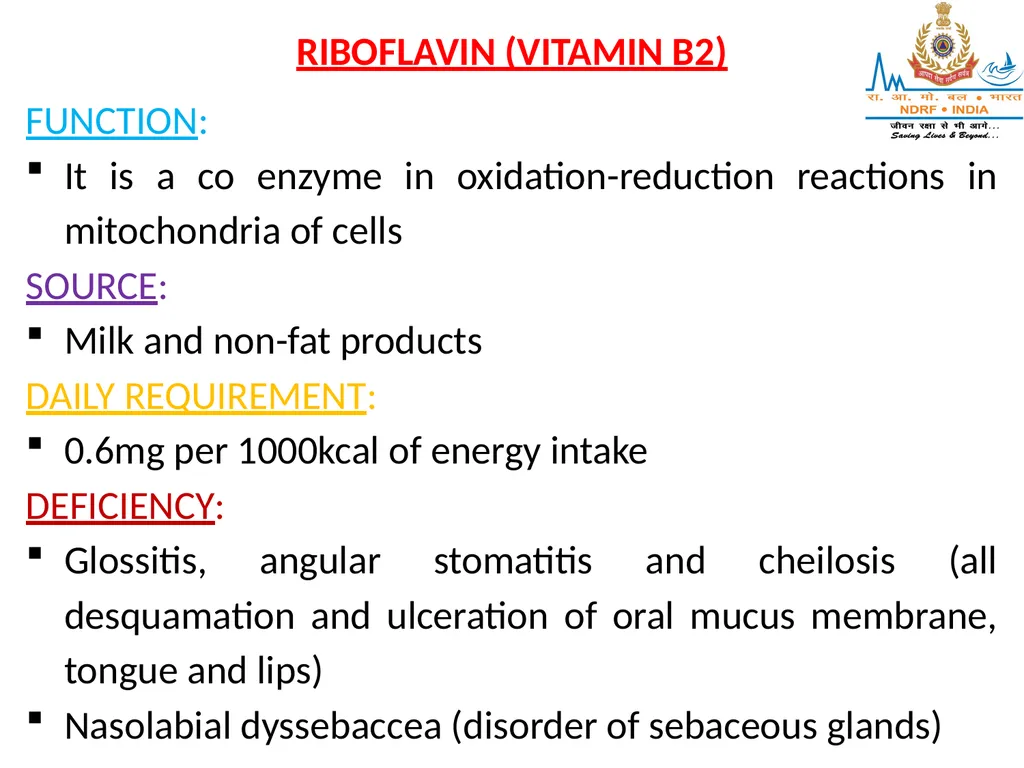
RIBOFLAVIN (VITAMIN B2)
FUNCTION:
It is a co enzyme in oxidation-reduction reactions in mitochondria of cells
SOURCE:
Milk and non-fat products
DAILY REQUIREMENT:
0.6mg per 1000kcal of energy intake
DEFICIENCY:
Glossitis, angular stomatitis and cheilosis (all desquamation and ulceration of oral mucus membrane, tongue and lips)
Nasolabial dyssebaccea (disorder of sebaceous glands)<br>
19
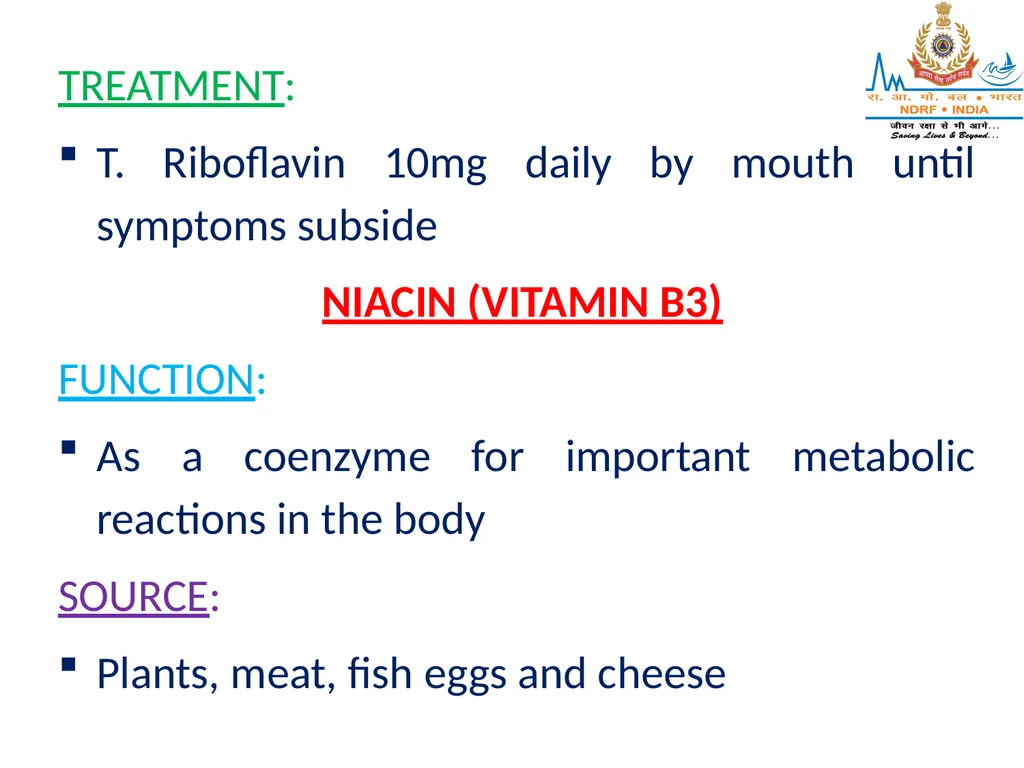
TREATMENT:
T. Riboflavin 10mg daily by mouth until symptoms subside
NIACIN (VITAMIN B3)
FUNCTION:
As a coenzyme for important metabolic reactions in the body
SOURCE:
Plants, meat, fish eggs and cheese<br>
T. Riboflavin 10mg daily by mouth until symptoms subside
NIACIN (VITAMIN B3)
FUNCTION:
As a coenzyme for important metabolic reactions in the body
SOURCE:
Plants, meat, fish eggs and cheese<br>
20
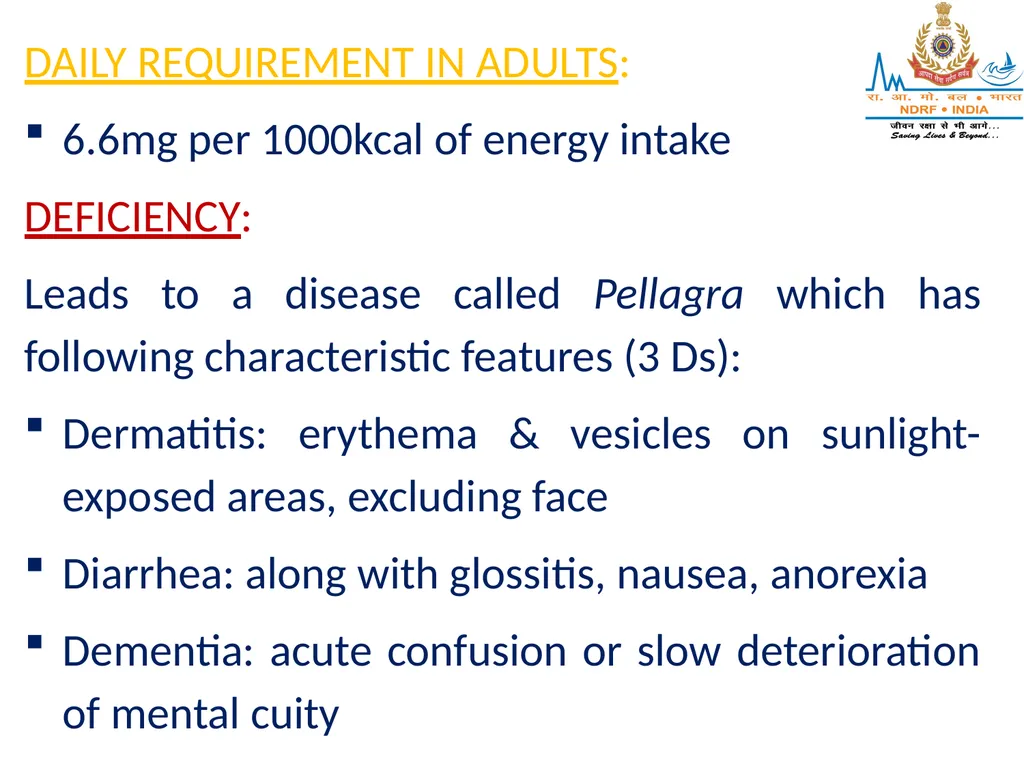
DAILY REQUIREMENT IN ADULTS:
6.6mg per 1000kcal of energy intake
DEFICIENCY:
Leads to a disease called Pellagra which has following characteristic features (3 Ds):
Dermatitis: erythema & vesicles on sunlight-exposed areas, excluding face
Diarrhea: along with glossitis, nausea, anorexia
Dementia: acute confusion or slow deterioration of mental cuity<br>
21
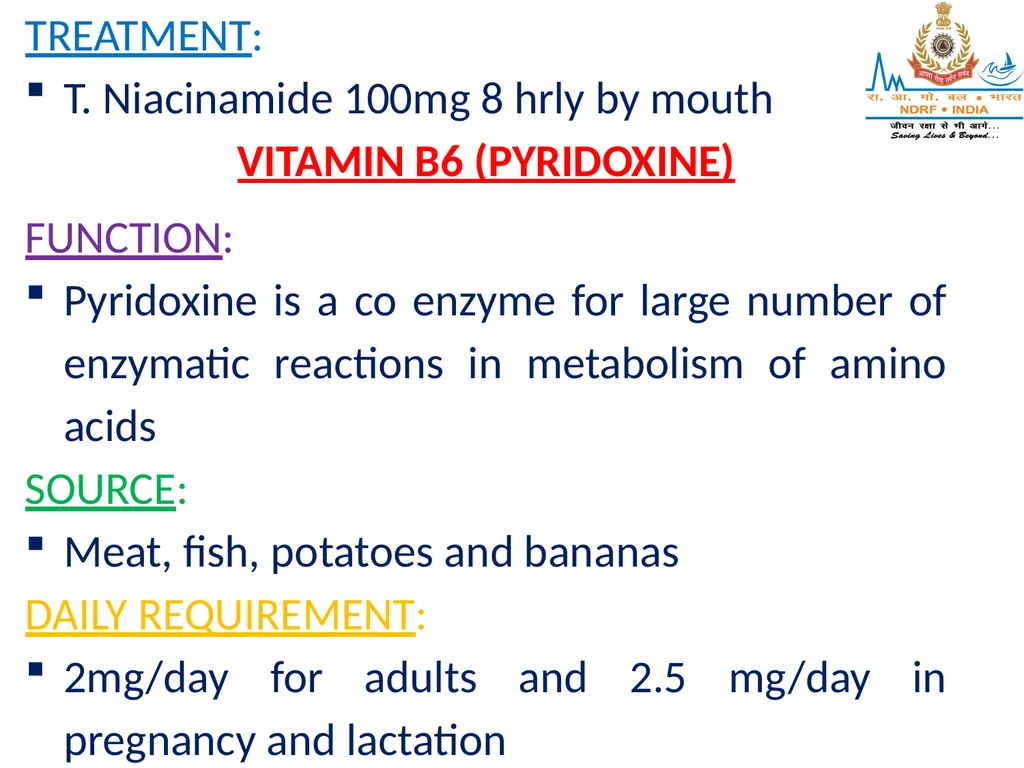
TREATMENT:
T. Niacinamide 100mg 8 hrly by mouth
VITAMIN B6 (PYRIDOXINE)
FUNCTION:
Pyridoxine is a co enzyme for large number of enzymatic reactions in metabolism of amino acids
SOURCE:
Meat, fish, potatoes and bananas
DAILY REQUIREMENT:
2mg/day for adults and 2.5 mg/day in pregnancy and lactation<br>
T. Niacinamide 100mg 8 hrly by mouth
VITAMIN B6 (PYRIDOXINE)
FUNCTION:
Pyridoxine is a co enzyme for large number of enzymatic reactions in metabolism of amino acids
SOURCE:
Meat, fish, potatoes and bananas
DAILY REQUIREMENT:
2mg/day for adults and 2.5 mg/day in pregnancy and lactation<br>
22
DEFICIENCY:
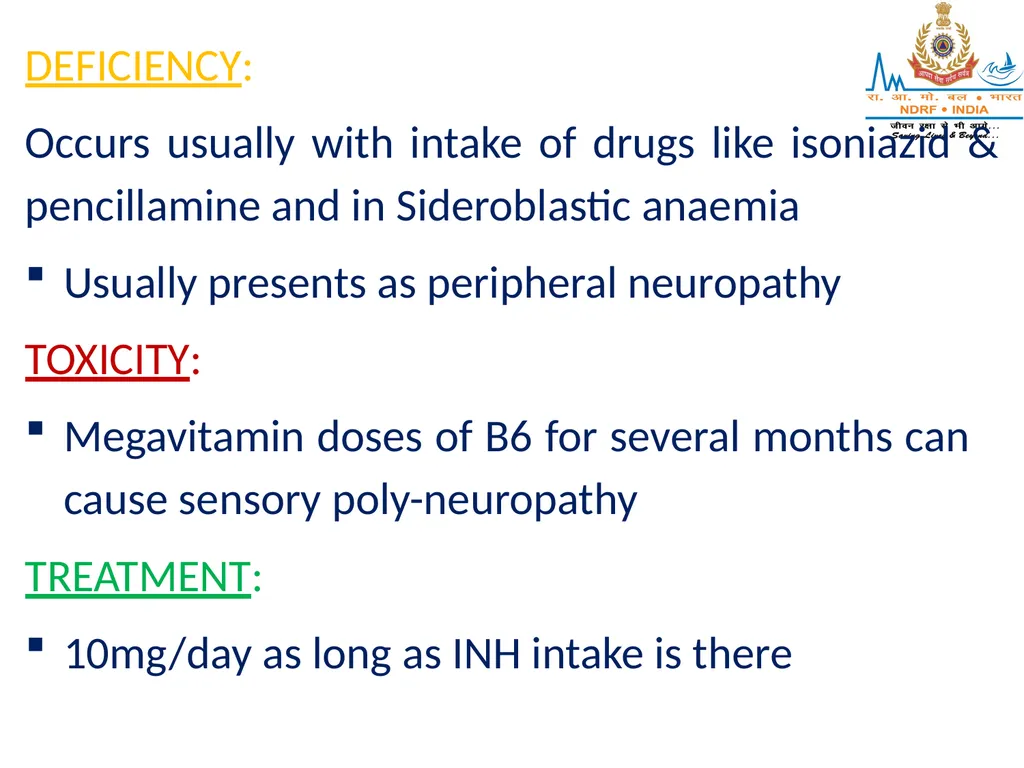
Occurs usually with intake of drugs like isoniazid & pencillamine and in Sideroblastic anaemia
Usually presents as peripheral neuropathy
TOXICITY:
Megavitamin doses of B6 for several months can cause sensory poly-neuropathy
TREATMENT:
10mg/day as long as INH intake is there<br>
Occurs usually with intake of drugs like isoniazid & pencillamine and in Sideroblastic anaemia
Usually presents as peripheral neuropathy
TOXICITY:
Megavitamin doses of B6 for several months can cause sensory poly-neuropathy
TREATMENT:
10mg/day as long as INH intake is there<br>
23
BIOTIN
FUNCTION:
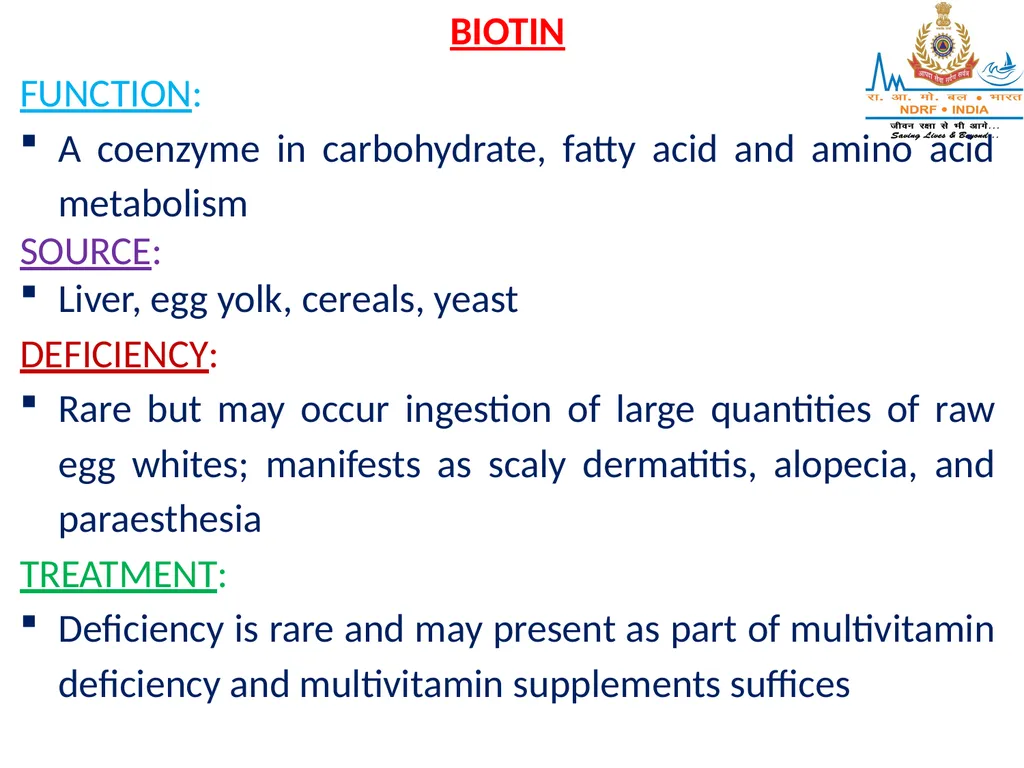
A coenzyme in carbohydrate, fatty acid and amino acid metabolism
SOURCE:
Liver, egg yolk, cereals, yeast
DEFICIENCY:
Rare but may occur ingestion of large quantities of raw egg whites; manifests as scaly dermatitis, alopecia, and paraesthesia
TREATMENT:
Deficiency is rare and may present as part of multivitamin deficiency and multivitamin supplements suffices<br>
24
VITAMIN B12 AND FOLATE: (COBALAMIN AND FOLIC ACID)
FUNCTION:
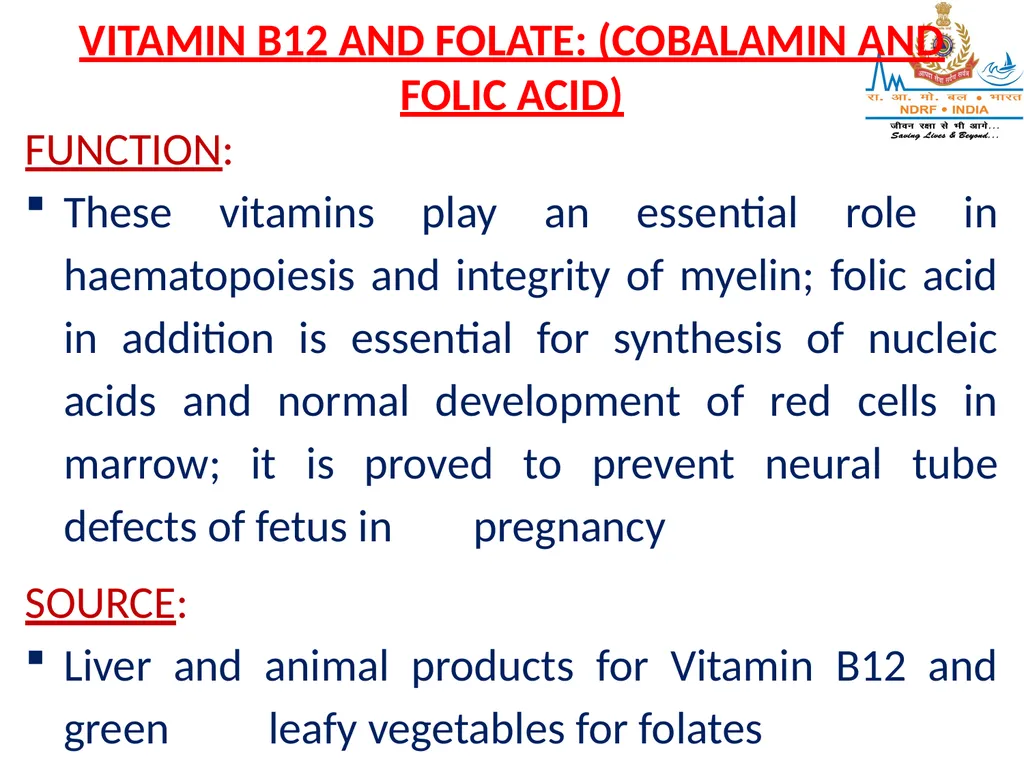
These vitamins play an essential role in haematopoiesis and integrity of myelin; folic acid in addition is essential for synthesis of nucleic acids and normal development of red cells in marrow; it is proved to prevent neural tube defects of fetus in pregnancy
SOURCE:
Liver and animal products for Vitamin B12 and green leafy vegetables for folates<br>
25
DAILY REQUIREMENT OF FOLIC ACID & VITAMIN B12:
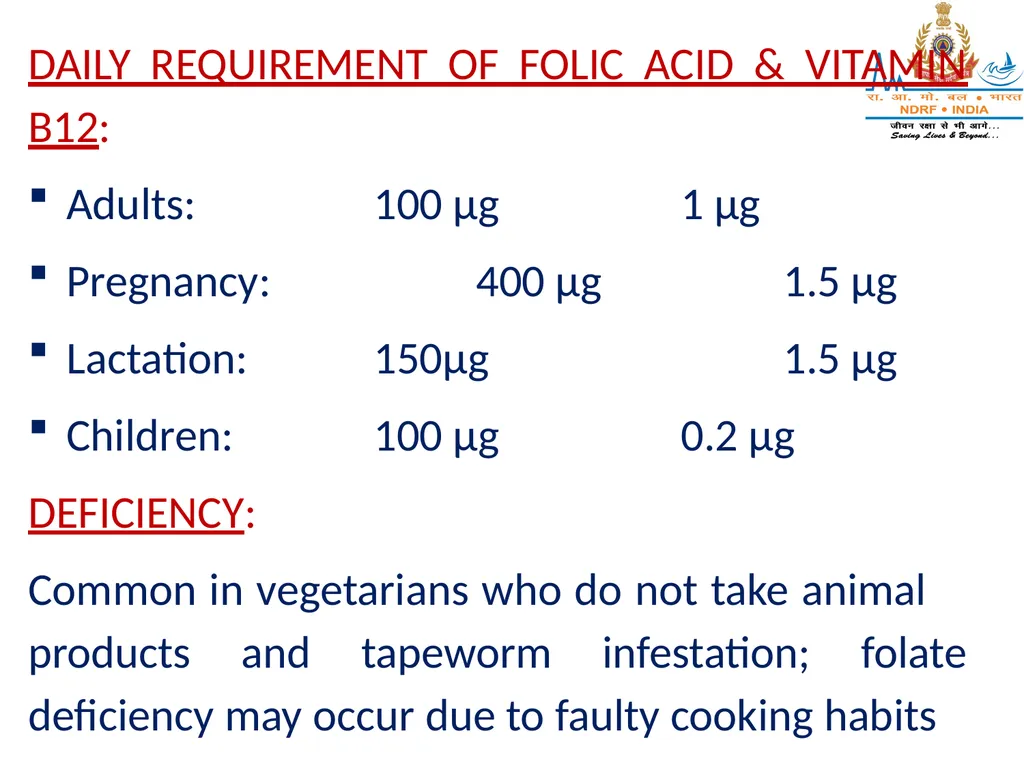
Adults: 100 µg 1 µg
Pregnancy: 400 µg 1.5 µg
Lactation: 150µg 1.5 µg
Children: 100 µg 0.2 µg
DEFICIENCY:
Common in vegetarians who do not take animal products and tapeworm infestation; folate deficiency may occur due to faulty cooking habits<br>
Adults: 100 µg 1 µg
Pregnancy: 400 µg 1.5 µg
Lactation: 150µg 1.5 µg
Children: 100 µg 0.2 µg
DEFICIENCY:
Common in vegetarians who do not take animal products and tapeworm infestation; folate deficiency may occur due to faulty cooking habits<br>
26
Deficiency of Vitamin B12 will cause megaloblastic anaemia, neurological degeneration (subacute degeneration of spinal cord)
Folic acid deficiency will cause glossitis, cheilosis and gastrointestinal disturbances like diarrhea, distension and flatulence as well birth defects like spina bifida, anenecephaly and encephalocele<br>
Folic acid deficiency will cause glossitis, cheilosis and gastrointestinal disturbances like diarrhea, distension and flatulence as well birth defects like spina bifida, anenecephaly and encephalocele<br>
27
TREATMENT:
Hydroxy cobalamin injection 1000µg IM weekly
Prevention of neural tube defects: T. Folic acid 5 mg tds daily before conception upto third trimester of pregnancy<br>
Hydroxy cobalamin injection 1000µg IM weekly
Prevention of neural tube defects: T. Folic acid 5 mg tds daily before conception upto third trimester of pregnancy<br>
28
VITAMIN C (ASCORBIC ACID)
FUNCTION:
Involved in intracellular electron transfer – tissue oxidation
Necessary for formation of collagen and connective tissue
Plays a part in immune function and in iron absorption also
SOURCE:
Fresh fruit and green leafy vegetables<br>
FUNCTION:
Involved in intracellular electron transfer – tissue oxidation
Necessary for formation of collagen and connective tissue
Plays a part in immune function and in iron absorption also
SOURCE:
Fresh fruit and green leafy vegetables<br>
29
VITAMIN C (ASCORBIC ACID)
DEFICIENCY:
Occurs when fresh fruit or vegetable is not taken for 2 – 3months; demand for Vitamin C is also increased in trauma, surgery, burns, infections, smoking and intake of certain drugs. Manifests as Scurvy -
Characteristic sign is swollen and spongy gums,
which bleed easily
Spontaneous bruising<br>
30
Hemorrhage into joint or into gastrointestinal tract
Anaemia
Fresh wounds fail to heal due to defective collagen formation
DAILY REQUIREMENT:
In adults, it is 40 -60 mg per day<br>
Anaemia
Fresh wounds fail to heal due to defective collagen formation
DAILY REQUIREMENT:
In adults, it is 40 -60 mg per day<br>
31
TOXICITY:
Intake of more than 1 g daily will cause diarrhea and formation of renal oxalate stones
TREATMENT:
T. Ascorbic acid 250mg 8 hourly is advocated in scurvy; in our troops where fresh vegetable at forward locations is infrequent T. Ascorbic acid 500mg daily will be ideal<br>
Intake of more than 1 g daily will cause diarrhea and formation of renal oxalate stones
TREATMENT:
T. Ascorbic acid 250mg 8 hourly is advocated in scurvy; in our troops where fresh vegetable at forward locations is infrequent T. Ascorbic acid 500mg daily will be ideal<br>
32
ANY QUESTION THANKS<br>