
VPDP update: Respiratory Planning and Delivery
TD
Published · 79 slides · 0 views

1 / 1








Description
VPDP update: Respiratory Planning and Delivery Meeting Hawys Youlden, Lead Nurse Immunisation Vaccine Preventable Disease Programme Public Health Wales Version 1 11 September 2026 COVID-19 Vaccination Autumn 2026 Vaccinations recommended
Related Topics
Download this presentation From Below
"VPDP update: Respiratory Planning and Delivery" is the property of its rightful owner. Permission is granted to download and print the materials on this website for personal, non-commercial use only, and to display it on your personal computer provided you do not modify the materials and that you retain all copyright notices contained in the materials. By downloading content from our website, you accept the terms of this agreement.
Share
Embed code
Presentation Transcript
01
VPDP update: Respiratory Planning and Delivery Meeting Hawys Youlden, Lead Nurse Immunisation Vaccine Preventable Disease Programme
Public Health Wales
Version 1
11 September 2026 COVID-19 Vaccination – Autumn 2026
Vaccinations recommended for children and young people,
and adults
<br>
Public Health Wales
Version 1
11 September 2026 COVID-19 Vaccination – Autumn 2026
Vaccinations recommended for children and young people,
and adults
<br>
02
** Awaiting the publication of updated COVID -19 green book chapter ** To support timeliness of local COVID-19 training sessions, VPDP have made a decision to share these training slides before the green book is published, therefore they may be subject to change
Once the COVID-19 green book chapter is published, this training slide set will be reviewed and updated to version 2 2<br>
Once the COVID-19 green book chapter is published, this training slide set will be reviewed and updated to version 2 2<br>
03
**Accord (HIPRA)® BIMERVAX LP.8.1 40 microgram per dose COVID-19 vaccine** Accord (HIPRA)® BIMERVAX LP.8.1 40 microgram per dose COVID-19 vaccine has been approved by MHRA for use in the autumn COVID-19 campaign
Product information for COVID-19 vaccines included in this training slide set is normally linked to the electronic medicines compendium (emc). The Summary of Product Characteristics (SmPC) for Accord (HIPRA)® BIMERVAX LP.8.1 is not available on emc; therefore, the current MHRA-approved SmPC is provided directly below and within the relevant slides:
Accord (HIPRA)® BIMERVAX LP.8.1 SUMMARY OF PRODUCT CHARACTERISTICS 3<br>
Product information for COVID-19 vaccines included in this training slide set is normally linked to the electronic medicines compendium (emc). The Summary of Product Characteristics (SmPC) for Accord (HIPRA)® BIMERVAX LP.8.1 is not available on emc; therefore, the current MHRA-approved SmPC is provided directly below and within the relevant slides:
Accord (HIPRA)® BIMERVAX LP.8.1 SUMMARY OF PRODUCT CHARACTERISTICS 3<br>
04
Acknowledgements Vaccine Preventable Disease Programme
Vaccine Programme Wales
Welsh Medicines Advice Service
Welsh Government
JCVI
UKHSA
Green Book 4<br>
Vaccine Programme Wales
Welsh Medicines Advice Service
Welsh Government
JCVI
UKHSA
Green Book 4<br>
05
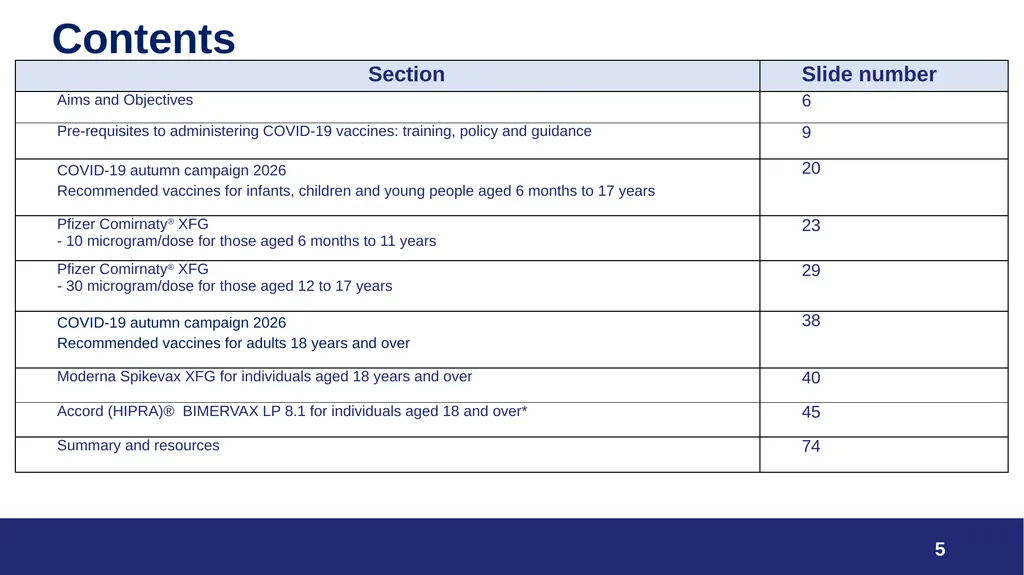
Contents 5<br>
06
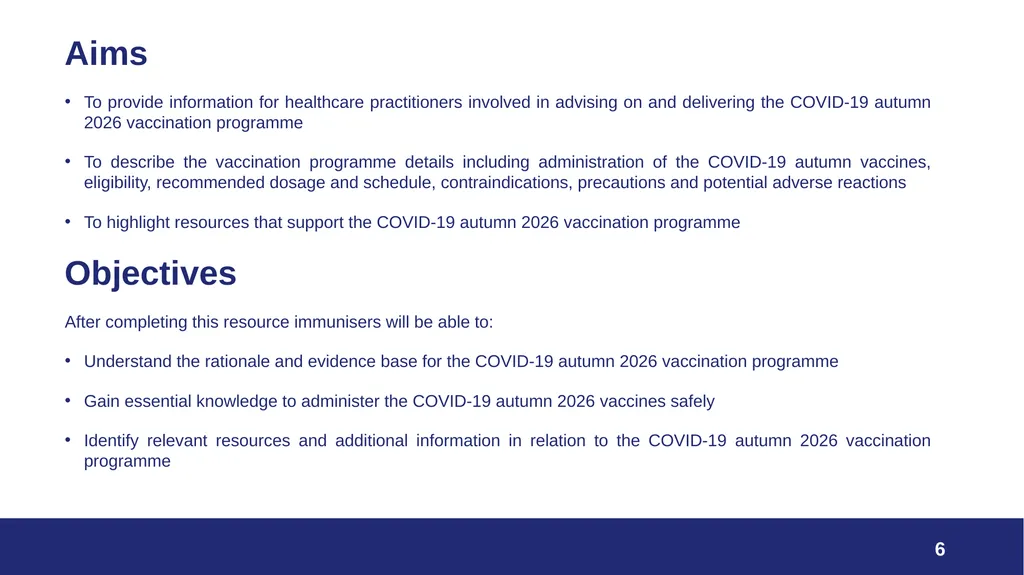
Aims
To provide information for healthcare practitioners involved in advising on and delivering the COVID-19 autumn 2026 vaccination programme
To describe the vaccination programme details including administration of the COVID-19 autumn vaccines, eligibility, recommended dosage and schedule, contraindications, precautions and potential adverse reactions
To highlight resources that support the COVID-19 autumn 2026 vaccination programme
Objectives
After completing this resource immunisers will be able to:
Understand the rationale and evidence base for the COVID-19 autumn 2026 vaccination programme
Gain essential knowledge to administer the COVID-19 autumn 2026 vaccines safely
Identify relevant resources and additional information in relation to the COVID-19 autumn 2026 vaccination programme 6<br>
To provide information for healthcare practitioners involved in advising on and delivering the COVID-19 autumn 2026 vaccination programme
To describe the vaccination programme details including administration of the COVID-19 autumn vaccines, eligibility, recommended dosage and schedule, contraindications, precautions and potential adverse reactions
To highlight resources that support the COVID-19 autumn 2026 vaccination programme
Objectives
After completing this resource immunisers will be able to:
Understand the rationale and evidence base for the COVID-19 autumn 2026 vaccination programme
Gain essential knowledge to administer the COVID-19 autumn 2026 vaccines safely
Identify relevant resources and additional information in relation to the COVID-19 autumn 2026 vaccination programme 6<br>
07
Pre-requisites to administering COVID-19 vaccines: training, policy and guidance and guidance<br>
08
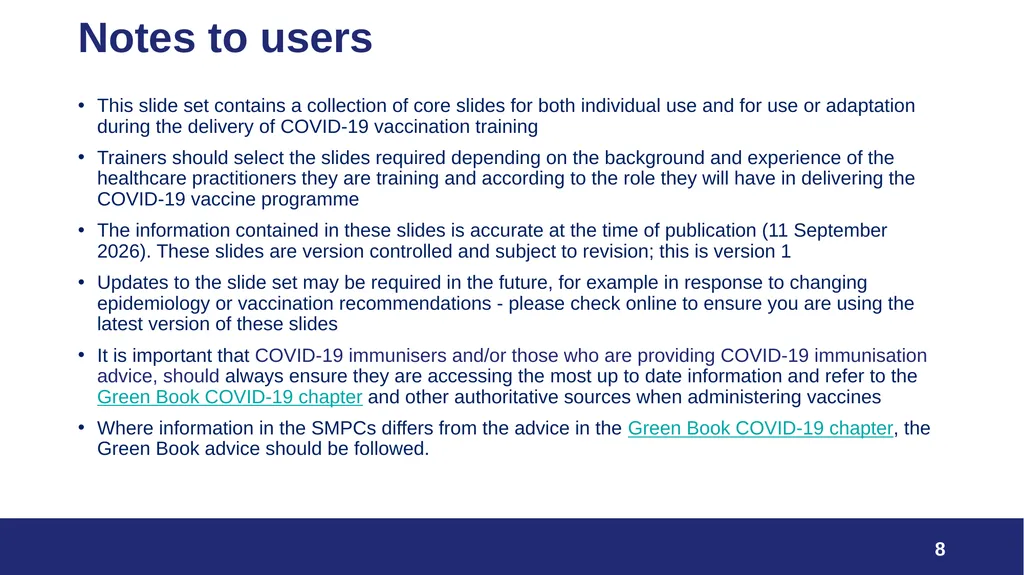
Notes to users This slide set contains a collection of core slides for both individual use and for use or adaptation during the delivery of COVID-19 vaccination training
Trainers should select the slides required depending on the background and experience of the healthcare practitioners they are training and according to the role they will have in delivering the COVID-19 vaccine programme
The information contained in these slides is accurate at the time of publication (11 September 2026). These slides are version controlled and subject to revision; this is version 1
Updates to the slide set may be required in the future, for example in response to changing epidemiology or vaccination recommendations - please check online to ensure you are using the latest version of these slides
It is important that COVID-19 immunisers and/or those who are providing COVID-19 immunisation advice, should always ensure they are accessing the most up to date information and refer to the Green Book COVID-19 chapter and other authoritative sources when administering vaccines
Where information in the SMPCs differs from the advice in the Green Book COVID-19 chapter, the Green Book advice should be followed. 8<br>
Trainers should select the slides required depending on the background and experience of the healthcare practitioners they are training and according to the role they will have in delivering the COVID-19 vaccine programme
The information contained in these slides is accurate at the time of publication (11 September 2026). These slides are version controlled and subject to revision; this is version 1
Updates to the slide set may be required in the future, for example in response to changing epidemiology or vaccination recommendations - please check online to ensure you are using the latest version of these slides
It is important that COVID-19 immunisers and/or those who are providing COVID-19 immunisation advice, should always ensure they are accessing the most up to date information and refer to the Green Book COVID-19 chapter and other authoritative sources when administering vaccines
Where information in the SMPCs differs from the advice in the Green Book COVID-19 chapter, the Green Book advice should be followed. 8<br>
09
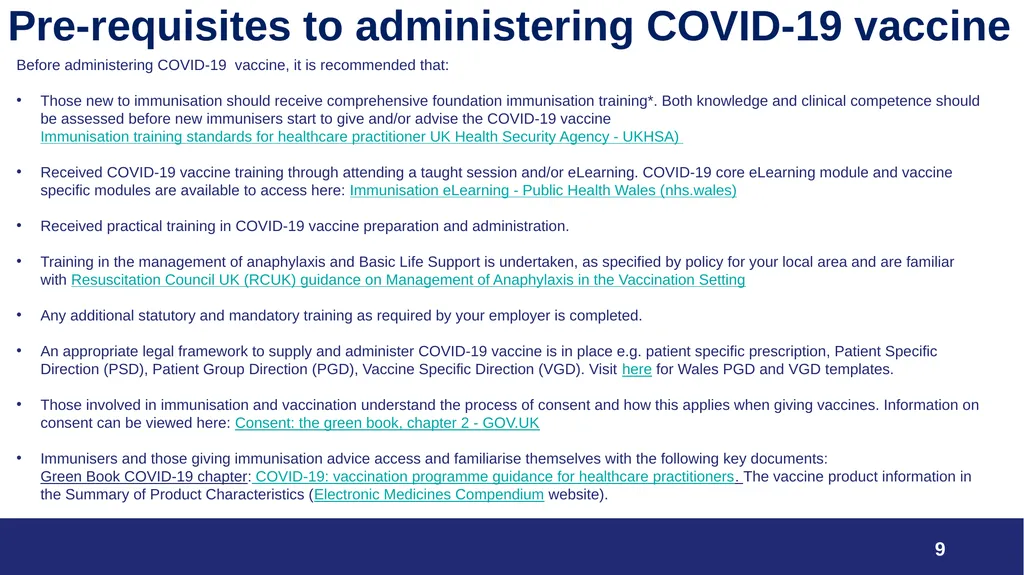
Pre-requisites to administering COVID-19 vaccine Before administering COVID-19 vaccine, it is recommended that:
Those new to immunisation should receive comprehensive foundation immunisation training*. Both knowledge and clinical competence should be assessed before new immunisers start to give and/or advise the COVID-19 vaccine Immunisation training standards for healthcare practitioner UK Health Security Agency - UKHSA)
Received COVID-19 vaccine training through attending a taught session and/or eLearning. COVID-19 core eLearning module and vaccine specific modules are available to access here: Immunisation eLearning - Public Health Wales (nhs.wales)
Received practical training in COVID-19 vaccine preparation and administration.
Training in the management of anaphylaxis and Basic Life Support is undertaken, as specified by policy for your local area and are familiar with Resuscitation Council UK (RCUK) guidance on Management of Anaphylaxis in the Vaccination Setting
Any additional statutory and mandatory training as required by your employer is completed.
An appropriate legal framework to supply and administer COVID-19 vaccine is in place e.g. patient specific prescription, Patient Specific Direction (PSD), Patient Group Direction (PGD), Vaccine Specific Direction (VGD). Visit here for Wales PGD and VGD templates.
Those involved in immunisation and vaccination understand the process of consent and how this applies when giving vaccines. Information on consent can be viewed here: Consent: the green book, chapter 2 - GOV.UK
Immunisers and those giving immunisation advice access and familiarise themselves with the following key documents: Green Book COVID-19 chapter: COVID-19: vaccination programme guidance for healthcare practitioners. The vaccine product information in the Summary of Product Characteristics (Electronic Medicines Compendium website). 9<br>
Those new to immunisation should receive comprehensive foundation immunisation training*. Both knowledge and clinical competence should be assessed before new immunisers start to give and/or advise the COVID-19 vaccine Immunisation training standards for healthcare practitioner UK Health Security Agency - UKHSA)
Received COVID-19 vaccine training through attending a taught session and/or eLearning. COVID-19 core eLearning module and vaccine specific modules are available to access here: Immunisation eLearning - Public Health Wales (nhs.wales)
Received practical training in COVID-19 vaccine preparation and administration.
Training in the management of anaphylaxis and Basic Life Support is undertaken, as specified by policy for your local area and are familiar with Resuscitation Council UK (RCUK) guidance on Management of Anaphylaxis in the Vaccination Setting
Any additional statutory and mandatory training as required by your employer is completed.
An appropriate legal framework to supply and administer COVID-19 vaccine is in place e.g. patient specific prescription, Patient Specific Direction (PSD), Patient Group Direction (PGD), Vaccine Specific Direction (VGD). Visit here for Wales PGD and VGD templates.
Those involved in immunisation and vaccination understand the process of consent and how this applies when giving vaccines. Information on consent can be viewed here: Consent: the green book, chapter 2 - GOV.UK
Immunisers and those giving immunisation advice access and familiarise themselves with the following key documents: Green Book COVID-19 chapter: COVID-19: vaccination programme guidance for healthcare practitioners. The vaccine product information in the Summary of Product Characteristics (Electronic Medicines Compendium website). 9<br>
10
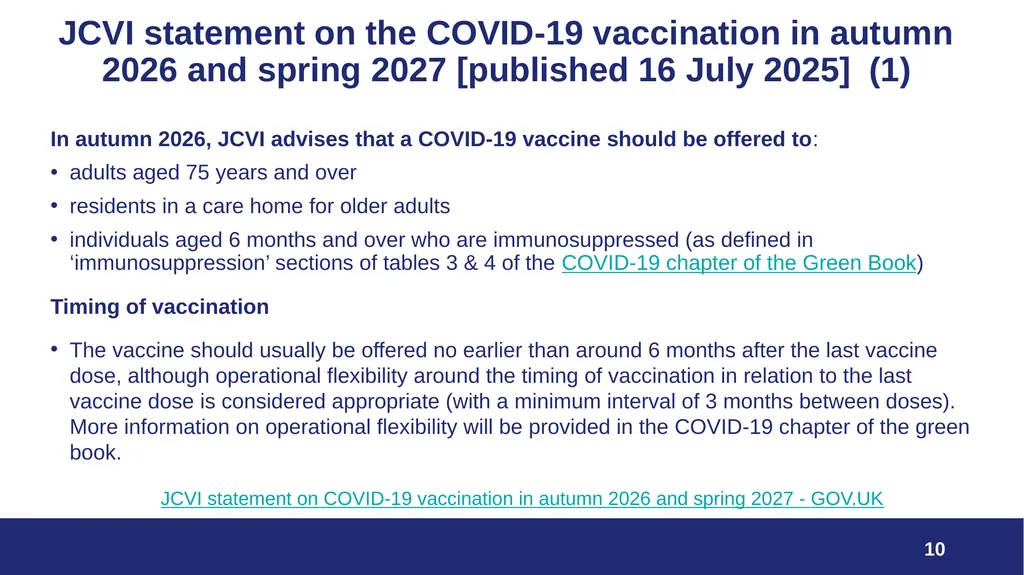
JCVI statement on the COVID-19 vaccination in autumn 2026 and spring 2027 [published 16 July 2025] (1) In autumn 2026, JCVI advises that a COVID-19 vaccine should be offered to:
adults aged 75 years and over
residents in a care home for older adults
individuals aged 6 months and over who are immunosuppressed (as defined in ‘immunosuppression’ sections of tables 3 & 4 of the COVID-19 chapter of the Green Book)
Timing of vaccination
The vaccine should usually be offered no earlier than around 6 months after the last vaccine dose, although operational flexibility around the timing of vaccination in relation to the last vaccine dose is considered appropriate (with a minimum interval of 3 months between doses). More information on operational flexibility will be provided in the COVID-19 chapter of the green book. 10 JCVI statement on COVID-19 vaccination in autumn 2026 and spring 2027 - GOV.UK<br>
adults aged 75 years and over
residents in a care home for older adults
individuals aged 6 months and over who are immunosuppressed (as defined in ‘immunosuppression’ sections of tables 3 & 4 of the COVID-19 chapter of the Green Book)
Timing of vaccination
The vaccine should usually be offered no earlier than around 6 months after the last vaccine dose, although operational flexibility around the timing of vaccination in relation to the last vaccine dose is considered appropriate (with a minimum interval of 3 months between doses). More information on operational flexibility will be provided in the COVID-19 chapter of the green book. 10 JCVI statement on COVID-19 vaccination in autumn 2026 and spring 2027 - GOV.UK<br>
11
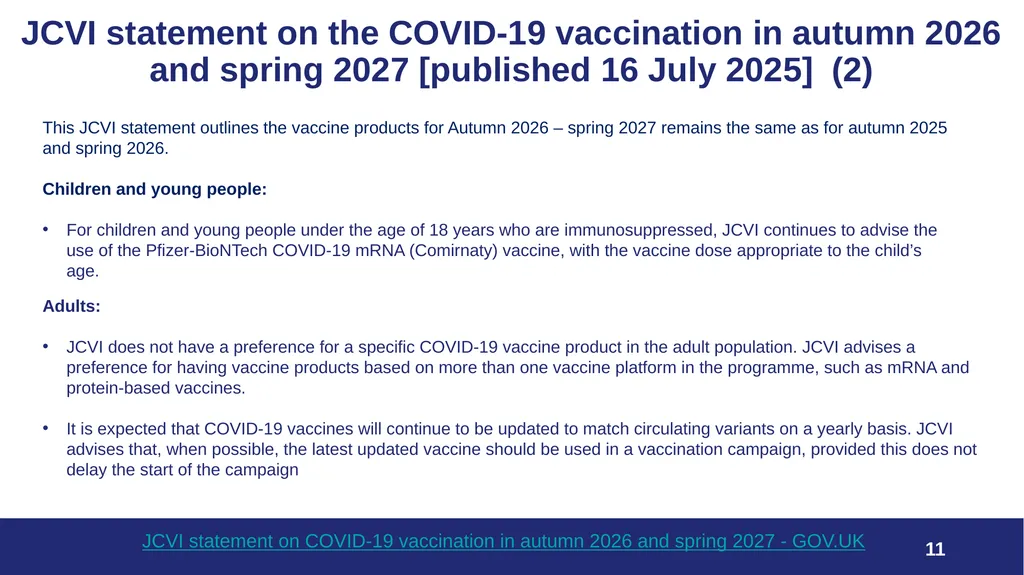
JCVI statement on the COVID-19 vaccination in autumn 2026 and spring 2027 [published 16 July 2025] (2) 11 This JCVI statement outlines the vaccine products for Autumn 2026 – spring 2027 remains the same as for autumn 2025 and spring 2026.
Children and young people:
For children and young people under the age of 18 years who are immunosuppressed, JCVI continues to advise the use of the Pfizer-BioNTech COVID-19 mRNA (Comirnaty) vaccine, with the vaccine dose appropriate to the child’s age. Adults:
JCVI does not have a preference for a specific COVID-19 vaccine product in the adult population. JCVI advises a preference for having vaccine products based on more than one vaccine platform in the programme, such as mRNA and protein-based vaccines.
It is expected that COVID-19 vaccines will continue to be updated to match circulating variants on a yearly basis. JCVI advises that, when possible, the latest updated vaccine should be used in a vaccination campaign, provided this does not delay the start of the campaign JCVI statement on COVID-19 vaccination in autumn 2026 and spring 2027 - GOV.UK<br>
Children and young people:
For children and young people under the age of 18 years who are immunosuppressed, JCVI continues to advise the use of the Pfizer-BioNTech COVID-19 mRNA (Comirnaty) vaccine, with the vaccine dose appropriate to the child’s age. Adults:
JCVI does not have a preference for a specific COVID-19 vaccine product in the adult population. JCVI advises a preference for having vaccine products based on more than one vaccine platform in the programme, such as mRNA and protein-based vaccines.
It is expected that COVID-19 vaccines will continue to be updated to match circulating variants on a yearly basis. JCVI advises that, when possible, the latest updated vaccine should be used in a vaccination campaign, provided this does not delay the start of the campaign JCVI statement on COVID-19 vaccination in autumn 2026 and spring 2027 - GOV.UK<br>
12
COVID-19 autumn vaccination programme 2026,
Welsh Health Circular (WHC/2026/009)
published 1 July 2026 (1) Groups eligible for a COVID-19 vaccine in autumn 2026:
adults aged 75 years and over on 31 January 2027
residents in a care home for older adults
individuals aged 6 months and over who are immunosuppressed (as defined in tables 3 or 4 in COVID-19: the green book chapter)
Programme start and end date:
The programme will commence as soon as vaccines and the relevant legal authority (Vaccine Group Direction and Patient Group Direction) are available in October 2026 and concludes on 31 January 2027. 12 The national COVID-19 vaccination programme autumn 2026 (WHC/2026/009) | GOV.WALES<br>
adults aged 75 years and over on 31 January 2027
residents in a care home for older adults
individuals aged 6 months and over who are immunosuppressed (as defined in tables 3 or 4 in COVID-19: the green book chapter)
Programme start and end date:
The programme will commence as soon as vaccines and the relevant legal authority (Vaccine Group Direction and Patient Group Direction) are available in October 2026 and concludes on 31 January 2027. 12 The national COVID-19 vaccination programme autumn 2026 (WHC/2026/009) | GOV.WALES<br>
13
COVID-19 autumn vaccination programme 2026,
Welsh Health Circular (WHC/2026/009)
published 1 July 2026 (2) Programme ambitions include:
The target across all eligible groups is 75%
Health boards (HBs) should make every effort to maximise uptake across all cohorts ensuring that:
Where existing uptake is below 75% HB’s are to show improved delivery and increase in vaccination uptake compared to last year across all eligible cohorts.
Evidence of interventions adopted locally to decrease the gap in vaccine uptake between the most and least deprived communities.
Every effort should be made to ensure taking up a vaccination offer is as accessible as possible. 13 For further information, see: The national COVID-19 vaccination programme autumn 2026 (WHC/2026/009) | GOV.WALES<br>
The target across all eligible groups is 75%
Health boards (HBs) should make every effort to maximise uptake across all cohorts ensuring that:
Where existing uptake is below 75% HB’s are to show improved delivery and increase in vaccination uptake compared to last year across all eligible cohorts.
Evidence of interventions adopted locally to decrease the gap in vaccine uptake between the most and least deprived communities.
Every effort should be made to ensure taking up a vaccination offer is as accessible as possible. 13 For further information, see: The national COVID-19 vaccination programme autumn 2026 (WHC/2026/009) | GOV.WALES<br>
14
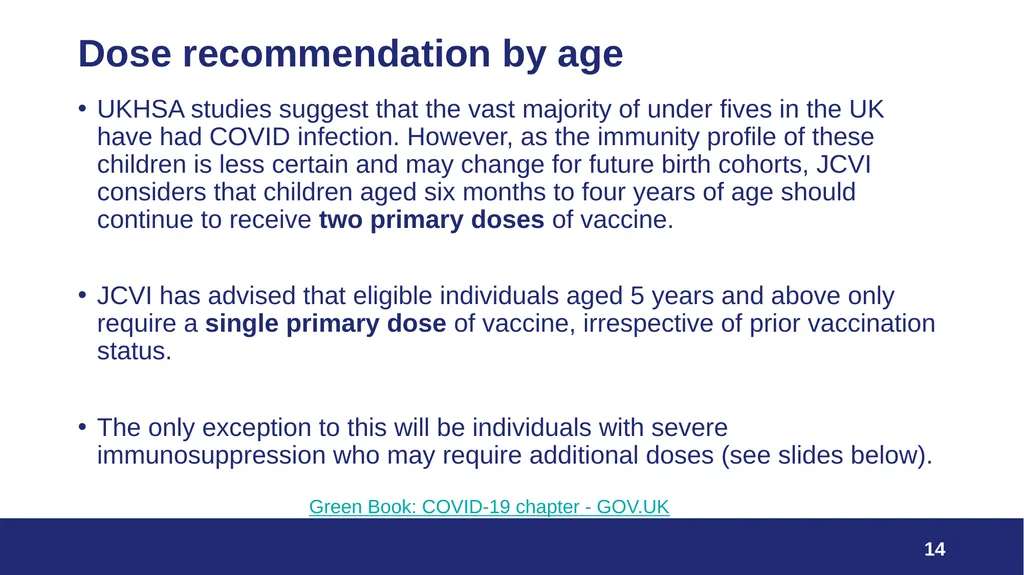
UKHSA studies suggest that the vast majority of under fives in the UK have had COVID infection. However, as the immunity profile of these children is less certain and may change for future birth cohorts, JCVI considers that children aged six months to four years of age should continue to receive two primary doses of vaccine.
JCVI has advised that eligible individuals aged 5 years and above only require a single primary dose of vaccine, irrespective of prior vaccination status.
The only exception to this will be individuals with severe immunosuppression who may require additional doses (see slides below). 14 Dose recommendation by age Green Book: COVID-19 chapter - GOV.UK<br>
JCVI has advised that eligible individuals aged 5 years and above only require a single primary dose of vaccine, irrespective of prior vaccination status.
The only exception to this will be individuals with severe immunosuppression who may require additional doses (see slides below). 14 Dose recommendation by age Green Book: COVID-19 chapter - GOV.UK<br>
15
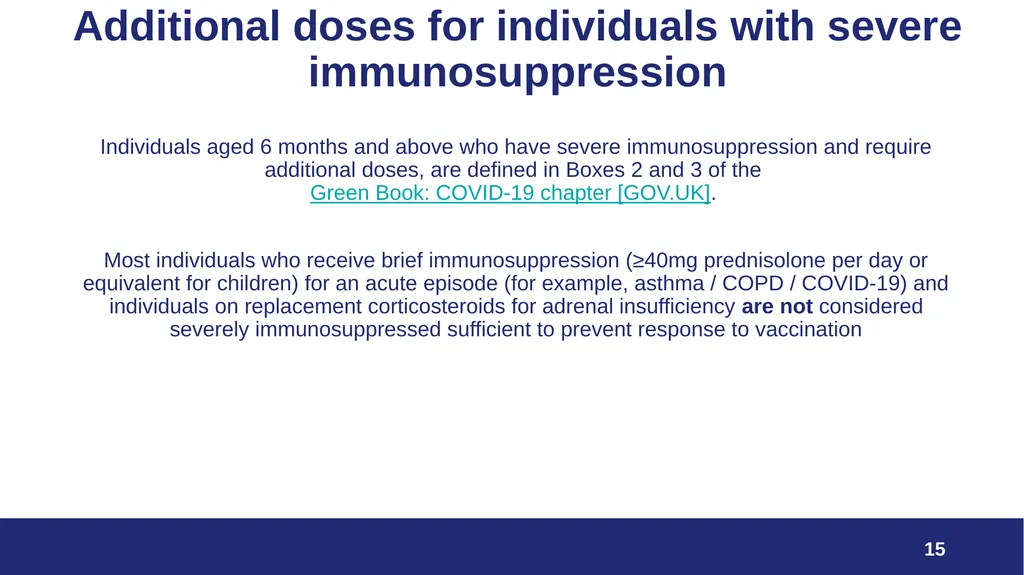
Individuals aged 6 months and above who have severe immunosuppression and require additional doses, are defined in Boxes 2 and 3 of the Green Book: COVID-19 chapter [GOV.UK].
Most individuals who receive brief immunosuppression (≥40mg prednisolone per day or equivalent for children) for an acute episode (for example, asthma / COPD / COVID-19) and individuals on replacement corticosteroids for adrenal insufficiency are not considered severely immunosuppressed sufficient to prevent response to vaccination 15 Additional doses for individuals with severe immunosuppression<br>
Most individuals who receive brief immunosuppression (≥40mg prednisolone per day or equivalent for children) for an acute episode (for example, asthma / COPD / COVID-19) and individuals on replacement corticosteroids for adrenal insufficiency are not considered severely immunosuppressed sufficient to prevent response to vaccination 15 Additional doses for individuals with severe immunosuppression<br>
16
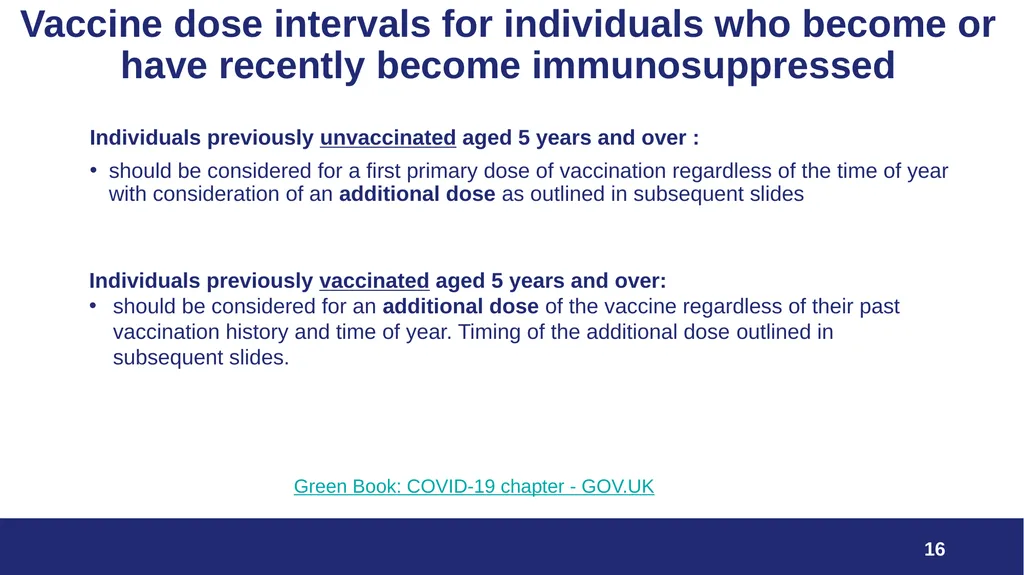
Vaccine dose intervals for individuals who become or have recently become immunosuppressed 16 Individuals previously unvaccinated aged 5 years and over :
should be considered for a first primary dose of vaccination regardless of the time of year with consideration of an additional dose as outlined in subsequent slides Individuals previously vaccinated aged 5 years and over:
should be considered for an additional dose of the vaccine regardless of their past vaccination history and time of year. Timing of the additional dose outlined in subsequent slides. Green Book: COVID-19 chapter - GOV.UK<br>
should be considered for a first primary dose of vaccination regardless of the time of year with consideration of an additional dose as outlined in subsequent slides Individuals previously vaccinated aged 5 years and over:
should be considered for an additional dose of the vaccine regardless of their past vaccination history and time of year. Timing of the additional dose outlined in subsequent slides. Green Book: COVID-19 chapter - GOV.UK<br>
17
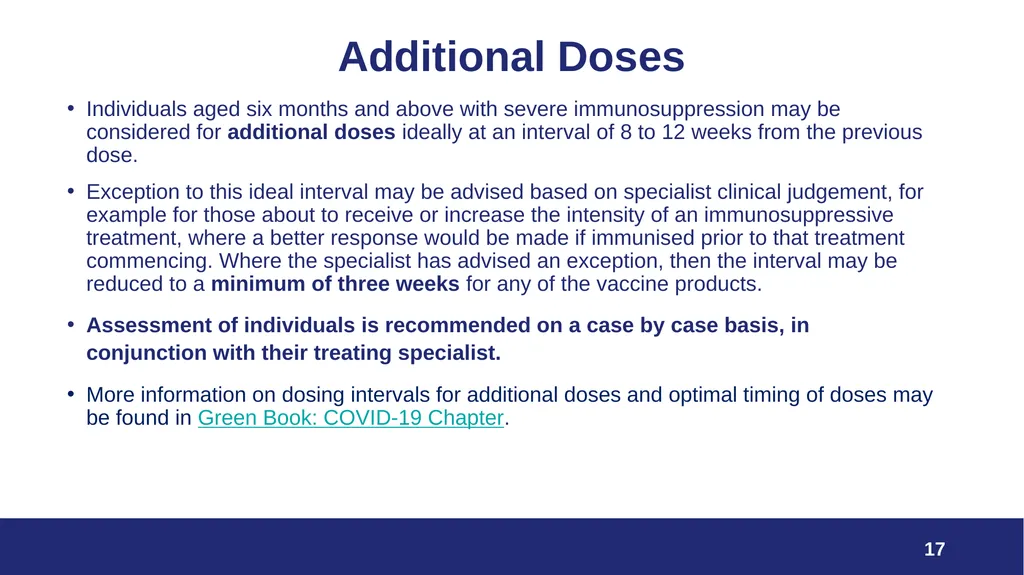
Additional Doses Individuals aged six months and above with severe immunosuppression may be considered for additional doses ideally at an interval of 8 to 12 weeks from the previous dose.
Exception to this ideal interval may be advised based on specialist clinical judgement, for example for those about to receive or increase the intensity of an immunosuppressive treatment, where a better response would be made if immunised prior to that treatment commencing. Where the specialist has advised an exception, then the interval may be reduced to a minimum of three weeks for any of the vaccine products.
Assessment of individuals is recommended on a case by case basis, in conjunction with their treating specialist.
More information on dosing intervals for additional doses and optimal timing of doses may be found in Green Book: COVID-19 Chapter. 17<br>
Exception to this ideal interval may be advised based on specialist clinical judgement, for example for those about to receive or increase the intensity of an immunosuppressive treatment, where a better response would be made if immunised prior to that treatment commencing. Where the specialist has advised an exception, then the interval may be reduced to a minimum of three weeks for any of the vaccine products.
Assessment of individuals is recommended on a case by case basis, in conjunction with their treating specialist.
More information on dosing intervals for additional doses and optimal timing of doses may be found in Green Book: COVID-19 Chapter. 17<br>
18
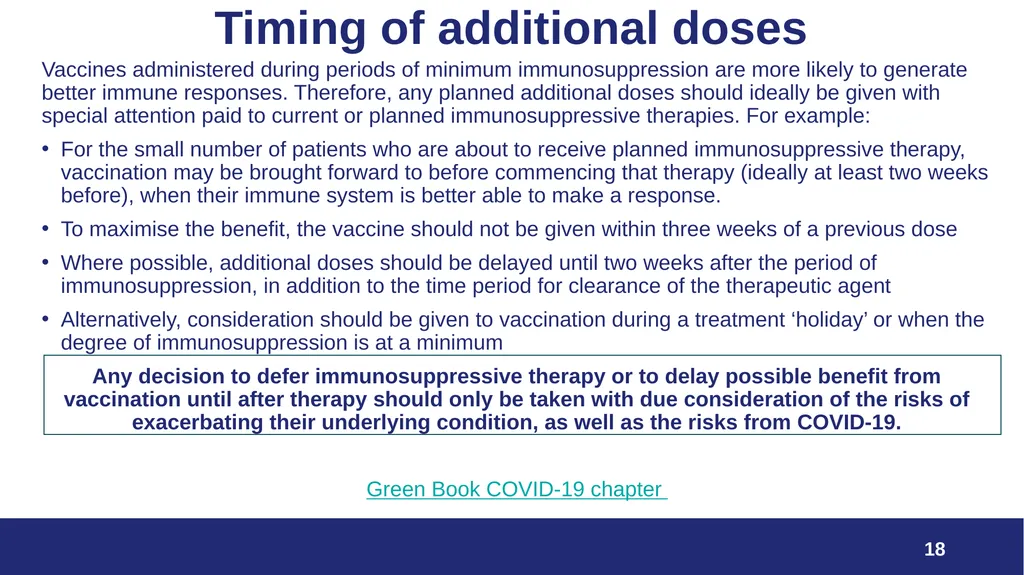
Timing of additional doses Vaccines administered during periods of minimum immunosuppression are more likely to generate better immune responses. Therefore, any planned additional doses should ideally be given with special attention paid to current or planned immunosuppressive therapies. For example:
For the small number of patients who are about to receive planned immunosuppressive therapy, vaccination may be brought forward to before commencing that therapy (ideally at least two weeks before), when their immune system is better able to make a response.
To maximise the benefit, the vaccine should not be given within three weeks of a previous dose
Where possible, additional doses should be delayed until two weeks after the period of immunosuppression, in addition to the time period for clearance of the therapeutic agent
Alternatively, consideration should be given to vaccination during a treatment ‘holiday’ or when the degree of immunosuppression is at a minimum
Any decision to defer immunosuppressive therapy or to delay possible benefit from vaccination until after therapy should only be taken with due consideration of the risks of exacerbating their underlying condition, as well as the risks from COVID-19.
Green Book COVID-19 chapter 18<br>
For the small number of patients who are about to receive planned immunosuppressive therapy, vaccination may be brought forward to before commencing that therapy (ideally at least two weeks before), when their immune system is better able to make a response.
To maximise the benefit, the vaccine should not be given within three weeks of a previous dose
Where possible, additional doses should be delayed until two weeks after the period of immunosuppression, in addition to the time period for clearance of the therapeutic agent
Alternatively, consideration should be given to vaccination during a treatment ‘holiday’ or when the degree of immunosuppression is at a minimum
Any decision to defer immunosuppressive therapy or to delay possible benefit from vaccination until after therapy should only be taken with due consideration of the risks of exacerbating their underlying condition, as well as the risks from COVID-19.
Green Book COVID-19 chapter 18<br>
19
Individuals who receive bone marrow transplant and CAR-T therapy These individuals may lose immunological memory from vaccination received prior to the treatment and the development of the underlying condition.
After treatment and recovery, these individuals should be considered for a full course of revaccination for all vaccines used in the routine programme (see Green Book: Immunisation of individuals with underlying medical conditions Chapter) under specialist advice.
Individuals who have recovered from a bone marrow transplant should be considered for a first dose of COVID-19 vaccine, regardless of the time of year.
A subsequent dose should then be offered ideally at an interval of 8 to 12 weeks, to extend the duration of protection. This interval may be reduced to a minimum of three weeks on specialist clinical advice.
Those who remain immunosuppressed will then continue to be eligible for seasonal campaigns. 19<br>
After treatment and recovery, these individuals should be considered for a full course of revaccination for all vaccines used in the routine programme (see Green Book: Immunisation of individuals with underlying medical conditions Chapter) under specialist advice.
Individuals who have recovered from a bone marrow transplant should be considered for a first dose of COVID-19 vaccine, regardless of the time of year.
A subsequent dose should then be offered ideally at an interval of 8 to 12 weeks, to extend the duration of protection. This interval may be reduced to a minimum of three weeks on specialist clinical advice.
Those who remain immunosuppressed will then continue to be eligible for seasonal campaigns. 19<br>
20
COVID-19 autumn campaign 2026
Recommended vaccines for infants, children and young people aged 6 months to 17 years<br>
Recommended vaccines for infants, children and young people aged 6 months to 17 years<br>
21
21<br>
22
Dosing and schedule Children aged 6 months to 4 years:
JCVI advises that children aged 6 months to 4 years who are immunosuppressed (as defined in table 4 of the COVID-19 Green Book Chapter) should be offered two primary doses of COVID-19 vaccine.
JCVI advises that all second and any subsequent seasonal doses should be given at a minimum interval of three months from their previous dose.
Children 5 years and above:
JCVI advises that children aged 5 years and above should be offered a single dose of COVID-19 vaccination irrespective of prior vaccination status, providing there is at least three months from the previous dose.
To note:
Individuals aged six months and above with severe immunosuppression (see ‘Box 2 & 3’ of the COVID-19 Green Book Chapter) may be considered for additional doses ideally at an interval of 8 to 12 weeks from the previous dose. Where the specialist has advised an exception, then the interval may be reduced to a minimum of three weeks for any of the vaccine products. This would be under a PSD. 22<br>
JCVI advises that children aged 6 months to 4 years who are immunosuppressed (as defined in table 4 of the COVID-19 Green Book Chapter) should be offered two primary doses of COVID-19 vaccine.
JCVI advises that all second and any subsequent seasonal doses should be given at a minimum interval of three months from their previous dose.
Children 5 years and above:
JCVI advises that children aged 5 years and above should be offered a single dose of COVID-19 vaccination irrespective of prior vaccination status, providing there is at least three months from the previous dose.
To note:
Individuals aged six months and above with severe immunosuppression (see ‘Box 2 & 3’ of the COVID-19 Green Book Chapter) may be considered for additional doses ideally at an interval of 8 to 12 weeks from the previous dose. Where the specialist has advised an exception, then the interval may be reduced to a minimum of three weeks for any of the vaccine products. This would be under a PSD. 22<br>
23
Pfizer Comirnaty® XFG 10 microgram per dose dispersion for injection pre-filled syringe COVID-19 mRNA Vaccine for ages: 6 months to 11 years 23 33 For ages: 12 years and over<br>
24
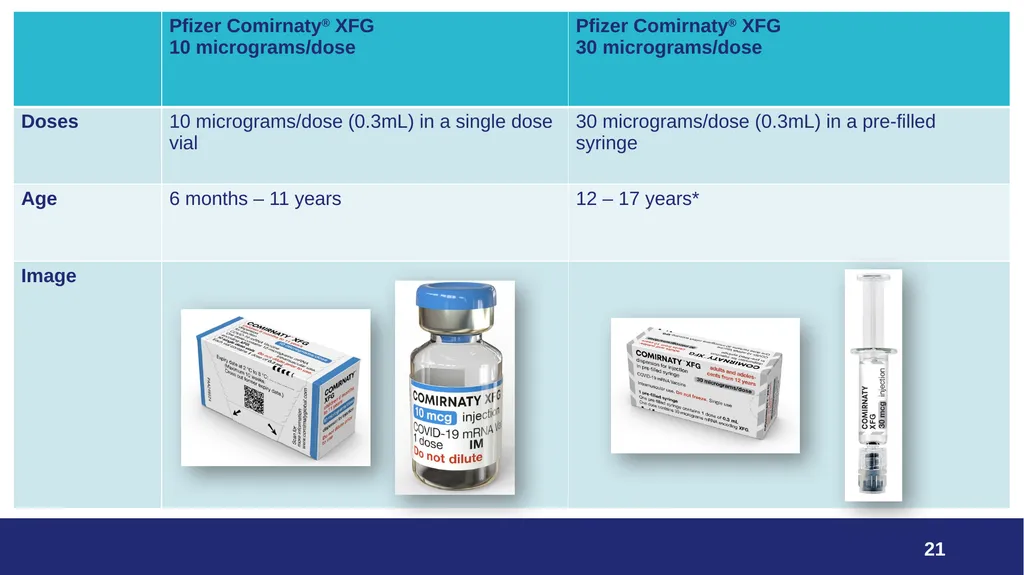
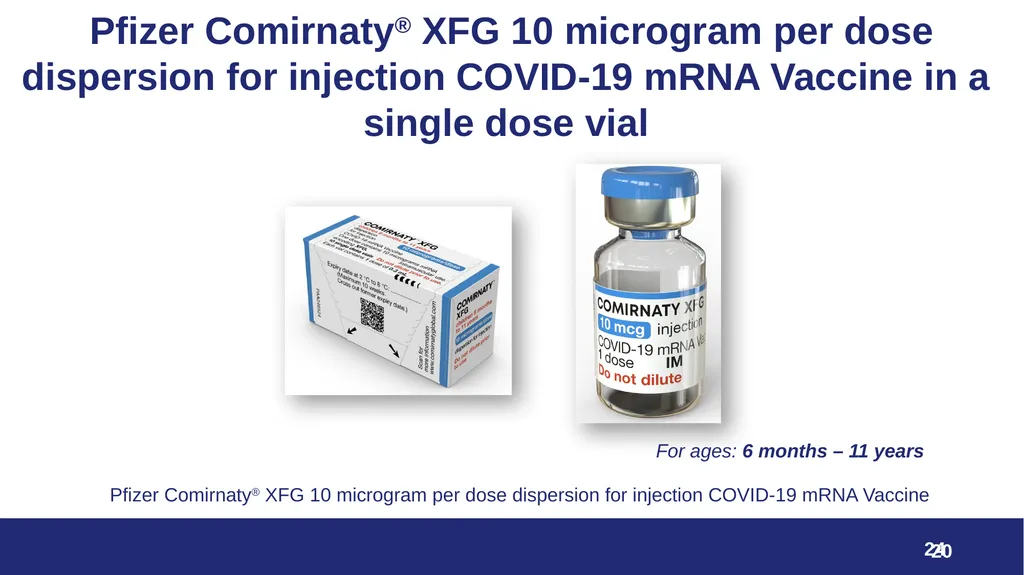
24 Pfizer Comirnaty® XFG 10 microgram per dose dispersion for injection COVID-19 mRNA Vaccine Pfizer Comirnaty® XFG 10 microgram per dose dispersion for injection COVID-19 mRNA Vaccine in a single dose vial 20 For ages: 6 months – 11 years<br>
25
Dosing and schedule For the Autumn 2026 COVID-19 campaign, there will be no Comirnaty® 3 micrograms/dose but Comirnaty® 10 micrograms/dose is licenced from 6 months to 11 years.
The SmPC for Comirnaty® XFG 10 micrograms/dose recommends a 3 dose primary schedule, however, as per COVID-19 Green Book chapter, a two dose primary schedule should be followed. This national recommendation therefore differs from the licensed schedule.
If an infant started their primary course with Comirnaty® LP.8.1 3 micrograms/dose, but the course was interrupted or delayed before the Autumn 2026 campaign, the course can be completed with Comirnaty® XFG 10 micrograms/dose. 25<br>
The SmPC for Comirnaty® XFG 10 micrograms/dose recommends a 3 dose primary schedule, however, as per COVID-19 Green Book chapter, a two dose primary schedule should be followed. This national recommendation therefore differs from the licensed schedule.
If an infant started their primary course with Comirnaty® LP.8.1 3 micrograms/dose, but the course was interrupted or delayed before the Autumn 2026 campaign, the course can be completed with Comirnaty® XFG 10 micrograms/dose. 25<br>
26
Presentation and preparation: Pfizer Comirnaty® XFG
10 microgram per dose dispersion for injection COVID-19 mRNA Vaccine 26 Pfizer Comirnaty® XFG 10 microgram per dose dispersion for injection COVID-19 mRNA vaccine is a single dose vial. NO dilution is required.
Vials of Comirnaty XFG 10microgram/dose have a blue cap and a single dose of 0.3mL (10micrograms/dose) of vaccine. Each dose must contain 0.3mL (10micrograms/dose) of vaccine.
Gently mix by inverting vials 10 times prior to use. Do not shake.
The thawed dispersion may contain white to off-white opaque amorphous particles.
After inverting, the vaccine should present as a clear to slightly opalescent dispersion with no particulates visible.
Do not use the vaccine if particulates or discolouration are present.
Following withdrawal of 0.3mL, discard the vial and any excess volume.
Do not pool excess vaccine from multiple vials. For ages: 6 months – 11 years<br>
Vials of Comirnaty XFG 10microgram/dose have a blue cap and a single dose of 0.3mL (10micrograms/dose) of vaccine. Each dose must contain 0.3mL (10micrograms/dose) of vaccine.
Gently mix by inverting vials 10 times prior to use. Do not shake.
The thawed dispersion may contain white to off-white opaque amorphous particles.
After inverting, the vaccine should present as a clear to slightly opalescent dispersion with no particulates visible.
Do not use the vaccine if particulates or discolouration are present.
Following withdrawal of 0.3mL, discard the vial and any excess volume.
Do not pool excess vaccine from multiple vials. For ages: 6 months – 11 years<br>
27
Storage: Pfizer Comirnaty® XFG COVID-19 10 microgram mRNA Vaccines Pfizer Comirnaty® XFG COVID-19 mRNA 10 mcg vaccines will be coming into NHS Wales thawed from UKHSA, it will already have the expiry date and time labelled on the box.
The vaccine may then be delivered to where it is going to be administered thawed but refrigerated between +2ºC to +8ºC.
Thawed vaccine must be transferred immediately to a vaccine fridge on arrival and stored in a carefully monitored temperature range of +2ºC to +8ºC.
Once thawed, the unopened vaccine may be stored refrigerated at +2ºC to +8ºC, protected from light, for up to 10 weeks.
Prior to use, the unopened vial can be stored for up to 24 hours* at temperatures between +8°C and +30°C. Thawed vials can be handled in room light conditions.
Once thawed, the vaccine should not be re-frozen. 27 For ages: 6 months – 11 years<br>
The vaccine may then be delivered to where it is going to be administered thawed but refrigerated between +2ºC to +8ºC.
Thawed vaccine must be transferred immediately to a vaccine fridge on arrival and stored in a carefully monitored temperature range of +2ºC to +8ºC.
Once thawed, the unopened vaccine may be stored refrigerated at +2ºC to +8ºC, protected from light, for up to 10 weeks.
Prior to use, the unopened vial can be stored for up to 24 hours* at temperatures between +8°C and +30°C. Thawed vials can be handled in room light conditions.
Once thawed, the vaccine should not be re-frozen. 27 For ages: 6 months – 11 years<br>
28
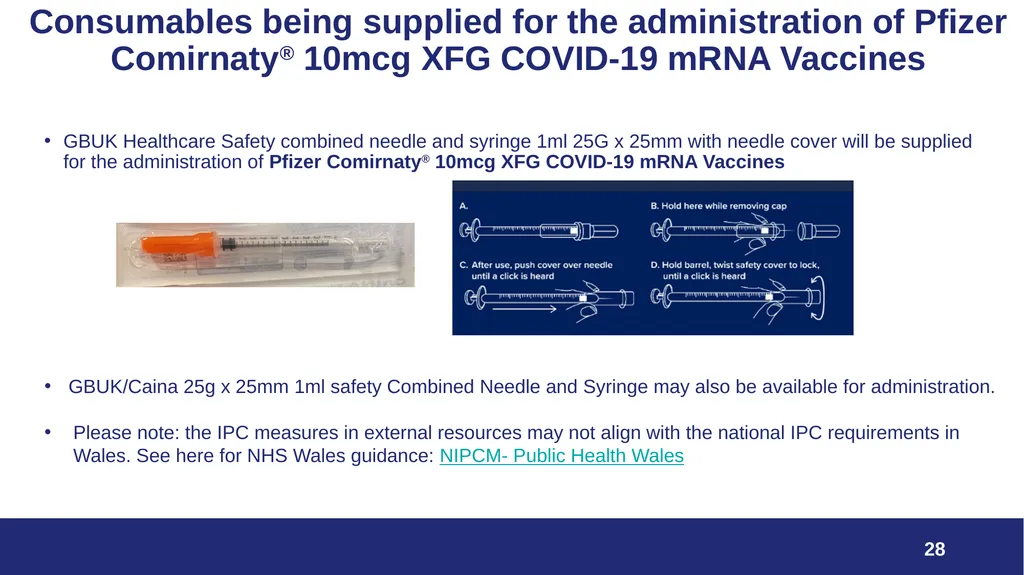
Consumables being supplied for the administration of Pfizer Comirnaty® 10mcg XFG COVID-19 mRNA Vaccines GBUK Healthcare Safety combined needle and syringe 1ml 25G x 25mm with needle cover will be supplied for the administration of Pfizer Comirnaty® 10mcg XFG COVID-19 mRNA Vaccines 28 GBUK/Caina 25g x 25mm 1ml safety Combined Needle and Syringe may also be available for administration.
Please note: the IPC measures in external resources may not align with the national IPC requirements in Wales. See here for NHS Wales guidance: NIPCM- Public Health Wales<br>
Please note: the IPC measures in external resources may not align with the national IPC requirements in Wales. See here for NHS Wales guidance: NIPCM- Public Health Wales<br>
29
Pfizer Comirnaty® XFG 30 microgram per dose dispersion for injection pre-filled syringe COVID-19 mRNA Vaccine for ages: 12 to 17 years 29 33<br>
30
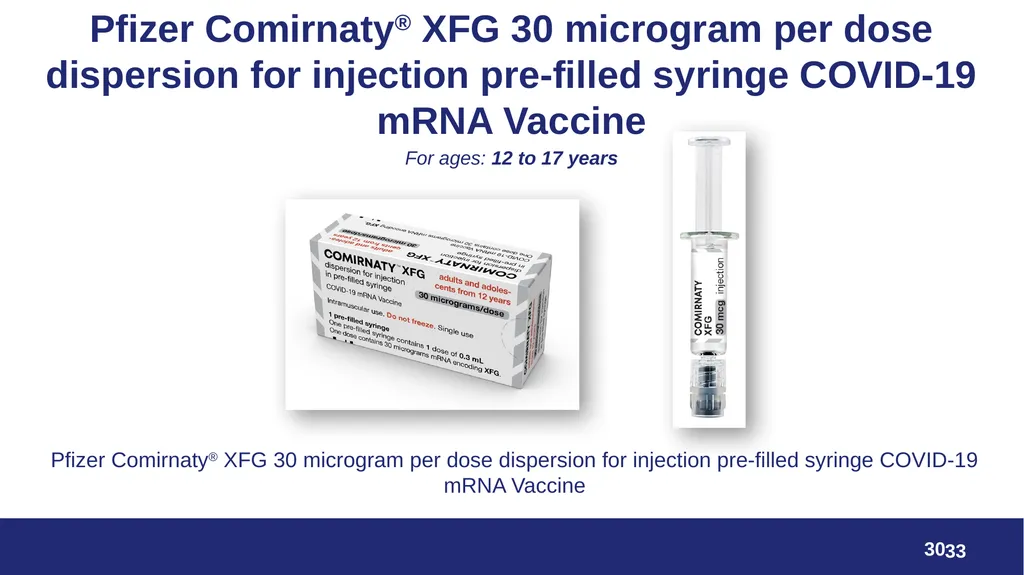
30 Pfizer Comirnaty® XFG 30 microgram per dose dispersion for injection pre-filled syringe COVID-19 mRNA Vaccine Pfizer Comirnaty® XFG 30 microgram per dose dispersion for injection pre-filled syringe COVID-19 mRNA Vaccine 33 For ages: 12 to 17 years<br>
31
Presentation and preparation: Pfizer Comirnaty® XFG
30 microgram per dose dispersion for injection COVID-19 mRNA Vaccine 31 Comirnaty XFG 30 micrograms/dose dispersion for injection is a white to off-white dispersion.
Pfizer Comirnaty® XFG 30 micrograms/dose dispersion for injection COVID-19 mRNA vaccine in a pre-filled syringe. NO dilution is required.
Each single dose pre-filled syringe of Comirnaty XFG contains 1 dose of 0.3 mL of vaccine
Comirnaty XFG should be prepared by a healthcare professional using aseptic technique to ensure the sterility of the prepared dispersion.
Remove tip cap by slowly turning the cap counterclockwise. Do not shake.
Attach a needle appropriate for intramuscular injection and administer the entire volume. For ages: 12 to 18 years<br>
Pfizer Comirnaty® XFG 30 micrograms/dose dispersion for injection COVID-19 mRNA vaccine in a pre-filled syringe. NO dilution is required.
Each single dose pre-filled syringe of Comirnaty XFG contains 1 dose of 0.3 mL of vaccine
Comirnaty XFG should be prepared by a healthcare professional using aseptic technique to ensure the sterility of the prepared dispersion.
Remove tip cap by slowly turning the cap counterclockwise. Do not shake.
Attach a needle appropriate for intramuscular injection and administer the entire volume. For ages: 12 to 18 years<br>
32
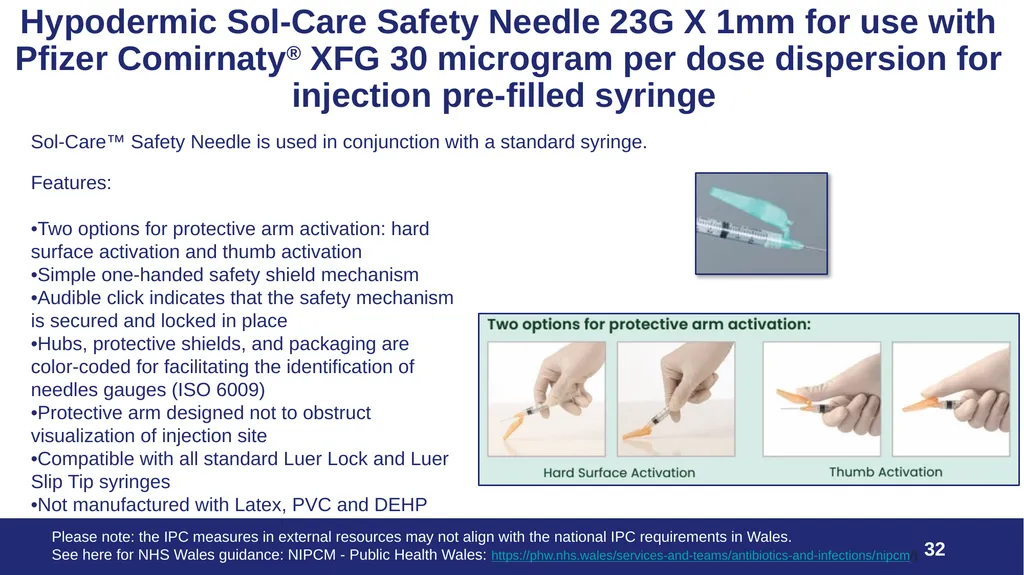
Hypodermic Sol-Care Safety Needle 23G X 1mm for use with Pfizer Comirnaty® XFG 30 microgram per dose dispersion for injection pre-filled syringe 32 Features:
•Two options for protective arm activation: hard surface activation and thumb activation
•Simple one-handed safety shield mechanism
•Audible click indicates that the safety mechanism is secured and locked in place
•Hubs, protective shields, and packaging are color-coded for facilitating the identification of needles gauges (ISO 6009)
•Protective arm designed not to obstruct visualization of injection site
•Compatible with all standard Luer Lock and Luer Slip Tip syringes
•Not manufactured with Latex, PVC and DEHP Sol-Care™ Safety Needle is used in conjunction with a standard syringe. Please note: the IPC measures in external resources may not align with the national IPC requirements in Wales.
See here for NHS Wales guidance: NIPCM - Public Health Wales: https://phw.nhs.wales/services-and-teams/antibiotics-and-infections/nipcm/)<br>
•Two options for protective arm activation: hard surface activation and thumb activation
•Simple one-handed safety shield mechanism
•Audible click indicates that the safety mechanism is secured and locked in place
•Hubs, protective shields, and packaging are color-coded for facilitating the identification of needles gauges (ISO 6009)
•Protective arm designed not to obstruct visualization of injection site
•Compatible with all standard Luer Lock and Luer Slip Tip syringes
•Not manufactured with Latex, PVC and DEHP Sol-Care™ Safety Needle is used in conjunction with a standard syringe. Please note: the IPC measures in external resources may not align with the national IPC requirements in Wales.
See here for NHS Wales guidance: NIPCM - Public Health Wales: https://phw.nhs.wales/services-and-teams/antibiotics-and-infections/nipcm/)<br>
33
Storage: Pfizer Comirnaty® 30 mcg XFG
COVID-19 mRNA Vaccine 33 Shelf-life 12 months when stored at +2 °C to +8 °C.
NOTE: The vaccine will be received and stored at +2 °C to +8 °C (refrigerated only).
Special precautions for storage:
Store glass pre-filled syringes at +2 °C to +8 °C. DO NOT FREEZE.
Store the vaccine in the original package in order to protect from light
During storage, minimise exposure to room light, and avoid exposure to direct sunlight and ultraviolet light<br>
NOTE: The vaccine will be received and stored at +2 °C to +8 °C (refrigerated only).
Special precautions for storage:
Store glass pre-filled syringes at +2 °C to +8 °C. DO NOT FREEZE.
Store the vaccine in the original package in order to protect from light
During storage, minimise exposure to room light, and avoid exposure to direct sunlight and ultraviolet light<br>
34
List of excipients: Pfizer Comirnaty® XFG
COVID-19 mRNA Vaccines These vaccines contain
((4-hydroxybutyl)azanediyl)bis(hexane-6,1-diyl)bis(2-hexyldecanoate) (ALC-0315)
2‑[(polyethylene glycol)-2000]-N,N-ditetradecylacetamide (ALC-0159)
1,2-Distearoyl-sn-glycero-3-phosphocholine (DSPC)
Cholesterol
Trometamol
Trometamol hydrochloride
Sucrose
Water for injections 34 Vaccine ingredients | Vaccine Knowledge (ox.ac.uk) For further information about specific excipients in vaccines see: SMPCs:
Comirnaty XFG 10 micrograms/dose dispersion for injection, single dose vial - Summary of Product Characteristics (SmPC) - (emc) | 102370
Comirnaty XFG 30 micrograms/dose dispersion for injection in pre-filled syringe - Summary of Product Characteristics (SmPC) - (emc) | 102371<br>
((4-hydroxybutyl)azanediyl)bis(hexane-6,1-diyl)bis(2-hexyldecanoate) (ALC-0315)
2‑[(polyethylene glycol)-2000]-N,N-ditetradecylacetamide (ALC-0159)
1,2-Distearoyl-sn-glycero-3-phosphocholine (DSPC)
Cholesterol
Trometamol
Trometamol hydrochloride
Sucrose
Water for injections 34 Vaccine ingredients | Vaccine Knowledge (ox.ac.uk) For further information about specific excipients in vaccines see: SMPCs:
Comirnaty XFG 10 micrograms/dose dispersion for injection, single dose vial - Summary of Product Characteristics (SmPC) - (emc) | 102370
Comirnaty XFG 30 micrograms/dose dispersion for injection in pre-filled syringe - Summary of Product Characteristics (SmPC) - (emc) | 102371<br>
35
Contraindications: Pfizer Comirnaty® XFG COVID-19 mRNA Vaccines Vaccination should be postponed in individuals suffering from acute severe febrile illness or acute infection. The presence of a minor infection and/or low-grade fever should not delay vaccination.
The vaccine is contraindicated in those who have had a previous systemic allergic reaction (including immediate-onset anaphylaxis) to:
a previous dose of a COVID-19 vaccine
any component (excipient) of a COVID-19 vaccine
People with a history of allergy: A very small number of individuals have experienced anaphylaxis when receiving a COVID-19 vaccine. Anyone with a history of allergic reaction to an excipient in the COVID-19 vaccine should not receive that vaccine (except with expert advice), but those with any other allergies (such as a food allergy) – including those with prior anaphylaxis – can have the vaccine. Guidance about the management of individuals with a history of allergy should be followed (summarised in Table 5) Green Book: COVID-19 chapter. 35<br>
The vaccine is contraindicated in those who have had a previous systemic allergic reaction (including immediate-onset anaphylaxis) to:
a previous dose of a COVID-19 vaccine
any component (excipient) of a COVID-19 vaccine
People with a history of allergy: A very small number of individuals have experienced anaphylaxis when receiving a COVID-19 vaccine. Anyone with a history of allergic reaction to an excipient in the COVID-19 vaccine should not receive that vaccine (except with expert advice), but those with any other allergies (such as a food allergy) – including those with prior anaphylaxis – can have the vaccine. Guidance about the management of individuals with a history of allergy should be followed (summarised in Table 5) Green Book: COVID-19 chapter. 35<br>
36
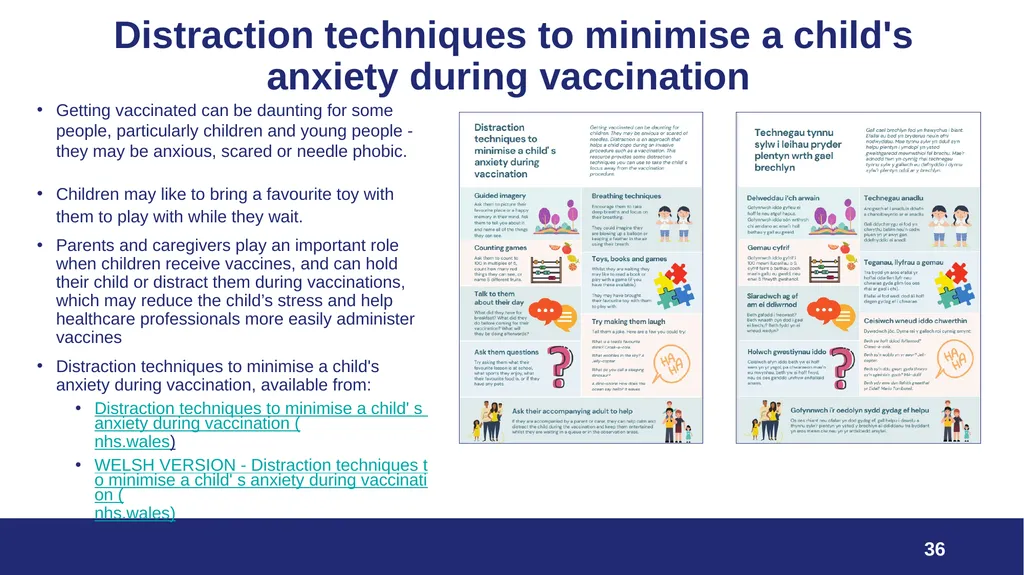
Distraction techniques to minimise a child's anxiety during vaccination Getting vaccinated can be daunting for some people, particularly children and young people - they may be anxious, scared or needle phobic.
Children may like to bring a favourite toy with them to play with while they wait.
Parents and caregivers play an important role when children receive vaccines, and can hold their child or distract them during vaccinations, which may reduce the child’s stress and help healthcare professionals more easily administer vaccines
Distraction techniques to minimise a child's anxiety during vaccination, available from:
Distraction techniques to minimise a child' s anxiety during vaccination (nhs.wales)
WELSH VERSION - Distraction techniques to minimise a child' s anxiety during vaccination (nhs.wales) 36<br>
Children may like to bring a favourite toy with them to play with while they wait.
Parents and caregivers play an important role when children receive vaccines, and can hold their child or distract them during vaccinations, which may reduce the child’s stress and help healthcare professionals more easily administer vaccines
Distraction techniques to minimise a child's anxiety during vaccination, available from:
Distraction techniques to minimise a child' s anxiety during vaccination (nhs.wales)
WELSH VERSION - Distraction techniques to minimise a child' s anxiety during vaccination (nhs.wales) 36<br>
37
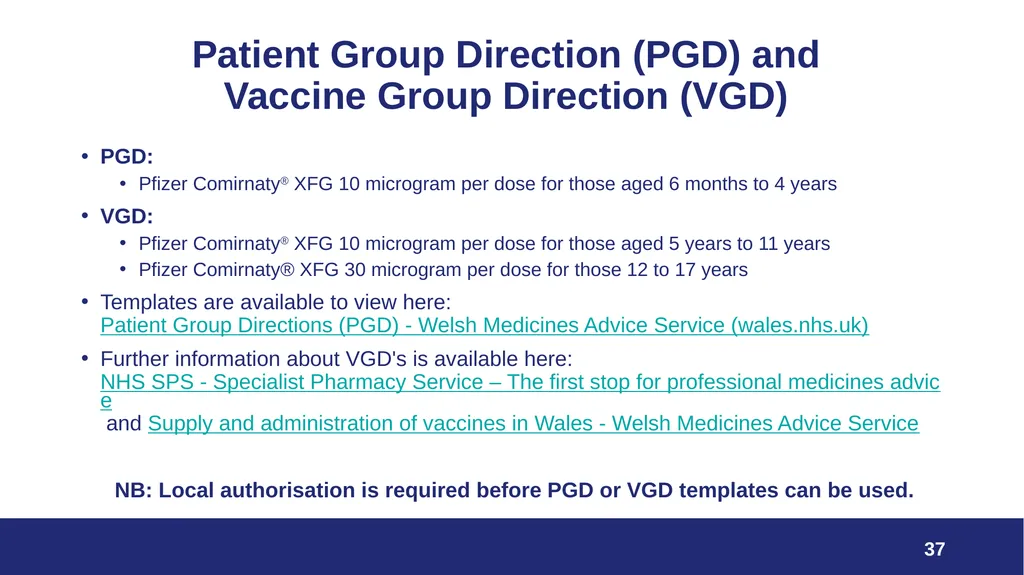
Patient Group Direction (PGD) and
Vaccine Group Direction (VGD) PGD:
Pfizer Comirnaty® XFG 10 microgram per dose for those aged 6 months to 4 years
VGD:
Pfizer Comirnaty® XFG 10 microgram per dose for those aged 5 years to 11 years
Pfizer Comirnaty® XFG 30 microgram per dose for those 12 to 17 years
Templates are available to view here: Patient Group Directions (PGD) - Welsh Medicines Advice Service (wales.nhs.uk)
Further information about VGD's is available here: NHS SPS - Specialist Pharmacy Service – The first stop for professional medicines advice and Supply and administration of vaccines in Wales - Welsh Medicines Advice Service
NB: Local authorisation is required before PGD or VGD templates can be used. 37<br>
Pfizer Comirnaty® XFG 10 microgram per dose for those aged 6 months to 4 years
VGD:
Pfizer Comirnaty® XFG 10 microgram per dose for those aged 5 years to 11 years
Pfizer Comirnaty® XFG 30 microgram per dose for those 12 to 17 years
Templates are available to view here: Patient Group Directions (PGD) - Welsh Medicines Advice Service (wales.nhs.uk)
Further information about VGD's is available here: NHS SPS - Specialist Pharmacy Service – The first stop for professional medicines advice and Supply and administration of vaccines in Wales - Welsh Medicines Advice Service
NB: Local authorisation is required before PGD or VGD templates can be used. 37<br>
38
COVID-19 autumn campaign 2026
Recommended vaccines for adults 18 years and over<br>
Recommended vaccines for adults 18 years and over<br>
39
39<br>
40
Moderna Spikevax XFG (0.1mg/mL for individuals aged 18 years and over)
COVID-19 autumn 2026<br>
COVID-19 autumn 2026<br>
41
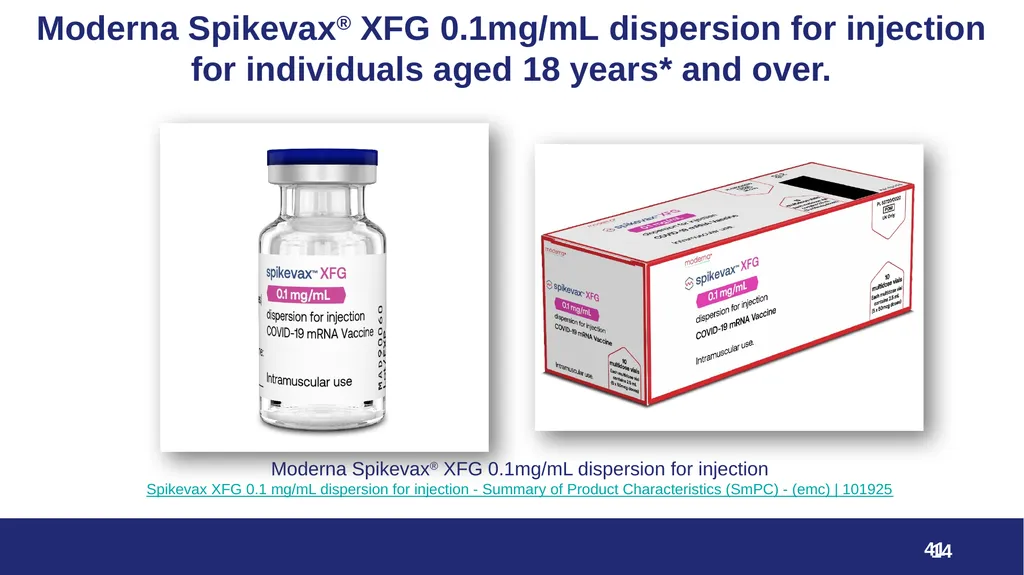
41 Moderna Spikevax® XFG 0.1mg/mL dispersion for injection
Spikevax XFG 0.1 mg/mL dispersion for injection - Summary of Product Characteristics (SmPC) - (emc) | 101925 Moderna Spikevax® XFG 0.1mg/mL dispersion for injection for individuals aged 18 years* and over. 14<br>
Spikevax XFG 0.1 mg/mL dispersion for injection - Summary of Product Characteristics (SmPC) - (emc) | 101925 Moderna Spikevax® XFG 0.1mg/mL dispersion for injection for individuals aged 18 years* and over. 14<br>
42
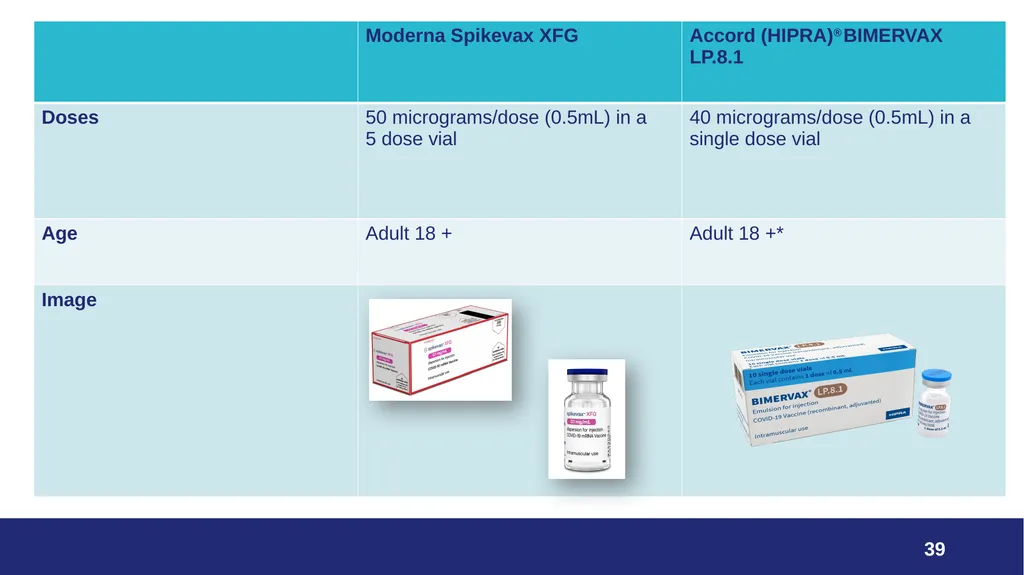
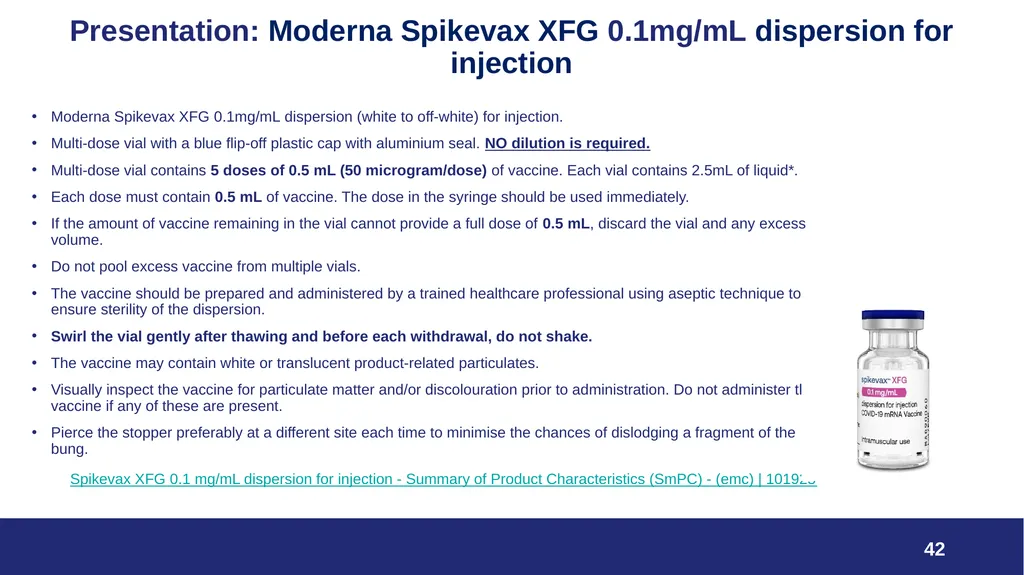
Presentation: Moderna Spikevax XFG 0.1mg/mL dispersion for injection Moderna Spikevax XFG 0.1mg/mL dispersion (white to off-white) for injection.
Multi-dose vial with a blue flip-off plastic cap with aluminium seal. NO dilution is required.
Multi-dose vial contains 5 doses of 0.5 mL (50 microgram/dose) of vaccine. Each vial contains 2.5mL of liquid*.
Each dose must contain 0.5 mL of vaccine. The dose in the syringe should be used immediately.
If the amount of vaccine remaining in the vial cannot provide a full dose of 0.5 mL, discard the vial and any excess volume.
Do not pool excess vaccine from multiple vials.
The vaccine should be prepared and administered by a trained healthcare professional using aseptic technique to ensure sterility of the dispersion.
Swirl the vial gently after thawing and before each withdrawal, do not shake.
The vaccine may contain white or translucent product-related particulates.
Visually inspect the vaccine for particulate matter and/or discolouration prior to administration. Do not administer the vaccine if any of these are present.
Pierce the stopper preferably at a different site each time to minimise the chances of dislodging a fragment of the bung.
Spikevax XFG 0.1 mg/mL dispersion for injection - Summary of Product Characteristics (SmPC) - (emc) | 101925 42<br>
Multi-dose vial with a blue flip-off plastic cap with aluminium seal. NO dilution is required.
Multi-dose vial contains 5 doses of 0.5 mL (50 microgram/dose) of vaccine. Each vial contains 2.5mL of liquid*.
Each dose must contain 0.5 mL of vaccine. The dose in the syringe should be used immediately.
If the amount of vaccine remaining in the vial cannot provide a full dose of 0.5 mL, discard the vial and any excess volume.
Do not pool excess vaccine from multiple vials.
The vaccine should be prepared and administered by a trained healthcare professional using aseptic technique to ensure sterility of the dispersion.
Swirl the vial gently after thawing and before each withdrawal, do not shake.
The vaccine may contain white or translucent product-related particulates.
Visually inspect the vaccine for particulate matter and/or discolouration prior to administration. Do not administer the vaccine if any of these are present.
Pierce the stopper preferably at a different site each time to minimise the chances of dislodging a fragment of the bung.
Spikevax XFG 0.1 mg/mL dispersion for injection - Summary of Product Characteristics (SmPC) - (emc) | 101925 42<br>
43
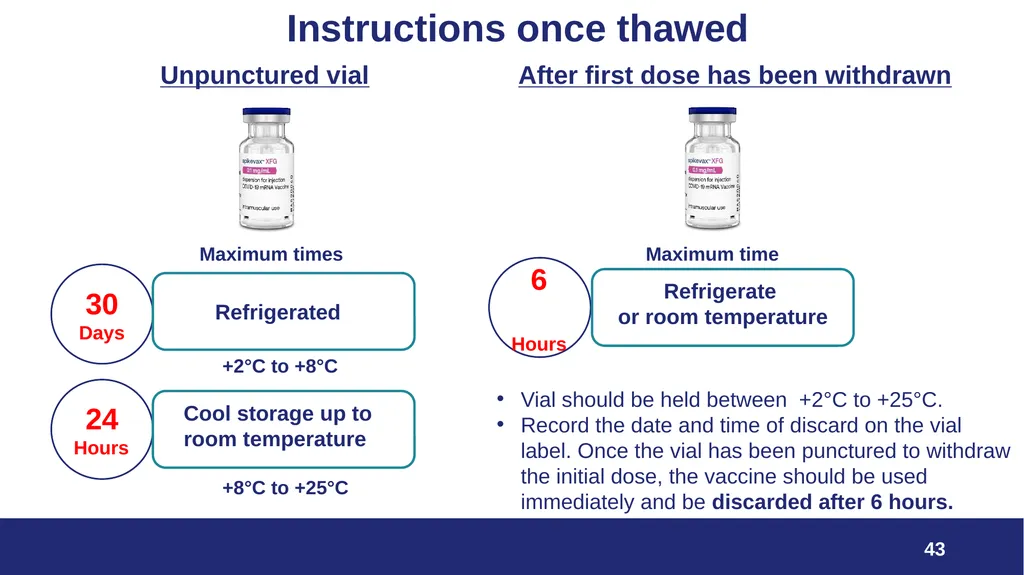
Instructions once thawed 43 Unpunctured vial Maximum times 30
Days 24
Hours Refrigerated Cool storage up to room temperature +2°C to +8°C +8°C to +25°C After first dose has been withdrawn ^ 6 Hours Refrigerate
or room temperature Maximum time Vial should be held between +2°C to +25°C.
Record the date and time of discard on the vial label. Once the vial has been punctured to withdraw the initial dose, the vaccine should be used immediately and be discarded after 6 hours.<br>
Days 24
Hours Refrigerated Cool storage up to room temperature +2°C to +8°C +8°C to +25°C After first dose has been withdrawn ^ 6 Hours Refrigerate
or room temperature Maximum time Vial should be held between +2°C to +25°C.
Record the date and time of discard on the vial label. Once the vial has been punctured to withdraw the initial dose, the vaccine should be used immediately and be discarded after 6 hours.<br>
44
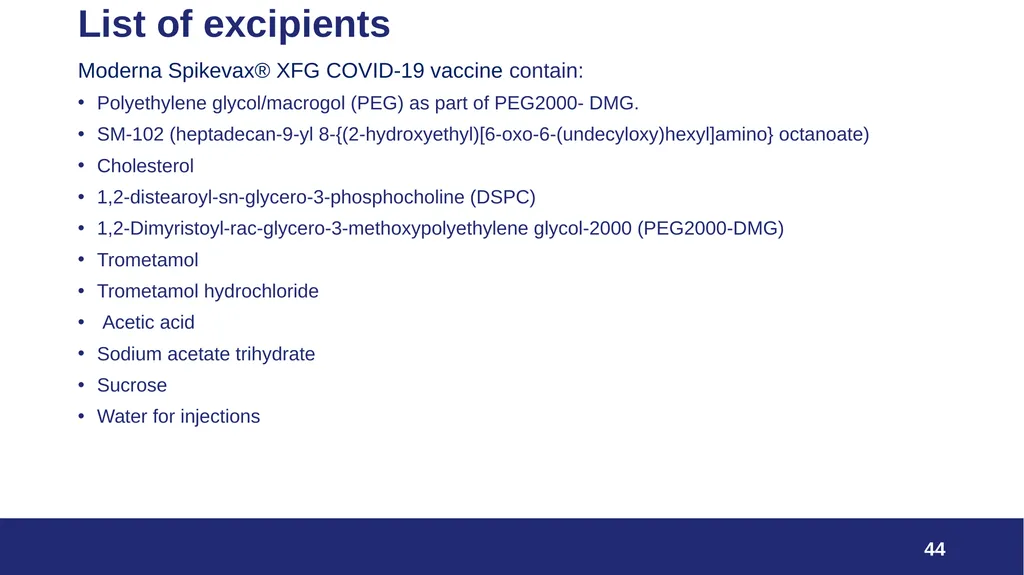
List of excipients Moderna Spikevax® XFG COVID-19 vaccine contain:
Polyethylene glycol/macrogol (PEG) as part of PEG2000- DMG.
SM-102 (heptadecan-9-yl 8-{(2-hydroxyethyl)[6-oxo-6-(undecyloxy)hexyl]amino} octanoate)
Cholesterol
1,2-distearoyl-sn-glycero-3-phosphocholine (DSPC)
1,2-Dimyristoyl-rac-glycero-3-methoxypolyethylene glycol-2000 (PEG2000-DMG)
Trometamol
Trometamol hydrochloride
Acetic acid
Sodium acetate trihydrate
Sucrose
Water for injections 44<br>
Polyethylene glycol/macrogol (PEG) as part of PEG2000- DMG.
SM-102 (heptadecan-9-yl 8-{(2-hydroxyethyl)[6-oxo-6-(undecyloxy)hexyl]amino} octanoate)
Cholesterol
1,2-distearoyl-sn-glycero-3-phosphocholine (DSPC)
1,2-Dimyristoyl-rac-glycero-3-methoxypolyethylene glycol-2000 (PEG2000-DMG)
Trometamol
Trometamol hydrochloride
Acetic acid
Sodium acetate trihydrate
Sucrose
Water for injections 44<br>
45
Accord (HIPRA)® BIMERVAX LP.8.1 40 microgram per dose emulsion for injection COVID-19 non-mRNA vaccine for adults 18 years and over*
COVID-19 autumn 2026<br>
COVID-19 autumn 2026<br>
46
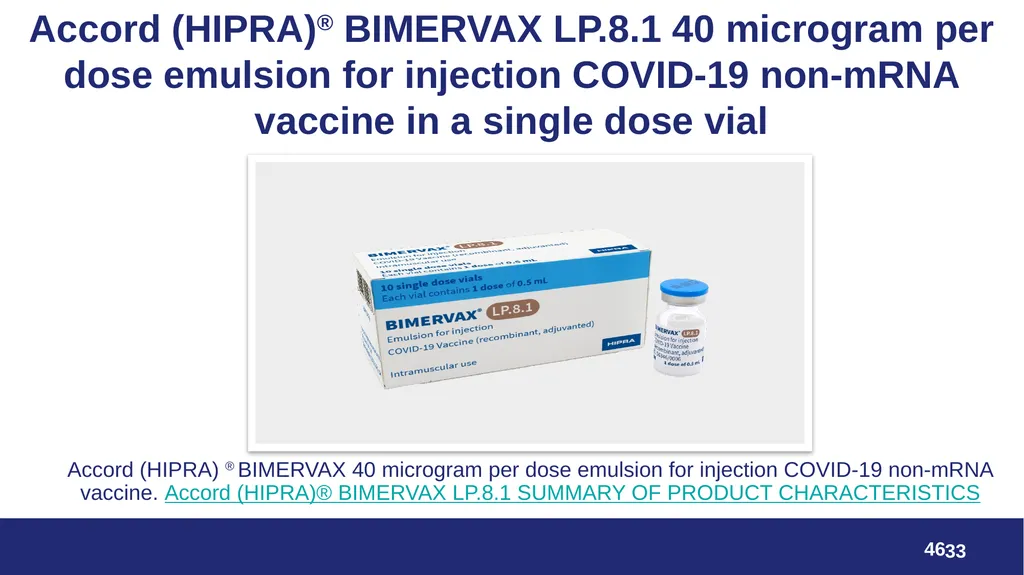
46 Accord (HIPRA)® BIMERVAX LP.8.1 40 microgram per dose emulsion for injection COVID-19 non-mRNA vaccine in a single dose vial Accord (HIPRA) ® BIMERVAX 40 microgram per dose emulsion for injection COVID-19 non-mRNA vaccine. Accord (HIPRA)® BIMERVAX LP.8.1 SUMMARY OF PRODUCT CHARACTERISTICS 33<br>
47
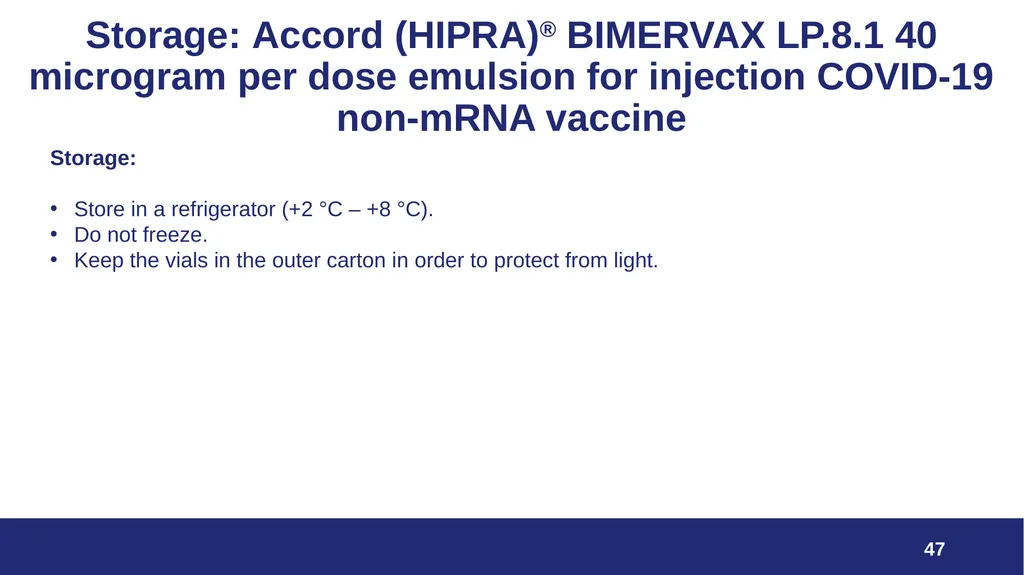
Storage: Accord (HIPRA)® BIMERVAX LP.8.1 40 microgram per dose emulsion for injection COVID-19 non-mRNA vaccine 47 Storage:
Store in a refrigerator (+2 °C – +8 °C).
Do not freeze.
Keep the vials in the outer carton in order to protect from light.<br>
Store in a refrigerator (+2 °C – +8 °C).
Do not freeze.
Keep the vials in the outer carton in order to protect from light.<br>
48
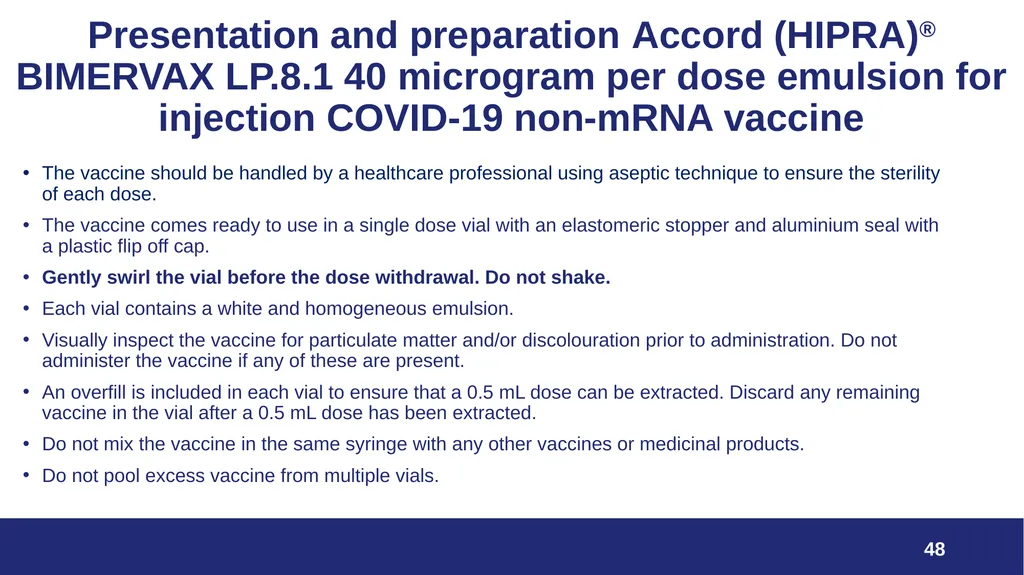
Presentation and preparation Accord (HIPRA)® BIMERVAX LP.8.1 40 microgram per dose emulsion for injection COVID-19 non-mRNA vaccine The vaccine should be handled by a healthcare professional using aseptic technique to ensure the sterility of each dose.
The vaccine comes ready to use in a single dose vial with an elastomeric stopper and aluminium seal with a plastic flip off cap.
Gently swirl the vial before the dose withdrawal. Do not shake.
Each vial contains a white and homogeneous emulsion.
Visually inspect the vaccine for particulate matter and/or discolouration prior to administration. Do not administer the vaccine if any of these are present.
An overfill is included in each vial to ensure that a 0.5 mL dose can be extracted. Discard any remaining vaccine in the vial after a 0.5 mL dose has been extracted.
Do not mix the vaccine in the same syringe with any other vaccines or medicinal products.
Do not pool excess vaccine from multiple vials. 48<br>
The vaccine comes ready to use in a single dose vial with an elastomeric stopper and aluminium seal with a plastic flip off cap.
Gently swirl the vial before the dose withdrawal. Do not shake.
Each vial contains a white and homogeneous emulsion.
Visually inspect the vaccine for particulate matter and/or discolouration prior to administration. Do not administer the vaccine if any of these are present.
An overfill is included in each vial to ensure that a 0.5 mL dose can be extracted. Discard any remaining vaccine in the vial after a 0.5 mL dose has been extracted.
Do not mix the vaccine in the same syringe with any other vaccines or medicinal products.
Do not pool excess vaccine from multiple vials. 48<br>
49
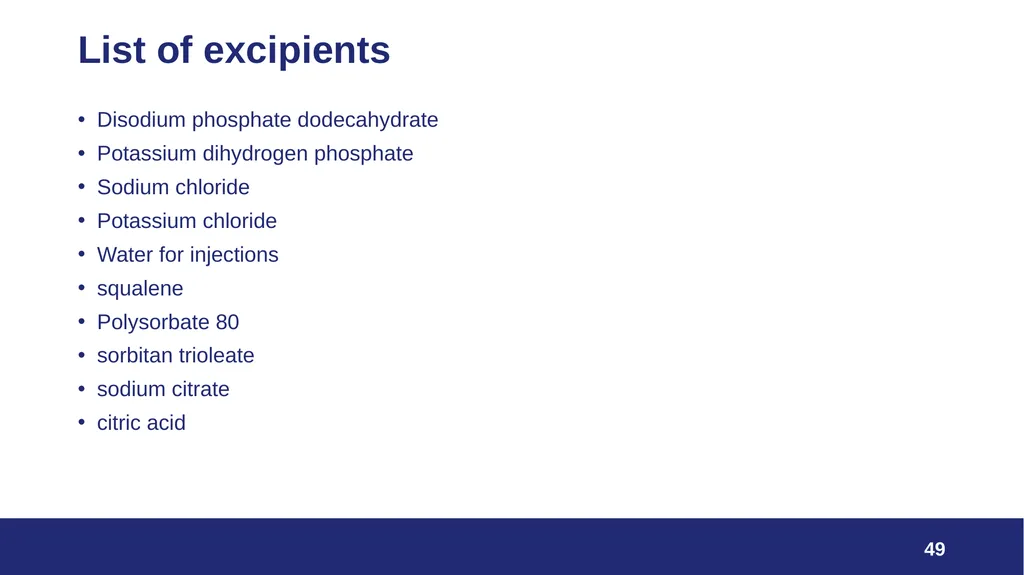
List of excipients Disodium phosphate dodecahydrate
Potassium dihydrogen phosphate
Sodium chloride
Potassium chloride
Water for injections
squalene
Polysorbate 80
sorbitan trioleate
sodium citrate
citric acid 49<br>
Potassium dihydrogen phosphate
Sodium chloride
Potassium chloride
Water for injections
squalene
Polysorbate 80
sorbitan trioleate
sodium citrate
citric acid 49<br>
50
Consumables
Moderna Spikevax XFG
Accord (HIPRA)® BIMERVAX LP.8.1
COVID-19 autumn 2026<br>
Moderna Spikevax XFG
Accord (HIPRA)® BIMERVAX LP.8.1
COVID-19 autumn 2026<br>
51
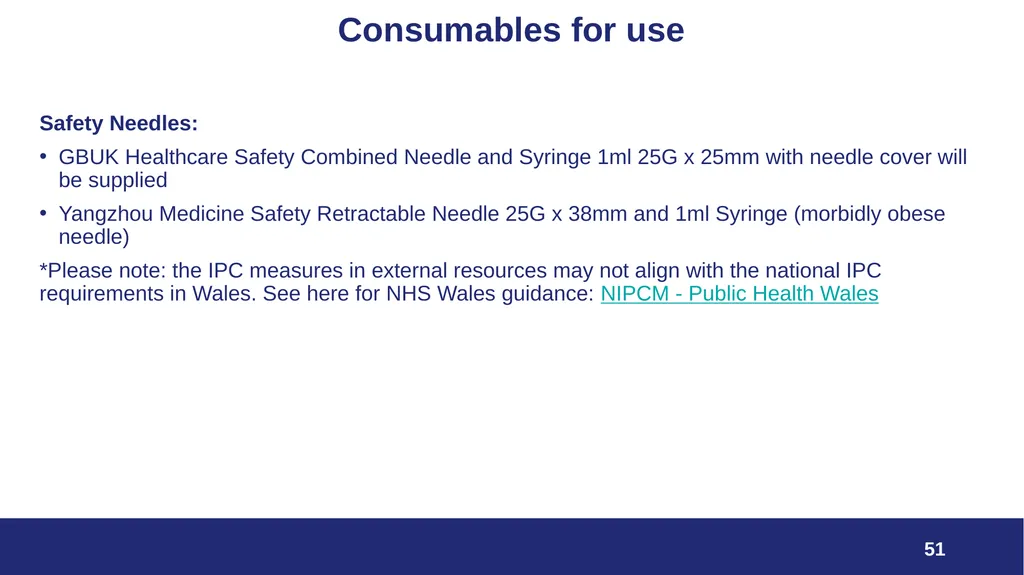
Consumables for use Safety Needles:
GBUK Healthcare Safety Combined Needle and Syringe 1ml 25G x 25mm with needle cover will be supplied
Yangzhou Medicine Safety Retractable Needle 25G x 38mm and 1ml Syringe (morbidly obese needle)
*Please note: the IPC measures in external resources may not align with the national IPC requirements in Wales. See here for NHS Wales guidance: NIPCM - Public Health Wales 51<br>
GBUK Healthcare Safety Combined Needle and Syringe 1ml 25G x 25mm with needle cover will be supplied
Yangzhou Medicine Safety Retractable Needle 25G x 38mm and 1ml Syringe (morbidly obese needle)
*Please note: the IPC measures in external resources may not align with the national IPC requirements in Wales. See here for NHS Wales guidance: NIPCM - Public Health Wales 51<br>
52
GBUK Healthcare Safety Combined Needle and Syringe 1ml 25G x 25mm with needle cover 52<br>
53
Additional slides outlining key principles for COVID-19 vaccines<br>
54
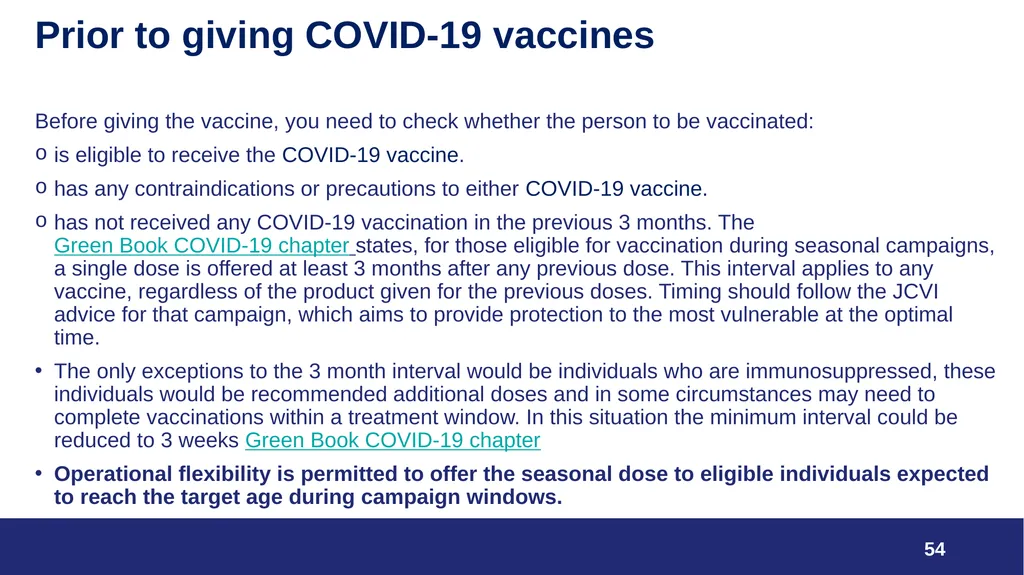
Prior to giving COVID-19 vaccines Before giving the vaccine, you need to check whether the person to be vaccinated:
is eligible to receive the COVID-19 vaccine.
has any contraindications or precautions to either COVID-19 vaccine.
has not received any COVID-19 vaccination in the previous 3 months. The Green Book COVID-19 chapter states, for those eligible for vaccination during seasonal campaigns, a single dose is offered at least 3 months after any previous dose. This interval applies to any vaccine, regardless of the product given for the previous doses. Timing should follow the JCVI advice for that campaign, which aims to provide protection to the most vulnerable at the optimal time.
The only exceptions to the 3 month interval would be individuals who are immunosuppressed, these individuals would be recommended additional doses and in some circumstances may need to complete vaccinations within a treatment window. In this situation the minimum interval could be reduced to 3 weeks Green Book COVID-19 chapter
Operational flexibility is permitted to offer the seasonal dose to eligible individuals expected to reach the target age during campaign windows. 54<br>
is eligible to receive the COVID-19 vaccine.
has any contraindications or precautions to either COVID-19 vaccine.
has not received any COVID-19 vaccination in the previous 3 months. The Green Book COVID-19 chapter states, for those eligible for vaccination during seasonal campaigns, a single dose is offered at least 3 months after any previous dose. This interval applies to any vaccine, regardless of the product given for the previous doses. Timing should follow the JCVI advice for that campaign, which aims to provide protection to the most vulnerable at the optimal time.
The only exceptions to the 3 month interval would be individuals who are immunosuppressed, these individuals would be recommended additional doses and in some circumstances may need to complete vaccinations within a treatment window. In this situation the minimum interval could be reduced to 3 weeks Green Book COVID-19 chapter
Operational flexibility is permitted to offer the seasonal dose to eligible individuals expected to reach the target age during campaign windows. 54<br>
55
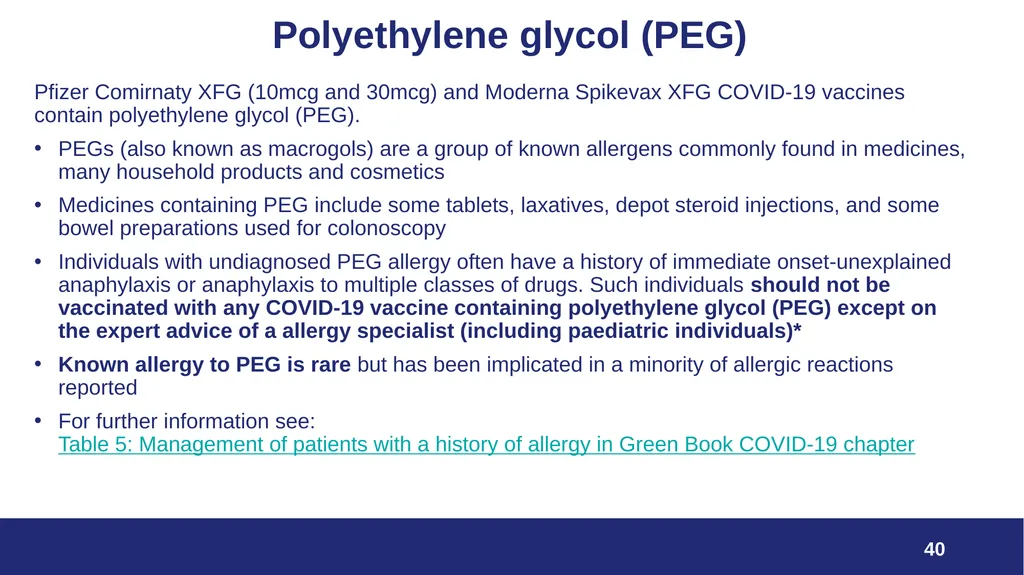
Polyethylene glycol (PEG) Pfizer Comirnaty XFG (10mcg and 30mcg) and Moderna Spikevax XFG COVID-19 vaccines contain polyethylene glycol (PEG).
PEGs (also known as macrogols) are a group of known allergens commonly found in medicines, many household products and cosmetics
Medicines containing PEG include some tablets, laxatives, depot steroid injections, and some bowel preparations used for colonoscopy
Individuals with undiagnosed PEG allergy often have a history of immediate onset-unexplained anaphylaxis or anaphylaxis to multiple classes of drugs. Such individuals should not be vaccinated with any COVID-19 vaccine containing polyethylene glycol (PEG) except on the expert advice of a allergy specialist (including paediatric individuals)*
Known allergy to PEG is rare but has been implicated in a minority of allergic reactions reported
For further information see: Table 5: Management of patients with a history of allergy in Green Book COVID-19 chapter 40<br>
PEGs (also known as macrogols) are a group of known allergens commonly found in medicines, many household products and cosmetics
Medicines containing PEG include some tablets, laxatives, depot steroid injections, and some bowel preparations used for colonoscopy
Individuals with undiagnosed PEG allergy often have a history of immediate onset-unexplained anaphylaxis or anaphylaxis to multiple classes of drugs. Such individuals should not be vaccinated with any COVID-19 vaccine containing polyethylene glycol (PEG) except on the expert advice of a allergy specialist (including paediatric individuals)*
Known allergy to PEG is rare but has been implicated in a minority of allergic reactions reported
For further information see: Table 5: Management of patients with a history of allergy in Green Book COVID-19 chapter 40<br>
56
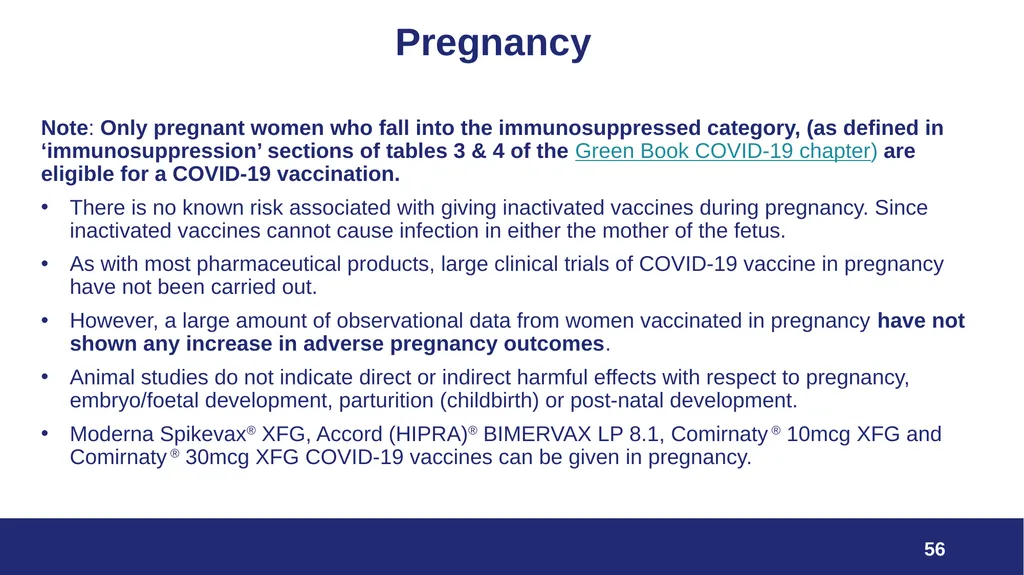
Pregnancy Note: Only pregnant women who fall into the immunosuppressed category, (as defined in ‘immunosuppression’ sections of tables 3 & 4 of the Green Book COVID-19 chapter) are eligible for a COVID-19 vaccination.
There is no known risk associated with giving inactivated vaccines during pregnancy. Since inactivated vaccines cannot cause infection in either the mother of the fetus.
As with most pharmaceutical products, large clinical trials of COVID-19 vaccine in pregnancy have not been carried out.
However, a large amount of observational data from women vaccinated in pregnancy have not shown any increase in adverse pregnancy outcomes.
Animal studies do not indicate direct or indirect harmful effects with respect to pregnancy, embryo/foetal development, parturition (childbirth) or post-natal development.
Moderna Spikevax® XFG, Accord (HIPRA)® BIMERVAX LP 8.1, Comirnaty ® 10mcg XFG and Comirnaty ® 30mcg XFG COVID-19 vaccines can be given in pregnancy. 56<br>
There is no known risk associated with giving inactivated vaccines during pregnancy. Since inactivated vaccines cannot cause infection in either the mother of the fetus.
As with most pharmaceutical products, large clinical trials of COVID-19 vaccine in pregnancy have not been carried out.
However, a large amount of observational data from women vaccinated in pregnancy have not shown any increase in adverse pregnancy outcomes.
Animal studies do not indicate direct or indirect harmful effects with respect to pregnancy, embryo/foetal development, parturition (childbirth) or post-natal development.
Moderna Spikevax® XFG, Accord (HIPRA)® BIMERVAX LP 8.1, Comirnaty ® 10mcg XFG and Comirnaty ® 30mcg XFG COVID-19 vaccines can be given in pregnancy. 56<br>
57
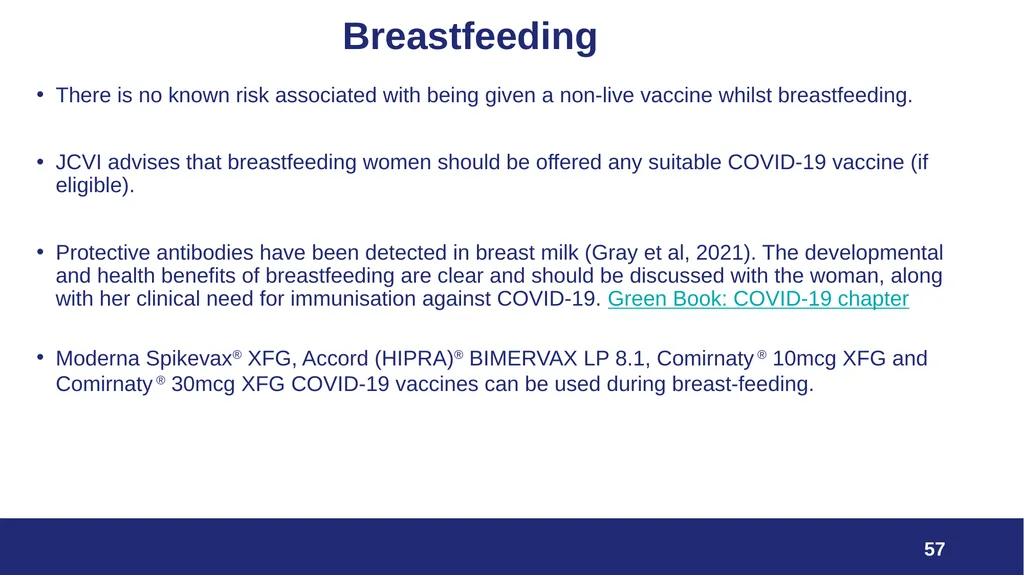
Breastfeeding There is no known risk associated with being given a non-live vaccine whilst breastfeeding.
JCVI advises that breastfeeding women should be offered any suitable COVID-19 vaccine (if eligible).
Protective antibodies have been detected in breast milk (Gray et al, 2021). The developmental and health benefits of breastfeeding are clear and should be discussed with the woman, along with her clinical need for immunisation against COVID-19. Green Book: COVID-19 chapter
Moderna Spikevax® XFG, Accord (HIPRA)® BIMERVAX LP 8.1, Comirnaty ® 10mcg XFG and Comirnaty ® 30mcg XFG COVID-19 vaccines can be used during breast-feeding. 57<br>
JCVI advises that breastfeeding women should be offered any suitable COVID-19 vaccine (if eligible).
Protective antibodies have been detected in breast milk (Gray et al, 2021). The developmental and health benefits of breastfeeding are clear and should be discussed with the woman, along with her clinical need for immunisation against COVID-19. Green Book: COVID-19 chapter
Moderna Spikevax® XFG, Accord (HIPRA)® BIMERVAX LP 8.1, Comirnaty ® 10mcg XFG and Comirnaty ® 30mcg XFG COVID-19 vaccines can be used during breast-feeding. 57<br>
58
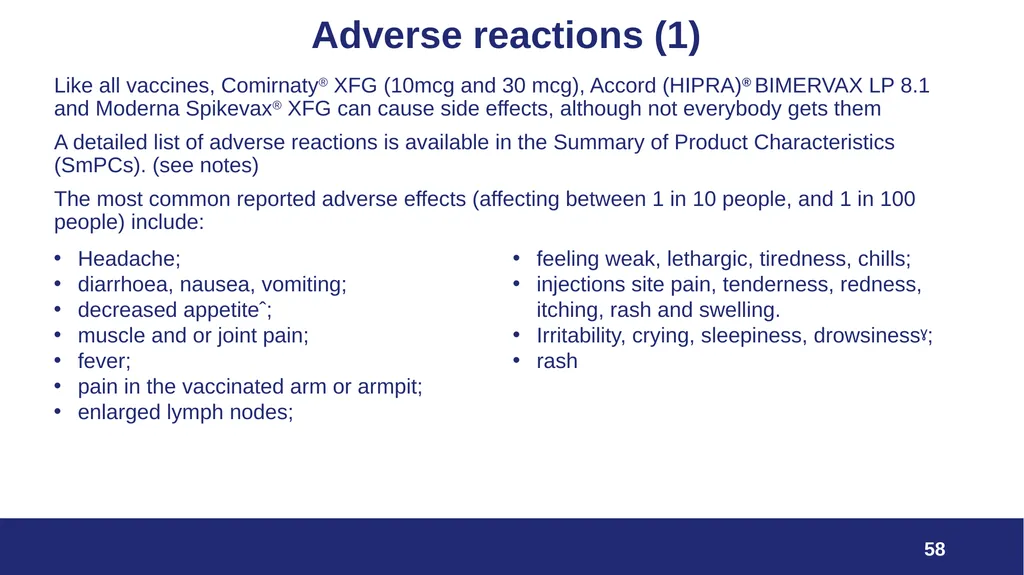
Adverse reactions (1) Like all vaccines, Comirnaty® XFG (10mcg and 30 mcg), Accord (HIPRA)® BIMERVAX LP 8.1 and Moderna Spikevax® XFG can cause side effects, although not everybody gets them
A detailed list of adverse reactions is available in the Summary of Product Characteristics (SmPCs). (see notes)
The most common reported adverse effects (affecting between 1 in 10 people, and 1 in 100 people) include: 58 Headache;
diarrhoea, nausea, vomiting;
decreased appetiteˆ;
muscle and or joint pain;
fever;
pain in the vaccinated arm or armpit;
enlarged lymph nodes;
feeling weak, lethargic, tiredness, chills;
injections site pain, tenderness, redness, itching, rash and swelling.
Irritability, crying, sleepiness, drowsinessˠ;
rash<br>
A detailed list of adverse reactions is available in the Summary of Product Characteristics (SmPCs). (see notes)
The most common reported adverse effects (affecting between 1 in 10 people, and 1 in 100 people) include: 58 Headache;
diarrhoea, nausea, vomiting;
decreased appetiteˆ;
muscle and or joint pain;
fever;
pain in the vaccinated arm or armpit;
enlarged lymph nodes;
feeling weak, lethargic, tiredness, chills;
injections site pain, tenderness, redness, itching, rash and swelling.
Irritability, crying, sleepiness, drowsinessˠ;
rash<br>
59
Adverse reactions (2) Further information is available in the vaccine specific SmPCs:
Comirnaty XFG 10 micrograms/dose dispersion for injection, single dose vial - Summary of Product Characteristics (SmPC) - (emc) | 102370
Comirnaty XFG 30 micrograms/dose dispersion for injection in pre-filled syringe - Summary of Product Characteristics (SmPC) - (emc) | 102371
Spikevax XFG 0.1 mg/mL dispersion for injection - Summary of Product Characteristics (SmPC) - (emc) | 101925
The SmPC for Accord (HIPRA)® BIMERVAX LP 8.1 is not currently available on the electronic medicines compendium (emc)
The information below is taken from the MHRA website:
Accord (HIPRA)® BIMERVAX LP.8.1 SUMMARY OF PRODUCT CHARACTERISTICS 59<br>
Comirnaty XFG 10 micrograms/dose dispersion for injection, single dose vial - Summary of Product Characteristics (SmPC) - (emc) | 102370
Comirnaty XFG 30 micrograms/dose dispersion for injection in pre-filled syringe - Summary of Product Characteristics (SmPC) - (emc) | 102371
Spikevax XFG 0.1 mg/mL dispersion for injection - Summary of Product Characteristics (SmPC) - (emc) | 101925
The SmPC for Accord (HIPRA)® BIMERVAX LP 8.1 is not currently available on the electronic medicines compendium (emc)
The information below is taken from the MHRA website:
Accord (HIPRA)® BIMERVAX LP.8.1 SUMMARY OF PRODUCT CHARACTERISTICS 59<br>
60
Myocarditis and pericarditis Cases of myocarditis and pericarditis have been reported rarely after COVID-19 vaccination. Cases have been observed more often after the second vaccination, and more often in younger males
Although now licensed from 6 months of age, Moderna Spikevax COVID-19 vaccines are not recommended for use in individuals of less than 18 years of age because of the slightly higher risk of myocarditis/pericarditis compared to Pfizer vaccines Green Book COVID-19 chapter
If an individual develops myocarditis or pericarditis following the first COVID-19 vaccination they should be assessed by an appropriate clinician to determine whether it is likely to be vaccine related.
For further information for healthcare professionals, refer to: Myocarditis and pericarditis after COVID-19 vaccination: clinical guidance - GOV.UK
As the mechanism of action and risk of recurrence of myocarditis and pericarditis are being investigated, the current advice is that an individual’s second or subsequent doses should be deferred pending further investigation and careful consideration of the risks and benefits 60<br>
Although now licensed from 6 months of age, Moderna Spikevax COVID-19 vaccines are not recommended for use in individuals of less than 18 years of age because of the slightly higher risk of myocarditis/pericarditis compared to Pfizer vaccines Green Book COVID-19 chapter
If an individual develops myocarditis or pericarditis following the first COVID-19 vaccination they should be assessed by an appropriate clinician to determine whether it is likely to be vaccine related.
For further information for healthcare professionals, refer to: Myocarditis and pericarditis after COVID-19 vaccination: clinical guidance - GOV.UK
As the mechanism of action and risk of recurrence of myocarditis and pericarditis are being investigated, the current advice is that an individual’s second or subsequent doses should be deferred pending further investigation and careful consideration of the risks and benefits 60<br>
61
Guillain-Barré syndrome (GBS) Very rare reports have been received of GBS following COVID-19 vaccination, so healthcare professionals should be alert to the signs and symptoms of GBS to ensure correct diagnosis and to rule out other causes, in order to initiate adequate supportive care and treatment
Individuals who have a history of GBS should be vaccinated as recommended for their age and underlying risk status. Cases of GBS reported following vaccination may occur by chance (the background rate of GBS is 2 per 100,000 per year in the population) and no causal mechanism with COVID-19 vaccination has been proven
There is evidence to suggest that having had a prior diagnosis of GBS does not predispose an individual to further episodes of GBS when immunised with other vaccines (Baxter et al, 2012) and for the Pfizer BioNTech COVID-19 vaccine (Shapiro Ben David et al, 2021)
In those who are diagnosed with GBS after the first dose of vaccine, the balance of risk benefit is in favour of the balance of risk against benefit is in favour of receiving any future doses they are eligible for. For information see Green Book COVID-19 chapter 61<br>
Individuals who have a history of GBS should be vaccinated as recommended for their age and underlying risk status. Cases of GBS reported following vaccination may occur by chance (the background rate of GBS is 2 per 100,000 per year in the population) and no causal mechanism with COVID-19 vaccination has been proven
There is evidence to suggest that having had a prior diagnosis of GBS does not predispose an individual to further episodes of GBS when immunised with other vaccines (Baxter et al, 2012) and for the Pfizer BioNTech COVID-19 vaccine (Shapiro Ben David et al, 2021)
In those who are diagnosed with GBS after the first dose of vaccine, the balance of risk benefit is in favour of the balance of risk against benefit is in favour of receiving any future doses they are eligible for. For information see Green Book COVID-19 chapter 61<br>
62
Individuals with a history of immune thrombocytopenia Individuals with a history of immune thrombocytopenia (ITP) may have experienced a fall in their platelet count following vaccination.
Previous ITP is not a contra-indication for vaccination.
Although evidence suggests a raised risk of ITP after the AstraZeneca vaccine (Simpson et al, 2021), ITP has also been reported with other COVID-19 vaccines (Lee et al, 2021).
Given these reports, monitoring of platelets 2-5 days post COVID-19 vaccination in patients with a history of ITP should be considered. Green Book COVID-19 chapter 62<br>
Previous ITP is not a contra-indication for vaccination.
Although evidence suggests a raised risk of ITP after the AstraZeneca vaccine (Simpson et al, 2021), ITP has also been reported with other COVID-19 vaccines (Lee et al, 2021).
Given these reports, monitoring of platelets 2-5 days post COVID-19 vaccination in patients with a history of ITP should be considered. Green Book COVID-19 chapter 62<br>
63
Erythema multiforme A number of cases of erythema multiforme (EM) have been reported after the Moderna and Pfizer mRNA vaccinations.
These reports appear to be consistent with EM minor, with no fatalities.
Recurrence has been reported after rechallenge with the Pfizer vaccine.
MHRA have consulted dermatology experts who consider EM an uncommon, benign and self-limiting condition which could plausibly be triggered by COVID-19 vaccination; although overreporting due to misdiagnosis was possible.
A past history of EM is not a contraindication for vaccination.
Green Book: COVID-19 chapter 63<br>
These reports appear to be consistent with EM minor, with no fatalities.
Recurrence has been reported after rechallenge with the Pfizer vaccine.
MHRA have consulted dermatology experts who consider EM an uncommon, benign and self-limiting condition which could plausibly be triggered by COVID-19 vaccination; although overreporting due to misdiagnosis was possible.
A past history of EM is not a contraindication for vaccination.
Green Book: COVID-19 chapter 63<br>
64
Capillary Leak Syndrome Extremely rare reports of capillary leak syndrome have been reported after AstraZeneca and Moderna vaccines in individuals with a prior history of this condition.
Individuals with a history of capillary leak syndrome, should be carefully counselled about the risks and benefits of vaccination and advice from a specialist should be sought. 64<br>
Individuals with a history of capillary leak syndrome, should be carefully counselled about the risks and benefits of vaccination and advice from a specialist should be sought. 64<br>
65
Co-administration with other vaccines For all vaccines, if they are due at the same time as the COVID-19 vaccine, they can be given.
As COVID-19 vaccines are considered inactivated (including the non-replicating adenovirus vaccine), where individuals in an eligible cohort present having recently received one or more inactivated or another live vaccine, COVID-19 vaccination should still be given.
The same applies for other live and inactivated vaccines where COVID-19 vaccination has been received first or where a patient presents requiring two or more vaccines. It is generally better for vaccination to proceed to avoid any further delay in protection and to avoid the risk of the patient not returning for a later appointment.
For further information see Green Book: COVID-19 chapter 65<br>
As COVID-19 vaccines are considered inactivated (including the non-replicating adenovirus vaccine), where individuals in an eligible cohort present having recently received one or more inactivated or another live vaccine, COVID-19 vaccination should still be given.
The same applies for other live and inactivated vaccines where COVID-19 vaccination has been received first or where a patient presents requiring two or more vaccines. It is generally better for vaccination to proceed to avoid any further delay in protection and to avoid the risk of the patient not returning for a later appointment.
For further information see Green Book: COVID-19 chapter 65<br>
66
Vaccinating Individuals with bleeding disorders Individuals with bleeding disorders may be vaccinated intramuscularly if, in the opinion of a doctor familiar with the individual’s bleeding risk, vaccines or similar small volume intramuscular injections can be administered with reasonable safety by this route.
If the individual receives medication/treatment to reduce bleeding, for example treatment for haemophilia, intramuscular vaccination can be scheduled shortly after such medication/ treatment is administered. Individuals on stable anticoagulation therapy, including individuals on warfarin who are up-to-date with their scheduled INR testing and whose latest INR is below the upper level of the therapeutic range, can receive intramuscular vaccination.
A fine needle (23 or 25 gauge) should be used for the vaccination, followed by firm pressure applied to the site without rubbing for at least 2 minutes (Advisory Committee on Immunization Practices 2019). The individual/parent/carer should be informed about the risk of haematoma from the injection Green Book: COVID-19 chapter 66<br>
If the individual receives medication/treatment to reduce bleeding, for example treatment for haemophilia, intramuscular vaccination can be scheduled shortly after such medication/ treatment is administered. Individuals on stable anticoagulation therapy, including individuals on warfarin who are up-to-date with their scheduled INR testing and whose latest INR is below the upper level of the therapeutic range, can receive intramuscular vaccination.
A fine needle (23 or 25 gauge) should be used for the vaccination, followed by firm pressure applied to the site without rubbing for at least 2 minutes (Advisory Committee on Immunization Practices 2019). The individual/parent/carer should be informed about the risk of haematoma from the injection Green Book: COVID-19 chapter 66<br>
67
Vaccination site The COVID-19 vaccine should be administered intramuscularly.
The preferred site is the deltoid muscle of the upper arm.
The needle needs to be long enough to ensure vaccine is injected into the muscle. For this reason, a 25mm needle is being provided for administration of the COVID-19 vaccine. A 38mm length needle is available if required for adults with a high BMI.
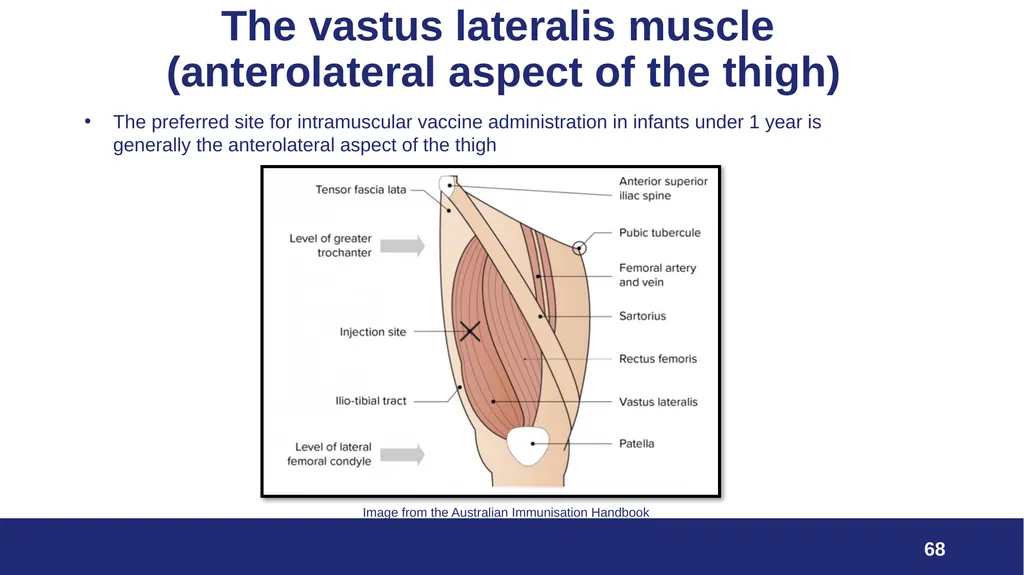
If there is insufficient muscle mass in the deltoid or a particular reason the deltoid muscle is unsuitable, the vaccine should be given into the vastus lateralis muscle in the anterolateral aspect of the thigh. 67 Image source: The Australian Immunisation Handbook (health.gov.au)<br>
The preferred site is the deltoid muscle of the upper arm.
The needle needs to be long enough to ensure vaccine is injected into the muscle. For this reason, a 25mm needle is being provided for administration of the COVID-19 vaccine. A 38mm length needle is available if required for adults with a high BMI.
If there is insufficient muscle mass in the deltoid or a particular reason the deltoid muscle is unsuitable, the vaccine should be given into the vastus lateralis muscle in the anterolateral aspect of the thigh. 67 Image source: The Australian Immunisation Handbook (health.gov.au)<br>
68
The vastus lateralis muscle
(anterolateral aspect of the thigh) Image from the Australian Immunisation Handbook 68 The preferred site for intramuscular vaccine administration in infants under 1 year is generally the anterolateral aspect of the thigh<br>
69
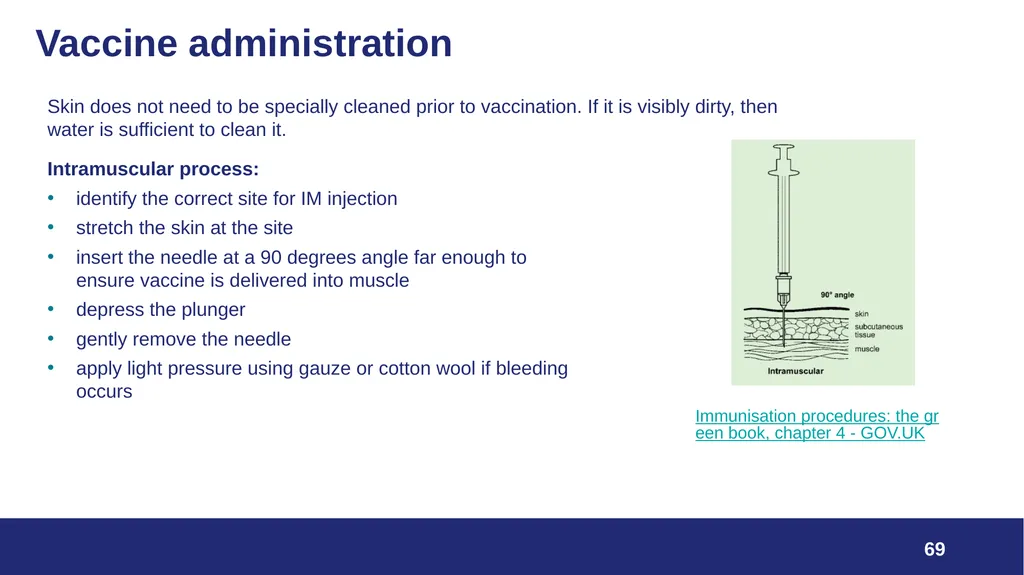
Vaccine administration Skin does not need to be specially cleaned prior to vaccination. If it is visibly dirty, then water is sufficient to clean it. Intramuscular process:
identify the correct site for IM injection
stretch the skin at the site
insert the needle at a 90 degrees angle far enough to ensure vaccine is delivered into muscle
depress the plunger
gently remove the needle
apply light pressure using gauze or cotton wool if bleeding occurs 69 Immunisation procedures: the green book, chapter 4 - GOV.UK<br>
identify the correct site for IM injection
stretch the skin at the site
insert the needle at a 90 degrees angle far enough to ensure vaccine is delivered into muscle
depress the plunger
gently remove the needle
apply light pressure using gauze or cotton wool if bleeding occurs 69 Immunisation procedures: the green book, chapter 4 - GOV.UK<br>
70
Disposal:
COVID-19 Vaccines Any unused product or waste material should be disposed of in accordance with local policy
Equipment used for immunisation, including used vials, ampoules, or discharged vaccines in a syringe or applicator, should be disposed of at the end of a session by sealing in an UN-approved puncture-resistant ‘sharps’ box, according to local authority regulations and guidance in the Welsh Health Technical Memorandum Safe and Sustainable Management of Healthcare Waste 2025 70<br>
Equipment used for immunisation, including used vials, ampoules, or discharged vaccines in a syringe or applicator, should be disposed of at the end of a session by sealing in an UN-approved puncture-resistant ‘sharps’ box, according to local authority regulations and guidance in the Welsh Health Technical Memorandum Safe and Sustainable Management of Healthcare Waste 2025 70<br>
71
Post vaccination waiting times For people with a history of allergy, as described in the Green Book, the 15 minute observation period remains. Further information is available here: Table 5 Green Book: COVID-19 chapter.
For those without a history of allergies (as described in the Green Book: COVID-19 Chapter), observation times are as follows:
After COVID-19 vaccine administration, individuals should be observed for any immediate reactions whilst they are receiving any verbal post vaccination information and exiting the centre.
Facilities for management of anaphylaxis should be available at all vaccination sites.
The advice to suspend the 15 minute observation period applies to all COVID-19 vaccines.
Vaccinated individuals should be informed about how to access immediate healthcare advice in the event of displaying any symptoms.
In some settings, for example domiciliary vaccination, this may require a responsible adult to be present for at least 15 minutes after vaccination.
No specific management is required for patients with a family history of allergies.
Some adverse effects and syncope may temporarily affect the ability to drive or use machines. It is advised not to drive or use machinery until the prevailing symptoms have cleared. 71<br>
For those without a history of allergies (as described in the Green Book: COVID-19 Chapter), observation times are as follows:
After COVID-19 vaccine administration, individuals should be observed for any immediate reactions whilst they are receiving any verbal post vaccination information and exiting the centre.
Facilities for management of anaphylaxis should be available at all vaccination sites.
The advice to suspend the 15 minute observation period applies to all COVID-19 vaccines.
Vaccinated individuals should be informed about how to access immediate healthcare advice in the event of displaying any symptoms.
In some settings, for example domiciliary vaccination, this may require a responsible adult to be present for at least 15 minutes after vaccination.
No specific management is required for patients with a family history of allergies.
Some adverse effects and syncope may temporarily affect the ability to drive or use machines. It is advised not to drive or use machinery until the prevailing symptoms have cleared. 71<br>
72
Informed consent Information to be given includes:
which vaccine is being offered and the disease against which it protects
benefits/risks of immunisation versus risks of the disease
any possible vaccine reactions and what to do if these occur 72 How much information should you give?
this will be personal to the individual at the time and will depend on their previous knowledge and discussions with others
give people as much information as they need and/or want to make an informed decision
some people will just ‘trust’ what you say while others want lots of information; either is fine
how much each individual needs is up to them, no one is obliged to seek full information Consent: the green book, chapter 2 - GOV.UK (www.gov.uk) Consent is a process, not a one-off discussion and must consider 3 factors:
the person giving consent must be appropriately informed: they must have the necessary information in order to make the decision
consent must be voluntary by the individual without undue pressure or coercion
the person consenting must have the capacity to make the decision Mental capacity Act 2005 https://www.legislation.gov.uk/ukpga/2005/9/contents<br>
which vaccine is being offered and the disease against which it protects
benefits/risks of immunisation versus risks of the disease
any possible vaccine reactions and what to do if these occur 72 How much information should you give?
this will be personal to the individual at the time and will depend on their previous knowledge and discussions with others
give people as much information as they need and/or want to make an informed decision
some people will just ‘trust’ what you say while others want lots of information; either is fine
how much each individual needs is up to them, no one is obliged to seek full information Consent: the green book, chapter 2 - GOV.UK (www.gov.uk) Consent is a process, not a one-off discussion and must consider 3 factors:
the person giving consent must be appropriately informed: they must have the necessary information in order to make the decision
consent must be voluntary by the individual without undue pressure or coercion
the person consenting must have the capacity to make the decision Mental capacity Act 2005 https://www.legislation.gov.uk/ukpga/2005/9/contents<br>
73
Reporting Adverse Events Vaccinees should be advised that they can report any adverse reactions or suspected side effects to the MHRA through the online yellow card scheme website or the Yellow Card app
Anyone (patients and HCWs) can make a Yellow Card report, even if they are uncertain as to whether a vaccine caused the condition
▼ This medicinal product is subject to additional monitoring. This will allow quick identification of new safety information. Healthcare professionals are asked to report any suspected adverse reactions*. 73 The QR code can be used for quick and easy access to the Yellow Card reporting site. www.mhra.gov.uk/yellowcard<br>
Anyone (patients and HCWs) can make a Yellow Card report, even if they are uncertain as to whether a vaccine caused the condition
▼ This medicinal product is subject to additional monitoring. This will allow quick identification of new safety information. Healthcare professionals are asked to report any suspected adverse reactions*. 73 The QR code can be used for quick and easy access to the Yellow Card reporting site. www.mhra.gov.uk/yellowcard<br>
74
Summary and resources<br>
75
Key messages COVID-19 is now a relatively mild disease for the vast majority of people. This ongoing increase in population immunity permits the development of a more targeted programme aimed at those at higher risk of developing serious COVID-19 disease.
Individuals aged six months to 4 years who become eligible for COVID-19 vaccination require 2 primary doses as per PGD (off-label).
Individuals aged six months and above with severe immunosuppression may be considered for additional doses ideally at an interval of 8 to 12 weeks from the previous dose.
Exception to this ideal interval may be advised based on specialist clinical judgement, for example for those about to receive or increase the intensity of an immunosuppressive treatment, where a better response would be made if immunised prior to that treatment commencing.
Where the specialist has advised an exception, then the interval may be reduced to a minimum of three weeks for any of the vaccine products.
Previously unvaccinated individuals who become or have recently become severely immunosuppressed, should be considered for a first dose of vaccination, and if recommended by their specialist clinician, the second dose given ideally between 8-12 weeks from the previous dose to extend protection.
Individuals who receive bone marrow transplants (BMT), or CAR-T therapy for certain conditions, may have lost immunological memory of previous vaccination and should be considered for a full course of revaccination for vaccines in the routine programme under specialist advice. Individuals who have recovered from a BMT should be considered for a first dose of COVID-19 vaccine regardless of time of year with a subsequent dose offered ideally 8 to 12 weeks later to extend the duration of protection. Specialist clinical advice should be sought.
For individuals about to receive planned immunosuppressive treatment, a minimum interval of 3 weeks between COVID-19 doses may be followed, to enable the vaccine to be given whilst the individual’s immune system is better able to respond. 75<br>
Individuals aged six months to 4 years who become eligible for COVID-19 vaccination require 2 primary doses as per PGD (off-label).
Individuals aged six months and above with severe immunosuppression may be considered for additional doses ideally at an interval of 8 to 12 weeks from the previous dose.
Exception to this ideal interval may be advised based on specialist clinical judgement, for example for those about to receive or increase the intensity of an immunosuppressive treatment, where a better response would be made if immunised prior to that treatment commencing.
Where the specialist has advised an exception, then the interval may be reduced to a minimum of three weeks for any of the vaccine products.
Previously unvaccinated individuals who become or have recently become severely immunosuppressed, should be considered for a first dose of vaccination, and if recommended by their specialist clinician, the second dose given ideally between 8-12 weeks from the previous dose to extend protection.
Individuals who receive bone marrow transplants (BMT), or CAR-T therapy for certain conditions, may have lost immunological memory of previous vaccination and should be considered for a full course of revaccination for vaccines in the routine programme under specialist advice. Individuals who have recovered from a BMT should be considered for a first dose of COVID-19 vaccine regardless of time of year with a subsequent dose offered ideally 8 to 12 weeks later to extend the duration of protection. Specialist clinical advice should be sought.
For individuals about to receive planned immunosuppressive treatment, a minimum interval of 3 weeks between COVID-19 doses may be followed, to enable the vaccine to be given whilst the individual’s immune system is better able to respond. 75<br>
76
Confident vaccine conversations - Behavioural Science Motivational Interviewing approach
eLearning module 76 This eLearning module has been developed as a collaborative project between:
Public health Wales - Health Protection Division -Training Guidance and Behavioral Science Team
Public health Wales - Behavioral Science Unit
Public health Wales - Health Protection Division - Vaccine Preventable Disease Programme
The eLearning module is available on ESR and Learning@Wales. Information and registration support is available here: Immunisation eLearning - Public Health Wales<br>
Public health Wales - Health Protection Division -Training Guidance and Behavioral Science Team
Public health Wales - Behavioral Science Unit
Public health Wales - Health Protection Division - Vaccine Preventable Disease Programme
The eLearning module is available on ESR and Learning@Wales. Information and registration support is available here: Immunisation eLearning - Public Health Wales<br>
77
Public resources 77 Immunisation and Vaccines - Public Health Wales (nhs.wales)
Order for FREE here: https://phw.nhs.wales/services-and-teams/health-information-resources/ COVID-19 Poster COVID-19 Autumn information Leaflet Currently being updated<br>
Order for FREE here: https://phw.nhs.wales/services-and-teams/health-information-resources/ COVID-19 Poster COVID-19 Autumn information Leaflet Currently being updated<br>
78
Further information to support the COVID-19 Vaccination Programme 78 COVID-19 Information for health care professionals webpage here COVID-19 Information for the public webpage here<br>
79
Further information Immunisation against infectious disease "Green Book"
JCVI statement on COVID-19 vaccination in autumn 2026 and spring 2027 - GOV.UK
The national COVID-19 vaccination programme autumn 2026 (WHC/2026/009) | GOV.WALES
PHW professional information resources:
COVID-19 resources for health and social care professionals - Public Health Wales (nhs.wales)
Vaccine resources for health and social care professionals - Public Health Wales (nhs.wales)
PHW training:
Immunisation training resources and events - Public Health Wales (nhs.wales)
Immunisation eLearning - Public Health Wales (nhs.wales)
UKHSA COVID-19 vaccination resources:
COVID-19 vaccination programme - GOV.UK (www.gov.uk)
UKHSA COVID-19 Immunisation programme Information for healthcare practitioners This document provides additional information, answers to frequently asked questions and actions to take in the event of inadvertent errors.
Oxford Knowledge Project: COVID-19 vaccines
MHRA: Guidance on coronavirus (COVID-19) 79<br>
JCVI statement on COVID-19 vaccination in autumn 2026 and spring 2027 - GOV.UK
The national COVID-19 vaccination programme autumn 2026 (WHC/2026/009) | GOV.WALES
PHW professional information resources:
COVID-19 resources for health and social care professionals - Public Health Wales (nhs.wales)
Vaccine resources for health and social care professionals - Public Health Wales (nhs.wales)
PHW training:
Immunisation training resources and events - Public Health Wales (nhs.wales)
Immunisation eLearning - Public Health Wales (nhs.wales)
UKHSA COVID-19 vaccination resources:
COVID-19 vaccination programme - GOV.UK (www.gov.uk)
UKHSA COVID-19 Immunisation programme Information for healthcare practitioners This document provides additional information, answers to frequently asked questions and actions to take in the event of inadvertent errors.
Oxford Knowledge Project: COVID-19 vaccines
MHRA: Guidance on coronavirus (COVID-19) 79<br>