
Warren Reeve Duchac Accounting 27e Receivables 9 C
CP
Published · 22 slides · 0 views

1 / 1
Description
Warren Reeve Duchac Accounting 27e Receivables 9 C H A P T E R humaniStock360Getty Images Classification of Receivables The term receivables includes all money claims against other entities, including people, companies, and other
Related Topics
Share
Embed code
Download this presentation From Below
"Warren Reeve Duchac Accounting 27e Receivables 9 C" is the property of its rightful owner. Permission is granted to download and print the materials on this website for personal, non-commercial use only, and to display it on your personal computer provided you do not modify the materials and that you retain all copyright notices contained in the materials. By downloading content from our website, you accept the terms of this agreement.
Presentation Transcript
01
Warren
Reeve
Duchac Accounting
27e Receivables 9 C H A P T E R human/iStock/360/Getty Images<br>
Reeve
Duchac Accounting
27e Receivables 9 C H A P T E R human/iStock/360/Getty Images<br>
02
Classification of Receivables The term receivables includes all money claims against other entities, including people, companies, and other organizations.
The receivables that result from sales on account are normally accounts receivable or notes receivable.
Notes and accounts receivable that result from sales transactions are sometimes called trade receivables. ©2018 Cengage Learning. All Rights Reserved. May not be scanned, copied or duplicated, or posted to a publicly accessible website, in whole or in part.<br>
The receivables that result from sales on account are normally accounts receivable or notes receivable.
Notes and accounts receivable that result from sales transactions are sometimes called trade receivables. ©2018 Cengage Learning. All Rights Reserved. May not be scanned, copied or duplicated, or posted to a publicly accessible website, in whole or in part.<br>
03
Accounts Receivables The most common transaction creating a receivable is selling merchandise or services on account (on credit).
The receivable is recorded as a debit to Accounts Receivable.
Such accounts receivable are normally collected within a short period, such as 30 or 60 days.
They are classified on the balance sheet as a current asset. ©2018 Cengage Learning. All Rights Reserved. May not be scanned, copied or duplicated, or posted to a publicly accessible website, in whole or in part.<br>
The receivable is recorded as a debit to Accounts Receivable.
Such accounts receivable are normally collected within a short period, such as 30 or 60 days.
They are classified on the balance sheet as a current asset. ©2018 Cengage Learning. All Rights Reserved. May not be scanned, copied or duplicated, or posted to a publicly accessible website, in whole or in part.<br>
04
Notes Receivables Notes receivable are amounts that customers owe for which a formal, written instrument of credit has been issued.
If notes receivable are expected to be collected within a year, they are classified on the balance sheet as a current asset.
Notes are often used for credit periods of more than 60 days.
Notes may also be used to settle a customer’s accounts receivable. ©2018 Cengage Learning. All Rights Reserved. May not be scanned, copied or duplicated, or posted to a publicly accessible website, in whole or in part.<br>
If notes receivable are expected to be collected within a year, they are classified on the balance sheet as a current asset.
Notes are often used for credit periods of more than 60 days.
Notes may also be used to settle a customer’s accounts receivable. ©2018 Cengage Learning. All Rights Reserved. May not be scanned, copied or duplicated, or posted to a publicly accessible website, in whole or in part.<br>
05
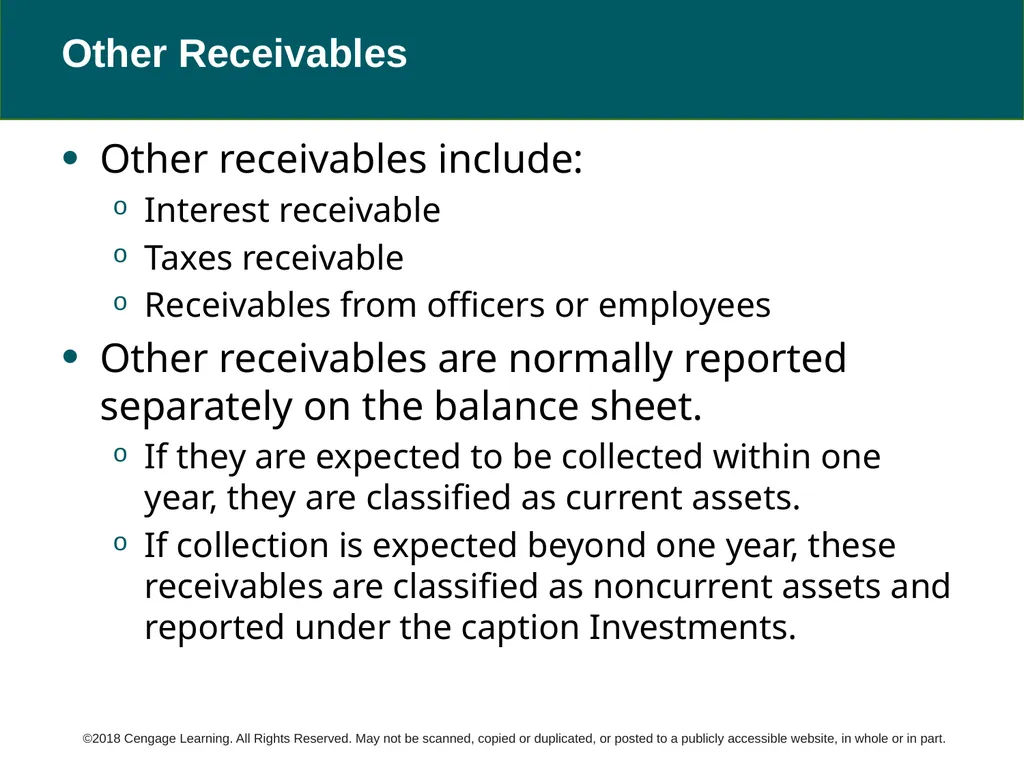
Other Receivables Other receivables include:
Interest receivable
Taxes receivable
Receivables from officers or employees
Other receivables are normally reported separately on the balance sheet.
If they are expected to be collected within one year, they are classified as current assets.
If collection is expected beyond one year, these receivables are classified as noncurrent assets and reported under the caption Investments. ©2018 Cengage Learning. All Rights Reserved. May not be scanned, copied or duplicated, or posted to a publicly accessible website, in whole or in part.<br>
Interest receivable
Taxes receivable
Receivables from officers or employees
Other receivables are normally reported separately on the balance sheet.
If they are expected to be collected within one year, they are classified as current assets.
If collection is expected beyond one year, these receivables are classified as noncurrent assets and reported under the caption Investments. ©2018 Cengage Learning. All Rights Reserved. May not be scanned, copied or duplicated, or posted to a publicly accessible website, in whole or in part.<br>
06
Uncollectible Receivables
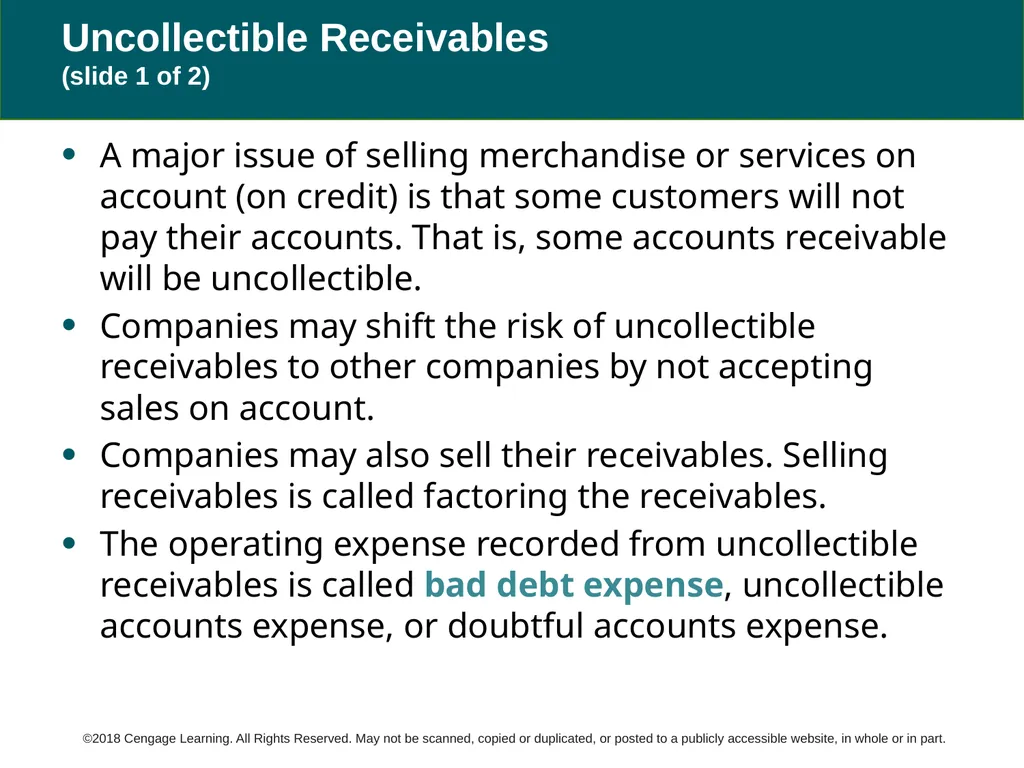
(slide 1 of 2) A major issue of selling merchandise or services on account (on credit) is that some customers will not pay their accounts. That is, some accounts receivable will be uncollectible.
Companies may shift the risk of uncollectible receivables to other companies by not accepting sales on account.
Companies may also sell their receivables. Selling receivables is called factoring the receivables.
The operating expense recorded from uncollectible receivables is called bad debt expense, uncollectible accounts expense, or doubtful accounts expense. ©2018 Cengage Learning. All Rights Reserved. May not be scanned, copied or duplicated, or posted to a publicly accessible website, in whole or in part.<br>
Companies may shift the risk of uncollectible receivables to other companies by not accepting sales on account.
Companies may also sell their receivables. Selling receivables is called factoring the receivables.
The operating expense recorded from uncollectible receivables is called bad debt expense, uncollectible accounts expense, or doubtful accounts expense. ©2018 Cengage Learning. All Rights Reserved. May not be scanned, copied or duplicated, or posted to a publicly accessible website, in whole or in part.<br>
07
Uncollectible Receivables
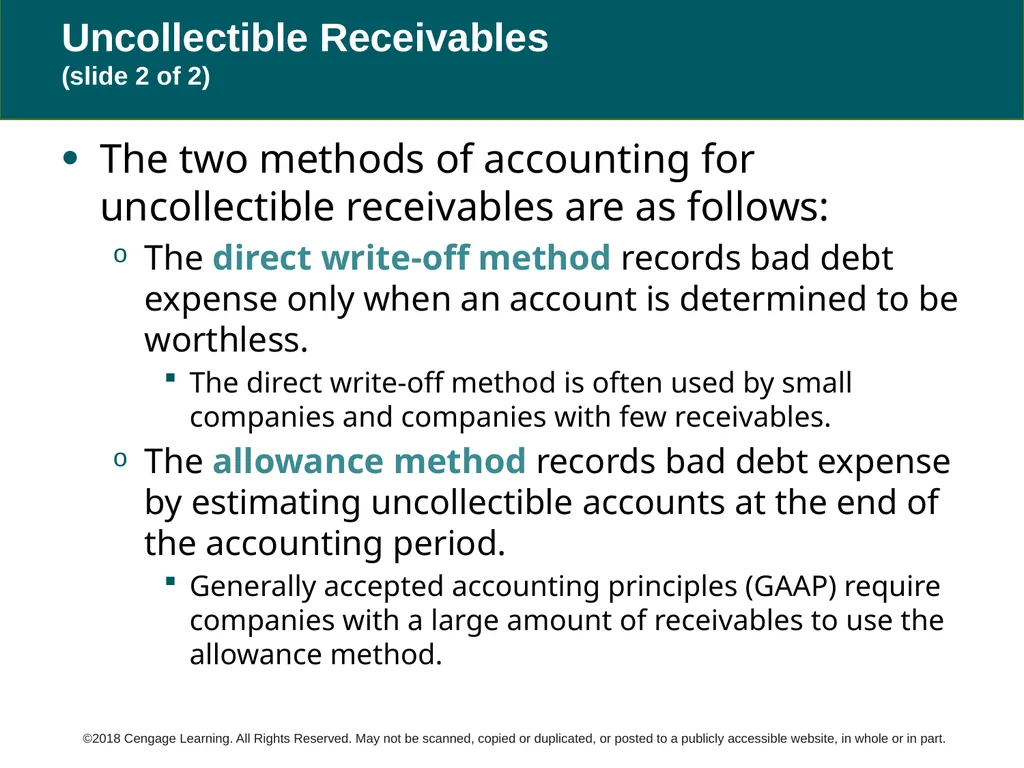
(slide 2 of 2) The two methods of accounting for uncollectible receivables are as follows:
The direct write-off method records bad debt expense only when an account is determined to be worthless.
The direct write-off method is often used by small companies and companies with few receivables.
The allowance method records bad debt expense by estimating uncollectible accounts at the end of the accounting period.
Generally accepted accounting principles (GAAP) require companies with a large amount of receivables to use the allowance method. ©2018 Cengage Learning. All Rights Reserved. May not be scanned, copied or duplicated, or posted to a publicly accessible website, in whole or in part.<br>
The direct write-off method records bad debt expense only when an account is determined to be worthless.
The direct write-off method is often used by small companies and companies with few receivables.
The allowance method records bad debt expense by estimating uncollectible accounts at the end of the accounting period.
Generally accepted accounting principles (GAAP) require companies with a large amount of receivables to use the allowance method. ©2018 Cengage Learning. All Rights Reserved. May not be scanned, copied or duplicated, or posted to a publicly accessible website, in whole or in part.<br>
08
Direct Write-Off Method for
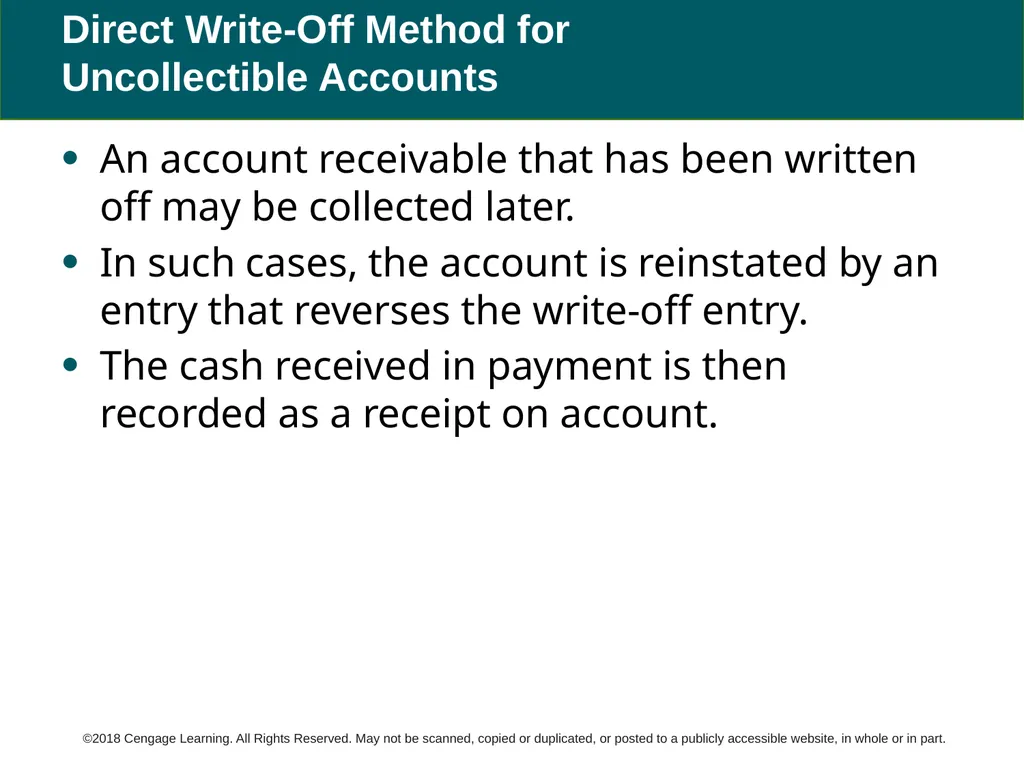
Uncollectible Accounts An account receivable that has been written off may be collected later.
In such cases, the account is reinstated by an entry that reverses the write-off entry.
The cash received in payment is then recorded as a receipt on account. ©2018 Cengage Learning. All Rights Reserved. May not be scanned, copied or duplicated, or posted to a publicly accessible website, in whole or in part.<br>
In such cases, the account is reinstated by an entry that reverses the write-off entry.
The cash received in payment is then recorded as a receipt on account. ©2018 Cengage Learning. All Rights Reserved. May not be scanned, copied or duplicated, or posted to a publicly accessible website, in whole or in part.<br>
09
Write-Offs to the Allowance Account
(slide 1 of 2) When a customer’s account is identified as uncollectible, it is written off against the allowance account.
This requires the company to remove the specific accounts receivable and an equal amount from the allowance account. ©2018 Cengage Learning. All Rights Reserved. May not be scanned, copied or duplicated, or posted to a publicly accessible website, in whole or in part.<br>
This requires the company to remove the specific accounts receivable and an equal amount from the allowance account. ©2018 Cengage Learning. All Rights Reserved. May not be scanned, copied or duplicated, or posted to a publicly accessible website, in whole or in part.<br>
10
Write-Offs to the Allowance Account
(slide 2 of 2) Because Allowance for Doubtful Accounts is based on an estimate, it will normally have a balance at the end of a period. The total write-offs to the allowance account during the period will rarely equal the balance of the account at the beginning of the period.
The allowance account will have a credit balance at the end of the period if the write-offs during the period are less than the beginning balance.
The allowance account will have a debit balance at the end of the period if the write-offs during the period exceed the beginning balance.
An account receivable that has been written off against the allowance account may be collected later. ©2018 Cengage Learning. All Rights Reserved. May not be scanned, copied or duplicated, or posted to a publicly accessible website, in whole or in part.<br>
The allowance account will have a credit balance at the end of the period if the write-offs during the period are less than the beginning balance.
The allowance account will have a debit balance at the end of the period if the write-offs during the period exceed the beginning balance.
An account receivable that has been written off against the allowance account may be collected later. ©2018 Cengage Learning. All Rights Reserved. May not be scanned, copied or duplicated, or posted to a publicly accessible website, in whole or in part.<br>
11
Estimating Uncollectibles The allowance method requires an estimate of uncollectible accounts at the end of the period.
This estimate is normally based on past experience, industry averages, and forecasts of the future.
The two methods used to estimate uncollectible accounts are as follows:
Percent of sales method
Analysis of receivables method ©2018 Cengage Learning. All Rights Reserved. May not be scanned, copied or duplicated, or posted to a publicly accessible website, in whole or in part.<br>
This estimate is normally based on past experience, industry averages, and forecasts of the future.
The two methods used to estimate uncollectible accounts are as follows:
Percent of sales method
Analysis of receivables method ©2018 Cengage Learning. All Rights Reserved. May not be scanned, copied or duplicated, or posted to a publicly accessible website, in whole or in part.<br>
12
Percent of Sales Method Since accounts receivable are created by credit sales, uncollectible accounts can be estimated as a percent of credit sales. ©2018 Cengage Learning. All Rights Reserved. May not be scanned, copied or duplicated, or posted to a publicly accessible website, in whole or in part.<br>
13
Analysis of Receivables Method
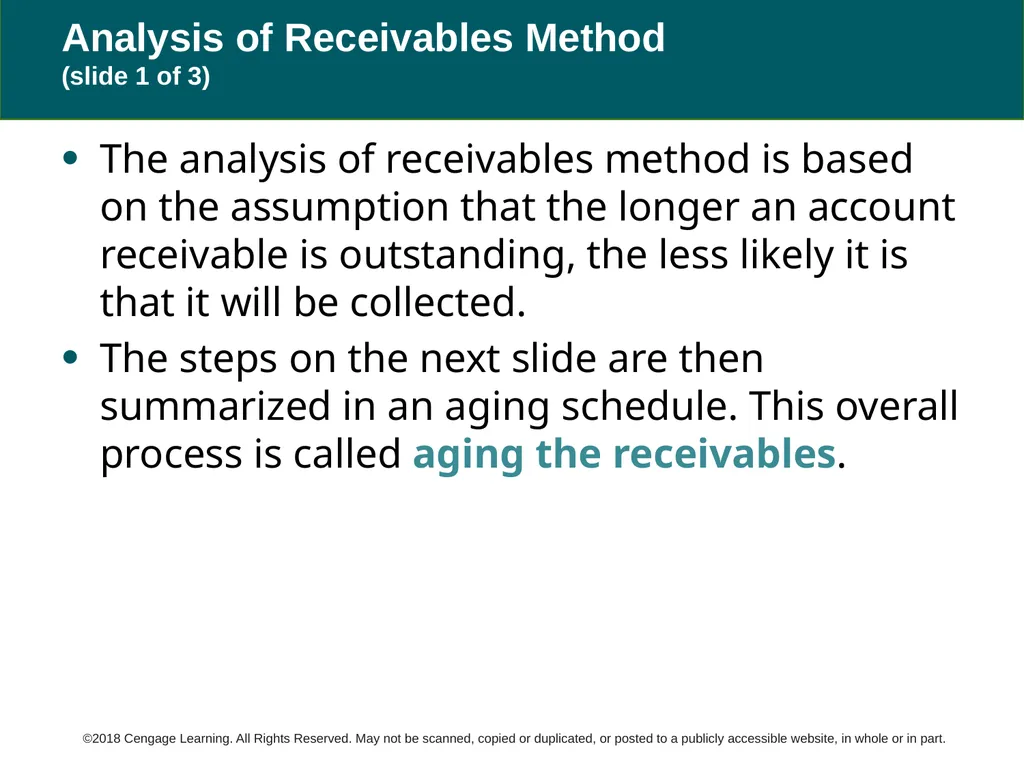
(slide 1 of 3) The analysis of receivables method is based on the assumption that the longer an account receivable is outstanding, the less likely it is that it will be collected.
The steps on the next slide are then summarized in an aging schedule. This overall process is called aging the receivables. ©2018 Cengage Learning. All Rights Reserved. May not be scanned, copied or duplicated, or posted to a publicly accessible website, in whole or in part.<br>
The steps on the next slide are then summarized in an aging schedule. This overall process is called aging the receivables. ©2018 Cengage Learning. All Rights Reserved. May not be scanned, copied or duplicated, or posted to a publicly accessible website, in whole or in part.<br>
14
Analysis of Receivables Method
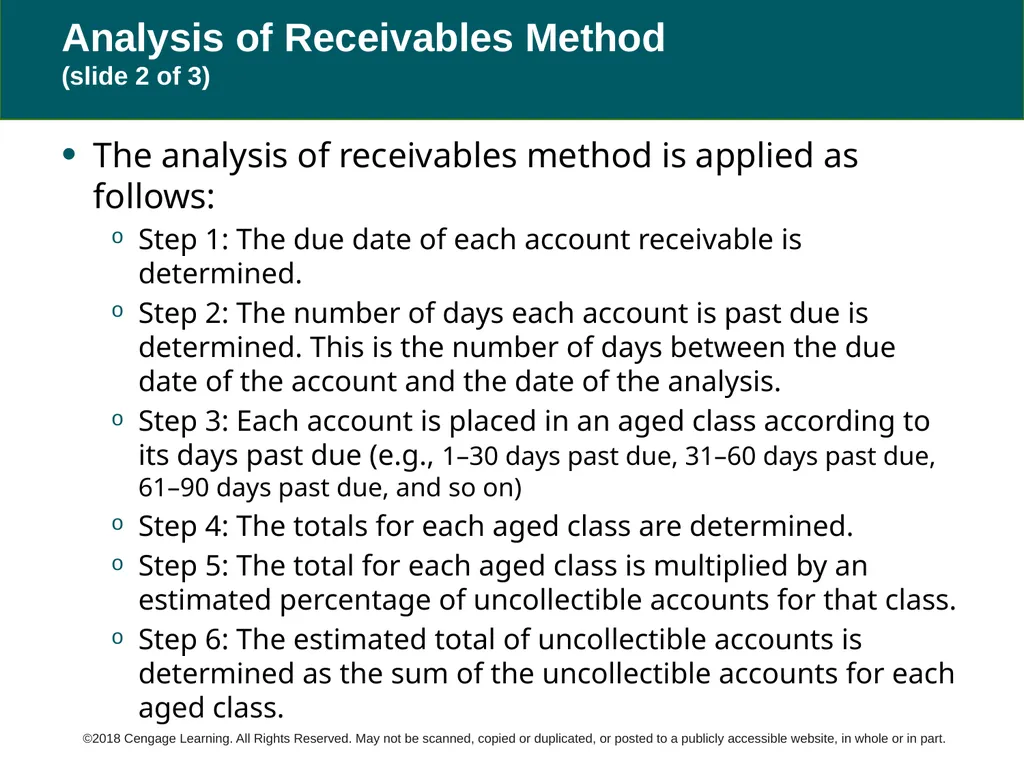
(slide 2 of 3) The analysis of receivables method is applied as follows:
Step 1: The due date of each account receivable is determined.
Step 2: The number of days each account is past due is determined. This is the number of days between the due date of the account and the date of the analysis.
Step 3: Each account is placed in an aged class according to its days past due (e.g., 1–30 days past due, 31–60 days past due, 61–90 days past due, and so on)
Step 4: The totals for each aged class are determined.
Step 5: The total for each aged class is multiplied by an estimated percentage of uncollectible accounts for that class.
Step 6: The estimated total of uncollectible accounts is determined as the sum of the uncollectible accounts for each aged class. ©2018 Cengage Learning. All Rights Reserved. May not be scanned, copied or duplicated, or posted to a publicly accessible website, in whole or in part.<br>
Step 1: The due date of each account receivable is determined.
Step 2: The number of days each account is past due is determined. This is the number of days between the due date of the account and the date of the analysis.
Step 3: Each account is placed in an aged class according to its days past due (e.g., 1–30 days past due, 31–60 days past due, 61–90 days past due, and so on)
Step 4: The totals for each aged class are determined.
Step 5: The total for each aged class is multiplied by an estimated percentage of uncollectible accounts for that class.
Step 6: The estimated total of uncollectible accounts is determined as the sum of the uncollectible accounts for each aged class. ©2018 Cengage Learning. All Rights Reserved. May not be scanned, copied or duplicated, or posted to a publicly accessible website, in whole or in part.<br>
15
Analysis of Receivables Method
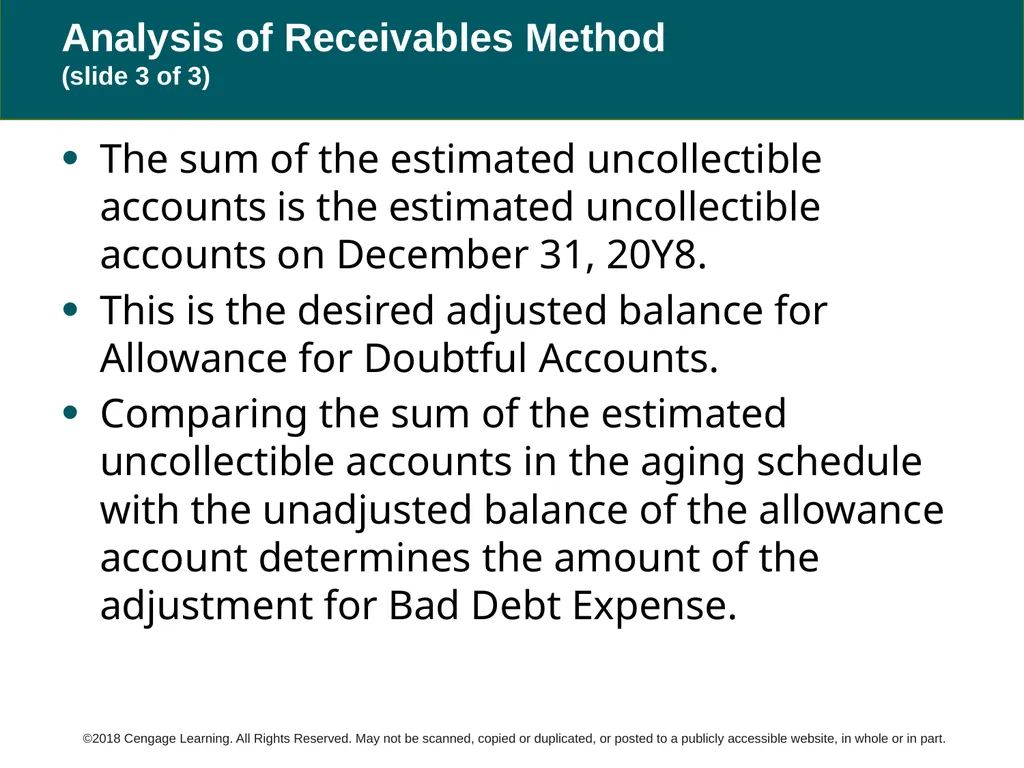
(slide 3 of 3) The sum of the estimated uncollectible accounts is the estimated uncollectible accounts on December 31, 20Y8.
This is the desired adjusted balance for Allowance for Doubtful Accounts.
Comparing the sum of the estimated uncollectible accounts in the aging schedule with the unadjusted balance of the allowance account determines the amount of the adjustment for Bad Debt Expense. ©2018 Cengage Learning. All Rights Reserved. May not be scanned, copied or duplicated, or posted to a publicly accessible website, in whole or in part.<br>
This is the desired adjusted balance for Allowance for Doubtful Accounts.
Comparing the sum of the estimated uncollectible accounts in the aging schedule with the unadjusted balance of the allowance account determines the amount of the adjustment for Bad Debt Expense. ©2018 Cengage Learning. All Rights Reserved. May not be scanned, copied or duplicated, or posted to a publicly accessible website, in whole or in part.<br>
16
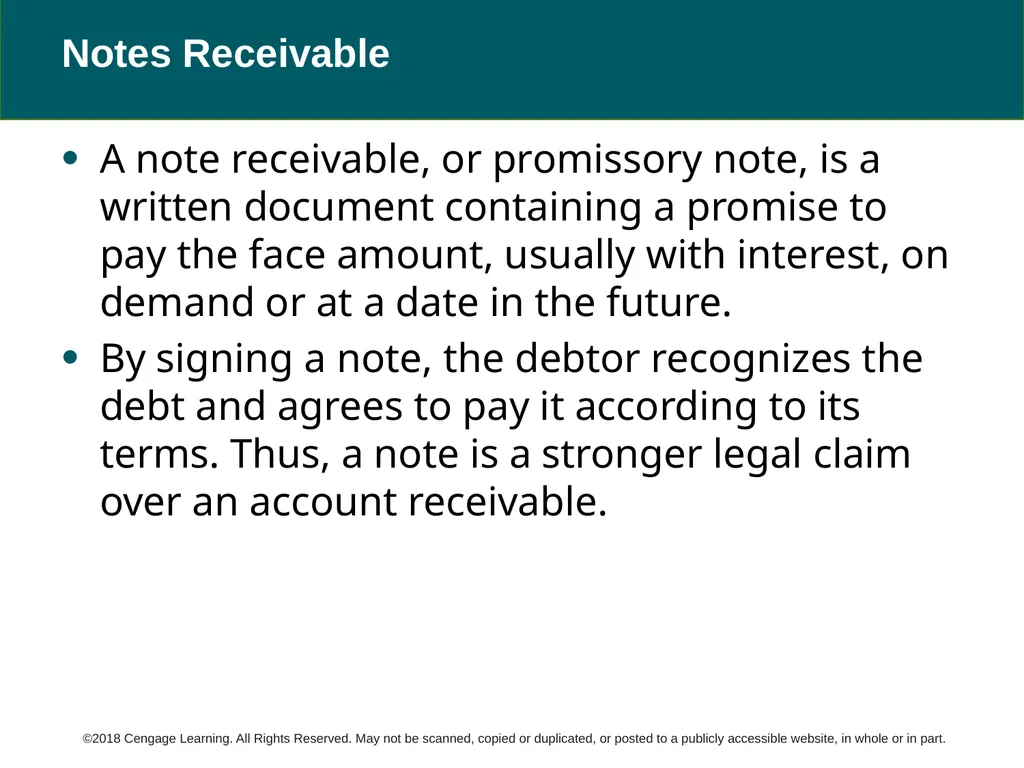
Notes Receivable A note receivable, or promissory note, is a written document containing a promise to pay the face amount, usually with interest, on demand or at a date in the future.
By signing a note, the debtor recognizes the debt and agrees to pay it according to its terms. Thus, a note is a stronger legal claim over an account receivable. ©2018 Cengage Learning. All Rights Reserved. May not be scanned, copied or duplicated, or posted to a publicly accessible website, in whole or in part.<br>
By signing a note, the debtor recognizes the debt and agrees to pay it according to its terms. Thus, a note is a stronger legal claim over an account receivable. ©2018 Cengage Learning. All Rights Reserved. May not be scanned, copied or duplicated, or posted to a publicly accessible website, in whole or in part.<br>
17
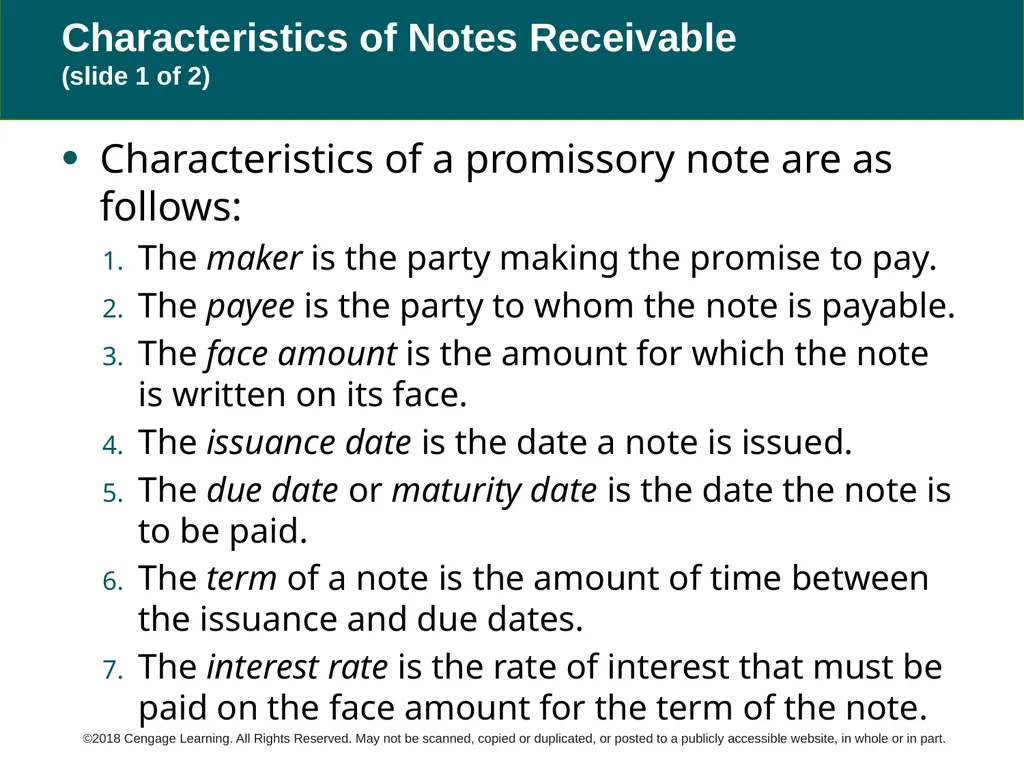
Characteristics of Notes Receivable
(slide 1 of 2) Characteristics of a promissory note are as follows:
The maker is the party making the promise to pay.
The payee is the party to whom the note is payable.
The face amount is the amount for which the note is written on its face.
The issuance date is the date a note is issued.
The due date or maturity date is the date the note is to be paid.
The term of a note is the amount of time between the issuance and due dates.
The interest rate is the rate of interest that must be paid on the face amount for the term of the note. ©2018 Cengage Learning. All Rights Reserved. May not be scanned, copied or duplicated, or posted to a publicly accessible website, in whole or in part.<br>
The maker is the party making the promise to pay.
The payee is the party to whom the note is payable.
The face amount is the amount for which the note is written on its face.
The issuance date is the date a note is issued.
The due date or maturity date is the date the note is to be paid.
The term of a note is the amount of time between the issuance and due dates.
The interest rate is the rate of interest that must be paid on the face amount for the term of the note. ©2018 Cengage Learning. All Rights Reserved. May not be scanned, copied or duplicated, or posted to a publicly accessible website, in whole or in part.<br>
18
Characteristics of Notes Receivable
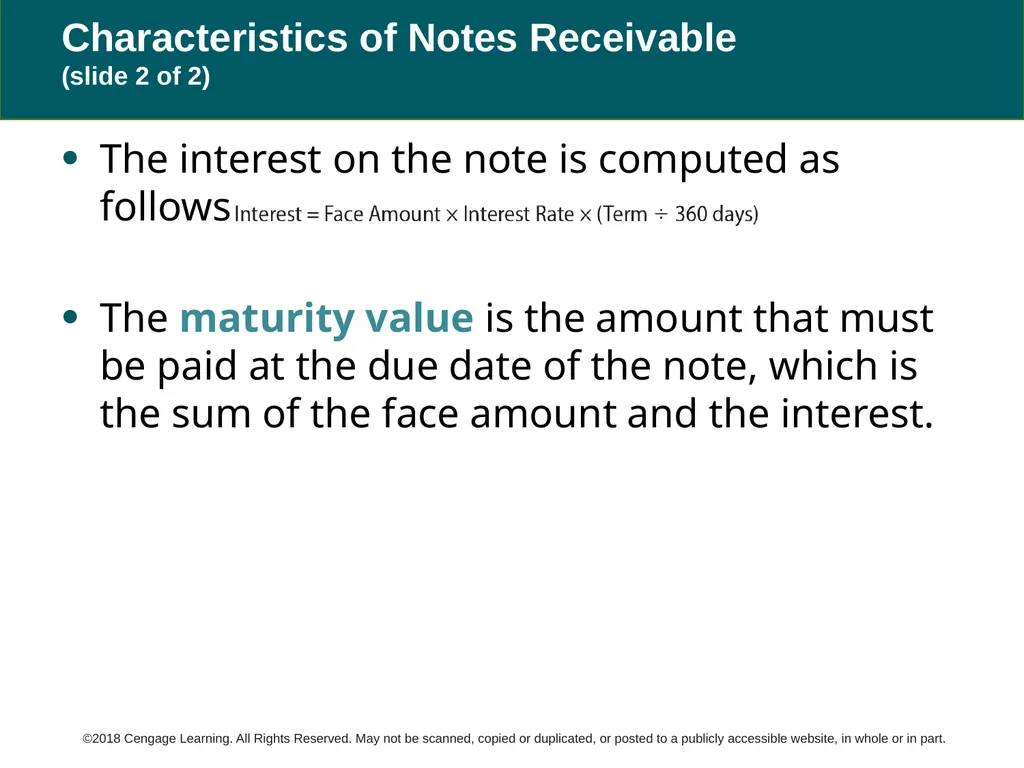
(slide 2 of 2) The interest on the note is computed as follows:
The maturity value is the amount that must be paid at the due date of the note, which is the sum of the face amount and the interest. ©2018 Cengage Learning. All Rights Reserved. May not be scanned, copied or duplicated, or posted to a publicly accessible website, in whole or in part.<br>
The maturity value is the amount that must be paid at the due date of the note, which is the sum of the face amount and the interest. ©2018 Cengage Learning. All Rights Reserved. May not be scanned, copied or duplicated, or posted to a publicly accessible website, in whole or in part.<br>
19
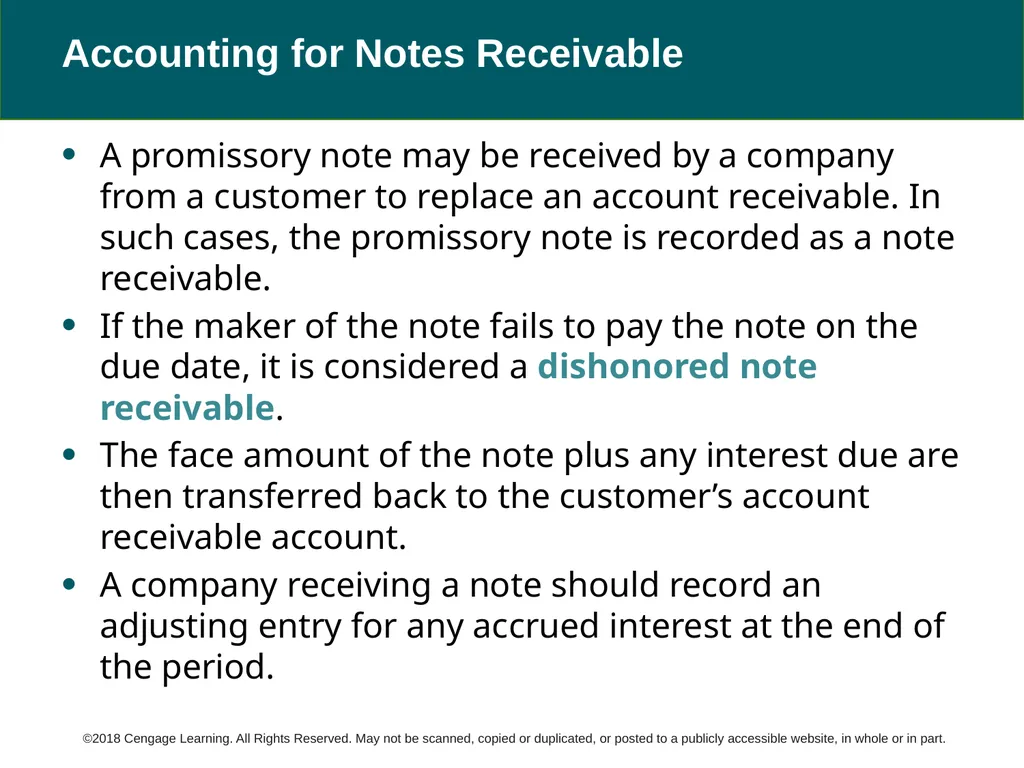
Accounting for Notes Receivable A promissory note may be received by a company from a customer to replace an account receivable. In such cases, the promissory note is recorded as a note receivable.
If the maker of the note fails to pay the note on the due date, it is considered a dishonored note receivable.
The face amount of the note plus any interest due are then transferred back to the customer’s account receivable account.
A company receiving a note should record an adjusting entry for any accrued interest at the end of the period. ©2018 Cengage Learning. All Rights Reserved. May not be scanned, copied or duplicated, or posted to a publicly accessible website, in whole or in part.<br>
If the maker of the note fails to pay the note on the due date, it is considered a dishonored note receivable.
The face amount of the note plus any interest due are then transferred back to the customer’s account receivable account.
A company receiving a note should record an adjusting entry for any accrued interest at the end of the period. ©2018 Cengage Learning. All Rights Reserved. May not be scanned, copied or duplicated, or posted to a publicly accessible website, in whole or in part.<br>
20
Reporting Receivables on the Balance Sheet All receivables that are expected to be realized in cash within a year are reported in the Current assets section of the balance sheet. ©2018 Cengage Learning. All Rights Reserved. May not be scanned, copied or duplicated, or posted to a publicly accessible website, in whole or in part.<br>
21
Financial Analysis and Interpretation:
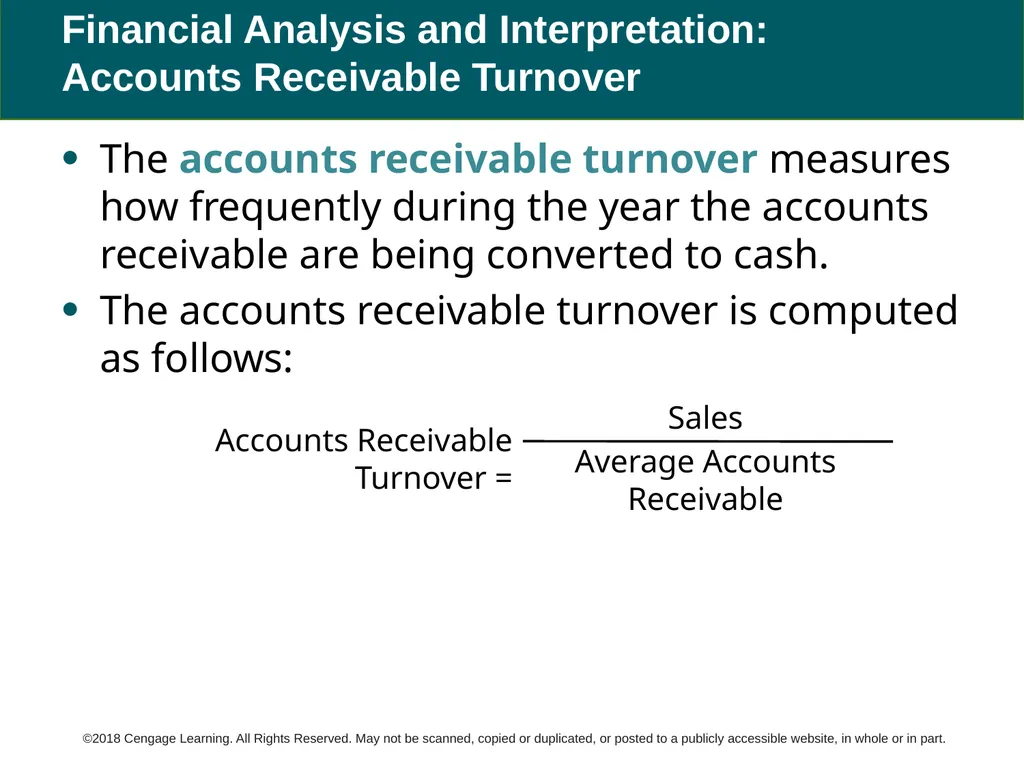
Accounts Receivable Turnover The accounts receivable turnover measures how frequently during the year the accounts receivable are being converted to cash.
The accounts receivable turnover is computed as follows: ©2018 Cengage Learning. All Rights Reserved. May not be scanned, copied or duplicated, or posted to a publicly accessible website, in whole or in part.<br>
The accounts receivable turnover is computed as follows: ©2018 Cengage Learning. All Rights Reserved. May not be scanned, copied or duplicated, or posted to a publicly accessible website, in whole or in part.<br>
22
Financial Analysis and Interpretation:
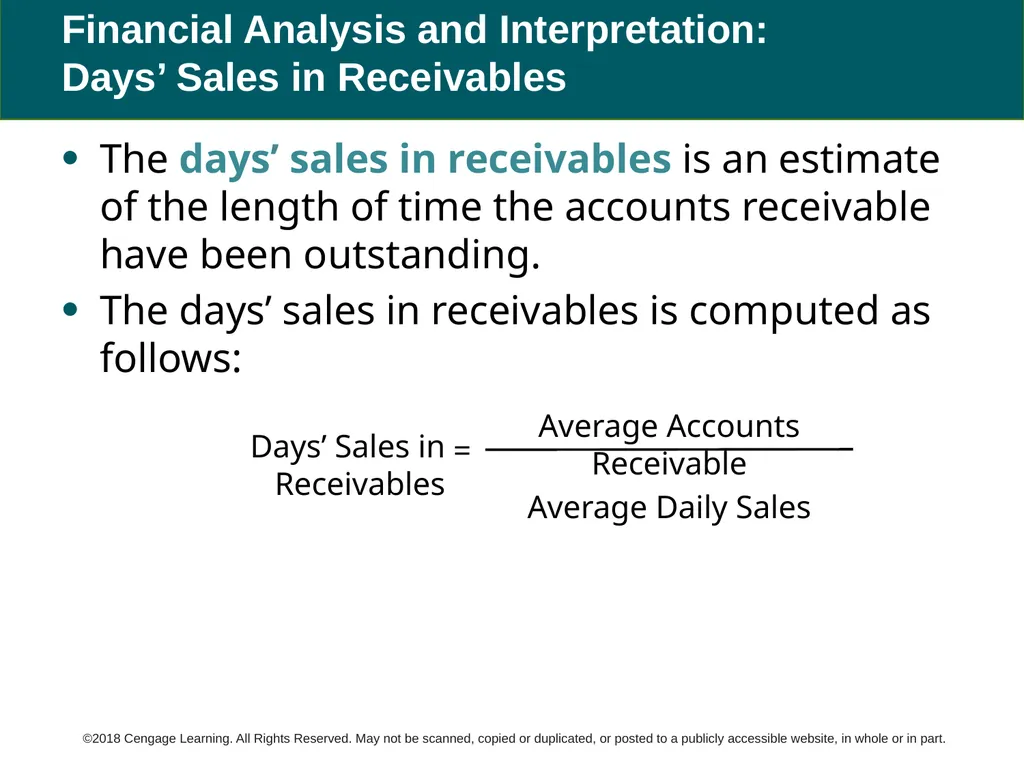
Days’ Sales in Receivables The days’ sales in receivables is an estimate of the length of time the accounts receivable have been outstanding.
The days’ sales in receivables is computed as follows: ©2018 Cengage Learning. All Rights Reserved. May not be scanned, copied or duplicated, or posted to a publicly accessible website, in whole or in part.<br>
The days’ sales in receivables is computed as follows: ©2018 Cengage Learning. All Rights Reserved. May not be scanned, copied or duplicated, or posted to a publicly accessible website, in whole or in part.<br>