WATER CYCLE 4: precipitation and runoff WJEC Focus Box 3.1.4 Eduqas Focus Box 2.1.4 We are grateful to Hodder for their permission to use the diagrams in this resource. Water Cycle 4 Air uplift, condensation, clouds Air uplift leads to
"WATER CYCLE 4: precipitation and runoff WJEC Focus" is the property of its rightful owner. Permission is granted to
download and print the materials on this website for personal, non-commercial use only, and to display it
on your personal computer provided you do not modify the materials and that you retain all copyright
notices contained in the materials. By downloading content from our website, you accept the terms of this
agreement.
Presentation Transcript
01
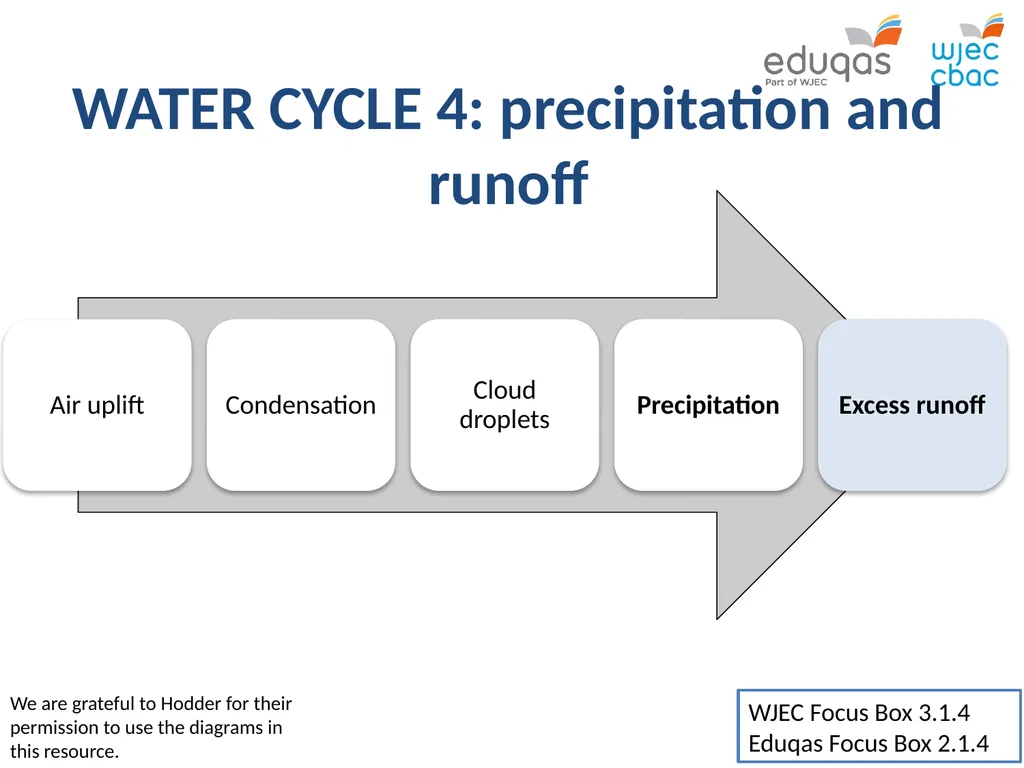
WATER CYCLE 4: precipitation and runoff WJEC Focus Box 3.1.4
Eduqas Focus Box 2.1.4 We are grateful to Hodder for their permission to use the diagrams in this resource.<br>
02
Water Cycle 4 Air uplift, condensation, clouds Air uplift leads to cooling and condensation because of the fall in pressure with altitude
This results in of the expansion of the air
As a result, there are fewer collisions between air molecules: this reduces the amount of heat energy per unit volume and air temperature falls
Cloud formation occurs when temperature is low enough for vapour to condense into water droplets Class activity
Why does condensation occur on windows? Why is your breath visible when you exhale on cold days?<br>
03
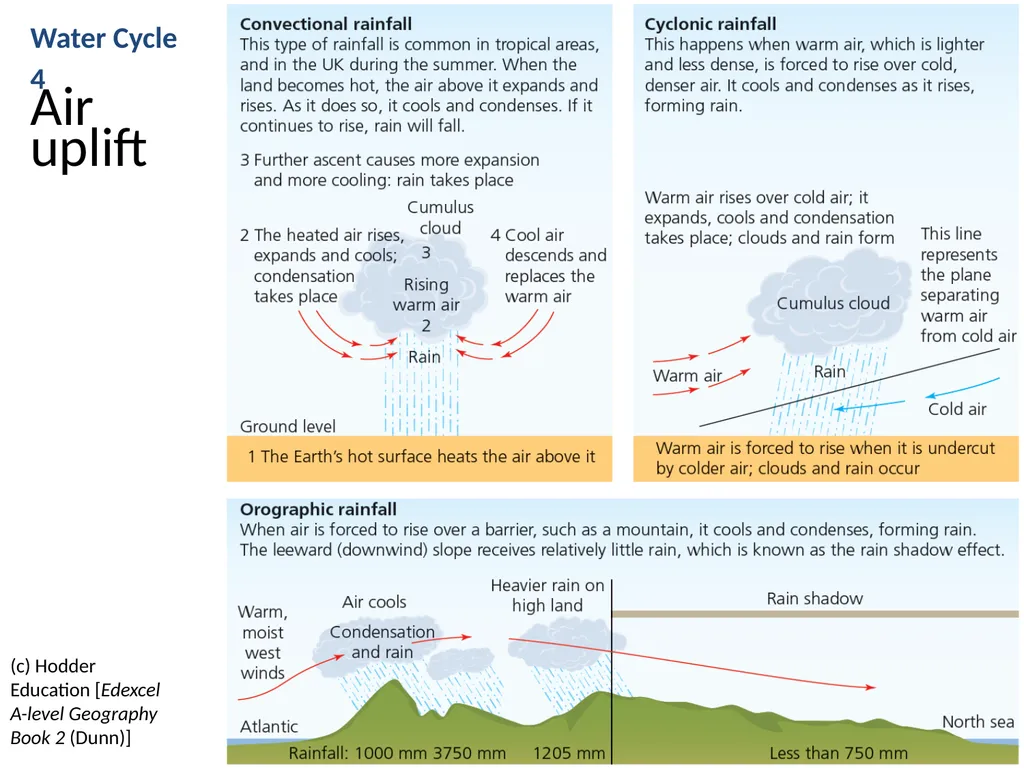
Water Cycle 4 Air uplift (c) Hodder Education [Edexcel A-level Geography Book 2 (Dunn)]<br>
04
Water Cycle 4 Air uplift mechanisms Class activity
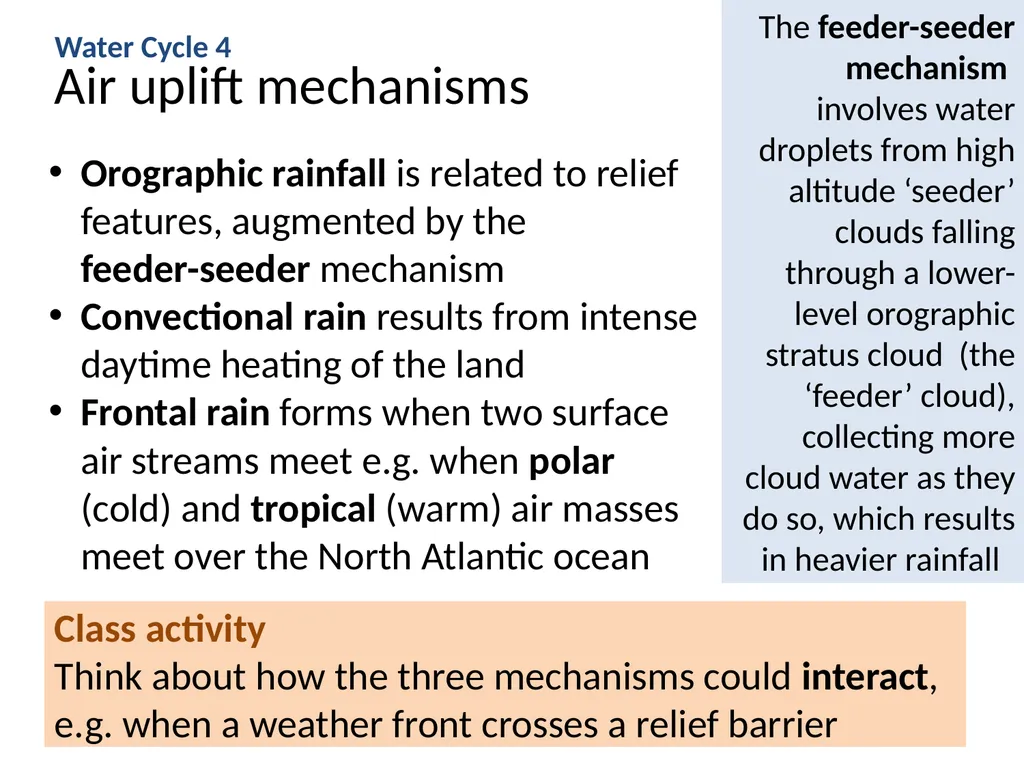
Think about how the three mechanisms could interact, e.g. when a weather front crosses a relief barrier Orographic rainfall is related to relief features, augmented by the feeder-seeder mechanism
Convectional rain results from intense daytime heating of the land
Frontal rain forms when two surface air streams meet e.g. when polar (cold) and tropical (warm) air masses meet over the North Atlantic ocean The feeder-seeder mechanism involves water droplets from high altitude ‘seeder’ clouds falling through a lower-level orographic stratus cloud (the ‘feeder’ cloud), collecting more cloud water as they do so, which results in heavier rainfall<br>
05
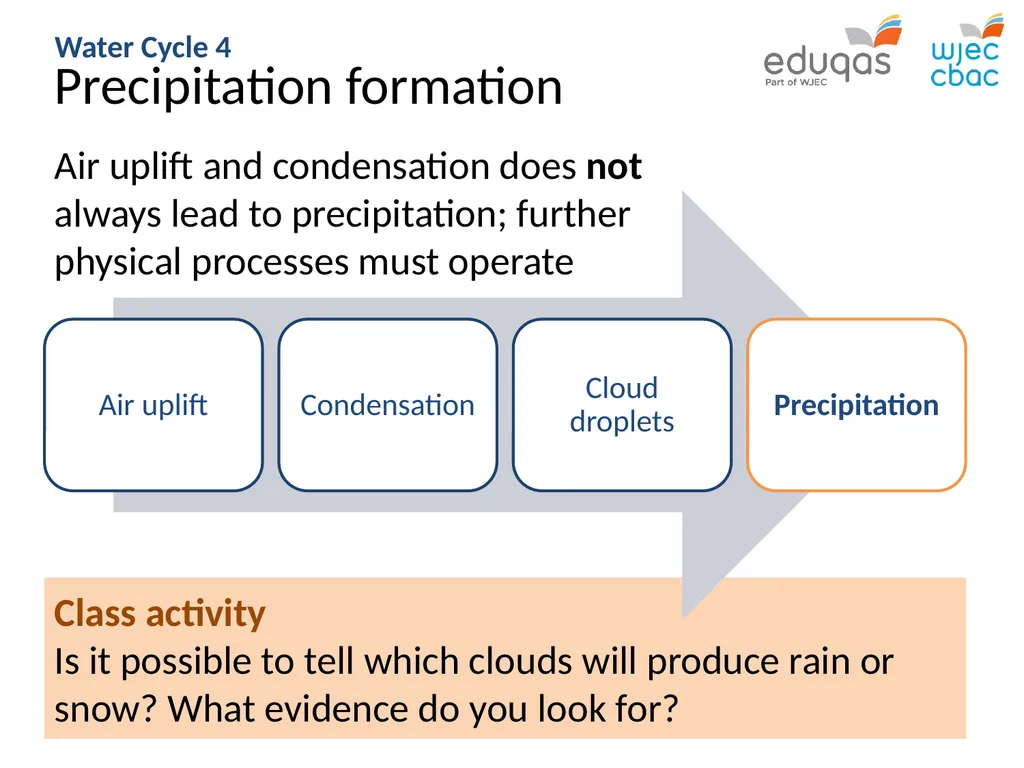
Water Cycle 4 Precipitation formation Air uplift and condensation does not always lead to precipitation; further physical processes must operate Class activity
Is it possible to tell which clouds will produce rain or snow? What evidence do you look for?<br>
06
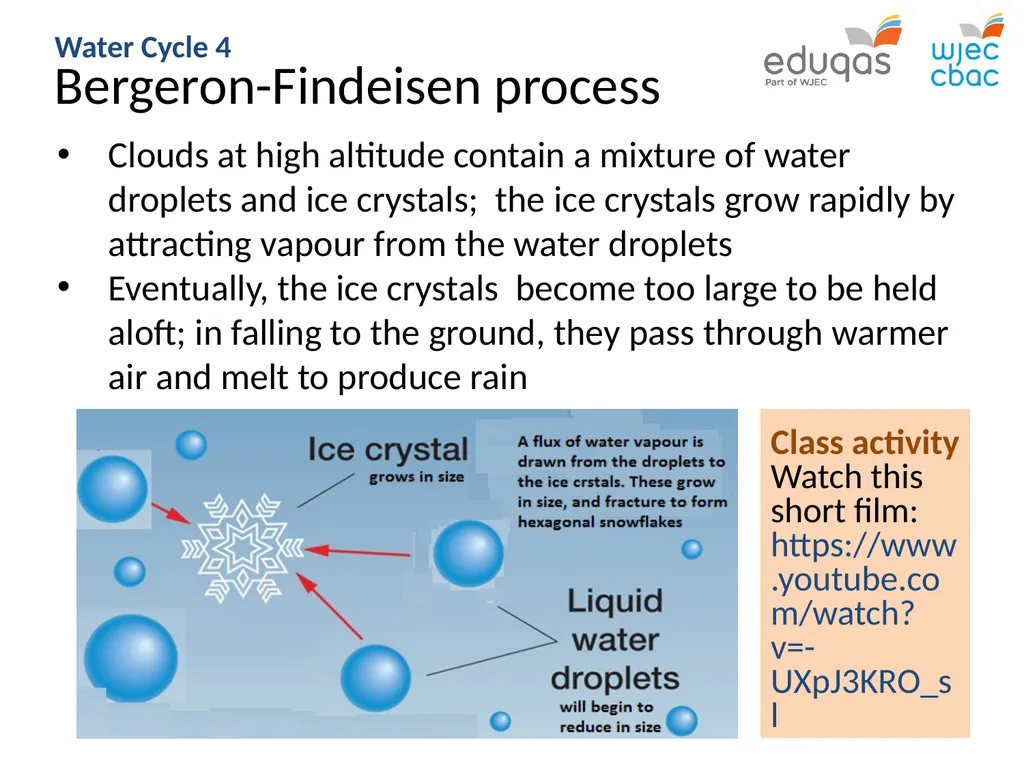
Water Cycle 4 Bergeron-Findeisen process Clouds at high altitude contain a mixture of water droplets and ice crystals; the ice crystals grow rapidly by attracting vapour from the water droplets
Eventually, the ice crystals become too large to be held aloft; in falling to the ground, they pass through warmer air and melt to produce rain Class activity
Watch this short film: https://www.youtube.com/watch?v=-UXpJ3KRO_sl<br>
07
Water Cycle 4 Collision process A second theory explains rainfall in the warm tropics
‘Super-sized’ condensation nuclei, e.g. large sea salt particles, provide ‘seeds’ around which very large water droplets form
The larger ‘super’ droplets fall and collide with smaller droplets, absorbing them
In support of this theory, unexpected downpours and flash flooding in arid areas demonstrate how high numbers of large raindrops can be generated quickly Class activity
Watch this short film: https://www.youtube.com/watch?v=WByQ3yKxj1s<br>
08
Water Cycle 4 Excess runoff generation (1) Runoff is all of the rainwater that contributes to river discharge following a rainfall event
Three drainage basin water flows contribute to runoff: overland flow, throughflow and groundwater flow
The balance between these three water pathways determines how flashy the river response is; and thus any likelihood of flooding Class activity
Research how excess runoff results from (1) monsoon rainfall (2) UK storm events and (3) snowmelt (show your results in a table)<br>
09
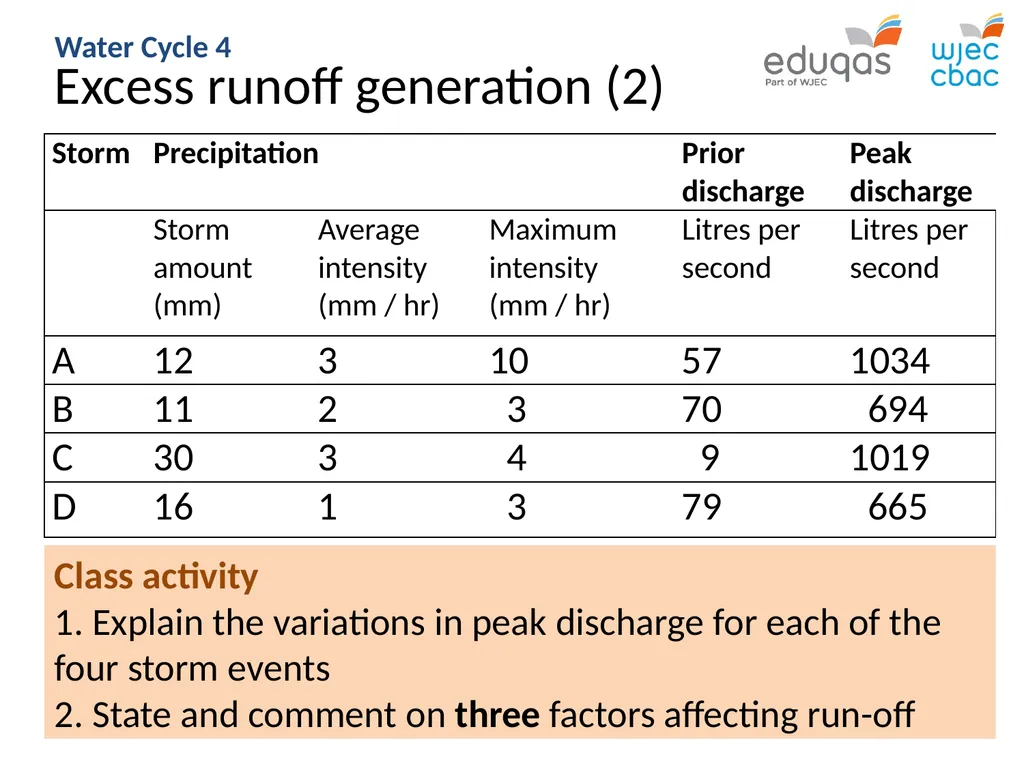
Water Cycle 4 Excess runoff generation (2) Class activity
1. Explain the variations in peak discharge for each of the four storm events
2. State and comment on three factors affecting run-off<br>
10
Water Cycle 4 Land use changes and runoff (1) Urbanisation renders previously permeable ground surfaces impermeable
Surfaces like concrete and tarmac increase overland flow generation and decrease the effectiveness of infiltration, throughflow and soil storage
The more ground that is covered by impermeable hard surfaces such as concrete or paving slabs, the less rainfall will soak into the ground and the more will flow over the surface into drains and sewers Class activity
Vegetation is removed to make room for urban areas. Why does this also contribute to increased runoff?<br>
11
Water Cycle 4 Land use changes and runoff (2) In England, Wales and Scotland, much of the forest which once covered the land has been removed
Flood risk in some parts of the UK is undoubtedly higher as a result of these changes
One study in mid-Wales found that rainwater’s infiltration rate into the soil was 67 times higher under trees than under sheep pasture Class activity
What other examples are there of recent floods in the UK? Might greater forest cover have prevented them?<br>
12
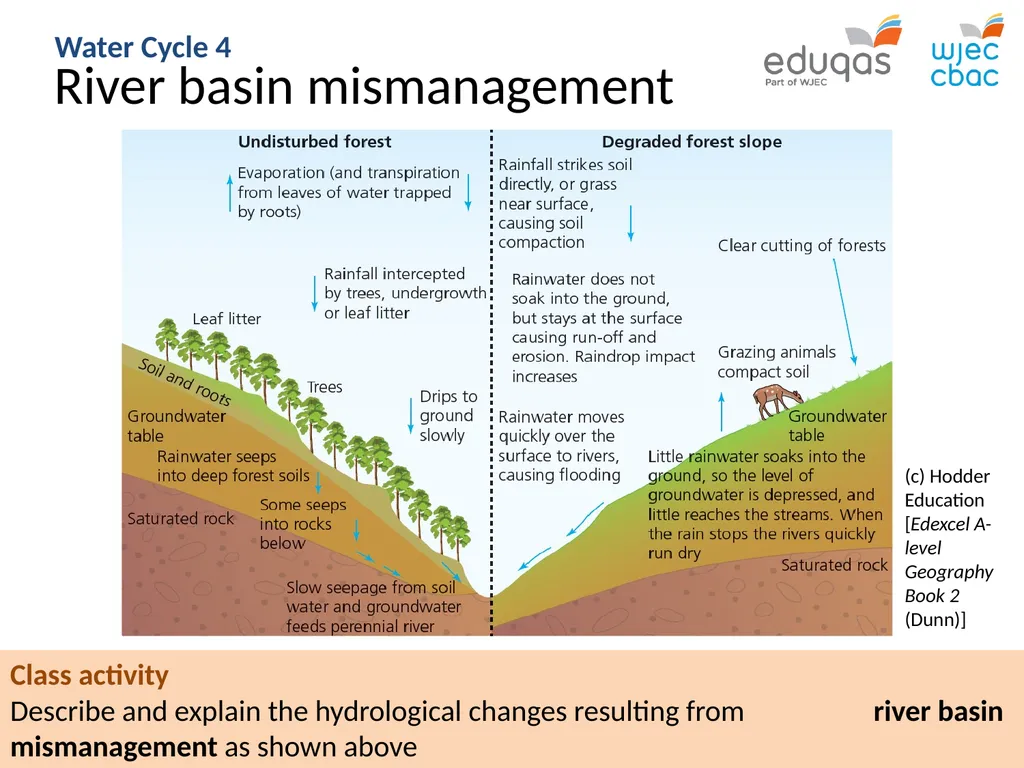
Class activity
Describe and explain the hydrological changes resulting from river basin mismanagement as shown above Water Cycle 4 River basin mismanagement (c) Hodder Education [Edexcel A-level Geography Book 2 (Dunn)]<br>
13
Water Cycle 4 Plenary There are three main causes of air uplift, condensation and cloud formation: they are the orographic, frontal and convection mechanisms
There are two recognized theories of precipitation formation: the Bergeron-Findeisen process and the collision process
Excess runoff generation occurs naturally in many parts of the world for climatic reasons. These include monsoon rainfall and annual snowmelt
Increasingly, human factors are to blame for overland flow generation in many drainage basins. Two important causes are urbanisation and forest removal<br>