
Water treatment: Boiler Problems Dr.Smita
KB
Published · 12 slides · 0 views
1 / 1
Description
Water treatment: Boiler Problems Dr.Smita Kavalgikar Engineering Sciences International Institute of Information Technology, I²IT www.isquareit.edu.in International Institute of Information Technology,I2IT,P-14,Rajiv Gandhi infotech
Related Topics
Share
Embed code
Download this presentation From Below
"Water treatment: Boiler Problems Dr.Smita" is the property of its rightful owner. Permission is granted to download and print the materials on this website for personal, non-commercial use only, and to display it on your personal computer provided you do not modify the materials and that you retain all copyright notices contained in the materials. By downloading content from our website, you accept the terms of this agreement.
Presentation Transcript
01
Water treatment: Boiler Problems Dr.Smita Kavalgikar
Engineering Sciences
International Institute of Information Technology, I²IT
www.isquareit.edu.in<br>
Engineering Sciences
International Institute of Information Technology, I²IT
www.isquareit.edu.in<br>
02
International Institute of Information Technology,I2IT,P-14,Rajiv Gandhi infotech Park,Hinjawadi Phase1,Pune-411057
Phone-+912022933441/2/3 | Email-info@isquareit.edu.in<br>
Phone-+912022933441/2/3 | Email-info@isquareit.edu.in<br>
03
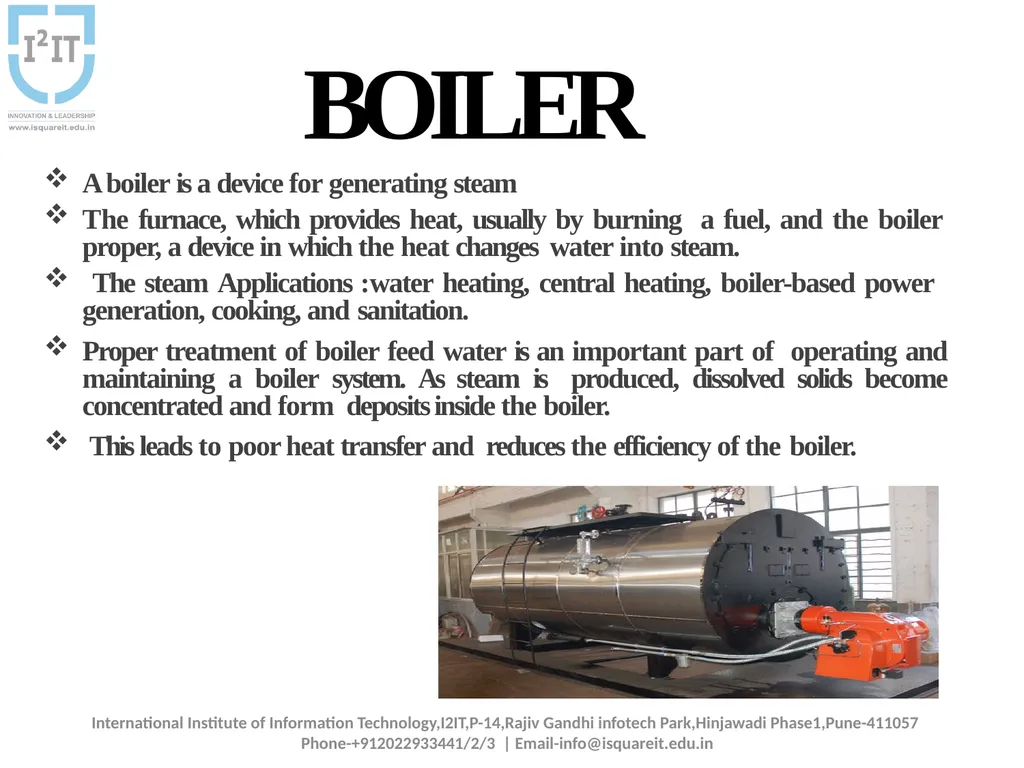
BOILER A boiler is a device for generating steam
The furnace, which provides heat, usually by burning a fuel, and the boiler proper, a device in which the heat changes water into steam.
The steam Applications :water heating, central heating, boiler-based power generation, cooking, and sanitation.
Proper treatment of boiler feed water is an important part of operating and maintaining a boiler system. As steam is produced, dissolved solids become concentrated and form deposits inside the boiler.
This leads to poor heat transfer and reduces the efficiency of the boiler. International Institute of Information Technology,I2IT,P-14,Rajiv Gandhi infotech Park,Hinjawadi Phase1,Pune-411057
Phone-+912022933441/2/3 | Email-info@isquareit.edu.in<br>
The furnace, which provides heat, usually by burning a fuel, and the boiler proper, a device in which the heat changes water into steam.
The steam Applications :water heating, central heating, boiler-based power generation, cooking, and sanitation.
Proper treatment of boiler feed water is an important part of operating and maintaining a boiler system. As steam is produced, dissolved solids become concentrated and form deposits inside the boiler.
This leads to poor heat transfer and reduces the efficiency of the boiler. International Institute of Information Technology,I2IT,P-14,Rajiv Gandhi infotech Park,Hinjawadi Phase1,Pune-411057
Phone-+912022933441/2/3 | Email-info@isquareit.edu.in<br>
04
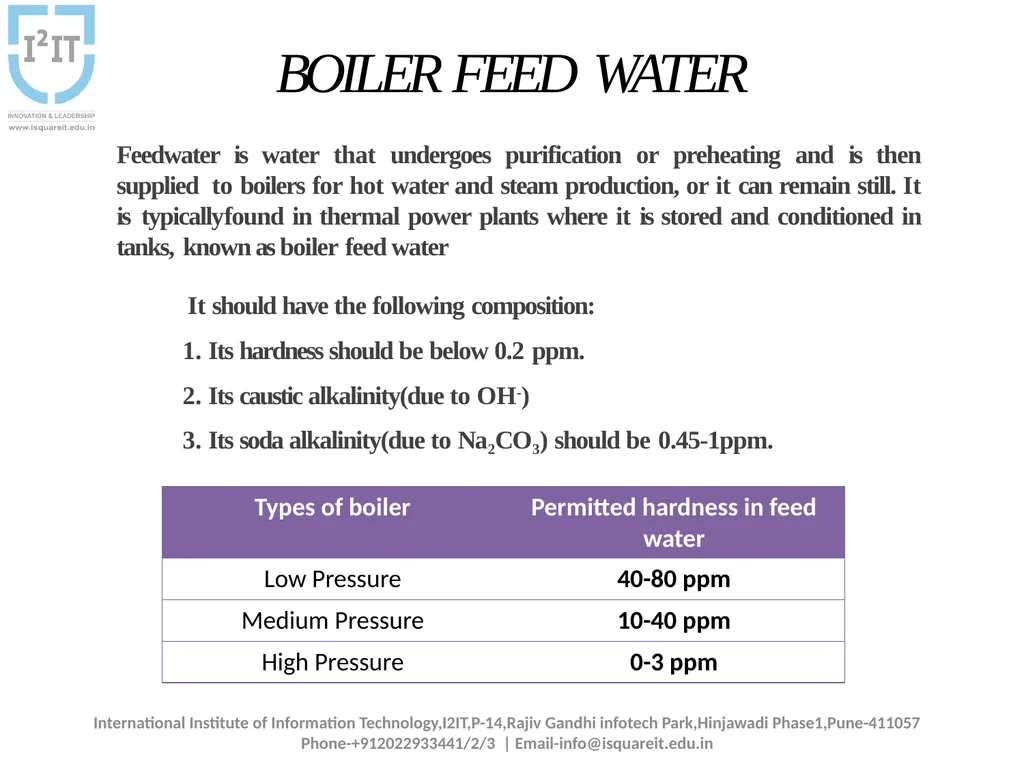
BOILER FEED WATER Feedwater is water that undergoes purification or preheating and is then supplied to boilers for hot water and steam production, or it can remain still. It is typicallyfound in thermal power plants where it is stored and conditioned in tanks, known as boiler feed water It should have the following composition:
Its hardness should be below 0.2 ppm.
Its caustic alkalinity(due to OH-)
Its soda alkalinity(due to Na2CO3) should be 0.45-1ppm. International Institute of Information Technology,I2IT,P-14,Rajiv Gandhi infotech Park,Hinjawadi Phase1,Pune-411057 Phone-+912022933441/2/3 | Email-info@isquareit.edu.in<br>
Its hardness should be below 0.2 ppm.
Its caustic alkalinity(due to OH-)
Its soda alkalinity(due to Na2CO3) should be 0.45-1ppm. International Institute of Information Technology,I2IT,P-14,Rajiv Gandhi infotech Park,Hinjawadi Phase1,Pune-411057 Phone-+912022933441/2/3 | Email-info@isquareit.edu.in<br>
05
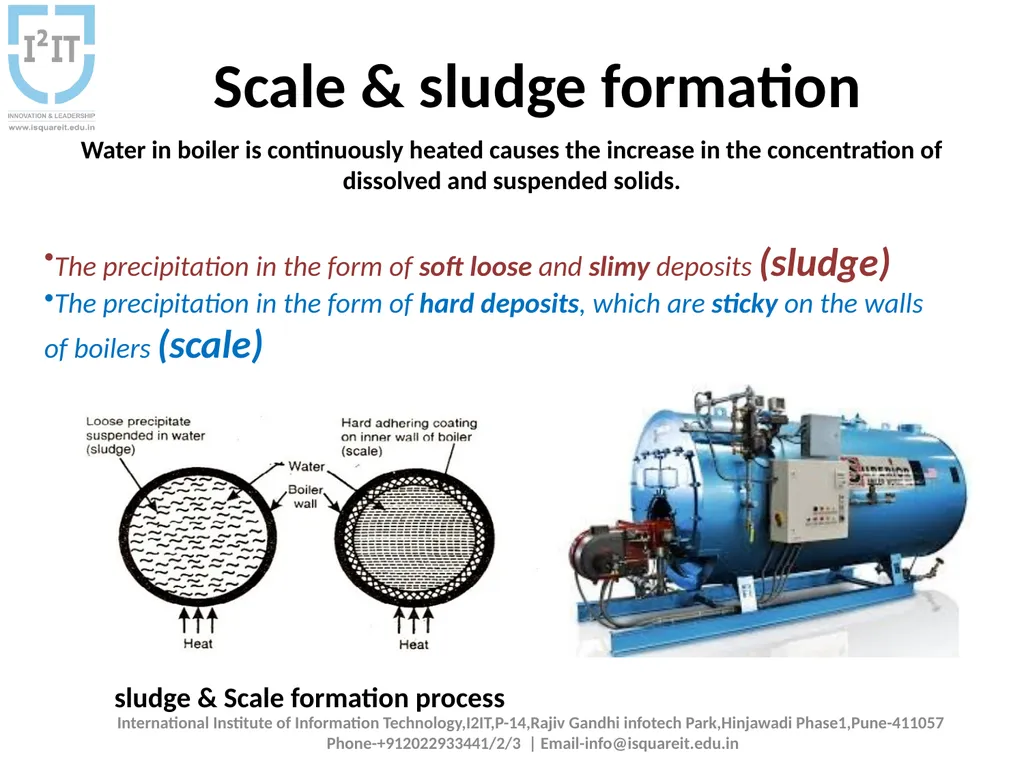
Scale & sludge formation Water in boiler is continuously heated causes the increase in the concentration of dissolved and suspended solids. The precipitation in the form of soft loose and slimy deposits (sludge)
The precipitation in the form of hard deposits, which are sticky on the walls
of boilers (scale) sludge & Scale formation process International Institute of Information Technology,I2IT,P-14,Rajiv Gandhi infotech Park,Hinjawadi Phase1,Pune-411057
Phone-+912022933441/2/3 | Email-info@isquareit.edu.in<br>
The precipitation in the form of hard deposits, which are sticky on the walls
of boilers (scale) sludge & Scale formation process International Institute of Information Technology,I2IT,P-14,Rajiv Gandhi infotech Park,Hinjawadi Phase1,Pune-411057
Phone-+912022933441/2/3 | Email-info@isquareit.edu.in<br>
06
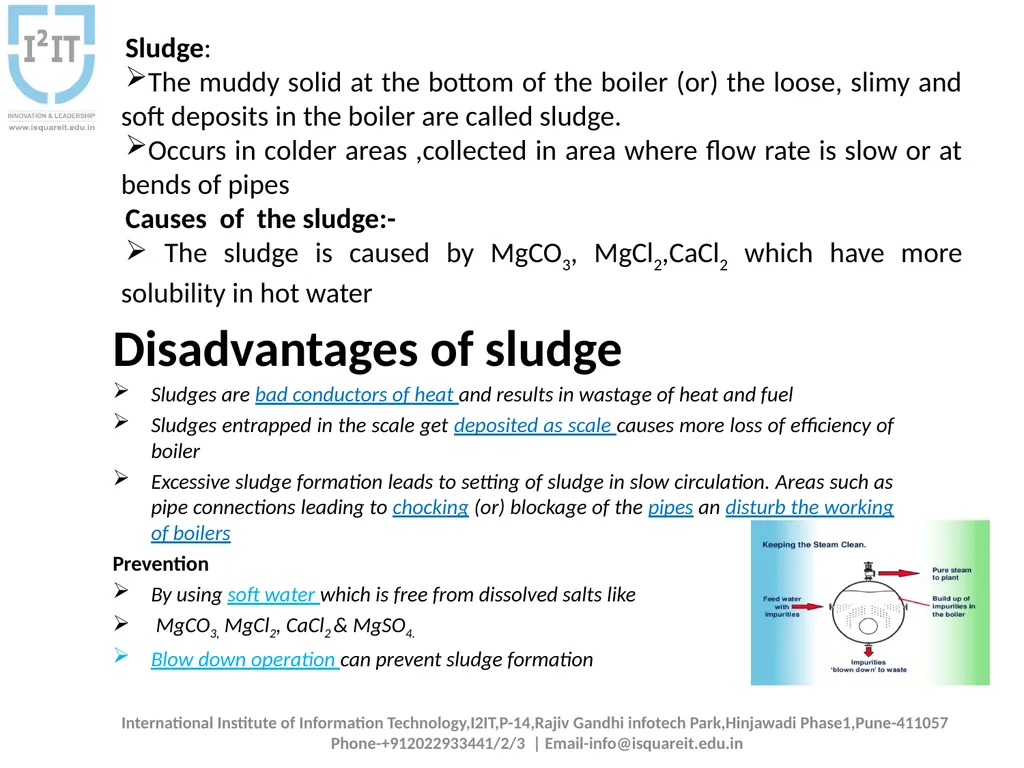
Disadvantages of sludge Sludges are bad conductors of heat and results in wastage of heat and fuel
Sludges entrapped in the scale get deposited as scale causes more loss of efficiency of boiler
Excessive sludge formation leads to setting of sludge in slow circulation. Areas such as pipe connections leading to chocking (or) blockage of the pipes an disturb the working of boilers
Prevention
By using soft water which is free from dissolved salts like
MgCO3, MgCl2, CaCl2 & MgSO4.
Blow down operation can prevent sludge formation Sludge:
The muddy solid at the bottom of the boiler (or) the loose, slimy and soft deposits in the boiler are called sludge.
Occurs in colder areas ,collected in area where flow rate is slow or at bends of pipes
Causes of the sludge:-
The sludge is caused by MgCO3, MgCl2,CaCl2 which have more solubility in hot water International Institute of Information Technology,I2IT,P-14,Rajiv Gandhi infotech Park,Hinjawadi Phase1,Pune-411057
Phone-+912022933441/2/3 | Email-info@isquareit.edu.in<br>
Sludges entrapped in the scale get deposited as scale causes more loss of efficiency of boiler
Excessive sludge formation leads to setting of sludge in slow circulation. Areas such as pipe connections leading to chocking (or) blockage of the pipes an disturb the working of boilers
Prevention
By using soft water which is free from dissolved salts like
MgCO3, MgCl2, CaCl2 & MgSO4.
Blow down operation can prevent sludge formation Sludge:
The muddy solid at the bottom of the boiler (or) the loose, slimy and soft deposits in the boiler are called sludge.
Occurs in colder areas ,collected in area where flow rate is slow or at bends of pipes
Causes of the sludge:-
The sludge is caused by MgCO3, MgCl2,CaCl2 which have more solubility in hot water International Institute of Information Technology,I2IT,P-14,Rajiv Gandhi infotech Park,Hinjawadi Phase1,Pune-411057
Phone-+912022933441/2/3 | Email-info@isquareit.edu.in<br>
07
Scale: -
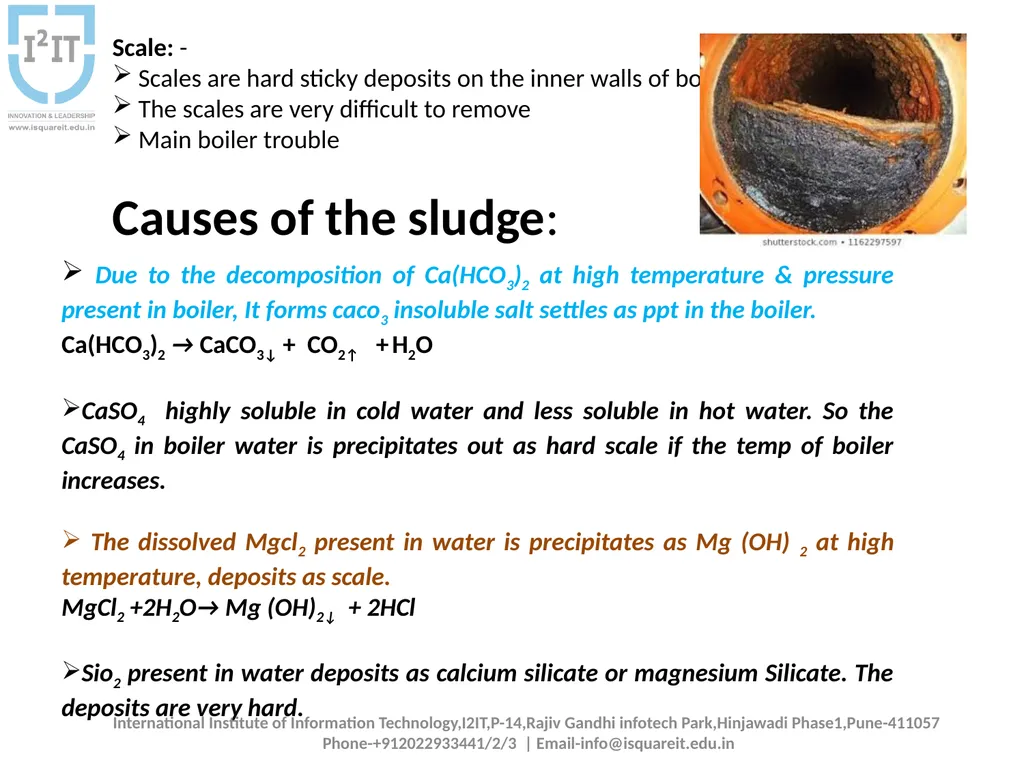
Scales are hard sticky deposits on the inner walls of boiler.
The scales are very difficult to remove
Main boiler trouble
Causes of the sludge: Due to the decomposition of Ca(HCO3)2 at high temperature & pressure present in boiler, It forms caco3 insoluble salt settles as ppt in the boiler.
Ca(HCO3)2 → CaCO3↓ + CO2↑ + H2O
CaSO4 highly soluble in cold water and less soluble in hot water. So the CaSO4 in boiler water is precipitates out as hard scale if the temp of boiler increases.
The dissolved Mgcl2 present in water is precipitates as Mg (OH) 2 at high temperature, deposits as scale.
MgCl2 +2H2O→ Mg (OH)2↓ + 2HCl
Sio2 present in water deposits as calcium silicate or magnesium Silicate. The deposits are very hard. International Institute of Information Technology,I2IT,P-14,Rajiv Gandhi infotech Park,Hinjawadi Phase1,Pune-411057
Phone-+912022933441/2/3 | Email-info@isquareit.edu.in<br>
Scales are hard sticky deposits on the inner walls of boiler.
The scales are very difficult to remove
Main boiler trouble
Causes of the sludge: Due to the decomposition of Ca(HCO3)2 at high temperature & pressure present in boiler, It forms caco3 insoluble salt settles as ppt in the boiler.
Ca(HCO3)2 → CaCO3↓ + CO2↑ + H2O
CaSO4 highly soluble in cold water and less soluble in hot water. So the CaSO4 in boiler water is precipitates out as hard scale if the temp of boiler increases.
The dissolved Mgcl2 present in water is precipitates as Mg (OH) 2 at high temperature, deposits as scale.
MgCl2 +2H2O→ Mg (OH)2↓ + 2HCl
Sio2 present in water deposits as calcium silicate or magnesium Silicate. The deposits are very hard. International Institute of Information Technology,I2IT,P-14,Rajiv Gandhi infotech Park,Hinjawadi Phase1,Pune-411057
Phone-+912022933441/2/3 | Email-info@isquareit.edu.in<br>
08
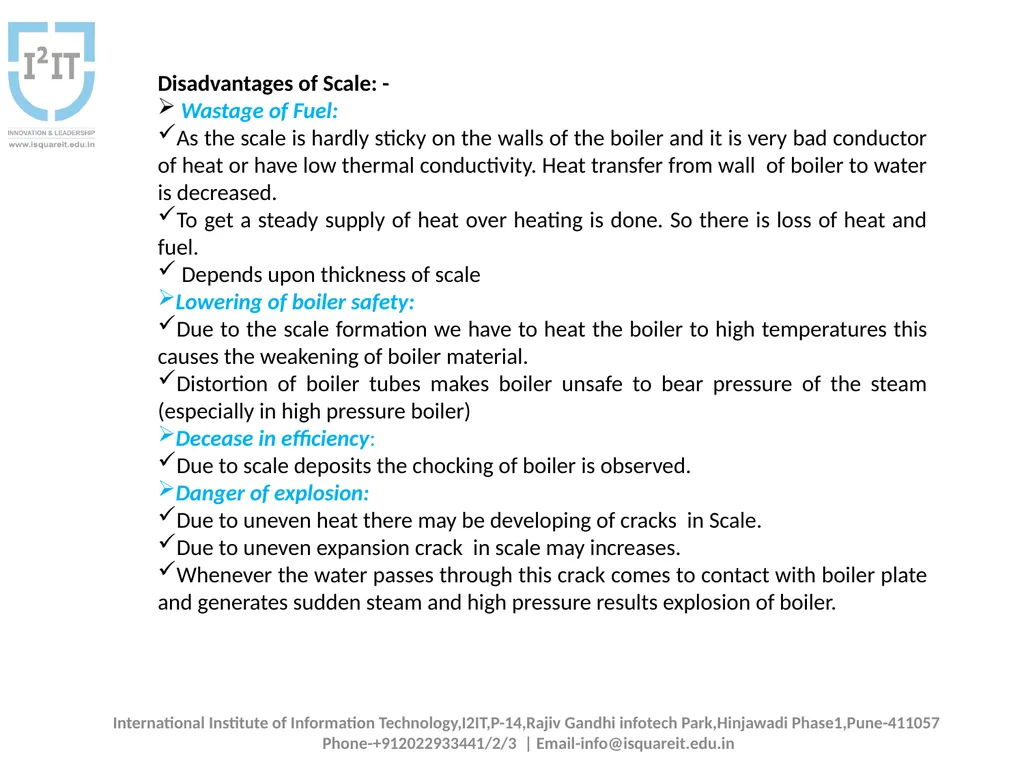
Disadvantages of Scale: -
Wastage of Fuel:
As the scale is hardly sticky on the walls of the boiler and it is very bad conductor of heat or have low thermal conductivity. Heat transfer from wall of boiler to water is decreased.
To get a steady supply of heat over heating is done. So there is loss of heat and fuel.
Depends upon thickness of scale
Lowering of boiler safety:
Due to the scale formation we have to heat the boiler to high temperatures this causes the weakening of boiler material.
Distortion of boiler tubes makes boiler unsafe to bear pressure of the steam (especially in high pressure boiler)
Decease in efficiency:
Due to scale deposits the chocking of boiler is observed.
Danger of explosion:
Due to uneven heat there may be developing of cracks in Scale.
Due to uneven expansion crack in scale may increases.
Whenever the water passes through this crack comes to contact with boiler plate and generates sudden steam and high pressure results explosion of boiler. International Institute of Information Technology,I2IT,P-14,Rajiv Gandhi infotech Park,Hinjawadi Phase1,Pune-411057
Phone-+912022933441/2/3 | Email-info@isquareit.edu.in<br>
Wastage of Fuel:
As the scale is hardly sticky on the walls of the boiler and it is very bad conductor of heat or have low thermal conductivity. Heat transfer from wall of boiler to water is decreased.
To get a steady supply of heat over heating is done. So there is loss of heat and fuel.
Depends upon thickness of scale
Lowering of boiler safety:
Due to the scale formation we have to heat the boiler to high temperatures this causes the weakening of boiler material.
Distortion of boiler tubes makes boiler unsafe to bear pressure of the steam (especially in high pressure boiler)
Decease in efficiency:
Due to scale deposits the chocking of boiler is observed.
Danger of explosion:
Due to uneven heat there may be developing of cracks in Scale.
Due to uneven expansion crack in scale may increases.
Whenever the water passes through this crack comes to contact with boiler plate and generates sudden steam and high pressure results explosion of boiler. International Institute of Information Technology,I2IT,P-14,Rajiv Gandhi infotech Park,Hinjawadi Phase1,Pune-411057
Phone-+912022933441/2/3 | Email-info@isquareit.edu.in<br>
09
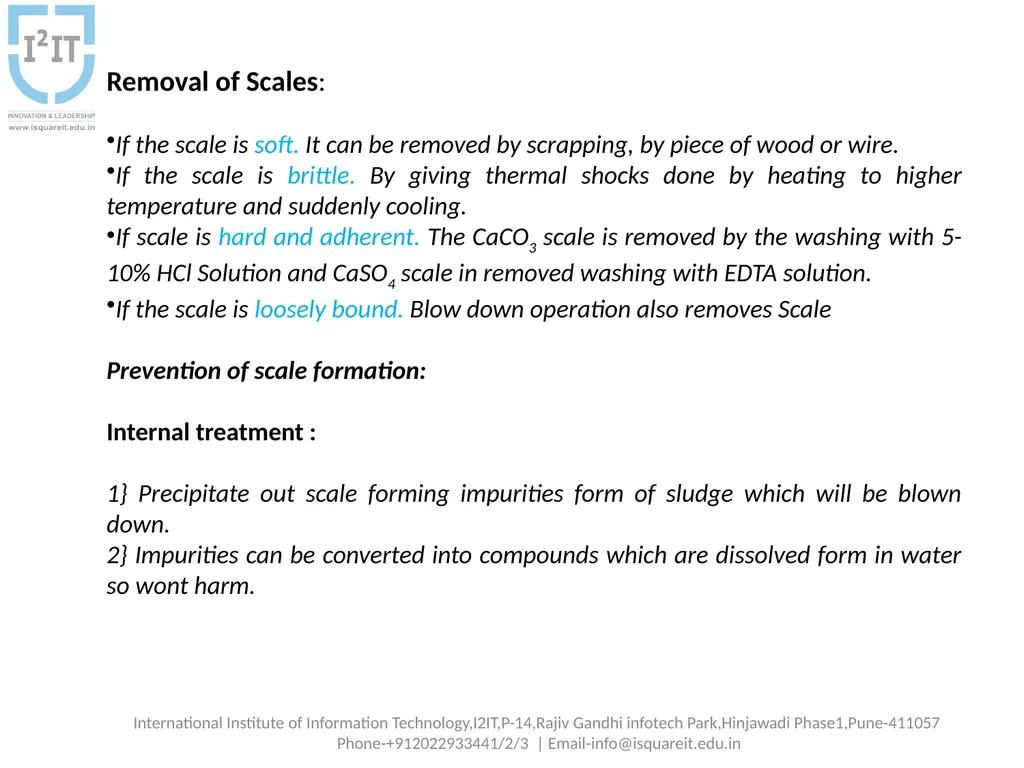
Removal of Scales:
If the scale is soft. It can be removed by scrapping, by piece of wood or wire.
If the scale is brittle. By giving thermal shocks done by heating to higher temperature and suddenly cooling.
If scale is hard and adherent. The CaCO3 scale is removed by the washing with 5-10% HCl Solution and CaSO4 scale in removed washing with EDTA solution.
If the scale is loosely bound. Blow down operation also removes Scale
Prevention of scale formation:
Internal treatment :
1} Precipitate out scale forming impurities form of sludge which will be blown down.
2} Impurities can be converted into compounds which are dissolved form in water so wont harm. International Institute of Information Technology,I2IT,P-14,Rajiv Gandhi infotech Park,Hinjawadi Phase1,Pune-411057
Phone-+912022933441/2/3 | Email-info@isquareit.edu.in<br>
If the scale is soft. It can be removed by scrapping, by piece of wood or wire.
If the scale is brittle. By giving thermal shocks done by heating to higher temperature and suddenly cooling.
If scale is hard and adherent. The CaCO3 scale is removed by the washing with 5-10% HCl Solution and CaSO4 scale in removed washing with EDTA solution.
If the scale is loosely bound. Blow down operation also removes Scale
Prevention of scale formation:
Internal treatment :
1} Precipitate out scale forming impurities form of sludge which will be blown down.
2} Impurities can be converted into compounds which are dissolved form in water so wont harm. International Institute of Information Technology,I2IT,P-14,Rajiv Gandhi infotech Park,Hinjawadi Phase1,Pune-411057
Phone-+912022933441/2/3 | Email-info@isquareit.edu.in<br>
10
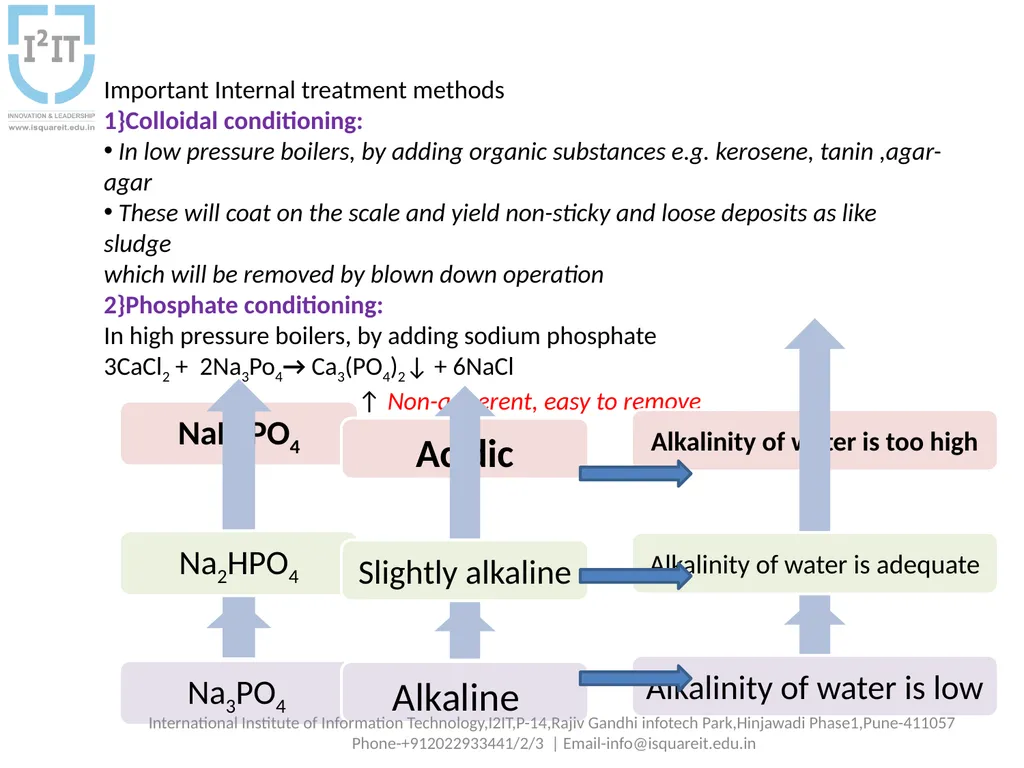
Important Internal treatment methods
1}Colloidal conditioning:
In low pressure boilers, by adding organic substances e.g. kerosene, tanin ,agar-agar
These will coat on the scale and yield non-sticky and loose deposits as like sludge
which will be removed by blown down operation
2}Phosphate conditioning:
In high pressure boilers, by adding sodium phosphate
3CaCl2 + 2Na3Po4→ Ca3(PO4)2↓ + 6NaCl
↑ Non-adherent, easy to remove International Institute of Information Technology,I2IT,P-14,Rajiv Gandhi infotech Park,Hinjawadi Phase1,Pune-411057
Phone-+912022933441/2/3 | Email-info@isquareit.edu.in<br>
1}Colloidal conditioning:
In low pressure boilers, by adding organic substances e.g. kerosene, tanin ,agar-agar
These will coat on the scale and yield non-sticky and loose deposits as like sludge
which will be removed by blown down operation
2}Phosphate conditioning:
In high pressure boilers, by adding sodium phosphate
3CaCl2 + 2Na3Po4→ Ca3(PO4)2↓ + 6NaCl
↑ Non-adherent, easy to remove International Institute of Information Technology,I2IT,P-14,Rajiv Gandhi infotech Park,Hinjawadi Phase1,Pune-411057
Phone-+912022933441/2/3 | Email-info@isquareit.edu.in<br>
11
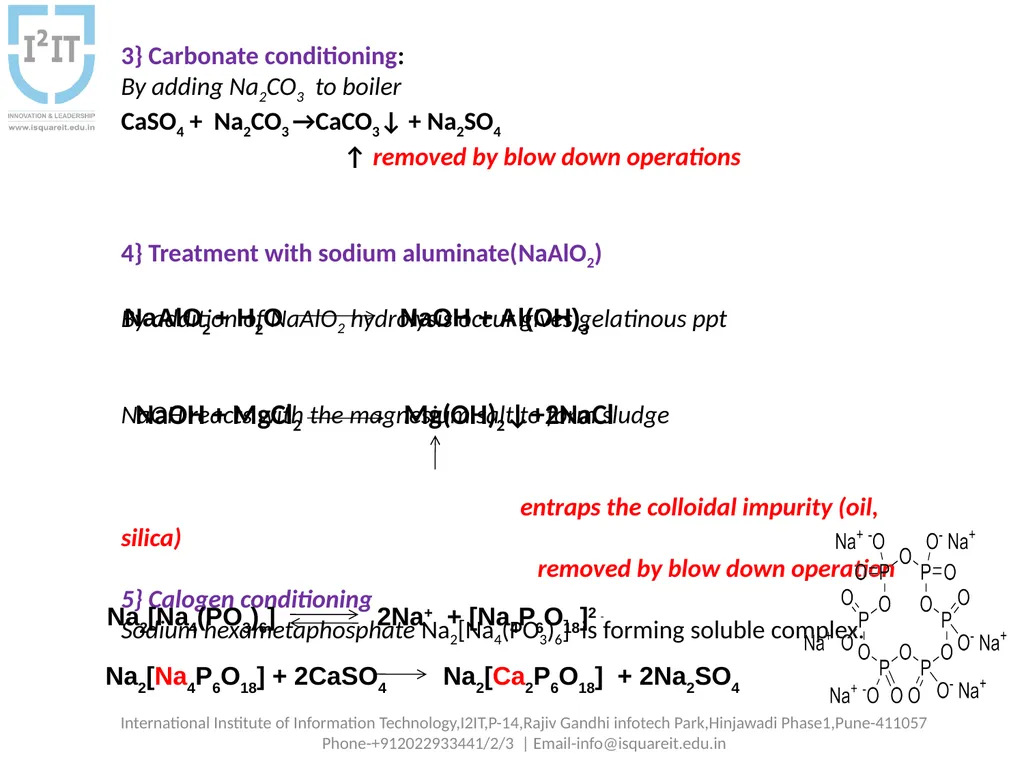
3} Carbonate conditioning:
By adding Na2CO3 to boiler
CaSO4 + Na2CO3 →CaCO3↓ + Na2SO4
↑ removed by blow down operations
4} Treatment with sodium aluminate(NaAlO2)
By addition of NaAlO2 hydrolysis occur gives gelatinous ppt
NaOH reacts with the magnesium salt to form sludge
entraps the colloidal impurity (oil, silica)
removed by blow down operation
5} Calogen conditioning
Sodium hexametaphosphate Na2[Na4(PO3)6] is forming soluble complex. NaAlO2 + H2O NaOH + Al(OH)3 NaOH + MgCl2 Mg(OH)2↓+2NaCl Na2[Na4(PO3)6] 2Na+ + [Na4P6O18]2 - Na2[Na4P6O18] + 2CaSO4 Na2[Ca2P6O18] + 2Na2SO4 International Institute of Information Technology,I2IT,P-14,Rajiv Gandhi infotech Park,Hinjawadi Phase1,Pune-411057 Phone-+912022933441/2/3 | Email-info@isquareit.edu.in<br>
By adding Na2CO3 to boiler
CaSO4 + Na2CO3 →CaCO3↓ + Na2SO4
↑ removed by blow down operations
4} Treatment with sodium aluminate(NaAlO2)
By addition of NaAlO2 hydrolysis occur gives gelatinous ppt
NaOH reacts with the magnesium salt to form sludge
entraps the colloidal impurity (oil, silica)
removed by blow down operation
5} Calogen conditioning
Sodium hexametaphosphate Na2[Na4(PO3)6] is forming soluble complex. NaAlO2 + H2O NaOH + Al(OH)3 NaOH + MgCl2 Mg(OH)2↓+2NaCl Na2[Na4(PO3)6] 2Na+ + [Na4P6O18]2 - Na2[Na4P6O18] + 2CaSO4 Na2[Ca2P6O18] + 2Na2SO4 International Institute of Information Technology,I2IT,P-14,Rajiv Gandhi infotech Park,Hinjawadi Phase1,Pune-411057 Phone-+912022933441/2/3 | Email-info@isquareit.edu.in<br>
12
International Institute of Information Technology,I2IT,P-14,Rajiv Gandhi infotech Park,Hinjawadi Phase1,Pune-411057 Phone-+912022933441/2/3 | Email-info@isquareit.edu.in Dr. Smita Kavalgikar
Mob. No: 9011079483
Email ID: smitan@isquareit.edu.in<br>
Mob. No: 9011079483
Email ID: smitan@isquareit.edu.in<br>