
WAVE OPTICS Lecture 1: Electromagnetic nature of

Published  . 0 views
↓ Download
WAVE OPTICS Lecture 1: Electromagnetic nature of
1 / 1
WAVE OPTICS Lecture 1: Electromagnetic nature of - slide 1 of 8 WAVE OPTICS Lecture 1: Electromagnetic nature of - slide 2 of 8 WAVE OPTICS Lecture 1: Electromagnetic nature of - slide 3 of 8 WAVE OPTICS Lecture 1: Electromagnetic nature of - slide 4 of 8 WAVE OPTICS Lecture 1: Electromagnetic nature of - slide 5 of 8 WAVE OPTICS Lecture 1: Electromagnetic nature of - slide 6 of 8 WAVE OPTICS Lecture 1: Electromagnetic nature of - slide 7 of 8 WAVE OPTICS Lecture 1: Electromagnetic nature of - slide 8 of 8
Description: WAVE OPTICS Lecture 1: Electromagnetic nature of light PROPERTIES OF LIGHT As particle Light has quantized particle called photon which travel through the space. Photon has specific or quantized energy thus light is also quantized.

Related Topics

Download Presentation

"WAVE OPTICS Lecture 1: Electromagnetic nature of" is the property of its rightful owner. Permission is granted to download and print the materials on this website for personal, non-commercial use only, and to display it on your personal computer provided you do not modify the materials and that you retain all copyright notices contained in the materials. By downloading content from our website, you accept the terms of this agreement.

Presentation Transcript

slide1. WAVE OPTICS Lecture 1: Electromagnetic nature of light<br>
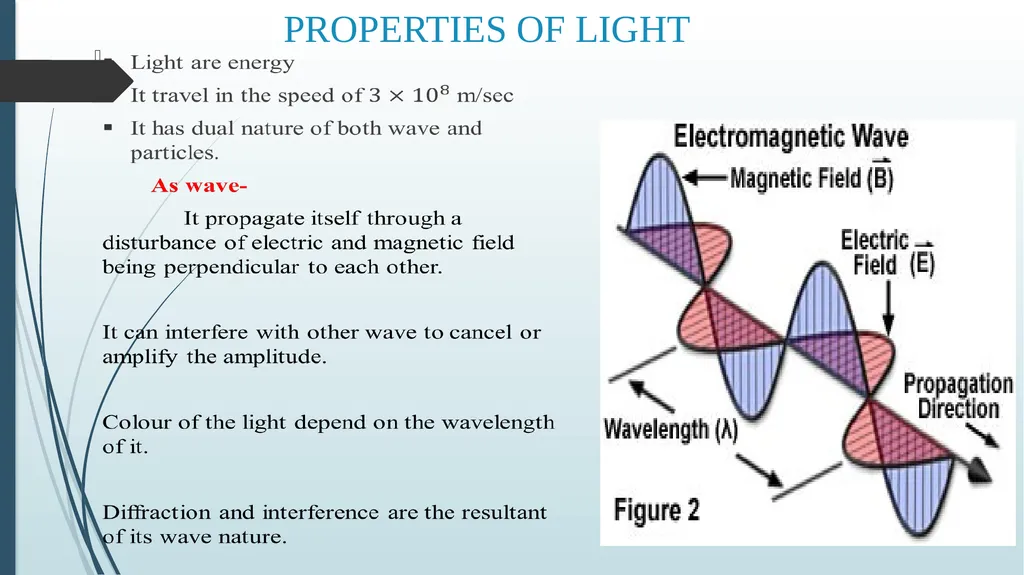
slide2. PROPERTIES OF LIGHT<br>
slide3. As particle Light has quantized particle called photon which travel through the space.

Photon has specific or quantized energy thus light is also quantized.

Photoelectric effect, scattering are some consequence of its particle nature.<br>
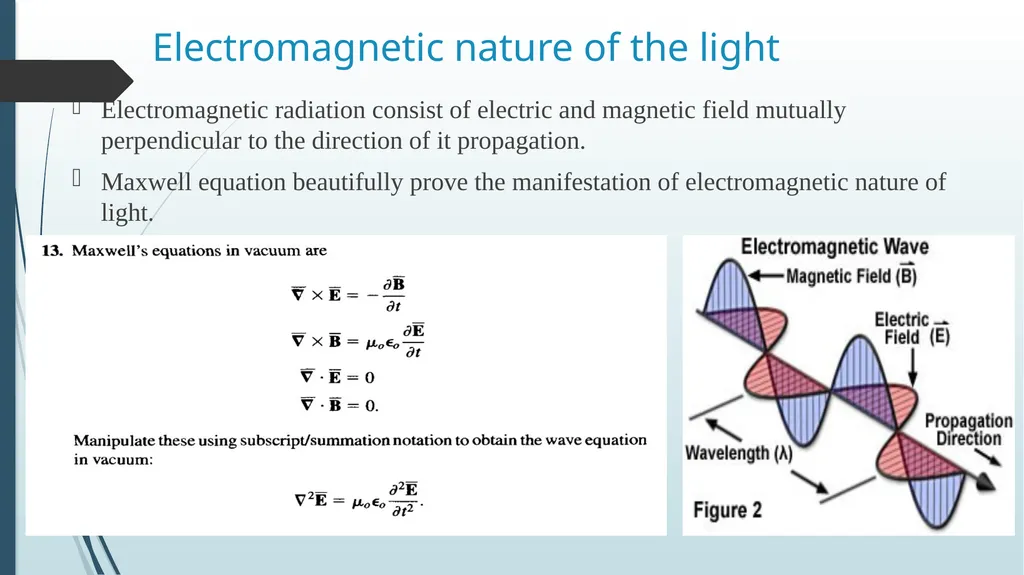
slide4. Electromagnetic nature of the light Electromagnetic radiation consist of electric and magnetic field mutually perpendicular to the direction of it propagation.
Maxwell equation beautifully prove the manifestation of electromagnetic nature of light.<br>
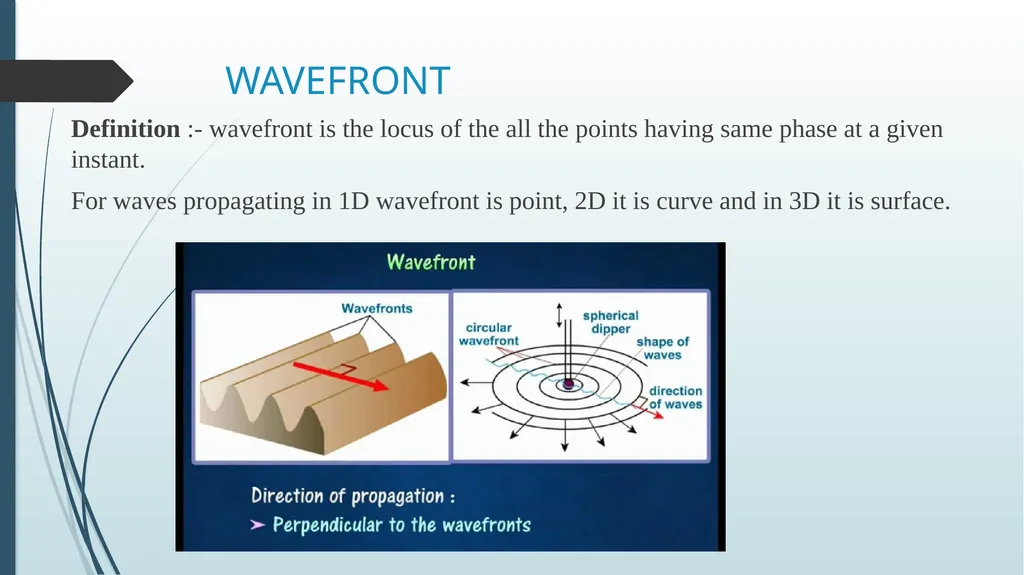
slide5. WAVEFRONT Definition :- wavefront is the locus of the all the points having same phase at a given instant.
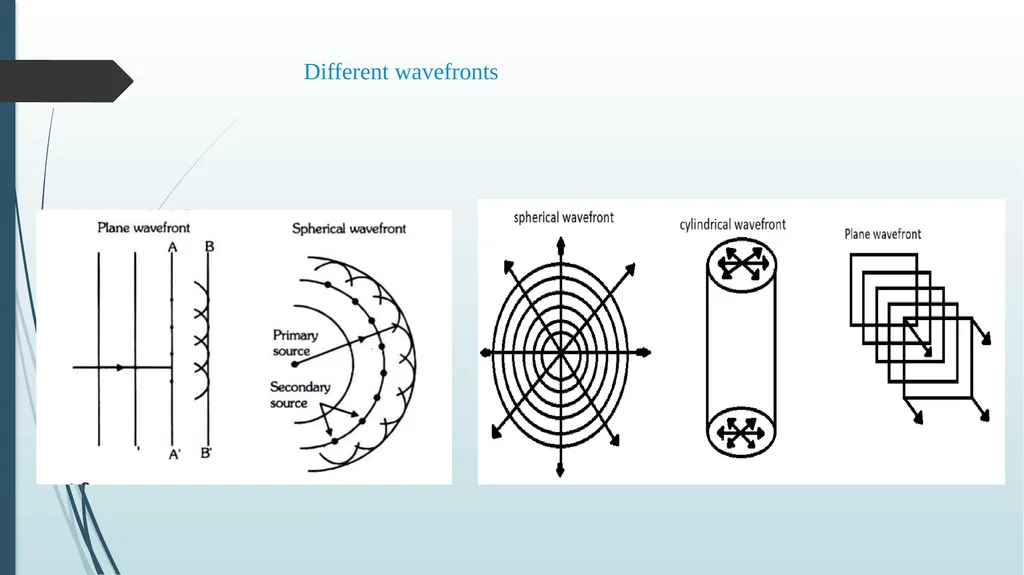
For waves propagating in 1D wavefront is point, 2D it is curve and in 3D it is surface.<br>
slide6. Different wavefronts<br>
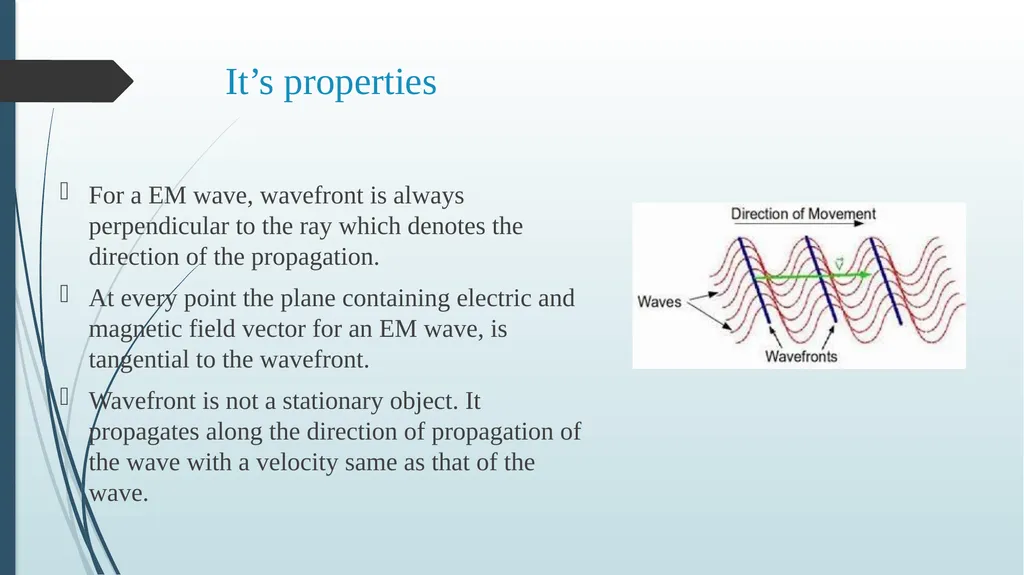
slide7. It’s properties For a EM wave, wavefront is always perpendicular to the ray which denotes the direction of the propagation.
At every point the plane containing electric and magnetic field vector for an EM wave, is tangential to the wavefront.
Wavefront is not a stationary object. It propagates along the direction of propagation of the wave with a velocity same as that of the wave.<br>
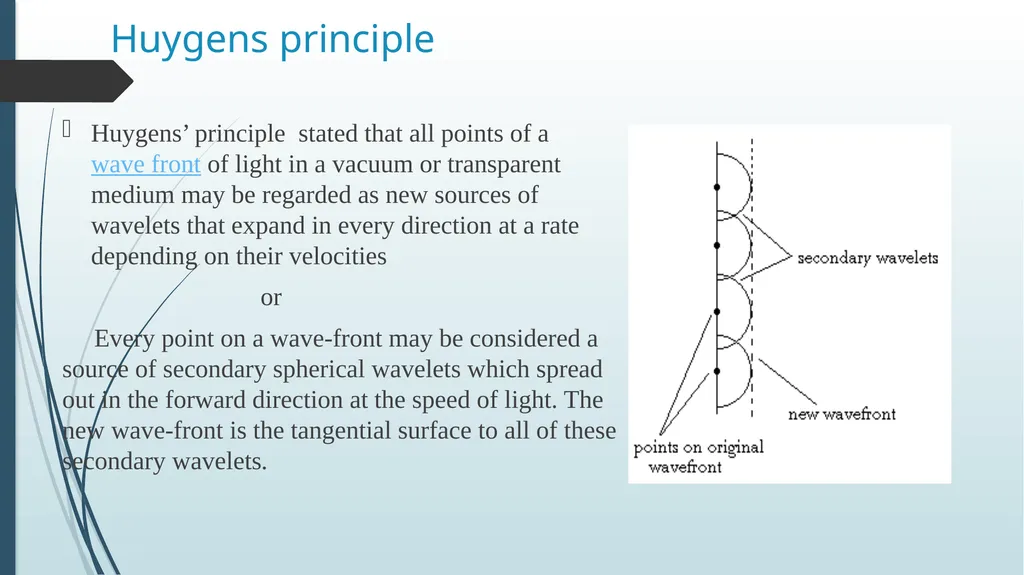
slide8. Huygens principle Huygens’ principle stated that all points of a wave front of light in a vacuum or transparent medium may be regarded as new sources of wavelets that expand in every direction at a rate depending on their velocities
or
Every point on a wave-front may be considered a source of secondary spherical wavelets which spread out in the forward direction at the speed of light. The new wave-front is the tangential surface to all of these secondary wavelets.<br>