
Ways we read… skimming extensive intensive
Description: Ways we read skimming extensive intensive scanning TEACHING OF ENGLISH LANGUAGE INVOVES DEVELOPMENT OF FOUR SKILLS Listening Speaking Reading and Writing. SUB-SKILLS OF READING SKILL Predicting information: more and more listening
Related Topics
Download Presentation
"Ways we read… skimming extensive intensive" is the property of its rightful owner. Permission is granted to download and print the materials on this website for personal, non-commercial use only, and to display it on your personal computer provided you do not modify the materials and that you retain all copyright notices contained in the materials. By downloading content from our website, you accept the terms of this agreement.
Presentation Transcript
slide1. Ways we read… skimming extensive intensive scanning<br>
slide2. TEACHING OF ENGLISH LANGUAGE INVOVES DEVELOPMENT OF FOUR SKILLS Listening
Speaking
Reading and
Writing.<br>
slide3. SUB-SKILLS OF READING SKILL Predicting information: more and more listening encourages predictive abilities and promotes interaction.
*ability to read at a standard speed with adequate comprehension.
*ability to understand specific points and central idea.
*ability to get the writer’s opinion and attitude.
*ability to get the meaning from context.
*Understand the marked features and their function.
* Ability to read with proper punctuation, pronunciation, stress and intonation.<br>
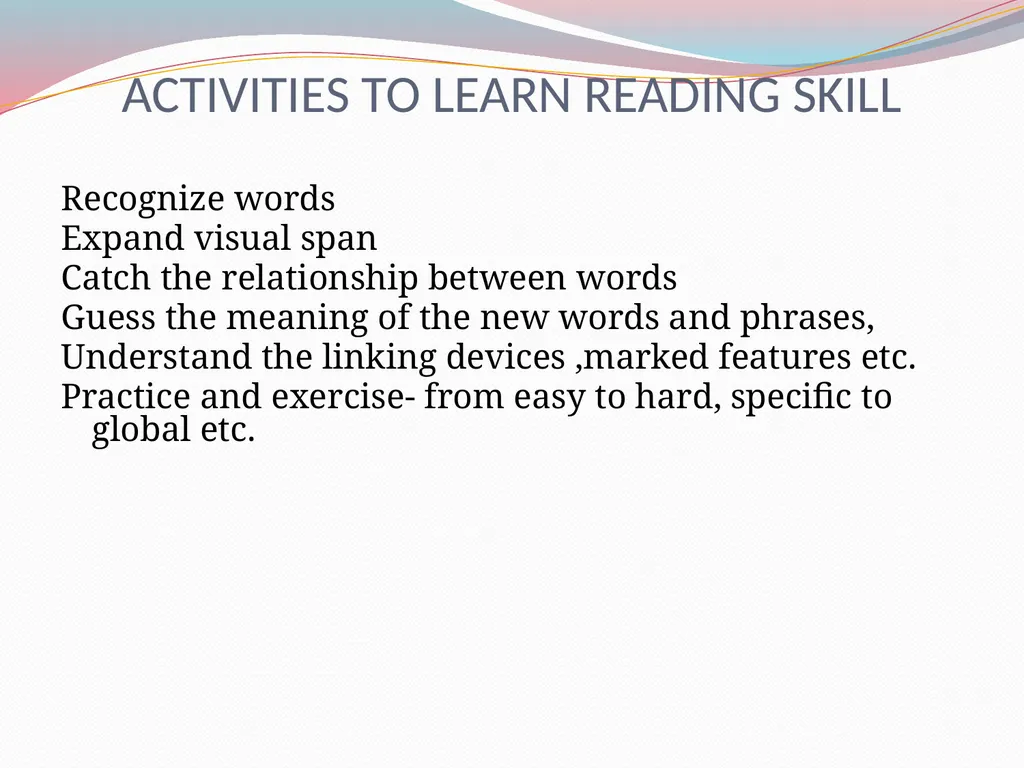
slide4. ACTIVITIES TO LEARN READING SKILL Recognize words
Expand visual span
Catch the relationship between words
Guess the meaning of the new words and phrases,
Understand the linking devices ,marked features etc.
Practice and exercise- from easy to hard, specific to global etc.<br>
slide5. TYPES OF READING Loud and silent reading
* Intensive and extensive reading<br>
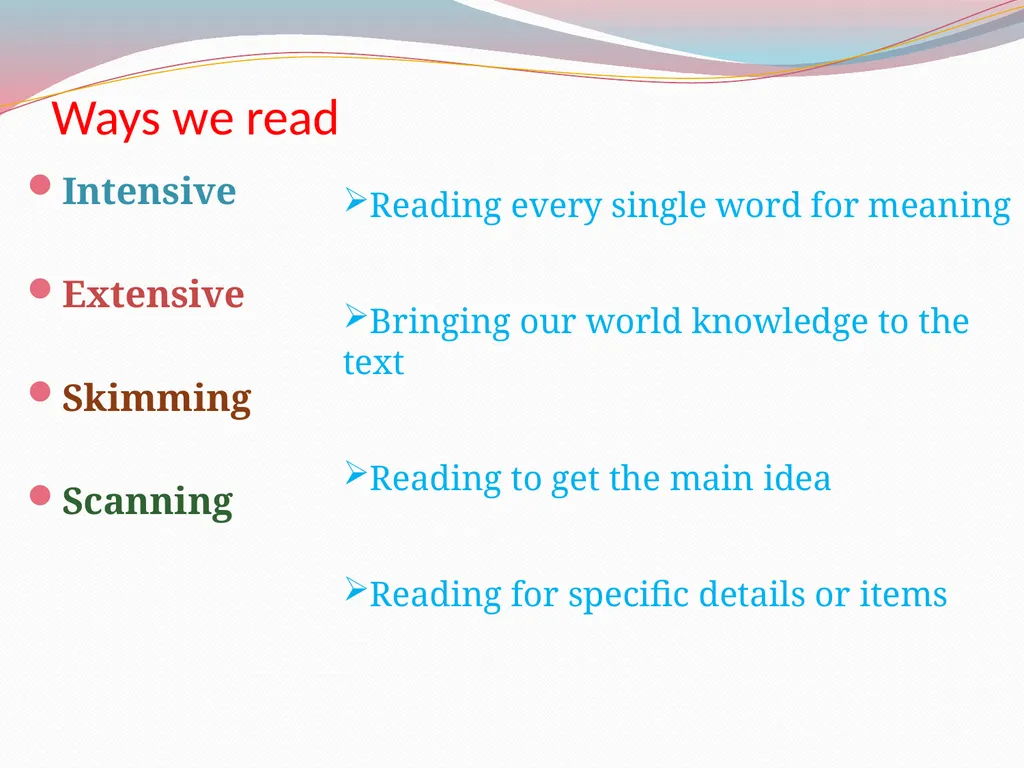
slide6. Ways we read Intensive
Extensive
Skimming
Scanning Reading every single word for meaning
Bringing our world knowledge to the text
Reading to get the main idea
Reading for specific details or items<br>
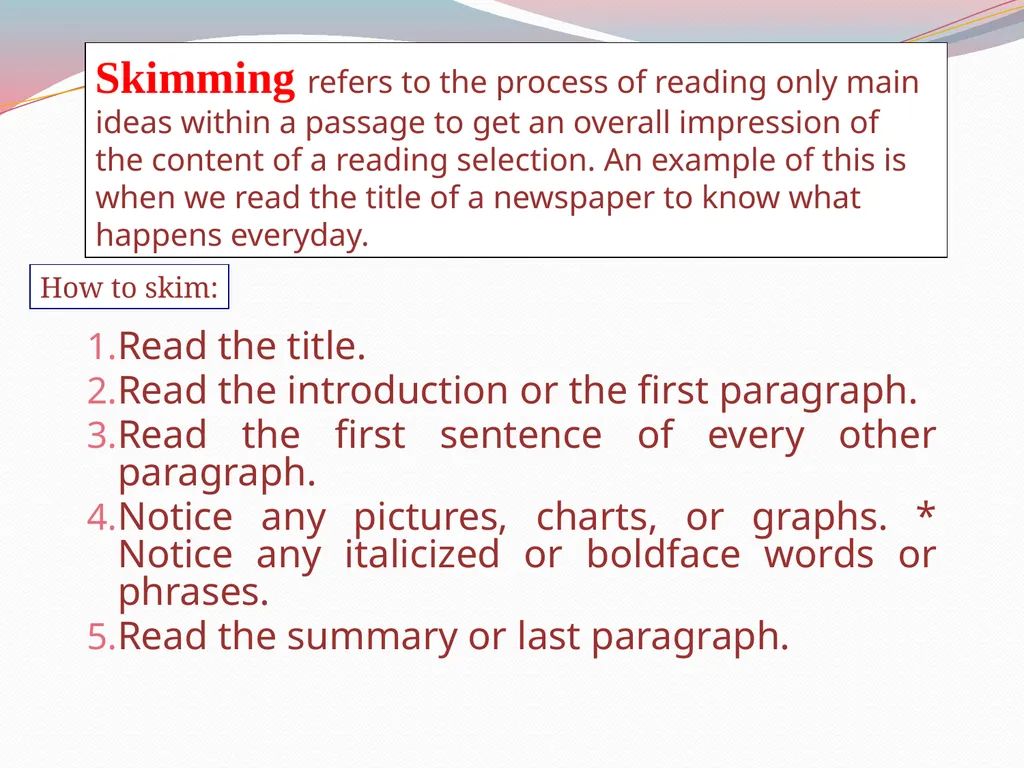
slide7. Read the title.
Read the introduction or the first paragraph.
Read the first sentence of every other paragraph.
Notice any pictures, charts, or graphs. * Notice any italicized or boldface words or phrases.
Read the summary or last paragraph. Skimming refers to the process of reading only main
ideas within a passage to get an overall impression of
the content of a reading selection. An example of this is
when we read the title of a newspaper to know what
happens everyday. How to skim:<br>
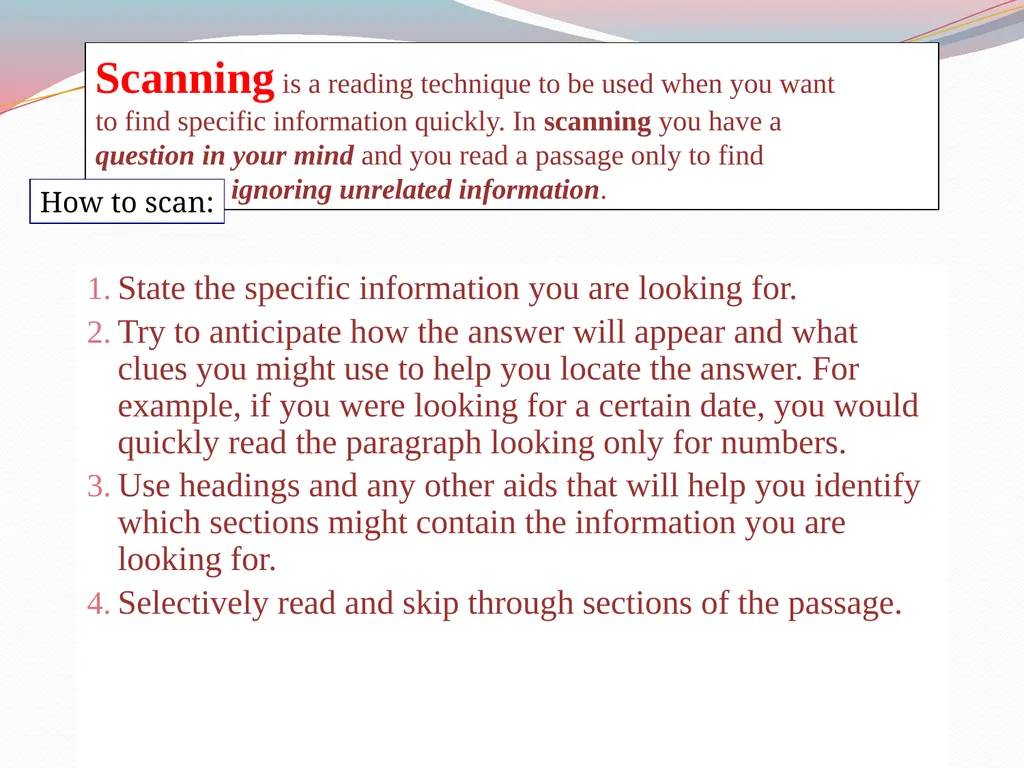
slide8. State the specific information you are looking for.
Try to anticipate how the answer will appear and what clues you might use to help you locate the answer. For example, if you were looking for a certain date, you would quickly read the paragraph looking only for numbers.
Use headings and any other aids that will help you identify which sections might contain the information you are looking for.
Selectively read and skip through sections of the passage. Scanning is a reading technique to be used when you want
to find specific information quickly. In scanning you have a
question in your mind and you read a passage only to find
the answer, ignoring unrelated information. How to scan:<br>
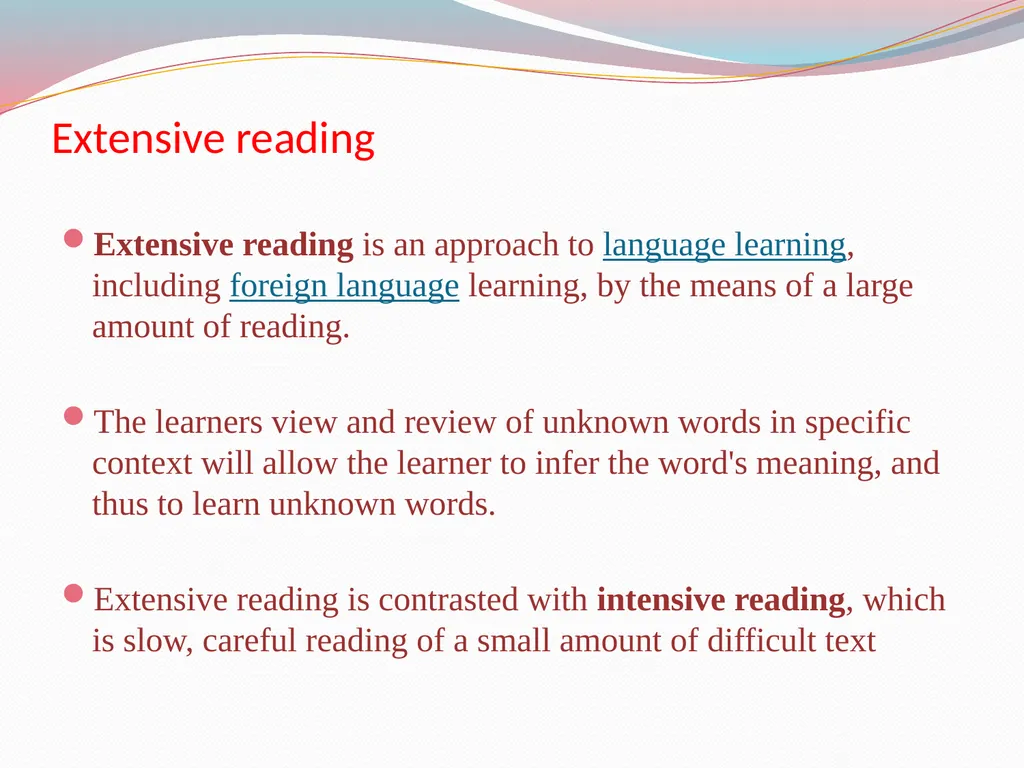
slide9. Extensive reading Extensive reading is an approach to language learning, including foreign language learning, by the means of a large amount of reading.
The learners view and review of unknown words in specific context will allow the learner to infer the word's meaning, and thus to learn unknown words.
Extensive reading is contrasted with intensive reading, which is slow, careful reading of a small amount of difficult text<br>
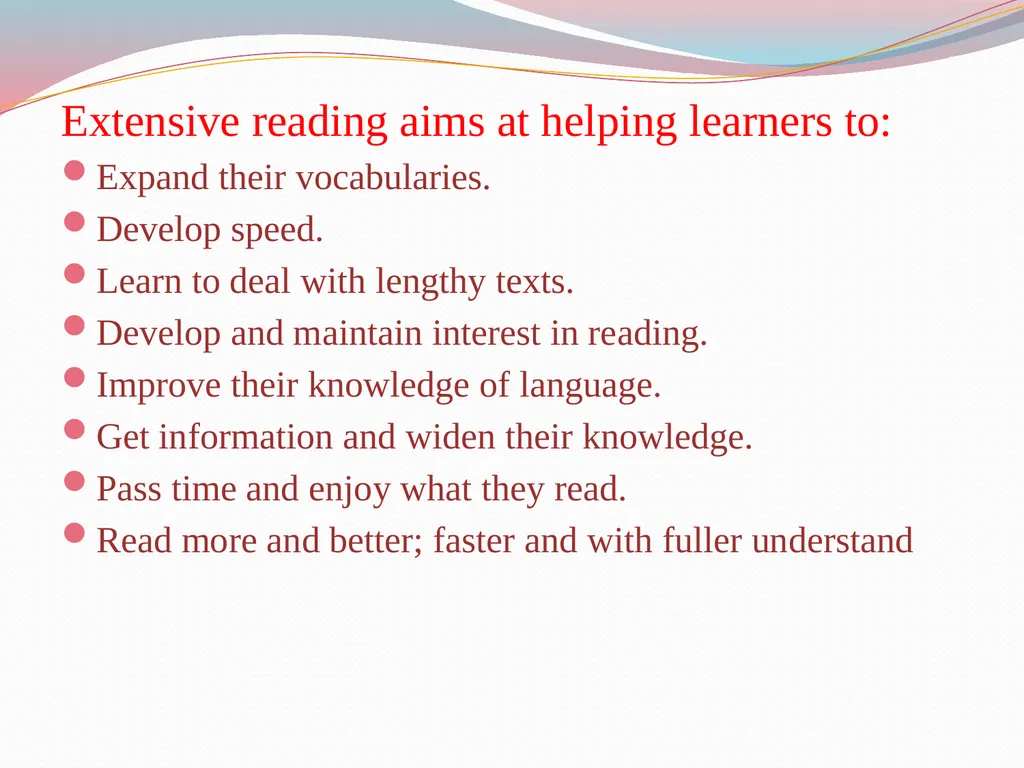
slide10. Extensive reading aims at helping learners to:
Expand their vocabularies.
Develop speed.
Learn to deal with lengthy texts.
Develop and maintain interest in reading.
Improve their knowledge of language.
Get information and widen their knowledge.
Pass time and enjoy what they read.
Read more and better; faster and with fuller understand<br>
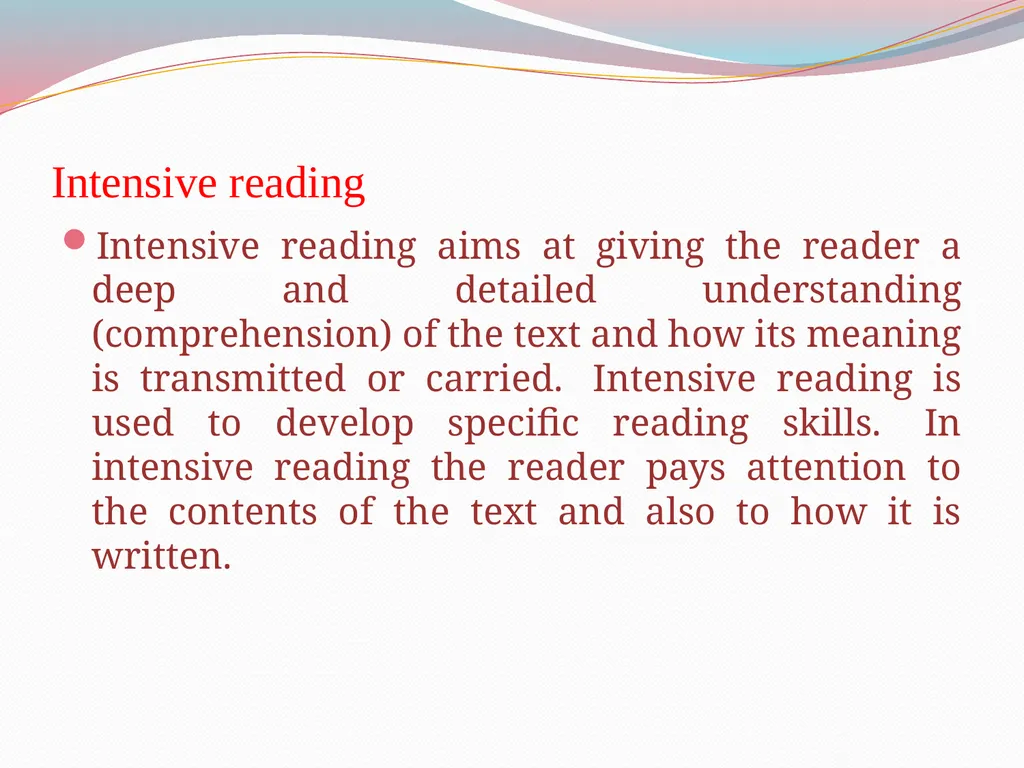
slide11. Intensive reading Intensive reading aims at giving the reader a deep and detailed understanding (comprehension) of the text and how its meaning is transmitted or carried. Intensive reading is used to develop specific reading skills. In intensive reading the reader pays attention to the contents of the text and also to how it is written.<br>
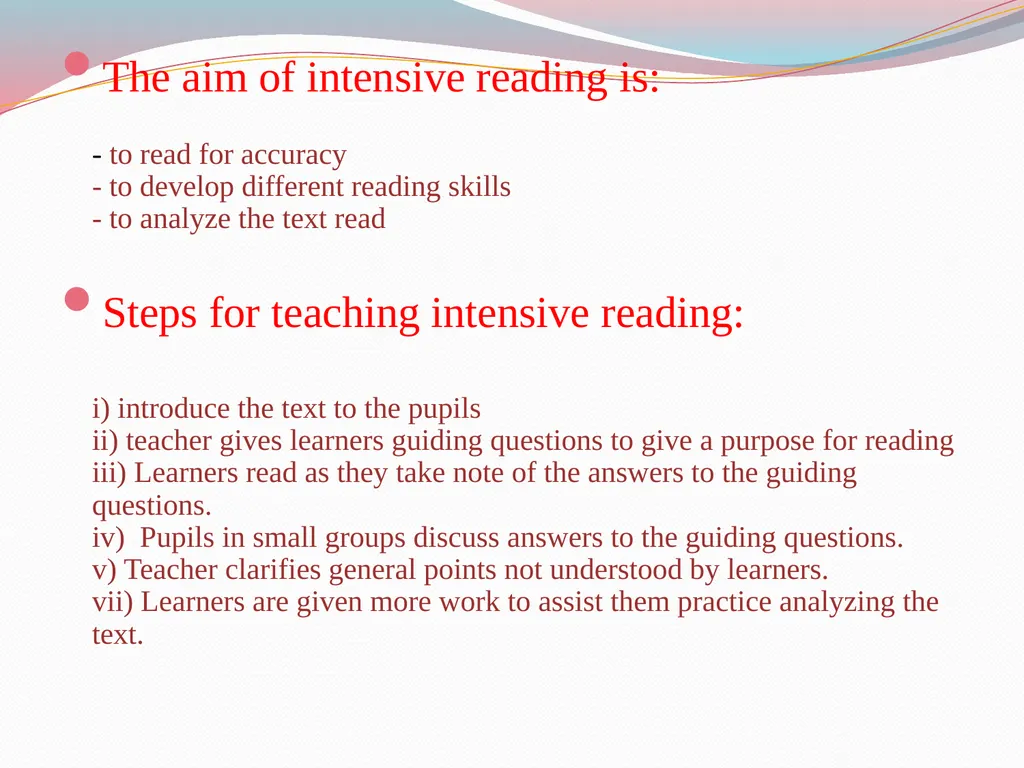
slide12. The aim of intensive reading is:
- to read for accuracy - to develop different reading skills - to analyze the text read
Steps for teaching intensive reading:
i) introduce the text to the pupils ii) teacher gives learners guiding questions to give a purpose for reading iii) Learners read as they take note of the answers to the guiding questions. iv) Pupils in small groups discuss answers to the guiding questions. v) Teacher clarifies general points not understood by learners. vii) Learners are given more work to assist them practice analyzing the text.<br>
slide13. THANK YOU<br>
slide2. TEACHING OF ENGLISH LANGUAGE INVOVES DEVELOPMENT OF FOUR SKILLS Listening
Speaking
Reading and
Writing.<br>
slide3. SUB-SKILLS OF READING SKILL Predicting information: more and more listening encourages predictive abilities and promotes interaction.
*ability to read at a standard speed with adequate comprehension.
*ability to understand specific points and central idea.
*ability to get the writer’s opinion and attitude.
*ability to get the meaning from context.
*Understand the marked features and their function.
* Ability to read with proper punctuation, pronunciation, stress and intonation.<br>
slide4. ACTIVITIES TO LEARN READING SKILL Recognize words
Expand visual span
Catch the relationship between words
Guess the meaning of the new words and phrases,
Understand the linking devices ,marked features etc.
Practice and exercise- from easy to hard, specific to global etc.<br>
slide5. TYPES OF READING Loud and silent reading
* Intensive and extensive reading<br>
slide6. Ways we read Intensive
Extensive
Skimming
Scanning Reading every single word for meaning
Bringing our world knowledge to the text
Reading to get the main idea
Reading for specific details or items<br>
slide7. Read the title.
Read the introduction or the first paragraph.
Read the first sentence of every other paragraph.
Notice any pictures, charts, or graphs. * Notice any italicized or boldface words or phrases.
Read the summary or last paragraph. Skimming refers to the process of reading only main
ideas within a passage to get an overall impression of
the content of a reading selection. An example of this is
when we read the title of a newspaper to know what
happens everyday. How to skim:<br>
slide8. State the specific information you are looking for.
Try to anticipate how the answer will appear and what clues you might use to help you locate the answer. For example, if you were looking for a certain date, you would quickly read the paragraph looking only for numbers.
Use headings and any other aids that will help you identify which sections might contain the information you are looking for.
Selectively read and skip through sections of the passage. Scanning is a reading technique to be used when you want
to find specific information quickly. In scanning you have a
question in your mind and you read a passage only to find
the answer, ignoring unrelated information. How to scan:<br>
slide9. Extensive reading Extensive reading is an approach to language learning, including foreign language learning, by the means of a large amount of reading.
The learners view and review of unknown words in specific context will allow the learner to infer the word's meaning, and thus to learn unknown words.
Extensive reading is contrasted with intensive reading, which is slow, careful reading of a small amount of difficult text<br>
slide10. Extensive reading aims at helping learners to:
Expand their vocabularies.
Develop speed.
Learn to deal with lengthy texts.
Develop and maintain interest in reading.
Improve their knowledge of language.
Get information and widen their knowledge.
Pass time and enjoy what they read.
Read more and better; faster and with fuller understand<br>
slide11. Intensive reading Intensive reading aims at giving the reader a deep and detailed understanding (comprehension) of the text and how its meaning is transmitted or carried. Intensive reading is used to develop specific reading skills. In intensive reading the reader pays attention to the contents of the text and also to how it is written.<br>
slide12. The aim of intensive reading is:
- to read for accuracy - to develop different reading skills - to analyze the text read
Steps for teaching intensive reading:
i) introduce the text to the pupils ii) teacher gives learners guiding questions to give a purpose for reading iii) Learners read as they take note of the answers to the guiding questions. iv) Pupils in small groups discuss answers to the guiding questions. v) Teacher clarifies general points not understood by learners. vii) Learners are given more work to assist them practice analyzing the text.<br>
slide13. THANK YOU<br>