
WEB-SOBA: Word Embeddings-Based Semi-automatic
PM
Published · 35 slides · 0 views

1 / 1

Description
WEB-SOBA: Word Embeddings-Based Semi-automatic Ontology Building for Aspect-Based Sentiment Classification Fenna ten Haaf, Christopher Claassen, Ruben Eschauzier, Joanne Tjan, Daniel Buijs, Flavius Frasincar, and Kim Schouten Erasmus
Related Topics
Share
Embed code
Download this presentation From Below
"WEB-SOBA: Word Embeddings-Based Semi-automatic" is the property of its rightful owner. Permission is granted to download and print the materials on this website for personal, non-commercial use only, and to display it on your personal computer provided you do not modify the materials and that you retain all copyright notices contained in the materials. By downloading content from our website, you accept the terms of this agreement.
Presentation Transcript
01
WEB-SOBA: Word Embeddings-Based Semi-automatic Ontology Building for Aspect-Based Sentiment Classification Fenna ten Haaf, Christopher Claassen,
Ruben Eschauzier, Joanne Tjan, Daniel Buijs,
Flavius Frasincar, and Kim Schouten
Erasmus University Rotterdam, the Netherlands 1<br>
Ruben Eschauzier, Joanne Tjan, Daniel Buijs,
Flavius Frasincar, and Kim Schouten
Erasmus University Rotterdam, the Netherlands 1<br>
02
Content Motivation
Related Work
Data
Methodology
Evaluation
Conclusion 2<br>
Related Work
Data
Methodology
Evaluation
Conclusion 2<br>
03
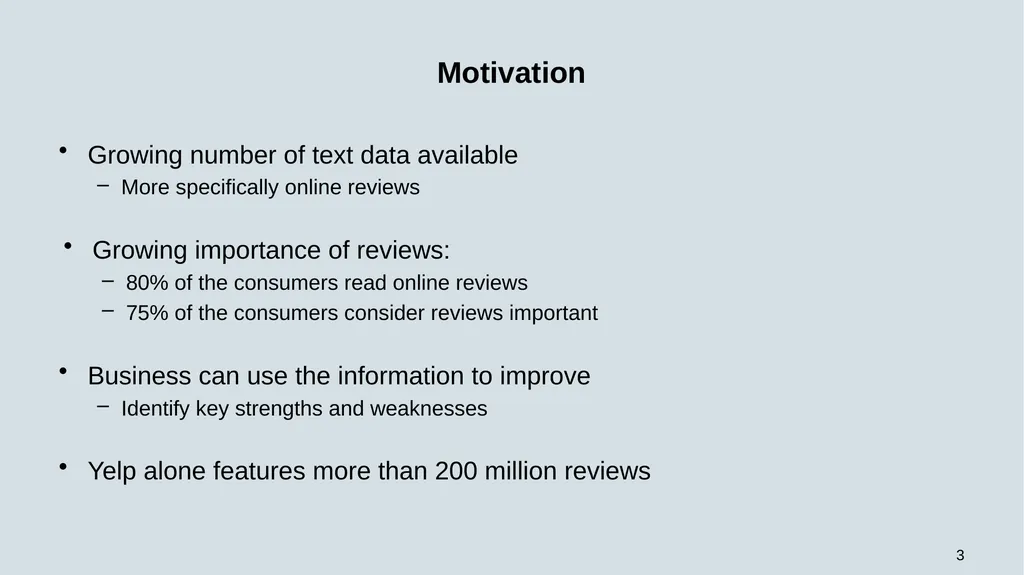
Motivation Growing number of text data available
More specifically online reviews
Growing importance of reviews:
80% of the consumers read online reviews
75% of the consumers consider reviews important
Business can use the information to improve
Identify key strengths and weaknesses
Yelp alone features more than 200 million reviews 3<br>
More specifically online reviews
Growing importance of reviews:
80% of the consumers read online reviews
75% of the consumers consider reviews important
Business can use the information to improve
Identify key strengths and weaknesses
Yelp alone features more than 200 million reviews 3<br>
04
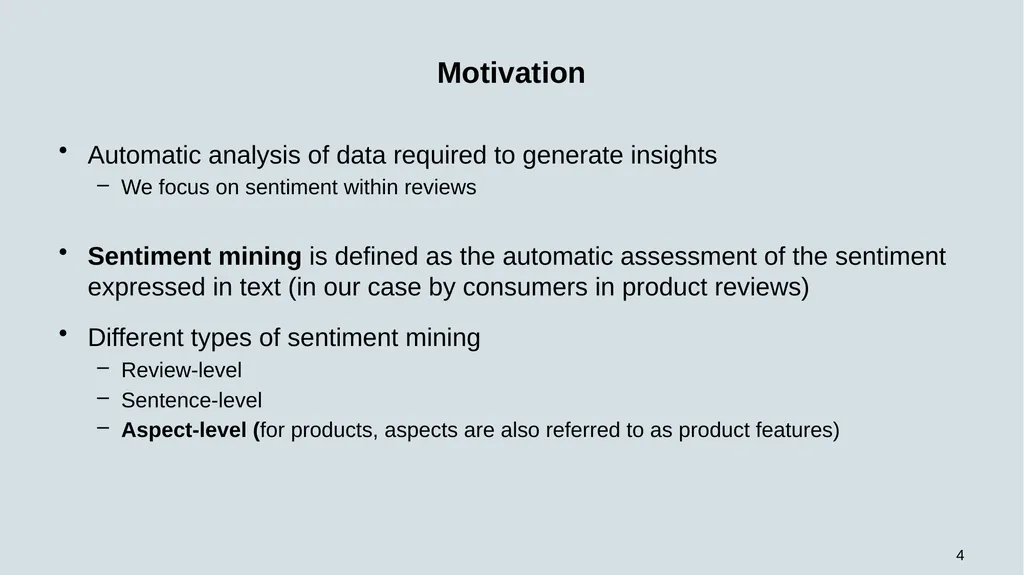
Motivation Automatic analysis of data required to generate insights
We focus on sentiment within reviews
Sentiment mining is defined as the automatic assessment of the sentiment expressed in text (in our case by consumers in product reviews)
Different types of sentiment mining
Review-level
Sentence-level
Aspect-level (for products, aspects are also referred to as product features) 4<br>
We focus on sentiment within reviews
Sentiment mining is defined as the automatic assessment of the sentiment expressed in text (in our case by consumers in product reviews)
Different types of sentiment mining
Review-level
Sentence-level
Aspect-level (for products, aspects are also referred to as product features) 4<br>
05
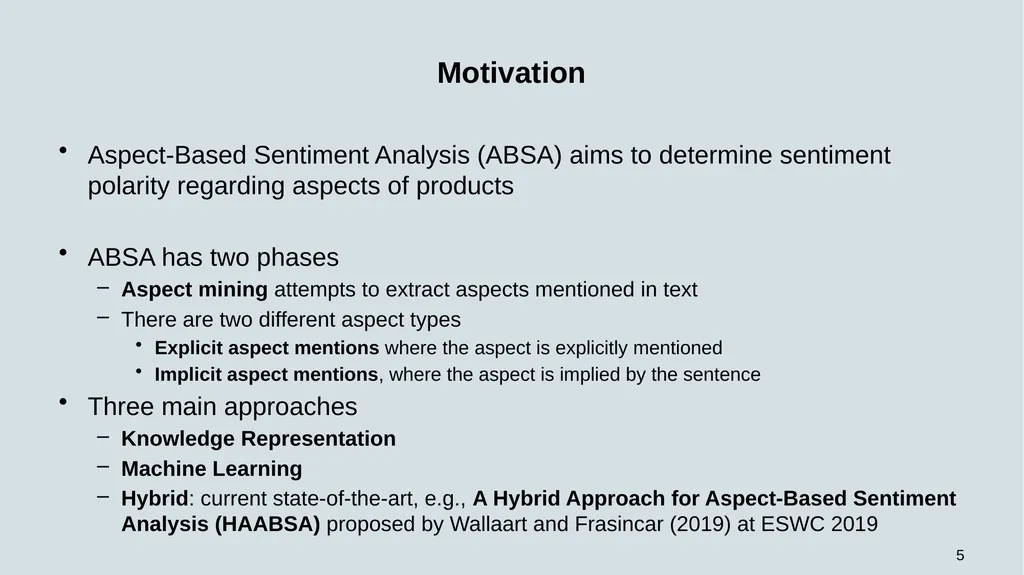
Motivation Aspect-Based Sentiment Analysis (ABSA) aims to determine sentiment polarity regarding aspects of products
ABSA has two phases
Aspect mining attempts to extract aspects mentioned in text
There are two different aspect types
Explicit aspect mentions where the aspect is explicitly mentioned
Implicit aspect mentions, where the aspect is implied by the sentence
Three main approaches
Knowledge Representation
Machine Learning
Hybrid: current state-of-the-art, e.g., A Hybrid Approach for Aspect-Based Sentiment Analysis (HAABSA) proposed by Wallaart and Frasincar (2019) at ESWC 2019 5<br>
ABSA has two phases
Aspect mining attempts to extract aspects mentioned in text
There are two different aspect types
Explicit aspect mentions where the aspect is explicitly mentioned
Implicit aspect mentions, where the aspect is implied by the sentence
Three main approaches
Knowledge Representation
Machine Learning
Hybrid: current state-of-the-art, e.g., A Hybrid Approach for Aspect-Based Sentiment Analysis (HAABSA) proposed by Wallaart and Frasincar (2019) at ESWC 2019 5<br>
06
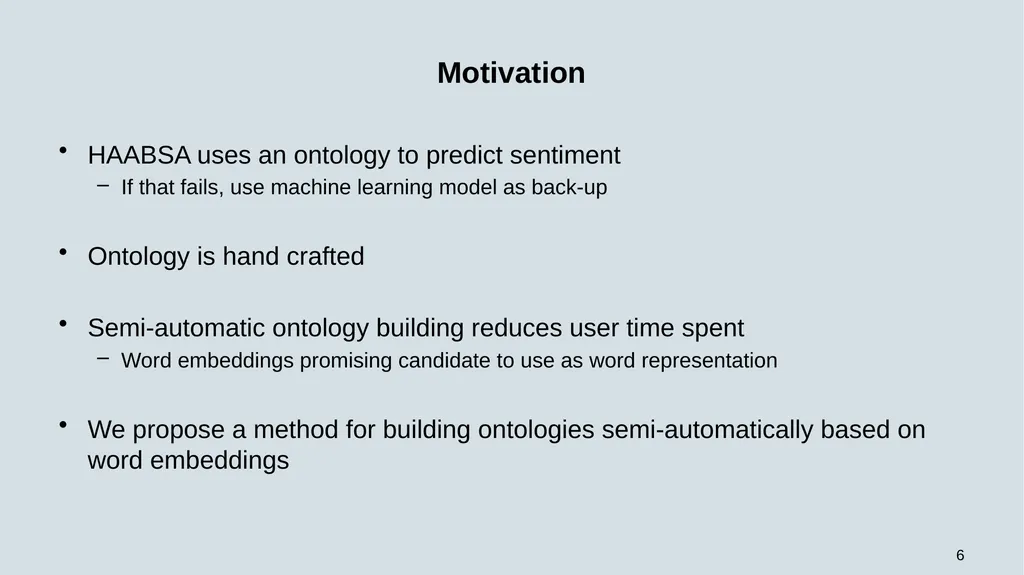
Motivation HAABSA uses an ontology to predict sentiment
If that fails, use machine learning model as back-up
Ontology is hand crafted
Semi-automatic ontology building reduces user time spent
Word embeddings promising candidate to use as word representation
We propose a method for building ontologies semi-automatically based on word embeddings 6<br>
If that fails, use machine learning model as back-up
Ontology is hand crafted
Semi-automatic ontology building reduces user time spent
Word embeddings promising candidate to use as word representation
We propose a method for building ontologies semi-automatically based on word embeddings 6<br>
07
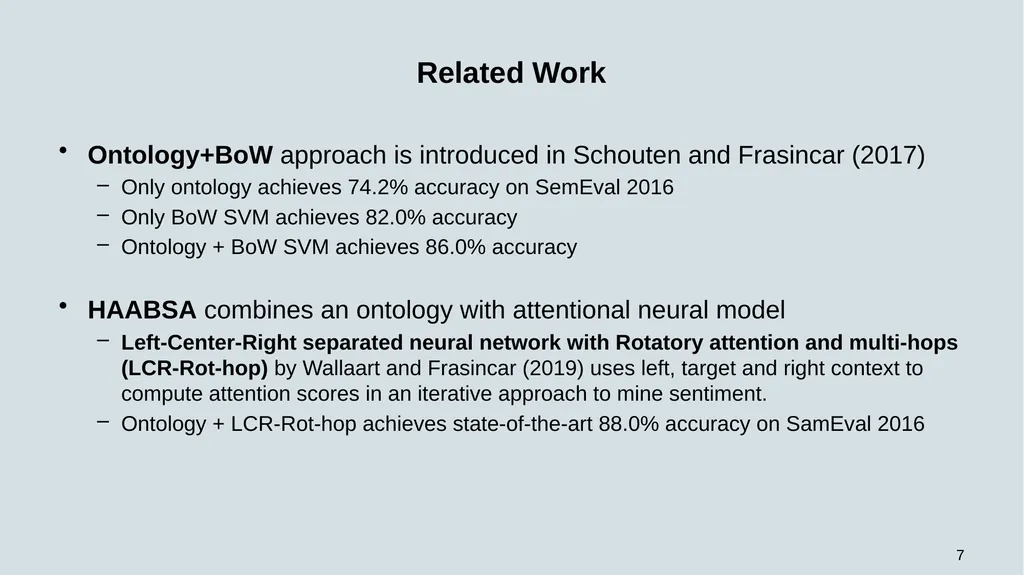
Related Work Ontology+BoW approach is introduced in Schouten and Frasincar (2017)
Only ontology achieves 74.2% accuracy on SemEval 2016
Only BoW SVM achieves 82.0% accuracy
Ontology + BoW SVM achieves 86.0% accuracy
HAABSA combines an ontology with attentional neural model
Left-Center-Right separated neural network with Rotatory attention and multi-hops (LCR-Rot-hop) by Wallaart and Frasincar (2019) uses left, target and right context to compute attention scores in an iterative approach to mine sentiment.
Ontology + LCR-Rot-hop achieves state-of-the-art 88.0% accuracy on SamEval 2016 7<br>
Only ontology achieves 74.2% accuracy on SemEval 2016
Only BoW SVM achieves 82.0% accuracy
Ontology + BoW SVM achieves 86.0% accuracy
HAABSA combines an ontology with attentional neural model
Left-Center-Right separated neural network with Rotatory attention and multi-hops (LCR-Rot-hop) by Wallaart and Frasincar (2019) uses left, target and right context to compute attention scores in an iterative approach to mine sentiment.
Ontology + LCR-Rot-hop achieves state-of-the-art 88.0% accuracy on SamEval 2016 7<br>
08
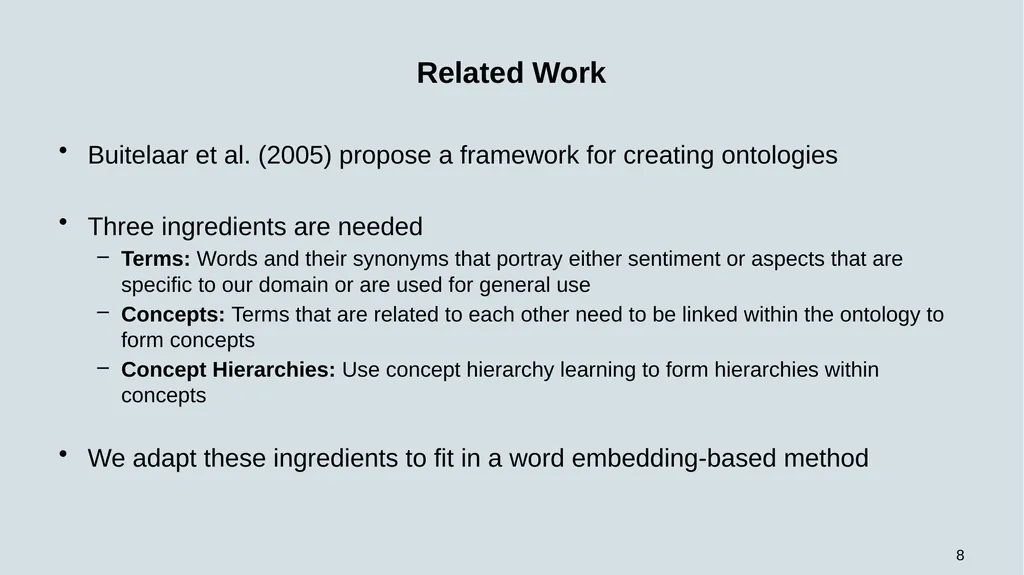
Related Work Buitelaar et al. (2005) propose a framework for creating ontologies
Three ingredients are needed
Terms: Words and their synonyms that portray either sentiment or aspects that are specific to our domain or are used for general use
Concepts: Terms that are related to each other need to be linked within the ontology to form concepts
Concept Hierarchies: Use concept hierarchy learning to form hierarchies within concepts
We adapt these ingredients to fit in a word embedding-based method 8<br>
Three ingredients are needed
Terms: Words and their synonyms that portray either sentiment or aspects that are specific to our domain or are used for general use
Concepts: Terms that are related to each other need to be linked within the ontology to form concepts
Concept Hierarchies: Use concept hierarchy learning to form hierarchies within concepts
We adapt these ingredients to fit in a word embedding-based method 8<br>
09
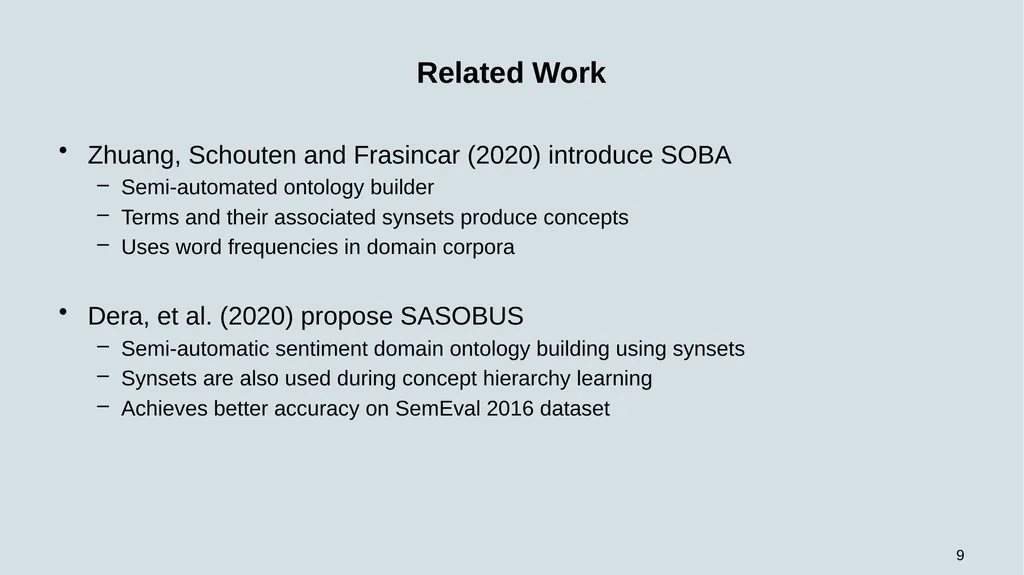
Related Work Zhuang, Schouten and Frasincar (2020) introduce SOBA
Semi-automated ontology builder
Terms and their associated synsets produce concepts
Uses word frequencies in domain corpora
Dera, et al. (2020) propose SASOBUS
Semi-automatic sentiment domain ontology building using synsets
Synsets are also used during concept hierarchy learning
Achieves better accuracy on SemEval 2016 dataset 9<br>
Semi-automated ontology builder
Terms and their associated synsets produce concepts
Uses word frequencies in domain corpora
Dera, et al. (2020) propose SASOBUS
Semi-automatic sentiment domain ontology building using synsets
Synsets are also used during concept hierarchy learning
Achieves better accuracy on SemEval 2016 dataset 9<br>
10
Data Domain corpus
Yelp Dataset Challenge dataset
Keep only restaurant reviews
5,508,394 domain-specific reviews of over 500,000 restaurants
Contrasting corpus
Pre-trained word2vec model
Google-news-300 10<br>
Yelp Dataset Challenge dataset
Keep only restaurant reviews
5,508,394 domain-specific reviews of over 500,000 restaurants
Contrasting corpus
Pre-trained word2vec model
Google-news-300 10<br>
11
Data 11<br>
12
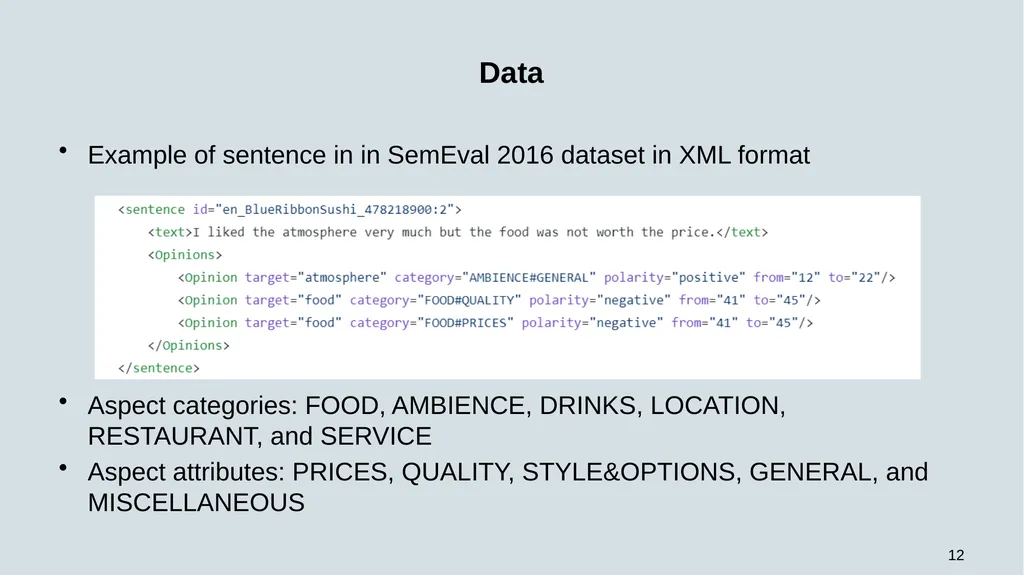
Data Example of sentence in in SemEval 2016 dataset in XML format
Aspect categories: FOOD, AMBIENCE, DRINKS, LOCATION, RESTAURANT, and SERVICE
Aspect attributes: PRICES, QUALITY, STYLE&OPTIONS, GENERAL, and MISCELLANEOUS 12<br>
Aspect categories: FOOD, AMBIENCE, DRINKS, LOCATION, RESTAURANT, and SERVICE
Aspect attributes: PRICES, QUALITY, STYLE&OPTIONS, GENERAL, and MISCELLANEOUS 12<br>
13
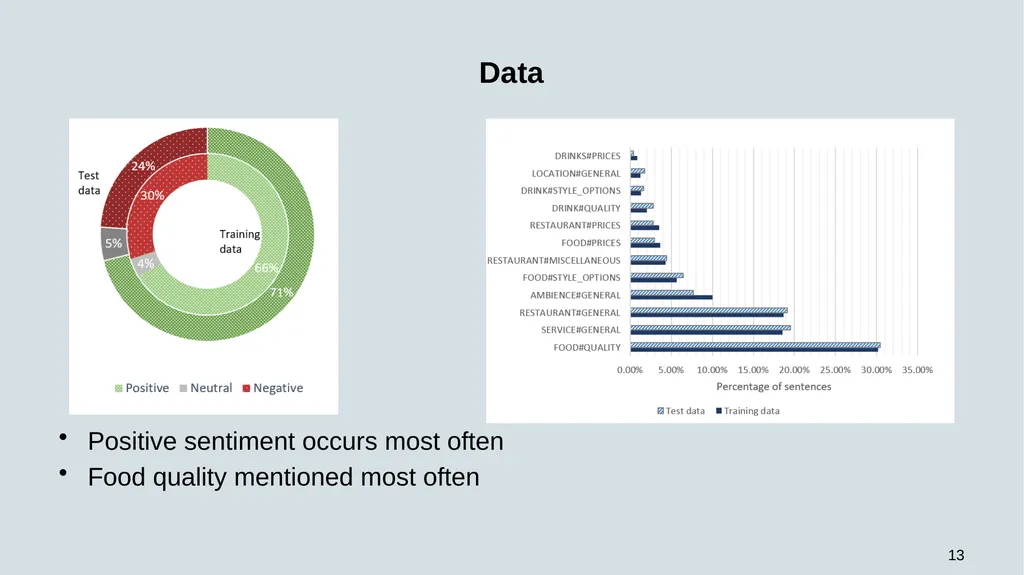
Data 13 Positive sentiment occurs most often
Food quality mentioned most often<br>
Food quality mentioned most often<br>
14
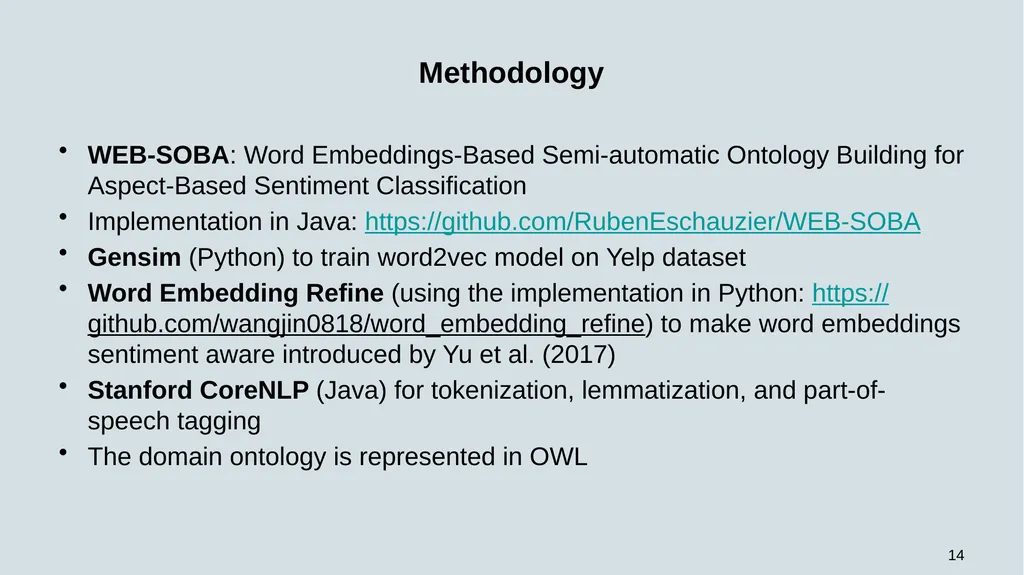
Methodology WEB-SOBA: Word Embeddings-Based Semi-automatic Ontology Building for Aspect-Based Sentiment Classification
Implementation in Java: https://github.com/RubenEschauzier/WEB-SOBA
Gensim (Python) to train word2vec model on Yelp dataset
Word Embedding Refine (using the implementation in Python: https://github.com/wangjin0818/word_embedding_refine) to make word embeddings sentiment aware introduced by Yu et al. (2017)
Stanford CoreNLP (Java) for tokenization, lemmatization, and part-of-speech tagging
The domain ontology is represented in OWL 14<br>
Implementation in Java: https://github.com/RubenEschauzier/WEB-SOBA
Gensim (Python) to train word2vec model on Yelp dataset
Word Embedding Refine (using the implementation in Python: https://github.com/wangjin0818/word_embedding_refine) to make word embeddings sentiment aware introduced by Yu et al. (2017)
Stanford CoreNLP (Java) for tokenization, lemmatization, and part-of-speech tagging
The domain ontology is represented in OWL 14<br>
15
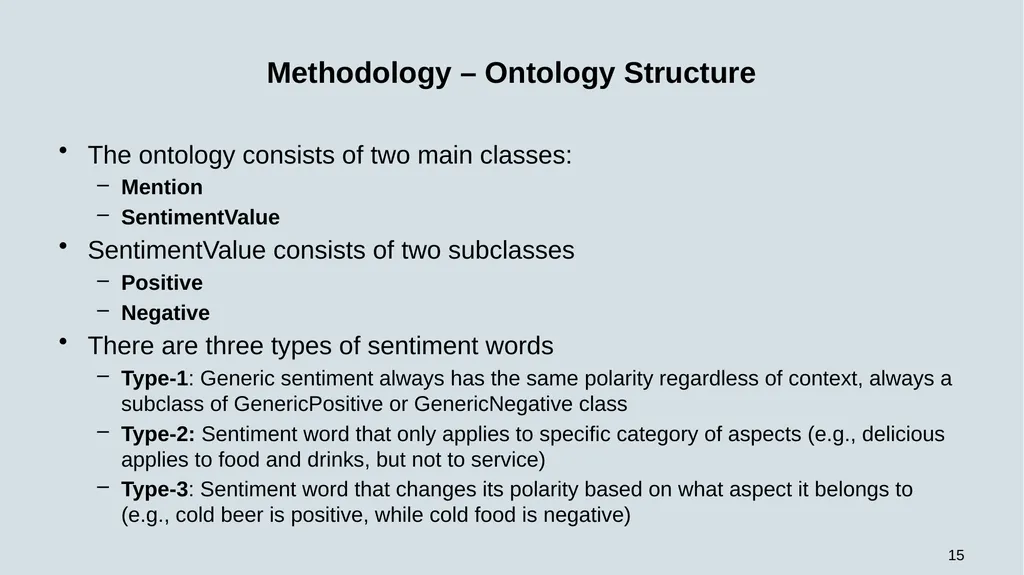
Methodology – Ontology Structure The ontology consists of two main classes:
Mention
SentimentValue
SentimentValue consists of two subclasses
Positive
Negative
There are three types of sentiment words
Type-1: Generic sentiment always has the same polarity regardless of context, always a subclass of GenericPositive or GenericNegative class
Type-2: Sentiment word that only applies to specific category of aspects (e.g., delicious applies to food and drinks, but not to service)
Type-3: Sentiment word that changes its polarity based on what aspect it belongs to (e.g., cold beer is positive, while cold food is negative) 15<br>
Mention
SentimentValue
SentimentValue consists of two subclasses
Positive
Negative
There are three types of sentiment words
Type-1: Generic sentiment always has the same polarity regardless of context, always a subclass of GenericPositive or GenericNegative class
Type-2: Sentiment word that only applies to specific category of aspects (e.g., delicious applies to food and drinks, but not to service)
Type-3: Sentiment word that changes its polarity based on what aspect it belongs to (e.g., cold beer is positive, while cold food is negative) 15<br>
16
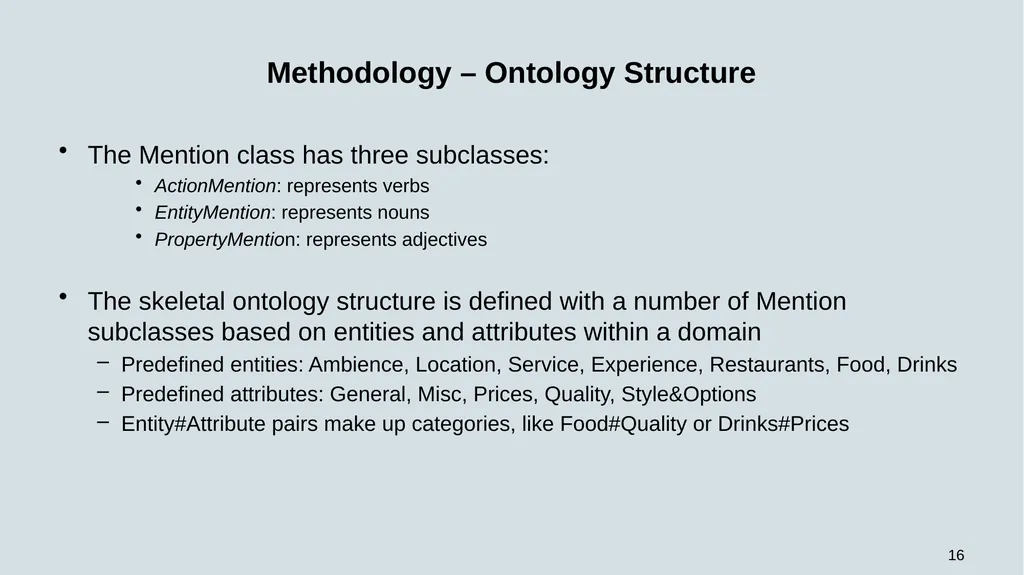
Methodology – Ontology Structure The Mention class has three subclasses:
ActionMention: represents verbs
EntityMention: represents nouns
PropertyMention: represents adjectives
The skeletal ontology structure is defined with a number of Mention subclasses based on entities and attributes within a domain
Predefined entities: Ambience, Location, Service, Experience, Restaurants, Food, Drinks
Predefined attributes: General, Misc, Prices, Quality, Style&Options
Entity#Attribute pairs make up categories, like Food#Quality or Drinks#Prices 16<br>
ActionMention: represents verbs
EntityMention: represents nouns
PropertyMention: represents adjectives
The skeletal ontology structure is defined with a number of Mention subclasses based on entities and attributes within a domain
Predefined entities: Ambience, Location, Service, Experience, Restaurants, Food, Drinks
Predefined attributes: General, Misc, Prices, Quality, Style&Options
Entity#Attribute pairs make up categories, like Food#Quality or Drinks#Prices 16<br>
17
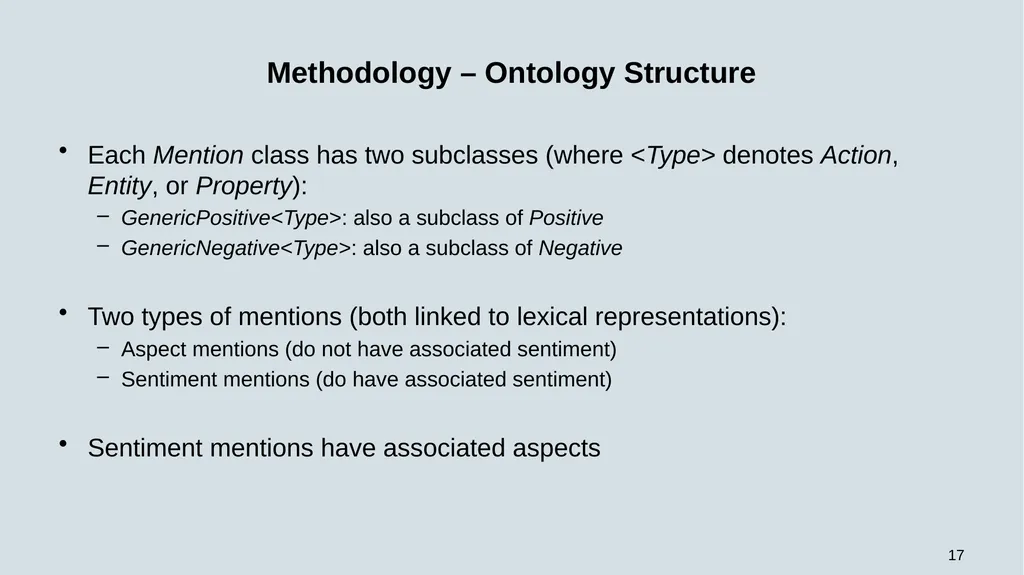
Methodology – Ontology Structure Each Mention class has two subclasses (where <Type> denotes Action, Entity, or Property):
GenericPositive<Type>: also a subclass of Positive
GenericNegative<Type>: also a subclass of Negative
Two types of mentions (both linked to lexical representations):
Aspect mentions (do not have associated sentiment)
Sentiment mentions (do have associated sentiment)
Sentiment mentions have associated aspects 17<br>
GenericPositive<Type>: also a subclass of Positive
GenericNegative<Type>: also a subclass of Negative
Two types of mentions (both linked to lexical representations):
Aspect mentions (do not have associated sentiment)
Sentiment mentions (do have associated sentiment)
Sentiment mentions have associated aspects 17<br>
18
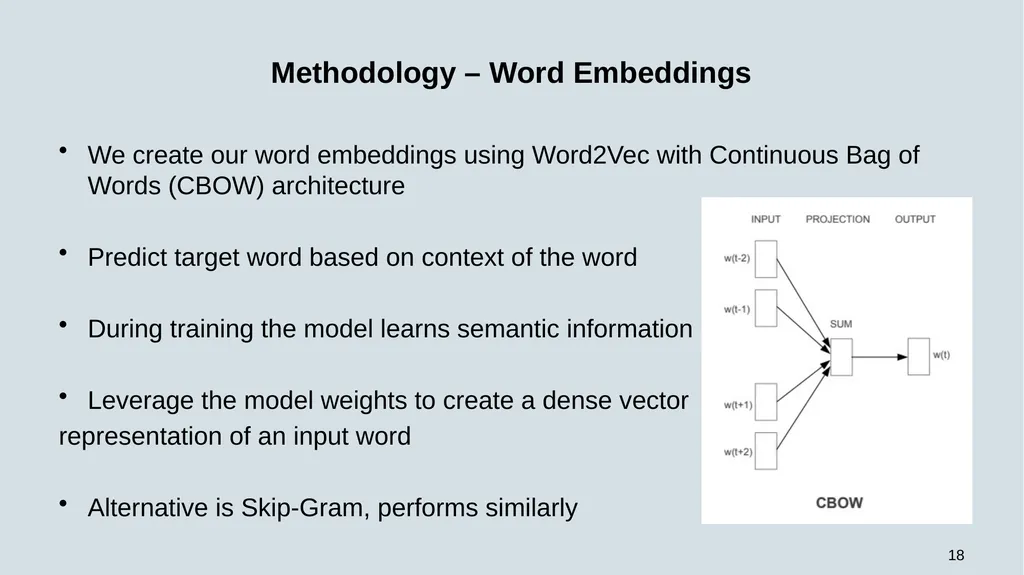
Methodology – Word Embeddings We create our word embeddings using Word2Vec with Continuous Bag of Words (CBOW) architecture
Predict target word based on context of the word
During training the model learns semantic information
Leverage the model weights to create a dense vector
representation of an input word
Alternative is Skip-Gram, performs similarly 18<br>
Predict target word based on context of the word
During training the model learns semantic information
Leverage the model weights to create a dense vector
representation of an input word
Alternative is Skip-Gram, performs similarly 18<br>
19
Methodology – Word Embeddings 19<br>
20
Methodology – Term Selection Extract all adjectives, nouns and verbs from Yelp data
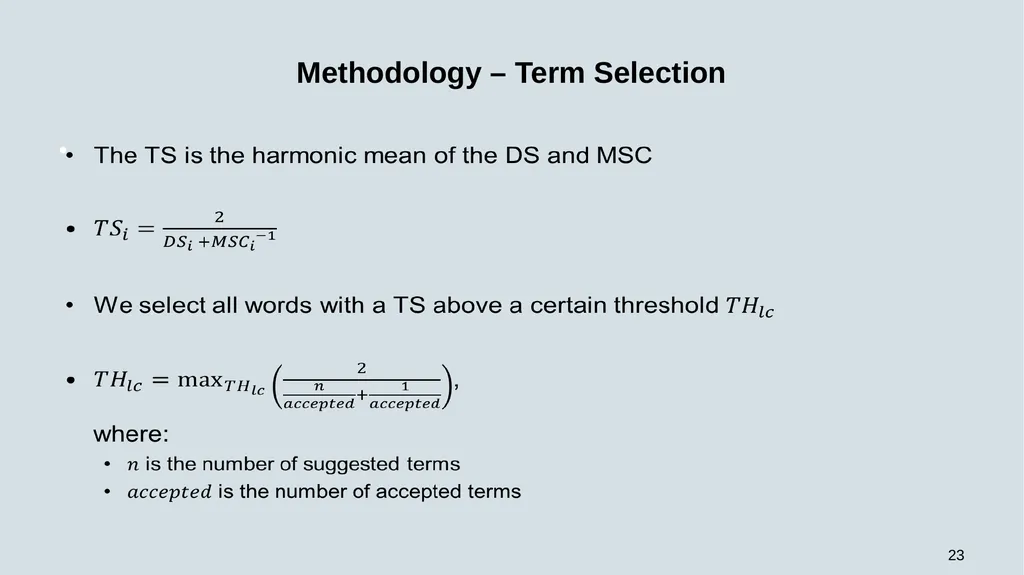
We calculate a TermScore (TS) for each word which is composed of a DomainSimilarity (DS) and MentionClassSimilarity (MCS) score 20<br>
We calculate a TermScore (TS) for each word which is composed of a DomainSimilarity (DS) and MentionClassSimilarity (MCS) score 20<br>
21
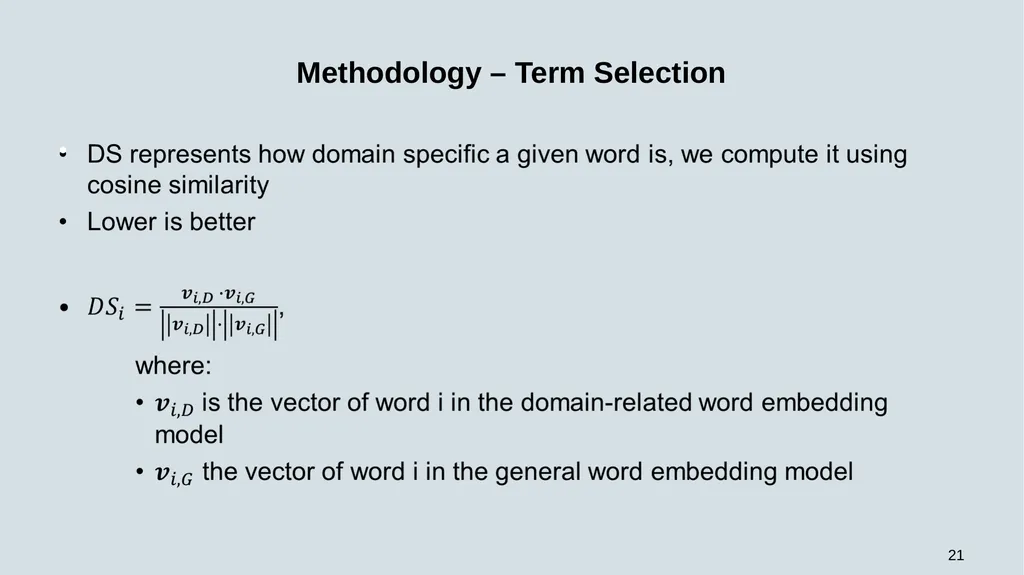
Methodology – Term Selection 21<br>
22
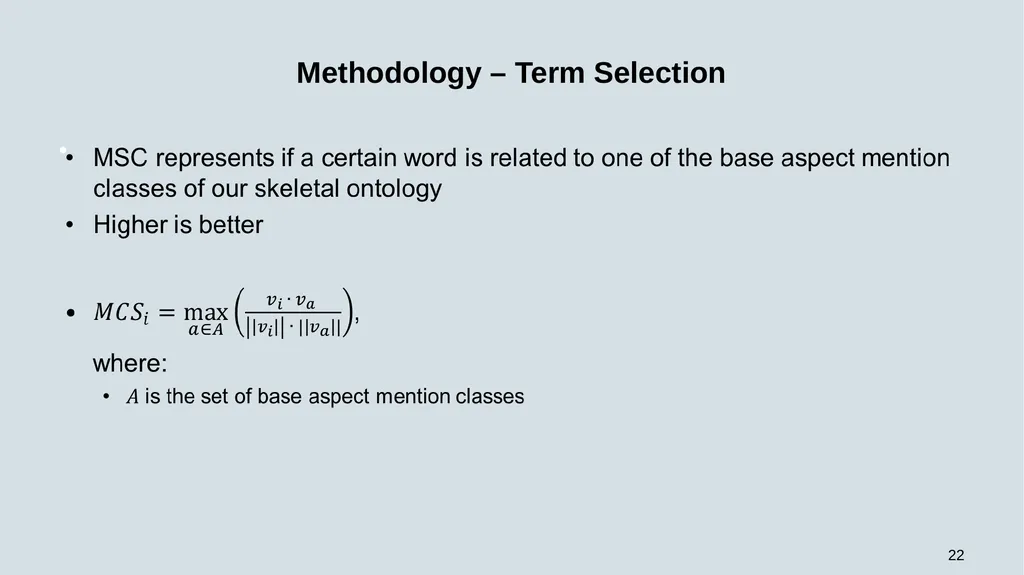
Methodology – Term Selection 22<br>
23
Methodology – Term Selection 23<br>
24
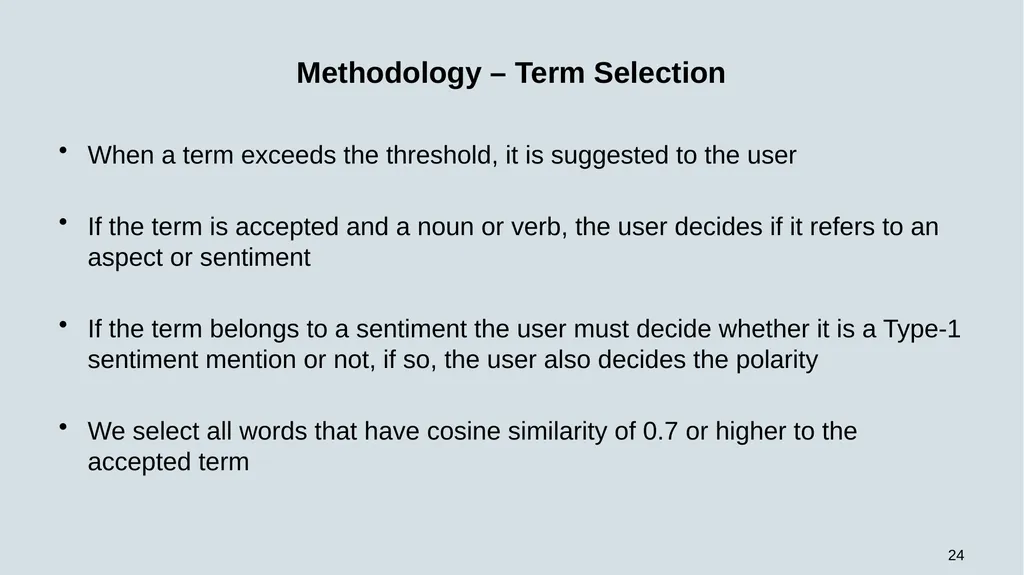
Methodology – Term Selection When a term exceeds the threshold, it is suggested to the user
If the term is accepted and a noun or verb, the user decides if it refers to an aspect or sentiment
If the term belongs to a sentiment the user must decide whether it is a Type-1 sentiment mention or not, if so, the user also decides the polarity
We select all words that have cosine similarity of 0.7 or higher to the accepted term 24<br>
If the term is accepted and a noun or verb, the user decides if it refers to an aspect or sentiment
If the term belongs to a sentiment the user must decide whether it is a Type-1 sentiment mention or not, if so, the user also decides the polarity
We select all words that have cosine similarity of 0.7 or higher to the accepted term 24<br>
25
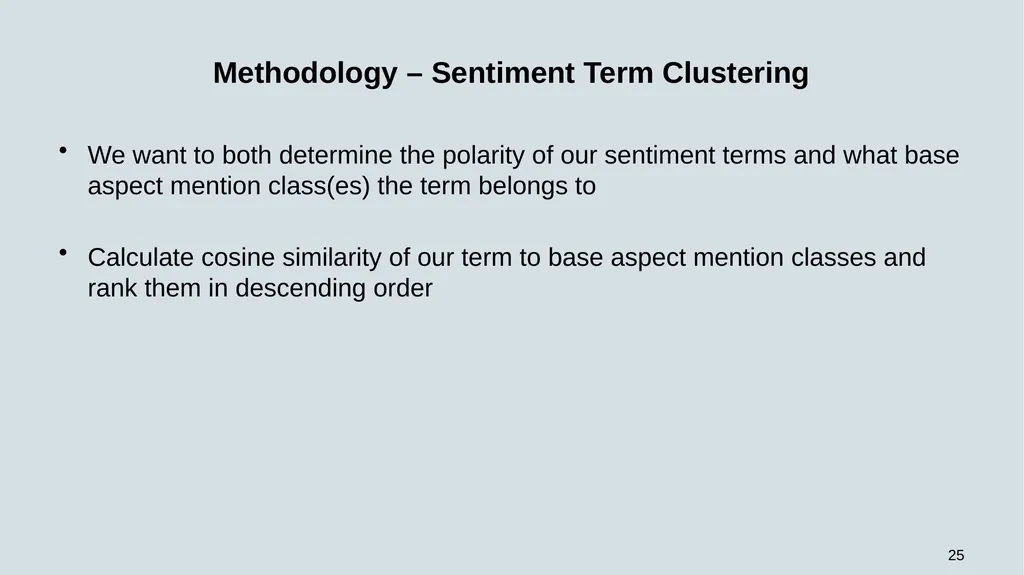
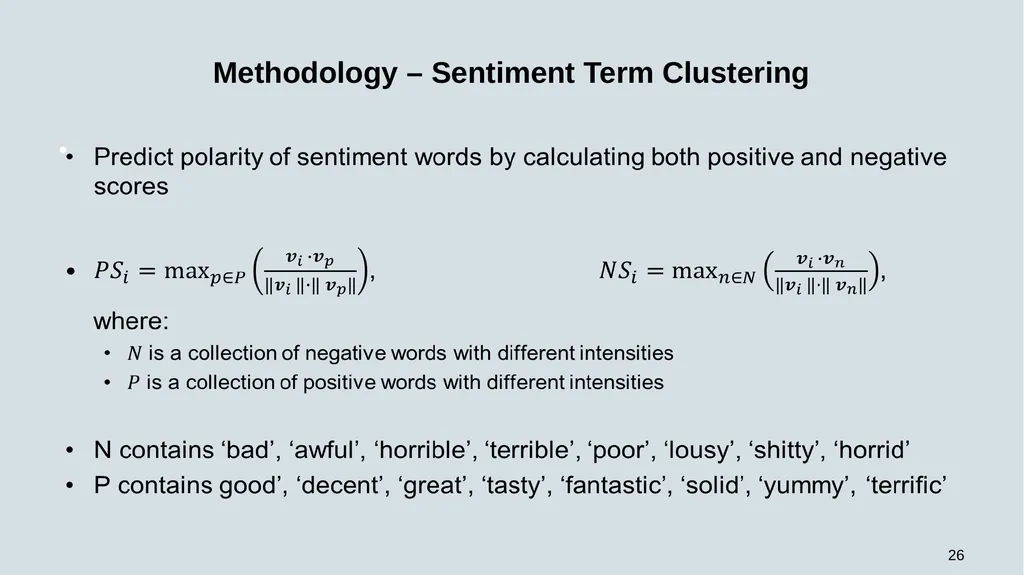
Methodology – Sentiment Term Clustering We want to both determine the polarity of our sentiment terms and what base aspect mention class(es) the term belongs to
Calculate cosine similarity of our term to base aspect mention classes and rank them in descending order 25<br>
Calculate cosine similarity of our term to base aspect mention classes and rank them in descending order 25<br>
26
Methodology – Sentiment Term Clustering 26<br>
27
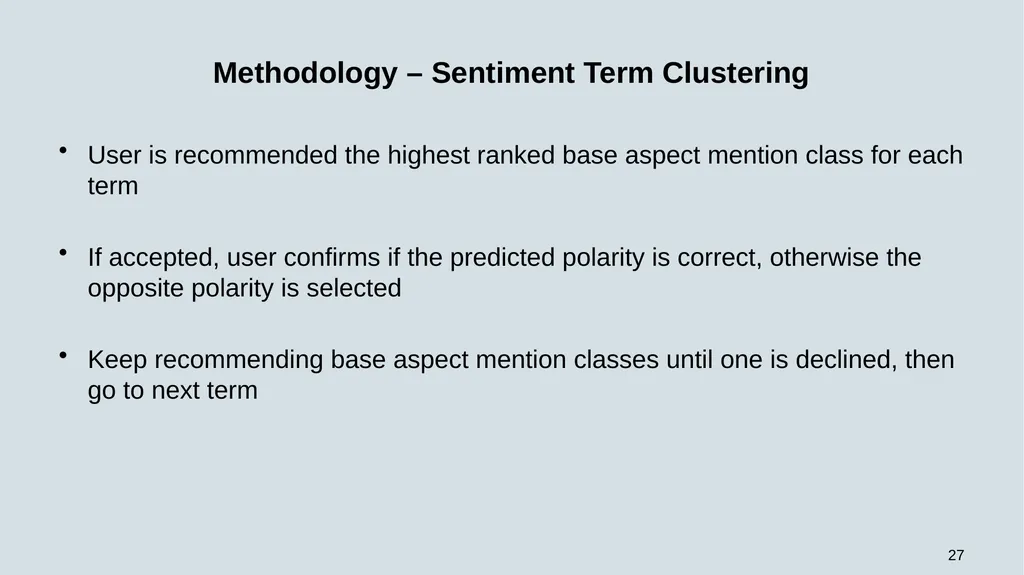
Methodology – Sentiment Term Clustering User is recommended the highest ranked base aspect mention class for each term
If accepted, user confirms if the predicted polarity is correct, otherwise the opposite polarity is selected
Keep recommending base aspect mention classes until one is declined, then go to next term 27<br>
If accepted, user confirms if the predicted polarity is correct, otherwise the opposite polarity is selected
Keep recommending base aspect mention classes until one is declined, then go to next term 27<br>
28
Methodology – Hierarchical Clustering 28<br>
29
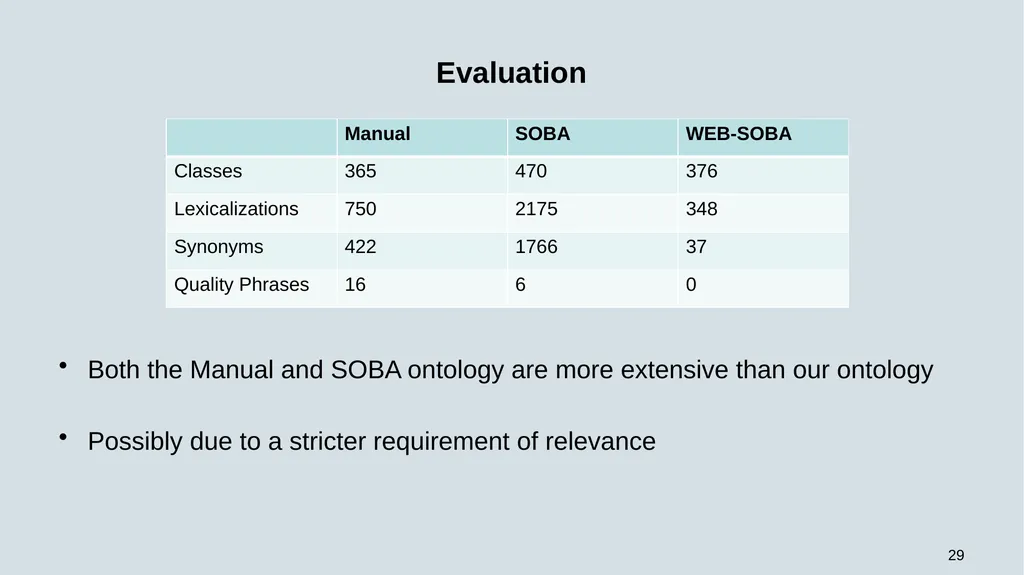
Evaluation Both the Manual and SOBA ontology are more extensive than our ontology
Possibly due to a stricter requirement of relevance 29<br>
Possibly due to a stricter requirement of relevance 29<br>
30
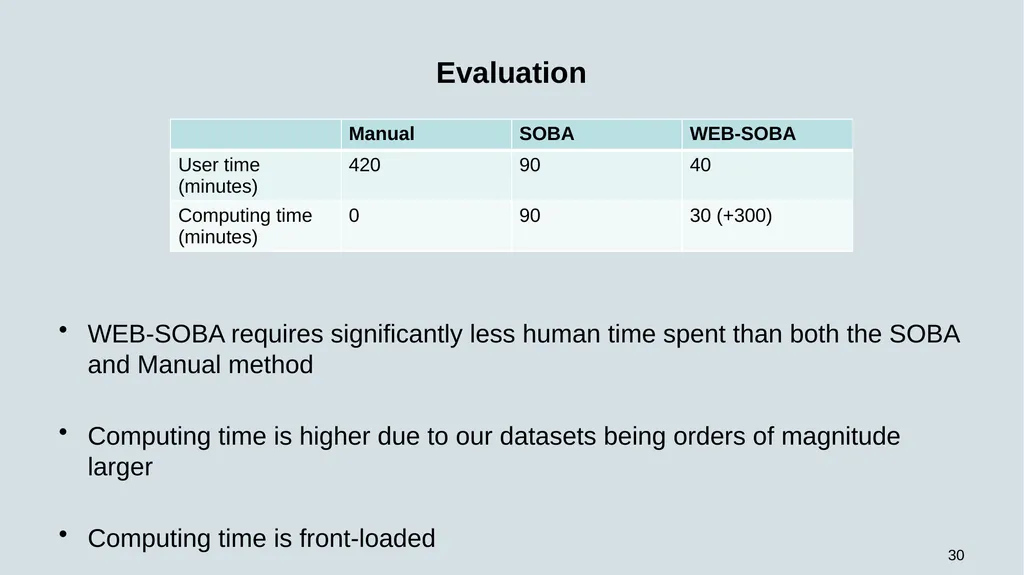
Evaluation WEB-SOBA requires significantly less human time spent than both the SOBA and Manual method
Computing time is higher due to our datasets being orders of magnitude larger
Computing time is front-loaded 30<br>
Computing time is higher due to our datasets being orders of magnitude larger
Computing time is front-loaded 30<br>
31
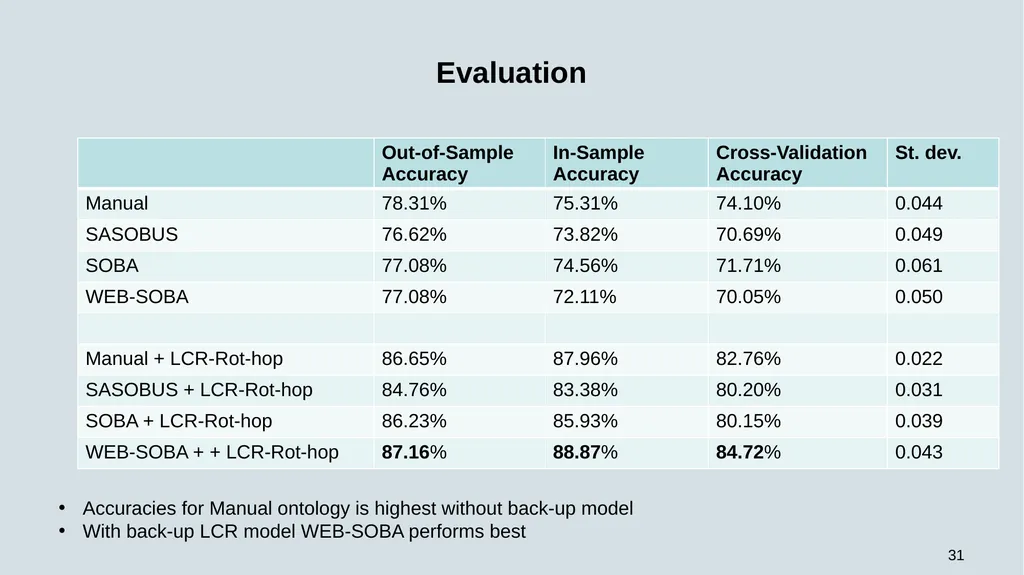
Evaluation 31 Accuracies for Manual ontology is highest without back-up model
With back-up LCR model WEB-SOBA performs best<br>
With back-up LCR model WEB-SOBA performs best<br>
32
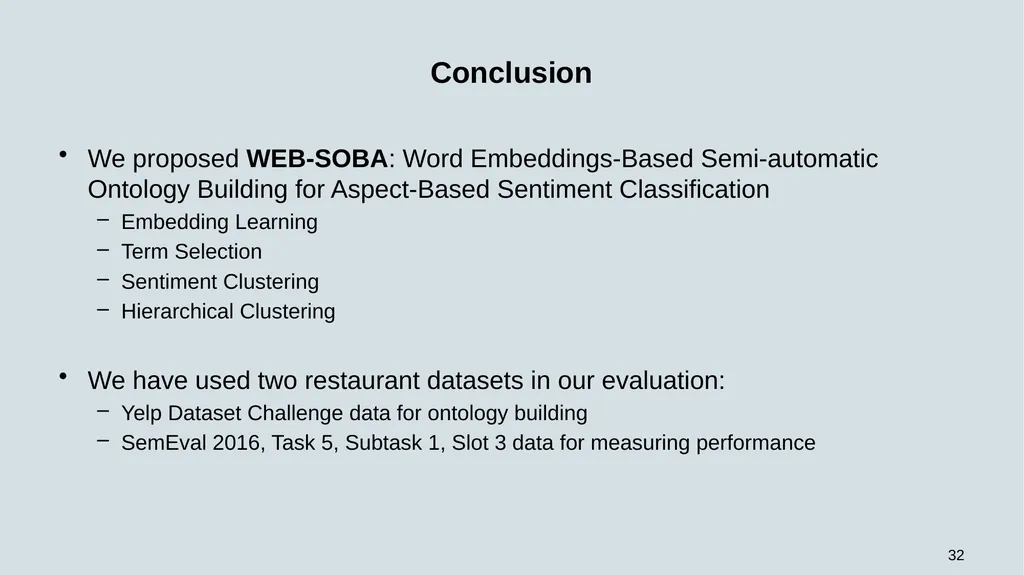
Conclusion We proposed WEB-SOBA: Word Embeddings-Based Semi-automatic Ontology Building for Aspect-Based Sentiment Classification
Embedding Learning
Term Selection
Sentiment Clustering
Hierarchical Clustering
We have used two restaurant datasets in our evaluation:
Yelp Dataset Challenge data for ontology building
SemEval 2016, Task 5, Subtask 1, Slot 3 data for measuring performance 32<br>
Embedding Learning
Term Selection
Sentiment Clustering
Hierarchical Clustering
We have used two restaurant datasets in our evaluation:
Yelp Dataset Challenge data for ontology building
SemEval 2016, Task 5, Subtask 1, Slot 3 data for measuring performance 32<br>
33
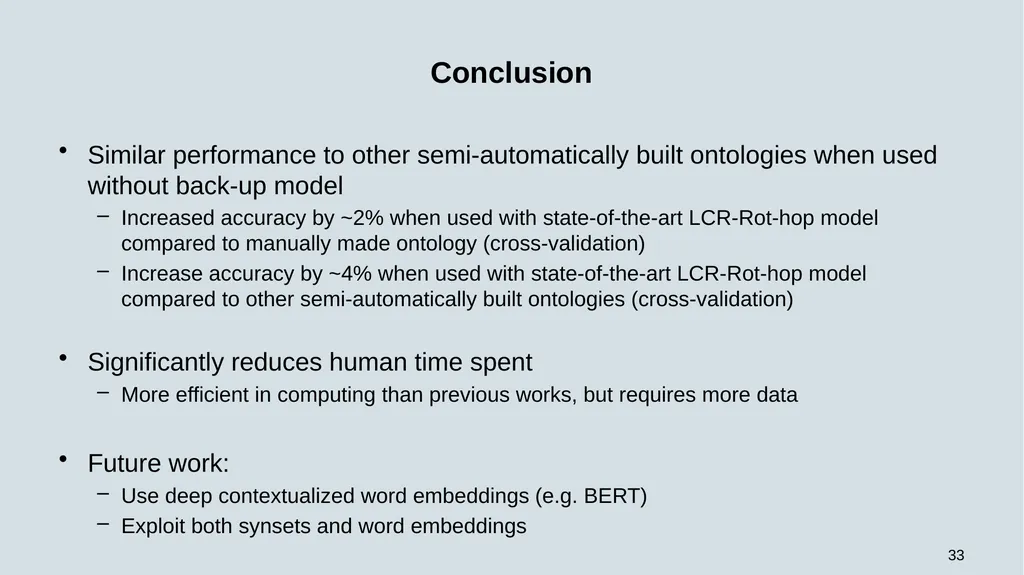
Conclusion Similar performance to other semi-automatically built ontologies when used without back-up model
Increased accuracy by ~2% when used with state-of-the-art LCR-Rot-hop model compared to manually made ontology (cross-validation)
Increase accuracy by ~4% when used with state-of-the-art LCR-Rot-hop model compared to other semi-automatically built ontologies (cross-validation)
Significantly reduces human time spent
More efficient in computing than previous works, but requires more data
Future work:
Use deep contextualized word embeddings (e.g. BERT)
Exploit both synsets and word embeddings 33<br>
Increased accuracy by ~2% when used with state-of-the-art LCR-Rot-hop model compared to manually made ontology (cross-validation)
Increase accuracy by ~4% when used with state-of-the-art LCR-Rot-hop model compared to other semi-automatically built ontologies (cross-validation)
Significantly reduces human time spent
More efficient in computing than previous works, but requires more data
Future work:
Use deep contextualized word embeddings (e.g. BERT)
Exploit both synsets and word embeddings 33<br>
34
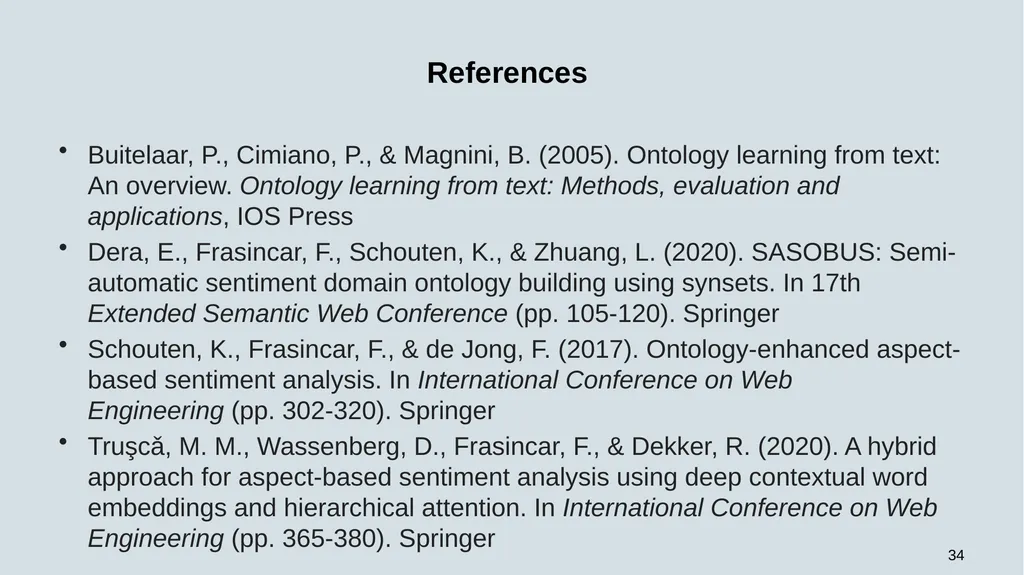
References Buitelaar, P., Cimiano, P., & Magnini, B. (2005). Ontology learning from text: An overview. Ontology learning from text: Methods, evaluation and applications, IOS Press
Dera, E., Frasincar, F., Schouten, K., & Zhuang, L. (2020). SASOBUS: Semi-automatic sentiment domain ontology building using synsets. In 17th Extended Semantic Web Conference (pp. 105-120). Springer
Schouten, K., Frasincar, F., & de Jong, F. (2017). Ontology-enhanced aspect-based sentiment analysis. In International Conference on Web Engineering (pp. 302-320). Springer
Truşcǎ, M. M., Wassenberg, D., Frasincar, F., & Dekker, R. (2020). A hybrid approach for aspect-based sentiment analysis using deep contextual word embeddings and hierarchical attention. In International Conference on Web Engineering (pp. 365-380). Springer 34<br>
Dera, E., Frasincar, F., Schouten, K., & Zhuang, L. (2020). SASOBUS: Semi-automatic sentiment domain ontology building using synsets. In 17th Extended Semantic Web Conference (pp. 105-120). Springer
Schouten, K., Frasincar, F., & de Jong, F. (2017). Ontology-enhanced aspect-based sentiment analysis. In International Conference on Web Engineering (pp. 302-320). Springer
Truşcǎ, M. M., Wassenberg, D., Frasincar, F., & Dekker, R. (2020). A hybrid approach for aspect-based sentiment analysis using deep contextual word embeddings and hierarchical attention. In International Conference on Web Engineering (pp. 365-380). Springer 34<br>
35
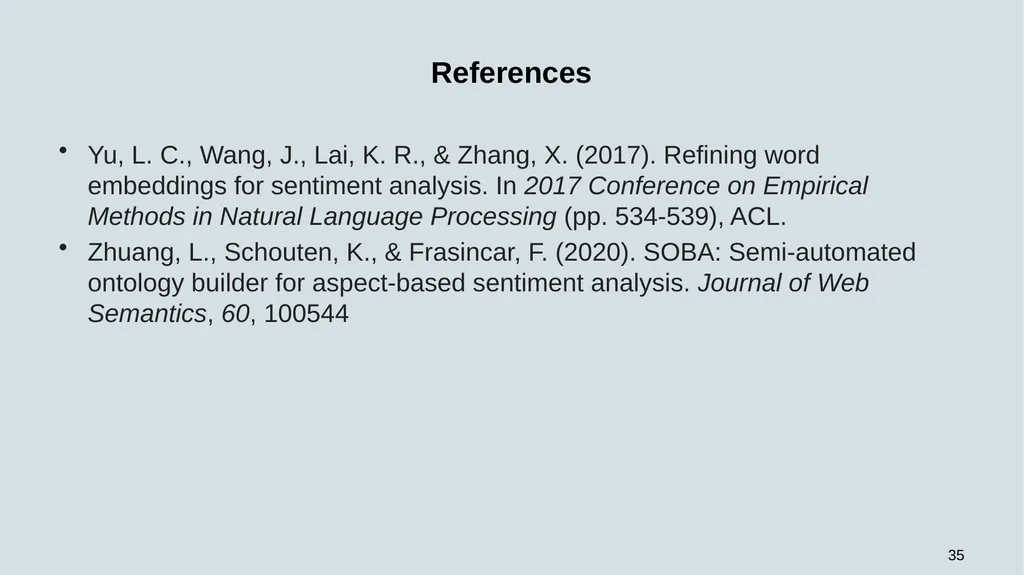
References Yu, L. C., Wang, J., Lai, K. R., & Zhang, X. (2017). Refining word embeddings for sentiment analysis. In 2017 Conference on Empirical Methods in Natural Language Processing (pp. 534-539), ACL.
Zhuang, L., Schouten, K., & Frasincar, F. (2020). SOBA: Semi-automated ontology builder for aspect-based sentiment analysis. Journal of Web Semantics, 60, 100544 35<br>
Zhuang, L., Schouten, K., & Frasincar, F. (2020). SOBA: Semi-automated ontology builder for aspect-based sentiment analysis. Journal of Web Semantics, 60, 100544 35<br>