
Webinar Training 19th November, 2020 Webinar 4:



Description: Webinar Training 19th November, 2020 Webinar 4: Increased sexual and gender-based violence, domestic violence and violence against children under COVID- 19 and how to prevent and respond to it Before we start Please keep your cameras off
Related Topics
Download Presentation
"Webinar Training 19th November, 2020 Webinar 4:" is the property of its rightful owner. Permission is granted to download and print the materials on this website for personal, non-commercial use only, and to display it on your personal computer provided you do not modify the materials and that you retain all copyright notices contained in the materials. By downloading content from our website, you accept the terms of this agreement.
Presentation Transcript
slide1. Webinar Training
19th November, 2020 Webinar 4: Increased sexual and gender-based violence, domestic violence and violence against children under COVID- 19 and how to prevent and respond to it<br>
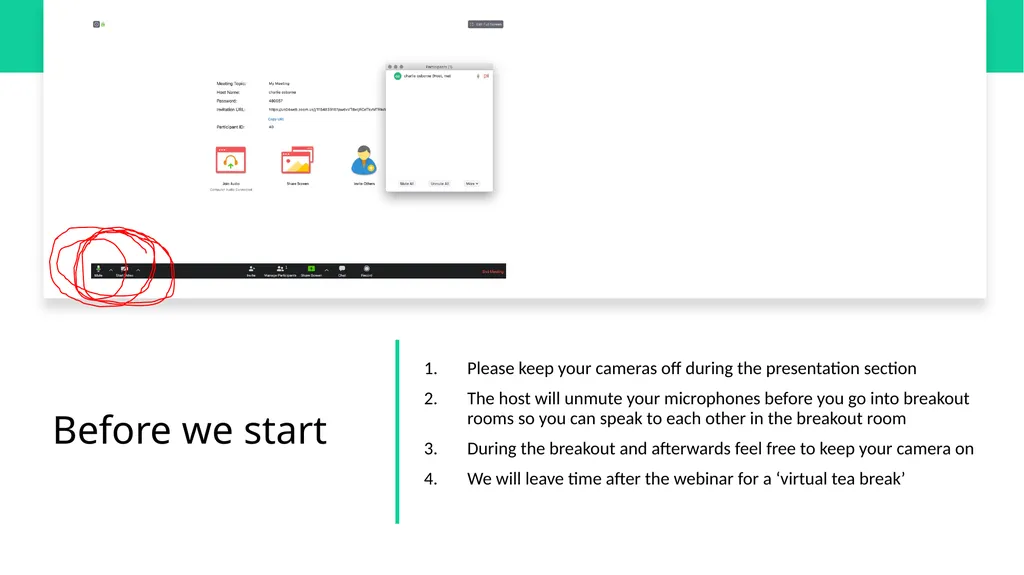
slide2. Before we start Please keep your cameras off during the presentation section
The host will unmute your microphones before you go into breakout rooms so you can speak to each other in the breakout room
During the breakout and afterwards feel free to keep your camera on
We will leave time after the webinar for a ‘virtual tea break’<br>
slide3. Learning Objectives To identify the potential risks of different forms of violence against women and children and sexual and gender-based violence in the context of COVID-19,
To understand and review locally appropriate prevention and response actions<br>
slide4. Target audience Education sector
Health workers
Local leadership<br>
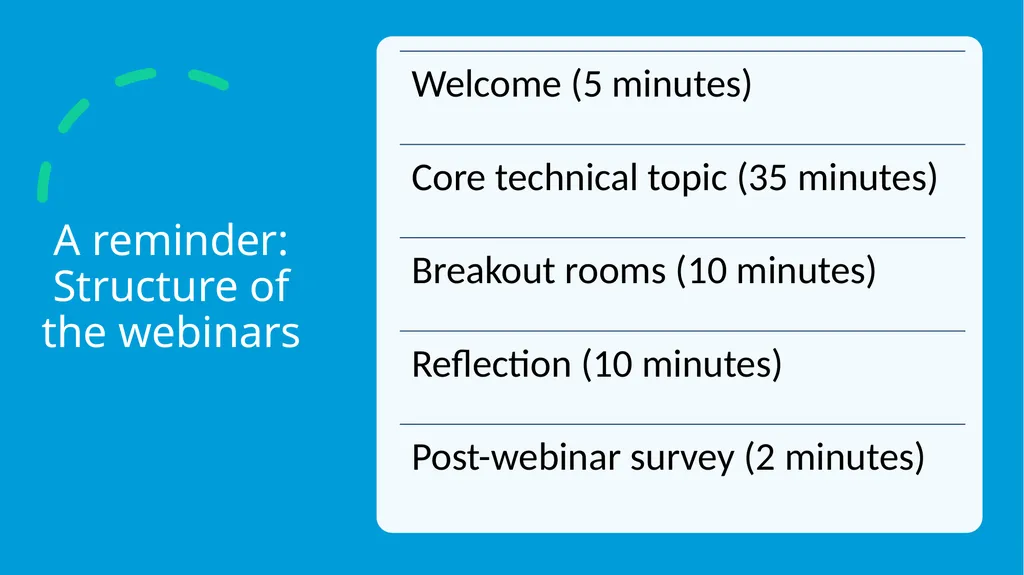
slide5. A reminder: Structure of the webinars<br>
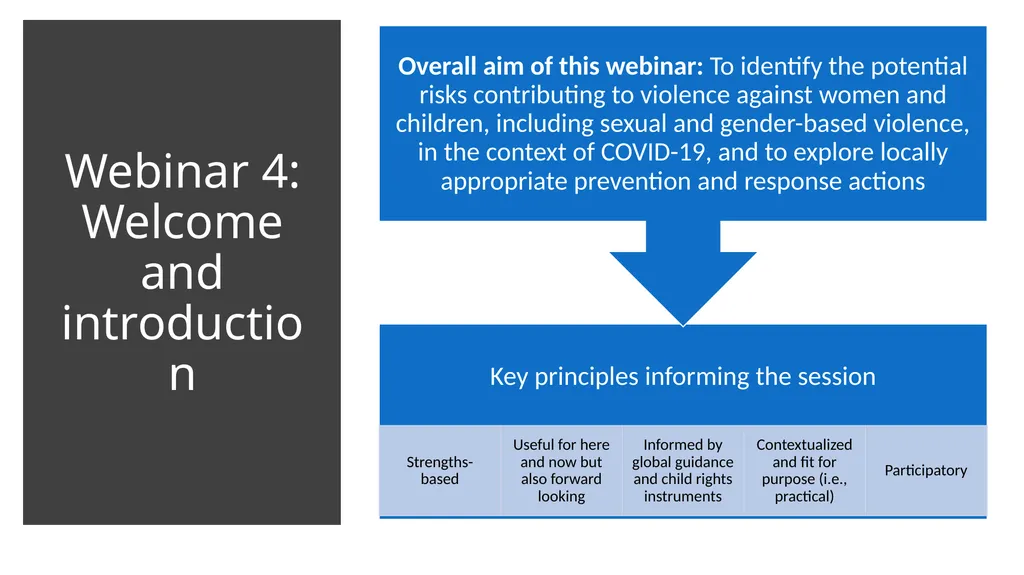
slide6. Webinar 4: Welcome and introduction<br>
slide7. Breakout time! Please write down this question:
What can we do to prevent and respond to violence during COVID-19?
You will be discussing this later in your breakout groups<br>
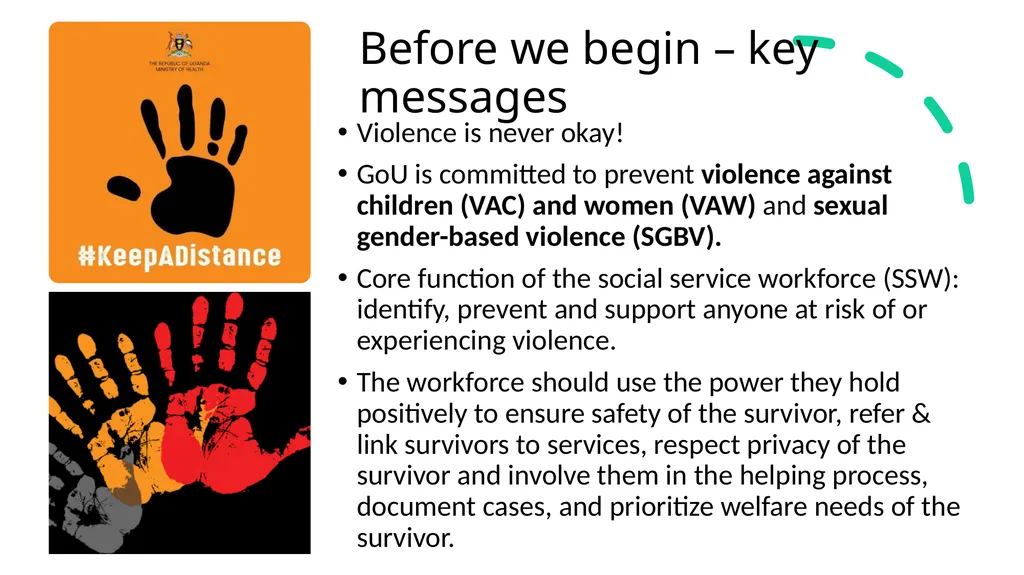
slide8. Before we begin – key messages Violence is never okay!
GoU is committed to prevent violence against children (VAC) and women (VAW) and sexual gender-based violence (SGBV).
Core function of the social service workforce (SSW): identify, prevent and support anyone at risk of or experiencing violence.
The workforce should use the power they hold positively to ensure safety of the survivor, refer & link survivors to services, respect privacy of the survivor and involve them in the helping process, document cases, and prioritize welfare needs of the survivor.<br>
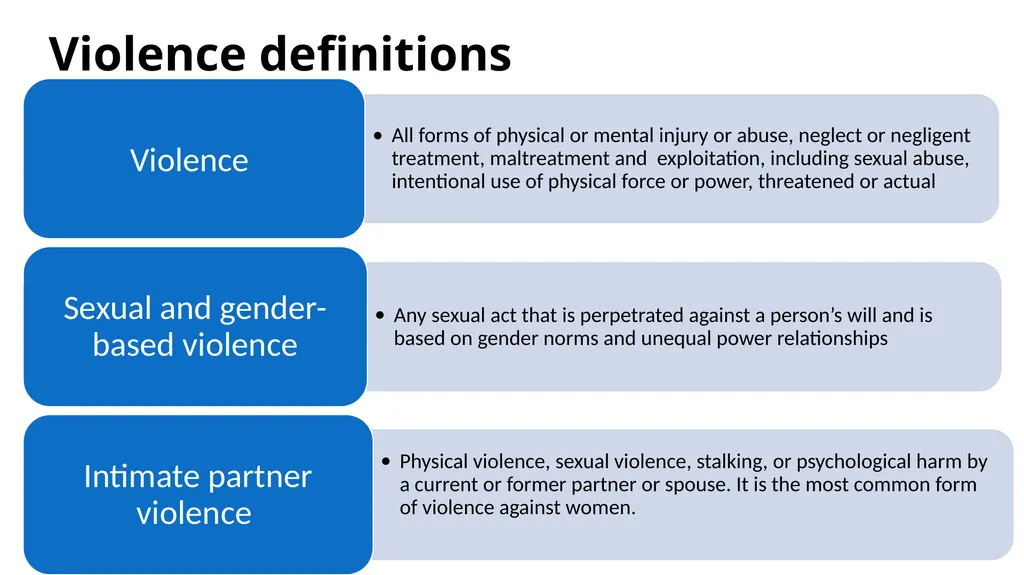
slide9. Violence definitions<br>
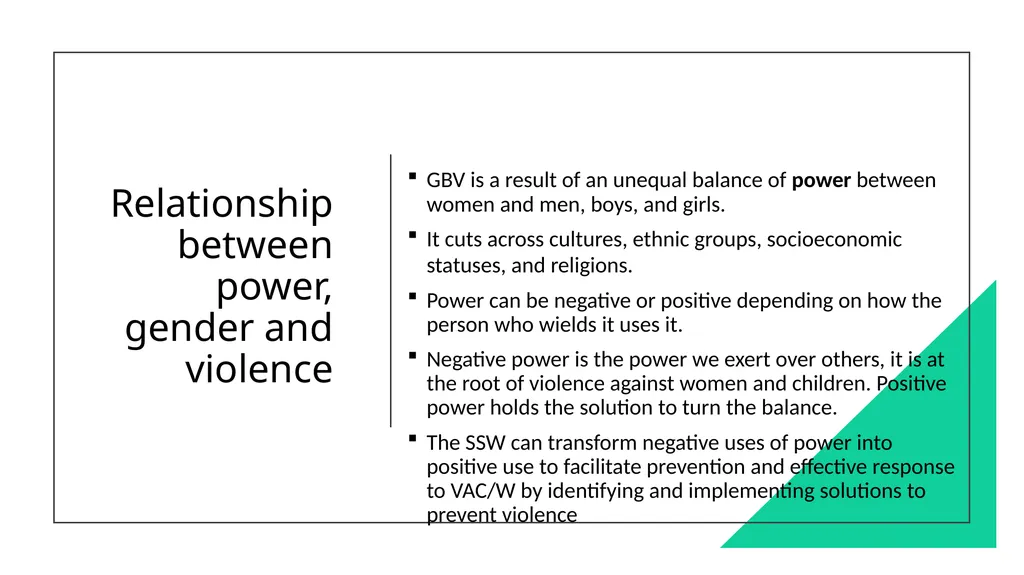
slide10. Relationship between power, gender and violence GBV is a result of an unequal balance of power between women and men, boys, and girls.
It cuts across cultures, ethnic groups, socioeconomic statuses, and religions.
Power can be negative or positive depending on how the person who wields it uses it.
Negative power is the power we exert over others, it is at the root of violence against women and children. Positive power holds the solution to turn the balance.
The SSW can transform negative uses of power into positive use to facilitate prevention and effective response to VAC/W by identifying and implementing solutions to prevent violence<br>
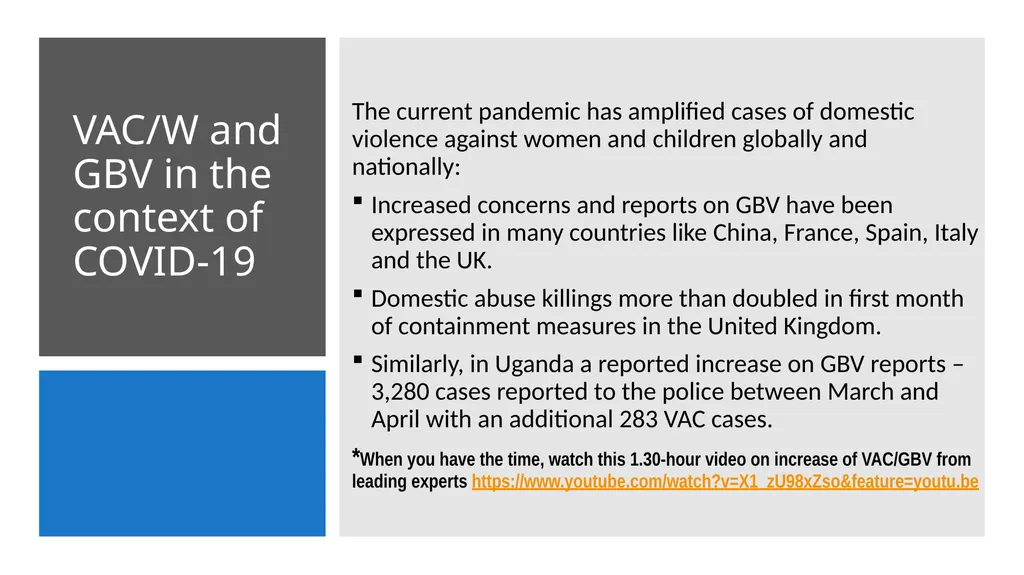
slide11. VAC/W and GBV in the context of COVID-19 The current pandemic has amplified cases of domestic violence against women and children globally and nationally:
Increased concerns and reports on GBV have been expressed in many countries like China, France, Spain, Italy and the UK.
Domestic abuse killings more than doubled in first month of containment measures in the United Kingdom.
Similarly, in Uganda a reported increase on GBV reports – 3,280 cases reported to the police between March and April with an additional 283 VAC cases.
*When you have the time, watch this 1.30-hour video on increase of VAC/GBV from leading experts https://www.youtube.com/watch?v=X1_zU98xZso&feature=youtu.be<br>
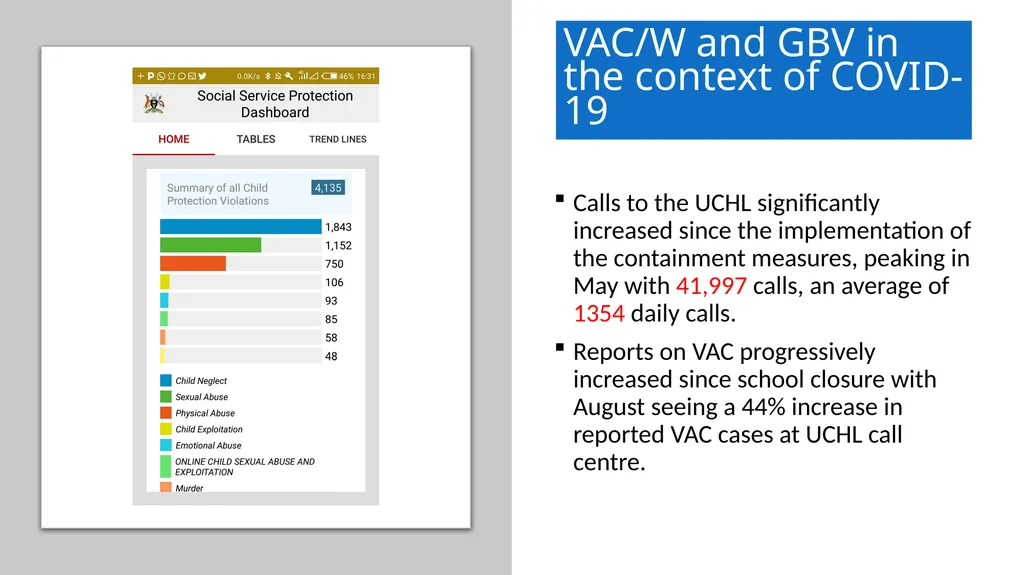
slide12. VAC/W and GBV in the context of COVID-19 Calls to the UCHL significantly increased since the implementation of the containment measures, peaking in May with 41,997 calls, an average of 1354 daily calls.
Reports on VAC progressively increased since school closure with August seeing a 44% increase in reported VAC cases at UCHL call centre.<br>
slide13. Why are levels of violence increasing during COVID-19 ? Pathways can be both direct & indirect, and are likely to interact, reinforcing existing vulnerabilities.
These pathways will depend on the type of vulnerability and contextual factors, including underlying gender norms and levels of GBV, VAW and VAC<br>
slide14. Chat box What types of violence are you noticing in your local community and in your work?
Who is the violence perpetrated against?
Who is the violence perpetrated by?
Is it reported?
How is it being responded to?<br>
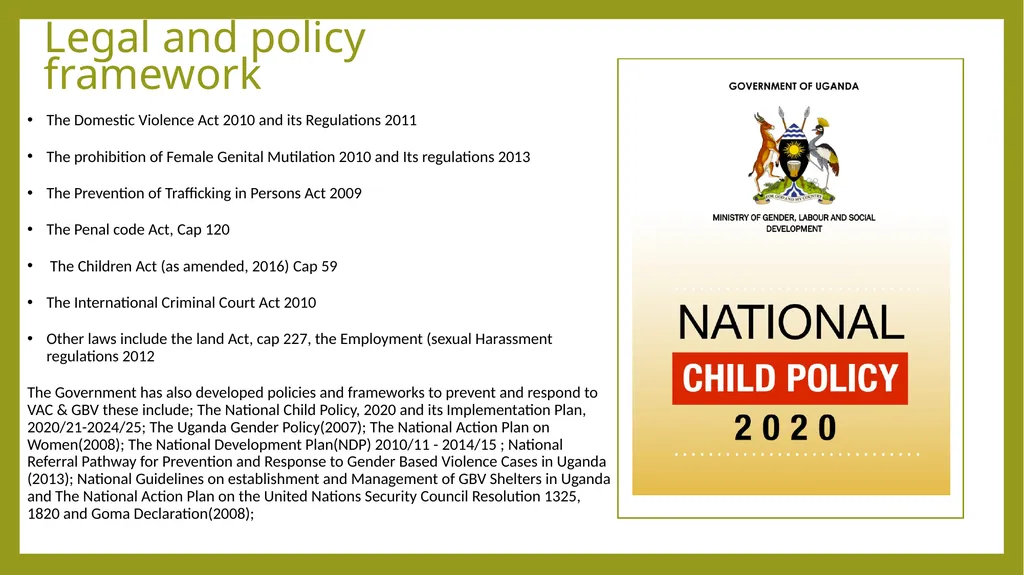
slide15. Legal and policy framework The Domestic Violence Act 2010 and its Regulations 2011
The prohibition of Female Genital Mutilation 2010 and Its regulations 2013
The Prevention of Trafficking in Persons Act 2009
The Penal code Act, Cap 120
The Children Act (as amended, 2016) Cap 59
The International Criminal Court Act 2010
Other laws include the land Act, cap 227, the Employment (sexual Harassment regulations 2012
The Government has also developed policies and frameworks to prevent and respond to VAC & GBV these include; The National Child Policy, 2020 and its Implementation Plan, 2020/21-2024/25; The Uganda Gender Policy(2007); The National Action Plan on Women(2008); The National Development Plan(NDP) 2010/11 - 2014/15 ; National Referral Pathway for Prevention and Response to Gender Based Violence Cases in Uganda (2013); National Guidelines on establishment and Management of GBV Shelters in Uganda and The National Action Plan on the United Nations Security Council Resolution 1325, 1820 and Goma Declaration(2008);<br>
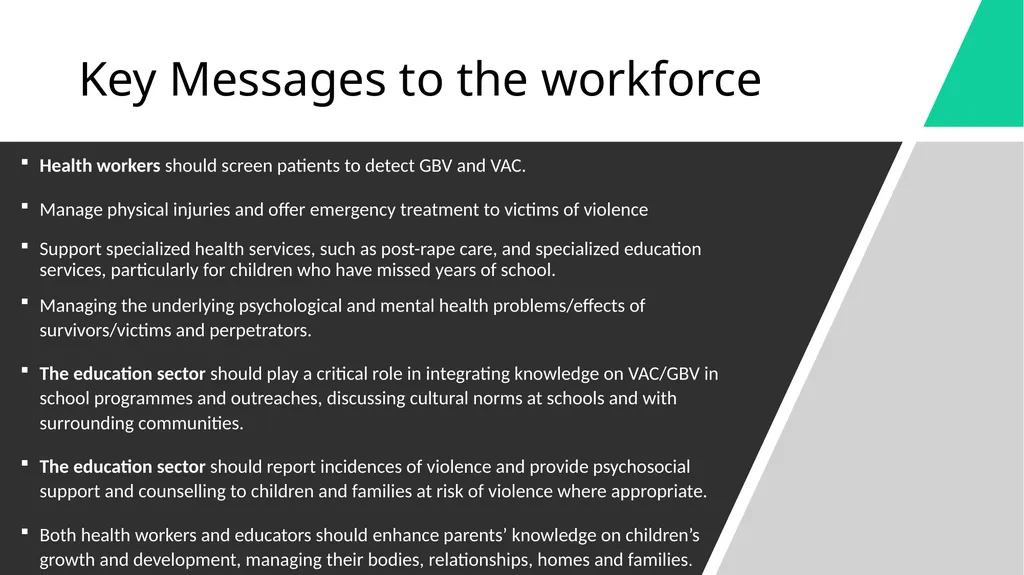
slide16. Key Messages to the workforce Health workers should screen patients to detect GBV and VAC.
Manage physical injuries and offer emergency treatment to victims of violence
Support specialized health services, such as post-rape care, and specialized education services, particularly for children who have missed years of school.
Managing the underlying psychological and mental health problems/effects of survivors/victims and perpetrators.
The education sector should play a critical role in integrating knowledge on VAC/GBV in school programmes and outreaches, discussing cultural norms at schools and with surrounding communities.
The education sector should report incidences of violence and provide psychosocial support and counselling to children and families at risk of violence where appropriate.
Both health workers and educators should enhance parents’ knowledge on children’s growth and development, managing their bodies, relationships, homes and families.<br>
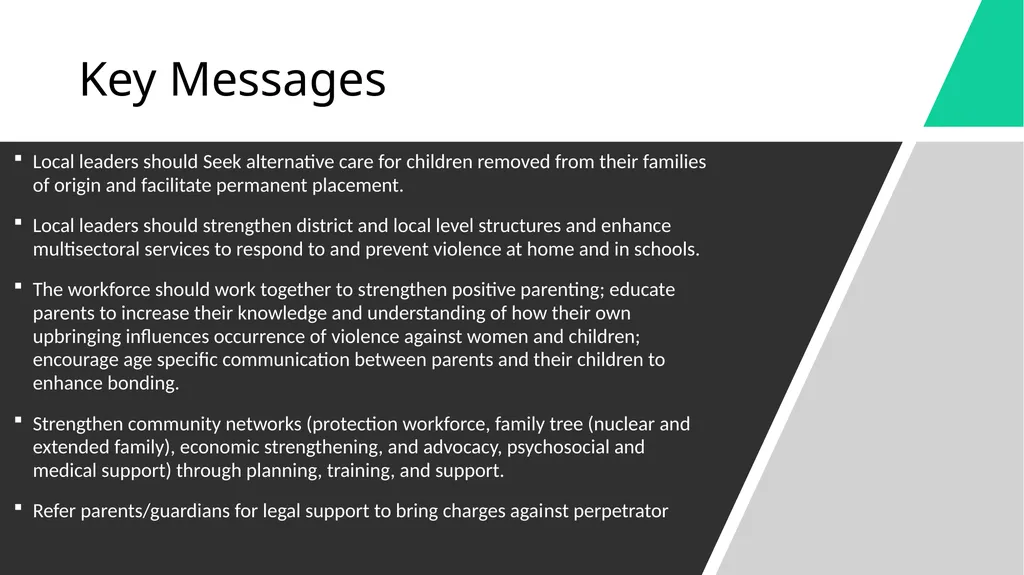
slide17. Key Messages Local leaders should Seek alternative care for children removed from their families of origin and facilitate permanent placement.
Local leaders should strengthen district and local level structures and enhance multisectoral services to respond to and prevent violence at home and in schools.
The workforce should work together to strengthen positive parenting; educate parents to increase their knowledge and understanding of how their own upbringing influences occurrence of violence against women and children; encourage age specific communication between parents and their children to enhance bonding.
Strengthen community networks (protection workforce, family tree (nuclear and extended family), economic strengthening, and advocacy, psychosocial and medical support) through planning, training, and support.
Refer parents/guardians for legal support to bring charges against perpetrator<br>
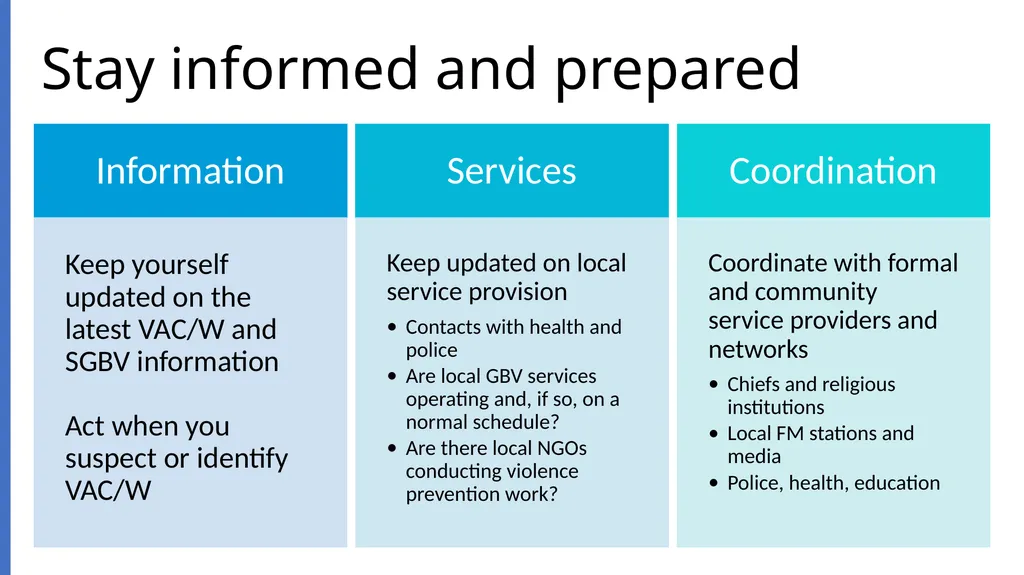
slide18. Stay informed and prepared<br>
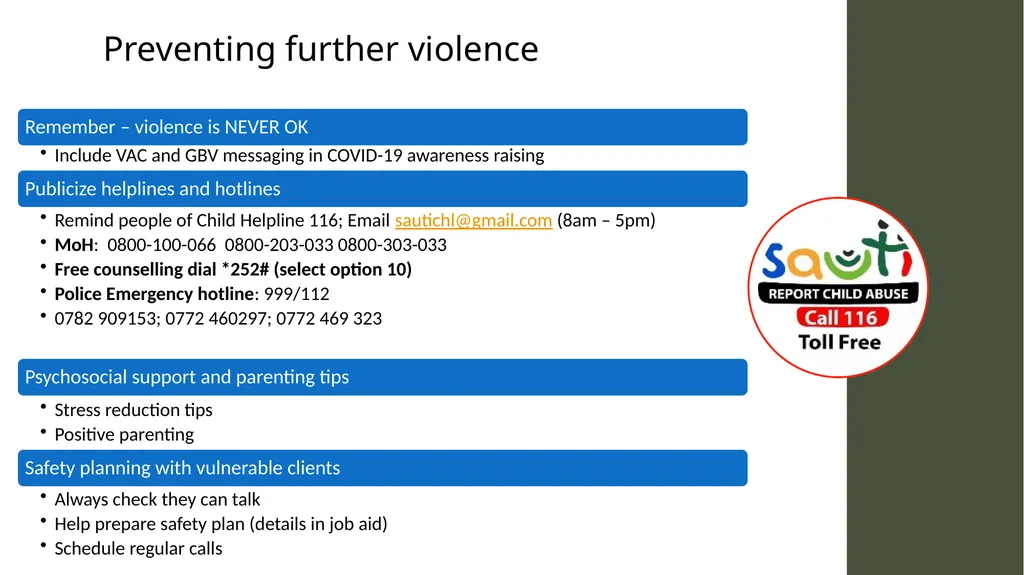
slide19. Preventing further violence<br>
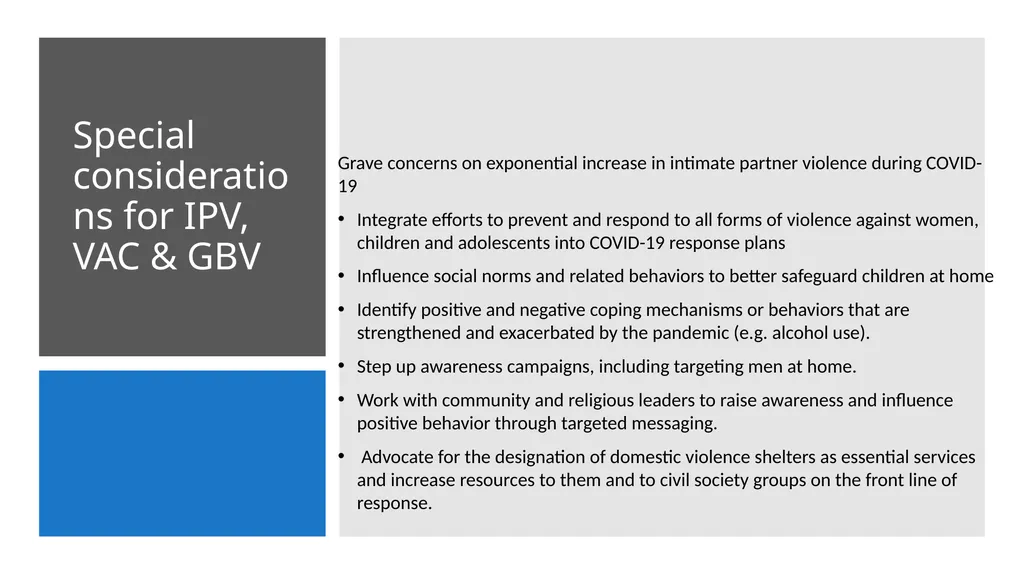
slide20. Special considerations for IPV, VAC & GBV Grave concerns on exponential increase in intimate partner violence during COVID-19
Integrate efforts to prevent and respond to all forms of violence against women, children and adolescents into COVID-19 response plans
Influence social norms and related behaviors to better safeguard children at home
Identify positive and negative coping mechanisms or behaviors that are strengthened and exacerbated by the pandemic (e.g. alcohol use).
Step up awareness campaigns, including targeting men at home.
Work with community and religious leaders to raise awareness and influence positive behavior through targeted messaging.
Advocate for the designation of domestic violence shelters as essential services and increase resources to them and to civil society groups on the front line of response.<br>
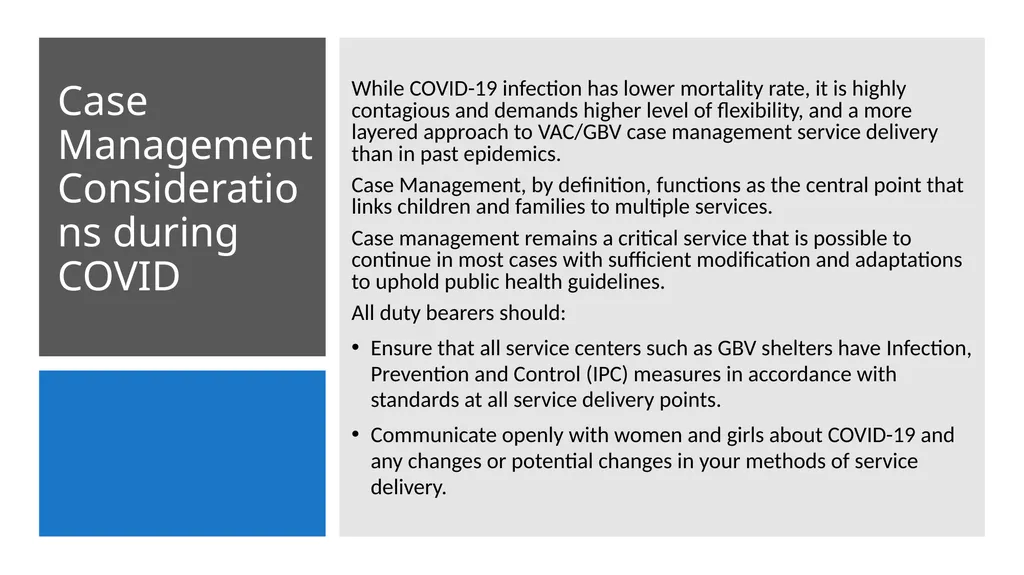
slide21. Case Management Considerations during COVID While COVID-19 infection has lower mortality rate, it is highly contagious and demands higher level of flexibility, and a more layered approach to VAC/GBV case management service delivery than in past epidemics.
Case Management, by definition, functions as the central point that links children and families to multiple services.
Case management remains a critical service that is possible to continue in most cases with sufficient modification and adaptations to uphold public health guidelines.
All duty bearers should:
Ensure that all service centers such as GBV shelters have Infection, Prevention and Control (IPC) measures in accordance with standards at all service delivery points.
Communicate openly with women and girls about COVID-19 and any changes or potential changes in your methods of service delivery.<br>
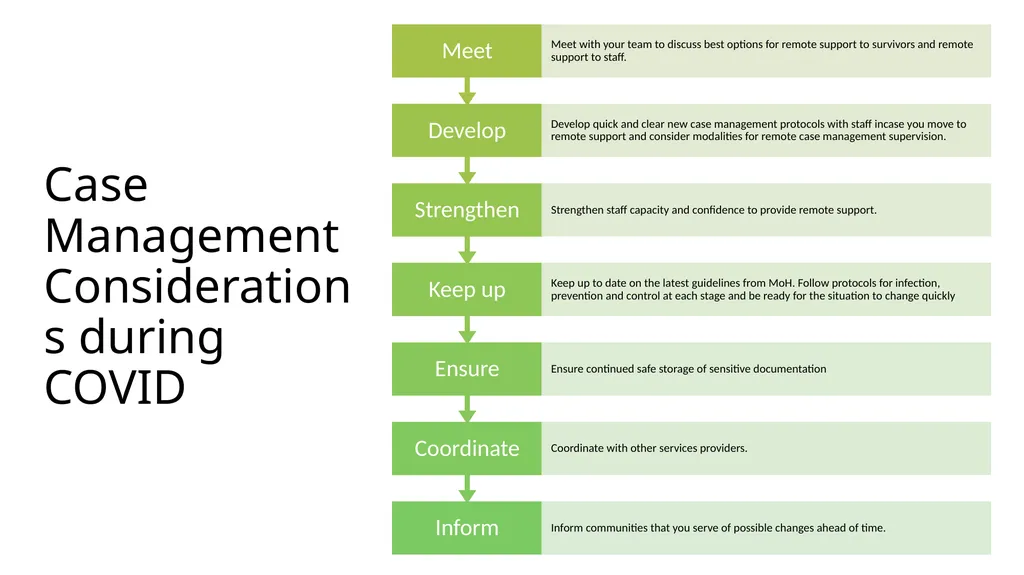
slide22. Case Management Considerations during COVID<br>
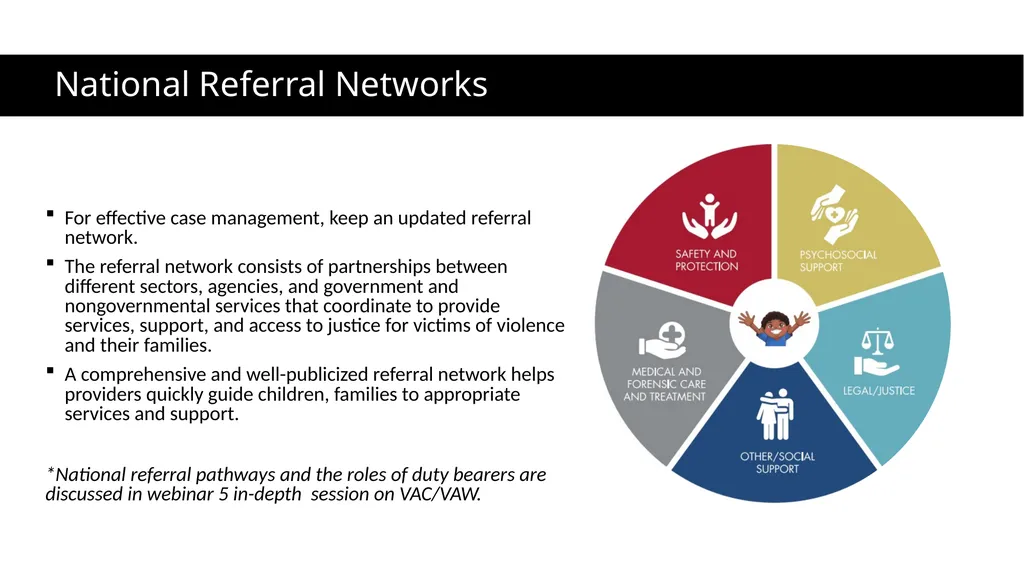
slide23. National Referral Networks For effective case management, keep an updated referral network.
The referral network consists of partnerships between different sectors, agencies, and government and nongovernmental services that coordinate to provide services, support, and access to justice for victims of violence and their families.
A comprehensive and well-publicized referral network helps providers quickly guide children, families to appropriate services and support.
*National referral pathways and the roles of duty bearers are discussed in webinar 5 in-depth session on VAC/VAW.<br>
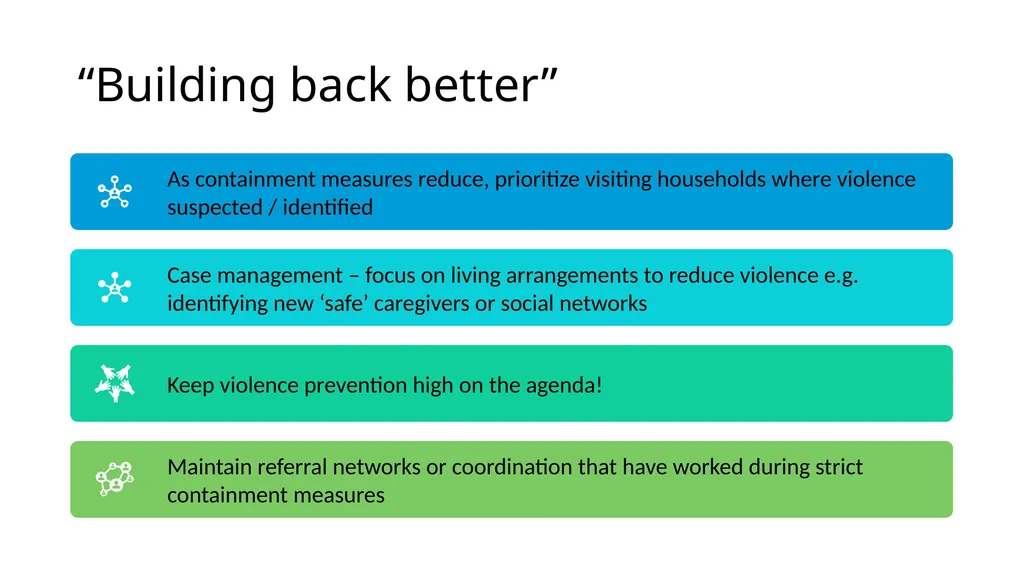
slide24. “Building back better”<br>
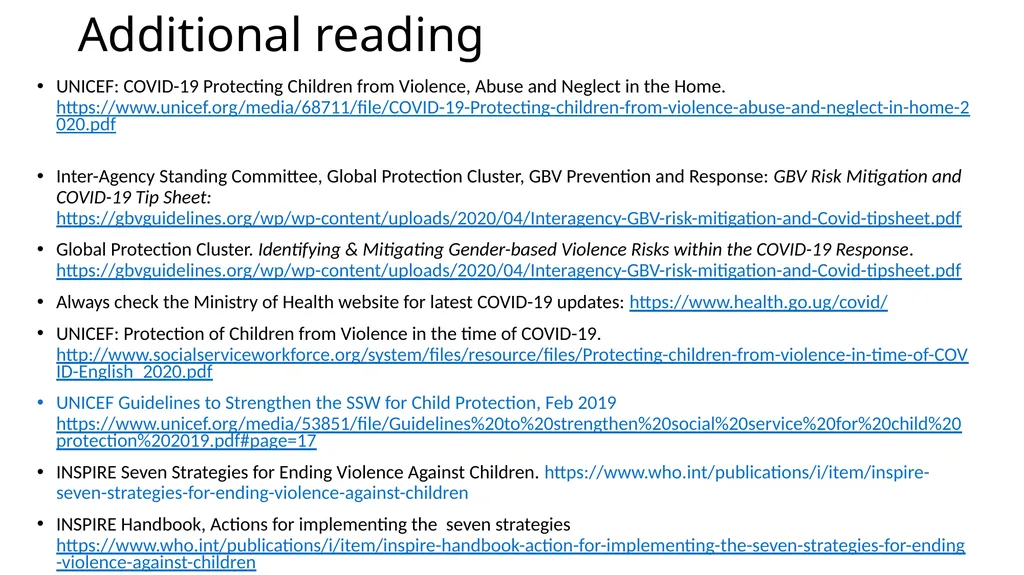
slide25. Additional reading UNICEF: COVID-19 Protecting Children from Violence, Abuse and Neglect in the Home. https://www.unicef.org/media/68711/file/COVID-19-Protecting-children-from-violence-abuse-and-neglect-in-home-2020.pdf
Inter-Agency Standing Committee, Global Protection Cluster, GBV Prevention and Response: GBV Risk Mitigation and COVID-19 Tip Sheet: https://gbvguidelines.org/wp/wp-content/uploads/2020/04/Interagency-GBV-risk-mitigation-and-Covid-tipsheet.pdf
Global Protection Cluster. Identifying & Mitigating Gender-based Violence Risks within the COVID-19 Response. https://gbvguidelines.org/wp/wp-content/uploads/2020/04/Interagency-GBV-risk-mitigation-and-Covid-tipsheet.pdf
Always check the Ministry of Health website for latest COVID-19 updates: https://www.health.go.ug/covid/
UNICEF: Protection of Children from Violence in the time of COVID-19. http://www.socialserviceworkforce.org/system/files/resource/files/Protecting-children-from-violence-in-time-of-COVID-English_2020.pdf
UNICEF Guidelines to Strengthen the SSW for Child Protection, Feb 2019 https://www.unicef.org/media/53851/file/Guidelines%20to%20strengthen%20social%20service%20for%20child%20protection%202019.pdf#page=17
INSPIRE Seven Strategies for Ending Violence Against Children. https://www.who.int/publications/i/item/inspire-seven-strategies-for-ending-violence-against-children
INSPIRE Handbook, Actions for implementing the seven strategies https://www.who.int/publications/i/item/inspire-handbook-action-for-implementing-the-seven-strategies-for-ending-violence-against-children<br>
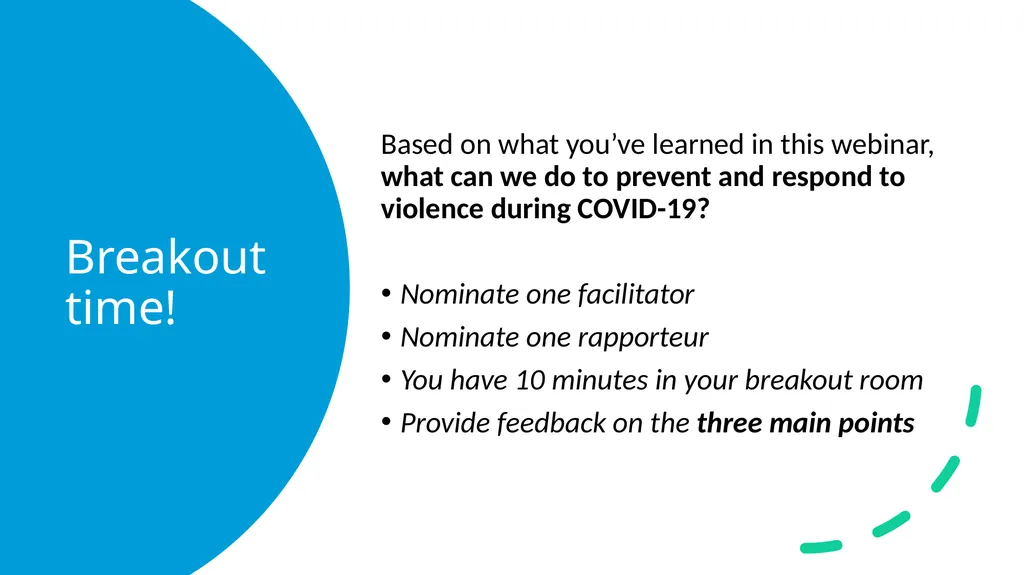
slide26. Breakout time! Based on what you’ve learned in this webinar, what can we do to prevent and respond to violence during COVID-19?
Nominate one facilitator
Nominate one rapporteur
You have 10 minutes in your breakout room
Provide feedback on the three main points<br>
slide27. Thank you!<br>
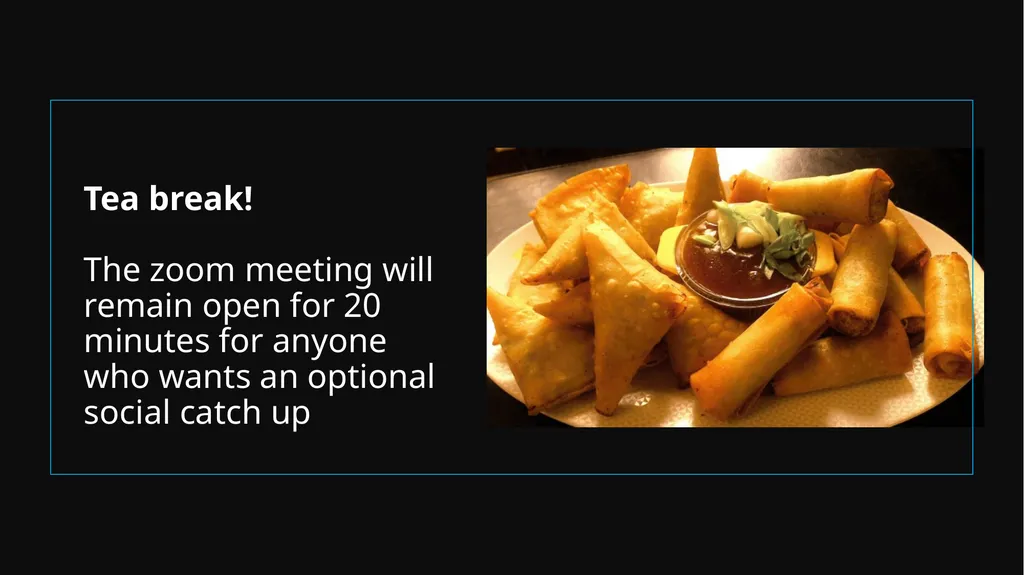
slide28. Tea break! The zoom meeting will remain open for 20 minutes for anyone who wants an optional social catch up<br>
19th November, 2020 Webinar 4: Increased sexual and gender-based violence, domestic violence and violence against children under COVID- 19 and how to prevent and respond to it<br>
slide2. Before we start Please keep your cameras off during the presentation section
The host will unmute your microphones before you go into breakout rooms so you can speak to each other in the breakout room
During the breakout and afterwards feel free to keep your camera on
We will leave time after the webinar for a ‘virtual tea break’<br>
slide3. Learning Objectives To identify the potential risks of different forms of violence against women and children and sexual and gender-based violence in the context of COVID-19,
To understand and review locally appropriate prevention and response actions<br>
slide4. Target audience Education sector
Health workers
Local leadership<br>
slide5. A reminder: Structure of the webinars<br>
slide6. Webinar 4: Welcome and introduction<br>
slide7. Breakout time! Please write down this question:
What can we do to prevent and respond to violence during COVID-19?
You will be discussing this later in your breakout groups<br>
slide8. Before we begin – key messages Violence is never okay!
GoU is committed to prevent violence against children (VAC) and women (VAW) and sexual gender-based violence (SGBV).
Core function of the social service workforce (SSW): identify, prevent and support anyone at risk of or experiencing violence.
The workforce should use the power they hold positively to ensure safety of the survivor, refer & link survivors to services, respect privacy of the survivor and involve them in the helping process, document cases, and prioritize welfare needs of the survivor.<br>
slide9. Violence definitions<br>
slide10. Relationship between power, gender and violence GBV is a result of an unequal balance of power between women and men, boys, and girls.
It cuts across cultures, ethnic groups, socioeconomic statuses, and religions.
Power can be negative or positive depending on how the person who wields it uses it.
Negative power is the power we exert over others, it is at the root of violence against women and children. Positive power holds the solution to turn the balance.
The SSW can transform negative uses of power into positive use to facilitate prevention and effective response to VAC/W by identifying and implementing solutions to prevent violence<br>
slide11. VAC/W and GBV in the context of COVID-19 The current pandemic has amplified cases of domestic violence against women and children globally and nationally:
Increased concerns and reports on GBV have been expressed in many countries like China, France, Spain, Italy and the UK.
Domestic abuse killings more than doubled in first month of containment measures in the United Kingdom.
Similarly, in Uganda a reported increase on GBV reports – 3,280 cases reported to the police between March and April with an additional 283 VAC cases.
*When you have the time, watch this 1.30-hour video on increase of VAC/GBV from leading experts https://www.youtube.com/watch?v=X1_zU98xZso&feature=youtu.be<br>
slide12. VAC/W and GBV in the context of COVID-19 Calls to the UCHL significantly increased since the implementation of the containment measures, peaking in May with 41,997 calls, an average of 1354 daily calls.
Reports on VAC progressively increased since school closure with August seeing a 44% increase in reported VAC cases at UCHL call centre.<br>
slide13. Why are levels of violence increasing during COVID-19 ? Pathways can be both direct & indirect, and are likely to interact, reinforcing existing vulnerabilities.
These pathways will depend on the type of vulnerability and contextual factors, including underlying gender norms and levels of GBV, VAW and VAC<br>
slide14. Chat box What types of violence are you noticing in your local community and in your work?
Who is the violence perpetrated against?
Who is the violence perpetrated by?
Is it reported?
How is it being responded to?<br>
slide15. Legal and policy framework The Domestic Violence Act 2010 and its Regulations 2011
The prohibition of Female Genital Mutilation 2010 and Its regulations 2013
The Prevention of Trafficking in Persons Act 2009
The Penal code Act, Cap 120
The Children Act (as amended, 2016) Cap 59
The International Criminal Court Act 2010
Other laws include the land Act, cap 227, the Employment (sexual Harassment regulations 2012
The Government has also developed policies and frameworks to prevent and respond to VAC & GBV these include; The National Child Policy, 2020 and its Implementation Plan, 2020/21-2024/25; The Uganda Gender Policy(2007); The National Action Plan on Women(2008); The National Development Plan(NDP) 2010/11 - 2014/15 ; National Referral Pathway for Prevention and Response to Gender Based Violence Cases in Uganda (2013); National Guidelines on establishment and Management of GBV Shelters in Uganda and The National Action Plan on the United Nations Security Council Resolution 1325, 1820 and Goma Declaration(2008);<br>
slide16. Key Messages to the workforce Health workers should screen patients to detect GBV and VAC.
Manage physical injuries and offer emergency treatment to victims of violence
Support specialized health services, such as post-rape care, and specialized education services, particularly for children who have missed years of school.
Managing the underlying psychological and mental health problems/effects of survivors/victims and perpetrators.
The education sector should play a critical role in integrating knowledge on VAC/GBV in school programmes and outreaches, discussing cultural norms at schools and with surrounding communities.
The education sector should report incidences of violence and provide psychosocial support and counselling to children and families at risk of violence where appropriate.
Both health workers and educators should enhance parents’ knowledge on children’s growth and development, managing their bodies, relationships, homes and families.<br>
slide17. Key Messages Local leaders should Seek alternative care for children removed from their families of origin and facilitate permanent placement.
Local leaders should strengthen district and local level structures and enhance multisectoral services to respond to and prevent violence at home and in schools.
The workforce should work together to strengthen positive parenting; educate parents to increase their knowledge and understanding of how their own upbringing influences occurrence of violence against women and children; encourage age specific communication between parents and their children to enhance bonding.
Strengthen community networks (protection workforce, family tree (nuclear and extended family), economic strengthening, and advocacy, psychosocial and medical support) through planning, training, and support.
Refer parents/guardians for legal support to bring charges against perpetrator<br>
slide18. Stay informed and prepared<br>
slide19. Preventing further violence<br>
slide20. Special considerations for IPV, VAC & GBV Grave concerns on exponential increase in intimate partner violence during COVID-19
Integrate efforts to prevent and respond to all forms of violence against women, children and adolescents into COVID-19 response plans
Influence social norms and related behaviors to better safeguard children at home
Identify positive and negative coping mechanisms or behaviors that are strengthened and exacerbated by the pandemic (e.g. alcohol use).
Step up awareness campaigns, including targeting men at home.
Work with community and religious leaders to raise awareness and influence positive behavior through targeted messaging.
Advocate for the designation of domestic violence shelters as essential services and increase resources to them and to civil society groups on the front line of response.<br>
slide21. Case Management Considerations during COVID While COVID-19 infection has lower mortality rate, it is highly contagious and demands higher level of flexibility, and a more layered approach to VAC/GBV case management service delivery than in past epidemics.
Case Management, by definition, functions as the central point that links children and families to multiple services.
Case management remains a critical service that is possible to continue in most cases with sufficient modification and adaptations to uphold public health guidelines.
All duty bearers should:
Ensure that all service centers such as GBV shelters have Infection, Prevention and Control (IPC) measures in accordance with standards at all service delivery points.
Communicate openly with women and girls about COVID-19 and any changes or potential changes in your methods of service delivery.<br>
slide22. Case Management Considerations during COVID<br>
slide23. National Referral Networks For effective case management, keep an updated referral network.
The referral network consists of partnerships between different sectors, agencies, and government and nongovernmental services that coordinate to provide services, support, and access to justice for victims of violence and their families.
A comprehensive and well-publicized referral network helps providers quickly guide children, families to appropriate services and support.
*National referral pathways and the roles of duty bearers are discussed in webinar 5 in-depth session on VAC/VAW.<br>
slide24. “Building back better”<br>
slide25. Additional reading UNICEF: COVID-19 Protecting Children from Violence, Abuse and Neglect in the Home. https://www.unicef.org/media/68711/file/COVID-19-Protecting-children-from-violence-abuse-and-neglect-in-home-2020.pdf
Inter-Agency Standing Committee, Global Protection Cluster, GBV Prevention and Response: GBV Risk Mitigation and COVID-19 Tip Sheet: https://gbvguidelines.org/wp/wp-content/uploads/2020/04/Interagency-GBV-risk-mitigation-and-Covid-tipsheet.pdf
Global Protection Cluster. Identifying & Mitigating Gender-based Violence Risks within the COVID-19 Response. https://gbvguidelines.org/wp/wp-content/uploads/2020/04/Interagency-GBV-risk-mitigation-and-Covid-tipsheet.pdf
Always check the Ministry of Health website for latest COVID-19 updates: https://www.health.go.ug/covid/
UNICEF: Protection of Children from Violence in the time of COVID-19. http://www.socialserviceworkforce.org/system/files/resource/files/Protecting-children-from-violence-in-time-of-COVID-English_2020.pdf
UNICEF Guidelines to Strengthen the SSW for Child Protection, Feb 2019 https://www.unicef.org/media/53851/file/Guidelines%20to%20strengthen%20social%20service%20for%20child%20protection%202019.pdf#page=17
INSPIRE Seven Strategies for Ending Violence Against Children. https://www.who.int/publications/i/item/inspire-seven-strategies-for-ending-violence-against-children
INSPIRE Handbook, Actions for implementing the seven strategies https://www.who.int/publications/i/item/inspire-handbook-action-for-implementing-the-seven-strategies-for-ending-violence-against-children<br>
slide26. Breakout time! Based on what you’ve learned in this webinar, what can we do to prevent and respond to violence during COVID-19?
Nominate one facilitator
Nominate one rapporteur
You have 10 minutes in your breakout room
Provide feedback on the three main points<br>
slide27. Thank you!<br>
slide28. Tea break! The zoom meeting will remain open for 20 minutes for anyone who wants an optional social catch up<br>