
WEEK 1 General Introduction: What is Logic? Logic
LS
Published · 3 slides · 0 views
1 / 1
Description
WEEK 1 General Introduction: What is Logic? Logic (from the Greek term, logos meaning word, or discourse) is simply the study of the underlying principles of correct human reasoning. Logic is an art in the sense that it enhances
Related Topics
Share
Embed code
Download this presentation From Below
"WEEK 1 General Introduction: What is Logic? Logic" is the property of its rightful owner. Permission is granted to download and print the materials on this website for personal, non-commercial use only, and to display it on your personal computer provided you do not modify the materials and that you retain all copyright notices contained in the materials. By downloading content from our website, you accept the terms of this agreement.
Presentation Transcript
01
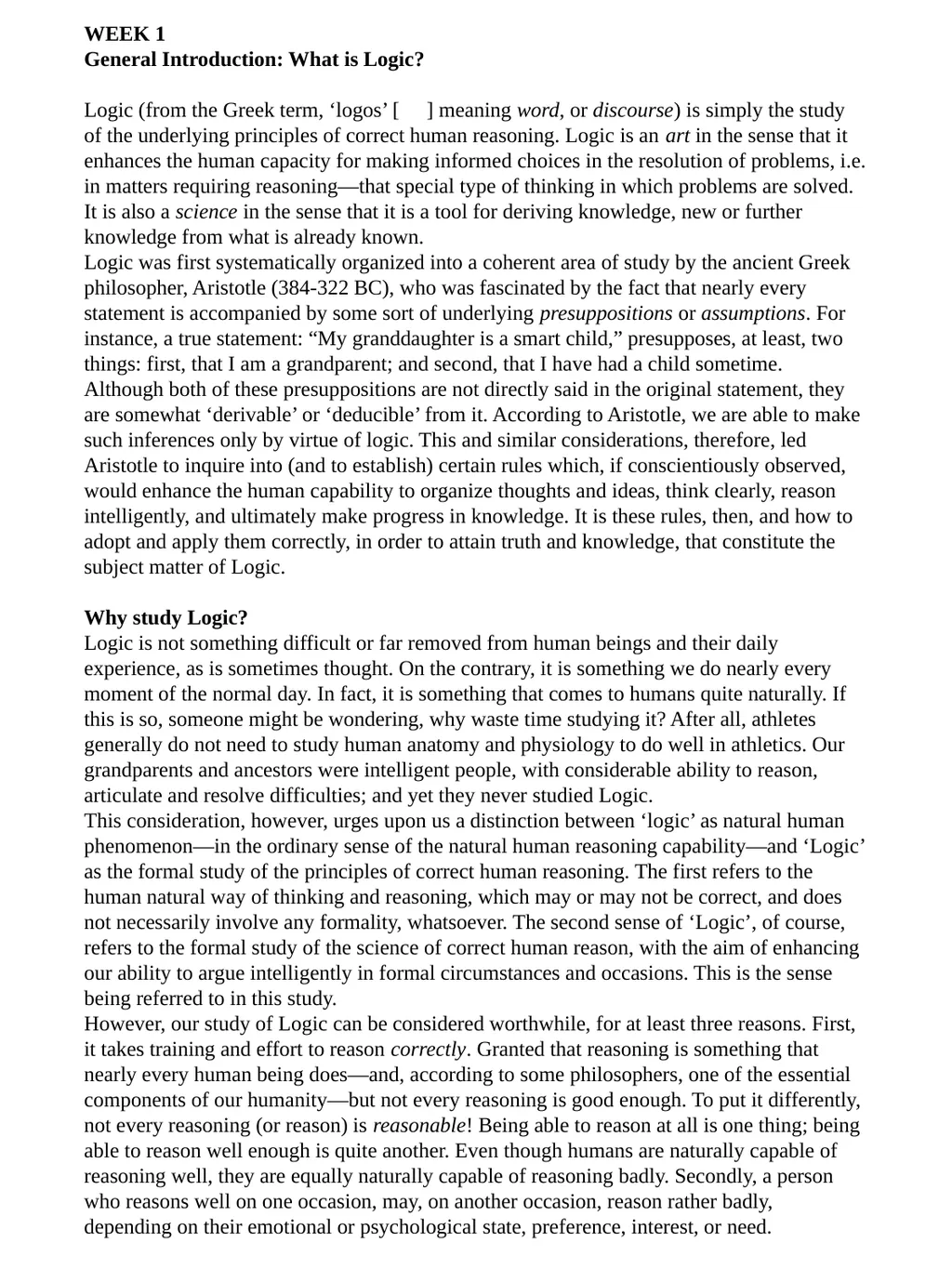
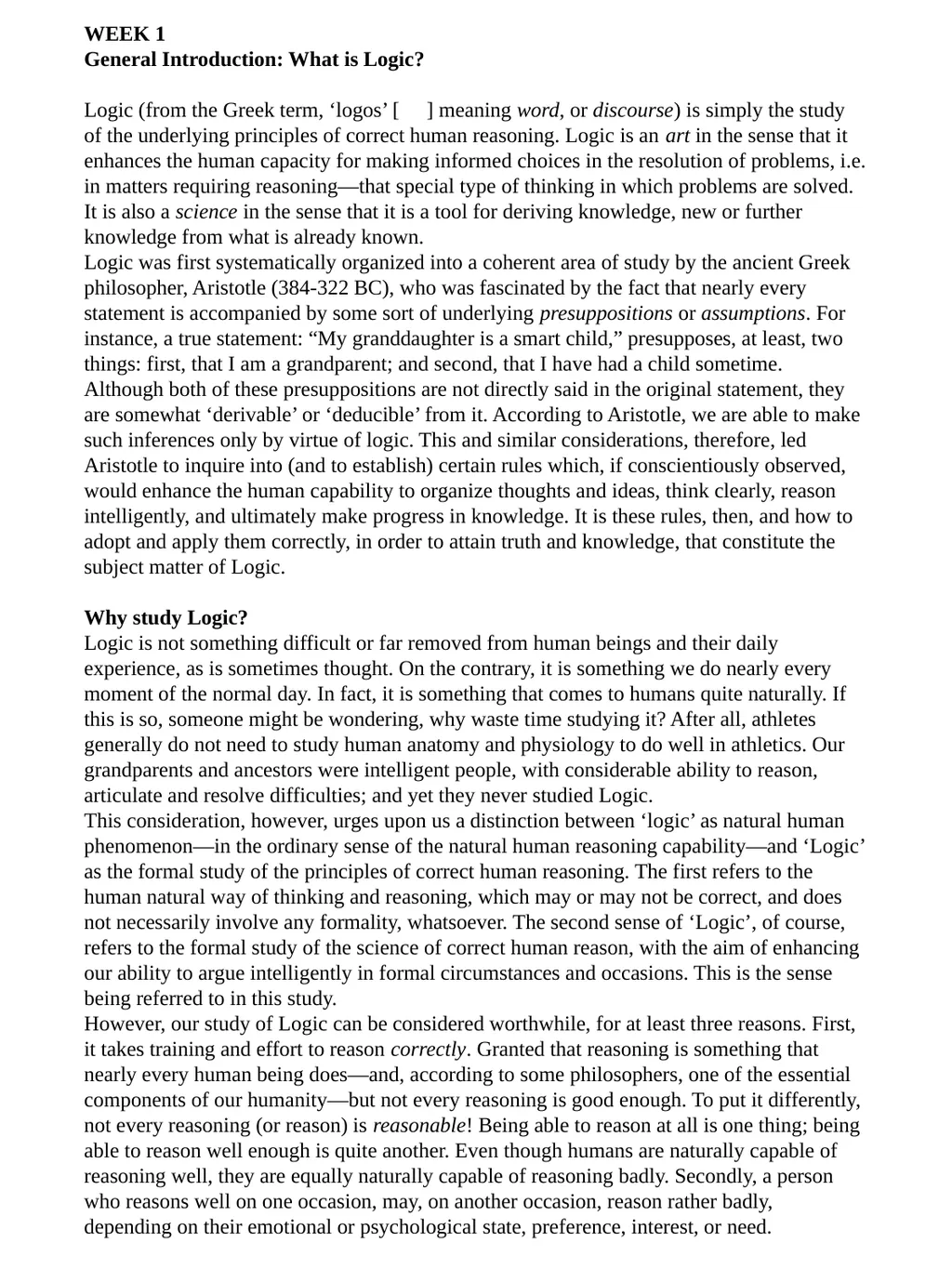
WEEK 1
General Introduction: What is Logic?
Logic (from the Greek term, ‘logos’ [] meaning word, or discourse) is simply the study of the underlying principles of correct human reasoning. Logic is an art in the sense that it enhances the human capacity for making informed choices in the resolution of problems, i.e. in matters requiring reasoning—that special type of thinking in which problems are solved. It is also a science in the sense that it is a tool for deriving knowledge, new or further knowledge from what is already known.
Logic was first systematically organized into a coherent area of study by the ancient Greek philosopher, Aristotle (384-322 BC), who was fascinated by the fact that nearly every statement is accompanied by some sort of underlying presuppositions or assumptions. For instance, a true statement: “My granddaughter is a smart child,” presupposes, at least, two things: first, that I am a grandparent; and second, that I have had a child sometime. Although both of these presuppositions are not directly said in the original statement, they are somewhat ‘derivable’ or ‘deducible’ from it. According to Aristotle, we are able to make such inferences only by virtue of logic. This and similar considerations, therefore, led Aristotle to inquire into (and to establish) certain rules which, if conscientiously observed, would enhance the human capability to organize thoughts and ideas, think clearly, reason intelligently, and ultimately make progress in knowledge. It is these rules, then, and how to adopt and apply them correctly, in order to attain truth and knowledge, that constitute the subject matter of Logic.
Why study Logic?
Logic is not something difficult or far removed from human beings and their daily experience, as is sometimes thought. On the contrary, it is something we do nearly every moment of the normal day. In fact, it is something that comes to humans quite naturally. If this is so, someone might be wondering, why waste time studying it? After all, athletes generally do not need to study human anatomy and physiology to do well in athletics. Our grandparents and ancestors were intelligent people, with considerable ability to reason, articulate and resolve difficulties; and yet they never studied Logic.
This consideration, however, urges upon us a distinction between ‘logic’ as natural human phenomenon—in the ordinary sense of the natural human reasoning capability—and ‘Logic’ as the formal study of the principles of correct human reasoning. The first refers to the human natural way of thinking and reasoning, which may or may not be correct, and does not necessarily involve any formality, whatsoever. The second sense of ‘Logic’, of course, refers to the formal study of the science of correct human reason, with the aim of enhancing our ability to argue intelligently in formal circumstances and occasions. This is the sense being referred to in this study.
However, our study of Logic can be considered worthwhile, for at least three reasons. First, it takes training and effort to reason correctly. Granted that reasoning is something that nearly every human being does—and, according to some philosophers, one of the essential components of our humanity—but not every reasoning is good enough. To put it differently, not every reasoning (or reason) is reasonable! Being able to reason at all is one thing; being able to reason well enough is quite another. Even though humans are naturally capable of reasoning well, they are equally naturally capable of reasoning badly. Secondly, a person who reasons well on one occasion, may, on another occasion, reason rather badly, depending on their emotional or psychological state, preference, interest, or need.<br>
02
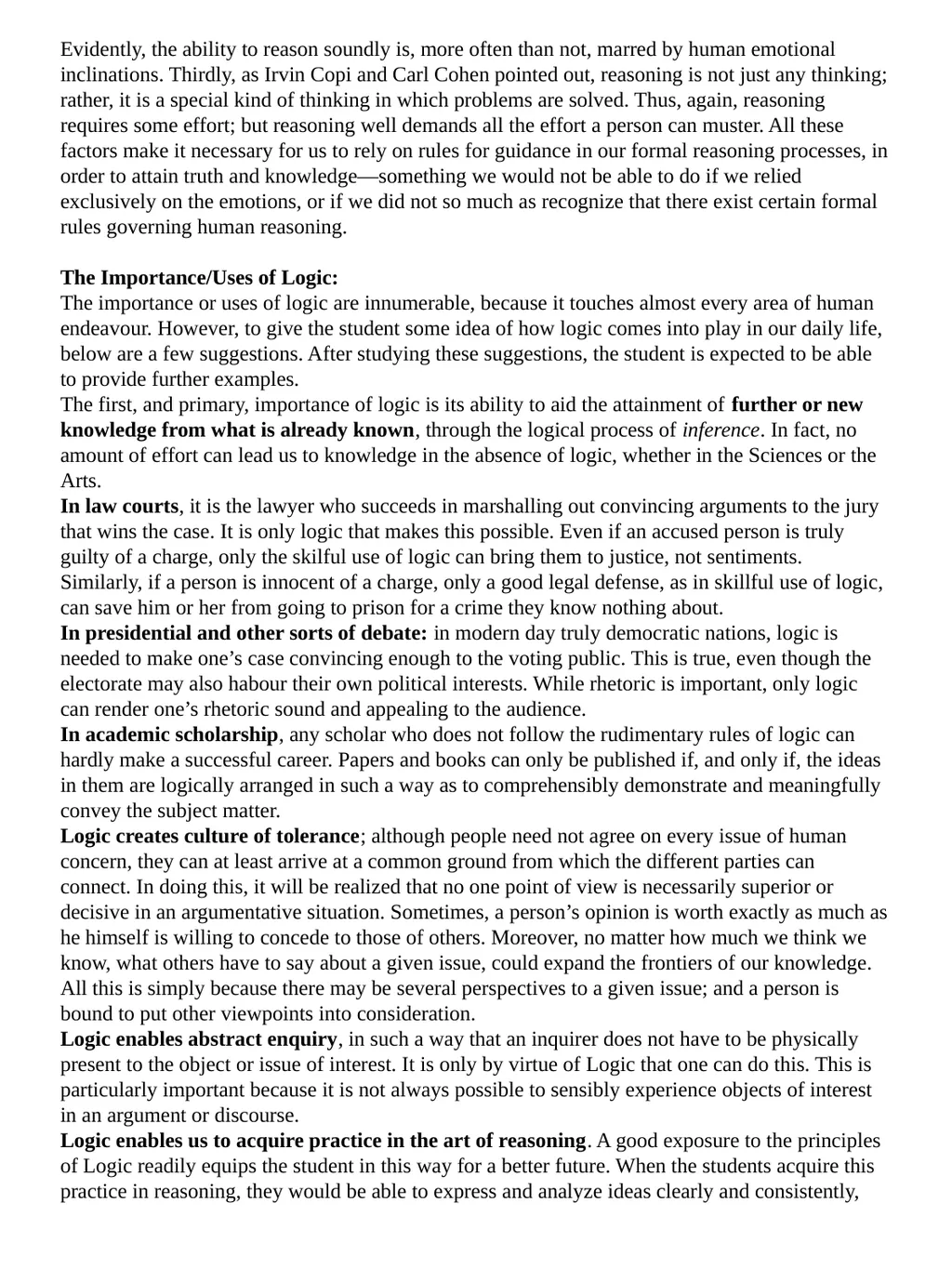
Evidently, the ability to reason soundly is, more often than not, marred by human emotional inclinations. Thirdly, as Irvin Copi and Carl Cohen pointed out, reasoning is not just any thinking; rather, it is a special kind of thinking in which problems are solved. Thus, again, reasoning requires some effort; but reasoning well demands all the effort a person can muster. All these factors make it necessary for us to rely on rules for guidance in our formal reasoning processes, in order to attain truth and knowledge—something we would not be able to do if we relied exclusively on the emotions, or if we did not so much as recognize that there exist certain formal rules governing human reasoning.
The Importance/Uses of Logic:
The importance or uses of logic are innumerable, because it touches almost every area of human endeavour. However, to give the student some idea of how logic comes into play in our daily life, below are a few suggestions. After studying these suggestions, the student is expected to be able to provide further examples.
The first, and primary, importance of logic is its ability to aid the attainment of further or new knowledge from what is already known, through the logical process of inference. In fact, no amount of effort can lead us to knowledge in the absence of logic, whether in the Sciences or the Arts.
In law courts, it is the lawyer who succeeds in marshalling out convincing arguments to the jury that wins the case. It is only logic that makes this possible. Even if an accused person is truly guilty of a charge, only the skilful use of logic can bring them to justice, not sentiments. Similarly, if a person is innocent of a charge, only a good legal defense, as in skillful use of logic, can save him or her from going to prison for a crime they know nothing about.
In presidential and other sorts of debate: in modern day truly democratic nations, logic is needed to make one’s case convincing enough to the voting public. This is true, even though the electorate may also habour their own political interests. While rhetoric is important, only logic can render one’s rhetoric sound and appealing to the audience.
In academic scholarship, any scholar who does not follow the rudimentary rules of logic can hardly make a successful career. Papers and books can only be published if, and only if, the ideas in them are logically arranged in such a way as to comprehensibly demonstrate and meaningfully convey the subject matter.
Logic creates culture of tolerance; although people need not agree on every issue of human concern, they can at least arrive at a common ground from which the different parties can connect. In doing this, it will be realized that no one point of view is necessarily superior or decisive in an argumentative situation. Sometimes, a person’s opinion is worth exactly as much as he himself is willing to concede to those of others. Moreover, no matter how much we think we know, what others have to say about a given issue, could expand the frontiers of our knowledge. All this is simply because there may be several perspectives to a given issue; and a person is bound to put other viewpoints into consideration.
Logic enables abstract enquiry, in such a way that an inquirer does not have to be physically present to the object or issue of interest. It is only by virtue of Logic that one can do this. This is particularly important because it is not always possible to sensibly experience objects of interest in an argument or discourse.
Logic enables us to acquire practice in the art of reasoning. A good exposure to the principles of Logic readily equips the student in this way for a better future. When the students acquire this practice in reasoning, they would be able to express and analyze ideas clearly and consistently,<br>
03
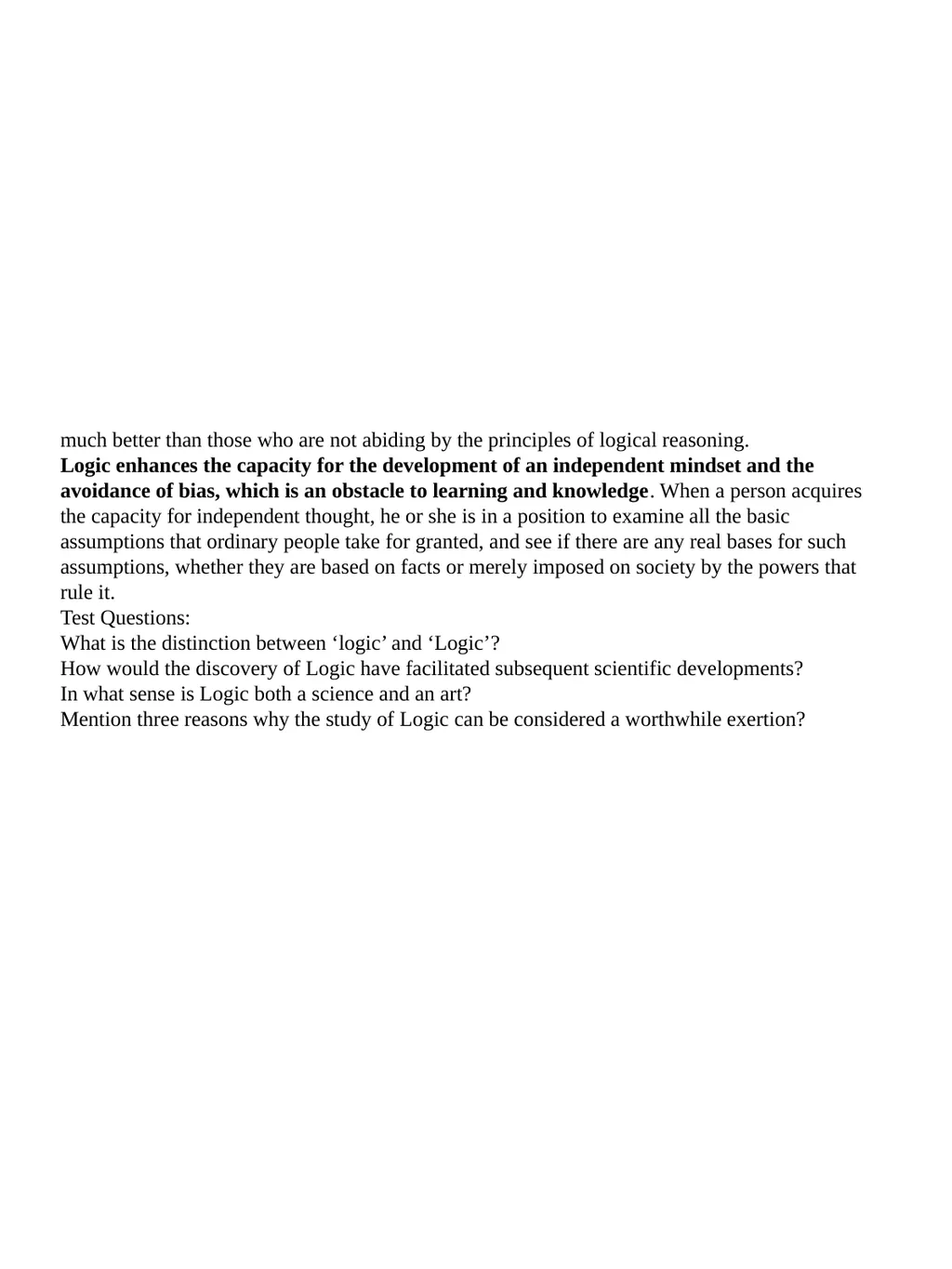
much better than those who are not abiding by the principles of logical reasoning.
Logic enhances the capacity for the development of an independent mindset and the avoidance of bias, which is an obstacle to learning and knowledge. When a person acquires the capacity for independent thought, he or she is in a position to examine all the basic assumptions that ordinary people take for granted, and see if there are any real bases for such assumptions, whether they are based on facts or merely imposed on society by the powers that rule it.
Test Questions:
What is the distinction between ‘logic’ and ‘Logic’?
How would the discovery of Logic have facilitated subsequent scientific developments?
In what sense is Logic both a science and an art?
Mention three reasons why the study of Logic can be considered a worthwhile exertion?<br>