Week 10: Coffee with Milk: The First Republic, 1889-1914 Marshall Deodoro da Fonseca Positivism A philosophy and religion founded by French philosopher August Comte from 1847 Through science and rational thought, humanity will advance
"Week 10: “Coffee with Milk”: The First Republic," is the property of its rightful owner. Permission is granted to
download and print the materials on this website for personal, non-commercial use only, and to display it
on your personal computer provided you do not modify the materials and that you retain all copyright
notices contained in the materials. By downloading content from our website, you accept the terms of this
agreement.
Presentation Transcript
01
Week 10: “Coffee with Milk”: The First Republic, 1889-1914<br>
02
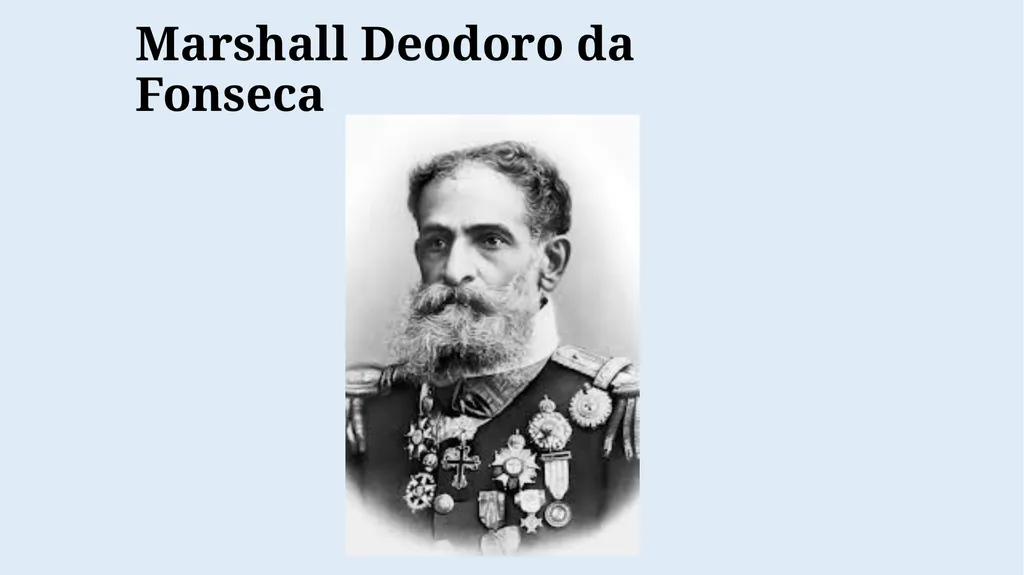
Marshall Deodoro da Fonseca<br>
03
Positivism A philosophy and religion founded by French philosopher August Comte from 1847
Through science and rational thought, humanity will advance through 3 stages of development…
…and will finally reach a “positivist” stage: full understanding of world and natural laws will be achieved by all.
“Orthodox” positivists are in the minority; fashion declines soon after 1889
But: “heterodox” positivism more influential: selective adoption/ adaptation of positivist ideas, plus other philosophies<br>
04
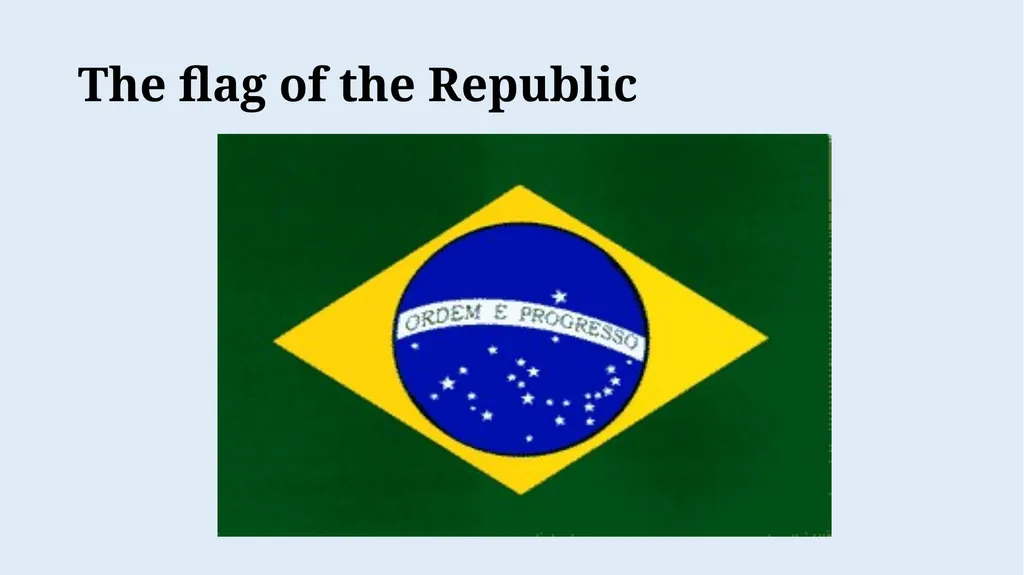
The flag of the Republic<br>
05
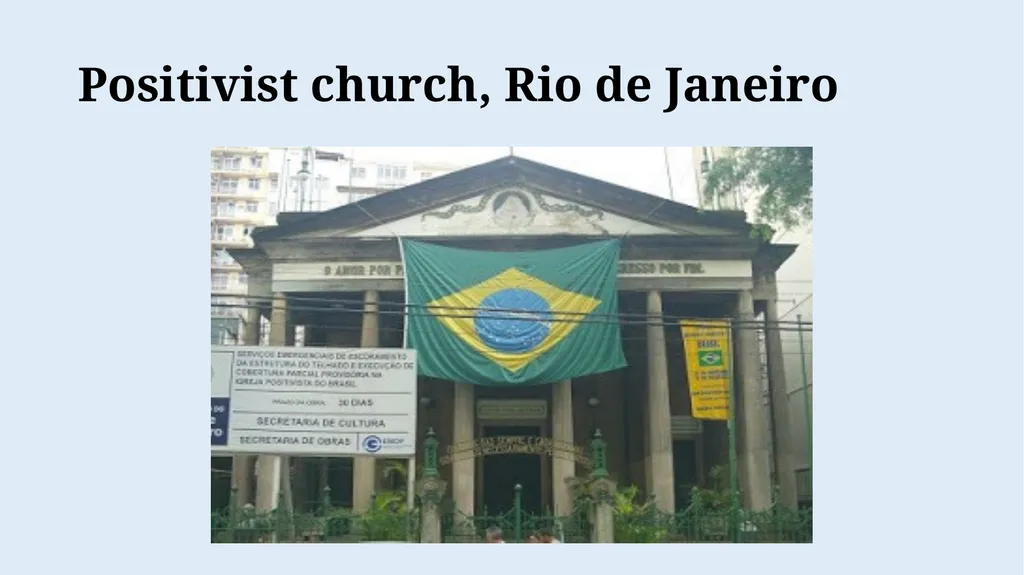
Positivist church, Rio de Janeiro<br>
06
“Order and Progress” “Progress” (broadly defined) to be achieved through “order”, ie:
NOT through any radical or popular process, but LED BY A SMALL SELECT GROUP who are suited to the task.
Comte develops positivism as response to French Revolution
Modernisation without democracy --> a “conservative” strain of Liberalism?<br>
07
Positivist contradictions Positivism embraced by army (Military Academy in Rio under Benjamin Constant) but…
Orthodox positivists don’t believe in armies…
Eventual army split between intellectual positivists and pragmatic “Young Turks” (emphasise military science and war)<br>
08
Positivism in practice Associations with republicanism and with the generation that help oust the monarchy
Positivism embraces humanity instead of God: associated with anticlericalism; positivists clash with the Catholic Church under Republic
“Progress” embraced feverishly by Brazilian elites: allow Brazil to take its place on the world stage<br>
09
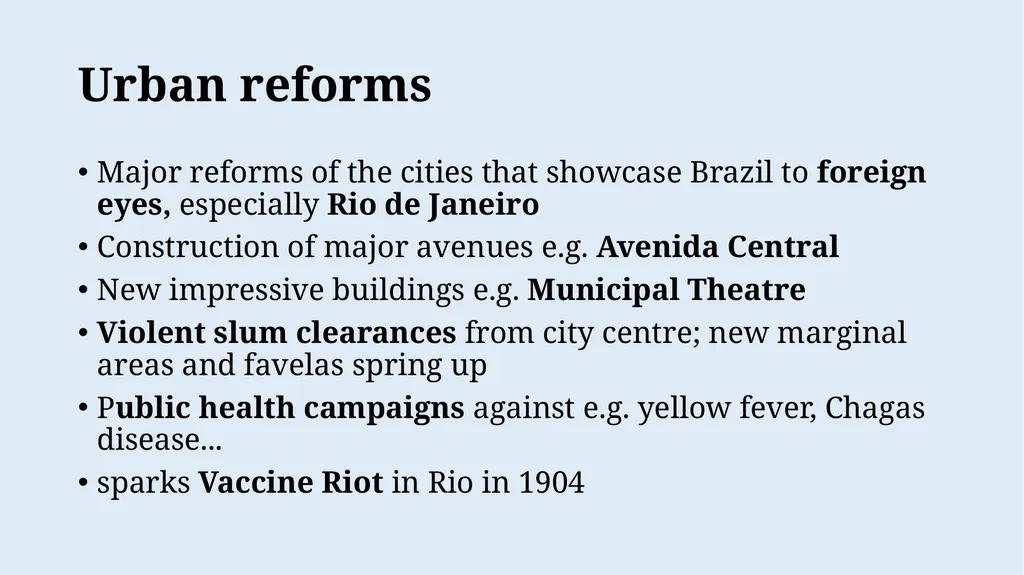
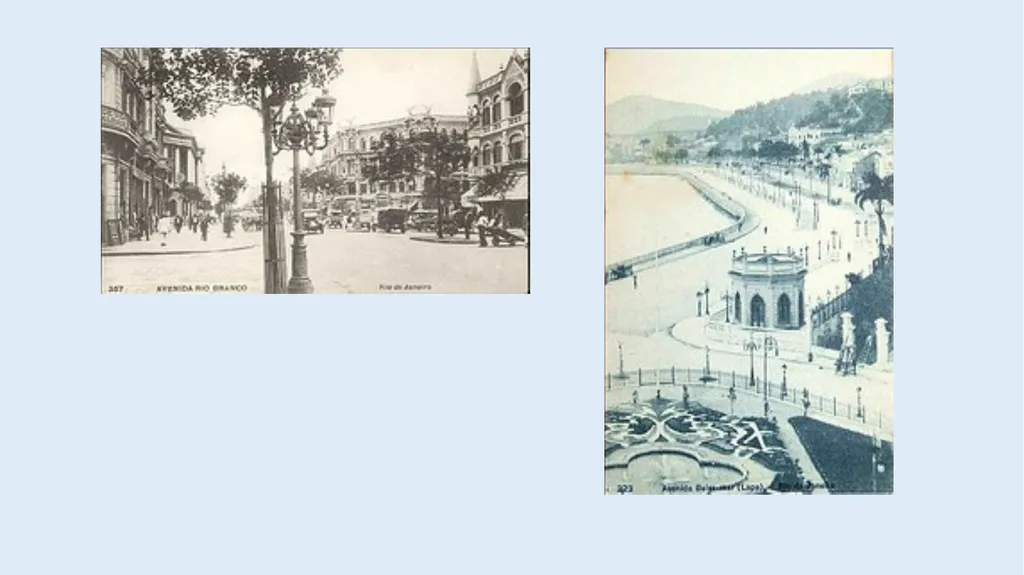
Urban reforms Major reforms of the cities that showcase Brazil to foreign eyes, especially Rio de Janeiro
Construction of major avenues e.g. Avenida Central
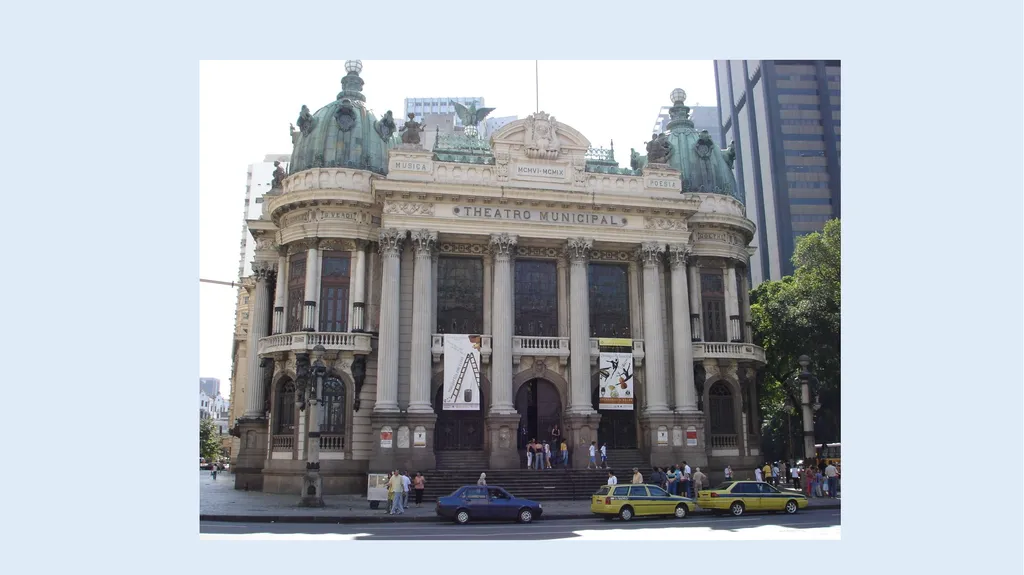
New impressive buildings e.g. Municipal Theatre
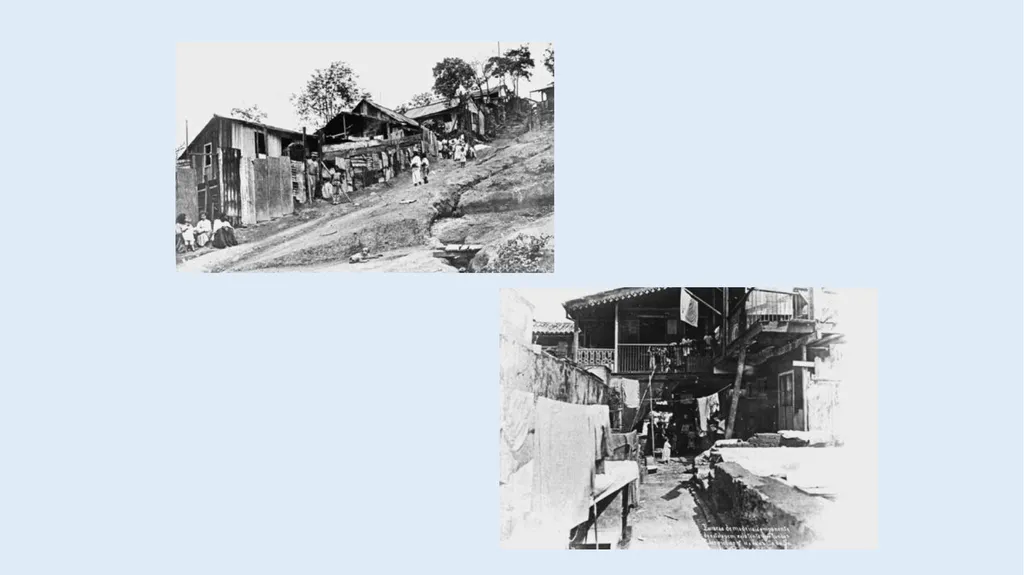
Violent slum clearances from city centre; new marginal areas and favelas spring up
Public health campaigns against e.g. yellow fever, Chagas disease...
sparks Vaccine Riot in Rio in 1904<br>
10
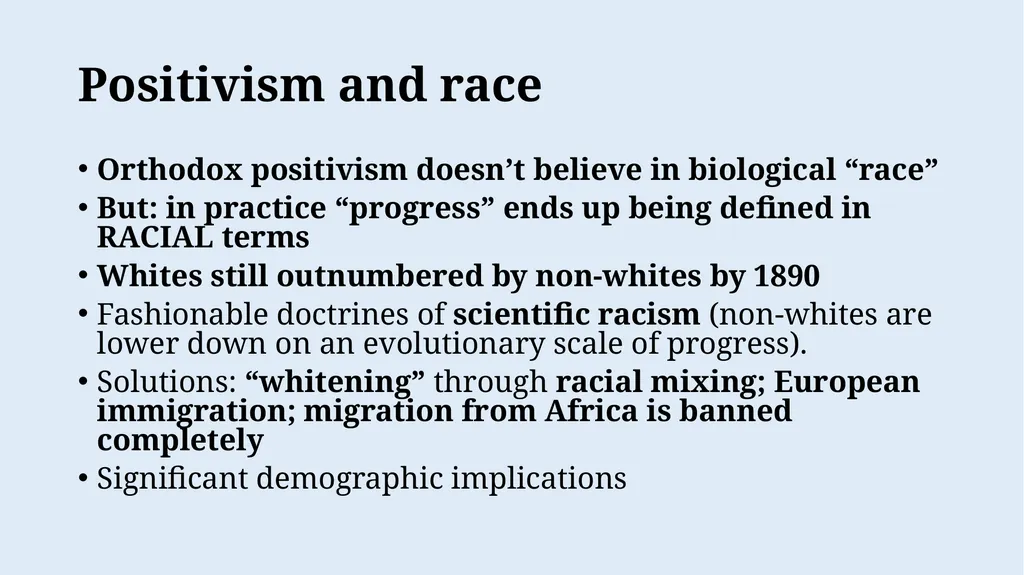
Positivism and race Orthodox positivism doesn’t believe in biological “race”
But: in practice “progress” ends up being defined in RACIAL terms
Whites still outnumbered by non-whites by 1890
Fashionable doctrines of scientific racism (non-whites are lower down on an evolutionary scale of progress).
Solutions: “whitening” through racial mixing; European immigration; migration from Africa is banned completely
Significant demographic implications<br>
11
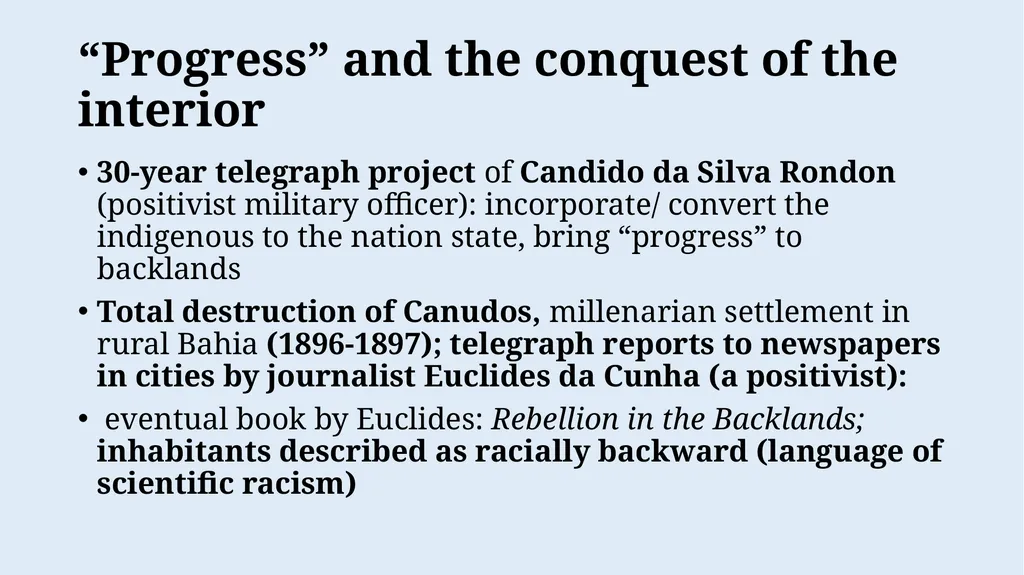
“Progress” and the conquest of the interior 30-year telegraph project of Candido da Silva Rondon (positivist military officer): incorporate/ convert the indigenous to the nation state, bring “progress” to backlands
Total destruction of Canudos, millenarian settlement in rural Bahia (1896-1897); telegraph reports to newspapers in cities by journalist Euclides da Cunha (a positivist):
eventual book by Euclides: Rebellion in the Backlands; inhabitants described as racially backward (language of scientific racism)<br>
12
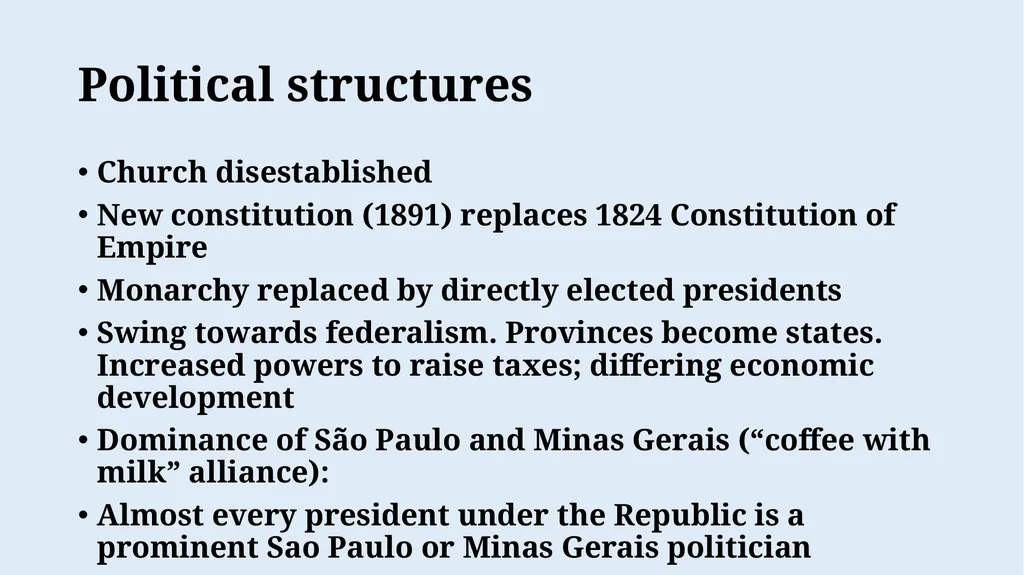
Political structures Church disestablished
New constitution (1891) replaces 1824 Constitution of Empire
Monarchy replaced by directly elected presidents
Swing towards federalism. Provinces become states. Increased powers to raise taxes; differing economic development
Dominance of São Paulo and Minas Gerais (“coffee with milk” alliance):
Almost every president under the Republic is a prominent Sao Paulo or Minas Gerais politician<br>
13
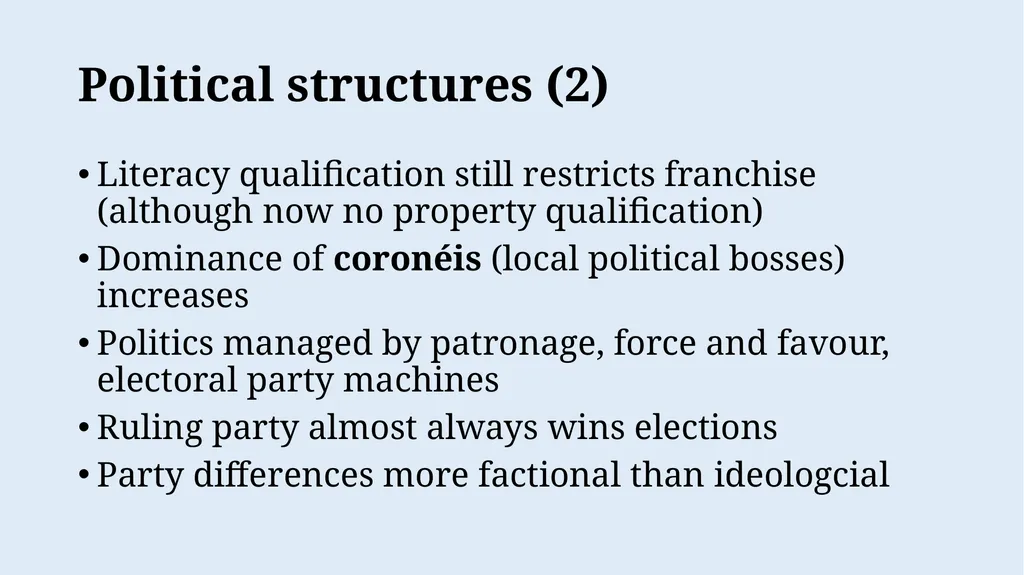
Political structures (2) Literacy qualification still restricts franchise (although now no property qualification)
Dominance of coronéis (local political bosses) increases
Politics managed by patronage, force and favour, electoral party machines
Ruling party almost always wins elections
Party differences more factional than ideologcial<br>
14
Increased role of the military Initial military rule (1889-1894); then civilian rule
But: military as active political agent; arbiter of disputes
Multiple military risings/ coup attempts, eg:
1891 coup attempt and revolt in Rio Grande do Sul helps usher in Floriano Peixoto;
series of military uprisings against Floriano’s regime from 1891
1904 coup plot linked to vaccine revolt in Rio
Naval revolt in 1910: “Revolt of the Lash”<br>
15
Economy Dominance of coffee: economy remains mainly AGRICULTURAL
5.5M sacks in 1890-1; over 16M in 1901-2; 75% of world’s coffee produced by Brazil at turn of century
Vulnerable to changes in world market; overproduction by 1893
1906 Taubaté agreement, signed by presidents of Minas Gerais, Sao Paulo, Rio de Janeiro: protect coffee through mínimum prices and stabilisation fund
Brief rubber boom in Amazon, 1900-1910, then crash<br>
16
Rubber boom: Belém opera house<br>
17
Industry and immigration Government not promoting industrialisation. Industry = only 10% of GDP in 1900.
But some industrialisation nonetheless…mainly in South-East
Coffee economy stimulates banking, imports/ exports, rail…
Industry fuelled by European immigrants: over 1.2M arrive in 1890s
In 1900, 92% of industrial workers in SP were immigrants
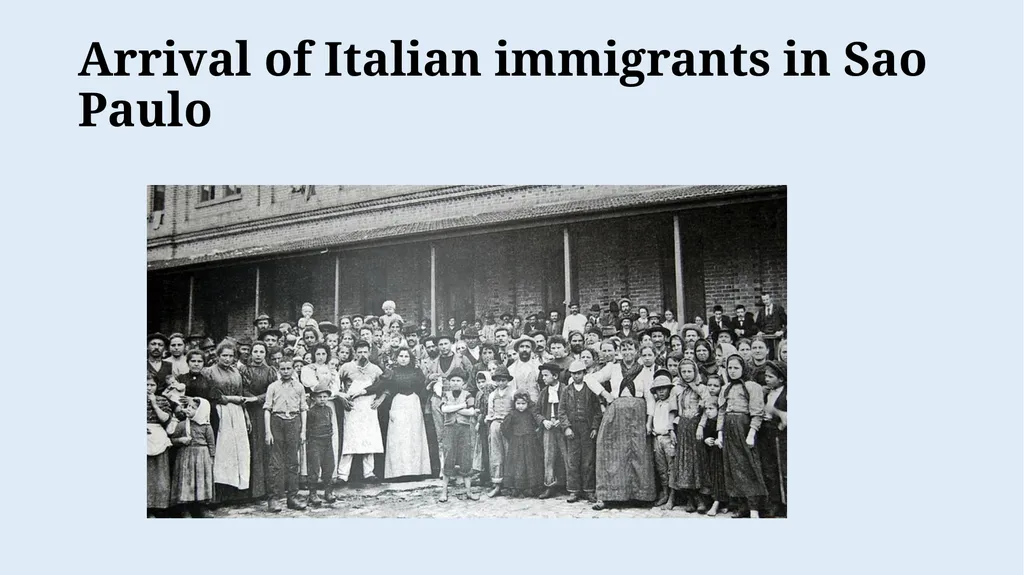
Nearly 3M immigrants arrive, 1884-1920: “melting-pot” of cultures
Southern Europeans: anarchism and socialism; trades unions slowly emerge…
Brazilian Communist Party founded 1922<br>
18
Arrival of Italian immigrants in Sao Paulo<br>
19
Questions for the seminar… How much changed under the Republic? Who were the winners and losers?
What was the role of coffee economically and politically?
How did ordinary people respond to life under the Republic?
How did Republicans and Positivists view Afro-Brazilians? With what implications?<br>