
Week 11, Lesson 4 Writing: Using a poetry stimulus
Description: Week 11, Lesson 4 Writing: Using a poetry stimulus To use a poem as a stimulus To be able to plan and structure effectively To develop our drafting skills Support Challenge Task or question to complete Complete low stakes quiz I like to see
Related Topics
Download Presentation
"Week 11, Lesson 4 Writing: Using a poetry stimulus" is the property of its rightful owner. Permission is granted to download and print the materials on this website for personal, non-commercial use only, and to display it on your personal computer provided you do not modify the materials and that you retain all copyright notices contained in the materials. By downloading content from our website, you accept the terms of this agreement.
Presentation Transcript
slide1. Week 11, Lesson 4
Writing: Using a poetry stimulus To use a poem as a stimulus
To be able to plan and structure effectively
To develop our drafting skills Support Challenge Task or question to complete<br>
slide2. Complete low stakes quiz<br>
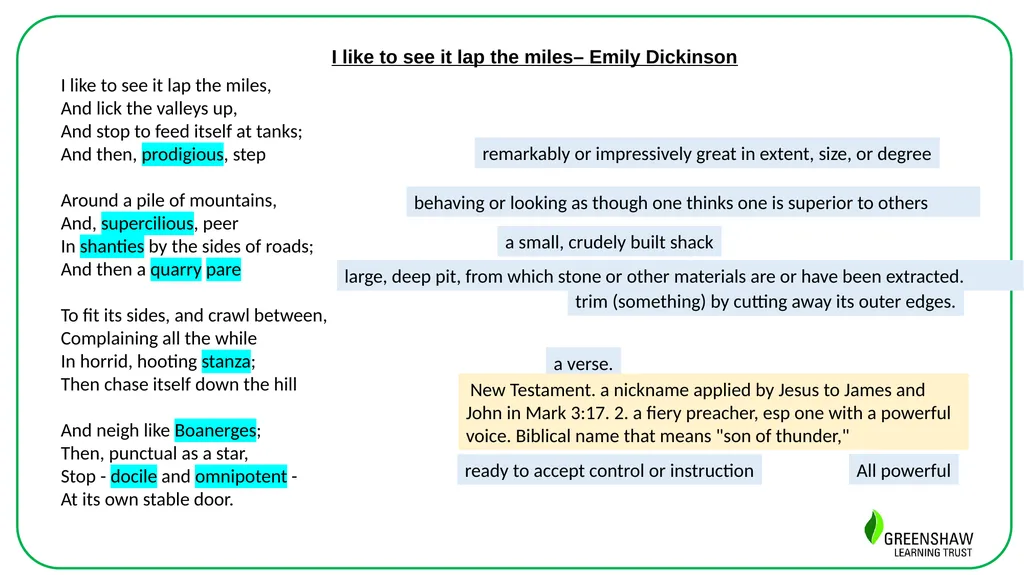
slide3. I like to see it lap the miles, And lick the valleys up, And stop to feed itself at tanks; And then, prodigious, step Around a pile of mountains, And, supercilious, peer In shanties by the sides of roads; And then a quarry pare To fit its sides, and crawl between, Complaining all the while In horrid, hooting stanza; Then chase itself down the hill And neigh like Boanerges; Then, punctual as a star, Stop - docile and omnipotent - At its own stable door. I like to see it lap the miles– Emily Dickinson remarkably or impressively great in extent, size, or degree behaving or looking as though one thinks one is superior to others a small, crudely built shack large, deep pit, from which stone or other materials are or have been extracted. trim (something) by cutting away its outer edges. a verse. ready to accept control or instruction All powerful New Testament. a nickname applied by Jesus to James and John in Mark 3:17. 2. a fiery preacher, esp one with a powerful voice. Biblical name that means "son of thunder,"<br>
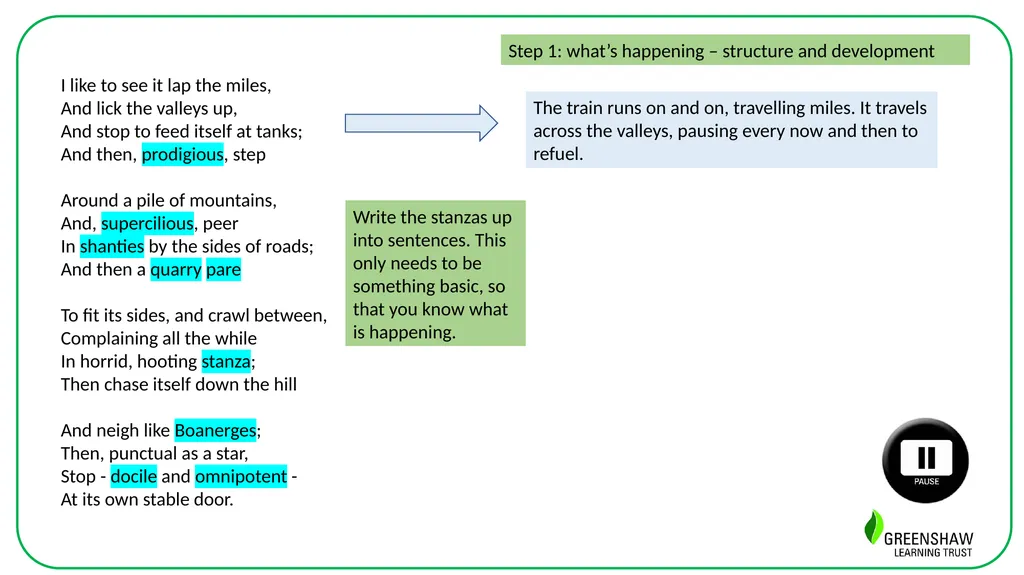
slide4. I like to see it lap the miles, And lick the valleys up, And stop to feed itself at tanks; And then, prodigious, step Around a pile of mountains, And, supercilious, peer In shanties by the sides of roads; And then a quarry pare To fit its sides, and crawl between, Complaining all the while In horrid, hooting stanza; Then chase itself down the hill And neigh like Boanerges; Then, punctual as a star, Stop - docile and omnipotent - At its own stable door. The train runs on and on, travelling miles. It travels across the valleys, pausing every now and then to refuel. Step 1: what’s happening – structure and development Write the stanzas up into sentences. This only needs to be something basic, so that you know what is happening.<br>
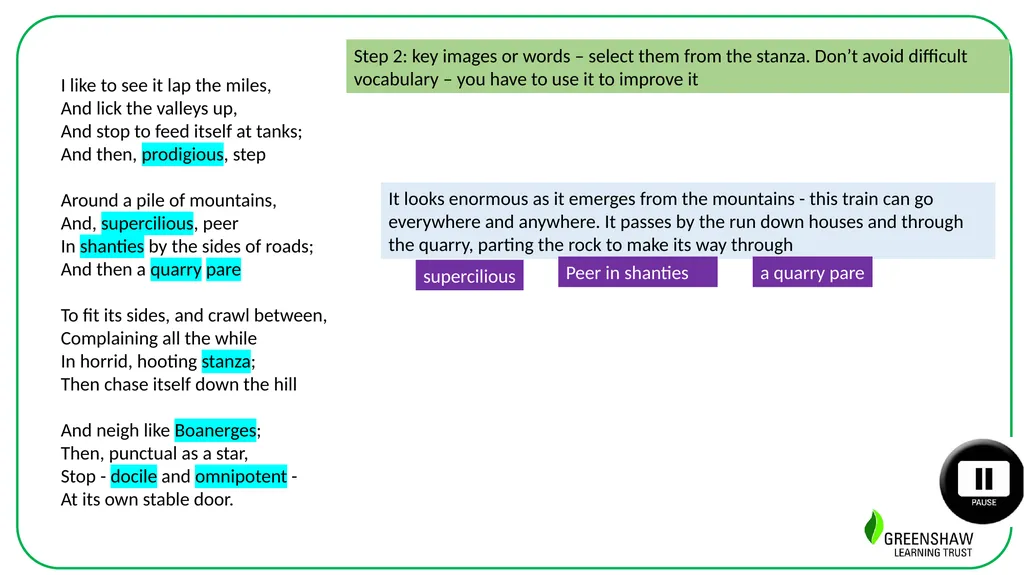
slide5. I like to see it lap the miles, And lick the valleys up, And stop to feed itself at tanks; And then, prodigious, step Around a pile of mountains, And, supercilious, peer In shanties by the sides of roads; And then a quarry pare To fit its sides, and crawl between, Complaining all the while In horrid, hooting stanza; Then chase itself down the hill And neigh like Boanerges; Then, punctual as a star, Stop - docile and omnipotent - At its own stable door. It looks enormous as it emerges from the mountains - this train can go everywhere and anywhere. It passes by the run down houses and through the quarry, parting the rock to make its way through Step 2: key images or words – select them from the stanza. Don’t avoid difficult vocabulary – you have to use it to improve it supercilious Peer in shanties a quarry pare<br>
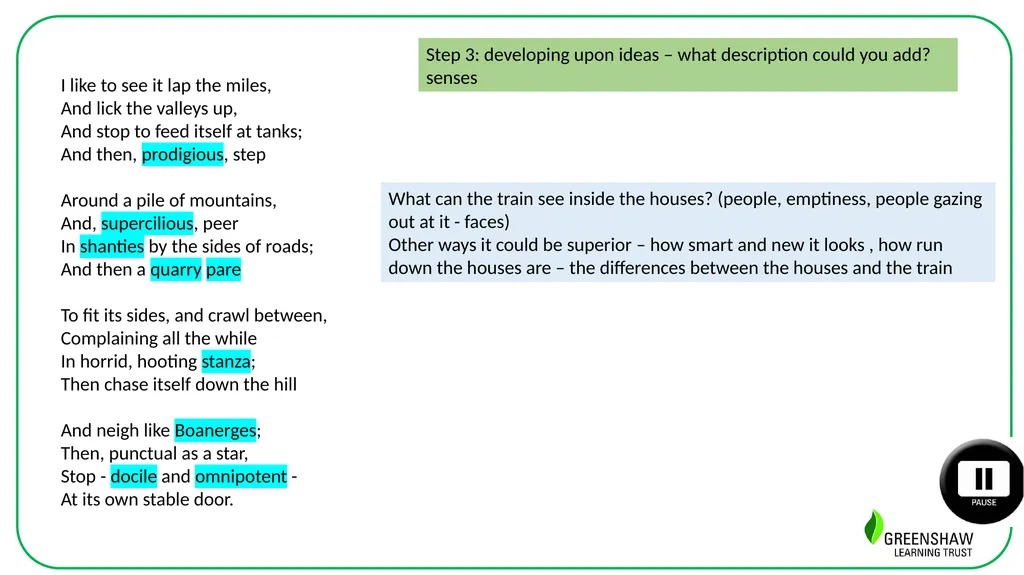
slide6. I like to see it lap the miles, And lick the valleys up, And stop to feed itself at tanks; And then, prodigious, step Around a pile of mountains, And, supercilious, peer In shanties by the sides of roads; And then a quarry pare To fit its sides, and crawl between, Complaining all the while In horrid, hooting stanza; Then chase itself down the hill And neigh like Boanerges; Then, punctual as a star, Stop - docile and omnipotent - At its own stable door. What can the train see inside the houses? (people, emptiness, people gazing out at it - faces)
Other ways it could be superior – how smart and new it looks , how run down the houses are – the differences between the houses and the train Step 3: developing upon ideas – what description could you add?
senses<br>
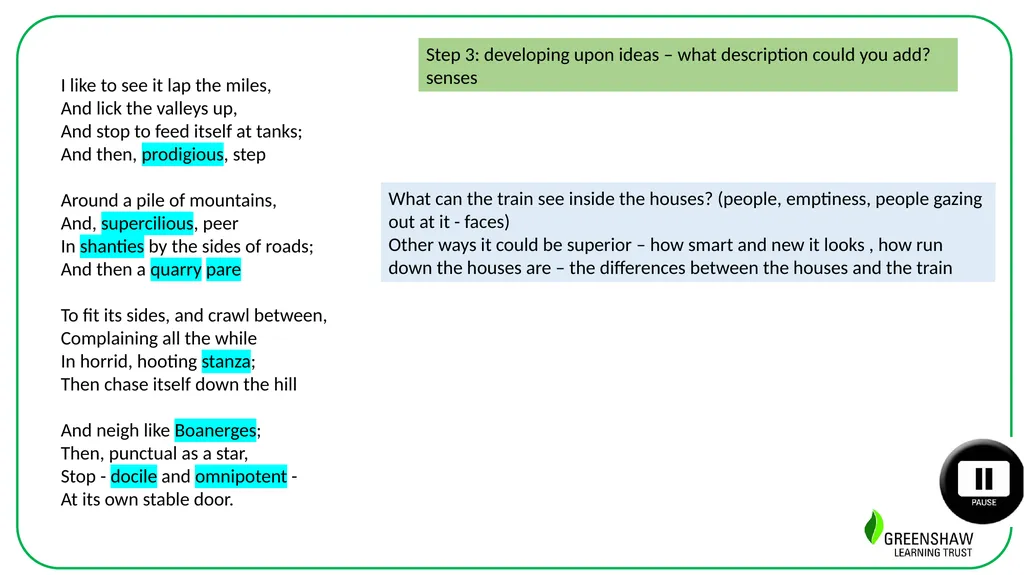
slide7. I like to see it lap the miles, And lick the valleys up, And stop to feed itself at tanks; And then, prodigious, step Around a pile of mountains, And, supercilious, peer In shanties by the sides of roads; And then a quarry pare To fit its sides, and crawl between, Complaining all the while In horrid, hooting stanza; Then chase itself down the hill And neigh like Boanerges; Then, punctual as a star, Stop - docile and omnipotent - At its own stable door. What can the train see inside the houses? (people, emptiness, people gazing out at it - faces)
Other ways it could be superior – how smart and new it looks , how run down the houses are – the differences between the houses and the train Step 3: developing upon ideas – what description could you add?
senses<br>
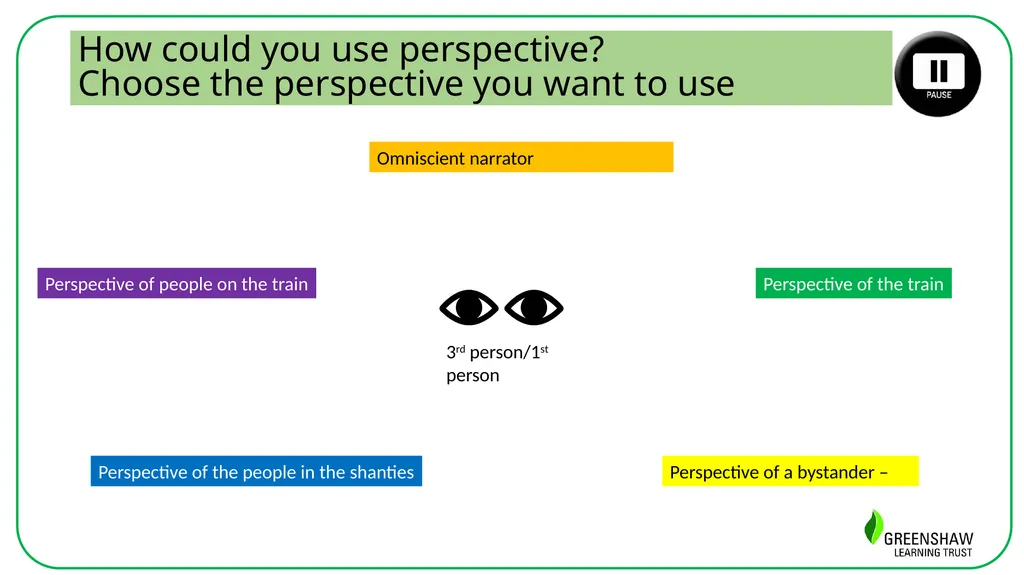
slide8. How could you use perspective? Choose the perspective you want to use Perspective of a bystander – Perspective of the train Perspective of people on the train Perspective of the people in the shanties Omniscient narrator 3rd person/1st person<br>
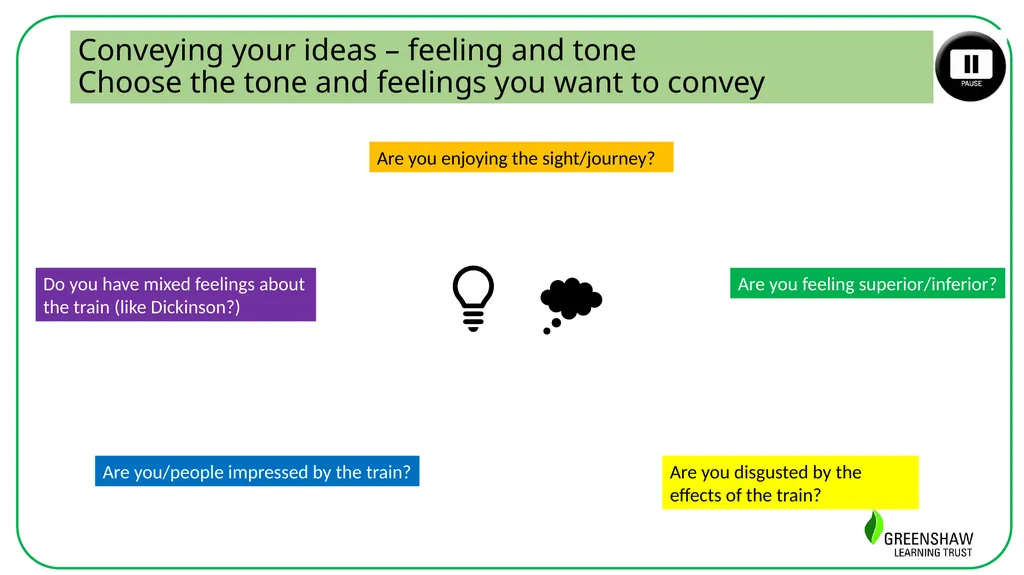
slide9. Conveying your ideas – feeling and tone Choose the tone and feelings you want to convey Are you disgusted by the effects of the train? Are you feeling superior/inferior? Do you have mixed feelings about the train (like Dickinson?) Are you/people impressed by the train? Are you enjoying the sight/journey?<br>
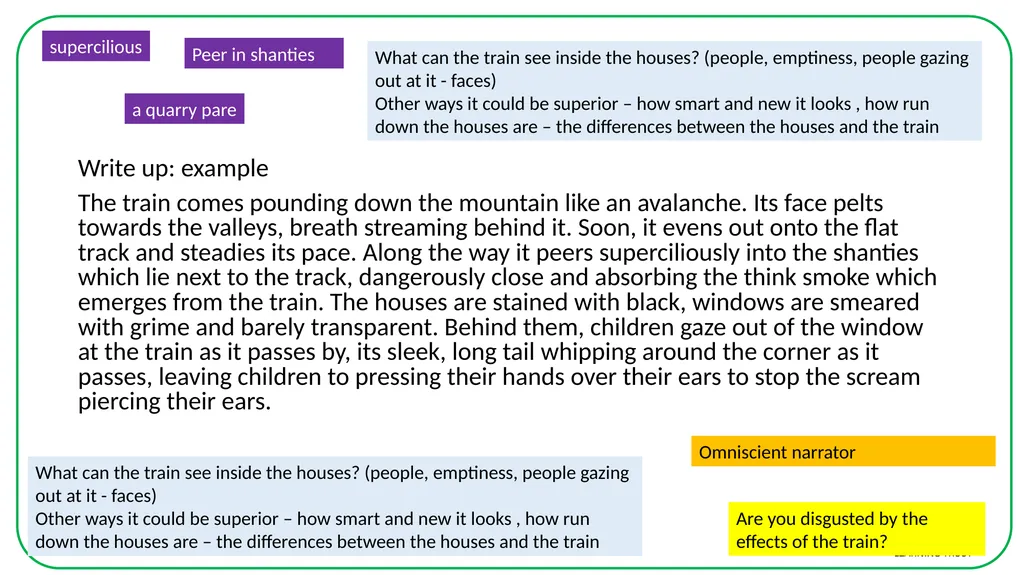
slide10. Write up: example
The train comes pounding down the mountain like an avalanche. Its face pelts towards the valleys, breath streaming behind it. Soon, it evens out onto the flat track and steadies its pace. Along the way it peers superciliously into the shanties which lie next to the track, dangerously close and absorbing the think smoke which emerges from the train. The houses are stained with black, windows are smeared with grime and barely transparent. Behind them, children gaze out of the window at the train as it passes by, its sleek, long tail whipping around the corner as it passes, leaving children to pressing their hands over their ears to stop the scream piercing their ears. Are you disgusted by the effects of the train? Omniscient narrator What can the train see inside the houses? (people, emptiness, people gazing out at it - faces)
Other ways it could be superior – how smart and new it looks , how run down the houses are – the differences between the houses and the train supercilious Peer in shanties a quarry pare What can the train see inside the houses? (people, emptiness, people gazing out at it - faces)
Other ways it could be superior – how smart and new it looks , how run down the houses are – the differences between the houses and the train<br>
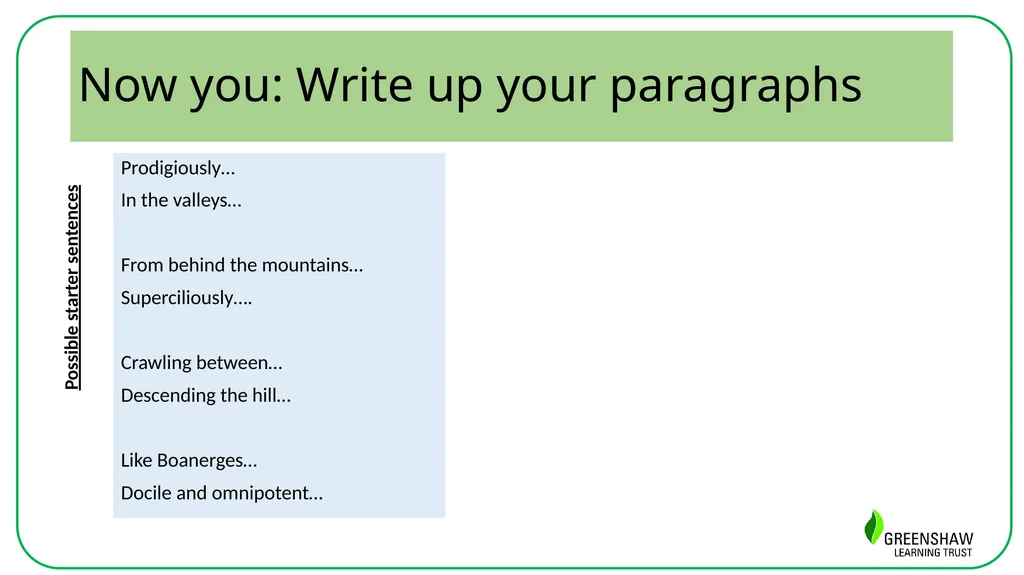
slide11. Now you: Write up your paragraphs Prodigiously…
In the valleys…
From behind the mountains…
Superciliously….
Crawling between…
Descending the hill…
Like Boanerges…
Docile and omnipotent… Possible starter sentences<br>
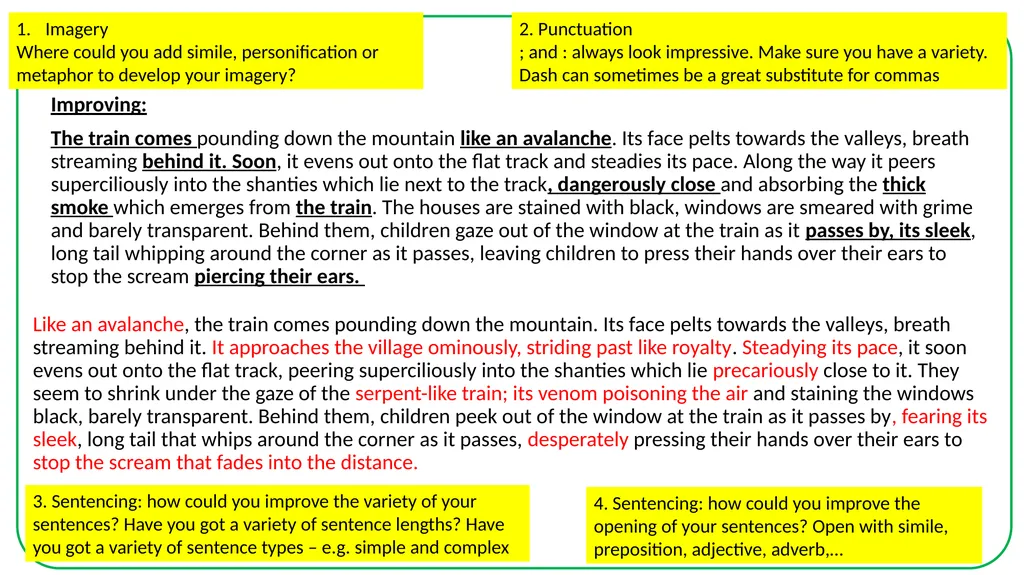
slide12. Improving:
The train comes pounding down the mountain like an avalanche. Its face pelts towards the valleys, breath streaming behind it. Soon, it evens out onto the flat track and steadies its pace. Along the way it peers superciliously into the shanties which lie next to the track, dangerously close and absorbing the thick smoke which emerges from the train. The houses are stained with black, windows are smeared with grime and barely transparent. Behind them, children gaze out of the window at the train as it passes by, its sleek, long tail whipping around the corner as it passes, leaving children to press their hands over their ears to stop the scream piercing their ears. 4. Sentencing: how could you improve the opening of your sentences? Open with simile, preposition, adjective, adverb,… 3. Sentencing: how could you improve the variety of your sentences? Have you got a variety of sentence lengths? Have you got a variety of sentence types – e.g. simple and complex 2. Punctuation
; and : always look impressive. Make sure you have a variety. Dash can sometimes be a great substitute for commas Imagery
Where could you add simile, personification or metaphor to develop your imagery? Like an avalanche, the train comes pounding down the mountain. Its face pelts towards the valleys, breath streaming behind it. It approaches the village ominously, striding past like royalty. Steadying its pace, it soon evens out onto the flat track, peering superciliously into the shanties which lie precariously close to it. They seem to shrink under the gaze of the serpent-like train; its venom poisoning the air and staining the windows black, barely transparent. Behind them, children peek out of the window at the train as it passes by, fearing its sleek, long tail that whips around the corner as it passes, desperately pressing their hands over their ears to stop the scream that fades into the distance.<br>
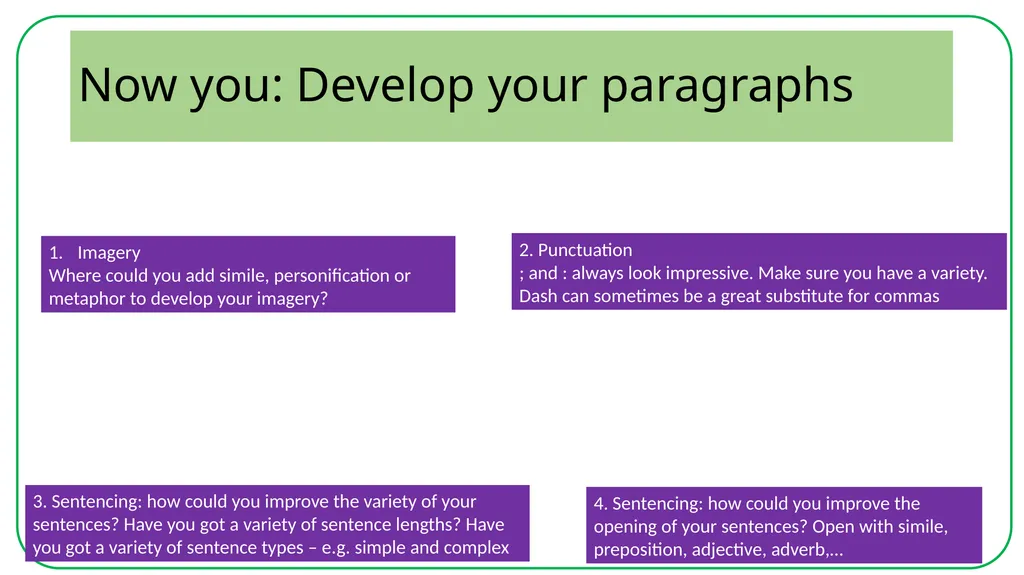
slide13. Now you: Develop your paragraphs 4. Sentencing: how could you improve the opening of your sentences? Open with simile, preposition, adjective, adverb,… 3. Sentencing: how could you improve the variety of your sentences? Have you got a variety of sentence lengths? Have you got a variety of sentence types – e.g. simple and complex 2. Punctuation
; and : always look impressive. Make sure you have a variety. Dash can sometimes be a great substitute for commas Imagery
Where could you add simile, personification or metaphor to develop your imagery?<br>
slide14. Complete the exit ticket By this point, you should have:
Outlined the content of each of the 4 paragraphs
Planned for key vocabulary, details, tone and perspective
Written up your paragraphs
Developed your paragraphs in 3 ways Have something you’re particularly proud of?
Have you tried this with a different text?
Email Me!: sgoodridge@yateacademy.co.uk<br>
Writing: Using a poetry stimulus To use a poem as a stimulus
To be able to plan and structure effectively
To develop our drafting skills Support Challenge Task or question to complete<br>
slide2. Complete low stakes quiz<br>
slide3. I like to see it lap the miles, And lick the valleys up, And stop to feed itself at tanks; And then, prodigious, step Around a pile of mountains, And, supercilious, peer In shanties by the sides of roads; And then a quarry pare To fit its sides, and crawl between, Complaining all the while In horrid, hooting stanza; Then chase itself down the hill And neigh like Boanerges; Then, punctual as a star, Stop - docile and omnipotent - At its own stable door. I like to see it lap the miles– Emily Dickinson remarkably or impressively great in extent, size, or degree behaving or looking as though one thinks one is superior to others a small, crudely built shack large, deep pit, from which stone or other materials are or have been extracted. trim (something) by cutting away its outer edges. a verse. ready to accept control or instruction All powerful New Testament. a nickname applied by Jesus to James and John in Mark 3:17. 2. a fiery preacher, esp one with a powerful voice. Biblical name that means "son of thunder,"<br>
slide4. I like to see it lap the miles, And lick the valleys up, And stop to feed itself at tanks; And then, prodigious, step Around a pile of mountains, And, supercilious, peer In shanties by the sides of roads; And then a quarry pare To fit its sides, and crawl between, Complaining all the while In horrid, hooting stanza; Then chase itself down the hill And neigh like Boanerges; Then, punctual as a star, Stop - docile and omnipotent - At its own stable door. The train runs on and on, travelling miles. It travels across the valleys, pausing every now and then to refuel. Step 1: what’s happening – structure and development Write the stanzas up into sentences. This only needs to be something basic, so that you know what is happening.<br>
slide5. I like to see it lap the miles, And lick the valleys up, And stop to feed itself at tanks; And then, prodigious, step Around a pile of mountains, And, supercilious, peer In shanties by the sides of roads; And then a quarry pare To fit its sides, and crawl between, Complaining all the while In horrid, hooting stanza; Then chase itself down the hill And neigh like Boanerges; Then, punctual as a star, Stop - docile and omnipotent - At its own stable door. It looks enormous as it emerges from the mountains - this train can go everywhere and anywhere. It passes by the run down houses and through the quarry, parting the rock to make its way through Step 2: key images or words – select them from the stanza. Don’t avoid difficult vocabulary – you have to use it to improve it supercilious Peer in shanties a quarry pare<br>
slide6. I like to see it lap the miles, And lick the valleys up, And stop to feed itself at tanks; And then, prodigious, step Around a pile of mountains, And, supercilious, peer In shanties by the sides of roads; And then a quarry pare To fit its sides, and crawl between, Complaining all the while In horrid, hooting stanza; Then chase itself down the hill And neigh like Boanerges; Then, punctual as a star, Stop - docile and omnipotent - At its own stable door. What can the train see inside the houses? (people, emptiness, people gazing out at it - faces)
Other ways it could be superior – how smart and new it looks , how run down the houses are – the differences between the houses and the train Step 3: developing upon ideas – what description could you add?
senses<br>
slide7. I like to see it lap the miles, And lick the valleys up, And stop to feed itself at tanks; And then, prodigious, step Around a pile of mountains, And, supercilious, peer In shanties by the sides of roads; And then a quarry pare To fit its sides, and crawl between, Complaining all the while In horrid, hooting stanza; Then chase itself down the hill And neigh like Boanerges; Then, punctual as a star, Stop - docile and omnipotent - At its own stable door. What can the train see inside the houses? (people, emptiness, people gazing out at it - faces)
Other ways it could be superior – how smart and new it looks , how run down the houses are – the differences between the houses and the train Step 3: developing upon ideas – what description could you add?
senses<br>
slide8. How could you use perspective? Choose the perspective you want to use Perspective of a bystander – Perspective of the train Perspective of people on the train Perspective of the people in the shanties Omniscient narrator 3rd person/1st person<br>
slide9. Conveying your ideas – feeling and tone Choose the tone and feelings you want to convey Are you disgusted by the effects of the train? Are you feeling superior/inferior? Do you have mixed feelings about the train (like Dickinson?) Are you/people impressed by the train? Are you enjoying the sight/journey?<br>
slide10. Write up: example
The train comes pounding down the mountain like an avalanche. Its face pelts towards the valleys, breath streaming behind it. Soon, it evens out onto the flat track and steadies its pace. Along the way it peers superciliously into the shanties which lie next to the track, dangerously close and absorbing the think smoke which emerges from the train. The houses are stained with black, windows are smeared with grime and barely transparent. Behind them, children gaze out of the window at the train as it passes by, its sleek, long tail whipping around the corner as it passes, leaving children to pressing their hands over their ears to stop the scream piercing their ears. Are you disgusted by the effects of the train? Omniscient narrator What can the train see inside the houses? (people, emptiness, people gazing out at it - faces)
Other ways it could be superior – how smart and new it looks , how run down the houses are – the differences between the houses and the train supercilious Peer in shanties a quarry pare What can the train see inside the houses? (people, emptiness, people gazing out at it - faces)
Other ways it could be superior – how smart and new it looks , how run down the houses are – the differences between the houses and the train<br>
slide11. Now you: Write up your paragraphs Prodigiously…
In the valleys…
From behind the mountains…
Superciliously….
Crawling between…
Descending the hill…
Like Boanerges…
Docile and omnipotent… Possible starter sentences<br>
slide12. Improving:
The train comes pounding down the mountain like an avalanche. Its face pelts towards the valleys, breath streaming behind it. Soon, it evens out onto the flat track and steadies its pace. Along the way it peers superciliously into the shanties which lie next to the track, dangerously close and absorbing the thick smoke which emerges from the train. The houses are stained with black, windows are smeared with grime and barely transparent. Behind them, children gaze out of the window at the train as it passes by, its sleek, long tail whipping around the corner as it passes, leaving children to press their hands over their ears to stop the scream piercing their ears. 4. Sentencing: how could you improve the opening of your sentences? Open with simile, preposition, adjective, adverb,… 3. Sentencing: how could you improve the variety of your sentences? Have you got a variety of sentence lengths? Have you got a variety of sentence types – e.g. simple and complex 2. Punctuation
; and : always look impressive. Make sure you have a variety. Dash can sometimes be a great substitute for commas Imagery
Where could you add simile, personification or metaphor to develop your imagery? Like an avalanche, the train comes pounding down the mountain. Its face pelts towards the valleys, breath streaming behind it. It approaches the village ominously, striding past like royalty. Steadying its pace, it soon evens out onto the flat track, peering superciliously into the shanties which lie precariously close to it. They seem to shrink under the gaze of the serpent-like train; its venom poisoning the air and staining the windows black, barely transparent. Behind them, children peek out of the window at the train as it passes by, fearing its sleek, long tail that whips around the corner as it passes, desperately pressing their hands over their ears to stop the scream that fades into the distance.<br>
slide13. Now you: Develop your paragraphs 4. Sentencing: how could you improve the opening of your sentences? Open with simile, preposition, adjective, adverb,… 3. Sentencing: how could you improve the variety of your sentences? Have you got a variety of sentence lengths? Have you got a variety of sentence types – e.g. simple and complex 2. Punctuation
; and : always look impressive. Make sure you have a variety. Dash can sometimes be a great substitute for commas Imagery
Where could you add simile, personification or metaphor to develop your imagery?<br>
slide14. Complete the exit ticket By this point, you should have:
Outlined the content of each of the 4 paragraphs
Planned for key vocabulary, details, tone and perspective
Written up your paragraphs
Developed your paragraphs in 3 ways Have something you’re particularly proud of?
Have you tried this with a different text?
Email Me!: sgoodridge@yateacademy.co.uk<br>