Welcome End of Course Testing and Tutoring EOC
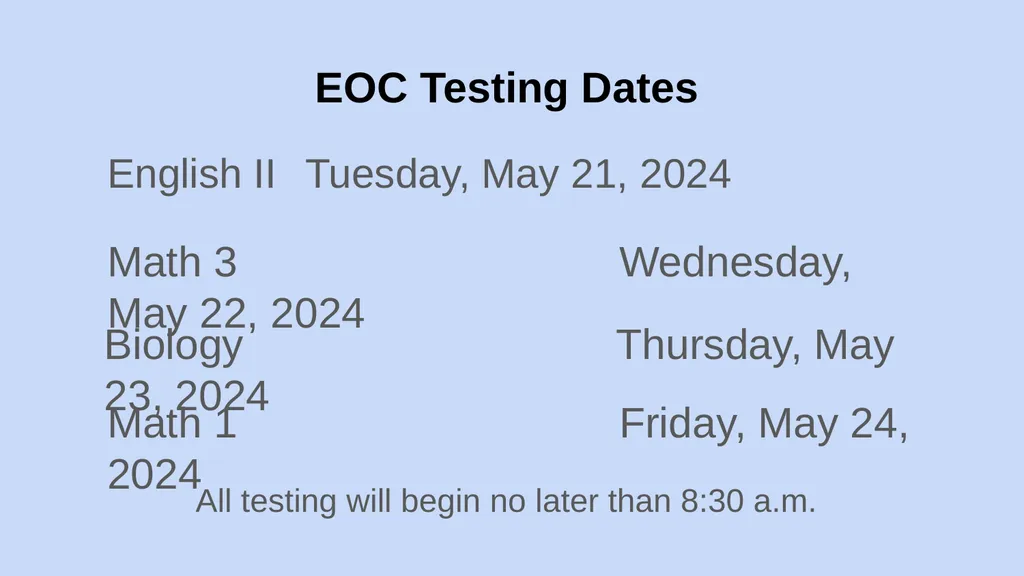
Description: Welcome End of Course Testing and Tutoring EOC Testing Dates English II Tuesday, May 21, 2024 Math 3 Wednesday, May 22, 2024 Biology Thursday, May 23, 2024 Math 1 Friday, May 24, 2024 All testing will begin no later than 8:30 a.m. We need
Related Topics
Download Presentation
"Welcome End of Course Testing and Tutoring EOC" is the property of its rightful owner. Permission is granted to download and print the materials on this website for personal, non-commercial use only, and to display it on your personal computer provided you do not modify the materials and that you retain all copyright notices contained in the materials. By downloading content from our website, you accept the terms of this agreement.
Presentation Transcript
slide1. Welcome End of Course Testing and Tutoring<br>
slide2. EOC Testing Dates English II Tuesday, May 21, 2024 Math 3 Wednesday, May 22, 2024 Biology Thursday, May 23, 2024 Math 1 Friday, May 24, 2024 All testing will begin no later than 8:30 a.m.<br>
slide3. We need your help! 1. Have your student to school on time. 2. Make sure your student is rested and fed. 3. Sign your student up for tutoring. 4. Communicate with your student’s teachers. 5. Encourage your student to participate, ask questions, and take ownership of their education.<br>
slide4. Parents + Students +Teachers = Success<br>
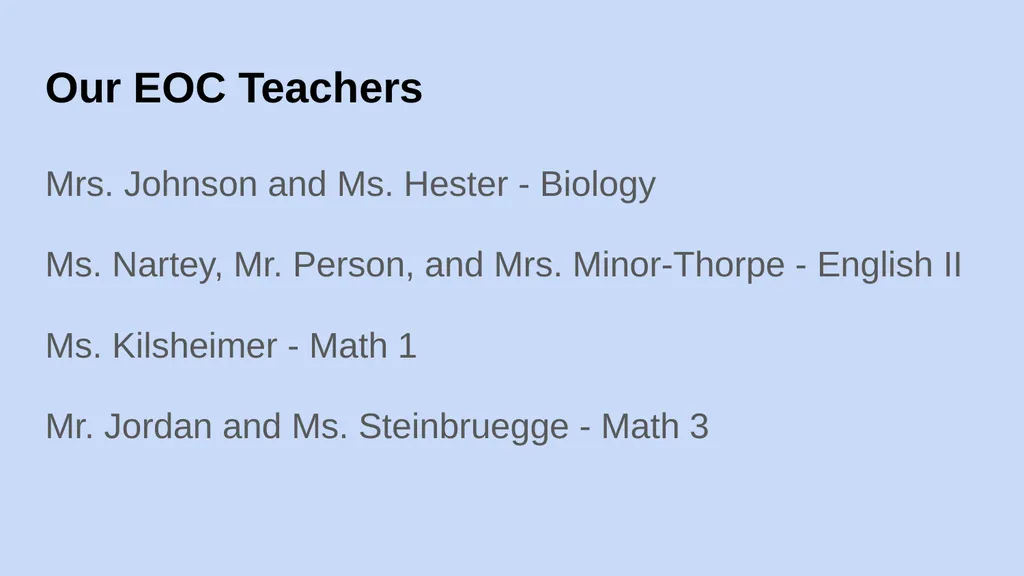
slide5. Our EOC Teachers Mrs. Johnson and Ms. Hester - Biology
Ms. Nartey, Mr. Person, and Mrs. Minor-Thorpe - English II
Ms. Kilsheimer - Math 1
Mr. Jordan and Ms. Steinbruegge - Math 3<br>
slide6. Biology Ms. Hester and Mrs. (Lyndsey) Johnson<br>
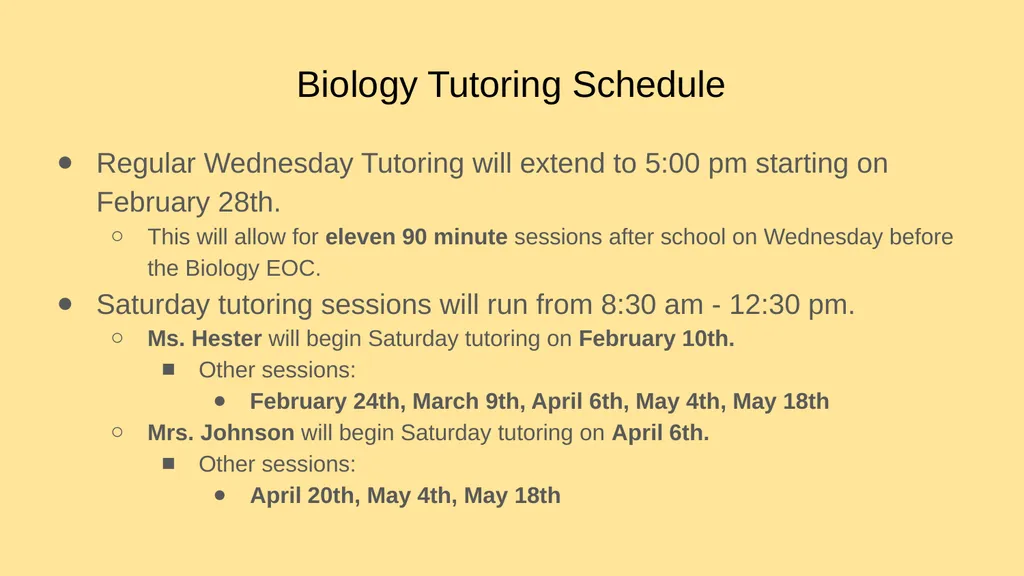
slide7. Biology Tutoring Schedule Regular Wednesday Tutoring will extend to 5:00 pm starting on February 28th.
This will allow for eleven 90 minute sessions after school on Wednesday before the Biology EOC.
Saturday tutoring sessions will run from 8:30 am - 12:30 pm.
Ms. Hester will begin Saturday tutoring on February 10th.
Other sessions:
February 24th, March 9th, April 6th, May 4th, May 18th
Mrs. Johnson will begin Saturday tutoring on April 6th.
Other sessions:
April 20th, May 4th, May 18th<br>
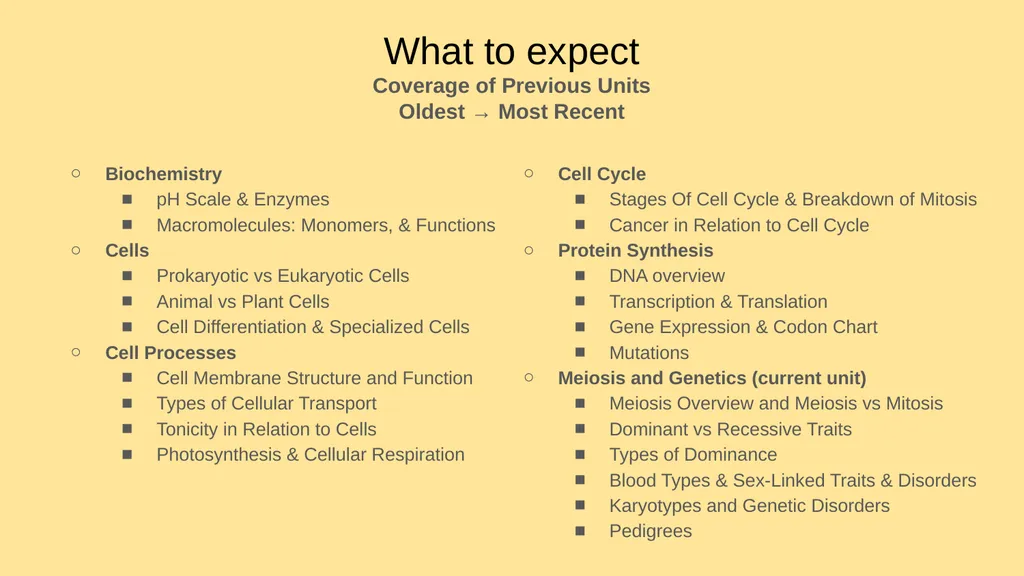
slide8. What to expect
Coverage of Previous Units
Oldest → Most Recent Biochemistry
pH Scale & Enzymes
Macromolecules: Monomers, & Functions
Cells
Prokaryotic vs Eukaryotic Cells
Animal vs Plant Cells
Cell Differentiation & Specialized Cells
Cell Processes
Cell Membrane Structure and Function
Types of Cellular Transport
Tonicity in Relation to Cells
Photosynthesis & Cellular Respiration Cell Cycle
Stages Of Cell Cycle & Breakdown of Mitosis
Cancer in Relation to Cell Cycle
Protein Synthesis
DNA overview
Transcription & Translation
Gene Expression & Codon Chart
Mutations
Meiosis and Genetics (current unit)
Meiosis Overview and Meiosis vs Mitosis
Dominant vs Recessive Traits
Types of Dominance
Blood Types & Sex-Linked Traits & Disorders
Karyotypes and Genetic Disorders
Pedigrees<br>
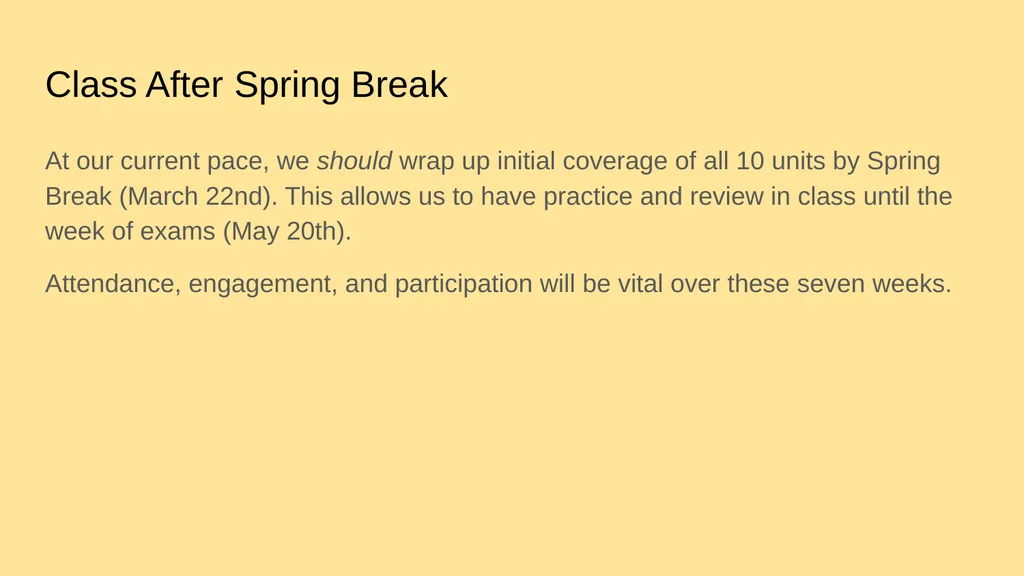
slide9. Class After Spring Break At our current pace, we should wrap up initial coverage of all 10 units by Spring Break (March 22nd). This allows us to have practice and review in class until the week of exams (May 20th).
Attendance, engagement, and participation will be vital over these seven weeks.<br>
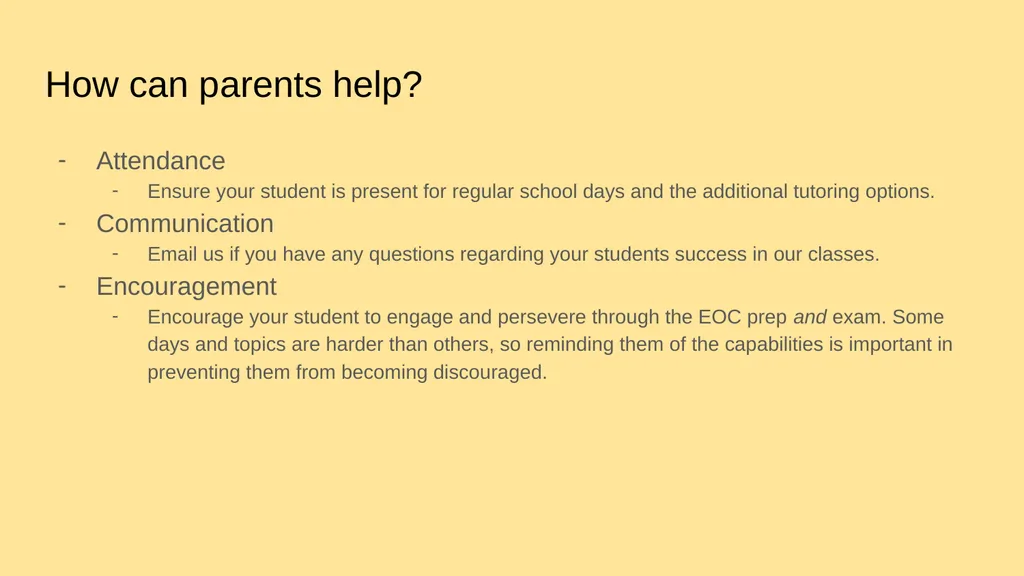
slide10. How can parents help? Attendance
Ensure your student is present for regular school days and the additional tutoring options.
Communication
Email us if you have any questions regarding your students success in our classes.
Encouragement
Encourage your student to engage and persevere through the EOC prep and exam. Some days and topics are harder than others, so reminding them of the capabilities is important in preventing them from becoming discouraged.<br>
slide11. English II End of Course Exam Overview English II Team
Piedmont Classical High School
EOC Night February 2024<br>
slide12. Meet the Team… Mr. Person Ms. Nartey Mrs. Minor - Thorpe<br>
slide13. Why Does The English II EOC Matter? The test measures our students' reading proficiency based on the NC Standard Course of Study for English Language Arts.
Test results contribute to 20% of each student’s final course grade. In other words, it can bring their final grades up or down.
Test results are used for school accountability and federal reporting. Source: NCDPI<br>
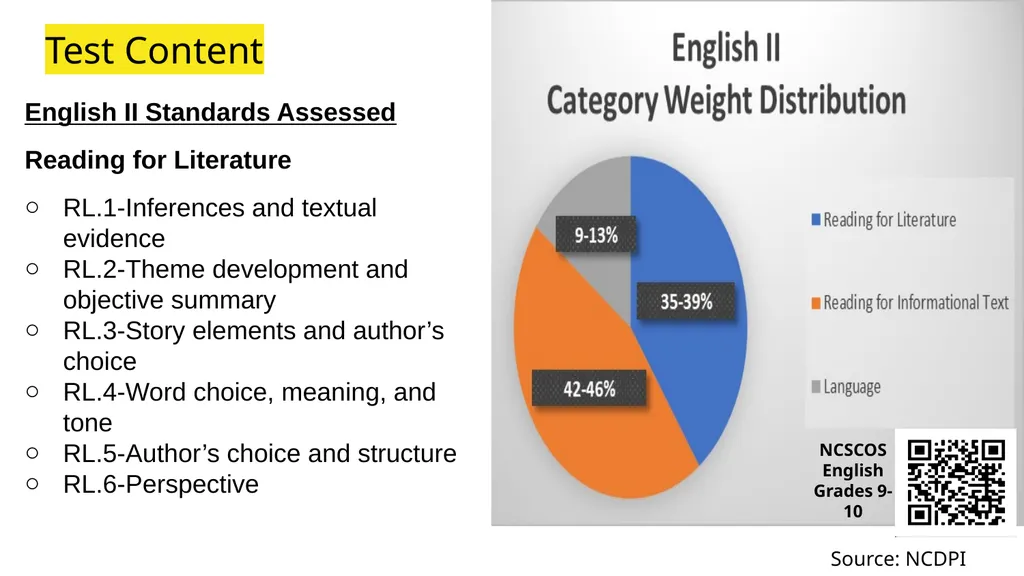
slide14. Test Content English II Standards Assessed
Reading for Literature
RL.1-Inferences and textual evidence
RL.2-Theme development and objective summary
RL.3-Story elements and author’s choice
RL.4-Word choice, meaning, and tone
RL.5-Author’s choice and structure
RL.6-Perspective NCSCOS
English
Grades 9-10 Source: NCDPI<br>
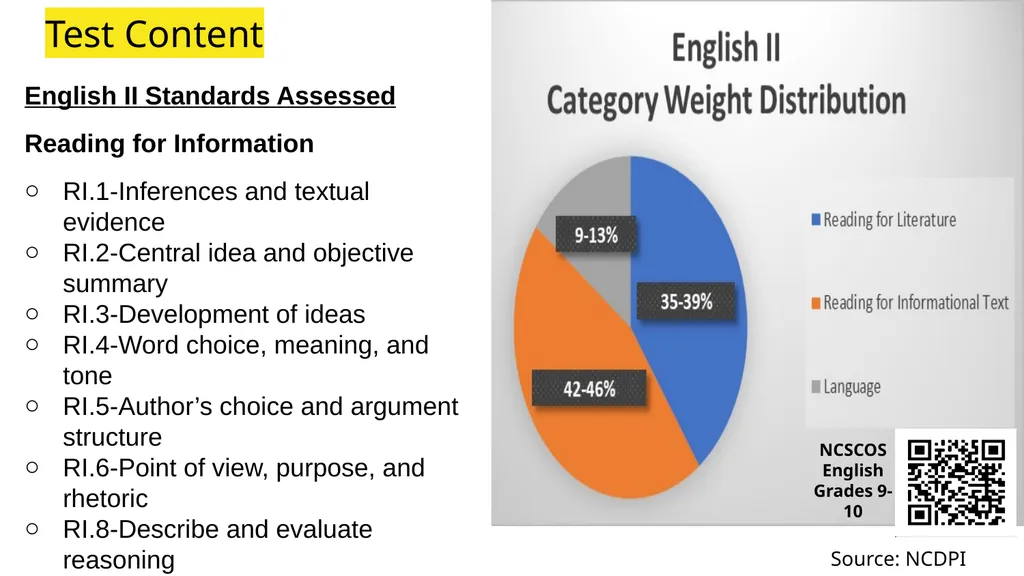
slide15. Test Content English II Standards Assessed
Reading for Information
RI.1-Inferences and textual evidence
RI.2-Central idea and objective summary
RI.3-Development of ideas
RI.4-Word choice, meaning, and tone
RI.5-Author’s choice and argument structure
RI.6-Point of view, purpose, and rhetoric
RI.8-Describe and evaluate reasoning NCSCOS
English
Grades 9-10 Source: NCDPI<br>
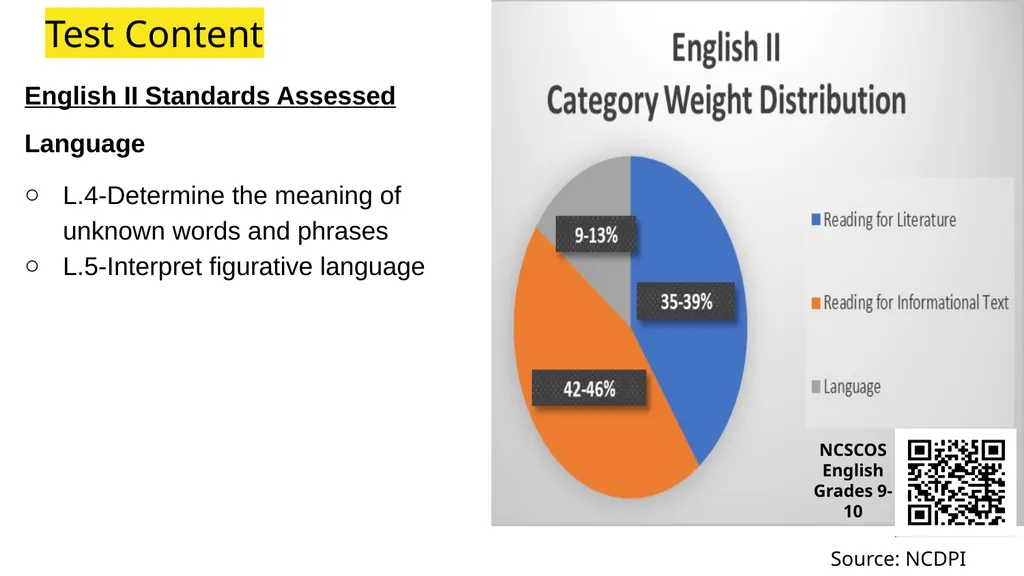
slide16. Test Content English II Standards Assessed
Language
L.4-Determine the meaning of unknown words and phrases
L.5-Interpret figurative language NCSCOS
English
Grades 9-10 Source: NCDPI<br>
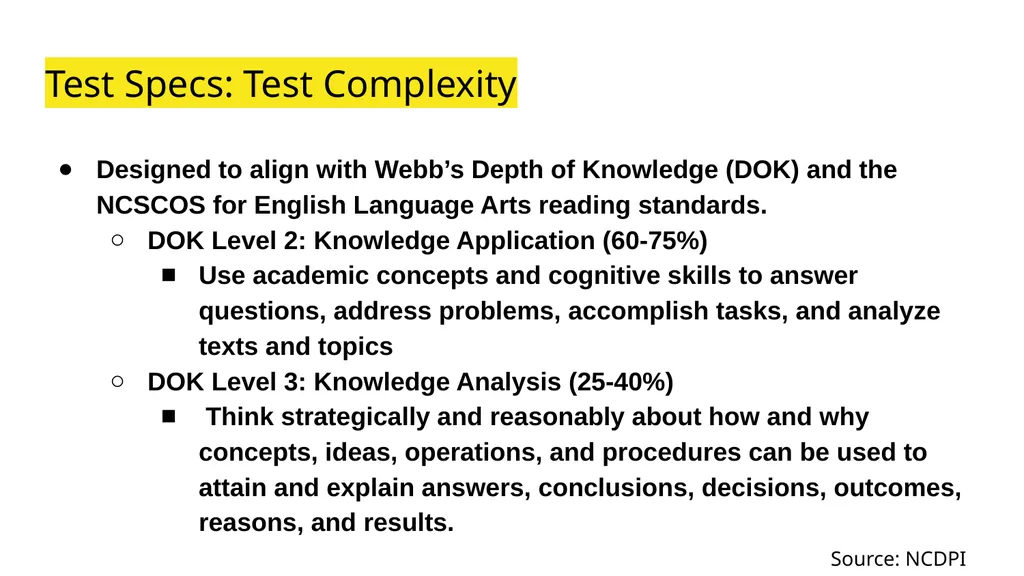
slide17. Test Specs: Test Complexity Designed to align with Webb’s Depth of Knowledge (DOK) and the NCSCOS for English Language Arts reading standards.
DOK Level 2: Knowledge Application (60-75%)
Use academic concepts and cognitive skills to answer questions, address problems, accomplish tasks, and analyze texts and topics
DOK Level 3: Knowledge Analysis (25-40%)
Think strategically and reasonably about how and why concepts, ideas, operations, and procedures can be used to attain and explain answers, conclusions, decisions, outcomes, reasons, and results. Source: NCDPI<br>
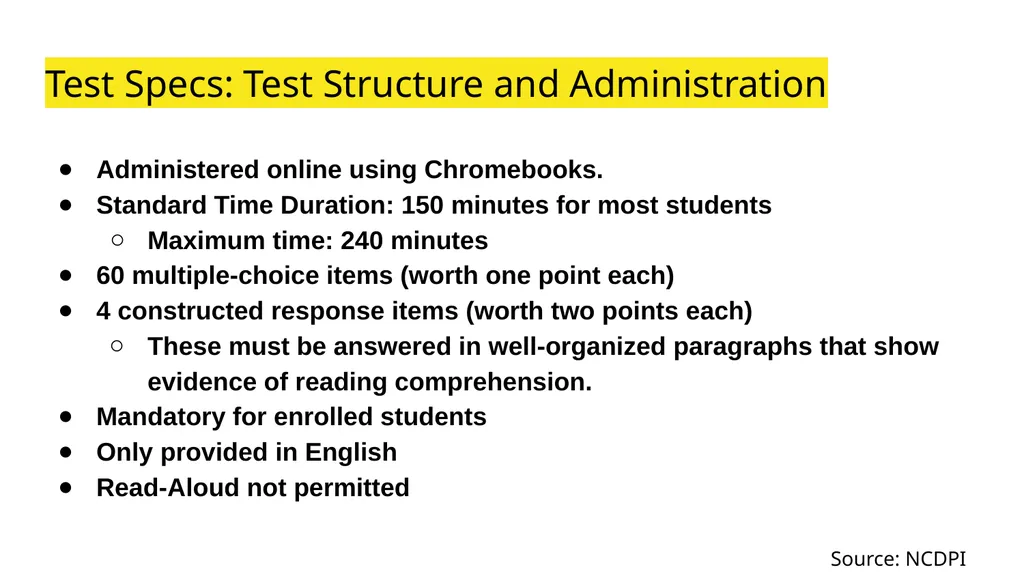
slide18. Test Specs: Test Structure and Administration Administered online using Chromebooks.
Standard Time Duration: 150 minutes for most students
Maximum time: 240 minutes
60 multiple-choice items (worth one point each)
4 constructed response items (worth two points each)
These must be answered in well-organized paragraphs that show evidence of reading comprehension.
Mandatory for enrolled students
Only provided in English
Read-Aloud not permitted Source: NCDPI<br>
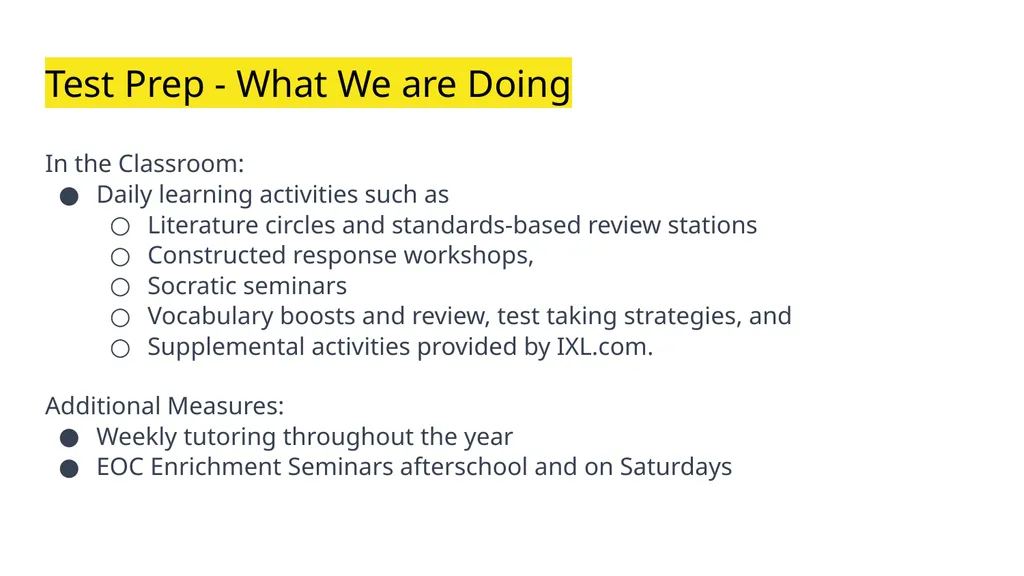
slide19. Test Prep - What We are Doing In the Classroom:
Daily learning activities such as
Literature circles and standards-based review stations
Constructed response workshops,
Socratic seminars
Vocabulary boosts and review, test taking strategies, and
Supplemental activities provided by IXL.com.
Additional Measures:
Weekly tutoring throughout the year
EOC Enrichment Seminars afterschool and on Saturdays<br>
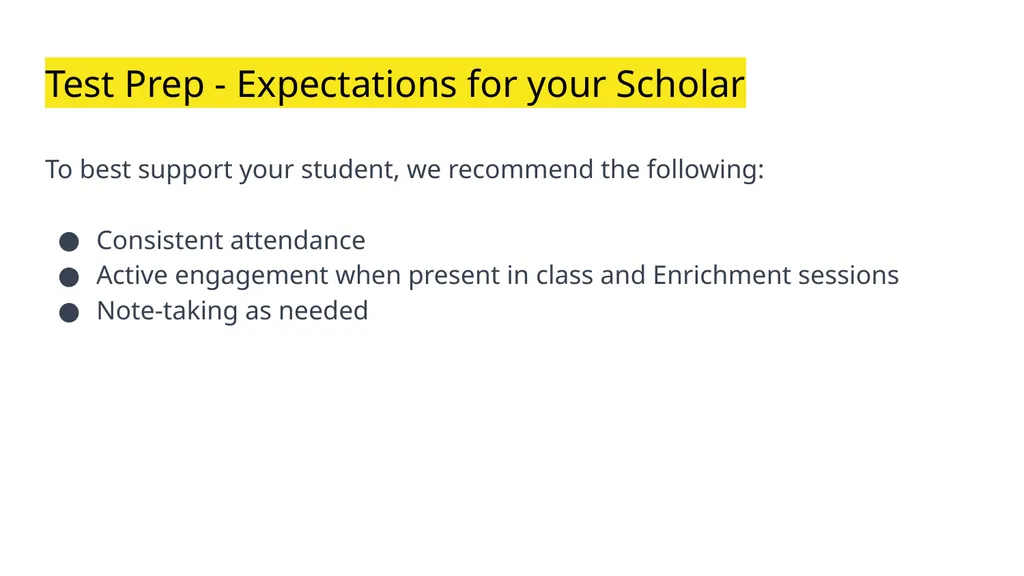
slide20. Test Prep - Expectations for your Scholar To best support your student, we recommend the following:
Consistent attendance
Active engagement when present in class and Enrichment sessions
Note-taking as needed<br>
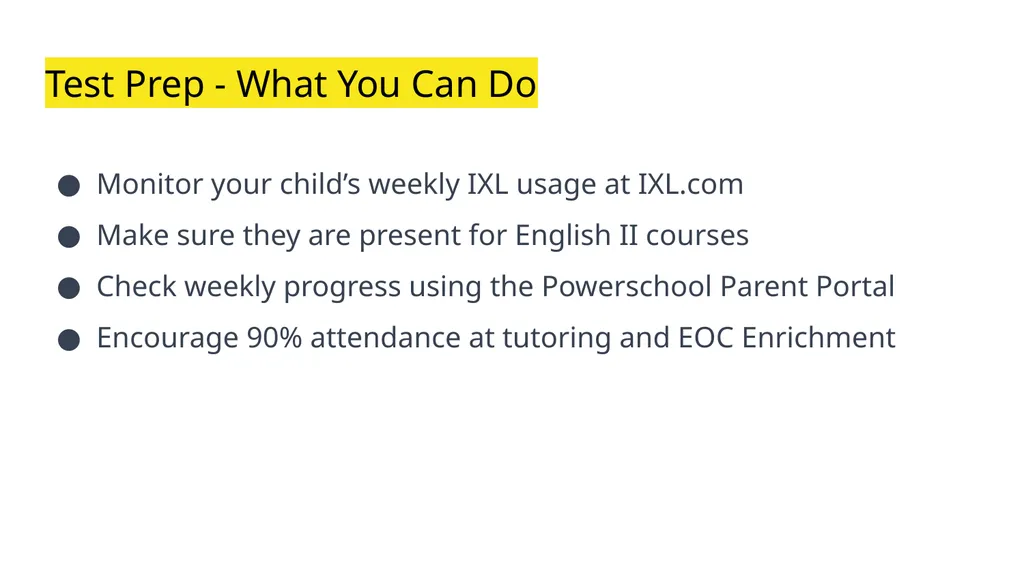
slide21. Test Prep - What You Can Do Monitor your child’s weekly IXL usage at IXL.com
Make sure they are present for English II courses
Check weekly progress using the Powerschool Parent Portal
Encourage 90% attendance at tutoring and EOC Enrichment<br>
slide22. Let’s Go Bobcats!!! Thank you for your ongoing cooperation and support for our students’ success! Mrs. Minor-Thorpenminor@piedmontclassical.com Ms. Nartey pnartey@piedmontclassical.com Mr. Person rperson@piedmontclassical.com<br>
slide23. Math Department<br>
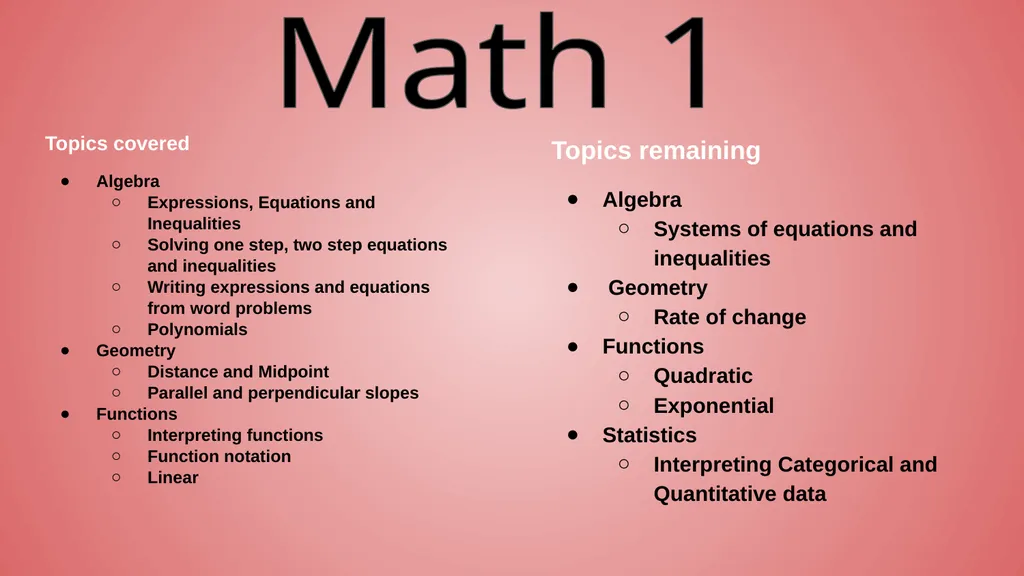
slide24. Topics covered
Algebra
Expressions, Equations and Inequalities
Solving one step, two step equations and inequalities
Writing expressions and equations from word problems
Polynomials
Geometry
Distance and Midpoint
Parallel and perpendicular slopes
Functions
Interpreting functions
Function notation
Linear Topics remaining
Algebra
Systems of equations and inequalities
Geometry
Rate of change
Functions
Quadratic
Exponential
Statistics
Interpreting Categorical and Quantitative data Math 1<br>
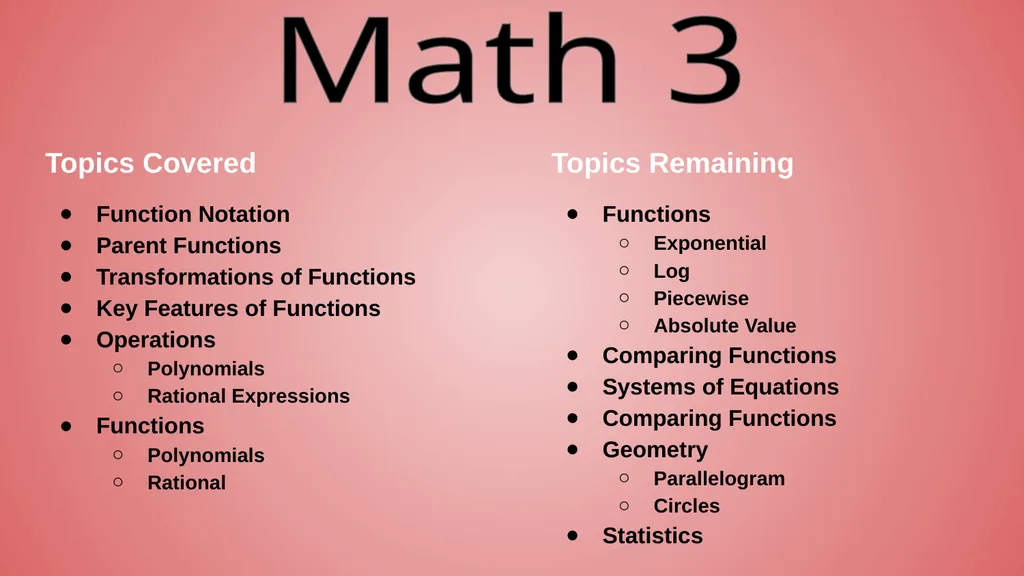
slide25. Topics Covered
Function Notation
Parent Functions
Transformations of Functions
Key Features of Functions
Operations
Polynomials
Rational Expressions
Functions
Polynomials
Rational Topics Remaining
Functions
Exponential
Log
Piecewise
Absolute Value
Comparing Functions
Systems of Equations
Comparing Functions
Geometry
Parallelogram
Circles
Statistics Math 3<br>
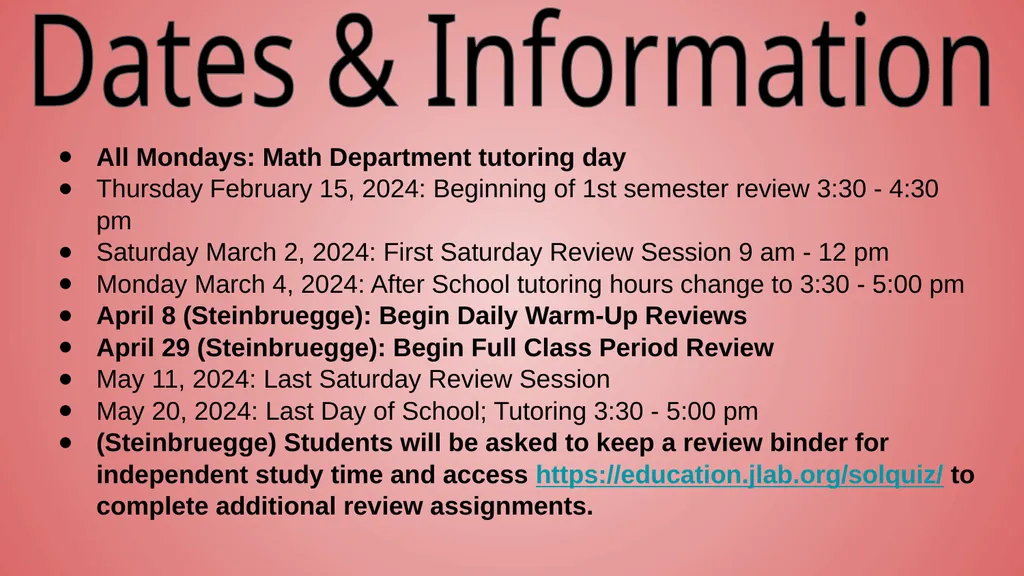
slide26. All Mondays: Math Department tutoring day
Thursday February 15, 2024: Beginning of 1st semester review 3:30 - 4:30 pm
Saturday March 2, 2024: First Saturday Review Session 9 am - 12 pm
Monday March 4, 2024: After School tutoring hours change to 3:30 - 5:00 pm
April 8 (Steinbruegge): Begin Daily Warm-Up Reviews
April 29 (Steinbruegge): Begin Full Class Period Review
May 11, 2024: Last Saturday Review Session
May 20, 2024: Last Day of School; Tutoring 3:30 - 5:00 pm
(Steinbruegge) Students will be asked to keep a review binder for independent study time and access https://education.jlab.org/solquiz/ to complete additional review assignments. Dates & Information<br>
slide27. Communication
Phone
Email
Letters
Drop off and Pick Up
Do your best to be on time
Encouragement
Encourage students to stay for tutoring
Students to study 15-20 minutes EACH night from their notebooks/binders
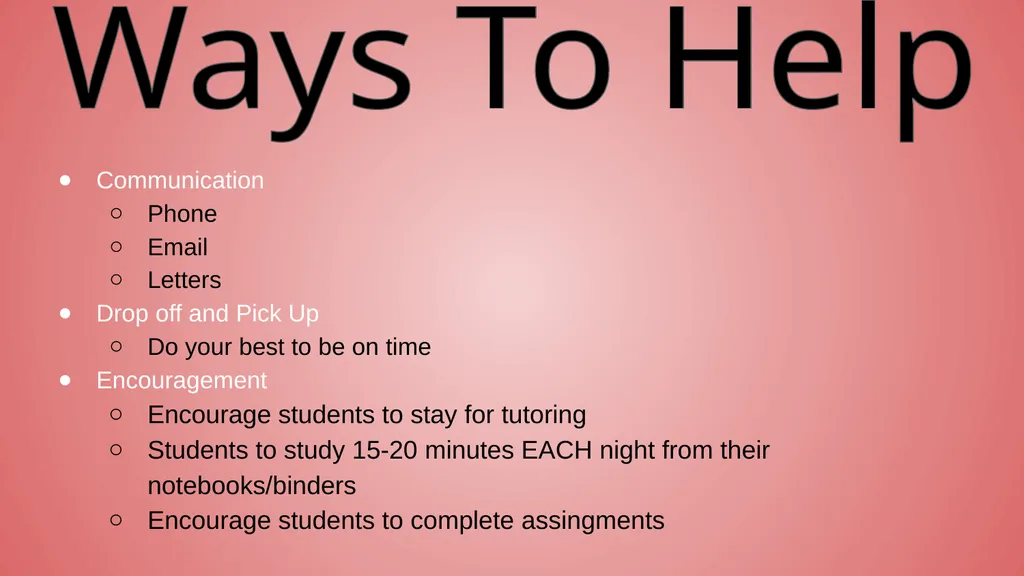
Encourage students to complete assingments Ways To Help<br>
slide28. Dates of tutoring are subject to change due to bad weather or sickness. Any changes will be communicated by the teacher or the school as a whole.<br>

slide2. EOC Testing Dates English II Tuesday, May 21, 2024 Math 3 Wednesday, May 22, 2024 Biology Thursday, May 23, 2024 Math 1 Friday, May 24, 2024 All testing will begin no later than 8:30 a.m.<br>
slide3. We need your help! 1. Have your student to school on time. 2. Make sure your student is rested and fed. 3. Sign your student up for tutoring. 4. Communicate with your student’s teachers. 5. Encourage your student to participate, ask questions, and take ownership of their education.<br>
slide4. Parents + Students +Teachers = Success<br>
slide5. Our EOC Teachers Mrs. Johnson and Ms. Hester - Biology
Ms. Nartey, Mr. Person, and Mrs. Minor-Thorpe - English II
Ms. Kilsheimer - Math 1
Mr. Jordan and Ms. Steinbruegge - Math 3<br>
slide6. Biology Ms. Hester and Mrs. (Lyndsey) Johnson<br>
slide7. Biology Tutoring Schedule Regular Wednesday Tutoring will extend to 5:00 pm starting on February 28th.
This will allow for eleven 90 minute sessions after school on Wednesday before the Biology EOC.
Saturday tutoring sessions will run from 8:30 am - 12:30 pm.
Ms. Hester will begin Saturday tutoring on February 10th.
Other sessions:
February 24th, March 9th, April 6th, May 4th, May 18th
Mrs. Johnson will begin Saturday tutoring on April 6th.
Other sessions:
April 20th, May 4th, May 18th<br>
slide8. What to expect
Coverage of Previous Units
Oldest → Most Recent Biochemistry
pH Scale & Enzymes
Macromolecules: Monomers, & Functions
Cells
Prokaryotic vs Eukaryotic Cells
Animal vs Plant Cells
Cell Differentiation & Specialized Cells
Cell Processes
Cell Membrane Structure and Function
Types of Cellular Transport
Tonicity in Relation to Cells
Photosynthesis & Cellular Respiration Cell Cycle
Stages Of Cell Cycle & Breakdown of Mitosis
Cancer in Relation to Cell Cycle
Protein Synthesis
DNA overview
Transcription & Translation
Gene Expression & Codon Chart
Mutations
Meiosis and Genetics (current unit)
Meiosis Overview and Meiosis vs Mitosis
Dominant vs Recessive Traits
Types of Dominance
Blood Types & Sex-Linked Traits & Disorders
Karyotypes and Genetic Disorders
Pedigrees<br>
slide9. Class After Spring Break At our current pace, we should wrap up initial coverage of all 10 units by Spring Break (March 22nd). This allows us to have practice and review in class until the week of exams (May 20th).
Attendance, engagement, and participation will be vital over these seven weeks.<br>
slide10. How can parents help? Attendance
Ensure your student is present for regular school days and the additional tutoring options.
Communication
Email us if you have any questions regarding your students success in our classes.
Encouragement
Encourage your student to engage and persevere through the EOC prep and exam. Some days and topics are harder than others, so reminding them of the capabilities is important in preventing them from becoming discouraged.<br>
slide11. English II End of Course Exam Overview English II Team
Piedmont Classical High School
EOC Night February 2024<br>
slide12. Meet the Team… Mr. Person Ms. Nartey Mrs. Minor - Thorpe<br>
slide13. Why Does The English II EOC Matter? The test measures our students' reading proficiency based on the NC Standard Course of Study for English Language Arts.
Test results contribute to 20% of each student’s final course grade. In other words, it can bring their final grades up or down.
Test results are used for school accountability and federal reporting. Source: NCDPI<br>
slide14. Test Content English II Standards Assessed
Reading for Literature
RL.1-Inferences and textual evidence
RL.2-Theme development and objective summary
RL.3-Story elements and author’s choice
RL.4-Word choice, meaning, and tone
RL.5-Author’s choice and structure
RL.6-Perspective NCSCOS
English
Grades 9-10 Source: NCDPI<br>
slide15. Test Content English II Standards Assessed
Reading for Information
RI.1-Inferences and textual evidence
RI.2-Central idea and objective summary
RI.3-Development of ideas
RI.4-Word choice, meaning, and tone
RI.5-Author’s choice and argument structure
RI.6-Point of view, purpose, and rhetoric
RI.8-Describe and evaluate reasoning NCSCOS
English
Grades 9-10 Source: NCDPI<br>
slide16. Test Content English II Standards Assessed
Language
L.4-Determine the meaning of unknown words and phrases
L.5-Interpret figurative language NCSCOS
English
Grades 9-10 Source: NCDPI<br>
slide17. Test Specs: Test Complexity Designed to align with Webb’s Depth of Knowledge (DOK) and the NCSCOS for English Language Arts reading standards.
DOK Level 2: Knowledge Application (60-75%)
Use academic concepts and cognitive skills to answer questions, address problems, accomplish tasks, and analyze texts and topics
DOK Level 3: Knowledge Analysis (25-40%)
Think strategically and reasonably about how and why concepts, ideas, operations, and procedures can be used to attain and explain answers, conclusions, decisions, outcomes, reasons, and results. Source: NCDPI<br>
slide18. Test Specs: Test Structure and Administration Administered online using Chromebooks.
Standard Time Duration: 150 minutes for most students
Maximum time: 240 minutes
60 multiple-choice items (worth one point each)
4 constructed response items (worth two points each)
These must be answered in well-organized paragraphs that show evidence of reading comprehension.
Mandatory for enrolled students
Only provided in English
Read-Aloud not permitted Source: NCDPI<br>
slide19. Test Prep - What We are Doing In the Classroom:
Daily learning activities such as
Literature circles and standards-based review stations
Constructed response workshops,
Socratic seminars
Vocabulary boosts and review, test taking strategies, and
Supplemental activities provided by IXL.com.
Additional Measures:
Weekly tutoring throughout the year
EOC Enrichment Seminars afterschool and on Saturdays<br>
slide20. Test Prep - Expectations for your Scholar To best support your student, we recommend the following:
Consistent attendance
Active engagement when present in class and Enrichment sessions
Note-taking as needed<br>
slide21. Test Prep - What You Can Do Monitor your child’s weekly IXL usage at IXL.com
Make sure they are present for English II courses
Check weekly progress using the Powerschool Parent Portal
Encourage 90% attendance at tutoring and EOC Enrichment<br>
slide22. Let’s Go Bobcats!!! Thank you for your ongoing cooperation and support for our students’ success! Mrs. Minor-Thorpenminor@piedmontclassical.com Ms. Nartey pnartey@piedmontclassical.com Mr. Person rperson@piedmontclassical.com<br>
slide23. Math Department<br>
slide24. Topics covered
Algebra
Expressions, Equations and Inequalities
Solving one step, two step equations and inequalities
Writing expressions and equations from word problems
Polynomials
Geometry
Distance and Midpoint
Parallel and perpendicular slopes
Functions
Interpreting functions
Function notation
Linear Topics remaining
Algebra
Systems of equations and inequalities
Geometry
Rate of change
Functions
Quadratic
Exponential
Statistics
Interpreting Categorical and Quantitative data Math 1<br>
slide25. Topics Covered
Function Notation
Parent Functions
Transformations of Functions
Key Features of Functions
Operations
Polynomials
Rational Expressions
Functions
Polynomials
Rational Topics Remaining
Functions
Exponential
Log
Piecewise
Absolute Value
Comparing Functions
Systems of Equations
Comparing Functions
Geometry
Parallelogram
Circles
Statistics Math 3<br>
slide26. All Mondays: Math Department tutoring day
Thursday February 15, 2024: Beginning of 1st semester review 3:30 - 4:30 pm
Saturday March 2, 2024: First Saturday Review Session 9 am - 12 pm
Monday March 4, 2024: After School tutoring hours change to 3:30 - 5:00 pm
April 8 (Steinbruegge): Begin Daily Warm-Up Reviews
April 29 (Steinbruegge): Begin Full Class Period Review
May 11, 2024: Last Saturday Review Session
May 20, 2024: Last Day of School; Tutoring 3:30 - 5:00 pm
(Steinbruegge) Students will be asked to keep a review binder for independent study time and access https://education.jlab.org/solquiz/ to complete additional review assignments. Dates & Information<br>
slide27. Communication
Phone
Letters
Drop off and Pick Up
Do your best to be on time
Encouragement
Encourage students to stay for tutoring
Students to study 15-20 minutes EACH night from their notebooks/binders
Encourage students to complete assingments Ways To Help<br>
slide28. Dates of tutoring are subject to change due to bad weather or sickness. Any changes will be communicated by the teacher or the school as a whole.<br>