04
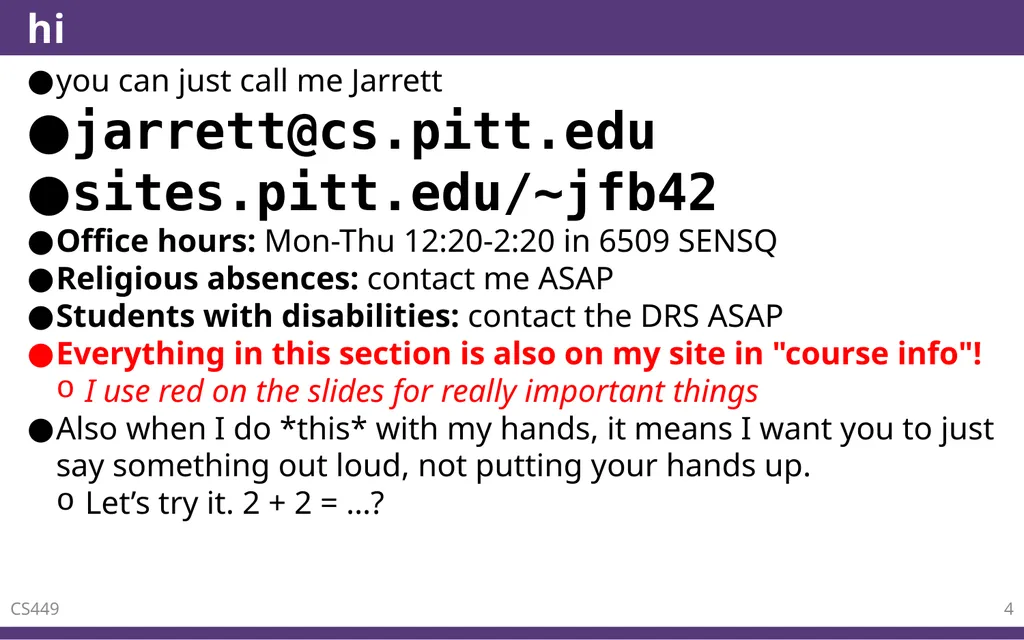
hi you can just call me Jarrett
jarrett@cs.pitt.edu
sites.pitt.edu/~jfb42
Office hours: Mon-Thu 12:20-2:20 in 6509 SENSQ
Religious absences: contact me ASAP
Students with disabilities: contact the DRS ASAP
Everything in this section is also on my site in "course info"!
I use red on the slides for really important things
Also when I do *this* with my hands, it means I want you to just say something out loud, not putting your hands up.
Let’s try it. 2 + 2 = …? CS449 4<br>
05
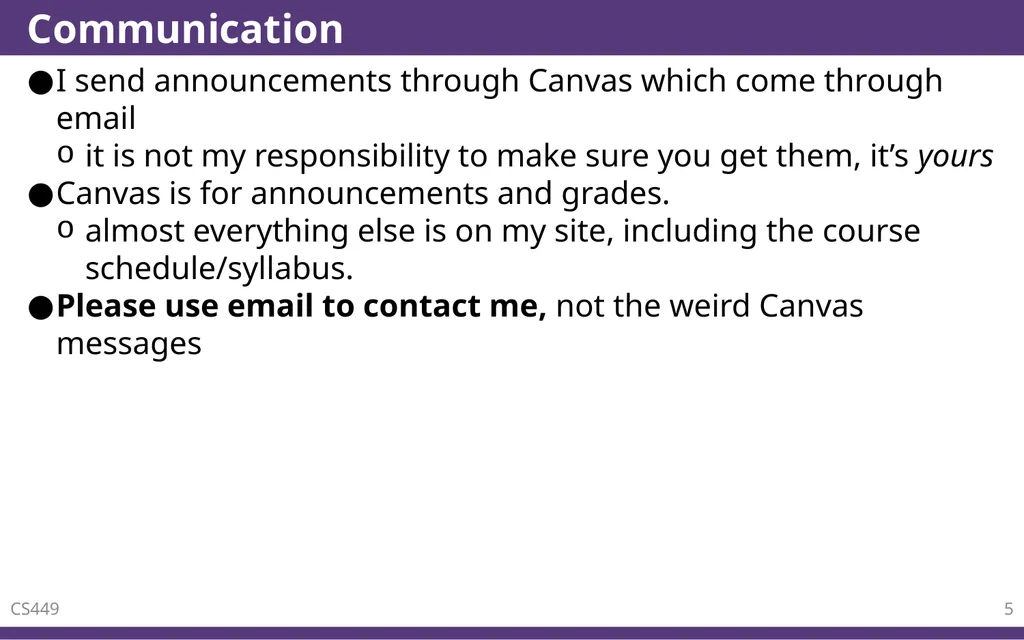
Communication I send announcements through Canvas which come through email
it is not my responsibility to make sure you get them, it’s yours
Canvas is for announcements and grades.
almost everything else is on my site, including the course schedule/syllabus.
Please use email to contact me, not the weird Canvas messages CS449 5<br>
06
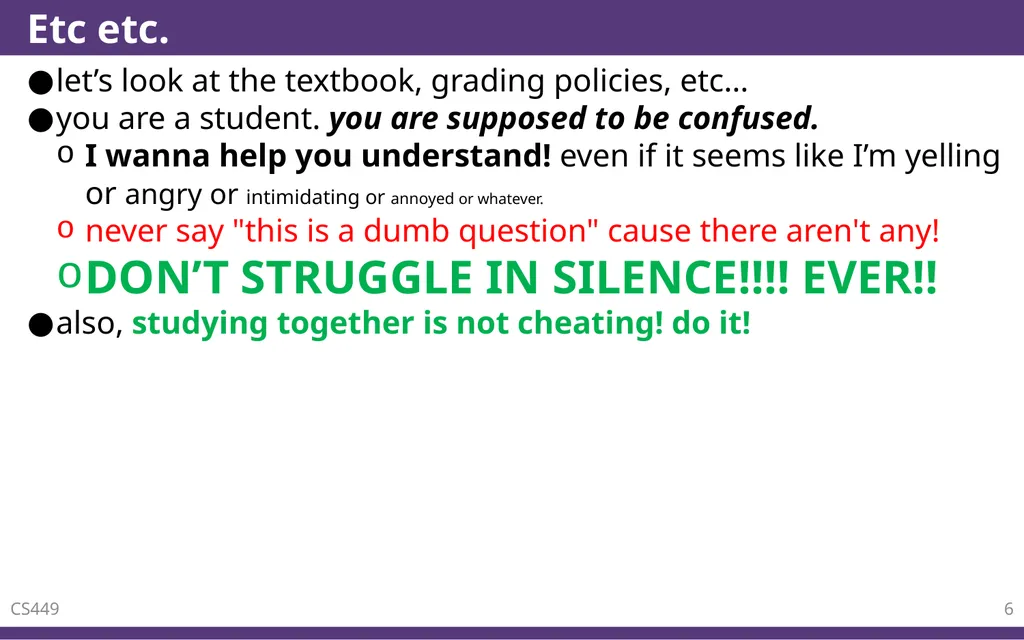
Etc etc. let’s look at the textbook, grading policies, etc…
you are a student. you are supposed to be confused.
I wanna help you understand! even if it seems like I’m yelling or angry or intimidating or annoyed or whatever.
never say "this is a dumb question" cause there aren't any!
DON’T STRUGGLE IN SILENCE!!!! EVER!!
also, studying together is not cheating! do it! CS449 6<br>
07
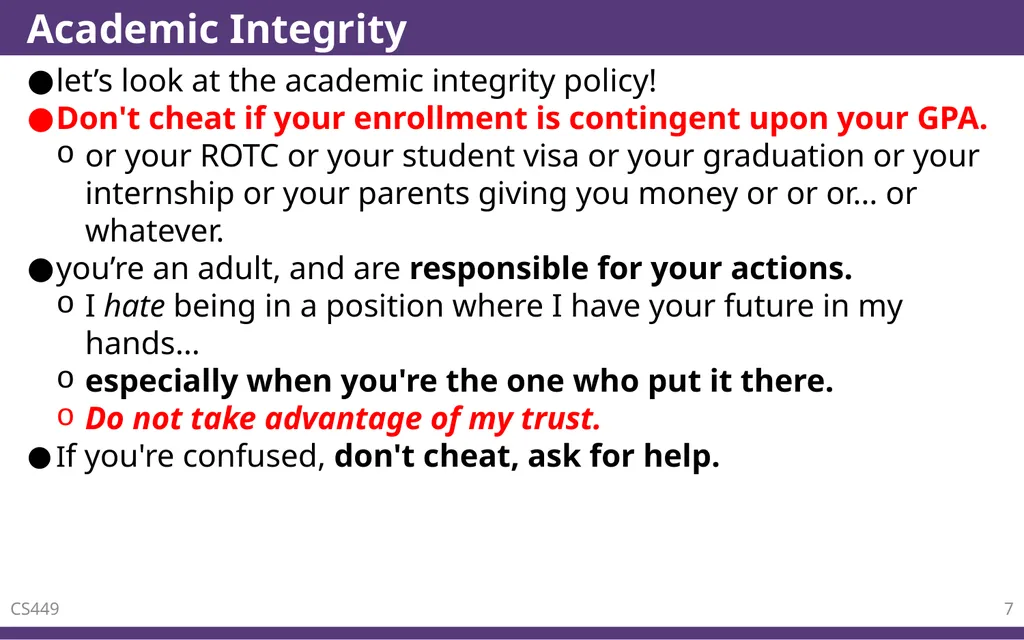
Academic Integrity let’s look at the academic integrity policy!
Don't cheat if your enrollment is contingent upon your GPA.
or your ROTC or your student visa or your graduation or your internship or your parents giving you money or or or… or whatever.
you’re an adult, and are responsible for your actions.
I hate being in a position where I have your future in my hands…
especially when you're the one who put it there.
Do not take advantage of my trust.
If you're confused, don't cheat, ask for help. CS449 7<br>
08
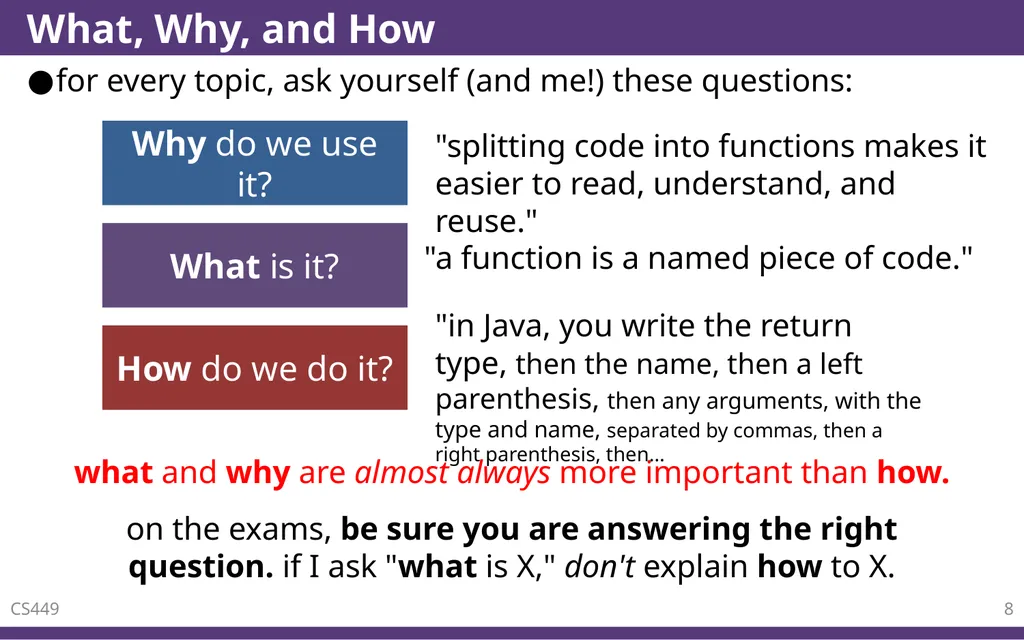
What, Why, and How for every topic, ask yourself (and me!) these questions: CS449 8 What is it? Why do we use it? How do we do it? "a function is a named piece of code." "splitting code into functions makes it easier to read, understand, and reuse." "in Java, you write the return type, then the name, then a left parenthesis, then any arguments, with the type and name, separated by commas, then a right parenthesis, then… what and why are almost always more important than how. on the exams, be sure you are answering the right question. if I ask "what is X," don't explain how to X.<br>
09
Compile-time vs.�Runtime CS449 9<br>
10
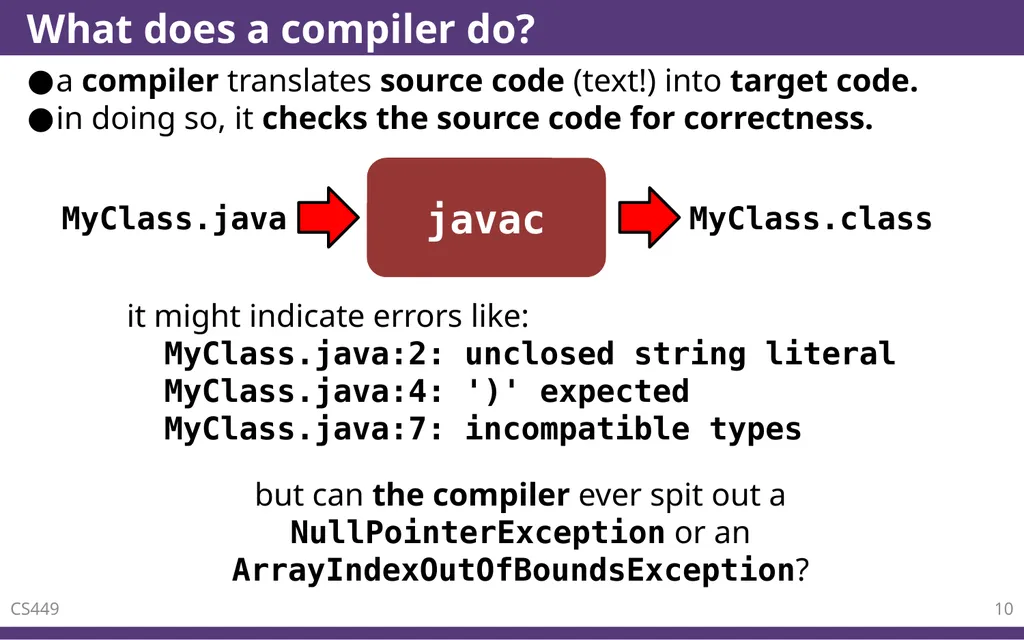
What does a compiler do? a compiler translates source code (text!) into target code.
in doing so, it checks the source code for correctness. CS449 10 MyClass.java javac MyClass.class it might indicate errors like:
MyClass.java:2: unclosed string literal
MyClass.java:4: ')' expected
MyClass.java:7: incompatible types but can the compiler ever spit out a NullPointerException or an ArrayIndexOutOfBoundsException?<br>
11
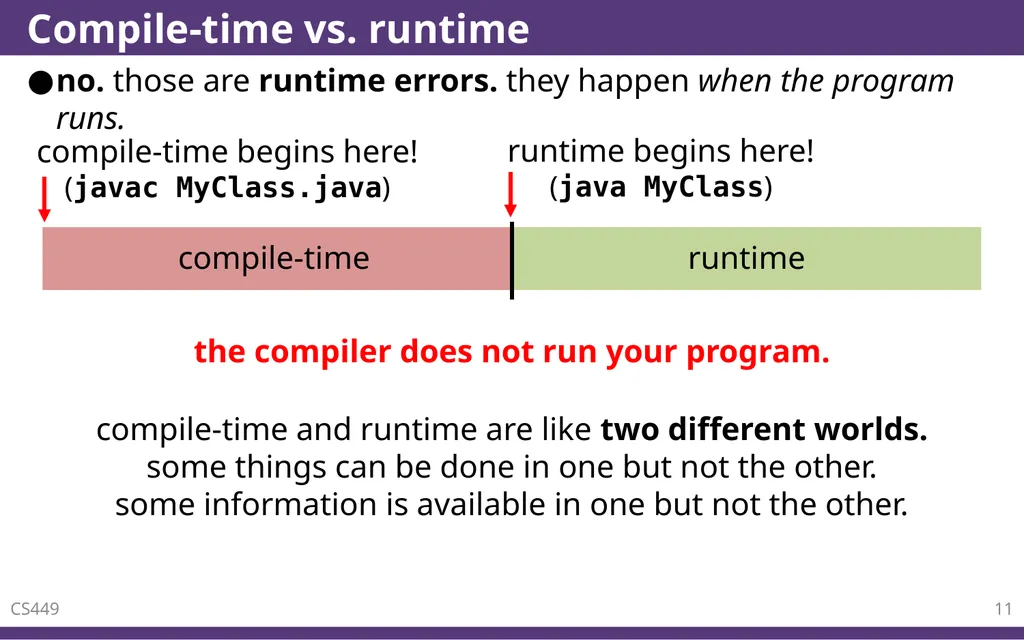
Compile-time vs. runtime no. those are runtime errors. they happen when the program runs. CS449 11 compile-time runtime the compiler does not run your program. compile-time and runtime are like two different worlds.
some things can be done in one but not the other.
some information is available in one but not the other.<br>
12
Error messages are incredibly important please, you need to understand this:�
error messages are the single most important piece of information you can give someone who is trying to help you. CS449 12<br>
13
Hello, world CS449 13<br>
14
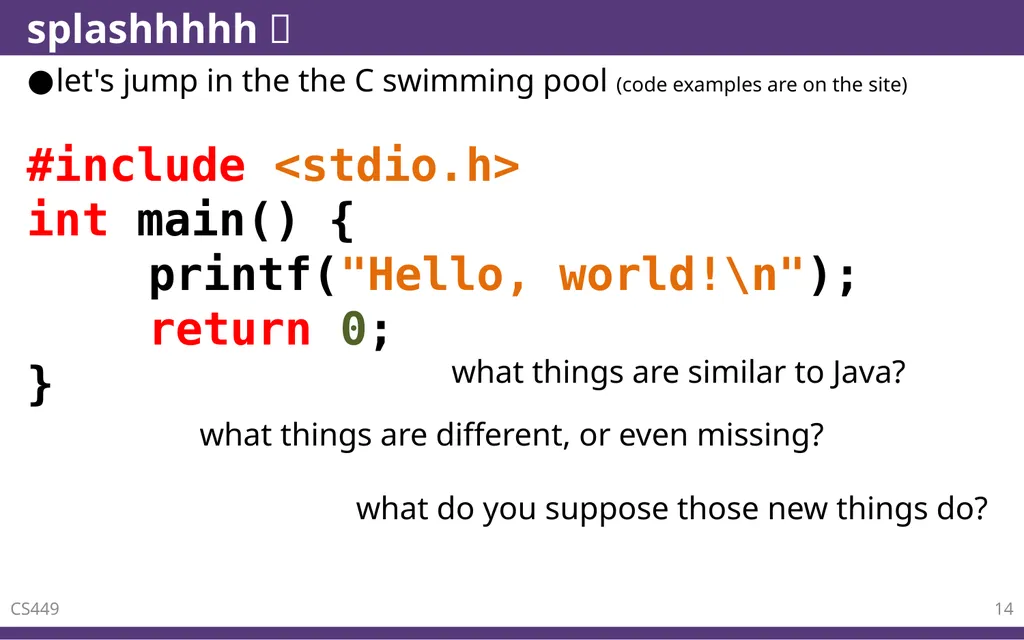
splashhhhh 💦 let's jump in the the C swimming pool (code examples are on the site)
#include <stdio.h>
int main() {
printf("Hello, world!\n");
return 0;
} CS449 14 what things are similar to Java? what things are different, or even missing? what do you suppose those new things do?<br>
15
Falling down the rabbit hole if you compile that C program, you get an executable file, but…
what does that executable file contain?
what happens when you run it?
how does the program actually make things happen?
how do programs control all the computer hardware?
how do multiple programs run at the same time?
that's what this course is all about.
by the end of the course, you will hopefully be able to answer all of the above questions! CS449 15<br>
16
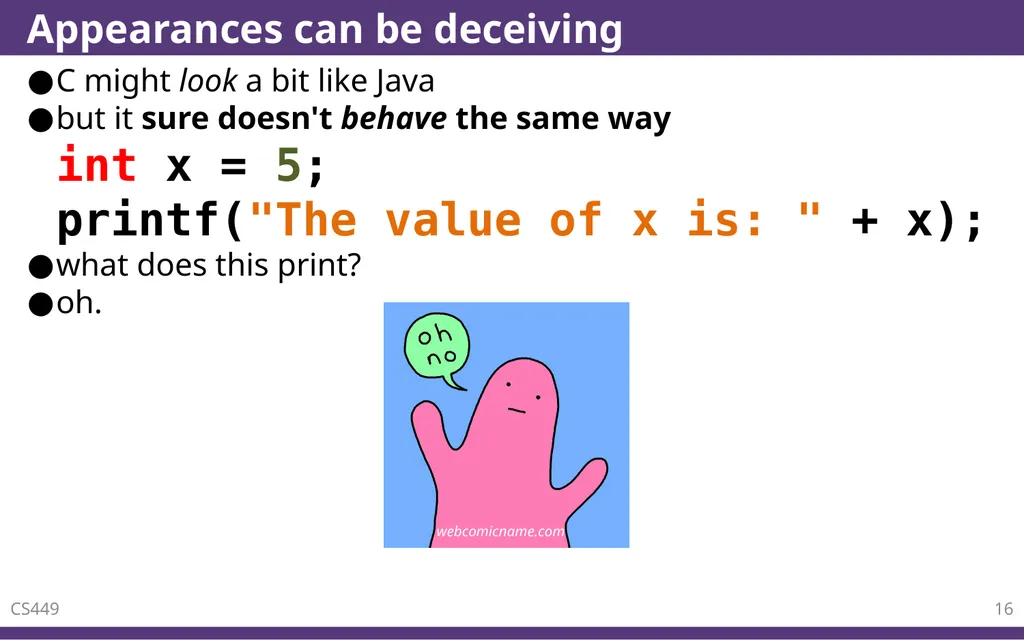
Appearances can be deceiving C might look a bit like Java
but it sure doesn't behave the same way
int x = 5;
printf("The value of x is: " + x);
what does this print?
oh. CS449 16<br>
17
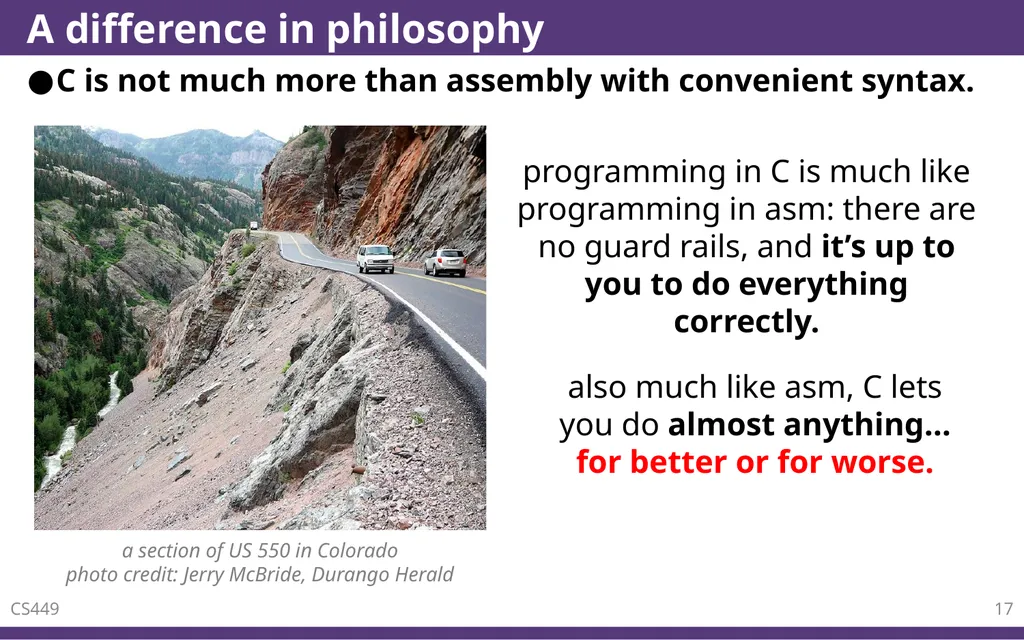
A difference in philosophy C is not much more than assembly with convenient syntax. CS449 17 programming in C is much like programming in asm: there are no guard rails, and it’s up to you to do everything correctly. also much like asm, C lets you do almost anything… for better or for worse. a section of US 550 in Colorado
photo credit: Jerry McBride, Durango Herald<br>
18
Undefined Behavior in Java, there are only two things your program can do:
it successfully runs to completion; or
it crashes with an exception.
in C, there is a third thing: undefined behavior (UB).
many, many things in C can cause UB. it’s all over the place.
it’s so widespread that it’s much harder to write a correct program in C than it is to write an incorrect one!
some possible outcomes of UB are:
the program crashes without telling you what went wrong.
the program continues to run, but it’s “messed up” somehow.
or worst of all… the program seems to work correctly 😱
there is a big difference between lucky and correct! CS449 18<br>
19
I'm gonna assume you know the following: how to write numbers and strings 123 4.5 "hello\nworld"
what mathematical operators are and do + - * / %
how to declare variables int x = 5;
how to write comments // with these /* and these */
if-else, while, do-while, for, and switch-case statements
what indentation is, why it's important, and how to do it
pieces of code “nest” inside one another.
indentation shows the level of nesting.
indentation is how humans visually parse the structure of code. it makes it so much faster and easier for us to read code.
you increase indent after a { and decrease before a }.
you only use tab and shift+tab to perform indentation. you never use the spacebar to indent. CS449 19<br>
20
Text input and output CS449 20<br>
21
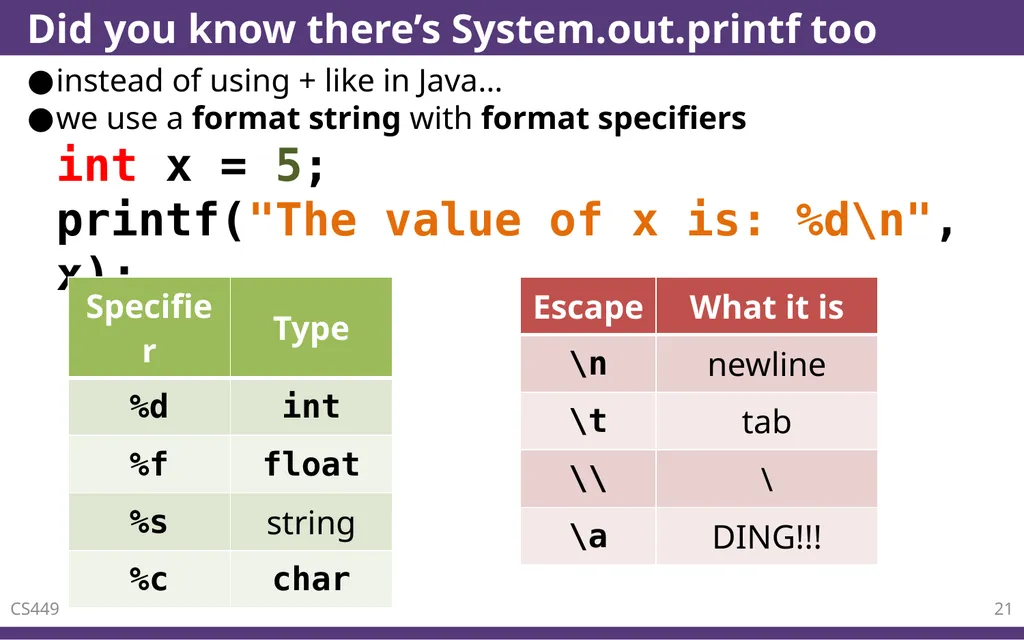
Did you know there’s System.out.printf too instead of using + like in Java…
we use a format string with format specifiers
int x = 5;
printf("The value of x is: %d\n", x); CS449 21<br>
22
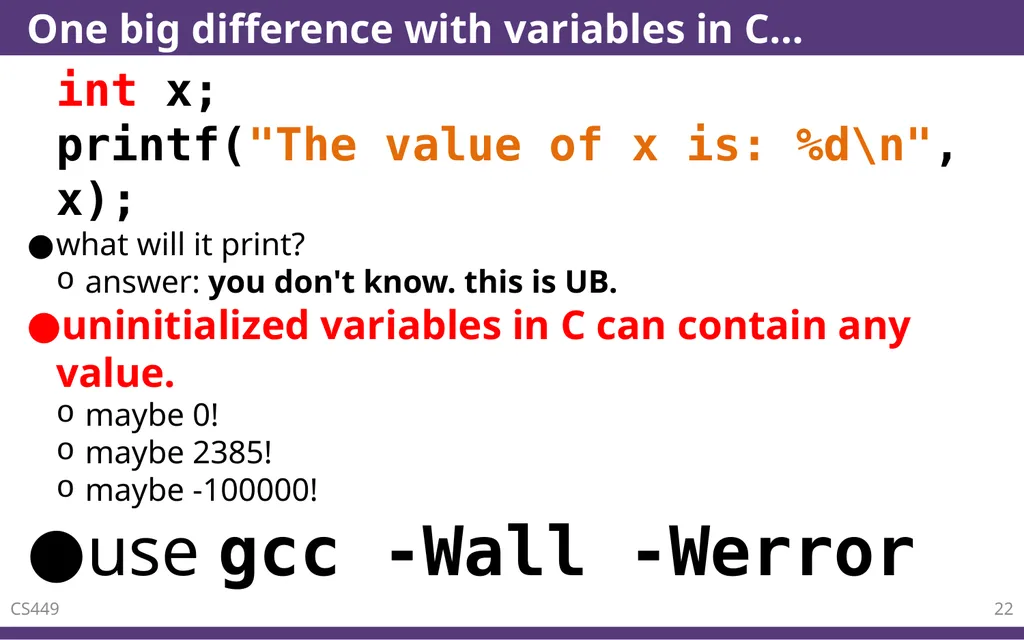
One big difference with variables in C… int x;
printf("The value of x is: %d\n", x);
what will it print?
answer: you don't know. this is UB.
uninitialized variables in C can contain any value.
maybe 0!
maybe 2385!
maybe -100000!
use gcc -Wall -Werror CS449 22<br>
23
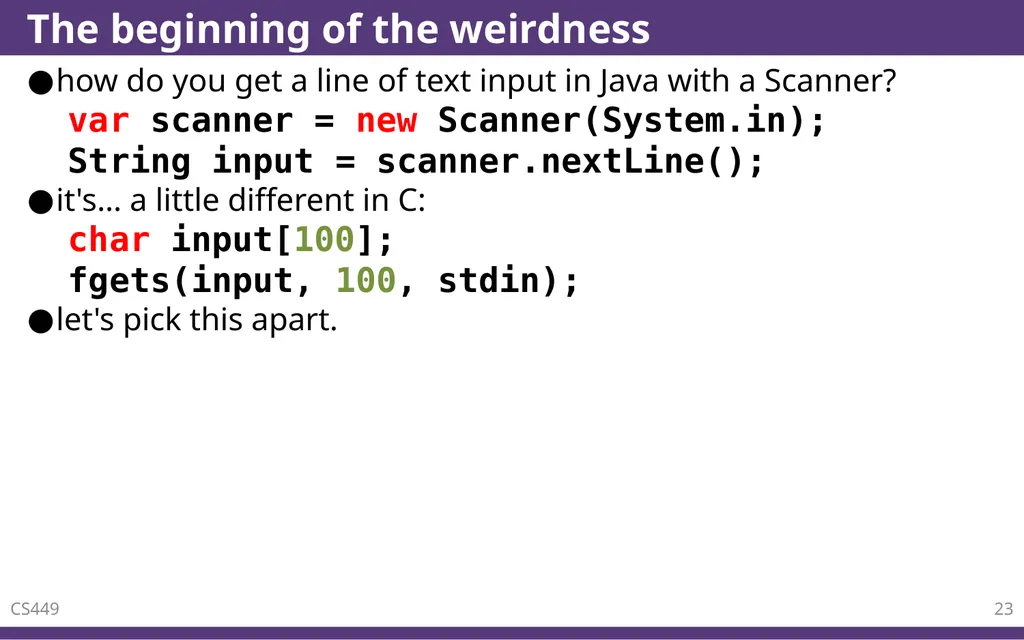
The beginning of the weirdness how do you get a line of text input in Java with a Scanner?
var scanner = new Scanner(System.in);
String input = scanner.nextLine();
it's… a little different in C:
char input[100];
fgets(input, 100, stdin);
let's pick this apart. CS449 23<br>
24
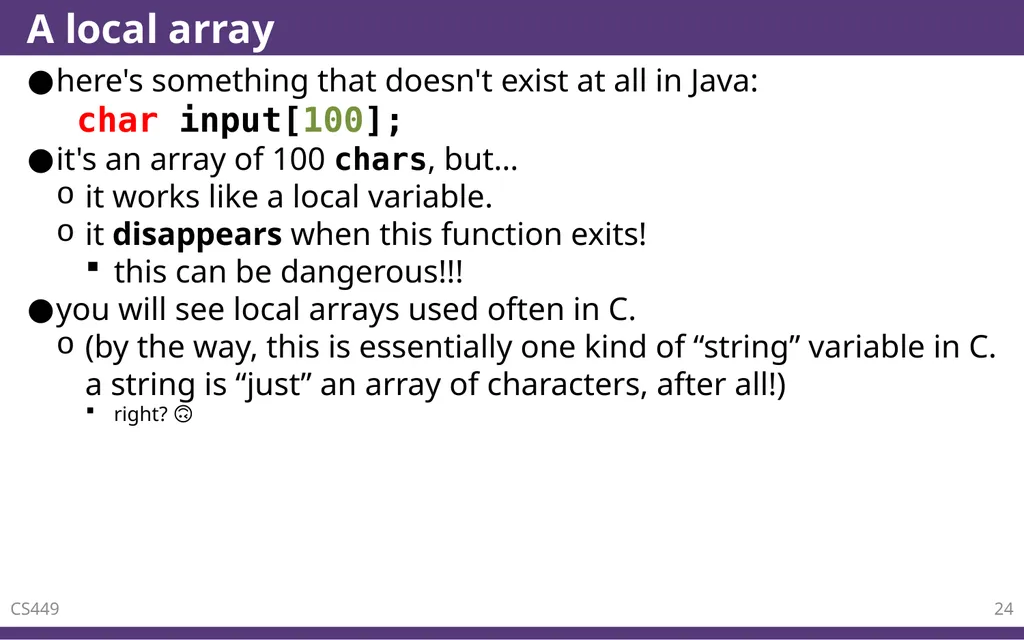
A local array here's something that doesn't exist at all in Java:� char input[100];
it's an array of 100 chars, but…
it works like a local variable.
it disappears when this function exits!
this can be dangerous!!!
you will see local arrays used often in C.
(by the way, this is essentially one kind of “string” variable in C. a string is “just” an array of characters, after all!)
right? 🙃 CS449 24<br>
25
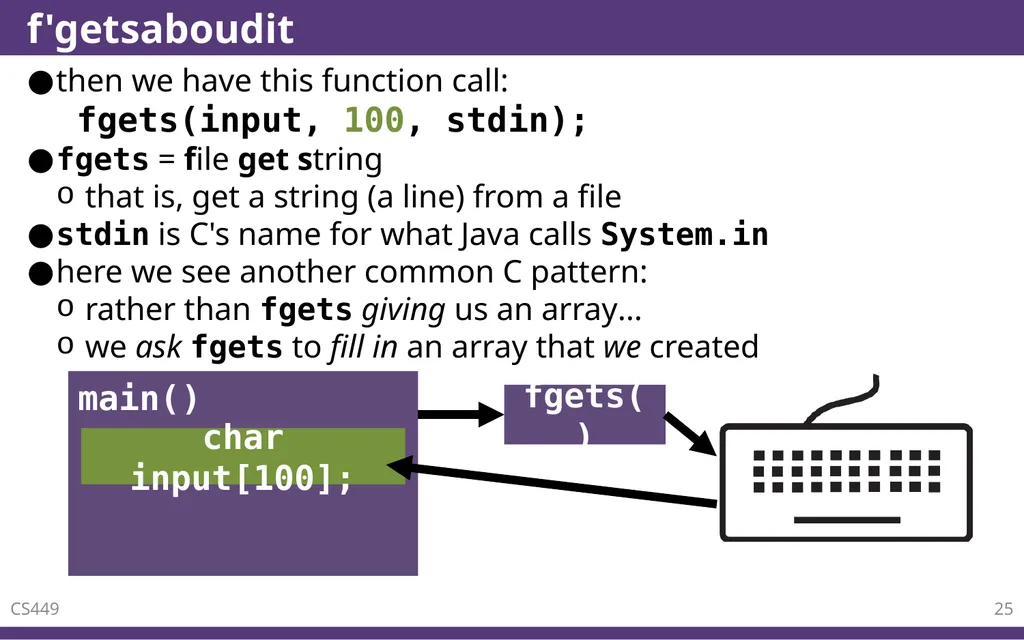
f'getsaboudit then we have this function call:� fgets(input, 100, stdin);
fgets = file get string
that is, get a string (a line) from a file
stdin is C's name for what Java calls System.in
here we see another common C pattern:
rather than fgets giving us an array…
we ask fgets to fill in an array that we created CS449 25 fgets()<br>
26
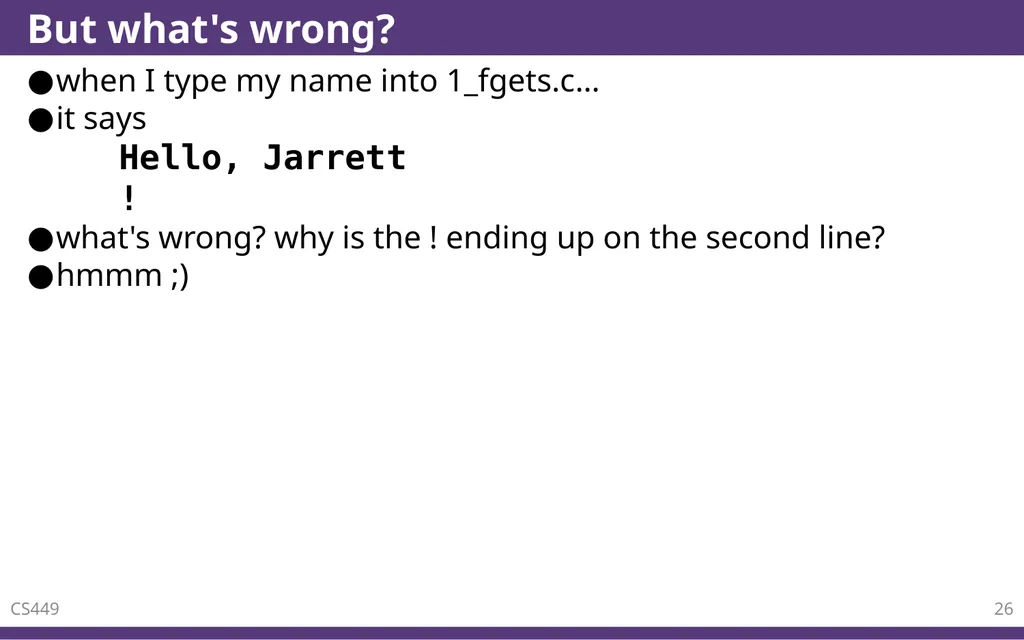
But what's wrong? when I type my name into 1_fgets.c…
it says
Hello, Jarrett
!
what's wrong? why is the ! ending up on the second line?
hmmm ;) CS449 26<br>