
Welcome to 2nd seminar Privatization of
KB
Published · 55 slides · 0 views

1 / 1








Description
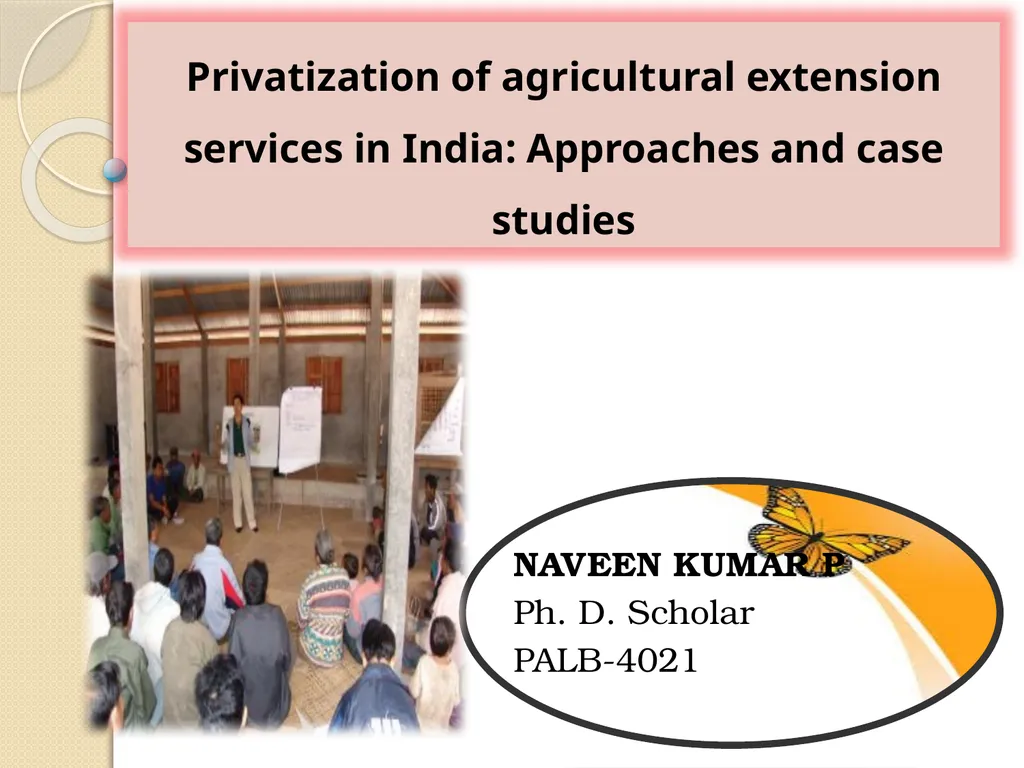
Welcome to 2nd seminar Privatization of agricultural extension services in India: Approaches and case studies NAVEEN KUMAR P Ph. D. Scholar PALB-4021 Agricultural extension is a general term meaning the application of scientific research
Related Topics
Share
Embed code
Download this presentation From Below
"Welcome to 2nd seminar Privatization of" is the property of its rightful owner. Permission is granted to download and print the materials on this website for personal, non-commercial use only, and to display it on your personal computer provided you do not modify the materials and that you retain all copyright notices contained in the materials. By downloading content from our website, you accept the terms of this agreement.
Presentation Transcript
01
Welcome to 2nd seminar<br>
02
Privatization of agricultural extension services in India: Approaches and case studies NAVEEN KUMAR P
Ph. D. Scholar
PALB-4021<br>
Ph. D. Scholar
PALB-4021<br>
03
Agricultural extension is a general term meaning the application of scientific research and new knowledge to agricultural practices through farmer education INTRODUCTION The term extension was first used to describe adult education programs in England in the second half of the 19th century<br>
04
Based on pre-independence experiences of the early extension efforts, systematic, planned and country-wide extension system passed through various stages to meet the needs of farming community
Immediately after the independence, organised extension activities were undertaken by the government through initiation of community development programme and others<br>
Immediately after the independence, organised extension activities were undertaken by the government through initiation of community development programme and others<br>
05
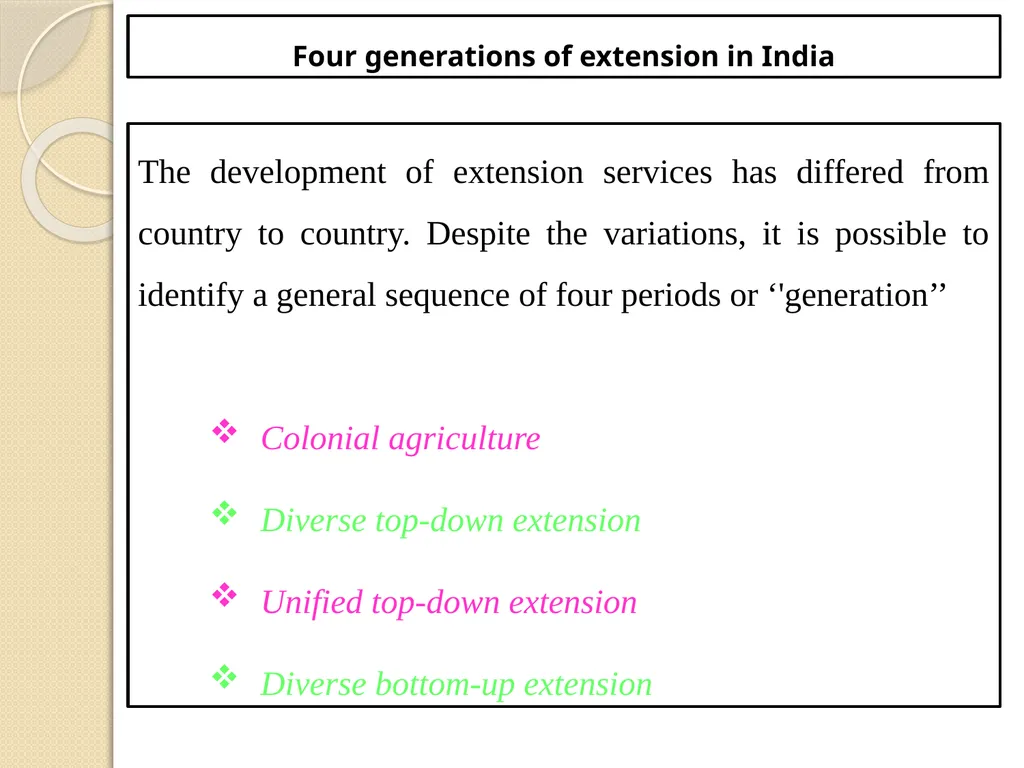
Four generations of extension in India The development of extension services has differed from country to country. Despite the variations, it is possible to identify a general sequence of four periods or ‘'generation’’
Colonial agriculture
Diverse top-down extension
Unified top-down extension
Diverse bottom-up extension<br>
Colonial agriculture
Diverse top-down extension
Unified top-down extension
Diverse bottom-up extension<br>
06
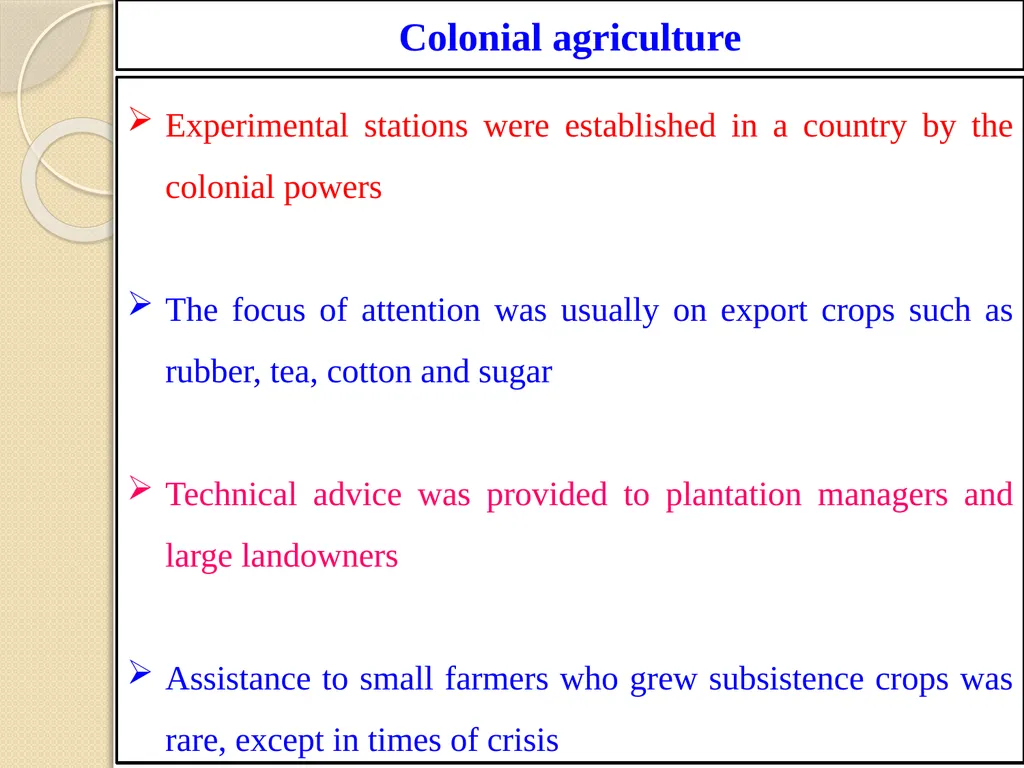
Experimental stations were established in a country by the colonial powers
The focus of attention was usually on export crops such as rubber, tea, cotton and sugar
Technical advice was provided to plantation managers and large landowners
Assistance to small farmers who grew subsistence crops was rare, except in times of crisis Colonial agriculture<br>
The focus of attention was usually on export crops such as rubber, tea, cotton and sugar
Technical advice was provided to plantation managers and large landowners
Assistance to small farmers who grew subsistence crops was rare, except in times of crisis Colonial agriculture<br>
07
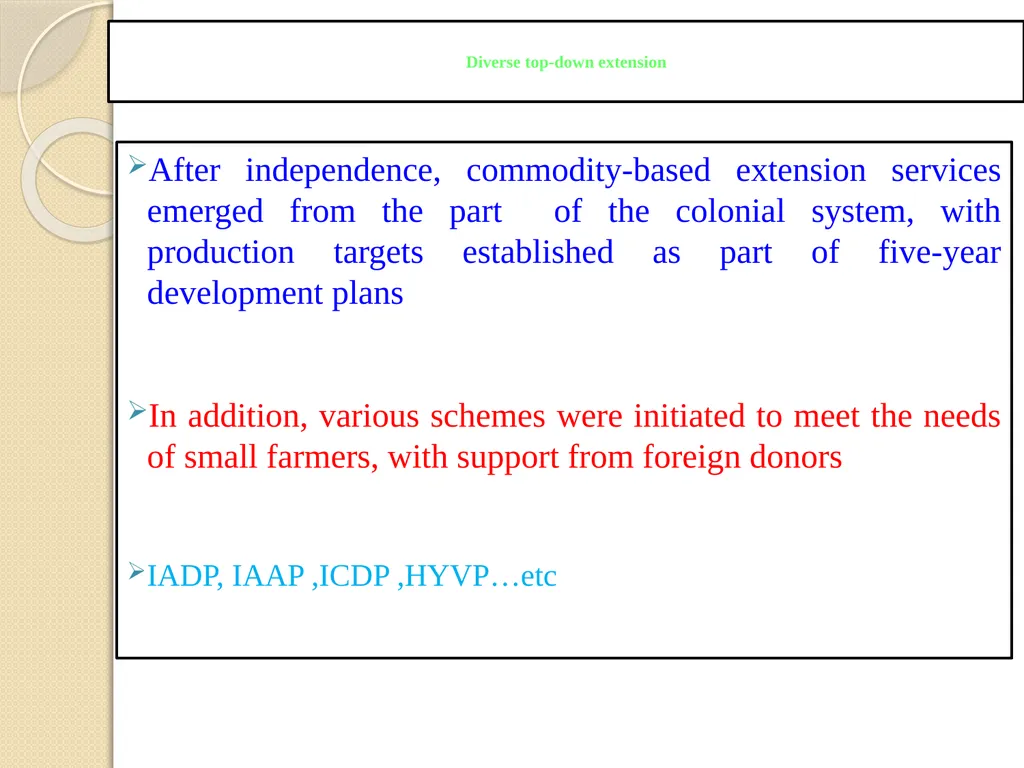
Diverse top-down extension After independence, commodity-based extension services emerged from the part of the colonial system, with production targets established as part of five-year development plans
In addition, various schemes were initiated to meet the needs of small farmers, with support from foreign donors
IADP, IAAP ,ICDP ,HYVP…etc<br>
In addition, various schemes were initiated to meet the needs of small farmers, with support from foreign donors
IADP, IAAP ,ICDP ,HYVP…etc<br>
08
During the 1970s and 1980's, the Training and Visit system (T&V) was introduced by the World Bank
Existing organizations were merged into a single national service
Regular messages were delivered to groups of farmers, promoting the adoption of "Green Revolution" technologies
The delivery of public extension services is based on a supply driven, top down approach rather than a demand driven approach Unified top-down extension<br>
Existing organizations were merged into a single national service
Regular messages were delivered to groups of farmers, promoting the adoption of "Green Revolution" technologies
The delivery of public extension services is based on a supply driven, top down approach rather than a demand driven approach Unified top-down extension<br>
09
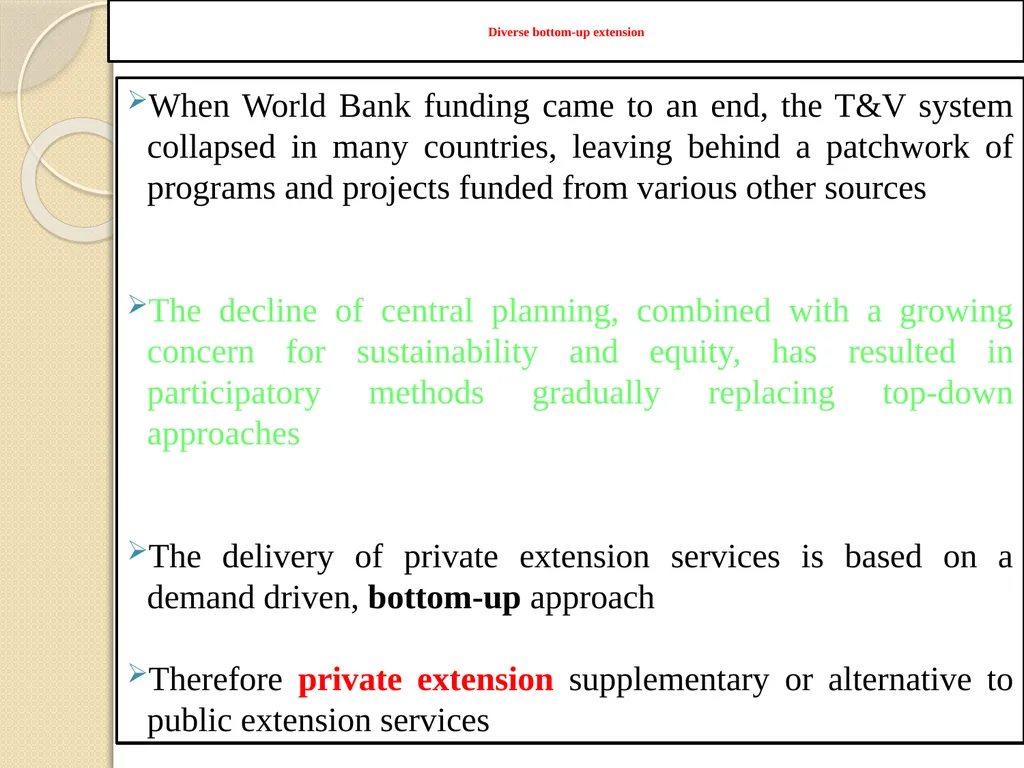
Diverse bottom-up extension When World Bank funding came to an end, the T&V system collapsed in many countries, leaving behind a patchwork of programs and projects funded from various other sources
The decline of central planning, combined with a growing concern for sustainability and equity, has resulted in participatory methods gradually replacing top-down approaches
The delivery of private extension services is based on a demand driven, bottom-up approach
Therefore private extension supplementary or alternative to public extension services<br>
The decline of central planning, combined with a growing concern for sustainability and equity, has resulted in participatory methods gradually replacing top-down approaches
The delivery of private extension services is based on a demand driven, bottom-up approach
Therefore private extension supplementary or alternative to public extension services<br>
10
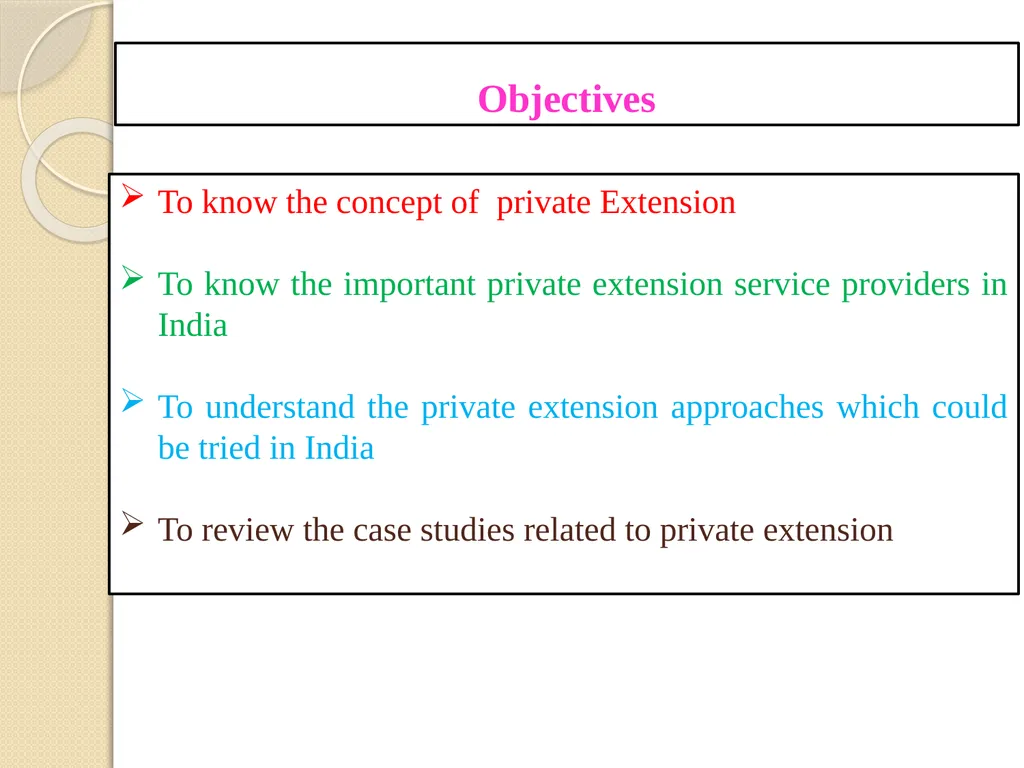
Objectives To know the concept of private Extension
To know the important private extension service providers in India
To understand the private extension approaches which could be tried in India
To review the case studies related to private extension<br>
To know the important private extension service providers in India
To understand the private extension approaches which could be tried in India
To review the case studies related to private extension<br>
11
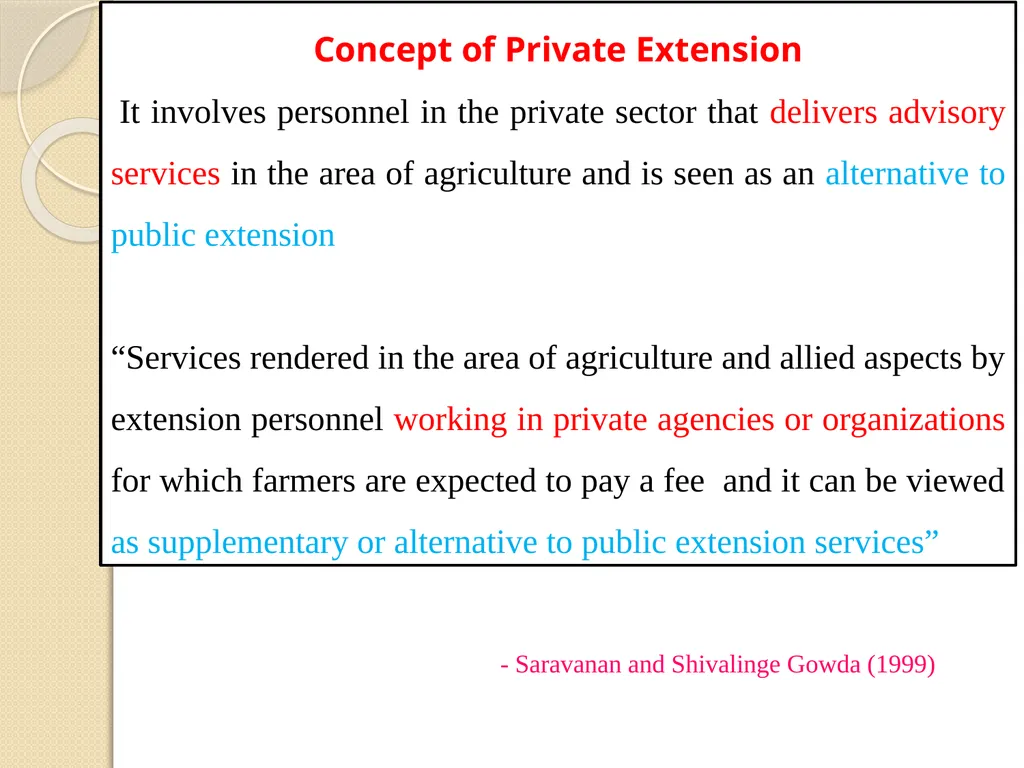
Concept of Private Extension
It involves personnel in the private sector that delivers advisory services in the area of agriculture and is seen as an alternative to public extension
“Services rendered in the area of agriculture and allied aspects by extension personnel working in private agencies or organizations for which farmers are expected to pay a fee and it can be viewed as supplementary or alternative to public extension services” - Saravanan and Shivalinge Gowda (1999)<br>
It involves personnel in the private sector that delivers advisory services in the area of agriculture and is seen as an alternative to public extension
“Services rendered in the area of agriculture and allied aspects by extension personnel working in private agencies or organizations for which farmers are expected to pay a fee and it can be viewed as supplementary or alternative to public extension services” - Saravanan and Shivalinge Gowda (1999)<br>
12
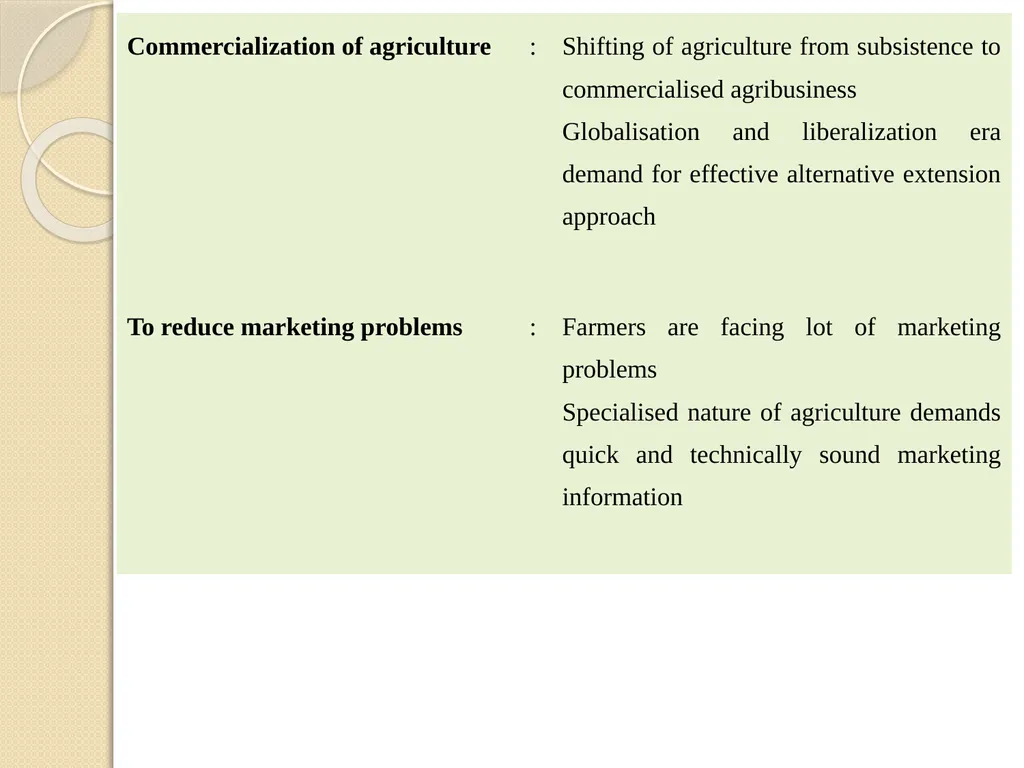
The most important reasons behind the issue of privatization of extension system are Reasons Behind the Privatization Issue<br>
13
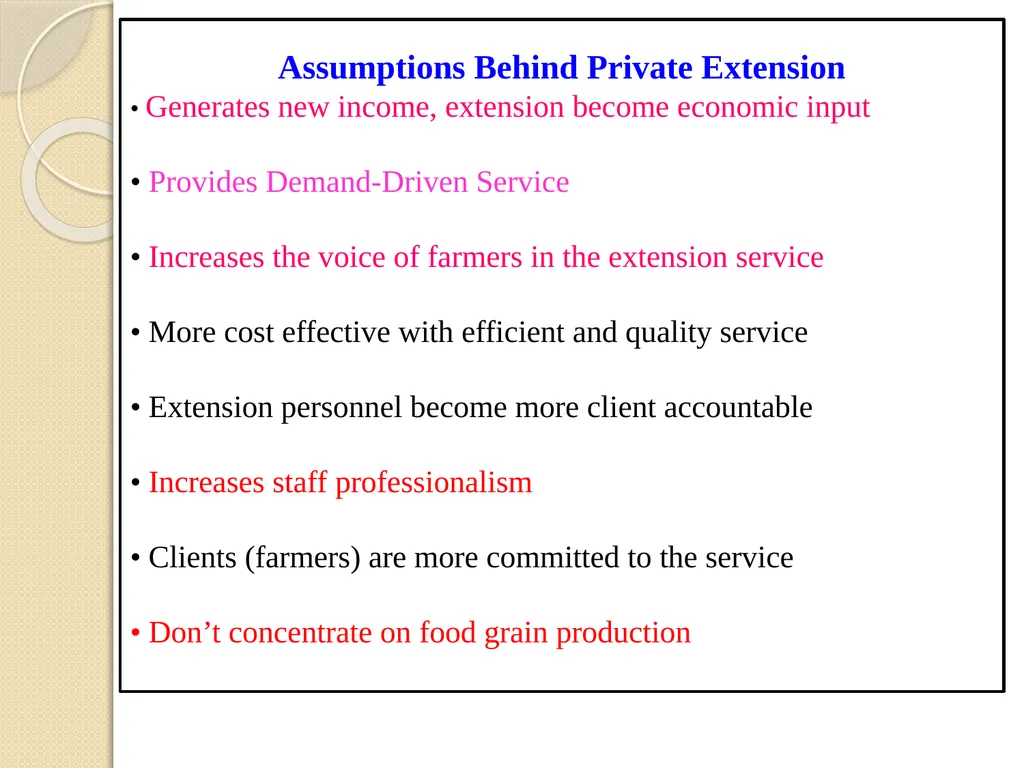
Assumptions Behind Private Extension
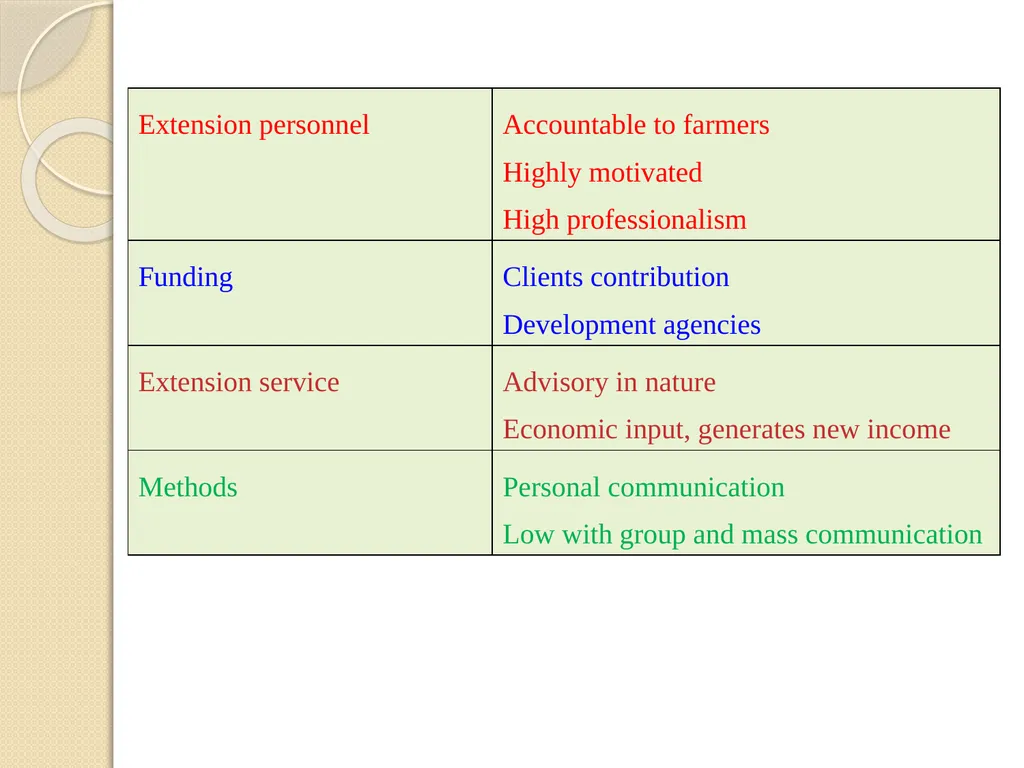
• Generates new income, extension become economic input
• Provides Demand-Driven Service
• Increases the voice of farmers in the extension service
• More cost effective with efficient and quality service
• Extension personnel become more client accountable
• Increases staff professionalism
• Clients (farmers) are more committed to the service
• Don’t concentrate on food grain production<br>
• Generates new income, extension become economic input
• Provides Demand-Driven Service
• Increases the voice of farmers in the extension service
• More cost effective with efficient and quality service
• Extension personnel become more client accountable
• Increases staff professionalism
• Clients (farmers) are more committed to the service
• Don’t concentrate on food grain production<br>
14
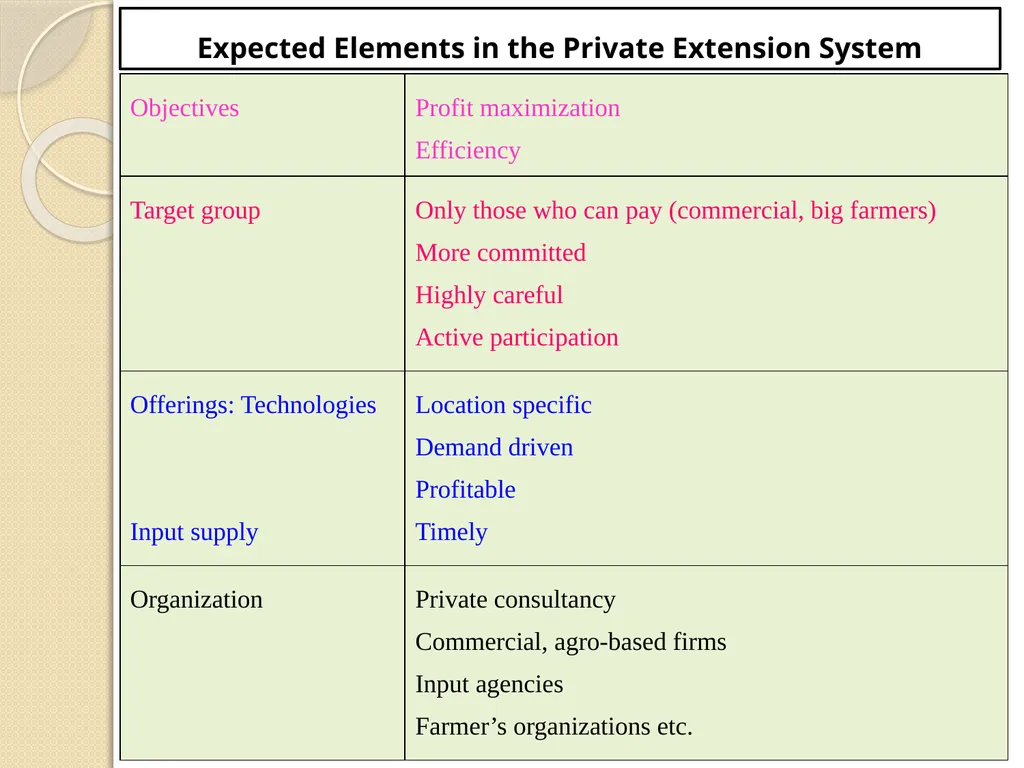
Expected Elements in the Private Extension System<br>
15
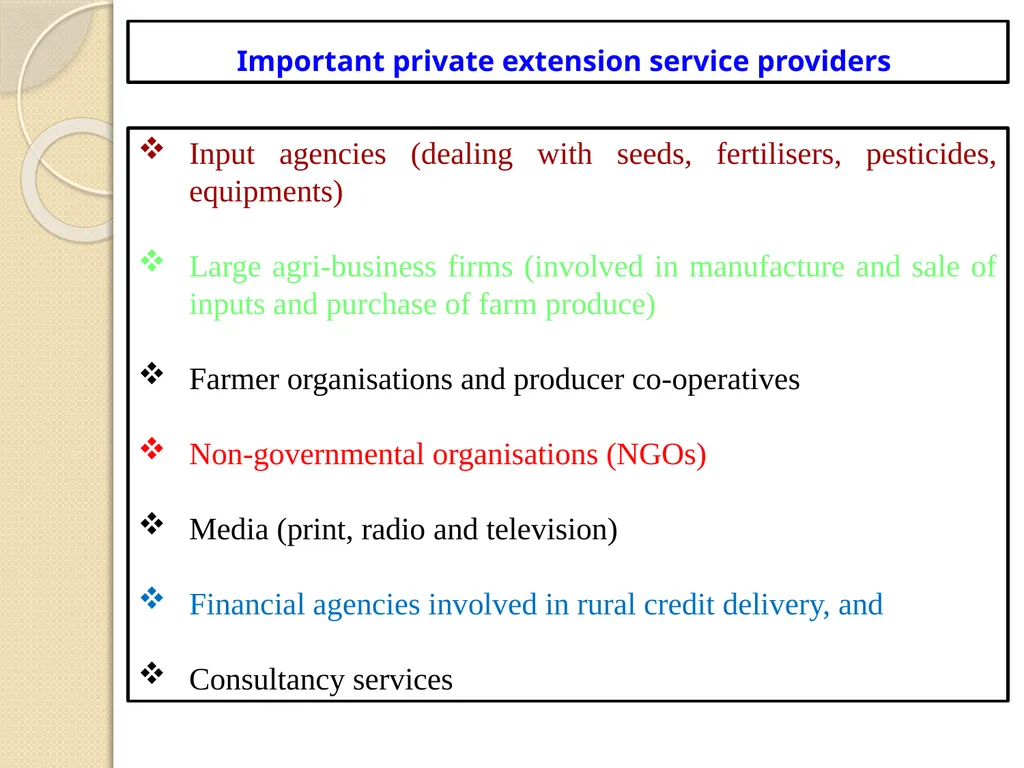
Input agencies (dealing with seeds, fertilisers, pesticides, equipments)
Large agri-business firms (involved in manufacture and sale of inputs and purchase of farm produce)
Farmer organisations and producer co-operatives
Non-governmental organisations (NGOs)
Media (print, radio and television)
Financial agencies involved in rural credit delivery, and
Consultancy services Important private extension service providers<br>
Large agri-business firms (involved in manufacture and sale of inputs and purchase of farm produce)
Farmer organisations and producer co-operatives
Non-governmental organisations (NGOs)
Media (print, radio and television)
Financial agencies involved in rural credit delivery, and
Consultancy services Important private extension service providers<br>
16
Input agency extension
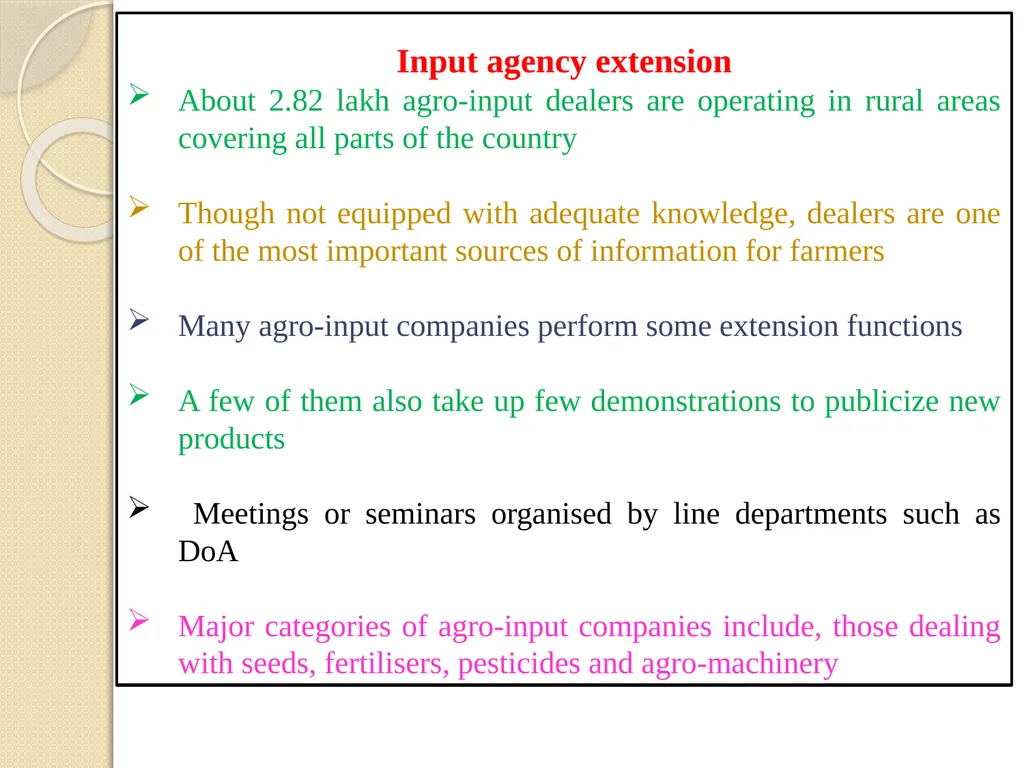
About 2.82 lakh agro-input dealers are operating in rural areas covering all parts of the country
Though not equipped with adequate knowledge, dealers are one of the most important sources of information for farmers
Many agro-input companies perform some extension functions
A few of them also take up few demonstrations to publicize new products
Meetings or seminars organised by line departments such as DoA
Major categories of agro-input companies include, those dealing with seeds, fertilisers, pesticides and agro-machinery<br>
About 2.82 lakh agro-input dealers are operating in rural areas covering all parts of the country
Though not equipped with adequate knowledge, dealers are one of the most important sources of information for farmers
Many agro-input companies perform some extension functions
A few of them also take up few demonstrations to publicize new products
Meetings or seminars organised by line departments such as DoA
Major categories of agro-input companies include, those dealing with seeds, fertilisers, pesticides and agro-machinery<br>
17
Agri-business firms (aggregators, processors)
Major agri-business firms like ITC and Pepsi co during the last few years have initiated innovative arrangements to provide farmers with integrated production and marketing support
ITC’s extension effort revolves around e-chaupals, which are essentially village internet kiosks that enable access to information on weather, market prices and scientific practices
PepsiCo was a pioneer in the concept of contract farming under which the company transfers agricultural best practices and technology and procures the produce at a guaranteed price<br>
Major agri-business firms like ITC and Pepsi co during the last few years have initiated innovative arrangements to provide farmers with integrated production and marketing support
ITC’s extension effort revolves around e-chaupals, which are essentially village internet kiosks that enable access to information on weather, market prices and scientific practices
PepsiCo was a pioneer in the concept of contract farming under which the company transfers agricultural best practices and technology and procures the produce at a guaranteed price<br>
18
Farmer organisations and producer co-operatives
User groups, including farmer interest groups, farmer clubs, commodity groups, women farmer groups, special interest groups’ etc play a very important role in extension
Government is also keen on promoting farmer organizations as it could create mechanism at the village level among farmer members to empower them for their own problem solving
One of the oldest and most successful farmer organisations in India is the Grape Growers Association of Maharashtra which provides a wide range of services to its member producers<br>
User groups, including farmer interest groups, farmer clubs, commodity groups, women farmer groups, special interest groups’ etc play a very important role in extension
Government is also keen on promoting farmer organizations as it could create mechanism at the village level among farmer members to empower them for their own problem solving
One of the oldest and most successful farmer organisations in India is the Grape Growers Association of Maharashtra which provides a wide range of services to its member producers<br>
19
Non-Governmental (voluntary) organisations (NGOs)
NGOs active in rural development in India range from fewer than 10,000 to several hundred thousand depending on the type of classification used
15,000-20,000 are actively engaged in rural development
India has a number of NGOs with varying levels of capacity, implementing a wide range of programmes
NGOs receive funding from the Government, corporate bodies as well as international donors
Bharatiya Agro-Industries Federation (BAIF), Professional Assistance for Development Action (PRADAN) and Action for Food Production (AFPRO)<br>
NGOs active in rural development in India range from fewer than 10,000 to several hundred thousand depending on the type of classification used
15,000-20,000 are actively engaged in rural development
India has a number of NGOs with varying levels of capacity, implementing a wide range of programmes
NGOs receive funding from the Government, corporate bodies as well as international donors
Bharatiya Agro-Industries Federation (BAIF), Professional Assistance for Development Action (PRADAN) and Action for Food Production (AFPRO)<br>
20
Media and Information Technology
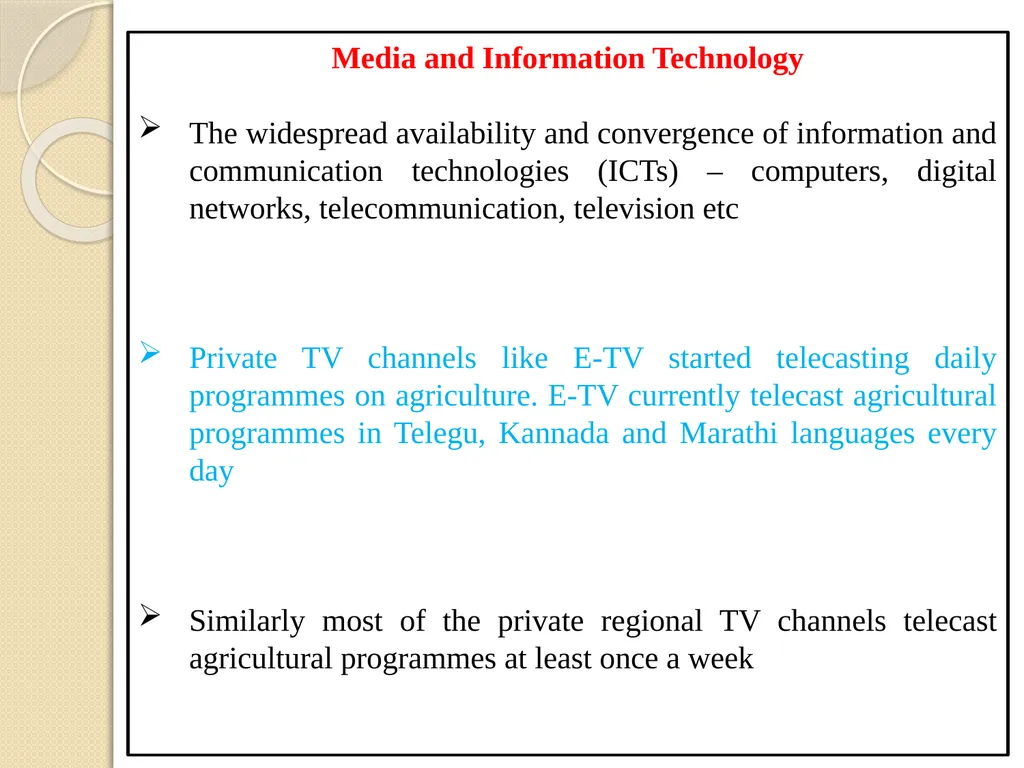
The widespread availability and convergence of information and communication technologies (ICTs) – computers, digital networks, telecommunication, television etc
Private TV channels like E-TV started telecasting daily programmes on agriculture. E-TV currently telecast agricultural programmes in Telegu, Kannada and Marathi languages every day
Similarly most of the private regional TV channels telecast agricultural programmes at least once a week<br>
The widespread availability and convergence of information and communication technologies (ICTs) – computers, digital networks, telecommunication, television etc
Private TV channels like E-TV started telecasting daily programmes on agriculture. E-TV currently telecast agricultural programmes in Telegu, Kannada and Marathi languages every day
Similarly most of the private regional TV channels telecast agricultural programmes at least once a week<br>
21
Community Radio (CR) is another innovation in use of media and it is a short range radio station that caters to the information needs of communities living in surrounding areas
Newspapers and farm magazines are important sources of information for farmers
Newspapers, especially those in local languages, provide at least one page every week for news and articles on different aspects of agriculture<br>
Newspapers and farm magazines are important sources of information for farmers
Newspapers, especially those in local languages, provide at least one page every week for news and articles on different aspects of agriculture<br>
22
Financial Institutions
Financial institutions lending to agricultural sector provide advice and consultancy to potential borrowers on financial viability of their proposals
All banks involved in agricultural lending organises farmer meetings and seminars every year
Banks also lend limited financial assistance to other organisations or state Department of Agriculture for organising agricultural seminars and farmer meetings
NABARD has been supporting the establishment of farmer clubs. Farmers’ Clubs are grassroot level informal forums of farmers
The broad objective of setting up Farmers’ Clubs is to achieve prosperity for the farmers with overall agricultural development in its area of operation<br>
Financial institutions lending to agricultural sector provide advice and consultancy to potential borrowers on financial viability of their proposals
All banks involved in agricultural lending organises farmer meetings and seminars every year
Banks also lend limited financial assistance to other organisations or state Department of Agriculture for organising agricultural seminars and farmer meetings
NABARD has been supporting the establishment of farmer clubs. Farmers’ Clubs are grassroot level informal forums of farmers
The broad objective of setting up Farmers’ Clubs is to achieve prosperity for the farmers with overall agricultural development in its area of operation<br>
23
Consultancy
Farmers generally consult progressive farmers for information and advice related to production, post harvest management and marketing
Another major source of advice is the local input dealer
Some input firms such as AGROCEL and Tata Kisan Kendras provide free consultancy services
Many professionals after retirement from agricultural research organizations have been providing consultancy to farmers
At present big farmers, farmers growing commercial crops like coffee, tea, spices, flowers, grapes, pomegranate etc and those having large poultry units and dairy farms are availing consultancy services<br>
Farmers generally consult progressive farmers for information and advice related to production, post harvest management and marketing
Another major source of advice is the local input dealer
Some input firms such as AGROCEL and Tata Kisan Kendras provide free consultancy services
Many professionals after retirement from agricultural research organizations have been providing consultancy to farmers
At present big farmers, farmers growing commercial crops like coffee, tea, spices, flowers, grapes, pomegranate etc and those having large poultry units and dairy farms are availing consultancy services<br>
24
Para technicians (those without professional degrees but trained in specific skills) do provide services for a fee in the area of artificial insemination, grafting, etc and charge for the service
Similarly para extension workers promoted by DoA in states such as UP, Rajasthan and Madhya Pradesh also provide limited extension services (message delivery and training) to fellow farmers in his/her village<br>
Similarly para extension workers promoted by DoA in states such as UP, Rajasthan and Madhya Pradesh also provide limited extension services (message delivery and training) to fellow farmers in his/her village<br>
25
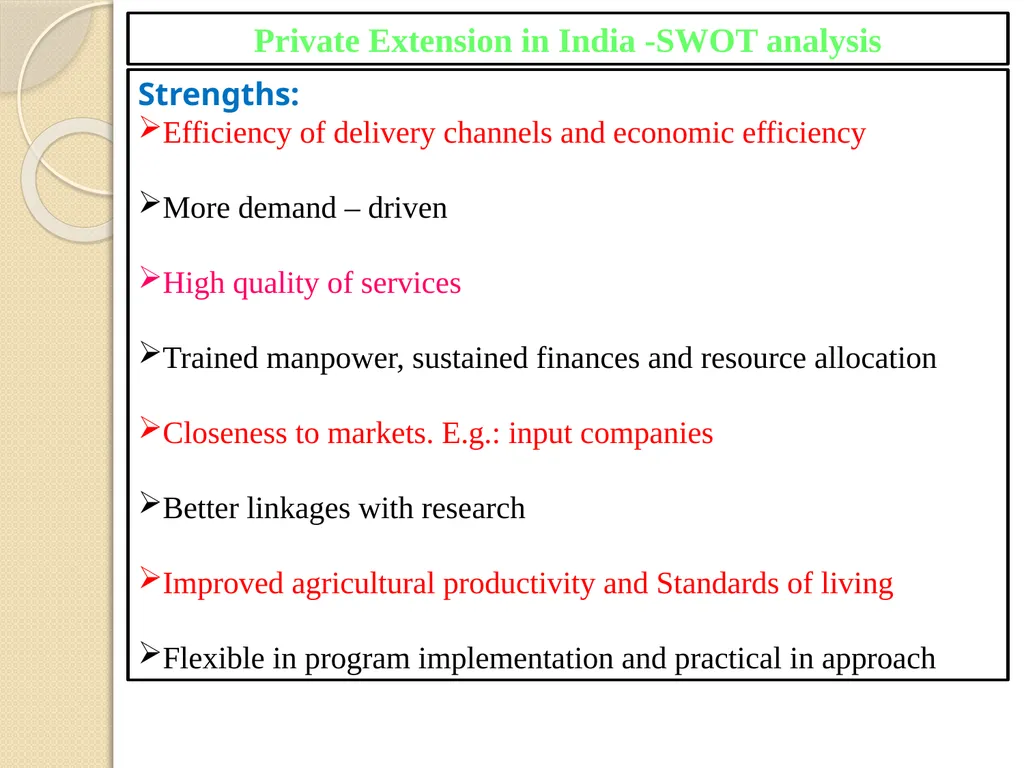
Private Extension in India -SWOT analysis Strengths:
Efficiency of delivery channels and economic efficiency
More demand – driven
High quality of services
Trained manpower, sustained finances and resource allocation
Closeness to markets. E.g.: input companies
Better linkages with research
Improved agricultural productivity and Standards of living
Flexible in program implementation and practical in approach<br>
Efficiency of delivery channels and economic efficiency
More demand – driven
High quality of services
Trained manpower, sustained finances and resource allocation
Closeness to markets. E.g.: input companies
Better linkages with research
Improved agricultural productivity and Standards of living
Flexible in program implementation and practical in approach<br>
26
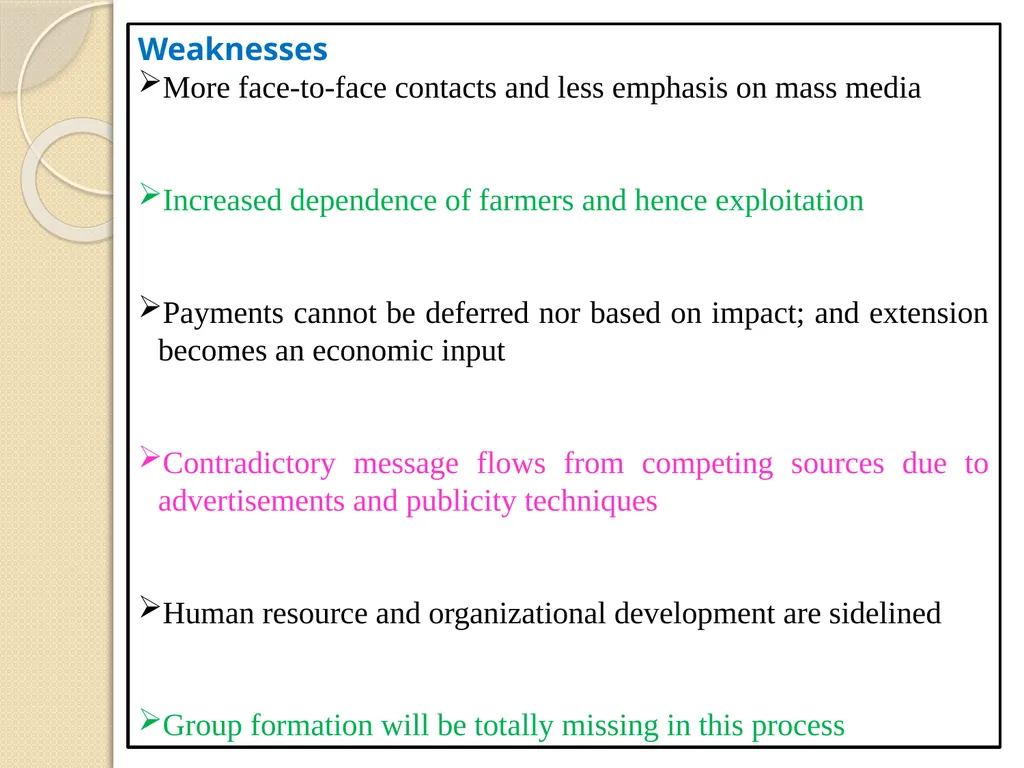
Weaknesses
More face-to-face contacts and less emphasis on mass media
Increased dependence of farmers and hence exploitation
Payments cannot be deferred nor based on impact; and extension becomes an economic input
Contradictory message flows from competing sources due to advertisements and publicity techniques
Human resource and organizational development are sidelined
Group formation will be totally missing in this process<br>
More face-to-face contacts and less emphasis on mass media
Increased dependence of farmers and hence exploitation
Payments cannot be deferred nor based on impact; and extension becomes an economic input
Contradictory message flows from competing sources due to advertisements and publicity techniques
Human resource and organizational development are sidelined
Group formation will be totally missing in this process<br>
27
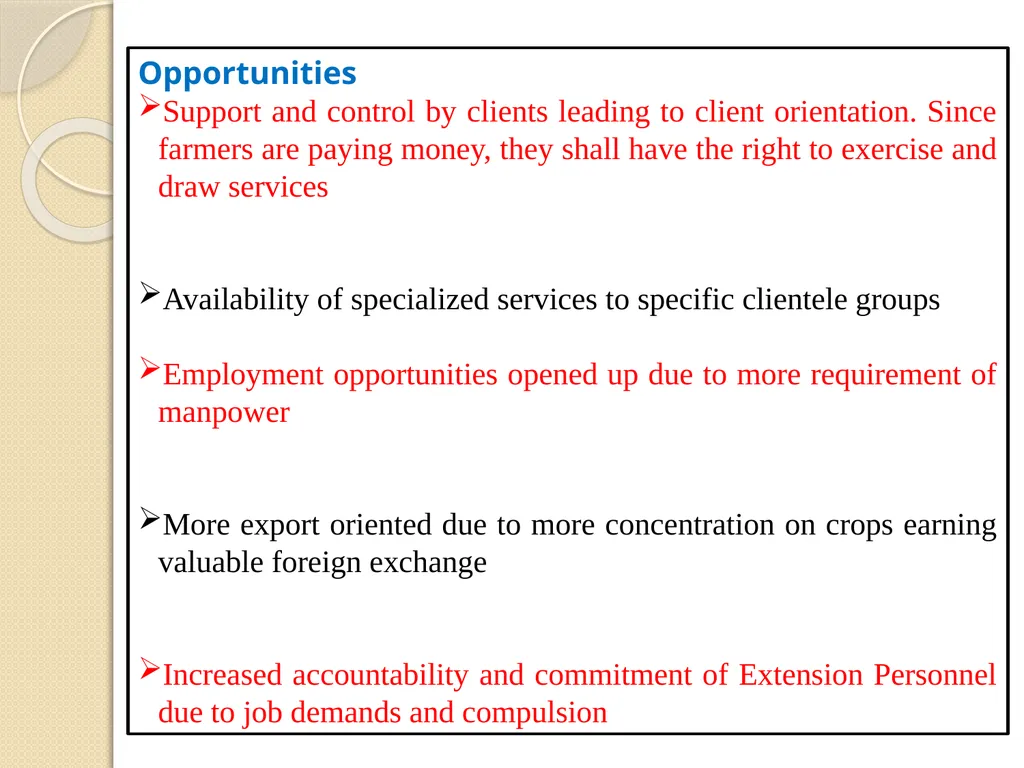
Opportunities
Support and control by clients leading to client orientation. Since farmers are paying money, they shall have the right to exercise and draw services
Availability of specialized services to specific clientele groups
Employment opportunities opened up due to more requirement of manpower
More export oriented due to more concentration on crops earning valuable foreign exchange
Increased accountability and commitment of Extension Personnel due to job demands and compulsion<br>
Support and control by clients leading to client orientation. Since farmers are paying money, they shall have the right to exercise and draw services
Availability of specialized services to specific clientele groups
Employment opportunities opened up due to more requirement of manpower
More export oriented due to more concentration on crops earning valuable foreign exchange
Increased accountability and commitment of Extension Personnel due to job demands and compulsion<br>
28
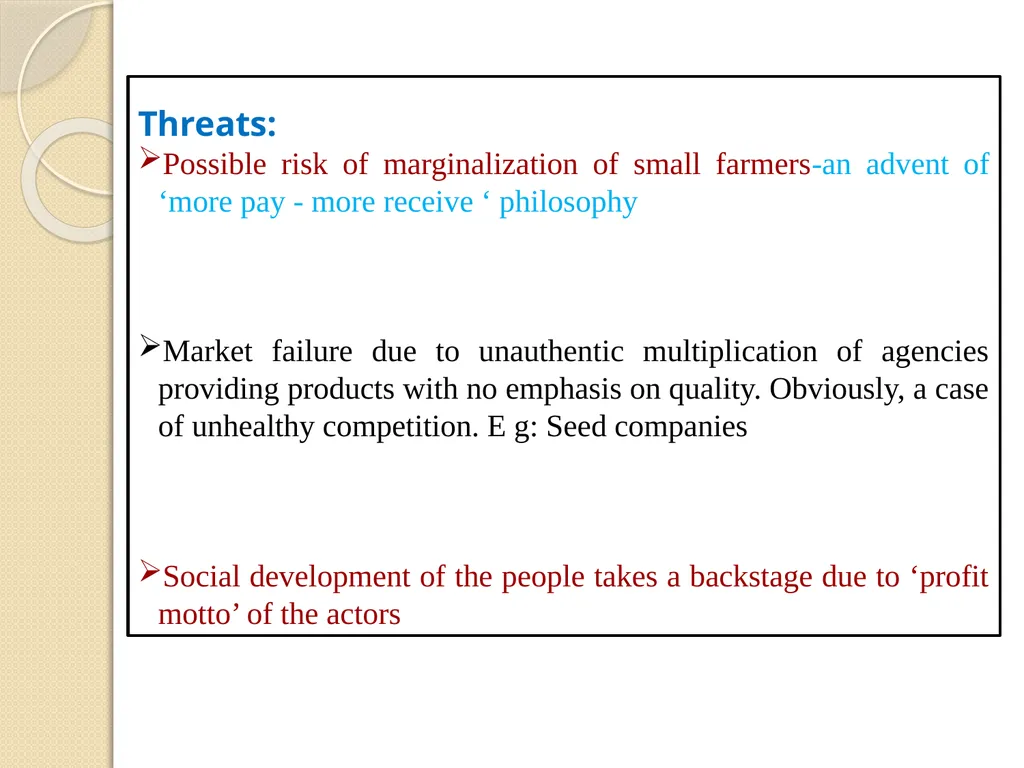
Threats:
Possible risk of marginalization of small farmers-an advent of ‘more pay - more receive ‘ philosophy
Market failure due to unauthentic multiplication of agencies providing products with no emphasis on quality. Obviously, a case of unhealthy competition. E g: Seed companies
Social development of the people takes a backstage due to ‘profit motto’ of the actors<br>
Possible risk of marginalization of small farmers-an advent of ‘more pay - more receive ‘ philosophy
Market failure due to unauthentic multiplication of agencies providing products with no emphasis on quality. Obviously, a case of unhealthy competition. E g: Seed companies
Social development of the people takes a backstage due to ‘profit motto’ of the actors<br>
29
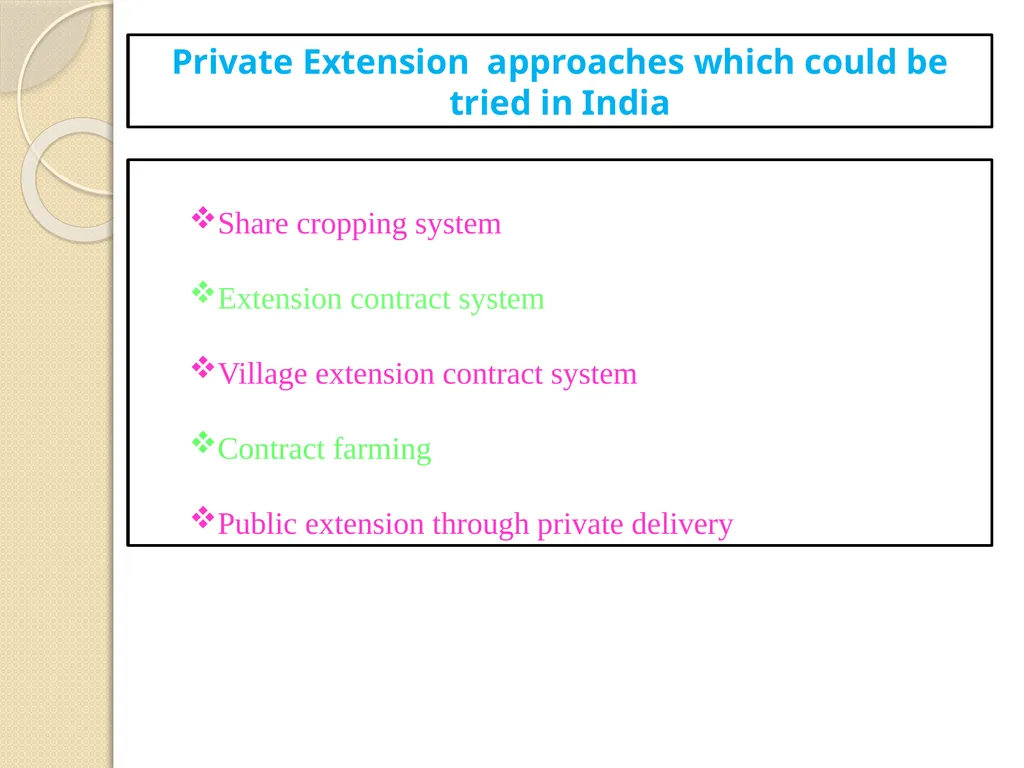
Private Extension approaches which could be tried in India Share cropping system
Extension contract system
Village extension contract system
Contract farming
Public extension through private delivery<br>
Extension contract system
Village extension contract system
Contract farming
Public extension through private delivery<br>
30
Share cropping system
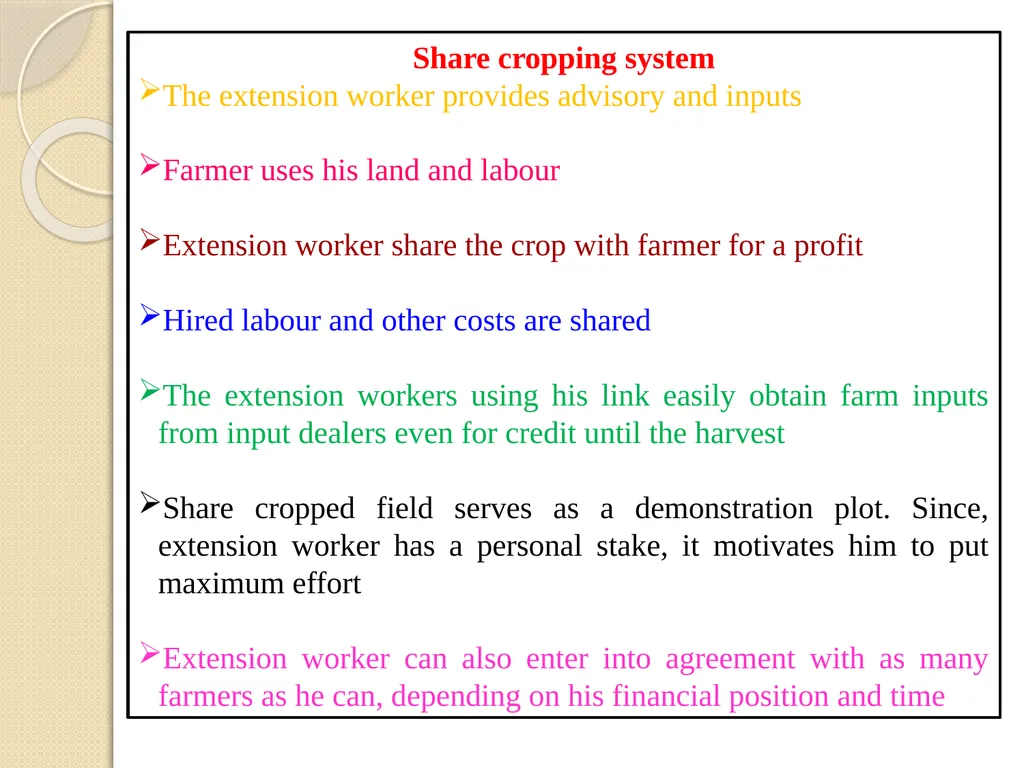
The extension worker provides advisory and inputs
Farmer uses his land and labour
Extension worker share the crop with farmer for a profit
Hired labour and other costs are shared
The extension workers using his link easily obtain farm inputs from input dealers even for credit until the harvest
Share cropped field serves as a demonstration plot. Since, extension worker has a personal stake, it motivates him to put maximum effort
Extension worker can also enter into agreement with as many farmers as he can, depending on his financial position and time<br>
The extension worker provides advisory and inputs
Farmer uses his land and labour
Extension worker share the crop with farmer for a profit
Hired labour and other costs are shared
The extension workers using his link easily obtain farm inputs from input dealers even for credit until the harvest
Share cropped field serves as a demonstration plot. Since, extension worker has a personal stake, it motivates him to put maximum effort
Extension worker can also enter into agreement with as many farmers as he can, depending on his financial position and time<br>
31
Extension contract system
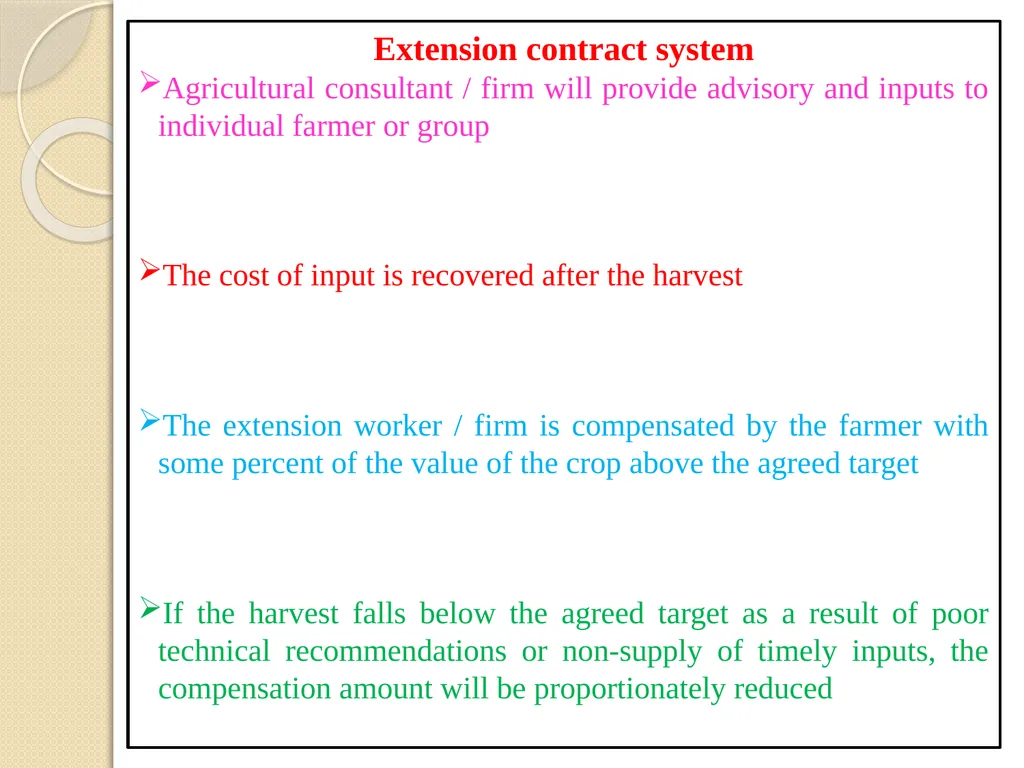
Agricultural consultant / firm will provide advisory and inputs to individual farmer or group
The cost of input is recovered after the harvest
The extension worker / firm is compensated by the farmer with some percent of the value of the crop above the agreed target
If the harvest falls below the agreed target as a result of poor technical recommendations or non-supply of timely inputs, the compensation amount will be proportionately reduced<br>
Agricultural consultant / firm will provide advisory and inputs to individual farmer or group
The cost of input is recovered after the harvest
The extension worker / firm is compensated by the farmer with some percent of the value of the crop above the agreed target
If the harvest falls below the agreed target as a result of poor technical recommendations or non-supply of timely inputs, the compensation amount will be proportionately reduced<br>
32
Village extension contract system
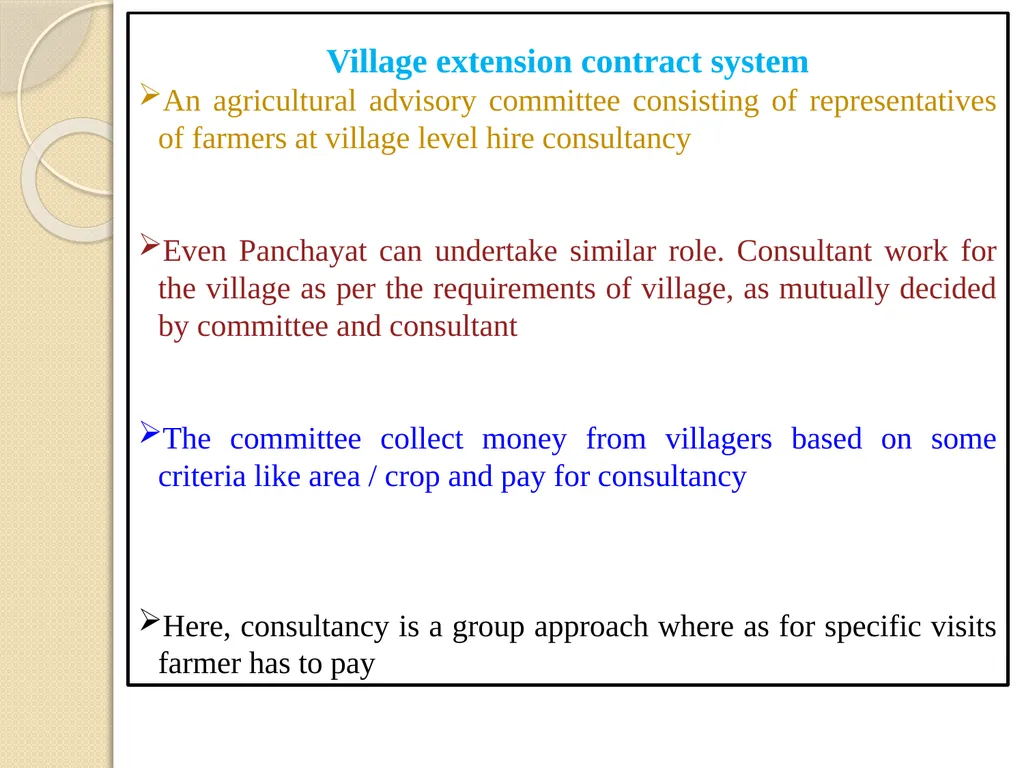
An agricultural advisory committee consisting of representatives of farmers at village level hire consultancy
Even Panchayat can undertake similar role. Consultant work for the village as per the requirements of village, as mutually decided by committee and consultant
The committee collect money from villagers based on some criteria like area / crop and pay for consultancy
Here, consultancy is a group approach where as for specific visits farmer has to pay<br>
An agricultural advisory committee consisting of representatives of farmers at village level hire consultancy
Even Panchayat can undertake similar role. Consultant work for the village as per the requirements of village, as mutually decided by committee and consultant
The committee collect money from villagers based on some criteria like area / crop and pay for consultancy
Here, consultancy is a group approach where as for specific visits farmer has to pay<br>
33
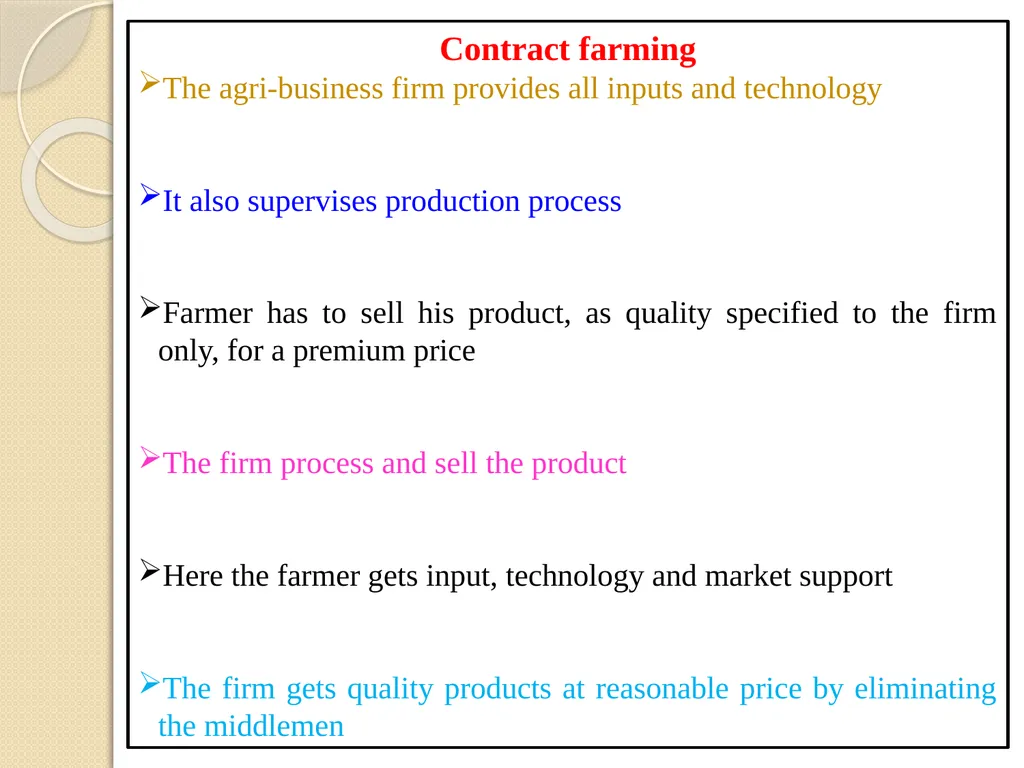
Contract farming
The agri-business firm provides all inputs and technology
It also supervises production process
Farmer has to sell his product, as quality specified to the firm only, for a premium price
The firm process and sell the product
Here the farmer gets input, technology and market support
The firm gets quality products at reasonable price by eliminating the middlemen<br>
The agri-business firm provides all inputs and technology
It also supervises production process
Farmer has to sell his product, as quality specified to the firm only, for a premium price
The firm process and sell the product
Here the farmer gets input, technology and market support
The firm gets quality products at reasonable price by eliminating the middlemen<br>
34
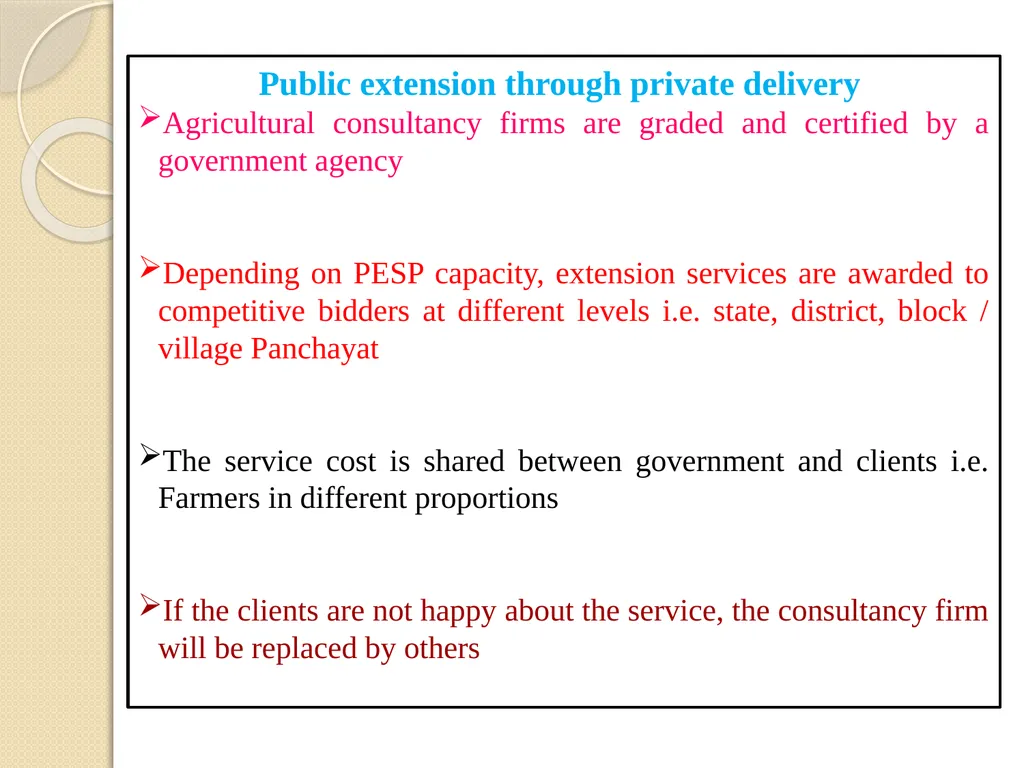
Public extension through private delivery
Agricultural consultancy firms are graded and certified by a government agency
Depending on PESP capacity, extension services are awarded to competitive bidders at different levels i.e. state, district, block / village Panchayat
The service cost is shared between government and clients i.e. Farmers in different proportions
If the clients are not happy about the service, the consultancy firm will be replaced by others<br>
Agricultural consultancy firms are graded and certified by a government agency
Depending on PESP capacity, extension services are awarded to competitive bidders at different levels i.e. state, district, block / village Panchayat
The service cost is shared between government and clients i.e. Farmers in different proportions
If the clients are not happy about the service, the consultancy firm will be replaced by others<br>
35
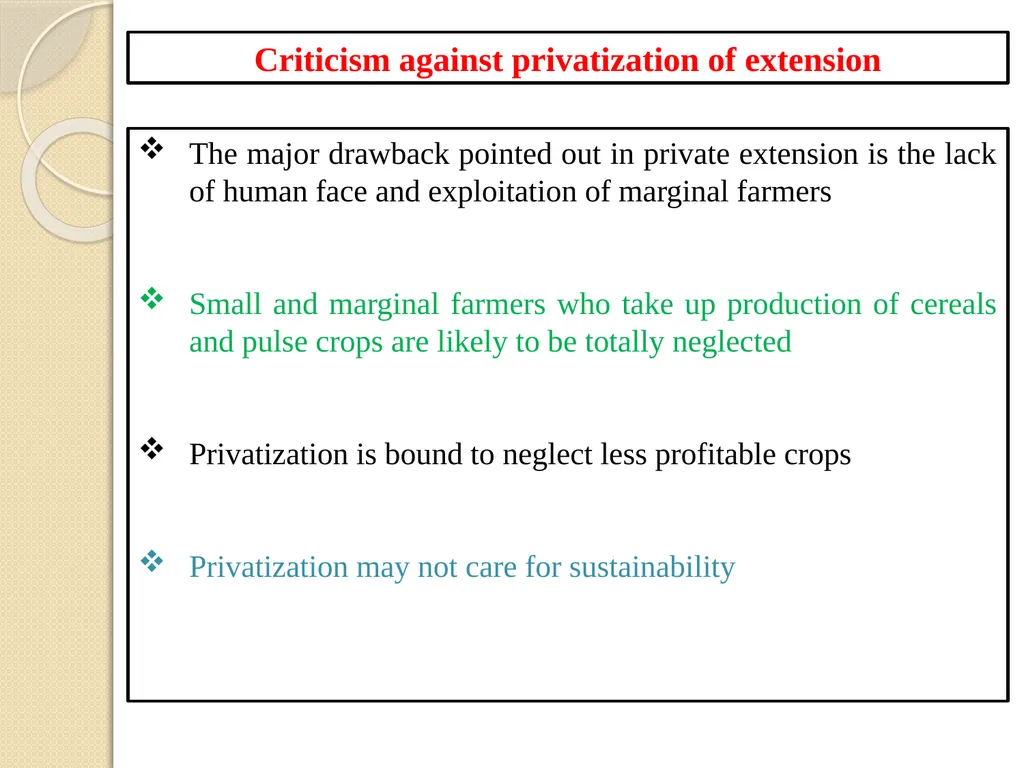
The major drawback pointed out in private extension is the lack of human face and exploitation of marginal farmers
Small and marginal farmers who take up production of cereals and pulse crops are likely to be totally neglected
Privatization is bound to neglect less profitable crops
Privatization may not care for sustainability Criticism against privatization of extension<br>
Small and marginal farmers who take up production of cereals and pulse crops are likely to be totally neglected
Privatization is bound to neglect less profitable crops
Privatization may not care for sustainability Criticism against privatization of extension<br>
36
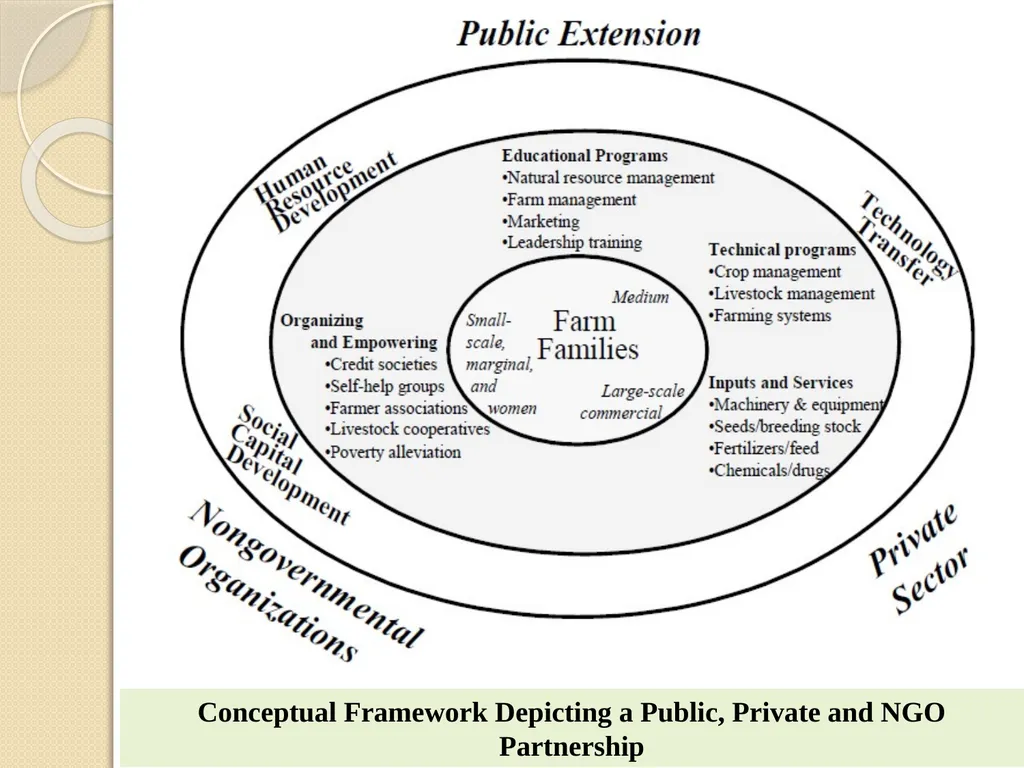
Conceptual Framework Depicting a Public, Private and NGO Partnership<br>
37
Case studies<br>
38
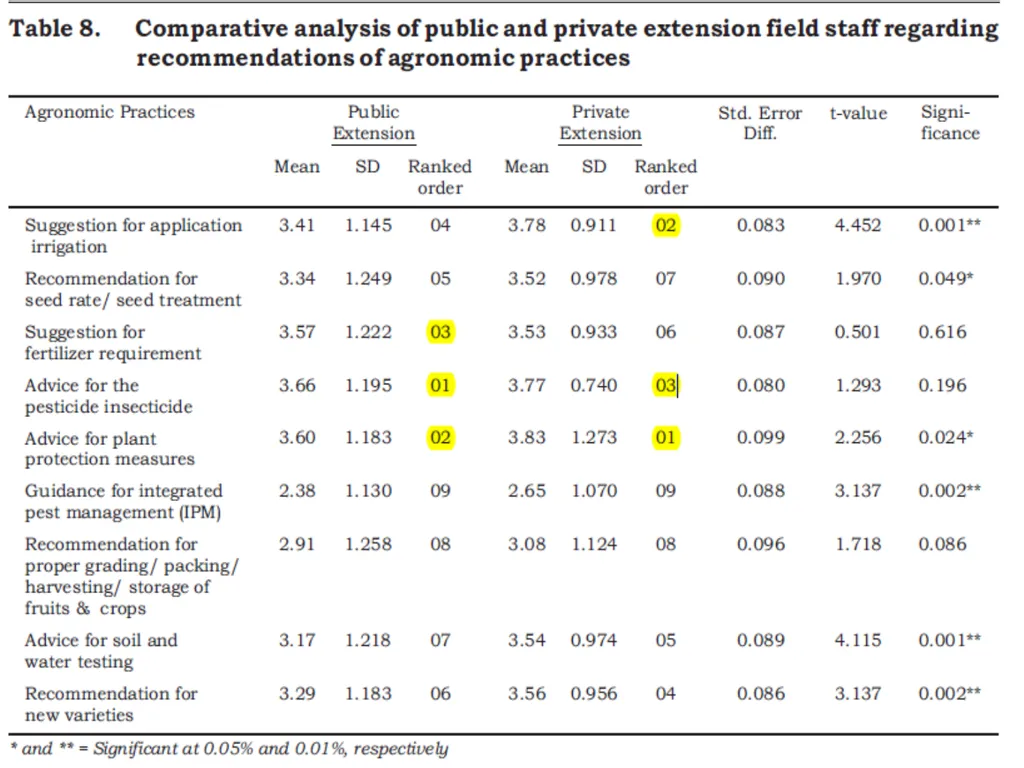
An analysis of public and private agricultural extension
services in Balochistan, Pakistan
-Mengal, A. A., 2012<br>
services in Balochistan, Pakistan
-Mengal, A. A., 2012<br>
39
Comprehensive study on private extension service availing farmers in Tarai region of Uttarakhand
Itigi Prabhakar, et al., (2011)<br>
40
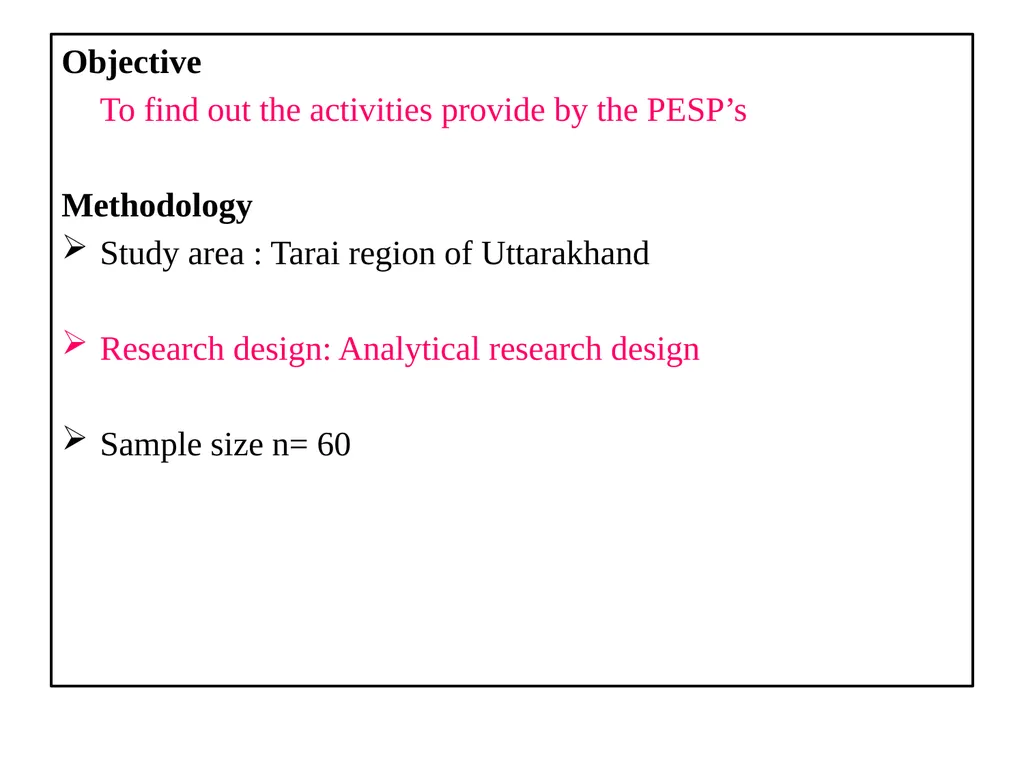
Objective
To find out the activities provide by the PESP’s
Methodology
Study area : Tarai region of Uttarakhand
Research design: Analytical research design
Sample size n= 60<br>
To find out the activities provide by the PESP’s
Methodology
Study area : Tarai region of Uttarakhand
Research design: Analytical research design
Sample size n= 60<br>
41
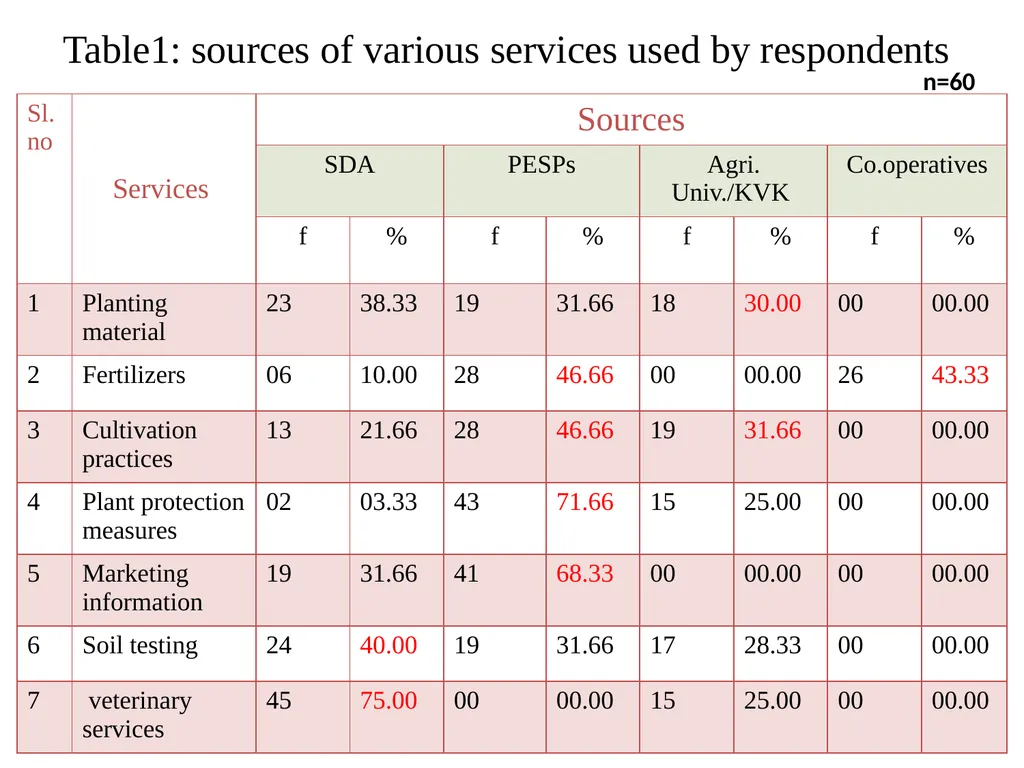
Table1: sources of various services used by respondents n=60<br>
42
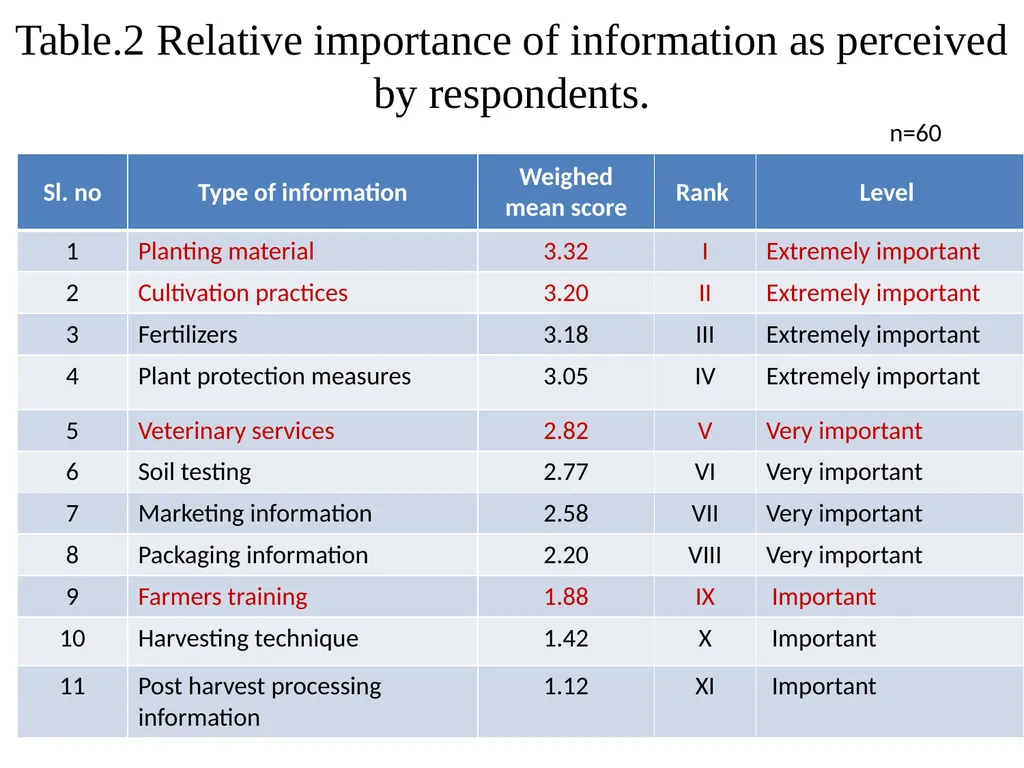
Table.2 Relative importance of information as perceived by respondents. n=60<br>
43
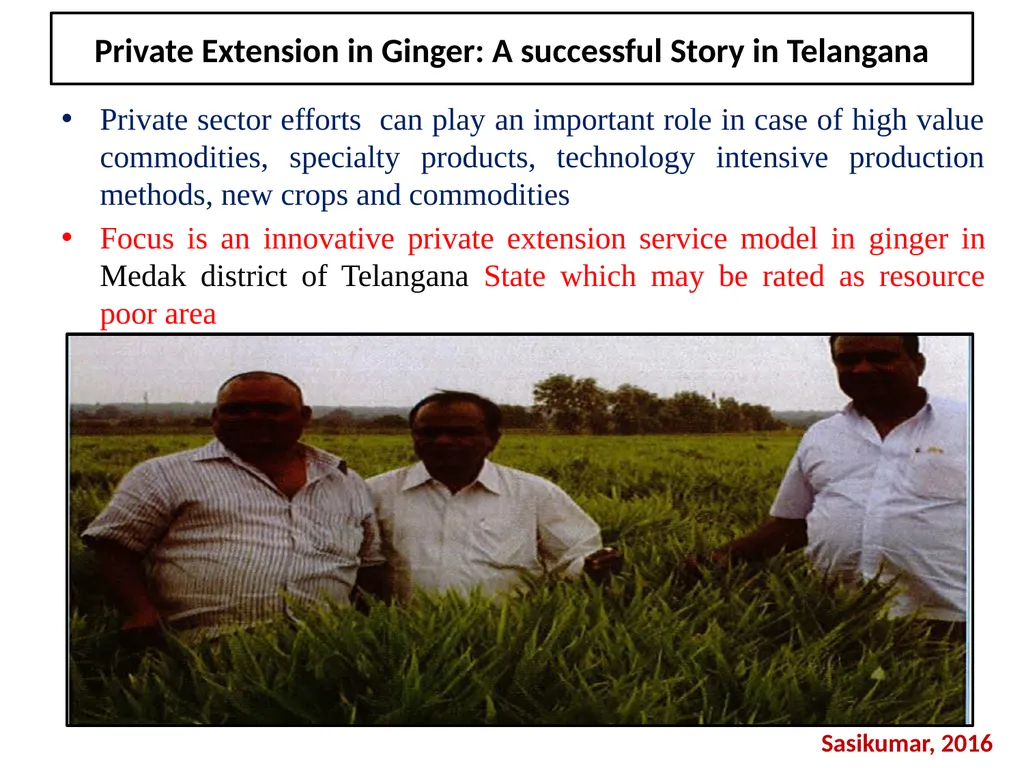
Private Extension in Ginger: A successful Story in Telangana Private sector efforts can play an important role in case of high value commodities, specialty products, technology intensive production methods, new crops and commodities
Focus is an innovative private extension service model in ginger in Medak district of Telangana State which may be rated as resource poor area Sasikumar, 2016<br>
Focus is an innovative private extension service model in ginger in Medak district of Telangana State which may be rated as resource poor area Sasikumar, 2016<br>
44
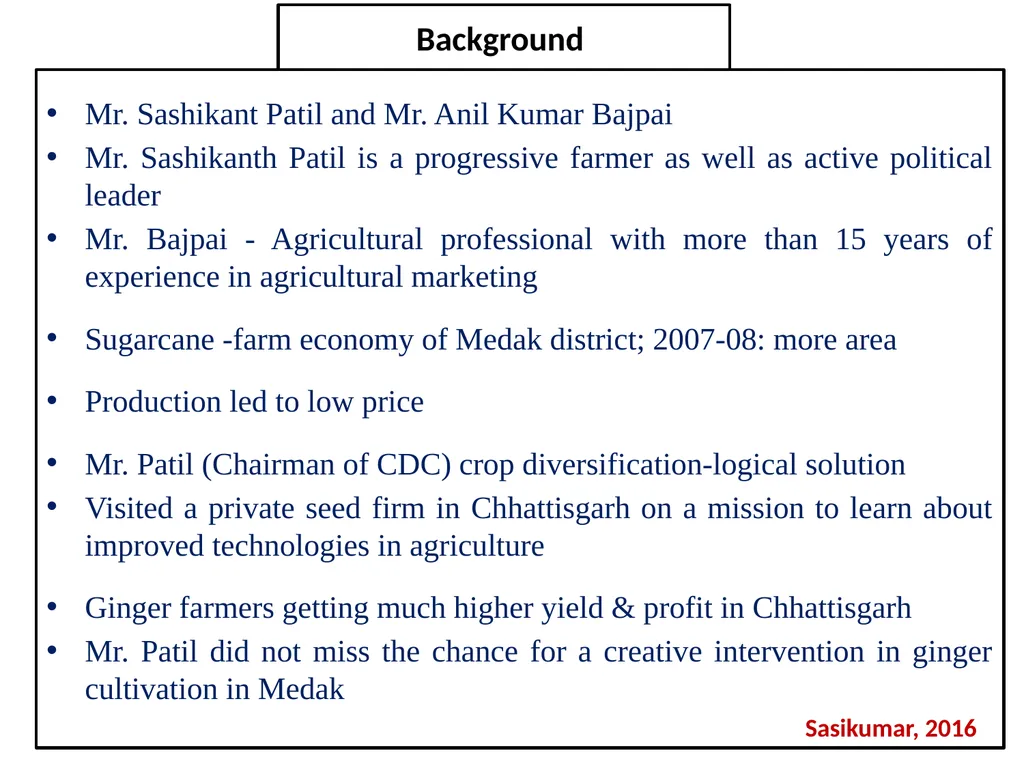
Background Mr. Sashikant Patil and Mr. Anil Kumar Bajpai
Mr. Sashikanth Patil is a progressive farmer as well as active political leader
Mr. Bajpai - Agricultural professional with more than 15 years of experience in agricultural marketing
Sugarcane -farm economy of Medak district; 2007-08: more area
Production led to low price
Mr. Patil (Chairman of CDC) crop diversification-logical solution
Visited a private seed firm in Chhattisgarh on a mission to learn about improved technologies in agriculture
Ginger farmers getting much higher yield & profit in Chhattisgarh
Mr. Patil did not miss the chance for a creative intervention in ginger cultivation in Medak Sasikumar, 2016<br>
Mr. Sashikanth Patil is a progressive farmer as well as active political leader
Mr. Bajpai - Agricultural professional with more than 15 years of experience in agricultural marketing
Sugarcane -farm economy of Medak district; 2007-08: more area
Production led to low price
Mr. Patil (Chairman of CDC) crop diversification-logical solution
Visited a private seed firm in Chhattisgarh on a mission to learn about improved technologies in agriculture
Ginger farmers getting much higher yield & profit in Chhattisgarh
Mr. Patil did not miss the chance for a creative intervention in ginger cultivation in Medak Sasikumar, 2016<br>
45
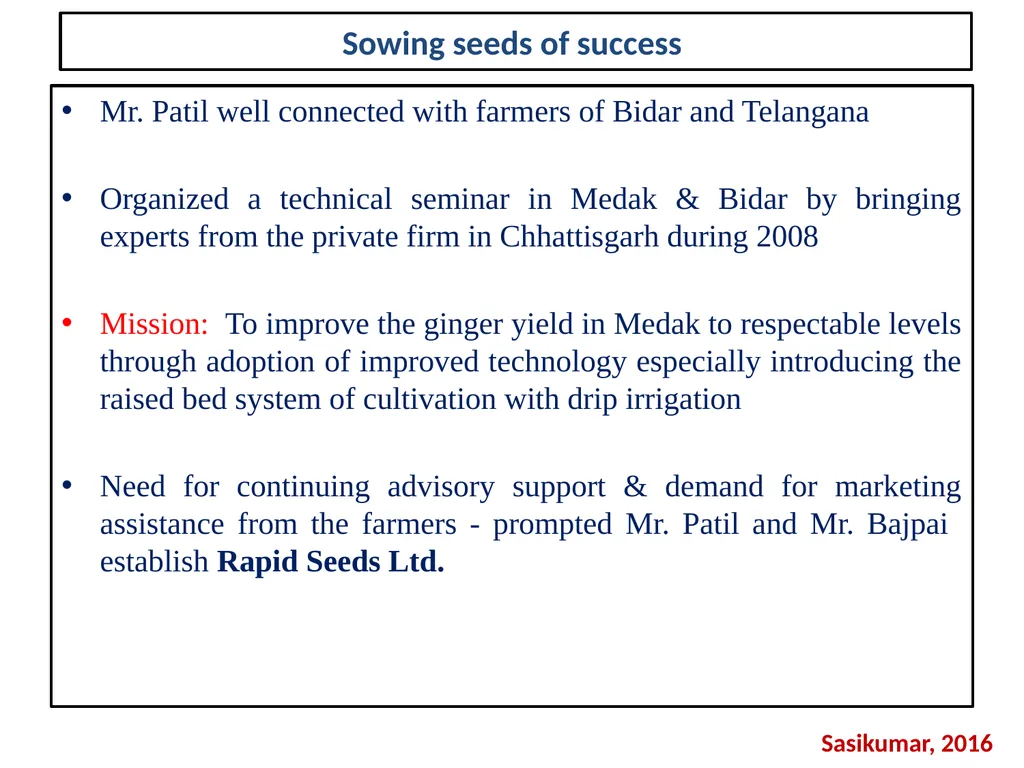
Sowing seeds of success Mr. Patil well connected with farmers of Bidar and Telangana
Organized a technical seminar in Medak & Bidar by bringing experts from the private firm in Chhattisgarh during 2008
Mission: To improve the ginger yield in Medak to respectable levels through adoption of improved technology especially introducing the raised bed system of cultivation with drip irrigation
Need for continuing advisory support & demand for marketing assistance from the farmers - prompted Mr. Patil and Mr. Bajpai establish Rapid Seeds Ltd. Sasikumar, 2016<br>
Organized a technical seminar in Medak & Bidar by bringing experts from the private firm in Chhattisgarh during 2008
Mission: To improve the ginger yield in Medak to respectable levels through adoption of improved technology especially introducing the raised bed system of cultivation with drip irrigation
Need for continuing advisory support & demand for marketing assistance from the farmers - prompted Mr. Patil and Mr. Bajpai establish Rapid Seeds Ltd. Sasikumar, 2016<br>
46
300 ginger farmers -AP, Telangana, Karnataka and Tamil Nadu
Provides good ginger seed material and detailed guidance
The farmers maintain a direct contact with the firm
Mr. Patil & Mr. Bajpai travels during crop season to visit the plots
Disease free plots for collection of seed ginger are identified
Offers a price premium for seed material
Sell their produce either in the market or to the firm Sasikumar, 2016 Private Extension Model<br>
Provides good ginger seed material and detailed guidance
The farmers maintain a direct contact with the firm
Mr. Patil & Mr. Bajpai travels during crop season to visit the plots
Disease free plots for collection of seed ginger are identified
Offers a price premium for seed material
Sell their produce either in the market or to the firm Sasikumar, 2016 Private Extension Model<br>
47
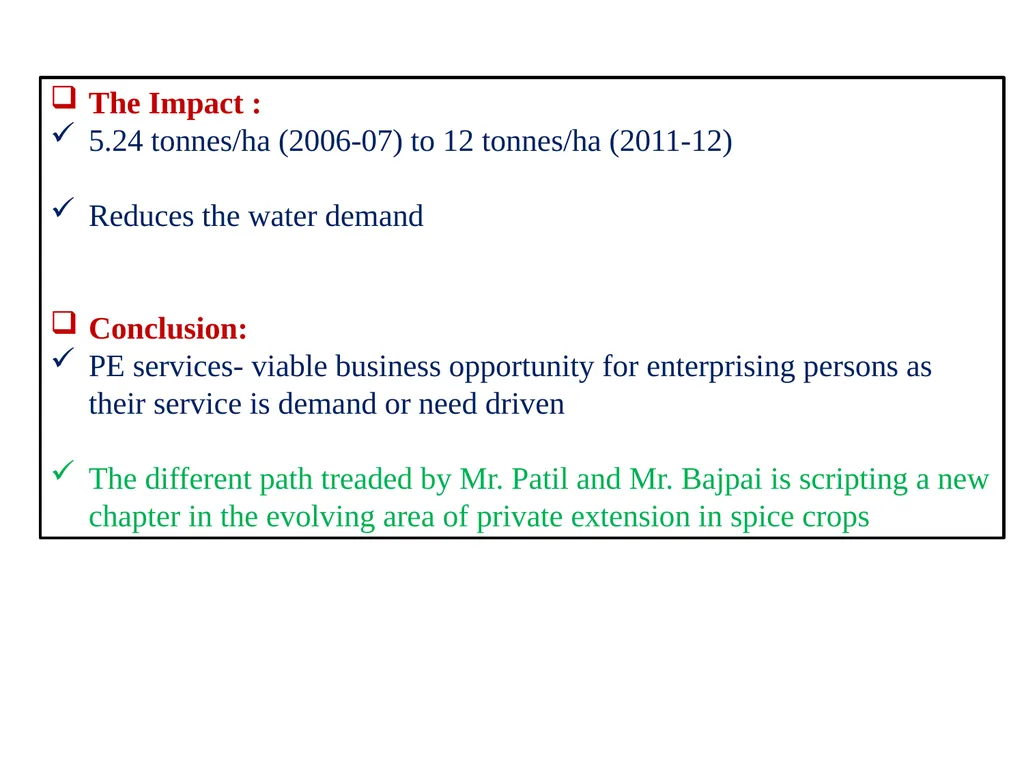
The Impact :
5.24 tonnes/ha (2006-07) to 12 tonnes/ha (2011-12)
Reduces the water demand
Conclusion:
PE services- viable business opportunity for enterprising persons as their service is demand or need driven
The different path treaded by Mr. Patil and Mr. Bajpai is scripting a new chapter in the evolving area of private extension in spice crops<br>
5.24 tonnes/ha (2006-07) to 12 tonnes/ha (2011-12)
Reduces the water demand
Conclusion:
PE services- viable business opportunity for enterprising persons as their service is demand or need driven
The different path treaded by Mr. Patil and Mr. Bajpai is scripting a new chapter in the evolving area of private extension in spice crops<br>
48
Conclusion Providing demand driven services
Increasing participation of the farmers in the extension
Cost effective with efficient and quality services
Private extension supplementing and complementing public sector extension To increase the competitiveness in the world and give justice to our farmers.<br>
Increasing participation of the farmers in the extension
Cost effective with efficient and quality services
Private extension supplementing and complementing public sector extension To increase the competitiveness in the world and give justice to our farmers.<br>
49
THANK U<br>