Welcome to Learning theory As humans we depend on a steady, predictable world. We need for there to be answers to questions and a reason for why things happen. However, reality is messy, and in many cases there just are no clear answers to
"Welcome to Learning theory As humans we depend on" is the property of its rightful owner. Permission is granted to
download and print the materials on this website for personal, non-commercial use only, and to display it
on your personal computer provided you do not modify the materials and that you retain all copyright
notices contained in the materials. By downloading content from our website, you accept the terms of this
agreement.
Presentation Transcript
01
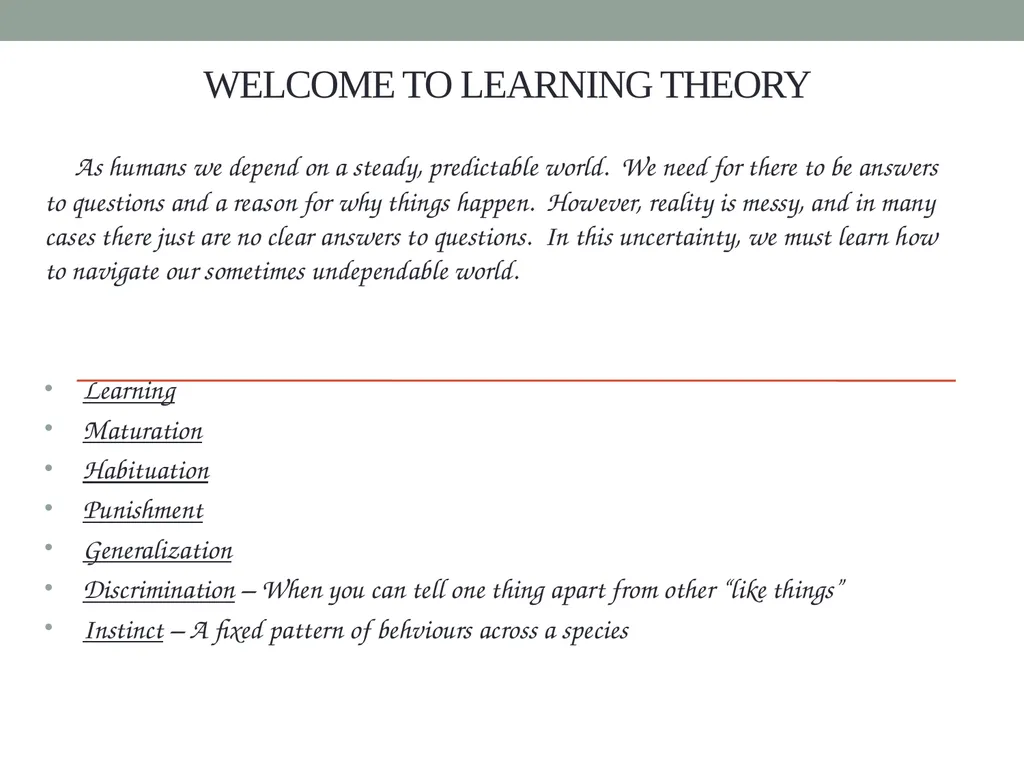
Welcome to Learning theory As humans we depend on a steady, predictable world. We need for there to be answers to questions and a reason for why things happen. However, reality is messy, and in many cases there just are no clear answers to questions. In this uncertainty, we must learn how to navigate our sometimes undependable world.
Learning
Maturation
Habituation
Punishment
Generalization
Discrimination – When you can tell one thing apart from other “like things”
Instinct – A fixed pattern of behviours across a species<br>
02
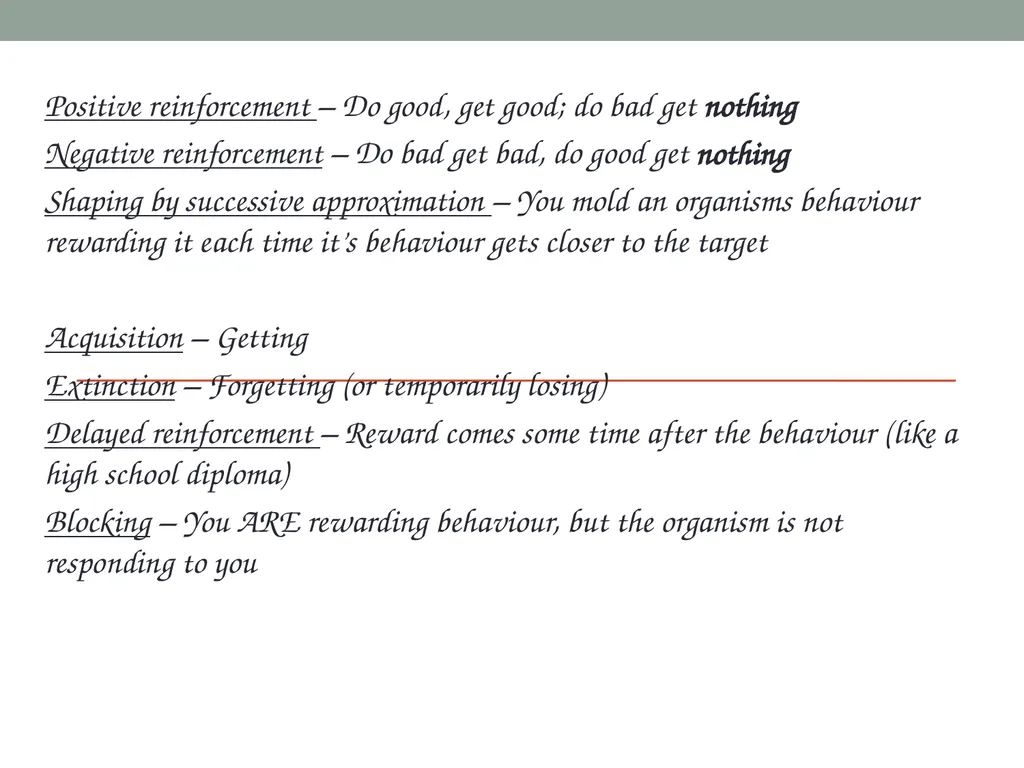
Positive reinforcement – Do good, get good; do bad get nothing
Negative reinforcement – Do bad get bad, do good get nothing
Shaping by successive approximation – You mold an organisms behaviour rewarding it each time it’s behaviour gets closer to the target
Acquisition – Getting
Extinction – Forgetting (or temporarily losing)
Delayed reinforcement – Reward comes some time after the behaviour (like a high school diploma)
Blocking – You ARE rewarding behaviour, but the organism is not responding to you<br>
03
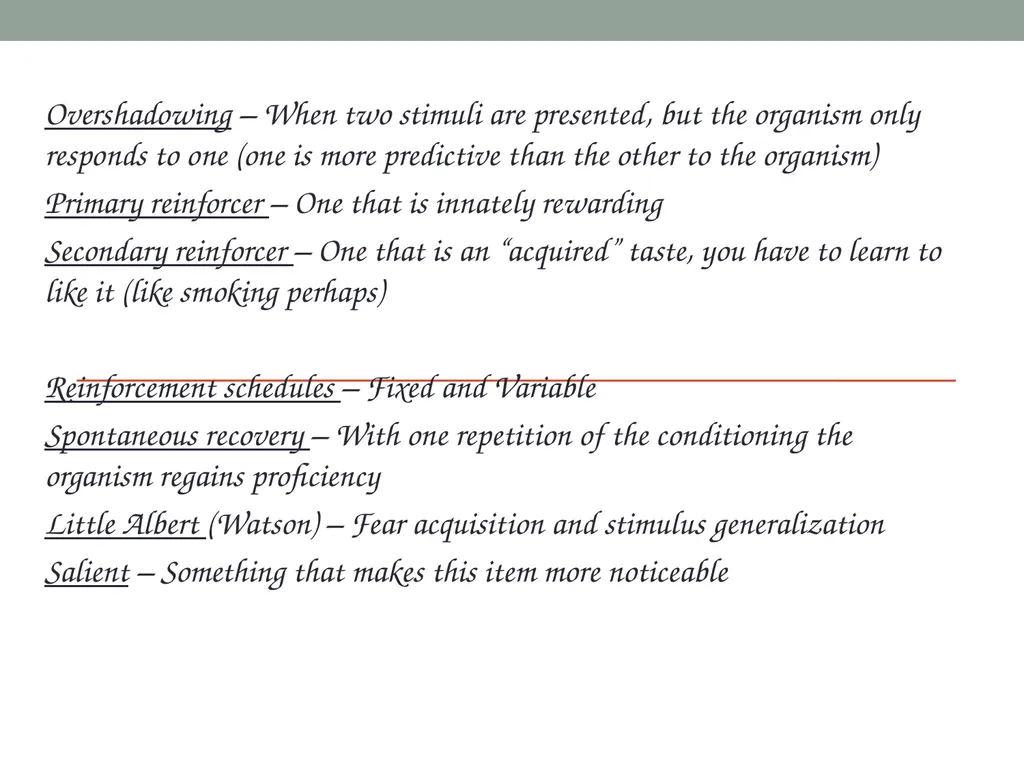
Overshadowing – When two stimuli are presented, but the organism only responds to one (one is more predictive than the other to the organism)
Primary reinforcer – One that is innately rewarding
Secondary reinforcer – One that is an “acquired” taste, you have to learn to like it (like smoking perhaps)
Reinforcement schedules – Fixed and Variable
Spontaneous recovery – With one repetition of the conditioning the organism regains proficiency
Little Albert (Watson) – Fear acquisition and stimulus generalization
Salient – Something that makes this item more noticeable<br>
04
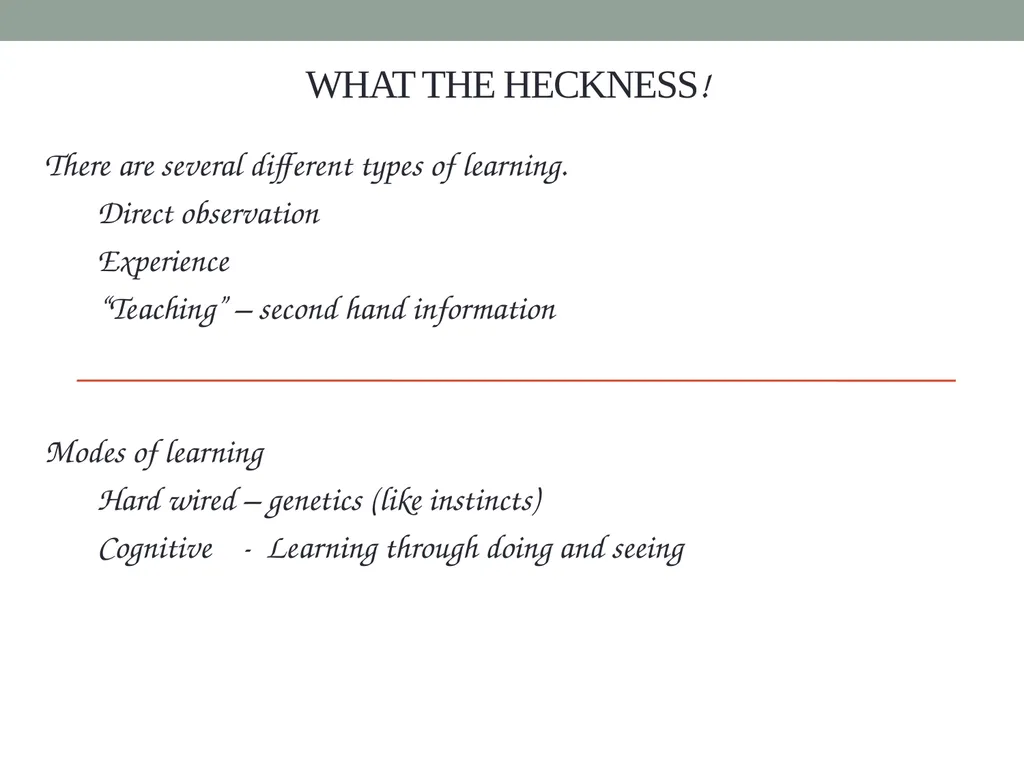
What the Heckness! There are several different types of learning.
Direct observation
Experience
“Teaching” – second hand information
Modes of learning
Hard wired – genetics (like instincts)
Cognitive - Learning through doing and seeing<br>
05
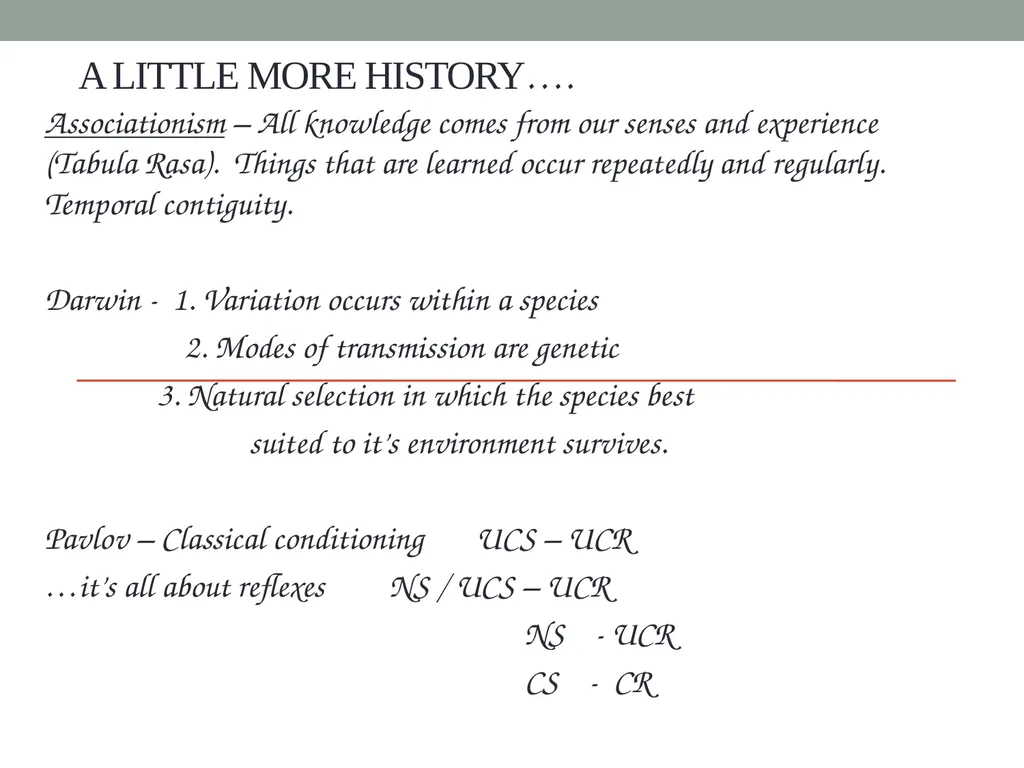
A little more History…. Associationism – All knowledge comes from our senses and experience (Tabula Rasa). Things that are learned occur repeatedly and regularly. Temporal contiguity.
Darwin - 1. Variation occurs within a species
2. Modes of transmission are genetic
3. Natural selection in which the species best
suited to it’s environment survives.
E.L. Thorndike Thorndike had created a “cat in a box” device to see how long it would take an intelligent animal to escape (with Salman – a guy not a fish). He also experimented with baby chick, trying to teach them to navigate a maze.
Law of Effect: All behaviour is random. However if a behaviour is followed by a pleasurable event, that behaviour is likely to be repeated. Only rewarded activities repeat.<br>
07
B.F. Skinner Skinner was a strict behaviourist. He practiced long after Watson. He was responsible for reinvigorating behaviourism because he made psychology Easy to understand, Easy to use, and made it apply to Everyone.
Skinner said that any complex behaviour could be taught, you just had to break the complex behaviour down into simple steps. These simple steps are sometimes called “schema.” Learning is therefore defined by the rewards that are applied.<br>
08
Rat Experiments Morphine test
A rat is burned (check reaction time). Injected with morphine, then burned again (slower reaction). Now the rat is injected with saline (salty water), and now the rat will react to the burn faster than it did the first time. Why?
Conflict test
A rat is given food when it taps a lever. Now that lever is electrified. Rat wont eat now. When given VALIUM, the rat will go an pad the lever and eat, even though it’s being painfully shocked each time. Why?<br>
09
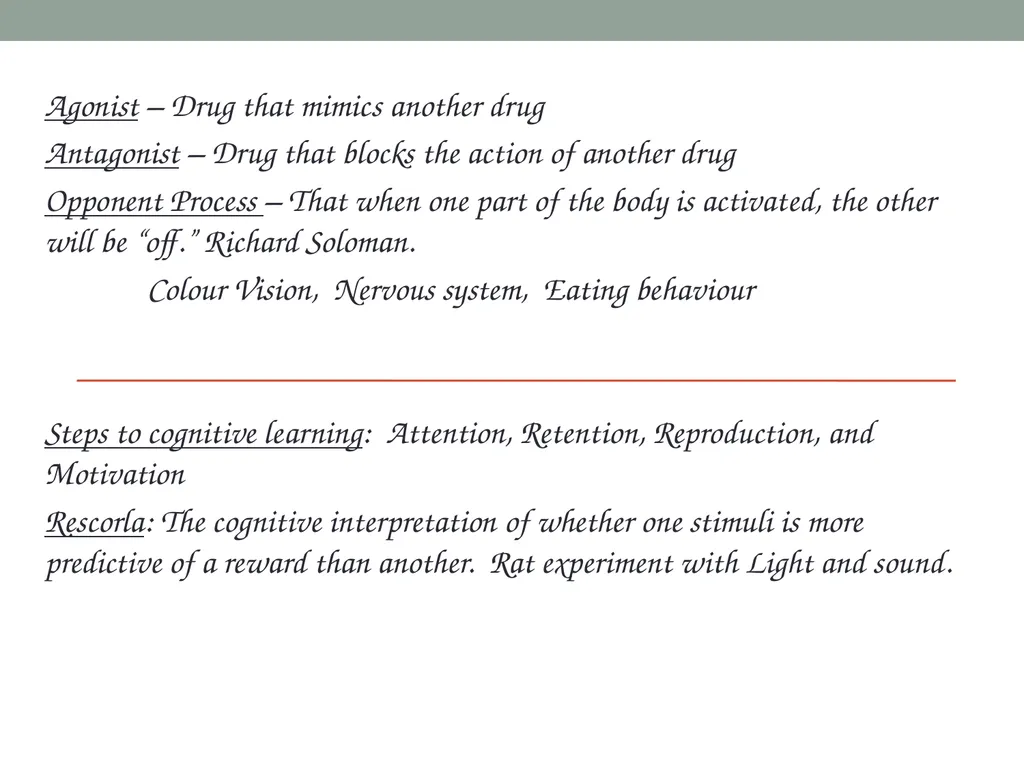
Agonist – Drug that mimics another drug
Antagonist – Drug that blocks the action of another drug
Opponent Process – That when one part of the body is activated, the other will be “off.” Richard Soloman.
Colour Vision, Nervous system, Eating behaviour
Steps to cognitive learning: Attention, Retention, Reproduction, and Motivation
Rescorla: The cognitive interpretation of whether one stimuli is more predictive of a reward than another. Rat experiment with Light and sound.<br>
10
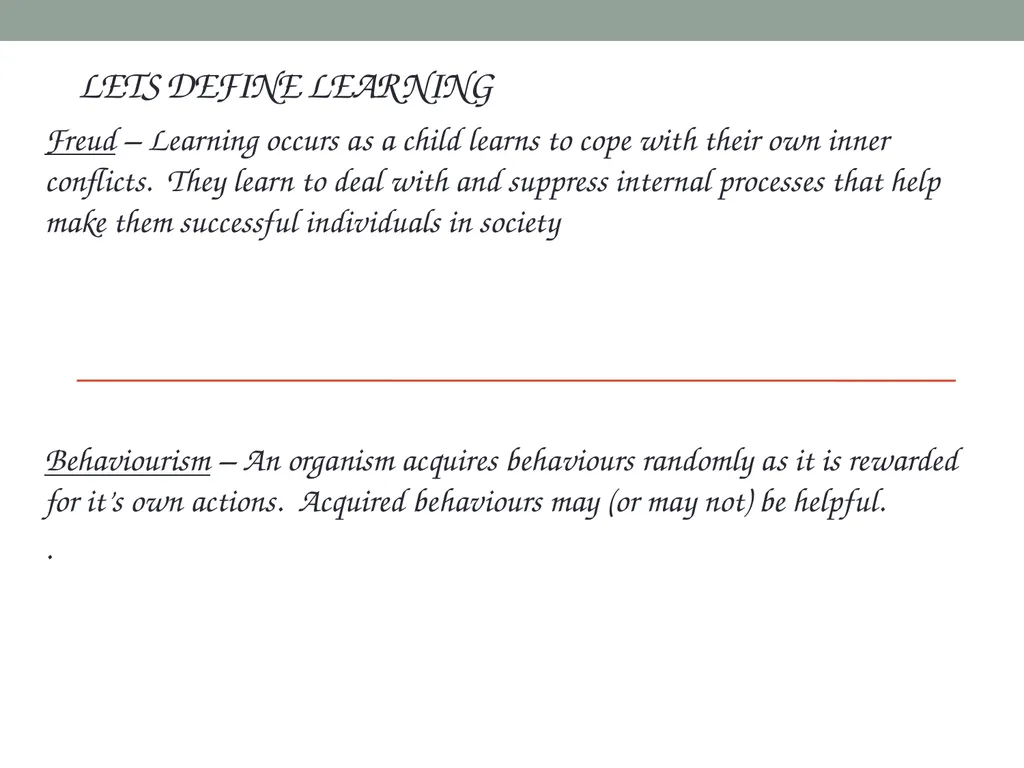
Lets define learning Freud – Learning occurs as a child learns to cope with their own inner conflicts. They learn to deal with and suppress internal processes that help make them successful individuals in society
Behaviourism – An organism acquires behaviours randomly as it is rewarded for it’s own actions. Acquired behaviours may (or may not) be helpful.
.<br>
11
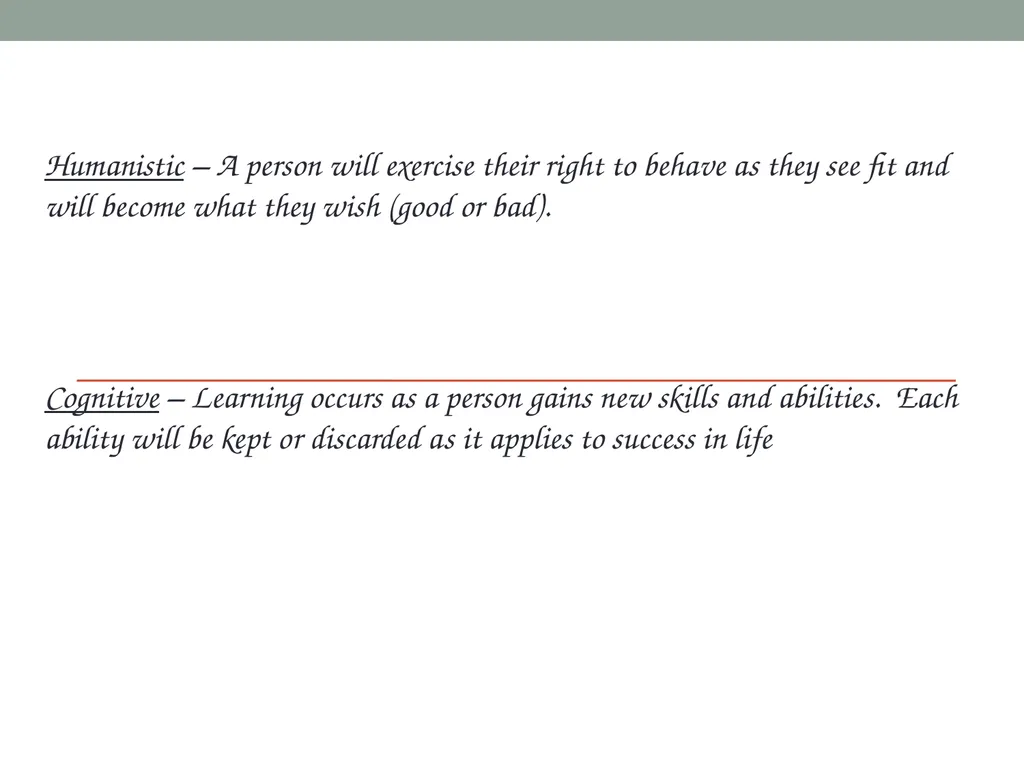
Humanistic – A person will exercise their right to behave as they see fit and will become what they wish (good or bad).
Cognitive – Learning occurs as a person gains new skills and abilities. Each ability will be kept or discarded as it applies to success in life<br>
12
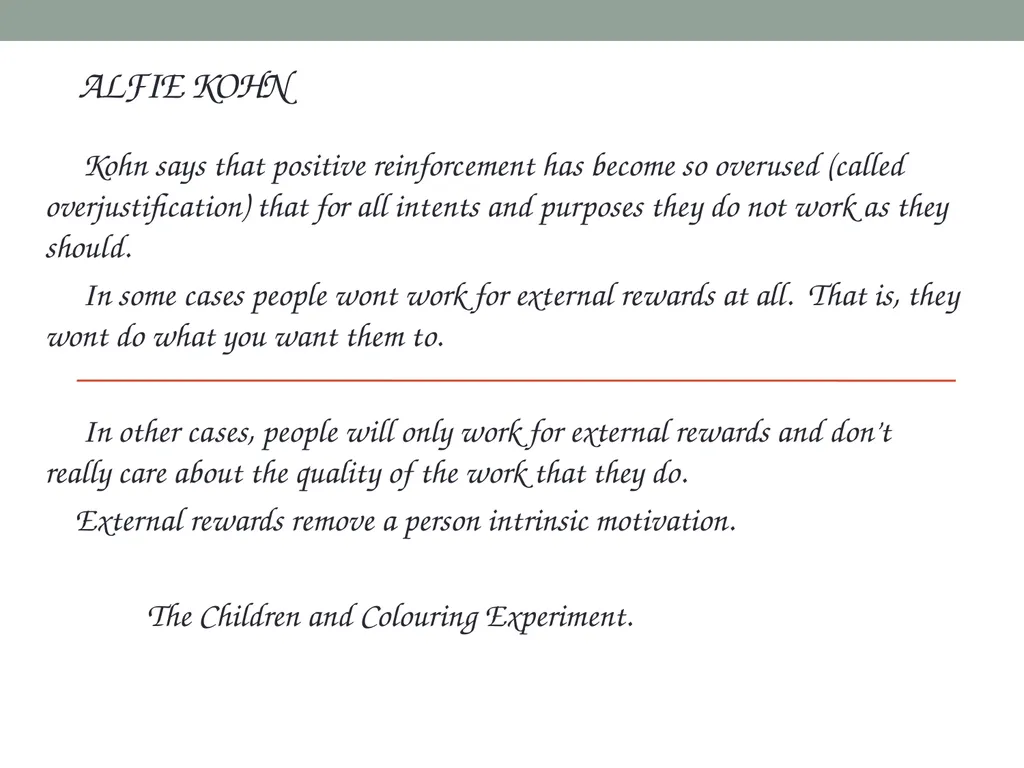
Alfie Kohn Kohn says that positive reinforcement has become so overused (called overjustification) that for all intents and purposes they do not work as they should.
In some cases people wont work for external rewards at all. That is, they wont do what you want them to.
In other cases, people will only work for external rewards and don’t really care about the quality of the work that they do.
External rewards remove a person intrinsic motivation.
The Children and Colouring Experiment.<br>
13
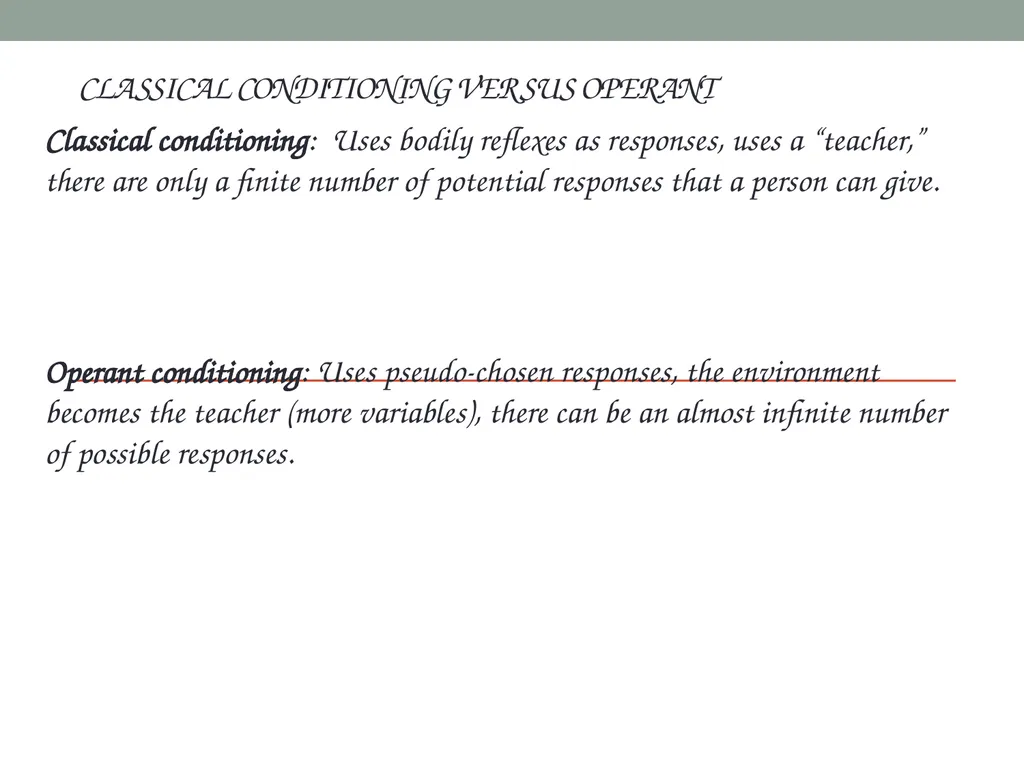
Classical conditioning versus Operant Classical conditioning: Uses bodily reflexes as responses, uses a “teacher,” there are only a finite number of potential responses that a person can give.
Operant conditioning: Uses pseudo-chosen responses, the environment becomes the teacher (more variables), there can be an almost infinite number of possible responses.<br>
14
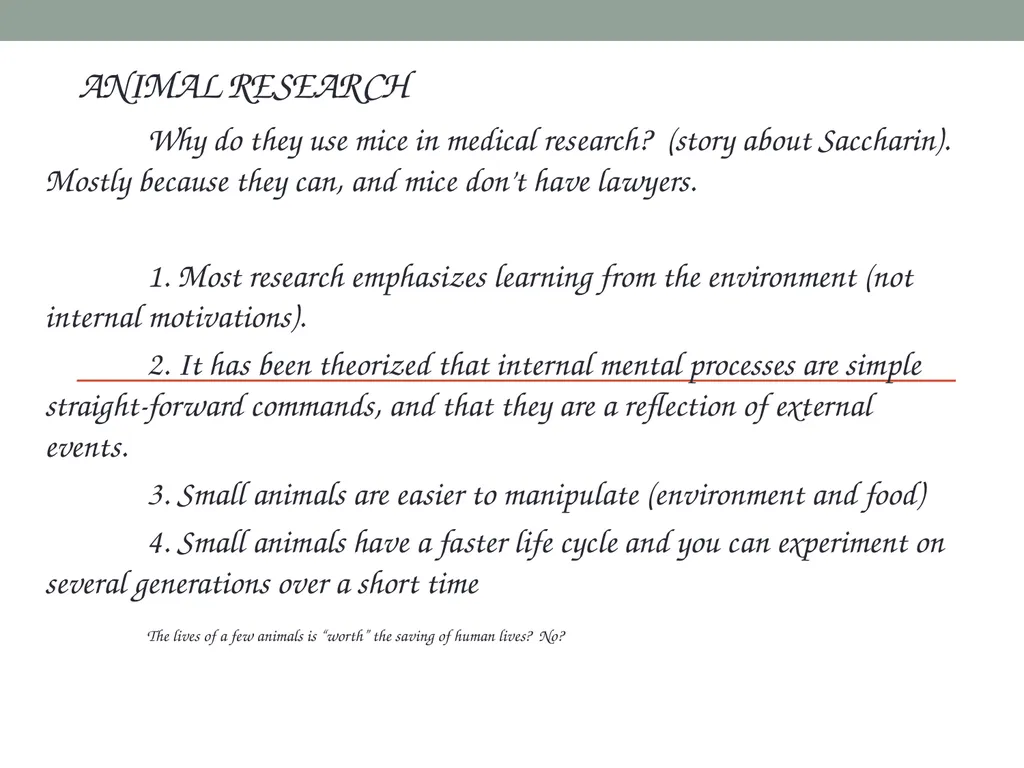
Animal Research Why do they use mice in medical research? (story about Saccharin). Mostly because they can, and mice don’t have lawyers.
1. Most research emphasizes learning from the environment (not internal motivations).
2. It has been theorized that internal mental processes are simple straight-forward commands, and that they are a reflection of external events.
3. Small animals are easier to manipulate (environment and food)
4. Small animals have a faster life cycle and you can experiment on several generations over a short time
The lives of a few animals is “worth” the saving of human lives? No?<br>
15
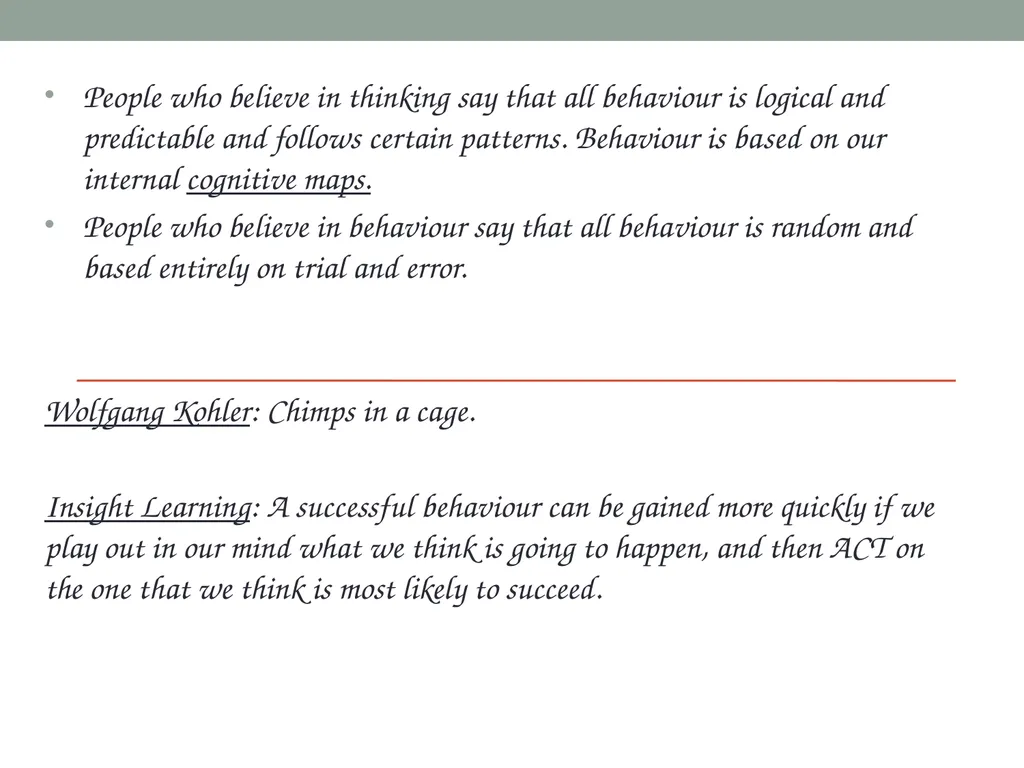
People who believe in thinking say that all behaviour is logical and predictable and follows certain patterns. Behaviour is based on our internal cognitive maps.
People who believe in behaviour say that all behaviour is random and based entirely on trial and error.
Wolfgang Kohler: Chimps in a cage.
Insight Learning: A successful behaviour can be gained more quickly if we play out in our mind what we think is going to happen, and then ACT on the one that we think is most likely to succeed.<br>
16
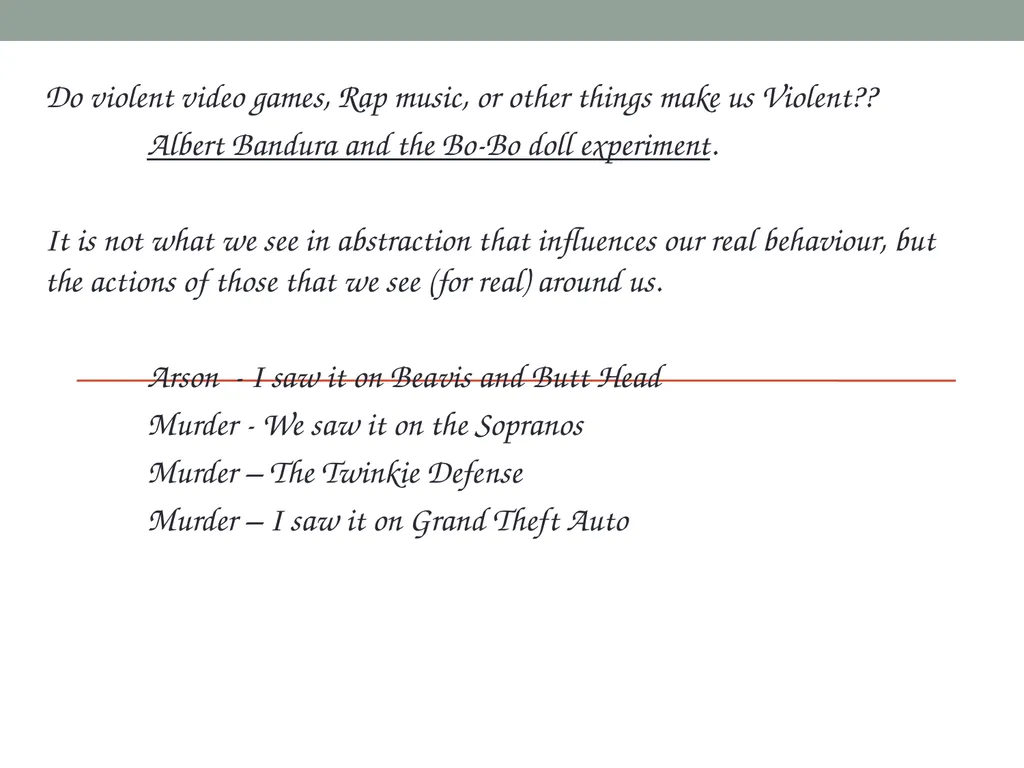
Do violent video games, Rap music, or other things make us Violent??
Albert Bandura and the Bo-Bo doll experiment.
It is not what we see in abstraction that influences our real behaviour, but the actions of those that we see (for real) around us.
Arson - I saw it on Beavis and Butt Head
Murder - We saw it on the Sopranos
Murder – The Twinkie Defense
Murder – I saw it on Grand Theft Auto<br>
17
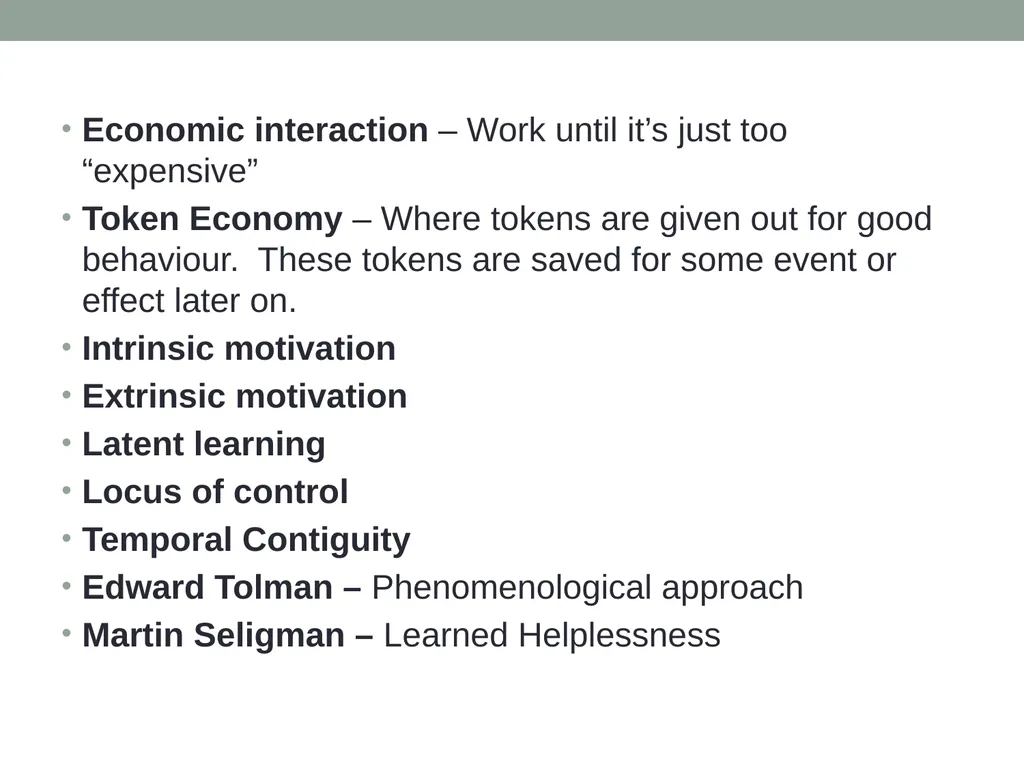
Economic interaction – Work until it’s just too “expensive”
Token Economy – Where tokens are given out for good behaviour. These tokens are saved for some event or effect later on.
Intrinsic motivation
Extrinsic motivation
Latent learning
Locus of control
Temporal Contiguity
Edward Tolman – Phenomenological approach
Martin Seligman – Learned Helplessness<br>