
Wendy Blount, DVM Practical Clinical Pathology Ups
A
Published · 71 slides · 0 views

1 / 1








Description
Wendy Blount, DVM Practical Clinical Pathology Ups and Downs of Blood Sugars Attendee 1 City TX Glucose Danger values - 40 gdl; 1000 gdl Hyperglycemia Brain dehydration due to hyperosmosis CNS signs (cerebral, brain stem) and seizures
Related Topics
Share
Embed code
Download this presentation From Below
"Wendy Blount, DVM Practical Clinical Pathology Ups" is the property of its rightful owner. Permission is granted to download and print the materials on this website for personal, non-commercial use only, and to display it on your personal computer provided you do not modify the materials and that you retain all copyright notices contained in the materials. By downloading content from our website, you accept the terms of this agreement.
Presentation Transcript
01
Wendy Blount, DVM Practical Clinical Pathology
Ups and Downs
of Blood Sugars<br>
of Blood Sugars<br>
02
Attendee 1 – City TX<br>
03
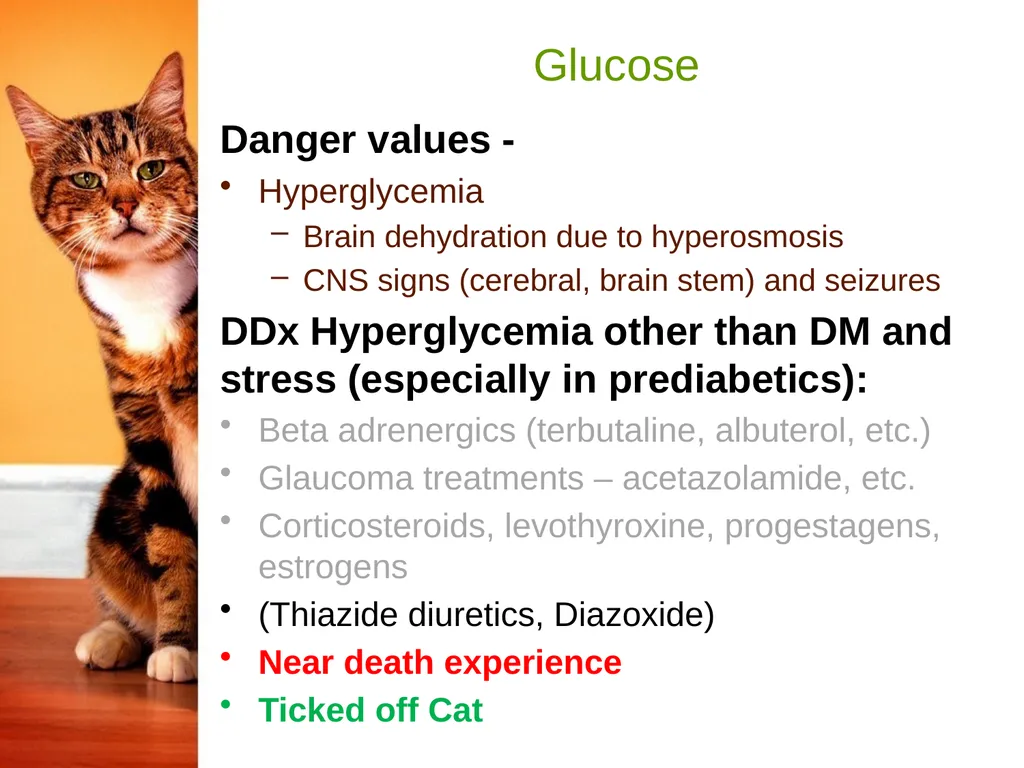
Glucose Danger values - <40 g/dl; >1000 g/dl
Hyperglycemia
Brain dehydration due to hyperosmosis
CNS signs (cerebral, brain stem) and seizures
DDx Hyperglycemia other than DM and stress (especially in prediabetics):
Beta adrenergics (terbutaline, albuterol, etc.)
Glaucoma treatments – acetazolamide, etc.
Corticosteroids, levothyroxine, progestagens, estrogens
(Thiazide diuretics, Diazoxide)
Near death experience
Ticked off Cat<br>
04
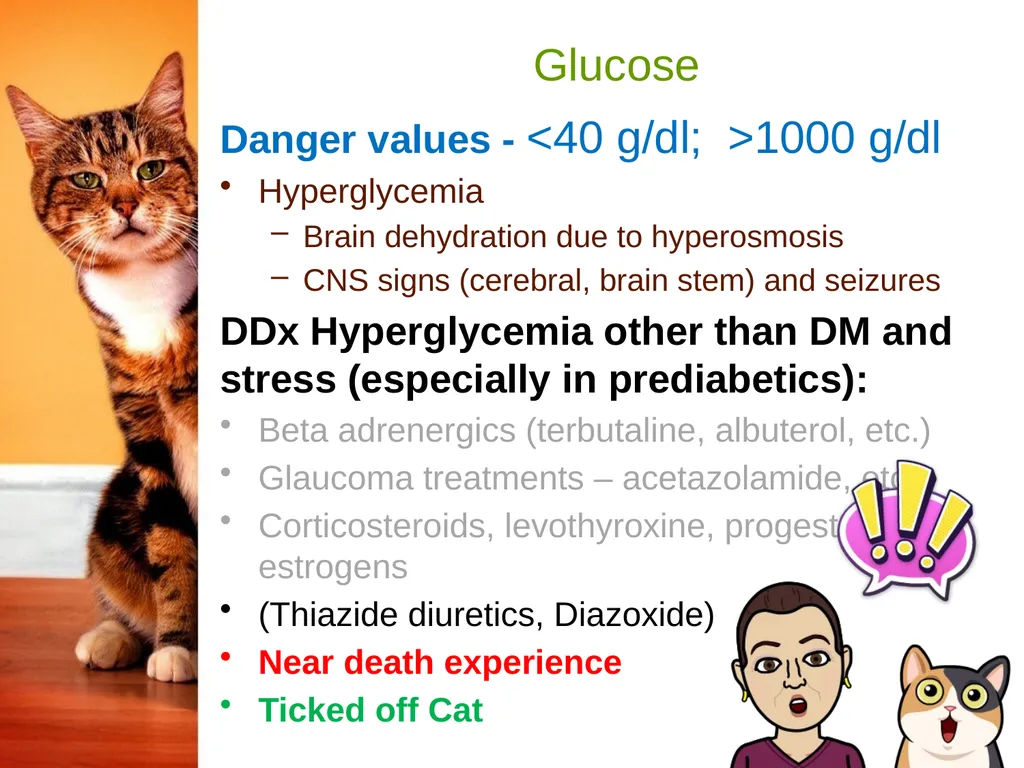
Glucose Danger values - <40 g/dl; >1000 g/dl
Hyperglycemia
Brain dehydration due to hyperosmosis
CNS signs (cerebral, brain stem) and seizures
DDx Hyperglycemia other than DM and stress (especially in prediabetics):
Beta adrenergics (terbutaline, albuterol, etc.)
Glaucoma treatments – acetazolamide, etc.
Corticosteroids, levothyroxine, progestagens, estrogens
(Thiazide diuretics, Diazoxide)
Near death experience
Ticked off Cat<br>
Hyperglycemia
Brain dehydration due to hyperosmosis
CNS signs (cerebral, brain stem) and seizures
DDx Hyperglycemia other than DM and stress (especially in prediabetics):
Beta adrenergics (terbutaline, albuterol, etc.)
Glaucoma treatments – acetazolamide, etc.
Corticosteroids, levothyroxine, progestagens, estrogens
(Thiazide diuretics, Diazoxide)
Near death experience
Ticked off Cat<br>
05
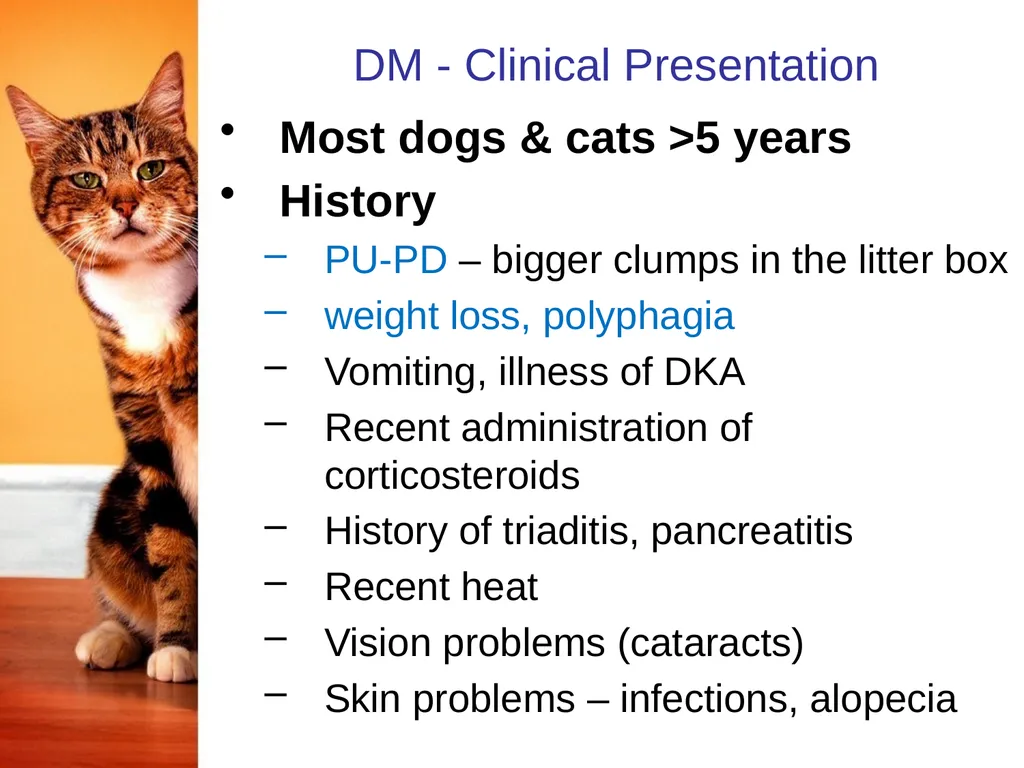
DM - Clinical Presentation Most dogs & cats >5 years
History
PU-PD – bigger clumps in the litter box
weight loss, polyphagia
Vomiting, illness of DKA
Recent administration of corticosteroids
History of triaditis, pancreatitis
Recent heat
Vision problems (cataracts)
Skin problems – infections, alopecia<br>
History
PU-PD – bigger clumps in the litter box
weight loss, polyphagia
Vomiting, illness of DKA
Recent administration of corticosteroids
History of triaditis, pancreatitis
Recent heat
Vision problems (cataracts)
Skin problems – infections, alopecia<br>
06
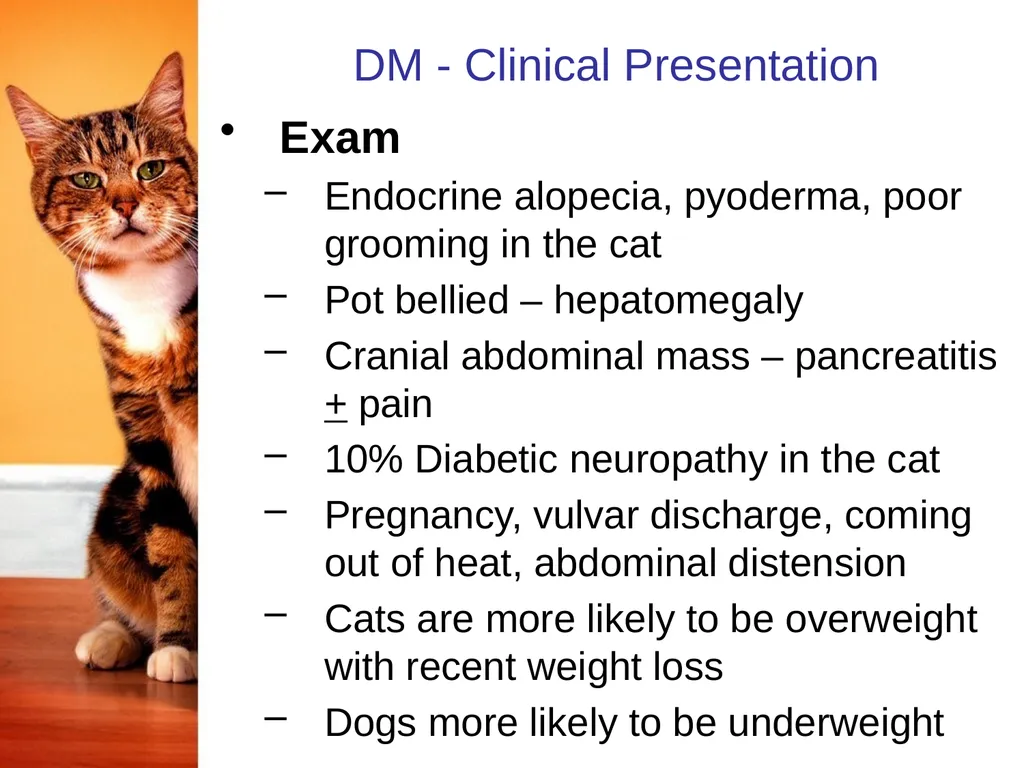
DM - Clinical Presentation Exam
Endocrine alopecia, pyoderma, poor grooming in the cat
Pot bellied – hepatomegaly
Cranial abdominal mass – pancreatitis + pain
10% Diabetic neuropathy in the cat
Pregnancy, vulvar discharge, coming out of heat, abdominal distension
Cats are more likely to be overweight with recent weight loss
Dogs more likely to be underweight<br>
07
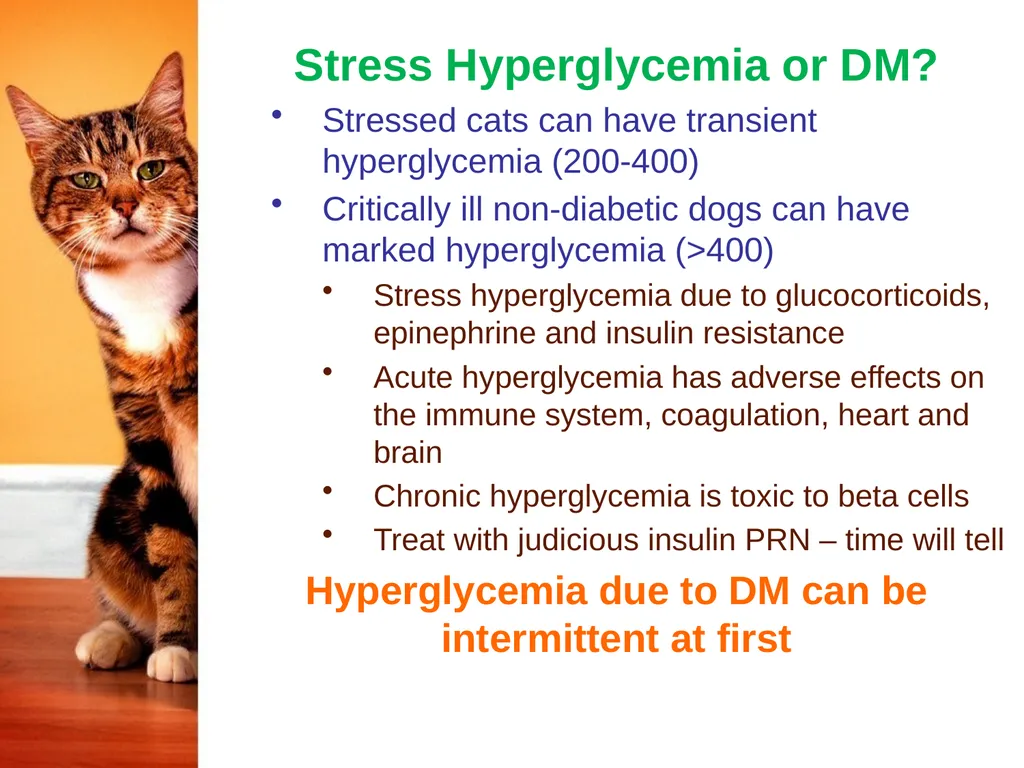
Stress Hyperglycemia or DM? Stressed cats can have transient hyperglycemia (200-400)
Critically ill non-diabetic dogs can have marked hyperglycemia (>400)
Stress hyperglycemia due to glucocorticoids, epinephrine and insulin resistance
Acute hyperglycemia has adverse effects on the immune system, coagulation, heart and brain
Chronic hyperglycemia is toxic to beta cells
Treat with judicious insulin PRN – time will tell
Hyperglycemia due to DM can be intermittent at first<br>
08
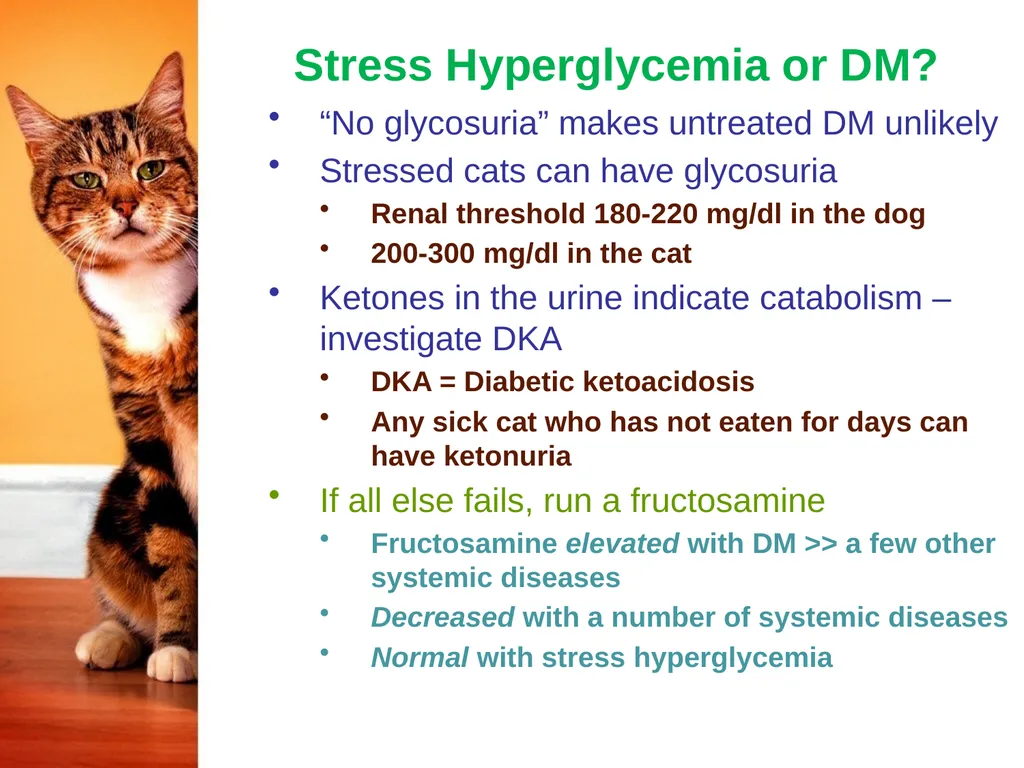
Stress Hyperglycemia or DM? “No glycosuria” makes untreated DM unlikely
Stressed cats can have glycosuria
Renal threshold 180-220 mg/dl in the dog
200-300 mg/dl in the cat
Ketones in the urine indicate catabolism – investigate DKA
DKA = Diabetic ketoacidosis
Any sick cat who has not eaten for days can have ketonuria
If all else fails, run a fructosamine
Fructosamine elevated with DM >> a few other systemic diseases
Decreased with a number of systemic diseases
Normal with stress hyperglycemia<br>
09
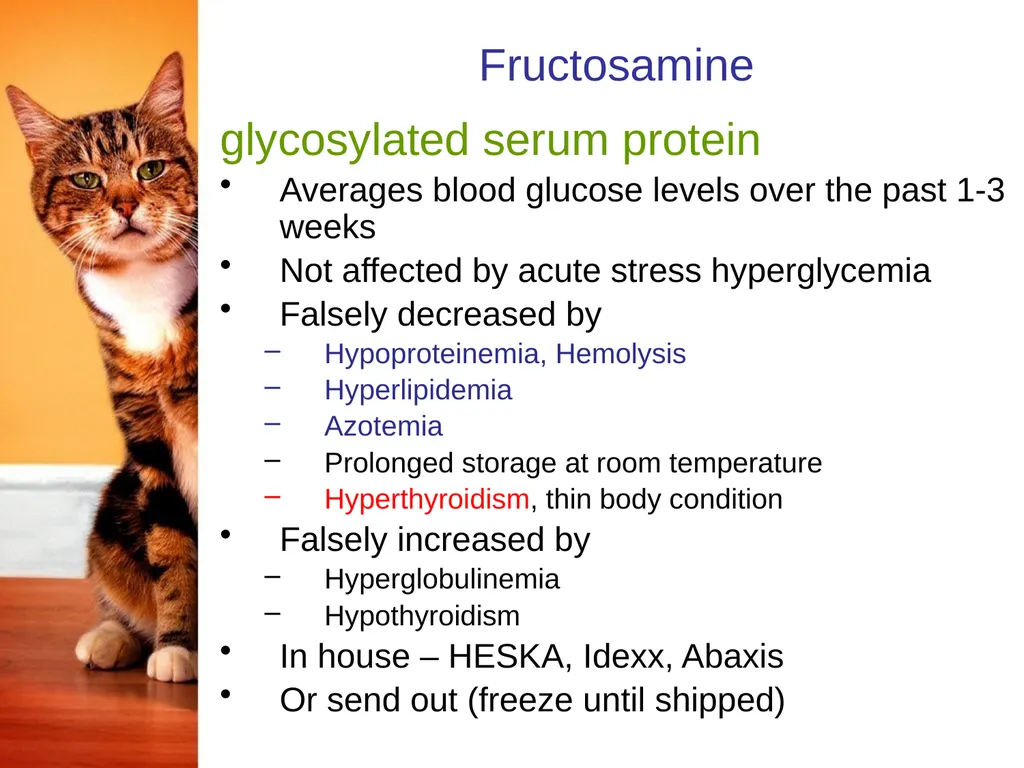
Fructosamine glycosylated serum protein
Averages blood glucose levels over the past 1-3 weeks
Not affected by acute stress hyperglycemia
Falsely decreased by - pancreatitis
Hypoproteinemia, Hemolysis
Hyperlipidemia
Azotemia
Prolonged storage at room temperature
Hyperthyroidism, thin body condition
Falsely increased by
Hyperglobulinemia
Hypothyroidism
In house – HESKA, Idexx, Abaxis
Or send out (freeze until shipped)<br>
10
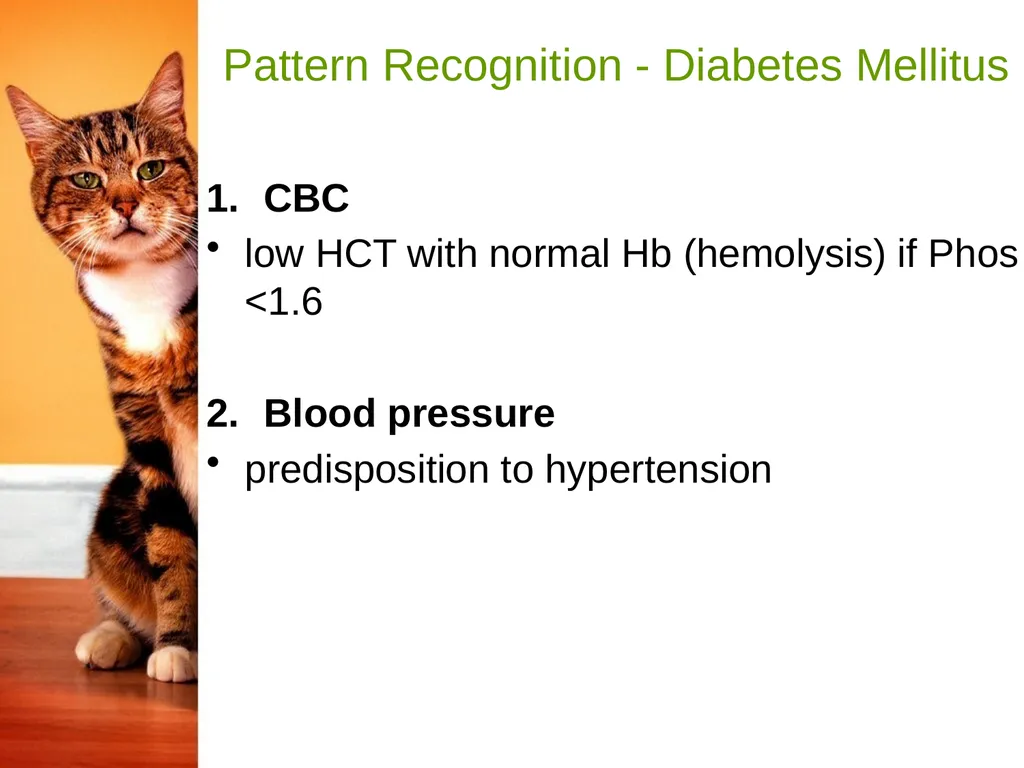
Pattern Recognition - Diabetes Mellitus CBC
low HCT with normal Hb (hemolysis) if Phos <1.6
Blood pressure
predisposition to hypertension<br>
low HCT with normal Hb (hemolysis) if Phos <1.6
Blood pressure
predisposition to hypertension<br>
11
Pattern Recognition - Diabetes Mellitus 3. Serum panel
Hyperglycemia (of course)
Hypophosphatemia – especially if DKA
Hypokalemia – especially if DKA
Elevated liver enzymes and hepatomegaly - Almost all unregulated diabetics have both
Symptoms of DM and Cushing’s overlap
Endocrine alopecia
PU-PD
Elevated liver enzymes with hepatomegaly
Cushing’s alone causes mild hyperglycemia that is not usually insulin dependent
Begin diabetic regulation before Dx HAC, fine tune after Dx & Tx<br>
12
Pattern Recognition - Diabetes Mellitus 3. Serum panel
Cholesterol high
triglycerides high
Azotemia if dehydrated
Albumin increased if dehydrated without pancreatitis<br>
Cholesterol high
triglycerides high
Azotemia if dehydrated
Albumin increased if dehydrated without pancreatitis<br>
13
Pattern Recognition - Diabetes Mellitus 4. Urinalysis
Look for UTI – predisposed by glucosuria, dilute urine and immunosuppression
25% of new diabetics have UTI
>50% UTI if also Cushingoid
Immunosuppression may result in benign sediment & lack if symptoms
Dilute urine may make bacteriuria hard to detect on urine sediment
Many rec. either culture or empirical treatment for UTI for new diabetics
Proteinuria – pancreatitis, HAC, UTI<br>
14
Pattern Recognition - Diabetes Mellitus 5. Thyroid testing
TT4 and fT4 for all diabetic cats >5 yrs old
Retest cats if regulation difficult
If regulation difficult and other signs of hypothyroidism in the dog – TSH, TT4, fT4
TT4 in euthyroid unregulated diabetics will often be low
Glucose >350-450 mg/dl means condition is potentially life threatening
Look for CRF if glucose >800 mg/dl<br>
15
Pattern Recognition - Diabetes Mellitus Indications of DKA
need hospitalization and careful monitoring, higher level of K+ and phos supplementation
Metabolic acidosis - Low HCO3, low TCO2, low blood pH, high anion gap
Ketosis - ketonuria, vomiting, lethargy
Phos <1.5 can cause severe hemolysis
K+ <2.5 can cause weakness and paralysis<br>
need hospitalization and careful monitoring, higher level of K+ and phos supplementation
Metabolic acidosis - Low HCO3, low TCO2, low blood pH, high anion gap
Ketosis - ketonuria, vomiting, lethargy
Phos <1.5 can cause severe hemolysis
K+ <2.5 can cause weakness and paralysis<br>
16
Pattern Recognition - Diabetes Mellitus Pancreatitis pattern
need fluid support, pain meds, antiemetics, maybe plasma if really bad
CBC
Thrombocytopenia – vasculitis, DIC
neutrophilia + left shift – pancreatic necrosis, fat necrosis
Anemia – Anemia of Chronic Inflammatory Disease (ACID), hemolysis<br>
need fluid support, pain meds, antiemetics, maybe plasma if really bad
CBC
Thrombocytopenia – vasculitis, DIC
neutrophilia + left shift – pancreatic necrosis, fat necrosis
Anemia – Anemia of Chronic Inflammatory Disease (ACID), hemolysis<br>
17
Pattern Recognition - Diabetes Mellitus Pancreatitis pattern
Panel - lipemia while fasting (esp. the cat)
Hypocalcemia – saponification of fat
Hypoalbuminemia – systemic inflammation, vasculitis
elevated liver enzymes, icterus
whacked out glucose
Hypophosphatemia – lack of insulin, renal loss, lack of intake
Hypochloridemia – vomiting
Hypokalemia – lack of insulin, acidosis, vomiting, diarrhea, lack of intake<br>
18
Pattern Recognition - Diabetes Mellitus Pancreatitis pattern
cPL, fPL
cPL best test for pancreatitis in the dog
US best test for pancreatitis in the cat
Amylase is seldom helpful, and a weak indicator
Lipase has very low sensitivity, but specific
pancreatitis is the most common cause of hyperlipidemia in the cat
Pancreatitis is on the short list of things that will cause icterus without anemia or elevated liver enzymes in the cat<br>
19
Pattern Recognition - Diabetes Mellitus Fatty liver pattern – need nutritional support for cats (feeding tube?)
Hx – heavy cat has not eaten in several days
Exam - liver enlarged, + icterus, sick
Fatty liver with HE indicates poor prognosis
Panel - ALKP significantly exceeds GGT only in feline hepatic lipidosis
+ elevated bili
Elevated ALT is common
Changes associated with co-morbidities that may be initial cause
Abd US
diffusely hyperechoic liver
Co-morbidities that may be initial cause
Fatty liver Often diagnosed on cytology<br>
20
Pattern Recognition - Diabetes Mellitus Fatty liver pattern – need nutritional support for cats (feeding tube?)
Hx – heavy cat has not eaten in several days
Exam - liver enlarged, + icterus, sick
Fatty liver with HE indicates poor prognosis
Panel - ALKP significantly exceeds GGT only in feline hepatic lipidosis
+ elevated bili
Elevated ALT is common
Changes associated with co-morbidities that may be initial cause
Abd US
diffusely hyperechoic liver
Co-morbidities that may be initial cause
Fatty liver Often diagnosed on cytology<br>
Hx – heavy cat has not eaten in several days
Exam - liver enlarged, + icterus, sick
Fatty liver with HE indicates poor prognosis
Panel - ALKP significantly exceeds GGT only in feline hepatic lipidosis
+ elevated bili
Elevated ALT is common
Changes associated with co-morbidities that may be initial cause
Abd US
diffusely hyperechoic liver
Co-morbidities that may be initial cause
Fatty liver Often diagnosed on cytology<br>
21
K+ & Phos in DKA Patient Insulin carries K+ & Phos into the cell
Insulin administration can make hypokalemia and hypophosphatemia worse – supplement first
Without insulin, both get washed out the kidneys due to PU-PD
90-95% of the body K+ is intracellular
Total body K+ can be depleted even if serum K+ is normal
H+ is exchanged for K+ Correcting acidosis worsens K+<br>
22
Continuous Glucose Monitoring (CGM) Systems (Flash) Probe measures glucose in interstitial fluid continuously to plot a curve
Wireless transmission to a pager size display
Human device validated in dogs 2016
Previous devices worn in a vest
Freestyle Libre is disposable
Available in the US as of Dec 2017
Requires a prescription
Approved for people – off label for pets<br>
Wireless transmission to a pager size display
Human device validated in dogs 2016
Previous devices worn in a vest
Freestyle Libre is disposable
Available in the US as of Dec 2017
Requires a prescription
Approved for people – off label for pets<br>
23
Continuous Glucose Monitoring (CGM) Systems (Flash) Shave fur over the dorsal neck
Clean with alcohol and let dry
Apply sticky disc this size of a quarter
Secure with a light bandage
Stay on dogs pretty well – cats can be a problem
Applying sport spray can help adhere
Disk stores data for 8 hours
Wave reader over the disk to read & save up to every 8 hrs, for 10 days
Disk $75-100, Reader $50<br>
24
Continuous Glucose Monitoring (CGM) Systems (Flash) Dr. Greg Matt, Houston TX<br>
25
Continuous Glucose Monitoring (CGM) Systems (Flash) Dr. Greg Matt, Houston TX<br>
26
Continuous Glucose Monitoring (CGM) Systems (Flash) Dr. Greg Matt, Houston TX<br>
27
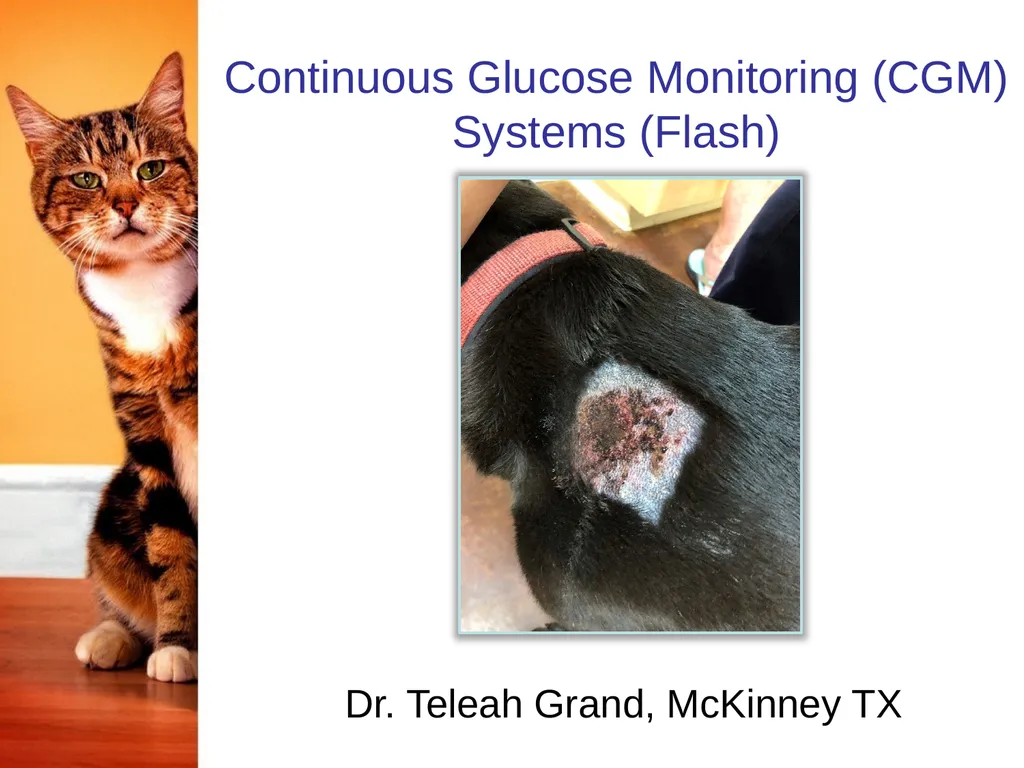
Continuous Glucose Monitoring (CGM) Systems (Flash) Dr. Teleah Grand, McKinney TX<br>
28
Attendee 2 – City TX<br>
29
Monitoring DM – Fructosamine (FRA) Low (<200)
Mild to moderate hypoglycemia
Not enough to cause Somogyi (glucose 65-80)
Decrease insulin by 10-20%
Normal range (200-350)
Good diabetic control (350-450)
High (>450 mcmol/L)
>600 – danger zone
Significant periods of hyperglycemia
Not enough insulin, or too much insulin
Hypoglycemia, rebound hyperglycemia (too much)
Or sustained hyperglycemia (not enough insulin)<br>
30
Monitoring DM - Fructosamine (FRA) Low FRA with poor glycemic control – check T4
Remission is defined as normal FRA w/o insulin
Regulation using FRA can work well when curves are not practical
But keep in mind that FRA is ideal in only 60% of diabetic pets with good clinical regulation<br>
Remission is defined as normal FRA w/o insulin
Regulation using FRA can work well when curves are not practical
But keep in mind that FRA is ideal in only 60% of diabetic pets with good clinical regulation<br>
31
Monitoring DM - Fructosamine (FRA) Low FRA with poor glycemic control – check T4
Remission is defined as normal FRA w/o insulin
Regulation using FRA can work well when curves are not practical
But keep in mind that FRA is ideal in only 60% of diabetic pets with good clinical regulation
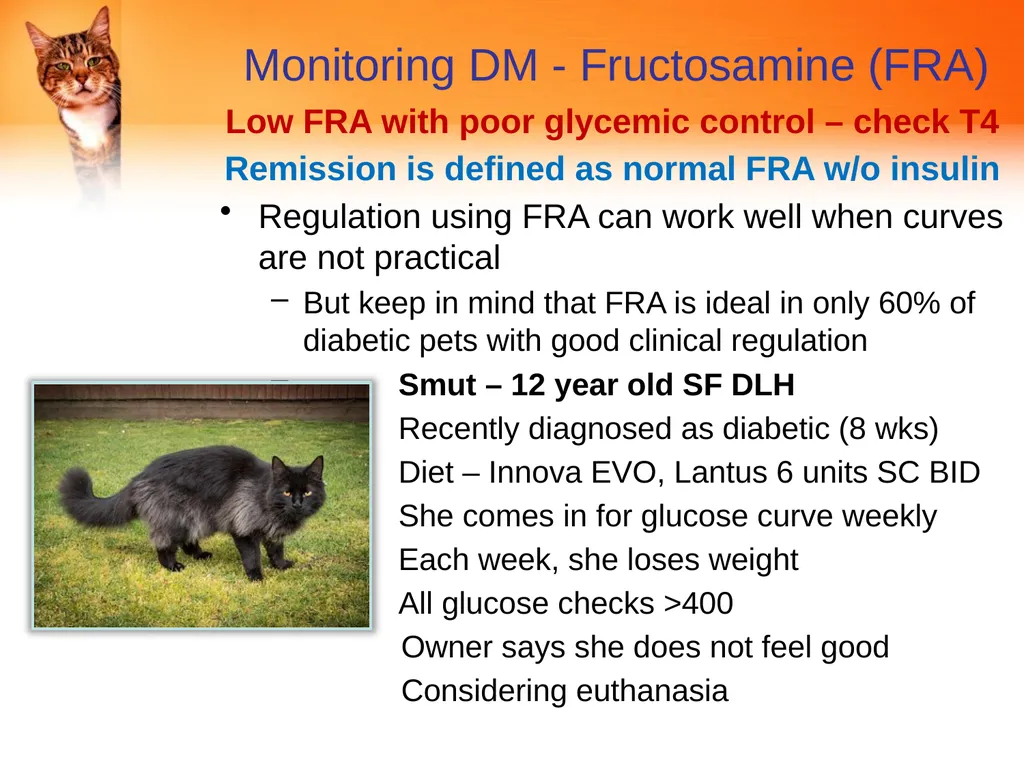
Smut – 12 year old SF DLH
Recently diagnosed as diabetic (8 wks)
Diet – Innova EVO, Lantus 6 units SC BID
She comes in for glucose curve weekly
Each week, she loses weight
All glucose checks >400
Owner says she does not feel good
Considering euthanasia<br>
32
Monitoring DM - Fructosamine (FRA) Low FRA with poor glycemic control – check T4
Remission is defined as normal FRA w/o insulin
Regulation using FRA can work well when curves are not practical
But keep in mind that FRA is ideal in only 60% of diabetic pets with good clinical regulation
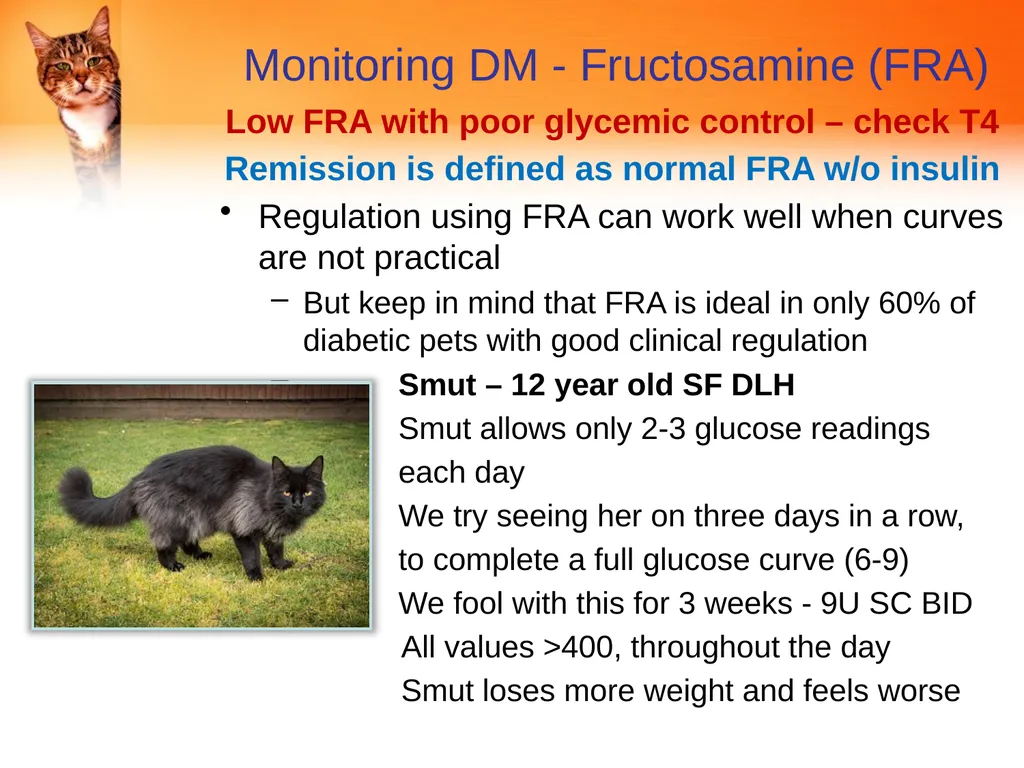
Smut – 12 year old SF DLH
Smut allows only 2-3 glucose readings
each day
We try seeing her on three days in a row,
to complete a full glucose curve (6-9)
We fool with this for 3 weeks - 9U SC BID
All values >400, throughout the day
Smut loses more weight and feels worse<br>
33
Monitoring DM - Fructosamine (FRA) Low FRA with poor glycemic control – check T4
Remission is defined as normal FRA w/o insulin
Regulation using FRA can work well when curves are not practical
But keep in mind that FRA is ideal in only 60% of diabetic pets with good clinical regulation
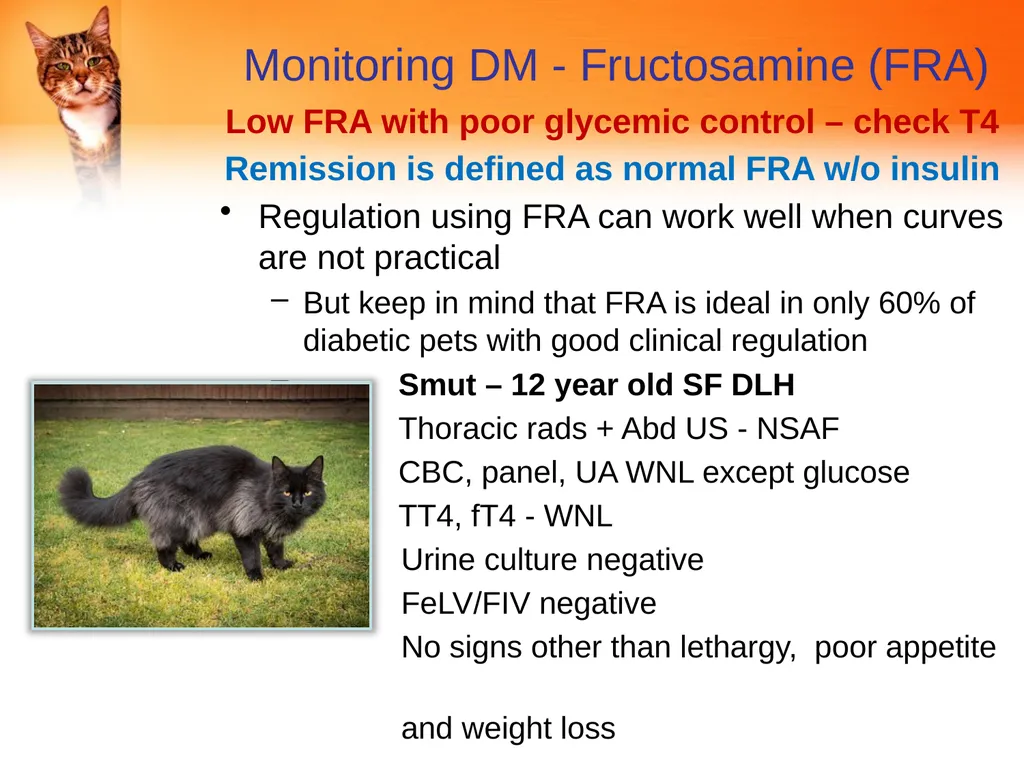
Smut – 12 year old SF DLH
Thoracic rads + Abd US - NSAF
CBC, panel, UA WNL except glucose
TT4, fT4 - WNL
Urine culture negative
FeLV/FIV negative
No signs other than lethargy, poor appetite
and weight loss<br>
34
Monitoring DM - Fructosamine (FRA) Low FRA with poor glycemic control – check T4
Remission is defined as normal FRA w/o insulin
Regulation using FRA can work well when curves are not practical
But keep in mind that FRA is ideal in only 60% of diabetic pets with good clinical regulation
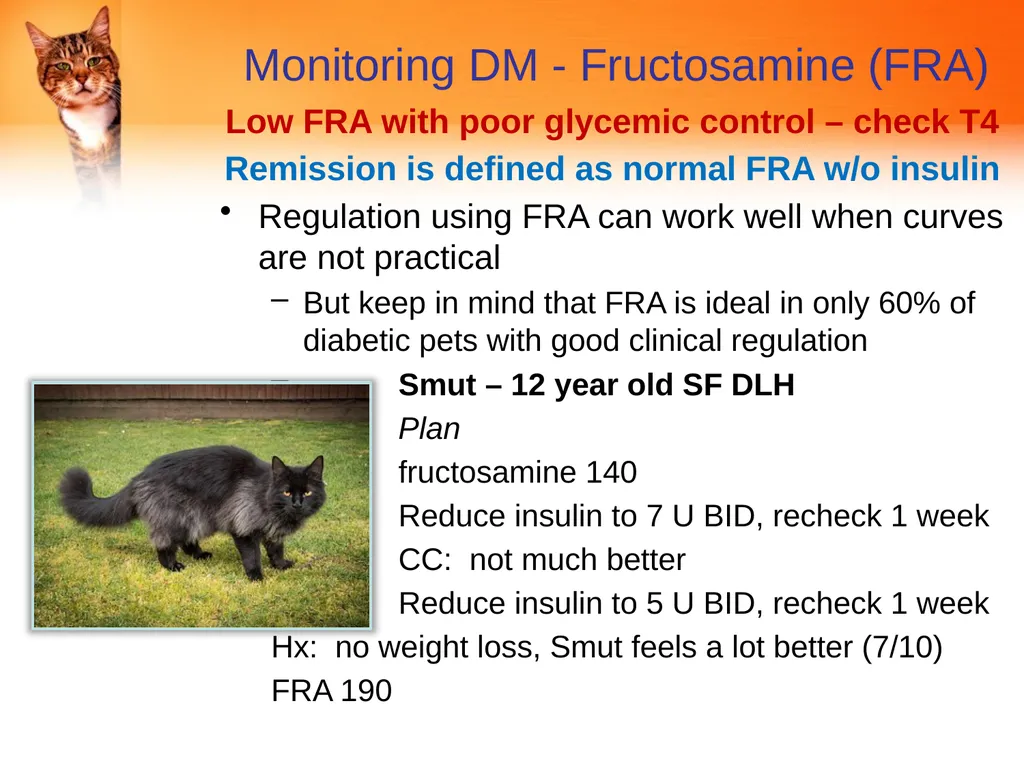
Smut – 12 year old SF DLH
Plan – regulate with fructosamine
fructosamine 140
Reduce insulin to 7 U BID, recheck 1 week
CC: not much better, FRA 180
Reduce insulin to 5 U BID, recheck 1 week
Hx: no weight loss, Smut feels a lot better (7/10)
FRA 190 – reduce insulin to 4U BID, recheck 1 wk<br>
35
Monitoring DM - Fructosamine (FRA) Low FRA with poor glycemic control – check T4
Remission is defined as normal FRA w/o insulin
Regulation using FRA can work well when curves are not practical
But keep in mind that FRA is ideal in only 60% of diabetic pets with good clinical regulation
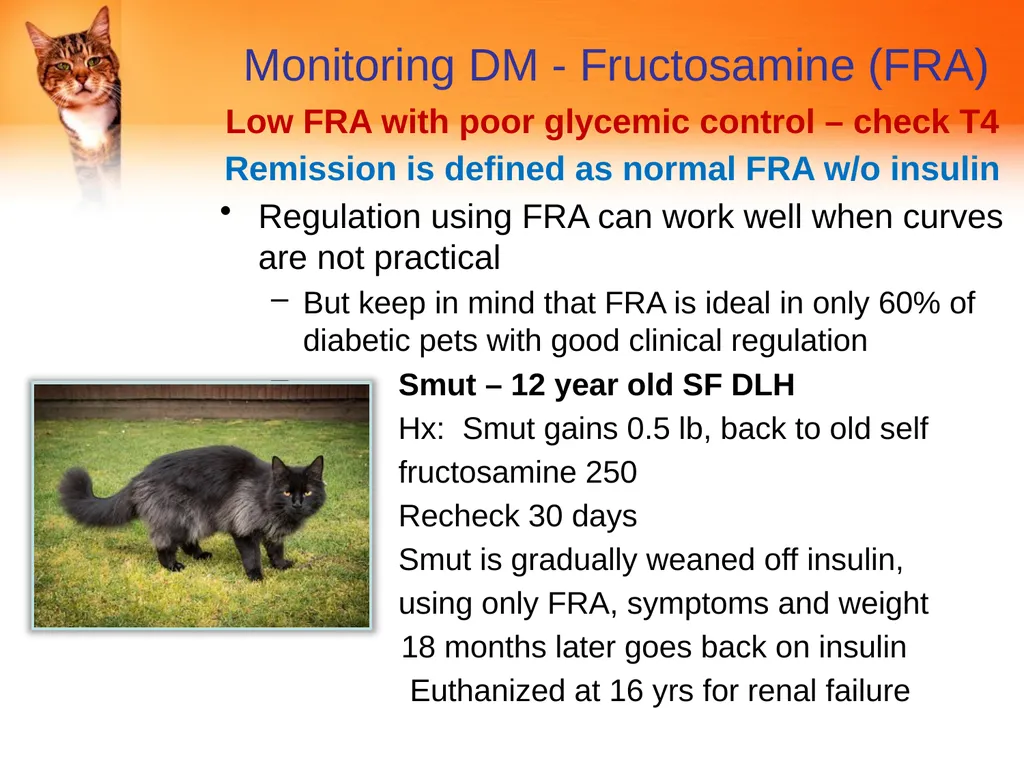
Smut – 12 year old SF DLH
Hx: Smut gains 0.5 lb, back to old self
fructosamine 250
Recheck 30 days
Smut is gradually weaned off insulin,
using only FRA, symptoms and weight
18 months later goes back on insulin
Euthanized at 16 yrs for renal failure<br>
36
Monitoring DM - Fructosamine (FRA) Low FRA with poor glycemic control – check T4
Remission is defined as normal FRA w/o insulin
Regulation using FRA can work well when curves are not practical
But keep in mind that FRA is ideal in only 60% of diabetic pets with good clinical regulation
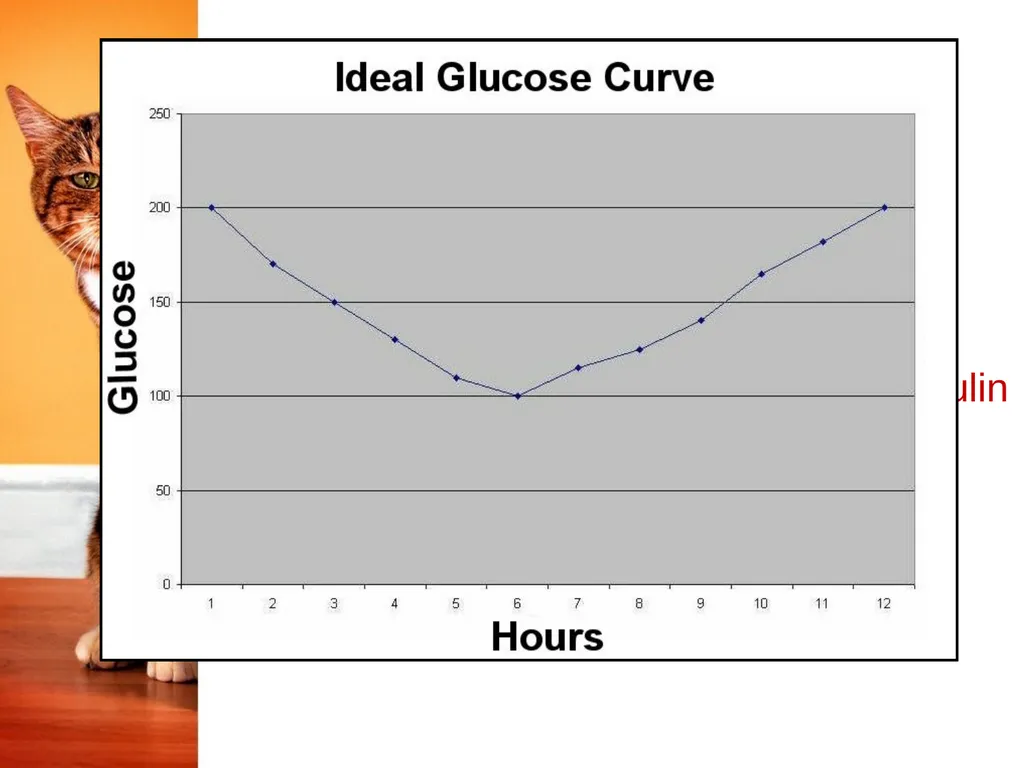
Why Do Glucose Curves?
Early detection of occult hypoglycemia
Ensure that dose changes are effective
To document dysregulation as the first step to correcting it<br>
37
Glucose Curve Protocol Owner feeds and gives insulin
Bring pet to clinic within 2 hours
Glucose (+ fructosamine) on arrival
Glucose every 2 hours when >100
Once you know the insulin duration, you may be able to take the first glucose 3-4 hrs after insulin
Glucose every hour when <100-150
Can miss nadir (low point) if you don’t do this
Continue until you get 2 values 2 hours apart that are upwardly trending
If nadir not <120, it’s difficult to determine duration
Usually can be completed in a business day, but not always
Some require 12-24 hours - finish at home or EC
Dogs on Lantus® can often do q3-4 hrs<br>
38
Home Glucose Curves Really are better than “in clinic”
Stress increases glucose
Especially in cats
Many owners can learn to do it
It’s very helpful for owners to be able to check blood sugar in an emergency
Entire curve does not have to be finished the same day
Have owners come in for appointment to discuss the glucose curve – bring pet at least quarterly
If the pet tolerates the CGM, this can be much easier on the owner<br>
39
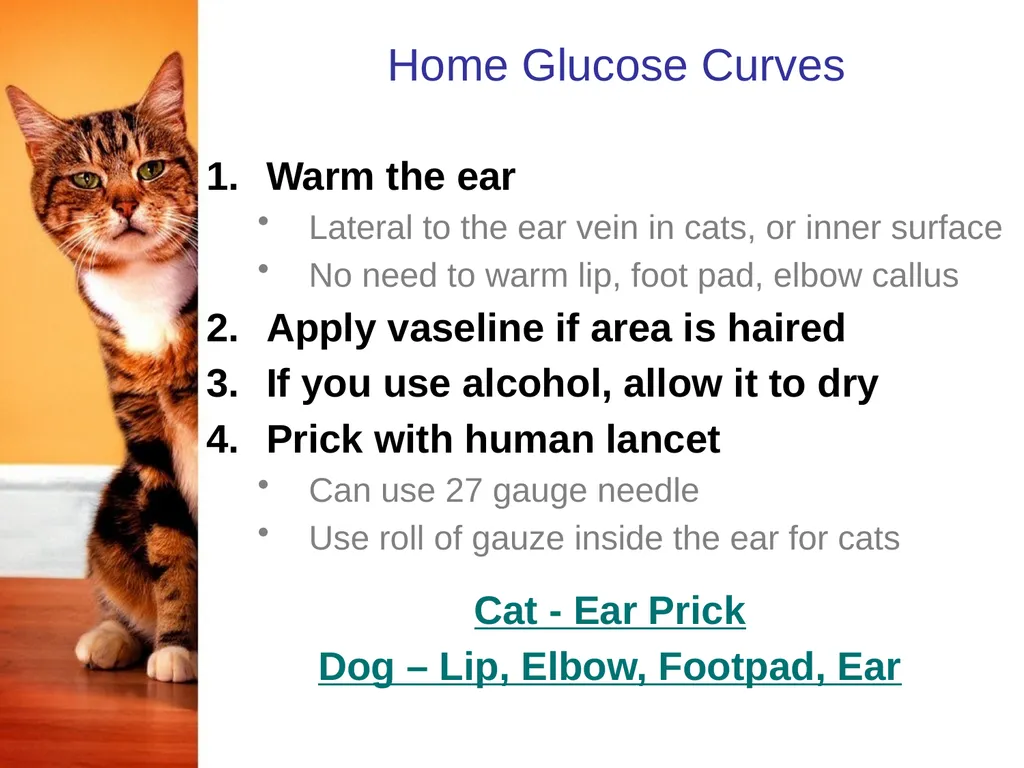
Home Glucose Curves Warm the ear
Lateral to the ear vein in cats, or inner surface
No need to warm lip, foot pad, elbow callus
Apply vaseline if area is haired
If you use alcohol, allow it to dry
Prick with human lancet
Can use 27 gauge needle
Use roll of gauze inside the ear for cats
Cat - Ear Prick
Dog – Lip, Elbow, Footpad, Ear<br>
40
Home Glucose Curves Choosing a glucometer
Low sample volume
Inadequate sample volume prevents sample from running
EDTA (purple top) and LiHep (green top) blood are fine in clinic<br>
Low sample volume
Inadequate sample volume prevents sample from running
EDTA (purple top) and LiHep (green top) blood are fine in clinic<br>
41
Home Glucose Curves Choosing a glucometer
Low sample volume
Inadequate sample volume prevents sample from running
EDTA (purple top) and LiHep (green top) blood are fine
Plasma calibrated rather than whole blood
𝑮𝒍𝒖𝒄𝒐𝒔𝒆𝒑𝒍𝒂𝒔𝒎𝒂 = ____𝑮𝒍𝒖𝒄𝒐𝒔𝒆𝒘𝒉𝒐𝒍𝒆 𝒃𝒍𝒐𝒐𝒅___
𝟏. 𝟎 − (𝟎. 𝟎𝟎𝟐𝟒 ×𝑯𝒄𝒕%)<br>
Low sample volume
Inadequate sample volume prevents sample from running
EDTA (purple top) and LiHep (green top) blood are fine
Plasma calibrated rather than whole blood
𝑮𝒍𝒖𝒄𝒐𝒔𝒆𝒑𝒍𝒂𝒔𝒎𝒂 = ____𝑮𝒍𝒖𝒄𝒐𝒔𝒆𝒘𝒉𝒐𝒍𝒆 𝒃𝒍𝒐𝒐𝒅___
𝟏. 𝟎 − (𝟎. 𝟎𝟎𝟐𝟒 ×𝑯𝒄𝒕%)<br>
42
Home Glucose Curves Choosing a glucometer
Auto-calibration of test strips
Calibrate to in house machine
Enter species code for veterinary meters if needed
Glucometers are most accurate <100mg/dl
AlphaTrak 2 Starter Kit $55
Meter, lancets, strips, lancing device<br>
Auto-calibration of test strips
Calibrate to in house machine
Enter species code for veterinary meters if needed
Glucometers are most accurate <100mg/dl
AlphaTrak 2 Starter Kit $55
Meter, lancets, strips, lancing device<br>
43
Interpreting Glucose Curves Duration of the curve
If your curve is 12 hours or less, you need to give insulin BID, not SID
I have never been able to use ProZinc SID in the dog
Glucose range
If all values are 100-250, leave it alone if symptoms are controlled
Avoid values above 300 and below 80
Average of 6 values taken in a 12-hour curve should be less than 250<br>
44
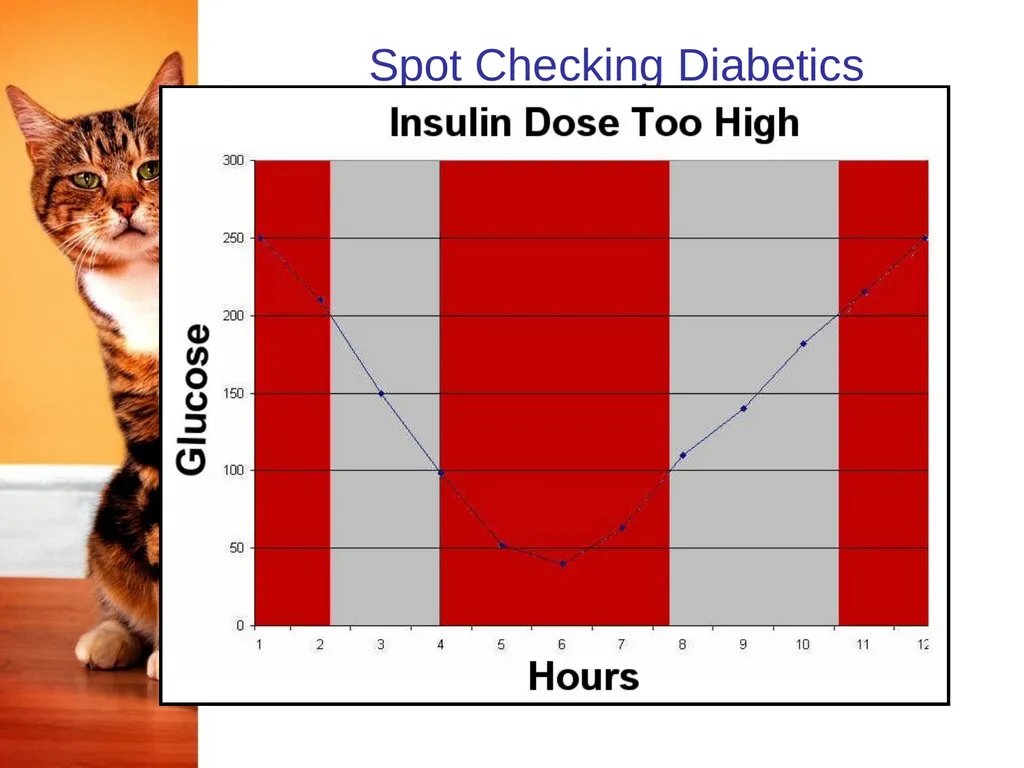
Interpreting Glucose Curves Glucose nadir
If < 80 reduce the insulin dose
If >130, consider increasing insulin dose, unless all values less than 250
Ideal nadir is 80-130
Glucose Peak
If nadir 80-130 and peak too high, change to longer duration insulin
regular < NPH < Lente
< PZI < glargine < detemir<br>
If < 80 reduce the insulin dose
If >130, consider increasing insulin dose, unless all values less than 250
Ideal nadir is 80-130
Glucose Peak
If nadir 80-130 and peak too high, change to longer duration insulin
regular < NPH < Lente
< PZI < glargine < detemir<br>
45
Somogyi Effect Rebound hyperglycemia follows blood glucose < 60
usually within 12 hours
Lasts 24-72 hours
Often >400 mg/dl
Due to epinephrine and glucagon release (counter-regulation)
cyclic response of 1-2 days of “good control” followed by several days of poor control increases suspicion
Fructosamine usually >500 mcmol/dl
Reduce insulin and recheck FRA + curve in 1 week<br>
46
Home Urine Testing I don’t use urine strips for glucosuria
Renal threshold 180-300 mg/dl
Most diabetics exceed this daily
Many well regulated diabetic dogs and cats will have daily glucosuria
It is reasonable to have owners keep KetoDiastix
Ketonuria indicates seeing the vet ASAP
Increasing insulin based on glucosuria can result in Somogyi effect<br>
Renal threshold 180-300 mg/dl
Most diabetics exceed this daily
Many well regulated diabetic dogs and cats will have daily glucosuria
It is reasonable to have owners keep KetoDiastix
Ketonuria indicates seeing the vet ASAP
Increasing insulin based on glucosuria can result in Somogyi effect<br>
47
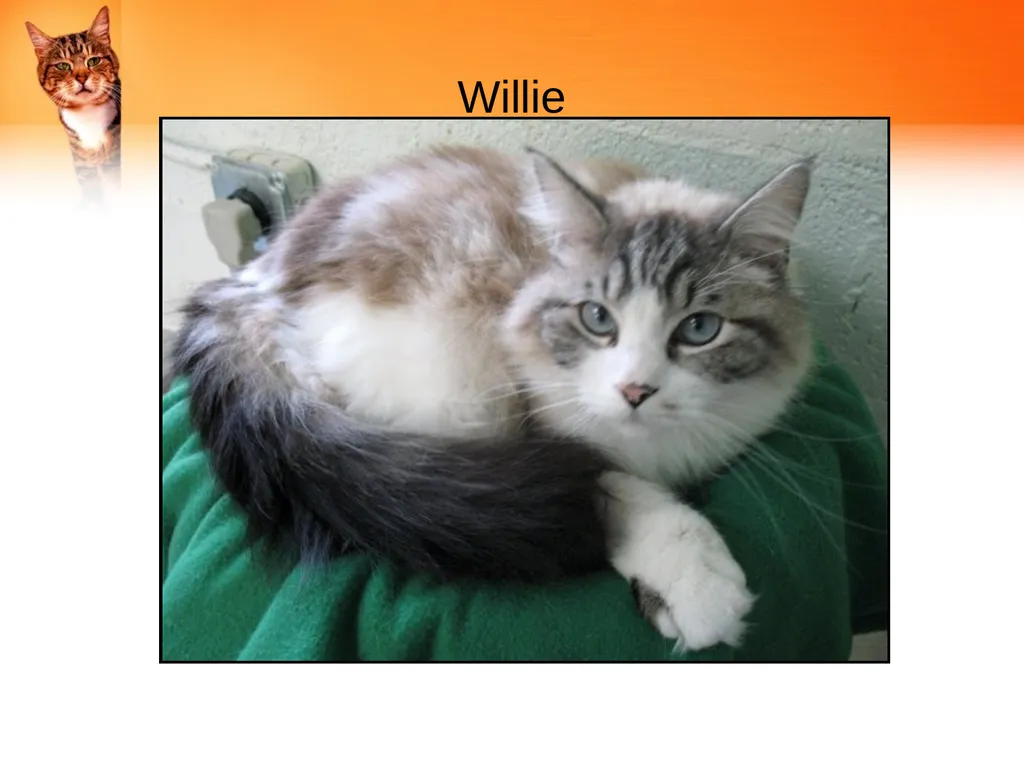
Willie<br>
48
Willie 17 year old DLH, has been a diabetic for about 3 years
Had an “insulin vacation” for about six months during the first year
Was taking 2 units NPH BID for about a year prior to boarding for 10 days
Eats Innova EVO dry free choice (crunchy junkie)
He doesn’t eat well when he boards
Since coming home from boarding a month ago, Willie has felt terrible
PU/PD
Doesn’t eat chicken jerky snacks as voraciously
Very lethargic<br>
49
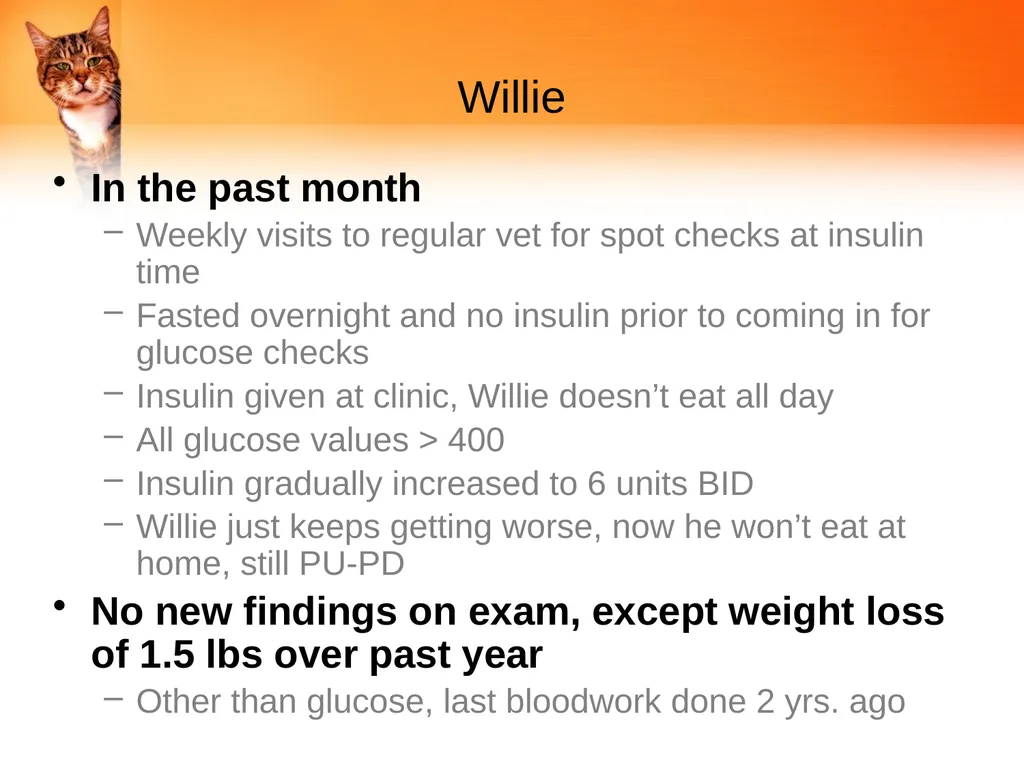
Willie In the past month
Weekly visits to regular vet for spot checks at insulin time
Fasted overnight and no insulin prior to coming in for glucose checks
Insulin given at clinic, Willie doesn’t eat all day
All glucose values > 400
Insulin gradually increased to 6 units BID
Willie just keeps getting worse, now he won’t eat at home, still PU-PD
No new findings on exam, except weight loss of 1.5 lbs over past year
Other than glucose, last bloodwork done 2 yrs. ago<br>
50
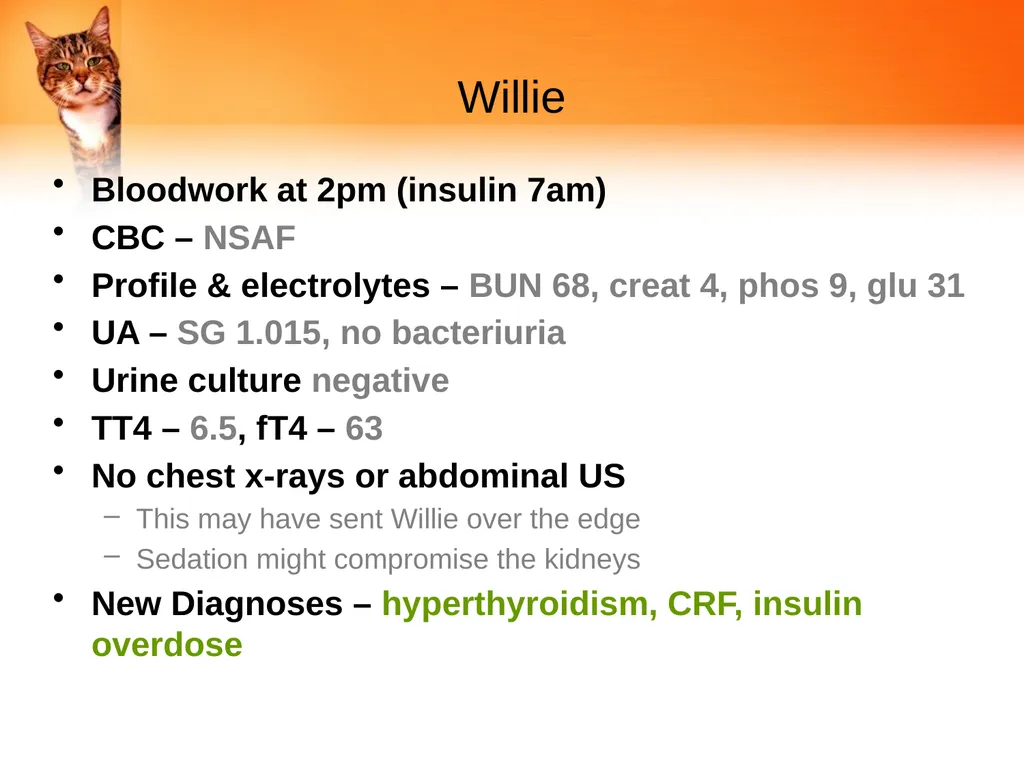
Willie Bloodwork at 2pm (insulin 7am)
CBC – NSAF
Profile & electrolytes – BUN 68, creat 4, phos 9, glu 31
UA – SG 1.015, no bacteriuria
Urine culture negative
TT4 – 6.5, fT4 – 63
No chest x-rays or abdominal US
This may have sent Willie over the edge
Sedation might compromise the kidneys
New Diagnoses – hyperthyroidism, CRF, insulin overdose<br>
51
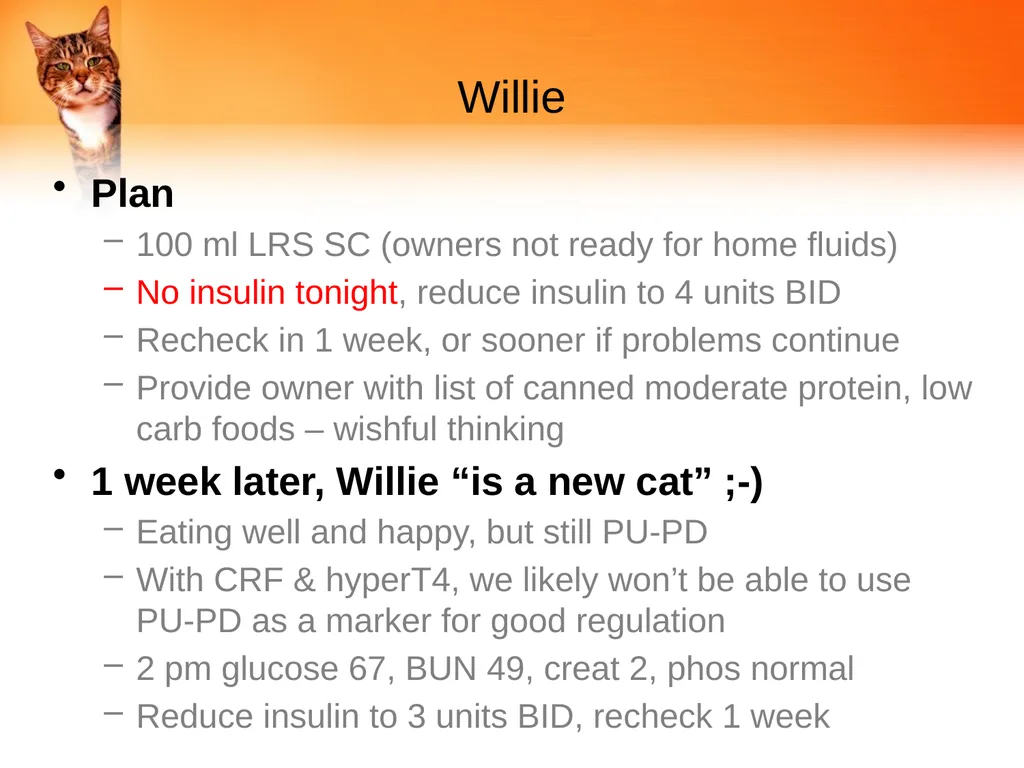
Willie Plan
100 ml LRS SC (owners not ready for home fluids)
No insulin tonight, reduce insulin to 4 units BID
Recheck in 1 week, or sooner if problems continue
Provide owner with list of canned moderate protein, low carb foods – wishful thinking
1 week later, Willie “is a new cat” ;-)
Eating well and happy, but still PU-PD
With CRF & hyperT4, we likely won’t be able to use PU-PD as a marker for good regulation
2 pm glucose 67, BUN 49, creat 2, phos normal
Reduce insulin to 3 units BID, recheck 1 week<br>
52
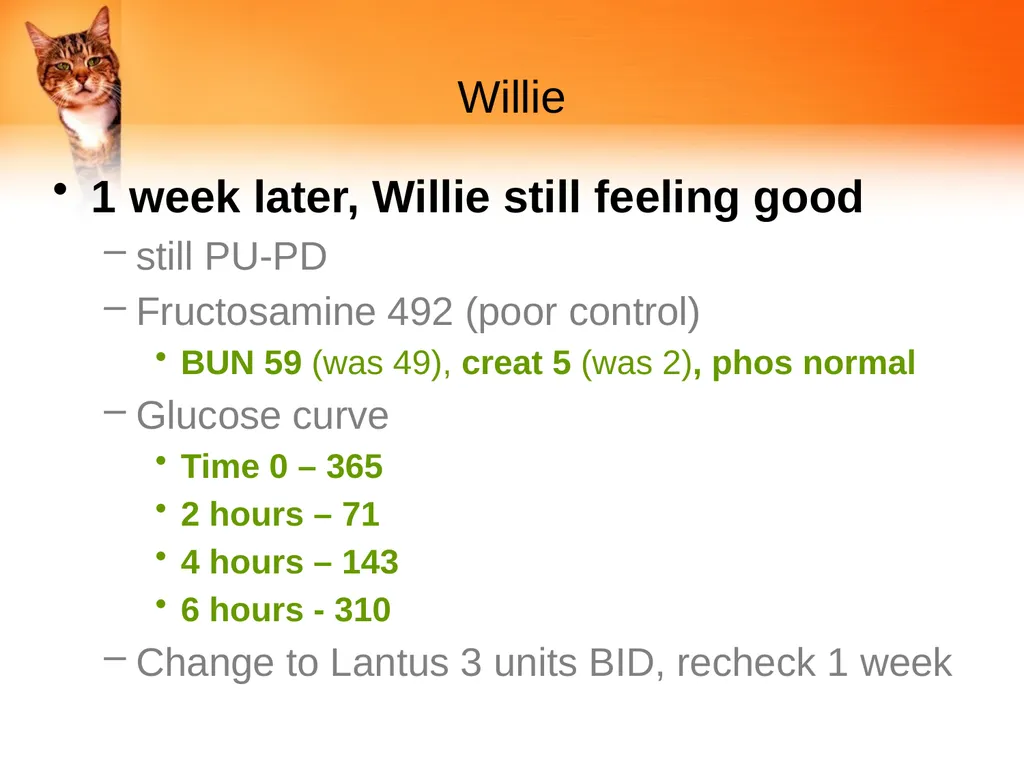
Willie 1 week later, Willie still feeling good
still PU-PD
Fructosamine 492 (poor control)
BUN 59 (was 49), creat 5 (was 2), phos normal
Glucose curve
Time 0 – 365
2 hours – 71
4 hours – 143
6 hours - 310
Change to Lantus 3 units BID, recheck 1 week<br>
still PU-PD
Fructosamine 492 (poor control)
BUN 59 (was 49), creat 5 (was 2), phos normal
Glucose curve
Time 0 – 365
2 hours – 71
4 hours – 143
6 hours - 310
Change to Lantus 3 units BID, recheck 1 week<br>
53
Willie 1 week later, Willie still feeling good
still PU-PD
Fructosamine within normal range
Begin methimazole 2.5 mg PO SID
Decrease Lantus to 2 units BID, recheck 1 week
Why?
Hyperthyroidism causes relative insulin resistance<br>
still PU-PD
Fructosamine within normal range
Begin methimazole 2.5 mg PO SID
Decrease Lantus to 2 units BID, recheck 1 week
Why?
Hyperthyroidism causes relative insulin resistance<br>
54
Attendee 2 – City TX<br>
55
Willie We eventually weaned Willie down to 0.5 unit every other day
If we stopped, he got hyperglycemic and did not feel good
If we increased, he got hypoglycemic and did not feel good
We continued this for 2 years, until he suffered an episode of acute renal failure at 19 years of age
His temperament was not suitable for hospitalization, and he was humanely euthanized<br>
56
Willie Lesson from Willie
PU-PD in an unregulated diabetic does not always mean more insulin is needed
Insulin overdose can cause PU-PD, due to rebound hyperglycemia
Other problems can cause PU-PD – CRF & hyperT4 in this case
Regular rechecks can nip problems in the bud and prevent illness from dysregulation
Glucose curves are not always necessary – one mid-day glu + FRA can tell a great deal<br>
57
Willie Lesson from Willie
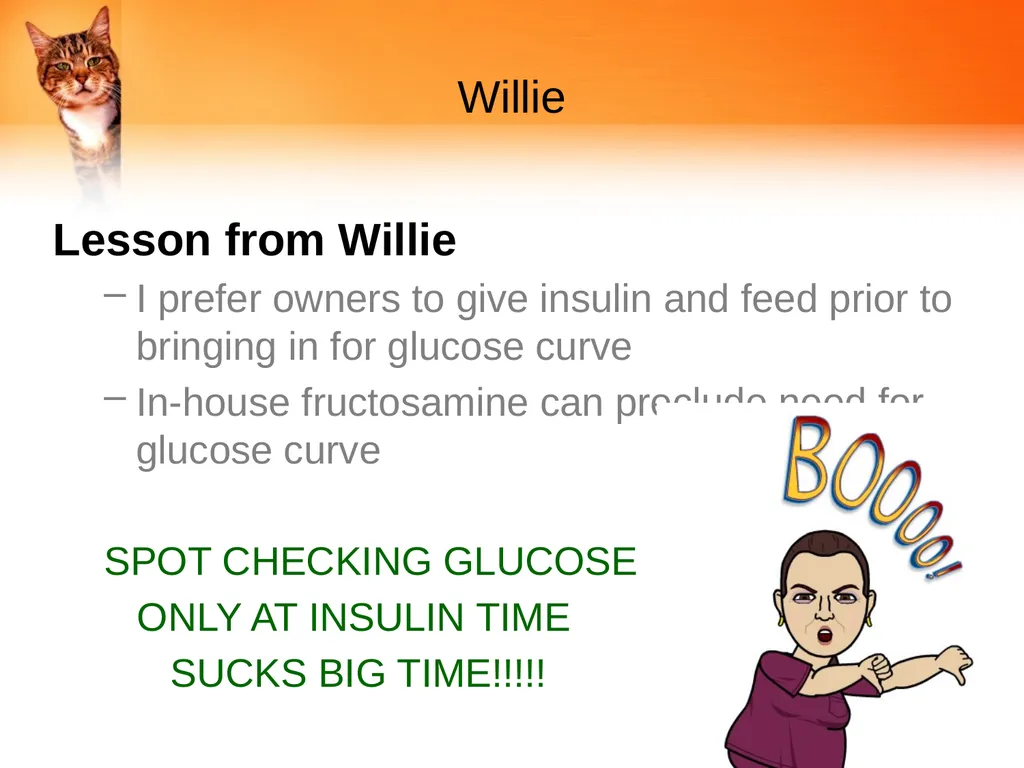
I prefer owners to give insulin and feed prior to bringing in for glucose curve
In-house fructosamine can preclude need for glucose curve
SPOT CHECKING GLUCOSE
ONLY AT INSULIN TIME
SUCKS BIG TIME!!!!!<br>
I prefer owners to give insulin and feed prior to bringing in for glucose curve
In-house fructosamine can preclude need for glucose curve
SPOT CHECKING GLUCOSE
ONLY AT INSULIN TIME
SUCKS BIG TIME!!!!!<br>
58
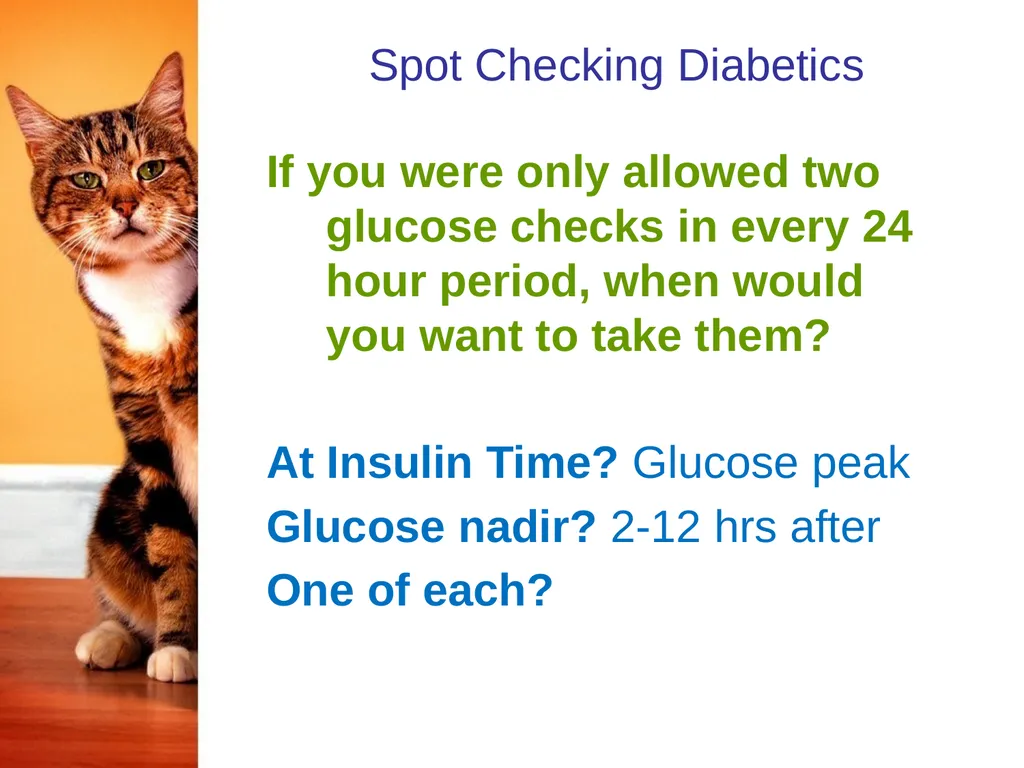
Spot Checking Diabetics If you were only allowed two glucose checks in every 24 hour period, when would you want to take them?
At Insulin Time? Glucose peak
Glucose nadir? 2-12 hrs after
One of each?<br>
At Insulin Time? Glucose peak
Glucose nadir? 2-12 hrs after
One of each?<br>
59
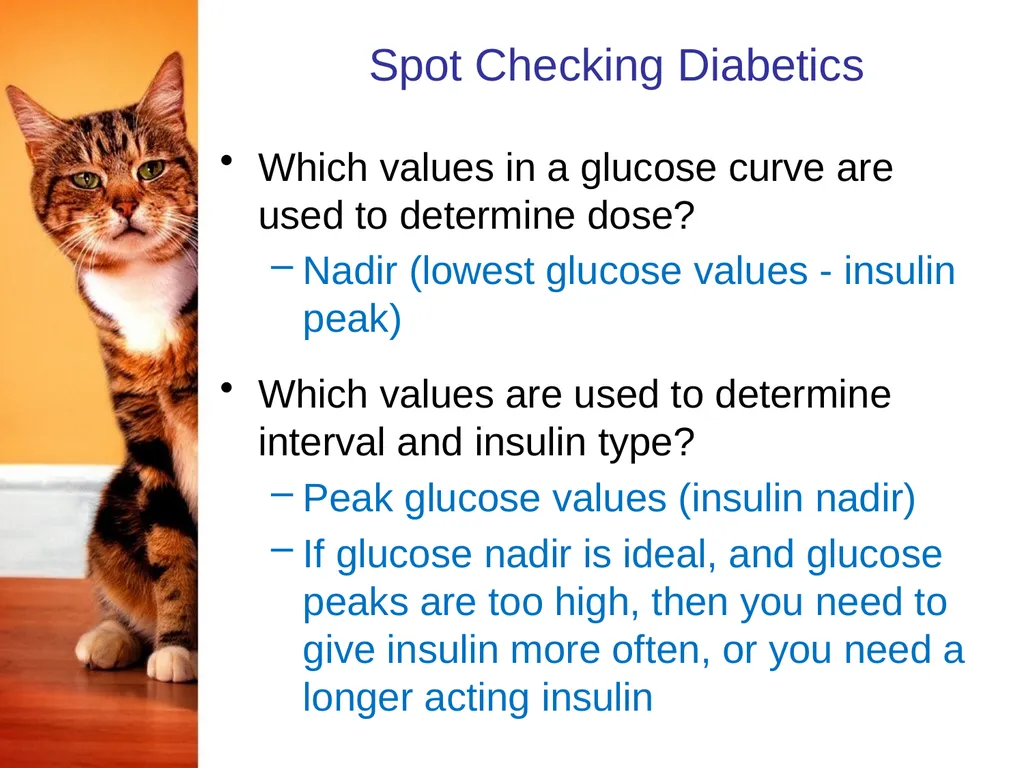
Spot Checking Diabetics Which values in a glucose curve are used to determine dose?
Nadir (lowest glucose values - insulin peak)
Which values are used to determine interval and insulin type?
Peak glucose values (insulin nadir)
If glucose nadir is ideal, and glucose peaks are too high, then you need to give insulin more often, or you need a longer acting insulin<br>
Nadir (lowest glucose values - insulin peak)
Which values are used to determine interval and insulin type?
Peak glucose values (insulin nadir)
If glucose nadir is ideal, and glucose peaks are too high, then you need to give insulin more often, or you need a longer acting insulin<br>
60
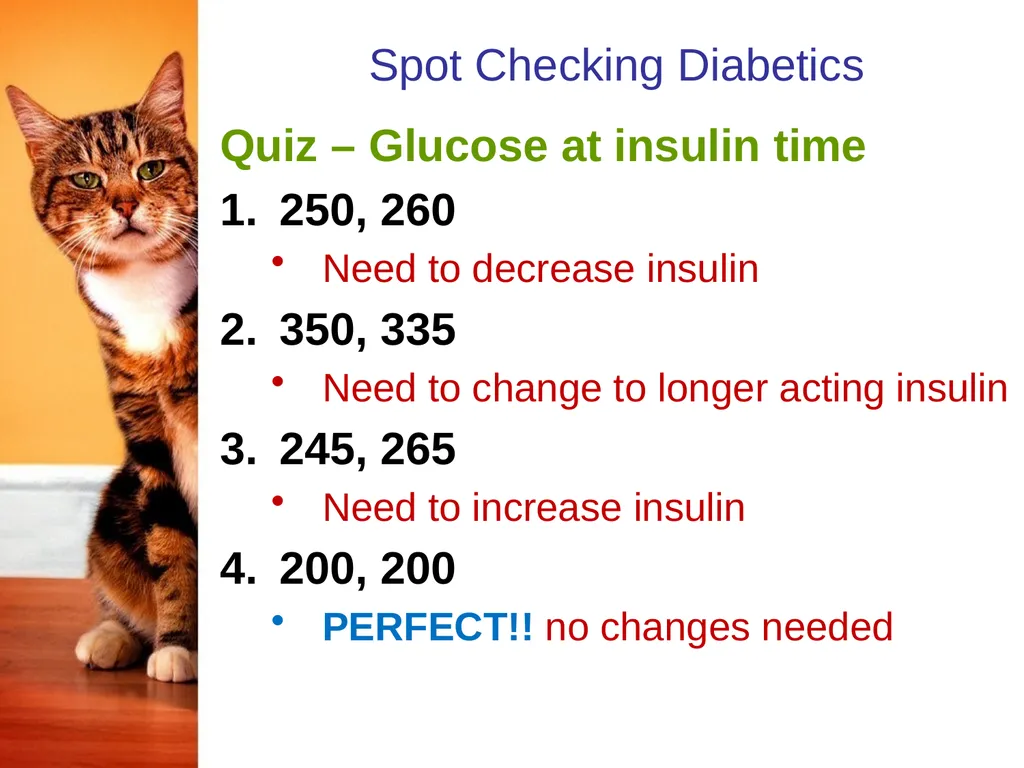
Spot Checking Diabetics Quiz – Glucose at insulin time
250, 260<br>
250, 260<br>
61
Spot Checking Diabetics Quiz – Glucose at insulin time
250, 260<br>
250, 260<br>
62
Spot Checking Diabetics Quiz – Glucose at insulin time
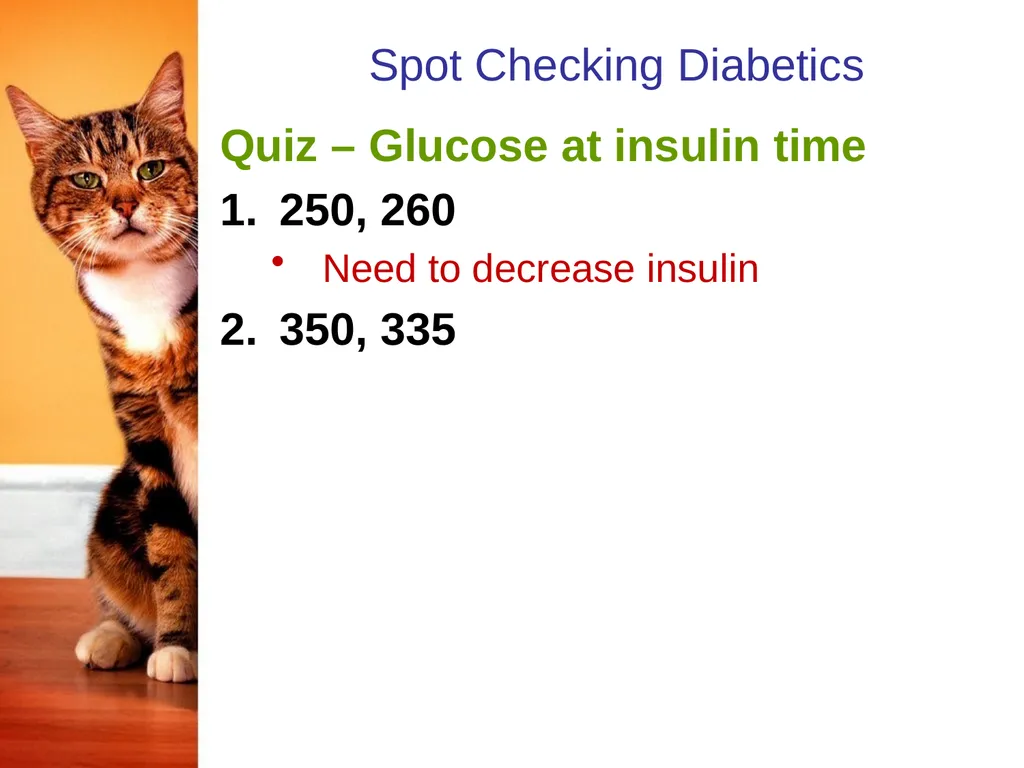
250, 260
Need to decrease insulin
350, 335<br>
250, 260
Need to decrease insulin
350, 335<br>
63
Spot Checking Diabetics Quiz – Glucose at insulin time
250, 260
Need to decrease insulin
350, 335<br>
250, 260
Need to decrease insulin
350, 335<br>
64
Spot Checking Diabetics Quiz – Glucose at insulin time
250, 260
Need to decrease insulin
350, 335
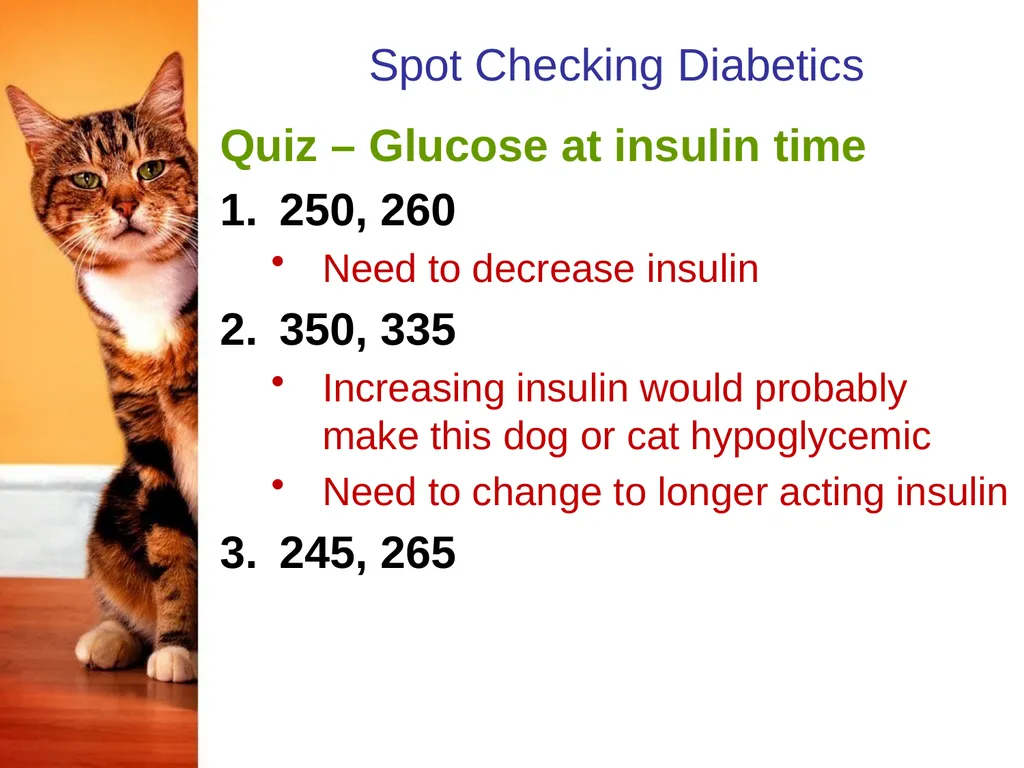
Increasing insulin would probably make this dog or cat hypoglycemic
Need to change to longer acting insulin
245, 265<br>
250, 260
Need to decrease insulin
350, 335
Increasing insulin would probably make this dog or cat hypoglycemic
Need to change to longer acting insulin
245, 265<br>
65
Spot Checking Diabetics Quiz – Glucose at insulin time
250, 260
Need to decrease insulin
350, 335
Need to change to longer acting insulin
245, 265<br>
250, 260
Need to decrease insulin
350, 335
Need to change to longer acting insulin
245, 265<br>
66
Spot Checking Diabetics Quiz – Glucose at insulin time
250, 260
Need to decrease insulin
350, 335
Need to change to longer acting insulin
245, 265
Need to increase insulin
200, 200<br>
250, 260
Need to decrease insulin
350, 335
Need to change to longer acting insulin
245, 265
Need to increase insulin
200, 200<br>
67
Spot Checking Diabetics Quiz – Glucose at insulin time
250, 260
Need to decrease insulin
350, 335
Need to change to longer acting insulin
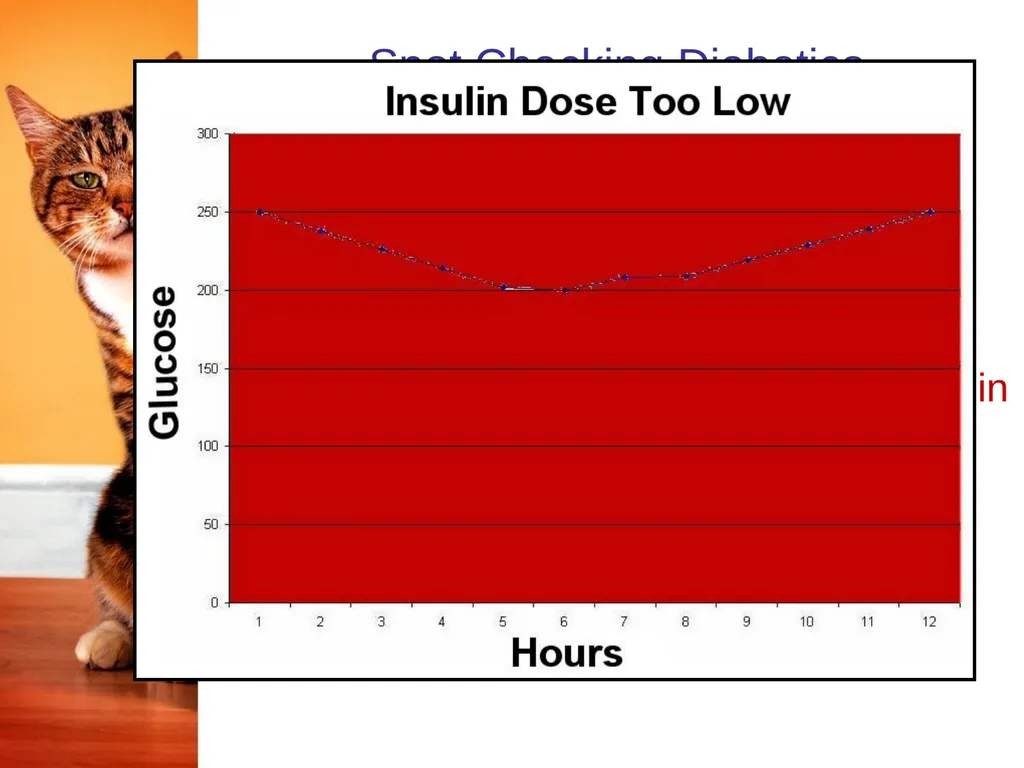
245, 265
Need to increase insulin
200, 200<br>
250, 260
Need to decrease insulin
350, 335
Need to change to longer acting insulin
245, 265
Need to increase insulin
200, 200<br>
68
Spot Checking Diabetics Quiz – Glucose at insulin time
250, 260
Need to decrease insulin
350, 335
Need to change to longer acting insulin
245, 265
Need to increase insulin
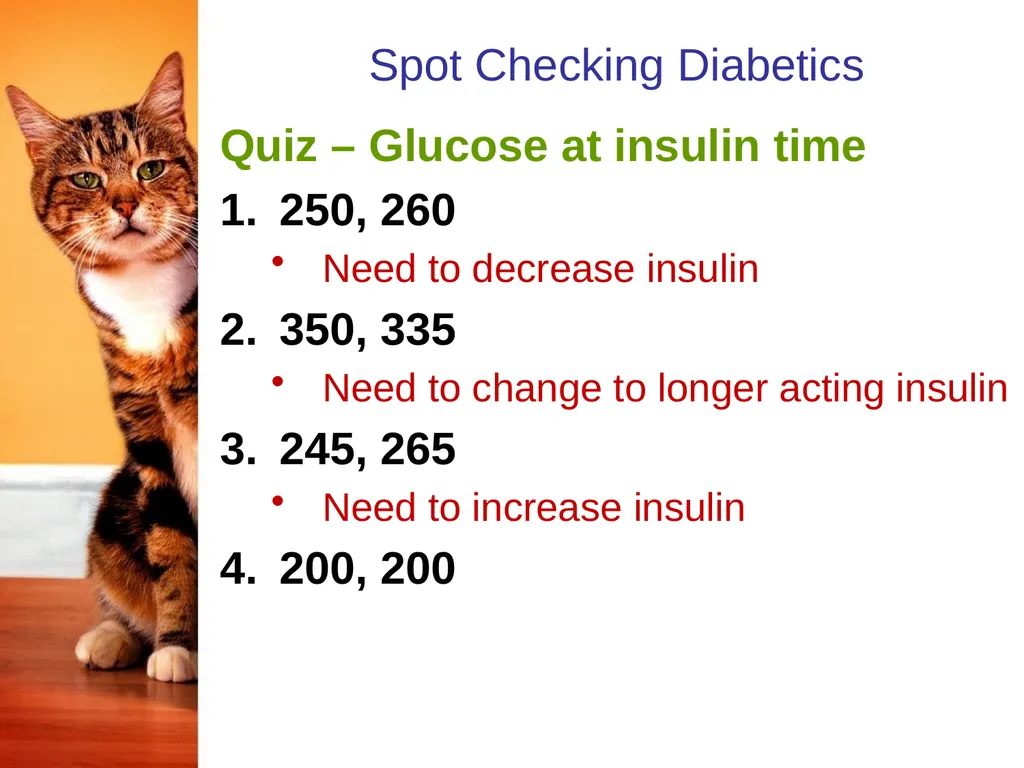
200, 200
PERFECT!! no changes needed<br>
250, 260
Need to decrease insulin
350, 335
Need to change to longer acting insulin
245, 265
Need to increase insulin
200, 200
PERFECT!! no changes needed<br>
69
Summary PowerPoint – Ups and Downs of Blood Sugar
.pptx
.pdfs – 1 and 6 slides per page
Vet Articles and Handouts
JVIM – Validation of Flash Glucose Monitoring Device (FreeStyle Libre) in Dogs
ASVCP - Guidelines for Glucometers in Vet Med
AAHA – Guidelines for Managing Diabetes Mellitus in Dogs and Cats
AAHA – Algorithm – Managing Hypoglycemia<br>
.pptx
.pdfs – 1 and 6 slides per page
Vet Articles and Handouts
JVIM – Validation of Flash Glucose Monitoring Device (FreeStyle Libre) in Dogs
ASVCP - Guidelines for Glucometers in Vet Med
AAHA – Guidelines for Managing Diabetes Mellitus in Dogs and Cats
AAHA – Algorithm – Managing Hypoglycemia<br>
70
Summary Vet Articles and Handouts
AAHA – Monitoring Blood Glucose in Diabetics
Feldman &Nelson – Algorithm – Interpreting Glucose Curves
Client Handouts
Diabetes Mellitus in Dogs
Diabetes Mellitus in Cats
Diabetic Ketoacidosis
FreeStyle Libre
Home Glucose Testing, Ear Prick, Lip Prick
Hypoglycemia<br>
AAHA – Monitoring Blood Glucose in Diabetics
Feldman &Nelson – Algorithm – Interpreting Glucose Curves
Client Handouts
Diabetes Mellitus in Dogs
Diabetes Mellitus in Cats
Diabetic Ketoacidosis
FreeStyle Libre
Home Glucose Testing, Ear Prick, Lip Prick
Hypoglycemia<br>
71
Acknowledgements Richard Nelson. Small Animal Clinical Diagnosis by Laboratory Methods, 5th Edition. Ch 8 – Endocrine, Metabolic and Lipid Disorders. Eds. Michael Willard, Harold Tvedten.
Teleah Grand, DVM. Animal Care Center at Stonebridge, McKinney TX. Photo of dog with reaction to FreeStyle Libre adhesive.
Greg Matt, DVM. Beechnut Animal Hospital, Houston TX. FreeStyle Libre CGMD videos.<br>
Teleah Grand, DVM. Animal Care Center at Stonebridge, McKinney TX. Photo of dog with reaction to FreeStyle Libre adhesive.
Greg Matt, DVM. Beechnut Animal Hospital, Houston TX. FreeStyle Libre CGMD videos.<br>
72
Acknowledgements Ward Animal Hospital. Case – Smut – using FRA.
Southwood Drive Animal Clinic. Dr, Shawn Penn, Dr. Doug Ashburn – Case - Willie – Diabetic Dysregulation.<br>
Southwood Drive Animal Clinic. Dr, Shawn Penn, Dr. Doug Ashburn – Case - Willie – Diabetic Dysregulation.<br>
73
Acknowledgements Eastex Vet Clinic. Dr. Jimmy Weatherly - Case – Dot with Addison’s Disease.
J Catharine Scott-Moncrief. Canine & Feline Endocrinology, 4th Edition. Ch 12 – Canine Hypoadrenocorticism.
Lathan & Thompson. Management of hypoadrenocorticism (Addison’s Disease) in dogs. Vet Med Res & Rpts. 2018:9 1–10.<br>
J Catharine Scott-Moncrief. Canine & Feline Endocrinology, 4th Edition. Ch 12 – Canine Hypoadrenocorticism.
Lathan & Thompson. Management of hypoadrenocorticism (Addison’s Disease) in dogs. Vet Med Res & Rpts. 2018:9 1–10.<br>