
What do we already know about the text? Who is

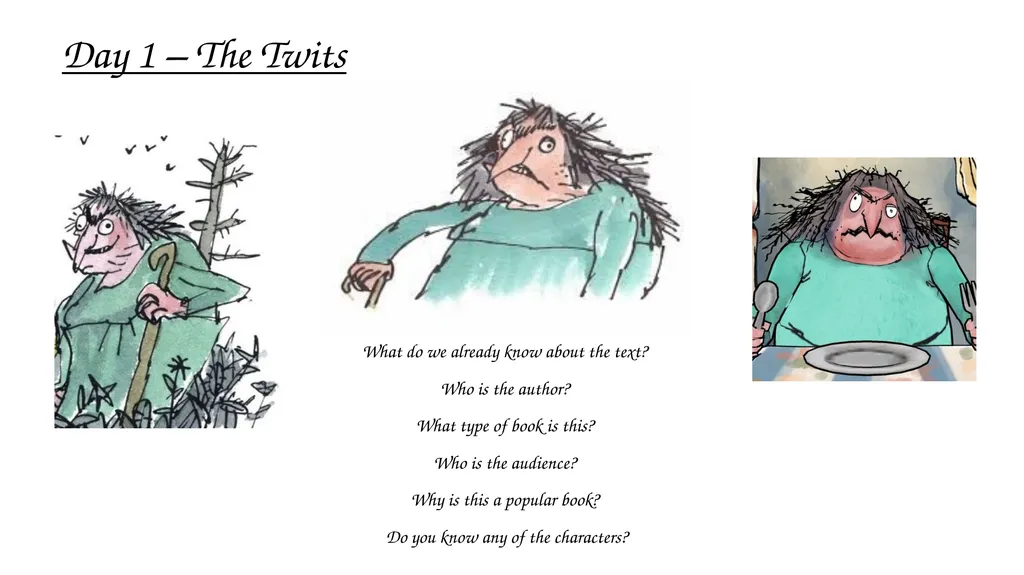







Description: What do we already know about the text? Who is the author? What type of book is this? Who is the audience? Why is this a popular book? Do you know any of the characters? Day 1 The Twits Noun hunt How many nouns can you think of linked
Related Topics
Download Presentation
"What do we already know about the text? Who is" is the property of its rightful owner. Permission is granted to download and print the materials on this website for personal, non-commercial use only, and to display it on your personal computer provided you do not modify the materials and that you retain all copyright notices contained in the materials. By downloading content from our website, you accept the terms of this agreement.
Presentation Transcript
slide1. What do we already know about the text?
Who is the author?
What type of book is this?
Who is the audience?
Why is this a popular book?
Do you know any of the characters? Day 1 – The Twits<br>
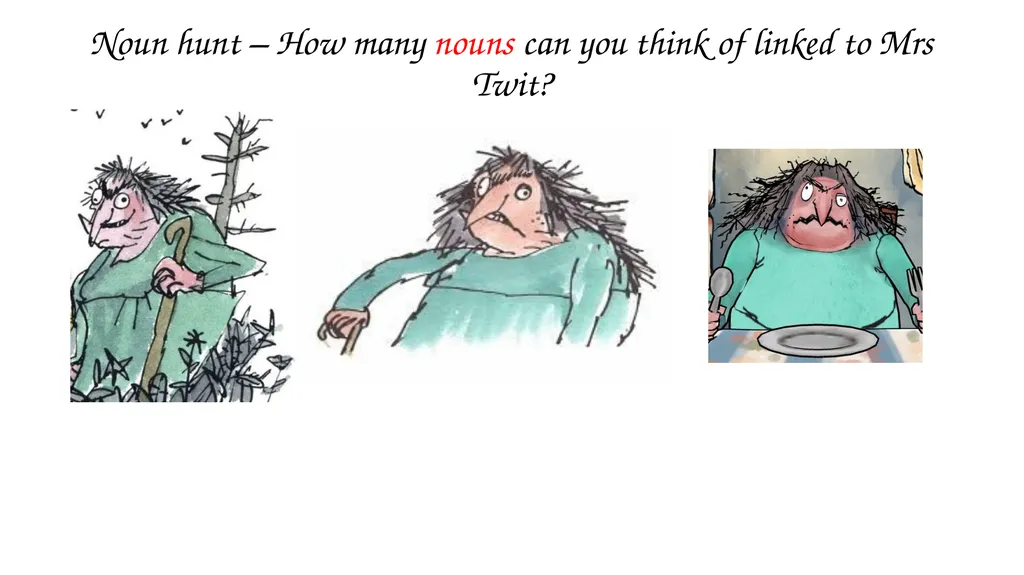
slide2. Noun hunt – How many nouns can you think of linked to Mrs Twit?<br>
slide3. Noun hunt – How many nouns can you think of linked to Mrs Twit?<br>
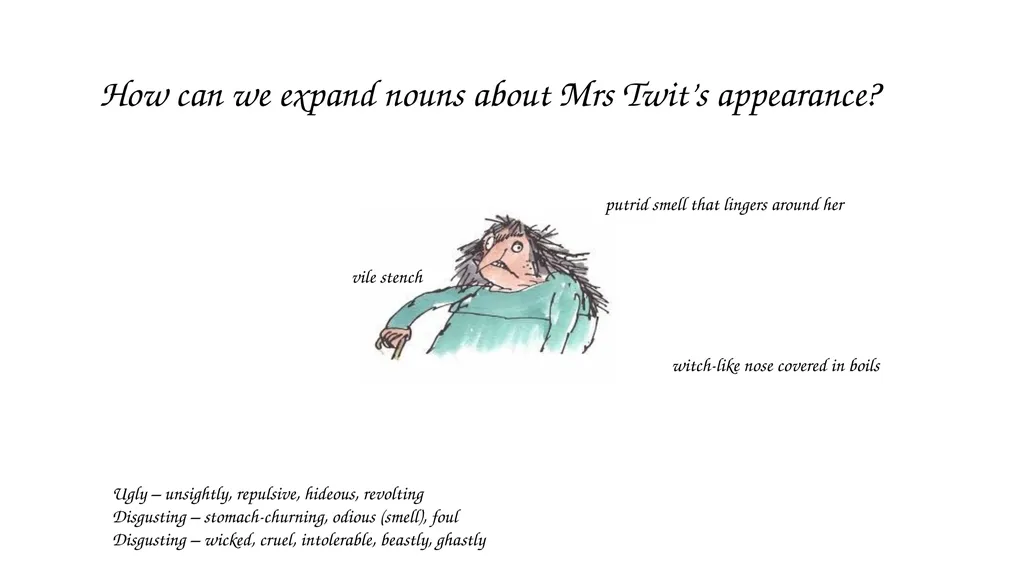
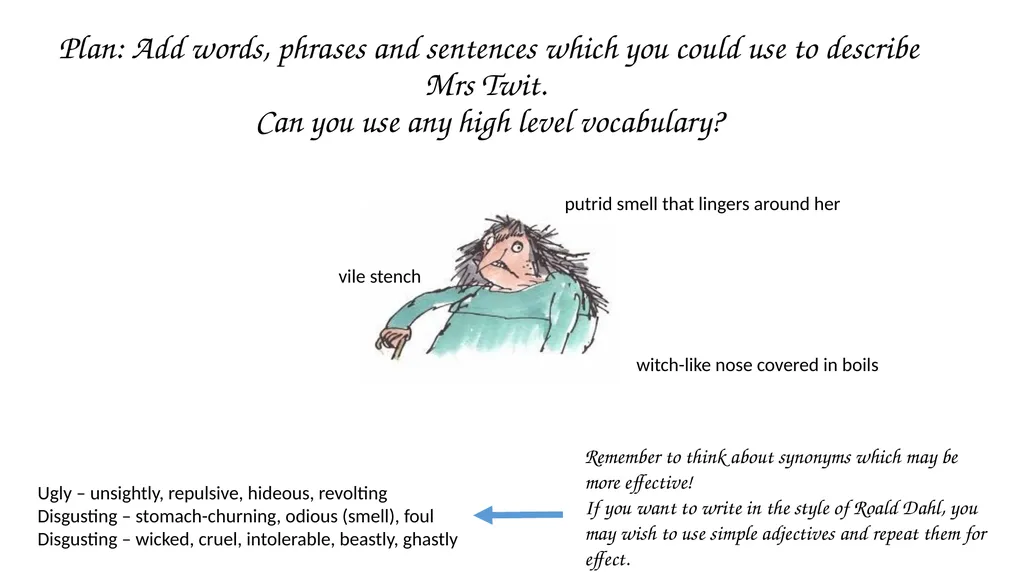
slide4. vile stench putrid smell that lingers around her witch-like nose covered in boils Ugly – unsightly, repulsive, hideous, revolting
Disgusting – stomach-churning, odious (smell), foul
Disgusting – wicked, cruel, intolerable, beastly, ghastly How can we expand nouns about Mrs Twit’s appearance?<br>
slide5. vile stench putrid smell that lingers around her witch-like nose covered in boils Ugly – unsightly, repulsive, hideous, revolting
Disgusting – stomach-churning, odious (smell), foul
Disgusting – wicked, cruel, intolerable, beastly, ghastly Plan: Add words, phrases and sentences which you could use to describe Mrs Twit.
Can you use any high level vocabulary? Remember to think about synonyms which may be more effective!
If you want to write in the style of Roald Dahl, you may wish to use simple adjectives and repeat them for effect.<br>
slide6. Now we have discussed our character’s appearance, we need to think about her personality which we can infer from her actions, her behaviour and her facial expressions.
Watch up to 1:05s on the clip and note down her actions, appearance and behaviour. Add words/phrases to mind map that describe Mrs Twit.
Watch clip 2/3 times to ensure that you have a good range of ideas! https://www.youtube.com/watch?v=eWvyB-QvbVA<br>
slide7. Day 1 – The Twits Can I write a character description? Have you ever met Mrs Twit? If you haven’t, I advise that you don’t because she is one of the smelliest women in the world. She has a smell. The sort of revolting smell that crawls up your nose and lingers there all day, making your eyes water uncontrollably. Now, enough about her foul stench because I’m afraid it gets worse: she is terribly ugly too. The first thing you notice when you cast your eyes upon Mrs Twit is the long, greasy whiskers hanging from her double chin (which, by the way, is covered in pus-filled boils and warts). Then, your eyes are drawn to her mouth. Her rotting, yellow teeth protrude from her receding gums, and pieces of chicken from her Christmas dinner (20 years ago) hang from the gaps. Feeling sick yet? The bizarre thing is Mrs Twit wasn’t born ugly like her vile husband. In fact, she was once ….. W.A.G.O.L.L Remember: this character description is going to be the opening of our chapter!<br>
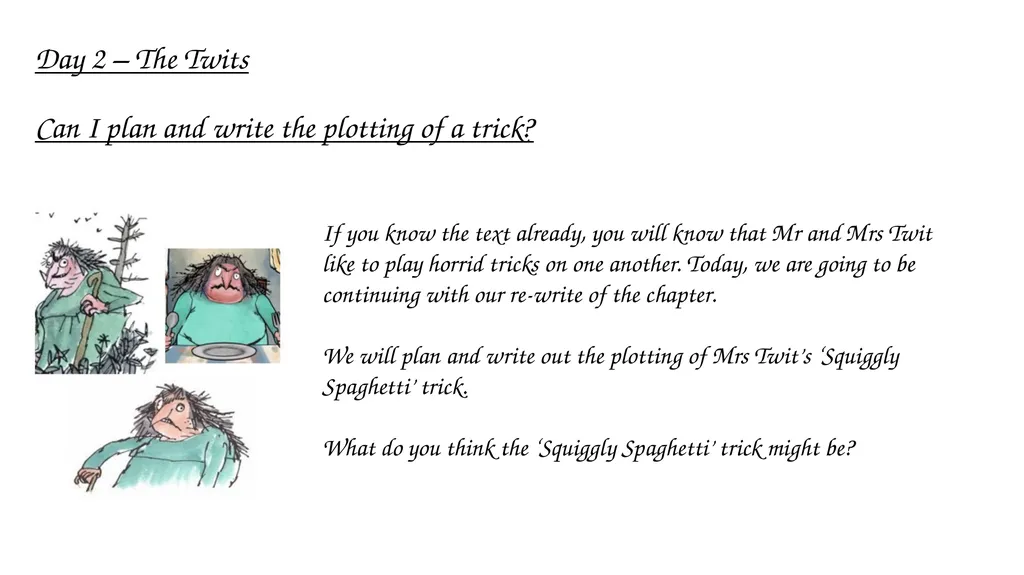
slide8. Day 2 – The Twits Can I plan and write the plotting of a trick? If you know the text already, you will know that Mr and Mrs Twit like to play horrid tricks on one another. Today, we are going to be continuing with our re-write of the chapter.
We will plan and write out the plotting of Mrs Twit’s ‘Squiggly Spaghetti’ trick.
What do you think the ‘Squiggly Spaghetti’ trick might be?<br>
slide9. Watch the clip from 1:05s to 1:33s
What is the garden like? What can you see? How would you describe the garden?
Watch the same section of the clip again. Focus on Mrs Twit’s body language – her actions and her behaviour.
Whilst you are watching, write down words and phrases for your plan which you may wish to use. https://www.youtube.com/watch?v=eWvyB-QvbVA<br>
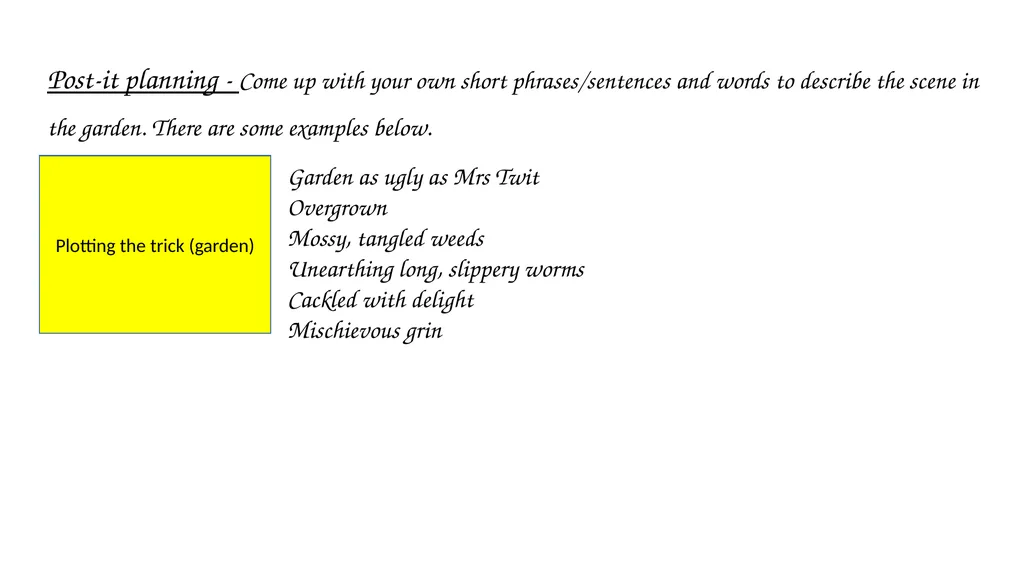
slide10. Plotting the trick (garden) Garden as ugly as Mrs Twit
Overgrown
Mossy, tangled weeds
Unearthing long, slippery worms
Cackled with delight
Mischievous grin Post-it planning - Come up with your own short phrases/sentences and words to describe the scene in the garden. There are some examples below.<br>
slide11. Watch the clip from 1:33s to 2:08s
What is the kitchen like? What can you see? How would you describe the kitchen?
Watch the same section of the clip again. Focus on Mrs Twit’s body language – her actions and her behaviour. What was she doing?
Whilst you are watching, write down words and phrases for your plan which you may wish to use. https://www.youtube.com/watch?v=eWvyB-QvbVA<br>
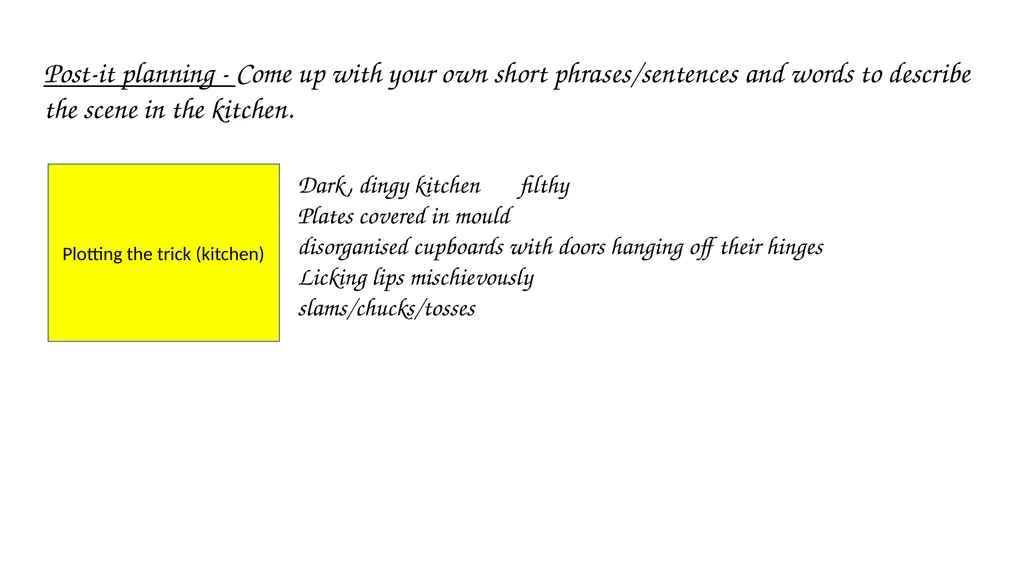
slide12. Plotting the trick (kitchen) Dark, dingy kitchen filthy
Plates covered in mould
disorganised cupboards with doors hanging off their hinges
Licking lips mischievously
slams/chucks/tosses Post-it planning - Come up with your own short phrases/sentences and words to describe the scene in the kitchen.<br>
slide13. Day 2 - Twits Can I plan and write the plotting of a trick? We are now going to use our plans to write the plotting and preparation of the ‘Squiggly Spaghetti’ trick.
Remember:
It must be descriptive so that the reader can really image the setting and what Mrs Twit is doing.
We need to convey Mrs Twit’s character through adjectives as well as using show not tell (describing her body language and behaviour).
We need to use a range of cohesive devices (different sentence openers, lengths of sentences, and adverbials for time, place and manner) to ensure our writing flows within and between paragraphs and is interesting to read!<br>
slide14. Day 3 – The Twits Can I plan the ‘Squiggly Spaghetti’ trick using dialogue to convey character and advance action?<br>
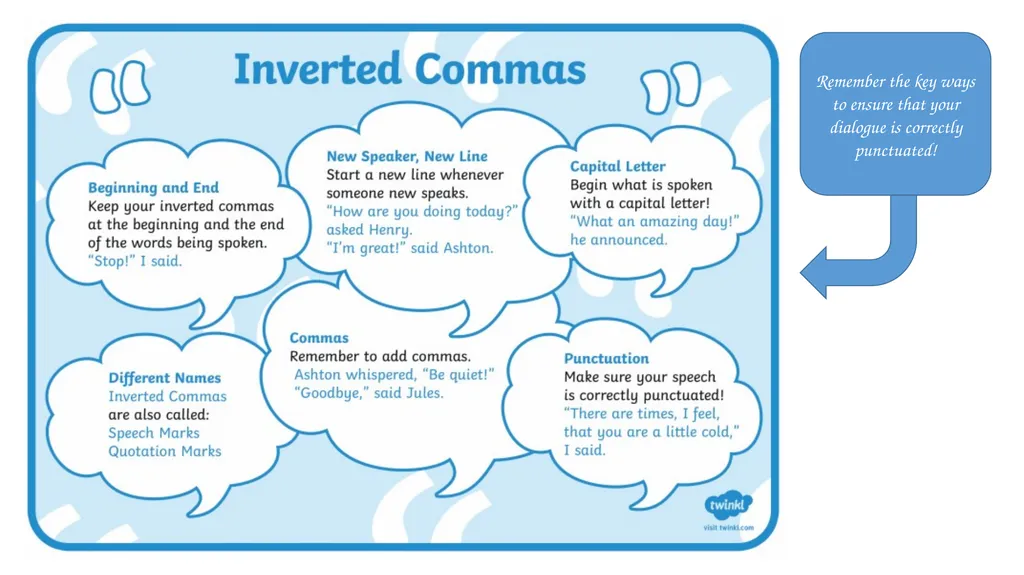
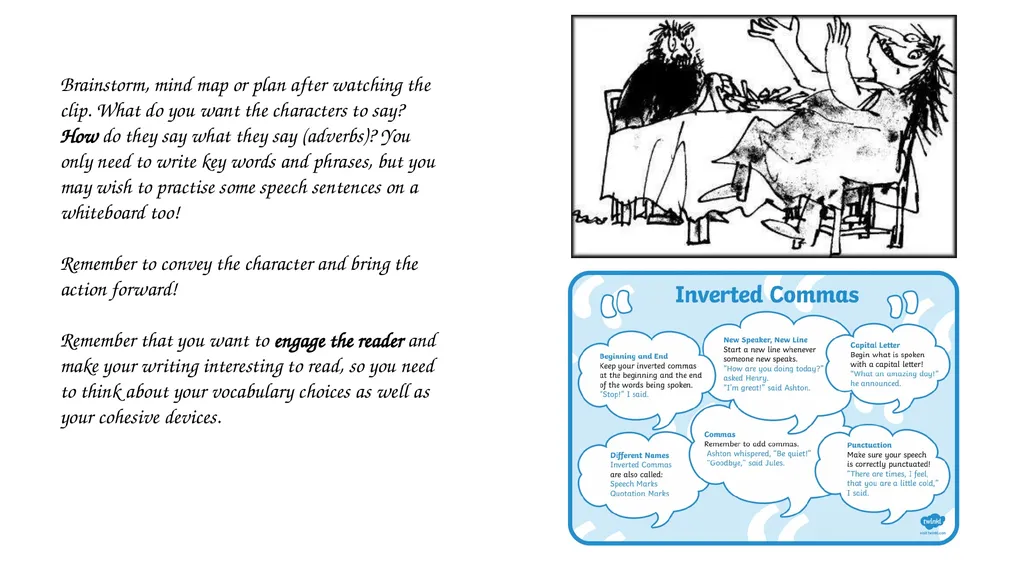
slide15. Remember the key ways to ensure that your dialogue is correctly punctuated!<br>
slide16. Watch the clip from 2:10s – 3:14s
First, we will focus on Mrs Twit only.
What are her actions and her expressions? What does she say? How does she say it?
Mrs Twit was hiding the fact that she has hidden worms in the spaghetti. She has to try and convince Mr Twit that https://www.youtube.com/watch?v=eWvyB-QvbVA<br>
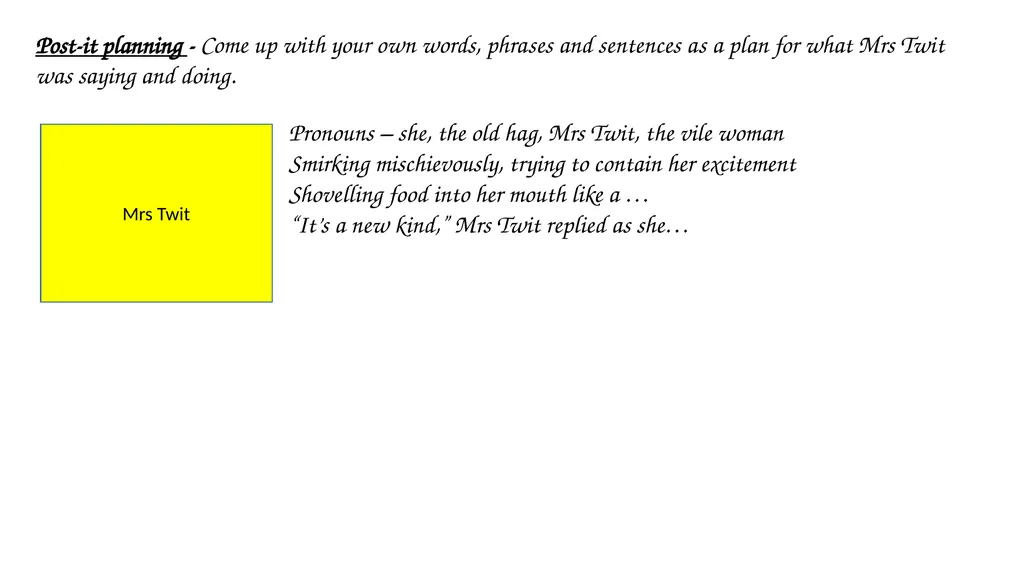
slide17. Mrs Twit Pronouns – she, the old hag, Mrs Twit, the vile woman
Smirking mischievously, trying to contain her excitement
Shovelling food into her mouth like a …
“It’s a new kind,” Mrs Twit replied as she… Post-it planning - Come up with your own words, phrases and sentences as a plan for what Mrs Twit was saying and doing.<br>
slide18. Watch the clip again from 2:10s – 3:14s.
Now, we will focus on Mr Twit only.
What are his actions and his expressions? What does he say? How does he say it? https://www.youtube.com/watch?v=eWvyB-QvbVA<br>
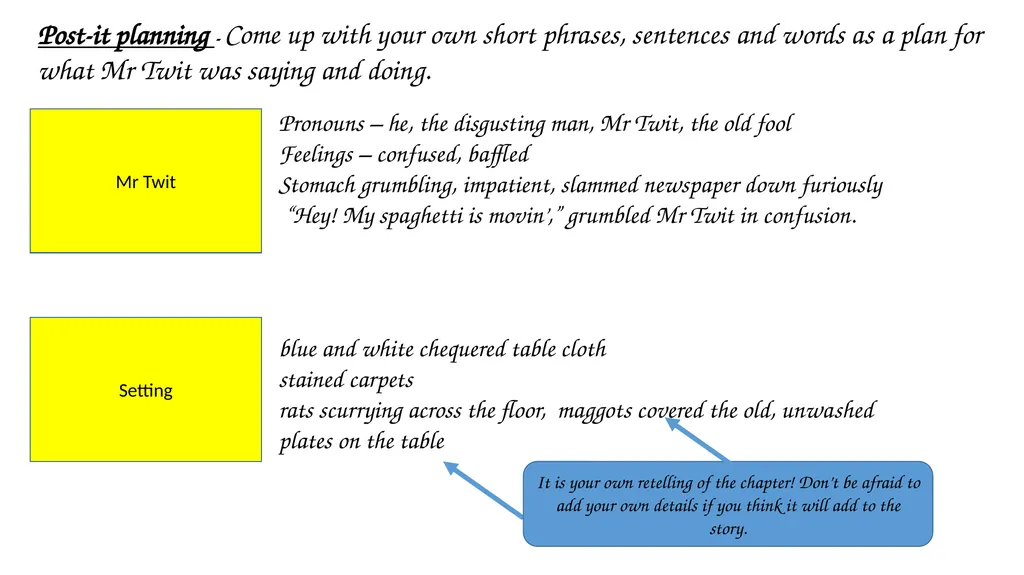
slide19. Mr Twit Pronouns – he, the disgusting man, Mr Twit, the old fool
Feelings – confused, baffled
Stomach grumbling, impatient, slammed newspaper down furiously
“Hey! My spaghetti is movin’,” grumbled Mr Twit in confusion. blue and white chequered table cloth
stained carpets
rats scurrying across the floor, maggots covered the old, unwashed plates on the table It is your own retelling of the chapter! Don’t be afraid to add your own details if you think it will add to the story. Post-it planning - Come up with your own short phrases, sentences and words as a plan for what Mr Twit was saying and doing. Setting<br>
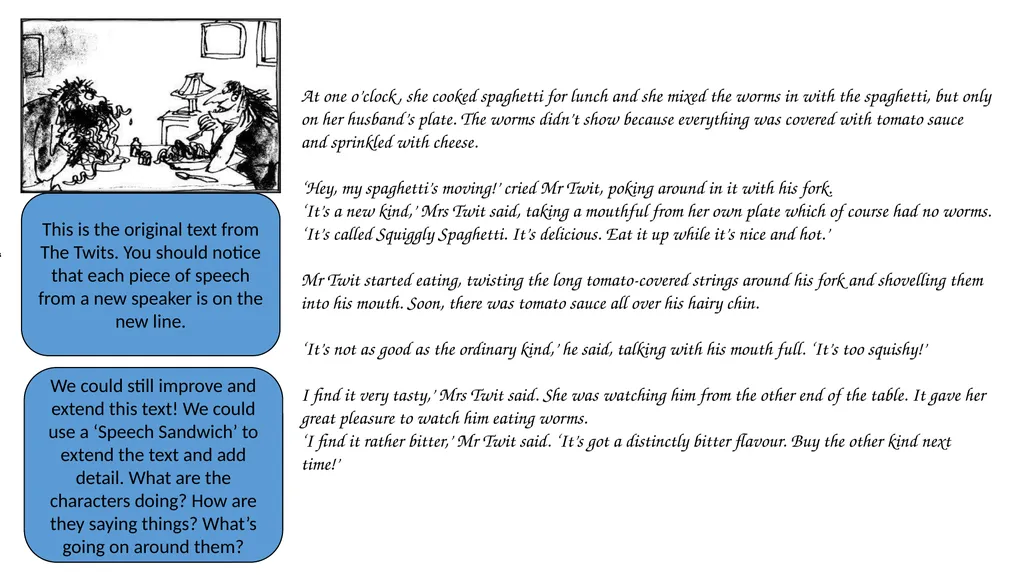
slide20. At one o’clock, she cooked spaghetti for lunch and she mixed the worms in with the spaghetti, but only on her husband’s plate. The worms didn’t show because everything was covered with tomato sauce and sprinkled with cheese.
‘Hey, my spaghetti’s moving!’ cried Mr Twit, poking around in it with his fork.
‘It’s a new kind,’ Mrs Twit said, taking a mouthful from her own plate which of course had no worms. ‘It’s called Squiggly Spaghetti. It’s delicious. Eat it up while it’s nice and hot.’
Mr Twit started eating, twisting the long tomato-covered strings around his fork and shovelling them into his mouth. Soon, there was tomato sauce all over his hairy chin.
‘It’s not as good as the ordinary kind,’ he said, talking with his mouth full. ‘It’s too squishy!’
I find it very tasty,’ Mrs Twit said. She was watching him from the other end of the table. It gave her great pleasure to watch him eating worms.
‘I find it rather bitter,’ Mr Twit said. ‘It’s got a distinctly bitter flavour. Buy the other kind next time!’ ‘ This is the original text from The Twits. You should notice that each piece of speech from a new speaker is on the new line. We could still improve and extend this text! We could use a ‘Speech Sandwich’ to extend the text and add detail. What are the characters doing? How are they saying things? What’s going on around them?<br>
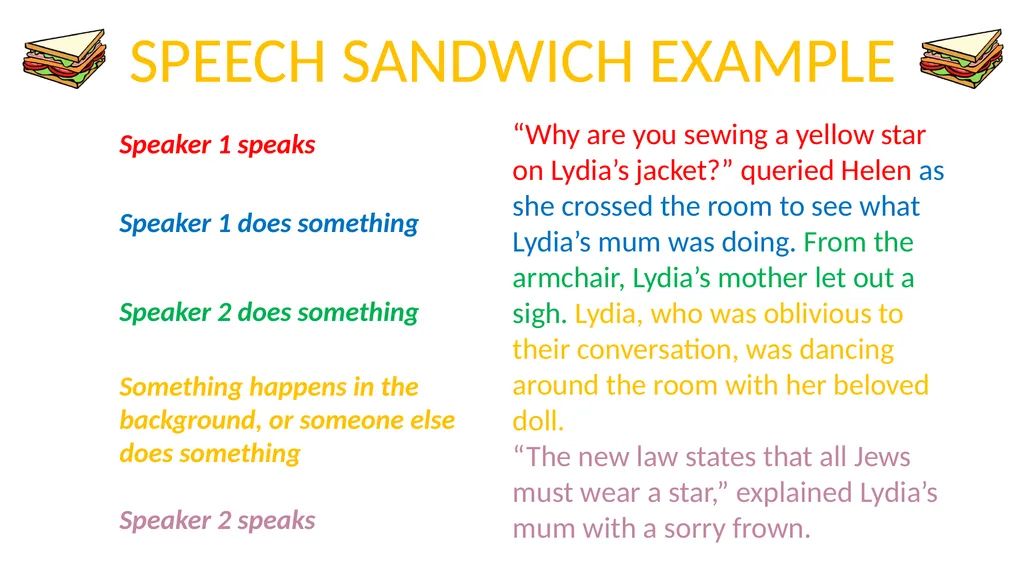
slide21. SPEECH SANDWICH EXAMPLE Speaker 1 speaks Speaker 1 does something Speaker 2 does something Something happens in the background, or someone else
does something Speaker 2 speaks “Why are you sewing a yellow star on Lydia’s jacket?” queried Helen as she crossed the room to see what Lydia’s mum was doing. From the armchair, Lydia’s mother let out a sigh. Lydia, who was oblivious to their conversation, was dancing around the room with her beloved doll. “The new law states that all Jews must wear a star,” explained Lydia’s mum with a sorry frown.<br>
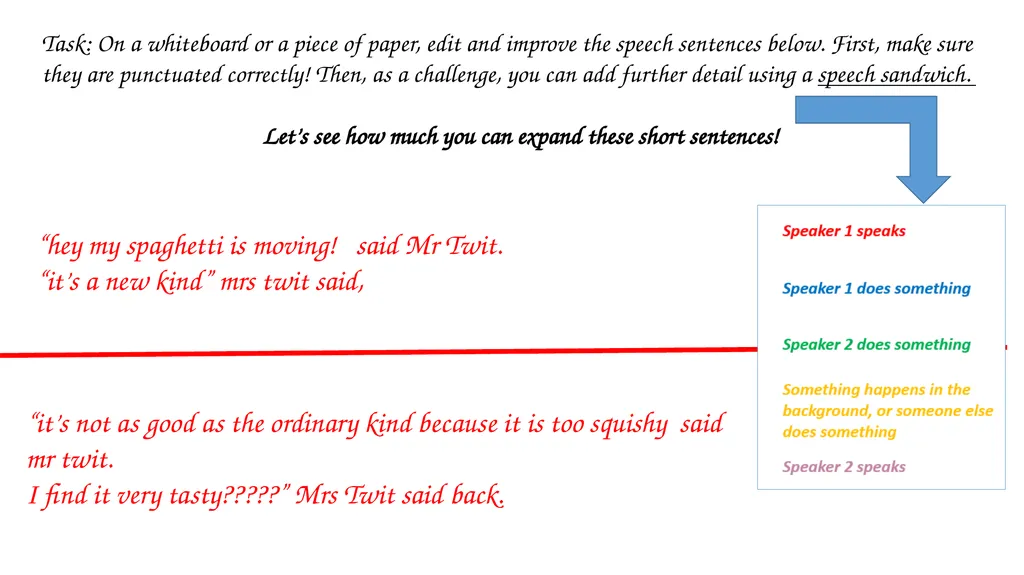
slide22. Task: On a whiteboard or a piece of paper, edit and improve the speech sentences below. First, make sure they are punctuated correctly! Then, as a challenge, you can add further detail using a speech sandwich.
Let’s see how much you can expand these short sentences! “hey my spaghetti is moving! said Mr Twit.
“it’s a new kind” mrs twit said, “it’s not as good as the ordinary kind because it is too squishy said mr twit.
I find it very tasty?????” Mrs Twit said back.<br>
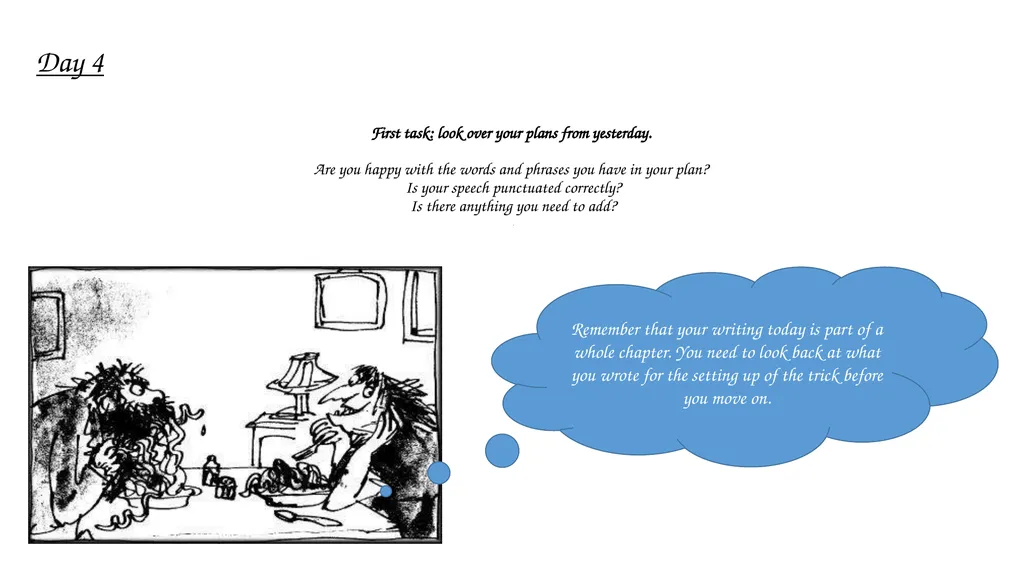
slide23. Day 4 First task: look over your plans from yesterday. Are you happy with the words and phrases you have in your plan? Is your speech punctuated correctly? Is there anything you need to add? . Remember that your writing today is part of a whole chapter. You need to look back at what you wrote for the setting up of the trick before you move on.<br>
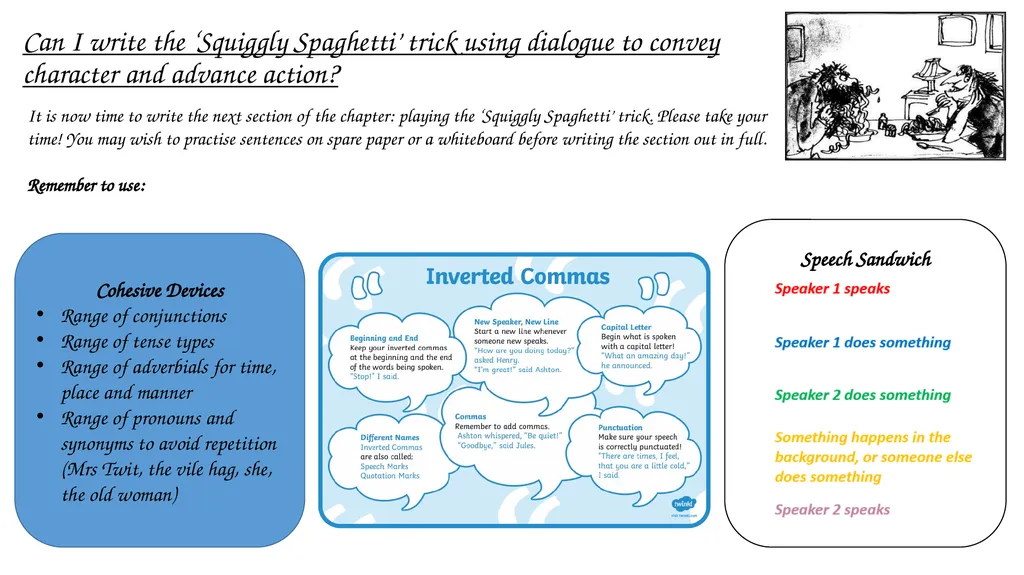
slide24. Can I write the ‘Squiggly Spaghetti’ trick using dialogue to convey character and advance action? Cohesive Devices
Range of conjunctions
Range of tense types
Range of adverbials for time, place and manner
Range of pronouns and synonyms to avoid repetition (Mrs Twit, the vile hag, she, the old woman) It is now time to write the next section of the chapter: playing the ‘Squiggly Spaghetti’ trick. Please take your time! You may wish to practise sentences on spare paper or a whiteboard before writing the section out in full.
Remember to use: Speech Sandwich<br>
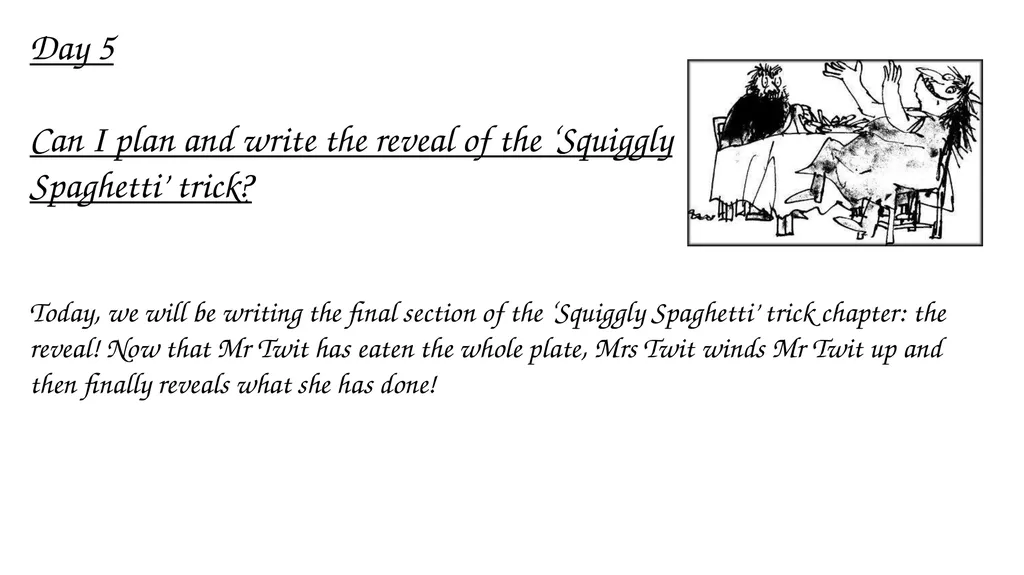
slide25. Day 5 Can I plan and write the reveal of the ‘Squiggly Spaghetti’ trick? Today, we will be writing the final section of the ‘Squiggly Spaghetti’ trick chapter: the reveal! Now that Mr Twit has eaten the whole plate, Mrs Twit winds Mr Twit up and then finally reveals what she has done!<br>
slide26. Watch the clip from 3:14s to the end.
First, focus on Mrs Twit.
What are her actions and her expressions? What does she say? How does she say it? Next, focus on Mr Twit.
What are his actions and his expressions? What does he say? How does he say it? https://www.youtube.com/watch?v=eWvyB-QvbVA<br>
slide27. Brainstorm, mind map or plan after watching the clip. What do you want the characters to say? How do they say what they say (adverbs)? You only need to write key words and phrases, but you may wish to practise some speech sentences on a whiteboard too!
Remember to convey the character and bring the action forward!
Remember that you want to engage the reader and make your writing interesting to read, so you need to think about your vocabulary choices as well as your cohesive devices.<br>
slide28. Mrs Twit waited until Mr Twit had eaten the whole plateful. Then she said, “You want to know why your spaghetti was squishy?”
Mr Twit wiped the tomato sauce from his beard with a corner of the tablecloth.
“Why?” he said.
“And why it had a nasty bitter taste?”
“Why?” he said.
“Because it was worms!” cried Mrs Twit, clapping her hands and stamping her feet on the floor and rocking with horrible laughter. This is the original ‘reveal’ from The Twits. You should notice that each piece of speech from a new speaker is on the new line. We could still improve and extend this text! Roald Dahl has used said THREE TIMES!
We could use a ‘Speech Sandwich’ to extend the text and add detail.
What are the characters doing? How are they saying things? What’s going on around them?<br>
slide29. Can I write the reveal of the ‘Squiggly Spaghetti’ trick using dialogue to convey character and advance action? Cohesive Devices
Range of conjunctions
Range of tense types
Range of adverbials for time, place and manner
Range of pronouns and synonyms to avoid repetition (Mrs Twit, the vile hag, she, the old woman) It is now time to write the final section of the chapter: the reveal of the ‘Squiggly Spaghetti’ trick. Please take your time! You may wish to practise sentences on spare paper or a whiteboard before writing the section out in full.
Remember to use: Speech Sandwich<br>
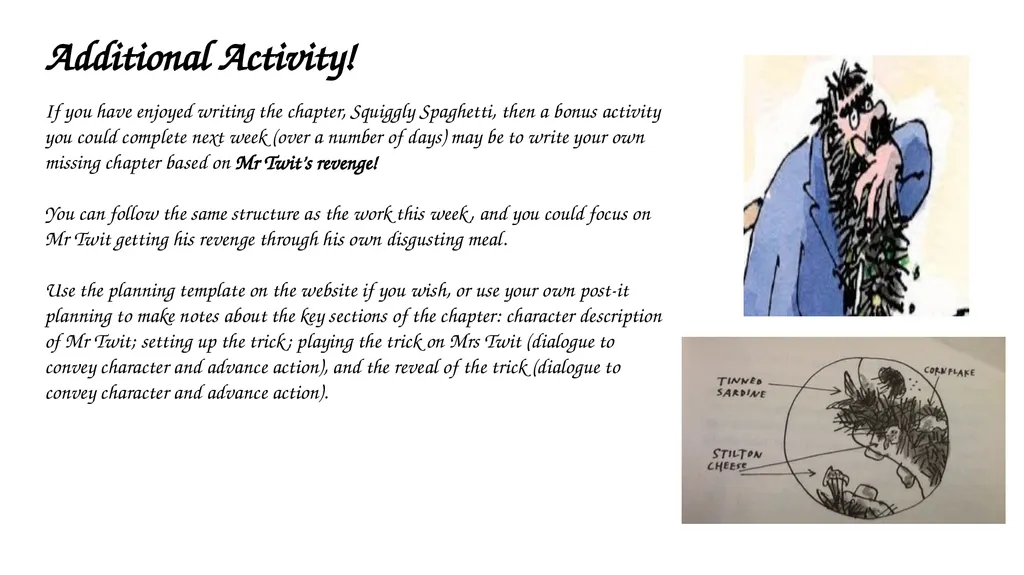
slide30. Additional Activity! If you have enjoyed writing the chapter, Squiggly Spaghetti, then a bonus activity you could complete next week (over a number of days) may be to write your own missing chapter based on Mr Twit’s revenge!
You can follow the same structure as the work this week, and you could focus on Mr Twit getting his revenge through his own disgusting meal.
Use the planning template on the website if you wish, or use your own post-it planning to make notes about the key sections of the chapter: character description of Mr Twit; setting up the trick; playing the trick on Mrs Twit (dialogue to convey character and advance action), and the reveal of the trick (dialogue to convey character and advance action).<br>
Who is the author?
What type of book is this?
Who is the audience?
Why is this a popular book?
Do you know any of the characters? Day 1 – The Twits<br>
slide2. Noun hunt – How many nouns can you think of linked to Mrs Twit?<br>
slide3. Noun hunt – How many nouns can you think of linked to Mrs Twit?<br>
slide4. vile stench putrid smell that lingers around her witch-like nose covered in boils Ugly – unsightly, repulsive, hideous, revolting
Disgusting – stomach-churning, odious (smell), foul
Disgusting – wicked, cruel, intolerable, beastly, ghastly How can we expand nouns about Mrs Twit’s appearance?<br>
slide5. vile stench putrid smell that lingers around her witch-like nose covered in boils Ugly – unsightly, repulsive, hideous, revolting
Disgusting – stomach-churning, odious (smell), foul
Disgusting – wicked, cruel, intolerable, beastly, ghastly Plan: Add words, phrases and sentences which you could use to describe Mrs Twit.
Can you use any high level vocabulary? Remember to think about synonyms which may be more effective!
If you want to write in the style of Roald Dahl, you may wish to use simple adjectives and repeat them for effect.<br>
slide6. Now we have discussed our character’s appearance, we need to think about her personality which we can infer from her actions, her behaviour and her facial expressions.
Watch up to 1:05s on the clip and note down her actions, appearance and behaviour. Add words/phrases to mind map that describe Mrs Twit.
Watch clip 2/3 times to ensure that you have a good range of ideas! https://www.youtube.com/watch?v=eWvyB-QvbVA<br>
slide7. Day 1 – The Twits Can I write a character description? Have you ever met Mrs Twit? If you haven’t, I advise that you don’t because she is one of the smelliest women in the world. She has a smell. The sort of revolting smell that crawls up your nose and lingers there all day, making your eyes water uncontrollably. Now, enough about her foul stench because I’m afraid it gets worse: she is terribly ugly too. The first thing you notice when you cast your eyes upon Mrs Twit is the long, greasy whiskers hanging from her double chin (which, by the way, is covered in pus-filled boils and warts). Then, your eyes are drawn to her mouth. Her rotting, yellow teeth protrude from her receding gums, and pieces of chicken from her Christmas dinner (20 years ago) hang from the gaps. Feeling sick yet? The bizarre thing is Mrs Twit wasn’t born ugly like her vile husband. In fact, she was once ….. W.A.G.O.L.L Remember: this character description is going to be the opening of our chapter!<br>
slide8. Day 2 – The Twits Can I plan and write the plotting of a trick? If you know the text already, you will know that Mr and Mrs Twit like to play horrid tricks on one another. Today, we are going to be continuing with our re-write of the chapter.
We will plan and write out the plotting of Mrs Twit’s ‘Squiggly Spaghetti’ trick.
What do you think the ‘Squiggly Spaghetti’ trick might be?<br>
slide9. Watch the clip from 1:05s to 1:33s
What is the garden like? What can you see? How would you describe the garden?
Watch the same section of the clip again. Focus on Mrs Twit’s body language – her actions and her behaviour.
Whilst you are watching, write down words and phrases for your plan which you may wish to use. https://www.youtube.com/watch?v=eWvyB-QvbVA<br>
slide10. Plotting the trick (garden) Garden as ugly as Mrs Twit
Overgrown
Mossy, tangled weeds
Unearthing long, slippery worms
Cackled with delight
Mischievous grin Post-it planning - Come up with your own short phrases/sentences and words to describe the scene in the garden. There are some examples below.<br>
slide11. Watch the clip from 1:33s to 2:08s
What is the kitchen like? What can you see? How would you describe the kitchen?
Watch the same section of the clip again. Focus on Mrs Twit’s body language – her actions and her behaviour. What was she doing?
Whilst you are watching, write down words and phrases for your plan which you may wish to use. https://www.youtube.com/watch?v=eWvyB-QvbVA<br>
slide12. Plotting the trick (kitchen) Dark, dingy kitchen filthy
Plates covered in mould
disorganised cupboards with doors hanging off their hinges
Licking lips mischievously
slams/chucks/tosses Post-it planning - Come up with your own short phrases/sentences and words to describe the scene in the kitchen.<br>
slide13. Day 2 - Twits Can I plan and write the plotting of a trick? We are now going to use our plans to write the plotting and preparation of the ‘Squiggly Spaghetti’ trick.
Remember:
It must be descriptive so that the reader can really image the setting and what Mrs Twit is doing.
We need to convey Mrs Twit’s character through adjectives as well as using show not tell (describing her body language and behaviour).
We need to use a range of cohesive devices (different sentence openers, lengths of sentences, and adverbials for time, place and manner) to ensure our writing flows within and between paragraphs and is interesting to read!<br>
slide14. Day 3 – The Twits Can I plan the ‘Squiggly Spaghetti’ trick using dialogue to convey character and advance action?<br>
slide15. Remember the key ways to ensure that your dialogue is correctly punctuated!<br>
slide16. Watch the clip from 2:10s – 3:14s
First, we will focus on Mrs Twit only.
What are her actions and her expressions? What does she say? How does she say it?
Mrs Twit was hiding the fact that she has hidden worms in the spaghetti. She has to try and convince Mr Twit that https://www.youtube.com/watch?v=eWvyB-QvbVA<br>
slide17. Mrs Twit Pronouns – she, the old hag, Mrs Twit, the vile woman
Smirking mischievously, trying to contain her excitement
Shovelling food into her mouth like a …
“It’s a new kind,” Mrs Twit replied as she… Post-it planning - Come up with your own words, phrases and sentences as a plan for what Mrs Twit was saying and doing.<br>
slide18. Watch the clip again from 2:10s – 3:14s.
Now, we will focus on Mr Twit only.
What are his actions and his expressions? What does he say? How does he say it? https://www.youtube.com/watch?v=eWvyB-QvbVA<br>
slide19. Mr Twit Pronouns – he, the disgusting man, Mr Twit, the old fool
Feelings – confused, baffled
Stomach grumbling, impatient, slammed newspaper down furiously
“Hey! My spaghetti is movin’,” grumbled Mr Twit in confusion. blue and white chequered table cloth
stained carpets
rats scurrying across the floor, maggots covered the old, unwashed plates on the table It is your own retelling of the chapter! Don’t be afraid to add your own details if you think it will add to the story. Post-it planning - Come up with your own short phrases, sentences and words as a plan for what Mr Twit was saying and doing. Setting<br>
slide20. At one o’clock, she cooked spaghetti for lunch and she mixed the worms in with the spaghetti, but only on her husband’s plate. The worms didn’t show because everything was covered with tomato sauce and sprinkled with cheese.
‘Hey, my spaghetti’s moving!’ cried Mr Twit, poking around in it with his fork.
‘It’s a new kind,’ Mrs Twit said, taking a mouthful from her own plate which of course had no worms. ‘It’s called Squiggly Spaghetti. It’s delicious. Eat it up while it’s nice and hot.’
Mr Twit started eating, twisting the long tomato-covered strings around his fork and shovelling them into his mouth. Soon, there was tomato sauce all over his hairy chin.
‘It’s not as good as the ordinary kind,’ he said, talking with his mouth full. ‘It’s too squishy!’
I find it very tasty,’ Mrs Twit said. She was watching him from the other end of the table. It gave her great pleasure to watch him eating worms.
‘I find it rather bitter,’ Mr Twit said. ‘It’s got a distinctly bitter flavour. Buy the other kind next time!’ ‘ This is the original text from The Twits. You should notice that each piece of speech from a new speaker is on the new line. We could still improve and extend this text! We could use a ‘Speech Sandwich’ to extend the text and add detail. What are the characters doing? How are they saying things? What’s going on around them?<br>
slide21. SPEECH SANDWICH EXAMPLE Speaker 1 speaks Speaker 1 does something Speaker 2 does something Something happens in the background, or someone else
does something Speaker 2 speaks “Why are you sewing a yellow star on Lydia’s jacket?” queried Helen as she crossed the room to see what Lydia’s mum was doing. From the armchair, Lydia’s mother let out a sigh. Lydia, who was oblivious to their conversation, was dancing around the room with her beloved doll. “The new law states that all Jews must wear a star,” explained Lydia’s mum with a sorry frown.<br>
slide22. Task: On a whiteboard or a piece of paper, edit and improve the speech sentences below. First, make sure they are punctuated correctly! Then, as a challenge, you can add further detail using a speech sandwich.
Let’s see how much you can expand these short sentences! “hey my spaghetti is moving! said Mr Twit.
“it’s a new kind” mrs twit said, “it’s not as good as the ordinary kind because it is too squishy said mr twit.
I find it very tasty?????” Mrs Twit said back.<br>
slide23. Day 4 First task: look over your plans from yesterday. Are you happy with the words and phrases you have in your plan? Is your speech punctuated correctly? Is there anything you need to add? . Remember that your writing today is part of a whole chapter. You need to look back at what you wrote for the setting up of the trick before you move on.<br>
slide24. Can I write the ‘Squiggly Spaghetti’ trick using dialogue to convey character and advance action? Cohesive Devices
Range of conjunctions
Range of tense types
Range of adverbials for time, place and manner
Range of pronouns and synonyms to avoid repetition (Mrs Twit, the vile hag, she, the old woman) It is now time to write the next section of the chapter: playing the ‘Squiggly Spaghetti’ trick. Please take your time! You may wish to practise sentences on spare paper or a whiteboard before writing the section out in full.
Remember to use: Speech Sandwich<br>
slide25. Day 5 Can I plan and write the reveal of the ‘Squiggly Spaghetti’ trick? Today, we will be writing the final section of the ‘Squiggly Spaghetti’ trick chapter: the reveal! Now that Mr Twit has eaten the whole plate, Mrs Twit winds Mr Twit up and then finally reveals what she has done!<br>
slide26. Watch the clip from 3:14s to the end.
First, focus on Mrs Twit.
What are her actions and her expressions? What does she say? How does she say it? Next, focus on Mr Twit.
What are his actions and his expressions? What does he say? How does he say it? https://www.youtube.com/watch?v=eWvyB-QvbVA<br>
slide27. Brainstorm, mind map or plan after watching the clip. What do you want the characters to say? How do they say what they say (adverbs)? You only need to write key words and phrases, but you may wish to practise some speech sentences on a whiteboard too!
Remember to convey the character and bring the action forward!
Remember that you want to engage the reader and make your writing interesting to read, so you need to think about your vocabulary choices as well as your cohesive devices.<br>
slide28. Mrs Twit waited until Mr Twit had eaten the whole plateful. Then she said, “You want to know why your spaghetti was squishy?”
Mr Twit wiped the tomato sauce from his beard with a corner of the tablecloth.
“Why?” he said.
“And why it had a nasty bitter taste?”
“Why?” he said.
“Because it was worms!” cried Mrs Twit, clapping her hands and stamping her feet on the floor and rocking with horrible laughter. This is the original ‘reveal’ from The Twits. You should notice that each piece of speech from a new speaker is on the new line. We could still improve and extend this text! Roald Dahl has used said THREE TIMES!
We could use a ‘Speech Sandwich’ to extend the text and add detail.
What are the characters doing? How are they saying things? What’s going on around them?<br>
slide29. Can I write the reveal of the ‘Squiggly Spaghetti’ trick using dialogue to convey character and advance action? Cohesive Devices
Range of conjunctions
Range of tense types
Range of adverbials for time, place and manner
Range of pronouns and synonyms to avoid repetition (Mrs Twit, the vile hag, she, the old woman) It is now time to write the final section of the chapter: the reveal of the ‘Squiggly Spaghetti’ trick. Please take your time! You may wish to practise sentences on spare paper or a whiteboard before writing the section out in full.
Remember to use: Speech Sandwich<br>
slide30. Additional Activity! If you have enjoyed writing the chapter, Squiggly Spaghetti, then a bonus activity you could complete next week (over a number of days) may be to write your own missing chapter based on Mr Twit’s revenge!
You can follow the same structure as the work this week, and you could focus on Mr Twit getting his revenge through his own disgusting meal.
Use the planning template on the website if you wish, or use your own post-it planning to make notes about the key sections of the chapter: character description of Mr Twit; setting up the trick; playing the trick on Mrs Twit (dialogue to convey character and advance action), and the reveal of the trick (dialogue to convey character and advance action).<br>