What ethical, social, and political issues are

Published  . 0 views
↓ Download
What ethical, social, and political issues are
1 / 1
What ethical, social, and political issues are - slide 1 of 33 What ethical, social, and political issues are - slide 2 of 33 What ethical, social, and political issues are - slide 3 of 33 What ethical, social, and political issues are - slide 4 of 33 What ethical, social, and political issues are - slide 5 of 33 What ethical, social, and political issues are - slide 6 of 33 What ethical, social, and political issues are - slide 7 of 33 What ethical, social, and political issues are - slide 8 of 33 What ethical, social, and political issues are - slide 9 of 33 What ethical, social, and political issues are - slide 10 of 33 What ethical, social, and political issues are - slide 11 of 33 What ethical, social, and political issues are - slide 12 of 33 What ethical, social, and political issues are - slide 13 of 33 What ethical, social, and political issues are - slide 14 of 33 What ethical, social, and political issues are - slide 15 of 33 What ethical, social, and political issues are - slide 16 of 33 What ethical, social, and political issues are - slide 17 of 33 What ethical, social, and political issues are - slide 18 of 33 What ethical, social, and political issues are - slide 19 of 33 What ethical, social, and political issues are - slide 20 of 33 What ethical, social, and political issues are - slide 21 of 33 What ethical, social, and political issues are - slide 22 of 33 What ethical, social, and political issues are - slide 23 of 33 What ethical, social, and political issues are - slide 24 of 33 What ethical, social, and political issues are - slide 25 of 33 What ethical, social, and political issues are - slide 26 of 33 What ethical, social, and political issues are - slide 27 of 33 What ethical, social, and political issues are - slide 28 of 33 What ethical, social, and political issues are - slide 29 of 33 What ethical, social, and political issues are - slide 30 of 33 What ethical, social, and political issues are - slide 31 of 33 What ethical, social, and political issues are - slide 32 of 33 What ethical, social, and political issues are - slide 33 of 33
Description: What ethical, social, and political issues are raised by ? What specific principles for conduct can be used to guide ethical decisions? Why do contemporary technology and the Internet pose challenges to the protection of individual privacy

Related Topics

Download Presentation

"What ethical, social, and political issues are" is the property of its rightful owner. Permission is granted to download and print the materials on this website for personal, non-commercial use only, and to display it on your personal computer provided you do not modify the materials and that you retain all copyright notices contained in the materials. By downloading content from our website, you accept the terms of this agreement.

Presentation Transcript

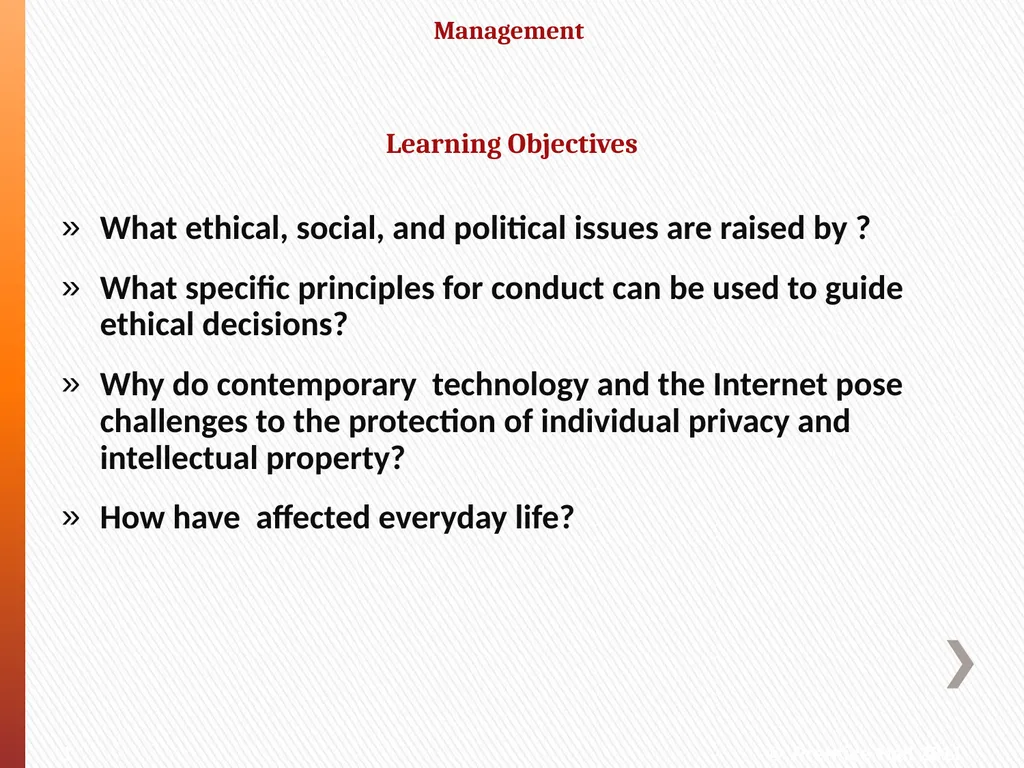
slide1. What ethical, social, and political issues are raised by ?
What specific principles for conduct can be used to guide ethical decisions?
Why do contemporary technology and the Internet pose challenges to the protection of individual privacy and intellectual property?
How have affected everyday life? Learning Objectives © Prentice Hall 2011 1<br>
slide2. Problem Need to efficiently target online ads
Solutions Behavioral targeting allows businesses and organizations to more precisely target desired demographics
Google monitors user activity on thousands of sites; businesses monitor own sites to understand customers
Demonstrates IT’s role in organizing and distributing information
Illustrates the ethical questions inherent in online information gathering Behavioral Targeting and Your Privacy You’re the Target © Prentice Hall 2011 2<br>
slide3. Recent cases of failed ethical judgment in business
Lehman Brothers, Minerals Management Service, Pfizer
In many, information systems used to bury decisions from public scrutiny
Ethics
Principles of right and wrong that individuals, acting as free moral agents, use to make choices to guide their behaviors Understanding Ethical and Social Issues Related to Systems © Prentice Hall 2011 3<br>
slide4. and ethics
raise new ethical questions because they create opportunities for
Intense social change, threatening existing distributions of power, money, rights, and obligations
New kinds of crime Understanding Ethical and Social Issues Related to Systems © Prentice Hall 2011 4<br>
slide5. Model for thinking about ethical, social, political issues
Society as a calm pond
IT as rock dropped in pond, creating ripples of new situations not covered by old rules
Social and political institutions cannot respond overnight to these ripples—it may take years to develop etiquette, expectations, laws
Requires understanding of ethics to make choices in legally gray areas Understanding Ethical and Social Issues Related to Systems © Prentice Hall 2011 5<br>
slide6. Understanding Ethical and Social Issues Related to Systems THE RELATIONSHIP BETWEEN ETHICAL, SOCIAL, AND POLITICAL ISSUES IN AN INFORMATION SOCIETY The introduction of new information technology has a ripple effect, raising new ethical, social, and political issues that must be dealt with on the individual, social, and political levels. These issues have five moral dimensions information rights and obligations, property rights and obligations, system quality, quality of life, and accountability and control. © Prentice Hall 2011 6<br>
slide7. Five moral dimensions of the information age
Information rights and obligations
Property rights and obligations
Accountability and control
System quality
Quality of life Understanding Ethical and Social Issues Related to Systems © Prentice Hall 2011 7<br>
slide8. Key technology trends that raise ethical issues
Doubling of computer power
More organizations depend on computer systems for critical operations
Rapidly declining data storage costs
Organizations can easily maintain detailed databases on individuals
Networking advances and the Internet
Copying data from one location to another and accessing personal data from remote locations is much easier Understanding Ethical and Social Issues Related to Systems © Prentice Hall 2011 8<br>
slide9. Key technology trends that raise ethical issues (cont.)
Advances in data analysis techniques
Companies can analyze vast quantities of data gathered on individuals for
Profiling
Combining data from multiple sources to create dossiers of detailed information on individuals
Nonobvious relationship awareness (NORA)
Combining data from multiple sources to find obscure hidden connections that might help identify criminals or terrorists Understanding Ethical and Social Issues Related to Systems © Prentice Hall 2011 9<br>
slide10. Understanding Ethical and Social Issues Related to Systems NONOBVIOUS RELATIONSHIP AWARENESS (NORA) NORA technology can take information about people from disparate sources and find obscure, nonobvious relationships. It might discover, for example, that an applicant for a job at a gold store shares a telephone number with a known criminal and issue an alert to the hiring manager. © Prentice Hall 2011 10<br>
slide11. Basic concepts for ethical analysis
Responsibility
Accepting the potential costs, duties, and obligations for decisions
Accountability
Mechanisms for identifying responsible parties
Liability
Permits individuals (and firms) to recover damages done to them
Due process
Laws are well known and understood, with an ability to appeal to higher authorities Ethics in an Information Society © Prentice Hall 2011 11<br>
slide12. Ethical analysis A five-step process
Identify and clearly describe the facts
Define the conflict or dilemma and identify the higher-order values involved
Identify the stakeholders
Identify the options that you can reasonably take
Identify the potential consequences of your options Ethics in an Information Society © Prentice Hall 2011 12<br>
slide13. Six Candidate Ethical Principles
Golden Rule
Do unto others as you would have them do unto you
Immanuel Kant’s Categorical Imperative
If an action is not right for everyone to take, it is not right for anyone
Descartes’ Rule of Change
If an action cannot be taken repeatedly, it is not right to take at all Ethics in an Information Society © Prentice Hall 2011 13<br>
slide14. Six Candidate Ethical Principles (cont.)
Utilitarian Principle
Take the action that achieves the higher or greater value
Risk Aversion Principle
Take the action that produces the least harm or least potential cost
Ethical “no free lunch” Rule
Assume that virtually all tangible and intangible objects are owned by someone unless there is a specific declaration otherwise Ethics in an Information Society © Prentice Hall 2011 14<br>
slide15. Professional codes of conduct
Promulgated by associations of professionals
E.g. IFLA, ARMA, AIIM, ACM
Promises by professions to regulate themselves in the general interest of society
Real-world ethical dilemmas
One set of interests pitted against another
E.g. Right of company to maximize productivity of workers vs. workers right to use Internet for short personal tasks Ethics in an Information Society © Prentice Hall 2011 15<br>
slide16. Privacy
Claim of individuals to be left alone, free from surveillance or interference from other individuals, organizations, or state. Claim to be able to control information about yourself The Moral Dimensions of © Prentice Hall 2011 16<br>
slide17. Fair information practices
Set of principles governing the collection and use of information
Basis of most international and local privacy laws
Based on mutuality of interest between record holder and individual 
Restated and extended by FTC in 1998 to provide guidelines for protecting online privacy
Used to drive changes in privacy legislation
COPPA
Gramm-Leach-Bliley Act
HIPAA The Moral Dimensions of © Prentice Hall 2011 17<br>
slide18. Principles of Information Systems
Notice/awareness (core principle)
Choice/consent (core principle)
Access/participation
Security
Enforcement The Moral Dimensions of © Prentice Hall 2011 18<br>
slide19. European Directive on Data Protection
Requires companies to inform people when they collect information about them and disclose how it will be stored and used.
Requires informed consent of customer
EU member nations cannot transfer personal data to countries with no similar privacy protection (e.g. U.S.)
U.S. businesses use safe harbor framework
Self-regulating policy to meet objectives of government legislation without involving government regulation or enforcement. The Moral Dimensions of © Prentice Hall 2011 19<br>
slide20. Internet Challenges to Privacy
Cookies
Tiny files downloaded by Web site to visitor’s hard drive to help identify visitor’s browser and track visits to site
Allow Web sites to develop profiles on visitors
Web beacons/bugs
Tiny graphics embedded in e-mail and Web pages to monitor who is reading message
Spyware
Surreptitiously installed on user’s computer
May transmit user’s keystrokes or display unwanted ads
Google’s collection of private data; behavioral targeting The Moral Dimensions of © Prentice Hall 2011 20<br>
slide21. The Moral Dimensions of HOW COOKIES IDENTIFY WEB VISITORS Cookies are written by a Web site on a visitor’s hard drive. When the visitor returns to that Web site, the Web server requests the ID number from the cookie and uses it to access the data stored by that server on that visitor. The Web site can then use these data to display personalized information. © Prentice Hall 2011 21<br>
slide22. U.S. allows businesses to gather transaction information and use this for other marketing purposes
Online industry promotes self-regulation over privacy legislation
However, extent of responsibility taken varies
Statements of information use
Opt-out selection boxes
Online “seals” of privacy principles
Most Web sites do not have any privacy policies The Moral Dimensions of © Prentice Hall 2011 22<br>
slide23. Technical solutions
The Platform for Privacy Preferences (P3P)
Allows Web sites to communicate privacy policies to visitor’s Web browser – user
User specifies privacy levels desired in browser settings
E.g. “medium” level accepts cookies from first-party host sites that have opt-in or opt-out policies but rejects third-party cookies that use personally identifiable information without an opt-in policy The Moral Dimensions of © Prentice Hall 2011 23<br>
slide24. The Moral Dimensions of THE P3P STANDARD P3P enables Web sites to translate their privacy policies into a standard format that can be read by the user’s Web browser software. The browser software evaluates the Web site’s privacy policy to determine whether it is compatible with the user’s privacy preferences. © Prentice Hall 2011 24<br>
slide25. Property rights Intellectual property
Intellectual property Intangible property of any kind created by individuals or corporations
Three main ways that protect intellectual property
Trade secret Intellectual work or product belonging to business, not in the public domain
Copyright Statutory grant protecting intellectual property from being copied for the life of the author, plus 70 years
Patents Grants creator of invention an exclusive monopoly on ideas behind invention for 20 years The Moral Dimensions of © Prentice Hall 2011 25<br>
slide26. Challenges to intellectual property rights
Digital media different from physical media (e.g. books)
Ease of replication
Ease of transmission (networks, Internet)
Difficulty in classifying software
Compactness
Difficulties in establishing uniqueness
Digital Millennium Copyright Act (DMCA)
Makes it illegal to circumvent technology-based protections of copyrighted materials The Moral Dimensions of © Prentice Hall 2011 26<br>
slide27. Accountability, Liability, Control
Computer-related liability problems
If software fails, who is responsible?
If seen as part of machine that injures or harms, software producer and operator may be liable
If seen as similar to book, difficult to hold author/publisher responsible
What should liability be if software seen as service? Would this be similar to telephone systems not being liable for transmitted messages? The Moral Dimensions of © Prentice Hall 2011 27<br>
slide28. System Quality Data Quality and System Errors
What is an acceptable, technologically feasible level of system quality?
Flawless software is economically unfeasible
Three principal sources of poor system performance
Software bugs, errors
Hardware or facility failures
Poor input data quality (most common source of business system failure) The Moral Dimensions of © Prentice Hall 2011 28<br>
slide29. Quality of life Equity, access, and boundaries
Negative social consequences of systems
Balancing power Although computing power decentralizing, key decision-making remains centralized
Rapidity of change Businesses may not have enough time to respond to global competition
Maintaining boundaries Computing, Internet use lengthens work-day, infringes on family, personal time
Dependence and vulnerability Public and private organizations ever more dependent on computer systems The Moral Dimensions of © Prentice Hall 2011 29<br>
slide30. Computer crime and abuse
Computer crime Commission of illegal acts through use of compute or against a computer system – computer may be object or instrument of crime
Computer abuse Unethical acts, not illegal
Spam High costs for businesses in dealing with spam
Employment
Reengineering work resulting in lost jobs
Equity and access – the digital divide
Certain ethnic and income groups in the United States less likely to have computers or Internet access The Moral Dimensions of © Prentice Hall 2011 30<br>
slide31. Which of the five moral dimensions of identified in this text is involved in this case?
What are the ethical, social, and political issues raised by this case?
Which of the ethical principles described in the text are useful for decision making about texting while driving? The Moral Dimensions of THE PERILS OF TEXTING © Prentice Hall 2011 31<br>
slide32. Health risks
Repetitive stress injury (RSI)
Largest source is computer keyboards
Carpal Tunnel Syndrome (CTS)
Computer vision syndrome (CVS)
Technostress
Role of radiation, screen emissions, low-level electromagnetic fields The Moral Dimensions of © Prentice Hall 2011 32<br>
slide33. What are some of the arguments for and against the use of digital media?
How might the brain be affected by constant digital media usage?
Do you think these arguments outweigh the positives of digital media usage? Why or why not?
What additional concerns are there for children using digital media? Should children under 8 use computers and cell phones? Why or why not? The Moral Dimensions of TOO MUCH TECHNOLOGY? © Prentice Hall 2011 33<br>