01
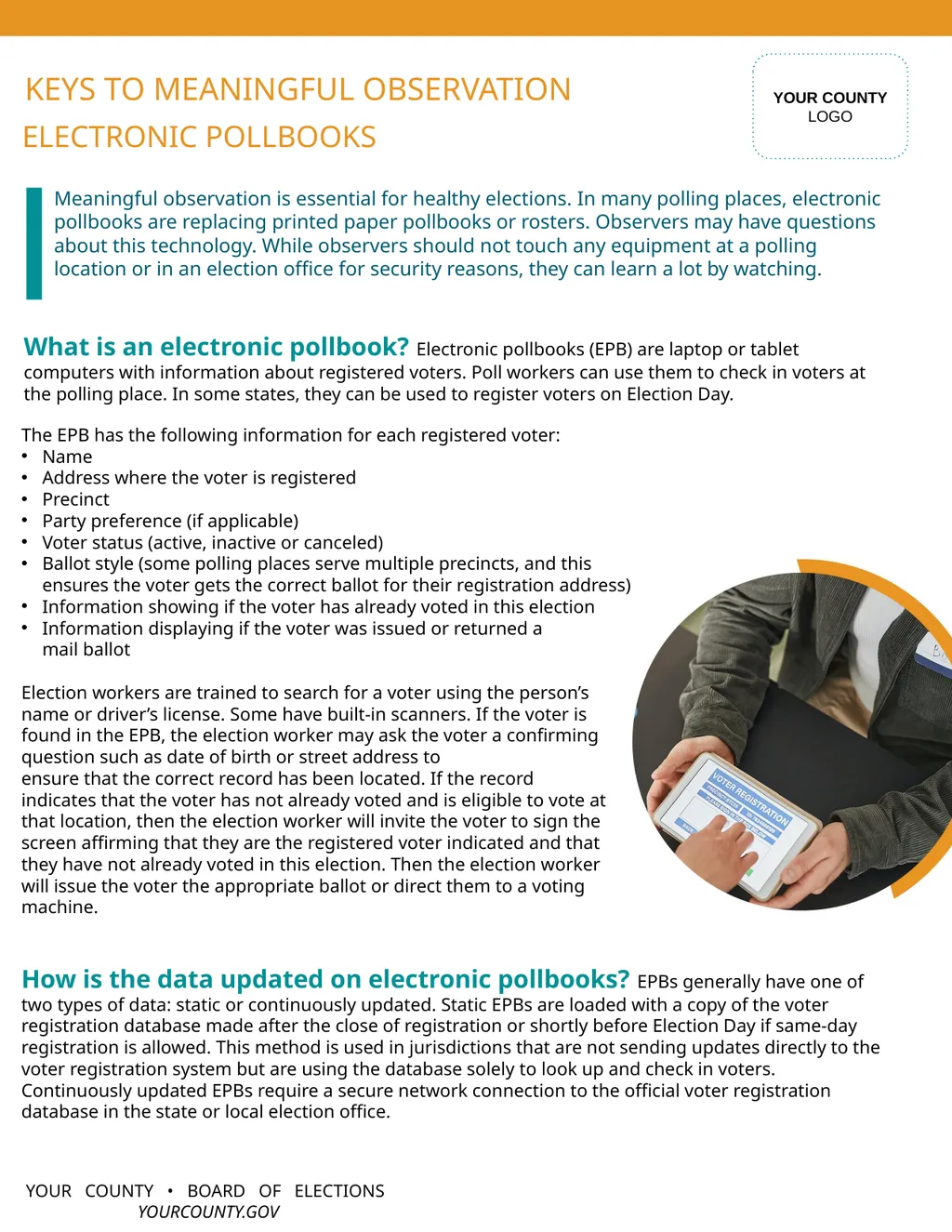
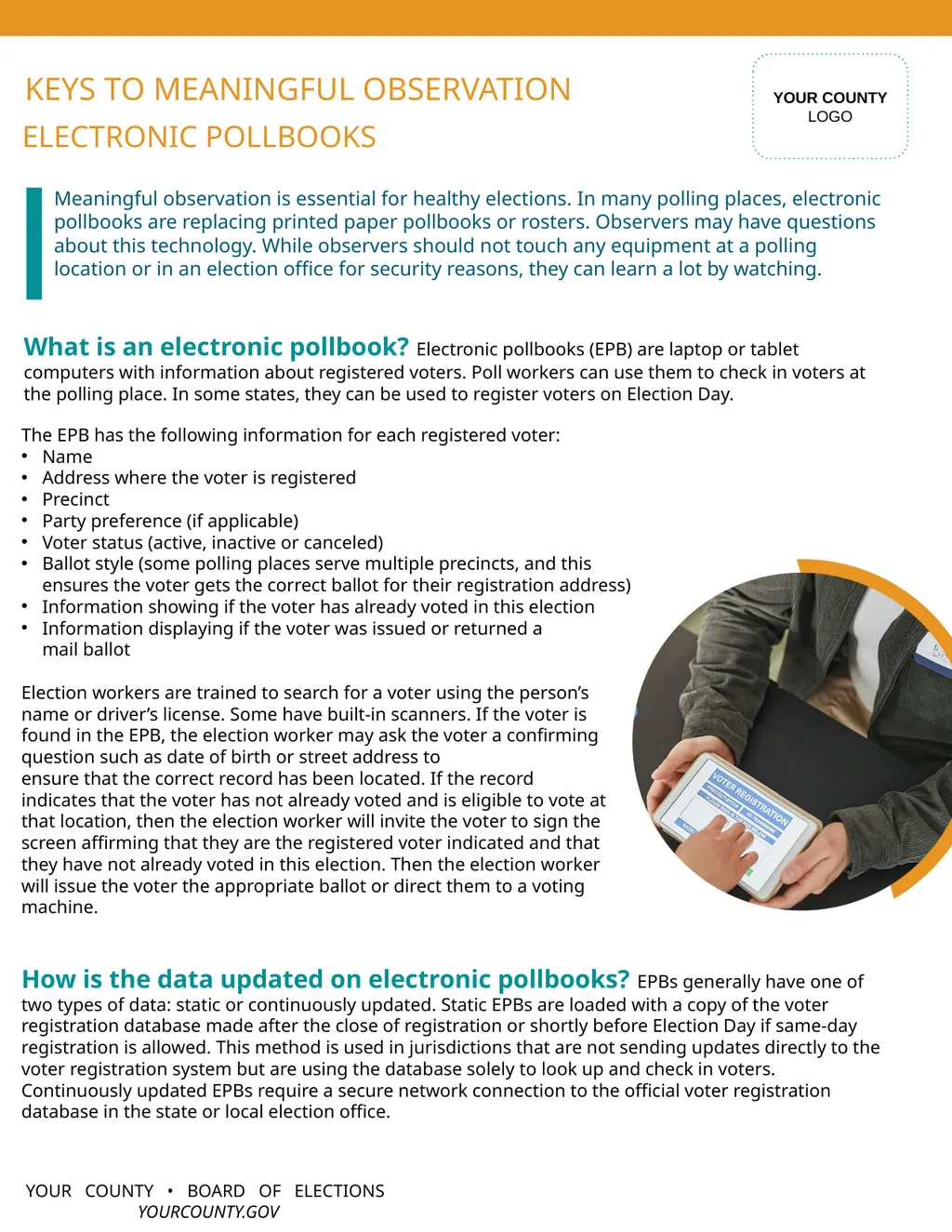
What is an electronic pollbook? Electronic pollbooks (EPB) are laptop or tablet computers with information about registered voters. Poll workers can use them to check in voters at the polling place. In some states, they can be used to register voters on Election Day. KEYS TO MEANINGFUL OBSERVATION YOUR COUNTY LOGO ELECTRONIC POLLBOOKS YOUR COUNTY • BOARD OF ELECTIONS YOURCOUNTY.GOV Meaningful observation is essential for healthy elections. In many polling places, electronic pollbooks are replacing printed paper pollbooks or rosters. Observers may have questions about this technology. While observers should not touch any equipment at a polling location or in an election office for security reasons, they can learn a lot by watching. How is the data updated on electronic pollbooks? EPBs generally have one of two types of data: static or continuously updated. Static EPBs are loaded with a copy of the voter registration database made after the close of registration or shortly before Election Day if same-day registration is allowed. This method is used in jurisdictions that are not sending updates directly to the voter registration system but are using the database solely to look up and check in voters. Continuously updated EPBs require a secure network connection to the official voter registration database in the state or local election office. The EPB has the following information for each registered voter:
Name
Address where the voter is registered
Precinct
Party preference (if applicable)
Voter status (active, inactive or canceled)
Ballot style (some polling places serve multiple precincts, and this ensures the voter gets the correct ballot for their registration address)
Information showing if the voter has already voted in this election
Information displaying if the voter was issued or returned a �mail ballot
Election workers are trained to search for a voter using the person’s name or driver’s license. Some have built-in scanners. If the voter is found in the EPB, the election worker may ask the voter a confirming question such as date of birth or street address to
ensure that the correct record has been located. If the record
indicates that the voter has not already voted and is eligible to vote at that location, then the election worker will invite the voter to sign the screen affirming that they are the registered voter indicated and that they have not already voted in this election. Then the election worker will issue the voter the appropriate ballot or direct them to a voting machine.<br>
02
IF YOU SEE SOMETHING, SAY SOMETHING If you see something that concerns you at the voting location, tell the proper authority. You should direct inquiries to the official in charge of the location. In some counties, there may be a formal complaint process to follow.
Always be respectful and realize that front line election workers may not be able to address all your concerns – and they may need to defer questions to the election office.
If that occurs, document your observations and inform your local election official. YOUR COUNTY • BOARD OF ELECTIONS YOURCOUNTY.GOV Are electronic pollbooks connected to the internet or voting equipment? EPBs may be networked to each other at the polling place or to a central database, but they are not connected to the internet like a home or office computer. They require a secure internet connection such as a password-protected mobile hotspot, a password-protected county network or a hard-wired network connection. In general, the tablets used as EPBs have a limited number of applications and do not allow election workers to access the internet for other purposes.
EPBs are not connected to the ballot tabulators or touchscreen voting machines at a polling place. Voting equipment is never connected to the internet.
How secure are electronic pollbooks? EPBs are kept secure in several ways.
First, they are password protected. Some require dual authentication. Election workers must log in to use them, and there may be a second level of password protection for some actions, such as undoing a check-in or running reports at the end of the day.
Second, EPBs are only connected to secure networks for a limited purpose. If multiple EPBs are used at a polling location, they are generally networked to each other so that a voter who checks in on one EPB shows up as “checked-in” on the others. This prevents double voting.
Third, EPBs may be connected in a closed secure network with the election office. Generally, this allows the election staff to monitor polling locations for potential problems such as battery life or long lines.
In some jurisdictions, EPBs may also be used to send live “check-in” data back to the official voter registration database. This prevents voters from being able to vote in multiple voting locations statewide. State cybersecurity professionals monitor network activity.
What if a voter disagrees with the information in the electronic pollbook? Occasionally a voter may disagree with the information the election worker finds when looking them up. For example, the voter’s record may not be found, the record may indicate that the voter already voted or the record may indicate that the voter is not registered with their preferred political party. In such circumstances, the election worker issues the voter a provisional ballot. IF these types of issues cannot be resolved at the polling place, they will be handled by the staff at the election office.<br>