
What is Carbon Footprint? What is
TA
Published · 44 slides · 0 views

1 / 1




Description
What is Carbon Footprint? What is Carbon-Neutrality? Dr R Ramesh, Associate Professor, CRI National Institute of Rural Development Panchayati Raj (NIRDPR), Hyderabad Lets start this session with a simple breathing exercise Inhale for
Related Topics
Share
Embed code
Download this presentation From Below
"What is Carbon Footprint? What is" is the property of its rightful owner. Permission is granted to download and print the materials on this website for personal, non-commercial use only, and to display it on your personal computer provided you do not modify the materials and that you retain all copyright notices contained in the materials. By downloading content from our website, you accept the terms of this agreement.
Presentation Transcript
01
What is Carbon Footprint?
What is Carbon-Neutrality? Dr R Ramesh, Associate Professor, CRI
National Institute of Rural Development & Panchayati Raj (NIRDPR), Hyderabad<br>
National Institute of Rural Development & Panchayati Raj (NIRDPR), Hyderabad<br>
02
Let’s start this session with a
simple breathing exercise<br>
03
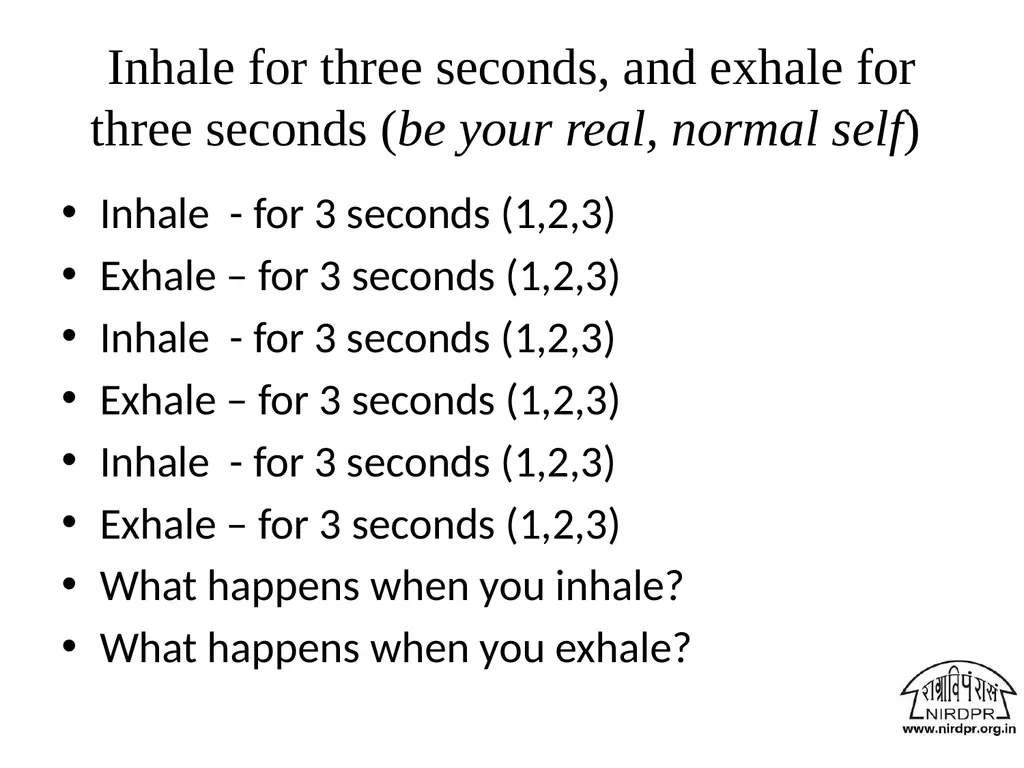
Inhale for three seconds, and exhale for three seconds (be your real, normal self) Inhale - for 3 seconds (1,2,3)
Exhale – for 3 seconds (1,2,3)
Inhale - for 3 seconds (1,2,3)
Exhale – for 3 seconds (1,2,3)
Inhale - for 3 seconds (1,2,3)
Exhale – for 3 seconds (1,2,3)
What happens when you inhale?
What happens when you exhale?<br>
Exhale – for 3 seconds (1,2,3)
Inhale - for 3 seconds (1,2,3)
Exhale – for 3 seconds (1,2,3)
Inhale - for 3 seconds (1,2,3)
Exhale – for 3 seconds (1,2,3)
What happens when you inhale?
What happens when you exhale?<br>
04
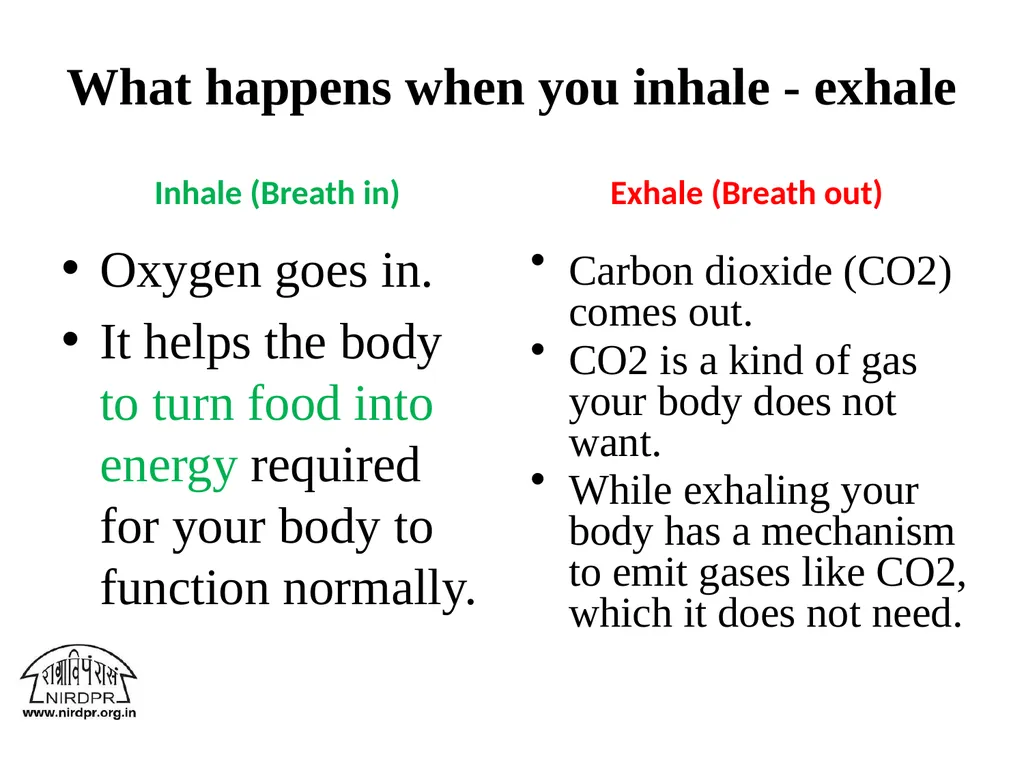
What happens when you inhale - exhale Inhale (Breath in) Oxygen goes in.
It helps the body to turn food into energy required for your body to function normally. Exhale (Breath out) Carbon dioxide (CO2) comes out.
CO2 is a kind of gas your body does not want.
While exhaling your body has a mechanism to emit gases like CO2, which it does not need.<br>
It helps the body to turn food into energy required for your body to function normally. Exhale (Breath out) Carbon dioxide (CO2) comes out.
CO2 is a kind of gas your body does not want.
While exhaling your body has a mechanism to emit gases like CO2, which it does not need.<br>
05
Breathing in turns food into energy Breath in Oxygen helps organisms grow, reproduce, and turn food into energy.
Humans get the oxygen they need by breathing through their nose and mouth into their lungs.
Oxygen gives our cells the ability to break down food in order to get the energy we need to survive.
Oxidation of complex organic substances occurs during respiration. Breath out Then, as we exhale, our lungs return to their resting state and ...
the pressure built up during inhalation is relieved through the release of gas as carbon dioxide.
Breathing is actually a rhythmic process of inhalation and exhalation in which air rich in oxygen is taken in and air rich in carbon dioxide is given out.<br>
Humans get the oxygen they need by breathing through their nose and mouth into their lungs.
Oxygen gives our cells the ability to break down food in order to get the energy we need to survive.
Oxidation of complex organic substances occurs during respiration. Breath out Then, as we exhale, our lungs return to their resting state and ...
the pressure built up during inhalation is relieved through the release of gas as carbon dioxide.
Breathing is actually a rhythmic process of inhalation and exhalation in which air rich in oxygen is taken in and air rich in carbon dioxide is given out.<br>
06
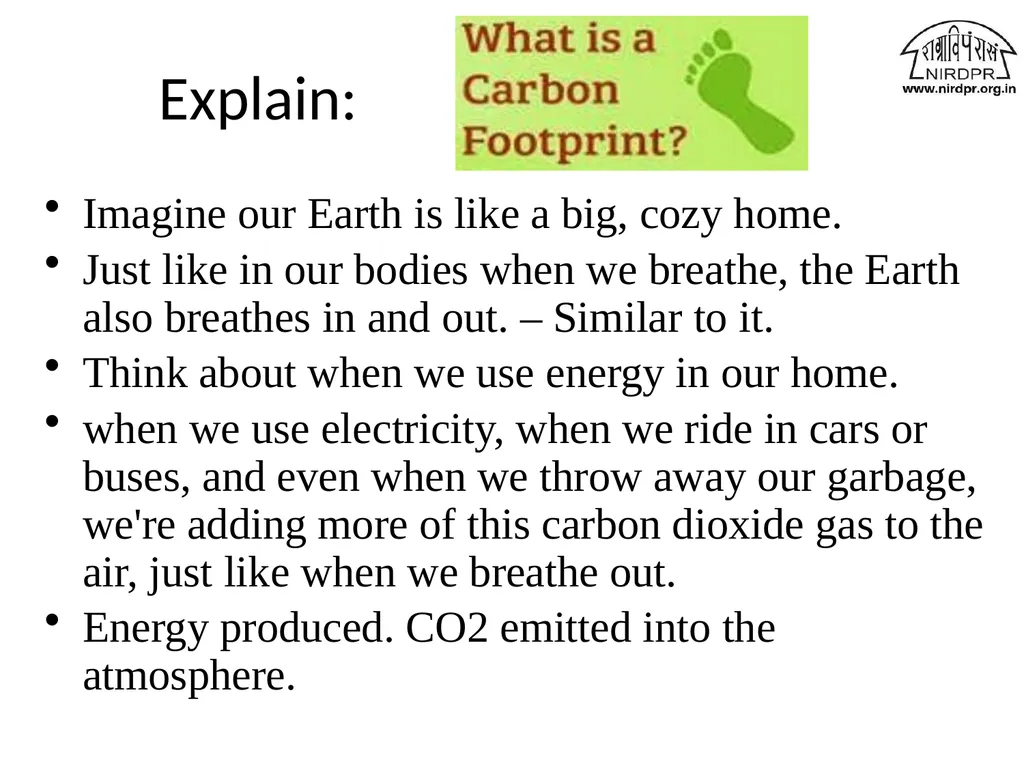
Explain: Imagine our Earth is like a big, cozy home.
Just like in our bodies when we breathe, the Earth also breathes in and out. – Similar to it.
Think about when we use energy in our home.
when we use electricity, when we ride in cars or buses, and even when we throw away our garbage, we're adding more of this carbon dioxide gas to the air, just like when we breathe out.
Energy produced. CO2 emitted into the atmosphere.<br>
Just like in our bodies when we breathe, the Earth also breathes in and out. – Similar to it.
Think about when we use energy in our home.
when we use electricity, when we ride in cars or buses, and even when we throw away our garbage, we're adding more of this carbon dioxide gas to the air, just like when we breathe out.
Energy produced. CO2 emitted into the atmosphere.<br>
07
It's like the Earth's way of exhaling, and too much of it can make the air around our house not very nice to breathe.
So, we need to be careful and try to use energy in a way that doesn't make too much "smoke" for our Earth-house.
We can use less energy, use cleaner energy, or plant more trees because trees help clean the air.
That way, our Earth-house stays happy and healthy for everyone.<br>
So, we need to be careful and try to use energy in a way that doesn't make too much "smoke" for our Earth-house.
We can use less energy, use cleaner energy, or plant more trees because trees help clean the air.
That way, our Earth-house stays happy and healthy for everyone.<br>
08
Almost every activity we perform generates CO2 (carbon emission) When you open your tap for bathing
When you switch on a light or fan
When you use a computer
When you switch on an air-conditioner
When you ride a bike or drive a car
When you throw a biscuit cover on the street
When you accept a single-use plastic item
When you discard a mobile phone to buy new<br>
When you switch on a light or fan
When you use a computer
When you switch on an air-conditioner
When you ride a bike or drive a car
When you throw a biscuit cover on the street
When you accept a single-use plastic item
When you discard a mobile phone to buy new<br>
09
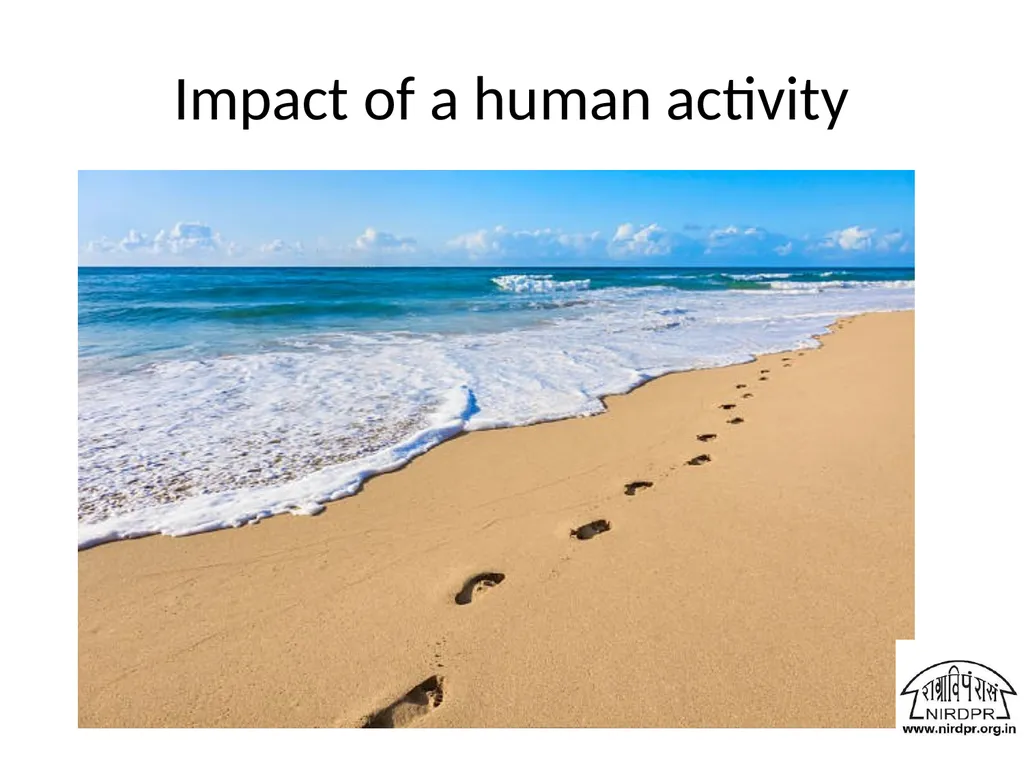
Impact of a human activity
on a clean beach<br>
10
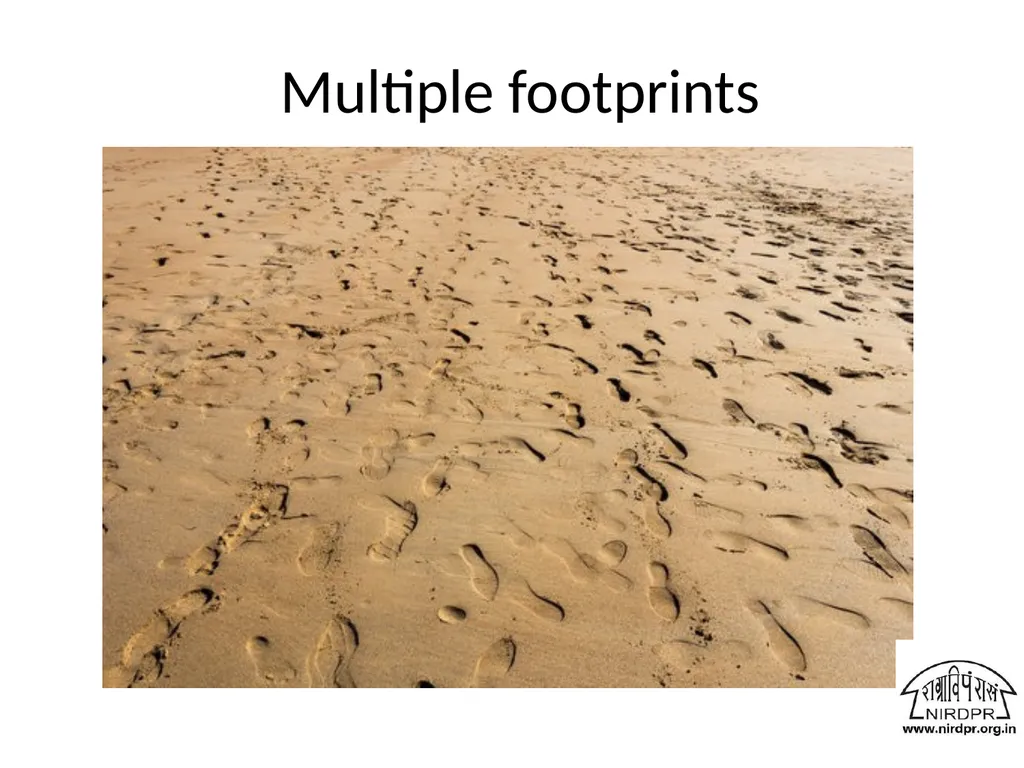
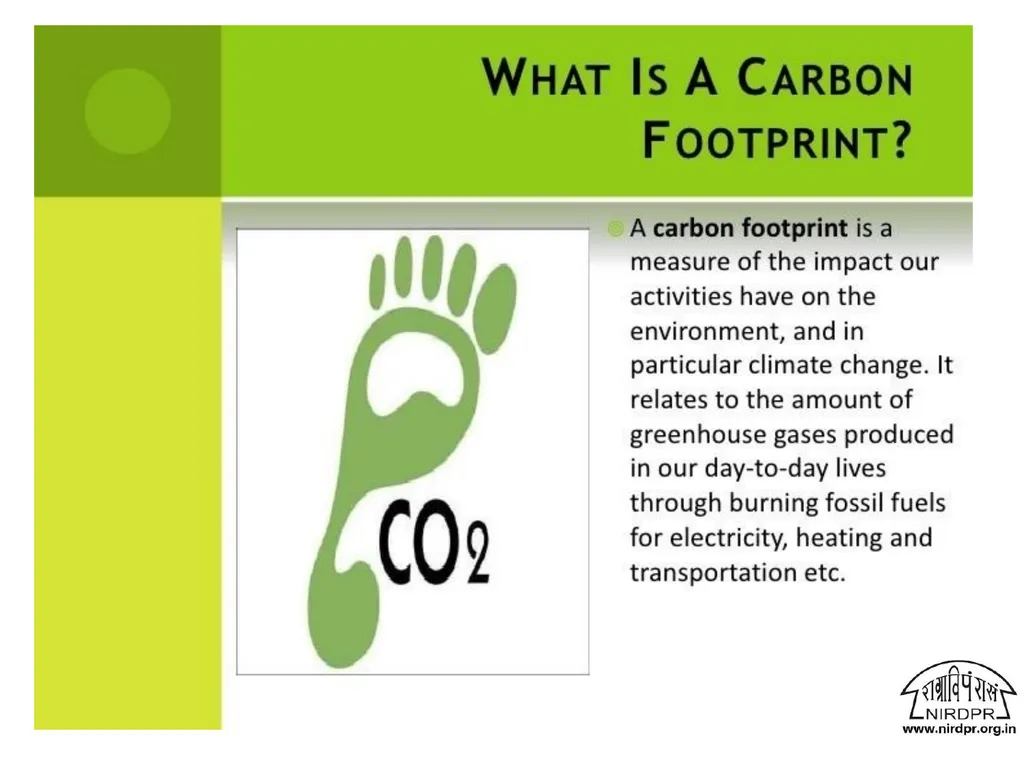
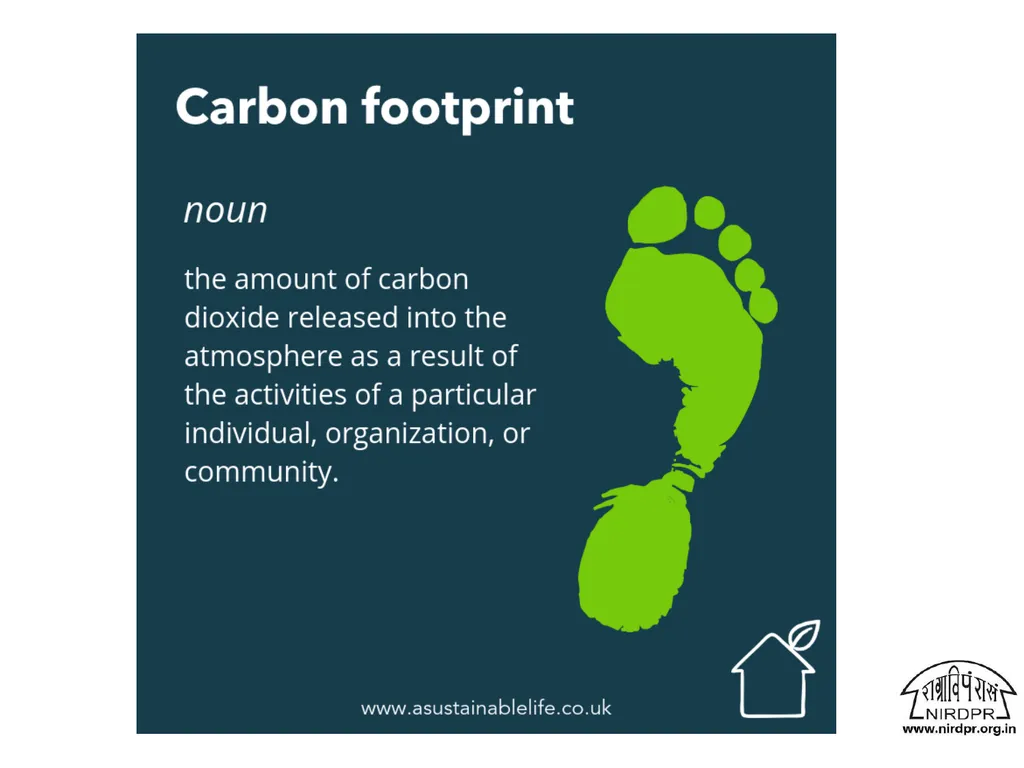
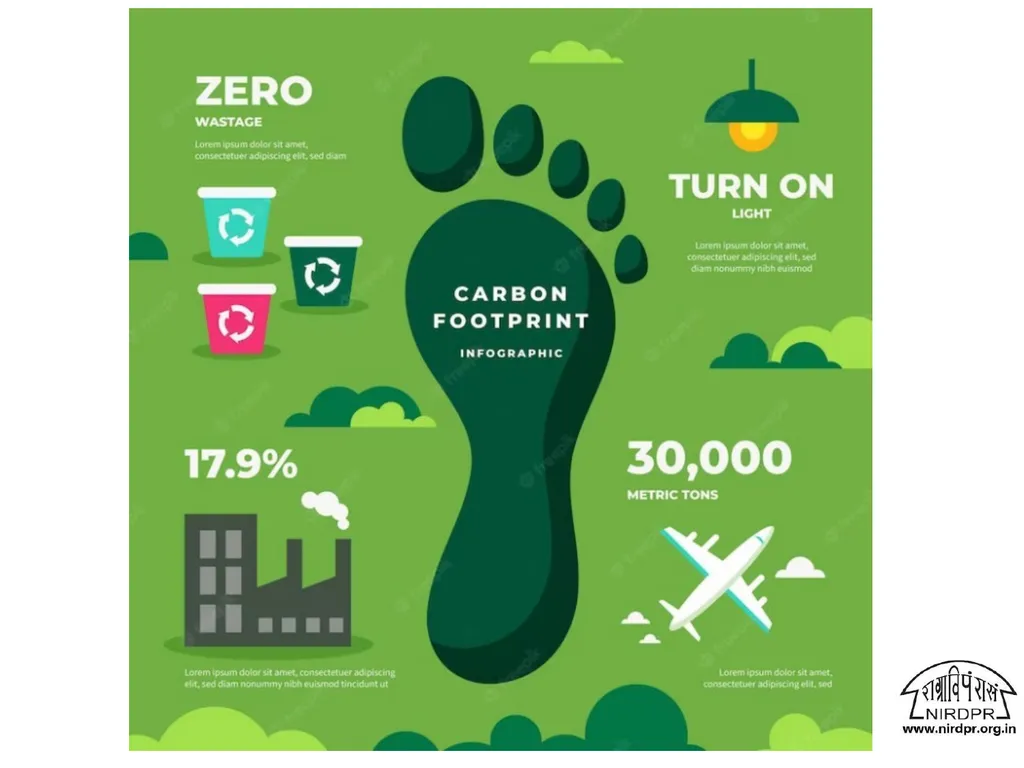
Footprint The idea behind "carbon footprint" is to convey the impact or "mark" that our activities make on the environment in terms of contributing to climate change.
It suggests that just as our footsteps leave an impression on the ground, our actions leave an imprint on the planet in the form of increased carbon dioxide and other greenhouse gas emissions.<br>
It suggests that just as our footsteps leave an impression on the ground, our actions leave an imprint on the planet in the form of increased carbon dioxide and other greenhouse gas emissions.<br>
11
Carbon footprint calculator Estimate your personal or household greenhouse gas emissions.
https://www.footprintcalculator.org/
This calculator takes into account:
Energy use (daily use habits and practice)
Transport (daily use habits and practice)
How responsibly or irresponsibly you dispose your waste (daily generation, disposal method)<br>
https://www.footprintcalculator.org/
This calculator takes into account:
Energy use (daily use habits and practice)
Transport (daily use habits and practice)
How responsibly or irresponsibly you dispose your waste (daily generation, disposal method)<br>
12
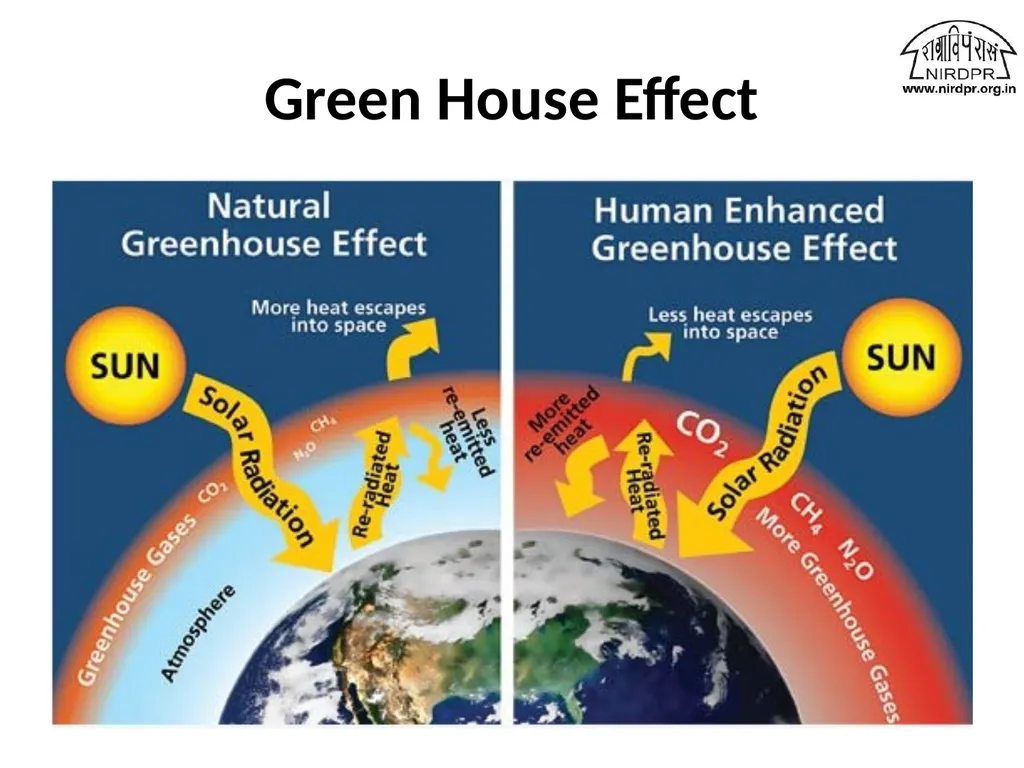
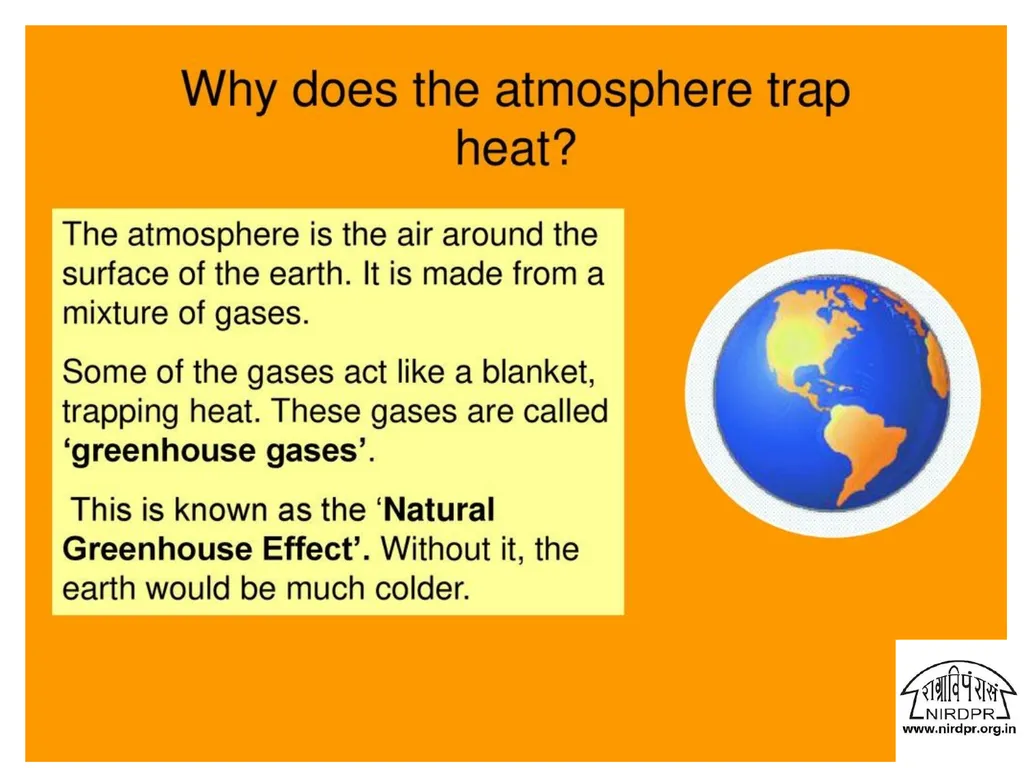
Natural Greenhouse effect is crucial These gases create a natural "blanket" around the Earth, trapping some of the heat from the sun and preventing it from escaping back into space.
This natural greenhouse effect is crucial for maintaining a temperature that allows life to thrive on Earth.
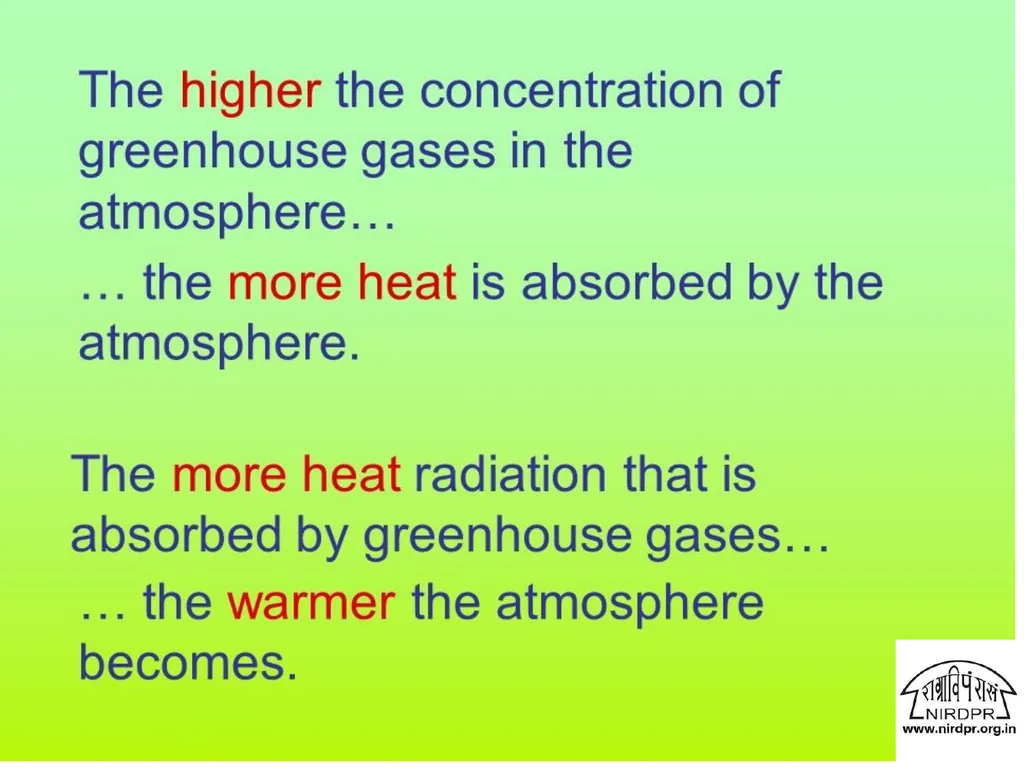
Extra accumulation of gases enhances the natural greenhouse effect, leading to an increase in global temperatures.
This phenomenon is commonly referred to as ‘global warming’ or ‘climate change’.<br>
This natural greenhouse effect is crucial for maintaining a temperature that allows life to thrive on Earth.
Extra accumulation of gases enhances the natural greenhouse effect, leading to an increase in global temperatures.
This phenomenon is commonly referred to as ‘global warming’ or ‘climate change’.<br>
13
Green House Effect<br>
14
Green House Gases Imagine the Earth is like a big, clear bubble, and this bubble lets sunlight in to keep everything warm.
Now, when we do certain things like using cars, factories, and even when cows burp (yes, really!), we release tiny, invisible gases into the air.
These gases are called "greenhouse gases."<br>
Now, when we do certain things like using cars, factories, and even when cows burp (yes, really!), we release tiny, invisible gases into the air.
These gases are called "greenhouse gases."<br>
15
Greenhouse gases are necessary Greenhouse gases are necessary for life as we know it, it's essential to strike a balance.
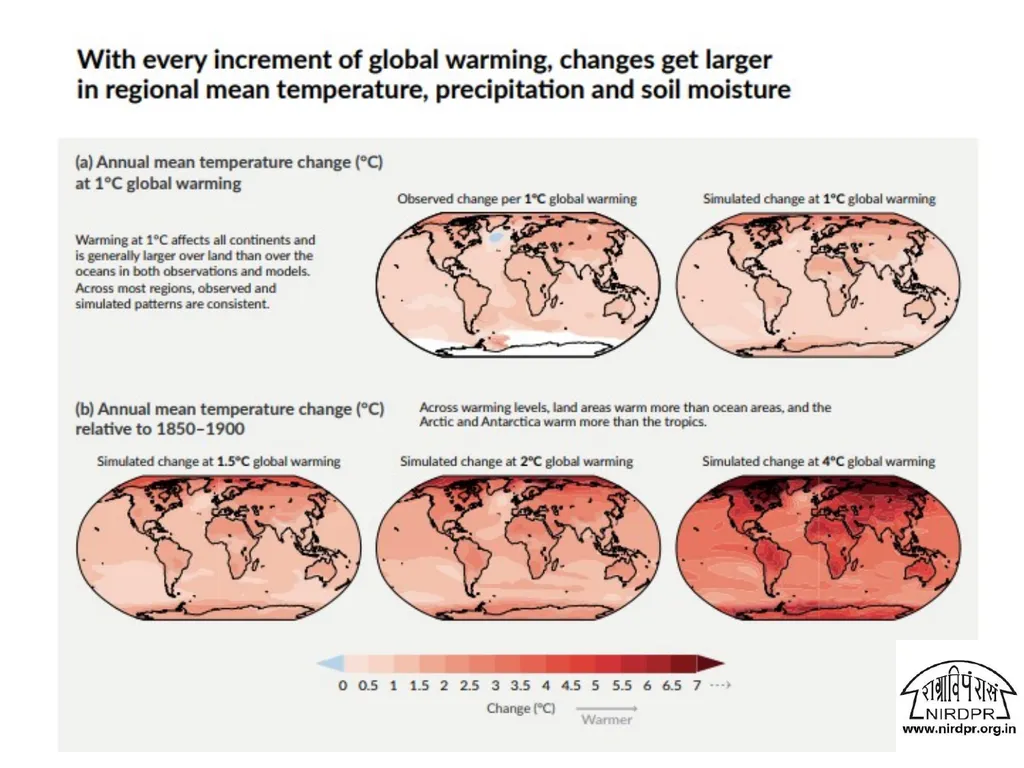
Too much of these gases can cause the Earth to become warmer than it should be.
leading to climate change, and causing various environmental issues.
It's important for us to be mindful of our activities and strive to reduce our impact on the environment to maintain a healthy balance.<br>
Too much of these gases can cause the Earth to become warmer than it should be.
leading to climate change, and causing various environmental issues.
It's important for us to be mindful of our activities and strive to reduce our impact on the environment to maintain a healthy balance.<br>
16
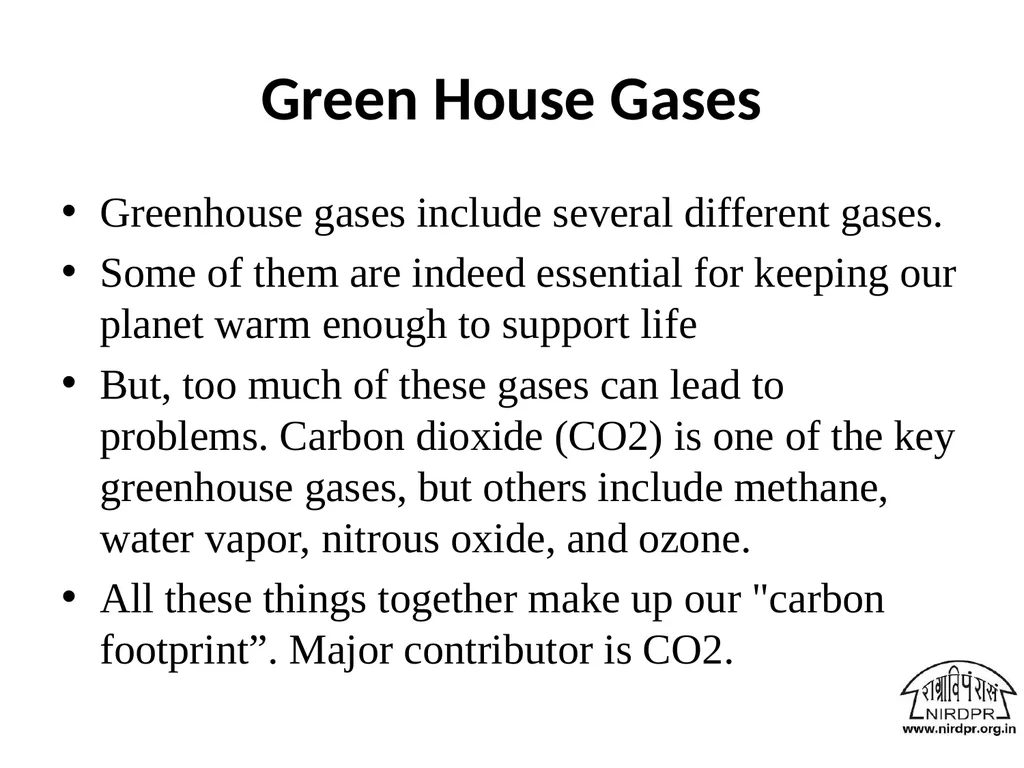
Green House Gases Greenhouse gases include several different gases.
Some of them are indeed essential for keeping our planet warm enough to support life
But, too much of these gases can lead to problems. Carbon dioxide (CO2) is one of the key greenhouse gases, but others include methane, water vapor, nitrous oxide, and ozone.
All these things together make up our "carbon footprint”. Major contributor is CO2.<br>
Some of them are indeed essential for keeping our planet warm enough to support life
But, too much of these gases can lead to problems. Carbon dioxide (CO2) is one of the key greenhouse gases, but others include methane, water vapor, nitrous oxide, and ozone.
All these things together make up our "carbon footprint”. Major contributor is CO2.<br>
17
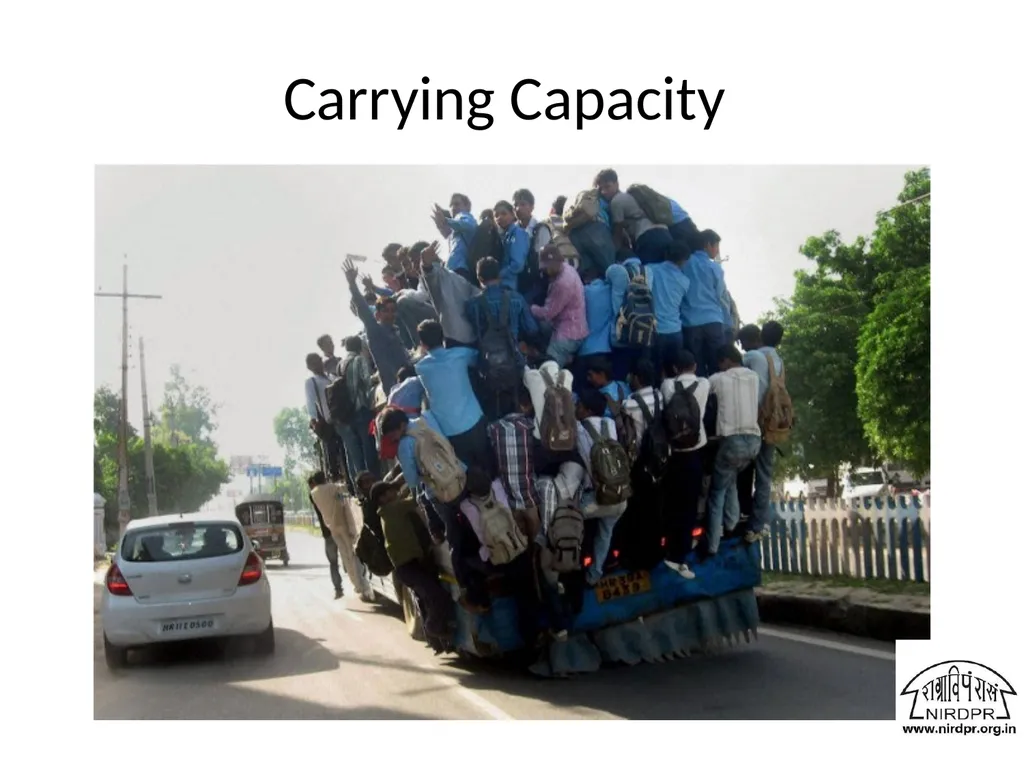
Carrying Capacity<br>
18
Impact of a human activity<br>
19
We create CO2 – Directly & Indirectly Directly Directly: when you:
Switch on lights, fans, TV, AC, computers, laptops, or use a car or bike that burn petrol / diesel.
Throw garbage
When you use chemical fertilizers and pesticides in farming
When you rear animals mostly in captivated conditions (for milk, chicken, mutton, beef etc.) Indirectly Indirectly: When you purchase items such as processed foods.
Or purchase a TV, AC, car or bike or a mobile phone, and so on.
The companies that manufacture these goods use a lot of power, and water.
They generate lots of waste, and pollution.
Their logistics, packaging and delivery to super markets and through online marketing cause huge CO2 emission.<br>
Switch on lights, fans, TV, AC, computers, laptops, or use a car or bike that burn petrol / diesel.
Throw garbage
When you use chemical fertilizers and pesticides in farming
When you rear animals mostly in captivated conditions (for milk, chicken, mutton, beef etc.) Indirectly Indirectly: When you purchase items such as processed foods.
Or purchase a TV, AC, car or bike or a mobile phone, and so on.
The companies that manufacture these goods use a lot of power, and water.
They generate lots of waste, and pollution.
Their logistics, packaging and delivery to super markets and through online marketing cause huge CO2 emission.<br>
20
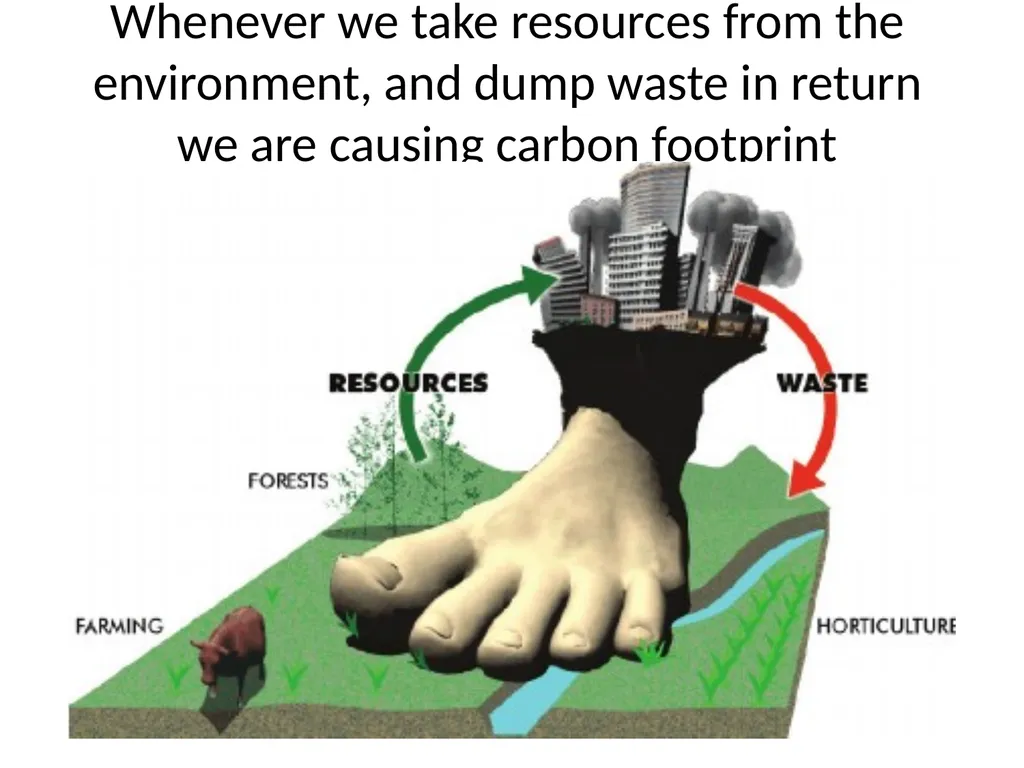
Whenever we take resources from the environment, and dump waste in return we are causing carbon footprint<br>
21
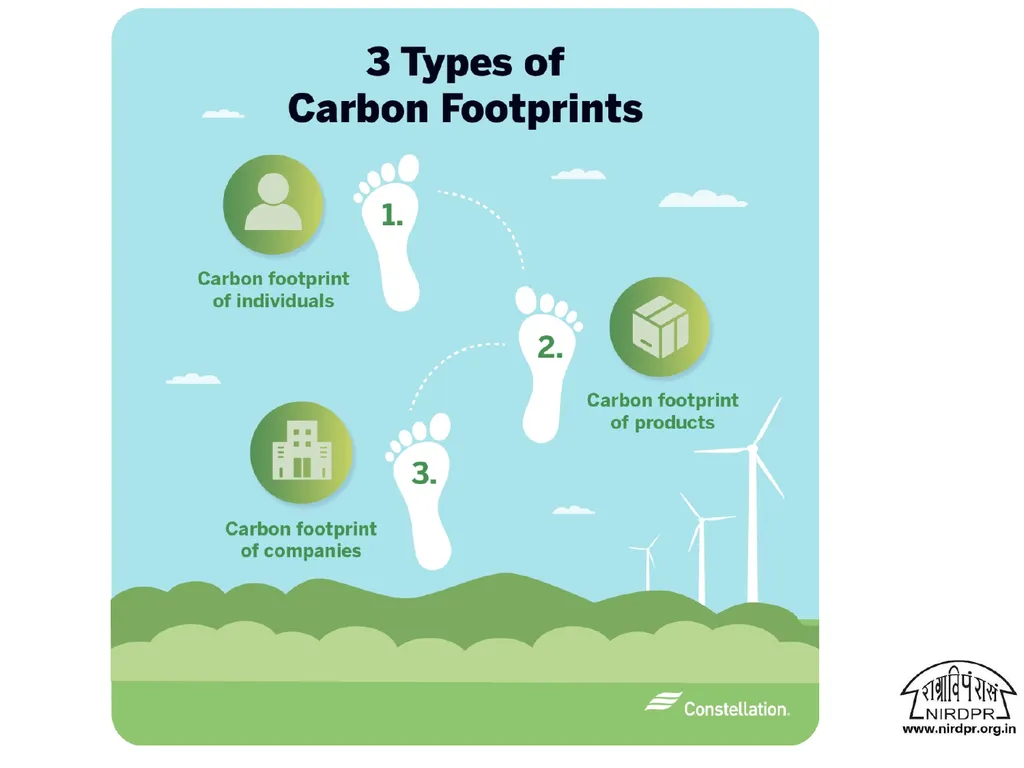
Multiple footprints<br>
22
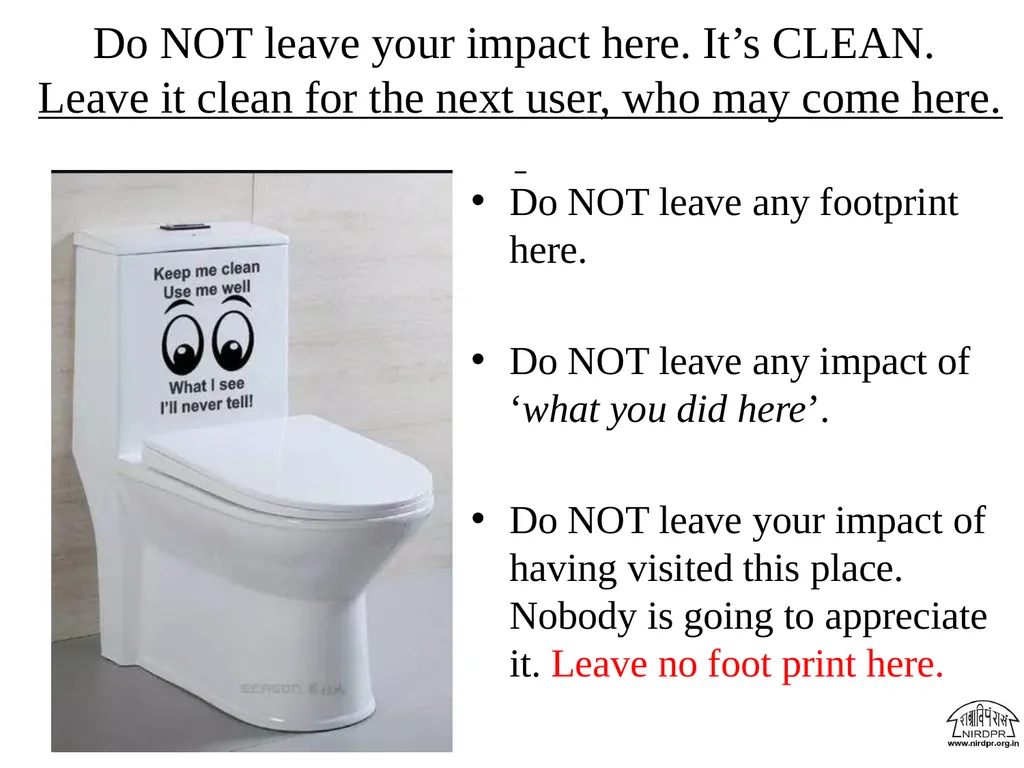
Do NOT leave your impact here. It’s CLEAN.
Leave it clean for the next user, who may come here. Do NOT leave any footprint here.
Do NOT leave any impact of ‘what you did here’.
Do NOT leave your impact of having visited this place. Nobody is going to appreciate it. Leave no foot print here.<br>
Do NOT leave any impact of ‘what you did here’.
Do NOT leave your impact of having visited this place. Nobody is going to appreciate it. Leave no foot print here.<br>
23
Being Carbon Neutral Carbon neutral means that any CO2 released into the atmosphere from a company's activities is balanced by an equivalent amount being removed.
Climate positive means that activity goes beyond achieving net-zero carbon emissions to create an environmental benefit by removing additional carbon dioxide from the atmosphere.<br>
Climate positive means that activity goes beyond achieving net-zero carbon emissions to create an environmental benefit by removing additional carbon dioxide from the atmosphere.<br>
24
Is ‘zero-emission’ possible? It is impossible to generate zero-carbon emissions; therefore, offsetting is a viable approach to become carbon-neutral.
A company putting in efforts to offset your carbon emissions sends a strong message to the community, that this company is committed to paving the way for a sustainable future.<br>
A company putting in efforts to offset your carbon emissions sends a strong message to the community, that this company is committed to paving the way for a sustainable future.<br>
25
What is the difference between Carbon neutral and Net-zero? As established previously, carbon-neutral and net-zero are two similar terms. In both cases, companies are working to reduce and balance their carbon footprint.
For example, a company's building running entirely on solar, and using zero fossil fuels can label its energy as “zero carbon.”
. In other words, net-zero describes the point in time where humans stop adding to the burden of climate-heating gases in the atmosphere.<br>
For example, a company's building running entirely on solar, and using zero fossil fuels can label its energy as “zero carbon.”
. In other words, net-zero describes the point in time where humans stop adding to the burden of climate-heating gases in the atmosphere.<br>
26
Other expressions we come across Net-Zero carbon emissions mean that an activity releases net-zero carbon emissions into the atmosphere.
Net-Zero emissions balance the whole amount of greenhouse gas (GHG) released and the amount removed from the atmosphere.
A net zero lifestyle refers to reducing greenhouse gas emissions to a level where any remaining emissions are offset by measures such as carbon sequestration or investing in renewable energy projects.
In other words, net-zero describes the point in time where humans stop adding to the burden of climate-heating gases in the atmosphere.<br>
Net-Zero emissions balance the whole amount of greenhouse gas (GHG) released and the amount removed from the atmosphere.
A net zero lifestyle refers to reducing greenhouse gas emissions to a level where any remaining emissions are offset by measures such as carbon sequestration or investing in renewable energy projects.
In other words, net-zero describes the point in time where humans stop adding to the burden of climate-heating gases in the atmosphere.<br>
27
Carbon neutrality By definition, carbon-neutral (or carbon neutrality) is the balance between emitting carbon and absorbing carbon emissions from carbon sinks.
Or simply, eliminate all carbon emissions altogether. Carbon sinks are any systems that absorb more carbon than they emit, such as forests, soils and oceans.
That goes with: ‘Plant more trees’.<br>
Or simply, eliminate all carbon emissions altogether. Carbon sinks are any systems that absorb more carbon than they emit, such as forests, soils and oceans.
That goes with: ‘Plant more trees’.<br>
28
Causative Factors Several factors can contribute to carbon emissions.
Cooking Practices: Traditional cooking methods using solid fuels like wood, dung, or crop residues can release a significant amount of carbon emissions.
Agricultural Practices: The use of inefficient or traditional farming techniques, including burning crop residues and using fossil fuels for machinery, contributes to carbon emissions.
Deforestation: Cutting down trees for firewood or clearing land for agriculture reduces the number of trees that can absorb carbon dioxide from the air.
Transportation: The use of fossil fuel-powered vehicles for commuting, transporting goods, or agricultural activities can contribute to carbon emissions.
Waste Management: Improper disposal of waste, especially organic waste, in open areas or through burning can release carbon dioxide and other pollutants.<br>
Cooking Practices: Traditional cooking methods using solid fuels like wood, dung, or crop residues can release a significant amount of carbon emissions.
Agricultural Practices: The use of inefficient or traditional farming techniques, including burning crop residues and using fossil fuels for machinery, contributes to carbon emissions.
Deforestation: Cutting down trees for firewood or clearing land for agriculture reduces the number of trees that can absorb carbon dioxide from the air.
Transportation: The use of fossil fuel-powered vehicles for commuting, transporting goods, or agricultural activities can contribute to carbon emissions.
Waste Management: Improper disposal of waste, especially organic waste, in open areas or through burning can release carbon dioxide and other pollutants.<br>
29
Factors Energy Sources: Reliance on non-renewable energy sources like coal and inefficient biomass for lighting and heating contributes to carbon emissions.
Industrial Activities: Small-scale industries or cottage industries that use fossil fuels as an energy source or engage in activities with high carbon intensity contribute to emissions.
Livestock Farming: Methane, a potent greenhouse gas, is released during the digestion process of livestock such as cows. Inefficient livestock management practices can contribute to increased methane emissions.
Land Use Changes: Converting natural landscapes into urban or agricultural areas can release stored carbon in the soil and vegetation.
Traditional Brick Kilns: In some villages, traditional brick-making methods involve burning large amounts of wood or coal, releasing substantial carbon emissions.
Addressing these factors may involve adopting cleaner cooking technologies, promoting sustainable agricultural practices, reforestation efforts, encouraging public transportation, and promoting renewable energy sources, among other measures.<br>
Industrial Activities: Small-scale industries or cottage industries that use fossil fuels as an energy source or engage in activities with high carbon intensity contribute to emissions.
Livestock Farming: Methane, a potent greenhouse gas, is released during the digestion process of livestock such as cows. Inefficient livestock management practices can contribute to increased methane emissions.
Land Use Changes: Converting natural landscapes into urban or agricultural areas can release stored carbon in the soil and vegetation.
Traditional Brick Kilns: In some villages, traditional brick-making methods involve burning large amounts of wood or coal, releasing substantial carbon emissions.
Addressing these factors may involve adopting cleaner cooking technologies, promoting sustainable agricultural practices, reforestation efforts, encouraging public transportation, and promoting renewable energy sources, among other measures.<br>
30
Factors Biomass Burning for Crop Residue: Burning crop residues in the fields after harvest, instead of incorporating them into the soil, releases carbon and other pollutants into the atmosphere.
Inefficient Traditional Stoves: Continued use of traditional, inefficient stoves for cooking that burn biomass fuels can result in higher carbon emissions compared to more modern and cleaner alternatives.
Mining Activities: If the village is engaged in mining activities, the extraction and processing of minerals can involve the use of fossil fuels, contributing to carbon emissions.
Lack of Waste Recycling: When waste, including plastics and other non-biodegradable materials, is not recycled or managed properly, it can decompose and release greenhouse gases like methane.
Water and Sanitation Practices: Inadequate sewage treatment and water sanitation practices can lead to the release of methane and carbon dioxide during the decomposition of organic matter in water bodies.<br>
Inefficient Traditional Stoves: Continued use of traditional, inefficient stoves for cooking that burn biomass fuels can result in higher carbon emissions compared to more modern and cleaner alternatives.
Mining Activities: If the village is engaged in mining activities, the extraction and processing of minerals can involve the use of fossil fuels, contributing to carbon emissions.
Lack of Waste Recycling: When waste, including plastics and other non-biodegradable materials, is not recycled or managed properly, it can decompose and release greenhouse gases like methane.
Water and Sanitation Practices: Inadequate sewage treatment and water sanitation practices can lead to the release of methane and carbon dioxide during the decomposition of organic matter in water bodies.<br>
31
Offsetting Addressing these factors involves promoting sustainable agricultural practices, planting more trees, encouraging the use of improved cookstoves, regulating and optimizing mining activities, implementing effective waste management systems, and improving water and sanitation infrastructure.<br>
32
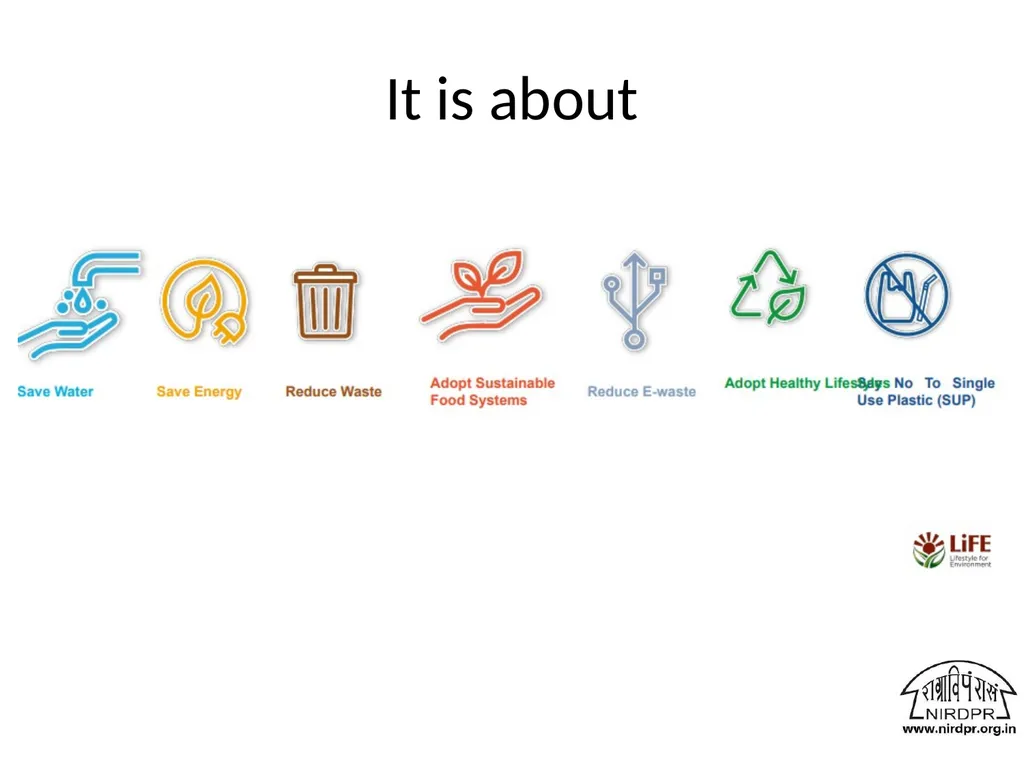
It is about<br>
33
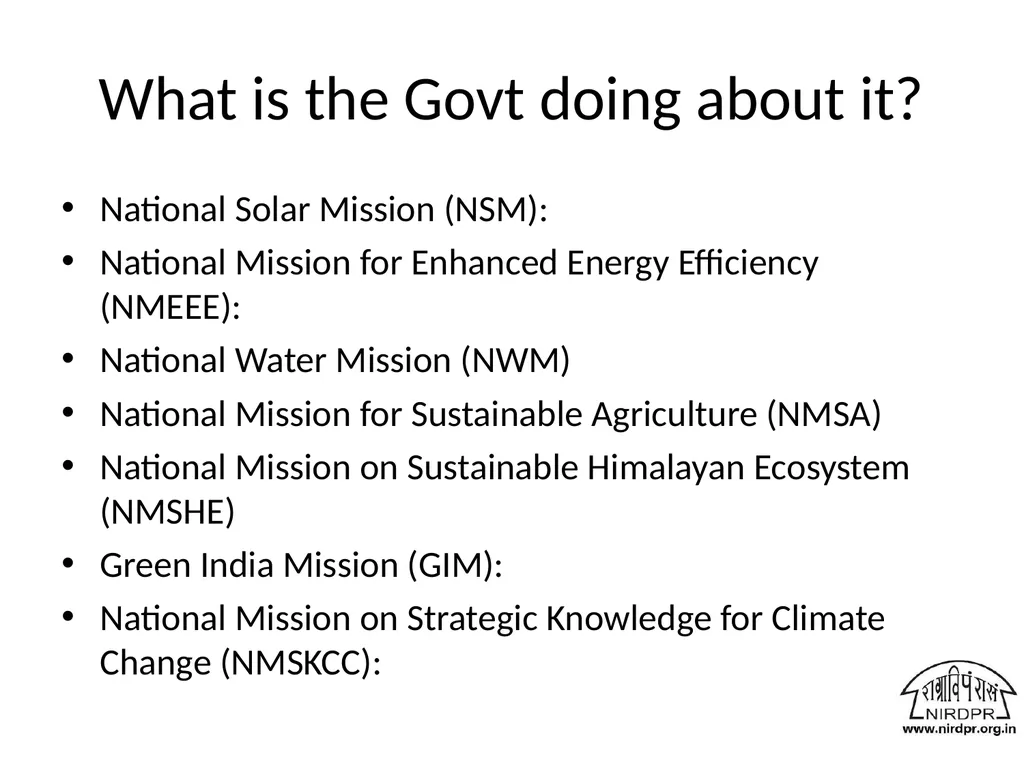
What is the Govt doing about it? National Solar Mission (NSM):
National Mission for Enhanced Energy Efficiency (NMEEE):
National Water Mission (NWM)
National Mission for Sustainable Agriculture (NMSA)
National Mission on Sustainable Himalayan Ecosystem (NMSHE)
Green India Mission (GIM):
National Mission on Strategic Knowledge for Climate Change (NMSKCC):<br>
National Mission for Enhanced Energy Efficiency (NMEEE):
National Water Mission (NWM)
National Mission for Sustainable Agriculture (NMSA)
National Mission on Sustainable Himalayan Ecosystem (NMSHE)
Green India Mission (GIM):
National Mission on Strategic Knowledge for Climate Change (NMSKCC):<br>
34
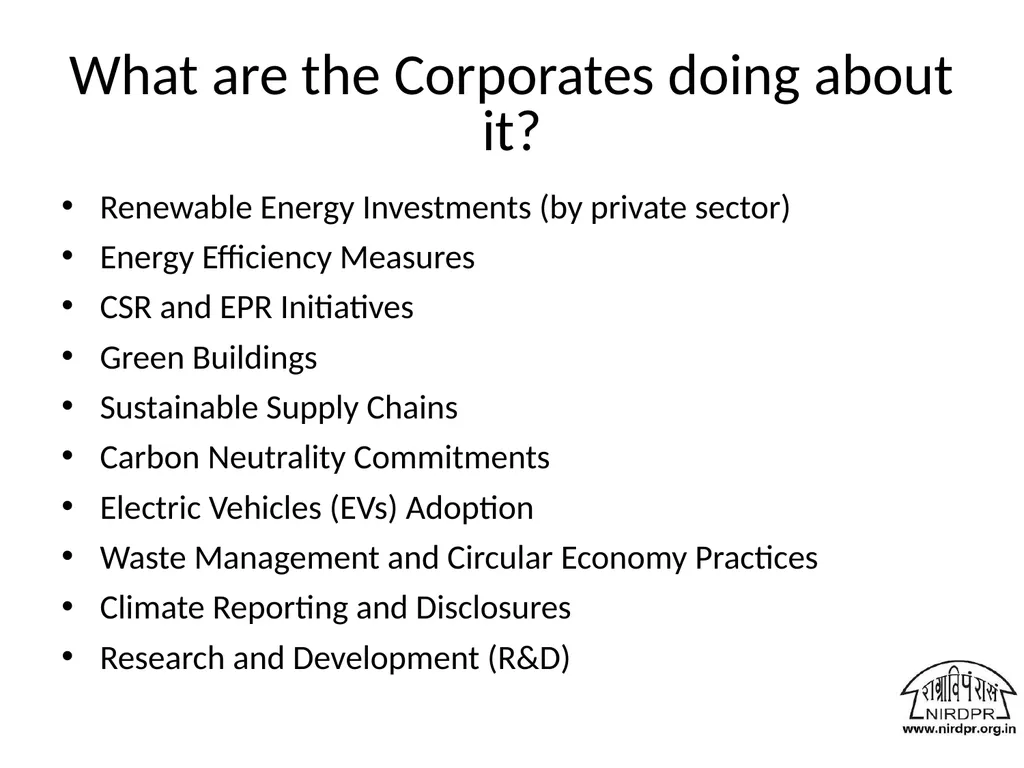
What are the Corporates doing about it? Renewable Energy Investments (by private sector)
Energy Efficiency Measures
CSR and EPR Initiatives
Green Buildings
Sustainable Supply Chains
Carbon Neutrality Commitments
Electric Vehicles (EVs) Adoption
Waste Management and Circular Economy Practices
Climate Reporting and Disclosures
Research and Development (R&D)<br>
Energy Efficiency Measures
CSR and EPR Initiatives
Green Buildings
Sustainable Supply Chains
Carbon Neutrality Commitments
Electric Vehicles (EVs) Adoption
Waste Management and Circular Economy Practices
Climate Reporting and Disclosures
Research and Development (R&D)<br>
35
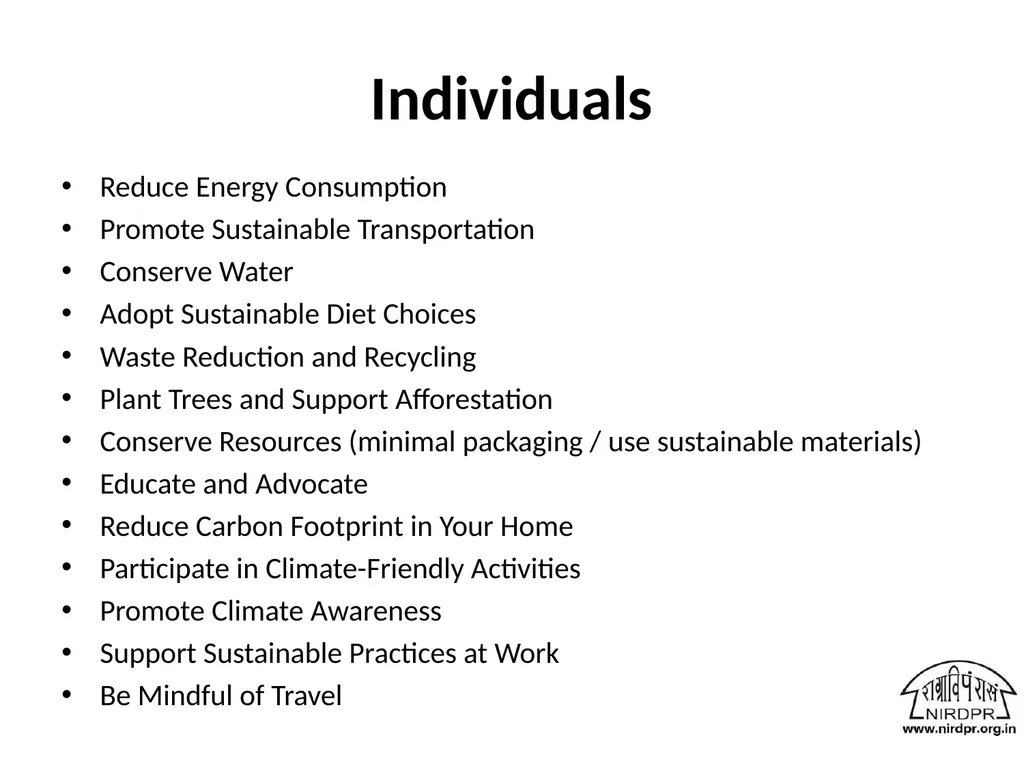
Individuals Reduce Energy Consumption
Promote Sustainable Transportation
Conserve Water
Adopt Sustainable Diet Choices
Waste Reduction and Recycling
Plant Trees and Support Afforestation
Conserve Resources (minimal packaging / use sustainable materials)
Educate and Advocate
Reduce Carbon Footprint in Your Home
Participate in Climate-Friendly Activities
Promote Climate Awareness
Support Sustainable Practices at Work
Be Mindful of Travel<br>
Promote Sustainable Transportation
Conserve Water
Adopt Sustainable Diet Choices
Waste Reduction and Recycling
Plant Trees and Support Afforestation
Conserve Resources (minimal packaging / use sustainable materials)
Educate and Advocate
Reduce Carbon Footprint in Your Home
Participate in Climate-Friendly Activities
Promote Climate Awareness
Support Sustainable Practices at Work
Be Mindful of Travel<br>
36
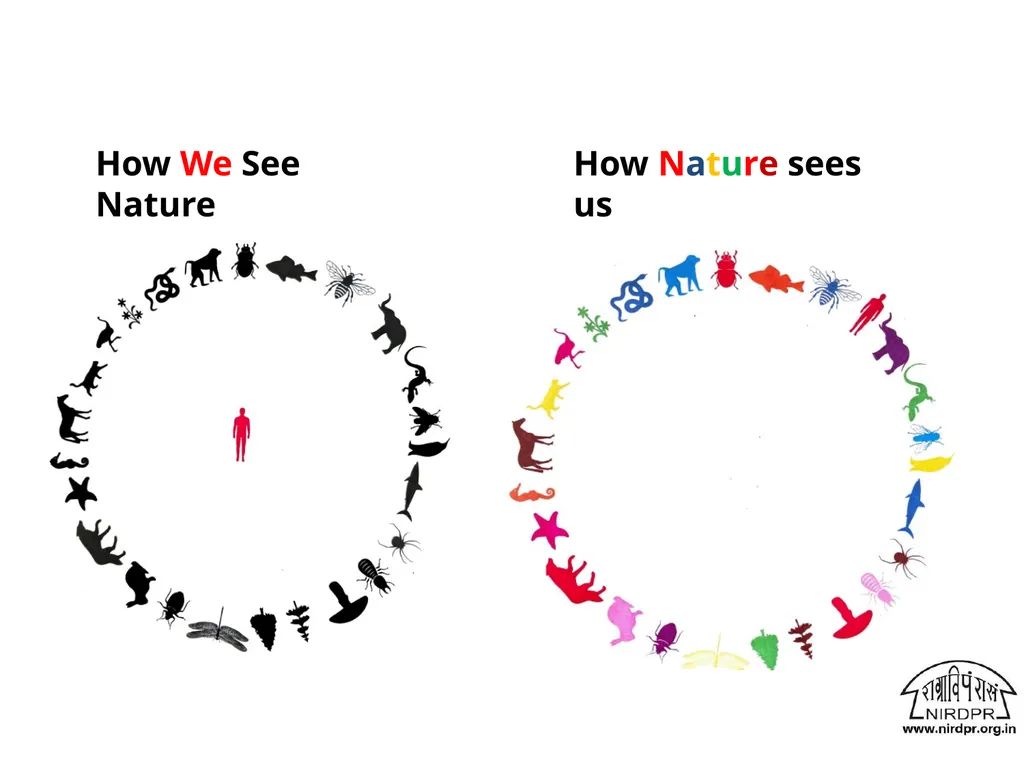
How We See Nature How Nature sees us<br>