
What is compost? Compost is organic matter that
LO
Published · 34 slides · 0 views

1 / 1

Description
What is compost? Compost is organic matter that has been decomposed and recycled as a fertilizer and soil amendment. Compost is a key ingredient in organic farming. End product of the decomposition of organic matter What is Composting? A
Related Topics
Share
Embed code
Download this presentation From Below
"What is compost? Compost is organic matter that" is the property of its rightful owner. Permission is granted to download and print the materials on this website for personal, non-commercial use only, and to display it on your personal computer provided you do not modify the materials and that you retain all copyright notices contained in the materials. By downloading content from our website, you accept the terms of this agreement.
Presentation Transcript
01
What is compost?
Compost is organic matter that has been decomposed and recycled as a fertilizer and soil amendment.
Compost is a key ingredient in organic farming.
End product of the decomposition of organic matter
What is Composting?
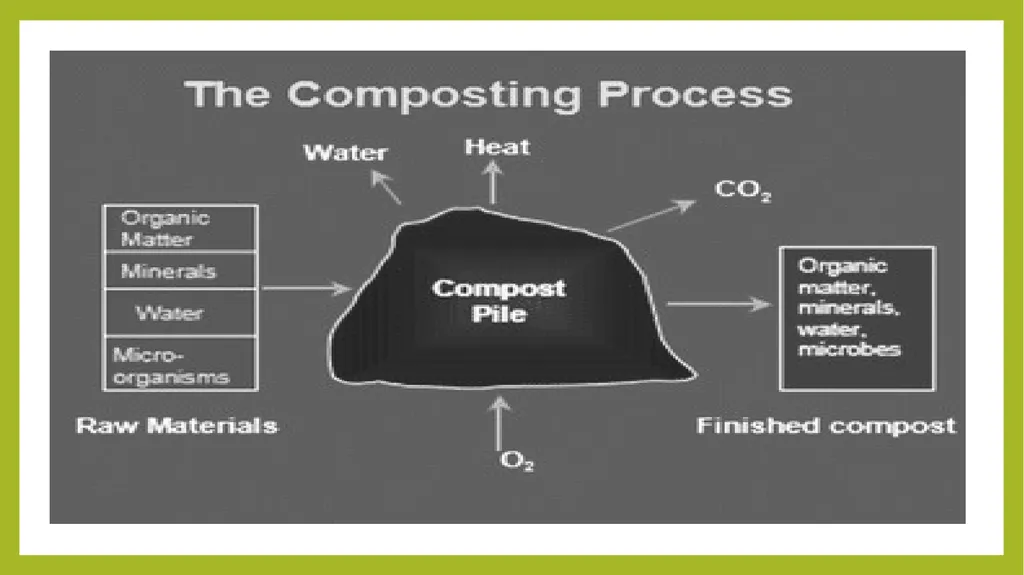
A biological process that transforms raw organic materials into a nutrient rich, biologically-stable soil additive suitable for plant and crop use.s define
Composting is a natural process that turns organic material into a dark rich substance.
By composting your organic waste you are returning nutrients back into the soil.
Finished compost looks like soil–dark brown, crumbly and smells like a forest floor.<br>
Compost is organic matter that has been decomposed and recycled as a fertilizer and soil amendment.
Compost is a key ingredient in organic farming.
End product of the decomposition of organic matter
What is Composting?
A biological process that transforms raw organic materials into a nutrient rich, biologically-stable soil additive suitable for plant and crop use.s define
Composting is a natural process that turns organic material into a dark rich substance.
By composting your organic waste you are returning nutrients back into the soil.
Finished compost looks like soil–dark brown, crumbly and smells like a forest floor.<br>
02
Why should I compost? Adding organic materials to the soil improves moisture retention.
Adding decomposed organic material to the soil feeds beneficial organisms.
Compost provides a balanced, slow–release source of nutrients that helps the soil hold nutrients long enough for plants to use them.
Composting saves money–you avoid the cost of buying soil conditioners, bagged manure etc.
Improves water-holding capacity resulting in reduced dependency on watering.<br>
Adding decomposed organic material to the soil feeds beneficial organisms.
Compost provides a balanced, slow–release source of nutrients that helps the soil hold nutrients long enough for plants to use them.
Composting saves money–you avoid the cost of buying soil conditioners, bagged manure etc.
Improves water-holding capacity resulting in reduced dependency on watering.<br>
03
Techniques of composting 1. Cold composting
Cold composting is one of the easiest forms of composting.
Many beneficial nutrients in cold compost remain uncompromised by high temperatures.
The process is slower.
Once established, the cold composting bins will provide you with a continuous supply of lawn and garden food.<br>
Cold composting is one of the easiest forms of composting.
Many beneficial nutrients in cold compost remain uncompromised by high temperatures.
The process is slower.
Once established, the cold composting bins will provide you with a continuous supply of lawn and garden food.<br>
04
2. Hot composting
A hot pile requires enough high-nitrogen materials to get the pile to heat up.
Microbial activity within the compost pile is at its optimum level, which results in finished compost in a much shorter period of time.
It requires some special equipment, as well as time and diligence.
Temperatures rising in a hot-compost pile come from the activity of numerous organisms breaking down organic matter.<br>
A hot pile requires enough high-nitrogen materials to get the pile to heat up.
Microbial activity within the compost pile is at its optimum level, which results in finished compost in a much shorter period of time.
It requires some special equipment, as well as time and diligence.
Temperatures rising in a hot-compost pile come from the activity of numerous organisms breaking down organic matter.<br>
05
Types of composting 1. Aerobic composting: -
This means to compost with air.
Organic waste will break down quickly and is not prone to smell.
This type of composting requires high maintenance, since it will need to be turned every couple days to keep air in the system and your temperatures up.
It is also likely to require accurate moisture monitoring.
This type of compost is good for large volumes of compost.<br>
This means to compost with air.
Organic waste will break down quickly and is not prone to smell.
This type of composting requires high maintenance, since it will need to be turned every couple days to keep air in the system and your temperatures up.
It is also likely to require accurate moisture monitoring.
This type of compost is good for large volumes of compost.<br>
06
2. Anaerobic composting
This is composting without air.
Anaerobic composting is low maintenance since you simply throw it in a pile and wait a couple years.
Compost may take years to break down.
Anaerobic composts create the awful smell most people associate with composting.
The bacteria break down the organic materials into harmful compounds like ammonia and methane.<br>
This is composting without air.
Anaerobic composting is low maintenance since you simply throw it in a pile and wait a couple years.
Compost may take years to break down.
Anaerobic composts create the awful smell most people associate with composting.
The bacteria break down the organic materials into harmful compounds like ammonia and methane.<br>
07
Methods in Aerobic composting Indore Method.
NADEP Method.
Kraal method.
Chinese heap method.
Urban solid waste composting.
Rain water composting.
Anstead’s process.
Nagpur pit method.
Windrow composting.
Bin composting/In-vessel composting.<br>
NADEP Method.
Kraal method.
Chinese heap method.
Urban solid waste composting.
Rain water composting.
Anstead’s process.
Nagpur pit method.
Windrow composting.
Bin composting/In-vessel composting.<br>
08
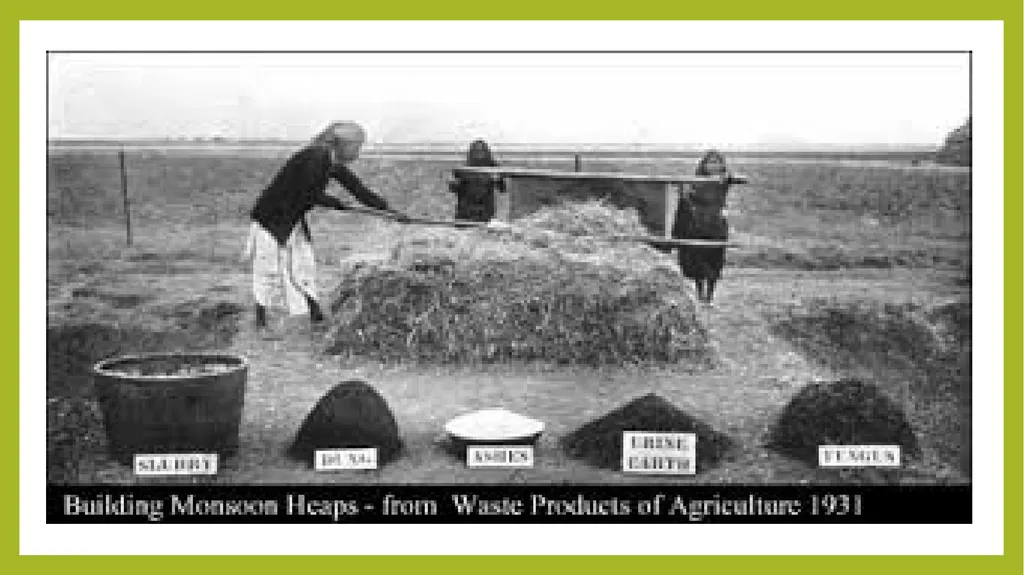
1. Indore method of composting This method was developed by A. Howard and Y. D. Wad at the Institute of Plant industry, Indore, India.
In this method organic wastes are spread in the cattle shed to serve as bedding.
Urine soaked material along with dung is removed every day and formed into a layer of about 15 cm thick at suitable sites.
Urine soaked earth, scraped from cattle sheds is mixed with water and sprinkled over the layer of wastes twice or thrice a day.
Layering process continued for about a fortnight. A thin layer of well decomposed compost is sprinkled over top and the heap given a turning and reformed.
Old compost acts as inoculum for decomposing the material.<br>
In this method organic wastes are spread in the cattle shed to serve as bedding.
Urine soaked material along with dung is removed every day and formed into a layer of about 15 cm thick at suitable sites.
Urine soaked earth, scraped from cattle sheds is mixed with water and sprinkled over the layer of wastes twice or thrice a day.
Layering process continued for about a fortnight. A thin layer of well decomposed compost is sprinkled over top and the heap given a turning and reformed.
Old compost acts as inoculum for decomposing the material.<br>
09
Breadth - 6-8 feet, depth - 2-3 feet (not more than 3 feet), length - 10 feet or more as per requirement.
One more layer of bedding material with wood ash and urinated mud should be added. First of all, spread dry wastes with cattle dung and soil in ratio of 4:2:1 up to 2 inch layer in composting pit. Afterwards, sprinkle the water over the materials, pit is filled with above materials up to 1 foot above the ground level.
The material is turned three times for proper aeration and moisture. First turning : 10-15 days after filling the pits. Second turning : 15 days after first turning. Third turning : After 2 month of second turning
The heap is left undisturbed for about a month. Then it is thoroughly moistened and given a turning. The compost is ready for application in another month.<br>
One more layer of bedding material with wood ash and urinated mud should be added. First of all, spread dry wastes with cattle dung and soil in ratio of 4:2:1 up to 2 inch layer in composting pit. Afterwards, sprinkle the water over the materials, pit is filled with above materials up to 1 foot above the ground level.
The material is turned three times for proper aeration and moisture. First turning : 10-15 days after filling the pits. Second turning : 15 days after first turning. Third turning : After 2 month of second turning
The heap is left undisturbed for about a month. Then it is thoroughly moistened and given a turning. The compost is ready for application in another month.<br>
10
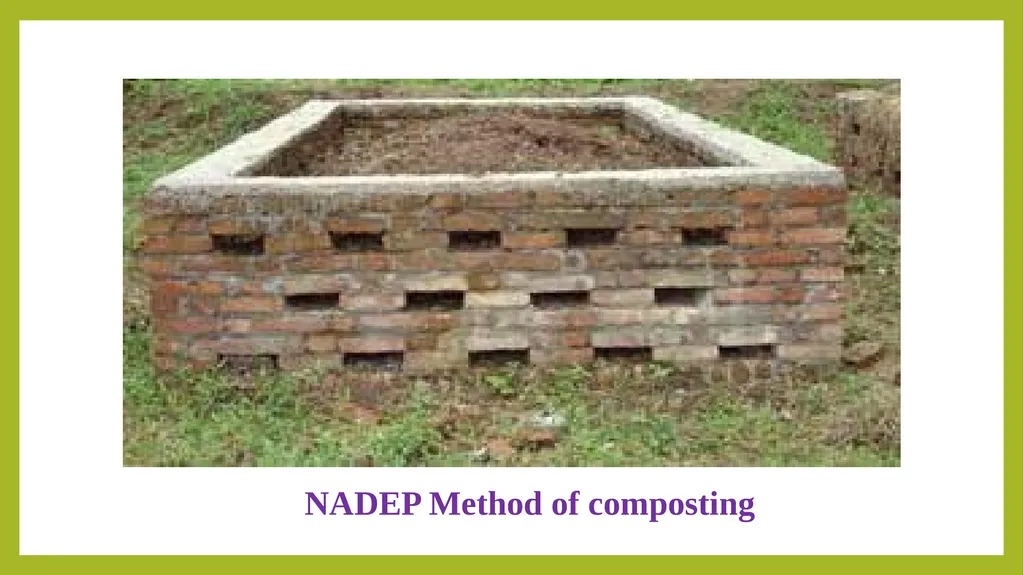
2. NADEP method Demonstration of this method at large scale was initiated at J. N. Krishi Vidyalaya, Indore.
Narayana rao .D. pandaripande popularly known as “nadep kaka” has advocated this method of composting.
Materials required: farm waste, dung, soil, water.
The time required for composting is 90-100days.
The compost contains 0.5-1.5%N, 0.5-0.9%P & 1.2-1.4%K.
Composting structure : tank of size 10’Χ6’Χ3’are constructed with 9” thick walls.
Lining of the bricks is made of mud.
7”Χ15” holes are left for circulation of air.<br>
Narayana rao .D. pandaripande popularly known as “nadep kaka” has advocated this method of composting.
Materials required: farm waste, dung, soil, water.
The time required for composting is 90-100days.
The compost contains 0.5-1.5%N, 0.5-0.9%P & 1.2-1.4%K.
Composting structure : tank of size 10’Χ6’Χ3’are constructed with 9” thick walls.
Lining of the bricks is made of mud.
7”Χ15” holes are left for circulation of air.<br>
11
NADEP Method of composting<br>
12
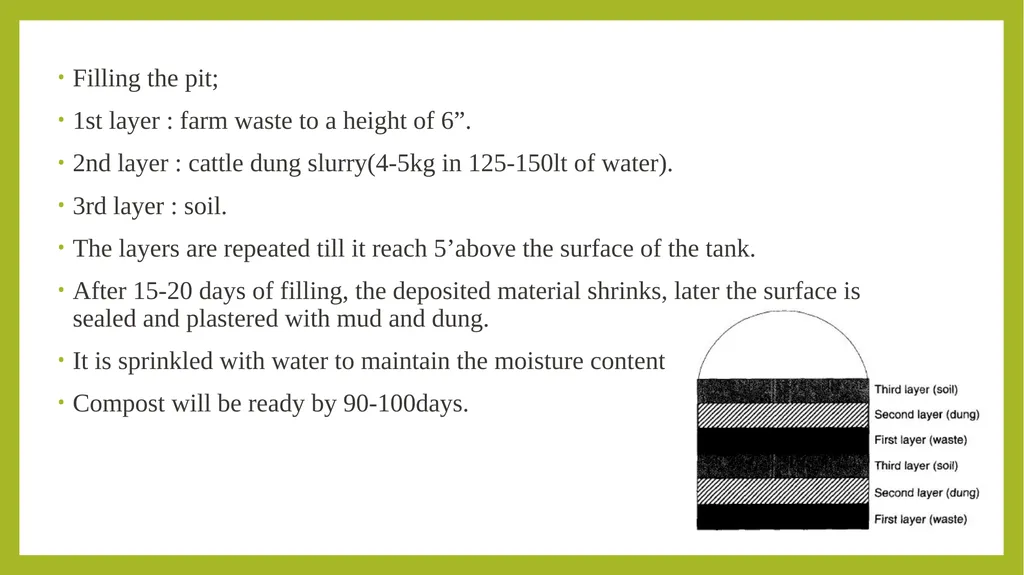
Filling the pit;
1st layer : farm waste to a height of 6”.
2nd layer : cattle dung slurry(4-5kg in 125-150lt of water).
3rd layer : soil.
The layers are repeated till it reach 5’above the surface of the tank.
After 15-20 days of filling, the deposited material shrinks, later the surface is sealed and plastered with mud and dung.
It is sprinkled with water to maintain the moisture content.
Compost will be ready by 90-100days.<br>
1st layer : farm waste to a height of 6”.
2nd layer : cattle dung slurry(4-5kg in 125-150lt of water).
3rd layer : soil.
The layers are repeated till it reach 5’above the surface of the tank.
After 15-20 days of filling, the deposited material shrinks, later the surface is sealed and plastered with mud and dung.
It is sprinkled with water to maintain the moisture content.
Compost will be ready by 90-100days.<br>
13
3. Kraal method Bedding and other plant residues like straw, leaves, grass etc are carted into kraals and packed in layers of 50- 60cm height and left there until thoroughly mixed with dung and urine of the animals.
The compost is carted directly to the fields twice a year.
This method is adopted only on farms having large number of livestock.<br>
The compost is carted directly to the fields twice a year.
This method is adopted only on farms having large number of livestock.<br>
14
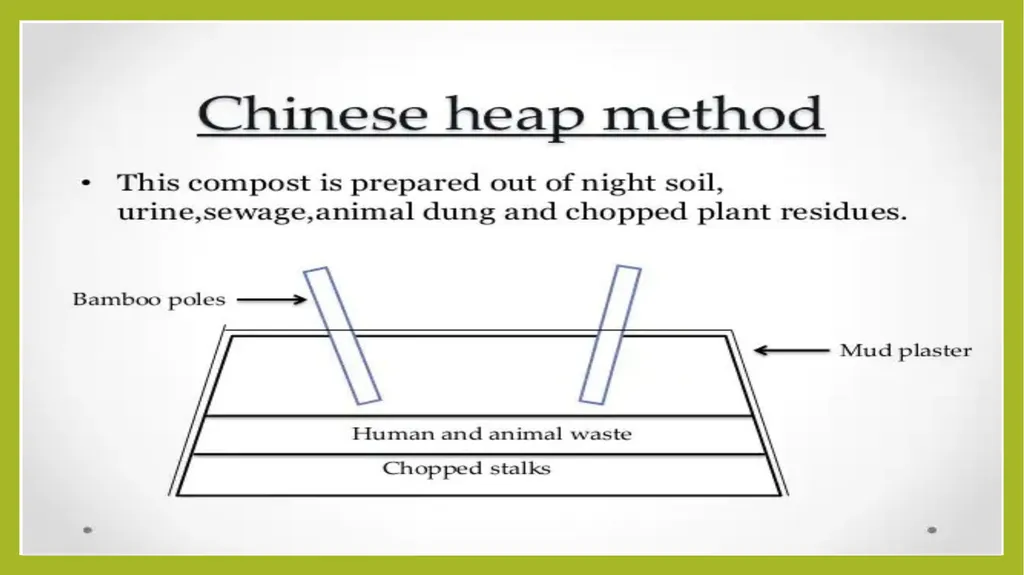
4. Chinese heap method This compost is prepared out of night soil, urine, sewage, animal dung and chopped plant residues.
Materials required;
Chopped stalks
Human and animal waste
Bamboo poles
Mud plaster
The first turning is done after 2 weeks and the moisture is made up with water or animal or human excreta.
The compost is ready for the use within 2 months.<br>
Materials required;
Chopped stalks
Human and animal waste
Bamboo poles
Mud plaster
The first turning is done after 2 weeks and the moisture is made up with water or animal or human excreta.
The compost is ready for the use within 2 months.<br>
15
5. Urban solid waste composting Divide a tonne of urban waste in to ten parts of 100kg each.
Spread 100kg of waste and sprinkle Tricoderma fungus and urea and moistened it.
As a second layer, spread 100kg waste and add bacillus bacterial culture and urea and then moistened it.
Repeat this layer.
Watering should be done periodically to maintain the moisture up to 60%.
Turning should be given on 30th and 45th day of composting.
Composting will be ready within 75-90 days.
Nutrient content of the compost 1.05, 0.31 and 0.48% N,P,K respectively.<br>
Spread 100kg of waste and sprinkle Tricoderma fungus and urea and moistened it.
As a second layer, spread 100kg waste and add bacillus bacterial culture and urea and then moistened it.
Repeat this layer.
Watering should be done periodically to maintain the moisture up to 60%.
Turning should be given on 30th and 45th day of composting.
Composting will be ready within 75-90 days.
Nutrient content of the compost 1.05, 0.31 and 0.48% N,P,K respectively.<br>
16
6. Rain water composting It is a modified Indore method involving use of farm waste with rain and canal water.
1st turning is given followed by penetration of rain water to a depth of 15-25cm.
2nd and 3rd turning @ 20 days interval.
6 watering and 3 turnings are required.
4.5m length, 2.5m broad, 1m height, and 60 cm deep.<br>
1st turning is given followed by penetration of rain water to a depth of 15-25cm.
2nd and 3rd turning @ 20 days interval.
6 watering and 3 turnings are required.
4.5m length, 2.5m broad, 1m height, and 60 cm deep.<br>
17
7. Anstead’s process The material to be composted are made into heaps of about 2m Χ 1m Χ 1m size.
The materials are mixed and moistened using dung, urine, ammonium sulphate, night soil emulsion etc.
After a week this fermented mass acts as an starter or activator.
Here quarter of the heap is removed to form the basis of the second heap.
The 1st heap is raised to its original size with fresh waste.<br>
The materials are mixed and moistened using dung, urine, ammonium sulphate, night soil emulsion etc.
After a week this fermented mass acts as an starter or activator.
Here quarter of the heap is removed to form the basis of the second heap.
The 1st heap is raised to its original size with fresh waste.<br>
18
8. Nagpur pit method Raw materials like cotton stalks, weeds, cowdung, sunhemp stalks were used.
Dried cotton stalks, sorghum, linseed stalk, soybean pod husk Inoculant 50kg cow dung, 30cm sun hemp stalks.
Pit size;10 Χ 2 Χ 1m.
Inoculant 2.5kg of viridae, 60lt of water, 1/2kg of jaggery, 15gm yeast.<br>
Dried cotton stalks, sorghum, linseed stalk, soybean pod husk Inoculant 50kg cow dung, 30cm sun hemp stalks.
Pit size;10 Χ 2 Χ 1m.
Inoculant 2.5kg of viridae, 60lt of water, 1/2kg of jaggery, 15gm yeast.<br>
19
9. Windrow composting A Turned windrow -Here the materials are placed in long narrow piles/windrow which are agitated on a regular basis.
Enhances the passive aeration.
The rate of air exchange depends on porosity of windrow.
Turnings can be accomplished with a front end loader or a bucket loader on a tractor.
Schedule of turning is single turning per week, were the frequency of turning decreases as the windrow ages.
A common period for manure composting operation is about 8 weeks.<br>
Enhances the passive aeration.
The rate of air exchange depends on porosity of windrow.
Turnings can be accomplished with a front end loader or a bucket loader on a tractor.
Schedule of turning is single turning per week, were the frequency of turning decreases as the windrow ages.
A common period for manure composting operation is about 8 weeks.<br>
20
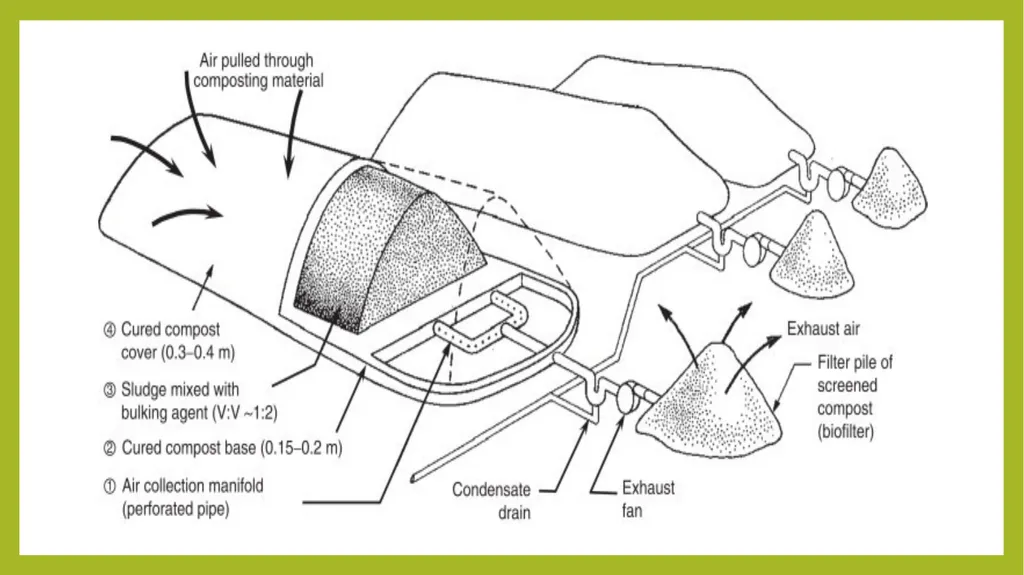
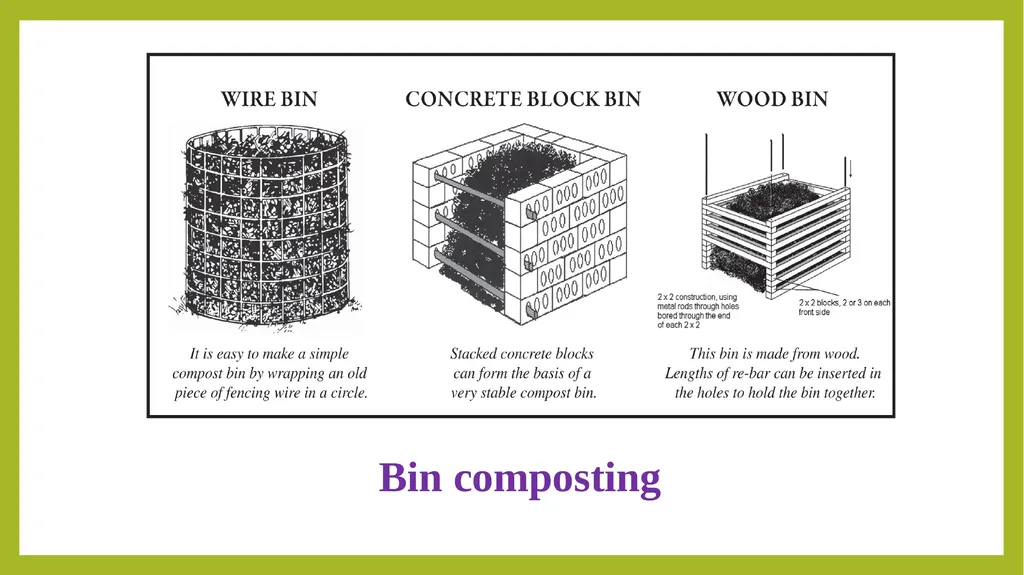
10. Bin composting/In-vessel composting It is a simplest In-vessel composting.
Bin is made out of tin/wood.
Operates like the aerated static pile method.
A higher pressure blower may be required as compared to the aerated static pile method.
Each layer is about 6” in depth.
Each layer sprinkled with CBCT stock solution (1:200), this will initiate and accelerate the composting process and eliminates odours.<br>
Bin is made out of tin/wood.
Operates like the aerated static pile method.
A higher pressure blower may be required as compared to the aerated static pile method.
Each layer is about 6” in depth.
Each layer sprinkled with CBCT stock solution (1:200), this will initiate and accelerate the composting process and eliminates odours.<br>
21
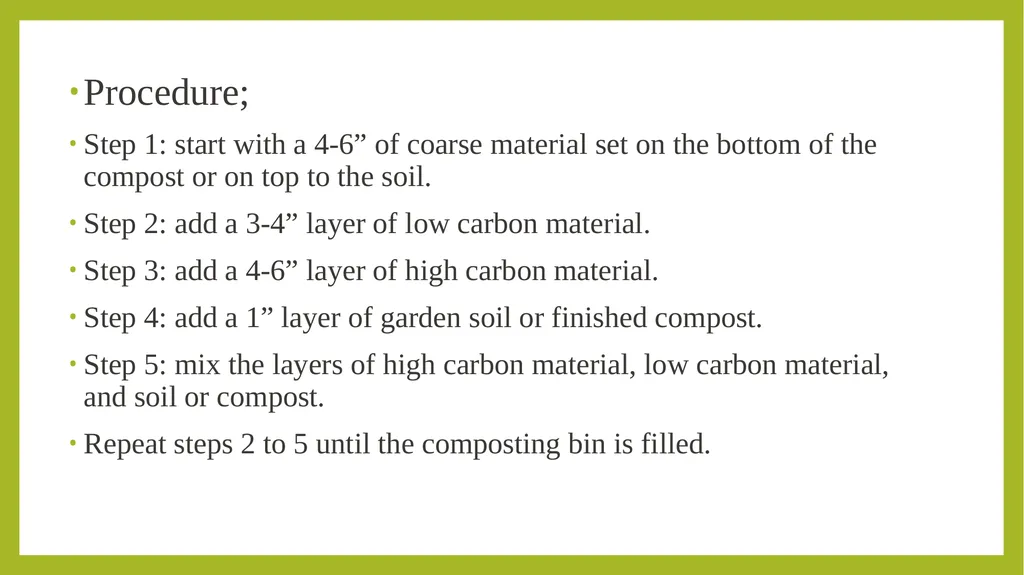
Procedure;
Step 1: start with a 4-6” of coarse material set on the bottom of the compost or on top to the soil.
Step 2: add a 3-4” layer of low carbon material.
Step 3: add a 4-6” layer of high carbon material.
Step 4: add a 1” layer of garden soil or finished compost.
Step 5: mix the layers of high carbon material, low carbon material, and soil or compost.
Repeat steps 2 to 5 until the composting bin is filled.<br>
Step 1: start with a 4-6” of coarse material set on the bottom of the compost or on top to the soil.
Step 2: add a 3-4” layer of low carbon material.
Step 3: add a 4-6” layer of high carbon material.
Step 4: add a 1” layer of garden soil or finished compost.
Step 5: mix the layers of high carbon material, low carbon material, and soil or compost.
Repeat steps 2 to 5 until the composting bin is filled.<br>
22
Bin composting<br>
23
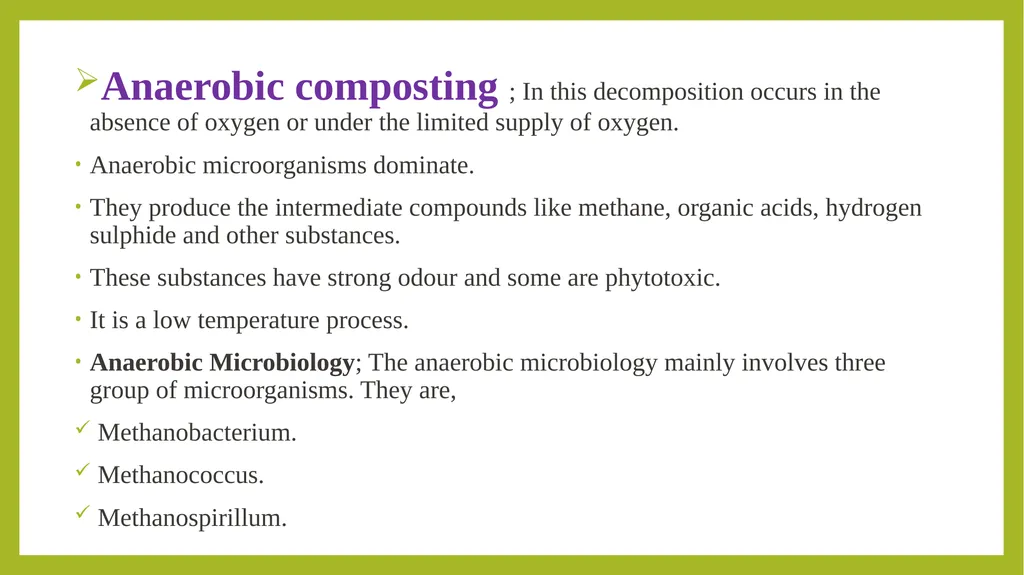
Anaerobic composting ; In this decomposition occurs in the absence of oxygen or under the limited supply of oxygen.
Anaerobic microorganisms dominate.
They produce the intermediate compounds like methane, organic acids, hydrogen sulphide and other substances.
These substances have strong odour and some are phytotoxic.
It is a low temperature process.
Anaerobic Microbiology; The anaerobic microbiology mainly involves three group of microorganisms. They are,
Methanobacterium.
Methanococcus.
Methanospirillum.<br>
Anaerobic microorganisms dominate.
They produce the intermediate compounds like methane, organic acids, hydrogen sulphide and other substances.
These substances have strong odour and some are phytotoxic.
It is a low temperature process.
Anaerobic Microbiology; The anaerobic microbiology mainly involves three group of microorganisms. They are,
Methanobacterium.
Methanococcus.
Methanospirillum.<br>
24
Anaerobic Composting techniques 1. Bangalore Method:
This method of composting was developed at IISc, Bangalore by Acharya in 1939.
Composting substrate are not turned.
This method is suitable in areas with scanty rainfall.
Time involved in production of finished compost is much longer.<br>
This method of composting was developed at IISc, Bangalore by Acharya in 1939.
Composting substrate are not turned.
This method is suitable in areas with scanty rainfall.
Time involved in production of finished compost is much longer.<br>
25
Steps Involved: • Trenches or pits of 1m depth, convenient length and breadth are dug.
Organic residues, dung and urine soaked mud are put in alternate layers.
• These layers are repeated in order at least 1.5-2m above ground level.
• It is left exposed without covering for 15 days.
• Then it is plastered with earth or mud of 1cm thick.
For initial 8-10 days aerobic composting takes place while, anaerobic composting takes place at a slower rate thereafter.
• It takes about 6-8 months to get finished product.
• It is the bulkiest compost.<br>
Organic residues, dung and urine soaked mud are put in alternate layers.
• These layers are repeated in order at least 1.5-2m above ground level.
• It is left exposed without covering for 15 days.
• Then it is plastered with earth or mud of 1cm thick.
For initial 8-10 days aerobic composting takes place while, anaerobic composting takes place at a slower rate thereafter.
• It takes about 6-8 months to get finished product.
• It is the bulkiest compost.<br>
26
MERITS:
• Turning not required.
• Simple and easy to manipulate.
• Efficient use of moisture.
• High manure recovery.
• Pathogen and weed free manure.
DEMERITS:
• Long duration.
• Low nutrient recovery.<br>
• Turning not required.
• Simple and easy to manipulate.
• Efficient use of moisture.
• High manure recovery.
• Pathogen and weed free manure.
DEMERITS:
• Long duration.
• Low nutrient recovery.<br>
27
2. Coimbatore method Composting is done in pits of different sizes depending on the waste material available.
A layer of waste materials is first laid in the pit.
It is moistened with a suspension of 5-10 kg cow dung in 2.5 to 5.0 l of water and 0.5 to 1.0 kg fine bone meal sprinkled over it uniformly.
Similar layers are laid one over the other till the material rises 0.75 m above the ground level. It is finally plastered with wet mud and left undisturbed for 8 to 10 weeks.
Plaster is then removed, material moistened with water, given a turning and made into a rectangular heap under shade. It is left undisturbed till its use.<br>
A layer of waste materials is first laid in the pit.
It is moistened with a suspension of 5-10 kg cow dung in 2.5 to 5.0 l of water and 0.5 to 1.0 kg fine bone meal sprinkled over it uniformly.
Similar layers are laid one over the other till the material rises 0.75 m above the ground level. It is finally plastered with wet mud and left undisturbed for 8 to 10 weeks.
Plaster is then removed, material moistened with water, given a turning and made into a rectangular heap under shade. It is left undisturbed till its use.<br>
28
3. Chinese pit method: Here composting is carried out in corner of the field in circular or rectangular pits.
The pits are filled layer by layer each layer being 15cm thick.
First layer is of green manure.
Second later is of Straw.
Third layer is of Animal dung.
These layers are alternated until pit is full.
Then it is plastered with the mud.<br>
The pits are filled layer by layer each layer being 15cm thick.
First layer is of green manure.
Second later is of Straw.
Third layer is of Animal dung.
These layers are alternated until pit is full.
Then it is plastered with the mud.<br>
29
The water layer of 4 cm depth is maintained on suface.
This creates an anaerobic condition.
First turning is given 1 month after filling and superphosphate is added.
Second turning is given after second month.
Third turning is given 2-3 weeks after second turning.
The material is allowed to decompose for three months.
It produces average of about 8 tonnes of compost per pit.<br>
This creates an anaerobic condition.
First turning is given 1 month after filling and superphosphate is added.
Second turning is given after second month.
Third turning is given 2-3 weeks after second turning.
The material is allowed to decompose for three months.
It produces average of about 8 tonnes of compost per pit.<br>