
What is reconciliation? Definitions, scope,
Description: What is reconciliation? Definitions, scope, actors, theoretical debates and the role of international organizations Reconciliation in the post-conflict environment in the Western Balkans as a precondition for the efficient implementation of
Related Topics
Download Presentation
"What is reconciliation? Definitions, scope," is the property of its rightful owner. Permission is granted to download and print the materials on this website for personal, non-commercial use only, and to display it on your personal computer provided you do not modify the materials and that you retain all copyright notices contained in the materials. By downloading content from our website, you accept the terms of this agreement.
Presentation Transcript
slide2. What is reconciliation?
Definitions, scope, actors, theoretical debates and the role of international organizations Reconciliation in the post-conflict environment in the Western Balkans as a precondition for the efficient implementation of the EU enlargement policy
Dr. Ružica Jakešević<br>
slide3. Lecture overview Introduction – reconciliation as a proces/goal
Definitions of reconciliation
Aspects of reconciliation
Actors and processes in reconciliation<br>
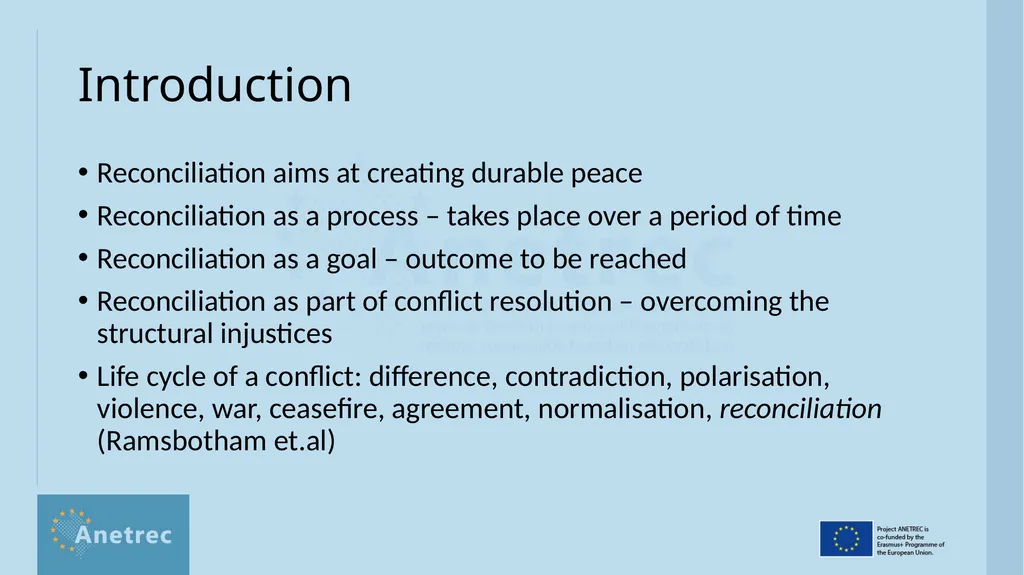
slide4. Introduction Reconciliation aims at creating durable peace
Reconciliation as a process – takes place over a period of time
Reconciliation as a goal – outcome to be reached
Reconciliation as part of conflict resolution – overcoming the structural injustices
Life cycle of a conflict: difference, contradiction, polarisation, violence, war, ceasefire, agreement, normalisation, reconciliation (Ramsbotham et.al)<br>
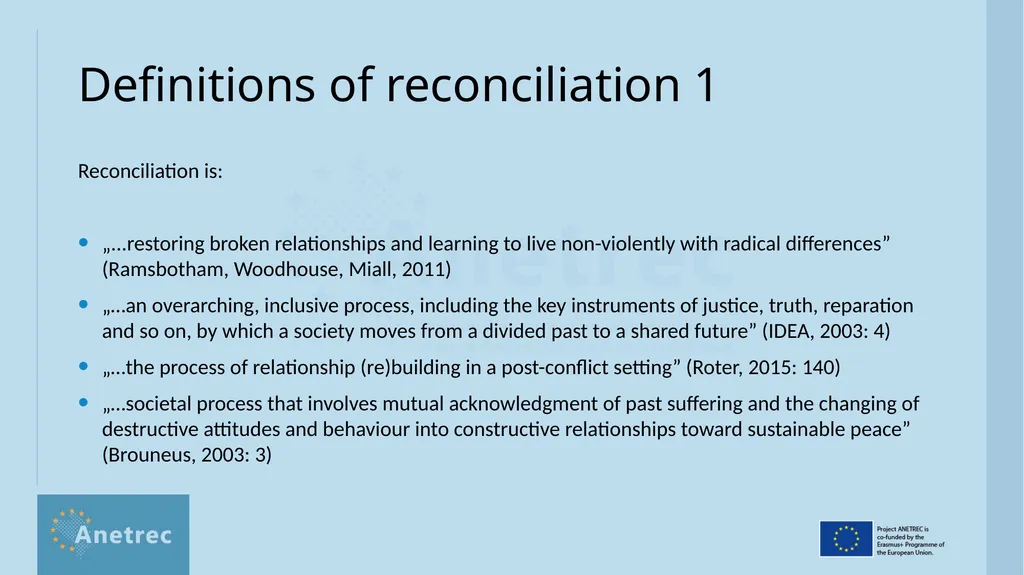
slide5. Definitions of reconciliation 1 Reconciliation is:
„...restoring broken relationships and learning to live non-violently with radical differences” (Ramsbotham, Woodhouse, Miall, 2011)
„…an overarching, inclusive process, including the key instruments of justice, truth, reparation and so on, by which a society moves from a divided past to a shared future” (IDEA, 2003: 4)
„…the process of relationship (re)building in a post-conflict setting” (Roter, 2015: 140)
„…societal process that involves mutual acknowledgment of past suffering and the changing of destructive attitudes and behaviour into constructive relationships toward sustainable peace” (Brouneus, 2003: 3)<br>
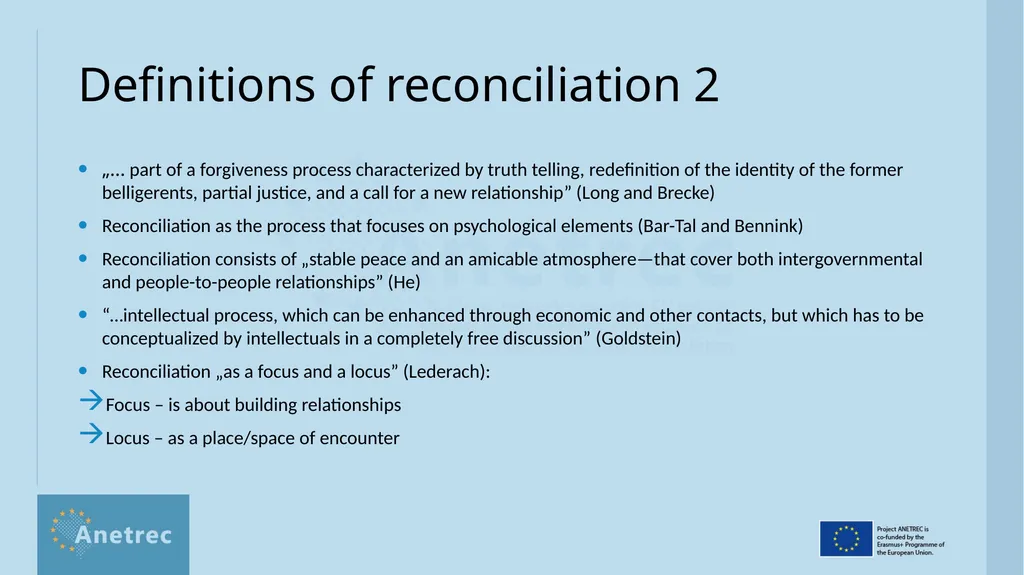
slide6. Definitions of reconciliation 2 „... part of a forgiveness process characterized by truth telling, redefinition of the identity of the former belligerents, partial justice, and a call for a new relationship” (Long and Brecke)
Reconciliation as the process that focuses on psychological elements (Bar-Tal and Bennink)
Reconciliation consists of „stable peace and an amicable atmosphere—that cover both intergovernmental and people-to-people relationships” (He)
“…intellectual process, which can be enhanced through economic and other contacts, but which has to be conceptualized by intellectuals in a completely free discussion” (Goldstein)
Reconciliation „as a focus and a locus” (Lederach):
Focus – is about building relationships
Locus – as a place/space of encounter<br>
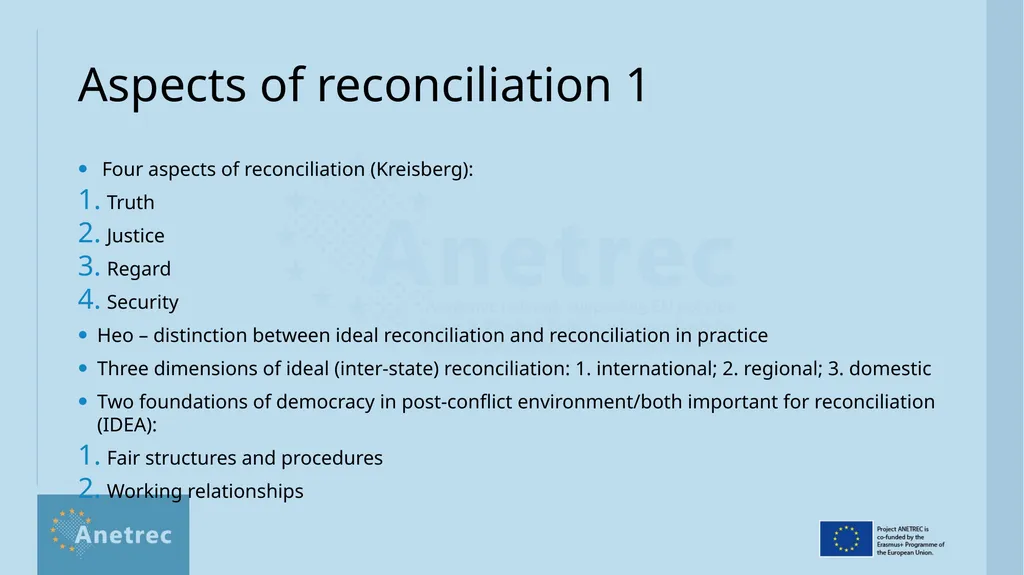
slide7. Aspects of reconciliation 1 Four aspects of reconciliation (Kreisberg):
Truth
Justice
Regard
Security
Heo – distinction between ideal reconciliation and reconciliation in practice
Three dimensions of ideal (inter-state) reconciliation: 1. international; 2. regional; 3. domestic
Two foundations of democracy in post-conflict environment/both important for reconciliation (IDEA):
Fair structures and procedures
Working relationships<br>
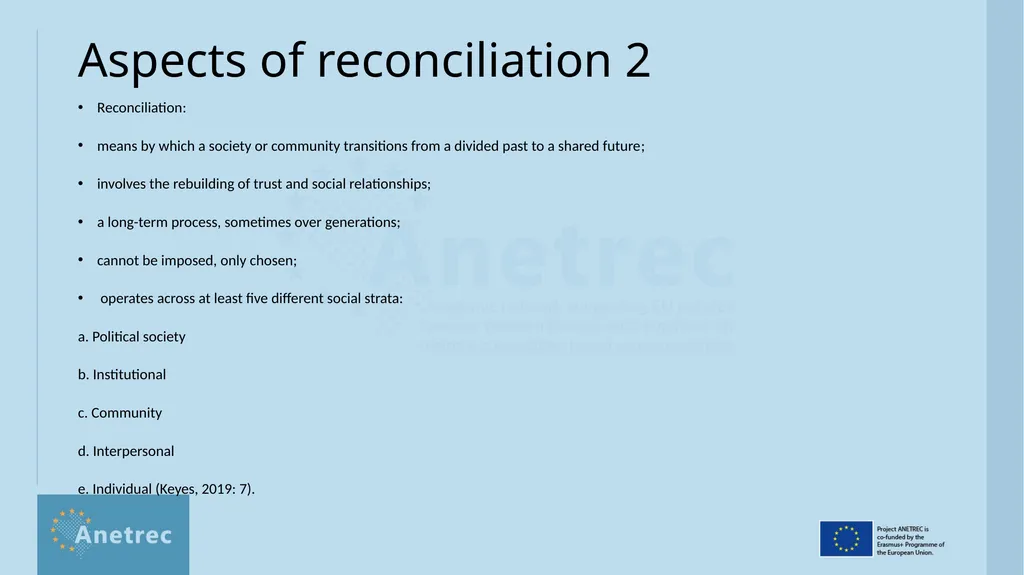
slide8. Aspects of reconciliation 2 Reconciliation:
means by which a society or community transitions from a divided past to a shared future;
involves the rebuilding of trust and social relationships;
a long-term process, sometimes over generations;
cannot be imposed, only chosen;
operates across at least five different social strata:
a. Political society
b. Institutional
c. Community
d. Interpersonal
e. Individual (Keyes, 2019: 7).<br>
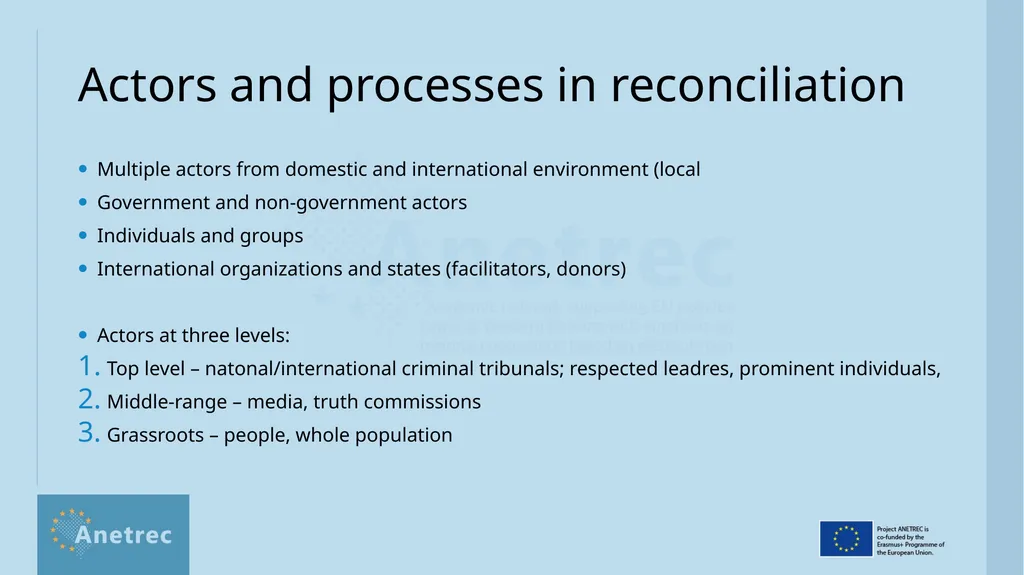
slide9. Actors and processes in reconciliation Multiple actors from domestic and international environment (local
Government and non-government actors
Individuals and groups
International organizations and states (facilitators, donors)
Actors at three levels:
Top level – natonal/international criminal tribunals; respected leadres, prominent individuals,
Middle-range – media, truth commissions
Grassroots – people, whole population<br>
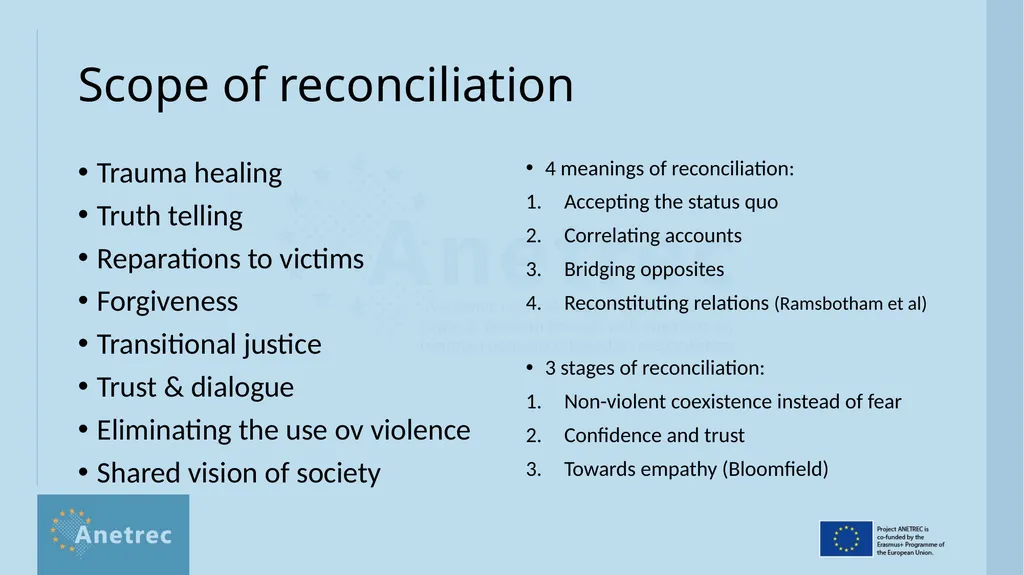
slide10. Scope of reconciliation Trauma healing
Truth telling
Reparations to victims
Forgiveness
Transitional justice
Trust & dialogue
Eliminating the use ov violence
Shared vision of society 4 meanings of reconciliation:
Accepting the status quo
Correlating accounts
Bridging opposites
Reconstituting relations (Ramsbotham et al)
3 stages of reconciliation:
Non-violent coexistence instead of fear
Confidence and trust
Towards empathy (Bloomfield)<br>
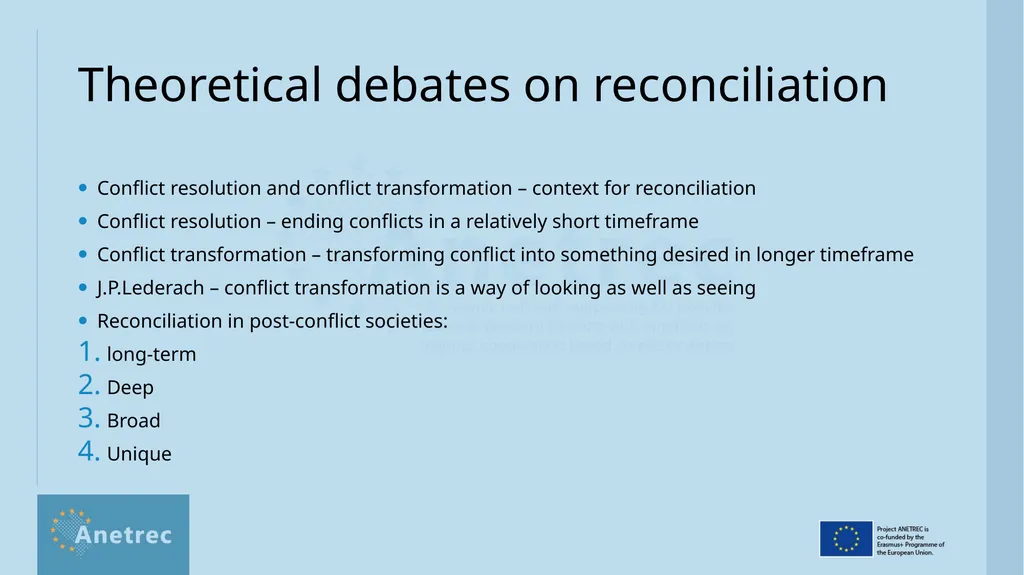
slide11. Theoretical debates on reconciliation Conflict resolution and conflict transformation – context for reconciliation
Conflict resolution – ending conflicts in a relatively short timeframe
Conflict transformation – transforming conflict into something desired in longer timeframe
J.P.Lederach – conflict transformation is a way of looking as well as seeing
Reconciliation in post-conflict societies:
long-term
Deep
Broad
Unique<br>
slide12. Reconciliation and international organizations 1 International organizations, alliances, integrations – grounds for reconciling enmities between states
European project – peacebuilding project – example of „security community“ (K. Deutsch)
UN – focus on international peace and security / Chapter VI (pacific settlement of disputes) – conflict prevention (+ roles of Secretary General and UNSC)
Political missions - good offices, conflict prevention, peacemaking and peacebuilding
An agenda for peace (1992) – preventive diplomacy, peacemaking, peacekeeping, post-conflict peacebuilding
Peacebuilding commission (2005)
OSCE – confidence-building measures as both preventive and reactive
- Political/economic/environmental/cultral CBMs<br>
slide13. Reconciliation and international organizations 2 EU – perceived as a peacebuilding project itself and security community
External action and resources vital for reconciliation
CFSP and CSDP – civilian and military mission
Enlargement policy + Neighbourhood policy
Emphasis on intra- and interstate reconciliation in Western Balkans
4 key challenges for EU conflcit prevention and peacebuilding:
Early warning-response gap
Cooperation with other international partners
Civil-military coordination
Local ownership<br>
slide14. Reconciliation in the Western Balkans Heavy involvement of international actors in all phases of the conflicts in 2 distinctive periods:
1991-1999 – failed preventive diplomacy/conflict management and resolution/negative peace
2000 onwards – peacebuliding / civilian missions / positive peace building
Ramsbotham/Woodhouse/Miall’s “hourglass model” of conflict: difference, contradiction, polarisation, violence, war, ceasefire, agreement, normalisation, reconciliation
Limited capacities of external actors at the beginning of the crisis
Lessons learned in the Western Balkans – development of new instruments and capabilities
UN – peacekeeping reform
EU – ESDP/CFSP development
NATO – first out-of-area operations<br>
slide15. Conclusion Reconciliation:
tackled from different aspects
several useful definitions
academics, practitioners, organization – differences in conceptualization of reconciliation
intra- and interstate dimension of reconciliation
Multitude of actors across different levels<br>
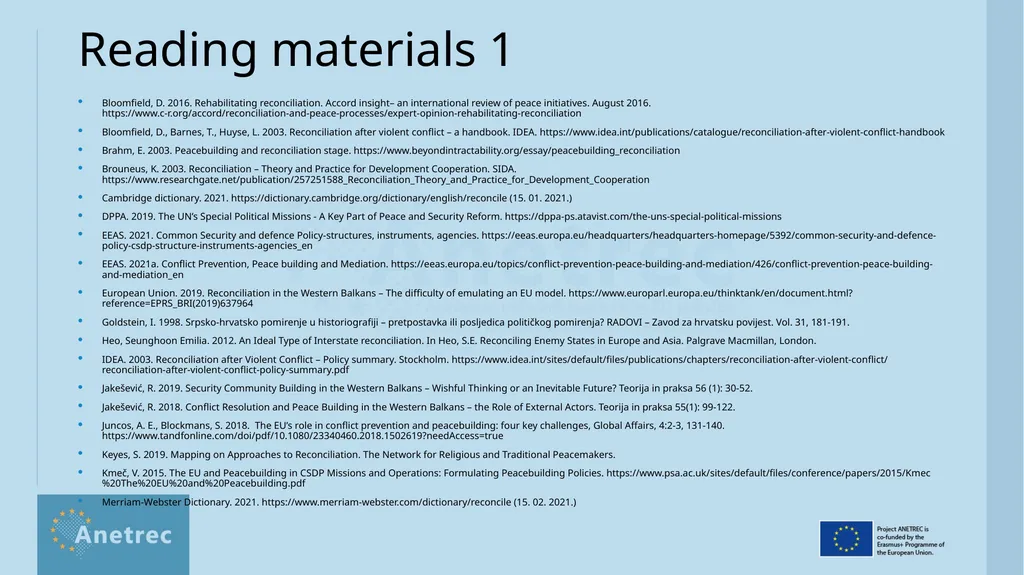
slide16. Reading materials 1 Bloomfield, D. 2016. Rehabilitating reconciliation. Accord insight– an international review of peace initiatives. August 2016. https://www.c-r.org/accord/reconciliation-and-peace-processes/expert-opinion-rehabilitating-reconciliation
Bloomfield, D., Barnes, T., Huyse, L. 2003. Reconciliation after violent conflict – a handbook. IDEA. https://www.idea.int/publications/catalogue/reconciliation-after-violent-conflict-handbook
Brahm, E. 2003. Peacebuilding and reconciliation stage. https://www.beyondintractability.org/essay/peacebuilding_reconciliation
Brouneus, K. 2003. Reconciliation – Theory and Practice for Development Cooperation. SIDA. https://www.researchgate.net/publication/257251588_Reconciliation_Theory_and_Practice_for_Development_Cooperation
Cambridge dictionary. 2021. https://dictionary.cambridge.org/dictionary/english/reconcile (15. 01. 2021.)
DPPA. 2019. The UN’s Special Political Missions - A Key Part of Peace and Security Reform. https://dppa-ps.atavist.com/the-uns-special-political-missions
EEAS. 2021. Common Security and defence Policy-structures, instruments, agencies. https://eeas.europa.eu/headquarters/headquarters-homepage/5392/common-security-and-defence-policy-csdp-structure-instruments-agencies_en
EEAS. 2021a. Conflict Prevention, Peace building and Mediation. https://eeas.europa.eu/topics/conflict-prevention-peace-building-and-mediation/426/conflict-prevention-peace-building-and-mediation_en
European Union. 2019. Reconciliation in the Western Balkans – The difficulty of emulating an EU model. https://www.europarl.europa.eu/thinktank/en/document.html?reference=EPRS_BRI(2019)637964
Goldstein, I. 1998. Srpsko-hrvatsko pomirenje u historiografiji – pretpostavka ili posljedica političkog pomirenja? RADOVI – Zavod za hrvatsku povijest. Vol. 31, 181-191.
Heo, Seunghoon Emilia. 2012. An Ideal Type of Interstate reconciliation. In Heo, S.E. Reconciling Enemy States in Europe and Asia. Palgrave Macmillan, London.
IDEA. 2003. Reconciliation after Violent Conflict – Policy summary. Stockholm. https://www.idea.int/sites/default/files/publications/chapters/reconciliation-after-violent-conflict/reconciliation-after-violent-conflict-policy-summary.pdf
Jakešević, R. 2019. Security Community Building in the Western Balkans – Wishful Thinking or an Inevitable Future? Teorija in praksa 56 (1): 30-52.
Jakešević, R. 2018. Conflict Resolution and Peace Building in the Western Balkans – the Role of External Actors. Teorija in praksa 55(1): 99-122.
Juncos, A. E., Blockmans, S. 2018. The EU’s role in conflict prevention and peacebuilding: four key challenges, Global Affairs, 4:2-3, 131-140. https://www.tandfonline.com/doi/pdf/10.1080/23340460.2018.1502619?needAccess=true
Keyes, S. 2019. Mapping on Approaches to Reconciliation. The Network for Religious and Traditional Peacemakers.
Kmeč, V. 2015. The EU and Peacebuilding in CSDP Missions and Operations: Formulating Peacebuilding Policies. https://www.psa.ac.uk/sites/default/files/conference/papers/2015/Kmec%20The%20EU%20and%20Peacebuilding.pdf
Merriam-Webster Dictionary. 2021. https://www.merriam-webster.com/dictionary/reconcile (15. 02. 2021.)<br>
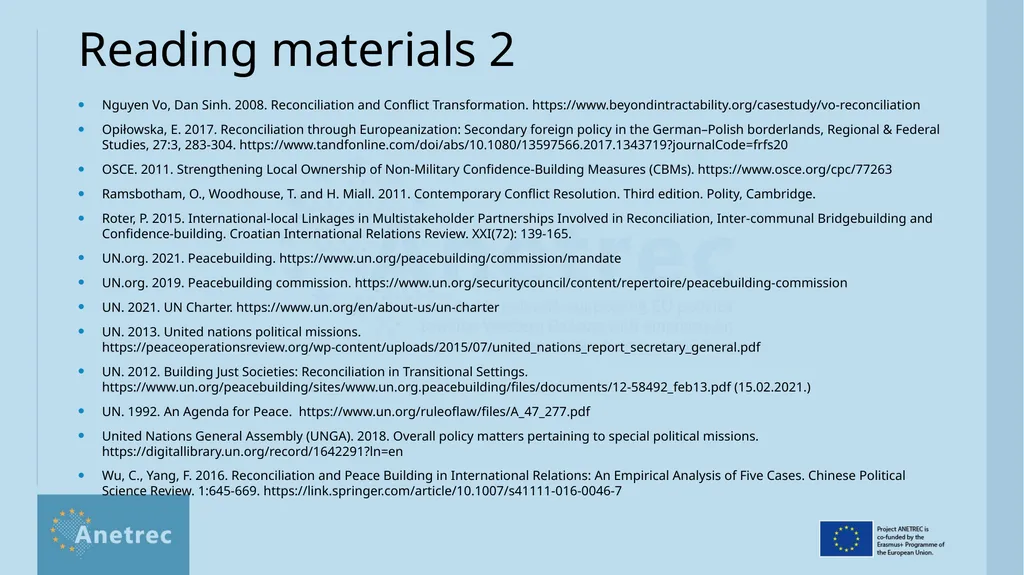
slide17. Reading materials 2 Nguyen Vo, Dan Sinh. 2008. Reconciliation and Conflict Transformation. https://www.beyondintractability.org/casestudy/vo-reconciliation
Opiłowska, E. 2017. Reconciliation through Europeanization: Secondary foreign policy in the German–Polish borderlands, Regional & Federal Studies, 27:3, 283-304. https://www.tandfonline.com/doi/abs/10.1080/13597566.2017.1343719?journalCode=frfs20
OSCE. 2011. Strengthening Local Ownership of Non-Military Confidence-Building Measures (CBMs). https://www.osce.org/cpc/77263
Ramsbotham, O., Woodhouse, T. and H. Miall. 2011. Contemporary Conflict Resolution. Third edition. Polity, Cambridge.
Roter, P. 2015. International-local Linkages in Multistakeholder Partnerships Involved in Reconciliation, Inter-communal Bridgebuilding and Confidence-building. Croatian International Relations Review. XXI(72): 139-165.
UN.org. 2021. Peacebuilding. https://www.un.org/peacebuilding/commission/mandate
UN.org. 2019. Peacebuilding commission. https://www.un.org/securitycouncil/content/repertoire/peacebuilding-commission
UN. 2021. UN Charter. https://www.un.org/en/about-us/un-charter
UN. 2013. United nations political missions. https://peaceoperationsreview.org/wp-content/uploads/2015/07/united_nations_report_secretary_general.pdf
UN. 2012. Building Just Societies: Reconciliation in Transitional Settings. https://www.un.org/peacebuilding/sites/www.un.org.peacebuilding/files/documents/12-58492_feb13.pdf (15.02.2021.)
UN. 1992. An Agenda for Peace. https://www.un.org/ruleoflaw/files/A_47_277.pdf
United Nations General Assembly (UNGA). 2018. Overall policy matters pertaining to special political missions. https://digitallibrary.un.org/record/1642291?ln=en
Wu, C., Yang, F. 2016. Reconciliation and Peace Building in International Relations: An Empirical Analysis of Five Cases. Chinese Political Science Review. 1:645-669. https://link.springer.com/article/10.1007/s41111-016-0046-7<br>
Dr. Ružica Jakešević<br>
slide3. Lecture overview Introduction – reconciliation as a proces/goal
Definitions of reconciliation
Aspects of reconciliation
Actors and processes in reconciliation<br>
slide4. Introduction Reconciliation aims at creating durable peace
Reconciliation as a process – takes place over a period of time
Reconciliation as a goal – outcome to be reached
Reconciliation as part of conflict resolution – overcoming the structural injustices
Life cycle of a conflict: difference, contradiction, polarisation, violence, war, ceasefire, agreement, normalisation, reconciliation (Ramsbotham et.al)<br>
slide5. Definitions of reconciliation 1 Reconciliation is:
„...restoring broken relationships and learning to live non-violently with radical differences” (Ramsbotham, Woodhouse, Miall, 2011)
„…an overarching, inclusive process, including the key instruments of justice, truth, reparation and so on, by which a society moves from a divided past to a shared future” (IDEA, 2003: 4)
„…the process of relationship (re)building in a post-conflict setting” (Roter, 2015: 140)
„…societal process that involves mutual acknowledgment of past suffering and the changing of destructive attitudes and behaviour into constructive relationships toward sustainable peace” (Brouneus, 2003: 3)<br>
slide6. Definitions of reconciliation 2 „... part of a forgiveness process characterized by truth telling, redefinition of the identity of the former belligerents, partial justice, and a call for a new relationship” (Long and Brecke)
Reconciliation as the process that focuses on psychological elements (Bar-Tal and Bennink)
Reconciliation consists of „stable peace and an amicable atmosphere—that cover both intergovernmental and people-to-people relationships” (He)
“…intellectual process, which can be enhanced through economic and other contacts, but which has to be conceptualized by intellectuals in a completely free discussion” (Goldstein)
Reconciliation „as a focus and a locus” (Lederach):
Focus – is about building relationships
Locus – as a place/space of encounter<br>
slide7. Aspects of reconciliation 1 Four aspects of reconciliation (Kreisberg):
Truth
Justice
Regard
Security
Heo – distinction between ideal reconciliation and reconciliation in practice
Three dimensions of ideal (inter-state) reconciliation: 1. international; 2. regional; 3. domestic
Two foundations of democracy in post-conflict environment/both important for reconciliation (IDEA):
Fair structures and procedures
Working relationships<br>
slide8. Aspects of reconciliation 2 Reconciliation:
means by which a society or community transitions from a divided past to a shared future;
involves the rebuilding of trust and social relationships;
a long-term process, sometimes over generations;
cannot be imposed, only chosen;
operates across at least five different social strata:
a. Political society
b. Institutional
c. Community
d. Interpersonal
e. Individual (Keyes, 2019: 7).<br>
slide9. Actors and processes in reconciliation Multiple actors from domestic and international environment (local
Government and non-government actors
Individuals and groups
International organizations and states (facilitators, donors)
Actors at three levels:
Top level – natonal/international criminal tribunals; respected leadres, prominent individuals,
Middle-range – media, truth commissions
Grassroots – people, whole population<br>
slide10. Scope of reconciliation Trauma healing
Truth telling
Reparations to victims
Forgiveness
Transitional justice
Trust & dialogue
Eliminating the use ov violence
Shared vision of society 4 meanings of reconciliation:
Accepting the status quo
Correlating accounts
Bridging opposites
Reconstituting relations (Ramsbotham et al)
3 stages of reconciliation:
Non-violent coexistence instead of fear
Confidence and trust
Towards empathy (Bloomfield)<br>
slide11. Theoretical debates on reconciliation Conflict resolution and conflict transformation – context for reconciliation
Conflict resolution – ending conflicts in a relatively short timeframe
Conflict transformation – transforming conflict into something desired in longer timeframe
J.P.Lederach – conflict transformation is a way of looking as well as seeing
Reconciliation in post-conflict societies:
long-term
Deep
Broad
Unique<br>
slide12. Reconciliation and international organizations 1 International organizations, alliances, integrations – grounds for reconciling enmities between states
European project – peacebuilding project – example of „security community“ (K. Deutsch)
UN – focus on international peace and security / Chapter VI (pacific settlement of disputes) – conflict prevention (+ roles of Secretary General and UNSC)
Political missions - good offices, conflict prevention, peacemaking and peacebuilding
An agenda for peace (1992) – preventive diplomacy, peacemaking, peacekeeping, post-conflict peacebuilding
Peacebuilding commission (2005)
OSCE – confidence-building measures as both preventive and reactive
- Political/economic/environmental/cultral CBMs<br>
slide13. Reconciliation and international organizations 2 EU – perceived as a peacebuilding project itself and security community
External action and resources vital for reconciliation
CFSP and CSDP – civilian and military mission
Enlargement policy + Neighbourhood policy
Emphasis on intra- and interstate reconciliation in Western Balkans
4 key challenges for EU conflcit prevention and peacebuilding:
Early warning-response gap
Cooperation with other international partners
Civil-military coordination
Local ownership<br>
slide14. Reconciliation in the Western Balkans Heavy involvement of international actors in all phases of the conflicts in 2 distinctive periods:
1991-1999 – failed preventive diplomacy/conflict management and resolution/negative peace
2000 onwards – peacebuliding / civilian missions / positive peace building
Ramsbotham/Woodhouse/Miall’s “hourglass model” of conflict: difference, contradiction, polarisation, violence, war, ceasefire, agreement, normalisation, reconciliation
Limited capacities of external actors at the beginning of the crisis
Lessons learned in the Western Balkans – development of new instruments and capabilities
UN – peacekeeping reform
EU – ESDP/CFSP development
NATO – first out-of-area operations<br>
slide15. Conclusion Reconciliation:
tackled from different aspects
several useful definitions
academics, practitioners, organization – differences in conceptualization of reconciliation
intra- and interstate dimension of reconciliation
Multitude of actors across different levels<br>
slide16. Reading materials 1 Bloomfield, D. 2016. Rehabilitating reconciliation. Accord insight– an international review of peace initiatives. August 2016. https://www.c-r.org/accord/reconciliation-and-peace-processes/expert-opinion-rehabilitating-reconciliation
Bloomfield, D., Barnes, T., Huyse, L. 2003. Reconciliation after violent conflict – a handbook. IDEA. https://www.idea.int/publications/catalogue/reconciliation-after-violent-conflict-handbook
Brahm, E. 2003. Peacebuilding and reconciliation stage. https://www.beyondintractability.org/essay/peacebuilding_reconciliation
Brouneus, K. 2003. Reconciliation – Theory and Practice for Development Cooperation. SIDA. https://www.researchgate.net/publication/257251588_Reconciliation_Theory_and_Practice_for_Development_Cooperation
Cambridge dictionary. 2021. https://dictionary.cambridge.org/dictionary/english/reconcile (15. 01. 2021.)
DPPA. 2019. The UN’s Special Political Missions - A Key Part of Peace and Security Reform. https://dppa-ps.atavist.com/the-uns-special-political-missions
EEAS. 2021. Common Security and defence Policy-structures, instruments, agencies. https://eeas.europa.eu/headquarters/headquarters-homepage/5392/common-security-and-defence-policy-csdp-structure-instruments-agencies_en
EEAS. 2021a. Conflict Prevention, Peace building and Mediation. https://eeas.europa.eu/topics/conflict-prevention-peace-building-and-mediation/426/conflict-prevention-peace-building-and-mediation_en
European Union. 2019. Reconciliation in the Western Balkans – The difficulty of emulating an EU model. https://www.europarl.europa.eu/thinktank/en/document.html?reference=EPRS_BRI(2019)637964
Goldstein, I. 1998. Srpsko-hrvatsko pomirenje u historiografiji – pretpostavka ili posljedica političkog pomirenja? RADOVI – Zavod za hrvatsku povijest. Vol. 31, 181-191.
Heo, Seunghoon Emilia. 2012. An Ideal Type of Interstate reconciliation. In Heo, S.E. Reconciling Enemy States in Europe and Asia. Palgrave Macmillan, London.
IDEA. 2003. Reconciliation after Violent Conflict – Policy summary. Stockholm. https://www.idea.int/sites/default/files/publications/chapters/reconciliation-after-violent-conflict/reconciliation-after-violent-conflict-policy-summary.pdf
Jakešević, R. 2019. Security Community Building in the Western Balkans – Wishful Thinking or an Inevitable Future? Teorija in praksa 56 (1): 30-52.
Jakešević, R. 2018. Conflict Resolution and Peace Building in the Western Balkans – the Role of External Actors. Teorija in praksa 55(1): 99-122.
Juncos, A. E., Blockmans, S. 2018. The EU’s role in conflict prevention and peacebuilding: four key challenges, Global Affairs, 4:2-3, 131-140. https://www.tandfonline.com/doi/pdf/10.1080/23340460.2018.1502619?needAccess=true
Keyes, S. 2019. Mapping on Approaches to Reconciliation. The Network for Religious and Traditional Peacemakers.
Kmeč, V. 2015. The EU and Peacebuilding in CSDP Missions and Operations: Formulating Peacebuilding Policies. https://www.psa.ac.uk/sites/default/files/conference/papers/2015/Kmec%20The%20EU%20and%20Peacebuilding.pdf
Merriam-Webster Dictionary. 2021. https://www.merriam-webster.com/dictionary/reconcile (15. 02. 2021.)<br>
slide17. Reading materials 2 Nguyen Vo, Dan Sinh. 2008. Reconciliation and Conflict Transformation. https://www.beyondintractability.org/casestudy/vo-reconciliation
Opiłowska, E. 2017. Reconciliation through Europeanization: Secondary foreign policy in the German–Polish borderlands, Regional & Federal Studies, 27:3, 283-304. https://www.tandfonline.com/doi/abs/10.1080/13597566.2017.1343719?journalCode=frfs20
OSCE. 2011. Strengthening Local Ownership of Non-Military Confidence-Building Measures (CBMs). https://www.osce.org/cpc/77263
Ramsbotham, O., Woodhouse, T. and H. Miall. 2011. Contemporary Conflict Resolution. Third edition. Polity, Cambridge.
Roter, P. 2015. International-local Linkages in Multistakeholder Partnerships Involved in Reconciliation, Inter-communal Bridgebuilding and Confidence-building. Croatian International Relations Review. XXI(72): 139-165.
UN.org. 2021. Peacebuilding. https://www.un.org/peacebuilding/commission/mandate
UN.org. 2019. Peacebuilding commission. https://www.un.org/securitycouncil/content/repertoire/peacebuilding-commission
UN. 2021. UN Charter. https://www.un.org/en/about-us/un-charter
UN. 2013. United nations political missions. https://peaceoperationsreview.org/wp-content/uploads/2015/07/united_nations_report_secretary_general.pdf
UN. 2012. Building Just Societies: Reconciliation in Transitional Settings. https://www.un.org/peacebuilding/sites/www.un.org.peacebuilding/files/documents/12-58492_feb13.pdf (15.02.2021.)
UN. 1992. An Agenda for Peace. https://www.un.org/ruleoflaw/files/A_47_277.pdf
United Nations General Assembly (UNGA). 2018. Overall policy matters pertaining to special political missions. https://digitallibrary.un.org/record/1642291?ln=en
Wu, C., Yang, F. 2016. Reconciliation and Peace Building in International Relations: An Empirical Analysis of Five Cases. Chinese Political Science Review. 1:645-669. https://link.springer.com/article/10.1007/s41111-016-0046-7<br>