What is the difference between a cabbage and a machine? What would Paley say and why? Discuss in pairs. Challenge to the teleological argument from Hume Learning Outcomes To be able to describe Humes criticisms of the teleological
"What is the difference between a cabbage and a" is the property of its rightful owner. Permission is granted to
download and print the materials on this website for personal, non-commercial use only, and to display it
on your personal computer provided you do not modify the materials and that you retain all copyright
notices contained in the materials. By downloading content from our website, you accept the terms of this
agreement.
Presentation Transcript
01
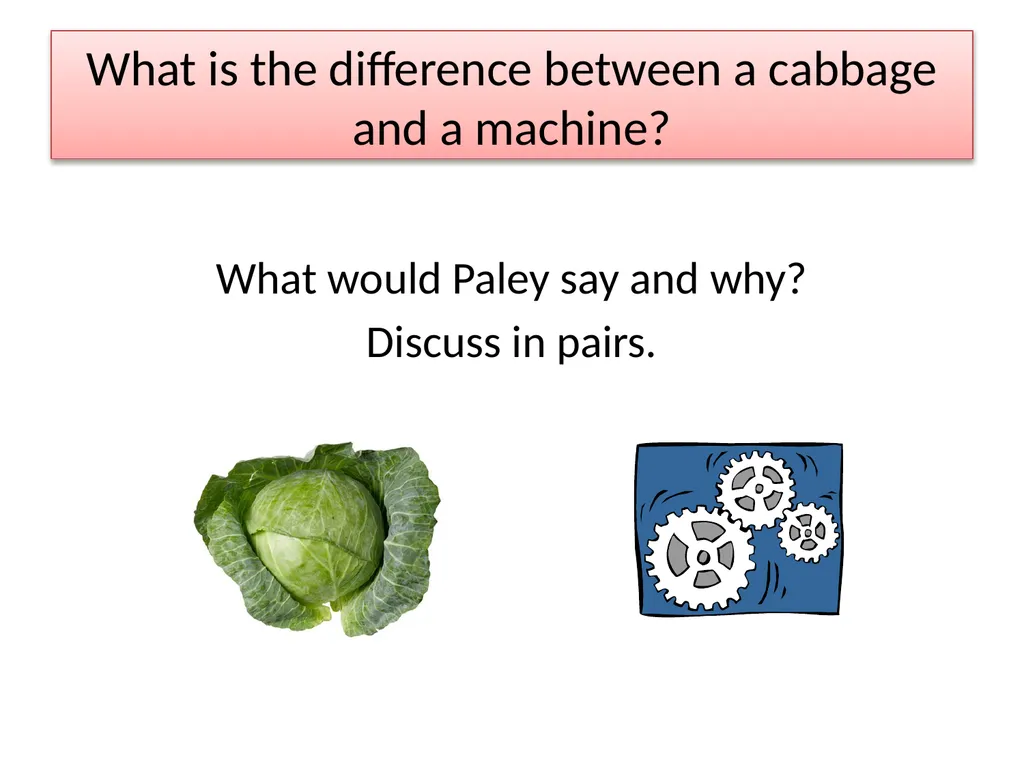
What is the difference between a cabbage and a machine? What would Paley say and why?
Discuss in pairs.<br>
02
Challenge to the teleological argument from Hume<br>
03
Learning Outcomes To be able to describe Hume’s criticisms of the teleological argument.
To be able to evaluate Hume’s criticisms of the teleological argument.<br>
04
Hume and the Teleological Argument Don’t get confused …
Hume puts forward a version of the Teleological Argument in Dialogues on Natural Religion through a character called Cleanthes …
AND he criticises it via Philo.
Although his main aim is criticism, he actually puts forward a good version of the argument first, which can be used in exams.<br>
05
‘You will find nothing but one great machine’
Complete the worksheet on what his character Cleanthes says.
What did mean? Hume’s Dialogues on Natural Religion<br>
06
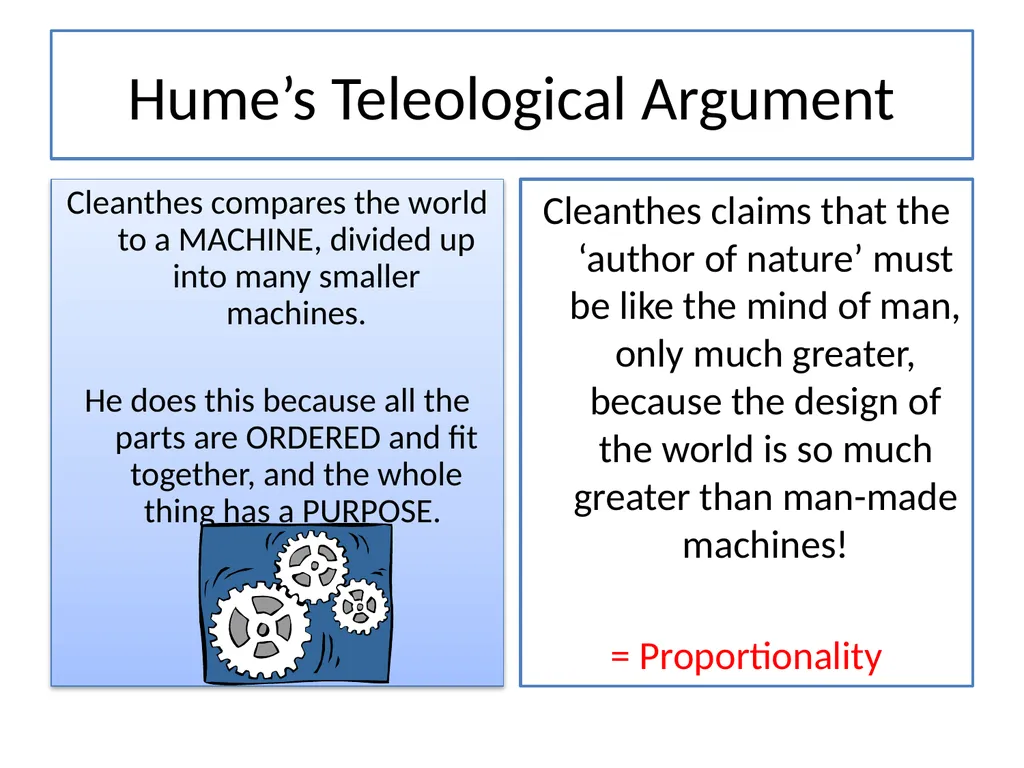
Hume’s Teleological Argument Cleanthes compares the world to a MACHINE, divided up into many smaller machines.
He does this because all the parts are ORDERED and fit together, and the whole thing has a PURPOSE. Cleanthes claims that the ‘author of nature’ must be like the mind of man, only much greater, because the design of the world is so much greater than man-made machines!
= Proportionality<br>
07
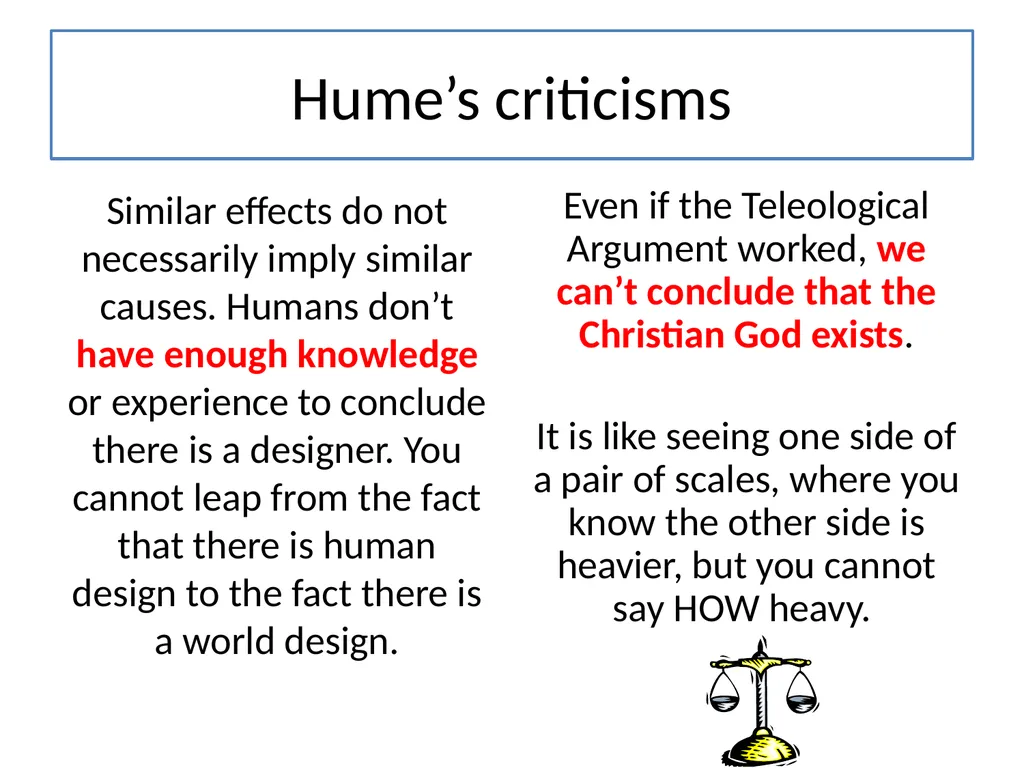
Hume’s criticisms Similar effects do not necessarily imply similar causes. Humans don’t have enough knowledge or experience to conclude there is a designer. You cannot leap from the fact that there is human design to the fact there is a world design. Even if the Teleological Argument worked, we can’t conclude that the Christian God exists.
It is like seeing one side of a pair of scales, where you know the other side is heavier, but you cannot say HOW heavy.<br>
08
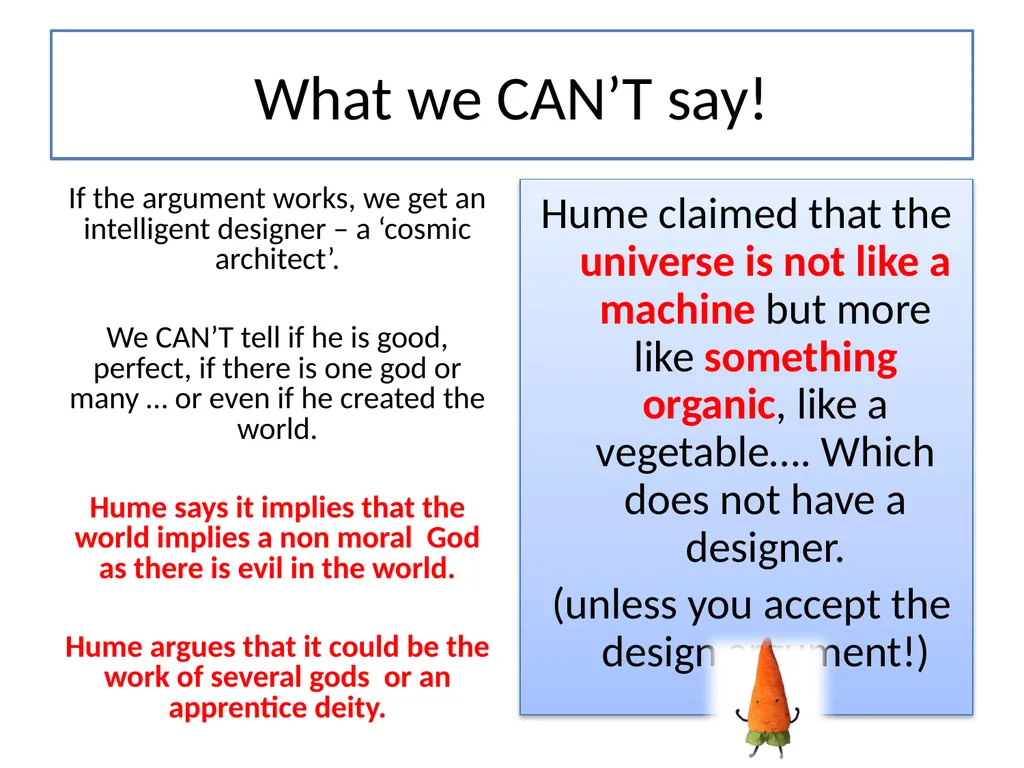
What we CAN’T say! If the argument works, we get an intelligent designer – a ‘cosmic architect’.
We CAN’T tell if he is good, perfect, if there is one god or many … or even if he created the world.
Hume says it implies that the world implies a non moral God as there is evil in the world.
Hume argues that it could be the work of several gods or an apprentice deity. Hume claimed that the universe is not like a machine but more like something organic, like a vegetable…. Which does not have a designer.
(unless you accept the design argument!)<br>
09
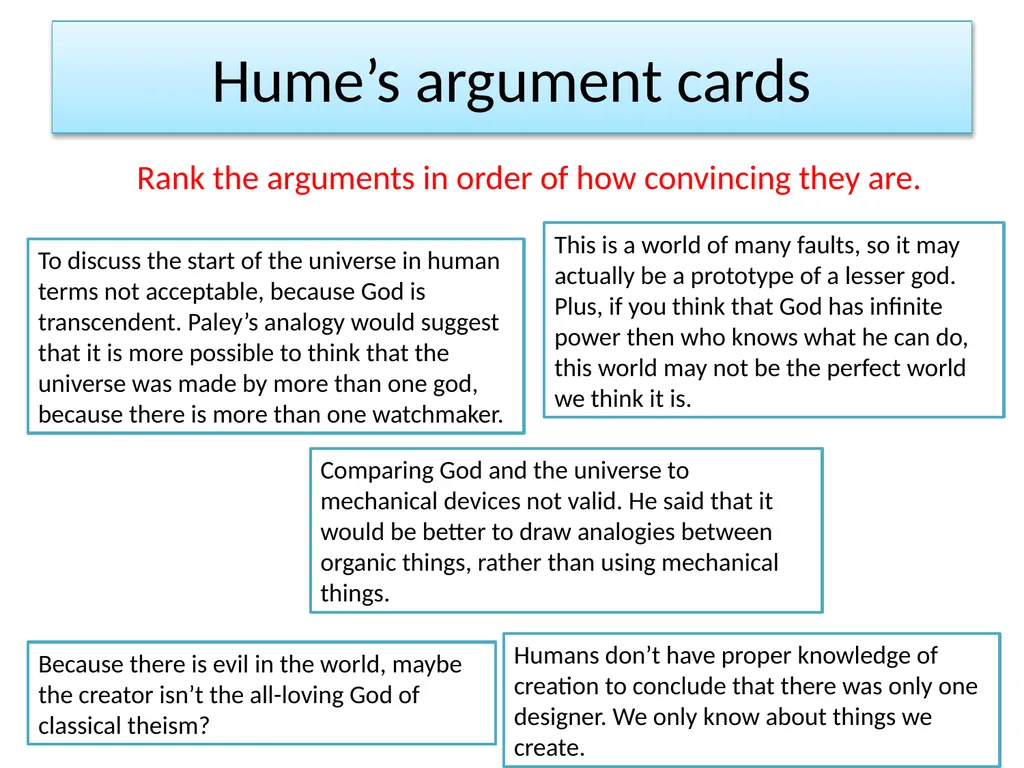
Hume’s argument cards Rank the arguments in order of how convincing they are. Comparing God and the universe to mechanical devices not valid. He said that it would be better to draw analogies between organic things, rather than using mechanical things. Humans don’t have proper knowledge of creation to conclude that there was only one designer. We only know about things we create. This is a world of many faults, so it may actually be a prototype of a lesser god. Plus, if you think that God has infinite power then who knows what he can do, this world may not be the perfect world we think it is. Because there is evil in the world, maybe the creator isn’t the all-loving God of classical theism? To discuss the start of the universe in human terms not acceptable, because God is transcendent. Paley’s analogy would suggest that it is more possible to think that the universe was made by more than one god, because there is more than one watchmaker.<br>
10
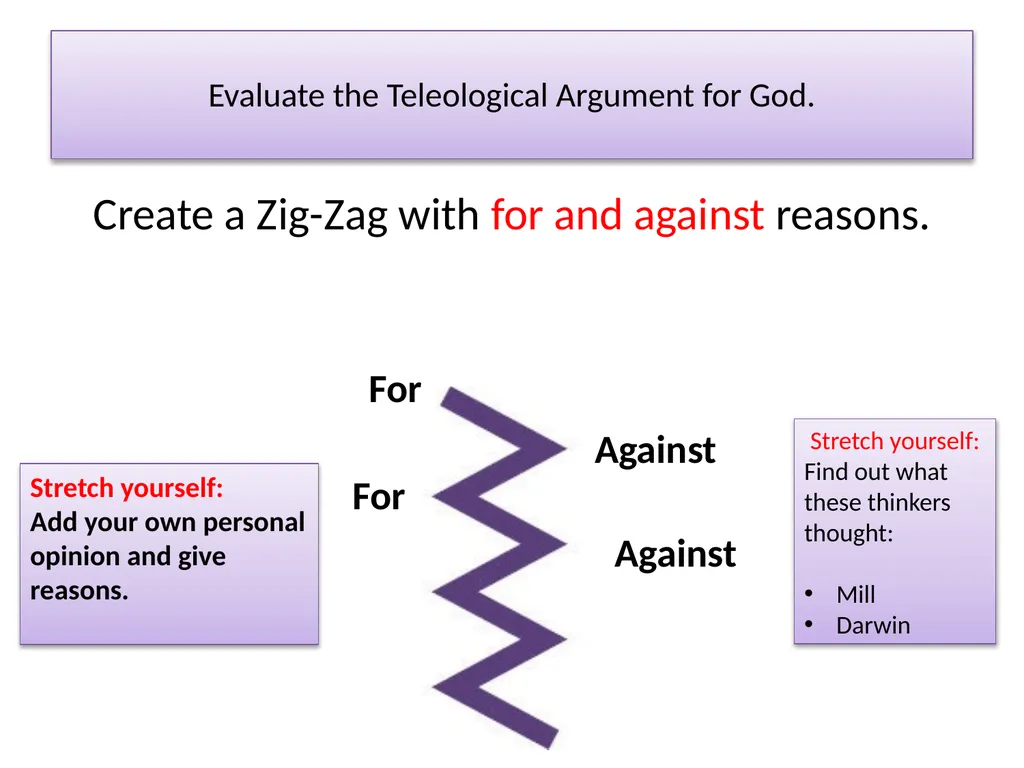
Create a Zig-Zag with for and against reasons. For Against For Against Stretch yourself:
Add your own personal opinion and give reasons. Evaluate the Teleological Argument for God. Stretch yourself:
Find out what these thinkers thought:
Mill
Darwin<br>
11
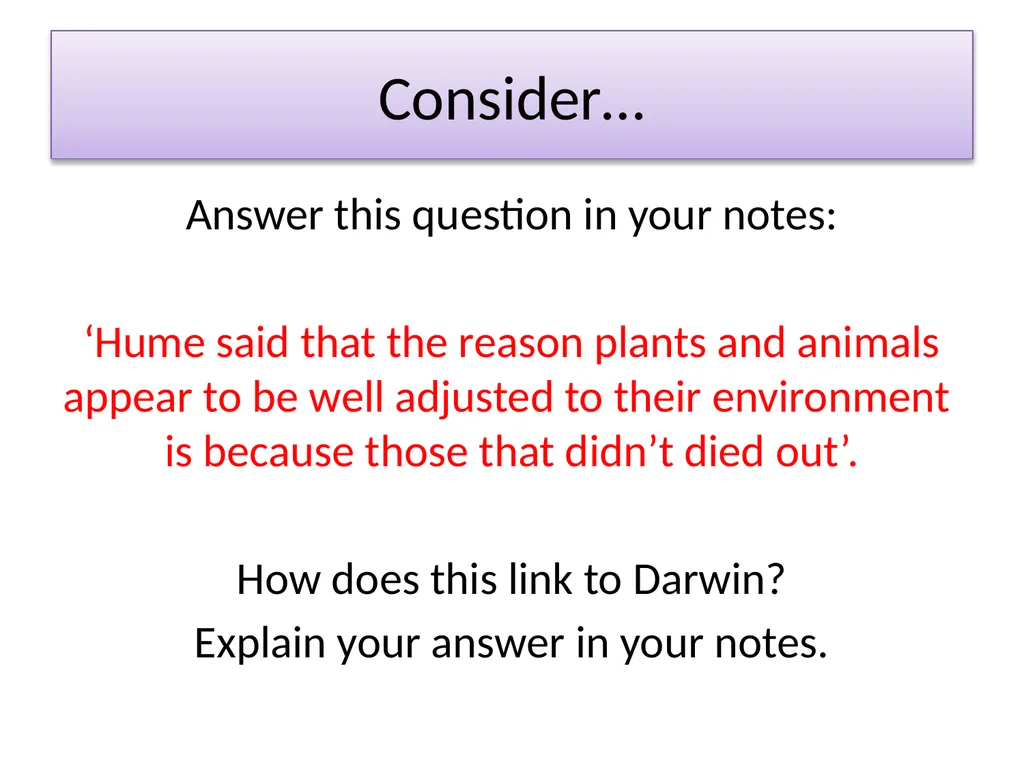
Consider… Answer this question in your notes:
‘Hume said that the reason plants and animals appear to be well adjusted to their environment is because those that didn’t died out’.
How does this link to Darwin?
Explain your answer in your notes.<br>
12
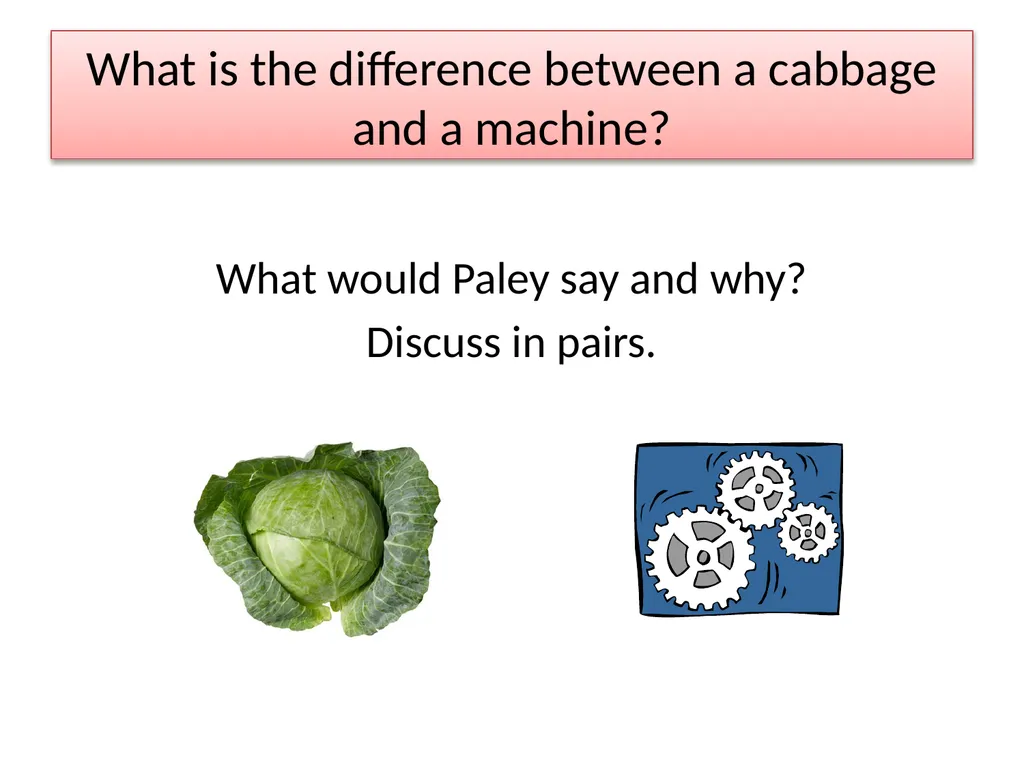
What is the difference between a cabbage and a machine? What would Hume say and why?
Discuss in pairs.<br>