
What main points can I make about him? Introduced
BR
Published · 6 slides · 0 views

1 / 1
Description
What main points can I make about him? Introduced as a childish character Stands up to his fathers outdated views Mistreats Eva Smith Although not immediately willing to, takes responsibility for his actions Drinks to deal with the guilt
Related Topics
Share
Embed code
Download this presentation From Below
"What main points can I make about him? Introduced" is the property of its rightful owner. Permission is granted to download and print the materials on this website for personal, non-commercial use only, and to display it on your personal computer provided you do not modify the materials and that you retain all copyright notices contained in the materials. By downloading content from our website, you accept the terms of this agreement.
Presentation Transcript
01
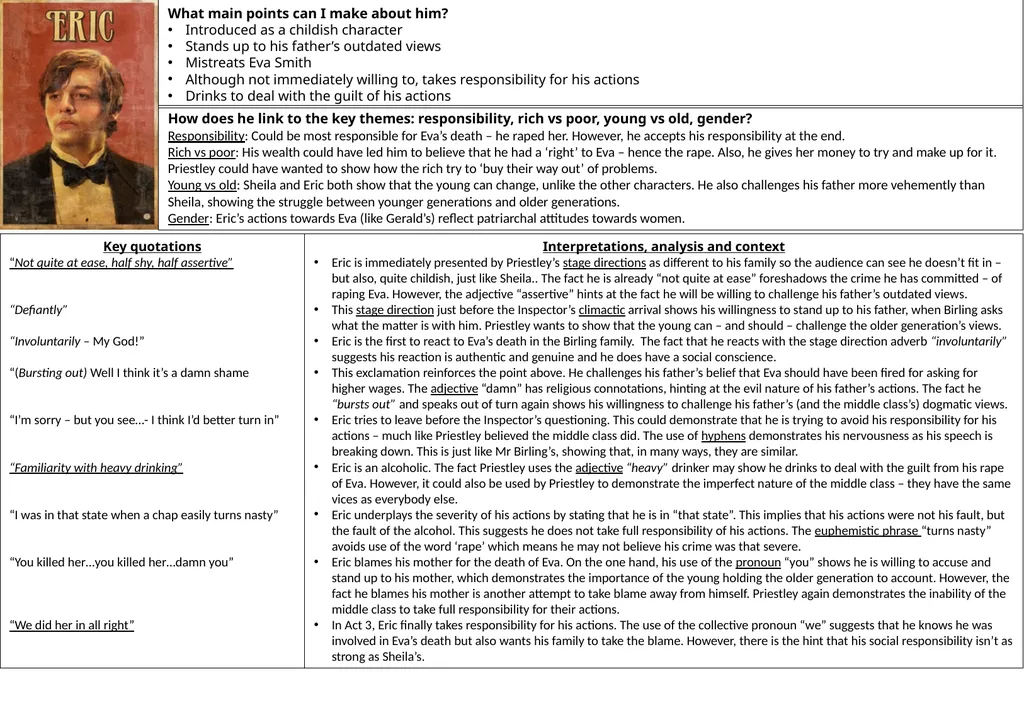
What main points can I make about him?
Introduced as a childish character
Stands up to his father’s outdated views
Mistreats Eva Smith
Although not immediately willing to, takes responsibility for his actions
Drinks to deal with the guilt of his actions How does he link to the key themes: responsibility, rich vs poor, young vs old, gender?
Responsibility: Could be most responsible for Eva’s death – he raped her. However, he accepts his responsibility at the end.
Rich vs poor: His wealth could have led him to believe that he had a ‘right’ to Eva – hence the rape. Also, he gives her money to try and make up for it. Priestley could have wanted to show how the rich try to ‘buy their way out’ of problems.
Young vs old: Sheila and Eric both show that the young can change, unlike the other characters. He also challenges his father more vehemently than Sheila, showing the struggle between younger generations and older generations.
Gender: Eric’s actions towards Eva (like Gerald’s) reflect patriarchal attitudes towards women. Interpretations, analysis and context
Eric is immediately presented by Priestley’s stage directions as different to his family so the audience can see he doesn’t fit in – but also, quite childish, just like Sheila.. The fact he is already “not quite at ease” foreshadows the crime he has committed – of raping Eva. However, the adjective “assertive” hints at the fact he will be willing to challenge his father’s outdated views.
This stage direction just before the Inspector’s climactic arrival shows his willingness to stand up to his father, when Birling asks what the matter is with him. Priestley wants to show that the young can – and should – challenge the older generation’s views.
Eric is the first to react to Eva’s death in the Birling family. The fact that he reacts with the stage direction adverb “involuntarily” suggests his reaction is authentic and genuine and he does have a social conscience.
This exclamation reinforces the point above. He challenges his father’s belief that Eva should have been fired for asking for higher wages. The adjective “damn” has religious connotations, hinting at the evil nature of his father’s actions. The fact he “bursts out” and speaks out of turn again shows his willingness to challenge his father’s (and the middle class’s) dogmatic views.
Eric tries to leave before the Inspector’s questioning. This could demonstrate that he is trying to avoid his responsibility for his actions – much like Priestley believed the middle class did. The use of hyphens demonstrates his nervousness as his speech is breaking down. This is just like Mr Birling’s, showing that, in many ways, they are similar.
Eric is an alcoholic. The fact Priestley uses the adjective “heavy” drinker may show he drinks to deal with the guilt from his rape of Eva. However, it could also be used by Priestley to demonstrate the imperfect nature of the middle class – they have the same vices as everybody else.
Eric underplays the severity of his actions by stating that he is in “that state”. This implies that his actions were not his fault, but the fault of the alcohol. This suggests he does not take full responsibility of his actions. The euphemistic phrase “turns nasty” avoids use of the word ‘rape’ which means he may not believe his crime was that severe.
Eric blames his mother for the death of Eva. On the one hand, his use of the pronoun “you” shows he is willing to accuse and stand up to his mother, which demonstrates the importance of the young holding the older generation to account. However, the fact he blames his mother is another attempt to take blame away from himself. Priestley again demonstrates the inability of the middle class to take full responsibility for their actions.
In Act 3, Eric finally takes responsibility for his actions. The use of the collective pronoun “we” suggests that he knows he was involved in Eva’s death but also wants his family to take the blame. However, there is the hint that his social responsibility isn’t as strong as Sheila’s. Key quotations
“Not quite at ease, half shy, half assertive”
“Defiantly”
“Involuntarily – My God!”
“(Bursting out) Well I think it’s a damn shame
“I’m sorry – but you see…- I think I’d better turn in”
“Familiarity with heavy drinking”
“I was in that state when a chap easily turns nasty”
“You killed her…you killed her…damn you”
“We did her in all right”<br>
02
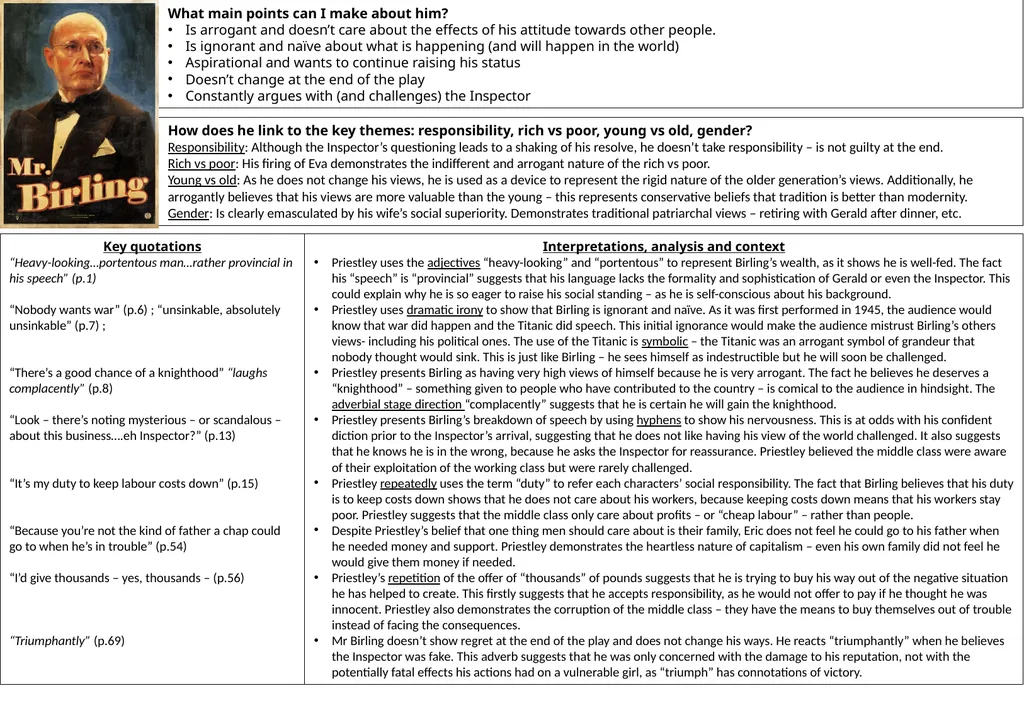
What main points can I make about him?
Is arrogant and doesn’t care about the effects of his attitude towards other people.
Is ignorant and naïve about what is happening (and will happen in the world)
Aspirational and wants to continue raising his status
Doesn’t change at the end of the play
Constantly argues with (and challenges) the Inspector How does he link to the key themes: responsibility, rich vs poor, young vs old, gender?
Responsibility: Although the Inspector’s questioning leads to a shaking of his resolve, he doesn’t take responsibility – is not guilty at the end.
Rich vs poor: His firing of Eva demonstrates the indifferent and arrogant nature of the rich vs poor.
Young vs old: As he does not change his views, he is used as a device to represent the rigid nature of the older generation’s views. Additionally, he arrogantly believes that his views are more valuable than the young – this represents conservative beliefs that tradition is better than modernity.
Gender: Is clearly emasculated by his wife’s social superiority. Demonstrates traditional patriarchal views – retiring with Gerald after dinner, etc. Interpretations, analysis and context
Priestley uses the adjectives “heavy-looking” and “portentous” to represent Birling’s wealth, as it shows he is well-fed. The fact his “speech” is “provincial” suggests that his language lacks the formality and sophistication of Gerald or even the Inspector. This could explain why he is so eager to raise his social standing – as he is self-conscious about his background.
Priestley uses dramatic irony to show that Birling is ignorant and naïve. As it was first performed in 1945, the audience would know that war did happen and the Titanic did speech. This initial ignorance would make the audience mistrust Birling’s others views- including his political ones. The use of the Titanic is symbolic – the Titanic was an arrogant symbol of grandeur that nobody thought would sink. This is just like Birling – he sees himself as indestructible but he will soon be challenged.
Priestley presents Birling as having very high views of himself because he is very arrogant. The fact he believes he deserves a “knighthood” – something given to people who have contributed to the country – is comical to the audience in hindsight. The adverbial stage direction “complacently” suggests that he is certain he will gain the knighthood.
Priestley presents Birling’s breakdown of speech by using hyphens to show his nervousness. This is at odds with his confident diction prior to the Inspector’s arrival, suggesting that he does not like having his view of the world challenged. It also suggests that he knows he is in the wrong, because he asks the Inspector for reassurance. Priestley believed the middle class were aware of their exploitation of the working class but were rarely challenged.
Priestley repeatedly uses the term “duty” to refer each characters’ social responsibility. The fact that Birling believes that his duty is to keep costs down shows that he does not care about his workers, because keeping costs down means that his workers stay poor. Priestley suggests that the middle class only care about profits – or “cheap labour” – rather than people.
Despite Priestley’s belief that one thing men should care about is their family, Eric does not feel he could go to his father when he needed money and support. Priestley demonstrates the heartless nature of capitalism – even his own family did not feel he would give them money if needed.
Priestley’s repetition of the offer of “thousands” of pounds suggests that he is trying to buy his way out of the negative situation he has helped to create. This firstly suggests that he accepts responsibility, as he would not offer to pay if he thought he was innocent. Priestley also demonstrates the corruption of the middle class – they have the means to buy themselves out of trouble instead of facing the consequences.
Mr Birling doesn’t show regret at the end of the play and does not change his ways. He reacts “triumphantly” when he believes the Inspector was fake. This adverb suggests that he was only concerned with the damage to his reputation, not with the potentially fatal effects his actions had on a vulnerable girl, as “triumph” has connotations of victory. Key quotations
“Heavy-looking…portentous man…rather provincial in his speech” (p.1)
“Nobody wants war” (p.6) ; “unsinkable, absolutely unsinkable” (p.7) ;
“There’s a good chance of a knighthood” “laughs complacently” (p.8)
“Look – there’s noting mysterious – or scandalous – about this business….eh Inspector?” (p.13)
“It’s my duty to keep labour costs down” (p.15)
“Because you’re not the kind of father a chap could go to when he’s in trouble” (p.54)
“I’d give thousands – yes, thousands – (p.56)
“Triumphantly” (p.69)<br>
03
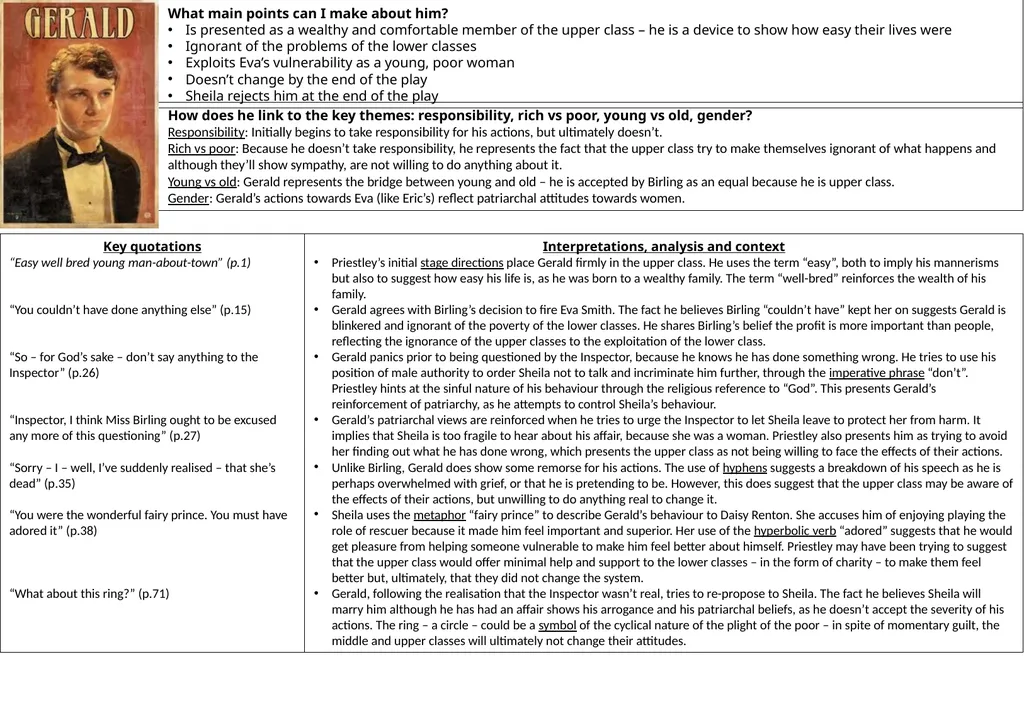
What main points can I make about him?
Is presented as a wealthy and comfortable member of the upper class – he is a device to show how easy their lives were
Ignorant of the problems of the lower classes
Exploits Eva’s vulnerability as a young, poor woman
Doesn’t change by the end of the play
Sheila rejects him at the end of the play How does he link to the key themes: responsibility, rich vs poor, young vs old, gender?
Responsibility: Initially begins to take responsibility for his actions, but ultimately doesn’t.
Rich vs poor: Because he doesn’t take responsibility, he represents the fact that the upper class try to make themselves ignorant of what happens and although they’ll show sympathy, are not willing to do anything about it.
Young vs old: Gerald represents the bridge between young and old – he is accepted by Birling as an equal because he is upper class.
Gender: Gerald’s actions towards Eva (like Eric’s) reflect patriarchal attitudes towards women. Interpretations, analysis and context
Priestley’s initial stage directions place Gerald firmly in the upper class. He uses the term “easy”, both to imply his mannerisms but also to suggest how easy his life is, as he was born to a wealthy family. The term “well-bred” reinforces the wealth of his family.
Gerald agrees with Birling’s decision to fire Eva Smith. The fact he believes Birling “couldn’t have” kept her on suggests Gerald is blinkered and ignorant of the poverty of the lower classes. He shares Birling’s belief the profit is more important than people, reflecting the ignorance of the upper classes to the exploitation of the lower class.
Gerald panics prior to being questioned by the Inspector, because he knows he has done something wrong. He tries to use his position of male authority to order Sheila not to talk and incriminate him further, through the imperative phrase “don’t”. Priestley hints at the sinful nature of his behaviour through the religious reference to “God”. This presents Gerald’s reinforcement of patriarchy, as he attempts to control Sheila’s behaviour.
Gerald’s patriarchal views are reinforced when he tries to urge the Inspector to let Sheila leave to protect her from harm. It implies that Sheila is too fragile to hear about his affair, because she was a woman. Priestley also presents him as trying to avoid her finding out what he has done wrong, which presents the upper class as not being willing to face the effects of their actions.
Unlike Birling, Gerald does show some remorse for his actions. The use of hyphens suggests a breakdown of his speech as he is perhaps overwhelmed with grief, or that he is pretending to be. However, this does suggest that the upper class may be aware of the effects of their actions, but unwilling to do anything real to change it.
Sheila uses the metaphor “fairy prince” to describe Gerald’s behaviour to Daisy Renton. She accuses him of enjoying playing the role of rescuer because it made him feel important and superior. Her use of the hyperbolic verb “adored” suggests that he would get pleasure from helping someone vulnerable to make him feel better about himself. Priestley may have been trying to suggest that the upper class would offer minimal help and support to the lower classes – in the form of charity – to make them feel better but, ultimately, that they did not change the system.
Gerald, following the realisation that the Inspector wasn’t real, tries to re-propose to Sheila. The fact he believes Sheila will marry him although he has had an affair shows his arrogance and his patriarchal beliefs, as he doesn’t accept the severity of his actions. The ring – a circle – could be a symbol of the cyclical nature of the plight of the poor – in spite of momentary guilt, the middle and upper classes will ultimately not change their attitudes. Key quotations
“Easy well bred young man-about-town” (p.1)
“You couldn’t have done anything else” (p.15)
“So – for God’s sake – don’t say anything to the Inspector” (p.26)
“Inspector, I think Miss Birling ought to be excused any more of this questioning” (p.27)
“Sorry – I – well, I’ve suddenly realised – that she’s dead” (p.35)
“You were the wonderful fairy prince. You must have adored it” (p.38)
“What about this ring?” (p.71)<br>
04
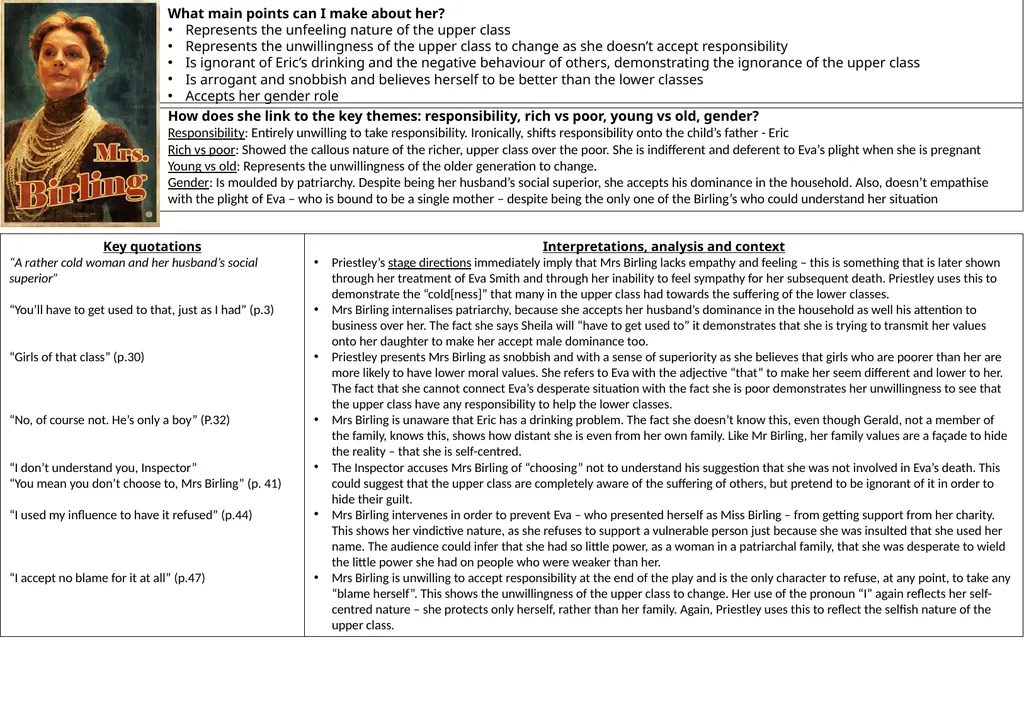
What main points can I make about her?
Represents the unfeeling nature of the upper class
Represents the unwillingness of the upper class to change as she doesn’t accept responsibility
Is ignorant of Eric’s drinking and the negative behaviour of others, demonstrating the ignorance of the upper class
Is arrogant and snobbish and believes herself to be better than the lower classes
Accepts her gender role How does she link to the key themes: responsibility, rich vs poor, young vs old, gender?
Responsibility: Entirely unwilling to take responsibility. Ironically, shifts responsibility onto the child’s father - Eric
Rich vs poor: Showed the callous nature of the richer, upper class over the poor. She is indifferent and deferent to Eva’s plight when she is pregnant
Young vs old: Represents the unwillingness of the older generation to change.
Gender: Is moulded by patriarchy. Despite being her husband’s social superior, she accepts his dominance in the household. Also, doesn’t empathise with the plight of Eva – who is bound to be a single mother – despite being the only one of the Birling’s who could understand her situation Interpretations, analysis and context
Priestley’s stage directions immediately imply that Mrs Birling lacks empathy and feeling – this is something that is later shown through her treatment of Eva Smith and through her inability to feel sympathy for her subsequent death. Priestley uses this to demonstrate the “cold[ness]” that many in the upper class had towards the suffering of the lower classes.
Mrs Birling internalises patriarchy, because she accepts her husband’s dominance in the household as well his attention to business over her. The fact she says Sheila will “have to get used to” it demonstrates that she is trying to transmit her values onto her daughter to make her accept male dominance too.
Priestley presents Mrs Birling as snobbish and with a sense of superiority as she believes that girls who are poorer than her are more likely to have lower moral values. She refers to Eva with the adjective “that” to make her seem different and lower to her. The fact that she cannot connect Eva’s desperate situation with the fact she is poor demonstrates her unwillingness to see that the upper class have any responsibility to help the lower classes.
Mrs Birling is unaware that Eric has a drinking problem. The fact she doesn’t know this, even though Gerald, not a member of the family, knows this, shows how distant she is even from her own family. Like Mr Birling, her family values are a façade to hide the reality – that she is self-centred.
The Inspector accuses Mrs Birling of “choosing” not to understand his suggestion that she was not involved in Eva’s death. This could suggest that the upper class are completely aware of the suffering of others, but pretend to be ignorant of it in order to hide their guilt.
Mrs Birling intervenes in order to prevent Eva – who presented herself as Miss Birling – from getting support from her charity. This shows her vindictive nature, as she refuses to support a vulnerable person just because she was insulted that she used her name. The audience could infer that she had so little power, as a woman in a patriarchal family, that she was desperate to wield the little power she had on people who were weaker than her.
Mrs Birling is unwilling to accept responsibility at the end of the play and is the only character to refuse, at any point, to take any “blame herself”. This shows the unwillingness of the upper class to change. Her use of the pronoun “I” again reflects her self-centred nature – she protects only herself, rather than her family. Again, Priestley uses this to reflect the selfish nature of the upper class. Key quotations
“A rather cold woman and her husband’s social superior”
“You’ll have to get used to that, just as I had” (p.3)
“Girls of that class” (p.30)
“No, of course not. He’s only a boy” (P.32)
“I don’t understand you, Inspector”
“You mean you don’t choose to, Mrs Birling” (p. 41)
“I used my influence to have it refused” (p.44)
“I accept no blame for it at all” (p.47)<br>
05
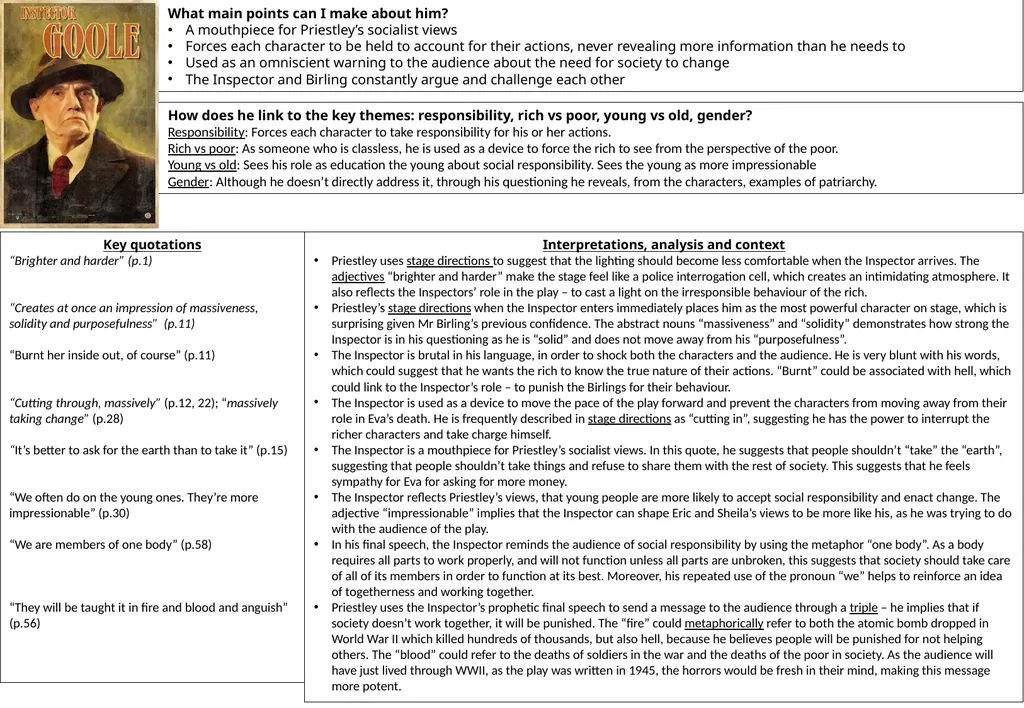
What main points can I make about him?
A mouthpiece for Priestley’s socialist views
Forces each character to be held to account for their actions, never revealing more information than he needs to
Used as an omniscient warning to the audience about the need for society to change
The Inspector and Birling constantly argue and challenge each other How does he link to the key themes: responsibility, rich vs poor, young vs old, gender?
Responsibility: Forces each character to take responsibility for his or her actions.
Rich vs poor: As someone who is classless, he is used as a device to force the rich to see from the perspective of the poor.
Young vs old: Sees his role as education the young about social responsibility. Sees the young as more impressionable
Gender: Although he doesn’t directly address it, through his questioning he reveals, from the characters, examples of patriarchy. Interpretations, analysis and context
Priestley uses stage directions to suggest that the lighting should become less comfortable when the Inspector arrives. The adjectives “brighter and harder” make the stage feel like a police interrogation cell, which creates an intimidating atmosphere. It also reflects the Inspectors’ role in the play – to cast a light on the irresponsible behaviour of the rich.
Priestley’s stage directions when the Inspector enters immediately places him as the most powerful character on stage, which is surprising given Mr Birling’s previous confidence. The abstract nouns “massiveness” and “solidity” demonstrates how strong the Inspector is in his questioning as he is “solid” and does not move away from his “purposefulness”.
The Inspector is brutal in his language, in order to shock both the characters and the audience. He is very blunt with his words, which could suggest that he wants the rich to know the true nature of their actions. “Burnt” could be associated with hell, which could link to the Inspector’s role – to punish the Birlings for their behaviour.
The Inspector is used as a device to move the pace of the play forward and prevent the characters from moving away from their role in Eva’s death. He is frequently described in stage directions as “cutting in”, suggesting he has the power to interrupt the richer characters and take charge himself.
The Inspector is a mouthpiece for Priestley’s socialist views. In this quote, he suggests that people shouldn’t “take” the “earth”, suggesting that people shouldn’t take things and refuse to share them with the rest of society. This suggests that he feels sympathy for Eva for asking for more money.
The Inspector reflects Priestley’s views, that young people are more likely to accept social responsibility and enact change. The adjective “impressionable” implies that the Inspector can shape Eric and Sheila’s views to be more like his, as he was trying to do with the audience of the play.
In his final speech, the Inspector reminds the audience of social responsibility by using the metaphor “one body”. As a body requires all parts to work properly, and will not function unless all parts are unbroken, this suggests that society should take care of all of its members in order to function at its best. Moreover, his repeated use of the pronoun “we” helps to reinforce an idea of togetherness and working together.
Priestley uses the Inspector’s prophetic final speech to send a message to the audience through a triple – he implies that if society doesn’t work together, it will be punished. The “fire” could metaphorically refer to both the atomic bomb dropped in World War II which killed hundreds of thousands, but also hell, because he believes people will be punished for not helping others. The “blood” could refer to the deaths of soldiers in the war and the deaths of the poor in society. As the audience will have just lived through WWII, as the play was written in 1945, the horrors would be fresh in their mind, making this message more potent. Key quotations
“Brighter and harder” (p.1)
“Creates at once an impression of massiveness, solidity and purposefulness” (p.11)
“Burnt her inside out, of course” (p.11)
“Cutting through, massively” (p.12, 22); “massively taking change” (p.28)
“It’s better to ask for the earth than to take it” (p.15)
“We often do on the young ones. They’re more impressionable” (p.30)
“We are members of one body” (p.58)
“They will be taught it in fire and blood and anguish” (p.56)<br>
06
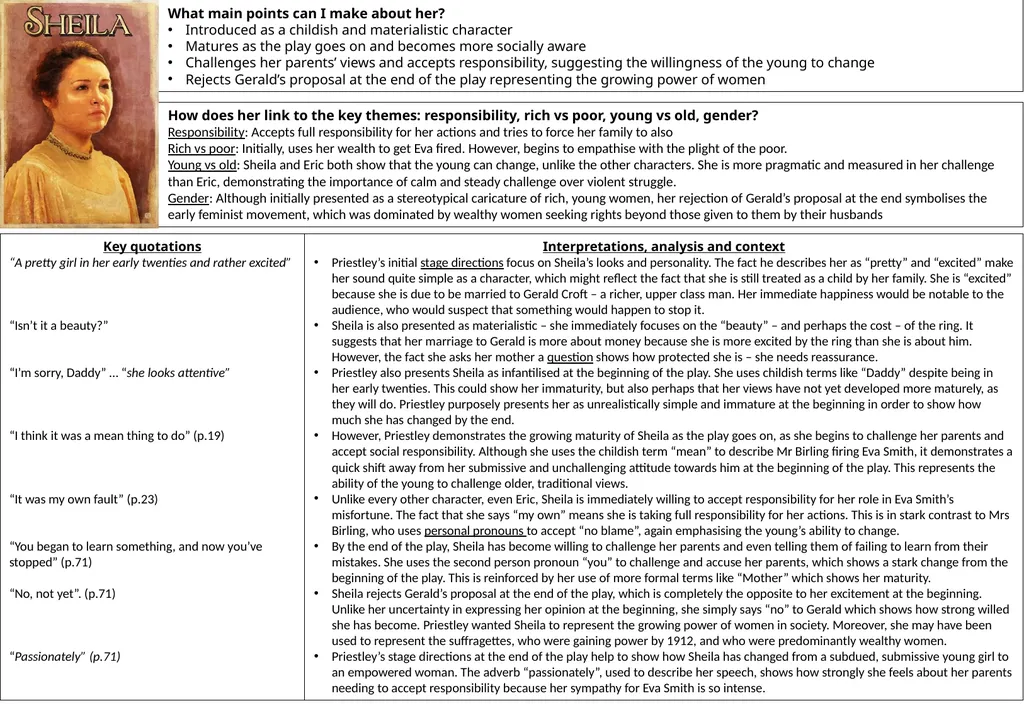
What main points can I make about her?
Introduced as a childish and materialistic character
Matures as the play goes on and becomes more socially aware
Challenges her parents’ views and accepts responsibility, suggesting the willingness of the young to change
Rejects Gerald’s proposal at the end of the play representing the growing power of women How does her link to the key themes: responsibility, rich vs poor, young vs old, gender?
Responsibility: Accepts full responsibility for her actions and tries to force her family to also
Rich vs poor: Initially, uses her wealth to get Eva fired. However, begins to empathise with the plight of the poor.
Young vs old: Sheila and Eric both show that the young can change, unlike the other characters. She is more pragmatic and measured in her challenge than Eric, demonstrating the importance of calm and steady challenge over violent struggle.
Gender: Although initially presented as a stereotypical caricature of rich, young women, her rejection of Gerald’s proposal at the end symbolises the early feminist movement, which was dominated by wealthy women seeking rights beyond those given to them by their husbands Interpretations, analysis and context
Priestley’s initial stage directions focus on Sheila’s looks and personality. The fact he describes her as “pretty” and “excited” make her sound quite simple as a character, which might reflect the fact that she is still treated as a child by her family. She is “excited” because she is due to be married to Gerald Croft – a richer, upper class man. Her immediate happiness would be notable to the audience, who would suspect that something would happen to stop it.
Sheila is also presented as materialistic – she immediately focuses on the “beauty” – and perhaps the cost – of the ring. It suggests that her marriage to Gerald is more about money because she is more excited by the ring than she is about him. However, the fact she asks her mother a question shows how protected she is – she needs reassurance.
Priestley also presents Sheila as infantilised at the beginning of the play. She uses childish terms like “Daddy” despite being in her early twenties. This could show her immaturity, but also perhaps that her views have not yet developed more maturely, as they will do. Priestley purposely presents her as unrealistically simple and immature at the beginning in order to show how much she has changed by the end.
However, Priestley demonstrates the growing maturity of Sheila as the play goes on, as she begins to challenge her parents and accept social responsibility. Although she uses the childish term “mean” to describe Mr Birling firing Eva Smith, it demonstrates a quick shift away from her submissive and unchallenging attitude towards him at the beginning of the play. This represents the ability of the young to challenge older, traditional views.
Unlike every other character, even Eric, Sheila is immediately willing to accept responsibility for her role in Eva Smith’s misfortune. The fact that she says “my own” means she is taking full responsibility for her actions. This is in stark contrast to Mrs Birling, who uses personal pronouns to accept “no blame”, again emphasising the young’s ability to change.
By the end of the play, Sheila has become willing to challenge her parents and even telling them of failing to learn from their mistakes. She uses the second person pronoun “you” to challenge and accuse her parents, which shows a stark change from the beginning of the play. This is reinforced by her use of more formal terms like “Mother” which shows her maturity.
Sheila rejects Gerald’s proposal at the end of the play, which is completely the opposite to her excitement at the beginning. Unlike her uncertainty in expressing her opinion at the beginning, she simply says “no” to Gerald which shows how strong willed she has become. Priestley wanted Sheila to represent the growing power of women in society. Moreover, she may have been used to represent the suffragettes, who were gaining power by 1912, and who were predominantly wealthy women.
Priestley’s stage directions at the end of the play help to show how Sheila has changed from a subdued, submissive young girl to an empowered woman. The adverb “passionately”, used to describe her speech, shows how strongly she feels about her parents needing to accept responsibility because her sympathy for Eva Smith is so intense. Key quotations
“A pretty girl in her early twenties and rather excited”
“Isn’t it a beauty?”
“I’m sorry, Daddy” … “she looks attentive”
“I think it was a mean thing to do” (p.19)
“It was my own fault” (p.23)
“You began to learn something, and now you’ve stopped” (p.71)
“No, not yet”. (p.71)
“Passionately” (p.71)<br>