
What makes a bird a native species? Write your

Description: What makes a bird a native species? Write your answer in your science journal. (you have 3 minutes to write what you know) https:www.birdnote.org Click Gallery Check out 1 nest cam Check out 2 featured bird videos Add to your What do
Related Topics
Download Presentation
"What makes a bird a native species? Write your" is the property of its rightful owner. Permission is granted to download and print the materials on this website for personal, non-commercial use only, and to display it on your personal computer provided you do not modify the materials and that you retain all copyright notices contained in the materials. By downloading content from our website, you accept the terms of this agreement.
Presentation Transcript
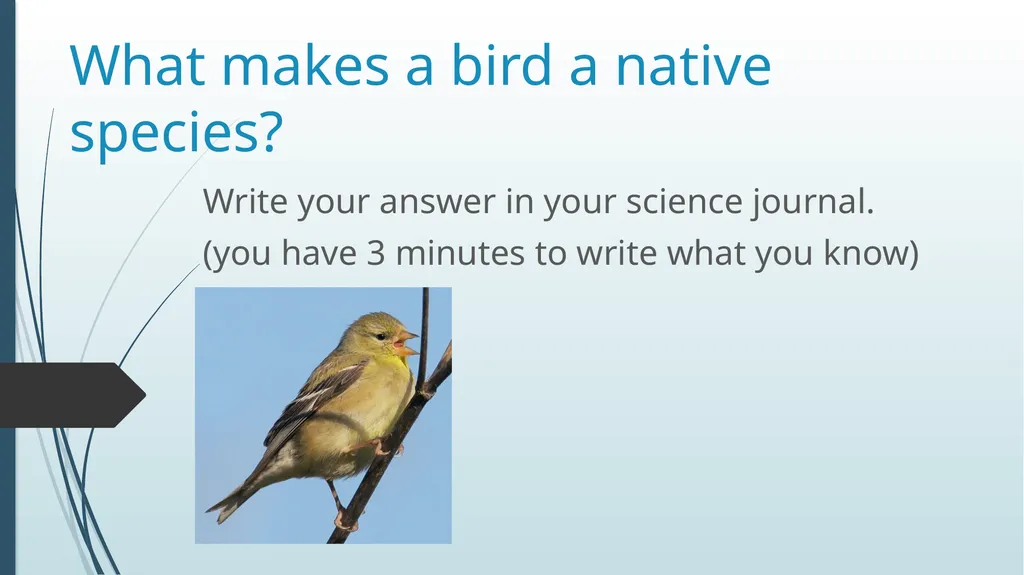
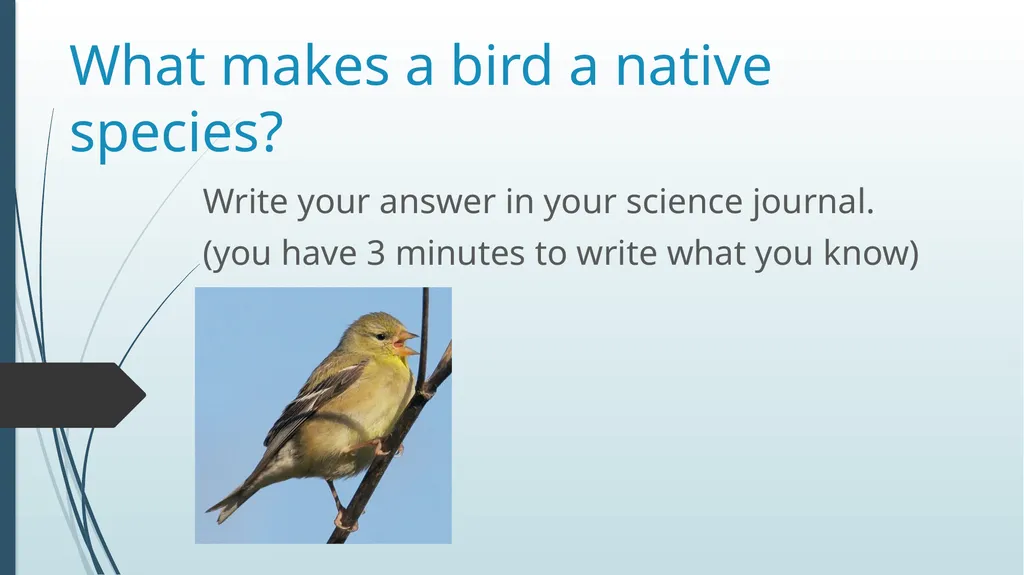
slide1. What makes a bird a native species? Write your answer in your science journal.
(you have 3 minutes to write what you know)<br>
slide2. https://www.birdnote.org/ Click “Gallery”
Check out 1 nest cam
Check out 2 featured bird videos
Add to your “What do you know about native bird species?”<br>
slide3. Monday Goals:
I can articulate what makes a bird a native species.
I can take notes on the native Washington birds.
I can use good writing habits.
Success Criteria:
Native Washington bird species notes.
What makes a species native restated.<br>
slide4. Teacher slide:
(Extended lesson ideas: https://www.birdnote.org/birds-washington-state)
The story provided is about the American Goldfinch (the Washington State bird)
Website on native Washington birds: http://www.birdweb.org/birdweb/birds
Washington State Webcams: https://wdfw.wa.gov/wildwatch/<br>
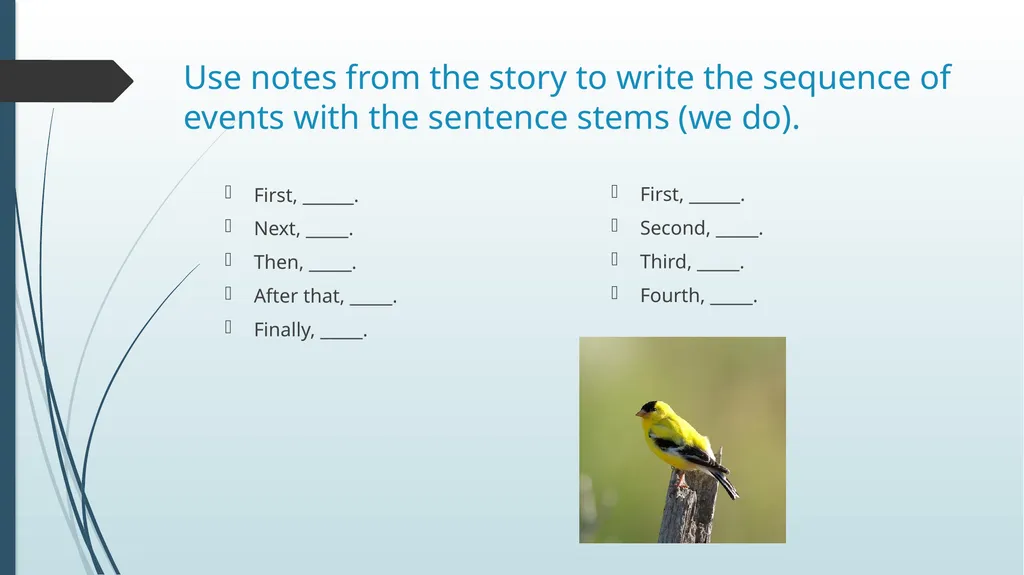
slide5. We have a story to read on the American Goldfinch. After reading the first time, please write down notes about the American Goldfinch.<br>
slide6. Use notes from the story to write the sequence of events with the sentence stems (we do). First, ______.
Next, _____.
Then, _____.
After that, _____.
Finally, _____. First, ______.
Second, _____.
Third, _____.
Fourth, _____.<br>
slide7. Another WA bird to research (you do) Go to the BirdWeb website
http://www.birdweb.org/birdweb/
Click on “Browse By: Birds”
Find another bird from Washington, read the information, and take notes on that bird.<br>
slide8. Use notes from the website to write the sequence of events surrounding the bird’s life cycle with the sentence stems (you do). First, ______.
Next, _____.
Then, _____.
After that, _____.
Finally, _____. First, ______.
Second, _____.
Third, _____.
Fourth, _____.<br>
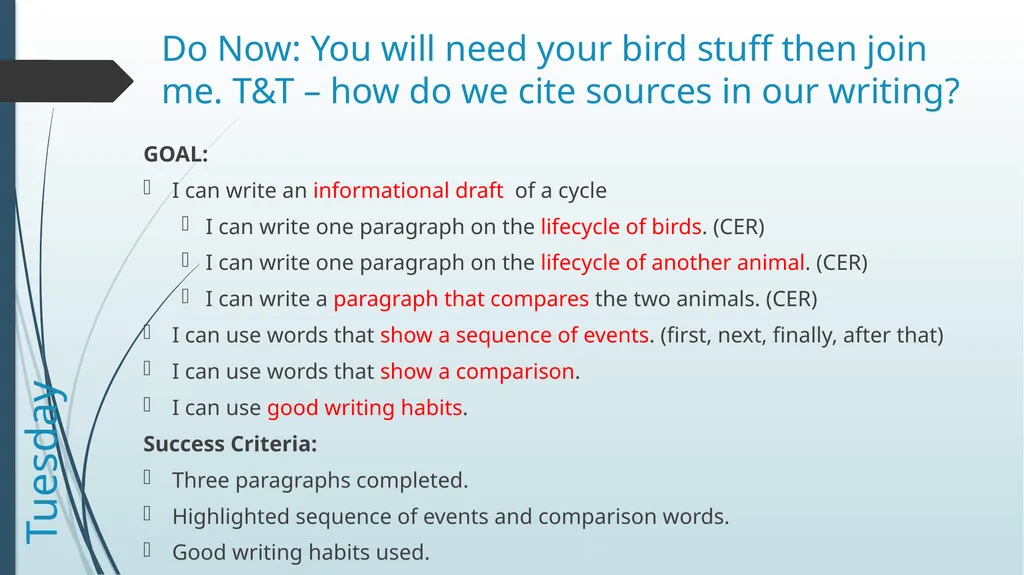
slide9. Do Now: You will need your bird stuff then join me. T&T – how do we cite sources in our writing? GOAL:
I can write an informational draft of a cycle
I can write one paragraph on the lifecycle of birds. (CER)
I can write one paragraph on the lifecycle of another animal. (CER)
I can write a paragraph that compares the two animals. (CER)
I can use words that show a sequence of events. (first, next, finally, after that)
I can use words that show a comparison.
I can use good writing habits.
Success Criteria:
Three paragraphs completed.
Highlighted sequence of events and comparison words.
Good writing habits used. Tuesday<br>
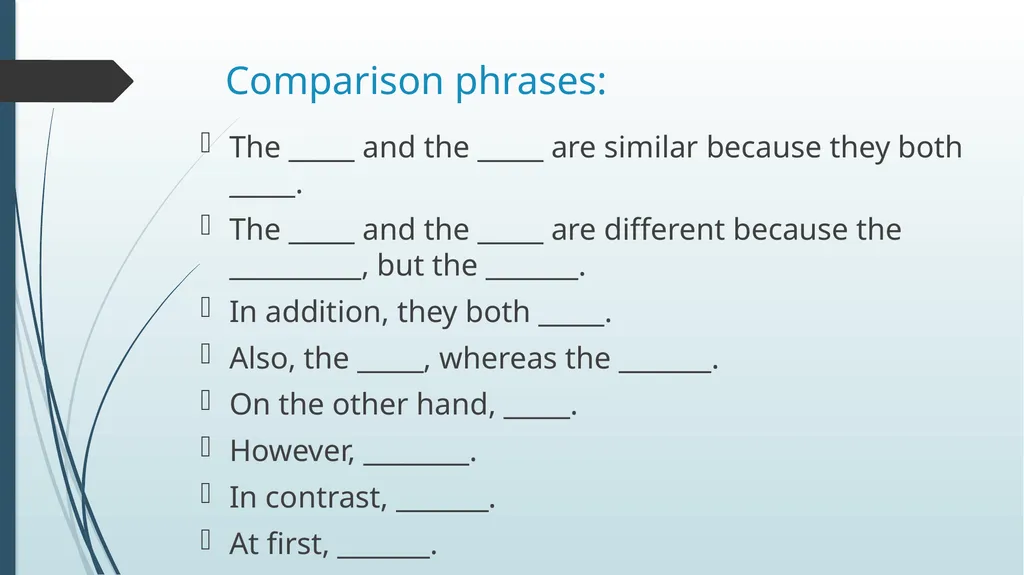
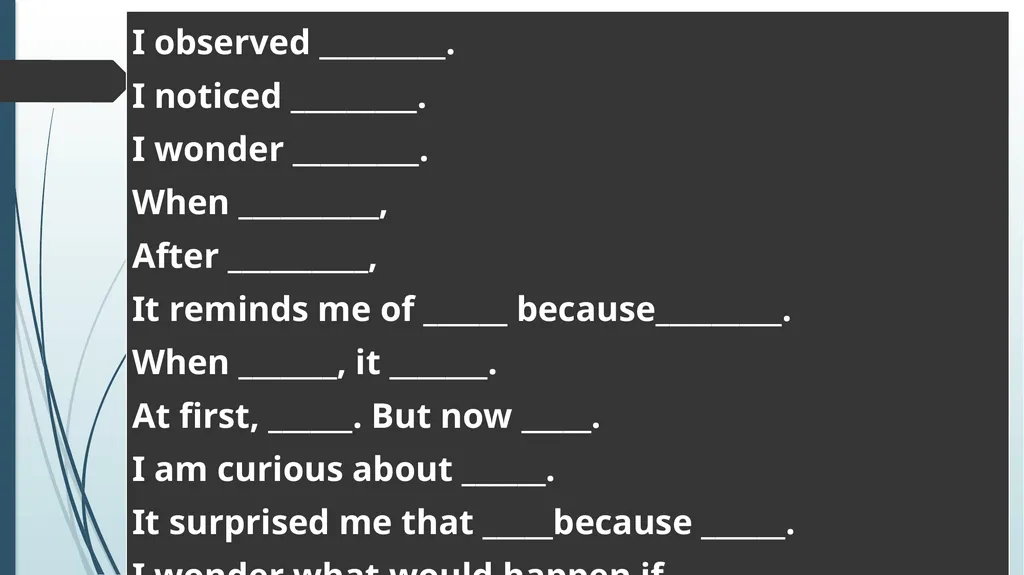
slide10. Comparison phrases: The _____ and the _____ are similar because they both _____.
The _____ and the _____ are different because the __________, but the _______.
In addition, they both _____.
Also, the _____, whereas the _______.
On the other hand, _____.
However, ________.
In contrast, _______.
At first, _______.<br>
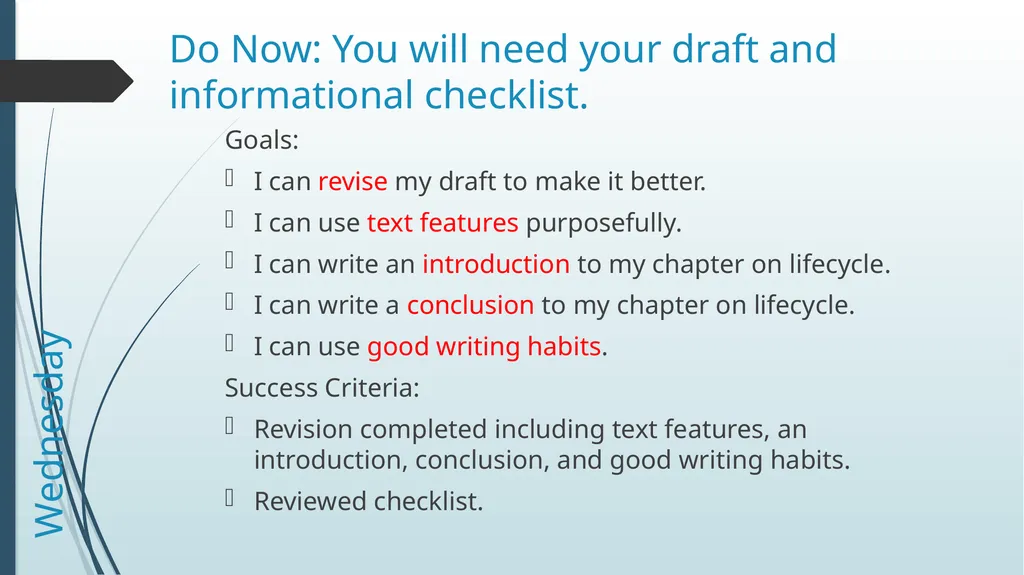
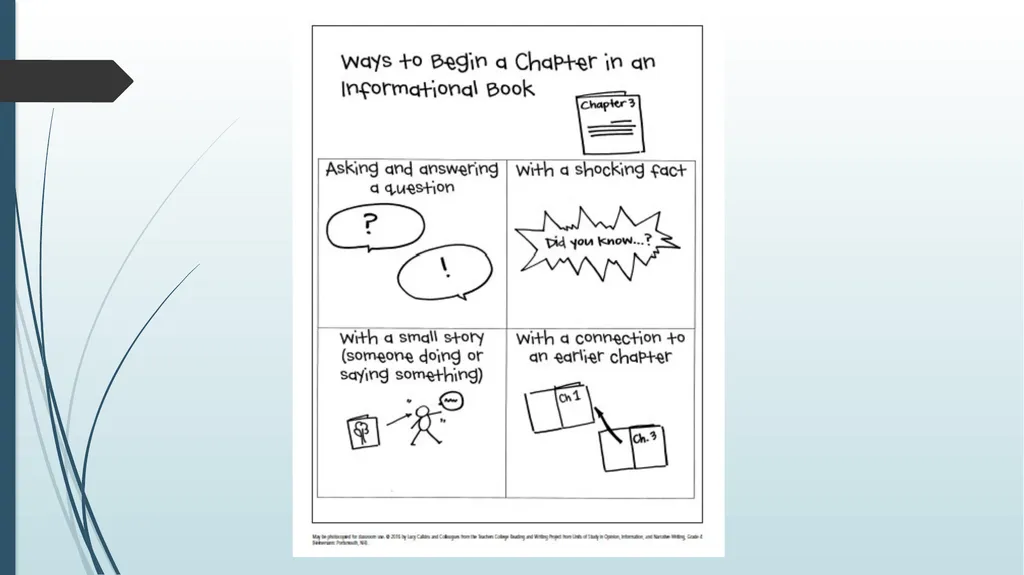
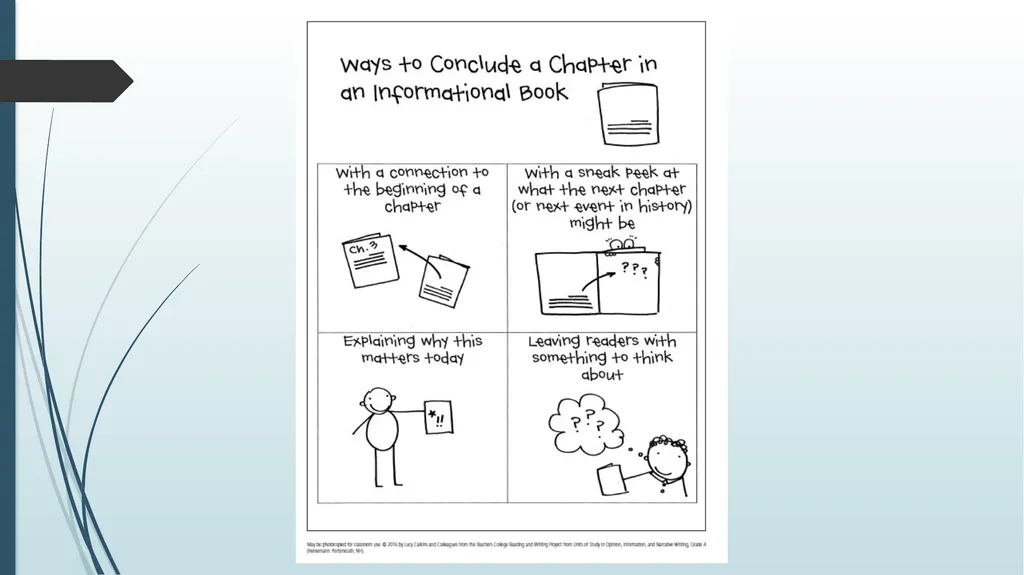
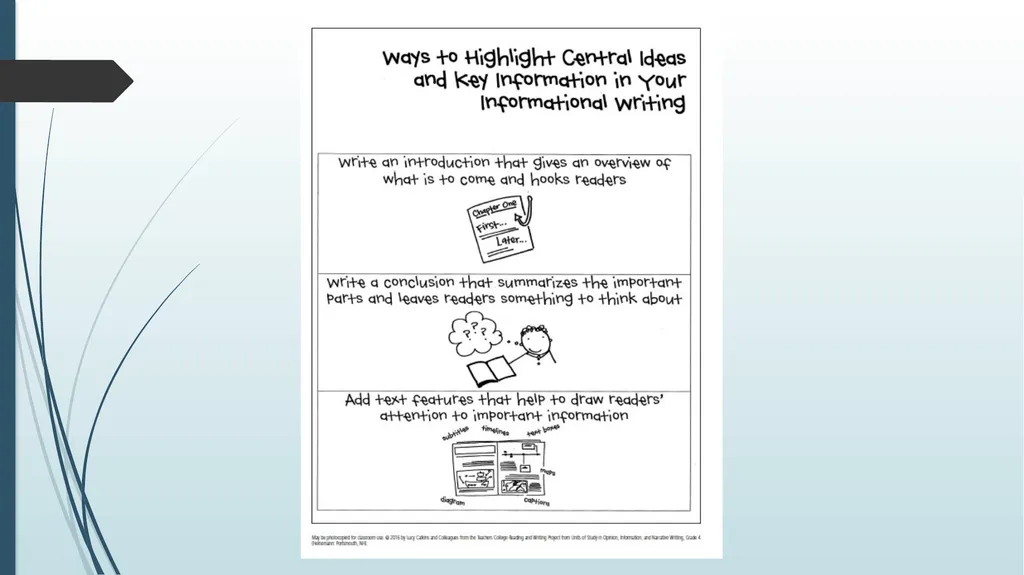
slide11. Do Now: You will need your draft and informational checklist. Goals:
I can revise my draft to make it better.
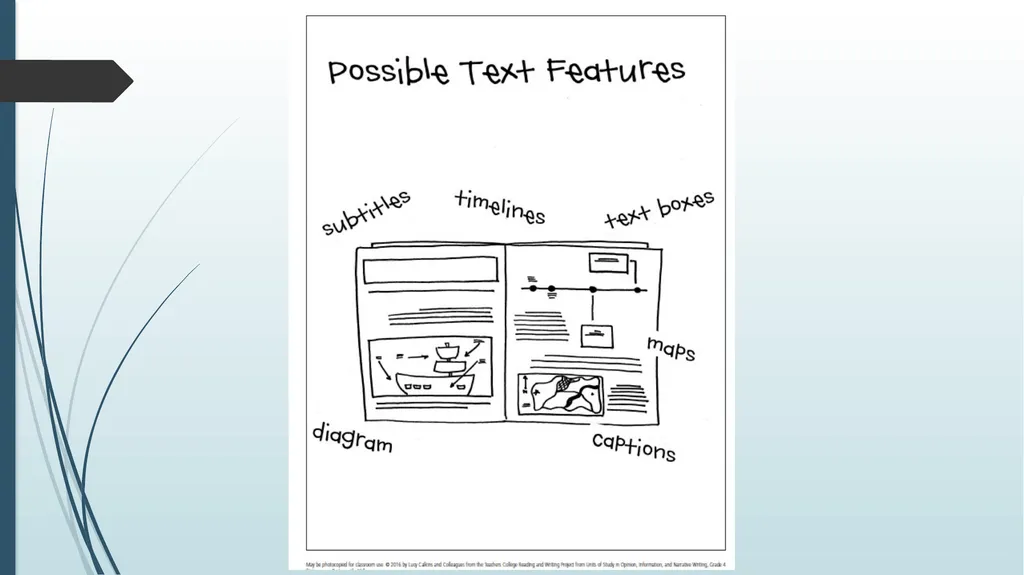
I can use text features purposefully.
I can write an introduction to my chapter on lifecycle.
I can write a conclusion to my chapter on lifecycle.
I can use good writing habits.
Success Criteria:
Revision completed including text features, an introduction, conclusion, and good writing habits.
Reviewed checklist. Wednesday<br>
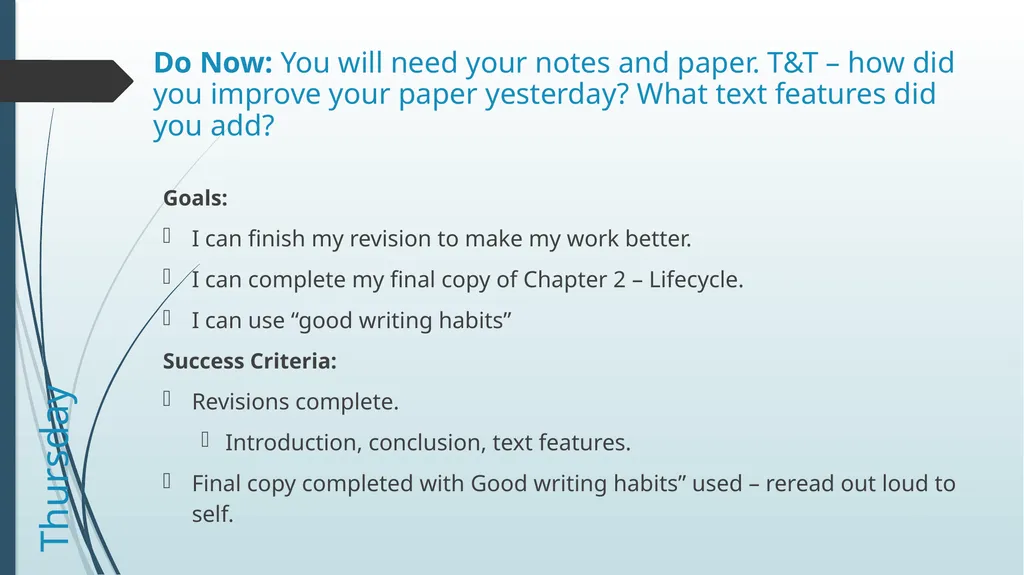
slide17. Do Now: You will need your notes and paper. T&T – how did you improve your paper yesterday? What text features did you add? Goals:
I can finish my revision to make my work better.
I can complete my final copy of Chapter 2 – Lifecycle.
I can use “good writing habits”
Success Criteria:
Revisions complete.
Introduction, conclusion, text features.
Final copy completed with Good writing habits” used – reread out loud to self. Thursday<br>
(you have 3 minutes to write what you know)<br>
slide2. https://www.birdnote.org/ Click “Gallery”
Check out 1 nest cam
Check out 2 featured bird videos
Add to your “What do you know about native bird species?”<br>
slide3. Monday Goals:
I can articulate what makes a bird a native species.
I can take notes on the native Washington birds.
I can use good writing habits.
Success Criteria:
Native Washington bird species notes.
What makes a species native restated.<br>
slide4. Teacher slide:
(Extended lesson ideas: https://www.birdnote.org/birds-washington-state)
The story provided is about the American Goldfinch (the Washington State bird)
Website on native Washington birds: http://www.birdweb.org/birdweb/birds
Washington State Webcams: https://wdfw.wa.gov/wildwatch/<br>
slide5. We have a story to read on the American Goldfinch. After reading the first time, please write down notes about the American Goldfinch.<br>
slide6. Use notes from the story to write the sequence of events with the sentence stems (we do). First, ______.
Next, _____.
Then, _____.
After that, _____.
Finally, _____. First, ______.
Second, _____.
Third, _____.
Fourth, _____.<br>
slide7. Another WA bird to research (you do) Go to the BirdWeb website
http://www.birdweb.org/birdweb/
Click on “Browse By: Birds”
Find another bird from Washington, read the information, and take notes on that bird.<br>
slide8. Use notes from the website to write the sequence of events surrounding the bird’s life cycle with the sentence stems (you do). First, ______.
Next, _____.
Then, _____.
After that, _____.
Finally, _____. First, ______.
Second, _____.
Third, _____.
Fourth, _____.<br>
slide9. Do Now: You will need your bird stuff then join me. T&T – how do we cite sources in our writing? GOAL:
I can write an informational draft of a cycle
I can write one paragraph on the lifecycle of birds. (CER)
I can write one paragraph on the lifecycle of another animal. (CER)
I can write a paragraph that compares the two animals. (CER)
I can use words that show a sequence of events. (first, next, finally, after that)
I can use words that show a comparison.
I can use good writing habits.
Success Criteria:
Three paragraphs completed.
Highlighted sequence of events and comparison words.
Good writing habits used. Tuesday<br>
slide10. Comparison phrases: The _____ and the _____ are similar because they both _____.
The _____ and the _____ are different because the __________, but the _______.
In addition, they both _____.
Also, the _____, whereas the _______.
On the other hand, _____.
However, ________.
In contrast, _______.
At first, _______.<br>
slide11. Do Now: You will need your draft and informational checklist. Goals:
I can revise my draft to make it better.
I can use text features purposefully.
I can write an introduction to my chapter on lifecycle.
I can write a conclusion to my chapter on lifecycle.
I can use good writing habits.
Success Criteria:
Revision completed including text features, an introduction, conclusion, and good writing habits.
Reviewed checklist. Wednesday<br>
slide17. Do Now: You will need your notes and paper. T&T – how did you improve your paper yesterday? What text features did you add? Goals:
I can finish my revision to make my work better.
I can complete my final copy of Chapter 2 – Lifecycle.
I can use “good writing habits”
Success Criteria:
Revisions complete.
Introduction, conclusion, text features.
Final copy completed with Good writing habits” used – reread out loud to self. Thursday<br>