
What Should be the Educational
YM
Published · 33 slides · 0 views

1 / 1






Description
What Should be the Educational BackgroundCompetencies for Entry into the Profession: Background and Status Update on Recent Discussions ILRTA Conference Alsip, IL November 6, 2017 Teresa M. Beck PhD, CTRS, FDRT Grand Valley State
Related Topics
Share
Embed code
Download this presentation From Below
"What Should be the Educational" is the property of its rightful owner. Permission is granted to download and print the materials on this website for personal, non-commercial use only, and to display it on your personal computer provided you do not modify the materials and that you retain all copyright notices contained in the materials. By downloading content from our website, you accept the terms of this agreement.
Presentation Transcript
01
What Should be the Educational Background/Competencies for Entry into the Profession: Background and Status Update on Recent Discussions ILRTA Conference
Alsip, IL
November 6, 2017
Teresa M. Beck PhD, CTRS, FDRT
Grand Valley State University
This powerpoint can be accessed at
http://www.gvsu.edu/tr/faculty-23.htm<br>
Alsip, IL
November 6, 2017
Teresa M. Beck PhD, CTRS, FDRT
Grand Valley State University
This powerpoint can be accessed at
http://www.gvsu.edu/tr/faculty-23.htm<br>
02
Session Objectives Describe early efforts of graduate education in the profession
Compare and contrast current graduate and undergraduate preparation
Differentiate between degree creep and maturation of a profession as it pertains to graduate education
Identify 3 challenges and 3 advantages for pursuing a master’s degree as entry level
Identify the status of the ATRA Higher Education Task Force<br>
Compare and contrast current graduate and undergraduate preparation
Differentiate between degree creep and maturation of a profession as it pertains to graduate education
Identify 3 challenges and 3 advantages for pursuing a master’s degree as entry level
Identify the status of the ATRA Higher Education Task Force<br>
03
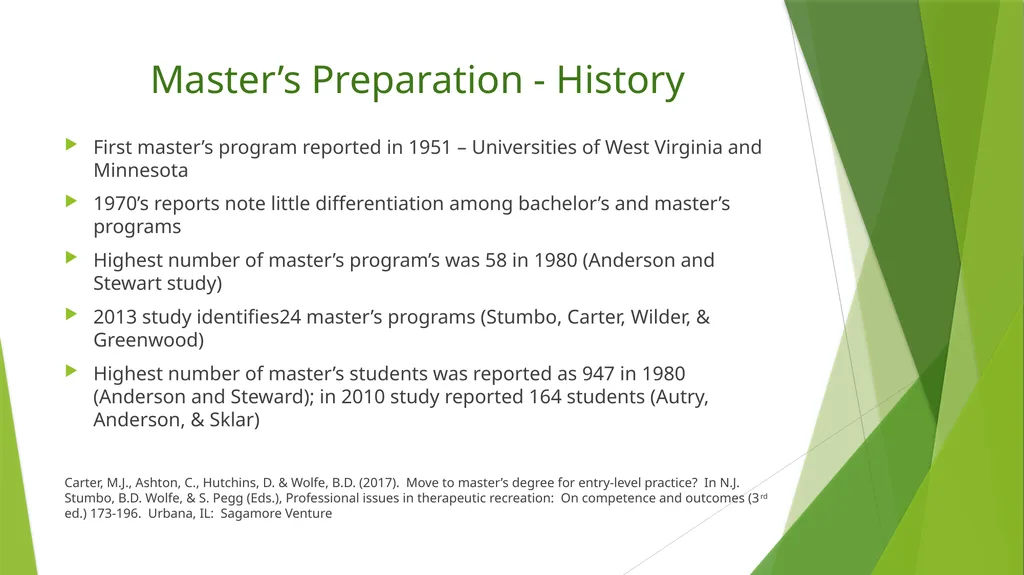
Master’s Preparation - History First master’s program reported in 1951 – Universities of West Virginia and Minnesota
1970’s reports note little differentiation among bachelor’s and master’s programs
Highest number of master’s program’s was 58 in 1980 (Anderson and Stewart study)
2013 study identifies24 master’s programs (Stumbo, Carter, Wilder, & Greenwood)
Highest number of master’s students was reported as 947 in 1980 (Anderson and Steward); in 2010 study reported 164 students (Autry, Anderson, & Sklar)
Carter, M.J., Ashton, C., Hutchins, D. & Wolfe, B.D. (2017). Move to master’s degree for entry-level practice? In N.J. Stumbo, B.D. Wolfe, & S. Pegg (Eds.), Professional issues in therapeutic recreation: On competence and outcomes (3rd ed.) 173-196. Urbana, IL: Sagamore Venture<br>
1970’s reports note little differentiation among bachelor’s and master’s programs
Highest number of master’s program’s was 58 in 1980 (Anderson and Stewart study)
2013 study identifies24 master’s programs (Stumbo, Carter, Wilder, & Greenwood)
Highest number of master’s students was reported as 947 in 1980 (Anderson and Steward); in 2010 study reported 164 students (Autry, Anderson, & Sklar)
Carter, M.J., Ashton, C., Hutchins, D. & Wolfe, B.D. (2017). Move to master’s degree for entry-level practice? In N.J. Stumbo, B.D. Wolfe, & S. Pegg (Eds.), Professional issues in therapeutic recreation: On competence and outcomes (3rd ed.) 173-196. Urbana, IL: Sagamore Venture<br>
04
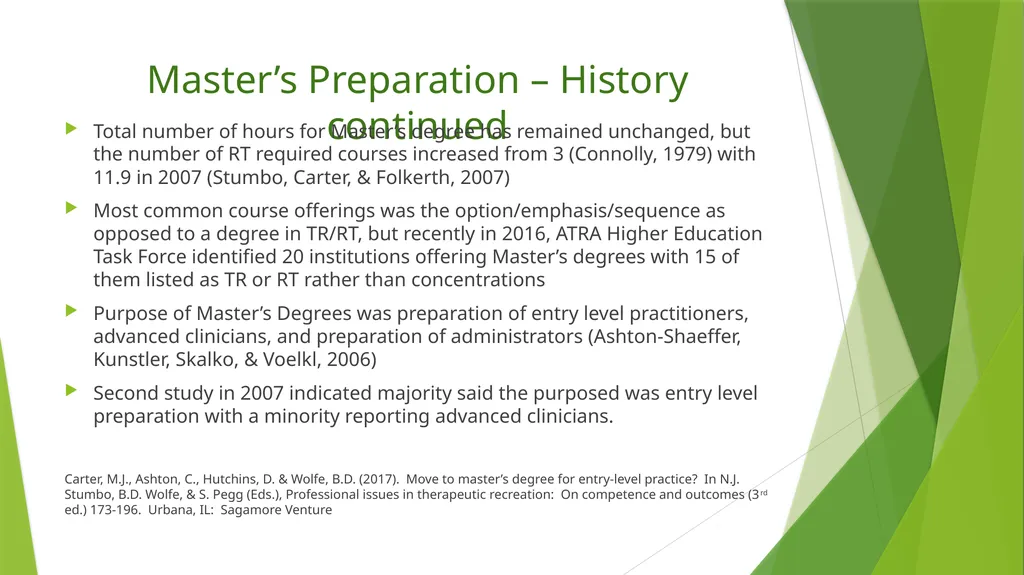
Master’s Preparation – History continued Total number of hours for Master’s degree has remained unchanged, but the number of RT required courses increased from 3 (Connolly, 1979) with 11.9 in 2007 (Stumbo, Carter, & Folkerth, 2007)
Most common course offerings was the option/emphasis/sequence as opposed to a degree in TR/RT, but recently in 2016, ATRA Higher Education Task Force identified 20 institutions offering Master’s degrees with 15 of them listed as TR or RT rather than concentrations
Purpose of Master’s Degrees was preparation of entry level practitioners, advanced clinicians, and preparation of administrators (Ashton-Shaeffer, Kunstler, Skalko, & Voelkl, 2006)
Second study in 2007 indicated majority said the purposed was entry level preparation with a minority reporting advanced clinicians.
Carter, M.J., Ashton, C., Hutchins, D. & Wolfe, B.D. (2017). Move to master’s degree for entry-level practice? In N.J. Stumbo, B.D. Wolfe, & S. Pegg (Eds.), Professional issues in therapeutic recreation: On competence and outcomes (3rd ed.) 173-196. Urbana, IL: Sagamore Venture<br>
Most common course offerings was the option/emphasis/sequence as opposed to a degree in TR/RT, but recently in 2016, ATRA Higher Education Task Force identified 20 institutions offering Master’s degrees with 15 of them listed as TR or RT rather than concentrations
Purpose of Master’s Degrees was preparation of entry level practitioners, advanced clinicians, and preparation of administrators (Ashton-Shaeffer, Kunstler, Skalko, & Voelkl, 2006)
Second study in 2007 indicated majority said the purposed was entry level preparation with a minority reporting advanced clinicians.
Carter, M.J., Ashton, C., Hutchins, D. & Wolfe, B.D. (2017). Move to master’s degree for entry-level practice? In N.J. Stumbo, B.D. Wolfe, & S. Pegg (Eds.), Professional issues in therapeutic recreation: On competence and outcomes (3rd ed.) 173-196. Urbana, IL: Sagamore Venture<br>
05
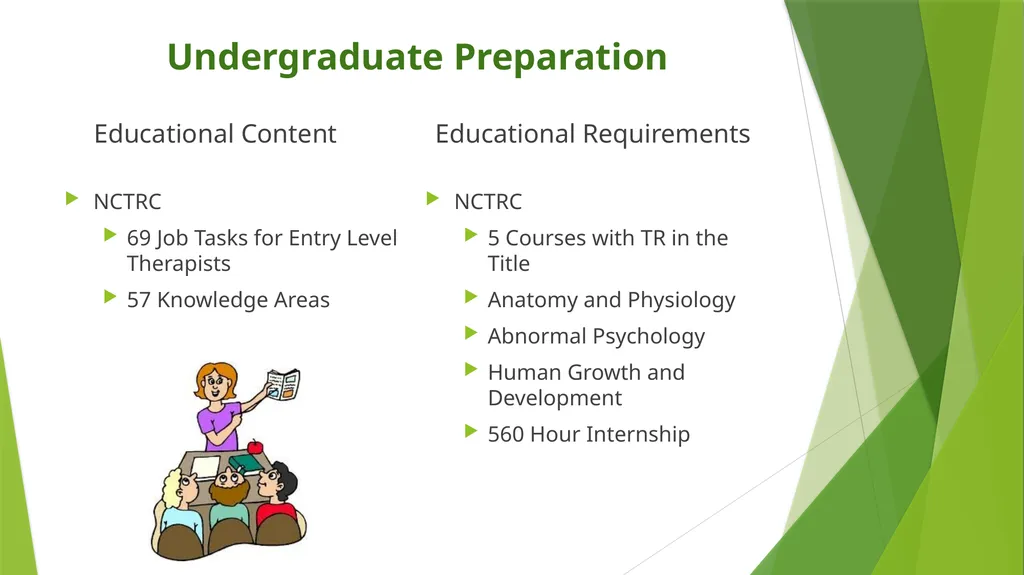
Undergraduate Preparation Educational Content NCTRC
69 Job Tasks for Entry Level Therapists
57 Knowledge Areas Educational Requirements NCTRC
5 Courses with TR in the Title
Anatomy and Physiology
Abnormal Psychology
Human Growth and Development
560 Hour Internship<br>
69 Job Tasks for Entry Level Therapists
57 Knowledge Areas Educational Requirements NCTRC
5 Courses with TR in the Title
Anatomy and Physiology
Abnormal Psychology
Human Growth and Development
560 Hour Internship<br>
06
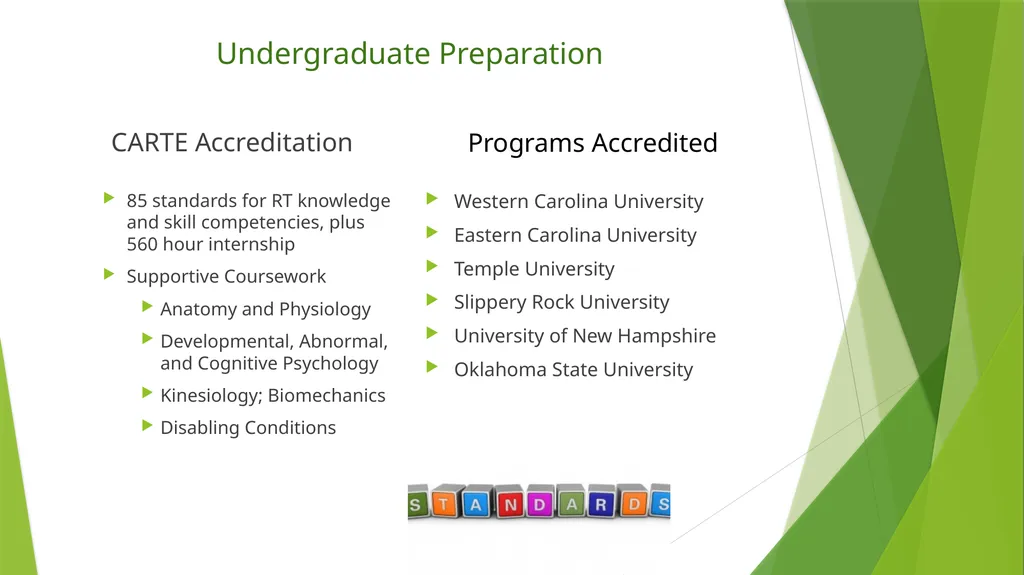
Undergraduate Preparation CARTE Accreditation 85 standards for RT knowledge and skill competencies, plus 560 hour internship
Supportive Coursework
Anatomy and Physiology
Developmental, Abnormal, and Cognitive Psychology
Kinesiology; Biomechanics
Disabling Conditions Programs Accredited Western Carolina University
Eastern Carolina University
Temple University
Slippery Rock University
University of New Hampshire
Oklahoma State University<br>
Supportive Coursework
Anatomy and Physiology
Developmental, Abnormal, and Cognitive Psychology
Kinesiology; Biomechanics
Disabling Conditions Programs Accredited Western Carolina University
Eastern Carolina University
Temple University
Slippery Rock University
University of New Hampshire
Oklahoma State University<br>
07
Undergraduate Preparation COAPRT Accreditation 4 Standards with additional standards in the area of History and Foundations, Design and Execution of TR Services, Managing TR Services, and Internship
Meet NCTRC’s standards as well for content, supportive coursework, and internship
Focuses on evidence of student learning outcomes Programs Accredited 22 programs have an accredited option in TR/RT<br>
Meet NCTRC’s standards as well for content, supportive coursework, and internship
Focuses on evidence of student learning outcomes Programs Accredited 22 programs have an accredited option in TR/RT<br>
08
Undergraduate Preparation Undergraduate degrees are restricted by many factors:
Typically a total of 120 credit hours
Basic skills – Writing and Math
General education requirements
Core coursework (emphasis in a degree program, ie – general recreation core, business, public health)
BS or BA degree requirements
Additional writing skills requirements
University or state required coursework (diversity, world perspectives, religion)<br>
Typically a total of 120 credit hours
Basic skills – Writing and Math
General education requirements
Core coursework (emphasis in a degree program, ie – general recreation core, business, public health)
BS or BA degree requirements
Additional writing skills requirements
University or state required coursework (diversity, world perspectives, religion)<br>
09
Change in the Workforce What workforce changes are anticipated in the next three to five years (2015-2017)?
The greatest changes HR professional expect are an increased number of jobs with specific technical requirements (60%), increased staff size (55%), higher education level requirements for most jobs (50%) and increased employee diversity (49%).
How will education needs in the workforce change over the next three to five years?
More than one-half (55%) of HR professionals anticipate increased demand for candidates with a bachelor's degree, and 41% expect increased need for advanced degrees (e.g., master's, MBA, Ph.D., M.D., J.D.).
Changing Employee Skills and Education Requirements – Changes in the Workforce. (10/3/2012). Society for Human Resource Management. Retrieved from http://www.shrm.org/research/surveyfindings/articles/pages/shrm-achieve-future-changes- workforce.aspx<br>
The greatest changes HR professional expect are an increased number of jobs with specific technical requirements (60%), increased staff size (55%), higher education level requirements for most jobs (50%) and increased employee diversity (49%).
How will education needs in the workforce change over the next three to five years?
More than one-half (55%) of HR professionals anticipate increased demand for candidates with a bachelor's degree, and 41% expect increased need for advanced degrees (e.g., master's, MBA, Ph.D., M.D., J.D.).
Changing Employee Skills and Education Requirements – Changes in the Workforce. (10/3/2012). Society for Human Resource Management. Retrieved from http://www.shrm.org/research/surveyfindings/articles/pages/shrm-achieve-future-changes- workforce.aspx<br>
10
Change in the Workforce “The bachelor’s degree is no longer the coin of the realm it once was. Thirty years ago, it distinguished you in the marketplace. That’s no longer so.”
Phillip Trella – Assistant Vice-President for Graduate Studies at the University of Virginia (Washington Post, February 19, 2012)
Today, 2 in 25 people age 25 and older have a master’s degree as their highest degree – about the same number with a bachelor’s in 1967.
Digest of Education Statistics (as cited in Simon, C. C. [Feb. 19, 2012]. Education Review: More students getting graduate degrees. The Washington Post.)<br>
Phillip Trella – Assistant Vice-President for Graduate Studies at the University of Virginia (Washington Post, February 19, 2012)
Today, 2 in 25 people age 25 and older have a master’s degree as their highest degree – about the same number with a bachelor’s in 1967.
Digest of Education Statistics (as cited in Simon, C. C. [Feb. 19, 2012]. Education Review: More students getting graduate degrees. The Washington Post.)<br>
11
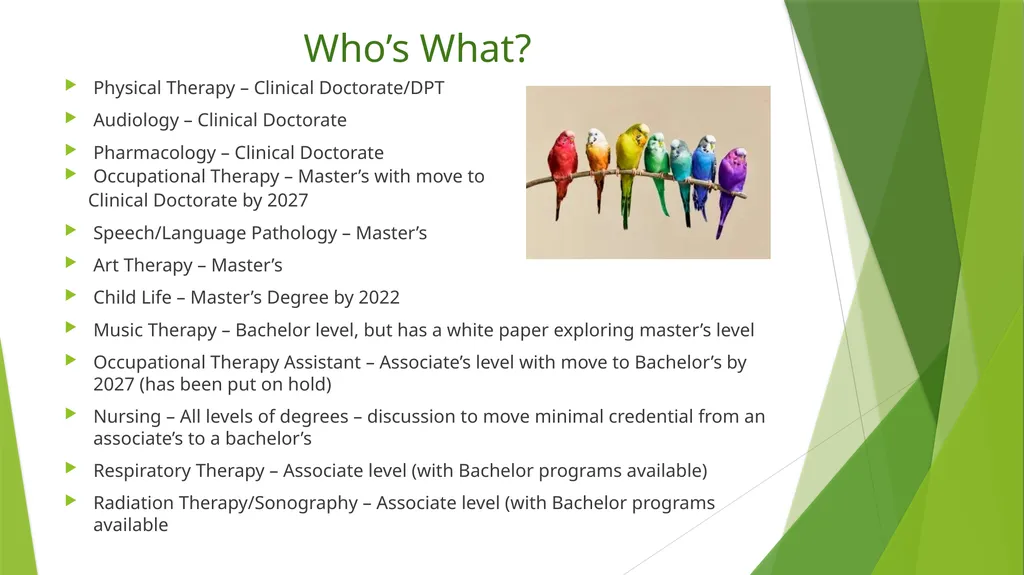
Who’s What? Physical Therapy – Clinical Doctorate/DPT
Audiology – Clinical Doctorate
Pharmacology – Clinical Doctorate
Occupational Therapy – Master’s with move to
Clinical Doctorate by 2027
Speech/Language Pathology – Master’s
Art Therapy – Master’s
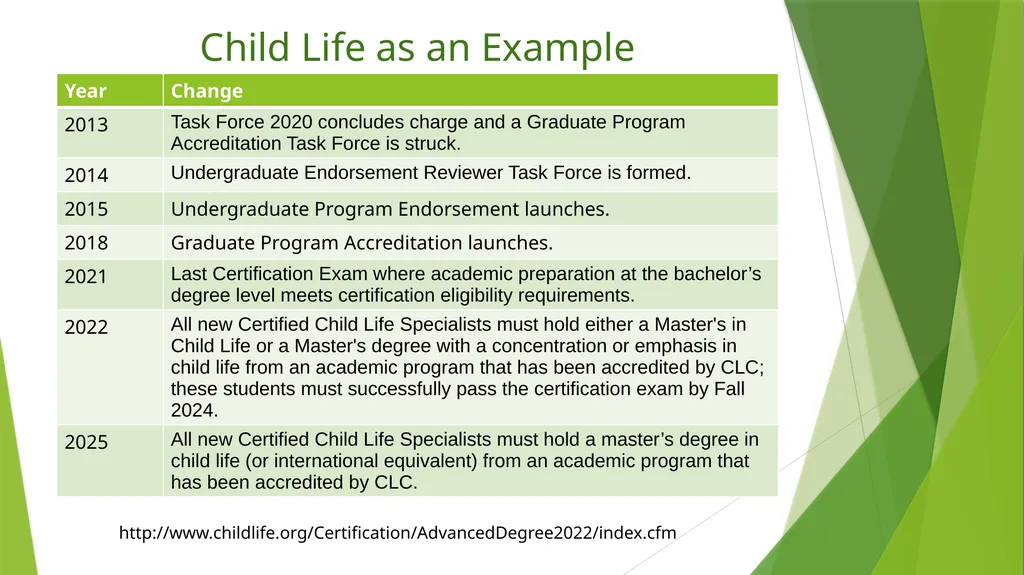
Child Life – Master’s Degree by 2022
Music Therapy – Bachelor level, but has a white paper exploring master’s level
Occupational Therapy Assistant – Associate’s level with move to Bachelor’s by 2027 (has been put on hold)
Nursing – All levels of degrees – discussion to move minimal credential from an associate’s to a bachelor’s
Respiratory Therapy – Associate level (with Bachelor programs available)
Radiation Therapy/Sonography – Associate level (with Bachelor programs available<br>
Audiology – Clinical Doctorate
Pharmacology – Clinical Doctorate
Occupational Therapy – Master’s with move to
Clinical Doctorate by 2027
Speech/Language Pathology – Master’s
Art Therapy – Master’s
Child Life – Master’s Degree by 2022
Music Therapy – Bachelor level, but has a white paper exploring master’s level
Occupational Therapy Assistant – Associate’s level with move to Bachelor’s by 2027 (has been put on hold)
Nursing – All levels of degrees – discussion to move minimal credential from an associate’s to a bachelor’s
Respiratory Therapy – Associate level (with Bachelor programs available)
Radiation Therapy/Sonography – Associate level (with Bachelor programs available<br>
12
Is it Credential Creep? Credential creep is requiring a higher degree (or credential) than what is needed to enter the profession.
Healthcare professions argue that an advanced degree is needed to deal with the rapid growth of knowledge and builds a more mature professional who relates better to the complexities of the therapeutic process.
Additionally, advanced degrees allow the graduate to be able to carry out clinical research and assume leadership roles in their professions and advance public policy.
Advanced degrees would prepare graduates to reason through problems analytically and professionally.
Advanced degrees would prepare graduates better for patient care and collaborative practice with other health care professionals.
Garvin, K. (January 14, 2013). “Degree creep” and the cost of health care education. Huffington Post. Retrieved from: http://www.huffingtonpost.com/kathleen-garvin/degree-creep-and-the-cost_b_2130347.html
Kreimer, S. (March 21, 2006). Requirements creep higher in health fields. Knight Ridder Tribune News Service<br>
Healthcare professions argue that an advanced degree is needed to deal with the rapid growth of knowledge and builds a more mature professional who relates better to the complexities of the therapeutic process.
Additionally, advanced degrees allow the graduate to be able to carry out clinical research and assume leadership roles in their professions and advance public policy.
Advanced degrees would prepare graduates to reason through problems analytically and professionally.
Advanced degrees would prepare graduates better for patient care and collaborative practice with other health care professionals.
Garvin, K. (January 14, 2013). “Degree creep” and the cost of health care education. Huffington Post. Retrieved from: http://www.huffingtonpost.com/kathleen-garvin/degree-creep-and-the-cost_b_2130347.html
Kreimer, S. (March 21, 2006). Requirements creep higher in health fields. Knight Ridder Tribune News Service<br>
13
What the Critics Say Advanced degrees are degree/credential creep.
Advanced degrees may exacerbate the shortage of health care workers.
Increased cost and time may exacerbate health care disparities in our society – few healthcare professionals come from minority populations – increased education requirements could further reduce minority populations.
It is the profession who needs to command respect and recognition, not the degree.
Healthcare facilities are reimbursed for clinical services, not according to the degrees held by their clinicians.
Siler, W.L. & Randolph, D.S. (July 21, 2006). A Clinical Look at Clinical Doctorates. The Chronicle of Higher Education<br>
Advanced degrees may exacerbate the shortage of health care workers.
Increased cost and time may exacerbate health care disparities in our society – few healthcare professionals come from minority populations – increased education requirements could further reduce minority populations.
It is the profession who needs to command respect and recognition, not the degree.
Healthcare facilities are reimbursed for clinical services, not according to the degrees held by their clinicians.
Siler, W.L. & Randolph, D.S. (July 21, 2006). A Clinical Look at Clinical Doctorates. The Chronicle of Higher Education<br>
14
Difference Between Maturation and Degree Creep Maturation occurs because the scope of a field advances and proper patient care requires additional education and acquisition of new skill sets.
Degree creep occurs because of factors external to the quality of patient care. It occurs in spite of a lack of supportive data.
Recognition
Increased salaries
Perceived increased educational and skill requirements of the profession
Perceived increased access for patients
Increased reimbursement
Ashford, E. (August 10. 2011). Colleges worry about ‘degree creep’ in health care. Community College Daily – American Association of Community College. Retrieved from: http://www.ccdaily.com/Pages/Academic- Programs/Community-colleges-concerned-about-degree-creep-.aspx
Loochtan, A. (2011). Creepy take 2…Consequences of degree creep in health professions. NN2 Annual Meeting 2011, Cheyenne, Wyoming. Retrieved from: http://www.nn2.org/images/DegreeCreep.pdf<br>
Degree creep occurs because of factors external to the quality of patient care. It occurs in spite of a lack of supportive data.
Recognition
Increased salaries
Perceived increased educational and skill requirements of the profession
Perceived increased access for patients
Increased reimbursement
Ashford, E. (August 10. 2011). Colleges worry about ‘degree creep’ in health care. Community College Daily – American Association of Community College. Retrieved from: http://www.ccdaily.com/Pages/Academic- Programs/Community-colleges-concerned-about-degree-creep-.aspx
Loochtan, A. (2011). Creepy take 2…Consequences of degree creep in health professions. NN2 Annual Meeting 2011, Cheyenne, Wyoming. Retrieved from: http://www.nn2.org/images/DegreeCreep.pdf<br>
15
Entry Level Masters in TR…
Degree Creep or Maturation? Is a master’s degree needed as entry level to TR in order to receive:
Recognition
Increased salaries
Increased access for patients
Increased reimbursement
OR
Is a master’s degree as entry level to the profession needed because the scope of a field advances and proper patient care requires additional education and acquisition of new skill sets?<br>
Recognition
Increased salaries
Increased access for patients
Increased reimbursement
OR
Is a master’s degree as entry level to the profession needed because the scope of a field advances and proper patient care requires additional education and acquisition of new skill sets?<br>
16
Question? Can therapeutic recreation students truly be competent entry level practitioners with a BS/BA that includes only 5 TR/RT courses and an internship of 560 hours?
Can therapeutic recreation educators teach minimal competency of all the content from the NCTRC Job Analysis, CARTE and COAPRT Accreditation Standards in 5 TR/RT courses?
Is the bachelor prepared recreational therapy professional prepared to collaborate with the interdisciplinary team with 5 TR courses compared to 12-18 discipline specific courses and a Master’s Degree taken by OT, PT and SLP?<br>
Can therapeutic recreation educators teach minimal competency of all the content from the NCTRC Job Analysis, CARTE and COAPRT Accreditation Standards in 5 TR/RT courses?
Is the bachelor prepared recreational therapy professional prepared to collaborate with the interdisciplinary team with 5 TR courses compared to 12-18 discipline specific courses and a Master’s Degree taken by OT, PT and SLP?<br>
17
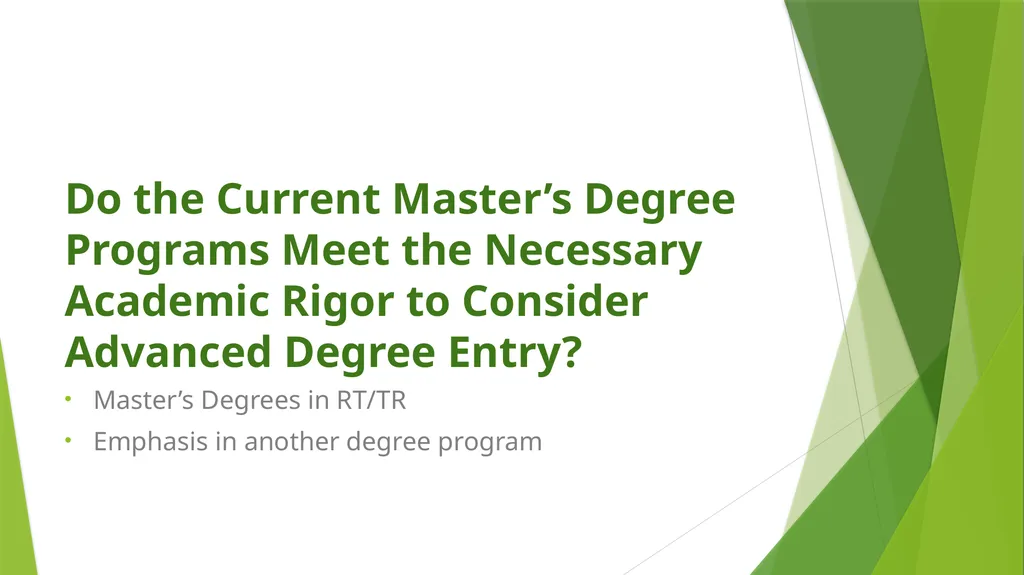
Do the Current Master’s Degree Programs Meet the Necessary Academic Rigor to Consider Advanced Degree Entry? Master’s Degrees in RT/TR
Emphasis in another degree program<br>
Emphasis in another degree program<br>
18
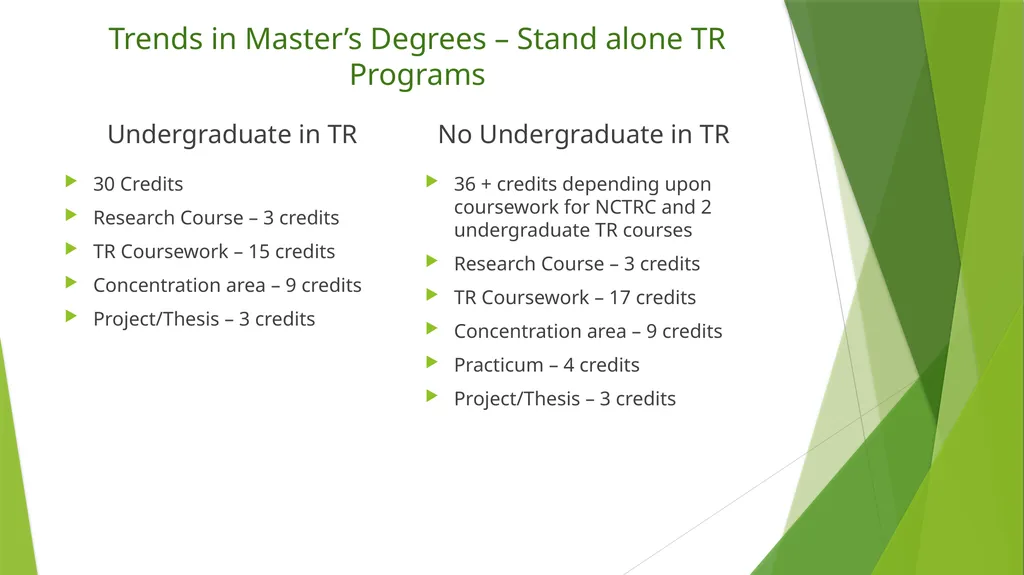
Trends in Master’s Degrees – Stand alone TR Programs Undergraduate in TR 30 Credits
Research Course – 3 credits
TR Coursework – 15 credits
Concentration area – 9 credits
Project/Thesis – 3 credits No Undergraduate in TR 36 + credits depending upon coursework for NCTRC and 2 undergraduate TR courses
Research Course – 3 credits
TR Coursework – 17 credits
Concentration area – 9 credits
Practicum – 4 credits
Project/Thesis – 3 credits<br>
Research Course – 3 credits
TR Coursework – 15 credits
Concentration area – 9 credits
Project/Thesis – 3 credits No Undergraduate in TR 36 + credits depending upon coursework for NCTRC and 2 undergraduate TR courses
Research Course – 3 credits
TR Coursework – 17 credits
Concentration area – 9 credits
Practicum – 4 credits
Project/Thesis – 3 credits<br>
19
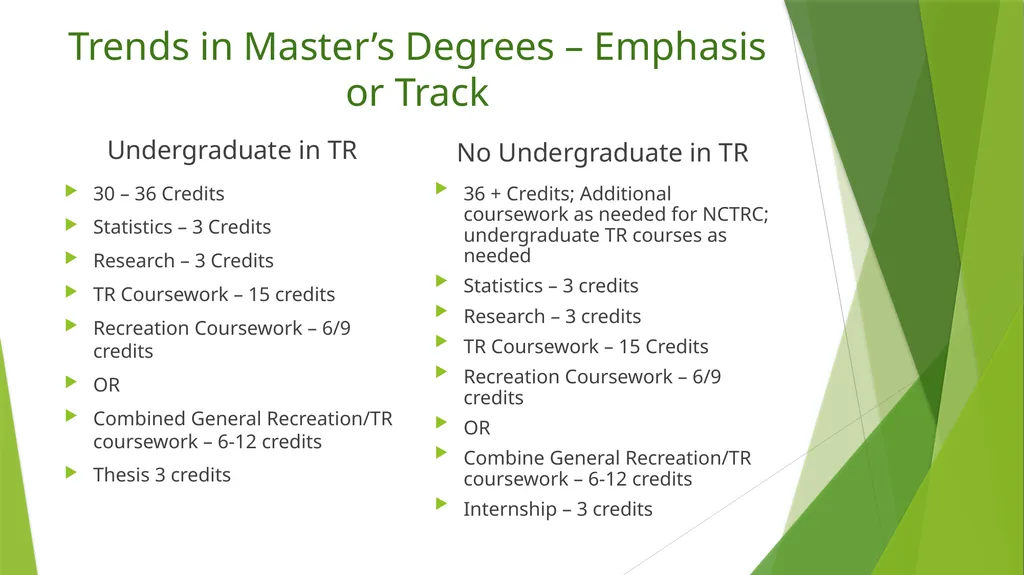
Trends in Master’s Degrees – Emphasis or Track Undergraduate in TR 30 – 36 Credits
Statistics – 3 Credits
Research – 3 Credits
TR Coursework – 15 credits
Recreation Coursework – 6/9 credits
OR
Combined General Recreation/TR coursework – 6-12 credits
Thesis 3 credits No Undergraduate in TR 36 + Credits; Additional coursework as needed for NCTRC; undergraduate TR courses as needed
Statistics – 3 credits
Research – 3 credits
TR Coursework – 15 Credits
Recreation Coursework – 6/9 credits
OR
Combine General Recreation/TR coursework – 6-12 credits
Internship – 3 credits<br>
Statistics – 3 Credits
Research – 3 Credits
TR Coursework – 15 credits
Recreation Coursework – 6/9 credits
OR
Combined General Recreation/TR coursework – 6-12 credits
Thesis 3 credits No Undergraduate in TR 36 + Credits; Additional coursework as needed for NCTRC; undergraduate TR courses as needed
Statistics – 3 credits
Research – 3 credits
TR Coursework – 15 Credits
Recreation Coursework – 6/9 credits
OR
Combine General Recreation/TR coursework – 6-12 credits
Internship – 3 credits<br>
20
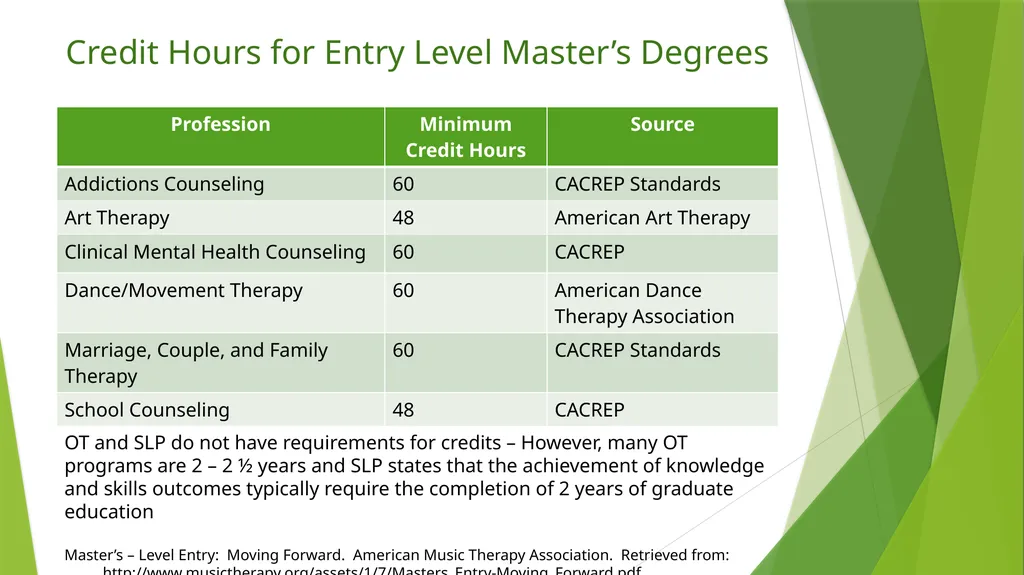
Credit Hours for Entry Level Master’s Degrees OT and SLP do not have requirements for credits – However, many OT programs are 2 – 2 ½ years and SLP states that the achievement of knowledge and skills outcomes typically require the completion of 2 years of graduate education
Master’s – Level Entry: Moving Forward. American Music Therapy Association. Retrieved from:
http://www.musictherapy.org/assets/1/7/Masters_Entry-Moving_Forward.pdf<br>
Master’s – Level Entry: Moving Forward. American Music Therapy Association. Retrieved from:
http://www.musictherapy.org/assets/1/7/Masters_Entry-Moving_Forward.pdf<br>
21
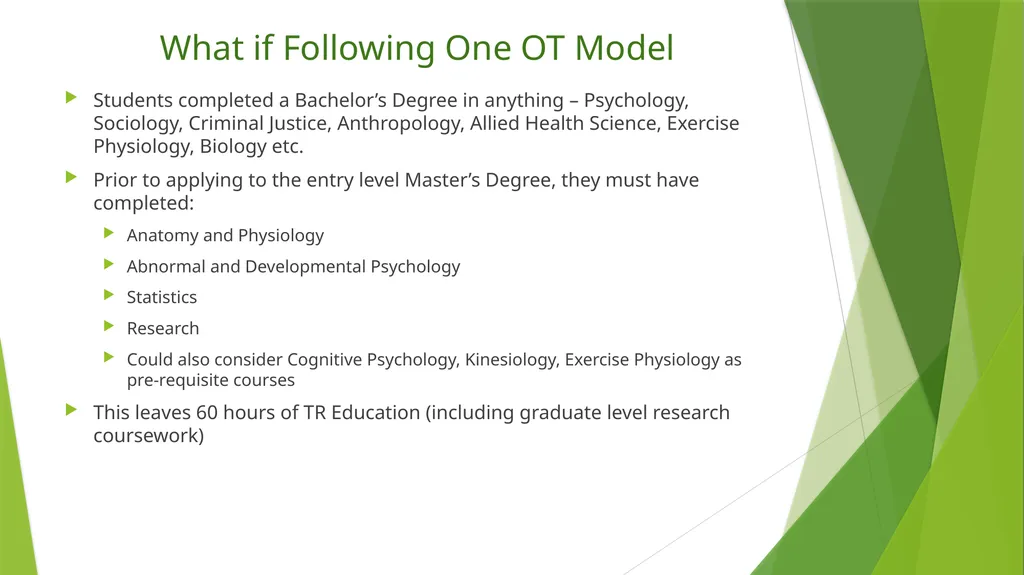
What if Following One OT Model Students completed a Bachelor’s Degree in anything – Psychology, Sociology, Criminal Justice, Anthropology, Allied Health Science, Exercise Physiology, Biology etc.
Prior to applying to the entry level Master’s Degree, they must have completed:
Anatomy and Physiology
Abnormal and Developmental Psychology
Statistics
Research
Could also consider Cognitive Psychology, Kinesiology, Exercise Physiology as pre-requisite courses
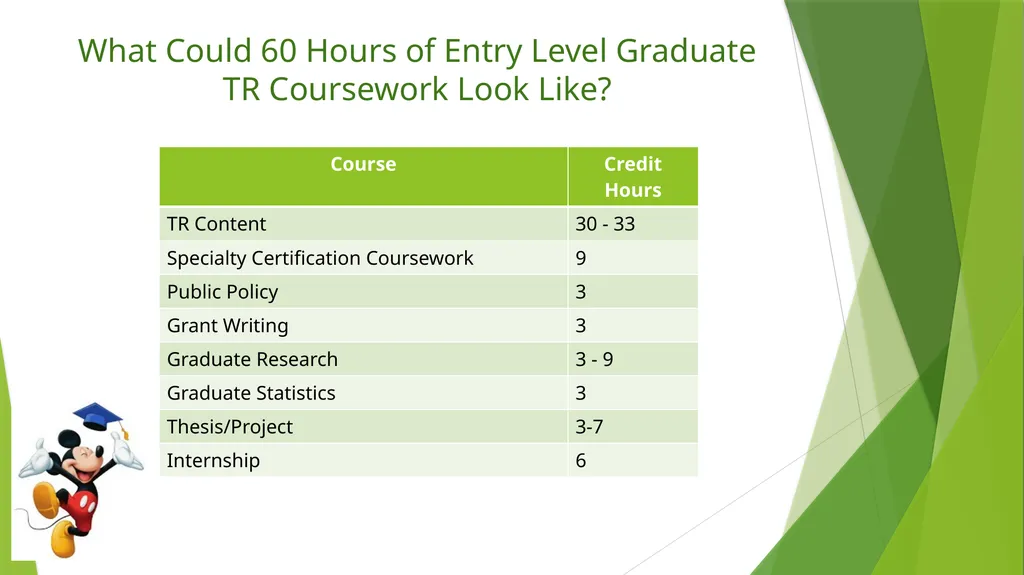
This leaves 60 hours of TR Education (including graduate level research coursework)<br>
Prior to applying to the entry level Master’s Degree, they must have completed:
Anatomy and Physiology
Abnormal and Developmental Psychology
Statistics
Research
Could also consider Cognitive Psychology, Kinesiology, Exercise Physiology as pre-requisite courses
This leaves 60 hours of TR Education (including graduate level research coursework)<br>
22
What Could 60 Hours of Entry Level Graduate TR Coursework Look Like?<br>
23
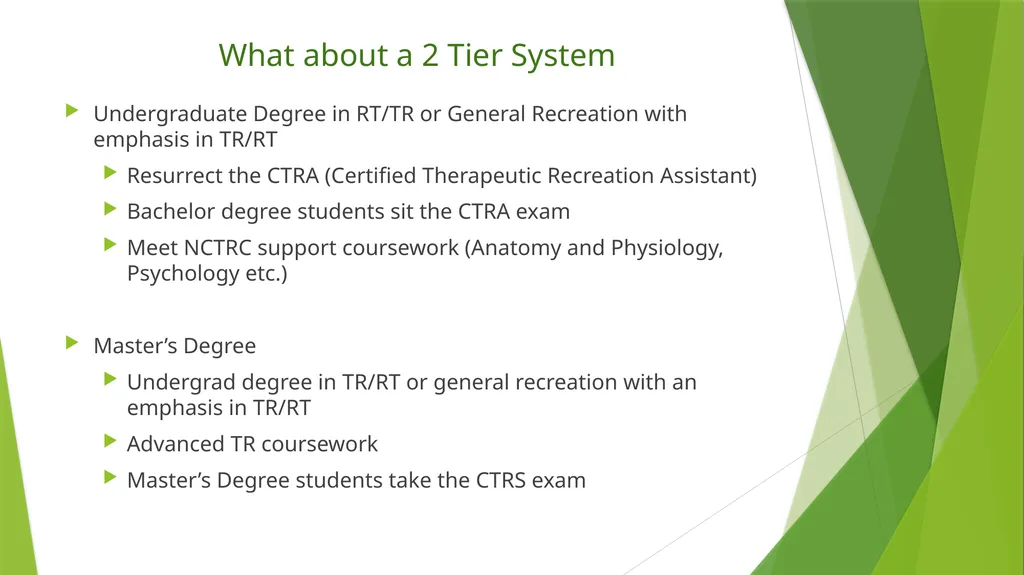
What about a 2 Tier System Undergraduate Degree in RT/TR or General Recreation with emphasis in TR/RT
Resurrect the CTRA (Certified Therapeutic Recreation Assistant)
Bachelor degree students sit the CTRA exam
Meet NCTRC support coursework (Anatomy and Physiology, Psychology etc.)
Master’s Degree
Undergrad degree in TR/RT or general recreation with an emphasis in TR/RT
Advanced TR coursework
Master’s Degree students take the CTRS exam<br>
Resurrect the CTRA (Certified Therapeutic Recreation Assistant)
Bachelor degree students sit the CTRA exam
Meet NCTRC support coursework (Anatomy and Physiology, Psychology etc.)
Master’s Degree
Undergrad degree in TR/RT or general recreation with an emphasis in TR/RT
Advanced TR coursework
Master’s Degree students take the CTRS exam<br>
24
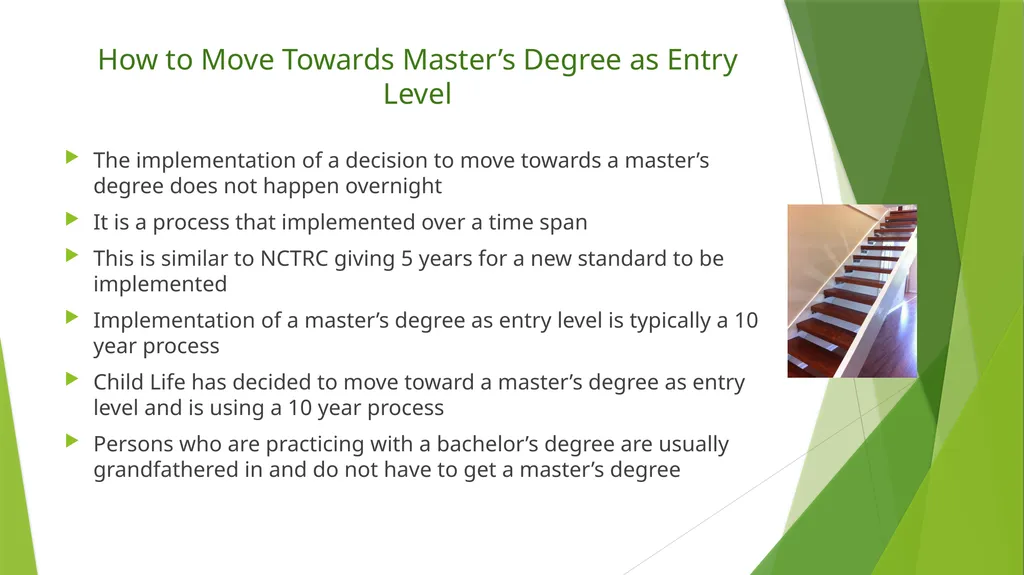
How to Move Towards Master’s Degree as Entry Level The implementation of a decision to move towards a master’s degree does not happen overnight
It is a process that implemented over a time span
This is similar to NCTRC giving 5 years for a new standard to be implemented
Implementation of a master’s degree as entry level is typically a 10 year process
Child Life has decided to move toward a master’s degree as entry level and is using a 10 year process
Persons who are practicing with a bachelor’s degree are usually grandfathered in and do not have to get a master’s degree<br>
It is a process that implemented over a time span
This is similar to NCTRC giving 5 years for a new standard to be implemented
Implementation of a master’s degree as entry level is typically a 10 year process
Child Life has decided to move toward a master’s degree as entry level and is using a 10 year process
Persons who are practicing with a bachelor’s degree are usually grandfathered in and do not have to get a master’s degree<br>
25
Child Life as an Example http://www.childlife.org/Certification/AdvancedDegree2022/index.cfm<br>
26
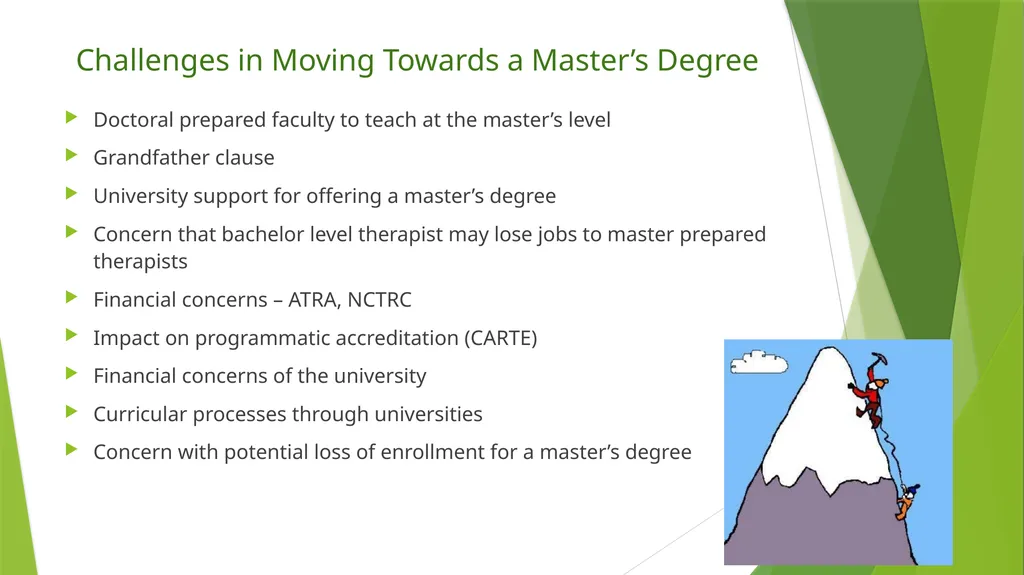
Challenges in Moving Towards a Master’s Degree Doctoral prepared faculty to teach at the master’s level
Grandfather clause
University support for offering a master’s degree
Concern that bachelor level therapist may lose jobs to master prepared therapists
Financial concerns – ATRA, NCTRC
Impact on programmatic accreditation (CARTE)
Financial concerns of the university
Curricular processes through universities
Concern with potential loss of enrollment for a master’s degree<br>
Grandfather clause
University support for offering a master’s degree
Concern that bachelor level therapist may lose jobs to master prepared therapists
Financial concerns – ATRA, NCTRC
Impact on programmatic accreditation (CARTE)
Financial concerns of the university
Curricular processes through universities
Concern with potential loss of enrollment for a master’s degree<br>
27
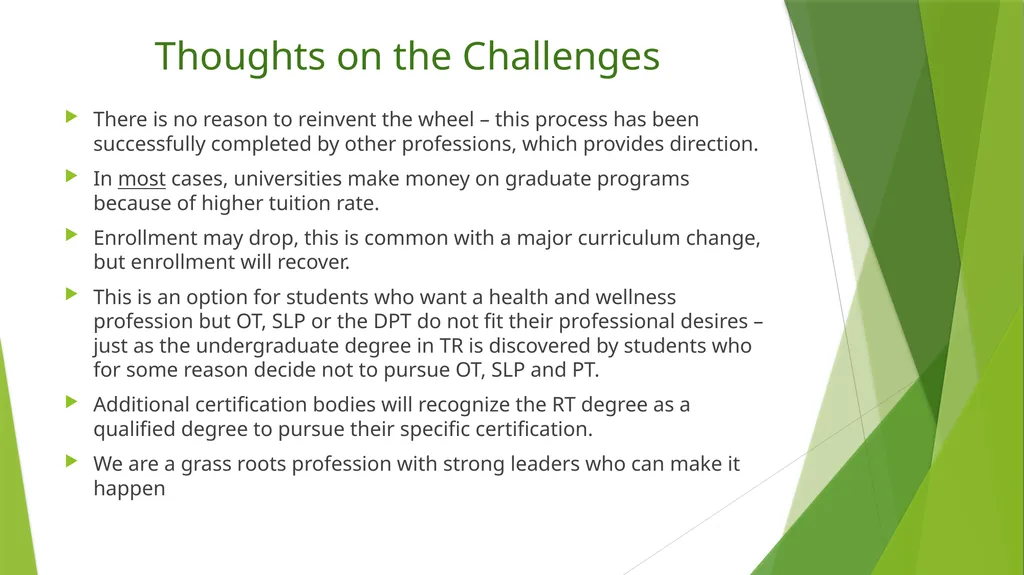
Thoughts on the Challenges There is no reason to reinvent the wheel – this process has been successfully completed by other professions, which provides direction.
In most cases, universities make money on graduate programs because of higher tuition rate.
Enrollment may drop, this is common with a major curriculum change, but enrollment will recover.
This is an option for students who want a health and wellness profession but OT, SLP or the DPT do not fit their professional desires – just as the undergraduate degree in TR is discovered by students who for some reason decide not to pursue OT, SLP and PT.
Additional certification bodies will recognize the RT degree as a qualified degree to pursue their specific certification.
We are a grass roots profession with strong leaders who can make it happen<br>
In most cases, universities make money on graduate programs because of higher tuition rate.
Enrollment may drop, this is common with a major curriculum change, but enrollment will recover.
This is an option for students who want a health and wellness profession but OT, SLP or the DPT do not fit their professional desires – just as the undergraduate degree in TR is discovered by students who for some reason decide not to pursue OT, SLP and PT.
Additional certification bodies will recognize the RT degree as a qualified degree to pursue their specific certification.
We are a grass roots profession with strong leaders who can make it happen<br>
28
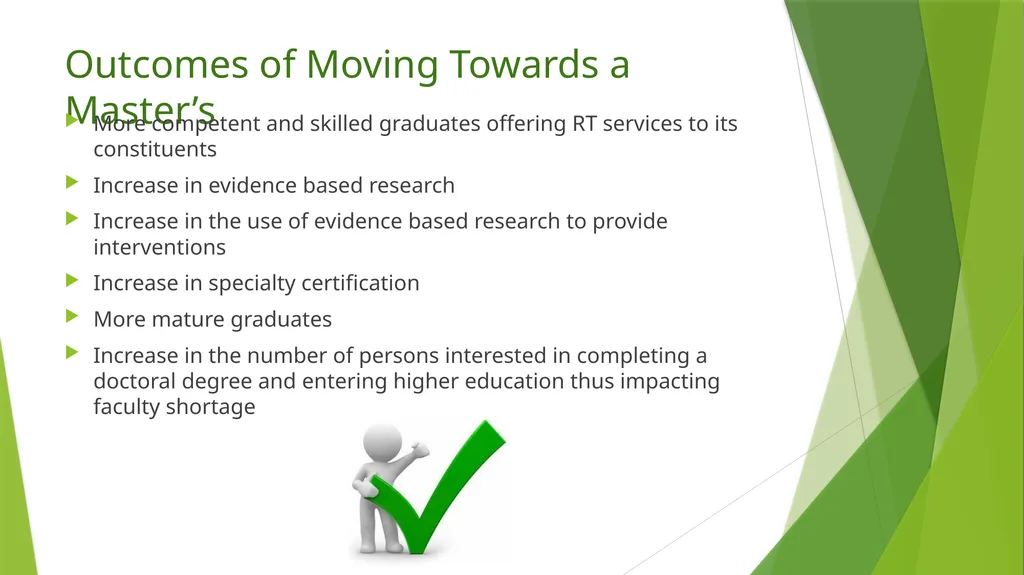
Outcomes of Moving Towards a Master’s More competent and skilled graduates offering RT services to its constituents
Increase in evidence based research
Increase in the use of evidence based research to provide interventions
Increase in specialty certification
More mature graduates
Increase in the number of persons interested in completing a doctoral degree and entering higher education thus impacting faculty shortage<br>
Increase in evidence based research
Increase in the use of evidence based research to provide interventions
Increase in specialty certification
More mature graduates
Increase in the number of persons interested in completing a doctoral degree and entering higher education thus impacting faculty shortage<br>
29
Because of More Skilled Graduates/ Practitioners Increased recognition
Increased salaries
Increased access for patients
Increased reimbursement
Positive impact on state licensure<br>
Increased salaries
Increased access for patients
Increased reimbursement
Positive impact on state licensure<br>
30
Current Status of Work in this Area 2015 – 2016 Online survey
Sent to TR educators (170 TR faculty from 82 colleges and universities)
Responses showed that faculty were almost equally split between whether the profession should move to master’s degree as entry level (including faculty at institutions that offered master’s degrees)
Reasons for or against master’s as entry level followed the same conversations as presented earlier in this presentation.
If the program moved to a master’s degree, different curriculum models offered – but most prevalent was the 3-2 or 4-1 (undergraduate TR major would earn a BS and MS in 5 years)
ATRA Higher Education Task Force – conducting research and focus groups to gather information to make recommendation to ATRA Board of Directors on what would constitute entry level into the profession of TR<br>
Sent to TR educators (170 TR faculty from 82 colleges and universities)
Responses showed that faculty were almost equally split between whether the profession should move to master’s degree as entry level (including faculty at institutions that offered master’s degrees)
Reasons for or against master’s as entry level followed the same conversations as presented earlier in this presentation.
If the program moved to a master’s degree, different curriculum models offered – but most prevalent was the 3-2 or 4-1 (undergraduate TR major would earn a BS and MS in 5 years)
ATRA Higher Education Task Force – conducting research and focus groups to gather information to make recommendation to ATRA Board of Directors on what would constitute entry level into the profession of TR<br>
31
Concluding Thoughts We are at a crossroads in our professional development
As a profession we can choose to be proactive or reactive
Crossroads call for leadership and courage, both on its leaders and its general membership
A proactive choice often requires substantial changes – the changes may be difficult for a profession, because they demand the profession to grow
The process of growth challenges the ways we think about ourselves and our profession
Substantial changes entail risk and can also reap rewards<br>
As a profession we can choose to be proactive or reactive
Crossroads call for leadership and courage, both on its leaders and its general membership
A proactive choice often requires substantial changes – the changes may be difficult for a profession, because they demand the profession to grow
The process of growth challenges the ways we think about ourselves and our profession
Substantial changes entail risk and can also reap rewards<br>
32
Questions to Ponder Is the BS Degree enough education for entry level practice?
Should the profession move to a master’s degree?
If yes, how does the master’s degree differ then from a bachelor’s degree as entry level
If no, what needs to be done to “fix” the undergraduate degree
What role does program accreditation play in curriculum development
What role does education play in the attainment of licensure<br>
Should the profession move to a master’s degree?
If yes, how does the master’s degree differ then from a bachelor’s degree as entry level
If no, what needs to be done to “fix” the undergraduate degree
What role does program accreditation play in curriculum development
What role does education play in the attainment of licensure<br>
33
Other Resources Bollag, B. (June 22, 2007). Credential Creep. The Chronicle of Higher Education
Compton, D. V. (2010). The evolution of education in therapeutic recreation.
Therapeutic Recreation Journal, 44(3), 157-159.
Master’s Level Entry: Core Considerations. American Music Therapy Association
http://www.musictherapy.org/assets/1/7/Masters_Level_Entry_Core_Considerations.pdf
Simon, C.C. (Feb. 19, 2012). Education Review: More Students Getting Graduate Degrees. Washington Post<br>
Compton, D. V. (2010). The evolution of education in therapeutic recreation.
Therapeutic Recreation Journal, 44(3), 157-159.
Master’s Level Entry: Core Considerations. American Music Therapy Association
http://www.musictherapy.org/assets/1/7/Masters_Level_Entry_Core_Considerations.pdf
Simon, C.C. (Feb. 19, 2012). Education Review: More Students Getting Graduate Degrees. Washington Post<br>