
While completing my fall externship as a graduate
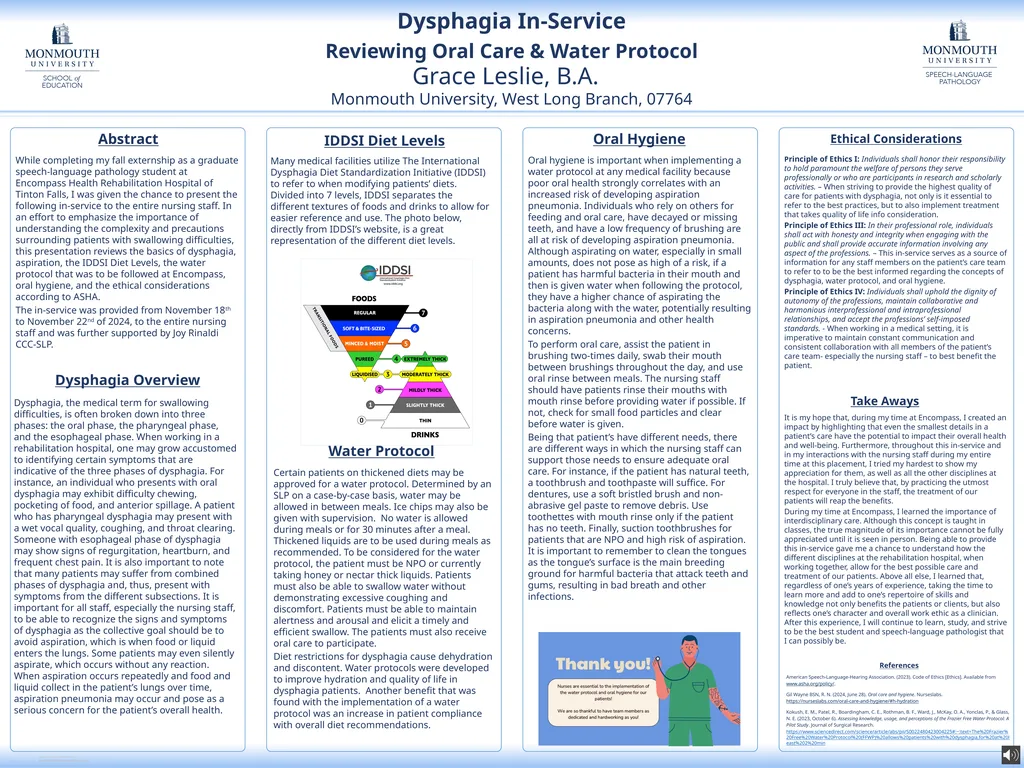
Description: While completing my fall externship as a graduate speech-language pathology student at Encompass Health Rehabilitation Hospital of Tinton Falls, I was given the chance to present the following in-service to the entire nursing staff. In an
Related Topics
Download Presentation
"While completing my fall externship as a graduate" is the property of its rightful owner. Permission is granted to download and print the materials on this website for personal, non-commercial use only, and to display it on your personal computer provided you do not modify the materials and that you retain all copyright notices contained in the materials. By downloading content from our website, you accept the terms of this agreement.
Presentation Transcript
slide1. While completing my fall externship as a graduate speech-language pathology student at Encompass Health Rehabilitation Hospital of Tinton Falls, I was given the chance to present the following in-service to the entire nursing staff. In an effort to emphasize the importance of understanding the complexity and precautions surrounding patients with swallowing difficulties, this presentation reviews the basics of dysphagia, aspiration, the IDDSI Diet Levels, the water protocol that was to be followed at Encompass, oral hygiene, and the ethical considerations according to ASHA.
The in-service was provided from November 18th to November 22nd of 2024, to the entire nursing staff and was further supported by Joy Rinaldi CCC-SLP. Abstract IDDSI Diet Levels Certain patients on thickened diets may be approved for a water protocol. Determined by an SLP on a case-by-case basis, water may be allowed in between meals. Ice chips may also be given with supervision. No water is allowed during meals or for 30 minutes after a meal. Thickened liquids are to be used during meals as recommended. To be considered for the water protocol, the patient must be NPO or currently taking honey or nectar thick liquids. Patients must also be able to swallow water without demonstrating excessive coughing and discomfort. Patients must be able to maintain alertness and arousal and elicit a timely and efficient swallow. The patients must also receive oral care to participate.
Diet restrictions for dysphagia cause dehydration and discontent. Water protocols were developed to improve hydration and quality of life in dysphagia patients. Another benefit that was found with the implementation of a water protocol was an increase in patient compliance with overall diet recommendations. Water Protocol Oral hygiene is important when implementing a water protocol at any medical facility because poor oral health strongly correlates with an increased risk of developing aspiration pneumonia. Individuals who rely on others for feeding and oral care, have decayed or missing teeth, and have a low frequency of brushing are all at risk of developing aspiration pneumonia. Although aspirating on water, especially in small amounts, does not pose as high of a risk, if a patient has harmful bacteria in their mouth and then is given water when following the protocol, they have a higher chance of aspirating the bacteria along with the water, potentially resulting in aspiration pneumonia and other health concerns.
To perform oral care, assist the patient in brushing two-times daily, swab their mouth between brushings throughout the day, and use oral rinse between meals. The nursing staff should have patients rinse their mouths with mouth rinse before providing water if possible. If not, check for small food particles and clear before water is given.
Being that patient’s have different needs, there are different ways in which the nursing staff can support those needs to ensure adequate oral care. For instance, if the patient has natural teeth, a toothbrush and toothpaste will suffice. For dentures, use a soft bristled brush and non-abrasive gel paste to remove debris. Use toothettes with mouth rinse only if the patient has no teeth. Finally, suction toothbrushes for patients that are NPO and high risk of aspiration. It is important to remember to clean the tongues as the tongue’s surface is the main breeding ground for harmful bacteria that attack teeth and gums, resulting in bad breath and other infections. Oral Hygiene Ethical Considerations Principle of Ethics I: Individuals shall honor their responsibility to hold paramount the welfare of persons they serve professionally or who are participants in research and scholarly activities. – When striving to provide the highest quality of care for patients with dysphagia, not only is it essential to refer to the best practices, but to also implement treatment that takes quality of life info consideration.
Principle of Ethics III: In their professional role, individuals shall act with honesty and integrity when engaging with the public and shall provide accurate information involving any aspect of the professions. – This in-service serves as a source of information for any staff members on the patient’s care team to refer to to be the best informed regarding the concepts of dysphagia, water protocol, and oral hygiene.
Principle of Ethics IV: Individuals shall uphold the dignity of autonomy of the professions, maintain collaborative and harmonious interprofessional and intraprofessional relationships, and accept the professions’ self-imposed standards. - When working in a medical setting, it is imperative to maintain constant communication and consistent collaboration with all members of the patient’s care team- especially the nursing staff – to best benefit the patient. References American Speech-Language-Hearing Association. (2023). Code of Ethics [Ethics]. Available from www.asha.org/policy/.
Gil Wayne BSN, R. N. (2024, June 28). Oral care and hygiene. Nurseslabs. https://nurseslabs.com/oral-care-and-hygiene/#h-hydration
Kokush, E. M., Patel, R., Boardingham, C. E., Rothman, B. F., Ward, J., McKay, O. A., Yonclas, P., & Glass, N. E. (2023, October 6). Assessing knowledge, usage, and perceptions of the Frazier Free Water Protocol: A Pilot Study. Journal of Surgical Research. https://www.sciencedirect.com/science/article/abs/pii/S0022480423004225#:~:text=The%20Frazier%20Free%20Water%20Protocol%20(FFWP)%20allows%20patients%20with%20dysphagia,for%20at%20least%202%20min Dysphagia Overview Dysphagia, the medical term for swallowing difficulties, is often broken down into three phases: the oral phase, the pharyngeal phase, and the esophageal phase. When working in a rehabilitation hospital, one may grow accustomed to identifying certain symptoms that are indicative of the three phases of dysphagia. For instance, an individual who presents with oral dysphagia may exhibit difficulty chewing, pocketing of food, and anterior spillage. A patient who has pharyngeal dysphagia may present with a wet vocal quality, coughing, and throat clearing. Someone with esophageal phase of dysphagia may show signs of regurgitation, heartburn, and frequent chest pain. It is also important to note that many patients may suffer from combined phases of dysphagia and, thus, present with symptoms from the different subsections. It is important for all staff, especially the nursing staff, to be able to recognize the signs and symptoms of dysphagia as the collective goal should be to avoid aspiration, which is when food or liquid enters the lungs. Some patients may even silently aspirate, which occurs without any reaction. When aspiration occurs repeatedly and food and liquid collect in the patient’s lungs over time, aspiration pneumonia may occur and pose as a serious concern for the patient’s overall health. Many medical facilities utilize The International Dysphagia Diet Standardization Initiative (IDDSI) to refer to when modifying patients’ diets. Divided into 7 levels, IDDSI separates the different textures of foods and drinks to allow for easier reference and use. The photo below, directly from IDDSI’s website, is a great representation of the different diet levels. Monmouth University, West Long Branch, 07764 Grace Leslie, B.A. Dysphagia In-Service
Reviewing Oral Care & Water Protocol Take Aways It is my hope that, during my time at Encompass, I created an impact by highlighting that even the smallest details in a patient’s care have the potential to impact their overall health and well-being. Furthermore, throughout this in-service and in my interactions with the nursing staff during my entire time at this placement, I tried my hardest to show my appreciation for them, as well as all the other disciplines at the hospital. I truly believe that, by practicing the utmost respect for everyone in the staff, the treatment of our patients will reap the benefits.
During my time at Encompass, I learned the importance of interdisciplinary care. Although this concept is taught in classes, the true magnitude of its importance cannot be fully appreciated until it is seen in person. Being able to provide this in-service gave me a chance to understand how the different disciplines at the rehabilitation hospital, when working together, allow for the best possible care and treatment of our patients. Above all else, I learned that, regardless of one’s years of experience, taking the time to learn more and add to one’s repertoire of skills and knowledge not only benefits the patients or clients, but also reflects one’s character and overall work ethic as a clinician. After this experience, I will continue to learn, study, and strive to be the best student and speech-language pathologist that I can possibly be.<br>
The in-service was provided from November 18th to November 22nd of 2024, to the entire nursing staff and was further supported by Joy Rinaldi CCC-SLP. Abstract IDDSI Diet Levels Certain patients on thickened diets may be approved for a water protocol. Determined by an SLP on a case-by-case basis, water may be allowed in between meals. Ice chips may also be given with supervision. No water is allowed during meals or for 30 minutes after a meal. Thickened liquids are to be used during meals as recommended. To be considered for the water protocol, the patient must be NPO or currently taking honey or nectar thick liquids. Patients must also be able to swallow water without demonstrating excessive coughing and discomfort. Patients must be able to maintain alertness and arousal and elicit a timely and efficient swallow. The patients must also receive oral care to participate.
Diet restrictions for dysphagia cause dehydration and discontent. Water protocols were developed to improve hydration and quality of life in dysphagia patients. Another benefit that was found with the implementation of a water protocol was an increase in patient compliance with overall diet recommendations. Water Protocol Oral hygiene is important when implementing a water protocol at any medical facility because poor oral health strongly correlates with an increased risk of developing aspiration pneumonia. Individuals who rely on others for feeding and oral care, have decayed or missing teeth, and have a low frequency of brushing are all at risk of developing aspiration pneumonia. Although aspirating on water, especially in small amounts, does not pose as high of a risk, if a patient has harmful bacteria in their mouth and then is given water when following the protocol, they have a higher chance of aspirating the bacteria along with the water, potentially resulting in aspiration pneumonia and other health concerns.
To perform oral care, assist the patient in brushing two-times daily, swab their mouth between brushings throughout the day, and use oral rinse between meals. The nursing staff should have patients rinse their mouths with mouth rinse before providing water if possible. If not, check for small food particles and clear before water is given.
Being that patient’s have different needs, there are different ways in which the nursing staff can support those needs to ensure adequate oral care. For instance, if the patient has natural teeth, a toothbrush and toothpaste will suffice. For dentures, use a soft bristled brush and non-abrasive gel paste to remove debris. Use toothettes with mouth rinse only if the patient has no teeth. Finally, suction toothbrushes for patients that are NPO and high risk of aspiration. It is important to remember to clean the tongues as the tongue’s surface is the main breeding ground for harmful bacteria that attack teeth and gums, resulting in bad breath and other infections. Oral Hygiene Ethical Considerations Principle of Ethics I: Individuals shall honor their responsibility to hold paramount the welfare of persons they serve professionally or who are participants in research and scholarly activities. – When striving to provide the highest quality of care for patients with dysphagia, not only is it essential to refer to the best practices, but to also implement treatment that takes quality of life info consideration.
Principle of Ethics III: In their professional role, individuals shall act with honesty and integrity when engaging with the public and shall provide accurate information involving any aspect of the professions. – This in-service serves as a source of information for any staff members on the patient’s care team to refer to to be the best informed regarding the concepts of dysphagia, water protocol, and oral hygiene.
Principle of Ethics IV: Individuals shall uphold the dignity of autonomy of the professions, maintain collaborative and harmonious interprofessional and intraprofessional relationships, and accept the professions’ self-imposed standards. - When working in a medical setting, it is imperative to maintain constant communication and consistent collaboration with all members of the patient’s care team- especially the nursing staff – to best benefit the patient. References American Speech-Language-Hearing Association. (2023). Code of Ethics [Ethics]. Available from www.asha.org/policy/.
Gil Wayne BSN, R. N. (2024, June 28). Oral care and hygiene. Nurseslabs. https://nurseslabs.com/oral-care-and-hygiene/#h-hydration
Kokush, E. M., Patel, R., Boardingham, C. E., Rothman, B. F., Ward, J., McKay, O. A., Yonclas, P., & Glass, N. E. (2023, October 6). Assessing knowledge, usage, and perceptions of the Frazier Free Water Protocol: A Pilot Study. Journal of Surgical Research. https://www.sciencedirect.com/science/article/abs/pii/S0022480423004225#:~:text=The%20Frazier%20Free%20Water%20Protocol%20(FFWP)%20allows%20patients%20with%20dysphagia,for%20at%20least%202%20min Dysphagia Overview Dysphagia, the medical term for swallowing difficulties, is often broken down into three phases: the oral phase, the pharyngeal phase, and the esophageal phase. When working in a rehabilitation hospital, one may grow accustomed to identifying certain symptoms that are indicative of the three phases of dysphagia. For instance, an individual who presents with oral dysphagia may exhibit difficulty chewing, pocketing of food, and anterior spillage. A patient who has pharyngeal dysphagia may present with a wet vocal quality, coughing, and throat clearing. Someone with esophageal phase of dysphagia may show signs of regurgitation, heartburn, and frequent chest pain. It is also important to note that many patients may suffer from combined phases of dysphagia and, thus, present with symptoms from the different subsections. It is important for all staff, especially the nursing staff, to be able to recognize the signs and symptoms of dysphagia as the collective goal should be to avoid aspiration, which is when food or liquid enters the lungs. Some patients may even silently aspirate, which occurs without any reaction. When aspiration occurs repeatedly and food and liquid collect in the patient’s lungs over time, aspiration pneumonia may occur and pose as a serious concern for the patient’s overall health. Many medical facilities utilize The International Dysphagia Diet Standardization Initiative (IDDSI) to refer to when modifying patients’ diets. Divided into 7 levels, IDDSI separates the different textures of foods and drinks to allow for easier reference and use. The photo below, directly from IDDSI’s website, is a great representation of the different diet levels. Monmouth University, West Long Branch, 07764 Grace Leslie, B.A. Dysphagia In-Service
Reviewing Oral Care & Water Protocol Take Aways It is my hope that, during my time at Encompass, I created an impact by highlighting that even the smallest details in a patient’s care have the potential to impact their overall health and well-being. Furthermore, throughout this in-service and in my interactions with the nursing staff during my entire time at this placement, I tried my hardest to show my appreciation for them, as well as all the other disciplines at the hospital. I truly believe that, by practicing the utmost respect for everyone in the staff, the treatment of our patients will reap the benefits.
During my time at Encompass, I learned the importance of interdisciplinary care. Although this concept is taught in classes, the true magnitude of its importance cannot be fully appreciated until it is seen in person. Being able to provide this in-service gave me a chance to understand how the different disciplines at the rehabilitation hospital, when working together, allow for the best possible care and treatment of our patients. Above all else, I learned that, regardless of one’s years of experience, taking the time to learn more and add to one’s repertoire of skills and knowledge not only benefits the patients or clients, but also reflects one’s character and overall work ethic as a clinician. After this experience, I will continue to learn, study, and strive to be the best student and speech-language pathologist that I can possibly be.<br>