
Why do so many battered women find themselves in
MT
Published · 29 slides · 0 views

1 / 1





Description
Why do so many battered women find themselves in batterers intervention groups? Melissa Scaia, Executive Director, DAIP Co-Author Turning Points: A Non-Violence Curriculum for Women Womens violence is less frequent and severe. Men use
Related Topics
Share
Embed code
Download this presentation From Below
"Why do so many battered women find themselves in" is the property of its rightful owner. Permission is granted to download and print the materials on this website for personal, non-commercial use only, and to display it on your personal computer provided you do not modify the materials and that you retain all copyright notices contained in the materials. By downloading content from our website, you accept the terms of this agreement.
Presentation Transcript
01
Why do so many battered women find themselves in batterer’s intervention groups? Melissa Scaia, Executive Director, DAIP
Co-Author – “Turning Points: A Non-Violence Curriculum for Women”<br>
Co-Author – “Turning Points: A Non-Violence Curriculum for Women”<br>
02
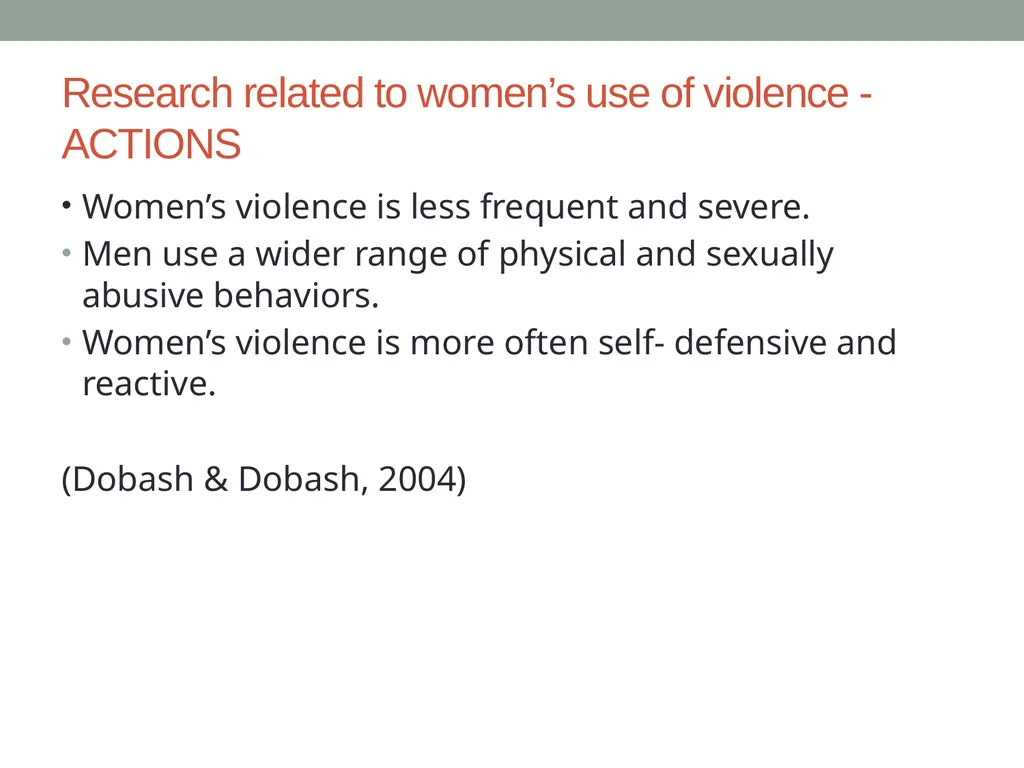
Women’s violence is less frequent and severe.
Men use a wider range of physical and sexually abusive behaviors.
Women’s violence is more often self- defensive and reactive.
(Dobash & Dobash, 2004) Research related to women’s use of violence - ACTIONS<br>
Men use a wider range of physical and sexually abusive behaviors.
Women’s violence is more often self- defensive and reactive.
(Dobash & Dobash, 2004) Research related to women’s use of violence - ACTIONS<br>
03
Women are more likely to report using violence in self-defense and fear.
(Swan, 2003; Dasgupta, 1999)
Women use violence to “secure short-term command over immediate situations.”
(Dasgupta, 2001)
Men are more likely to report that they used violence to control their partner.
(Barnett, Lee and Thelen, 1997 ; Hamberger, Lohr, Bonge and Tolin, 1997). Research related to women’s use of violence – INTENT OF ACTIONS<br>
(Swan, 2003; Dasgupta, 1999)
Women use violence to “secure short-term command over immediate situations.”
(Dasgupta, 2001)
Men are more likely to report that they used violence to control their partner.
(Barnett, Lee and Thelen, 1997 ; Hamberger, Lohr, Bonge and Tolin, 1997). Research related to women’s use of violence – INTENT OF ACTIONS<br>
04
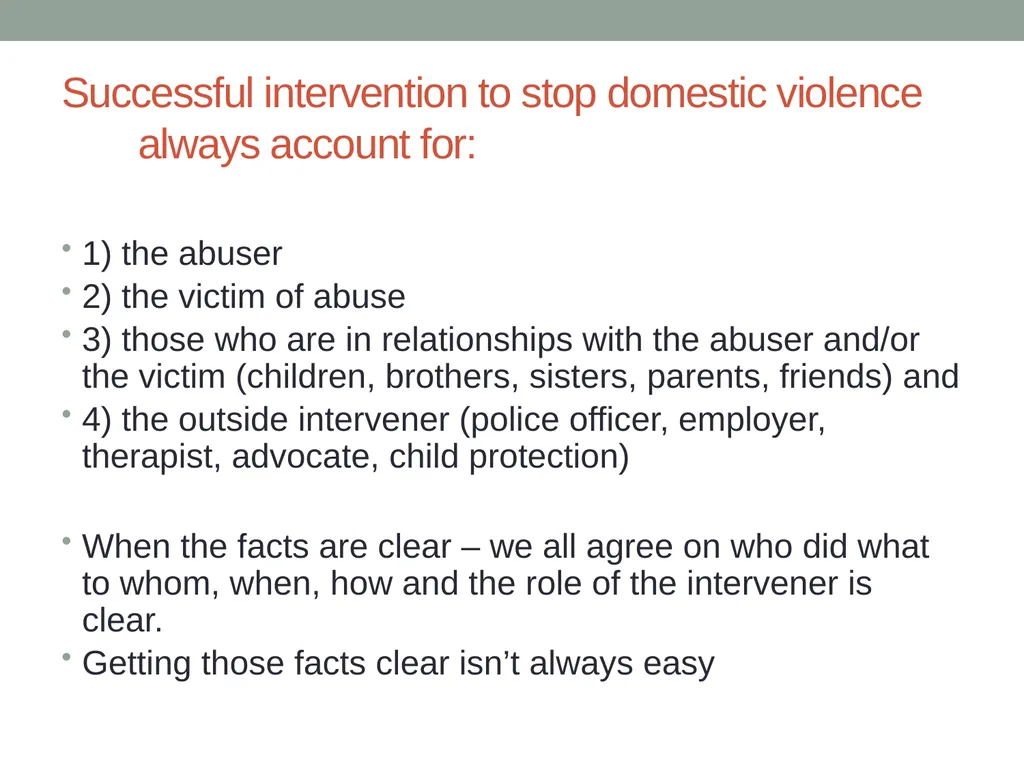
Successful intervention to stop domestic violence always account for: 1) the abuser
2) the victim of abuse
3) those who are in relationships with the abuser and/or the victim (children, brothers, sisters, parents, friends) and
4) the outside intervener (police officer, employer, therapist, advocate, child protection)
When the facts are clear – we all agree on who did what to whom, when, how and the role of the intervener is clear.
Getting those facts clear isn’t always easy<br>
2) the victim of abuse
3) those who are in relationships with the abuser and/or the victim (children, brothers, sisters, parents, friends) and
4) the outside intervener (police officer, employer, therapist, advocate, child protection)
When the facts are clear – we all agree on who did what to whom, when, how and the role of the intervener is clear.
Getting those facts clear isn’t always easy<br>
05
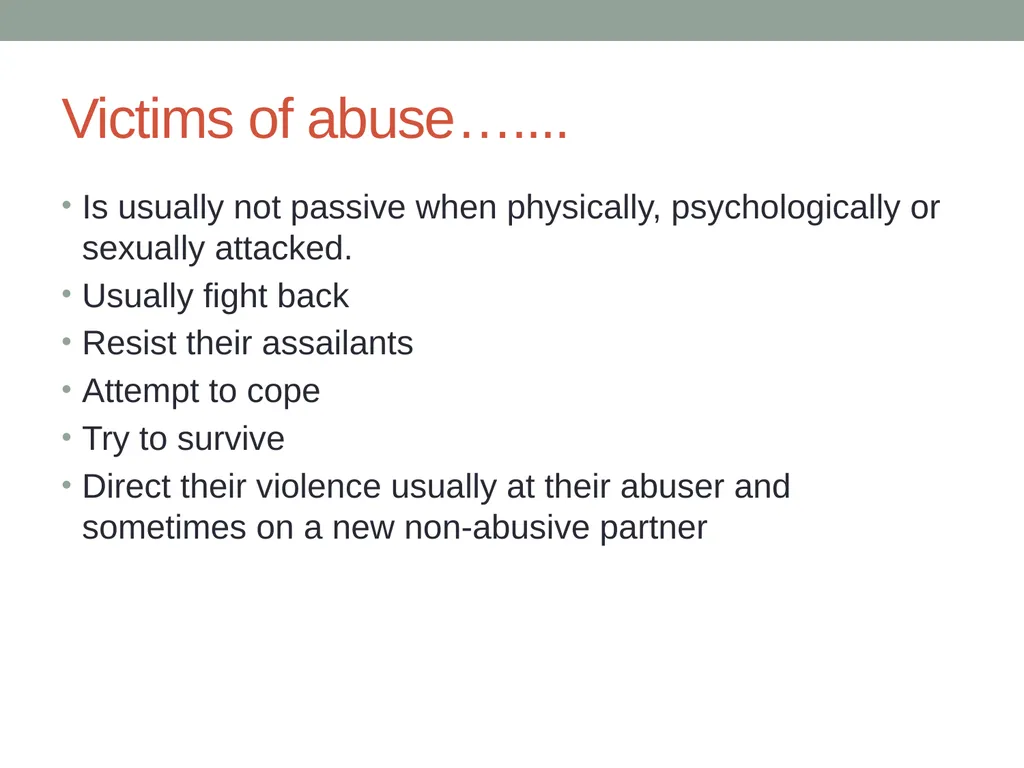
Victims of abuse….... Is usually not passive when physically, psychologically or sexually attacked.
Usually fight back
Resist their assailants
Attempt to cope
Try to survive
Direct their violence usually at their abuser and sometimes on a new non-abusive partner<br>
Usually fight back
Resist their assailants
Attempt to cope
Try to survive
Direct their violence usually at their abuser and sometimes on a new non-abusive partner<br>
06
Why do so many battered women find themselves in batterers’ groups? The use of the term “domestic violence” to describe all acts of intimate partner violence.
Police policy and problematic arrests for resistive violence.
Limited group options and misguided actions by facilitators.
Poor arrest decisions
Problematic convictions<br>
Police policy and problematic arrests for resistive violence.
Limited group options and misguided actions by facilitators.
Poor arrest decisions
Problematic convictions<br>
07
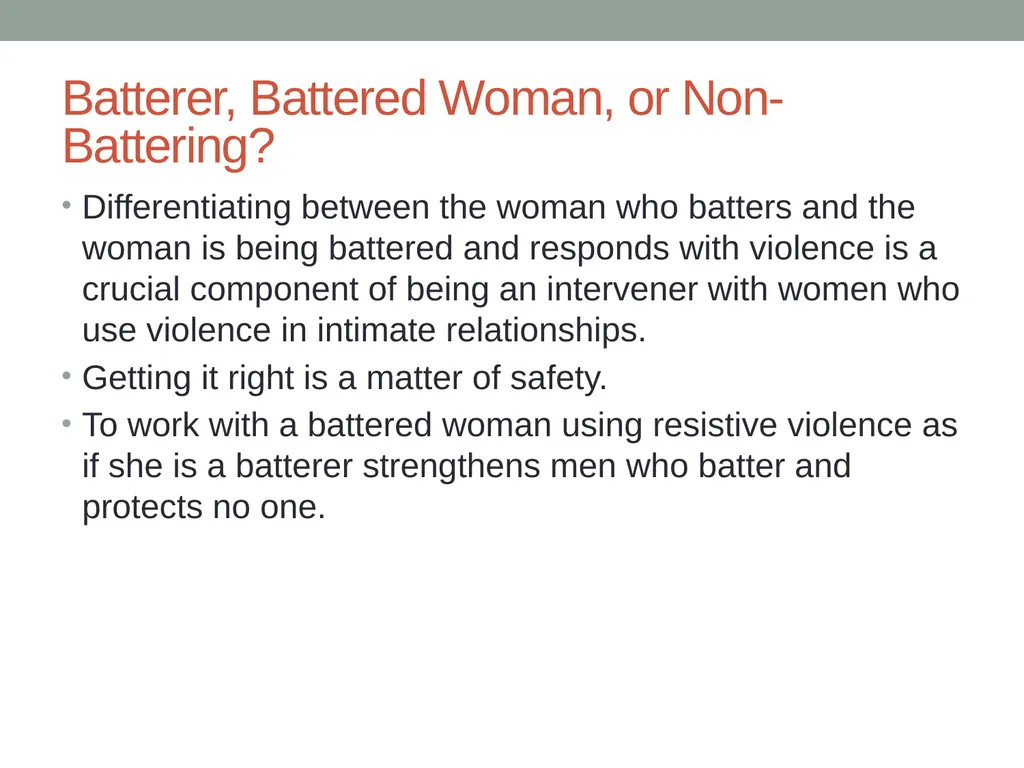
Batterer, Battered Woman, or Non-Battering? Differentiating between the woman who batters and the woman is being battered and responds with violence is a crucial component of being an intervener with women who use violence in intimate relationships.
Getting it right is a matter of safety.
To work with a battered woman using resistive violence as if she is a batterer strengthens men who batter and protects no one.<br>
Getting it right is a matter of safety.
To work with a battered woman using resistive violence as if she is a batterer strengthens men who batter and protects no one.<br>
08
What is domestic violence? Any act of violence committed by a person against an intimate partner.<br>
09
Breaking down the term Battering
Resistive
Non-battering partner violence<br>
Resistive
Non-battering partner violence<br>
10
Defining coercive control or battering: An on-going pattern of coercion, intimidation, and violence to establish and maintain control in an intimate relationship.<br>
11
Coercive control or battering The ongoing use of coercive and controlling actions, including acts of intimidation and violence, targeting a victim whose autonomy and safety is thereby reduced.
Elements of domination
Physical
Sexual
Psychological
Spiritual<br>
Elements of domination
Physical
Sexual
Psychological
Spiritual<br>
12
Characteristics of the behaviors associated with battering: Typically has an element of entrapment…….. “You can’t leave me without being punished.”
Pattern of abuse, its impact, and victims’ responses are not static over time.
The power differential created by violence shapes all interactions between outsiders and family members.
Vulnerability to continued acts of violence takes away victims’ ability to speak freely<br>
Pattern of abuse, its impact, and victims’ responses are not static over time.
The power differential created by violence shapes all interactions between outsiders and family members.
Vulnerability to continued acts of violence takes away victims’ ability to speak freely<br>
13
Resistive violence Including both legal and illegal use of force which is used by victims of battering to control their abusers’ use of coercive and controlling tactics or in reaction to other men’s violence against them as women.<br>
14
Resistive violence Defined: Part of a victim’s broader strategy to stop (contain) the abuse:
Negotiation
Appeals to family and friends
Appeasement
Anger and hostility
Separation
Withdrawal
Use of force<br>
Negotiation
Appeals to family and friends
Appeasement
Anger and hostility
Separation
Withdrawal
Use of force<br>
15
Resistive violence (cont’d) Punishment (including the use of children)
Drinking, drugs, suicide (attempts)
Violence
Continuum of severity (far less likely to cause injury)
Defensive violence during attacks
Retaliation
Threats
Seeking outsiders to help<br>
Drinking, drugs, suicide (attempts)
Violence
Continuum of severity (far less likely to cause injury)
Defensive violence during attacks
Retaliation
Threats
Seeking outsiders to help<br>
16
Non-battering domestic violence is used by one intimate partner against the other that is neither an ongoing attempt to exert control through coercion, nor a response to that coercion. It encompasses all other acts of intimate partner violence, which can again be subdivided into some general categories for the purposes of intervention:<br>
17
3 categories of non-battering domestic violence 1) pathological violence = in which ending or controlling the pathology would end the violence (mental illness, drug and alcohol addiction with no pattern of coercion and entrapment of the parter0
2) anomie – violence associated with a breakdown in social order. Examples include: an increase in rape and abuse of women by their partners in desperate social conditions, such as those experienced during war and in refugee camps.
3) common couple’s violence = in which one or both parties use violence, but it is not part of an ongoing patter of coercion and intimidation; no element of entrapment is present.<br>
2) anomie – violence associated with a breakdown in social order. Examples include: an increase in rape and abuse of women by their partners in desperate social conditions, such as those experienced during war and in refugee camps.
3) common couple’s violence = in which one or both parties use violence, but it is not part of an ongoing patter of coercion and intimidation; no element of entrapment is present.<br>
18
Widespread social problem of domestic violence amongst men and women is not the same What if all men stopped using violence against women today?
Would women’s violence increase, decrease or stay the same?
What if all women stopped using violence against men today?
Would men’s violence increase, decrease, or stay the same?<br>
Would women’s violence increase, decrease or stay the same?
What if all women stopped using violence against men today?
Would men’s violence increase, decrease, or stay the same?<br>
19
Police policy and problematic arrests for resistive violence Interveners lack access to the information from other interveners that would place the violence in context.
Each intervening professional should be informed by previous interveners and should gather information that will determine the type and level of intervention necessary.<br>
Each intervening professional should be informed by previous interveners and should gather information that will determine the type and level of intervention necessary.<br>
20
Risk questions asked by officers of the Duluth Police Department to position every subsequent intervener to respond in context 1) Do you think he/she will seriously injure or kill you, your children, or someone else close to you? What makes you think so? What makes you think not? Does he/she have access to guns?
2) How frequently does he/she assault you? Describe the time you were the most frightened or injured by him/her.
3) Does he/she initiate unwanted contact either electronically or in person? Describe the unwanted contact. How often?
4) How frequently doe he/she intimidate or threaten you? Has he/she intimidated or threatened you regarding talking to police or seeking help from the court?
5) Has he/she ever forced you to do things sexually you didn’t want to?<br>
2) How frequently does he/she assault you? Describe the time you were the most frightened or injured by him/her.
3) Does he/she initiate unwanted contact either electronically or in person? Describe the unwanted contact. How often?
4) How frequently doe he/she intimidate or threaten you? Has he/she intimidated or threatened you regarding talking to police or seeking help from the court?
5) Has he/she ever forced you to do things sexually you didn’t want to?<br>
21
Answers to risk questions set the path The victim’s answers to these questions enable others to make the differentiations needed.
We recommend that communities offering specialized groups for women using force utilize the “City of Duluth Blueprint for Safety Model Response” for creating police policy or contact Praxis International.<br>
We recommend that communities offering specialized groups for women using force utilize the “City of Duluth Blueprint for Safety Model Response” for creating police policy or contact Praxis International.<br>
22
Limited group options and misguided actions by facilitators Limited availability of group options
Judges and probation officers sometimes reluctant to send these “offenders” to groups that address victimization
If a woman is using violence in a patterned way intended to establish a relationship of dominance over her partner, then regardless of her victim status in the past, she should be in a group for batterers.
If a woman is the ongoing victim of the person she assaulted then she should be part of a “resistive violence” group like the “Turning Points” group
Too often facilitators are unwilling to see that women are wrongly placed in their groups
Screen for problematic referrals<br>
Judges and probation officers sometimes reluctant to send these “offenders” to groups that address victimization
If a woman is using violence in a patterned way intended to establish a relationship of dominance over her partner, then regardless of her victim status in the past, she should be in a group for batterers.
If a woman is the ongoing victim of the person she assaulted then she should be part of a “resistive violence” group like the “Turning Points” group
Too often facilitators are unwilling to see that women are wrongly placed in their groups
Screen for problematic referrals<br>
23
Poor arrest decisions Working with police departments to conduct a thorough investigation
Was a self-defense determination made?
When self-defense and predominant aggressor investigation skills are integrated with supervisory oversight, the number of problematic arrests decline<br>
Was a self-defense determination made?
When self-defense and predominant aggressor investigation skills are integrated with supervisory oversight, the number of problematic arrests decline<br>
24
Problematic convictions Does convicting battered women for using force the same as men who batter equal justice?
Most sentences in communities are the same for all domestic violence crimes
Abusers use the battered woman’s conviction against her
It can increase his control of her.
Limit her ability to leave him.
She may be reluctant to call the police in the future
“Crossroads: Justice and Accountability for Victims of Battering Who Use Violence Against Their Batterers”<br>
Most sentences in communities are the same for all domestic violence crimes
Abusers use the battered woman’s conviction against her
It can increase his control of her.
Limit her ability to leave him.
She may be reluctant to call the police in the future
“Crossroads: Justice and Accountability for Victims of Battering Who Use Violence Against Their Batterers”<br>
25
Key questions for determining type of violence Is there an on-going pattern?
Is the violence intended to instill fear?
Is the violence intended to dominate and control?
Who did what to whom? When? How?
With what impact?<br>
Is the violence intended to instill fear?
Is the violence intended to dominate and control?
Who did what to whom? When? How?
With what impact?<br>
26
What type of domestic violence are the women who are court ordered your supervised visitation center using? Battering
Resistive
Non-battering
How do know?
Who gives you the information to make the determination?<br>
Resistive
Non-battering
How do know?
Who gives you the information to make the determination?<br>
27
Distinguishing group model types for women Anger management
Batterers Intervention Program (BIP)
Resistive Violence group process – addresses women’s experience and use of violence with the goal for ending both<br>
Batterers Intervention Program (BIP)
Resistive Violence group process – addresses women’s experience and use of violence with the goal for ending both<br>
28
Resources Domestic Violence Turning Points
www.dvturningpoints.com
Advocates for Family Peace
www.stopdomesticabuse.org
Domestic Abuse Intervention Project
www.theduluthmodel.org
Praxis International
www.praxisinternational.org
Mending the Sacred Hoop
www.msh-ta.org
Battered Women’s Justice Project
www.bwjp.org<br>
www.dvturningpoints.com
Advocates for Family Peace
www.stopdomesticabuse.org
Domestic Abuse Intervention Project
www.theduluthmodel.org
Praxis International
www.praxisinternational.org
Mending the Sacred Hoop
www.msh-ta.org
Battered Women’s Justice Project
www.bwjp.org<br>
29
Authors: Ellen Pence, PhD, Laura Connely & Melissa Scaia, MPA
Facilitators weekly sessions
Participants workbook
DVDs featuring:
Short lectures
Vignettes
Women’s stories
To order go to: www.dvturningpoints.com
Contact Domestic Violence Turning Points at
218-656-0272 or info@dvturningpoints.com TURNING POINTS: A Nonviolence Curriculum for Women<br>
Facilitators weekly sessions
Participants workbook
DVDs featuring:
Short lectures
Vignettes
Women’s stories
To order go to: www.dvturningpoints.com
Contact Domestic Violence Turning Points at
218-656-0272 or info@dvturningpoints.com TURNING POINTS: A Nonviolence Curriculum for Women<br>