
WIC fiscal training for local agency coordinators
MY
Published · 37 slides · 0 views

1 / 1

Description
WIC fiscal training for local agency coordinators and fiscal staff Objectives for this training Local agency staff can utilize their WIC grant award effectively to maximize program impact. Local agency staff will understand the fiscal
Related Topics
Share
Embed code
Download this presentation From Below
"WIC fiscal training for local agency coordinators" is the property of its rightful owner. Permission is granted to download and print the materials on this website for personal, non-commercial use only, and to display it on your personal computer provided you do not modify the materials and that you retain all copyright notices contained in the materials. By downloading content from our website, you accept the terms of this agreement.
Presentation Transcript
01
WIC fiscal training for
local agency coordinators and fiscal staff<br>
02
Objectives for this training Local agency staff can utilize their WIC grant award effectively to maximize program impact.
Local agency staff will understand the fiscal review standards and reporting requirements.
Local agency staff will know where to get technical assistance and answers to questions on different fiscal issues.<br>
Local agency staff will understand the fiscal review standards and reporting requirements.
Local agency staff will know where to get technical assistance and answers to questions on different fiscal issues.<br>
03
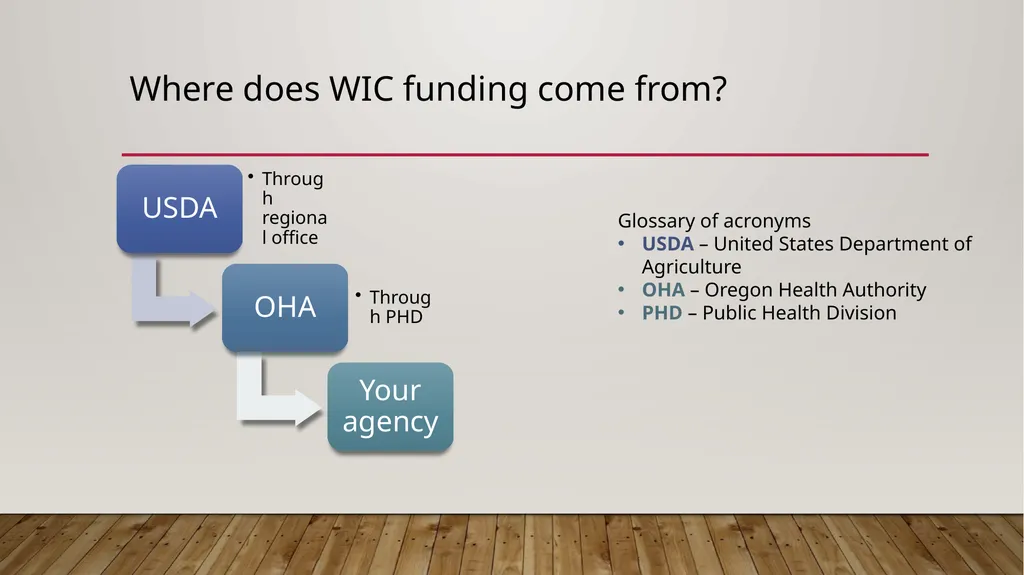
Where does WIC funding come from? Glossary of acronyms
USDA – United States Department of Agriculture
OHA – Oregon Health Authority
PHD – Public Health Division<br>
USDA – United States Department of Agriculture
OHA – Oregon Health Authority
PHD – Public Health Division<br>
04
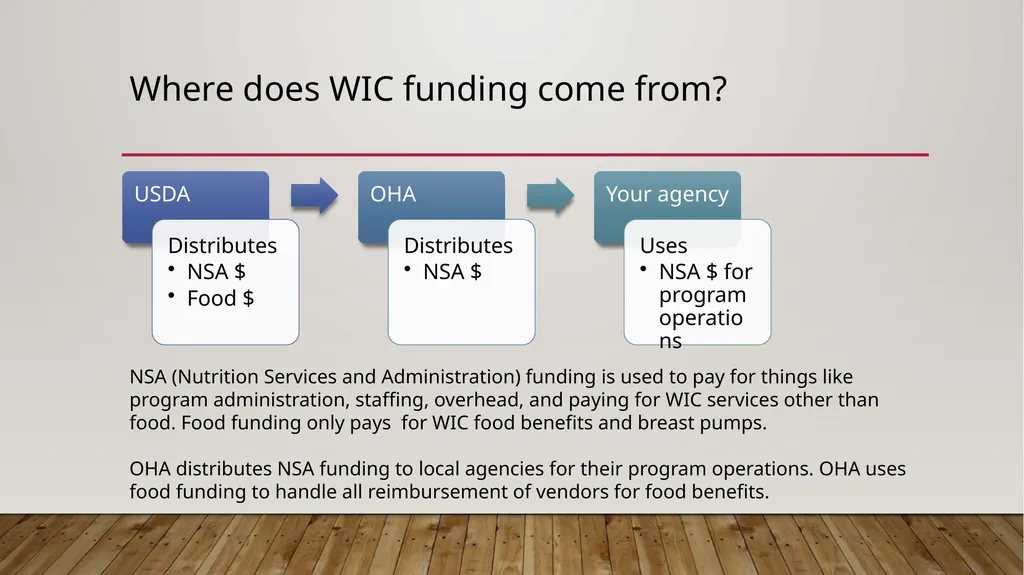
Where does WIC funding come from? NSA (Nutrition Services and Administration) funding is used to pay for things like program administration, staffing, overhead, and paying for WIC services other than food. Food funding only pays for WIC food benefits and breast pumps.
OHA distributes NSA funding to local agencies for their program operations. OHA uses food funding to handle all reimbursement of vendors for food benefits.<br>
OHA distributes NSA funding to local agencies for their program operations. OHA uses food funding to handle all reimbursement of vendors for food benefits.<br>
05
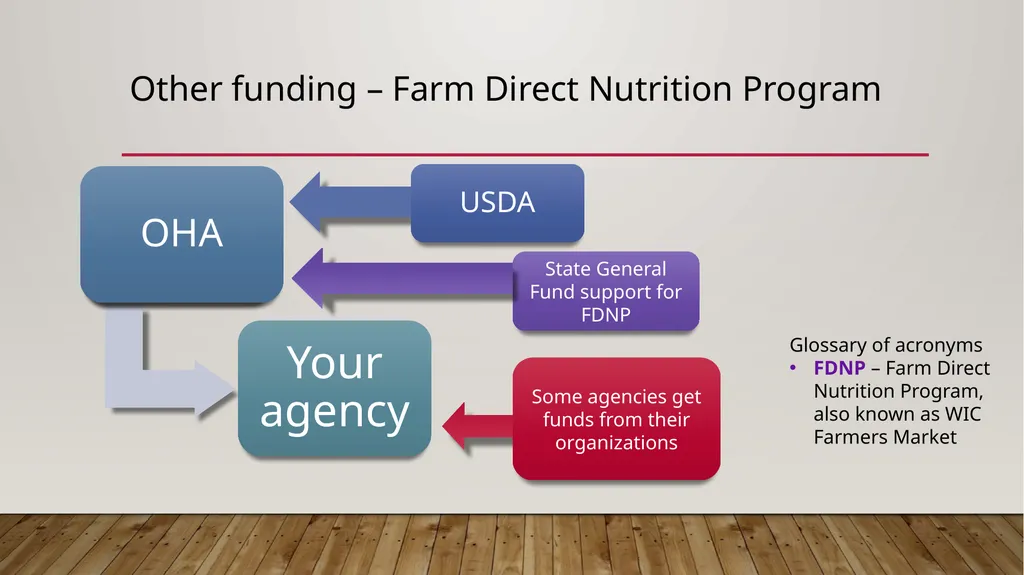
Other funding – Farm Direct Nutrition Program State General Fund support for FDNP Some agencies get funds from their organizations Glossary of acronyms
FDNP – Farm Direct Nutrition Program, also known as WIC Farmers Market<br>
FDNP – Farm Direct Nutrition Program, also known as WIC Farmers Market<br>
06
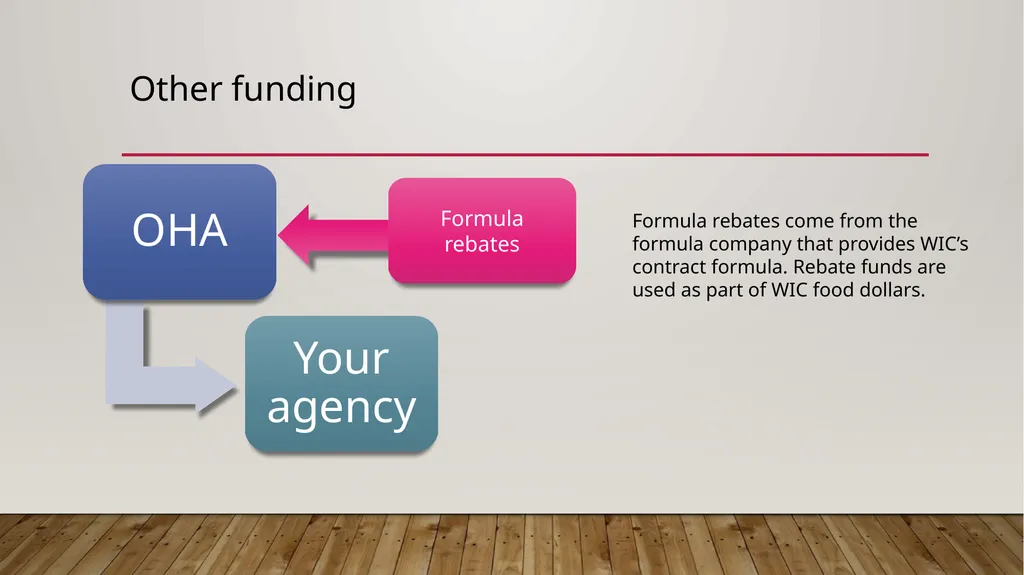
Other funding Formula rebates Formula rebates come from the formula company that provides WIC’s contract formula. Rebate funds are used as part of WIC food dollars.<br>
07
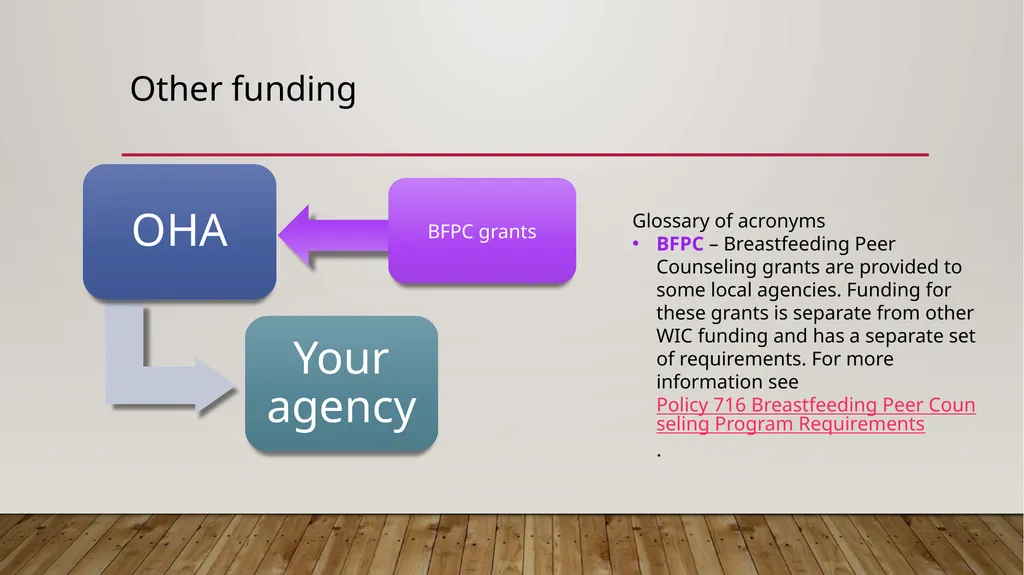
Other funding BFPC grants Glossary of acronyms
BFPC – Breastfeeding Peer Counseling grants are provided to some local agencies. Funding for these grants is separate from other WIC funding and has a separate set of requirements. For more information see Policy 716 Breastfeeding Peer Counseling Program Requirements.<br>
BFPC – Breastfeeding Peer Counseling grants are provided to some local agencies. Funding for these grants is separate from other WIC funding and has a separate set of requirements. For more information see Policy 716 Breastfeeding Peer Counseling Program Requirements.<br>
08
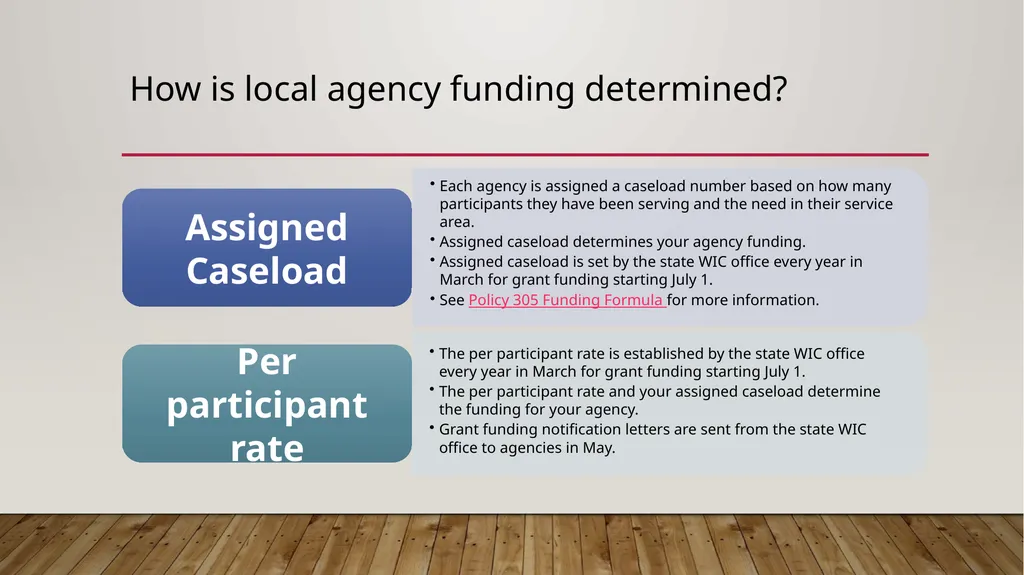
How is local agency funding determined?<br>
09
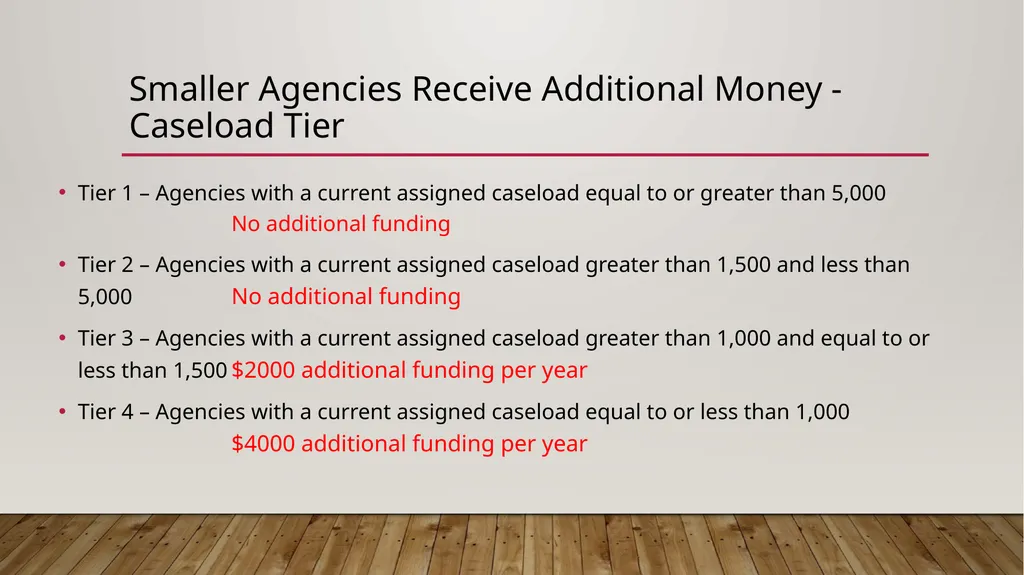
Smaller Agencies Receive Additional Money - Caseload Tier Tier 1 – Agencies with a current assigned caseload equal to or greater than 5,000 No additional funding
Tier 2 – Agencies with a current assigned caseload greater than 1,500 and less than 5,000 No additional funding
Tier 3 – Agencies with a current assigned caseload greater than 1,000 and equal to or less than 1,500 $2000 additional funding per year
Tier 4 – Agencies with a current assigned caseload equal to or less than 1,000 $4000 additional funding per year<br>
10
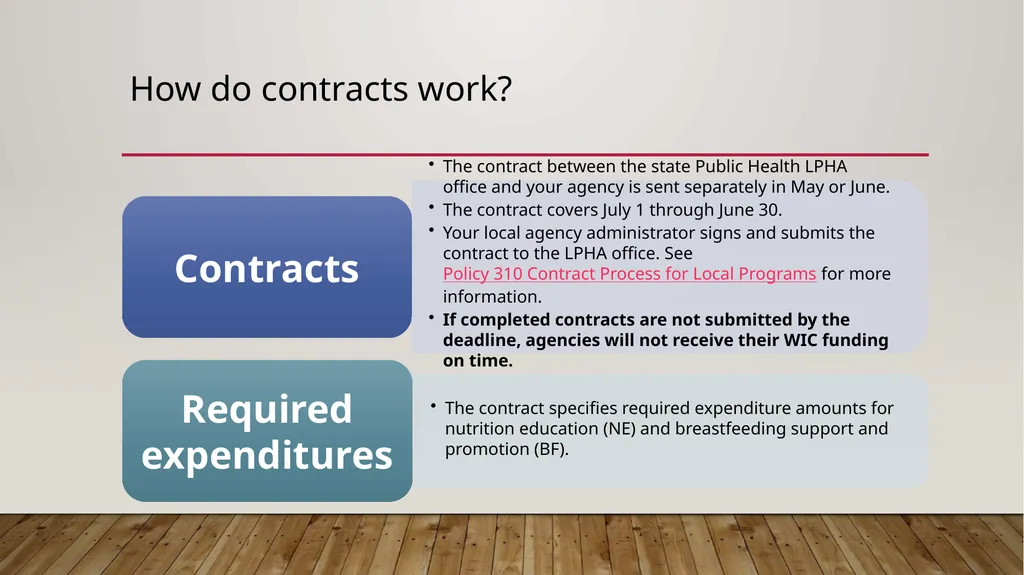
How do contracts work?<br>
11
How are funds received? Agencies receive 1/12th of their total annual funding every month starting July 1.
These payments are reconciled quarterly.
There are certain situations where funds can be carried over to the next month.
To understand how this works, you need to understand how WIC fiscal years work.<br>
These payments are reconciled quarterly.
There are certain situations where funds can be carried over to the next month.
To understand how this works, you need to understand how WIC fiscal years work.<br>
12
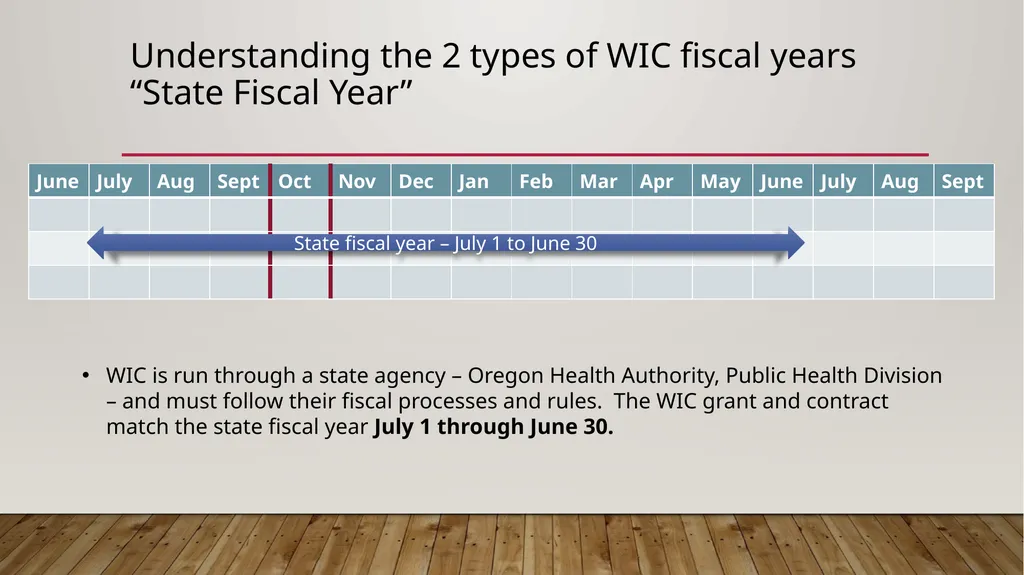
Understanding the 2 types of WIC fiscal years
“State Fiscal Year” State fiscal year – July 1 to June 30 WIC is run through a state agency – Oregon Health Authority, Public Health Division – and must follow their fiscal processes and rules. The WIC grant and contract match the state fiscal year July 1 through June 30.<br>
13
Understanding the 2 types of WIC fiscal years
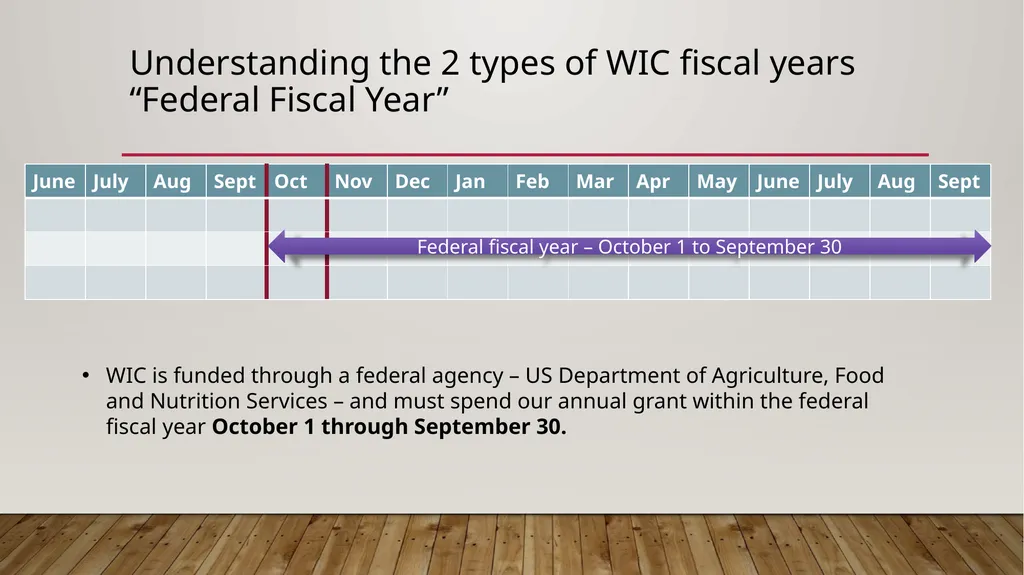
“Federal Fiscal Year” Federal fiscal year – October 1 to September 30 WIC is funded through a federal agency – US Department of Agriculture, Food and Nutrition Services – and must spend our annual grant within the federal fiscal year October 1 through September 30.<br>
14
Understanding the 2 types of WIC fiscal years
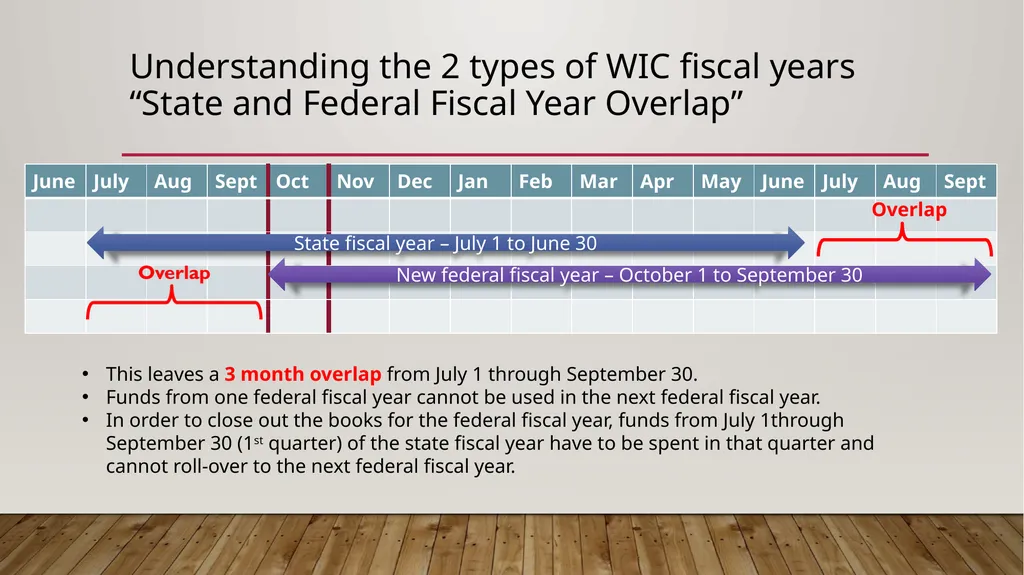
“State and Federal Fiscal Year Overlap” State fiscal year – July 1 to June 30 New federal fiscal year – October 1 to September 30 This leaves a 3 month overlap from July 1 through September 30.
Funds from one federal fiscal year cannot be used in the next federal fiscal year.
In order to close out the books for the federal fiscal year, funds from July 1through September 30 (1st quarter) of the state fiscal year have to be spent in that quarter and cannot roll-over to the next federal fiscal year. Overlap<br>
15
Quarterly revenue and expense reports<br>
16
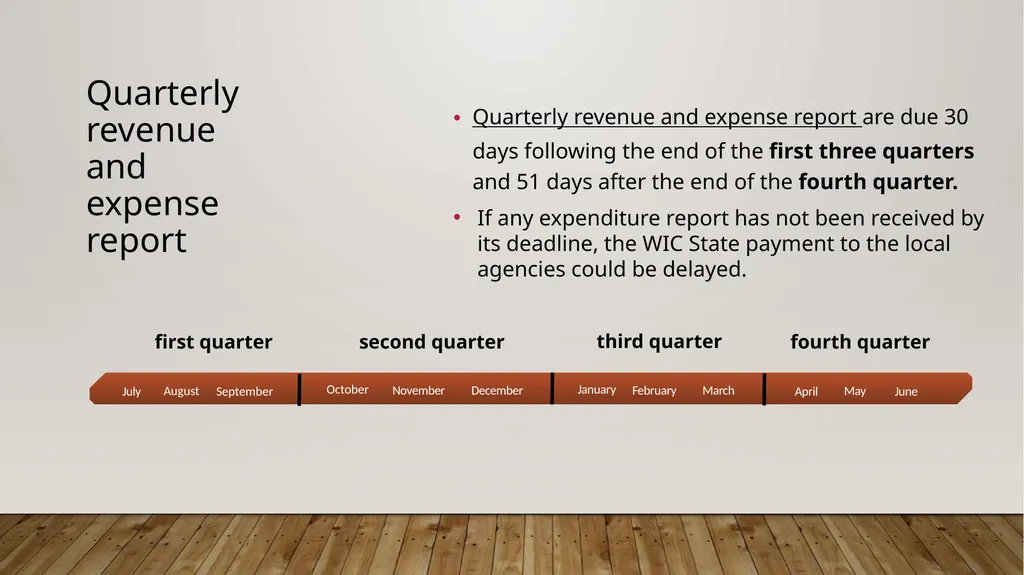
July August September October November December January February March April May June Quarterly revenue and expense report are due 30 days following the end of the first three quarters and 51 days after the end of the fourth quarter.
If any expenditure report has not been received by its deadline, the WIC State payment to the local agencies could be delayed. Quarterly revenue and expense report first quarter second quarter third quarter fourth quarter<br>
If any expenditure report has not been received by its deadline, the WIC State payment to the local agencies could be delayed. Quarterly revenue and expense report first quarter second quarter third quarter fourth quarter<br>
17
Underspending your WIC grant At the end of every quarter, there are a few agencies that have not submitted Quarterly Revenue and Expense reports showing they’ve spent their full WIC grant.
When the underspent amount is significant, the State WIC office sends out underspent notices to these agencies in early February and May in hopes they can correct it at the end of the end of the 2nd and 3rd quarters.<br>
When the underspent amount is significant, the State WIC office sends out underspent notices to these agencies in early February and May in hopes they can correct it at the end of the end of the 2nd and 3rd quarters.<br>
18
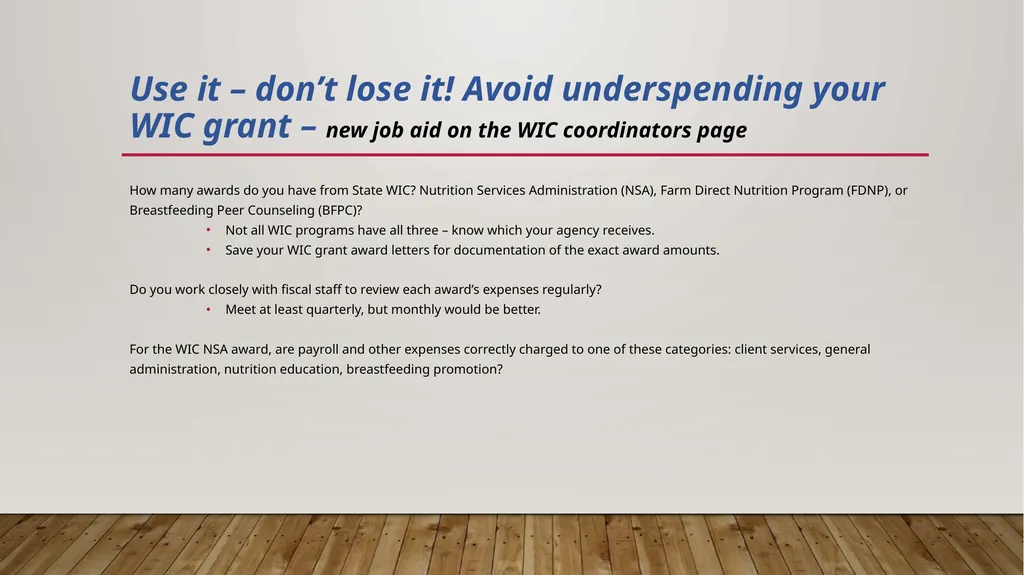
Use it – don’t lose it! Avoid underspending your WIC grant – new job aid on the WIC coordinators page How many awards do you have from State WIC? Nutrition Services Administration (NSA), Farm Direct Nutrition Program (FDNP), or Breastfeeding Peer Counseling (BFPC)?
Not all WIC programs have all three – know which your agency receives.
Save your WIC grant award letters for documentation of the exact award amounts.
Do you work closely with fiscal staff to review each award’s expenses regularly?
Meet at least quarterly, but monthly would be better.
For the WIC NSA award, are payroll and other expenses correctly charged to one of these categories: client services, general administration, nutrition education, breastfeeding promotion?<br>
19
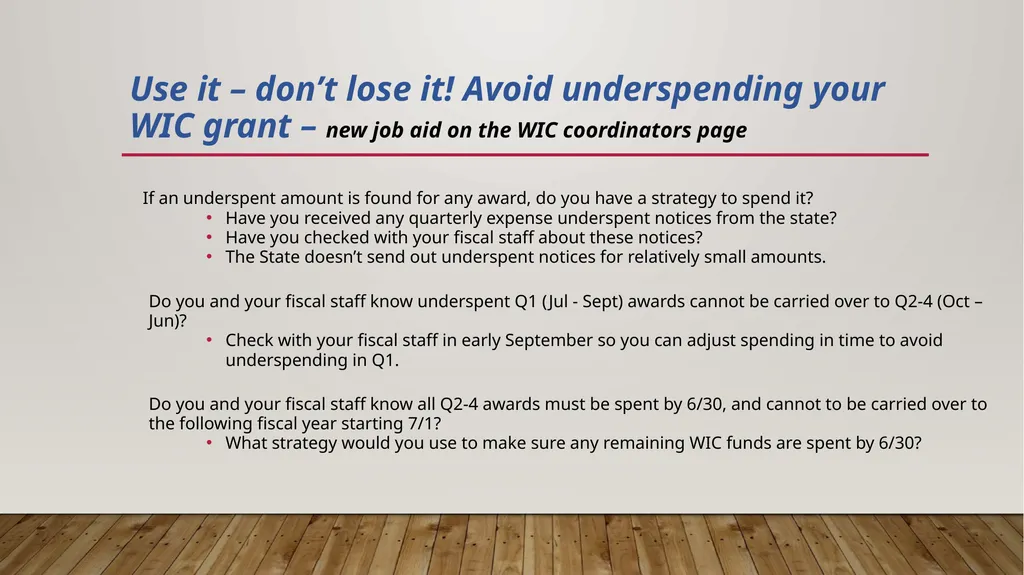
Use it – don’t lose it! Avoid underspending your WIC grant – new job aid on the WIC coordinators page If an underspent amount is found for any award, do you have a strategy to spend it?
Have you received any quarterly expense underspent notices from the state?
Have you checked with your fiscal staff about these notices?
The State doesn’t send out underspent notices for relatively small amounts.
Do you and your fiscal staff know underspent Q1 (Jul - Sept) awards cannot be carried over to Q2-4 (Oct – Jun)?
Check with your fiscal staff in early September so you can adjust spending in time to avoid underspending in Q1.
Do you and your fiscal staff know all Q2-4 awards must be spent by 6/30, and cannot to be carried over to the following fiscal year starting 7/1?
What strategy would you use to make sure any remaining WIC funds are spent by 6/30?<br>
20
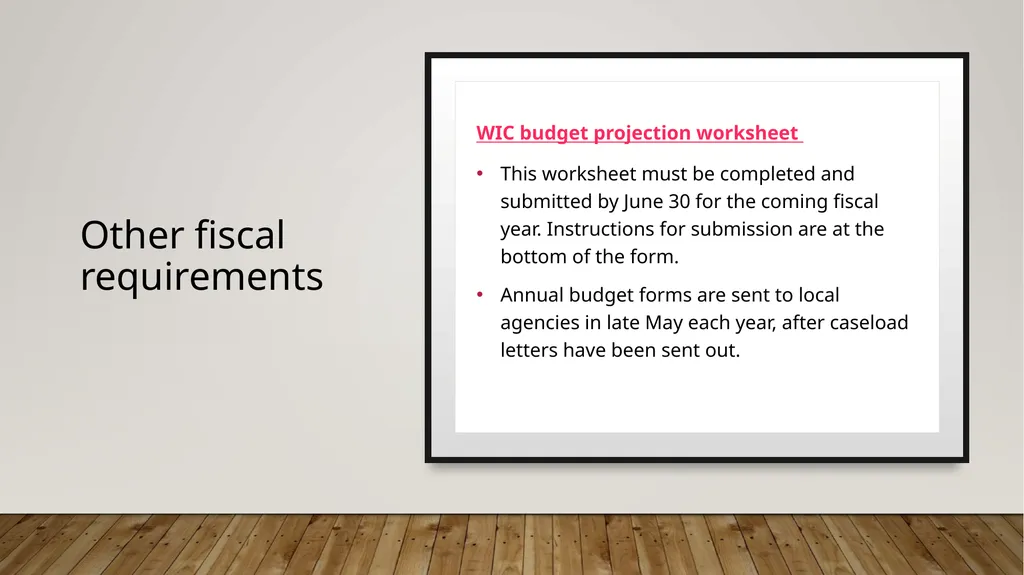
Other fiscal requirements WIC budget projection worksheet
This worksheet must be completed and submitted by June 30 for the coming fiscal year. Instructions for submission are at the bottom of the form.
Annual budget forms are sent to local agencies in late May each year, after caseload letters have been sent out.<br>
This worksheet must be completed and submitted by June 30 for the coming fiscal year. Instructions for submission are at the bottom of the form.
Annual budget forms are sent to local agencies in late May each year, after caseload letters have been sent out.<br>
21
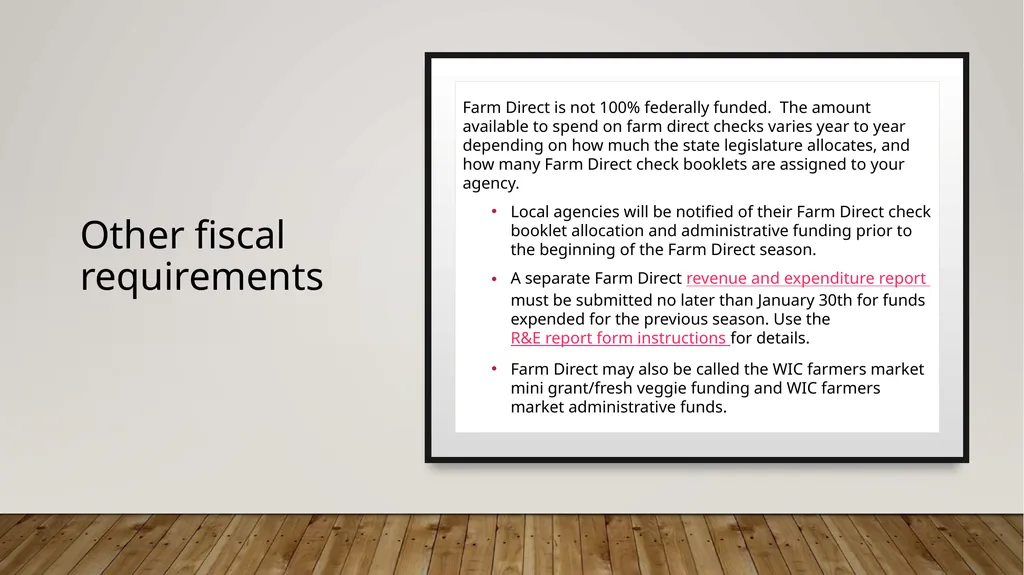
Other fiscal requirements Farm Direct is not 100% federally funded. The amount available to spend on farm direct checks varies year to year depending on how much the state legislature allocates, and how many Farm Direct check booklets are assigned to your agency.
Local agencies will be notified of their Farm Direct check booklet allocation and administrative funding prior to the beginning of the Farm Direct season.
A separate Farm Direct revenue and expenditure report must be submitted no later than January 30th for funds expended for the previous season. Use the R&E report form instructions for details.
Farm Direct may also be called the WIC farmers market mini grant/fresh veggie funding and WIC farmers market administrative funds.<br>
22
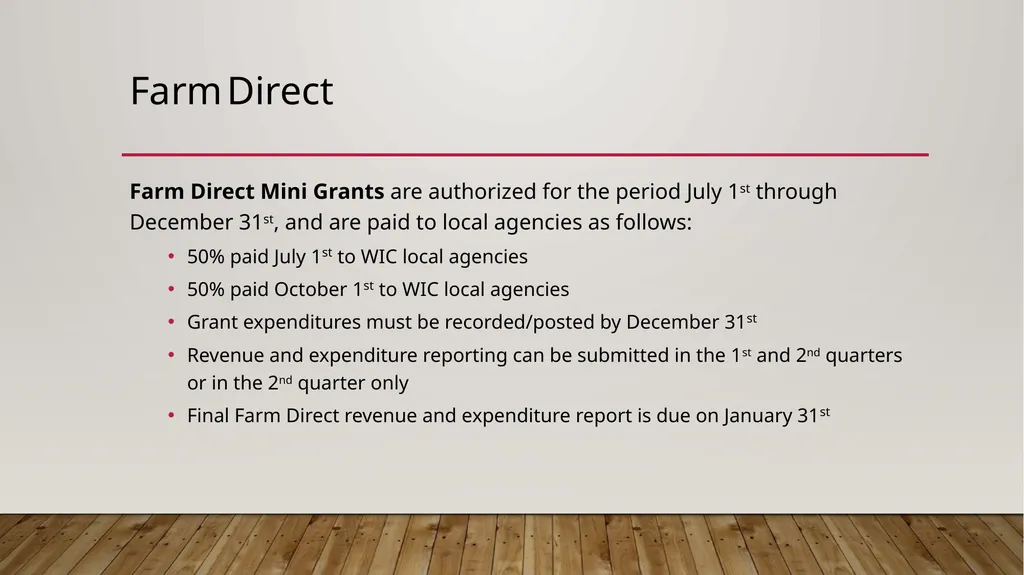
Farm Direct Farm Direct Mini Grants are authorized for the period July 1st through December 31st, and are paid to local agencies as follows:
50% paid July 1st to WIC local agencies
50% paid October 1st to WIC local agencies
Grant expenditures must be recorded/posted by December 31st
Revenue and expenditure reporting can be submitted in the 1st and 2nd quarters or in the 2nd quarter only
Final Farm Direct revenue and expenditure report is due on January 31st<br>
23
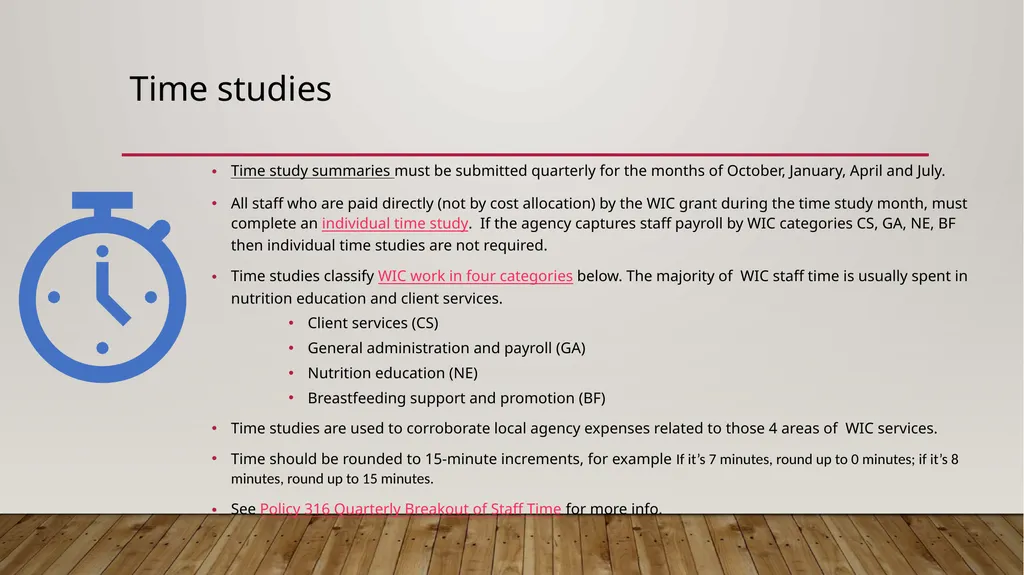
Time studies Time study summaries must be submitted quarterly for the months of October, January, April and July.
All staff who are paid directly (not by cost allocation) by the WIC grant during the time study month, must complete an individual time study. If the agency captures staff payroll by WIC categories CS, GA, NE, BF then individual time studies are not required.
Time studies classify WIC work in four categories below. The majority of WIC staff time is usually spent in nutrition education and client services.
Client services (CS)
General administration and payroll (GA)
Nutrition education (NE)
Breastfeeding support and promotion (BF)
Time studies are used to corroborate local agency expenses related to those 4 areas of WIC services.
Time should be rounded to 15-minute increments, for example If it’s 7 minutes, round up to 0 minutes; if it’s 8 minutes, round up to 15 minutes.
See Policy 316 Quarterly Breakout of Staff Time for more info.<br>
24
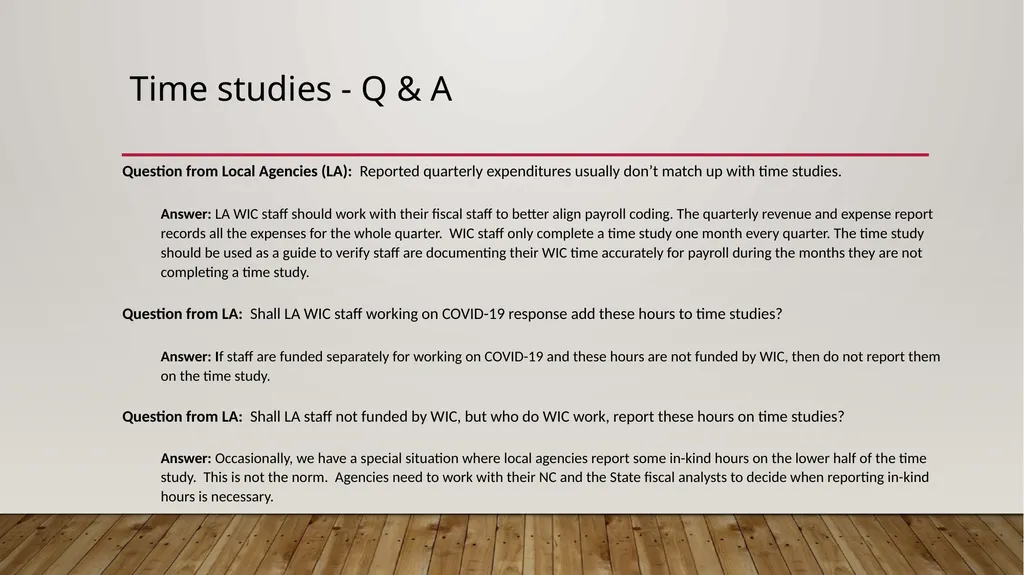
Time studies - Q & A Question from Local Agencies (LA): Reported quarterly expenditures usually don’t match up with time studies.
Answer: LA WIC staff should work with their fiscal staff to better align payroll coding. The quarterly revenue and expense report records all the expenses for the whole quarter. WIC staff only complete a time study one month every quarter. The time study should be used as a guide to verify staff are documenting their WIC time accurately for payroll during the months they are not completing a time study.
Question from LA: Shall LA WIC staff working on COVID-19 response add these hours to time studies?
Answer: If staff are funded separately for working on COVID-19 and these hours are not funded by WIC, then do not report them on the time study.
Question from LA: Shall LA staff not funded by WIC, but who do WIC work, report these hours on time studies?
Answer: Occasionally, we have a special situation where local agencies report some in-kind hours on the lower half of the time study. This is not the norm. Agencies need to work with their NC and the State fiscal analysts to decide when reporting in-kind hours is necessary.<br>
25
Travel
and
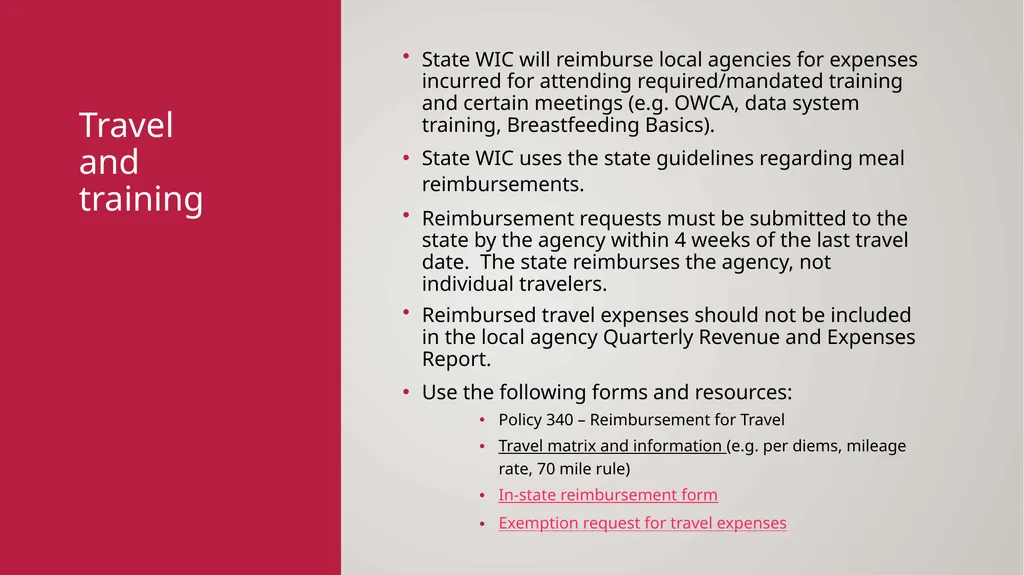
training State WIC will reimburse local agencies for expenses incurred for attending required/mandated training and certain meetings (e.g. OWCA, data system training, Breastfeeding Basics).
State WIC uses the state guidelines regarding meal reimbursements.
Reimbursement requests must be submitted to the state by the agency within 4 weeks of the last travel date. The state reimburses the agency, not individual travelers.
Reimbursed travel expenses should not be included in the local agency Quarterly Revenue and Expenses Report.
Use the following forms and resources:
Policy 340 – Reimbursement for Travel
Travel matrix and information (e.g. per diems, mileage rate, 70 mile rule)
In-state reimbursement form
Exemption request for travel expenses<br>
26
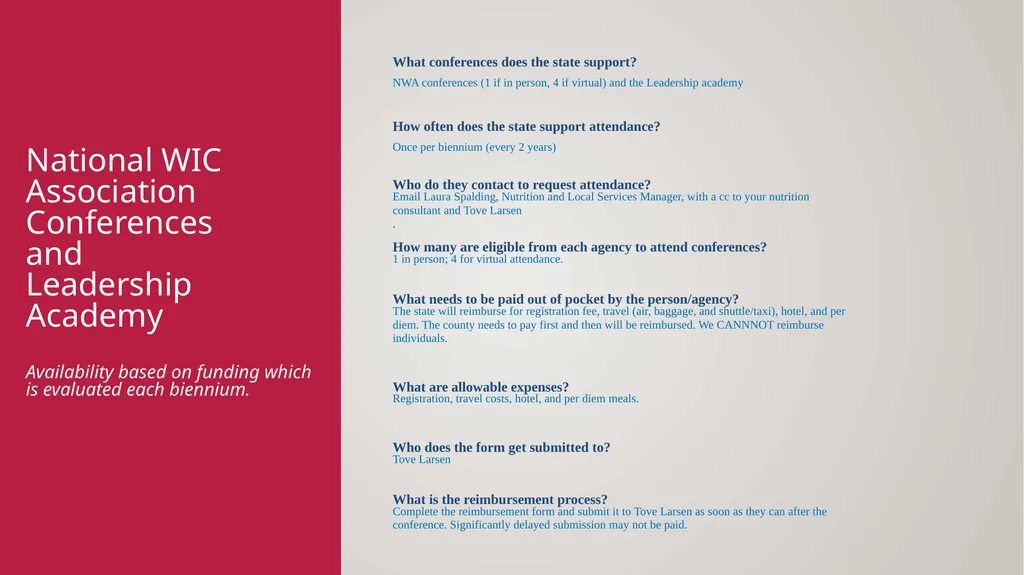
National WIC Association Conferences
and
Leadership Academy
Availability based on funding which is evaluated each biennium. What conferences does the state support?
NWA conferences (1 if in person, 4 if virtual) and the Leadership academy
How often does the state support attendance?
Once per biennium (every 2 years)
Who do they contact to request attendance?
Email Laura Spalding, Nutrition and Local Services Manager, with a cc to your nutrition consultant and Tove Larsen
.
How many are eligible from each agency to attend conferences?
1 in person; 4 for virtual attendance.
What needs to be paid out of pocket by the person/agency?
The state will reimburse for registration fee, travel (air, baggage, and shuttle/taxi), hotel, and per diem. The county needs to pay first and then will be reimbursed. We CANNNOT reimburse individuals.
What are allowable expenses?
Registration, travel costs, hotel, and per diem meals.
Who does the form get submitted to?
Tove Larsen
What is the reimbursement process?
Complete the reimbursement form and submit it to Tove Larsen as soon as they can after the conference. Significantly delayed submission may not be paid.<br>
27
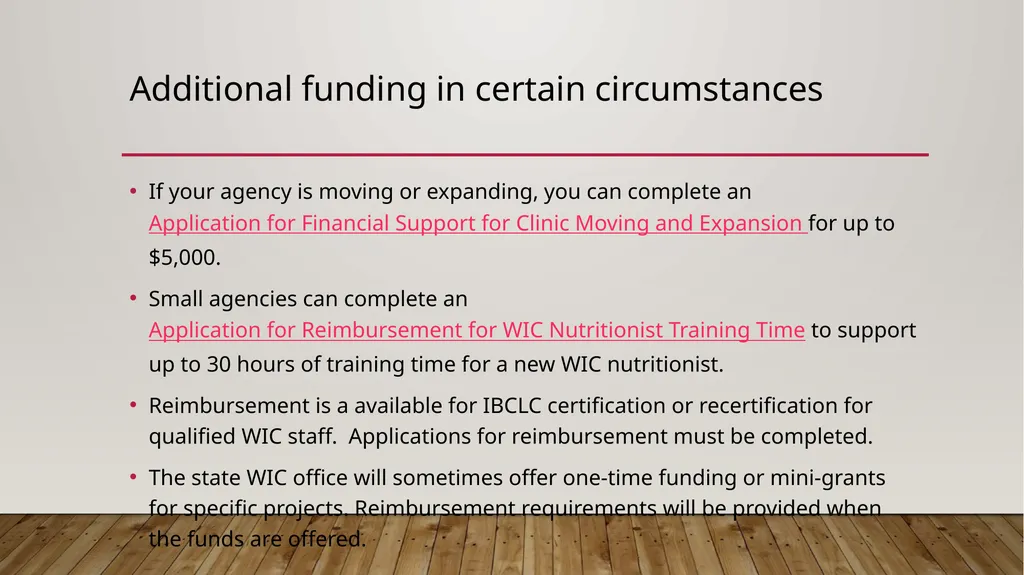
Additional funding in certain circumstances If your agency is moving or expanding, you can complete an Application for Financial Support for Clinic Moving and Expansion for up to $5,000.
Small agencies can complete an Application for Reimbursement for WIC Nutritionist Training Time to support up to 30 hours of training time for a new WIC nutritionist.
Reimbursement is a available for IBCLC certification or recertification for qualified WIC staff. Applications for reimbursement must be completed.
The state WIC office will sometimes offer one-time funding or mini-grants for specific projects. Reimbursement requirements will be provided when the funds are offered.<br>
28
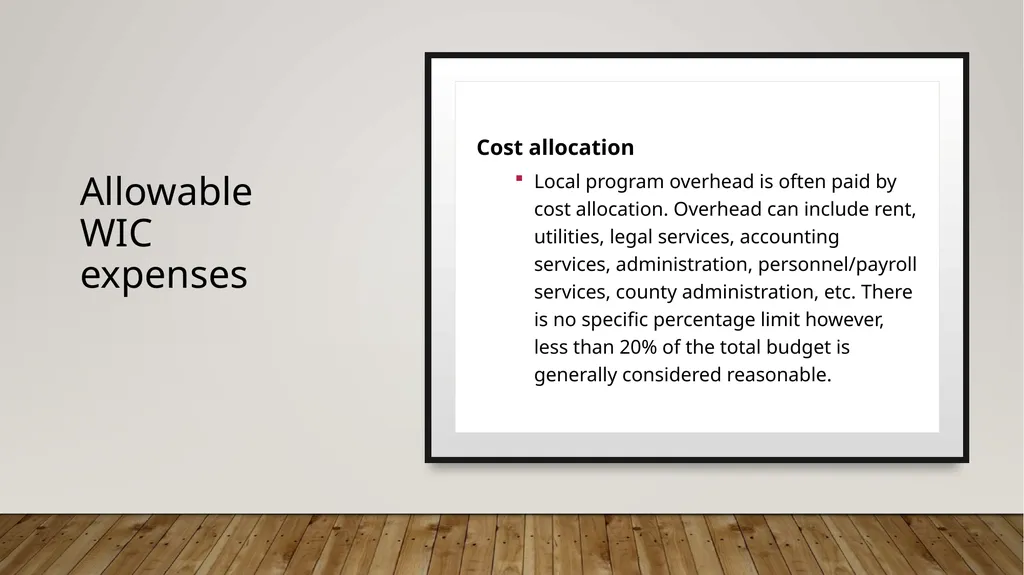
Allowable
WIC
expenses Cost allocation
Local program overhead is often paid by cost allocation. Overhead can include rent, utilities, legal services, accounting services, administration, personnel/payroll services, county administration, etc. There is no specific percentage limit however, less than 20% of the total budget is generally considered reasonable.<br>
Local program overhead is often paid by cost allocation. Overhead can include rent, utilities, legal services, accounting services, administration, personnel/payroll services, county administration, etc. There is no specific percentage limit however, less than 20% of the total budget is generally considered reasonable.<br>
29
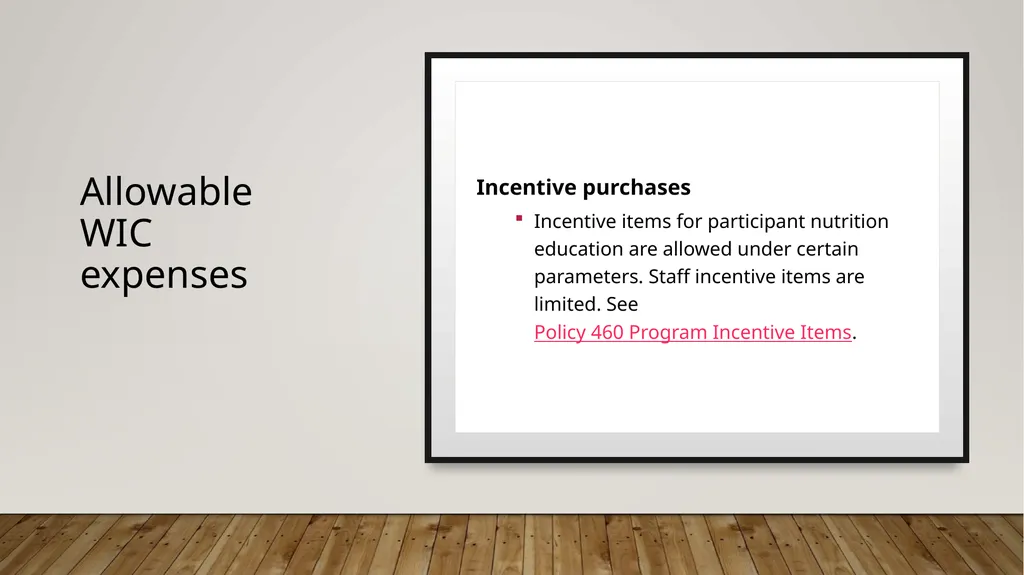
Allowable
WIC
expenses Incentive purchases
Incentive items for participant nutrition education are allowed under certain parameters. Staff incentive items are limited. See Policy 460 Program Incentive Items.<br>
Incentive items for participant nutrition education are allowed under certain parameters. Staff incentive items are limited. See Policy 460 Program Incentive Items.<br>
30
Allowable
WIC
expenses Capital purchases:
Expenditures must be approved if the item to be purchased is over $2,500. Contact the state WIC office for pre-approval from USDA Western Region office. Capital Expenditure Approval Form.<br>
Expenditures must be approved if the item to be purchased is over $2,500. Contact the state WIC office for pre-approval from USDA Western Region office. Capital Expenditure Approval Form.<br>
31
Local agency fiscal monitoring and compliance review WIC biennial fiscal review is completed by the State Fiscal Compliance Specialist from the Office of Public Health Director. The fiscal compliance specialist will schedule the fiscal review either shortly before or shortly after the WIC biennial review.<br>
32
Local agency fiscal monitoring and compliance review A fiscal compliance review is conducted to provide assurance that the local WIC agency has an accounting system with proper internal controls to identify and report revenues, expenditures and equipment provided by federal funds through the Oregon Health Authority (OHA).
A period is selected for conducting the review. The accounting transactions for that period will be evaluated for accuracy and compliance with applicable federal and state regulations, Women, Infants and Children Program (WIC) policies and procedures.<br>
A period is selected for conducting the review. The accounting transactions for that period will be evaluated for accuracy and compliance with applicable federal and state regulations, Women, Infants and Children Program (WIC) policies and procedures.<br>
33
Local agency fiscal monitoring and compliance review Instances of noncompliance, material discrepancies and other irregularities are considered findings of the review for which management response and corrective action is required within 60 days upon receipt of the fiscal reports.<br>
34
Local agency fiscal monitoring and compliance review – some areas of focus Fiscal Audit of Time Study Summaries
The quarterly time study summary submitted to the State must accurately reflect the information recorded on individual staff WIC time study sheets, and individual staff time studies must accurately reflect what staff record on payroll records. Individual time studies for up to four employees are audited
Compliance finding examples: The total hours on summary and individual time studies match but the activities do not. Time spent in other Program Elements is charged to WIC. An employee was absent, but their time was charged to WIC.
Inventory of goods purchased with WIC funds
For example: breast pumps, scales, laptops, printers, HemoCue machines
Allowable Costs
Verification WIC funds used for only allowable costs<br>
35
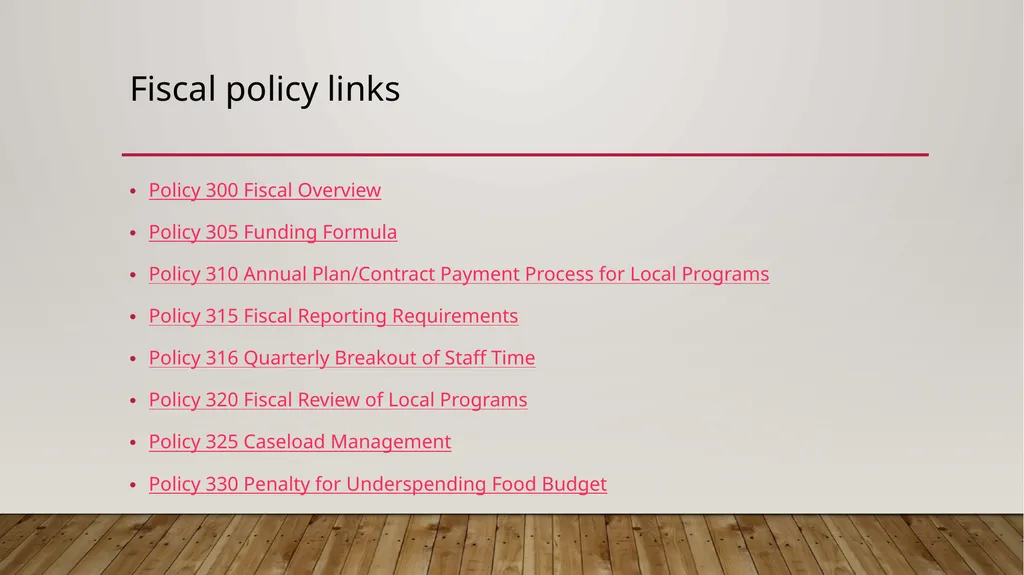
Fiscal policy links Policy 300 Fiscal Overview
Policy 305 Funding Formula
Policy 310 Annual Plan/Contract Payment Process for Local Programs
Policy 315 Fiscal Reporting Requirements
Policy 316 Quarterly Breakout of Staff Time
Policy 320 Fiscal Review of Local Programs
Policy 325 Caseload Management
Policy 330 Penalty for Underspending Food Budget<br>
36
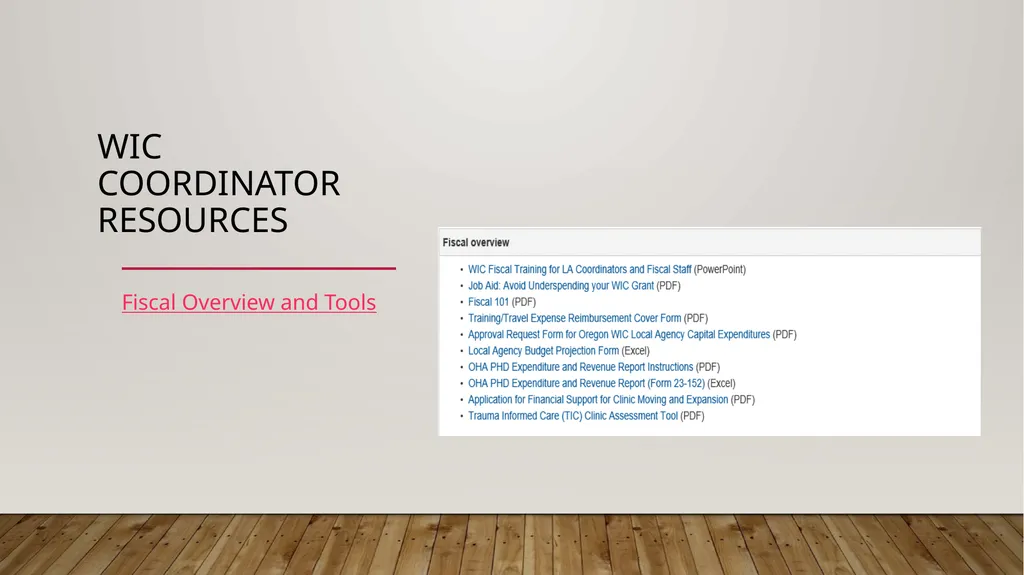
WIC Coordinator Resources Fiscal Overview and Tools<br>
37
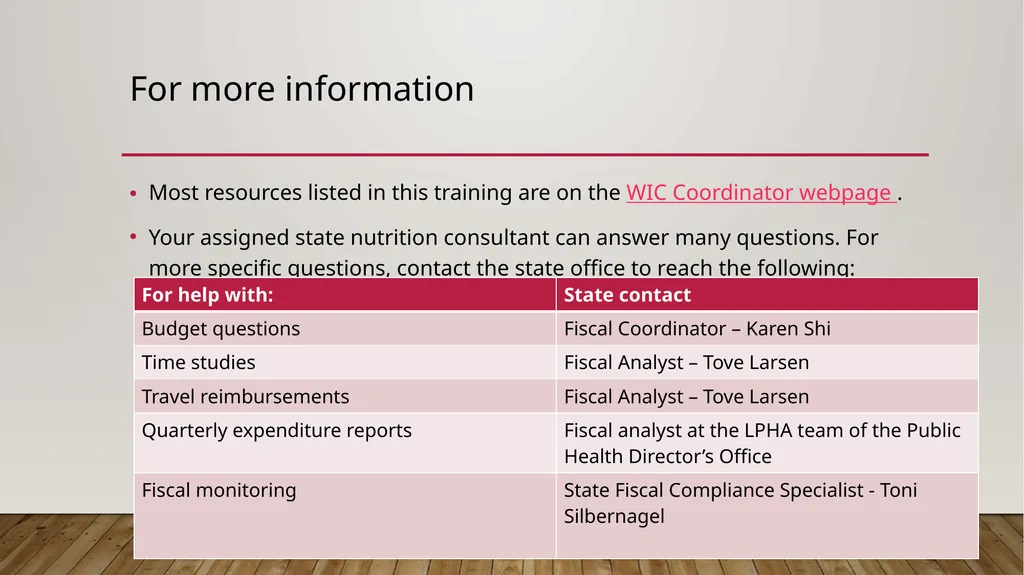
For more information Most resources listed in this training are on the WIC Coordinator webpage .
Your assigned state nutrition consultant can answer many questions. For more specific questions, contact the state office to reach the following:<br>
Your assigned state nutrition consultant can answer many questions. For more specific questions, contact the state office to reach the following:<br>