
WJEC Level 1-2 Sport and Coaching Principles Unit

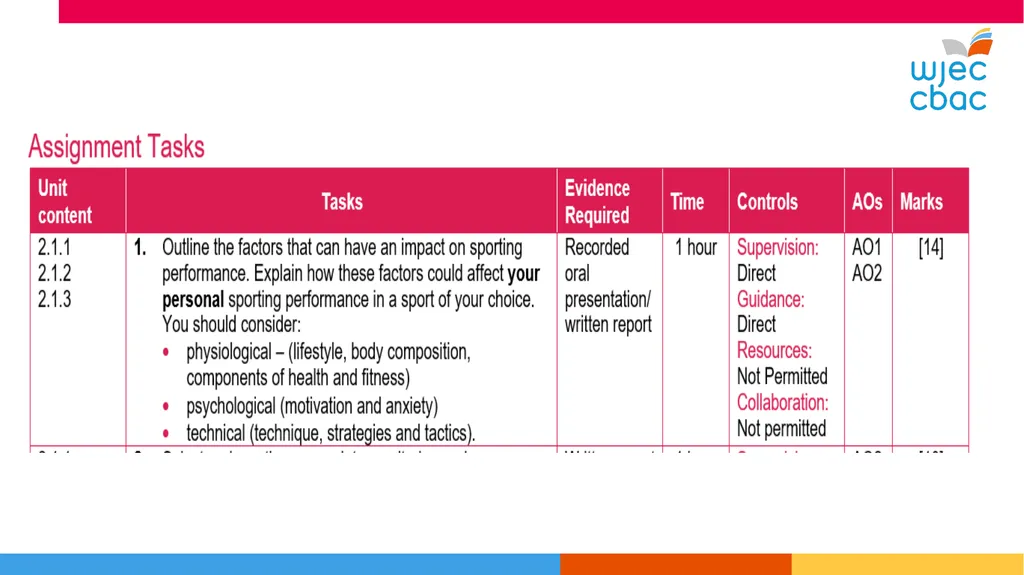
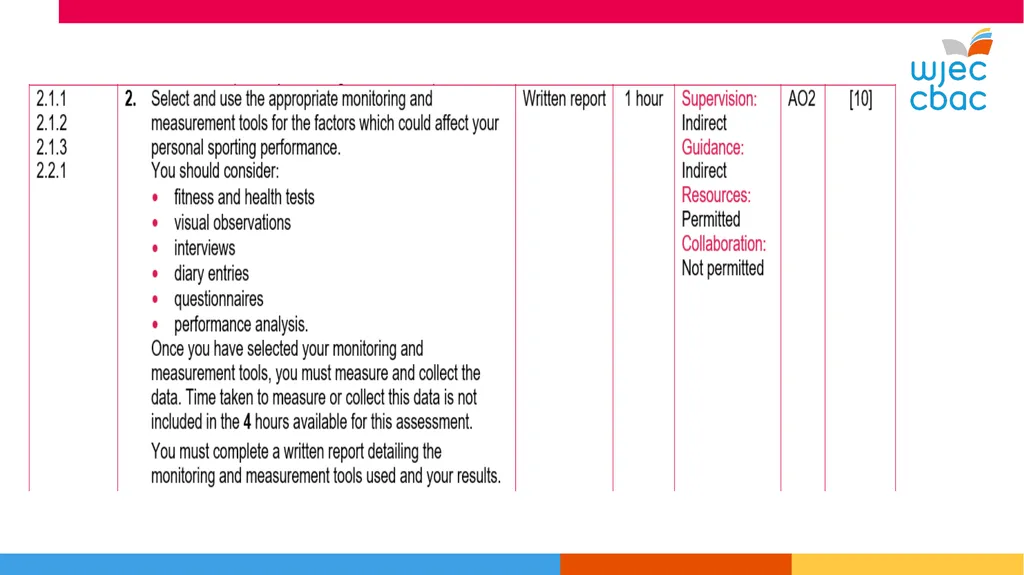
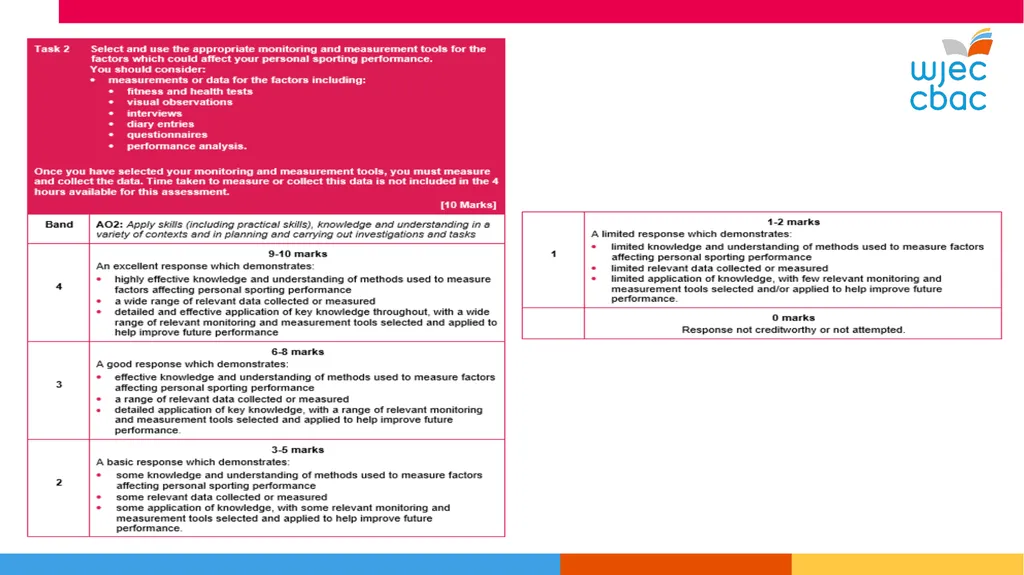
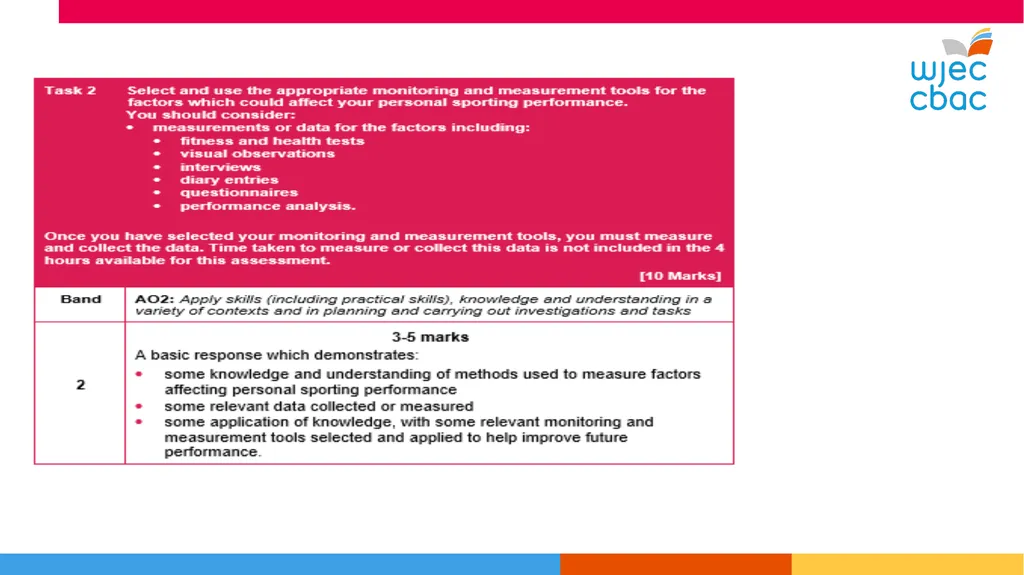
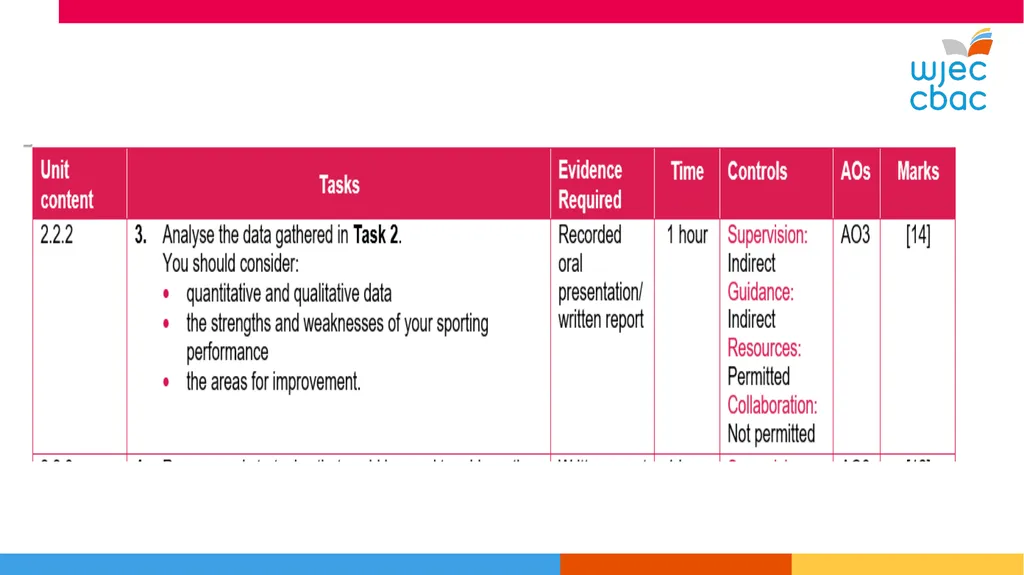
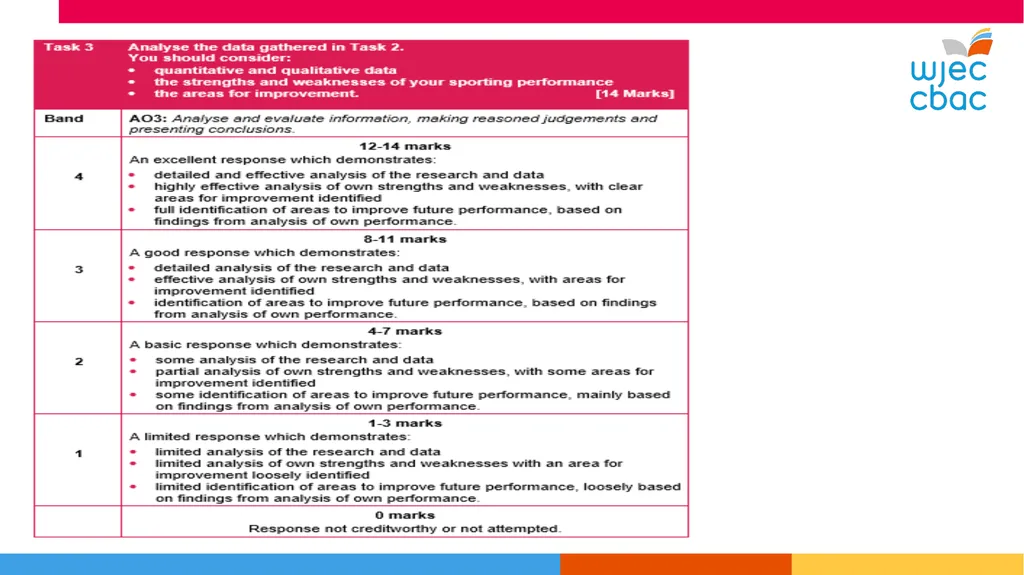
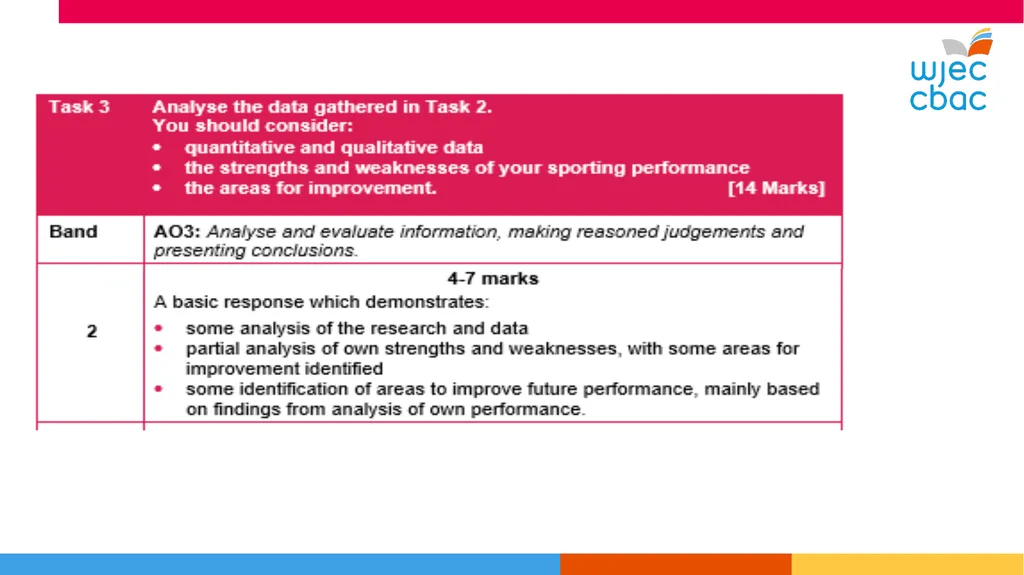
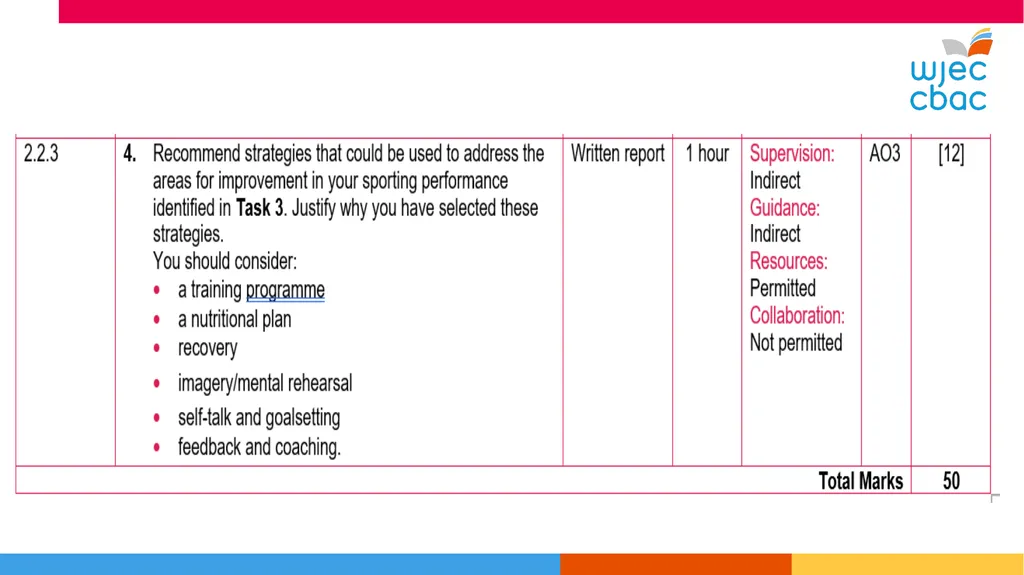
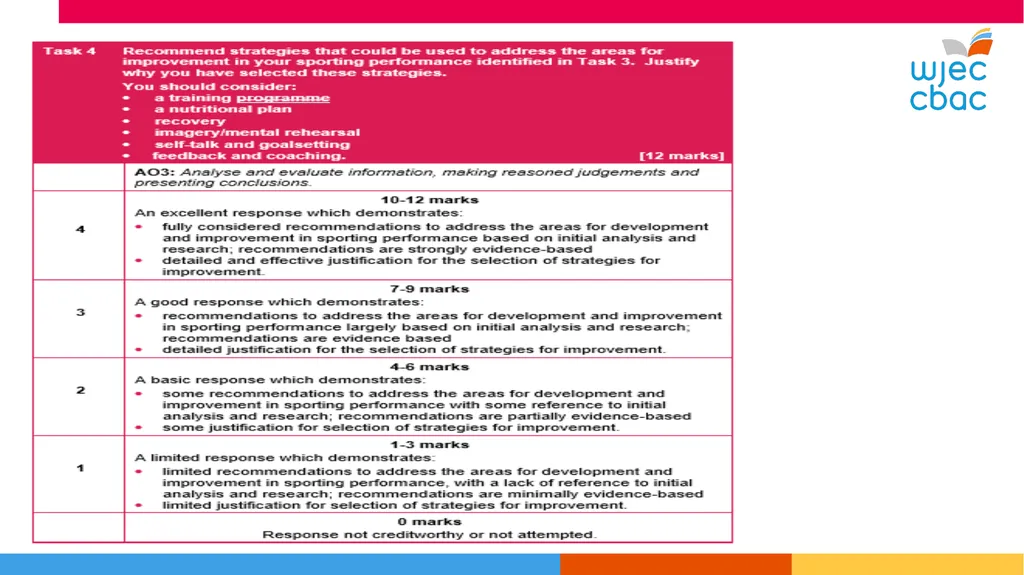
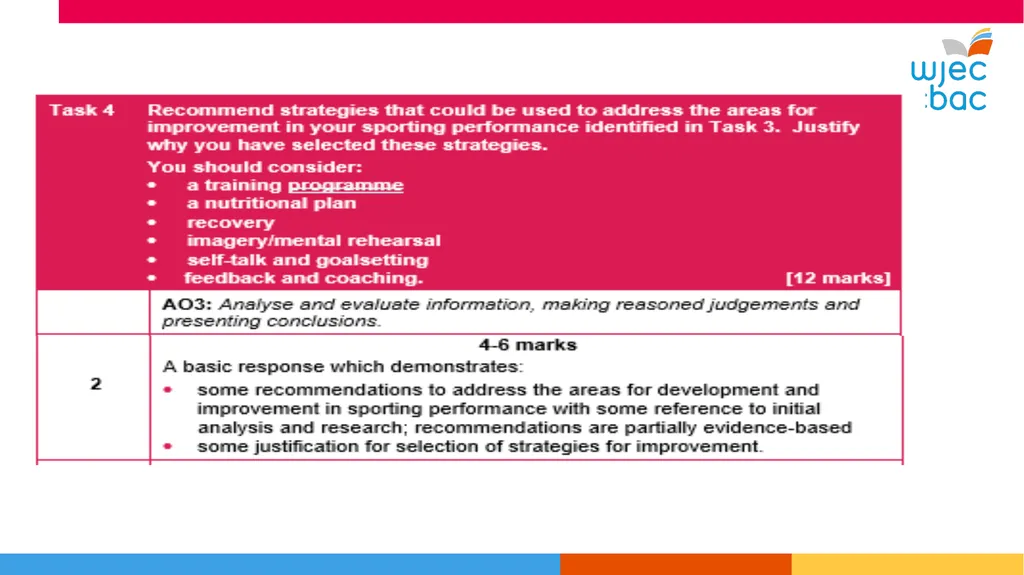
Description: WJEC Level 1-2 Sport and Coaching Principles Unit 2: Improving Sporting Performance 2024 Standards Purpose of This PPT This PPT includes of examples of learner work to demonstrate the standards applied during the moderation process.
Related Topics
Download Presentation
"WJEC Level 1-2 Sport and Coaching Principles Unit" is the property of its rightful owner. Permission is granted to download and print the materials on this website for personal, non-commercial use only, and to display it on your personal computer provided you do not modify the materials and that you retain all copyright notices contained in the materials. By downloading content from our website, you accept the terms of this agreement.
Presentation Transcript
slide1. WJEC Level 1-2 Sport and Coaching Principles
Unit 2: Improving Sporting Performance
2024 Standards<br>
slide2. Purpose of This PPT This PPT includes of examples of learner work to demonstrate the standards applied during the moderation process.
Examples of three standards are included for each of the four Tasks that make up the NEA for this unit. These are based on the Grade Boundaries (Raw Marks) from the May 2023 assessment window which are shown on the next slide:<br>
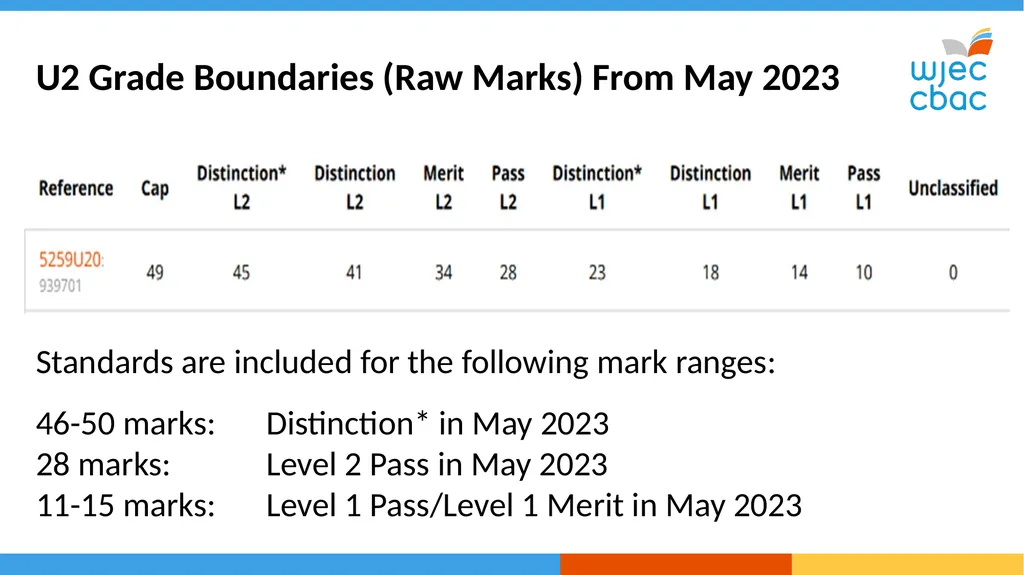
slide3. U2 Grade Boundaries (Raw Marks) From May 2023 Standards are included for the following mark ranges:
46-50 marks: Distinction* in May 2023
28 marks: Level 2 Pass in May 2023
11-15 marks: Level 1 Pass/Level 1 Merit in May 2023<br>
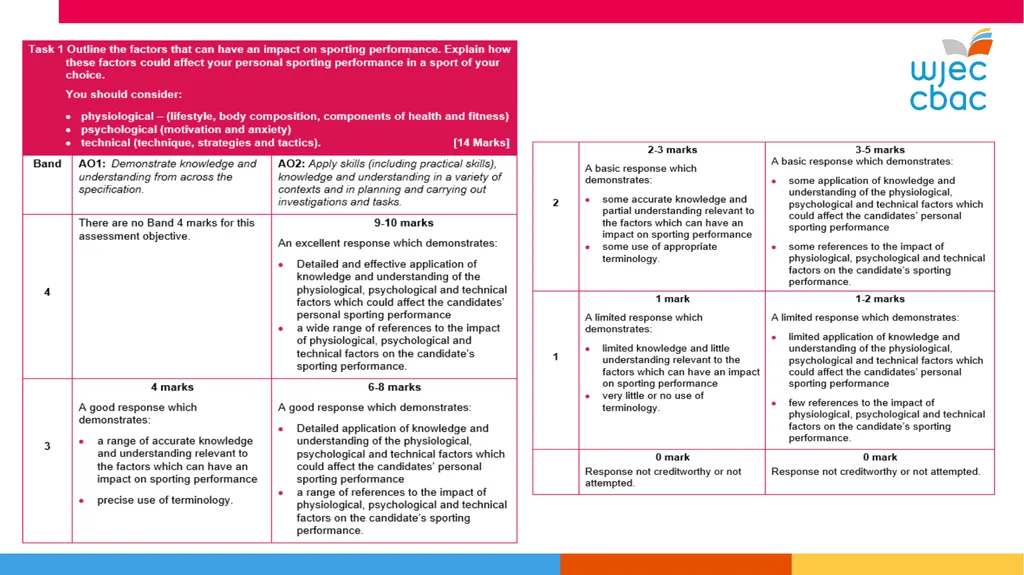
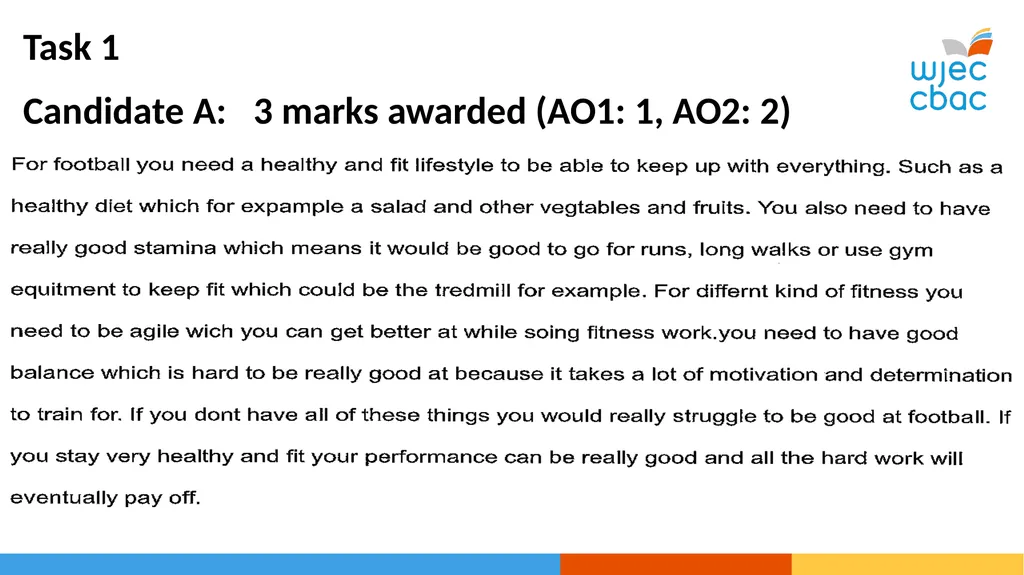
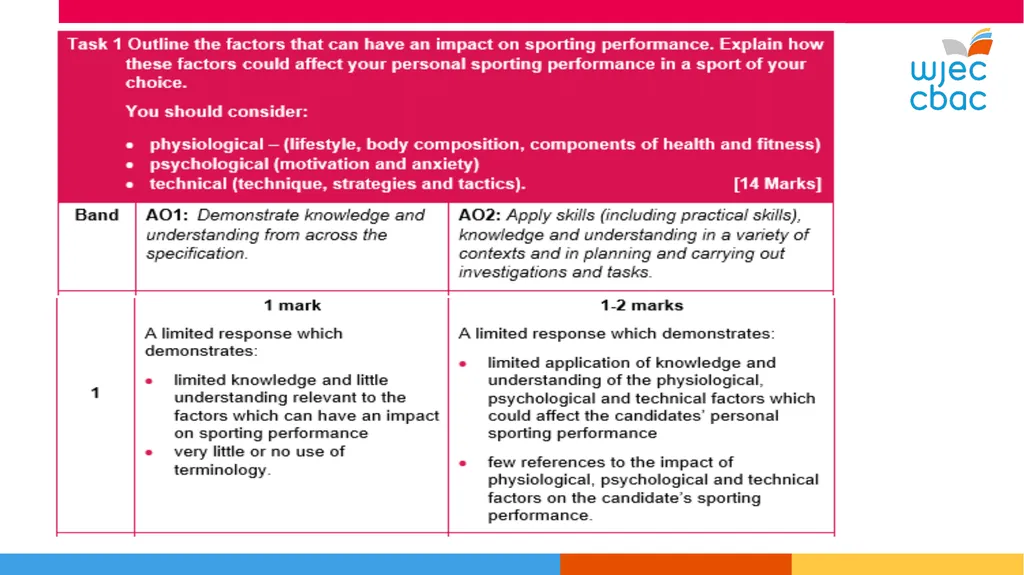
slide7. Task 1
Candidate A: 3 marks awarded (AO1: 1, AO2: 2)<br>
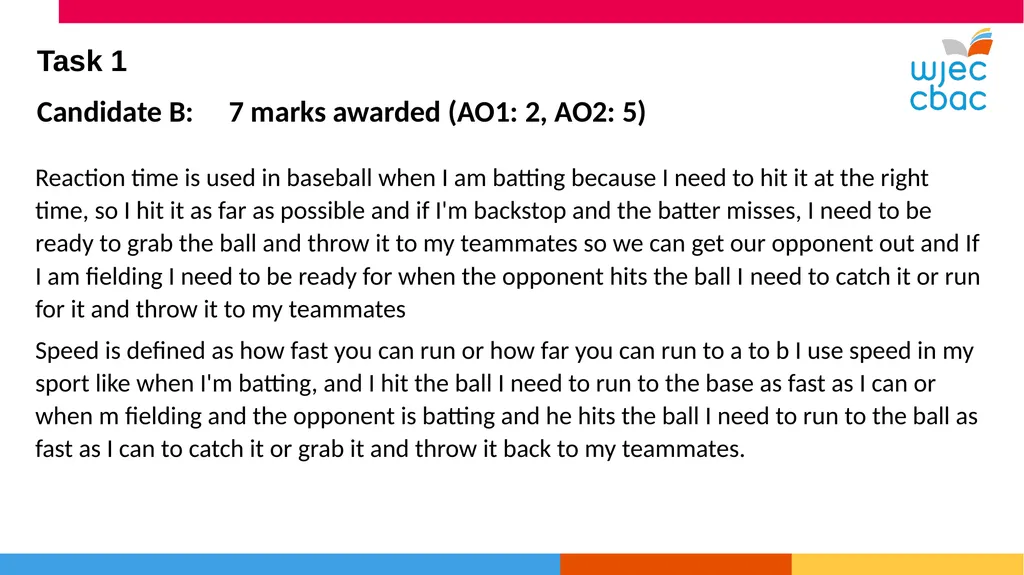
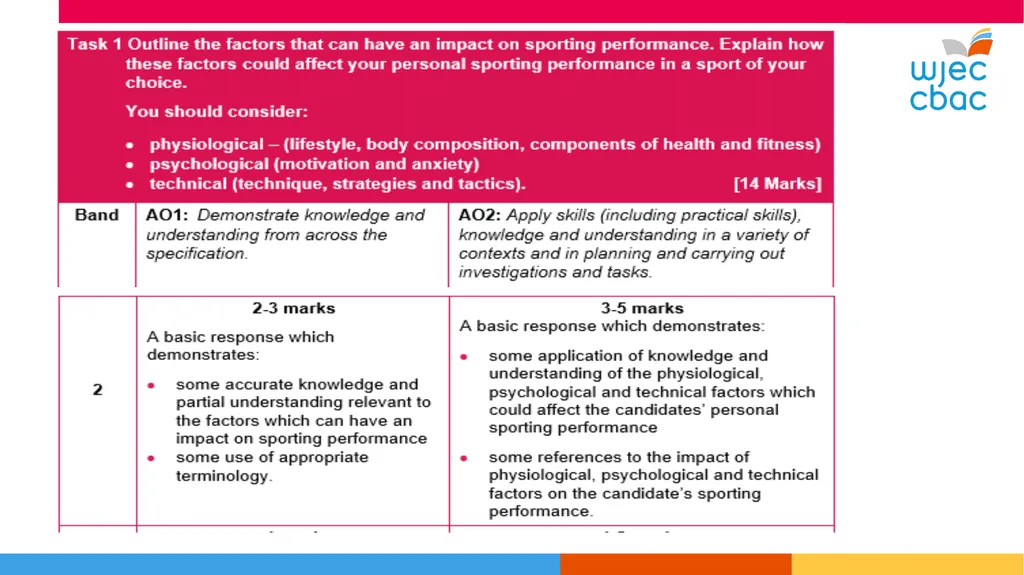
slide9. Task 1 Candidate B: 7 marks awarded (AO1: 2, AO2: 5) Reaction time is used in baseball when I am batting because I need to hit it at the right time, so I hit it as far as possible and if I'm backstop and the batter misses, I need to be ready to grab the ball and throw it to my teammates so we can get our opponent out and If I am fielding I need to be ready for when the opponent hits the ball I need to catch it or run for it and throw it to my teammates
Speed is defined as how fast you can run or how far you can run to a to b I use speed in my sport like when I'm batting, and I hit the ball I need to run to the base as fast as I can or when m fielding and the opponent is batting and he hits the ball I need to run to the ball as fast as I can to catch it or grab it and throw it back to my teammates.<br>
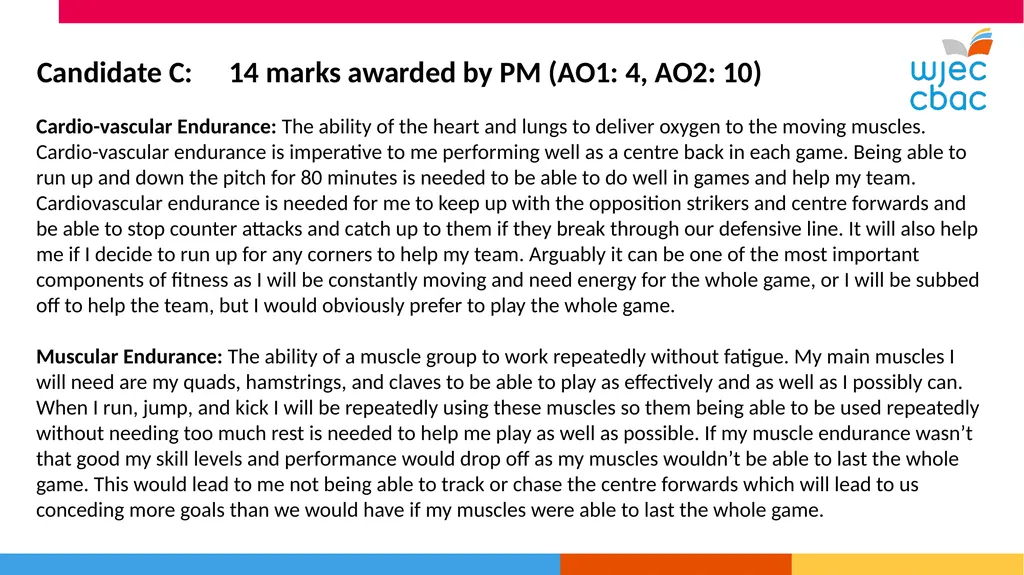
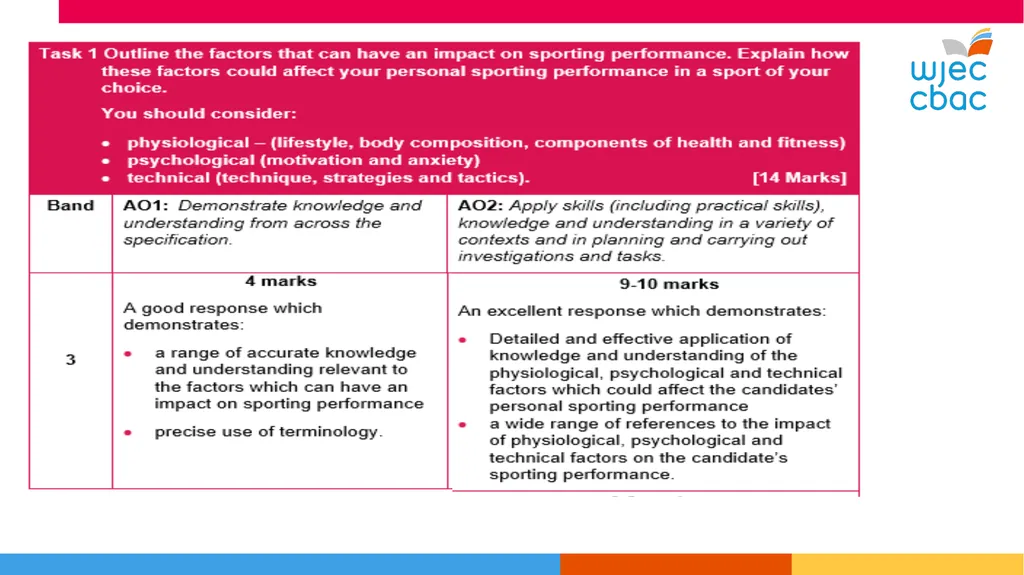
slide11. Candidate C: 14 marks awarded by PM (AO1: 4, AO2: 10) Cardio-vascular Endurance: The ability of the heart and lungs to deliver oxygen to the moving muscles. Cardio-vascular endurance is imperative to me performing well as a centre back in each game. Being able to run up and down the pitch for 80 minutes is needed to be able to do well in games and help my team. Cardiovascular endurance is needed for me to keep up with the opposition strikers and centre forwards and be able to stop counter attacks and catch up to them if they break through our defensive line. It will also help me if I decide to run up for any corners to help my team. Arguably it can be one of the most important components of fitness as I will be constantly moving and need energy for the whole game, or I will be subbed off to help the team, but I would obviously prefer to play the whole game.
Muscular Endurance: The ability of a muscle group to work repeatedly without fatigue. My main muscles I will need are my quads, hamstrings, and claves to be able to play as effectively and as well as I possibly can. When I run, jump, and kick I will be repeatedly using these muscles so them being able to be used repeatedly without needing too much rest is needed to help me play as well as possible. If my muscle endurance wasn’t that good my skill levels and performance would drop off as my muscles wouldn’t be able to last the whole game. This would lead to me not being able to track or chase the centre forwards which will lead to us conceding more goals than we would have if my muscles were able to last the whole game.<br>
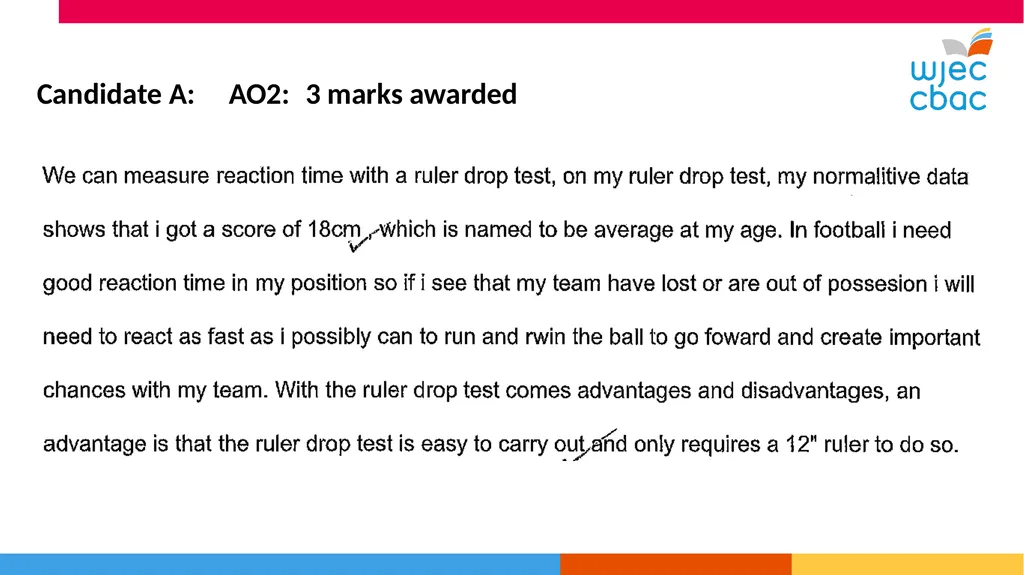
slide15. Candidate A: AO2: 3 marks awarded<br>
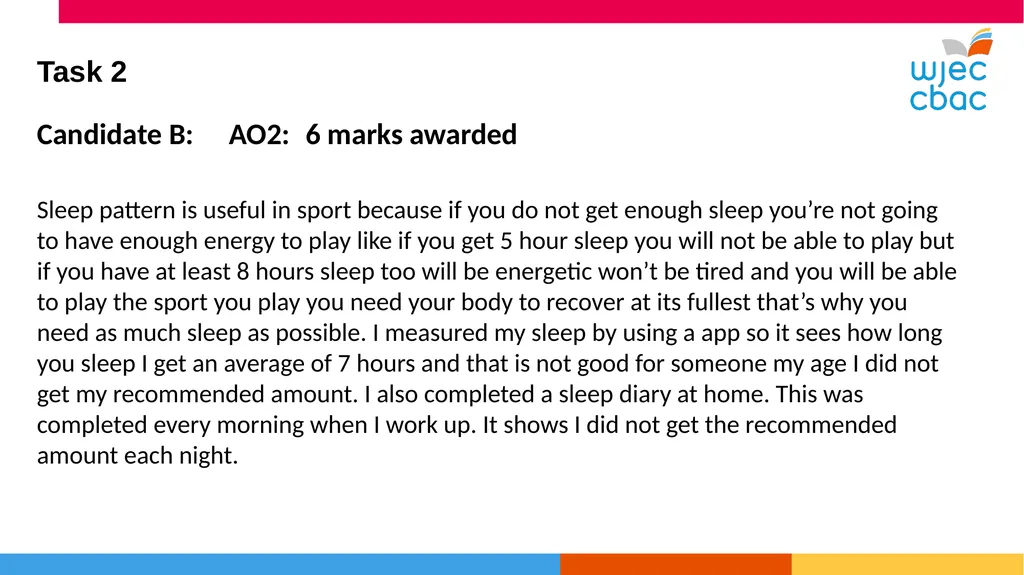
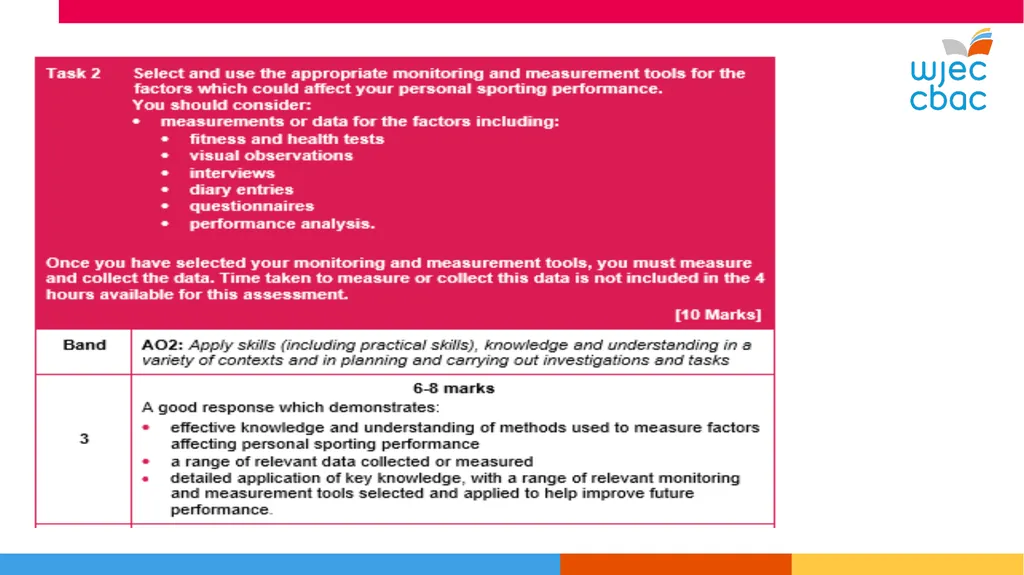
slide17. Task 2 Candidate B: AO2: 6 marks awarded Sleep pattern is useful in sport because if you do not get enough sleep you’re not going to have enough energy to play like if you get 5 hour sleep you will not be able to play but if you have at least 8 hours sleep too will be energetic won’t be tired and you will be able to play the sport you play you need your body to recover at its fullest that’s why you need as much sleep as possible. I measured my sleep by using a app so it sees how long you sleep I get an average of 7 hours and that is not good for someone my age I did not get my recommended amount. I also completed a sleep diary at home. This was completed every morning when I work up. It shows I did not get the recommended amount each night.<br>
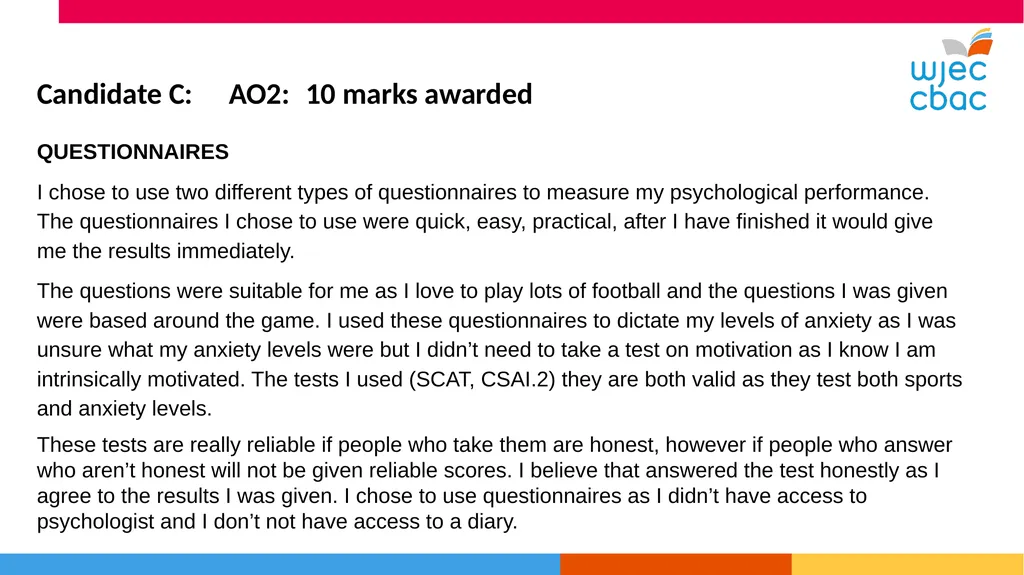
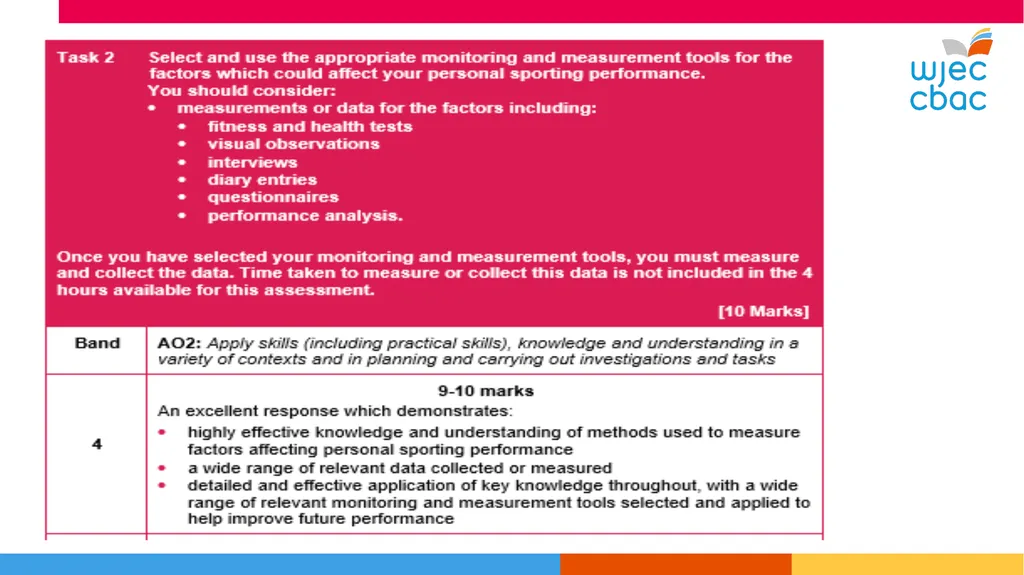
slide19. Candidate C: AO2: 10 marks awarded QUESTIONNAIRES
I chose to use two different types of questionnaires to measure my psychological performance. The questionnaires I chose to use were quick, easy, practical, after I have finished it would give me the results immediately.
The questions were suitable for me as I love to play lots of football and the questions I was given were based around the game. I used these questionnaires to dictate my levels of anxiety as I was unsure what my anxiety levels were but I didn’t need to take a test on motivation as I know I am intrinsically motivated. The tests I used (SCAT, CSAI.2) they are both valid as they test both sports and anxiety levels.
These tests are really reliable if people who take them are honest, however if people who answer who aren’t honest will not be given reliable scores. I believe that answered the test honestly as I agree to the results I was given. I chose to use questionnaires as I didn’t have access to psychologist and I don’t not have access to a diary.<br>
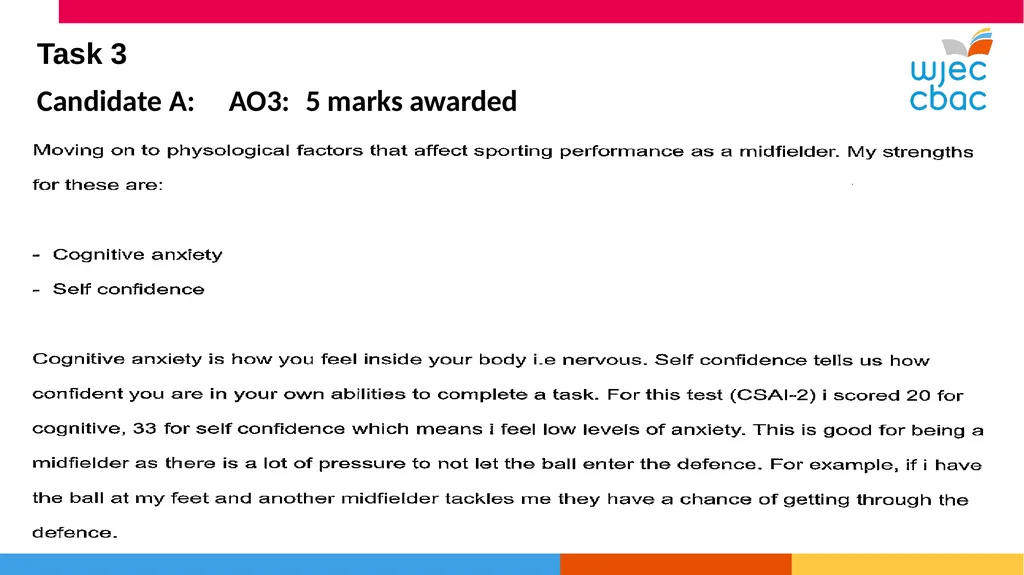
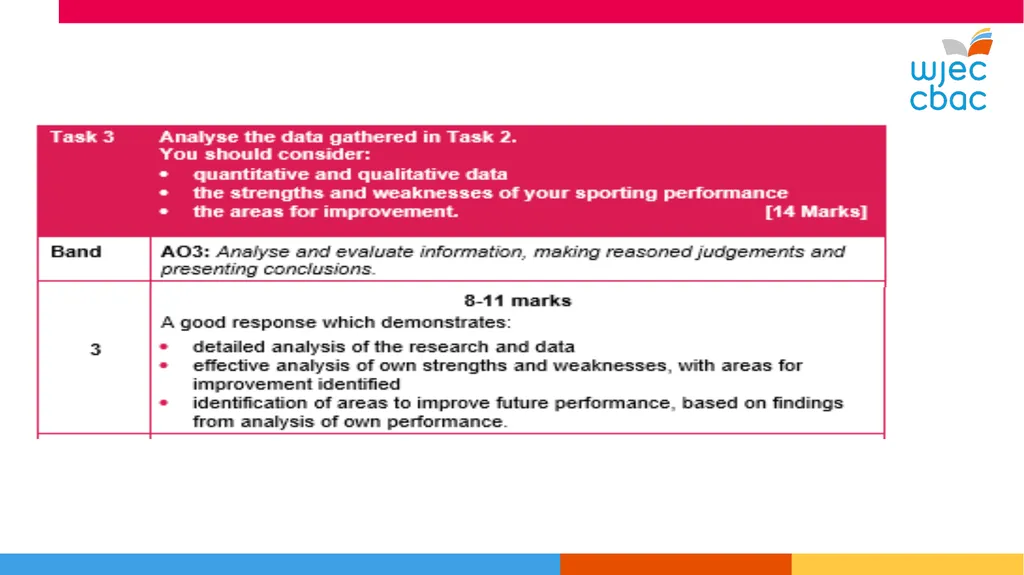
slide23. Task 3 Candidate A: AO3: 5 marks awarded<br>
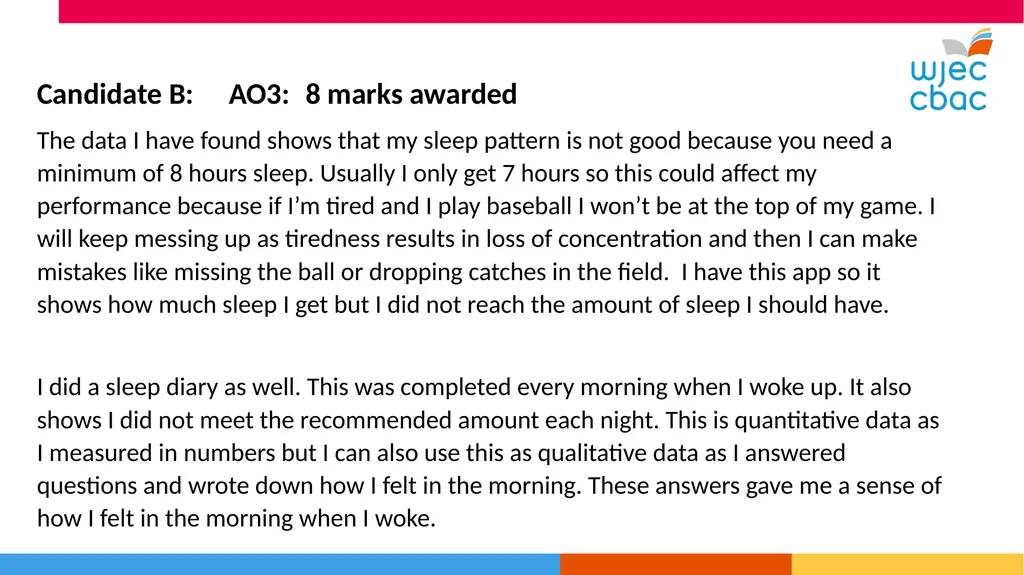
slide25. Candidate B: AO3: 8 marks awarded The data I have found shows that my sleep pattern is not good because you need a minimum of 8 hours sleep. Usually I only get 7 hours so this could affect my performance because if I’m tired and I play baseball I won’t be at the top of my game. I will keep messing up as tiredness results in loss of concentration and then I can make mistakes like missing the ball or dropping catches in the field. I have this app so it shows how much sleep I get but I did not reach the amount of sleep I should have.
I did a sleep diary as well. This was completed every morning when I woke up. It also shows I did not meet the recommended amount each night. This is quantitative data as I measured in numbers but I can also use this as qualitative data as I answered questions and wrote down how I felt in the morning. These answers gave me a sense of how I felt in the morning when I woke.<br>
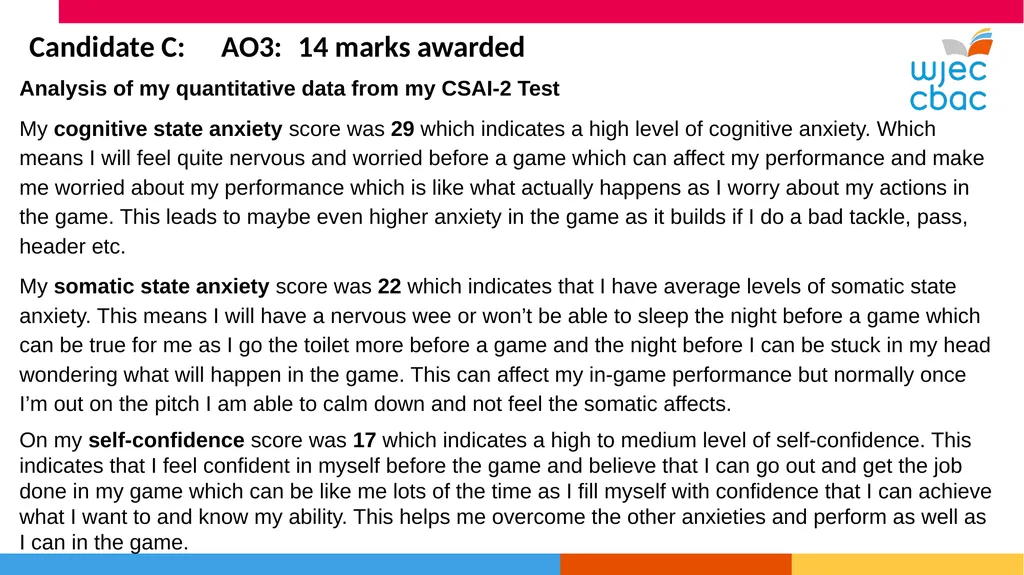
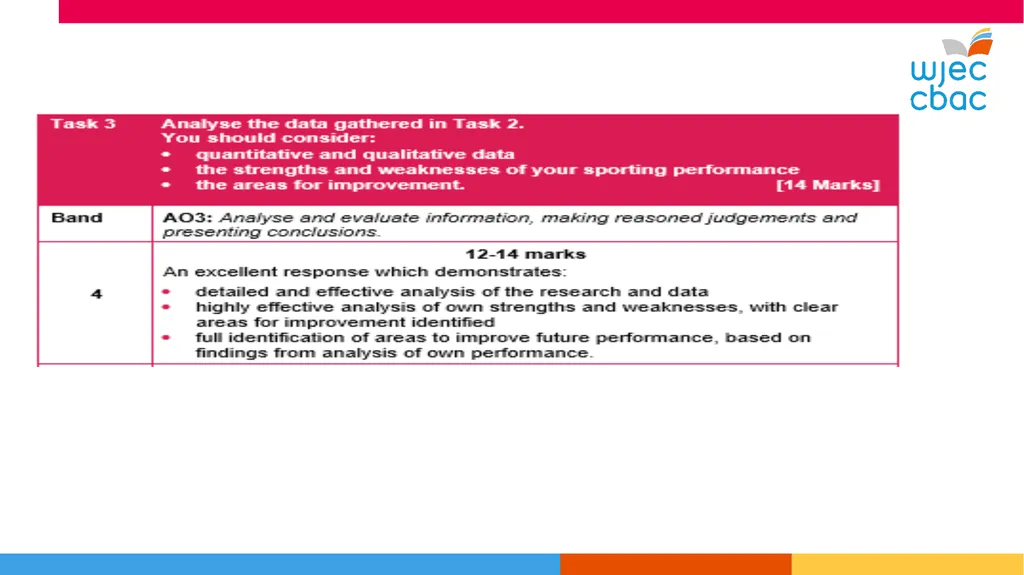
slide27. Candidate C: AO3: 14 marks awarded Analysis of my quantitative data from my CSAI-2 Test
My cognitive state anxiety score was 29 which indicates a high level of cognitive anxiety. Which means I will feel quite nervous and worried before a game which can affect my performance and make me worried about my performance which is like what actually happens as I worry about my actions in the game. This leads to maybe even higher anxiety in the game as it builds if I do a bad tackle, pass, header etc.
My somatic state anxiety score was 22 which indicates that I have average levels of somatic state anxiety. This means I will have a nervous wee or won’t be able to sleep the night before a game which can be true for me as I go the toilet more before a game and the night before I can be stuck in my head wondering what will happen in the game. This can affect my in-game performance but normally once I’m out on the pitch I am able to calm down and not feel the somatic affects.
On my self-confidence score was 17 which indicates a high to medium level of self-confidence. This indicates that I feel confident in myself before the game and believe that I can go out and get the job done in my game which can be like me lots of the time as I fill myself with confidence that I can achieve what I want to and know my ability. This helps me overcome the other anxieties and perform as well as I can in the game.<br>
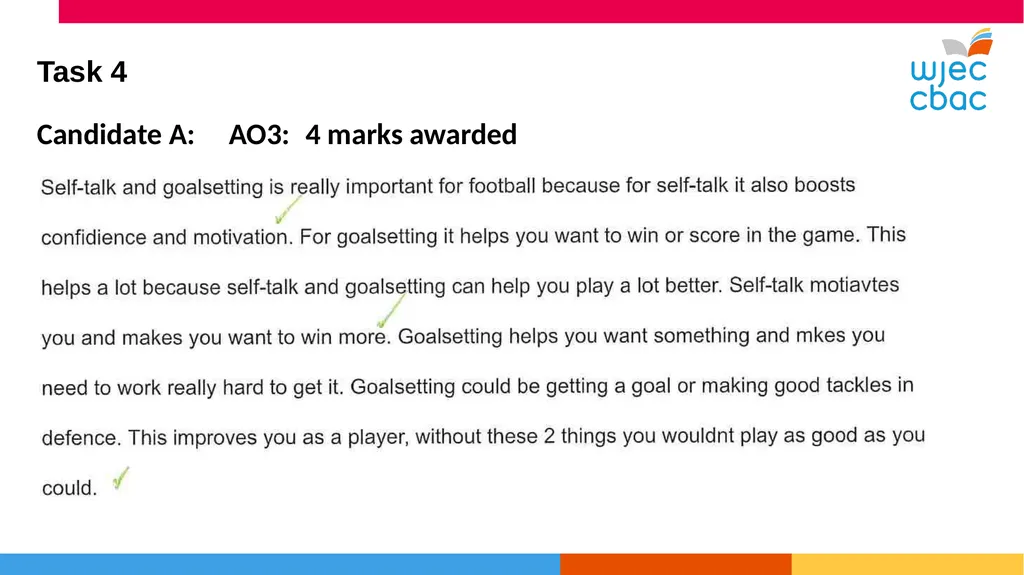
slide31. Task 4 Candidate A: AO3: 4 marks awarded<br>
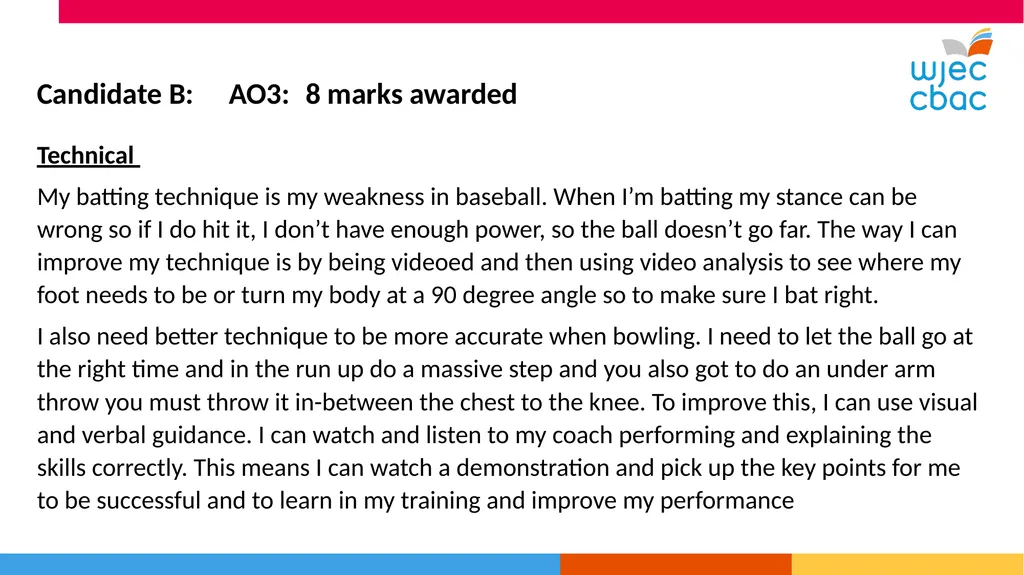
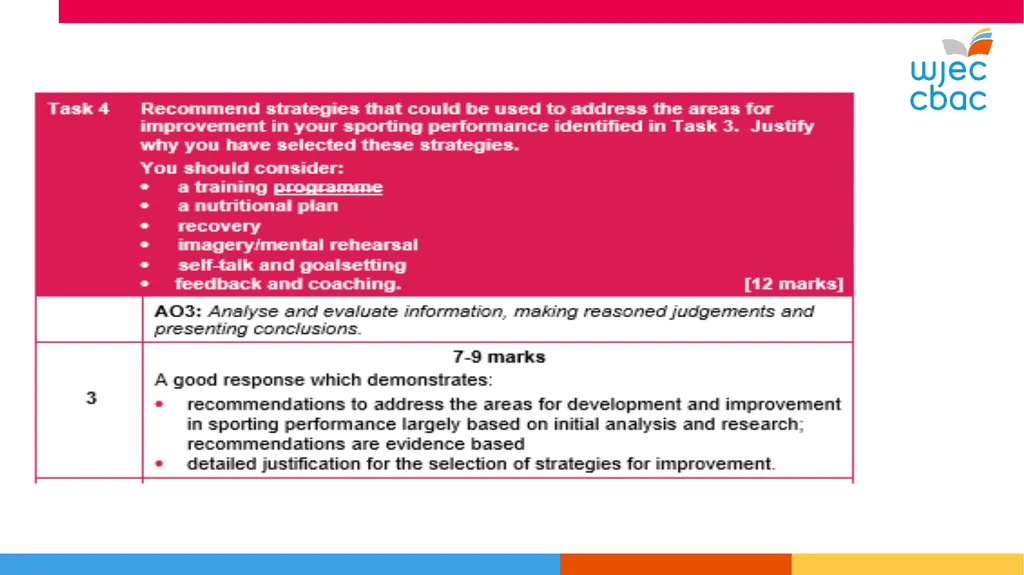
slide33. Candidate B: AO3: 8 marks awarded Technical
My batting technique is my weakness in baseball. When I’m batting my stance can be wrong so if I do hit it, I don’t have enough power, so the ball doesn’t go far. The way I can improve my technique is by being videoed and then using video analysis to see where my foot needs to be or turn my body at a 90 degree angle so to make sure I bat right.
I also need better technique to be more accurate when bowling. I need to let the ball go at the right time and in the run up do a massive step and you also got to do an under arm throw you must throw it in-between the chest to the knee. To improve this, I can use visual and verbal guidance. I can watch and listen to my coach performing and explaining the skills correctly. This means I can watch a demonstration and pick up the key points for me to be successful and to learn in my training and improve my performance<br>
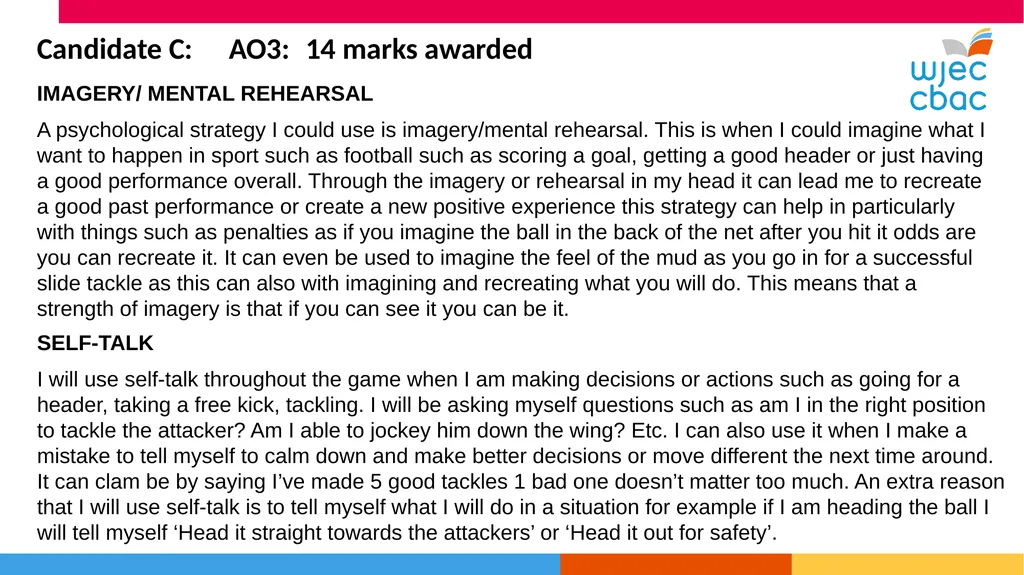
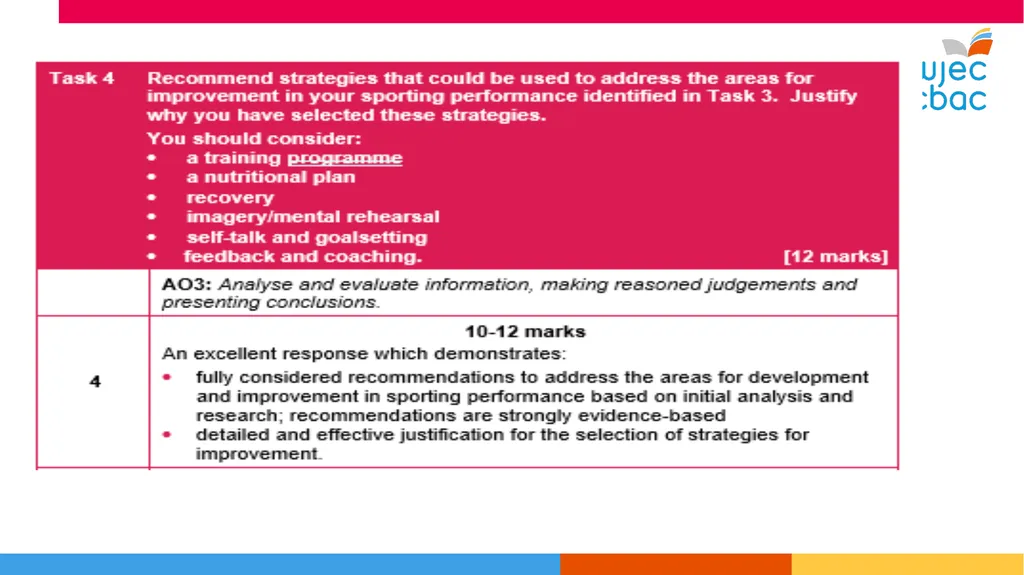
slide35. Candidate C: AO3: 14 marks awarded IMAGERY/ MENTAL REHEARSAL
A psychological strategy I could use is imagery/mental rehearsal. This is when I could imagine what I want to happen in sport such as football such as scoring a goal, getting a good header or just having a good performance overall. Through the imagery or rehearsal in my head it can lead me to recreate a good past performance or create a new positive experience this strategy can help in particularly with things such as penalties as if you imagine the ball in the back of the net after you hit it odds are you can recreate it. It can even be used to imagine the feel of the mud as you go in for a successful slide tackle as this can also with imagining and recreating what you will do. This means that a strength of imagery is that if you can see it you can be it. SELF-TALK
I will use self-talk throughout the game when I am making decisions or actions such as going for a header, taking a free kick, tackling. I will be asking myself questions such as am I in the right position to tackle the attacker? Am I able to jockey him down the wing? Etc. I can also use it when I make a mistake to tell myself to calm down and make better decisions or move different the next time around. It can clam be by saying I’ve made 5 good tackles 1 bad one doesn’t matter too much. An extra reason that I will use self-talk is to tell myself what I will do in a situation for example if I am heading the ball I will tell myself ‘Head it straight towards the attackers’ or ‘Head it out for safety’.<br>
slide2. Purpose of This PPT This PPT includes of examples of learner work to demonstrate the standards applied during the moderation process.
Examples of three standards are included for each of the four Tasks that make up the NEA for this unit. These are based on the Grade Boundaries (Raw Marks) from the May 2023 assessment window which are shown on the next slide:<br>
slide3. U2 Grade Boundaries (Raw Marks) From May 2023 Standards are included for the following mark ranges:
46-50 marks: Distinction* in May 2023
28 marks: Level 2 Pass in May 2023
11-15 marks: Level 1 Pass/Level 1 Merit in May 2023<br>
slide7. Task 1
Candidate A: 3 marks awarded (AO1: 1, AO2: 2)<br>
slide9. Task 1 Candidate B: 7 marks awarded (AO1: 2, AO2: 5) Reaction time is used in baseball when I am batting because I need to hit it at the right time, so I hit it as far as possible and if I'm backstop and the batter misses, I need to be ready to grab the ball and throw it to my teammates so we can get our opponent out and If I am fielding I need to be ready for when the opponent hits the ball I need to catch it or run for it and throw it to my teammates
Speed is defined as how fast you can run or how far you can run to a to b I use speed in my sport like when I'm batting, and I hit the ball I need to run to the base as fast as I can or when m fielding and the opponent is batting and he hits the ball I need to run to the ball as fast as I can to catch it or grab it and throw it back to my teammates.<br>
slide11. Candidate C: 14 marks awarded by PM (AO1: 4, AO2: 10) Cardio-vascular Endurance: The ability of the heart and lungs to deliver oxygen to the moving muscles. Cardio-vascular endurance is imperative to me performing well as a centre back in each game. Being able to run up and down the pitch for 80 minutes is needed to be able to do well in games and help my team. Cardiovascular endurance is needed for me to keep up with the opposition strikers and centre forwards and be able to stop counter attacks and catch up to them if they break through our defensive line. It will also help me if I decide to run up for any corners to help my team. Arguably it can be one of the most important components of fitness as I will be constantly moving and need energy for the whole game, or I will be subbed off to help the team, but I would obviously prefer to play the whole game.
Muscular Endurance: The ability of a muscle group to work repeatedly without fatigue. My main muscles I will need are my quads, hamstrings, and claves to be able to play as effectively and as well as I possibly can. When I run, jump, and kick I will be repeatedly using these muscles so them being able to be used repeatedly without needing too much rest is needed to help me play as well as possible. If my muscle endurance wasn’t that good my skill levels and performance would drop off as my muscles wouldn’t be able to last the whole game. This would lead to me not being able to track or chase the centre forwards which will lead to us conceding more goals than we would have if my muscles were able to last the whole game.<br>
slide15. Candidate A: AO2: 3 marks awarded<br>
slide17. Task 2 Candidate B: AO2: 6 marks awarded Sleep pattern is useful in sport because if you do not get enough sleep you’re not going to have enough energy to play like if you get 5 hour sleep you will not be able to play but if you have at least 8 hours sleep too will be energetic won’t be tired and you will be able to play the sport you play you need your body to recover at its fullest that’s why you need as much sleep as possible. I measured my sleep by using a app so it sees how long you sleep I get an average of 7 hours and that is not good for someone my age I did not get my recommended amount. I also completed a sleep diary at home. This was completed every morning when I work up. It shows I did not get the recommended amount each night.<br>
slide19. Candidate C: AO2: 10 marks awarded QUESTIONNAIRES
I chose to use two different types of questionnaires to measure my psychological performance. The questionnaires I chose to use were quick, easy, practical, after I have finished it would give me the results immediately.
The questions were suitable for me as I love to play lots of football and the questions I was given were based around the game. I used these questionnaires to dictate my levels of anxiety as I was unsure what my anxiety levels were but I didn’t need to take a test on motivation as I know I am intrinsically motivated. The tests I used (SCAT, CSAI.2) they are both valid as they test both sports and anxiety levels.
These tests are really reliable if people who take them are honest, however if people who answer who aren’t honest will not be given reliable scores. I believe that answered the test honestly as I agree to the results I was given. I chose to use questionnaires as I didn’t have access to psychologist and I don’t not have access to a diary.<br>
slide23. Task 3 Candidate A: AO3: 5 marks awarded<br>
slide25. Candidate B: AO3: 8 marks awarded The data I have found shows that my sleep pattern is not good because you need a minimum of 8 hours sleep. Usually I only get 7 hours so this could affect my performance because if I’m tired and I play baseball I won’t be at the top of my game. I will keep messing up as tiredness results in loss of concentration and then I can make mistakes like missing the ball or dropping catches in the field. I have this app so it shows how much sleep I get but I did not reach the amount of sleep I should have.
I did a sleep diary as well. This was completed every morning when I woke up. It also shows I did not meet the recommended amount each night. This is quantitative data as I measured in numbers but I can also use this as qualitative data as I answered questions and wrote down how I felt in the morning. These answers gave me a sense of how I felt in the morning when I woke.<br>
slide27. Candidate C: AO3: 14 marks awarded Analysis of my quantitative data from my CSAI-2 Test
My cognitive state anxiety score was 29 which indicates a high level of cognitive anxiety. Which means I will feel quite nervous and worried before a game which can affect my performance and make me worried about my performance which is like what actually happens as I worry about my actions in the game. This leads to maybe even higher anxiety in the game as it builds if I do a bad tackle, pass, header etc.
My somatic state anxiety score was 22 which indicates that I have average levels of somatic state anxiety. This means I will have a nervous wee or won’t be able to sleep the night before a game which can be true for me as I go the toilet more before a game and the night before I can be stuck in my head wondering what will happen in the game. This can affect my in-game performance but normally once I’m out on the pitch I am able to calm down and not feel the somatic affects.
On my self-confidence score was 17 which indicates a high to medium level of self-confidence. This indicates that I feel confident in myself before the game and believe that I can go out and get the job done in my game which can be like me lots of the time as I fill myself with confidence that I can achieve what I want to and know my ability. This helps me overcome the other anxieties and perform as well as I can in the game.<br>
slide31. Task 4 Candidate A: AO3: 4 marks awarded<br>
slide33. Candidate B: AO3: 8 marks awarded Technical
My batting technique is my weakness in baseball. When I’m batting my stance can be wrong so if I do hit it, I don’t have enough power, so the ball doesn’t go far. The way I can improve my technique is by being videoed and then using video analysis to see where my foot needs to be or turn my body at a 90 degree angle so to make sure I bat right.
I also need better technique to be more accurate when bowling. I need to let the ball go at the right time and in the run up do a massive step and you also got to do an under arm throw you must throw it in-between the chest to the knee. To improve this, I can use visual and verbal guidance. I can watch and listen to my coach performing and explaining the skills correctly. This means I can watch a demonstration and pick up the key points for me to be successful and to learn in my training and improve my performance<br>
slide35. Candidate C: AO3: 14 marks awarded IMAGERY/ MENTAL REHEARSAL
A psychological strategy I could use is imagery/mental rehearsal. This is when I could imagine what I want to happen in sport such as football such as scoring a goal, getting a good header or just having a good performance overall. Through the imagery or rehearsal in my head it can lead me to recreate a good past performance or create a new positive experience this strategy can help in particularly with things such as penalties as if you imagine the ball in the back of the net after you hit it odds are you can recreate it. It can even be used to imagine the feel of the mud as you go in for a successful slide tackle as this can also with imagining and recreating what you will do. This means that a strength of imagery is that if you can see it you can be it. SELF-TALK
I will use self-talk throughout the game when I am making decisions or actions such as going for a header, taking a free kick, tackling. I will be asking myself questions such as am I in the right position to tackle the attacker? Am I able to jockey him down the wing? Etc. I can also use it when I make a mistake to tell myself to calm down and make better decisions or move different the next time around. It can clam be by saying I’ve made 5 good tackles 1 bad one doesn’t matter too much. An extra reason that I will use self-talk is to tell myself what I will do in a situation for example if I am heading the ball I will tell myself ‘Head it straight towards the attackers’ or ‘Head it out for safety’.<br>