
Words and their meanings Presented By Sanar
LS
Published · 26 slides · 0 views

1 / 1



Description
Words and their meanings Presented By Sanar Mohamed Thamer Introduction to lexical semantics Approaches to lexical semantics Possible word meaning Lexical and grammatical meaning The nature of word meanings Prototypical word: the best
Related Topics
Share
Embed code
Download this presentation From Below
"Words and their meanings Presented By Sanar" is the property of its rightful owner. Permission is granted to download and print the materials on this website for personal, non-commercial use only, and to display it on your personal computer provided you do not modify the materials and that you retain all copyright notices contained in the materials. By downloading content from our website, you accept the terms of this agreement.
Presentation Transcript
01
Words and their meanings
Presented By
Sanar Mohamed Thamer<br>
02
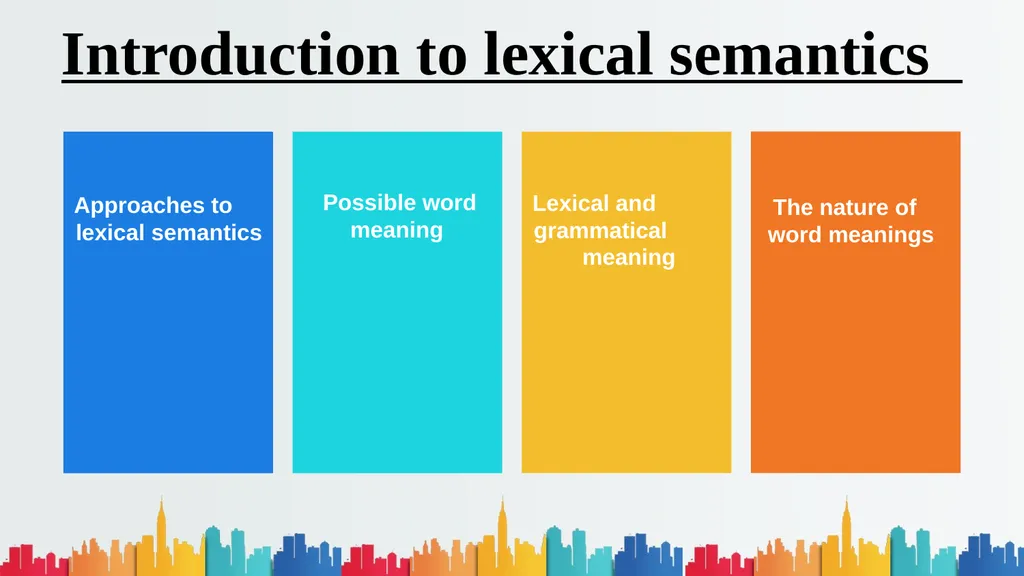
Introduction to lexical semantics Approaches to lexical semantics Possible word meaning Lexical and grammatical meaning The nature of word meanings<br>
03
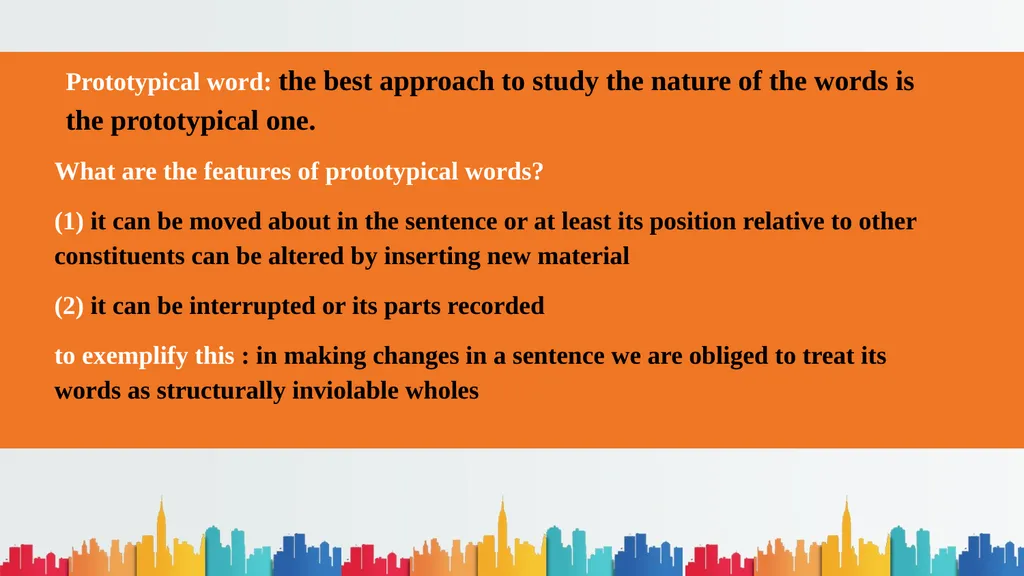
Prototypical word: the best approach to study the nature of the words is the prototypical one.
What are the features of prototypical words?
(1) it can be moved about in the sentence or at least its position relative to other constituents can be altered by inserting new material
(2) it can be interrupted or its parts recorded
to exemplify this : in making changes in a sentence we are obliged to treat its words as structurally inviolable wholes<br>
What are the features of prototypical words?
(1) it can be moved about in the sentence or at least its position relative to other constituents can be altered by inserting new material
(2) it can be interrupted or its parts recorded
to exemplify this : in making changes in a sentence we are obliged to treat its words as structurally inviolable wholes<br>
04
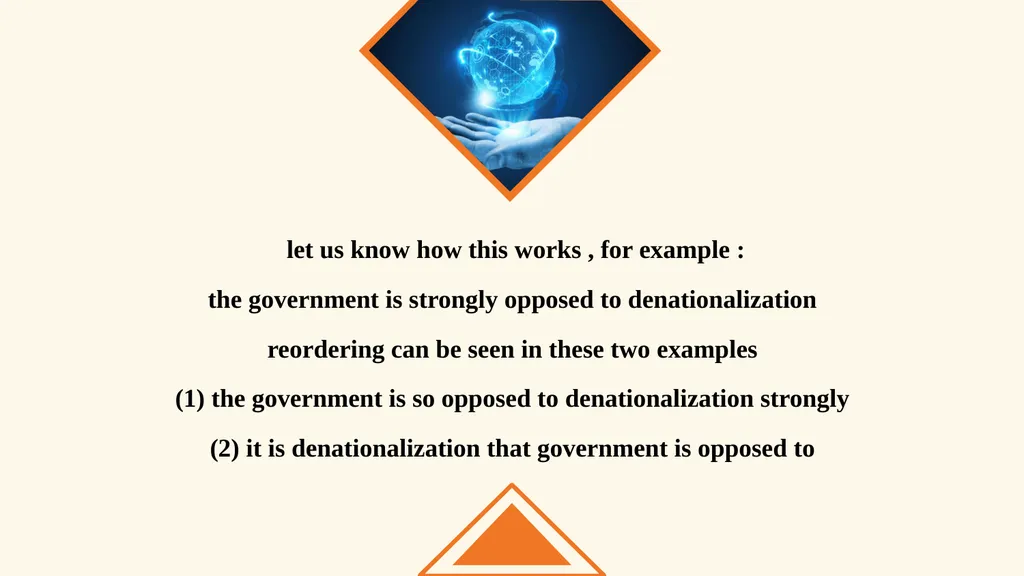
let us know how this works , for example :
the government is strongly opposed to denationalization
reordering can be seen in these two examples
(1) the government is so opposed to denationalization strongly
(2) it is denationalization that government is opposed to<br>
the government is strongly opposed to denationalization
reordering can be seen in these two examples
(1) the government is so opposed to denationalization strongly
(2) it is denationalization that government is opposed to<br>
05
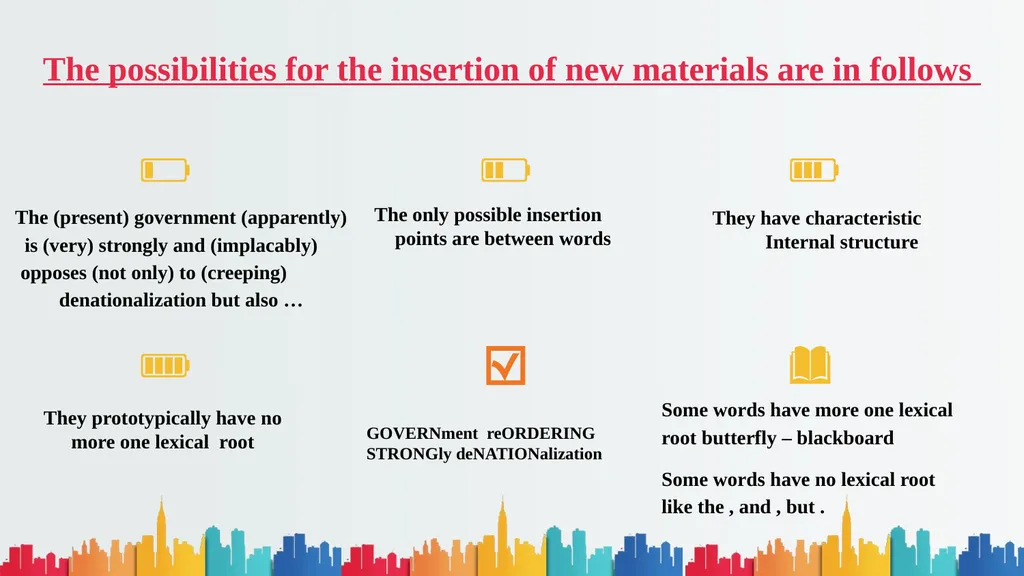
The possibilities for the insertion of new materials are in follows The (present) government (apparently) is (very) strongly and (implacably) opposes (not only) to (creeping) denationalization but also … They prototypically have no more one lexical root The only possible insertion points are between words They have characteristic Internal structure GOVERNment reORDERING STRONGly deNATIONalization Some words have more one lexical root butterfly – blackboard
Some words have no lexical root like the , and , but .<br>
Some words have no lexical root like the , and , but .<br>
06
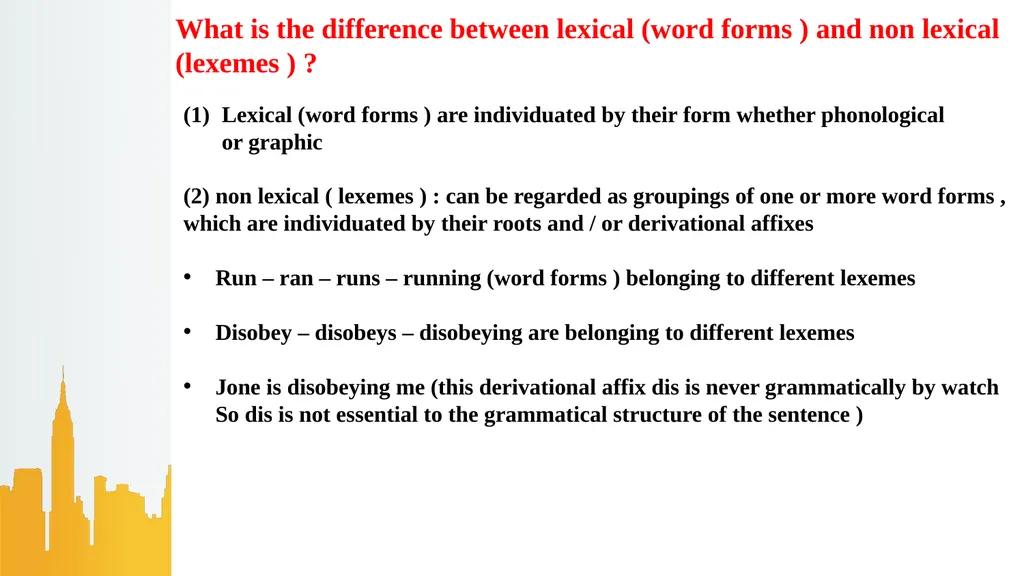
What is the difference between lexical (word forms ) and non lexical (lexemes ) ? Lexical (word forms ) are individuated by their form whether phonological or graphic
(2) non lexical ( lexemes ) : can be regarded as groupings of one or more word forms , which are individuated by their roots and / or derivational affixes
Run – ran – runs – running (word forms ) belonging to different lexemes
Disobey – disobeys – disobeying are belonging to different lexemes
Jone is disobeying me (this derivational affix dis is never grammatically by watch So dis is not essential to the grammatical structure of the sentence )<br>
(2) non lexical ( lexemes ) : can be regarded as groupings of one or more word forms , which are individuated by their roots and / or derivational affixes
Run – ran – runs – running (word forms ) belonging to different lexemes
Disobey – disobeys – disobeying are belonging to different lexemes
Jone is disobeying me (this derivational affix dis is never grammatically by watch So dis is not essential to the grammatical structure of the sentence )<br>
07
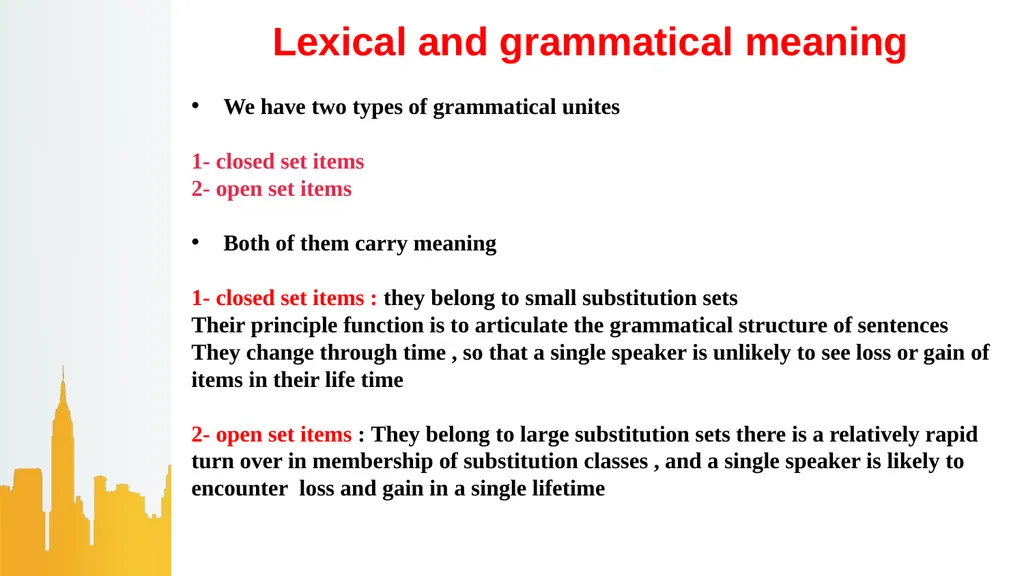
Lexical and grammatical meaning We have two types of grammatical unites
1- closed set items
2- open set items
Both of them carry meaning
1- closed set items : they belong to small substitution sets
Their principle function is to articulate the grammatical structure of sentences
They change through time , so that a single speaker is unlikely to see loss or gain of items in their life time
2- open set items : They belong to large substitution sets there is a relatively rapid turn over in membership of substitution classes , and a single speaker is likely to encounter loss and gain in a single lifetime<br>
1- closed set items
2- open set items
Both of them carry meaning
1- closed set items : they belong to small substitution sets
Their principle function is to articulate the grammatical structure of sentences
They change through time , so that a single speaker is unlikely to see loss or gain of items in their life time
2- open set items : They belong to large substitution sets there is a relatively rapid turn over in membership of substitution classes , and a single speaker is likely to encounter loss and gain in a single lifetime<br>
08
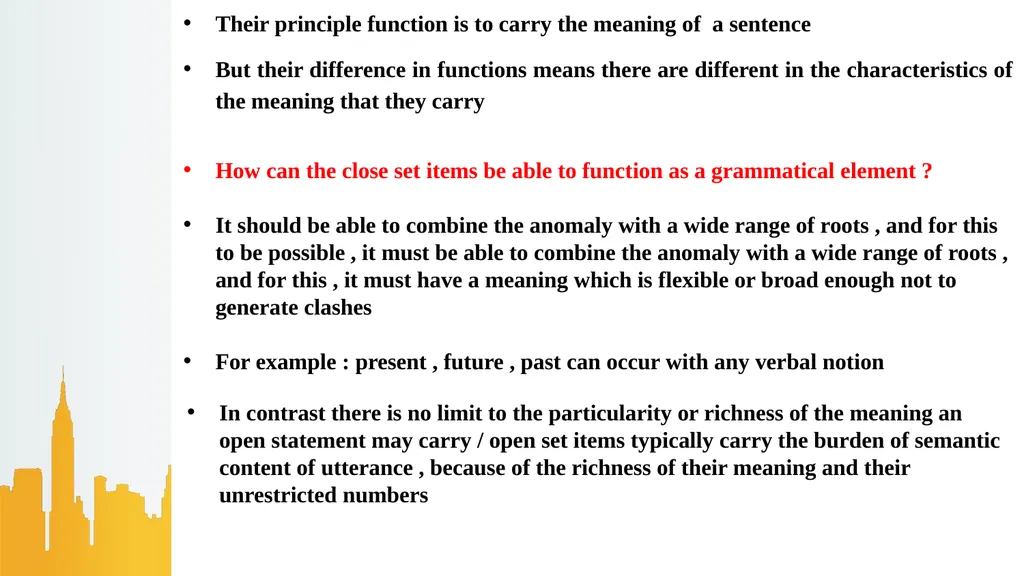
Their principle function is to carry the meaning of a sentence
But their difference in functions means there are different in the characteristics of the meaning that they carry How can the close set items be able to function as a grammatical element ?
It should be able to combine the anomaly with a wide range of roots , and for this to be possible , it must be able to combine the anomaly with a wide range of roots , and for this , it must have a meaning which is flexible or broad enough not to generate clashes
For example : present , future , past can occur with any verbal notion In contrast there is no limit to the particularity or richness of the meaning an open statement may carry / open set items typically carry the burden of semantic content of utterance , because of the richness of their meaning and their unrestricted numbers<br>
But their difference in functions means there are different in the characteristics of the meaning that they carry How can the close set items be able to function as a grammatical element ?
It should be able to combine the anomaly with a wide range of roots , and for this to be possible , it must be able to combine the anomaly with a wide range of roots , and for this , it must have a meaning which is flexible or broad enough not to generate clashes
For example : present , future , past can occur with any verbal notion In contrast there is no limit to the particularity or richness of the meaning an open statement may carry / open set items typically carry the burden of semantic content of utterance , because of the richness of their meaning and their unrestricted numbers<br>
09
The notion (possible word meaning ) Are there any restrictions on possible meanings forwards ?
It may be thought that no language could possibly have a word meaning for instance “ to face west on a sunny morning while doing something quickly ”
Language have words , at least partly , because in the cultures they serve , the meaning such words carry need to be communicated
The word could designate a specific sort of act of disrespect towards the Sun God which carried specific penalties. If we take into account the possibility of outlandish (to us ) religious beliefs , it is clear that the scope for improbable word meaning of this sort is (almost) unlimited.<br>
It may be thought that no language could possibly have a word meaning for instance “ to face west on a sunny morning while doing something quickly ”
Language have words , at least partly , because in the cultures they serve , the meaning such words carry need to be communicated
The word could designate a specific sort of act of disrespect towards the Sun God which carried specific penalties. If we take into account the possibility of outlandish (to us ) religious beliefs , it is clear that the scope for improbable word meaning of this sort is (almost) unlimited.<br>
10
( The woman drank the wine slowly)
The notion “drank slowly ” could easily be lexicalized (i.e. expressed by a single word : we have in English , after all , verbs such as quaff and sip , which combine the meaning of “ drink” with some with adverbial manner component .
Similarly , a verb meaning “ drink wine ” is not at all implausible as one of the senses of drink in English specifically “ drink alcoholic beverage ” ( as in Mary doesn't drink , she will just have an orange juice )
In contrast to these more – or – less plausible word meaning , consider next the possibility of having a word meaning “ the woman drank ” (blisk) , or “ the wine slowly ” blenk.
On this system, Blisk wine would mean “ the woman drank wine ” , and the woman drank blenk would mean “ the woman drank the wine slowly ” it seems clear here that we are in the realms not of implausibility , but of impossibility.<br>
The notion “drank slowly ” could easily be lexicalized (i.e. expressed by a single word : we have in English , after all , verbs such as quaff and sip , which combine the meaning of “ drink” with some with adverbial manner component .
Similarly , a verb meaning “ drink wine ” is not at all implausible as one of the senses of drink in English specifically “ drink alcoholic beverage ” ( as in Mary doesn't drink , she will just have an orange juice )
In contrast to these more – or – less plausible word meaning , consider next the possibility of having a word meaning “ the woman drank ” (blisk) , or “ the wine slowly ” blenk.
On this system, Blisk wine would mean “ the woman drank wine ” , and the woman drank blenk would mean “ the woman drank the wine slowly ” it seems clear here that we are in the realms not of implausibility , but of impossibility.<br>
11
The difference between dependent and independent components of a semantic combination
In dependent component : it is the one which determined the semantic relations of the combination as a whole with external items
For example
It is very large ____ it is large
(governs the combinability of the phrase very large with other items But in ( a very large wind ) we can not omit large because this attributes to a semantic incompatibility between large and wind
There is no inherent clash between very and wind
Also in warm milk ( independent item milk )
Very young boy
(continuous dependency chain )
In the case (wine slowly ) (there is no continuous dependency chain )<br>
In dependent component : it is the one which determined the semantic relations of the combination as a whole with external items
For example
It is very large ____ it is large
(governs the combinability of the phrase very large with other items But in ( a very large wind ) we can not omit large because this attributes to a semantic incompatibility between large and wind
There is no inherent clash between very and wind
Also in warm milk ( independent item milk )
Very young boy
(continuous dependency chain )
In the case (wine slowly ) (there is no continuous dependency chain )<br>
12
So there must be no gap in the chain
For example , we couldn’t say
Very milk<br>
For example , we couldn’t say
Very milk<br>
13
A couple of quotations from Chomsky are relevant here:
(1) The most elementary notion we have , the notion physical objects seems to be quiet complex
(2) There is no logical grounds for the appearant non existence of words such as LAMB it refers to the single object consisting of dogs for legs so that its LAMB is brown
The word HERD according to Chomsky denote a single scattered object with cows as parts so that a cow lost a leg implies the HERD lost a leg
Q / how can we apply the notion of nameability of physical objects ?
Physical things must be bounded it must have boundaries set on the bases of either physical detachability or characteristic features appearance or behavior<br>
(1) The most elementary notion we have , the notion physical objects seems to be quiet complex
(2) There is no logical grounds for the appearant non existence of words such as LAMB it refers to the single object consisting of dogs for legs so that its LAMB is brown
The word HERD according to Chomsky denote a single scattered object with cows as parts so that a cow lost a leg implies the HERD lost a leg
Q / how can we apply the notion of nameability of physical objects ?
Physical things must be bounded it must have boundaries set on the bases of either physical detachability or characteristic features appearance or behavior<br>
14
For instance , Chomsky's left half of an aeroplane wing , this is physical but while the whole wing is bounded by distinctive function and appearance the left half is not separated from the rest of the wing by any silent function or visual discontinuity
According to Chomsky there are some scattered individuals are namable such as fences , villages . Forest
For Pullman we can say that namable collections of otherwise independently namable interties generally show one or more of the followings :
1- the collections is relatively spatio temporarily contiguous ( fence village)
2- it is the product of human agency ( fence village , artistic installations
3- the members of the collections jointly fulfill a function not fulfilled by any of them separately ( fence , biking )<br>
According to Chomsky there are some scattered individuals are namable such as fences , villages . Forest
For Pullman we can say that namable collections of otherwise independently namable interties generally show one or more of the followings :
1- the collections is relatively spatio temporarily contiguous ( fence village)
2- it is the product of human agency ( fence village , artistic installations
3- the members of the collections jointly fulfill a function not fulfilled by any of them separately ( fence , biking )<br>
15
Pulman’s view :
Pulman refers to “ things which are designated by singular count nouns or proper names but nevertheless regarded as plural : collective word like herd , pile and flock , and proper names like the United States or the Commonwealth ”
(2) A word like committee can take plural concord with a verb : The committee have decided but this is not the case with , for instance , pile ‘ The pile of stones are black
Chomsky’s view:
In the case of LIMP he gives us as the sort of sentence which would prove that there was a genuine word LIMP , something like the LIMP of the dog is brown
Similarly in
the foliage of this tree is light green
(means simply that the leaves of the tree are light green
We should notice that :
Chomsky requirements for herd are perhaps more restricted ( a part of a cow must count a part of a herd .
The this criterion would rule out foliage , one would not say ( the foliage of this tree has prominent veins , but the leaves of this tree have prominent veins)<br>
Pulman refers to “ things which are designated by singular count nouns or proper names but nevertheless regarded as plural : collective word like herd , pile and flock , and proper names like the United States or the Commonwealth ”
(2) A word like committee can take plural concord with a verb : The committee have decided but this is not the case with , for instance , pile ‘ The pile of stones are black
Chomsky’s view:
In the case of LIMP he gives us as the sort of sentence which would prove that there was a genuine word LIMP , something like the LIMP of the dog is brown
Similarly in
the foliage of this tree is light green
(means simply that the leaves of the tree are light green
We should notice that :
Chomsky requirements for herd are perhaps more restricted ( a part of a cow must count a part of a herd .
The this criterion would rule out foliage , one would not say ( the foliage of this tree has prominent veins , but the leaves of this tree have prominent veins)<br>
16
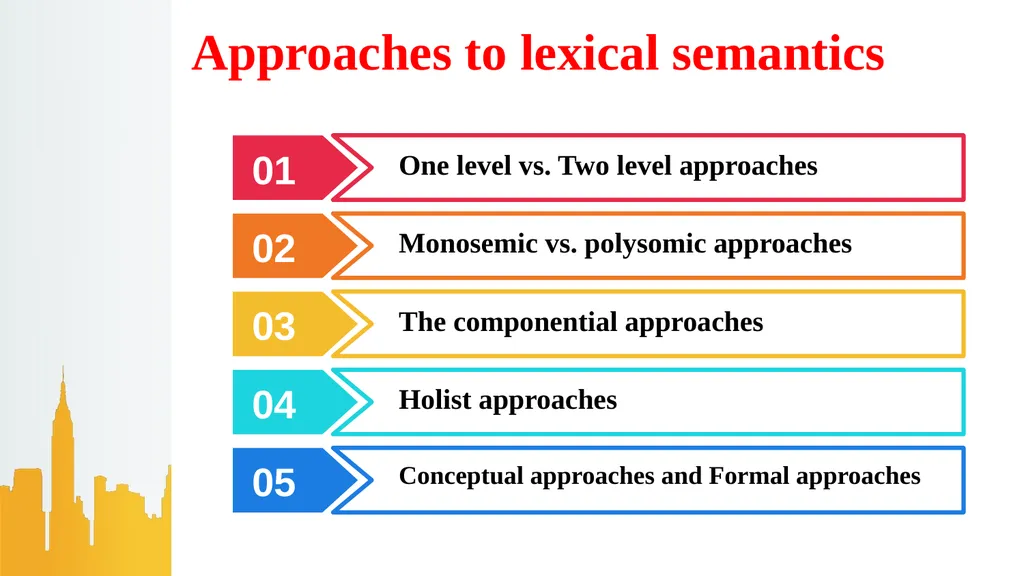
Approaches to lexical semantics 01 One level vs. Two level approaches 02 Monosemic vs. polysomic approaches 03 The componential approaches 04 Holist approaches 05 Conceptual approaches and Formal approaches<br>
17
One level vs. Two level approaches Human beings can make and learn to recognize an almost infinite variety of speech sounds but in a particular language , only a handful of these function distinctively to convey meanings or enter into systematic relations of any complexity
In a similar way the variety of raw meanings is virtually infinite , but only a limited number of these are truly linguistic and interact systematically with other aspects of the linguistic system
The vast detailed knowledge of the world which speakers undoubtedly poses , a property , not of language elements , but of concepts<br>
In a similar way the variety of raw meanings is virtually infinite , but only a limited number of these are truly linguistic and interact systematically with other aspects of the linguistic system
The vast detailed knowledge of the world which speakers undoubtedly poses , a property , not of language elements , but of concepts<br>
18
How can we recognize linguistic meaning ?
involvement with syntax , whether by virtue of being the meaning carried by some grammatical elements or because it correlates with such factors as agreements patterns or sub categorization of major syntactic categories Partisans of the single level view clamed that no non arbitrary bases for a singing aspects of meaning (or knowledge ) to the semantic or encyclopedic side of a purported dichotomy has been put forward which survive even a cursory scrutiny
Must cognitive linguistics would take the view that all meaning is conceptual and the extra level of structure proposed by the two level camp does not actually do any theoretical word<br>
involvement with syntax , whether by virtue of being the meaning carried by some grammatical elements or because it correlates with such factors as agreements patterns or sub categorization of major syntactic categories Partisans of the single level view clamed that no non arbitrary bases for a singing aspects of meaning (or knowledge ) to the semantic or encyclopedic side of a purported dichotomy has been put forward which survive even a cursory scrutiny
Must cognitive linguistics would take the view that all meaning is conceptual and the extra level of structure proposed by the two level camp does not actually do any theoretical word<br>
19
2- Monosemic vs. polysomic approaches
Monosemic view : ( few senses as possible should be given separate recognition in the lexicon of a language , and as many as possible derived from these , The argument usually goes like this : if one reading of a word is in any way a motivated extension of another one, then only one should be recorded , and the other should be left to the operation of Lexical Rule
Polysemic view : rejects the assumption that a motivated extension of a word sense does not need to be recorded in the lexicon because the lexical rules only specify potential extensions of meaning
Only some of which become conventionalized and incorporated in the lexicon , others are possible and many appears as nonce forms
For example :
The term “drink”<br>
Monosemic view : ( few senses as possible should be given separate recognition in the lexicon of a language , and as many as possible derived from these , The argument usually goes like this : if one reading of a word is in any way a motivated extension of another one, then only one should be recorded , and the other should be left to the operation of Lexical Rule
Polysemic view : rejects the assumption that a motivated extension of a word sense does not need to be recorded in the lexicon because the lexical rules only specify potential extensions of meaning
Only some of which become conventionalized and incorporated in the lexicon , others are possible and many appears as nonce forms
For example :
The term “drink”<br>
20
3- The componential approaches
This approach think of the meaning of a word as being constructed out of smaller more elementary invariant units of meaning , atomic structure of matter
These semantic atoms are variously known as seems , semantic features , semantic component, semantic markers , semantic primes
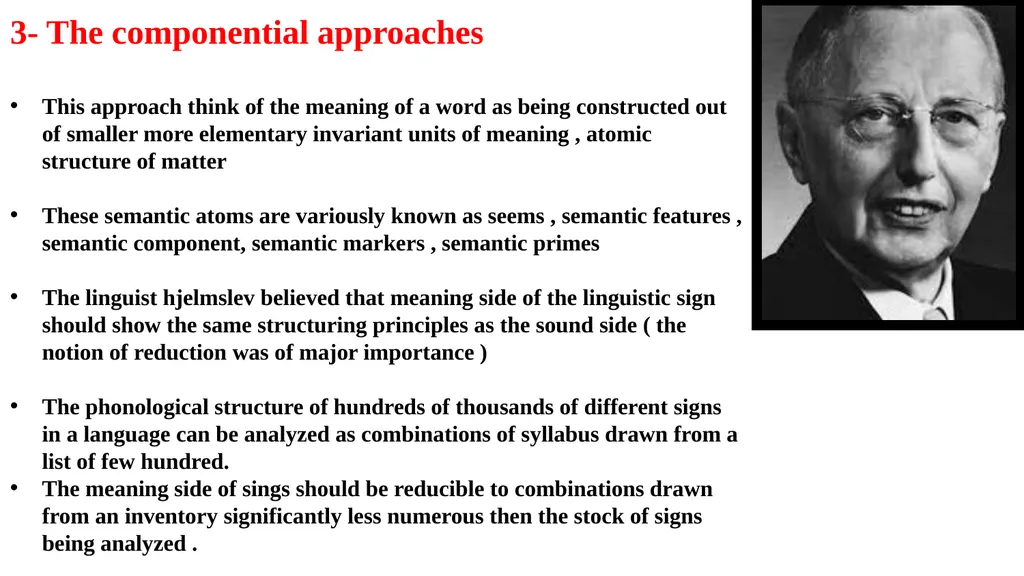
The linguist hjelmslev believed that meaning side of the linguistic sign should show the same structuring principles as the sound side ( the notion of reduction was of major importance )
The phonological structure of hundreds of thousands of different signs in a language can be analyzed as combinations of syllabus drawn from a list of few hundred.
The meaning side of sings should be reducible to combinations drawn from an inventory significantly less numerous then the stock of signs being analyzed .<br>
This approach think of the meaning of a word as being constructed out of smaller more elementary invariant units of meaning , atomic structure of matter
These semantic atoms are variously known as seems , semantic features , semantic component, semantic markers , semantic primes
The linguist hjelmslev believed that meaning side of the linguistic sign should show the same structuring principles as the sound side ( the notion of reduction was of major importance )
The phonological structure of hundreds of thousands of different signs in a language can be analyzed as combinations of syllabus drawn from a list of few hundred.
The meaning side of sings should be reducible to combinations drawn from an inventory significantly less numerous then the stock of signs being analyzed .<br>
21
4- Holist approaches
Localist view : ( contextual variations can be accounted for by rules of interactions with Context )
Holistic view : (meaning of a word can not be known without taking into account the meanings of all the other words in a language )
Versions of Holisms:
Haas : use theory of meaning which encapsulated in the dictum ( don’t lock for the meaning Lock for the use ) in other words , the meaning of an expressions is the use to which it is put
Hass gave his theory a personal twist (words can shall be known by the company they keep )
This interprets use as the context actual and potential<br>
Localist view : ( contextual variations can be accounted for by rules of interactions with Context )
Holistic view : (meaning of a word can not be known without taking into account the meanings of all the other words in a language )
Versions of Holisms:
Haas : use theory of meaning which encapsulated in the dictum ( don’t lock for the meaning Lock for the use ) in other words , the meaning of an expressions is the use to which it is put
Hass gave his theory a personal twist (words can shall be known by the company they keep )
This interprets use as the context actual and potential<br>
22
He said that the meaning of a word was a semantic fields which had two dimensions :
Syntagmatic dimension ( in which all possible contexts of the word were arranged in order normality and a paradigmatic dimension paradigmatic dimension ( in which for each context , the possible paradigmatic substitutes for the word were arranged in order for normality
The words semantic field , as understood by Haas constitutes its meanings ( every word therefore participates in the meaning of every other word , the semantic field of a word reflects its meaning<br>
Syntagmatic dimension ( in which all possible contexts of the word were arranged in order normality and a paradigmatic dimension paradigmatic dimension ( in which for each context , the possible paradigmatic substitutes for the word were arranged in order for normality
The words semantic field , as understood by Haas constitutes its meanings ( every word therefore participates in the meaning of every other word , the semantic field of a word reflects its meaning<br>
23
Lyons
His belief that meaning are not substantive but relational , and are constituted by contrast within the same system
He stated that the since of a lexical item consist of the set of sense relations which the item contracts with other items which participate in the same field
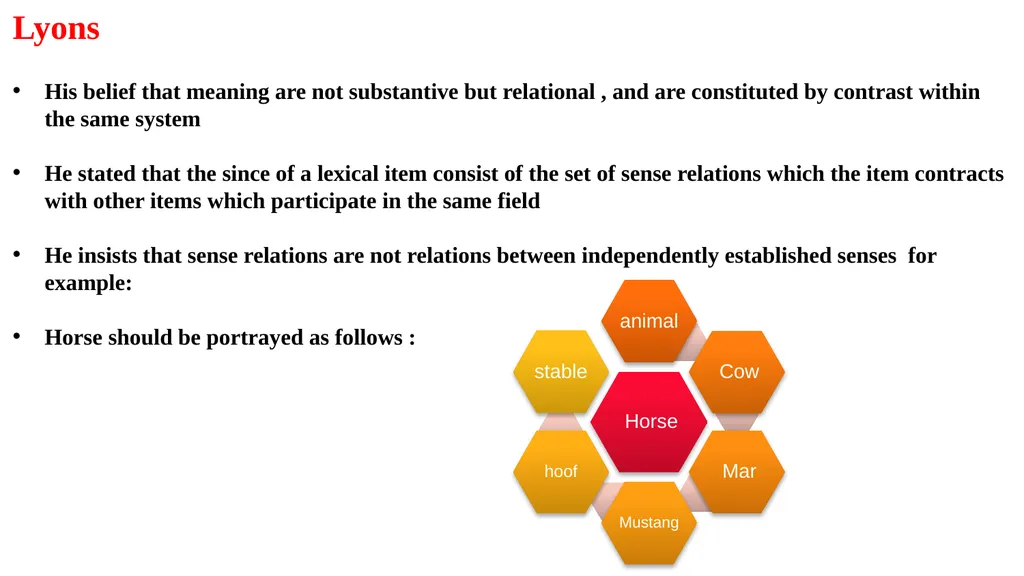
He insists that sense relations are not relations between independently established senses for example:
Horse should be portrayed as follows :<br>
His belief that meaning are not substantive but relational , and are constituted by contrast within the same system
He stated that the since of a lexical item consist of the set of sense relations which the item contracts with other items which participate in the same field
He insists that sense relations are not relations between independently established senses for example:
Horse should be portrayed as follows :<br>
24
5- Conceptual approach
Single level approaches and identify the meaning of a word with the concept or concepts it gives access to in the cognitive system
The origins of the prototype approach can be traced to Wittgen stein
He proposed the notion of family resemblance ( the members of a large family typically resemble one another in a variety of text but there are no features which they all had , and their may be members who share no features but these will non the less be linked to the others by a chain of resemblance
Why this notion is not very helpful for semantic analysis ?
Because it did not say what family resemblance consisted of , there was nothing other than arbitrary stipulation to stop every one in the world from belonging to the same family<br>
Single level approaches and identify the meaning of a word with the concept or concepts it gives access to in the cognitive system
The origins of the prototype approach can be traced to Wittgen stein
He proposed the notion of family resemblance ( the members of a large family typically resemble one another in a variety of text but there are no features which they all had , and their may be members who share no features but these will non the less be linked to the others by a chain of resemblance
Why this notion is not very helpful for semantic analysis ?
Because it did not say what family resemblance consisted of , there was nothing other than arbitrary stipulation to stop every one in the world from belonging to the same family<br>
25
This notion further refined by cognitive psychologists Rosch who established what is non as a prototype theory ( members of a category are not equal they vary in how good they
Are or how representative of the category
Jackendoff is another linguist who locates word meaning in conceptual structure
He sees no need for an intermediate linguistic semantics
He is strongly componentialist , he believes that intuitively perceived relationships must be accounted for in terms of shared semantic building blocks
Formal approaches
Express the facts of meaning through a strict formalism
The hoped for payoff from adopting this sort of approach includes greater explicitness, Testability of hypothesis , easier link up with syntax , and machine implement ability<br>
Are or how representative of the category
Jackendoff is another linguist who locates word meaning in conceptual structure
He sees no need for an intermediate linguistic semantics
He is strongly componentialist , he believes that intuitively perceived relationships must be accounted for in terms of shared semantic building blocks
Formal approaches
Express the facts of meaning through a strict formalism
The hoped for payoff from adopting this sort of approach includes greater explicitness, Testability of hypothesis , easier link up with syntax , and machine implement ability<br>
26
Thank you<br>