Working at Height from Ladders Steps A Toolbox Talk covering the use of Ladders, Steps and associated Work at Height Equipment What is Work at Height? Work at Height means work in any place where, if there were no precautions in place, a
"Working at Height from Ladders & Steps A Toolbox" is the property of its rightful owner. Permission is granted to
download and print the materials on this website for personal, non-commercial use only, and to display it
on your personal computer provided you do not modify the materials and that you retain all copyright
notices contained in the materials. By downloading content from our website, you accept the terms of this
agreement.
Presentation Transcript
01
Working at Height from Ladders & Steps A Toolbox Talk
covering the use of Ladders, Steps and associated Work at Height Equipment<br>
02
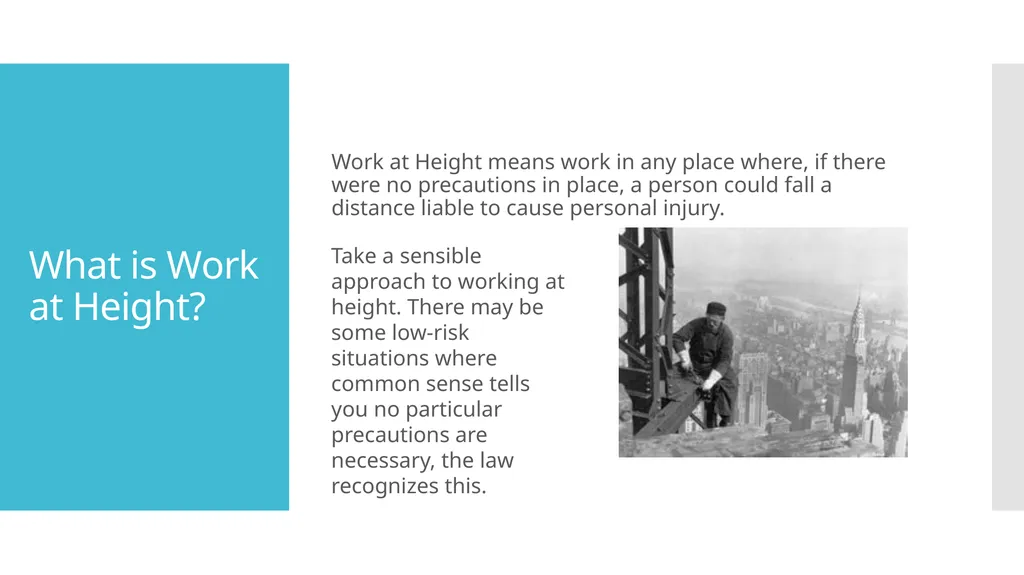
What is Work at Height? Work at Height means work in any place where, if there were no precautions in place, a person could fall a distance liable to cause personal injury. Take a sensible approach to working at height. There may be some low-risk situations where common sense tells you no particular precautions are necessary, the law recognizes this.<br>
03
Are ladders & step ladders banned? There is a common misconception that ladders and stepladders are banned, but this is not the case.
There are many situations where a ladder is the most suitable equipment for working at height. For tasks of low risk or short duration, ladders and step ladders can be a sensible option.
Remember - Take a sensible approach to working at height. There may be some low-risk situations where common sense tells you no particular precautions are necessary, the law recognizes this. Source – HSE indg 344, 401, 455<br>
04
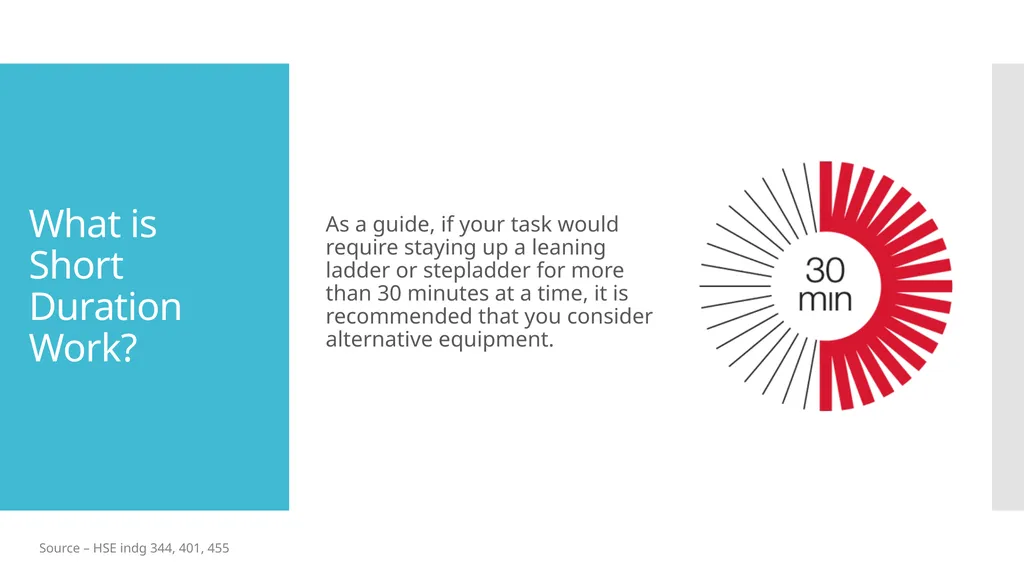
What is Short Duration Work? As a guide, if your task would require staying up a leaning ladder or stepladder for more than 30 minutes at a time, it is recommended that you consider alternative equipment. Source – HSE indg 344, 401, 455<br>
05
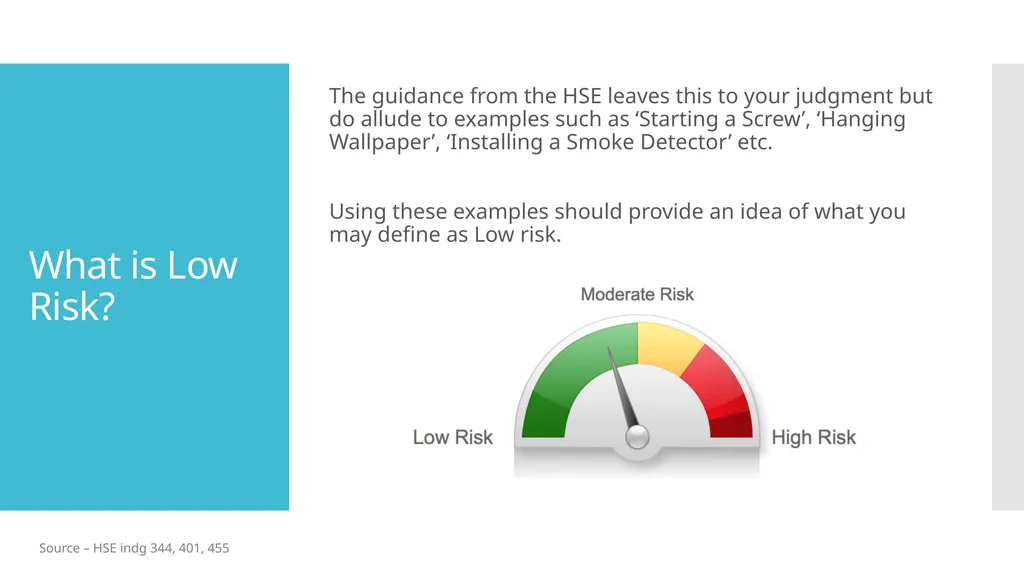
What is Low Risk? The guidance from the HSE leaves this to your judgment but do allude to examples such as ‘Starting a Screw’, ‘Hanging Wallpaper’, ‘Installing a Smoke Detector’ etc.
Using these examples should provide an idea of what you may define as Low risk. Source – HSE indg 344, 401, 455<br>
06
You should only use ladders and steps in situations where they can be used safely. Ladders and steps needs to be
Level
Stable
Ladders need to be secured (where it is reasonably practicable to do so).
You can source ladders or accessories that can help make your ladder meet these requirements
Check all four stepladder feet are in contact with the ground and the steps are level Source – HSE indg 344, 401, 455<br>
07
Step Ladders Source – HSE indg 344, 401, 455 When deciding if it is safe to carry out a particular task on a stepladder where you cannot maintain a handhold (eg to put a box on a shelf, hang wallpaper, install a smoke detector on a ceiling), this needs to be justified, taking into account:
The height of the task
Whether a handhold is still available to steady yourself before and after the task
Whether it is light work
Whether it avoids side loading
Whether it avoids overreaching
Whether the stepladder can be tied (e.g. when side-on working)<br>
08
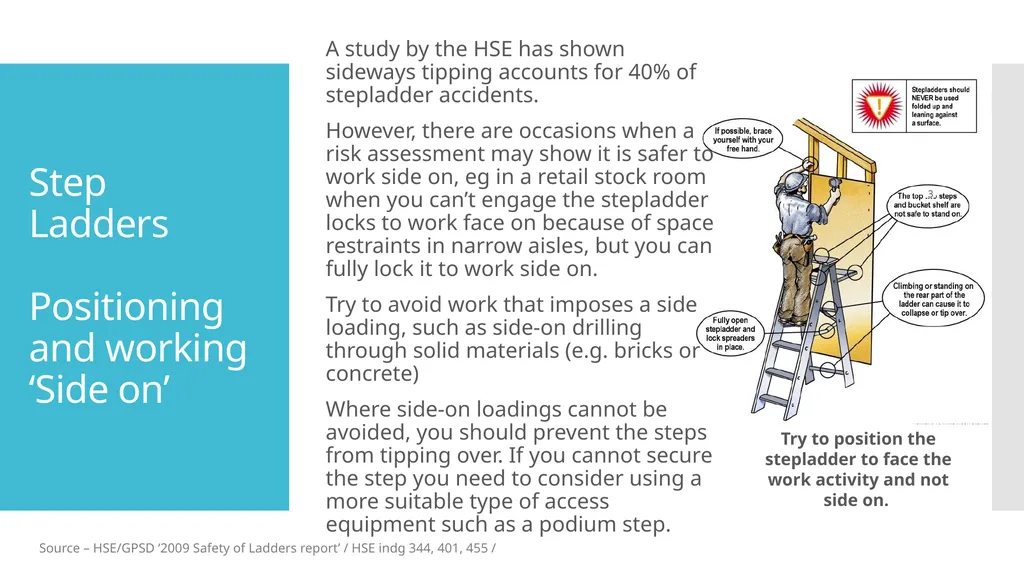
Step Ladders Positioning and working ‘Side on’ Source – HSE/GPSD ‘2009 Safety of Ladders report’ / HSE indg 344, 401, 455 / Try to position the stepladder to face the work activity and not side on. A study by the HSE has shown sideways tipping accounts for 40% of stepladder accidents.
However, there are occasions when a risk assessment may show it is safer to work side on, eg in a retail stock room when you can’t engage the stepladder locks to work face on because of space restraints in narrow aisles, but you can fully lock it to work side on.
Try to avoid work that imposes a side loading, such as side-on drilling through solid materials (e.g. bricks or concrete)
Where side-on loadings cannot be avoided, you should prevent the steps from tipping over. If you cannot secure the step you need to consider using a more suitable type of access equipment such as a podium step.<br>
09
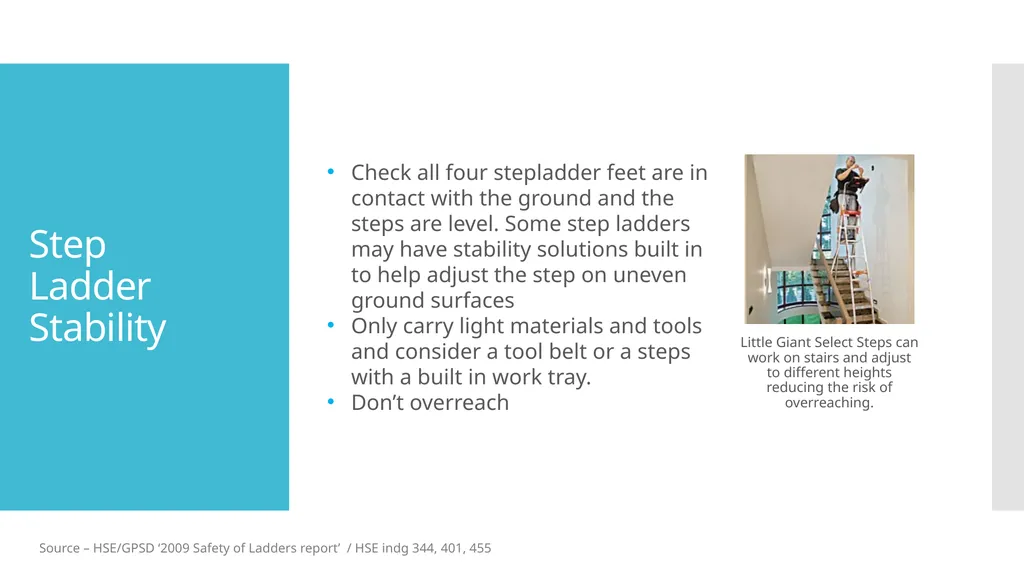
Step Ladder Stability Source – HSE/GPSD ‘2009 Safety of Ladders report’ / HSE indg 344, 401, 455 Check all four stepladder feet are in contact with the ground and the steps are level. Some step ladders may have stability solutions built in to help adjust the step on uneven ground surfaces
Only carry light materials and tools and consider a tool belt or a steps with a built in work tray.
Don’t overreach Little Giant Select Steps can work on stairs and adjust to different heights reducing the risk of overreaching.<br>
10
Can I stand on the Platform of a Platform Step? Don’t stand and work on the top three steps (including a step forming the very top of the stepladder) unless there is a suitable handhold. The red line indicates this is the highest tread you can work from on a Swingback or Builders type step. Here you can stand on the platform as the parapet or continuous handrail provides a suitable handhold and third point of contact. Source – HSE indg 344, 401, 455 /<br>
11
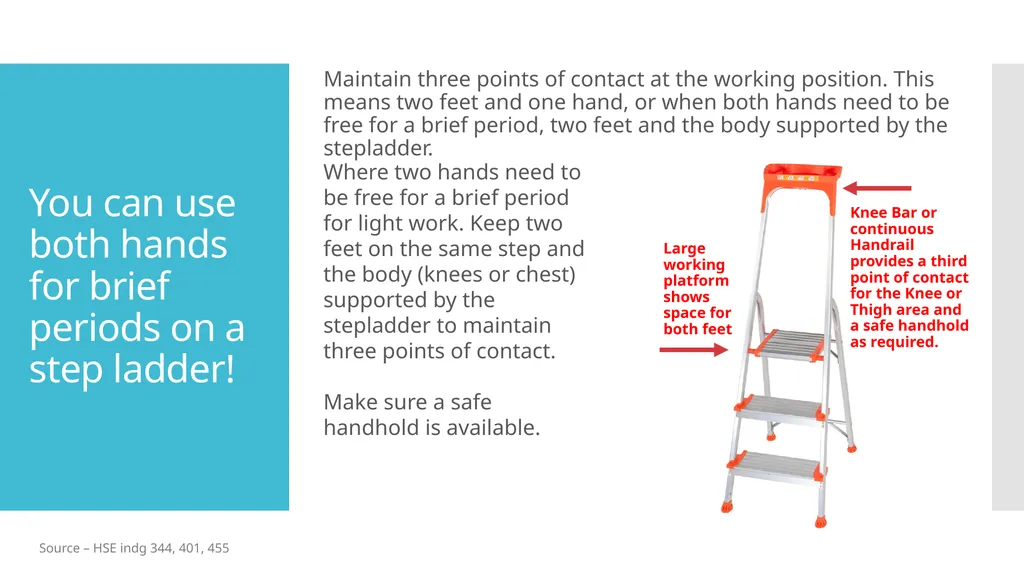
You can use both hands for brief periods on a step ladder! Maintain three points of contact at the working position. This means two feet and one hand, or when both hands need to be free for a brief period, two feet and the body supported by the stepladder. Where two hands need to be free for a brief period for light work. Keep two feet on the same step and the body (knees or chest) supported by the stepladder to maintain three points of contact.
Make sure a safe handhold is available. Knee Bar or continuous Handrail provides a third point of contact for the Knee or Thigh area and a safe handhold as required. Large working platform shows space for both feet Source – HSE indg 344, 401, 455<br>
12
Users responsibilities Employees have general legal duties to take reasonable care of themselves and others who may be affected by their actions, and to co-operate with their employer to enable their health and safety duties and requirements to be complied with.
For an employee, or those working under someone else’s control, the law says they must:
Report any safety hazard they identify to their employer;
Use the equipment and safety devices supplied or given to them properly, in accordance with any training and instructions (unless they think that would be unsafe, in which case they should seek further instructions before continuing). Source – HSE indg 344, 401, 455<br>
13
Employers responsibilities Employers need to make sure that any ladder or stepladder is both suitable for the work task and in a safe condition before use. As a guide, only use ladders or stepladders that:
Have no visible defects. They should have a pre-use check each working day
Have an up-to-date record of the detailed visual inspections carried out regularly by a competent person. These should be done in accordance with the manufacturer’s instructions
Are suitable for the intended use, ie are strong and robust enough for the job Source – HSE indg 344, 401, 455<br>