Working Capital Fund Jorge Rivera, WCF Director Paola Felix-Rodriguez, Budget Branch Chief Working Capital Fund.. Defined The Working Capital Fund (WCF) was established in 1944, authorized under 7 U.S.C. 2235 and is defined as: A fund
"Working Capital Fund Jorge Rivera, WCF Director" is the property of its rightful owner. Permission is granted to
download and print the materials on this website for personal, non-commercial use only, and to display it
on your personal computer provided you do not modify the materials and that you retain all copyright
notices contained in the materials. By downloading content from our website, you accept the terms of this
agreement.
Presentation Transcript
01
Working Capital Fund Jorge Rivera, WCF Director
Paola Felix-Rodriguez, Budget Branch Chief<br>
02
Working Capital Fund….. Defined The Working Capital Fund (WCF) was established in 1944, authorized under 7 U.S.C. 2235 and is defined as:
A fund without fiscal year limitation for payment of salaries and other costs for centrally managed services approved by:
Public Law 78-129 (legislation creating the WCF)
Secretary of Agriculture and the Director, OMB
Credited with advances or reimbursements:
from customers for which services are performed
on the basis of rates based on estimated or actual charges for services
such advances not to make available funds for any period beyond that provided by the Act appropriating the funds
Providing a mechanism to avoid duplication of services among agencies.<br>
03
Working Capital Fund….. Defined Cont. The WCF finances centrally-managed Activity Centers that provide support services to USDA and Non-USDA organizations and allows the Department to achieve efficiencies by engaging in economies of scale.
WCF Activity Centers deliver a wide variety of services under the following functional categories:
Information Technology and Data Center Services
Financial Management and Human Resources Operations
Administrative Services
Media Communication Services
Correspondence Management and Secretarial Support<br>
04
WCF Governance Structure The WCF employs an integrated governance structure to ensure effective service delivery and financial performance:
WCF was placed under centralized management in 1983. Day-to-day management operations are performed by the WCF Division (WCFD) under the Office of the Chief Financial Officer. The WCFD along with the WCF Controller and CFO has the overall responsibility for the financial health and integrity of the WCF.
Advisory functions are carried out by a WCF Executive Committee, authorized under Departmental Regulation 1043-40, which is comprised of high-level, senior management officials who provide the CFO, working with the CIO and ASA with advice and counsel with regards to allowances for Activity Centers in WCF.<br>
05
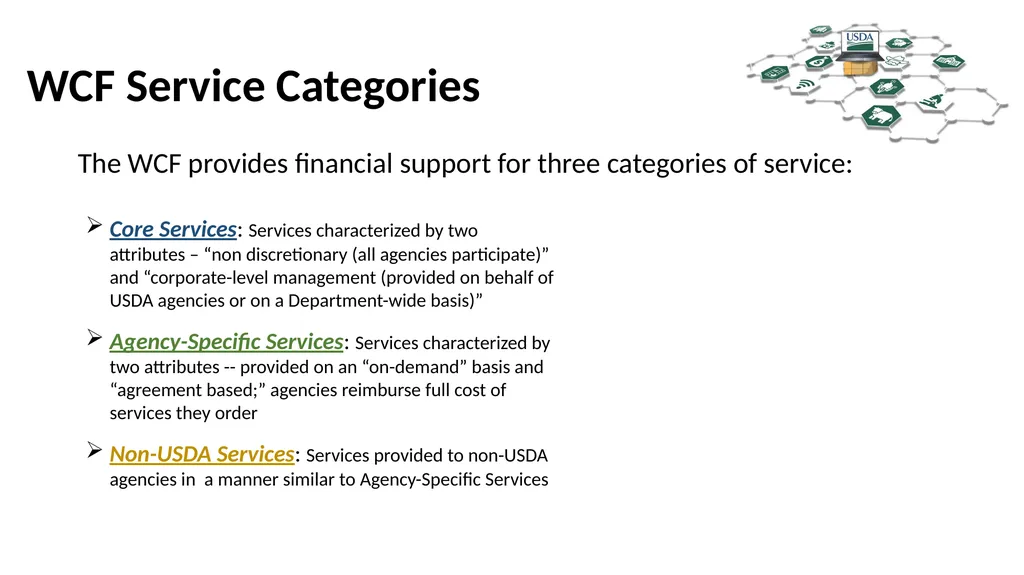
WCF Service Categories The WCF provides financial support for three categories of service: Core Services: Services characterized by two attributes – “non discretionary (all agencies participate)” and “corporate-level management (provided on behalf of USDA agencies or on a Department-wide basis)”
Agency-Specific Services: Services characterized by two attributes -- provided on an “on-demand” basis and “agreement based;” agencies reimburse full cost of services they order
Non-USDA Services: Services provided to non-USDA agencies in a manner similar to Agency-Specific Services<br>
06
WCF Budget Outlook AS USDA revamps it’s operating model to achieve a more customer-focused organization, WCF activity centers have been tasked with consolidating end-user services and data centers from 39 USDA data centers to a single data center and a back-up. This move will provide a cost-effective, high quality department-wide helpdesk and reduce cybersecurity vulnerabilities.<br>
07
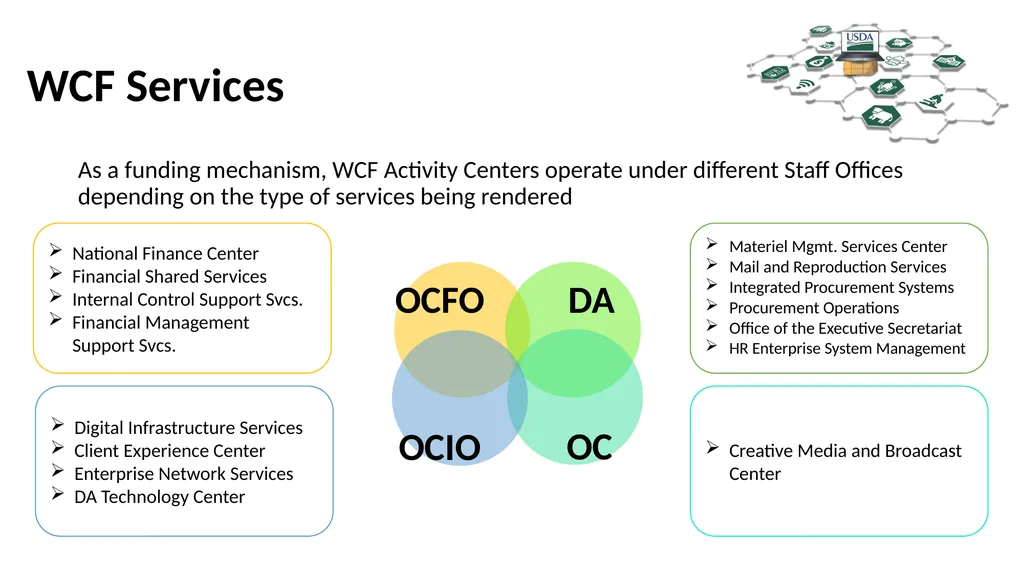
WCF Services As a funding mechanism, WCF Activity Centers operate under different Staff Offices depending on the type of services being rendered National Finance Center
Financial Shared Services
Internal Control Support Svcs.
Financial Management Support Svcs. Digital Infrastructure Services
Client Experience Center
Enterprise Network Services
DA Technology Center OCFO DA OCIO OC Materiel Mgmt. Services Center
Mail and Reproduction Services
Integrated Procurement Systems
Procurement Operations
Office of the Executive Secretariat
HR Enterprise System Management Creative Media and Broadcast Center<br>
08
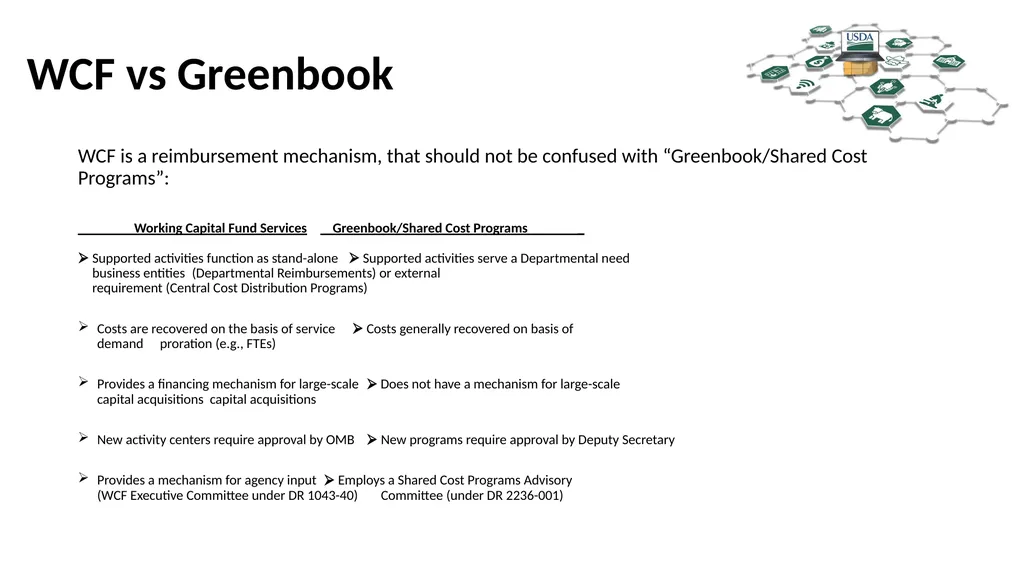
WCF vs Greenbook WCF is a reimbursement mechanism, that should not be confused with “Greenbook/Shared Cost Programs”:
Working Capital Fund Services Greenbook/Shared Cost Programs _ Supported activities function as stand-alone Supported activities serve a Departmental need business entities (Departmental Reimbursements) or external requirement (Central Cost Distribution Programs)
Costs are recovered on the basis of service Costs generally recovered on basis of demand proration (e.g., FTEs)
Provides a financing mechanism for large-scale Does not have a mechanism for large-scale capital acquisitions capital acquisitions
New activity centers require approval by OMB New programs require approval by Deputy Secretary
Provides a mechanism for agency input Employs a Shared Cost Programs Advisory (WCF Executive Committee under DR 1043-40) Committee (under DR 2236-001)<br>
09
WCF Benefits to USDA WCF provides benefits to the Department and it’s agencies such as:
Economies of scale
Reduced overhead
Central cost-based management
Coordination that avoids duplication of effort among agencies
Improved services to the agencies and/or the public
Availability of services to agencies that could not afford them if administered by agencies independently
Ability to replace equipment on a long-term basis or make investments in corporate-level systems applications through the cost recovery mechanism<br>
10
Agency Reporting for WCF Services As more services are centralized at the Department level to achieve economies of scale, accurate reporting is crucial in order to have a facts-based, data-driven, decision-making, customer-focused mindset.
Agencies need to properly record obligations for services received from a WCF activity center by:
Obligating funds in a timely manner reflective of the appropriate period of performance
Using the distinctive FMMI activity center vendor code to property identify the service provider
Recording obligations using a budget object class that describes the type of services being procured
Taking into consideration the metrics used by each activity center to assess cost to further allocate cost within your agency<br>
11
Questions Any questions?
For more information, please email us at USDAWCF@usda.gov<br>