
Working Group on Euro Risk-Free Rates Preparing
LV
Published · 26 slides · 0 views

1 / 1


Description
Working Group on Euro Risk-Free Rates Preparing for the interest rate benchmark reforms and the new risk-free rates SG7 Communication and Education December 2019 Table of contents Purpose and use of this pack What is happening with regard
Related Topics
Share
Embed code
Download this presentation From Below
"Working Group on Euro Risk-Free Rates Preparing" is the property of its rightful owner. Permission is granted to download and print the materials on this website for personal, non-commercial use only, and to display it on your personal computer provided you do not modify the materials and that you retain all copyright notices contained in the materials. By downloading content from our website, you accept the terms of this agreement.
Presentation Transcript
01
Working Group on Euro Risk-Free Rates
Preparing for the interest rate benchmark reforms and the new risk-free rates SG7 Communication and Education | December 2019<br>
02
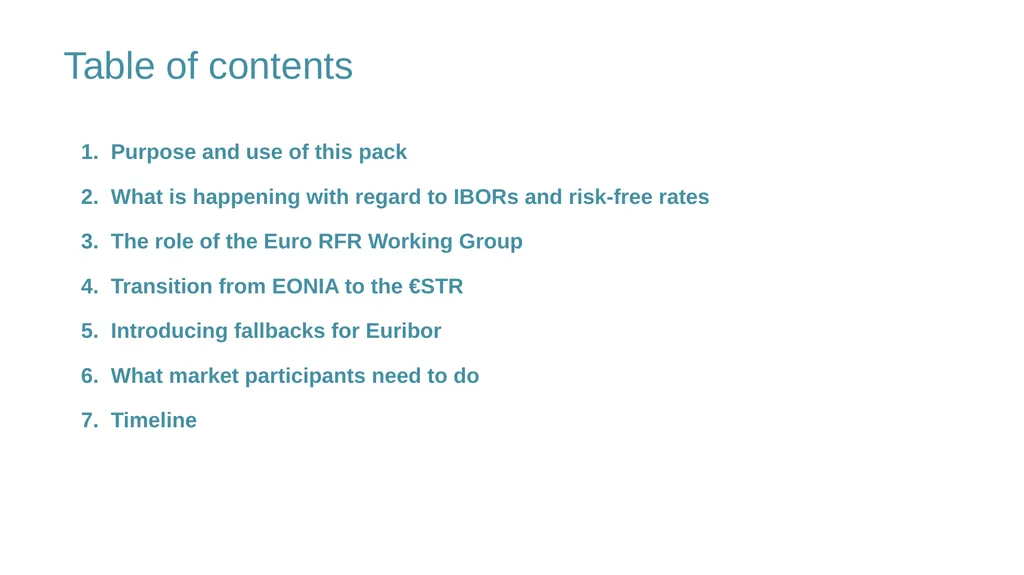
Table of contents Purpose and use of this pack
What is happening with regard to IBORs and risk-free rates
The role of the Euro RFR Working Group
Transition from EONIA to the €STR
Introducing fallbacks for Euribor
What market participants need to do
Timeline 2<br>
What is happening with regard to IBORs and risk-free rates
The role of the Euro RFR Working Group
Transition from EONIA to the €STR
Introducing fallbacks for Euribor
What market participants need to do
Timeline 2<br>
03
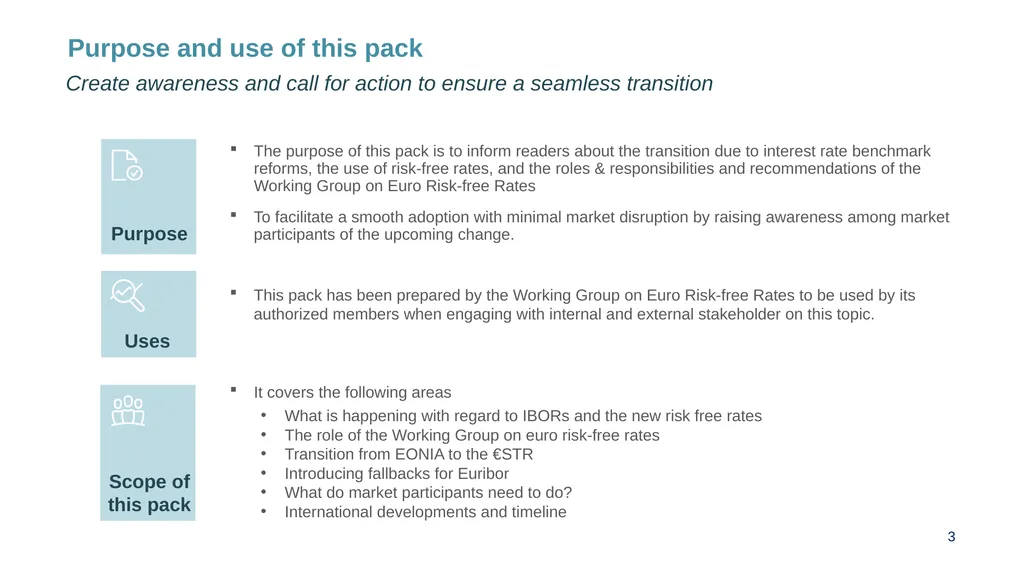
The purpose of this pack is to inform readers about the transition due to interest rate benchmark reforms, the use of risk-free rates, and the roles & responsibilities and recommendations of the Working Group on Euro Risk-free Rates Purpose and use of this pack This pack has been prepared by the Working Group on Euro Risk-free Rates to be used by its authorized members when engaging with internal and external stakeholder on this topic. It covers the following areas Create awareness and call for action to ensure a seamless transition To facilitate a smooth adoption with minimal market disruption by raising awareness among market participants of the upcoming change. What is happening with regard to IBORs and the new risk free rates
The role of the Working Group on euro risk-free rates
Transition from EONIA to the €STR
Introducing fallbacks for Euribor
What do market participants need to do?
International developments and timeline 3 Purpose Uses Scope of this pack<br>
The role of the Working Group on euro risk-free rates
Transition from EONIA to the €STR
Introducing fallbacks for Euribor
What do market participants need to do?
International developments and timeline 3 Purpose Uses Scope of this pack<br>
04
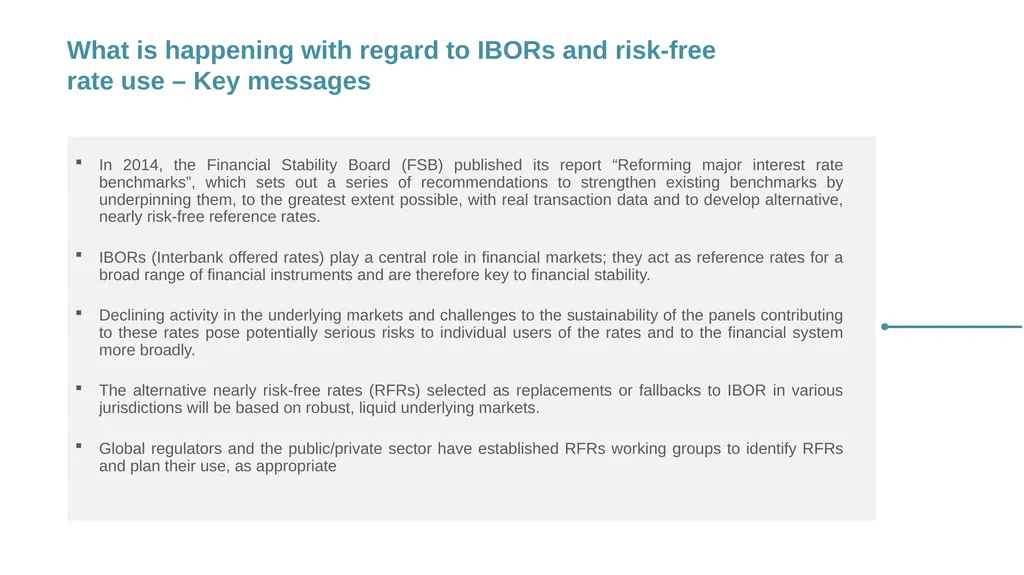
In 2014, the Financial Stability Board (FSB) published its report “Reforming major interest rate benchmarks”, which sets out a series of recommendations to strengthen existing benchmarks by underpinning them, to the greatest extent possible, with real transaction data and to develop alternative, nearly risk-free reference rates.
IBORs (Interbank offered rates) play a central role in financial markets; they act as reference rates for a broad range of financial instruments and are therefore key to financial stability.
Declining activity in the underlying markets and challenges to the sustainability of the panels contributing to these rates pose potentially serious risks to individual users of the rates and to the financial system more broadly.
The alternative nearly risk-free rates (RFRs) selected as replacements or fallbacks to IBOR in various jurisdictions will be based on robust, liquid underlying markets.
Global regulators and the public/private sector have established RFRs working groups to identify RFRs and plan their use, as appropriate What is happening with regard to IBORs and risk-free rate use – Key messages 4<br>
05
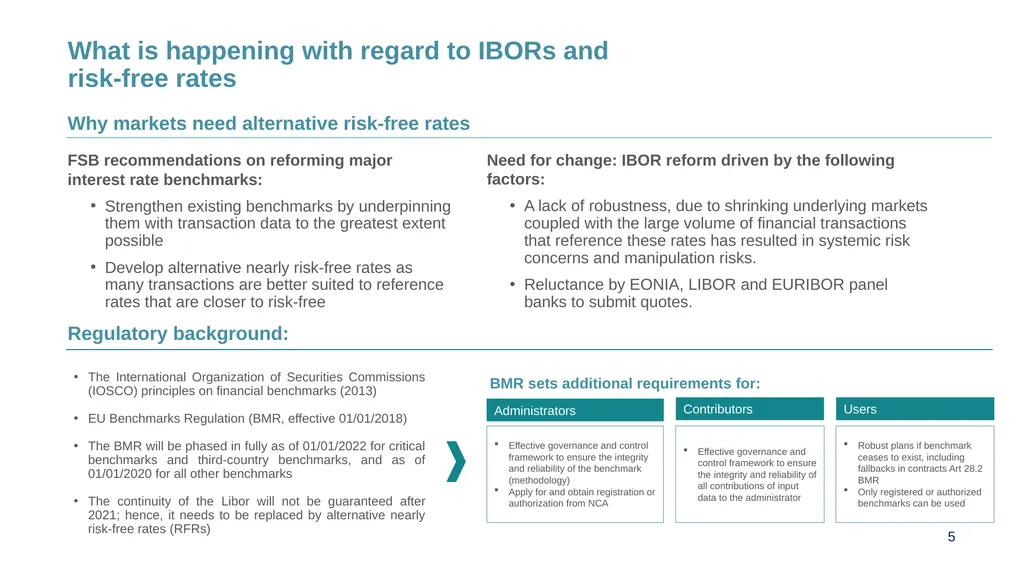
What is happening with regard to IBORs and risk-free rates Why markets need alternative risk-free rates Need for change: IBOR reform driven by the following factors:
A lack of robustness, due to shrinking underlying markets coupled with the large volume of financial transactions that reference these rates has resulted in systemic risk concerns and manipulation risks.
Reluctance by EONIA, LIBOR and EURIBOR panel banks to submit quotes. Regulatory background: The International Organization of Securities Commissions (IOSCO) principles on financial benchmarks (2013)
EU Benchmarks Regulation (BMR, effective 01/01/2018)
The BMR will be phased in fully as of 01/01/2022 for critical benchmarks and third-country benchmarks, and as of 01/01/2020 for all other benchmarks
The continuity of the Libor will not be guaranteed after 2021; hence, it needs to be replaced by alternative nearly risk-free rates (RFRs) BMR sets additional requirements for: Effective governance and control framework to ensure the integrity and reliability of the benchmark (methodology)
Apply for and obtain registration or authorization from NCA Administrators Effective governance and control framework to ensure the integrity and reliability of all contributions of input data to the administrator Robust plans if benchmark ceases to exist, including fallbacks in contracts Art 28.2 BMR
Only registered or authorized benchmarks can be used Contributors Users 5 FSB recommendations on reforming major interest rate benchmarks:
Strengthen existing benchmarks by underpinning them with transaction data to the greatest extent possible
Develop alternative nearly risk-free rates as many transactions are better suited to reference rates that are closer to risk-free<br>
06
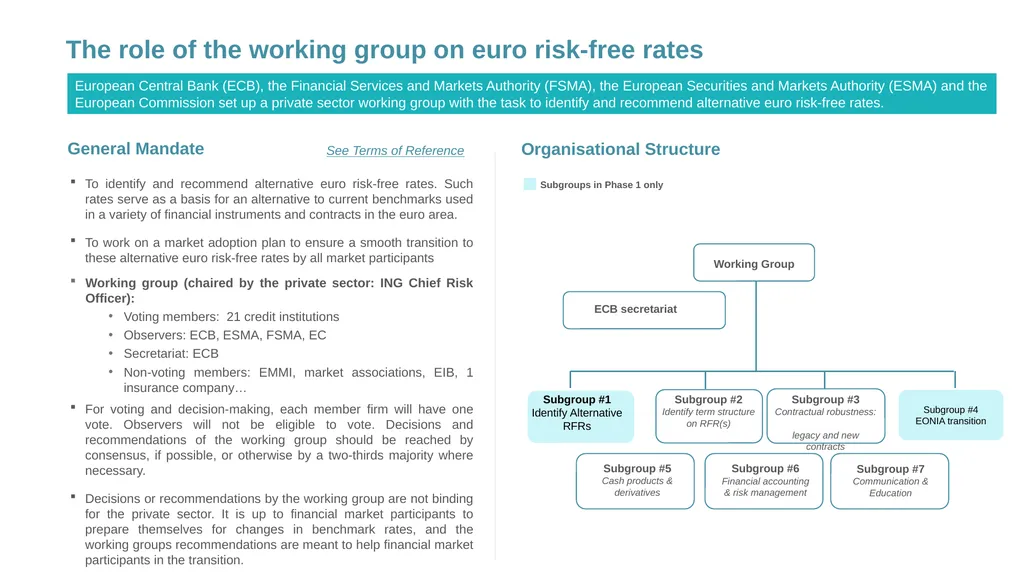
The role of the working group on euro risk-free rates European Central Bank (ECB), the Financial Services and Markets Authority (FSMA), the European Securities and Markets Authority (ESMA) and the European Commission set up a private sector working group with the task to identify and recommend alternative euro risk-free rates. Organisational Structure General Mandate To identify and recommend alternative euro risk-free rates. Such rates serve as a basis for an alternative to current benchmarks used in a variety of financial instruments and contracts in the euro area.
To work on a market adoption plan to ensure a smooth transition to these alternative euro risk-free rates by all market participants
Working group (chaired by the private sector: ING Chief Risk Officer):
Voting members: 21 credit institutions
Observers: ECB, ESMA, FSMA, EC
Secretariat: ECB
Non-voting members: EMMI, market associations, EIB, 1 insurance company…
For voting and decision-making, each member firm will have one vote. Observers will not be eligible to vote. Decisions and recommendations of the working group should be reached by consensus, if possible, or otherwise by a two-thirds majority where necessary.
Decisions or recommendations by the working group are not binding for the private sector. It is up to financial market participants to prepare themselves for changes in benchmark rates, and the working groups recommendations are meant to help financial market participants in the transition. See Terms of Reference Subgroup #1
Identify Alternative RFRs Subgroup #4
EONIA transition Subgroups in Phase 1 only 6 Working Group ECB secretariat Subgroup #2
Identify term structure on RFR(s) Subgroup #3
Contractual robustness: legacy and new contracts Subgroup #5
Cash products & derivatives Subgroup #6
Financial accounting & risk management Subgroup #7
Communication & Education<br>
07
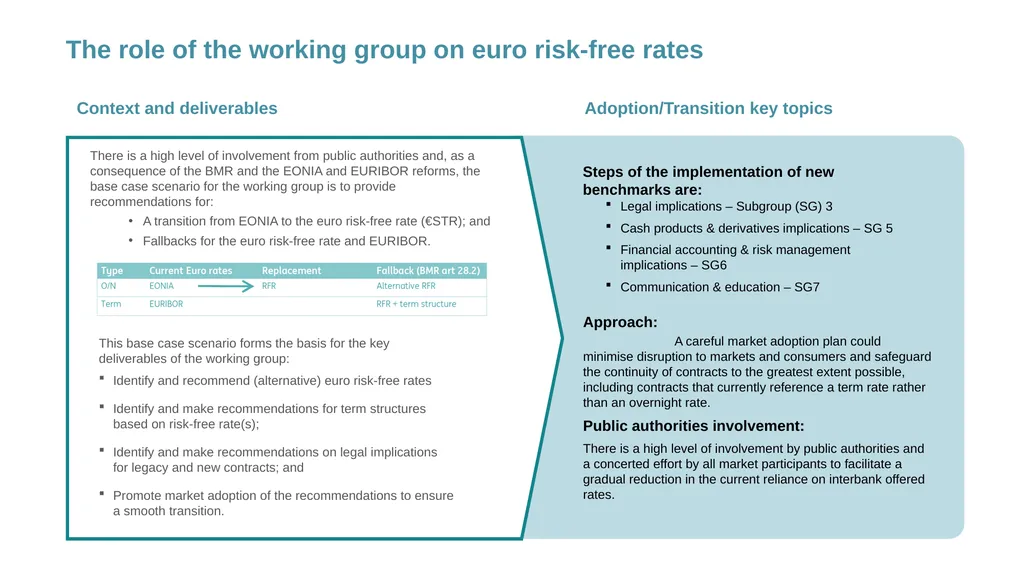
Steps of the implementation of new benchmarks are:
Legal implications – Subgroup (SG) 3
Cash products & derivatives implications – SG 5
Financial accounting & risk management implications – SG6
Communication & education – SG7 Approach: A careful market adoption plan could minimise disruption to markets and consumers and safeguard the continuity of contracts to the greatest extent possible, including contracts that currently reference a term rate rather than an overnight rate.
Public authorities involvement:
There is a high level of involvement by public authorities and a concerted effort by all market participants to facilitate a gradual reduction in the current reliance on interbank offered rates. There is a high level of involvement from public authorities and, as a consequence of the BMR and the EONIA and EURIBOR reforms, the base case scenario for the working group is to provide recommendations for:
A transition from EONIA to the euro risk-free rate (€STR); and
Fallbacks for the euro risk-free rate and EURIBOR. This base case scenario forms the basis for the key deliverables of the working group:
Identify and recommend (alternative) euro risk-free rates
Identify and make recommendations for term structures based on risk-free rate(s);
Identify and make recommendations on legal implications for legacy and new contracts; and
Promote market adoption of the recommendations to ensure a smooth transition. Context and deliverables Adoption/Transition key topics 7 The role of the working group on euro risk-free rates<br>
08
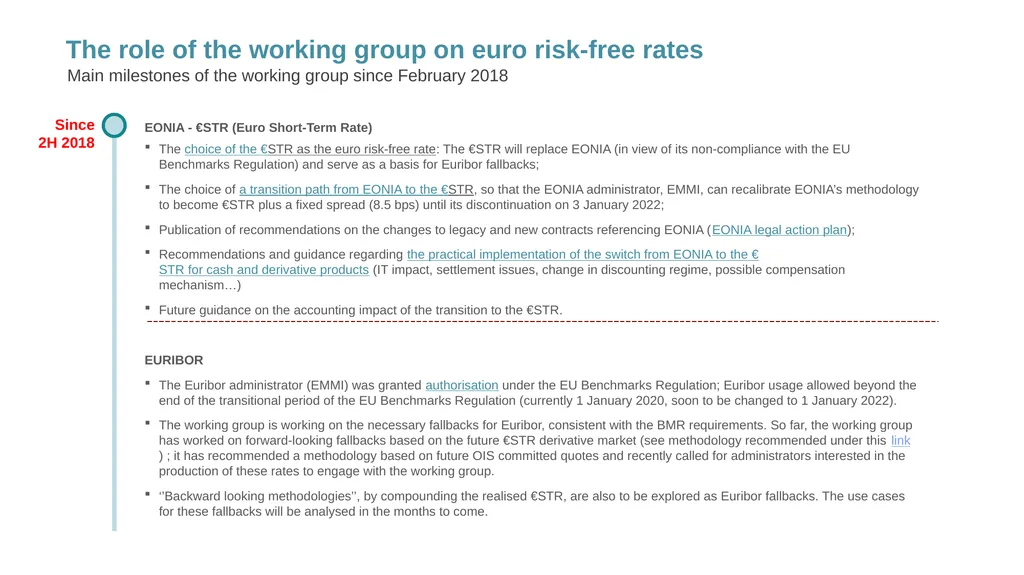
Main milestones of the working group since February 2018 EONIA - €STR (Euro Short-Term Rate)
The choice of the €STR as the euro risk-free rate: The €STR will replace EONIA (in view of its non-compliance with the EU Benchmarks Regulation) and serve as a basis for Euribor fallbacks;
The choice of a transition path from EONIA to the €STR, so that the EONIA administrator, EMMI, can recalibrate EONIA’s methodology to become €STR plus a fixed spread (8.5 bps) until its discontinuation on 3 January 2022;
Publication of recommendations on the changes to legacy and new contracts referencing EONIA (EONIA legal action plan);
Recommendations and guidance regarding the practical implementation of the switch from EONIA to the €STR for cash and derivative products (IT impact, settlement issues, change in discounting regime, possible compensation mechanism…)
Future guidance on the accounting impact of the transition to the €STR.
EURIBOR
The Euribor administrator (EMMI) was granted authorisation under the EU Benchmarks Regulation; Euribor usage allowed beyond the end of the transitional period of the EU Benchmarks Regulation (currently 1 January 2020, soon to be changed to 1 January 2022).
The working group is working on the necessary fallbacks for Euribor, consistent with the BMR requirements. So far, the working group has worked on forward-looking fallbacks based on the future €STR derivative market (see methodology recommended under this link) ; it has recommended a methodology based on future OIS committed quotes and recently called for administrators interested in the production of these rates to engage with the working group.
‘’Backward looking methodologies’’, by compounding the realised €STR, are also to be explored as Euribor fallbacks. The use cases for these fallbacks will be analysed in the months to come. Since 2H 2018 The role of the working group on euro risk-free rates<br>
09
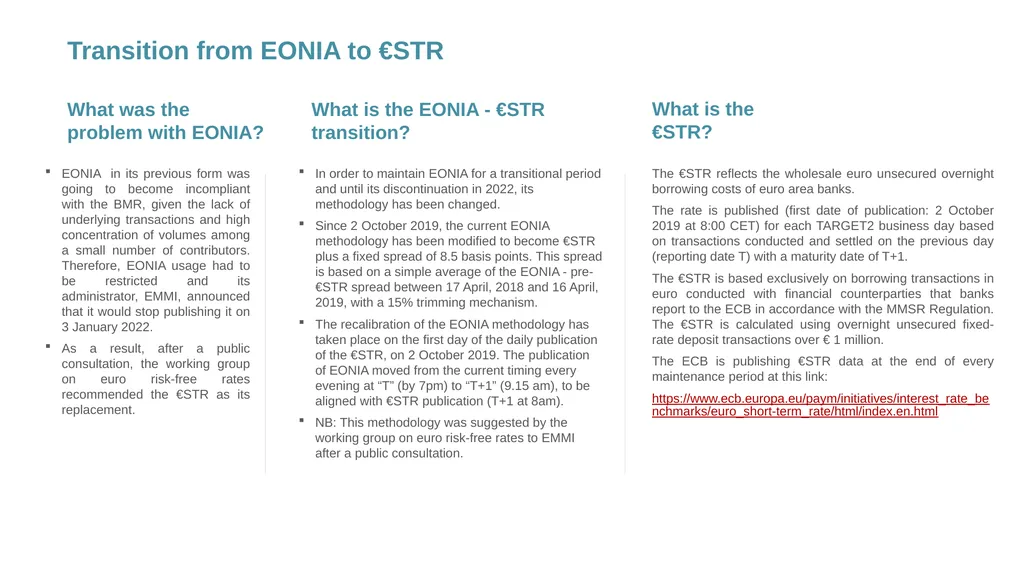
EONIA in its previous form was going to become incompliant with the BMR, given the lack of underlying transactions and high concentration of volumes among a small number of contributors. Therefore, EONIA usage had to be restricted and its administrator, EMMI, announced that it would stop publishing it on 3 January 2022.
As a result, after a public consultation, the working group on euro risk-free rates recommended the €STR as its replacement. What is the €STR? Transition from EONIA to €STR 9 What was the problem with EONIA? What is the EONIA - €STR transition? The €STR reflects the wholesale euro unsecured overnight borrowing costs of euro area banks.
The rate is published (first date of publication: 2 October 2019 at 8:00 CET) for each TARGET2 business day based on transactions conducted and settled on the previous day (reporting date T) with a maturity date of T+1.
The €STR is based exclusively on borrowing transactions in euro conducted with financial counterparties that banks report to the ECB in accordance with the MMSR Regulation. The €STR is calculated using overnight unsecured fixed-rate deposit transactions over € 1 million.
The ECB is publishing €STR data at the end of every maintenance period at this link:
https://www.ecb.europa.eu/paym/initiatives/interest_rate_benchmarks/euro_short-term_rate/html/index.en.html In order to maintain EONIA for a transitional period and until its discontinuation in 2022, its methodology has been changed.
Since 2 October 2019, the current EONIA methodology has been modified to become €STR plus a fixed spread of 8.5 basis points. This spread is based on a simple average of the EONIA - pre-€STR spread between 17 April, 2018 and 16 April, 2019, with a 15% trimming mechanism.
The recalibration of the EONIA methodology has taken place on the first day of the daily publication of the €STR, on 2 October 2019. The publication of EONIA moved from the current timing every evening at “T” (by 7pm) to “T+1” (9.15 am), to be aligned with €STR publication (T+1 at 8am).
NB: This methodology was suggested by the working group on euro risk-free rates to EMMI after a public consultation.<br>
10
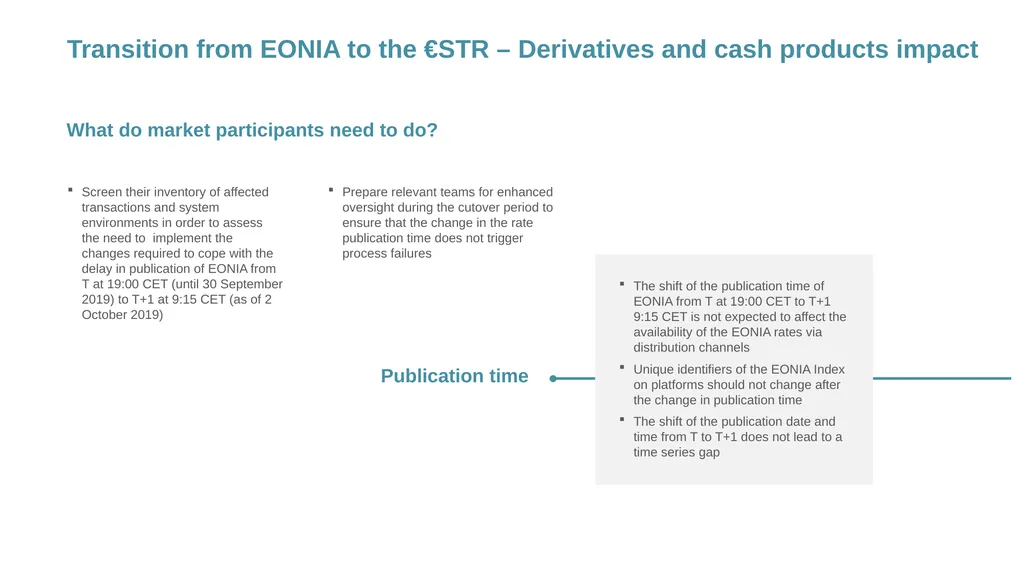
Screen their inventory of affected transactions and system environments in order to assess the need to implement the changes required to cope with the delay in publication of EONIA from T at 19:00 CET (until 30 September 2019) to T+1 at 9:15 CET (as of 2 October 2019) What do market participants need to do? Publication time Transition from EONIA to the €STR – Derivatives and cash products impact 10 The shift of the publication time of EONIA from T at 19:00 CET to T+1 9:15 CET is not expected to affect the availability of the EONIA rates via distribution channels
Unique identifiers of the EONIA Index on platforms should not change after the change in publication time
The shift of the publication date and time from T to T+1 does not lead to a time series gap Prepare relevant teams for enhanced oversight during the cutover period to ensure that the change in the rate publication time does not trigger process failures<br>
11
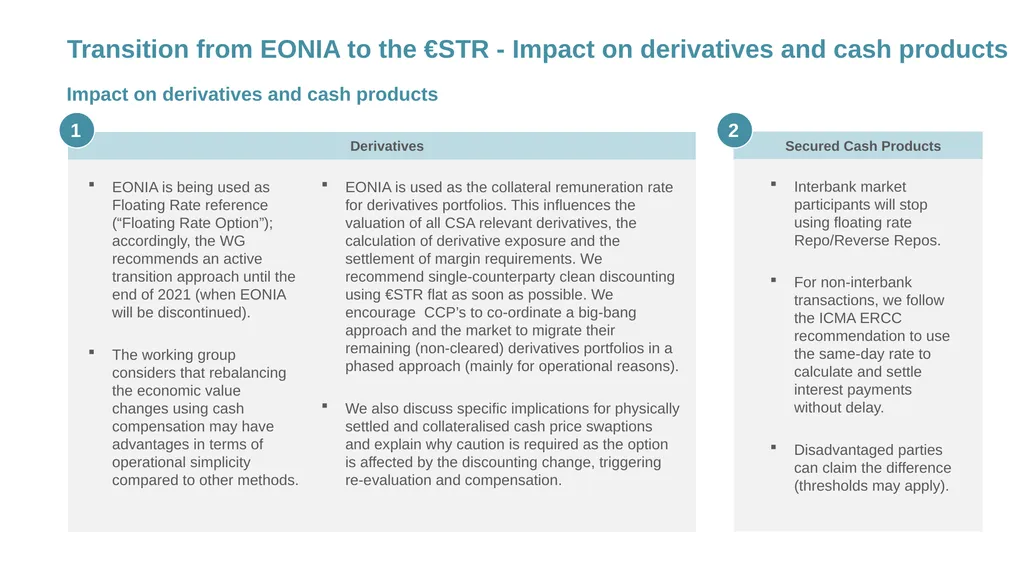
Transition from EONIA to the €STR - Impact on derivatives and cash products Impact on derivatives and cash products 11 EONIA is being used as Floating Rate reference (“Floating Rate Option”); accordingly, the WG recommends an active transition approach until the end of 2021 (when EONIA will be discontinued).
The working group considers that rebalancing the economic value changes using cash compensation may have advantages in terms of operational simplicity compared to other methods. Derivatives Interbank market participants will stop using floating rate Repo/Reverse Repos.
For non-interbank transactions, we follow the ICMA ERCC recommendation to use the same-day rate to calculate and settle interest payments without delay.
Disadvantaged parties can claim the difference (thresholds may apply). Secured Cash Products EONIA is used as the collateral remuneration rate for derivatives portfolios. This influences the valuation of all CSA relevant derivatives, the calculation of derivative exposure and the settlement of margin requirements. We recommend single-counterparty clean discounting using €STR flat as soon as possible. We encourage CCP’s to co-ordinate a big-bang approach and the market to migrate their remaining (non-cleared) derivatives portfolios in a phased approach (mainly for operational reasons).
We also discuss specific implications for physically settled and collateralised cash price swaptions and explain why caution is required as the option is affected by the discounting change, triggering re-evaluation and compensation.<br>
12
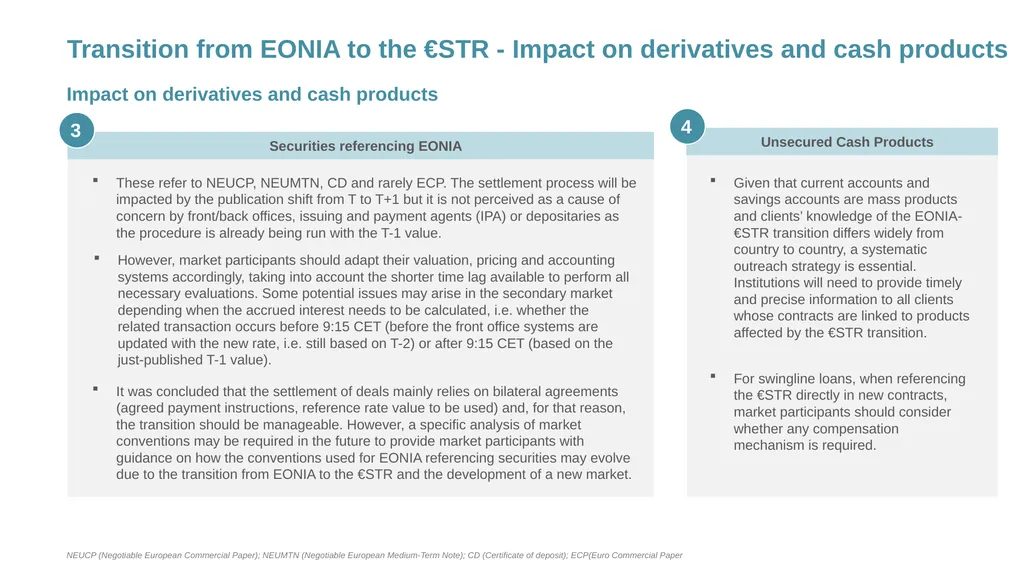
Securities referencing EONIA It was concluded that the settlement of deals mainly relies on bilateral agreements (agreed payment instructions, reference rate value to be used) and, for that reason, the transition should be manageable. However, a specific analysis of market conventions may be required in the future to provide market participants with guidance on how the conventions used for EONIA referencing securities may evolve due to the transition from EONIA to the €STR and the development of a new market. NEUCP (Negotiable European Commercial Paper); NEUMTN (Negotiable European Medium-Term Note); CD (Certificate of deposit); ECP(Euro Commercial Paper 12 These refer to NEUCP, NEUMTN, CD and rarely ECP. The settlement process will be impacted by the publication shift from T to T+1 but it is not perceived as a cause of concern by front/back offices, issuing and payment agents (IPA) or depositaries as the procedure is already being run with the T-1 value. However, market participants should adapt their valuation, pricing and accounting systems accordingly, taking into account the shorter time lag available to perform all necessary evaluations. Some potential issues may arise in the secondary market depending when the accrued interest needs to be calculated, i.e. whether the related transaction occurs before 9:15 CET (before the front office systems are updated with the new rate, i.e. still based on T-2) or after 9:15 CET (based on the just-published T-1 value). Transition from EONIA to the €STR - Impact on derivatives and cash products Impact on derivatives and cash products Given that current accounts and savings accounts are mass products and clients’ knowledge of the EONIA-€STR transition differs widely from country to country, a systematic outreach strategy is essential. Institutions will need to provide timely and precise information to all clients whose contracts are linked to products affected by the €STR transition.
For swingline loans, when referencing the €STR directly in new contracts, market participants should consider whether any compensation mechanism is required. Unsecured Cash Products<br>
For swingline loans, when referencing the €STR directly in new contracts, market participants should consider whether any compensation mechanism is required. Unsecured Cash Products<br>
13
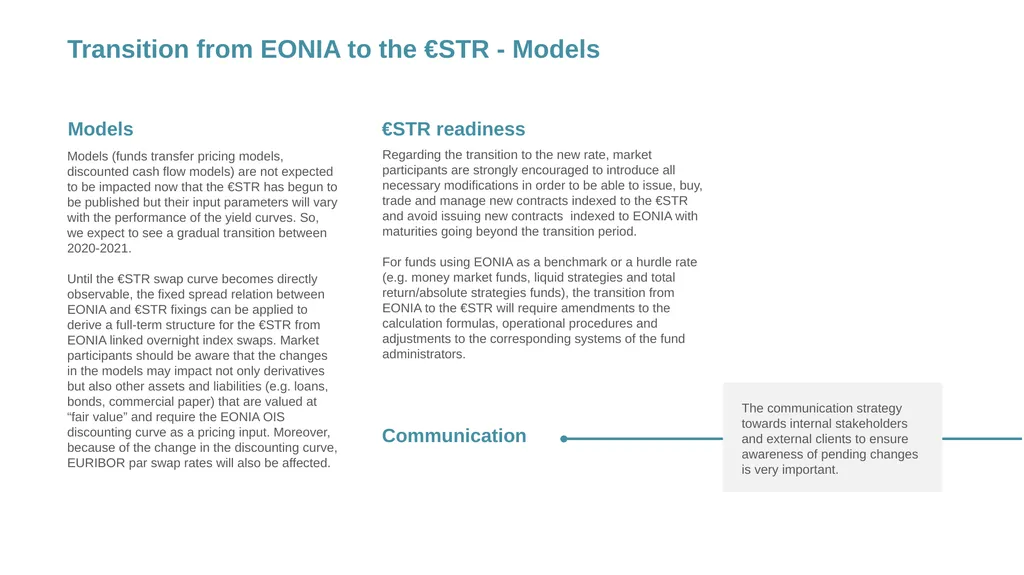
Models Models (funds transfer pricing models, discounted cash flow models) are not expected to be impacted now that the €STR has begun to be published but their input parameters will vary with the performance of the yield curves. So, we expect to see a gradual transition between 2020-2021.
Until the €STR swap curve becomes directly observable, the fixed spread relation between EONIA and €STR fixings can be applied to derive a full-term structure for the €STR from EONIA linked overnight index swaps. Market participants should be aware that the changes in the models may impact not only derivatives but also other assets and liabilities (e.g. loans, bonds, commercial paper) that are valued at “fair value” and require the EONIA OIS discounting curve as a pricing input. Moreover, because of the change in the discounting curve, EURIBOR par swap rates will also be affected. Communication €STR readiness Transition from EONIA to the €STR - Models 13 Regarding the transition to the new rate, market participants are strongly encouraged to introduce all necessary modifications in order to be able to issue, buy, trade and manage new contracts indexed to the €STR and avoid issuing new contracts indexed to EONIA with maturities going beyond the transition period.
For funds using EONIA as a benchmark or a hurdle rate (e.g. money market funds, liquid strategies and total return/absolute strategies funds), the transition from EONIA to the €STR will require amendments to the calculation formulas, operational procedures and adjustments to the corresponding systems of the fund administrators. The communication strategy towards internal stakeholders and external clients to ensure awareness of pending changes is very important.<br>
14
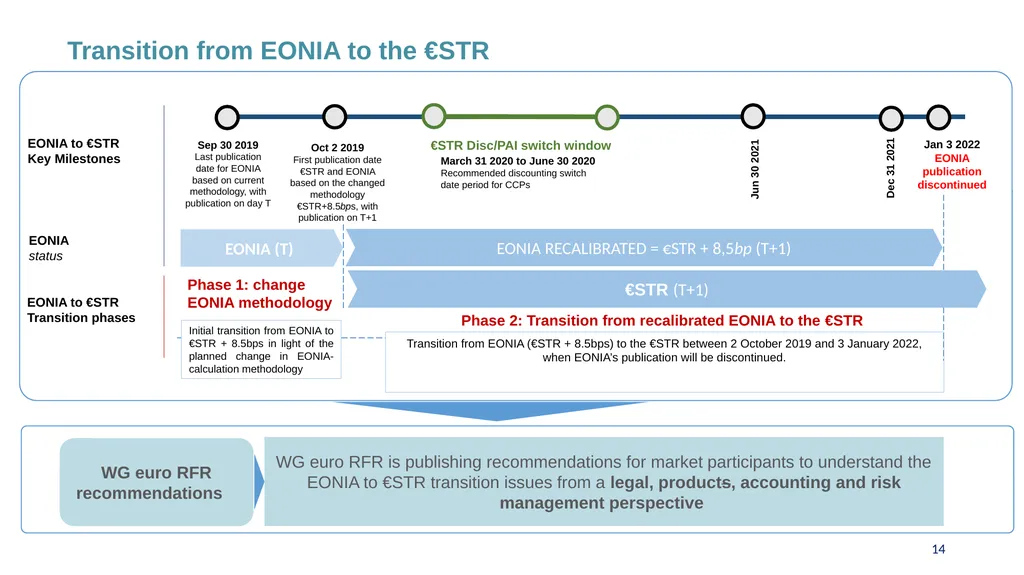
14 Transition from EONIA to the €STR Oct 2 2019
First publication date €STR and EONIA based on the changed methodology €STR+8.5bps, with publication on T+1 EONIA
status EONIA to €STR
Key Milestones Sep 30 2019
Last publication date for EONIA based on current methodology, with publication on day T March 31 2020 to June 30 2020
Recommended discounting switch date period for CCPs €STR Disc/PAI switch window EONIA (T) Dec 31 2021 Jun 30 2021 Transition from EONIA (€STR + 8.5bps) to the €STR between 2 October 2019 and 3 January 2022, when EONIA’s publication will be discontinued. EONIA RECALIBRATED = €STR + 8,5bp (T+1) Initial transition from EONIA to €STR + 8.5bps in light of the planned change in EONIA-calculation methodology Phase 1: change EONIA methodology Phase 2: From EONIA recalibrated to €STR transition Jan 3 2022
EONIA publication discontinued EONIA to €STR
Transition phases WG euro RFR is publishing recommendations for market participants to understand the EONIA to €STR transition issues from a legal, products, accounting and risk management perspective WG euro RFR recommendations €STR (T+1) Phase 2: Transition from recalibrated EONIA to the €STR<br>
15
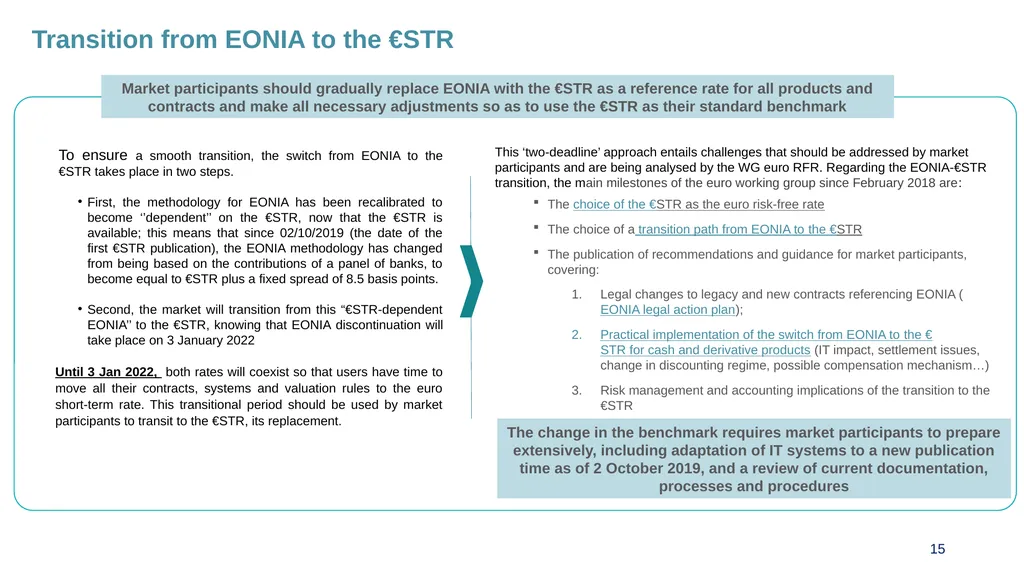
Market participants should gradually replace EONIA with the €STR as a reference rate for all products and contracts and make all necessary adjustments so as to use the €STR as their standard benchmark This ‘two-deadline’ approach entails challenges that should be addressed by market participants and are being analysed by the WG euro RFR. Regarding the EONIA-€STR transition, the main milestones of the euro working group since February 2018 are:
The choice of the €STR as the euro risk-free rate
The choice of a transition path from EONIA to the €STR
The publication of recommendations and guidance for market participants, covering:
Legal changes to legacy and new contracts referencing EONIA (EONIA legal action plan);
Practical implementation of the switch from EONIA to the €STR for cash and derivative products (IT impact, settlement issues, change in discounting regime, possible compensation mechanism…)
Risk management and accounting implications of the transition to the €STR To ensure a smooth transition, the switch from EONIA to the €STR takes place in two steps.
First, the methodology for EONIA has been recalibrated to become ‘’dependent’’ on the €STR, now that the €STR is available; this means that since 02/10/2019 (the date of the first €STR publication), the EONIA methodology has changed from being based on the contributions of a panel of banks, to become equal to €STR plus a fixed spread of 8.5 basis points.
Second, the market will transition from this “€STR-dependent EONIA’’ to the €STR, knowing that EONIA discontinuation will take place on 3 January 2022
Until 3 Jan 2022, both rates will coexist so that users have time to move all their contracts, systems and valuation rules to the euro short-term rate. This transitional period should be used by market participants to transit to the €STR, its replacement. The change in the benchmark requires market participants to prepare extensively, including adaptation of IT systems to a new publication time as of 2 October 2019, and a review of current documentation, processes and procedures Transition from EONIA to the €STR 15<br>
16
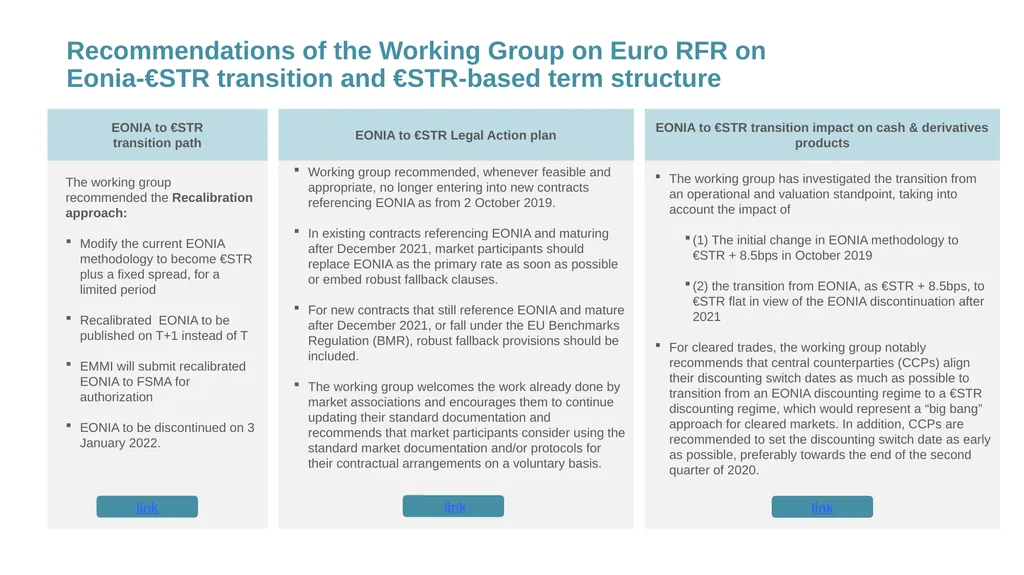
Recommendations of the Working Group on Euro RFR on Eonia-€STR transition and €STR-based term structure The working group recommended the Recalibration approach:
Modify the current EONIA methodology to become €STR plus a fixed spread, for a limited period
Recalibrated EONIA to be published on T+1 instead of T
EMMI will submit recalibrated EONIA to FSMA for authorization
EONIA to be discontinued on 3 January 2022. EONIA to €STR
transition path Working group recommended, whenever feasible and appropriate, no longer entering into new contracts referencing EONIA as from 2 October 2019.
In existing contracts referencing EONIA and maturing after December 2021, market participants should replace EONIA as the primary rate as soon as possible or embed robust fallback clauses.
For new contracts that still reference EONIA and mature after December 2021, or fall under the EU Benchmarks Regulation (BMR), robust fallback provisions should be included.
The working group welcomes the work already done by market associations and encourages them to continue updating their standard documentation and recommends that market participants consider using the standard market documentation and/or protocols for their contractual arrangements on a voluntary basis. EONIA to €STR Legal Action plan The working group has investigated the transition from an operational and valuation standpoint, taking into account the impact of
(1) The initial change in EONIA methodology to €STR + 8.5bps in October 2019
(2) the transition from EONIA, as €STR + 8.5bps, to €STR flat in view of the EONIA discontinuation after 2021
For cleared trades, the working group notably recommends that central counterparties (CCPs) align their discounting switch dates as much as possible to transition from an EONIA discounting regime to a €STR discounting regime, which would represent a “big bang” approach for cleared markets. In addition, CCPs are recommended to set the discounting switch date as early as possible, preferably towards the end of the second quarter of 2020. EONIA to €STR transition impact on cash & derivatives products 16 link<br>
17
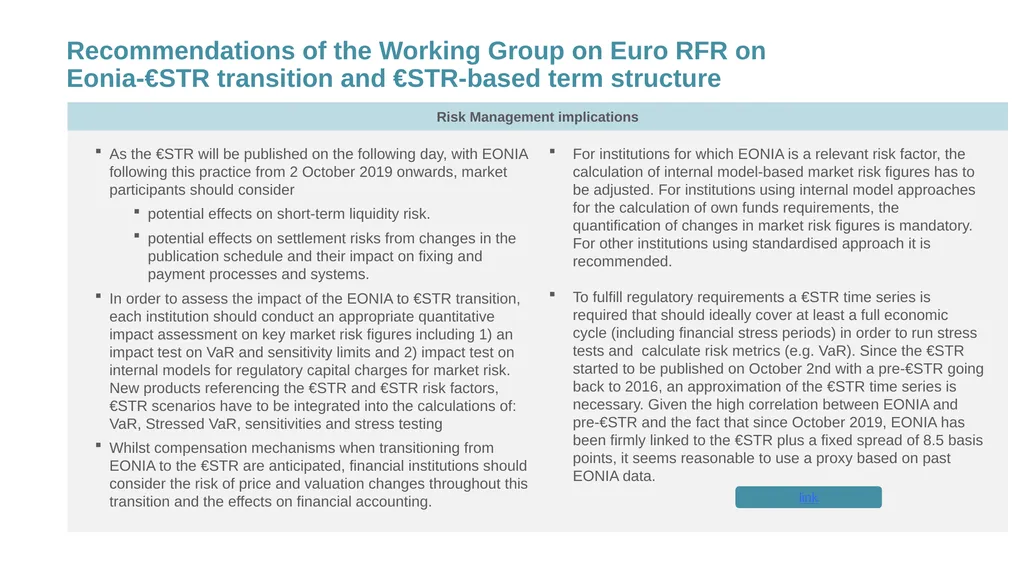
17 Recommendations of the Working Group on Euro RFR on Eonia-€STR transition and €STR-based term structure As the €STR will be published on the following day, with EONIA following this practice from 2 October 2019 onwards, market participants should consider
potential effects on short-term liquidity risk.
potential effects on settlement risks from changes in the publication schedule and their impact on fixing and payment processes and systems.
In order to assess the impact of the EONIA to €STR transition, each institution should conduct an appropriate quantitative impact assessment on key market risk figures including 1) an impact test on VaR and sensitivity limits and 2) impact test on internal models for regulatory capital charges for market risk. New products referencing the €STR and €STR risk factors, €STR scenarios have to be integrated into the calculations of: VaR, Stressed VaR, sensitivities and stress testing
Whilst compensation mechanisms when transitioning from EONIA to the €STR are anticipated, financial institutions should consider the risk of price and valuation changes throughout this transition and the effects on financial accounting. Risk Management implications link For institutions for which EONIA is a relevant risk factor, the calculation of internal model-based market risk figures has to be adjusted. For institutions using internal model approaches for the calculation of own funds requirements, the quantification of changes in market risk figures is mandatory. For other institutions using standardised approach it is recommended.
To fulfill regulatory requirements a €STR time series is required that should ideally cover at least a full economic cycle (including financial stress periods) in order to run stress tests and calculate risk metrics (e.g. VaR). Since the €STR started to be published on October 2nd with a pre-€STR going back to 2016, an approximation of the €STR time series is necessary. Given the high correlation between EONIA and pre-€STR and the fact that since October 2019, EONIA has been firmly linked to the €STR plus a fixed spread of 8.5 basis points, it seems reasonable to use a proxy based on past EONIA data.<br>
18
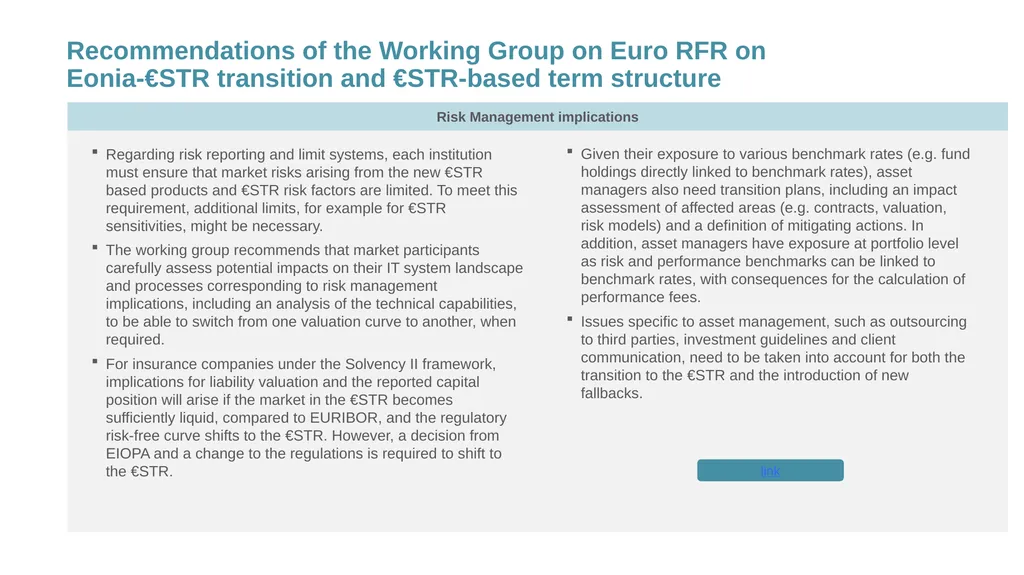
18 Recommendations of the Working Group on Euro RFR on Eonia-€STR transition and €STR-based term structure Regarding risk reporting and limit systems, each institution must ensure that market risks arising from the new €STR based products and €STR risk factors are limited. To meet this requirement, additional limits, for example for €STR sensitivities, might be necessary.
The working group recommends that market participants carefully assess potential impacts on their IT system landscape and processes corresponding to risk management implications, including an analysis of the technical capabilities, to be able to switch from one valuation curve to another, when required.
For insurance companies under the Solvency II framework, implications for liability valuation and the reported capital position will arise if the market in the €STR becomes sufficiently liquid, compared to EURIBOR, and the regulatory risk-free curve shifts to the €STR. However, a decision from EIOPA and a change to the regulations is required to shift to the €STR. Risk Management implications Given their exposure to various benchmark rates (e.g. fund holdings directly linked to benchmark rates), asset managers also need transition plans, including an impact assessment of affected areas (e.g. contracts, valuation, risk models) and a definition of mitigating actions. In addition, asset managers have exposure at portfolio level as risk and performance benchmarks can be linked to benchmark rates, with consequences for the calculation of performance fees.
Issues specific to asset management, such as outsourcing to third parties, investment guidelines and client communication, need to be taken into account for both the transition to the €STR and the introduction of new fallbacks. link<br>
19
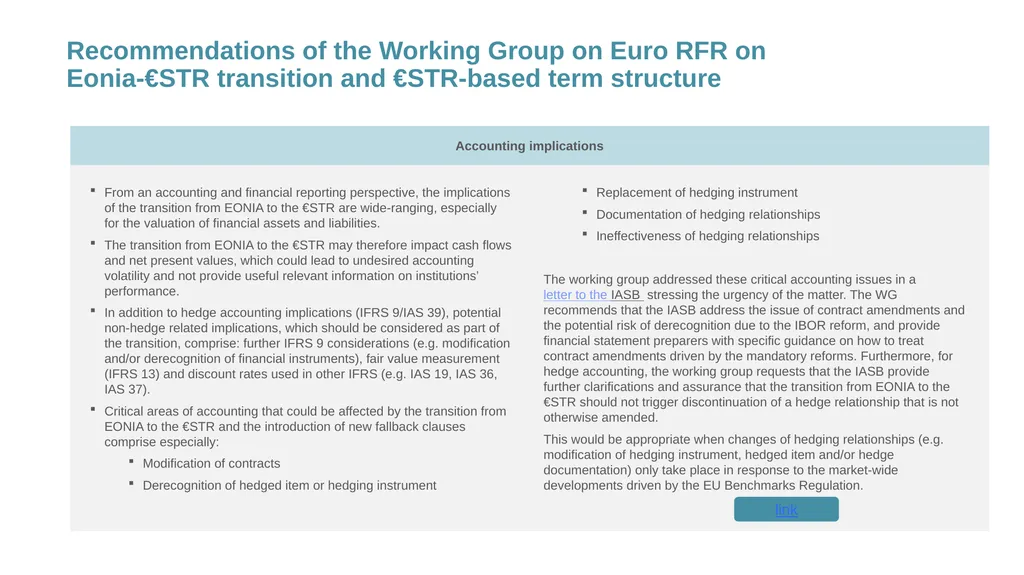
19 Recommendations of the Working Group on Euro RFR on Eonia-€STR transition and €STR-based term structure From an accounting and financial reporting perspective, the implications of the transition from EONIA to the €STR are wide-ranging, especially for the valuation of financial assets and liabilities.
The transition from EONIA to the €STR may therefore impact cash flows and net present values, which could lead to undesired accounting volatility and not provide useful relevant information on institutions’ performance.
In addition to hedge accounting implications (IFRS 9/IAS 39), potential non-hedge related implications, which should be considered as part of the transition, comprise: further IFRS 9 considerations (e.g. modification and/or derecognition of financial instruments), fair value measurement (IFRS 13) and discount rates used in other IFRS (e.g. IAS 19, IAS 36, IAS 37).
Critical areas of accounting that could be affected by the transition from EONIA to the €STR and the introduction of new fallback clauses comprise especially:
Modification of contracts
Derecognition of hedged item or hedging instrument
Replacement of hedging instrument
Documentation of hedging relationships
Ineffectiveness of hedging relationships
The working group addressed these critical accounting issues in a letter to the IASB stressing the urgency of the matter. The WG recommends that the IASB address the issue of contract amendments and the potential risk of derecognition due to the IBOR reform, and provide financial statement preparers with specific guidance on how to treat contract amendments driven by the mandatory reforms. Furthermore, for hedge accounting, the working group requests that the IASB provide further clarifications and assurance that the transition from EONIA to the €STR should not trigger discontinuation of a hedge relationship that is not otherwise amended.
This would be appropriate when changes of hedging relationships (e.g. modification of hedging instrument, hedged item and/or hedge documentation) only take place in response to the market-wide developments driven by the EU Benchmarks Regulation. Accounting implications<br>
20
20 Recommendations of the Working Group on Euro RFR on Eonia-€STR transition and €STR-based term structure The working group is also looking at identifying fallbacks for EURIBOR based on the €STR. Both backward- and forward-looking options are being considered.
As part of its work on forward-looking options, in March 2019 the working group recommended a methodology based on (tradeable) OIS quotes for calculating a €STR-based forward-looking term structure and is now inviting benchmark administrators to express their interest in producing such a term structure.
The working group is also analyzing backward-looking methodologies, as well as credit spreads to be embedded in the fallback. €STR-based term structure as fallback to Euribor<br>
21
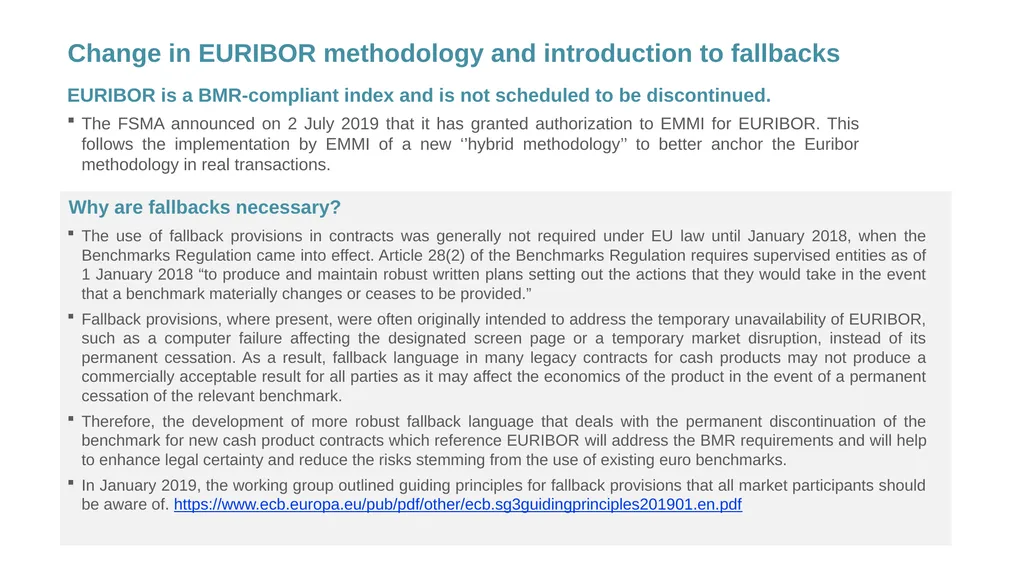
EURIBOR is a BMR-compliant index and is not scheduled to be discontinued.
The FSMA announced on 2 July 2019 that it has granted authorization to EMMI for EURIBOR. This follows the implementation by EMMI of a new ‘’hybrid methodology’’ to better anchor the Euribor methodology in real transactions. Change in EURIBOR methodology and introduction to fallbacks 21 Why are fallbacks necessary? The use of fallback provisions in contracts was generally not required under EU law until January 2018, when the Benchmarks Regulation came into effect. Article 28(2) of the Benchmarks Regulation requires supervised entities as of 1 January 2018 “to produce and maintain robust written plans setting out the actions that they would take in the event that a benchmark materially changes or ceases to be provided.”
Fallback provisions, where present, were often originally intended to address the temporary unavailability of EURIBOR, such as a computer failure affecting the designated screen page or a temporary market disruption, instead of its permanent cessation. As a result, fallback language in many legacy contracts for cash products may not produce a commercially acceptable result for all parties as it may affect the economics of the product in the event of a permanent cessation of the relevant benchmark.
Therefore, the development of more robust fallback language that deals with the permanent discontinuation of the benchmark for new cash product contracts which reference EURIBOR will address the BMR requirements and will help to enhance legal certainty and reduce the risks stemming from the use of existing euro benchmarks.
In January 2019, the working group outlined guiding principles for fallback provisions that all market participants should be aware of. https://www.ecb.europa.eu/pub/pdf/other/ecb.sg3guidingprinciples201901.en.pdf<br>
22
What market participants need to do UNDERSTAND EXPOSURES AND RISKS Quantify IBOR exposures (ongoing monitoring of products, contracts and processes)
Risk assessment (valuation, model and risk management)
Consider risk mitigants in a range of scenarios
Consider regulatory obligations
Put in place contingency arrangements
Future-proof documentation ACTIVELY REDUCE RELIANCE
ON EONIA & IBORs to be ceased Get ahead of the problem and plan for transition now
Provide information on impacted product offerings to clients, or request information from your advisors
Use the €STR where possible
Reduce EONIA legacy exposure
Define scenarios and implementation roadmap for transition of legacy products
Consider need to transition when transacting products with maturity beyond 2021 ENGAGE WITH TRANSITION EFFORTS Consider the adoption of euro RFR WG recommendations for measures to ensure a smooth transition for financial institutions
Tap into market-led transition initiatives
Respond to consultations
Express interest in participating in subgroups to RFR Secretariat (EuroRFR@ecb.europa.eu)
Raise awareness internally and externally
Set up internal governance transition programme
Identify senior accountable executive 22<br>
23
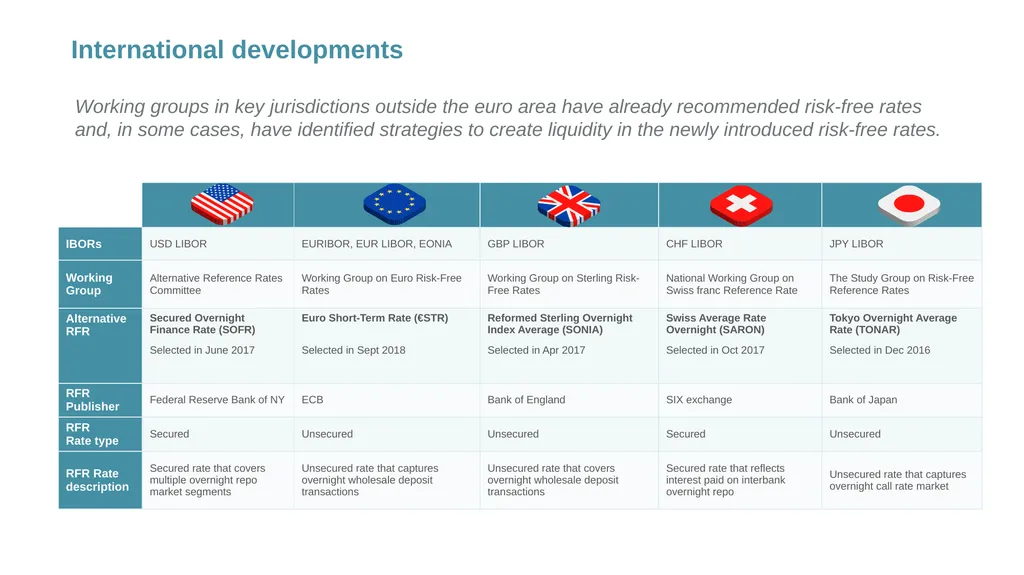
23 International developments Working groups in key jurisdictions outside the euro area have already recommended risk-free rates and, in some cases, have identified strategies to create liquidity in the newly introduced risk-free rates.<br>
24
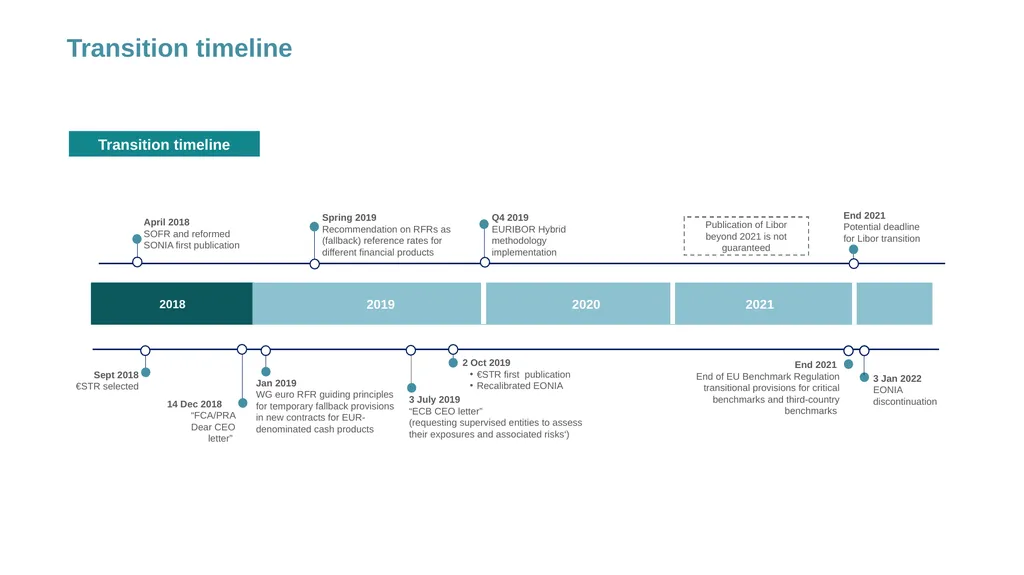
Transition timeline 24 April 2018
SOFR and reformed SONIA first publication Spring 2019
Recommendation on RFRs as (fallback) reference rates for different financial products Q4 2019
EURIBOR Hybrid methodology implementation End 2021
Potential deadline
for Libor transition Publication of Libor beyond 2021 is not guaranteed Transition timeline<br>
25
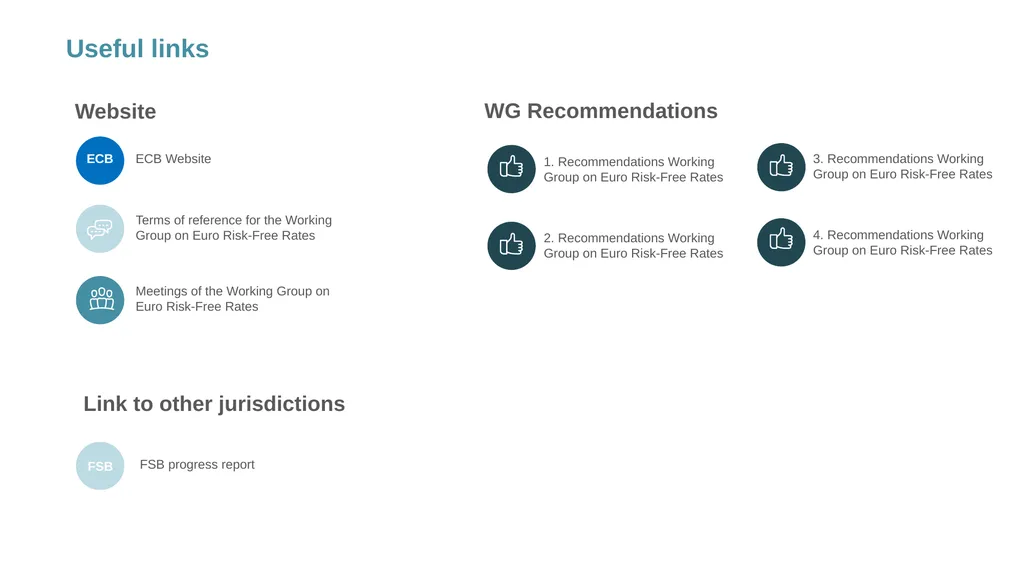
Useful links Terms of reference for the Working Group on Euro Risk-Free Rates 25 Website Meetings of the Working Group on Euro Risk-Free Rates 1. Recommendations Working Group on Euro Risk-Free Rates 2. Recommendations Working Group on Euro Risk-Free Rates Link to other jurisdictions FSB progress report FSB ECB Website 3. Recommendations Working Group on Euro Risk-Free Rates 4. Recommendations Working Group on Euro Risk-Free Rates WG Recommendations<br>
26
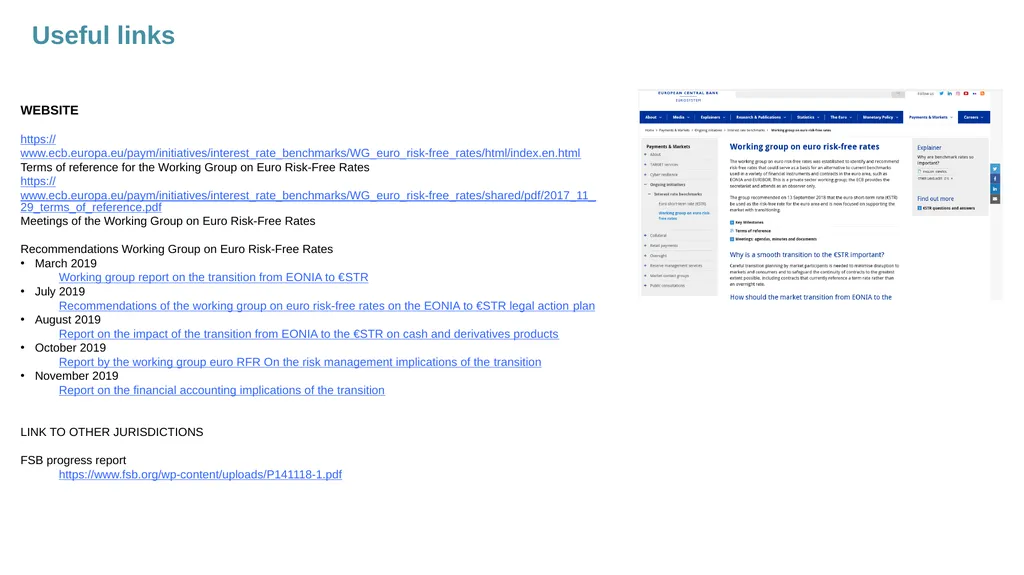
Useful links WEBSITE
https://www.ecb.europa.eu/paym/initiatives/interest_rate_benchmarks/WG_euro_risk-free_rates/html/index.en.html
Terms of reference for the Working Group on Euro Risk-Free Rates
https://www.ecb.europa.eu/paym/initiatives/interest_rate_benchmarks/WG_euro_risk-free_rates/shared/pdf/2017_11_29_terms_of_reference.pdf
Meetings of the Working Group on Euro Risk-Free Rates
Recommendations Working Group on Euro Risk-Free Rates
March 2019
Working group report on the transition from EONIA to €STR
July 2019
Recommendations of the working group on euro risk-free rates on the EONIA to €STR legal action plan
August 2019
Report on the impact of the transition from EONIA to the €STR on cash and derivatives products
October 2019
Report by the working group euro RFR On the risk management implications of the transition
November 2019
Report on the financial accounting implications of the transition
LINK TO OTHER JURISDICTIONS
FSB progress report
https://www.fsb.org/wp-content/uploads/P141118-1.pdf 26<br>