
Working Together: Effective Committees and PC/PB

Description: Working Together: Effective Committees and PCPB Meetings Slides for Module 9 Topic: Preparing and Supporting PCPB Officers Preparing and Supporting PCPB Officers Leadership Roles Skills for Officers Officer Training and Support Training
Related Topics
Download Presentation
"Working Together: Effective Committees and PC/PB" is the property of its rightful owner. Permission is granted to download and print the materials on this website for personal, non-commercial use only, and to display it on your personal computer provided you do not modify the materials and that you retain all copyright notices contained in the materials. By downloading content from our website, you accept the terms of this agreement.
Presentation Transcript
slide1. Working Together: Effective Committees and PC/PB Meetings Slides for Module 9
Topic: Preparing and Supporting PC/PB Officers<br>
slide2. Preparing and Supporting PC/PB Officers Leadership Roles
Skills for Officers
Officer Training and Support<br>
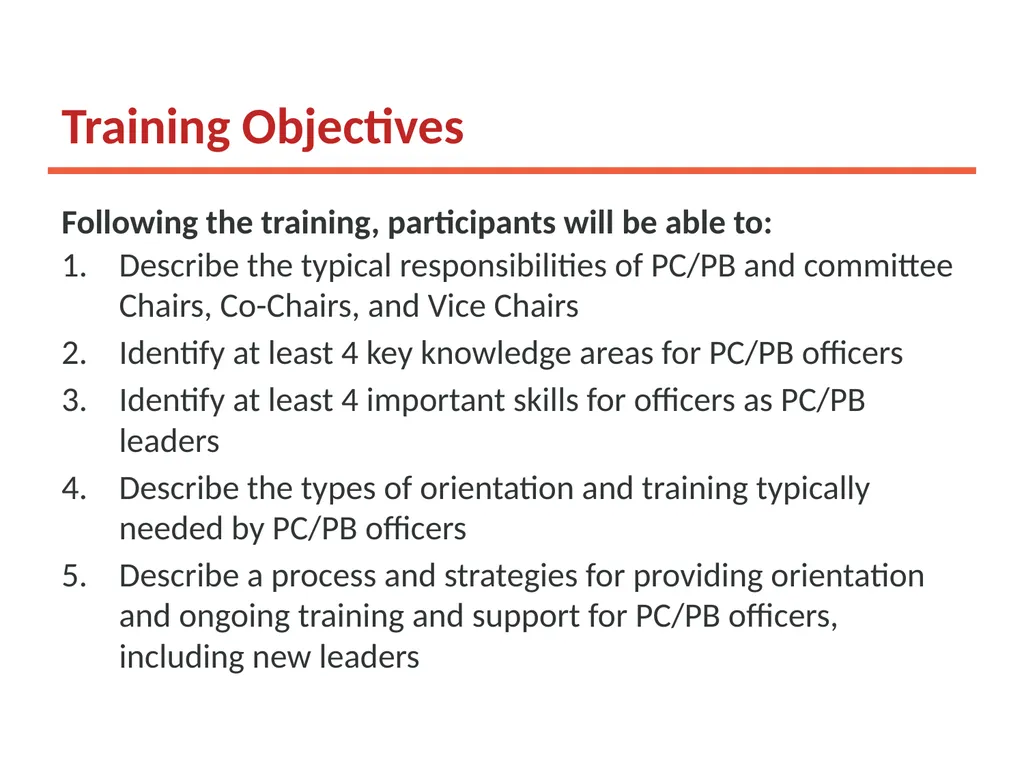
slide3. Training Objectives Following the training, participants will be able to:
Describe the typical responsibilities of PC/PB and committee Chairs, Co-Chairs, and Vice Chairs
Identify at least 4 key knowledge areas for PC/PB officers
Identify at least 4 important skills for officers as PC/PB leaders
Describe the types of orientation and training typically needed by PC/PB officers
Describe a process and strategies for providing orientation and ongoing training and support for PC/PB officers, including new leaders<br>
slide4. PC/PB Leadership Roles HRSA/HAB Expectations for Officers
Officer Roles<br>
slide5. Who Are the PC/PB Officers PC/PB Chair, Co-Chairs, and/or Vice-Chairs
Committee Chairs, Co-Chairs, and/or Vice-Chairs
Sometimes other PC/PB officers – elected or appointed:
Parliamentarian
Secretary
Representatives to serve on statewide HIV planning bodies
Executive Committee typically includes most or all officers
Usually includes at least one officer from each committee
May also include at-large members, often consumers<br>
slide6. HRSA/HAB Expectations for PC/PB Chairs/Co-Chairs The PC/PB may not be chaired solely by an employee of the recipient [p 148]
The Chair may be appointed by the CEO or elected by the PC/PB [p 103]
Chairs/Co-Chairs must reside within the boundaries of the EMA/TGA [p 120]
Chairs/Co-Chairs benefit from development of skills for facilitation and how to chair a successful meeting [p 244]
Part A Manual<br>
slide7. HRSA/HAB Expectations for PC/PB Chairs/Co-Chairs (cont.) Sign the letter of assurance (PC) or concurrence (PB) included in the annual Part A application [p 51]
At meetings, help ensure that everyone is heard, the agreed-upon process for running meetings is followed, and time limits are placed on discussion [p 206]
Review and certify the accuracy of the detailed minutes of each PC/PB meeting [p 95]
Help review and manage conflict of interest [p 151]
Part A Manual<br>
slide8. Differentiating Chair, Co-Chair, and Vice- Chair Roles Chair – the leader of the PC/PB or committee, elected or appointed
Vice-Chair – the number two leader of the PC/PB or committee, who fills in for the Chair when needed and carries out assignments from the Chair
Sometimes automatically becomes the next Chair
Co-Chairs – two or more individuals who share leadership of the PC/PB or a committee
Both may have equal status or one may be more senior due to tenure
Sometimes one Co-Chair is required to be a consumer or PLWH or only one is allowed to represent a provider<br>
slide9. Typical Roles for PC/PB Chairs Develop meeting agendas
Chair and facilitate meetings
Assign tasks to committees
Ensure that the agreed-upon meeting process, policies and procedures, and agenda are followed
Request needed support: data, staffing Set deadlines and timelines and monitor progress on work plan
Help direct the work of the PC/PB support staff/manager
May also:
Establish work groups or committees
Appoint members to committees<br>
slide10. Typical Roles for Committee Chairs Develop committee agendas
Chair and facilitate committee meetings
Ensure that the agreed-upon meeting process, policies and procedures, and agenda are followed
Work with PC/PB support staff to plan committee meetings and identify data, materials, staffing needs<br>
slide11. Typical Roles for Committee Chairs (cont.) Ensure development of committee work plan and monitor progress/timelines
Ensure training & mentoring for committee members
Help prepare/review work products/reports
Work collaboratively with other committees
Represent/report for the committee at Executive Committee and PC/PB meetings<br>
slide12. Typical Roles for Co-Chairs Share all the roles of the Chair
Often means:
Chairing meetings every other month
For PC/PB Co-Chairs
Monitoring the work of committees, with half the committees assigned to each Co-Chair
Sharing or dividing other roles, such as representing the PC/PB in the community
If one Co-Chair is “senior,” then the other often functions more like a Vice-Chair<br>
slide13. Typical Roles for PC/PB or Committee Vice-Chairs or “Junior” Co-Chairs Chair the PC/PB or committee or carry out other tasks when the Chair is absent or unavailable
Carry out assignments on behalf of the Chair
Attend meetings of assigned committees
Represent the PC/PB or committee externally
Chair a subcommittee or work group
Become Chair or Acting Chair if a Chair leaves the PC/PB before completing the term
Prepare for becoming the Chair when the current Chair “terms out” – part of succession planning<br>
slide14. Your PC/PB has always had a Chair and a Vice-Chair, and the Vice-Chair almost always becomes the next Chair. However, 2 recent Chairs have left the PC/PB before the end of their terms. One Vice-Chair had received very little training or mentoring before taking on the new role – the Chair was very engaged and didn’t delegate anything. Your current Chair just got a new job and says it’s just too much to do all the work alone. In addition, you have only had 1 consumer Chair or Vice-Chair in the past 6 years. Several members are urging changes to the Bylaws so that 1 of the 2 top officers is always a consumer or other PLWH.
What might be the benefits and disadvantages of Co-Chairs vs. Vice-Chairs? What might the PC/PB do and why? Quick Scenario: Chairs, Co-Chairs, and Vice-Chairs<br>
slide15. Roles of PC/PB Officers in Engaging Members Help recruit members, sometimes including non-PC/PB members
Orient, train, and help mentor new members
Motivate members to participate/contribute actively
Provide a welcoming environment for members
Identify concerns/problems that may negatively affect member participation and help find solutions<br>
slide16. Actions for Officers to Avoid Holding a meeting when there are no tasks to complete
Making decisions without consulting PC/PB or committee members
Favoring some members over others or allowing a few members to dominate discussion
Allowing unlimited discussion
Making any member feel uninformed or unvalued
If parliamentary procedure is in use:
Advocating for a particular decision while chairing a PC/PB meeting
Voting except when there is a tie<br>
slide17. Skills for Officers Knowledge Areas
Skill Areas<br>
slide18. Quick Discussion: Skills for PC/PB Leaders Based on your experience in HIV community planning:
What are the 2-3 most important skills for a PC/PB Chair or Co-Chair?
What are the most important skills for a PC/PB committee Chair or Co-Chair?
If they are different, why?<br>
slide19. PC/PB Officer Knowledge Areas RWHAP: RWHAP legislation, guidance, and history – especially Part A
Your EMA/TGA and Part A Program: Local epidemic, recipient agency, integrated/comprehensive plan, system of care, service priorities & funding allocations, service expenditures, HIV care continuum, PLWH service needs, barriers, and gaps
PC/PB governance/operations: Bylaws, polices & procedures, committees, meeting rules and process, staffing, MOU
PC/PB membership: Roster, vacancies, representation and reflectiveness, open nominations process
PC/PB status and plans: Annual calendar, PC/PB and committee work plans and status<br>
slide20. PC/PB Officer Skill Areas HIV community planning: Organizing and implementing key planning tasks, especially legislatively defined roles of PC/PB
Communications: especially oral, but also concise written communications
Meeting rules/procedures: Using your PC/PB’s chosen method of running meetings
Recipient relations: Working productively with recipient staff<br>
slide21. PC/PB Skill Areas (cont.) Leadership and group process – as needed to:
Chair and facilitate meetings
Work well with members from diverse cultures and backgrounds
Motivate, engage, and support members
Manage public comment and input
Establish and maintain a high-performing team
Analyze and resolve conflicts and other group-process issues
Implement truly inclusive planning<br>
slide22. Oral Communications Roles and Skills for Running a Meeting Communicate: Start the meeting, welcome new members, make introductions, address agenda, set the scene
Control: Maintain control, manage time, be flexible but keep to the agenda
Coax: Encourage full participation without anyone dominating; ask hard questions and raise hard issues
Compare: Summarize various views presented
Clarify: Make sure everyone understands the discussion, and minimize jargon and technical terms<br>
slide23. Oral Communications Roles and Skills for Running a Meeting (cont.) Support decision making: Ensure that decisions are made and that they reflect the PC/PB’s purposes, and ensure that decisions are recorded and have someone assigned to implement them
Guide: Remember your role in guiding the meeting, helping members work as a productive team, and managing time
End the meeting: Summarize decisions made, follow-up action needed, and focus items for the next meeting<br>
slide24. Officer Training and Support Initial Orientation and Training
Strategies for Training and Supporting Officers<br>
slide25. Training and Support for PC/PB Officers All officers should receive orientation immediately after election/appointment
Officers chosen to fill a vacated seat should receive immediate orientation
New officers or officers who are relatively new PC/PB members should be offered additional orientation
All officers should receive additional training during their terms − as a group, based on roles, or as individuals
Executive Committee meetings provide an opportunity for brief updates/training if all officers serve on that committee<br>
slide26. Components of Initial Orientation and Training General orientation should provide information on topics important for all officers, like:
Officer roles/position descriptions
HRSA/HAB expectations for PC/PBs and officers
PC/PB governance documents (Bylaws, policies and procedures)
PC/PB annual work plan
Role of officers with regard to the recipient
Responsibilities for consumer engagement
Expectations for officer collaboration
PC/PB staff support for officers
Training should cover skills like group process, team building, and planning/managing meetings<br>
slide27. Suggested Strategies for Training and Supporting PC/PB Leaders (1-3) Orientation: Provide a structured, interactive orientation for new officers immediately after their election, and before they chair their first meeting
Self-assessments: Ask all new officers to self-assess their knowledge and skills and identify most-needed orientation, training, and materials.
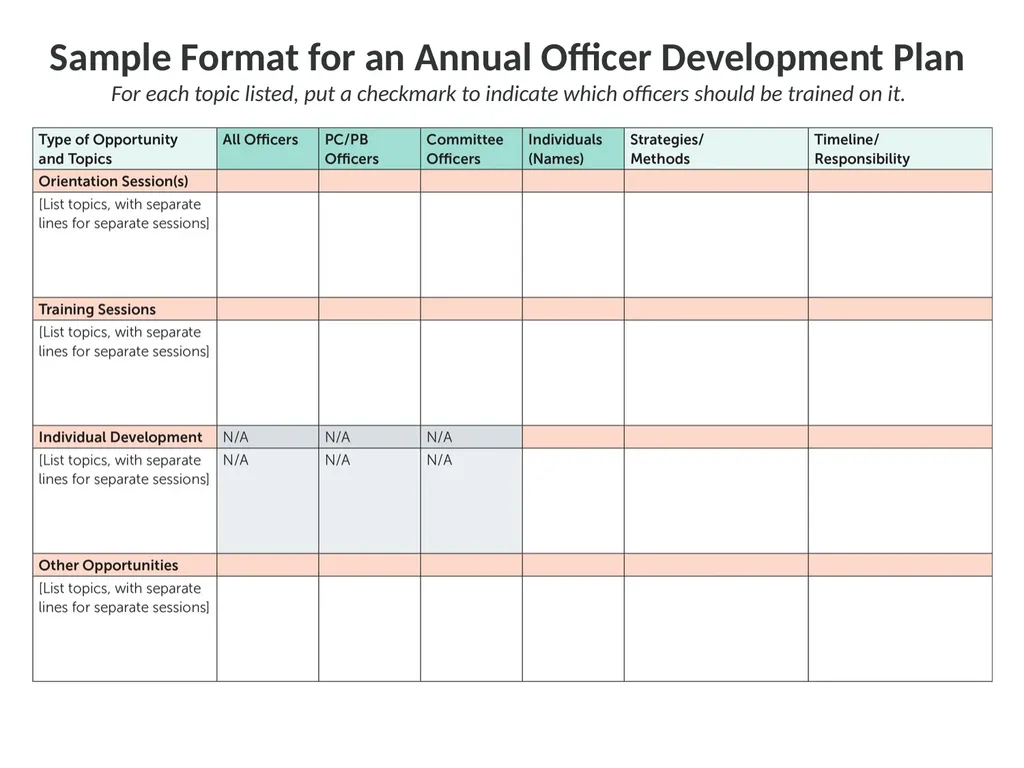
Officer Development Plan: Prepare a concise but specific Officer Development Plan for the PC/PB each year that includes shared and individual training needs and provides strategies and a timeline for planned officer development opportunities<br>
slide28. Sample Format for an Annual Officer Development Plan For each topic listed, put a checkmark to indicate which officers should be trained on it.<br>
slide29. Suggested Strategies for Training and Supporting PC/PB Leaders (4-6) Budgeting of funds for officer development: Set aside some PC/PB support funds for officer training & support
Access to materials: Be sure all officers have quick access to needed documents
Use of Executive Committee meetings: Set aside time during Executive Committee meetings for quick, focused training sessions and information updates<br>
slide30. Suggested Strategies for Training and Supporting PC/PB Leaders (7-9) Periodic sessions: Hold periodic training and consultation sessions for all officers or all committee and work group officers, to learn new tools, share experience, and address identified information or skill development needs
Mentoring: Arrange for former PC/PB officers or appropriate staff to serve as mentors or advisors to new officers, formally or informally
Continuing support from PC/PB support staff: Ensure access to needed information and materials, logistical and administrative assistance, and advice for meeting planning and follow up and for successful completion of other tasks<br>
slide31. Suggested Strategies for Training and Supporting PC/PB Leaders (10) Other officer development: Think creatively in arranging other opportunities for officer development, for example:
Attendance at meetings or conferences that provide training, and sharing of skills and tools with other officers
Observation of other planning bodies that provide useful models – by attending in person or virtually
Debriefings, including member feedback
Use of online training on group process or team building
Access to materials and tools on leadership and group process<br>
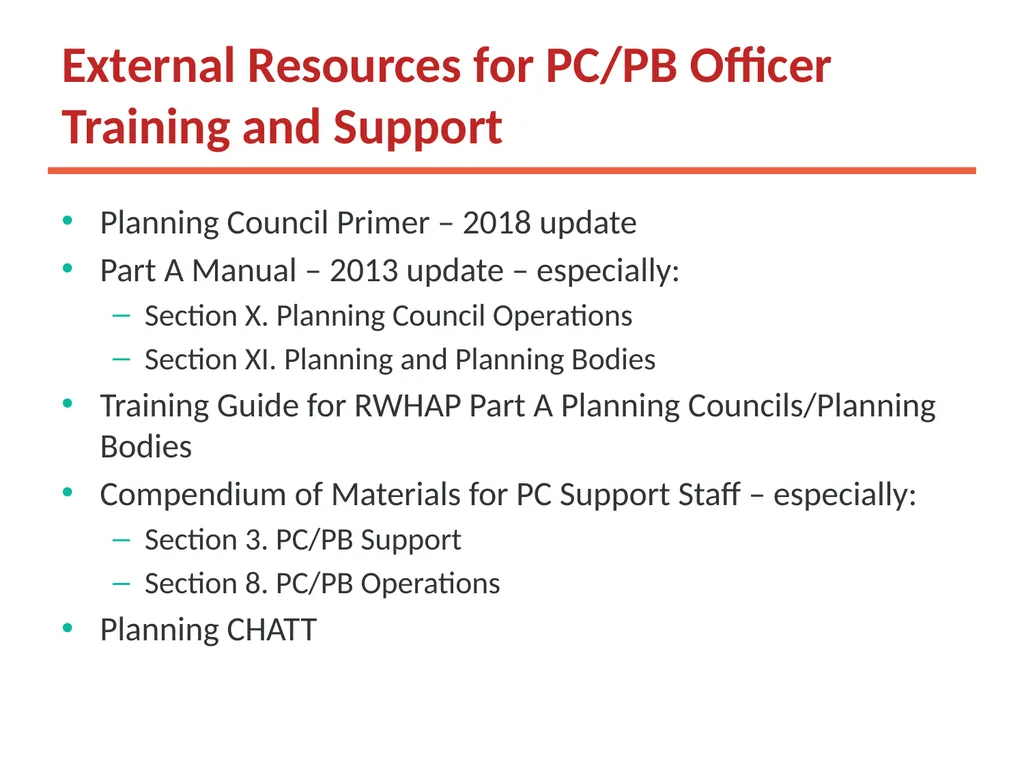
slide32. External Resources for PC/PB Officer Training and Support Planning Council Primer – 2018 update
Part A Manual – 2013 update – especially:
Section X. Planning Council Operations
Section XI. Planning and Planning Bodies
Training Guide for RWHAP Part A Planning Councils/Planning Bodies
Compendium of Materials for PC Support Staff – especially:
Section 3. PC/PB Support
Section 8. PC/PB Operations
Planning CHATT<br>
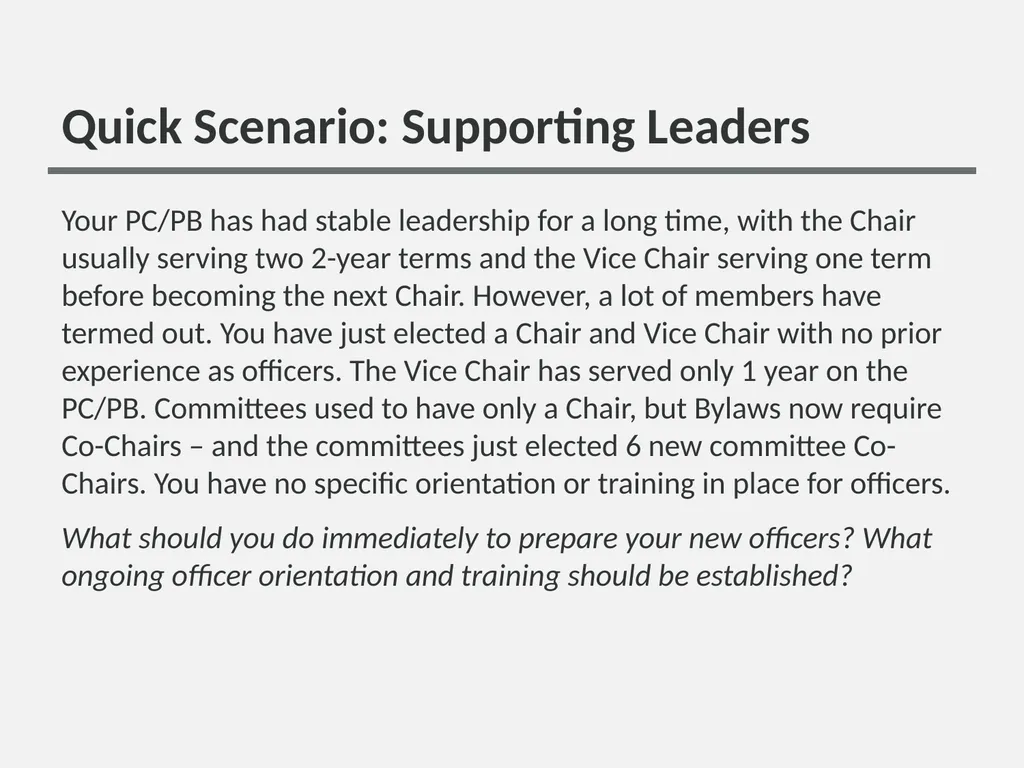
slide33. Your PC/PB has had stable leadership for a long time, with the Chair usually serving two 2-year terms and the Vice Chair serving one term before becoming the next Chair. However, a lot of members have termed out. You have just elected a Chair and Vice Chair with no prior experience as officers. The Vice Chair has served only 1 year on the PC/PB. Committees used to have only a Chair, but Bylaws now require Co-Chairs – and the committees just elected 6 new committee Co-Chairs. You have no specific orientation or training in place for officers.
What should you do immediately to prepare your new officers? What ongoing officer orientation and training should be established? Quick Scenario: Supporting Leaders<br>
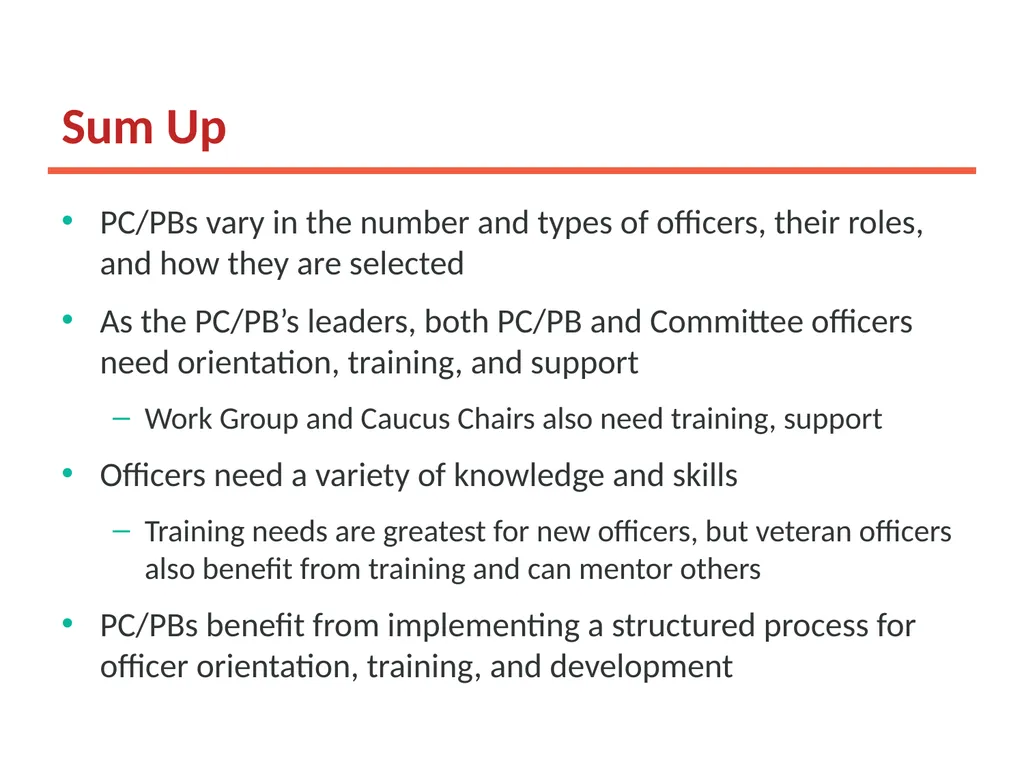
slide34. Sum Up PC/PBs vary in the number and types of officers, their roles, and how they are selected
As the PC/PB’s leaders, both PC/PB and Committee officers need orientation, training, and support
Work Group and Caucus Chairs also need training, support
Officers need a variety of knowledge and skills
Training needs are greatest for new officers, but veteran officers also benefit from training and can mentor others
PC/PBs benefit from implementing a structured process for officer orientation, training, and development<br>
slide35. Optional Slide for Activity<br>
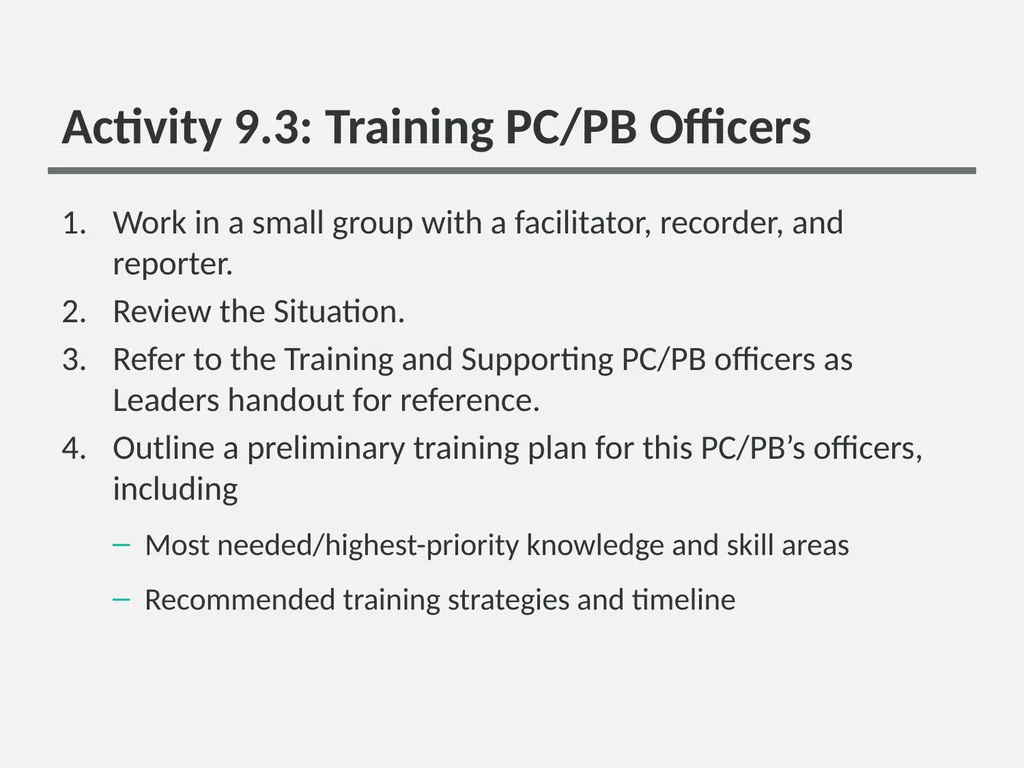
slide36. Work in a small group with a facilitator, recorder, and reporter.
Review the Situation.
Refer to the Training and Supporting PC/PB officers as Leaders handout for reference.
Outline a preliminary training plan for this PC/PB’s officers, including
Most needed/highest-priority knowledge and skill areas
Recommended training strategies and timeline Activity 9.3: Training PC/PB Officers<br>
Topic: Preparing and Supporting PC/PB Officers<br>
slide2. Preparing and Supporting PC/PB Officers Leadership Roles
Skills for Officers
Officer Training and Support<br>
slide3. Training Objectives Following the training, participants will be able to:
Describe the typical responsibilities of PC/PB and committee Chairs, Co-Chairs, and Vice Chairs
Identify at least 4 key knowledge areas for PC/PB officers
Identify at least 4 important skills for officers as PC/PB leaders
Describe the types of orientation and training typically needed by PC/PB officers
Describe a process and strategies for providing orientation and ongoing training and support for PC/PB officers, including new leaders<br>
slide4. PC/PB Leadership Roles HRSA/HAB Expectations for Officers
Officer Roles<br>
slide5. Who Are the PC/PB Officers PC/PB Chair, Co-Chairs, and/or Vice-Chairs
Committee Chairs, Co-Chairs, and/or Vice-Chairs
Sometimes other PC/PB officers – elected or appointed:
Parliamentarian
Secretary
Representatives to serve on statewide HIV planning bodies
Executive Committee typically includes most or all officers
Usually includes at least one officer from each committee
May also include at-large members, often consumers<br>
slide6. HRSA/HAB Expectations for PC/PB Chairs/Co-Chairs The PC/PB may not be chaired solely by an employee of the recipient [p 148]
The Chair may be appointed by the CEO or elected by the PC/PB [p 103]
Chairs/Co-Chairs must reside within the boundaries of the EMA/TGA [p 120]
Chairs/Co-Chairs benefit from development of skills for facilitation and how to chair a successful meeting [p 244]
Part A Manual<br>
slide7. HRSA/HAB Expectations for PC/PB Chairs/Co-Chairs (cont.) Sign the letter of assurance (PC) or concurrence (PB) included in the annual Part A application [p 51]
At meetings, help ensure that everyone is heard, the agreed-upon process for running meetings is followed, and time limits are placed on discussion [p 206]
Review and certify the accuracy of the detailed minutes of each PC/PB meeting [p 95]
Help review and manage conflict of interest [p 151]
Part A Manual<br>
slide8. Differentiating Chair, Co-Chair, and Vice- Chair Roles Chair – the leader of the PC/PB or committee, elected or appointed
Vice-Chair – the number two leader of the PC/PB or committee, who fills in for the Chair when needed and carries out assignments from the Chair
Sometimes automatically becomes the next Chair
Co-Chairs – two or more individuals who share leadership of the PC/PB or a committee
Both may have equal status or one may be more senior due to tenure
Sometimes one Co-Chair is required to be a consumer or PLWH or only one is allowed to represent a provider<br>
slide9. Typical Roles for PC/PB Chairs Develop meeting agendas
Chair and facilitate meetings
Assign tasks to committees
Ensure that the agreed-upon meeting process, policies and procedures, and agenda are followed
Request needed support: data, staffing Set deadlines and timelines and monitor progress on work plan
Help direct the work of the PC/PB support staff/manager
May also:
Establish work groups or committees
Appoint members to committees<br>
slide10. Typical Roles for Committee Chairs Develop committee agendas
Chair and facilitate committee meetings
Ensure that the agreed-upon meeting process, policies and procedures, and agenda are followed
Work with PC/PB support staff to plan committee meetings and identify data, materials, staffing needs<br>
slide11. Typical Roles for Committee Chairs (cont.) Ensure development of committee work plan and monitor progress/timelines
Ensure training & mentoring for committee members
Help prepare/review work products/reports
Work collaboratively with other committees
Represent/report for the committee at Executive Committee and PC/PB meetings<br>
slide12. Typical Roles for Co-Chairs Share all the roles of the Chair
Often means:
Chairing meetings every other month
For PC/PB Co-Chairs
Monitoring the work of committees, with half the committees assigned to each Co-Chair
Sharing or dividing other roles, such as representing the PC/PB in the community
If one Co-Chair is “senior,” then the other often functions more like a Vice-Chair<br>
slide13. Typical Roles for PC/PB or Committee Vice-Chairs or “Junior” Co-Chairs Chair the PC/PB or committee or carry out other tasks when the Chair is absent or unavailable
Carry out assignments on behalf of the Chair
Attend meetings of assigned committees
Represent the PC/PB or committee externally
Chair a subcommittee or work group
Become Chair or Acting Chair if a Chair leaves the PC/PB before completing the term
Prepare for becoming the Chair when the current Chair “terms out” – part of succession planning<br>
slide14. Your PC/PB has always had a Chair and a Vice-Chair, and the Vice-Chair almost always becomes the next Chair. However, 2 recent Chairs have left the PC/PB before the end of their terms. One Vice-Chair had received very little training or mentoring before taking on the new role – the Chair was very engaged and didn’t delegate anything. Your current Chair just got a new job and says it’s just too much to do all the work alone. In addition, you have only had 1 consumer Chair or Vice-Chair in the past 6 years. Several members are urging changes to the Bylaws so that 1 of the 2 top officers is always a consumer or other PLWH.
What might be the benefits and disadvantages of Co-Chairs vs. Vice-Chairs? What might the PC/PB do and why? Quick Scenario: Chairs, Co-Chairs, and Vice-Chairs<br>
slide15. Roles of PC/PB Officers in Engaging Members Help recruit members, sometimes including non-PC/PB members
Orient, train, and help mentor new members
Motivate members to participate/contribute actively
Provide a welcoming environment for members
Identify concerns/problems that may negatively affect member participation and help find solutions<br>
slide16. Actions for Officers to Avoid Holding a meeting when there are no tasks to complete
Making decisions without consulting PC/PB or committee members
Favoring some members over others or allowing a few members to dominate discussion
Allowing unlimited discussion
Making any member feel uninformed or unvalued
If parliamentary procedure is in use:
Advocating for a particular decision while chairing a PC/PB meeting
Voting except when there is a tie<br>
slide17. Skills for Officers Knowledge Areas
Skill Areas<br>
slide18. Quick Discussion: Skills for PC/PB Leaders Based on your experience in HIV community planning:
What are the 2-3 most important skills for a PC/PB Chair or Co-Chair?
What are the most important skills for a PC/PB committee Chair or Co-Chair?
If they are different, why?<br>
slide19. PC/PB Officer Knowledge Areas RWHAP: RWHAP legislation, guidance, and history – especially Part A
Your EMA/TGA and Part A Program: Local epidemic, recipient agency, integrated/comprehensive plan, system of care, service priorities & funding allocations, service expenditures, HIV care continuum, PLWH service needs, barriers, and gaps
PC/PB governance/operations: Bylaws, polices & procedures, committees, meeting rules and process, staffing, MOU
PC/PB membership: Roster, vacancies, representation and reflectiveness, open nominations process
PC/PB status and plans: Annual calendar, PC/PB and committee work plans and status<br>
slide20. PC/PB Officer Skill Areas HIV community planning: Organizing and implementing key planning tasks, especially legislatively defined roles of PC/PB
Communications: especially oral, but also concise written communications
Meeting rules/procedures: Using your PC/PB’s chosen method of running meetings
Recipient relations: Working productively with recipient staff<br>
slide21. PC/PB Skill Areas (cont.) Leadership and group process – as needed to:
Chair and facilitate meetings
Work well with members from diverse cultures and backgrounds
Motivate, engage, and support members
Manage public comment and input
Establish and maintain a high-performing team
Analyze and resolve conflicts and other group-process issues
Implement truly inclusive planning<br>
slide22. Oral Communications Roles and Skills for Running a Meeting Communicate: Start the meeting, welcome new members, make introductions, address agenda, set the scene
Control: Maintain control, manage time, be flexible but keep to the agenda
Coax: Encourage full participation without anyone dominating; ask hard questions and raise hard issues
Compare: Summarize various views presented
Clarify: Make sure everyone understands the discussion, and minimize jargon and technical terms<br>
slide23. Oral Communications Roles and Skills for Running a Meeting (cont.) Support decision making: Ensure that decisions are made and that they reflect the PC/PB’s purposes, and ensure that decisions are recorded and have someone assigned to implement them
Guide: Remember your role in guiding the meeting, helping members work as a productive team, and managing time
End the meeting: Summarize decisions made, follow-up action needed, and focus items for the next meeting<br>
slide24. Officer Training and Support Initial Orientation and Training
Strategies for Training and Supporting Officers<br>
slide25. Training and Support for PC/PB Officers All officers should receive orientation immediately after election/appointment
Officers chosen to fill a vacated seat should receive immediate orientation
New officers or officers who are relatively new PC/PB members should be offered additional orientation
All officers should receive additional training during their terms − as a group, based on roles, or as individuals
Executive Committee meetings provide an opportunity for brief updates/training if all officers serve on that committee<br>
slide26. Components of Initial Orientation and Training General orientation should provide information on topics important for all officers, like:
Officer roles/position descriptions
HRSA/HAB expectations for PC/PBs and officers
PC/PB governance documents (Bylaws, policies and procedures)
PC/PB annual work plan
Role of officers with regard to the recipient
Responsibilities for consumer engagement
Expectations for officer collaboration
PC/PB staff support for officers
Training should cover skills like group process, team building, and planning/managing meetings<br>
slide27. Suggested Strategies for Training and Supporting PC/PB Leaders (1-3) Orientation: Provide a structured, interactive orientation for new officers immediately after their election, and before they chair their first meeting
Self-assessments: Ask all new officers to self-assess their knowledge and skills and identify most-needed orientation, training, and materials.
Officer Development Plan: Prepare a concise but specific Officer Development Plan for the PC/PB each year that includes shared and individual training needs and provides strategies and a timeline for planned officer development opportunities<br>
slide28. Sample Format for an Annual Officer Development Plan For each topic listed, put a checkmark to indicate which officers should be trained on it.<br>
slide29. Suggested Strategies for Training and Supporting PC/PB Leaders (4-6) Budgeting of funds for officer development: Set aside some PC/PB support funds for officer training & support
Access to materials: Be sure all officers have quick access to needed documents
Use of Executive Committee meetings: Set aside time during Executive Committee meetings for quick, focused training sessions and information updates<br>
slide30. Suggested Strategies for Training and Supporting PC/PB Leaders (7-9) Periodic sessions: Hold periodic training and consultation sessions for all officers or all committee and work group officers, to learn new tools, share experience, and address identified information or skill development needs
Mentoring: Arrange for former PC/PB officers or appropriate staff to serve as mentors or advisors to new officers, formally or informally
Continuing support from PC/PB support staff: Ensure access to needed information and materials, logistical and administrative assistance, and advice for meeting planning and follow up and for successful completion of other tasks<br>
slide31. Suggested Strategies for Training and Supporting PC/PB Leaders (10) Other officer development: Think creatively in arranging other opportunities for officer development, for example:
Attendance at meetings or conferences that provide training, and sharing of skills and tools with other officers
Observation of other planning bodies that provide useful models – by attending in person or virtually
Debriefings, including member feedback
Use of online training on group process or team building
Access to materials and tools on leadership and group process<br>
slide32. External Resources for PC/PB Officer Training and Support Planning Council Primer – 2018 update
Part A Manual – 2013 update – especially:
Section X. Planning Council Operations
Section XI. Planning and Planning Bodies
Training Guide for RWHAP Part A Planning Councils/Planning Bodies
Compendium of Materials for PC Support Staff – especially:
Section 3. PC/PB Support
Section 8. PC/PB Operations
Planning CHATT<br>
slide33. Your PC/PB has had stable leadership for a long time, with the Chair usually serving two 2-year terms and the Vice Chair serving one term before becoming the next Chair. However, a lot of members have termed out. You have just elected a Chair and Vice Chair with no prior experience as officers. The Vice Chair has served only 1 year on the PC/PB. Committees used to have only a Chair, but Bylaws now require Co-Chairs – and the committees just elected 6 new committee Co-Chairs. You have no specific orientation or training in place for officers.
What should you do immediately to prepare your new officers? What ongoing officer orientation and training should be established? Quick Scenario: Supporting Leaders<br>
slide34. Sum Up PC/PBs vary in the number and types of officers, their roles, and how they are selected
As the PC/PB’s leaders, both PC/PB and Committee officers need orientation, training, and support
Work Group and Caucus Chairs also need training, support
Officers need a variety of knowledge and skills
Training needs are greatest for new officers, but veteran officers also benefit from training and can mentor others
PC/PBs benefit from implementing a structured process for officer orientation, training, and development<br>
slide35. Optional Slide for Activity<br>
slide36. Work in a small group with a facilitator, recorder, and reporter.
Review the Situation.
Refer to the Training and Supporting PC/PB officers as Leaders handout for reference.
Outline a preliminary training plan for this PC/PB’s officers, including
Most needed/highest-priority knowledge and skill areas
Recommended training strategies and timeline Activity 9.3: Training PC/PB Officers<br>