
Workshop 1: Focusing on Strategies for Long-Term
EM
Published · 21 slides · 0 views

1 / 1

Description
Workshop 1: Focusing on Strategies for Long-Term Success Please sit with your stateterritory team members 2016 SLDS Best Practices Conference February 3, 2016 1 Please introduce yourself Name Role Stateterritory you represent Welcome! 2
Related Topics
Share
Embed code
Download this presentation From Below
"Workshop 1: Focusing on Strategies for Long-Term" is the property of its rightful owner. Permission is granted to download and print the materials on this website for personal, non-commercial use only, and to display it on your personal computer provided you do not modify the materials and that you retain all copyright notices contained in the materials. By downloading content from our website, you accept the terms of this agreement.
Presentation Transcript
01
Workshop 1: Focusing on Strategies for Long-Term Success Please sit with your state/territory team members 2016 SLDS Best Practices Conference
February 3, 2016 1<br>
February 3, 2016 1<br>
02
Please introduce yourself
Name
Role
State/territory you represent Welcome! 2<br>
Name
Role
State/territory you represent Welcome! 2<br>
03
Today’s workshops are meant to help you:
Think about the long term
How can you ensure that the SLDS efforts stay relevant, viable, and useful?
Translate your state-specific challenges into strategies to be put into practice
How do you strategically address barriers to being successful in the long run?
What have other states done that may be applicable to your situation? Workshop Purpose 3<br>
Think about the long term
How can you ensure that the SLDS efforts stay relevant, viable, and useful?
Translate your state-specific challenges into strategies to be put into practice
How do you strategically address barriers to being successful in the long run?
What have other states done that may be applicable to your situation? Workshop Purpose 3<br>
04
You will be working in multi-state teams to solve a problem as if you were a single state.
Each team will receive a scenario.
Your team’s job will be to use the actual roles of your team members to address the scenario.
Each team will present its approach to the scenario and receive feedback. Workshop 1 Approach 4<br>
Each team will receive a scenario.
Your team’s job will be to use the actual roles of your team members to address the scenario.
Each team will present its approach to the scenario and receive feedback. Workshop 1 Approach 4<br>
05
This afternoon, we will
Build upon the scenarios discussed and shared in Workshop 1
Consider your own state-specific challenges and root causes
Strategize your solutions as a state team
Receive feedback from other states Looking Ahead: Workshop 2 5<br>
Build upon the scenarios discussed and shared in Workshop 1
Consider your own state-specific challenges and root causes
Strategize your solutions as a state team
Receive feedback from other states Looking Ahead: Workshop 2 5<br>
06
The scenarios you will be working through are common, real-world challenges to the success of SLDS efforts. They are meant to help you think through strategies to effectively navigate the work in the long term.
Changes in Leadership: That’s Not What the Data Say
Collaboration & Control: Ready! Set! Wait …
Funding Your SLDS: Desperately Seeking Support Scenarios 6<br>
Changes in Leadership: That’s Not What the Data Say
Collaboration & Control: Ready! Set! Wait …
Funding Your SLDS: Desperately Seeking Support Scenarios 6<br>
07
During the first five minutes: Think about the scenario and consider the questions below from your own perspective. Jot down some notes to share with your group.
What is/are the problem(s) in this scenario?
What are the symptoms of the problem(s)?
Why are these problematic?
What do you consider to be the root or cause of the problem(s)?
What else do you need to know to ensure that you understand the issue? Instructions: Begin by working on your own 7<br>
What is/are the problem(s) in this scenario?
What are the symptoms of the problem(s)?
Why are these problematic?
What do you consider to be the root or cause of the problem(s)?
What else do you need to know to ensure that you understand the issue? Instructions: Begin by working on your own 7<br>
08
Use your individual responses to discuss and determine as a group
The problem
The root cause of the problem
Your assumptions about the scenario
The most effective strategies to address the problem
Discuss a course of action and prepare a five-minute presentation that addresses the questions above.
Your group presenter(s) should identify the roles of the team members. Instructions: Follow with Team Work 8<br>
The problem
The root cause of the problem
Your assumptions about the scenario
The most effective strategies to address the problem
Discuss a course of action and prepare a five-minute presentation that addresses the questions above.
Your group presenter(s) should identify the roles of the team members. Instructions: Follow with Team Work 8<br>
09
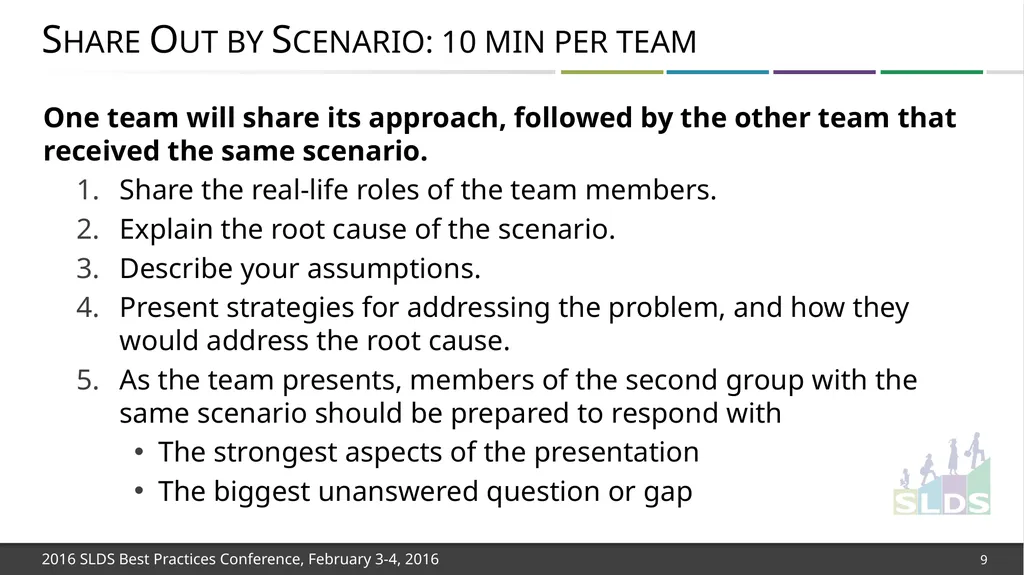
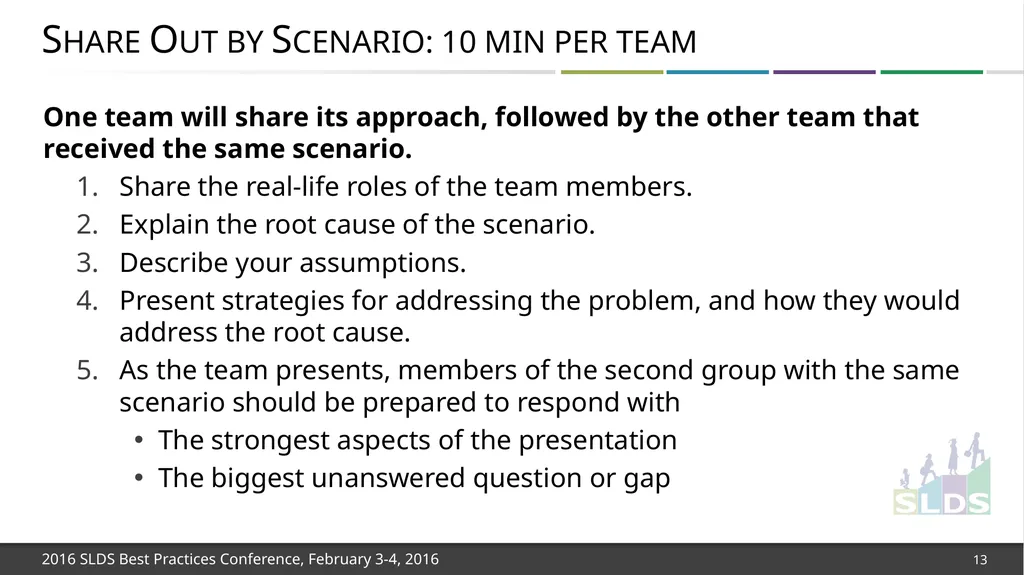
One team will share its approach, followed by the other team that received the same scenario.
Share the real-life roles of the team members.
Explain the root cause of the scenario.
Describe your assumptions.
Present strategies for addressing the problem, and how they would address the root cause.
As the team presents, members of the second group with the same scenario should be prepared to respond with
The strongest aspects of the presentation
The biggest unanswered question or gap Share Out by Scenario: 10 min per team 9<br>
Share the real-life roles of the team members.
Explain the root cause of the scenario.
Describe your assumptions.
Present strategies for addressing the problem, and how they would address the root cause.
As the team presents, members of the second group with the same scenario should be prepared to respond with
The strongest aspects of the presentation
The biggest unanswered question or gap Share Out by Scenario: 10 min per team 9<br>
10
During Workshop 2 this afternoon
The remaining two teams will present their scenarios
We will build upon the scenarios addressed
You will consider your own challenges to long-term success and their root causes
You will develop solutions with your state team and receive feedback from other participants Wrap Up 10<br>
The remaining two teams will present their scenarios
We will build upon the scenarios addressed
You will consider your own challenges to long-term success and their root causes
You will develop solutions with your state team and receive feedback from other participants Wrap Up 10<br>
11
Workshop 2: Focusing on Strategies for Long-Term Success 2016 SLDS Best Practices Conference
February 3, 2016 11<br>
February 3, 2016 11<br>
12
In this session
The remaining two teams will present
We will build upon the scenarios addressed
You will consider your own challenges to long-term success and their root causes
You will develop solutions with your state team and receive feedback from other participants Workshop 2 12<br>
The remaining two teams will present
We will build upon the scenarios addressed
You will consider your own challenges to long-term success and their root causes
You will develop solutions with your state team and receive feedback from other participants Workshop 2 12<br>
13
One team will share its approach, followed by the other team that received the same scenario.
Share the real-life roles of the team members.
Explain the root cause of the scenario.
Describe your assumptions.
Present strategies for addressing the problem, and how they would address the root cause.
As the team presents, members of the second group with the same scenario should be prepared to respond with
The strongest aspects of the presentation
The biggest unanswered question or gap Share Out by Scenario: 10 min per team 13<br>
Share the real-life roles of the team members.
Explain the root cause of the scenario.
Describe your assumptions.
Present strategies for addressing the problem, and how they would address the root cause.
As the team presents, members of the second group with the same scenario should be prepared to respond with
The strongest aspects of the presentation
The biggest unanswered question or gap Share Out by Scenario: 10 min per team 13<br>
14
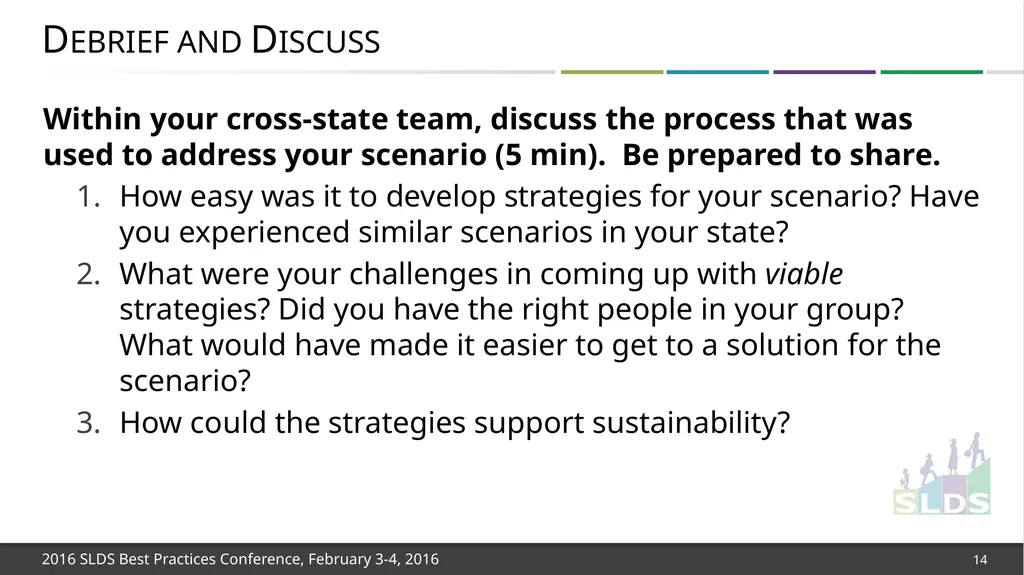
Within your cross-state team, discuss the process that was used to address your scenario (5 min). Be prepared to share.
How easy was it to develop strategies for your scenario? Have you experienced similar scenarios in your state?
What were your challenges in coming up with viable strategies? Did you have the right people in your group? What would have made it easier to get to a solution for the scenario?
How could the strategies support sustainability? Debrief and Discuss 14<br>
How easy was it to develop strategies for your scenario? Have you experienced similar scenarios in your state?
What were your challenges in coming up with viable strategies? Did you have the right people in your group? What would have made it easier to get to a solution for the scenario?
How could the strategies support sustainability? Debrief and Discuss 14<br>
15
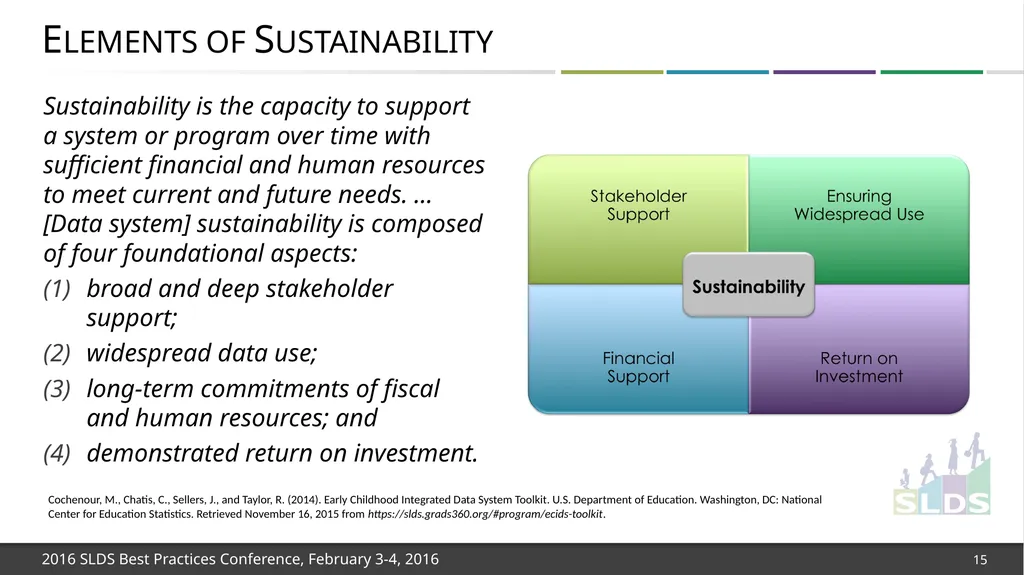
Sustainability is the capacity to support a system or program over time with sufficient financial and human resources to meet current and future needs. … [Data system] sustainability is composed of four foundational aspects:
broad and deep stakeholder support;
widespread data use;
long-term commitments of fiscal and human resources; and
demonstrated return on investment. Elements of Sustainability Cochenour, M., Chatis, C., Sellers, J., and Taylor, R. (2014). Early Childhood Integrated Data System Toolkit. U.S. Department of Education. Washington, DC: National Center for Education Statistics. Retrieved November 16, 2015 from https://slds.grads360.org/#program/ecids-toolkit. 15<br>
broad and deep stakeholder support;
widespread data use;
long-term commitments of fiscal and human resources; and
demonstrated return on investment. Elements of Sustainability Cochenour, M., Chatis, C., Sellers, J., and Taylor, R. (2014). Early Childhood Integrated Data System Toolkit. U.S. Department of Education. Washington, DC: National Center for Education Statistics. Retrieved November 16, 2015 from https://slds.grads360.org/#program/ecids-toolkit. 15<br>
16
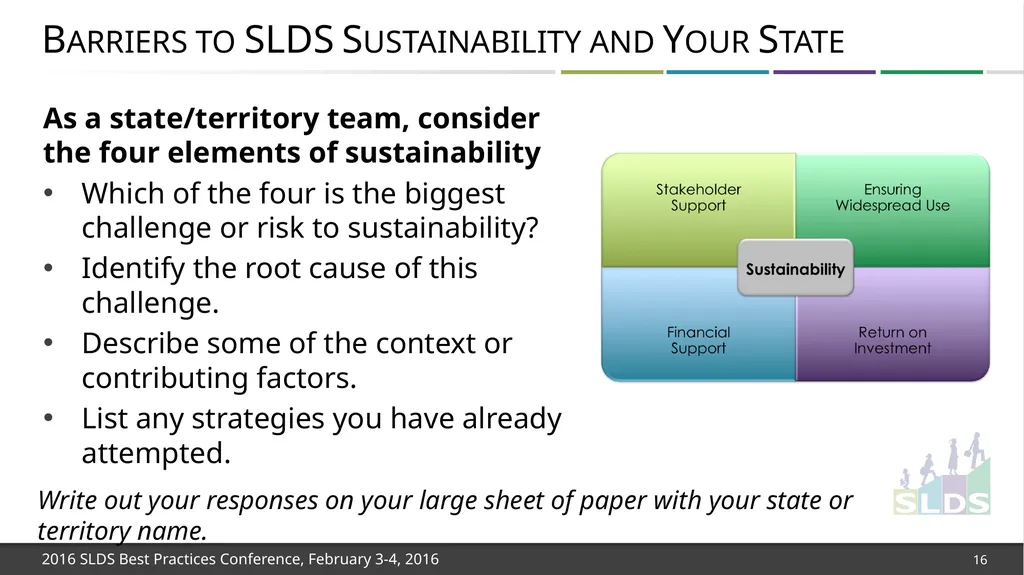
As a state/territory team, consider the four elements of sustainability
Which of the four is the biggest challenge or risk to sustainability?
Identify the root cause of this challenge.
Describe some of the context or contributing factors.
List any strategies you have already attempted. Barriers to SLDS Sustainability and Your State Write out your responses on your large sheet of paper with your state or territory name. 16<br>
Which of the four is the biggest challenge or risk to sustainability?
Identify the root cause of this challenge.
Describe some of the context or contributing factors.
List any strategies you have already attempted. Barriers to SLDS Sustainability and Your State Write out your responses on your large sheet of paper with your state or territory name. 16<br>
17
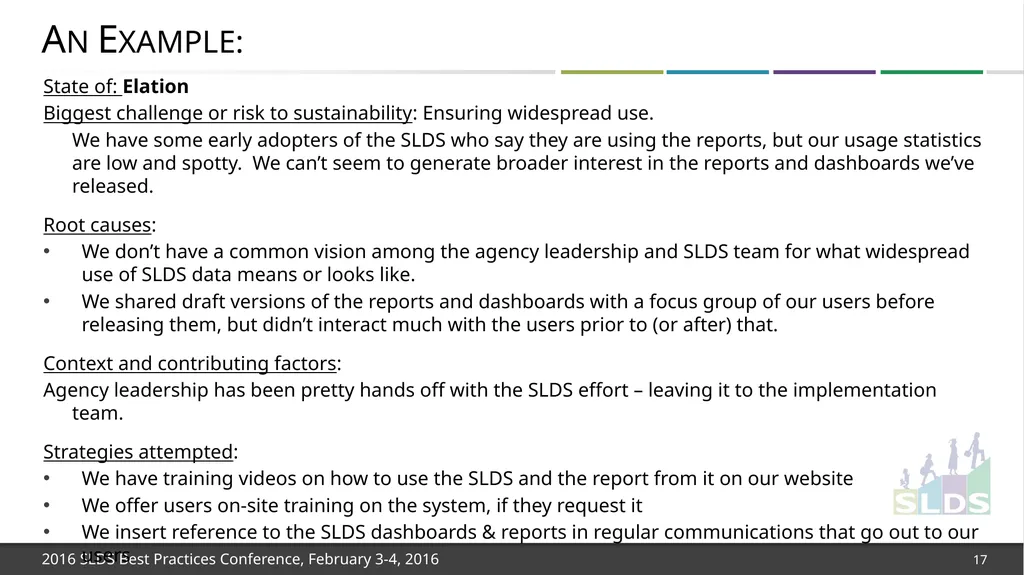
State of: Elation
Biggest challenge or risk to sustainability: Ensuring widespread use.
We have some early adopters of the SLDS who say they are using the reports, but our usage statistics are low and spotty. We can’t seem to generate broader interest in the reports and dashboards we’ve released.
Root causes:
We don’t have a common vision among the agency leadership and SLDS team for what widespread use of SLDS data means or looks like.
We shared draft versions of the reports and dashboards with a focus group of our users before releasing them, but didn’t interact much with the users prior to (or after) that.
Context and contributing factors:
Agency leadership has been pretty hands off with the SLDS effort – leaving it to the implementation team.
Strategies attempted:
We have training videos on how to use the SLDS and the report from it on our website
We offer users on-site training on the system, if they request it
We insert reference to the SLDS dashboards & reports in regular communications that go out to our users An Example: 17<br>
Biggest challenge or risk to sustainability: Ensuring widespread use.
We have some early adopters of the SLDS who say they are using the reports, but our usage statistics are low and spotty. We can’t seem to generate broader interest in the reports and dashboards we’ve released.
Root causes:
We don’t have a common vision among the agency leadership and SLDS team for what widespread use of SLDS data means or looks like.
We shared draft versions of the reports and dashboards with a focus group of our users before releasing them, but didn’t interact much with the users prior to (or after) that.
Context and contributing factors:
Agency leadership has been pretty hands off with the SLDS effort – leaving it to the implementation team.
Strategies attempted:
We have training videos on how to use the SLDS and the report from it on our website
We offer users on-site training on the system, if they request it
We insert reference to the SLDS dashboards & reports in regular communications that go out to our users An Example: 17<br>
18
Travel around the room as a state/territory team and review the other posters
Put a Post-It note with your state abbreviation on other posters that have the same challenge to sustainability as you.
Write a brief summary on other posters of a successful strategy that you have implemented to address the challenge. Include your state/territory abbreviation.
Once you have provided feedback around the room, take a look at the comments provided for your poster. Gallery Walk 18<br>
Put a Post-It note with your state abbreviation on other posters that have the same challenge to sustainability as you.
Write a brief summary on other posters of a successful strategy that you have implemented to address the challenge. Include your state/territory abbreviation.
Once you have provided feedback around the room, take a look at the comments provided for your poster. Gallery Walk 18<br>
19
We will debrief and discuss the trends that emerged from the gallery walk.
As we discuss, think about what you hear. Take notes based on the discussion so you can give a two-minute statement about what you learned and what you will do when you return to the office. Gallery Walk Discussion 19<br>
As we discuss, think about what you hear. Take notes based on the discussion so you can give a two-minute statement about what you learned and what you will do when you return to the office. Gallery Walk Discussion 19<br>
20
What have you learned?
What will you do first? Moving Forward 20<br>
What will you do first? Moving Forward 20<br>
21
Evening activities
Demonstration kiosks start tomorrow at 8:30 a.m.
The District of Columbia, Idaho, Indiana, Iowa, Kentucky, Maryland, Minnesota, Montana, Nevada, North Carolina, Rhode Island, Utah, and NCES will have kiosks
See conference program for details
This presentation and materials are in the SLDS Best Practices Conference Community of Practice workspace on GRADS360°
If you have questions, contact your SST POC or support@sst-slds.org Reminders 21<br>
Demonstration kiosks start tomorrow at 8:30 a.m.
The District of Columbia, Idaho, Indiana, Iowa, Kentucky, Maryland, Minnesota, Montana, Nevada, North Carolina, Rhode Island, Utah, and NCES will have kiosks
See conference program for details
This presentation and materials are in the SLDS Best Practices Conference Community of Practice workspace on GRADS360°
If you have questions, contact your SST POC or support@sst-slds.org Reminders 21<br>