Workshop on Labour Migration: Contributions from the Ministries of Labour in the Americas Todays labour migration in the Americas and the role of the ministries of labour July 13, 2017 Table of Contents Premises Migration and development:
"Workshop on Labour Migration: Contributions from" is the property of its rightful owner. Permission is granted to
download and print the materials on this website for personal, non-commercial use only, and to display it
on your personal computer provided you do not modify the materials and that you retain all copyright
notices contained in the materials. By downloading content from our website, you accept the terms of this
agreement.
Presentation Transcript
01
Workshop on Labour Migration: Contributions from the Ministries of Labour in the Americas Today's labour migration in the Americas and the role of the ministries of labour
July 13, 2017<br>
02
Table of Contents Premises
Migration and development: is it possible?
The integrated nature of the phenomenon of migration
Highlights of migration in the Americas
Migrant Workers
Family Members
Instruments for the protection of migrants
Insufficient?
Conventions of portability
An agenda for social security and protection
Final thoughts 2<br>
03
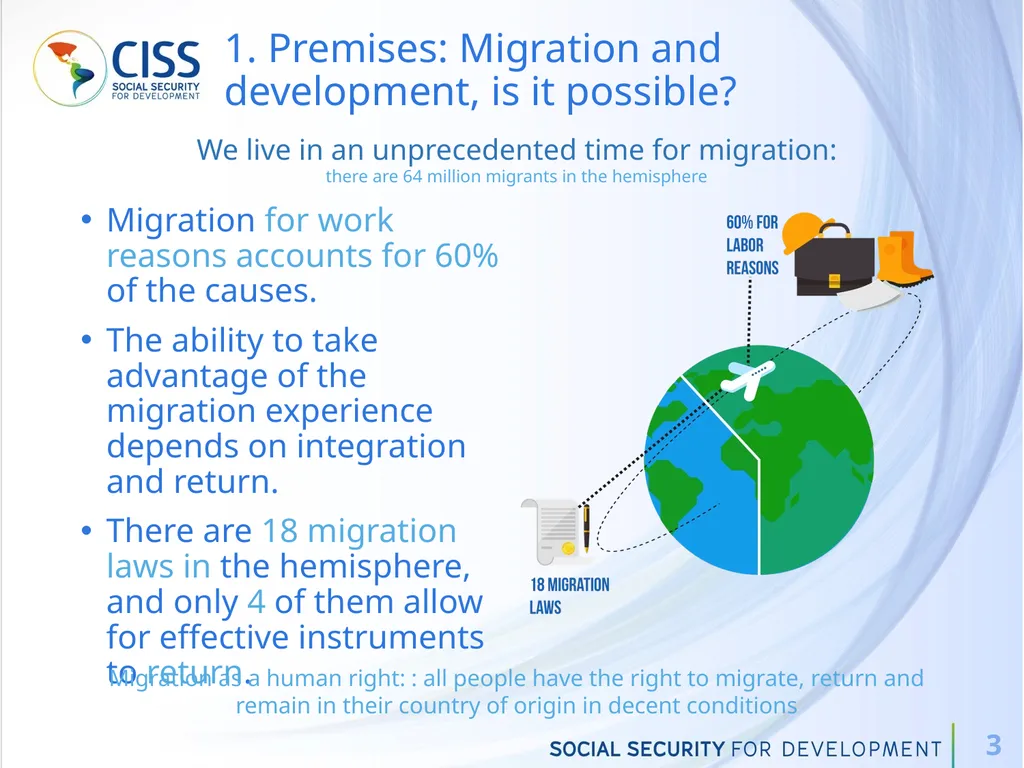
1. Premises: Migration and development, is it possible? 3 Migration for work reasons accounts for 60% of the causes.
The ability to take advantage of the migration experience depends on integration and return.
There are 18 migration laws in the hemisphere, and only 4 of them allow for effective instruments to return. We live in an unprecedented time for migration:
there are 64 million migrants in the hemisphere
Migration as a human right: : all people have the right to migrate, return and remain in their country of origin in decent conditions<br>
04
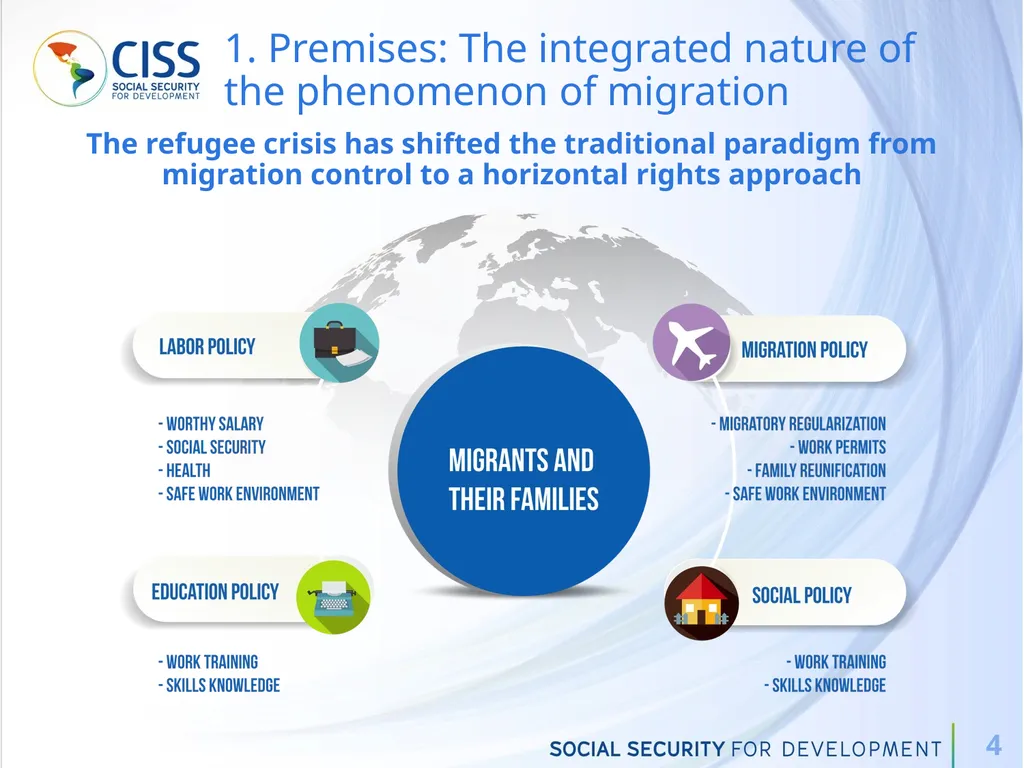
1. Premises: The integrated nature of the phenomenon of migration The refugee crisis has shifted the traditional paradigm from migration control to a horizontal rights approach 4<br>
05
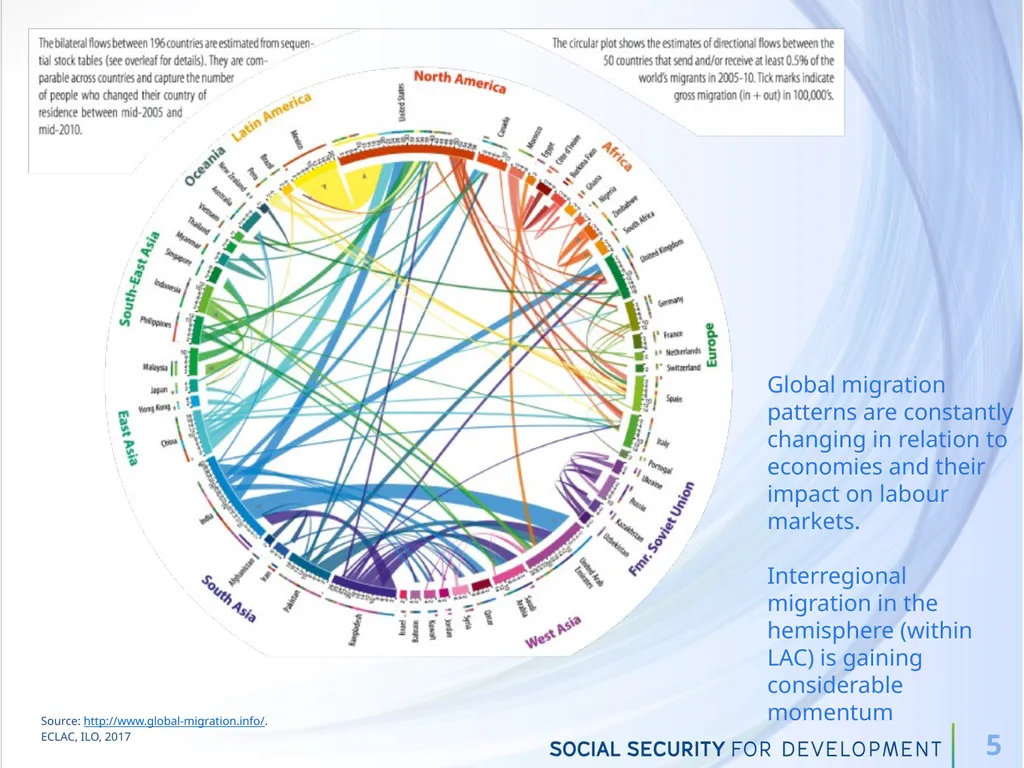
5 Source: http://www.global-migration.info/.
ECLAC, ILO, 2017 Global migration patterns are constantly changing in relation to economies and their impact on labour markets.
Interregional migration in the hemisphere (within LAC) is gaining considerable momentum<br>
06
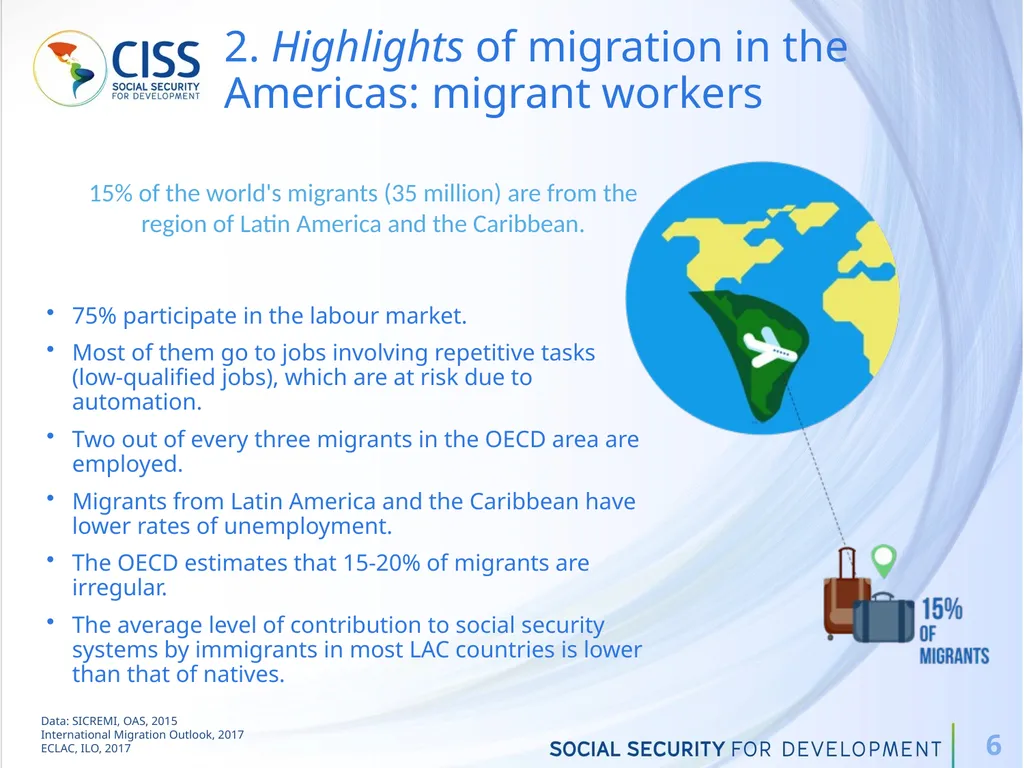
2. Highlights of migration in the Americas: migrant workers 6 Data: SICREMI, OAS, 2015
International Migration Outlook, 2017
ECLAC, ILO, 2017 75% participate in the labour market.
Most of them go to jobs involving repetitive tasks (low-qualified jobs), which are at risk due to automation.
Two out of every three migrants in the OECD area are employed.
Migrants from Latin America and the Caribbean have lower rates of unemployment.
The OECD estimates that 15-20% of migrants are irregular.
The average level of contribution to social security systems by immigrants in most LAC countries is lower than that of natives. 15% of the world's migrants (35 million) are from the region of Latin America and the Caribbean.<br>
07
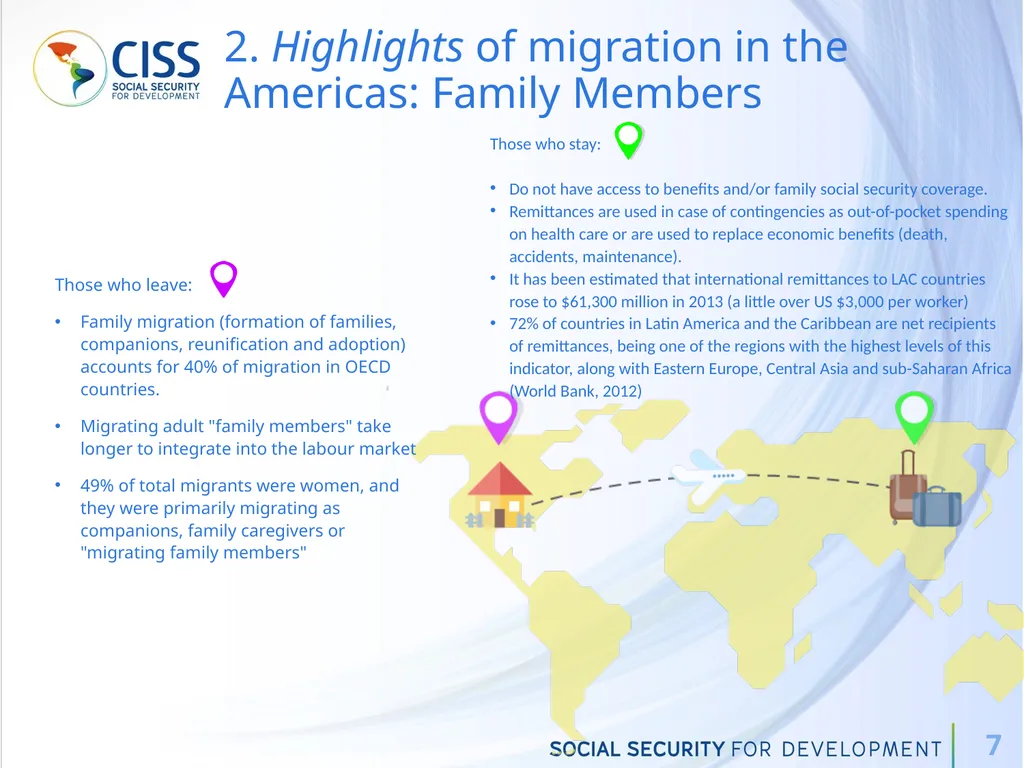
2. Highlights of migration in the Americas: Family Members 7 Those who stay:
Do not have access to benefits and/or family social security coverage.
Remittances are used in case of contingencies as out-of-pocket spending on health care or are used to replace economic benefits (death, accidents, maintenance).
It has been estimated that international remittances to LAC countries rose to $61,300 million in 2013 (a little over US $3,000 per worker)
72% of countries in Latin America and the Caribbean are net recipients of remittances, being one of the regions with the highest levels of this indicator, along with Eastern Europe, Central Asia and sub-Saharan Africa (World Bank, 2012) Those who leave:
Family migration (formation of families, companions, reunification and adoption) accounts for 40% of migration in OECD countries.
Migrating adult "family members" take longer to integrate into the labour market
49% of total migrants were women, and they were primarily migrating as companions, family caregivers or "migrating family members"<br>
08
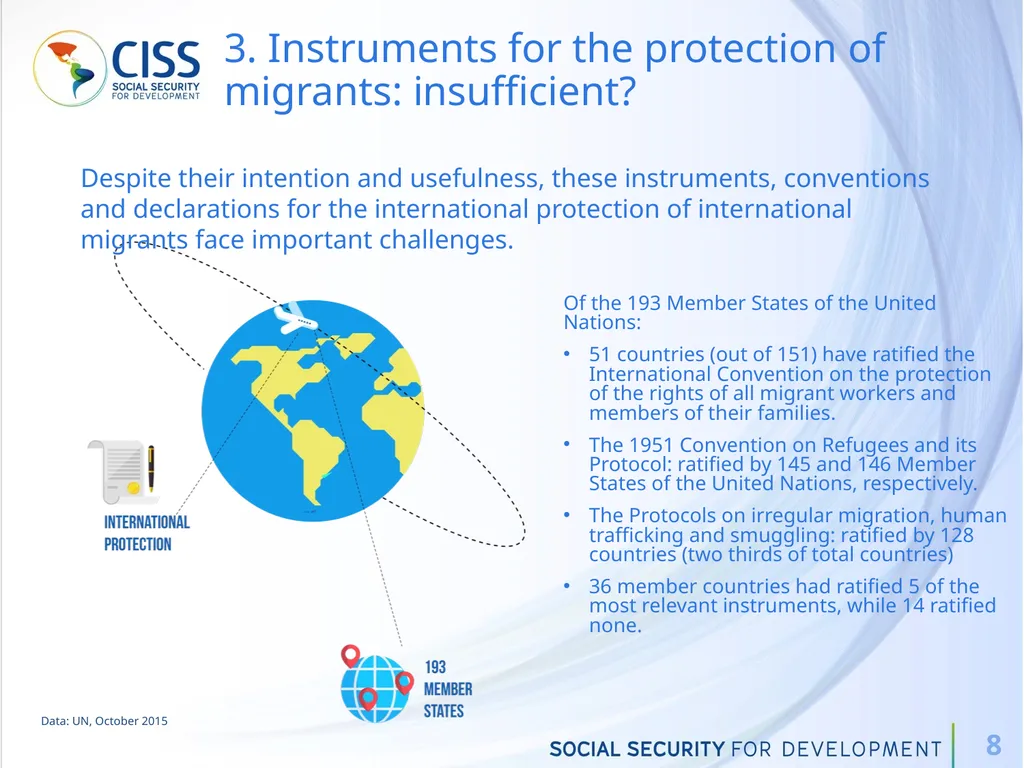
3. Instruments for the protection of migrants: insufficient? 8 Data: UN, October 2015 Of the 193 Member States of the United Nations:
51 countries (out of 151) have ratified the International Convention on the protection of the rights of all migrant workers and members of their families.
The 1951 Convention on Refugees and its Protocol: ratified by 145 and 146 Member States of the United Nations, respectively.
The Protocols on irregular migration, human trafficking and smuggling: ratified by 128 countries (two thirds of total countries)
36 member countries had ratified 5 of the most relevant instruments, while 14 ratified none. Despite their intention and usefulness, these instruments, conventions and declarations for the international protection of international migrants face important challenges.<br>
09
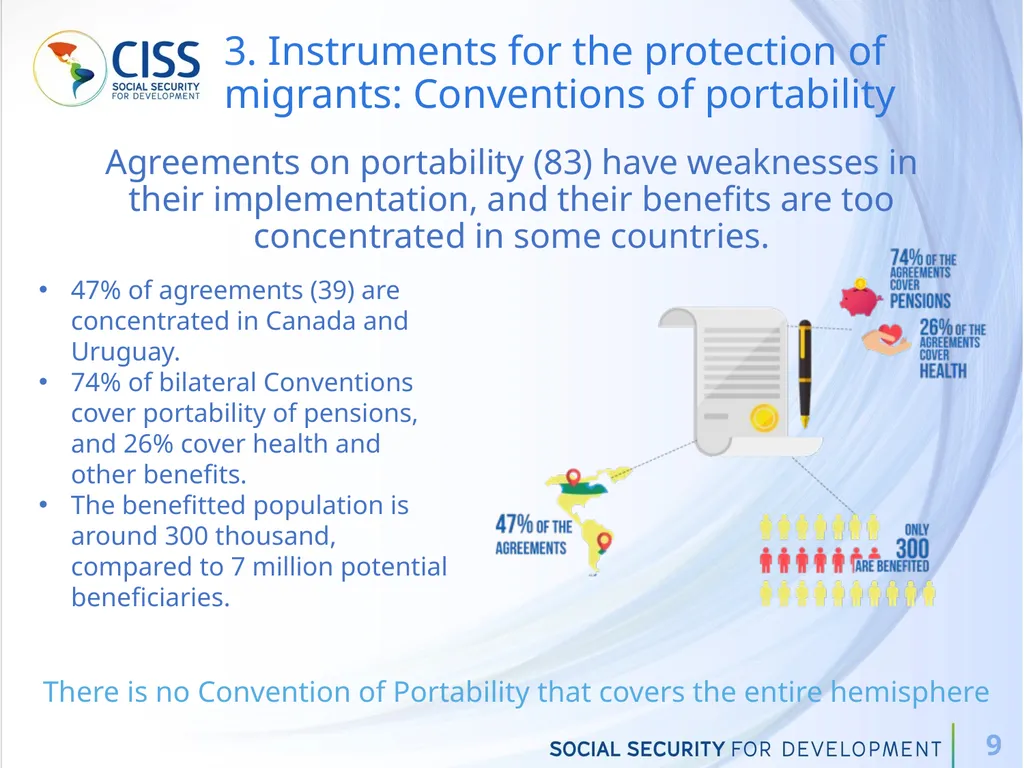
3. Instruments for the protection of migrants: Conventions of portability 9 Agreements on portability (83) have weaknesses in their implementation, and their benefits are too concentrated in some countries. 47% of agreements (39) are concentrated in Canada and Uruguay.
74% of bilateral Conventions cover portability of pensions, and 26% cover health and other benefits.
The benefitted population is around 300 thousand, compared to 7 million potential beneficiaries. There is no Convention of Portability that covers the entire hemisphere<br>
10
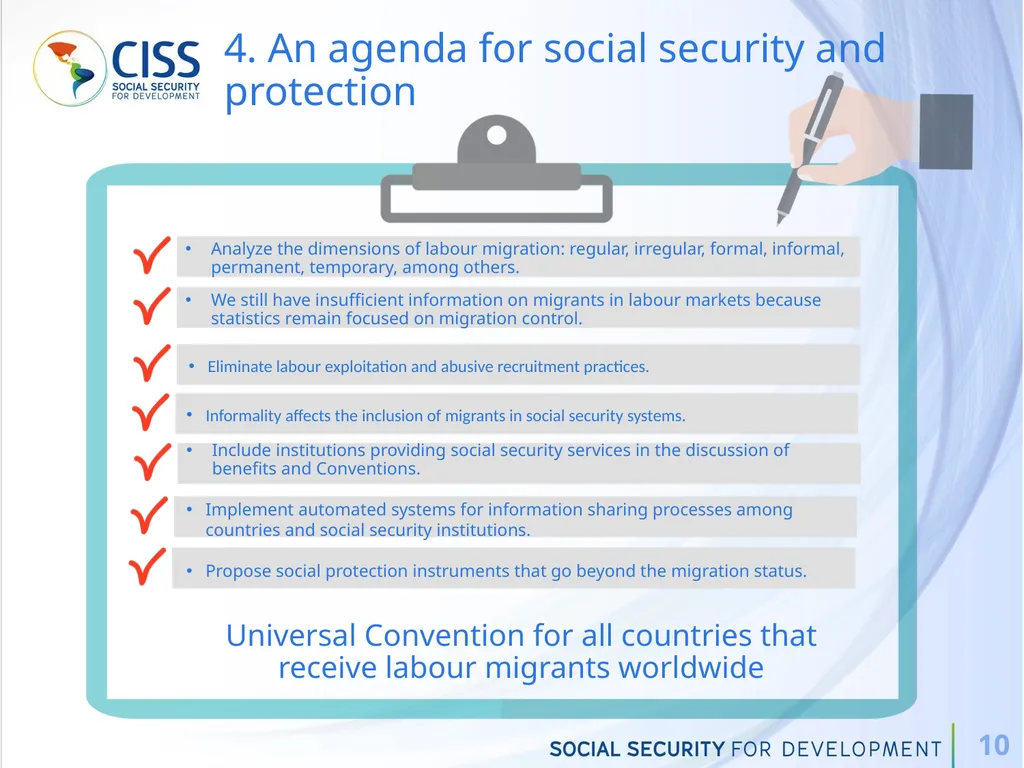
10 4. An agenda for social security and protection Informality affects the inclusion of migrants in social security systems. Analyze the dimensions of labour migration: regular, irregular, formal, informal, permanent, temporary, among others.
We still have insufficient information on migrants in labour markets because statistics remain focused on migration control.
Universal Convention for all countries that receive labour migrants worldwide Eliminate labour exploitation and abusive recruitment practices. Include institutions providing social security services in the discussion of benefits and Conventions.
Implement automated systems for information sharing processes among countries and social security institutions.
Propose social protection instruments that go beyond the migration status.<br>
11
5. Final thoughts: conclusions Mass migration of workers raises the need for changes in social security and protection because of:
Inadequate implementation of international norms and conventions.
Low expectation of access to pension.
Poor exploitation of return and promotion of savings.
There are not enough instruments for the protection of family members of migrants in sending countries.
Irregular migration is exposed to greater risks and lack of protection with high costs in the long term. 11<br>
12
5. Final thoughts: recommendations It must:
Educate and train throughout life for prevention
Introduce independent savings mechanisms
Promote better labour conditions
Introduce mechanisms for access to health
A new system of social security and protection would focus on:
Promoting the return and availing of migration
Promoting universal access to health care
Reforming pension models: more solid and realistic
Introducing ad hoc schemes for new work models of migrants
Eliminating entry barriers (make registration more flexible) 12 Social security and protection is faced with the challenge of providing flexibility to register and protect migrants and their families regardless of their immigration status and place of origin.<br>