01
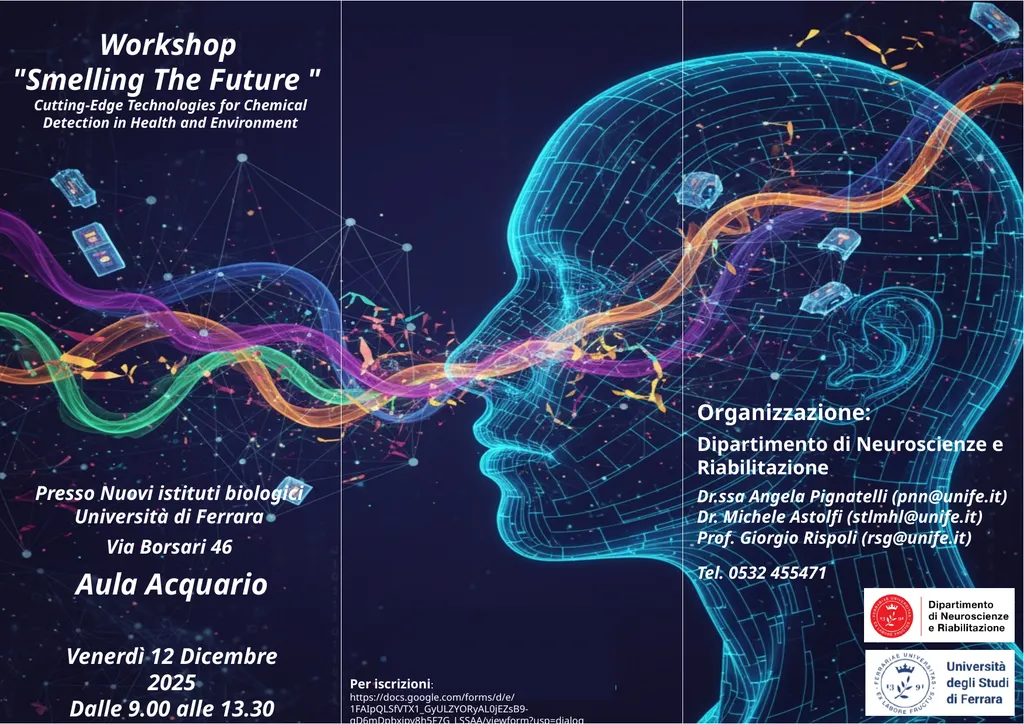
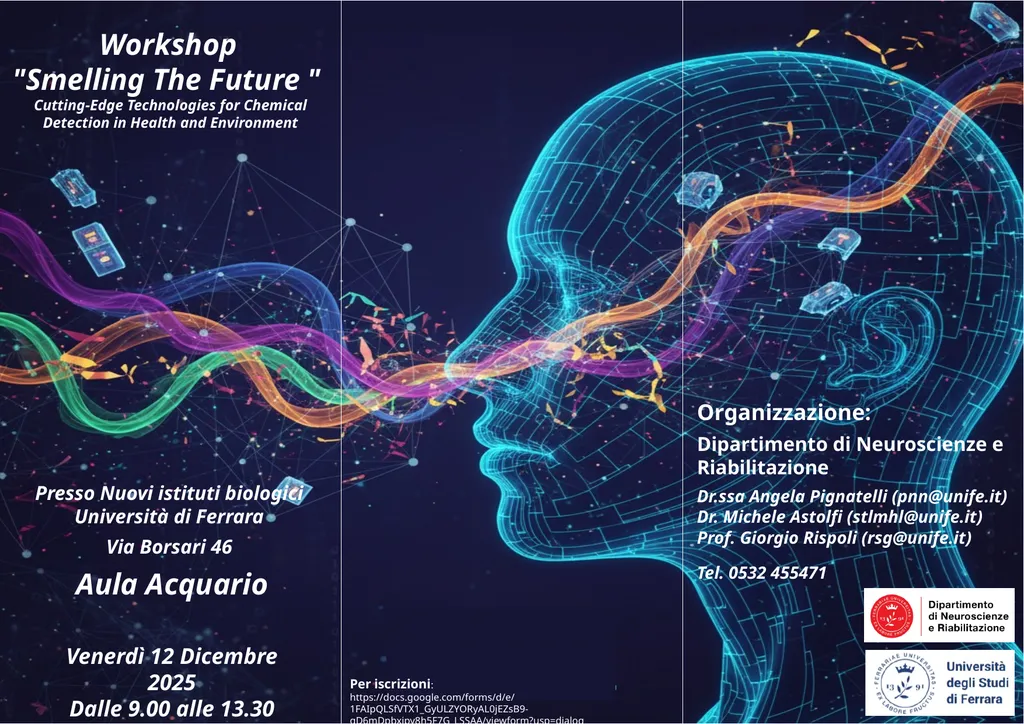
Workshop
"Smelling The Future "
Cutting-Edge Technologies for Chemical Detection in Health and Environment Venerdì 12 Dicembre 2025
Dalle 9.00 alle 13.30 Presso Nuovi istituti biologici Università di Ferrara
Via Borsari 46
Aula Acquario Organizzazione:
Dipartimento di Neuroscienze e Riabilitazione
Dr.ssa Angela Pignatelli (pnn@unife.it)
Dr. Michele Astolfi (stlmhl@unife.it)
Prof. Giorgio Rispoli (rsg@unife.it)
Tel. 0532 455471 Per iscrizioni:
https://docs.google.com/forms/d/e/1FAIpQLSfVTX1_GyULZYORyAL0jEZsB9-gD6mDpbxjpy8h5F7G_LSSAA/viewform?usp=dialog<br>
02
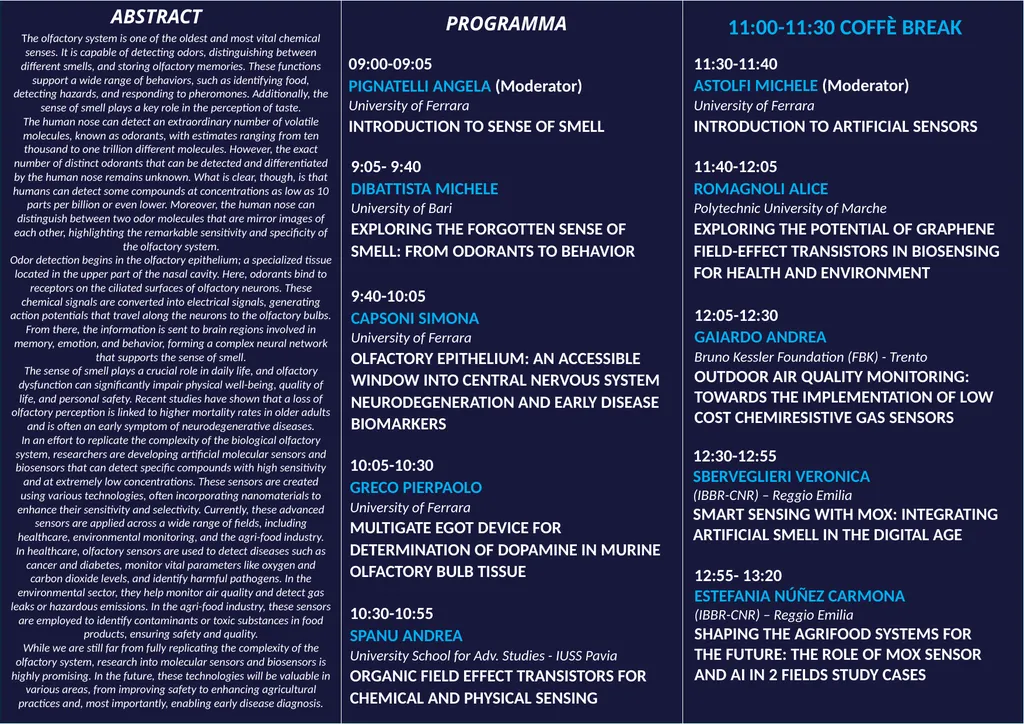
PROGRAMMA 09:00-09:05
PIGNATELLI ANGELA (Moderator)
University of Ferrara
INTRODUCTION TO SENSE OF SMELL 9:05- 9:40
DIBATTISTA MICHELE
University of Bari
EXPLORING THE FORGOTTEN SENSE OF SMELL: FROM ODORANTS TO BEHAVIOR 9:40-10:05
CAPSONI SIMONA
University of Ferrara
OLFACTORY EPITHELIUM: AN ACCESSIBLE WINDOW INTO CENTRAL NERVOUS SYSTEM NEURODEGENERATION AND EARLY DISEASE BIOMARKERS 10:05-10:30
GRECO PIERPAOLO
University of Ferrara
MULTIGATE EGOT DEVICE FOR DETERMINATION OF DOPAMINE IN MURINE OLFACTORY BULB TISSUE 10:30-10:55
SPANU ANDREA
University School for Adv. Studies - IUSS Pavia
ORGANIC FIELD EFFECT TRANSISTORS FOR CHEMICAL AND PHYSICAL SENSING 11:00-11:30 COFFÈ BREAK 11:30-11:40
ASTOLFI MICHELE (Moderator)
University of Ferrara
INTRODUCTION TO ARTIFICIAL SENSORS 11:40-12:05
ROMAGNOLI ALICE
Polytechnic University of Marche
EXPLORING THE POTENTIAL OF GRAPHENE FIELD-EFFECT TRANSISTORS IN BIOSENSING FOR HEALTH AND ENVIRONMENT 12:05-12:30
GAIARDO ANDREA
Bruno Kessler Foundation (FBK) - Trento
OUTDOOR AIR QUALITY MONITORING: TOWARDS THE IMPLEMENTATION OF LOW COST CHEMIRESISTIVE GAS SENSORS 12:30-12:55
SBERVEGLIERI VERONICA
(IBBR-CNR) – Reggio Emilia
SMART SENSING WITH MOX: INTEGRATING ARTIFICIAL SMELL IN THE DIGITAL AGE 12:55- 13:20
ESTEFANIA NÚÑEZ CARMONA
(IBBR-CNR) – Reggio Emilia
SHAPING THE AGRIFOOD SYSTEMS FOR THE FUTURE: THE ROLE OF MOX SENSOR AND AI IN 2 FIELDS STUDY CASES ABSTRACT The olfactory system is one of the oldest and most vital chemical senses. It is capable of detecting odors, distinguishing between different smells, and storing olfactory memories. These functions support a wide range of behaviors, such as identifying food, detecting hazards, and responding to pheromones. Additionally, the sense of smell plays a key role in the perception of taste.�The human nose can detect an extraordinary number of volatile molecules, known as odorants, with estimates ranging from ten thousand to one trillion different molecules. However, the exact number of distinct odorants that can be detected and differentiated by the human nose remains unknown. What is clear, though, is that humans can detect some compounds at concentrations as low as 10 parts per billion or even lower. Moreover, the human nose can distinguish between two odor molecules that are mirror images of each other, highlighting the remarkable sensitivity and specificity of the olfactory system.�Odor detection begins in the olfactory epithelium; a specialized tissue located in the upper part of the nasal cavity. Here, odorants bind to receptors on the ciliated surfaces of olfactory neurons. These chemical signals are converted into electrical signals, generating action potentials that travel along the neurons to the olfactory bulbs. From there, the information is sent to brain regions involved in memory, emotion, and behavior, forming a complex neural network that supports the sense of smell.�The sense of smell plays a crucial role in daily life, and olfactory dysfunction can significantly impair physical well-being, quality of life, and personal safety. Recent studies have shown that a loss of olfactory perception is linked to higher mortality rates in older adults and is often an early symptom of neurodegenerative diseases.�In an effort to replicate the complexity of the biological olfactory system, researchers are developing artificial molecular sensors and biosensors that can detect specific compounds with high sensitivity and at extremely low concentrations. These sensors are created using various technologies, often incorporating nanomaterials to enhance their sensitivity and selectivity. Currently, these advanced sensors are applied across a wide range of fields, including healthcare, environmental monitoring, and the agri-food industry.�In healthcare, olfactory sensors are used to detect diseases such as cancer and diabetes, monitor vital parameters like oxygen and carbon dioxide levels, and identify harmful pathogens. In the environmental sector, they help monitor air quality and detect gas leaks or hazardous emissions. In the agri-food industry, these sensors are employed to identify contaminants or toxic substances in food products, ensuring safety and quality.�While we are still far from fully replicating the complexity of the olfactory system, research into molecular sensors and biosensors is highly promising. In the future, these technologies will be valuable in various areas, from improving safety to enhancing agricultural practices and, most importantly, enabling early disease diagnosis.<br>