
World-Historical Background 1 Two Approaches to











Description: World-Historical Background 1 Two Approaches to Society The Governor of She said to Confucius, In our village there is a man nicknamed Straight Body. When his father stole a sheep, he gave evidence against him. Confucius answered, In
Related Topics
Download Presentation
"World-Historical Background 1 Two Approaches to" is the property of its rightful owner. Permission is granted to download and print the materials on this website for personal, non-commercial use only, and to display it on your personal computer provided you do not modify the materials and that you retain all copyright notices contained in the materials. By downloading content from our website, you accept the terms of this agreement.
Presentation Transcript
slide1. World-Historical Background 1<br>
slide2. Two Approaches to Society “The Governor of She said to Confucius, ‘In our village there is a man nicknamed ‘Straight Body’. When his father stole a sheep, he gave evidence against him.’
Confucius answered, ‘In our village those who are straight are quite different. Fathers cover up for their sons, and sons cover up for their fathers. Straightness is to be found in such behaviour.’” (Confucius, Analects, XIII, 18) 2<br>
slide3. Conflict in China: Family or State? The Governor of She: the State, the Law is primary
Confucius (551-479 BCE) : the Family is primary 3<br>
slide4. Why Confucianism in China? Confucius defends primacy of family, kinship
Praises Sage kings of Xia dynasty (2205-1766 BCE)
Confucius’ birth: 551 BCE
Xia precedes the hereditary monarchy and the sharper inequalities of Shang (1766-1122 BCE)
Confucius refers to a time that is closer to early kinship egalitarianism
No hereditary monarchy with the early Xia
Confucius: return to the time before “the Fall” 4<br>
slide5. Kinship tradition of China versus Greek anti-traditionalism > reflects ancient Chinese kinship tradition of over 1700 years before Confucius
Traditionalism of Confucius: find the truth, the core values, in the tradition—but at its ideal starting point
Socrates rejects the rule of tradition
He “corrupts the youth,” by demanding that we rethink everything for ourselves, not accept what the elders say
Reflects Greek overthrow of old kinship order
Confucius’ referral to early tradition provides ethical corrective for corrupt states 5<br>
slide6. Historical Timeline 1) Early hunter-gatherers— paleolithic age
120,000 years of homo sapiens (sapiens sapiens?)
2 million years of homo habilis (stone tools)
2) Revolution 10,000-8000 BCE – begins neolithic age
Herders and simple agriculturalists
Transitional stage
3) Revolution 3,500 BCE
rise of hierarchical state societies (complex agriculture)
Time of the “Fall” (see Book of Genesis) 6<br>
slide7. 1) Separation from Nature 1) Mode of life of hunter/gatherers
Appropriation of nature
Dependence on independent nature
Unity with nature
2) Mode of life of herders, simple agriculturalists
Human transformation of nature
3) Hierarchical states control nature: irrigation
Transformations of societies: rich and poor 7<br>
slide8. Evolution of material creativity 1) Change nature into tools (for hunting, gathering)
2) Transform nature with tools (for herding, simple agriculture)
3) Intensified domination of nature (e.g., the animal drawn plow)—Civilization
NB: Non-biological changes, outside the human organism 8<br>
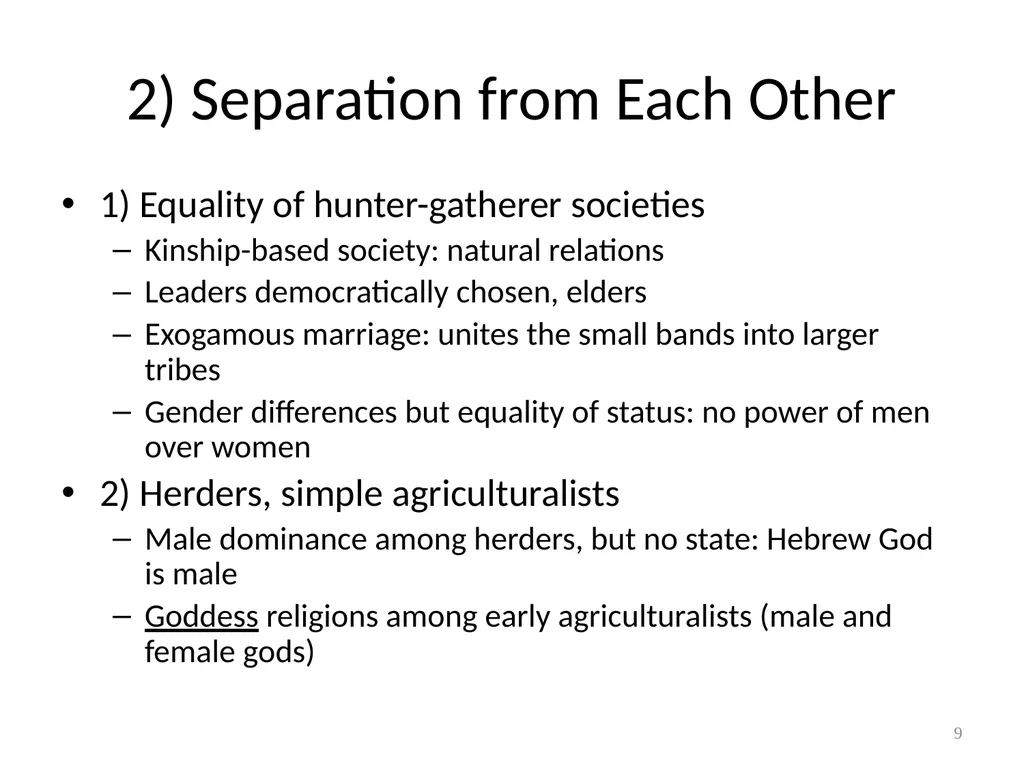
slide9. 2) Separation from Each Other 1) Equality of hunter-gatherer societies
Kinship-based society: natural relations
Leaders democratically chosen, elders
Exogamous marriage: unites the small bands into larger tribes
Gender differences but equality of status: no power of men over women
2) Herders, simple agriculturalists
Male dominance among herders, but no state: Hebrew God is male
Goddess religions among early agriculturalists (male and female gods) 9<br>
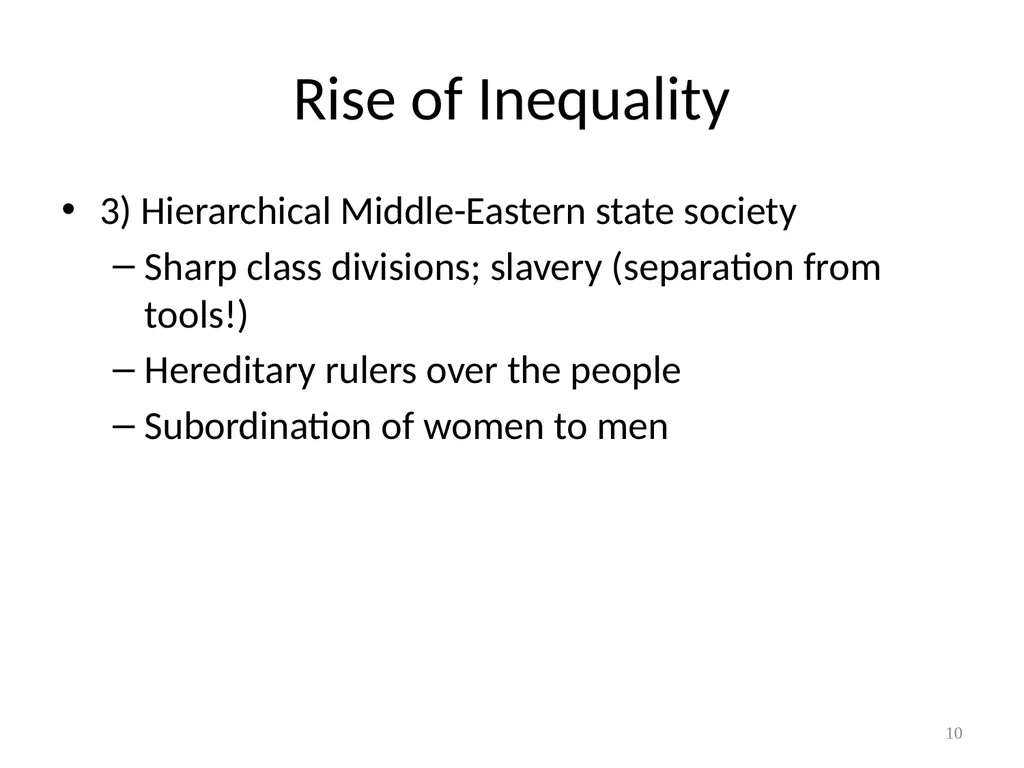
slide10. Rise of Inequality 3) Hierarchical Middle-Eastern state society
Sharp class divisions; slavery (separation from tools!)
Hereditary rulers over the people
Subordination of women to men 10<br>
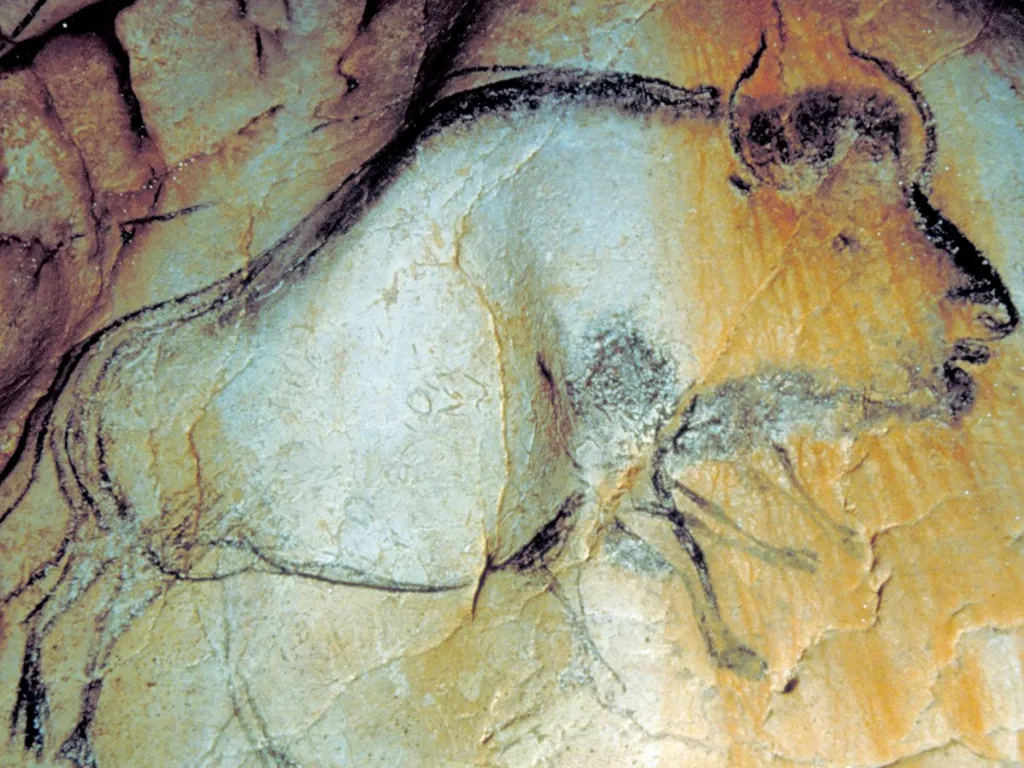
slide11. Oneness with Nature/God Religion of hunter-gatherers: animism
Divine in nature
Harmony of divine and human
Cave paintings: Why deep in caves?
Cave as uterus of world; Earth Mother (Gaia)
Shamanism: humans participate in creation
=Oneness of humans with “God”
Genesis: Adam and Eve walked with God in the Garden of Eden 11<br>
slide12. 12<br>
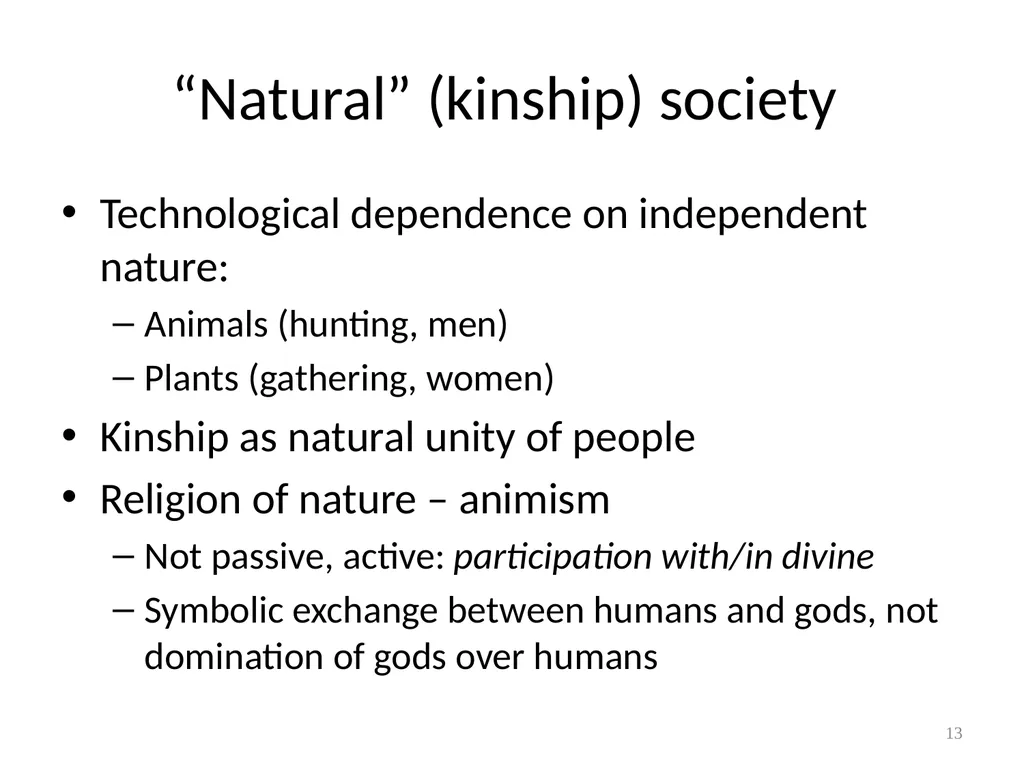
slide13. “Natural” (kinship) society Technological dependence on independent nature:
Animals (hunting, men)
Plants (gathering, women)
Kinship as natural unity of people
Religion of nature – animism
Not passive, active: participation with/in divine
Symbolic exchange between humans and gods, not domination of gods over humans 13<br>
slide14. 14<br>
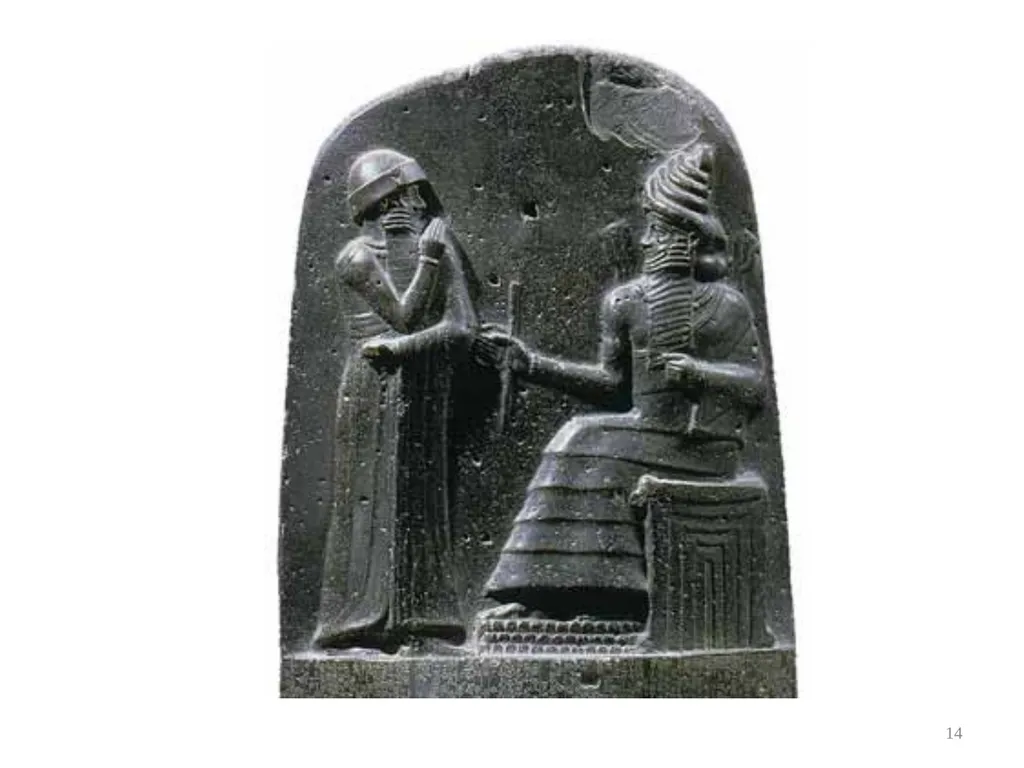
slide15. Shamash and Hammurabi Which is which? (Spodek, 59)
Gods look like kings (and vice versa)
Separation of ruler from ruled
Separation of divine from human
God-given laws cement human divisions
Rich and poor
Men and women 15<br>
slide16. Historical “fall” (summary) On technological level
from dependence on independent nature
to control over nature
On social level
from family-based, egalitarian society
to class-based, male dominant society
rulers are all powerful
On consciousness level
Animist oneness > Gods/priests/kings are all powerful ruling over the common people 16<br>
slide17. Neo-Kinship Society of China One clan group conquers others
Contrast with Western model: internal warrior, like Gilgamesh,
breaks with clan democracy, imposes his own rules: “law,” legalism
Head of clan > king of society
Kinship + hierarchy
= Kinship system adapts to civilization
Kinship is not replaced by legal order 17<br>
slide18. Early ancestor worship Father of family is “priest”:
mediator with Heaven
The “gods” include great grandmother!
i.e., not alien, arbitrary rulers, as in the West
Religion = ritual exchange between living and spirits of the dead
=> a religion of kinship
Also in nature: Heaven and the Earth as cosmic father and mother 18<br>
slide19. Ideology of the Good Father With neo-kinship hierarchy, the King is regarded as the Father of all his people
Not literal kinship but metaphorical
However, ethnic appearance, culture, language is similar 19<br>
slide20. Legalism in the West Socrates’ discussion with the Laws in Crito
The Laws say: “Are we not, first, your parents?”
= Platonic resolution of the conflict of Antigone
Antigone defends the tradition of the family—she wants to bury her brother as the old order requires
The King however decrees a law forbidding this
He puts himself above the ancient kinship order
> Further developed in Roman Cosmopolitan law
Expressed in Stoic obedience to divine Law 20<br>
slide21. Historical Expression of this Conflict in China Confucius 551-479 BCE
Period of Warring States: 481-222 BCE
Qin dynasty unites China: 221 BCE
Qin Shi Huangdi “The First Emperor” (See movie “Hero”)
Adopts Legalism; burns books of Confucius
Han revolution 202 BCE
Peasant leader: Liu Bang (died 195 BCE)
> Han rulers adopt the philosophy of Confucius
How long did the Qin (Chin) dynasty last? 21<br>
slide22. Long Duration of Chinese Empire Legalist Qin 221-202 BCE (19 yrs)
Confucian Han 202 BCE to 220 CE (422 years)
Period of disunity (361 years)
Chinese empire reunited by Sui (581- )
Minor interruptions (esp. 1916-49)
over 1300 years!!
Confucian teaching, education of bureaucracy continues throughout this entire period
Persistence of the family-based outlook 22<br>
slide23. 1 The Character of Chinese Philosophy 23<br>
slide24. Character of Confucian philosophy Remarkable continuity of Chinese philosophy
Confucius (551-479 BCE) refers to the Duke of Chou (about 1100 BCE) who defended “the mandate of Heaven”
The ruler has a right to rule from Heaven
But only as long as he exercises virtue and cares for the people
Official Chinese philosophy to the end of the last dynasty in 1911
Hence, the practical and humanistic character of Chinese philosophy
On the nature of Western philosophy, a Chinese host told Bertrand Russell:
So much “brain bashing” was bad for the liver
A sensible man would prefer to sit by a river and listen to bird-song 24<br>
slide25. Different summaries Hegel summed up Chinese philosophy:
While for Indians everything has a dreamlike spirituality
for the Chinese “everything that belongs to Spirit – morality, … inward religion, science and art – is alien.”
More temperate view:
Chinese philosophers are interested in human needs, the improvement of government, morals, and the values of private life
Not abstract “brain bashing” that serves no useful purpose 25<br>
slide26. Meanings of humanism Humanism here is not meant as
Renaissance humanism: rediscovering the classics of earlier Greek and Roman thought
Not a belief in the glories of the human being
Hsun Tzu: “man’s nature is evil”
Not a human-centered universe
In which nature exists for the sake of humans
Or the belief that the world is a construct of human thought 26<br>
slide27. This-worldly goals Humanism = not God-centered
Chinese philosophers did not believe a God created the world, Who is the source of value and purpose
Belief in spirits, demons, gods, but these are not creators or moral legislators
The goals of life are this-worldly
Not based on rewards in the afterlife
No transcendence of ordinary world—no “liberation” from material selves
Goal of philosophy:
Reflect on these human goals
And the right means of attaining them 27<br>
slide28. Practical philosophy “Practical philosophy”:
ethics,
and examination of how people ought to act, think, or feel
This is true also for India (Shankara, 7th CE) and Greece (Plato, 4th BCE)
For early Confucian philosophy, with its practical orientation, there is no need for speculation on
the reality of the world: this is obvious, taken for granted
the relation of mind and body: our minds centered on the world
the identity of the self: our selves are tied up with others
Such reflection is necessary in Shankara and Plato for practical philosophy
Can we explain why this is so? 28<br>
slide29. Classics The main early works
The Analects of Confucius
Little here about the ultimate nature of the universe
The Tao Te Ching of Lao Tzu is more elevated
The Tao or Dao: an ineffable source of Heaven and Earth
Writings of (Confucian) Mencius and (Taoist) Chuang Tzu
contain considerable speculation re innate knowledge, relativity of truth
The I Ching (Book of Changes): book on divination and cosmological speculation 29<br>
slide30. Why the practical orientation? Hence a greater emphasis in Chinese philosophy on the practical,
as opposed to the abstract theoretical
But why?
1) Historical climate: period of warring states?
But in Europe, the Thirty Years War after the French Revolution, produced great speculative philosophy (e.g., Hegel) 30<br>
slide31. Role of Language 2) Chinese language is ideographic
Characters are pictographic, and not abstract as are alphabets
So the reader feels more connected to the sensible world
3) Lack of inflection of the Chinese language
Inflection: the modification of a word to express different grammatical categories such as tense, case, voice, aspect, person, number, gender, and mood.
Hence seeing the world in terms of abstract categories parallel to those of language: thing, quality, past, etc.
Hence the illusion of looking directly at concrete reality through the mirror of language 31<br>
slide32. Chicken-and-egg Sapir-Whorf hypothesis: determination by language, by grammar of conceptual categories
Chicken-and-egg problem: maybe the Chinese mind preceded the language
But “influence” of language is too weak, “determination” by language is too strong
implying impossibility of abstract thinking
Hence: let language play its role in restricting the appetite for metaphysical flights
But look elsewhere too 32<br>
slide33. Alienation and Harmony Idea of India: philosophy is inspired by a sense of alienation from the world, the natural world as a foreign “other”
Recall: Human labor transforms nature: the Biblical fall from a Garden of Eden
And so India develops philosophies to dispel that sense
But the Chinese feel in “harmony with the cosmos,” at home in the world from the beginning
Hence no need to unmask the alienation as an illusion (India)
Or to provide a rational foundation for it (Greece) 33<br>
slide34. Role of philosophy Role of philosophy in this case:
Elaborate in various ways this sense of harmony, maintaining, enhancing the harmony
Or recovering it if it is lost
But this pushes the explanation back further:
Why did this vision of harmony prevail, by contrast with India or Greece?
See larger historical context above
Few attempts to articulate systems of theoretical knowledge
not because of lack of interest in or knowledge of such theory
but because of a reasoned depreciation of its value 34<br>
slide35. Affective knowledge 1) Affective knowledge
“hsin” or “mind” = heart-mind, or thinking heart
No separation of mind and heart, knowledge and “mere” passion or subjective feeling
Mencius: we know our duties through a sense of shame that certain actions inspire
Wisdom: not through construction and testing of theories
“What a person knows without having to reflect on it is what he truly knows.” 35<br>
slide36. Know-how 2) Primacy of “know-how”
Not “knowing that” of propositional knowledge: the hammer is made of wood and steel
Knowing how to cook, use a hammer: not a matter of following a recipe
Confucius: moral knowledge is of the Mean, a flexible balance between excess and defect
Not an abstract formula, but a matter of know-how
Chuang Tzu: knowledge of the Way (the Tao): easy, unforced behavior that “goes with the grain” of the Way 36<br>
slide37. Tai Chi Tai Chi by a Shaolin Monk in Nature
https://www.youtube.com/watch?v=skj69i5usgI
Recall Bertrand Russell’s conversation in China:
So much “brain bashing” was bad for the liver
A sensible man would prefer to sit by a river and listen to bird-song
And perform Tai Chi! 37<br>
slide38. Ineffability 3) Ineffability of practical knowledge
Chuang Tzu:
The wheelwright’s knowledge: “a knack that cannot be explained”
“Those who know the nature of things do not try to explain it in words; and those who try, show thereby, that they do not know.”
George Bernard Shaw: Those who can do; those who can’t teach. 38<br>
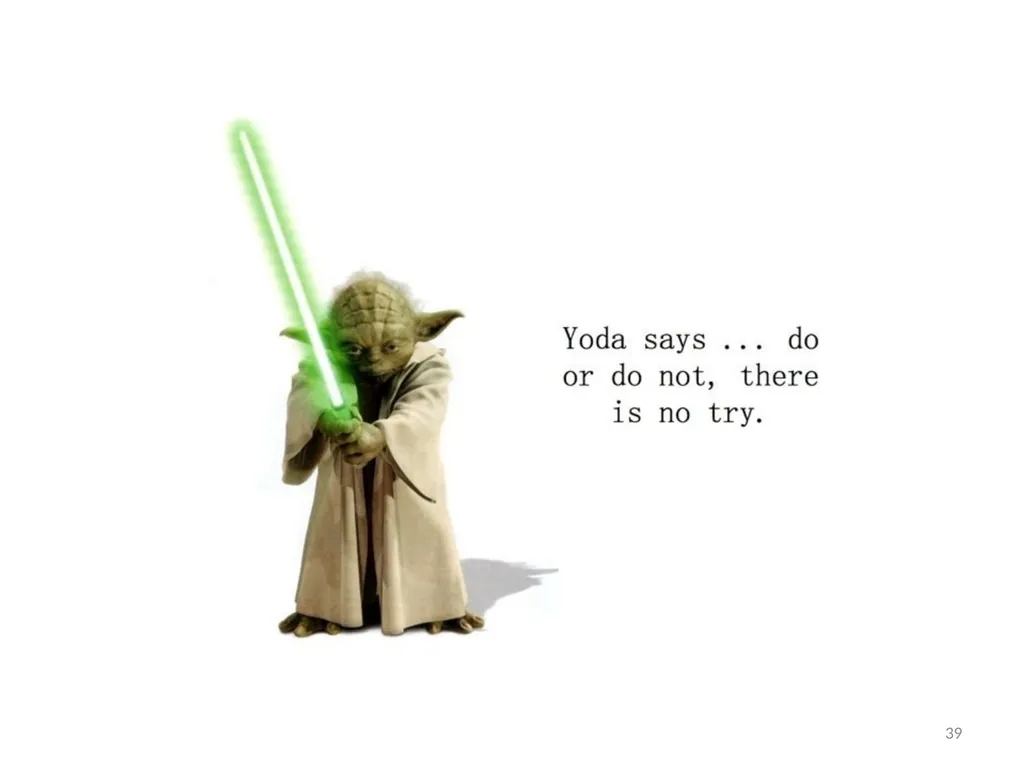
slide39. 39<br>
slide40. Theoretical knowledge interferes with practice Where knowledge matters most
it is an illusion to suppose that any adequate theory can be constructed
Such knowledge, regimenting the practice, would interfere with the effortless practical mastery that is required 40<br>
slide41. Not “the view from nowhere” The theoretical stance puts one at a distance from the world
Disengagement required by physics or metaphysics
Take stock, analyze, regiment, impose coherent structure
Ideal “view from nowhere” required
The knowledge that really counts belongs to the engaged person
who is integrated in the theater of action 41<br>
slide42. Levels of harmony Hence harmony with the cosmos and depreciation of theoretical knowledge are not separate ingredients of Chinese thought
Another mode of knowing is required, a style of harmonious engagement with the world
Levels of harmony
Within the self, family, and society
Between heaven, earth, and people
Balance between negative and positive of yin and yang
Correspondences between “the five elements” and their human analogues
Adaptation to “the Way,” the Tao 42<br>
slide43. World-Historical Context Bringing in the earliest condition of the first human beings
supplements these explanations in the Cooper text
China is the developed civilization whose culture and philosophies are the oldest, and so remain closest to
the ancient animism: “spirit” is all around us in the material world
the family-oriented kinship society of the beginning
What can we learn from Chinese philosophy? 43<br>
slide44. Confucianism 44<br>
slide45. Stages of Confucianism Most influential of all philosophers
2000 years’ teachings that influenced the most populous country in the world
1) Simple, popular teachings of the master
2) Elaborated with more theoretical context
by Mencius and Hsun Tzu
3) Complex elaborations to incorporate other theories
Neo-Confucianism 45<br>
slide46. Biography Confucius, latinization of “K’ung Fu Tzu” = Master Kung 551-479 BCE
Unsuccessful advisor to rulers
Resigns in disgust with the ruler
Wanders from state to state, gathering disciples
Confident in the rightness of his ideas: “If anyone were to employ me, in a year’s time I would have brought things to a satisfactory state.” (Analects, XIII, 10) 46<br>
slide47. Analects Analects: short sayings compiled by his students
Advice to rulers
Moral tales
Comments on his person
Nuggets of moral philosophy
Sceptical silence about metaphysical matters (Is there an afterlife?) 47<br>
slide48. Fall from favor He was considered the patron saint of the European Enlightenment
But soon lost this prestige
Hegel says his teachings are mediocre
“Commonplace and unexciting” (contemporary author)
20th century rejection by Mao Tse-Tung and leftist radicals in China 48<br>
slide49. Misconceptions Misconceptions about Confucius that are unsympathetic to our contemporary beliefs:
Conservativism
His nostalgia for the past sage king of the 12th c BC
His alleged insistence on rigid performance of rituals and customs
Especially those connected to “filial piety”
Extreme cultivation of “Virtue”
Devotion to public service
Out of favor with contemporary criticism of politicians
In our individualistic society, we tend to prefer the romantic individualism of the Taoists 49<br>
slide50. Today’s governments have lost the Way He was a conservative: “I am for the Chou” (III, 14)
The glory days of this famous dynasty
Contrasted with corrupted practices of the present
Current governments have declined from this time
“those in authority have lost the Way and the common people have, for long, been rootless” (XIX, 19)
The earlier days were more favorable to the “chun tzu” – the “gentleman” or “superior person”
Hence, this is a critical philosophy
Not “conservative” in the sense of accepting the status quo 50<br>
slide51. Importance of the rites (li) Li: social duties and customs
“Unless a man has the spirit of the rites (li) … he will wear himself out … become unruly, intolerant.”
They provide disciplined channels through which the chun tzu is able to put his morality into practice (XV, 18)
Mencius: they are “exit gates”
Without them we are locked up inside ourselves, with no way to express our inner side (jen),
There would be no point in being “on the Way” because there would be no where to go [5(B), 7] 51<br>
slide52. From family to larger society Rites of filial piety provide such channels or exit gates
But also, “when mourning for one’s parents a man realizes himself to the full” (XIX, 17)
This sets an example of unselfish behavior for others to follow, inspiring a disinterested urge to lead the moral life
The Great Learning:
moral example is set within the family
And from there spreads throughout the larger society 52<br>
slide53. One’s public duty The same for duties in public life
The chun tzu (virtuous or superior person) “takes office in order to do his duty” even without personal benefit (XVIII, 7)
In such disinterested action he behaves in accordance with the “basic stuff” (chi) of his humanity
Such virtue “is like the wind; the small man’s virtue is like grass. Let the wind blow over the grass and it is sure to bend” (XII, 19) 53<br>
slide54. Confucian Golden Rule Hence Confucius is not trying to justify the status quo
But to bring about the re-emergence of the chun tzu
The chun tzu:
Guides his behavior by the Confucian version of the Golden Rule: “Do not impose on others what you yourself do not desire” (XII, 2)
the exercize of “jen” 54<br>
slide55. Jen and li 14 translations of jen: virtue, humanity, benevolence …
But mourning one’s parents is not benevolence
And, Confucius says, a person can have benevolence without jen
Jen is an inner quality, that can’t be determined from outward behavior
It is “found within himself” (XV, 21)
It is “a native substance” or “basic stuff) (chih or chi) (XV, 18)
It underlies simplicity, magnanimity, modesty, etc.
Jen as “inner moral force”
Like the wind it puts pressure on others
It must be constrained and channeled by li, lest it “wear itself out” 55<br>
slide56. The bonds that hold society and the world together come from within Reasons for cultivating the inner moral force of the chun tzu have to do with harmony
1) Cosmic level: A life that manifests jen (i.e., jen channeled through li) accords with the way of Heaven
“Heaven is the author of the virtue (jen) that is in me” (VII, 23)
2) Social level:
The chun tzu promotes harmony in the family, the wider community, and the State
The bonds that keep men and women together in peace and cooperation come from inside them
Love, a sense of duty, piety
Not simply by external rewards and punishments 56<br>
slide57. Inner harmony 3) Harmony within the individual
The chun tzu is a balanced person: he is “easy of mind, while the small man is always full of anxiety” (VII, 37)
He is at one with himself, not overcome by passions or threats
He is “able to overcome himself”—integrating the various facets of his life 57<br>
slide58. A balance of Jen and Li Jen as a beautiful “neighborhood” in which a person feels “at home”
Like a gravitational force, giving weight and stability to a person’s life
Because he is in harmony with himself, the chun tzu follows the Mean
Not living mechanically or for profit
But also not blind moral enthusiasm
Jen must be checked by li: the customs and duties that go with one’s station in life
Hence, “a well-balanced admixture” of jen and “acquired refinement” (li) produces the chun tzu (VI, 18) 58<br>
slide59. Confucian vision today Today’s moral poles:
some see morality simply as a device for regulating self-interested behavior (externally oriented utilitarianism)
Others see it as inner authenticity (free internal choice of individual, without any rule)
Confucius’ vision of a middle way: A well balanced mixture of
an inner moral source (jen)
and well-tried rules of right conduct (li) rooted in tradition 59<br>
slide60. Issues for Confucius A disciple: “one cannot get to hear [Confucius’] views” on
Human nature
The Way of Heaven
Confucius must establish three things
1) human nature does not preclude the emergence of the chun tzu
I.e., people can act in this higher way
And not simply out of self-interest 60<br>
slide61. Human nature and the chun tzu 2) Becoming a superior being is not only for special individuals
Otherwise ordinary people have no chance of developing jen
3) It’s more than a capacity;
We are also capable of living in a haze of opium
there must be predisposition or inclination to live a superior life 61<br>
slide62. Mencius Mencius (Meng Tzu, Master Meng) (372-289 BCE) replies to theories of human nature that oppose Confucius’ ideal, that say
Our nature is to go for food and sex
Our nature is to pursue self-gratification
Mencius replies with examples
If a criminal sees an infant crawling to an open well, he will try to save the child
with no self-interest involved 62<br>
slide63. The four germs of compassion “The reason why I say that all humans have hearts that are not unfeeling toward others is this. Suppose someone suddenly saw a child about to fall into a well: anyone in such a situation would have a feeling of alarm and compassion—not because one sought to get in good with the child's parents, not because one wanted fame among one's neighbors and friends, and not because one would dislike the sound of the child's cries. From this we can see that if one is without the feeling of compassion, one is not human.” (Mencius 2A6; Van Norden 2008, 46) 63<br>
slide64. The four germs/beginnings/sprouts of compassion The feeling of commiseration is the beginning of humanity; [jen]
the feeling of shame and dislike is the beginning of righteousness;
the feeling of deference and compliance is the beginning of propriety; [li]
and the feeling of right or wrong is the beginning of wisdom.
Men have these Four Beginnings just as they have their four limbs. Having these Four Beginnings, but saying that they cannot develop them, is to destroy themselves. 2A: 6 64<br>
slide65. Morality will outweigh egotism 1) There may be selfish tendencies in us, but these moral urges too are innate, part of our nature
They cannot be explained by self-interest
or social conditioning
2) These natural moral inclinations will tend to outweigh selfish motives
under neutral or normal conditions 65<br>
slide66. Obstacles to morality These sprouts of morality are like our physical limbs
Something has to go wrong for us not to want to stretch and exercize them
Like seeds of barley, like water’s tendency to flow downward
External obstacles or structures can block, impede, or destroy this
E.g., bad education
or struggle for scarce goods 66<br>
slide67. Retain your inner child Reason and moral rightness are natural to human beings
making us different from animals
The superior person seeks to maintain this difference
“A great man is one who retains the heart of a new-born babe” (4B: 12) 67<br>
slide68. Counter arguments Hsun Tzu (298-238 BCE) another Confucian, replies: “man’s nature is evil”
Desire for profit, if unchecked, “lead people into “wrangling and strife … violence and crime”
Goodness requires artificial actions
education
threats of punishments
If human nature were innately good, how explain
how quickly people can become evil?
the need for moral education?
the need for law? 68<br>
slide69. More evidence against Mencius People learn to act morally
Morality requires effort
“Nature” means that something is the way it is
E.g., if a warped piece of wood must be straightened by force
it is absurd to say that it is naturally straight 69<br>
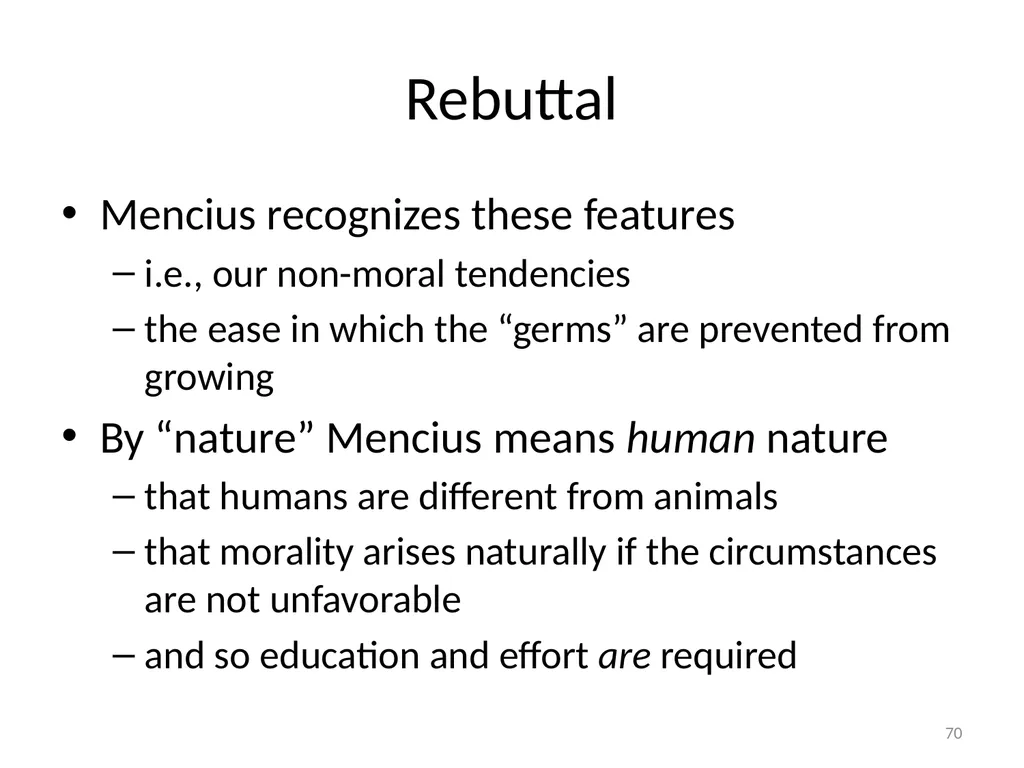
slide70. Rebuttal Mencius recognizes these features
i.e., our non-moral tendencies
the ease in which the “germs” are prevented from growing
By “nature” Mencius means human nature
that humans are different from animals
that morality arises naturally if the circumstances are not unfavorable
and so education and effort are required 70<br>
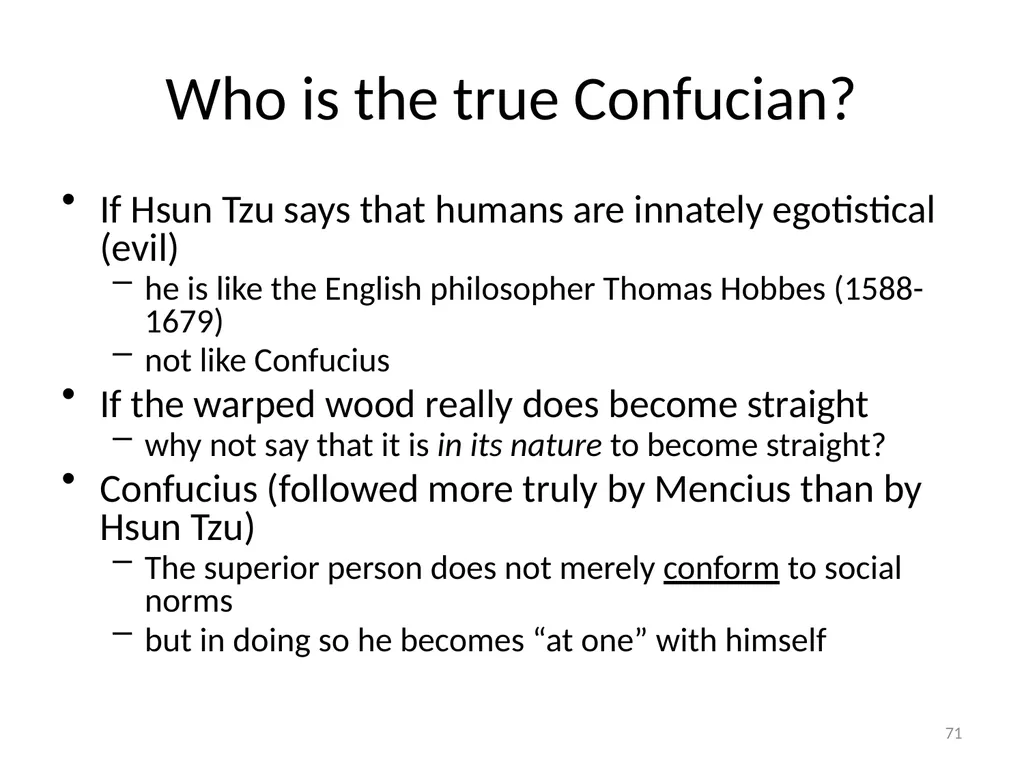
slide71. Who is the true Confucian? If Hsun Tzu says that humans are innately egotistical (evil)
he is like the English philosopher Thomas Hobbes (1588-1679)
not like Confucius
If the warped wood really does become straight
why not say that it is in its nature to become straight?
Confucius (followed more truly by Mencius than by Hsun Tzu)
The superior person does not merely conform to social norms
but in doing so he becomes “at one” with himself 71<br>
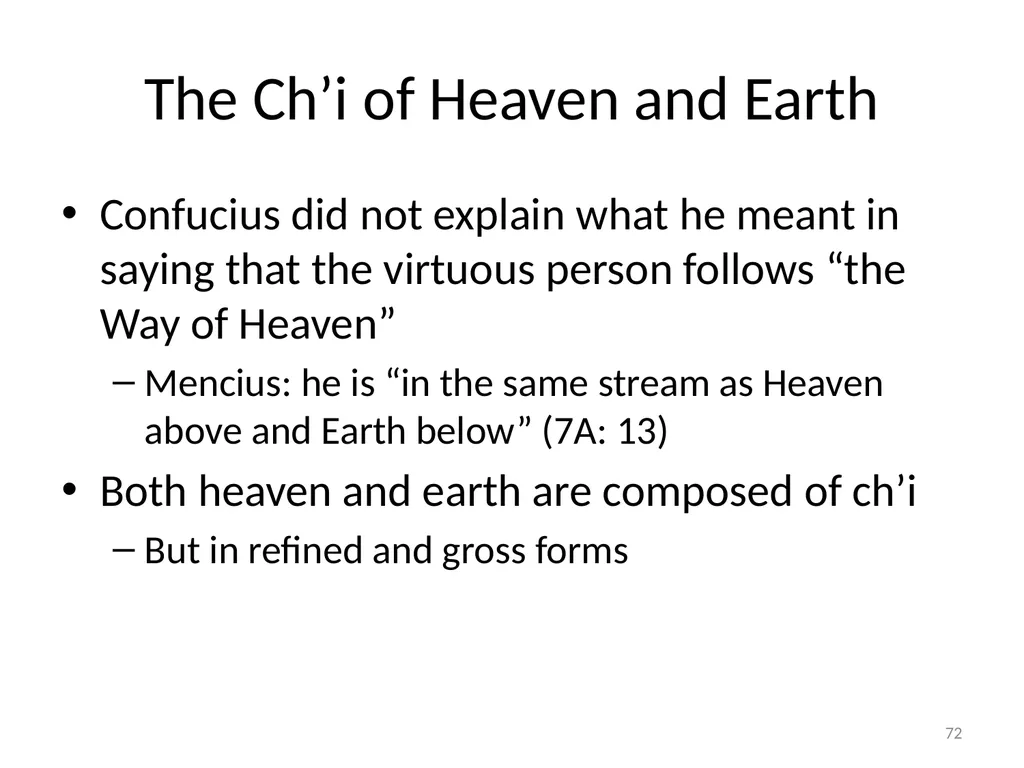
slide72. The Ch’i of Heaven and Earth Confucius did not explain what he meant in saying that the virtuous person follows “the Way of Heaven”
Mencius: he is “in the same stream as Heaven above and Earth below” (7A: 13)
Both heaven and earth are composed of ch’i
But in refined and gross forms 72<br>
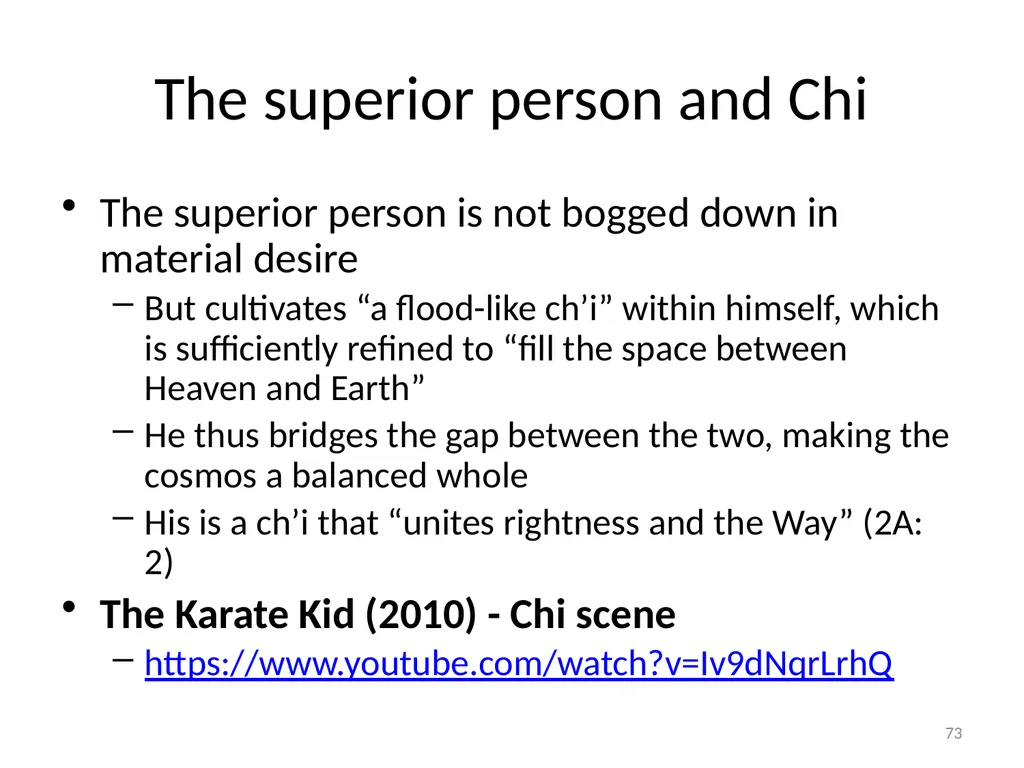
slide73. The superior person and Chi The superior person is not bogged down in material desire
But cultivates “a flood-like ch’i” within himself, which is sufficiently refined to “fill the space between Heaven and Earth”
He thus bridges the gap between the two, making the cosmos a balanced whole
His is a ch’i that “unites rightness and the Way” (2A: 2)
The Karate Kid (2010) - Chi scene
https://www.youtube.com/watch?v=Iv9dNqrLrhQ 73<br>
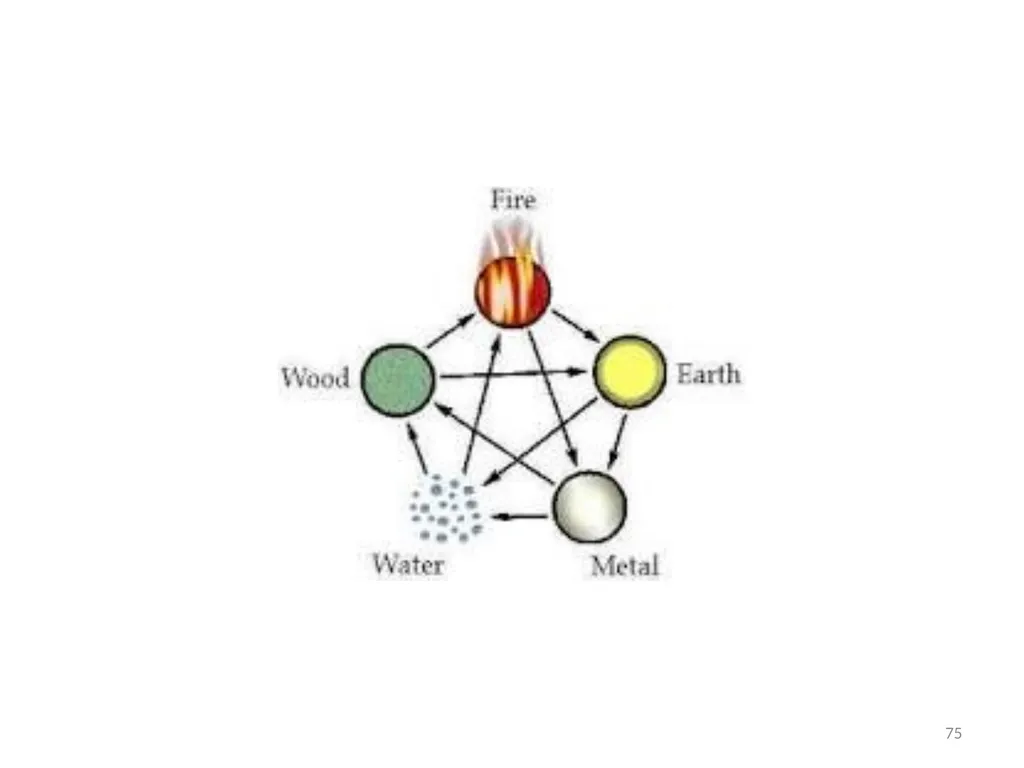
slide74. The five elements Later Han Confucians develop such cosmological theory
in the doctrine of the five elements
Heaven employs the five basic elements of earth such that
wood fuels fire
Soil or earth begets metal
Just as in human life
father begets son—and so bad parenting would be unnatural 74<br>
slide75. 75<br>
slide76. Correspondences of nature in human life Doctrine of systematic correspondences of the elements
applied to government (Tung Chung-Shu)
wood is the agent of the Minister of Agriculture
metal is that of the Ministry of the Interior
Because metal cuts down trees
It is the duty of the latter to punish corrupt officials in the former 76<br>
slide77. Yin and Yang “Heaven has the yin and the yang”
Tung Chung-Shu (179–104 BC): integrates Taoist ideas into Confucianism
Human nature is composed of
Congenital goodness (yang)
And natural emotions (yin)
And so “the self works in the same way as Heaven”
And the Ways of Heaven and man are one 77<br>
slide78. 78<br>
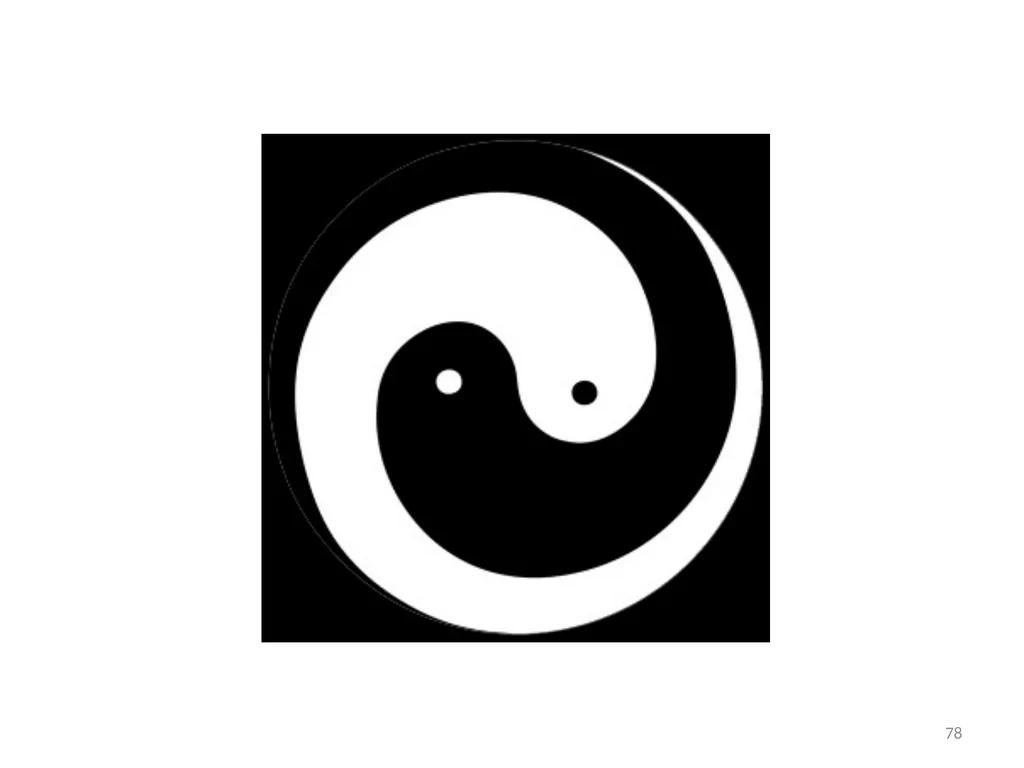
slide79. Men and Women In yin and yang the opposites are united
Yin: dark, feminine, soft, hidden
Yang: bright, masculine, firm, open
Hence men and women have need of one another
Shadow and brightness are interrelated
Unity of polarities:
creative interaction,
infinite process of transformation
This is intrinsically valuable and self-fulfilling 79<br>
slide80. Integrating human beings with the universe Yin and yang integrates human existence with reality as a whole
1) human psychology is subject to the same interplay as other forces of nature
2) an imbalance in human life reverberates throughout the world
An imbalanced ruler can cause floods
3) Humans should imitate the relations in Heaven
Heaven is primarily yang and blocks the infection by yin 80<br>
slide81. Blocking the infection of Jen The superior person blocks the infection of jen (yang) by inordinate desire (yin):
He “knows how to avoid injuring desire and yet to have a rest from emotion, and thus fit in with Heaven … prohibiting what Heaven prohibits.” (Tung Chung-Shu)
Not through intellectual understanding but through practical mastery of one’s life and emotions 81<br>
slide82. Taoism 82<br>
slide83. Appeal of Taoism Its doctrines appeal today to ecologists, feminists
Has a romantic image, lacking to Confucianism
Legends of Taoist sages spurning official positions sought after by Confucians
Lin Yutang (1895-1976):
Confucianism attracts “those who wear official buttons and those who kowtow to them”
But repels those who find this “too decorous, too reasonable, too correct,” who have “a hidden desire to go about with dishevelled hair … and bare feet” and so go to Taoism 83<br>
slide84. Tensions in China Expressing the tensions of
Town and country
Discipline and freedom
Reason and romance
Prose and poetry 84<br>
slide85. Reasons to hesitate 1) Confucius does not figure badly in Taoist texts
Chuang Tzu describes him as converting someone to Taoism
Sometimes the butt of jokes, but more often he figures as a wise man who misses the deepest truths
2) Many Chinese have embraced both Confucianism and Taoism
1) Confucianism when going to work
2) Taoism when back-packing in the mountains 85<br>
slide86. Common goals 3) Differences between Taoist thinkers re Confucius
Magical Taoists with demons, alchemy, quest for immortality (See film Crouching Tiger, Hidden Dragon, 2000) https://www.youtube.com/watch?v=KXIJv1NoXmo
Lao Tzu (author of the Tao Te Ching) is more sympathetic to Confucianism than Chuang Tzu
4) Both trends aim at
1) defining the Superior Person
2) showing a harmony with the Way (Tao) 86<br>
slide87. The Way in Taoism The Way (the Tao or Dao) is more central to Taoism
1) Not just the manner or direction in which Heaven and earth operate,
but the source of this operation
2) more is said about the Way
3) attempts to deduce proper human conduct from the features of the Way
Others give the impression of inventing a “Way of Heaven”
that corresponds to their prior commitment to certain ethical positions 87<br>
slide88. Lao Tzu and Chuang Tzu Two great Taoist figures
Lao Tzu supposed author of the Tao Te Ching
Possibly an invented figure, supposedly of the 6th c BCE
The Tao Te Ching: probably a 4th c compilation
Lao Tzu means “Old Master”
Chuang Tzu, author of the Chuang Tzu
Historical figure (c. 369-280 BCE)
An official
Author of the first 6 or 7 books of the Chuang Tzu (the “inner” chapters) 88<br>
slide89. Artificiality “All artificiality is false” – Chuang Tzu
The true man is not artificial
Artifice = social conventions, rules of etiquette, private property
i.e., much of civilized society
“Exterminate benevolence, discard rectitude” Lao Tzu (19)
Not moral nihilism: i.e., denying that one life can be better than others 89<br>
slide90. Forget knowledge Forget about knowledge and wisdom, and people will be a hundred times better off.
Throw away charity and righteousness, and people will return to brotherly love.
Throw away profit and greed, and there won't be any thieves. 90<br>
slide91. Keeping at the Center of the Circle These three are superficial and aren't enough
to keep us at the center of the circle, so we must also:
Embrace simplicity.
Put others first.
Desire little.
Tao Te Ching, 19: 91<br>
slide92. Losing the Way Not just a critique of excessive and oppressive performance of rites of Confucians
But the very existence of a moral code is a sign that things have gone wrong
That people have lost the Way
“The adoption of conventional ways has been the ruin … of primordial nature … the ruin of the world” (Chuang Tzu) 92<br>
slide93. Declining from the Way The kind person acts from the heart, and accomplishes a multitude of things.
The righteous person acts out of pity, yet leaves many things undone.
The moral person will act out of duty, and when no one will respond will roll up his sleeves and uses force. 93<br>
slide94. The outcome is Law When the Tao is forgotten, there is righteousness.
When righteousness is forgotten, there is morality.
When morality is forgotten, there is the law.
The law is the husk of faith, and trust is the beginning of chaos.
Tao Te Ching, 38 94<br>
slide95. Primitivism? What is the “natural” way of life?
Is it a call for primitivism, a return to a state of nature before civilization?
Imitate animals or natural phenomena
Imitate the gardener who refuses to use machines
Make ourselves like the uncarved block before it is sculpted 95<br>
slide96. Not advocating Tarzan But this idea is not adequate
It is possible to live naturally within advanced culture
Lao Tzu writes for the emperor
Skilled craftsmen can follow the Way
So it’s not advocating a Tarzan-like return to nature
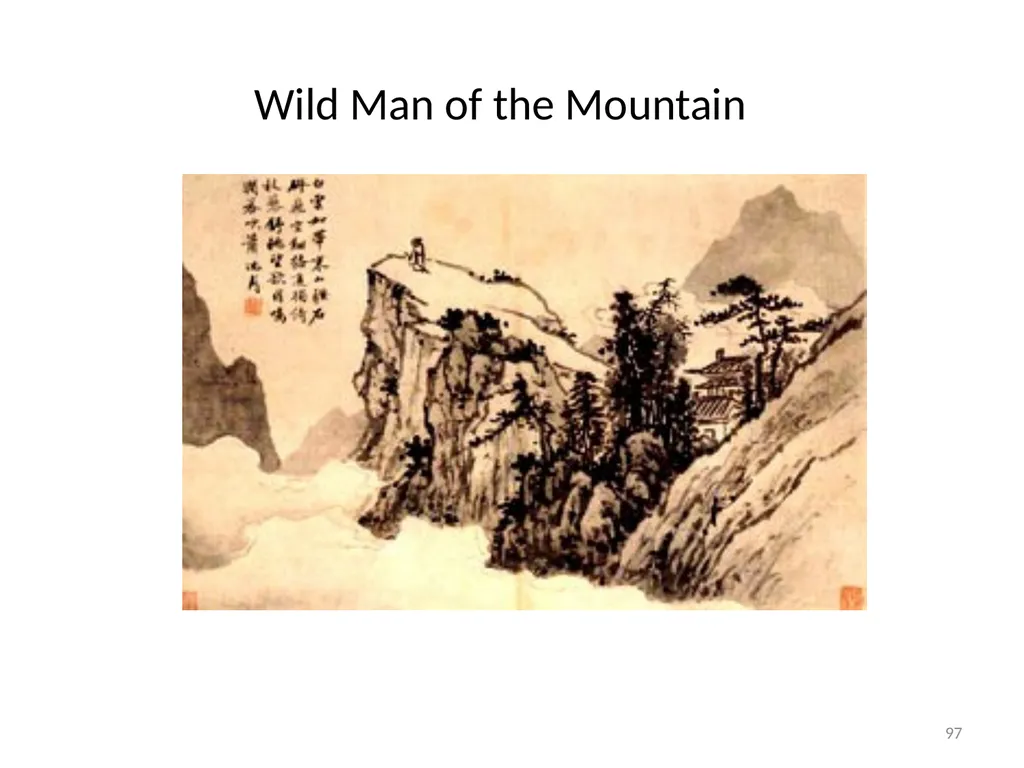
But there is admiration for “the wild man of the mountain” or the poetic wanderer 96<br>
slide97. Wild Man of the Mountain 97<br>
slide98. Cows, not tigers Not any natural animal
Grazing cows not hunting tigers
Rolling stream not exploding volcano
What is natural is what follows the Way
not a “state of nature” of self-interested individualism
What follows the Way is wu wei (non-action)
Be submissive
Weak
Feminine
Yielding 98<br>
slide99. Let yourself be The person of wu wei – the ideal human behavior, the way of the Way
“does not contend”
Her spirit is one of apathy, indifference, affable passivity
Like the swimmer who goes with the current
Or more fundamentally, like the water itself
“Because water excels in benefiting [things] without contending with them … it comes close to the Way.” (Lao Tzu, 8) 99<br>
slide100. Imitate water Like water, the Way influences “without dominating”
The Way is the source and sustainer of life
But does not interfere with it
“To let oneself be is to follow the Way.” Chuang Tzu (22e) 100<br>
slide101. Pragmatism Pragmatic advantages of wu wei in Lao Tzu
“the person who goes against the Way will come to an early end” (55)
by not contending “you will meet with no danger. You can then endure.” (44)
= a philosophy of survival during violent times?
Deeper truth: the power of “weakness”
“If you would take from a thing, you must first give to it. …
The submissive and the weak will overcome the hard and the strong” (36) 101<br>
slide102. Not cynicism, but natural law Not cynicism, not cunning strategy in hard times,
but natural truth, and a fact of social life
Laws of nature
Water finally dissolves the stone
Newton’s 3rd law: for every action there is an equal and opposite reaction. If you push against the stone, the stone pushes back against you.
Magnetism, electricity: equal forces repel one another; opposites attract 102<br>
slide103. Nations should be like women A large country should take the low place like a great watershed, which from its low position assumes the female role. The female overcomes the male by the power of her position. Her tranquility gives rise to her humility. If a large country takes the low position, it will be able to influence smaller countries. If smaller countries take the lower position, then they can allow themselves to be influenced. So both seek to take the lower position in order to influence the other, or be influenced.
Lao Tzu, 61 103<br>
slide104. Wu Wei For Chuang Tzu, wu wei
“Supreme contentment” (18a)
A resurgence of vitality (19a)
“non-action does not wear one out” (7f)
Alan Watts on Wu Wei
https://www.youtube.com/watch?v=LgZ73Lc5VS8 104<br>
slide105. The Dextrous Butcher Ting the cook was cutting meat free from the bones of an ox for Lord Wen-hui. His hands danced as his shoulders turned with the step of his foot and bending of his knee. With a shush and a hush, the blade sang following his lead, never missing a note. Ting and his blade moved as though dancing to “The Mulberry Grove,” or as if conducting the “Ching-shou” with a full orchestra.
Lord Wen-hui exclaimed, “What a joy! It’s good, is it not, that such a simple craft can be so elevated?” 105<br>
slide106. Ting laid aside his knife. “All I care about is the Way. If find it in my craft, that’s all. When I first butchered an ox, I saw nothing but ox meat. It took three years for me to see the whole ox. Now I go out to meet it with my whole spirit and don’t think only about what meets the eye. Sensing and knowing stop. The spirit goes where it will, following the natural contours, revealing large cavities, leading the blade through openings, moving onward according to actual form — yet not touching the central arteries or tendons and ligaments, much less touching bone. 106<br>
slide107. “A good cook need sharpen his blade but once a year. He cuts cleanly. An awkward cook sharpens his knife every month. He chops. I’ve used this knife for nineteen years, carving thousands of oxen. Still the blade is as sharp as the first time it was lifted from the whetstone. At the joints there are spaces, and the blade has no thickness. Entering with no thickness where there is space, the blade may move freely where it will: there’s plenty of room to move. Thus, after nineteen years, my knife remains as sharp as it was that first day.”
Chuang Tzu, Chapter 3 107<br>
slide108. Dream of a Butterfly Deeper ethical understanding in Chuang Tzu:
“perfect freedom”
Return to one’s “true being”
Versus his alleged “relativism” as in
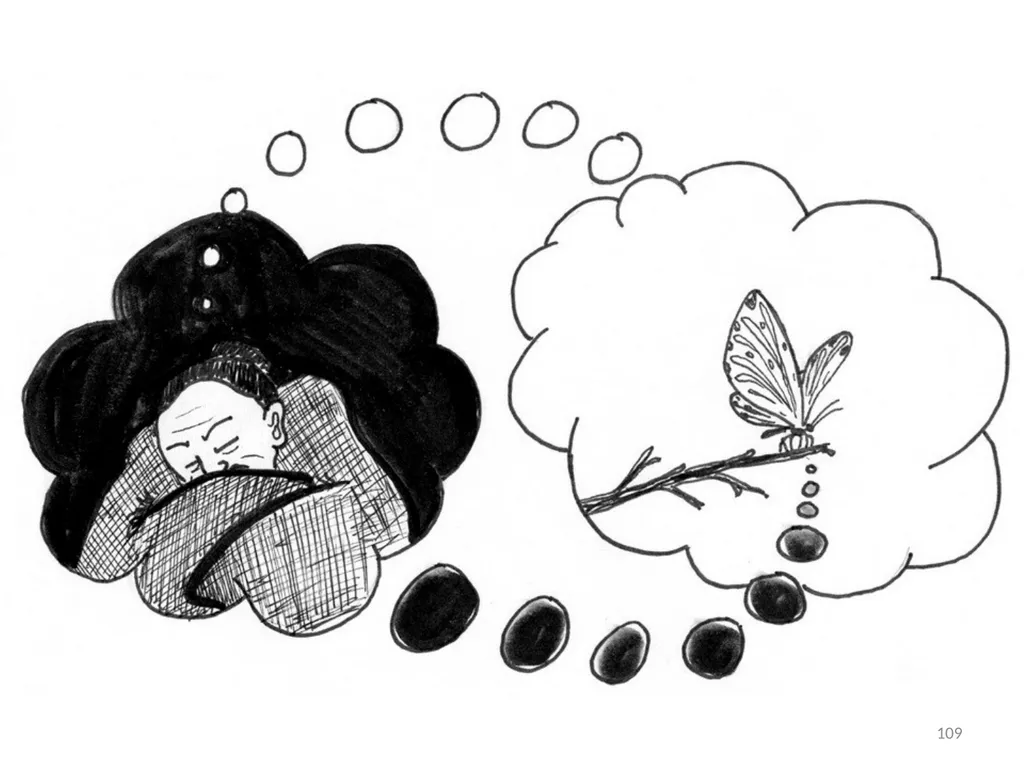
“Once upon a time, I dreamt I was a butterfly, fluttering hither and thither, to all intents and purposes a butterfly. I was conscious only of my happiness as a butterfly, unaware that I was myself. Soon I awaked, and there I was, veritably myself again. Now I do not know whether I was then a man dreaming I was a butterfly, or whether I am now a butterfly, dreaming I am a man.” 108<br>
slide109. 109<br>
slide110. Opposites are one Man or butterfly? What is the answer?
One or the other?
But opposites are one for Taoism
Difference from Lao Tzu re opposition of Yin and Yang
“heaven and earth are one, the yin and the yang are one, and likewise the opposed aspects of all contraries”
Since in reality “there is no contrast” it follows that “there is no distinction” either (2a) 110<br>
slide111. Arguments for this relativism But it is only “in an absolute sense” that there is neither great nor small, good nor evil
that “things are relative” (17a)
1) A person’s opinions change
How know that the 60th is any more correct than the 59th?
But this doesn’t show that no opinion is correct
2) Opposites quickly pass into one another: pleasure into pain, action into laziness …
But this supposes the opposites are real 111<br>
slide112. 3) What is great and good in one circumstance can be petty or evil in another
And so “there is no absolute morality, but only opportunist expedience” (17a)
But everybody agrees that the rightness of an action depends on circumstances
4) Appeal to linguistic relativism
“There is, in reality, neither truth nor error … nor other distinctions … There are only diverse aspects, which depend on the point of view” (2c)
Because all judgments are functions of language 112<br>
slide113. Immersion in language Things we ordinarily distinguish are
“designated by words to which nothing corresponds in reality” (2e)
Hence our distinctions are “no better than a clacking of hens” (2c)
Language is a practical device
tested by success of communication
not by accurate portrayal of reality
Since we are immersed in our language
it seems that we could never know reality outside of it 113<br>
slide114. Don’t impose your views on others but also don’t impose them on yourself Chuang Tzu does not provide arguments for defending this view
Perhaps because it was commonplace for Chinese thought
He focuses on the implications for human freedom and authenticity
Refusal to impose a language-relative perspective on other people
But also on oneself as well 114<br>
slide115. Against brain bashing From The Chuang-Tzu:
‘But to wear out your brain trying to make things into one without realizing that they are all the same—this is called “three in the morning.”
Recall Bertrand Russell on “brain bashing” 115<br>
slide116. “Three in the morning” ‘What do I mean by “three in the morning”? When the monkey trainer was handing out acorns, he said, “You get three in the morning and four at night,” This made all the monkeys furious. “Well, then,” he said, “you get four in the morning and three at night.” The monkeys were all delighted. 116<br>
slide117. Walking two roads ‘There was no change in the reality behind the words, and yet the monkeys responded with joy and anger. Let them, if they want to. So the sage harmonizes with both right and wrong and rests in Heaven the Equalizer. This is called walking two roads.’ 117<br>
slide118. Angry monkeys Story of the monkeys angry at getting three roots in the morning and four in the evening
But happy to get four in the morning and three in the evening
Our competing perspectives are no better than that!
We should neglect these distinctions
except for ordinary pragmatic considerations
not let them “penetrate the palace of the mind” (5e) 118<br>
slide119. Respect tradition, but … Respect the traditional concepts and traditions of the villages
But it would be wrong if the villagers thought these represented the Way
because they do not “extend to the affairs of other earthly beings” with different ways of “coordinating social interaction”
Recall Confucius:
Li: the external ways of acting, which differ for different relations
Jen: the inner moral force or spirit, which is expressed in these different ways 119<br>
slide120. Confucianism and Daoism: What is the difference? Confucius is focused on Morality
External behaviours (Li) are relative
But it is important to know them so as to relate to others in a way that expresses respect
The inner moral force is universal
Chuang-Tzu is focused on the nature of reality or Metaphysics
People’s ideas of what is true are relative
because of language, circumstances, etc.
Accept these differences
But reality (the Way, the Dao) is beyond these limited views:
Be aware of that too! 120<br>
slide121. The Way allows a variety of perspectives The Way allows for a variety of perspectives
So this laissez-faire attitude follows the Way
The Way influences everything
By making it possible to speak and think in cooperation
“whilst remaining indifferent” to particular schemes of speech and thought
without imposing anything 121<br>
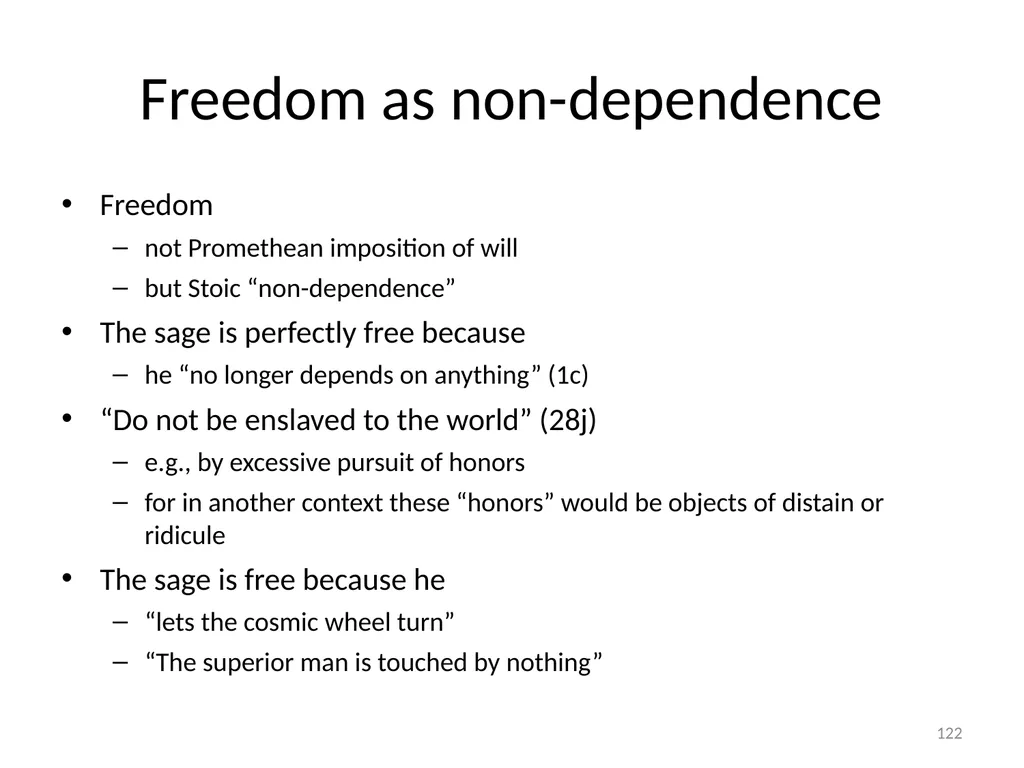
slide122. Freedom as non-dependence Freedom
not Promethean imposition of will
but Stoic “non-dependence”
The sage is perfectly free because
he “no longer depends on anything” (1c)
“Do not be enslaved to the world” (28j)
e.g., by excessive pursuit of honors
for in another context these “honors” would be objects of distain or ridicule
The sage is free because he
“lets the cosmic wheel turn”
“The superior man is touched by nothing” 122<br>
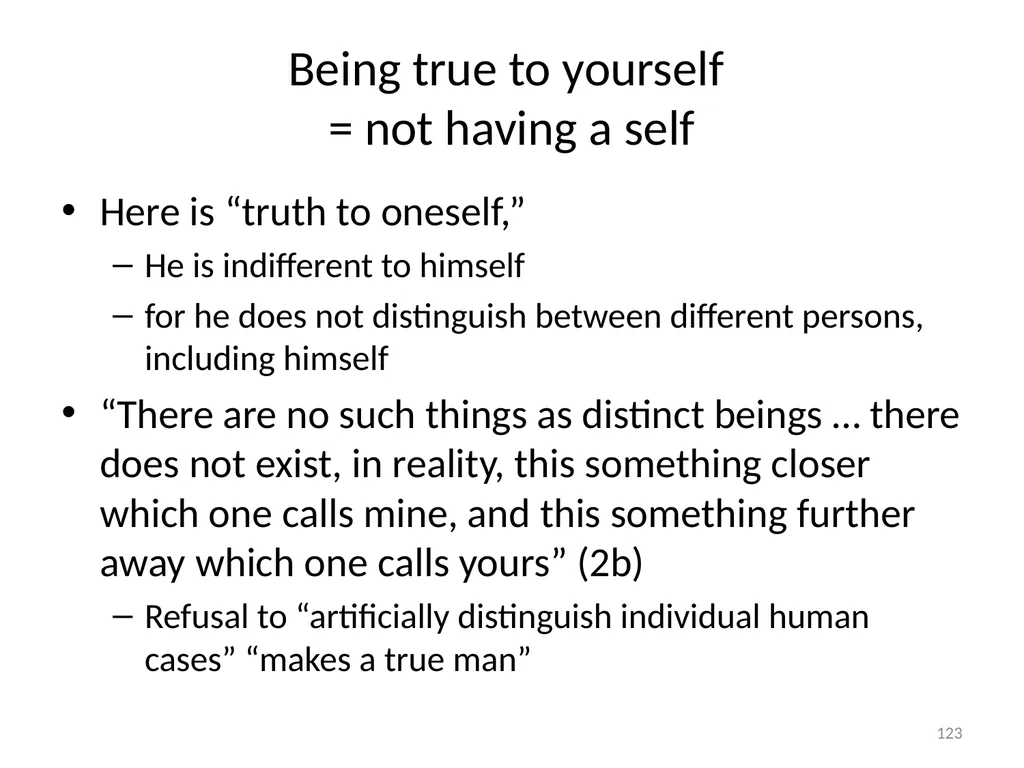
slide123. Being true to yourself = not having a self Here is “truth to oneself,”
He is indifferent to himself
for he does not distinguish between different persons, including himself
“There are no such things as distinct beings … there does not exist, in reality, this something closer which one calls mine, and this something further away which one calls yours” (2b)
Refusal to “artificially distinguish individual human cases” “makes a true man” 123<br>
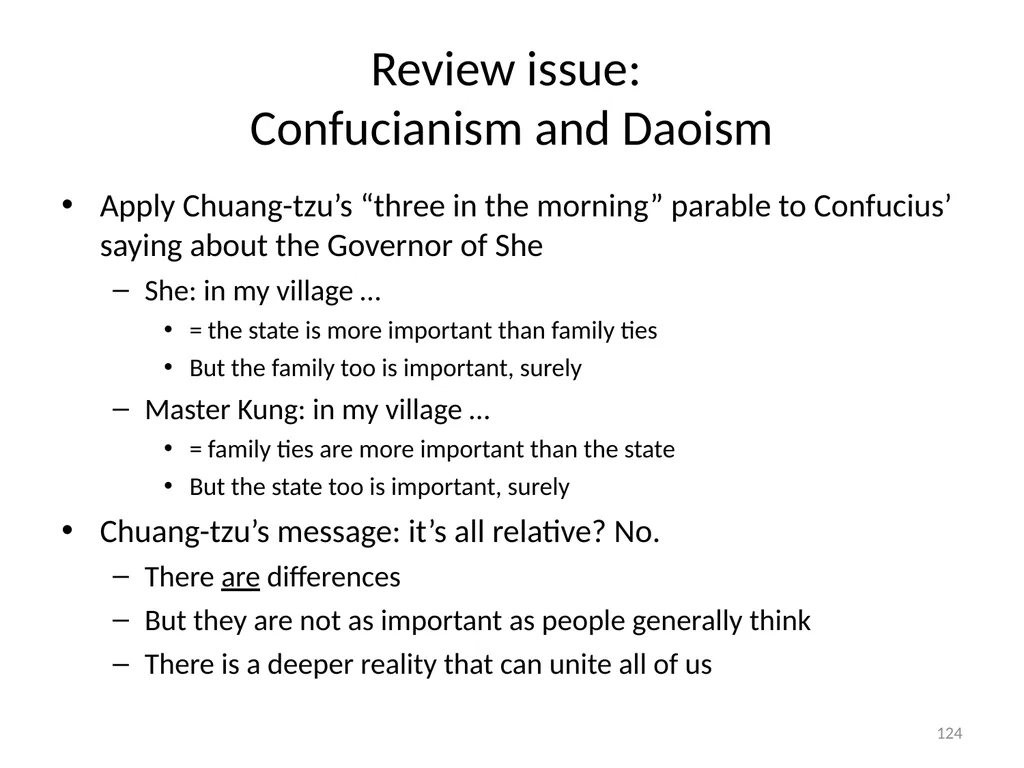
slide124. Review issue: Confucianism and Daoism Apply Chuang-tzu’s “three in the morning” parable to Confucius’ saying about the Governor of She
She: in my village …
= the state is more important than family ties
But the family too is important, surely
Master Kung: in my village …
= family ties are more important than the state
But the state too is important, surely
Chuang-tzu’s message: it’s all relative? No.
There are differences
But they are not as important as people generally think
There is a deeper reality that can unite all of us 124<br>
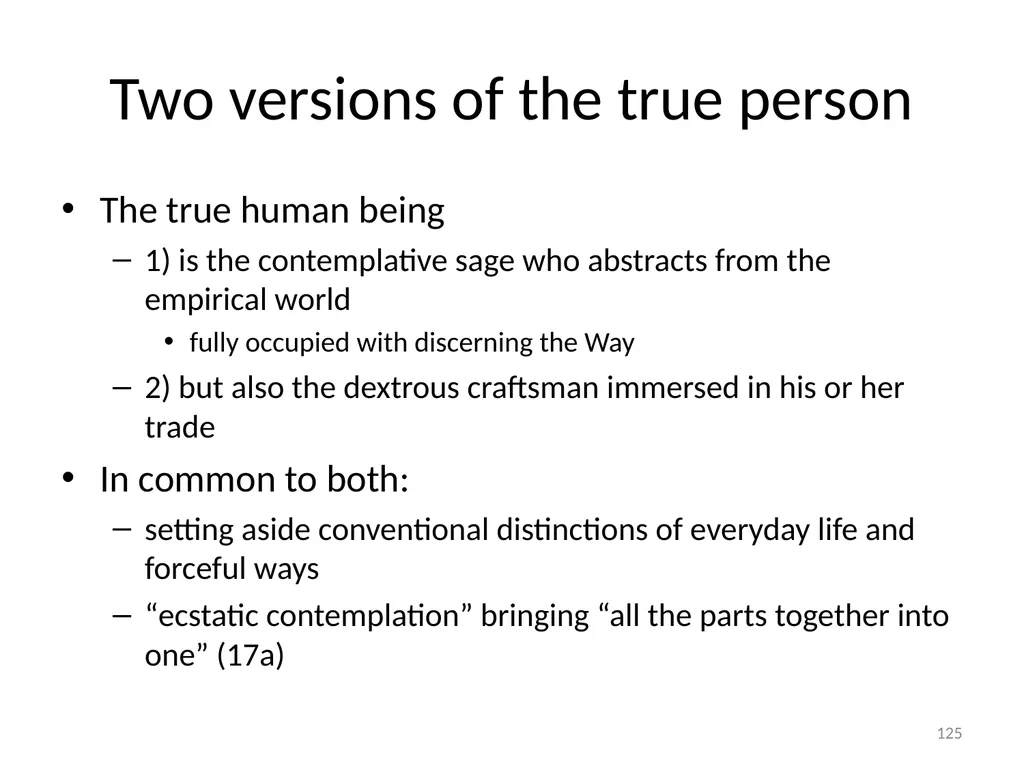
slide125. Two versions of the true person The true human being
1) is the contemplative sage who abstracts from the empirical world
fully occupied with discerning the Way
2) but also the dextrous craftsman immersed in his or her trade
In common to both:
setting aside conventional distinctions of everyday life and forceful ways
“ecstatic contemplation” bringing “all the parts together into one” (17a) 125<br>
slide126. Rising above artificial conventions or going beneath them The wood sculptor,
through the “fusion of [his] nature into one with that of the trees,”
loses all concern for himself and “even the notion of his own body”
How?
Through a vision that rises above the world of artificial distinctions
Or a practical immersion that takes him deeply into things 126<br>
slide127. What is the Tao? There is agreement of the Taoist Masters Lao Tzu and Chuang Tzu
1) It is not “the way of the world”
a tendency that things just have
2) It is the source of things
“the beginning of heaven and earth … the mother of the myriad creatures” (Lao Tzu, 1)
3) It is not a creator God, but it is “divine”
for it is “without substance” of its own
The Way “from which beings emanate cannot properly be called the author of these beings” (Chuang Tzu, 25j) 127<br>
slide128. Ineffability 4) The Way is ineffable
“The Way that can be spoken of is not the constant Way.” (Lao Tzu, 1)
“What is the good of looking for impossible terms to express an ineffable being?” (Chuang Tzu, 2e) 128<br>
slide129. Beginning of the Tao Te Ching The tao that can be described is not the eternal Tao. The name that can be spoken is not the eternal Name. The nameless is the boundary of Heaven and Earth. The named is the mother of creation. 129<br>
slide130. Darkness is the beginning of all Freed from desire, you can see the hidden mystery. By having desire, you can only see what is visibly real. Yet mystery and reality emerge from the same source. This source is called darkness. Darkness born from darkness. The beginning of all understanding.
Tao Te Ching, 1
Darkness: male or female? 130<br>
slide131. Why is the Tao ineffable? 1 Disagreement of the Taoist masters over why the Tao is ineffable
Lao Tzu:
For every property, X, there is also non-X
The Tao is the source of both
So if it were X, it would not be non-X
Hence the Tao cannot be described by any one of the properties of things
The names of language always describe one property as opposed to another
Hence the Tao cannot be named 131<br>
slide132. Why is the Tao ineffable? 2 For Chuang Tzu the ineffability is a consequence of his “linguistic relativism”
All the properties of the world are imposed on it by means of our linguistic conventions
But if the Way has any features, these would really belong to it
and not merely be ascribed to it by our human conventions 132<br>
slide133. Non-being, not a being Asking what is the Way
with which the sage and the craftsman are acquainted
prepares us to think of the Way as some kind of thing or being
although a very special “deep” kind of being
The masters however speak in negatives:
non-being, void, empty, between being and nothing 133<br>
slide134. Perhaps it’s just living free from the social conventions Alternative interpretation: Perhaps our thought is taking the wrong way around this issue
We think of the Way as what explains the wisdom of the sage or the skill of the craftsman
But instead perhaps we should think that the Way just is these matters:
It just is the abstracted state of the sage
Or the immersed activity of the craftsman 134<br>
slide135. Reducing the Way to being free of conventions Both have set aside everyday distinctions
rising above them
or going below them by fusing with things
Following the way just reduces to living free from the conventions,
the linguistic and conceptual schemes of everyday social business 135<br>
slide136. Why “the Way”? But the Taoist says more than this:
The Tao is the source of things
It confers on them their destiny
It is a mystery
But why is this mystery called the Way?
And not the One, the Absolute, Pure Being, etc. 136<br>
slide137. The Way that gives all ways Martin Heidegger: “tao could be the way that gives all ways”
I.e., it gives all the perspectives and conceptual schemes
And so gives or allows the emergence of the objects spoken of through these schemes
But then this source could not even be spoken of
because all the terms come from within these conceptual or linguistic schemes
and so do not provide access to their source
And yet the Taoist Master does speak about the Way
How is this possible? 137<br>
slide138. Chuang Tzu: vibrating with the harmony in all beings “I have spoken without art, naturally, according to the impulse of my inner sense … Preliminary to all discourses, there pre-exists an innate harmony in all beings, their nature. From the fact of this pre-existing harmony, my speech, if it is natural, will make others vibrate, with few or no words.”
Chuang Tzu 27a 138<br>
slide139. Natural speech 1) There may be a form of speech that is a natural response to the world
2) This speech communicates by vibration
not by informative propositions
3) Such natural speech need not be verbal, for it can be “spoken without words”
more like music 139<br>
slide140. Letting things be 1) The various perspectives or ways we talk about things
and so the things talked about
presuppose a source or ground: the Way
2) These ways of talking are pragmatic devices
but people mistakenly think they are accurate representations of reality
3) There is another kind of speech
less imposing
a natural response to things in accord with their essence or destiny
letting things be what they essentially are 140<br>
slide141. More than setting aside convention It is not just a matter of setting aside conventions
but a quiet and patient readiness
to fit one’s words and actions to the world
to vibrate with the pre-existing inner harmony
This is the essence of wu wei 141<br>
slide142. The Two Ways of the Way Two possibilities for following the Way
The simple words of the sage
“without art”
“perceived spontaneously” to be “fitting”
The way of the craftsman
or the swimmer who follows the current
Speech “without words”:
acting on things without contending with them or imposing on them
An easy response to one’s materials or environment that anyone “with a natural sense of right and wrong” can see at once to be “fitting”
https://www.youtube.com/watch?v=2xDzVZcqtYI 142<br>
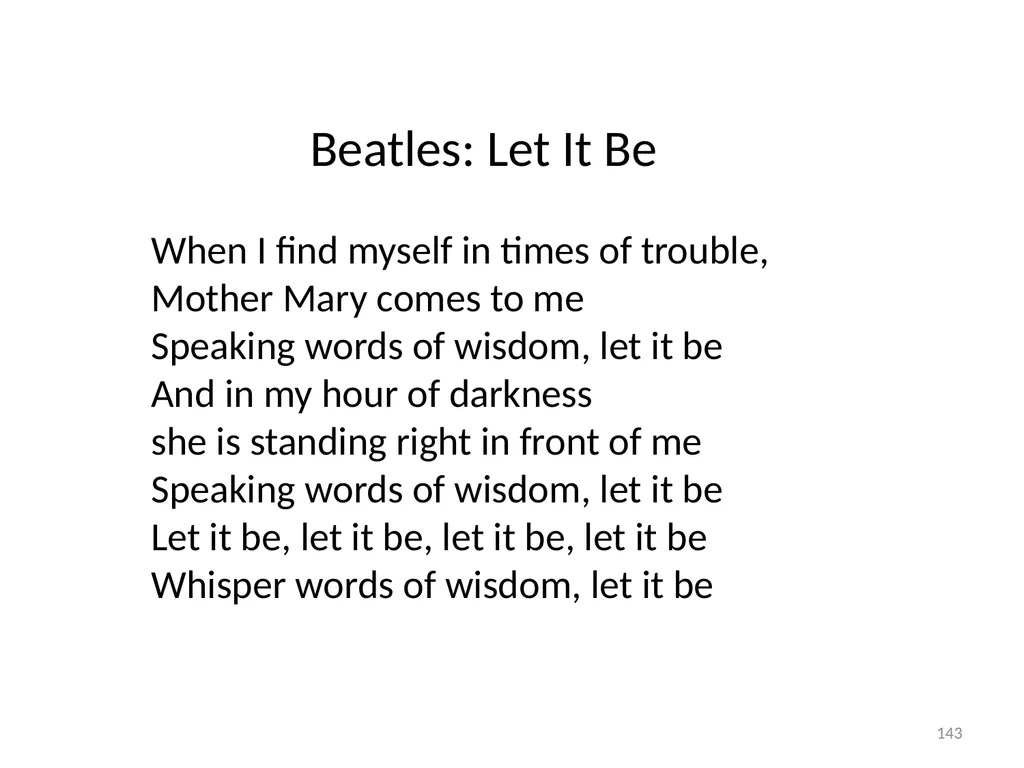
slide143. Beatles: Let It Be
When I find myself in times of trouble,
Mother Mary comes to me
Speaking words of wisdom, let it be
And in my hour of darkness
she is standing right in front of me
Speaking words of wisdom, let it be
Let it be, let it be, let it be, let it be
Whisper words of wisdom, let it be 143<br>
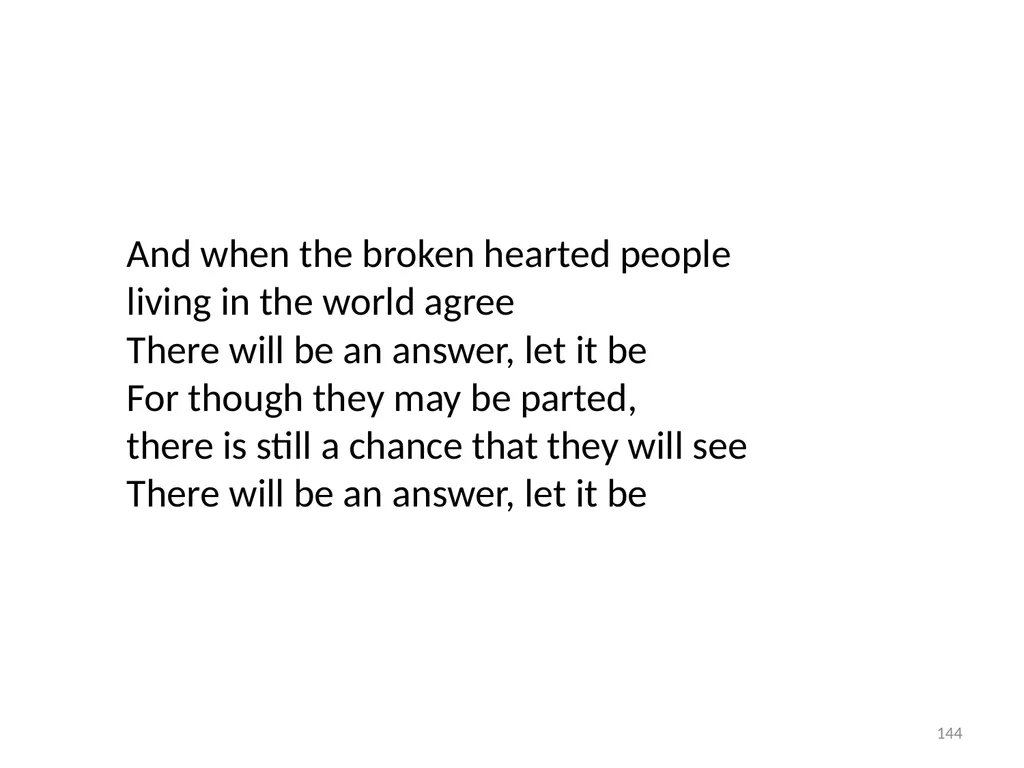
slide144. And when the broken hearted people
living in the world agree
There will be an answer, let it be
For though they may be parted,
there is still a chance that they will see
There will be an answer, let it be 144<br>
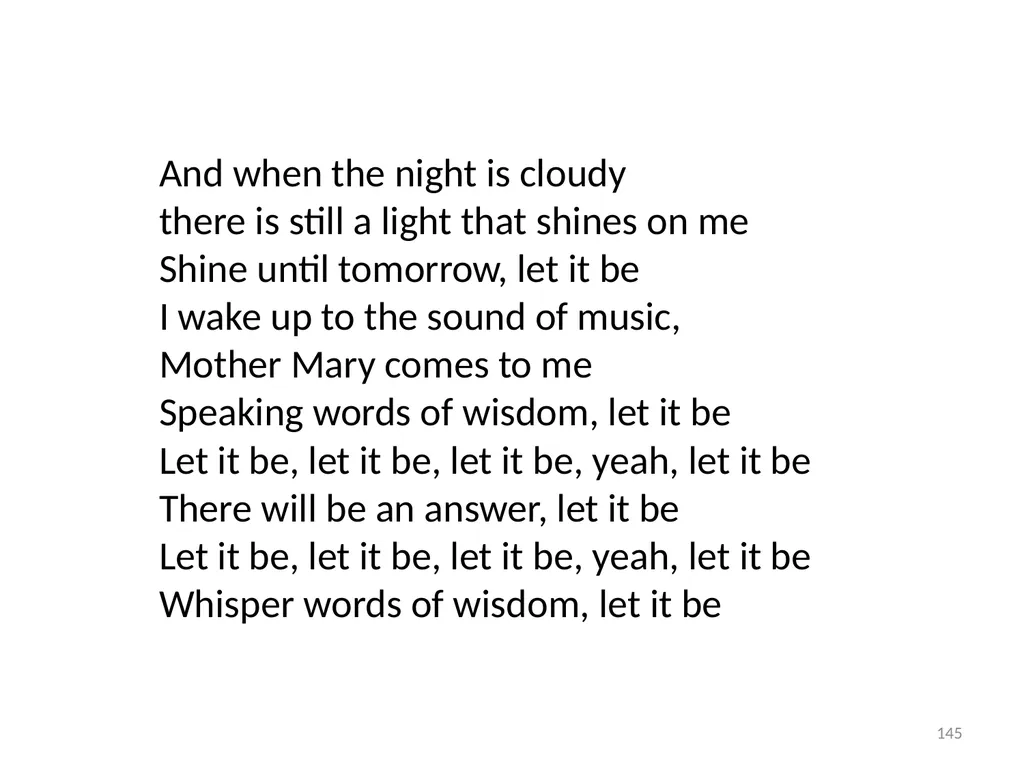
slide145. And when the night is cloudy
there is still a light that shines on me
Shine until tomorrow, let it be
I wake up to the sound of music,
Mother Mary comes to me
Speaking words of wisdom, let it be
Let it be, let it be, let it be, yeah, let it be
There will be an answer, let it be
Let it be, let it be, let it be, yeah, let it be
Whisper words of wisdom, let it be 145<br>
slide2. Two Approaches to Society “The Governor of She said to Confucius, ‘In our village there is a man nicknamed ‘Straight Body’. When his father stole a sheep, he gave evidence against him.’
Confucius answered, ‘In our village those who are straight are quite different. Fathers cover up for their sons, and sons cover up for their fathers. Straightness is to be found in such behaviour.’” (Confucius, Analects, XIII, 18) 2<br>
slide3. Conflict in China: Family or State? The Governor of She: the State, the Law is primary
Confucius (551-479 BCE) : the Family is primary 3<br>
slide4. Why Confucianism in China? Confucius defends primacy of family, kinship
Praises Sage kings of Xia dynasty (2205-1766 BCE)
Confucius’ birth: 551 BCE
Xia precedes the hereditary monarchy and the sharper inequalities of Shang (1766-1122 BCE)
Confucius refers to a time that is closer to early kinship egalitarianism
No hereditary monarchy with the early Xia
Confucius: return to the time before “the Fall” 4<br>
slide5. Kinship tradition of China versus Greek anti-traditionalism > reflects ancient Chinese kinship tradition of over 1700 years before Confucius
Traditionalism of Confucius: find the truth, the core values, in the tradition—but at its ideal starting point
Socrates rejects the rule of tradition
He “corrupts the youth,” by demanding that we rethink everything for ourselves, not accept what the elders say
Reflects Greek overthrow of old kinship order
Confucius’ referral to early tradition provides ethical corrective for corrupt states 5<br>
slide6. Historical Timeline 1) Early hunter-gatherers— paleolithic age
120,000 years of homo sapiens (sapiens sapiens?)
2 million years of homo habilis (stone tools)
2) Revolution 10,000-8000 BCE – begins neolithic age
Herders and simple agriculturalists
Transitional stage
3) Revolution 3,500 BCE
rise of hierarchical state societies (complex agriculture)
Time of the “Fall” (see Book of Genesis) 6<br>
slide7. 1) Separation from Nature 1) Mode of life of hunter/gatherers
Appropriation of nature
Dependence on independent nature
Unity with nature
2) Mode of life of herders, simple agriculturalists
Human transformation of nature
3) Hierarchical states control nature: irrigation
Transformations of societies: rich and poor 7<br>
slide8. Evolution of material creativity 1) Change nature into tools (for hunting, gathering)
2) Transform nature with tools (for herding, simple agriculture)
3) Intensified domination of nature (e.g., the animal drawn plow)—Civilization
NB: Non-biological changes, outside the human organism 8<br>
slide9. 2) Separation from Each Other 1) Equality of hunter-gatherer societies
Kinship-based society: natural relations
Leaders democratically chosen, elders
Exogamous marriage: unites the small bands into larger tribes
Gender differences but equality of status: no power of men over women
2) Herders, simple agriculturalists
Male dominance among herders, but no state: Hebrew God is male
Goddess religions among early agriculturalists (male and female gods) 9<br>
slide10. Rise of Inequality 3) Hierarchical Middle-Eastern state society
Sharp class divisions; slavery (separation from tools!)
Hereditary rulers over the people
Subordination of women to men 10<br>
slide11. Oneness with Nature/God Religion of hunter-gatherers: animism
Divine in nature
Harmony of divine and human
Cave paintings: Why deep in caves?
Cave as uterus of world; Earth Mother (Gaia)
Shamanism: humans participate in creation
=Oneness of humans with “God”
Genesis: Adam and Eve walked with God in the Garden of Eden 11<br>
slide12. 12<br>
slide13. “Natural” (kinship) society Technological dependence on independent nature:
Animals (hunting, men)
Plants (gathering, women)
Kinship as natural unity of people
Religion of nature – animism
Not passive, active: participation with/in divine
Symbolic exchange between humans and gods, not domination of gods over humans 13<br>
slide14. 14<br>
slide15. Shamash and Hammurabi Which is which? (Spodek, 59)
Gods look like kings (and vice versa)
Separation of ruler from ruled
Separation of divine from human
God-given laws cement human divisions
Rich and poor
Men and women 15<br>
slide16. Historical “fall” (summary) On technological level
from dependence on independent nature
to control over nature
On social level
from family-based, egalitarian society
to class-based, male dominant society
rulers are all powerful
On consciousness level
Animist oneness > Gods/priests/kings are all powerful ruling over the common people 16<br>
slide17. Neo-Kinship Society of China One clan group conquers others
Contrast with Western model: internal warrior, like Gilgamesh,
breaks with clan democracy, imposes his own rules: “law,” legalism
Head of clan > king of society
Kinship + hierarchy
= Kinship system adapts to civilization
Kinship is not replaced by legal order 17<br>
slide18. Early ancestor worship Father of family is “priest”:
mediator with Heaven
The “gods” include great grandmother!
i.e., not alien, arbitrary rulers, as in the West
Religion = ritual exchange between living and spirits of the dead
=> a religion of kinship
Also in nature: Heaven and the Earth as cosmic father and mother 18<br>
slide19. Ideology of the Good Father With neo-kinship hierarchy, the King is regarded as the Father of all his people
Not literal kinship but metaphorical
However, ethnic appearance, culture, language is similar 19<br>
slide20. Legalism in the West Socrates’ discussion with the Laws in Crito
The Laws say: “Are we not, first, your parents?”
= Platonic resolution of the conflict of Antigone
Antigone defends the tradition of the family—she wants to bury her brother as the old order requires
The King however decrees a law forbidding this
He puts himself above the ancient kinship order
> Further developed in Roman Cosmopolitan law
Expressed in Stoic obedience to divine Law 20<br>
slide21. Historical Expression of this Conflict in China Confucius 551-479 BCE
Period of Warring States: 481-222 BCE
Qin dynasty unites China: 221 BCE
Qin Shi Huangdi “The First Emperor” (See movie “Hero”)
Adopts Legalism; burns books of Confucius
Han revolution 202 BCE
Peasant leader: Liu Bang (died 195 BCE)
> Han rulers adopt the philosophy of Confucius
How long did the Qin (Chin) dynasty last? 21<br>
slide22. Long Duration of Chinese Empire Legalist Qin 221-202 BCE (19 yrs)
Confucian Han 202 BCE to 220 CE (422 years)
Period of disunity (361 years)
Chinese empire reunited by Sui (581- )
Minor interruptions (esp. 1916-49)
over 1300 years!!
Confucian teaching, education of bureaucracy continues throughout this entire period
Persistence of the family-based outlook 22<br>
slide23. 1 The Character of Chinese Philosophy 23<br>
slide24. Character of Confucian philosophy Remarkable continuity of Chinese philosophy
Confucius (551-479 BCE) refers to the Duke of Chou (about 1100 BCE) who defended “the mandate of Heaven”
The ruler has a right to rule from Heaven
But only as long as he exercises virtue and cares for the people
Official Chinese philosophy to the end of the last dynasty in 1911
Hence, the practical and humanistic character of Chinese philosophy
On the nature of Western philosophy, a Chinese host told Bertrand Russell:
So much “brain bashing” was bad for the liver
A sensible man would prefer to sit by a river and listen to bird-song 24<br>
slide25. Different summaries Hegel summed up Chinese philosophy:
While for Indians everything has a dreamlike spirituality
for the Chinese “everything that belongs to Spirit – morality, … inward religion, science and art – is alien.”
More temperate view:
Chinese philosophers are interested in human needs, the improvement of government, morals, and the values of private life
Not abstract “brain bashing” that serves no useful purpose 25<br>
slide26. Meanings of humanism Humanism here is not meant as
Renaissance humanism: rediscovering the classics of earlier Greek and Roman thought
Not a belief in the glories of the human being
Hsun Tzu: “man’s nature is evil”
Not a human-centered universe
In which nature exists for the sake of humans
Or the belief that the world is a construct of human thought 26<br>
slide27. This-worldly goals Humanism = not God-centered
Chinese philosophers did not believe a God created the world, Who is the source of value and purpose
Belief in spirits, demons, gods, but these are not creators or moral legislators
The goals of life are this-worldly
Not based on rewards in the afterlife
No transcendence of ordinary world—no “liberation” from material selves
Goal of philosophy:
Reflect on these human goals
And the right means of attaining them 27<br>
slide28. Practical philosophy “Practical philosophy”:
ethics,
and examination of how people ought to act, think, or feel
This is true also for India (Shankara, 7th CE) and Greece (Plato, 4th BCE)
For early Confucian philosophy, with its practical orientation, there is no need for speculation on
the reality of the world: this is obvious, taken for granted
the relation of mind and body: our minds centered on the world
the identity of the self: our selves are tied up with others
Such reflection is necessary in Shankara and Plato for practical philosophy
Can we explain why this is so? 28<br>
slide29. Classics The main early works
The Analects of Confucius
Little here about the ultimate nature of the universe
The Tao Te Ching of Lao Tzu is more elevated
The Tao or Dao: an ineffable source of Heaven and Earth
Writings of (Confucian) Mencius and (Taoist) Chuang Tzu
contain considerable speculation re innate knowledge, relativity of truth
The I Ching (Book of Changes): book on divination and cosmological speculation 29<br>
slide30. Why the practical orientation? Hence a greater emphasis in Chinese philosophy on the practical,
as opposed to the abstract theoretical
But why?
1) Historical climate: period of warring states?
But in Europe, the Thirty Years War after the French Revolution, produced great speculative philosophy (e.g., Hegel) 30<br>
slide31. Role of Language 2) Chinese language is ideographic
Characters are pictographic, and not abstract as are alphabets
So the reader feels more connected to the sensible world
3) Lack of inflection of the Chinese language
Inflection: the modification of a word to express different grammatical categories such as tense, case, voice, aspect, person, number, gender, and mood.
Hence seeing the world in terms of abstract categories parallel to those of language: thing, quality, past, etc.
Hence the illusion of looking directly at concrete reality through the mirror of language 31<br>
slide32. Chicken-and-egg Sapir-Whorf hypothesis: determination by language, by grammar of conceptual categories
Chicken-and-egg problem: maybe the Chinese mind preceded the language
But “influence” of language is too weak, “determination” by language is too strong
implying impossibility of abstract thinking
Hence: let language play its role in restricting the appetite for metaphysical flights
But look elsewhere too 32<br>
slide33. Alienation and Harmony Idea of India: philosophy is inspired by a sense of alienation from the world, the natural world as a foreign “other”
Recall: Human labor transforms nature: the Biblical fall from a Garden of Eden
And so India develops philosophies to dispel that sense
But the Chinese feel in “harmony with the cosmos,” at home in the world from the beginning
Hence no need to unmask the alienation as an illusion (India)
Or to provide a rational foundation for it (Greece) 33<br>
slide34. Role of philosophy Role of philosophy in this case:
Elaborate in various ways this sense of harmony, maintaining, enhancing the harmony
Or recovering it if it is lost
But this pushes the explanation back further:
Why did this vision of harmony prevail, by contrast with India or Greece?
See larger historical context above
Few attempts to articulate systems of theoretical knowledge
not because of lack of interest in or knowledge of such theory
but because of a reasoned depreciation of its value 34<br>
slide35. Affective knowledge 1) Affective knowledge
“hsin” or “mind” = heart-mind, or thinking heart
No separation of mind and heart, knowledge and “mere” passion or subjective feeling
Mencius: we know our duties through a sense of shame that certain actions inspire
Wisdom: not through construction and testing of theories
“What a person knows without having to reflect on it is what he truly knows.” 35<br>
slide36. Know-how 2) Primacy of “know-how”
Not “knowing that” of propositional knowledge: the hammer is made of wood and steel
Knowing how to cook, use a hammer: not a matter of following a recipe
Confucius: moral knowledge is of the Mean, a flexible balance between excess and defect
Not an abstract formula, but a matter of know-how
Chuang Tzu: knowledge of the Way (the Tao): easy, unforced behavior that “goes with the grain” of the Way 36<br>
slide37. Tai Chi Tai Chi by a Shaolin Monk in Nature
https://www.youtube.com/watch?v=skj69i5usgI
Recall Bertrand Russell’s conversation in China:
So much “brain bashing” was bad for the liver
A sensible man would prefer to sit by a river and listen to bird-song
And perform Tai Chi! 37<br>
slide38. Ineffability 3) Ineffability of practical knowledge
Chuang Tzu:
The wheelwright’s knowledge: “a knack that cannot be explained”
“Those who know the nature of things do not try to explain it in words; and those who try, show thereby, that they do not know.”
George Bernard Shaw: Those who can do; those who can’t teach. 38<br>
slide39. 39<br>
slide40. Theoretical knowledge interferes with practice Where knowledge matters most
it is an illusion to suppose that any adequate theory can be constructed
Such knowledge, regimenting the practice, would interfere with the effortless practical mastery that is required 40<br>
slide41. Not “the view from nowhere” The theoretical stance puts one at a distance from the world
Disengagement required by physics or metaphysics
Take stock, analyze, regiment, impose coherent structure
Ideal “view from nowhere” required
The knowledge that really counts belongs to the engaged person
who is integrated in the theater of action 41<br>
slide42. Levels of harmony Hence harmony with the cosmos and depreciation of theoretical knowledge are not separate ingredients of Chinese thought
Another mode of knowing is required, a style of harmonious engagement with the world
Levels of harmony
Within the self, family, and society
Between heaven, earth, and people
Balance between negative and positive of yin and yang
Correspondences between “the five elements” and their human analogues
Adaptation to “the Way,” the Tao 42<br>
slide43. World-Historical Context Bringing in the earliest condition of the first human beings
supplements these explanations in the Cooper text
China is the developed civilization whose culture and philosophies are the oldest, and so remain closest to
the ancient animism: “spirit” is all around us in the material world
the family-oriented kinship society of the beginning
What can we learn from Chinese philosophy? 43<br>
slide44. Confucianism 44<br>
slide45. Stages of Confucianism Most influential of all philosophers
2000 years’ teachings that influenced the most populous country in the world
1) Simple, popular teachings of the master
2) Elaborated with more theoretical context
by Mencius and Hsun Tzu
3) Complex elaborations to incorporate other theories
Neo-Confucianism 45<br>
slide46. Biography Confucius, latinization of “K’ung Fu Tzu” = Master Kung 551-479 BCE
Unsuccessful advisor to rulers
Resigns in disgust with the ruler
Wanders from state to state, gathering disciples
Confident in the rightness of his ideas: “If anyone were to employ me, in a year’s time I would have brought things to a satisfactory state.” (Analects, XIII, 10) 46<br>
slide47. Analects Analects: short sayings compiled by his students
Advice to rulers
Moral tales
Comments on his person
Nuggets of moral philosophy
Sceptical silence about metaphysical matters (Is there an afterlife?) 47<br>
slide48. Fall from favor He was considered the patron saint of the European Enlightenment
But soon lost this prestige
Hegel says his teachings are mediocre
“Commonplace and unexciting” (contemporary author)
20th century rejection by Mao Tse-Tung and leftist radicals in China 48<br>
slide49. Misconceptions Misconceptions about Confucius that are unsympathetic to our contemporary beliefs:
Conservativism
His nostalgia for the past sage king of the 12th c BC
His alleged insistence on rigid performance of rituals and customs
Especially those connected to “filial piety”
Extreme cultivation of “Virtue”
Devotion to public service
Out of favor with contemporary criticism of politicians
In our individualistic society, we tend to prefer the romantic individualism of the Taoists 49<br>
slide50. Today’s governments have lost the Way He was a conservative: “I am for the Chou” (III, 14)
The glory days of this famous dynasty
Contrasted with corrupted practices of the present
Current governments have declined from this time
“those in authority have lost the Way and the common people have, for long, been rootless” (XIX, 19)
The earlier days were more favorable to the “chun tzu” – the “gentleman” or “superior person”
Hence, this is a critical philosophy
Not “conservative” in the sense of accepting the status quo 50<br>
slide51. Importance of the rites (li) Li: social duties and customs
“Unless a man has the spirit of the rites (li) … he will wear himself out … become unruly, intolerant.”
They provide disciplined channels through which the chun tzu is able to put his morality into practice (XV, 18)
Mencius: they are “exit gates”
Without them we are locked up inside ourselves, with no way to express our inner side (jen),
There would be no point in being “on the Way” because there would be no where to go [5(B), 7] 51<br>
slide52. From family to larger society Rites of filial piety provide such channels or exit gates
But also, “when mourning for one’s parents a man realizes himself to the full” (XIX, 17)
This sets an example of unselfish behavior for others to follow, inspiring a disinterested urge to lead the moral life
The Great Learning:
moral example is set within the family
And from there spreads throughout the larger society 52<br>
slide53. One’s public duty The same for duties in public life
The chun tzu (virtuous or superior person) “takes office in order to do his duty” even without personal benefit (XVIII, 7)
In such disinterested action he behaves in accordance with the “basic stuff” (chi) of his humanity
Such virtue “is like the wind; the small man’s virtue is like grass. Let the wind blow over the grass and it is sure to bend” (XII, 19) 53<br>
slide54. Confucian Golden Rule Hence Confucius is not trying to justify the status quo
But to bring about the re-emergence of the chun tzu
The chun tzu:
Guides his behavior by the Confucian version of the Golden Rule: “Do not impose on others what you yourself do not desire” (XII, 2)
the exercize of “jen” 54<br>
slide55. Jen and li 14 translations of jen: virtue, humanity, benevolence …
But mourning one’s parents is not benevolence
And, Confucius says, a person can have benevolence without jen
Jen is an inner quality, that can’t be determined from outward behavior
It is “found within himself” (XV, 21)
It is “a native substance” or “basic stuff) (chih or chi) (XV, 18)
It underlies simplicity, magnanimity, modesty, etc.
Jen as “inner moral force”
Like the wind it puts pressure on others
It must be constrained and channeled by li, lest it “wear itself out” 55<br>
slide56. The bonds that hold society and the world together come from within Reasons for cultivating the inner moral force of the chun tzu have to do with harmony
1) Cosmic level: A life that manifests jen (i.e., jen channeled through li) accords with the way of Heaven
“Heaven is the author of the virtue (jen) that is in me” (VII, 23)
2) Social level:
The chun tzu promotes harmony in the family, the wider community, and the State
The bonds that keep men and women together in peace and cooperation come from inside them
Love, a sense of duty, piety
Not simply by external rewards and punishments 56<br>
slide57. Inner harmony 3) Harmony within the individual
The chun tzu is a balanced person: he is “easy of mind, while the small man is always full of anxiety” (VII, 37)
He is at one with himself, not overcome by passions or threats
He is “able to overcome himself”—integrating the various facets of his life 57<br>
slide58. A balance of Jen and Li Jen as a beautiful “neighborhood” in which a person feels “at home”
Like a gravitational force, giving weight and stability to a person’s life
Because he is in harmony with himself, the chun tzu follows the Mean
Not living mechanically or for profit
But also not blind moral enthusiasm
Jen must be checked by li: the customs and duties that go with one’s station in life
Hence, “a well-balanced admixture” of jen and “acquired refinement” (li) produces the chun tzu (VI, 18) 58<br>
slide59. Confucian vision today Today’s moral poles:
some see morality simply as a device for regulating self-interested behavior (externally oriented utilitarianism)
Others see it as inner authenticity (free internal choice of individual, without any rule)
Confucius’ vision of a middle way: A well balanced mixture of
an inner moral source (jen)
and well-tried rules of right conduct (li) rooted in tradition 59<br>
slide60. Issues for Confucius A disciple: “one cannot get to hear [Confucius’] views” on
Human nature
The Way of Heaven
Confucius must establish three things
1) human nature does not preclude the emergence of the chun tzu
I.e., people can act in this higher way
And not simply out of self-interest 60<br>
slide61. Human nature and the chun tzu 2) Becoming a superior being is not only for special individuals
Otherwise ordinary people have no chance of developing jen
3) It’s more than a capacity;
We are also capable of living in a haze of opium
there must be predisposition or inclination to live a superior life 61<br>
slide62. Mencius Mencius (Meng Tzu, Master Meng) (372-289 BCE) replies to theories of human nature that oppose Confucius’ ideal, that say
Our nature is to go for food and sex
Our nature is to pursue self-gratification
Mencius replies with examples
If a criminal sees an infant crawling to an open well, he will try to save the child
with no self-interest involved 62<br>
slide63. The four germs of compassion “The reason why I say that all humans have hearts that are not unfeeling toward others is this. Suppose someone suddenly saw a child about to fall into a well: anyone in such a situation would have a feeling of alarm and compassion—not because one sought to get in good with the child's parents, not because one wanted fame among one's neighbors and friends, and not because one would dislike the sound of the child's cries. From this we can see that if one is without the feeling of compassion, one is not human.” (Mencius 2A6; Van Norden 2008, 46) 63<br>
slide64. The four germs/beginnings/sprouts of compassion The feeling of commiseration is the beginning of humanity; [jen]
the feeling of shame and dislike is the beginning of righteousness;
the feeling of deference and compliance is the beginning of propriety; [li]
and the feeling of right or wrong is the beginning of wisdom.
Men have these Four Beginnings just as they have their four limbs. Having these Four Beginnings, but saying that they cannot develop them, is to destroy themselves. 2A: 6 64<br>
slide65. Morality will outweigh egotism 1) There may be selfish tendencies in us, but these moral urges too are innate, part of our nature
They cannot be explained by self-interest
or social conditioning
2) These natural moral inclinations will tend to outweigh selfish motives
under neutral or normal conditions 65<br>
slide66. Obstacles to morality These sprouts of morality are like our physical limbs
Something has to go wrong for us not to want to stretch and exercize them
Like seeds of barley, like water’s tendency to flow downward
External obstacles or structures can block, impede, or destroy this
E.g., bad education
or struggle for scarce goods 66<br>
slide67. Retain your inner child Reason and moral rightness are natural to human beings
making us different from animals
The superior person seeks to maintain this difference
“A great man is one who retains the heart of a new-born babe” (4B: 12) 67<br>
slide68. Counter arguments Hsun Tzu (298-238 BCE) another Confucian, replies: “man’s nature is evil”
Desire for profit, if unchecked, “lead people into “wrangling and strife … violence and crime”
Goodness requires artificial actions
education
threats of punishments
If human nature were innately good, how explain
how quickly people can become evil?
the need for moral education?
the need for law? 68<br>
slide69. More evidence against Mencius People learn to act morally
Morality requires effort
“Nature” means that something is the way it is
E.g., if a warped piece of wood must be straightened by force
it is absurd to say that it is naturally straight 69<br>
slide70. Rebuttal Mencius recognizes these features
i.e., our non-moral tendencies
the ease in which the “germs” are prevented from growing
By “nature” Mencius means human nature
that humans are different from animals
that morality arises naturally if the circumstances are not unfavorable
and so education and effort are required 70<br>
slide71. Who is the true Confucian? If Hsun Tzu says that humans are innately egotistical (evil)
he is like the English philosopher Thomas Hobbes (1588-1679)
not like Confucius
If the warped wood really does become straight
why not say that it is in its nature to become straight?
Confucius (followed more truly by Mencius than by Hsun Tzu)
The superior person does not merely conform to social norms
but in doing so he becomes “at one” with himself 71<br>
slide72. The Ch’i of Heaven and Earth Confucius did not explain what he meant in saying that the virtuous person follows “the Way of Heaven”
Mencius: he is “in the same stream as Heaven above and Earth below” (7A: 13)
Both heaven and earth are composed of ch’i
But in refined and gross forms 72<br>
slide73. The superior person and Chi The superior person is not bogged down in material desire
But cultivates “a flood-like ch’i” within himself, which is sufficiently refined to “fill the space between Heaven and Earth”
He thus bridges the gap between the two, making the cosmos a balanced whole
His is a ch’i that “unites rightness and the Way” (2A: 2)
The Karate Kid (2010) - Chi scene
https://www.youtube.com/watch?v=Iv9dNqrLrhQ 73<br>
slide74. The five elements Later Han Confucians develop such cosmological theory
in the doctrine of the five elements
Heaven employs the five basic elements of earth such that
wood fuels fire
Soil or earth begets metal
Just as in human life
father begets son—and so bad parenting would be unnatural 74<br>
slide75. 75<br>
slide76. Correspondences of nature in human life Doctrine of systematic correspondences of the elements
applied to government (Tung Chung-Shu)
wood is the agent of the Minister of Agriculture
metal is that of the Ministry of the Interior
Because metal cuts down trees
It is the duty of the latter to punish corrupt officials in the former 76<br>
slide77. Yin and Yang “Heaven has the yin and the yang”
Tung Chung-Shu (179–104 BC): integrates Taoist ideas into Confucianism
Human nature is composed of
Congenital goodness (yang)
And natural emotions (yin)
And so “the self works in the same way as Heaven”
And the Ways of Heaven and man are one 77<br>
slide78. 78<br>
slide79. Men and Women In yin and yang the opposites are united
Yin: dark, feminine, soft, hidden
Yang: bright, masculine, firm, open
Hence men and women have need of one another
Shadow and brightness are interrelated
Unity of polarities:
creative interaction,
infinite process of transformation
This is intrinsically valuable and self-fulfilling 79<br>
slide80. Integrating human beings with the universe Yin and yang integrates human existence with reality as a whole
1) human psychology is subject to the same interplay as other forces of nature
2) an imbalance in human life reverberates throughout the world
An imbalanced ruler can cause floods
3) Humans should imitate the relations in Heaven
Heaven is primarily yang and blocks the infection by yin 80<br>
slide81. Blocking the infection of Jen The superior person blocks the infection of jen (yang) by inordinate desire (yin):
He “knows how to avoid injuring desire and yet to have a rest from emotion, and thus fit in with Heaven … prohibiting what Heaven prohibits.” (Tung Chung-Shu)
Not through intellectual understanding but through practical mastery of one’s life and emotions 81<br>
slide82. Taoism 82<br>
slide83. Appeal of Taoism Its doctrines appeal today to ecologists, feminists
Has a romantic image, lacking to Confucianism
Legends of Taoist sages spurning official positions sought after by Confucians
Lin Yutang (1895-1976):
Confucianism attracts “those who wear official buttons and those who kowtow to them”
But repels those who find this “too decorous, too reasonable, too correct,” who have “a hidden desire to go about with dishevelled hair … and bare feet” and so go to Taoism 83<br>
slide84. Tensions in China Expressing the tensions of
Town and country
Discipline and freedom
Reason and romance
Prose and poetry 84<br>
slide85. Reasons to hesitate 1) Confucius does not figure badly in Taoist texts
Chuang Tzu describes him as converting someone to Taoism
Sometimes the butt of jokes, but more often he figures as a wise man who misses the deepest truths
2) Many Chinese have embraced both Confucianism and Taoism
1) Confucianism when going to work
2) Taoism when back-packing in the mountains 85<br>
slide86. Common goals 3) Differences between Taoist thinkers re Confucius
Magical Taoists with demons, alchemy, quest for immortality (See film Crouching Tiger, Hidden Dragon, 2000) https://www.youtube.com/watch?v=KXIJv1NoXmo
Lao Tzu (author of the Tao Te Ching) is more sympathetic to Confucianism than Chuang Tzu
4) Both trends aim at
1) defining the Superior Person
2) showing a harmony with the Way (Tao) 86<br>
slide87. The Way in Taoism The Way (the Tao or Dao) is more central to Taoism
1) Not just the manner or direction in which Heaven and earth operate,
but the source of this operation
2) more is said about the Way
3) attempts to deduce proper human conduct from the features of the Way
Others give the impression of inventing a “Way of Heaven”
that corresponds to their prior commitment to certain ethical positions 87<br>
slide88. Lao Tzu and Chuang Tzu Two great Taoist figures
Lao Tzu supposed author of the Tao Te Ching
Possibly an invented figure, supposedly of the 6th c BCE
The Tao Te Ching: probably a 4th c compilation
Lao Tzu means “Old Master”
Chuang Tzu, author of the Chuang Tzu
Historical figure (c. 369-280 BCE)
An official
Author of the first 6 or 7 books of the Chuang Tzu (the “inner” chapters) 88<br>
slide89. Artificiality “All artificiality is false” – Chuang Tzu
The true man is not artificial
Artifice = social conventions, rules of etiquette, private property
i.e., much of civilized society
“Exterminate benevolence, discard rectitude” Lao Tzu (19)
Not moral nihilism: i.e., denying that one life can be better than others 89<br>
slide90. Forget knowledge Forget about knowledge and wisdom, and people will be a hundred times better off.
Throw away charity and righteousness, and people will return to brotherly love.
Throw away profit and greed, and there won't be any thieves. 90<br>
slide91. Keeping at the Center of the Circle These three are superficial and aren't enough
to keep us at the center of the circle, so we must also:
Embrace simplicity.
Put others first.
Desire little.
Tao Te Ching, 19: 91<br>
slide92. Losing the Way Not just a critique of excessive and oppressive performance of rites of Confucians
But the very existence of a moral code is a sign that things have gone wrong
That people have lost the Way
“The adoption of conventional ways has been the ruin … of primordial nature … the ruin of the world” (Chuang Tzu) 92<br>
slide93. Declining from the Way The kind person acts from the heart, and accomplishes a multitude of things.
The righteous person acts out of pity, yet leaves many things undone.
The moral person will act out of duty, and when no one will respond will roll up his sleeves and uses force. 93<br>
slide94. The outcome is Law When the Tao is forgotten, there is righteousness.
When righteousness is forgotten, there is morality.
When morality is forgotten, there is the law.
The law is the husk of faith, and trust is the beginning of chaos.
Tao Te Ching, 38 94<br>
slide95. Primitivism? What is the “natural” way of life?
Is it a call for primitivism, a return to a state of nature before civilization?
Imitate animals or natural phenomena
Imitate the gardener who refuses to use machines
Make ourselves like the uncarved block before it is sculpted 95<br>
slide96. Not advocating Tarzan But this idea is not adequate
It is possible to live naturally within advanced culture
Lao Tzu writes for the emperor
Skilled craftsmen can follow the Way
So it’s not advocating a Tarzan-like return to nature
But there is admiration for “the wild man of the mountain” or the poetic wanderer 96<br>
slide97. Wild Man of the Mountain 97<br>
slide98. Cows, not tigers Not any natural animal
Grazing cows not hunting tigers
Rolling stream not exploding volcano
What is natural is what follows the Way
not a “state of nature” of self-interested individualism
What follows the Way is wu wei (non-action)
Be submissive
Weak
Feminine
Yielding 98<br>
slide99. Let yourself be The person of wu wei – the ideal human behavior, the way of the Way
“does not contend”
Her spirit is one of apathy, indifference, affable passivity
Like the swimmer who goes with the current
Or more fundamentally, like the water itself
“Because water excels in benefiting [things] without contending with them … it comes close to the Way.” (Lao Tzu, 8) 99<br>
slide100. Imitate water Like water, the Way influences “without dominating”
The Way is the source and sustainer of life
But does not interfere with it
“To let oneself be is to follow the Way.” Chuang Tzu (22e) 100<br>
slide101. Pragmatism Pragmatic advantages of wu wei in Lao Tzu
“the person who goes against the Way will come to an early end” (55)
by not contending “you will meet with no danger. You can then endure.” (44)
= a philosophy of survival during violent times?
Deeper truth: the power of “weakness”
“If you would take from a thing, you must first give to it. …
The submissive and the weak will overcome the hard and the strong” (36) 101<br>
slide102. Not cynicism, but natural law Not cynicism, not cunning strategy in hard times,
but natural truth, and a fact of social life
Laws of nature
Water finally dissolves the stone
Newton’s 3rd law: for every action there is an equal and opposite reaction. If you push against the stone, the stone pushes back against you.
Magnetism, electricity: equal forces repel one another; opposites attract 102<br>
slide103. Nations should be like women A large country should take the low place like a great watershed, which from its low position assumes the female role. The female overcomes the male by the power of her position. Her tranquility gives rise to her humility. If a large country takes the low position, it will be able to influence smaller countries. If smaller countries take the lower position, then they can allow themselves to be influenced. So both seek to take the lower position in order to influence the other, or be influenced.
Lao Tzu, 61 103<br>
slide104. Wu Wei For Chuang Tzu, wu wei
“Supreme contentment” (18a)
A resurgence of vitality (19a)
“non-action does not wear one out” (7f)
Alan Watts on Wu Wei
https://www.youtube.com/watch?v=LgZ73Lc5VS8 104<br>
slide105. The Dextrous Butcher Ting the cook was cutting meat free from the bones of an ox for Lord Wen-hui. His hands danced as his shoulders turned with the step of his foot and bending of his knee. With a shush and a hush, the blade sang following his lead, never missing a note. Ting and his blade moved as though dancing to “The Mulberry Grove,” or as if conducting the “Ching-shou” with a full orchestra.
Lord Wen-hui exclaimed, “What a joy! It’s good, is it not, that such a simple craft can be so elevated?” 105<br>
slide106. Ting laid aside his knife. “All I care about is the Way. If find it in my craft, that’s all. When I first butchered an ox, I saw nothing but ox meat. It took three years for me to see the whole ox. Now I go out to meet it with my whole spirit and don’t think only about what meets the eye. Sensing and knowing stop. The spirit goes where it will, following the natural contours, revealing large cavities, leading the blade through openings, moving onward according to actual form — yet not touching the central arteries or tendons and ligaments, much less touching bone. 106<br>
slide107. “A good cook need sharpen his blade but once a year. He cuts cleanly. An awkward cook sharpens his knife every month. He chops. I’ve used this knife for nineteen years, carving thousands of oxen. Still the blade is as sharp as the first time it was lifted from the whetstone. At the joints there are spaces, and the blade has no thickness. Entering with no thickness where there is space, the blade may move freely where it will: there’s plenty of room to move. Thus, after nineteen years, my knife remains as sharp as it was that first day.”
Chuang Tzu, Chapter 3 107<br>
slide108. Dream of a Butterfly Deeper ethical understanding in Chuang Tzu:
“perfect freedom”
Return to one’s “true being”
Versus his alleged “relativism” as in
“Once upon a time, I dreamt I was a butterfly, fluttering hither and thither, to all intents and purposes a butterfly. I was conscious only of my happiness as a butterfly, unaware that I was myself. Soon I awaked, and there I was, veritably myself again. Now I do not know whether I was then a man dreaming I was a butterfly, or whether I am now a butterfly, dreaming I am a man.” 108<br>
slide109. 109<br>
slide110. Opposites are one Man or butterfly? What is the answer?
One or the other?
But opposites are one for Taoism
Difference from Lao Tzu re opposition of Yin and Yang
“heaven and earth are one, the yin and the yang are one, and likewise the opposed aspects of all contraries”
Since in reality “there is no contrast” it follows that “there is no distinction” either (2a) 110<br>
slide111. Arguments for this relativism But it is only “in an absolute sense” that there is neither great nor small, good nor evil
that “things are relative” (17a)
1) A person’s opinions change
How know that the 60th is any more correct than the 59th?
But this doesn’t show that no opinion is correct
2) Opposites quickly pass into one another: pleasure into pain, action into laziness …
But this supposes the opposites are real 111<br>
slide112. 3) What is great and good in one circumstance can be petty or evil in another
And so “there is no absolute morality, but only opportunist expedience” (17a)
But everybody agrees that the rightness of an action depends on circumstances
4) Appeal to linguistic relativism
“There is, in reality, neither truth nor error … nor other distinctions … There are only diverse aspects, which depend on the point of view” (2c)
Because all judgments are functions of language 112<br>
slide113. Immersion in language Things we ordinarily distinguish are
“designated by words to which nothing corresponds in reality” (2e)
Hence our distinctions are “no better than a clacking of hens” (2c)
Language is a practical device
tested by success of communication
not by accurate portrayal of reality
Since we are immersed in our language
it seems that we could never know reality outside of it 113<br>
slide114. Don’t impose your views on others but also don’t impose them on yourself Chuang Tzu does not provide arguments for defending this view
Perhaps because it was commonplace for Chinese thought
He focuses on the implications for human freedom and authenticity
Refusal to impose a language-relative perspective on other people
But also on oneself as well 114<br>
slide115. Against brain bashing From The Chuang-Tzu:
‘But to wear out your brain trying to make things into one without realizing that they are all the same—this is called “three in the morning.”
Recall Bertrand Russell on “brain bashing” 115<br>
slide116. “Three in the morning” ‘What do I mean by “three in the morning”? When the monkey trainer was handing out acorns, he said, “You get three in the morning and four at night,” This made all the monkeys furious. “Well, then,” he said, “you get four in the morning and three at night.” The monkeys were all delighted. 116<br>
slide117. Walking two roads ‘There was no change in the reality behind the words, and yet the monkeys responded with joy and anger. Let them, if they want to. So the sage harmonizes with both right and wrong and rests in Heaven the Equalizer. This is called walking two roads.’ 117<br>
slide118. Angry monkeys Story of the monkeys angry at getting three roots in the morning and four in the evening
But happy to get four in the morning and three in the evening
Our competing perspectives are no better than that!
We should neglect these distinctions
except for ordinary pragmatic considerations
not let them “penetrate the palace of the mind” (5e) 118<br>
slide119. Respect tradition, but … Respect the traditional concepts and traditions of the villages
But it would be wrong if the villagers thought these represented the Way
because they do not “extend to the affairs of other earthly beings” with different ways of “coordinating social interaction”
Recall Confucius:
Li: the external ways of acting, which differ for different relations
Jen: the inner moral force or spirit, which is expressed in these different ways 119<br>
slide120. Confucianism and Daoism: What is the difference? Confucius is focused on Morality
External behaviours (Li) are relative
But it is important to know them so as to relate to others in a way that expresses respect
The inner moral force is universal
Chuang-Tzu is focused on the nature of reality or Metaphysics
People’s ideas of what is true are relative
because of language, circumstances, etc.
Accept these differences
But reality (the Way, the Dao) is beyond these limited views:
Be aware of that too! 120<br>
slide121. The Way allows a variety of perspectives The Way allows for a variety of perspectives
So this laissez-faire attitude follows the Way
The Way influences everything
By making it possible to speak and think in cooperation
“whilst remaining indifferent” to particular schemes of speech and thought
without imposing anything 121<br>
slide122. Freedom as non-dependence Freedom
not Promethean imposition of will
but Stoic “non-dependence”
The sage is perfectly free because
he “no longer depends on anything” (1c)
“Do not be enslaved to the world” (28j)
e.g., by excessive pursuit of honors
for in another context these “honors” would be objects of distain or ridicule
The sage is free because he
“lets the cosmic wheel turn”
“The superior man is touched by nothing” 122<br>
slide123. Being true to yourself = not having a self Here is “truth to oneself,”
He is indifferent to himself
for he does not distinguish between different persons, including himself
“There are no such things as distinct beings … there does not exist, in reality, this something closer which one calls mine, and this something further away which one calls yours” (2b)
Refusal to “artificially distinguish individual human cases” “makes a true man” 123<br>
slide124. Review issue: Confucianism and Daoism Apply Chuang-tzu’s “three in the morning” parable to Confucius’ saying about the Governor of She
She: in my village …
= the state is more important than family ties
But the family too is important, surely
Master Kung: in my village …
= family ties are more important than the state
But the state too is important, surely
Chuang-tzu’s message: it’s all relative? No.
There are differences
But they are not as important as people generally think
There is a deeper reality that can unite all of us 124<br>
slide125. Two versions of the true person The true human being
1) is the contemplative sage who abstracts from the empirical world
fully occupied with discerning the Way
2) but also the dextrous craftsman immersed in his or her trade
In common to both:
setting aside conventional distinctions of everyday life and forceful ways
“ecstatic contemplation” bringing “all the parts together into one” (17a) 125<br>
slide126. Rising above artificial conventions or going beneath them The wood sculptor,
through the “fusion of [his] nature into one with that of the trees,”
loses all concern for himself and “even the notion of his own body”
How?
Through a vision that rises above the world of artificial distinctions
Or a practical immersion that takes him deeply into things 126<br>
slide127. What is the Tao? There is agreement of the Taoist Masters Lao Tzu and Chuang Tzu
1) It is not “the way of the world”
a tendency that things just have
2) It is the source of things
“the beginning of heaven and earth … the mother of the myriad creatures” (Lao Tzu, 1)
3) It is not a creator God, but it is “divine”
for it is “without substance” of its own
The Way “from which beings emanate cannot properly be called the author of these beings” (Chuang Tzu, 25j) 127<br>
slide128. Ineffability 4) The Way is ineffable
“The Way that can be spoken of is not the constant Way.” (Lao Tzu, 1)
“What is the good of looking for impossible terms to express an ineffable being?” (Chuang Tzu, 2e) 128<br>
slide129. Beginning of the Tao Te Ching The tao that can be described is not the eternal Tao. The name that can be spoken is not the eternal Name. The nameless is the boundary of Heaven and Earth. The named is the mother of creation. 129<br>
slide130. Darkness is the beginning of all Freed from desire, you can see the hidden mystery. By having desire, you can only see what is visibly real. Yet mystery and reality emerge from the same source. This source is called darkness. Darkness born from darkness. The beginning of all understanding.
Tao Te Ching, 1
Darkness: male or female? 130<br>
slide131. Why is the Tao ineffable? 1 Disagreement of the Taoist masters over why the Tao is ineffable
Lao Tzu:
For every property, X, there is also non-X
The Tao is the source of both
So if it were X, it would not be non-X
Hence the Tao cannot be described by any one of the properties of things
The names of language always describe one property as opposed to another
Hence the Tao cannot be named 131<br>
slide132. Why is the Tao ineffable? 2 For Chuang Tzu the ineffability is a consequence of his “linguistic relativism”
All the properties of the world are imposed on it by means of our linguistic conventions
But if the Way has any features, these would really belong to it
and not merely be ascribed to it by our human conventions 132<br>
slide133. Non-being, not a being Asking what is the Way
with which the sage and the craftsman are acquainted
prepares us to think of the Way as some kind of thing or being
although a very special “deep” kind of being
The masters however speak in negatives:
non-being, void, empty, between being and nothing 133<br>
slide134. Perhaps it’s just living free from the social conventions Alternative interpretation: Perhaps our thought is taking the wrong way around this issue
We think of the Way as what explains the wisdom of the sage or the skill of the craftsman
But instead perhaps we should think that the Way just is these matters:
It just is the abstracted state of the sage
Or the immersed activity of the craftsman 134<br>
slide135. Reducing the Way to being free of conventions Both have set aside everyday distinctions
rising above them
or going below them by fusing with things
Following the way just reduces to living free from the conventions,
the linguistic and conceptual schemes of everyday social business 135<br>
slide136. Why “the Way”? But the Taoist says more than this:
The Tao is the source of things
It confers on them their destiny
It is a mystery
But why is this mystery called the Way?
And not the One, the Absolute, Pure Being, etc. 136<br>
slide137. The Way that gives all ways Martin Heidegger: “tao could be the way that gives all ways”
I.e., it gives all the perspectives and conceptual schemes
And so gives or allows the emergence of the objects spoken of through these schemes
But then this source could not even be spoken of
because all the terms come from within these conceptual or linguistic schemes
and so do not provide access to their source
And yet the Taoist Master does speak about the Way
How is this possible? 137<br>
slide138. Chuang Tzu: vibrating with the harmony in all beings “I have spoken without art, naturally, according to the impulse of my inner sense … Preliminary to all discourses, there pre-exists an innate harmony in all beings, their nature. From the fact of this pre-existing harmony, my speech, if it is natural, will make others vibrate, with few or no words.”
Chuang Tzu 27a 138<br>
slide139. Natural speech 1) There may be a form of speech that is a natural response to the world
2) This speech communicates by vibration
not by informative propositions
3) Such natural speech need not be verbal, for it can be “spoken without words”
more like music 139<br>
slide140. Letting things be 1) The various perspectives or ways we talk about things
and so the things talked about
presuppose a source or ground: the Way
2) These ways of talking are pragmatic devices
but people mistakenly think they are accurate representations of reality
3) There is another kind of speech
less imposing
a natural response to things in accord with their essence or destiny
letting things be what they essentially are 140<br>
slide141. More than setting aside convention It is not just a matter of setting aside conventions
but a quiet and patient readiness
to fit one’s words and actions to the world
to vibrate with the pre-existing inner harmony
This is the essence of wu wei 141<br>
slide142. The Two Ways of the Way Two possibilities for following the Way
The simple words of the sage
“without art”
“perceived spontaneously” to be “fitting”
The way of the craftsman
or the swimmer who follows the current
Speech “without words”:
acting on things without contending with them or imposing on them
An easy response to one’s materials or environment that anyone “with a natural sense of right and wrong” can see at once to be “fitting”
https://www.youtube.com/watch?v=2xDzVZcqtYI 142<br>
slide143. Beatles: Let It Be
When I find myself in times of trouble,
Mother Mary comes to me
Speaking words of wisdom, let it be
And in my hour of darkness
she is standing right in front of me
Speaking words of wisdom, let it be
Let it be, let it be, let it be, let it be
Whisper words of wisdom, let it be 143<br>
slide144. And when the broken hearted people
living in the world agree
There will be an answer, let it be
For though they may be parted,
there is still a chance that they will see
There will be an answer, let it be 144<br>
slide145. And when the night is cloudy
there is still a light that shines on me
Shine until tomorrow, let it be
I wake up to the sound of music,
Mother Mary comes to me
Speaking words of wisdom, let it be
Let it be, let it be, let it be, yeah, let it be
There will be an answer, let it be
Let it be, let it be, let it be, yeah, let it be
Whisper words of wisdom, let it be 145<br>