
WORLD TRADE ORGANIZATION Dr.A.ANTONYRAJ Assistant
KB
Published · 51 slides · 0 views

1 / 1



Description
WORLD TRADE ORGANIZATION Dr.A.ANTONYRAJ Assistant Professor, Department of Management studies, Bon Secours College for women, Thanjavur. The World Trade Organization WTO A rules-based, member-driven organization. Its main function is
Related Topics
Share
Embed code
Download this presentation From Below
"WORLD TRADE ORGANIZATION Dr.A.ANTONYRAJ Assistant" is the property of its rightful owner. Permission is granted to download and print the materials on this website for personal, non-commercial use only, and to display it on your personal computer provided you do not modify the materials and that you retain all copyright notices contained in the materials. By downloading content from our website, you accept the terms of this agreement.
Presentation Transcript
01
WORLD TRADE ORGANIZATION Dr.A.ANTONYRAJ
Assistant Professor,
Department of Management studies,
Bon Secours College for women, Thanjavur.<br>
Assistant Professor,
Department of Management studies,
Bon Secours College for women, Thanjavur.<br>
02
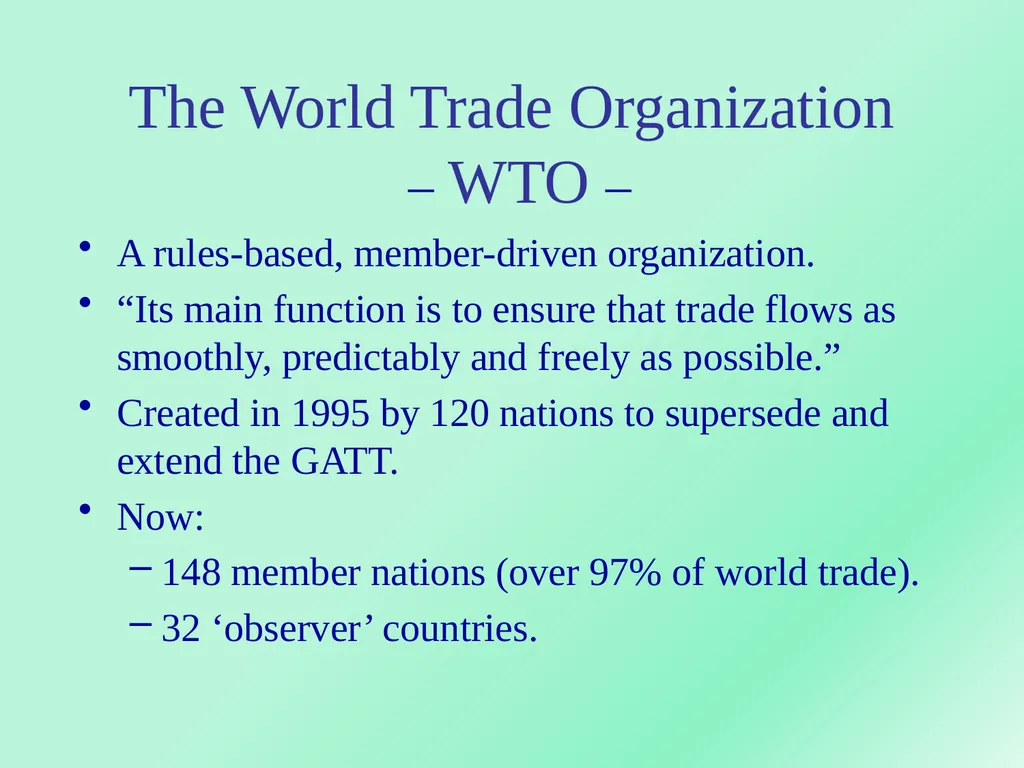
The World Trade Organization
– WTO – A rules-based, member-driven organization.
“Its main function is to ensure that trade flows as smoothly, predictably and freely as possible.”
Created in 1995 by 120 nations to supersede and extend the GATT.
Now:
148 member nations (over 97% of world trade).
32 ‘observer’ countries.<br>
“Its main function is to ensure that trade flows as smoothly, predictably and freely as possible.”
Created in 1995 by 120 nations to supersede and extend the GATT.
Now:
148 member nations (over 97% of world trade).
32 ‘observer’ countries.<br>
03
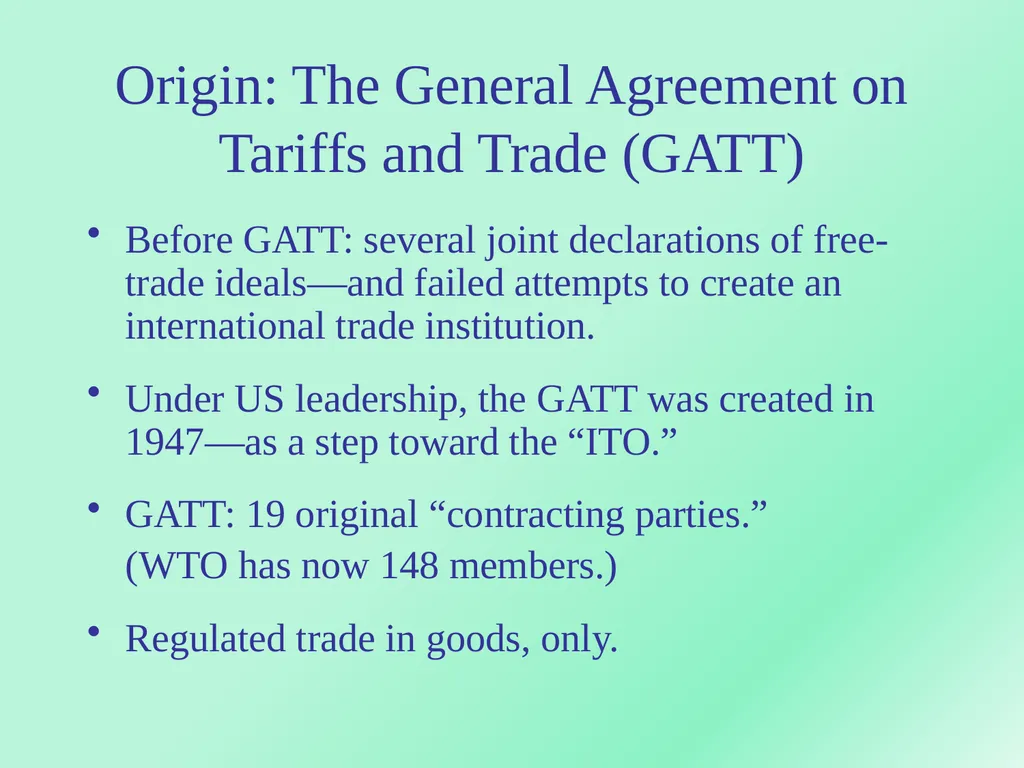
Origin: The General Agreement on Tariffs and Trade (GATT) Before GATT: several joint declarations of free-trade ideals—and failed attempts to create an international trade institution.
Under US leadership, the GATT was created in 1947—as a step toward the “ITO.”
GATT: 19 original “contracting parties.”
(WTO has now 148 members.)
Regulated trade in goods, only.<br>
Under US leadership, the GATT was created in 1947—as a step toward the “ITO.”
GATT: 19 original “contracting parties.”
(WTO has now 148 members.)
Regulated trade in goods, only.<br>
04
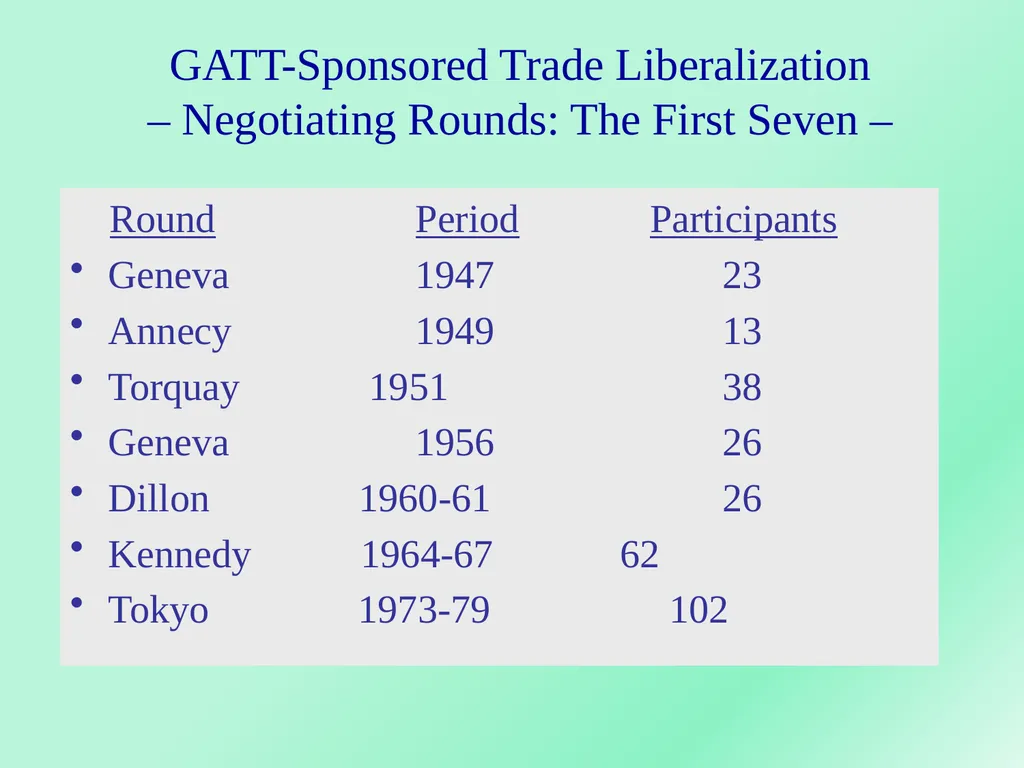
GATT-Sponsored Trade Liberalization
– Negotiating Rounds: The First Seven – Round Period Participants
Geneva 1947 23
Annecy 1949 13
Torquay 1951 38
Geneva 1956 26
Dillon 1960-61 26
Kennedy 1964-67 62
Tokyo 1973-79 102<br>
Geneva 1947 23
Annecy 1949 13
Torquay 1951 38
Geneva 1956 26
Dillon 1960-61 26
Kennedy 1964-67 62
Tokyo 1973-79 102<br>
05
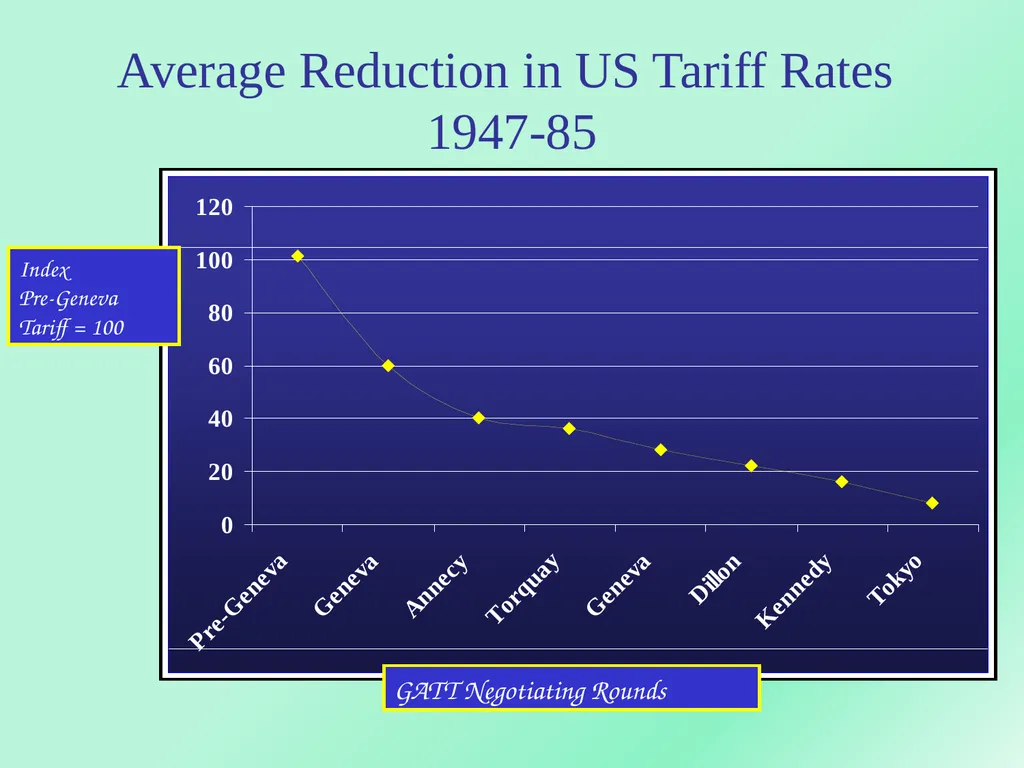
Average Reduction in US Tariff Rates 1947-85 Index
Pre-Geneva
Tariff = 100 GATT Negotiating Rounds<br>
Pre-Geneva
Tariff = 100 GATT Negotiating Rounds<br>
06
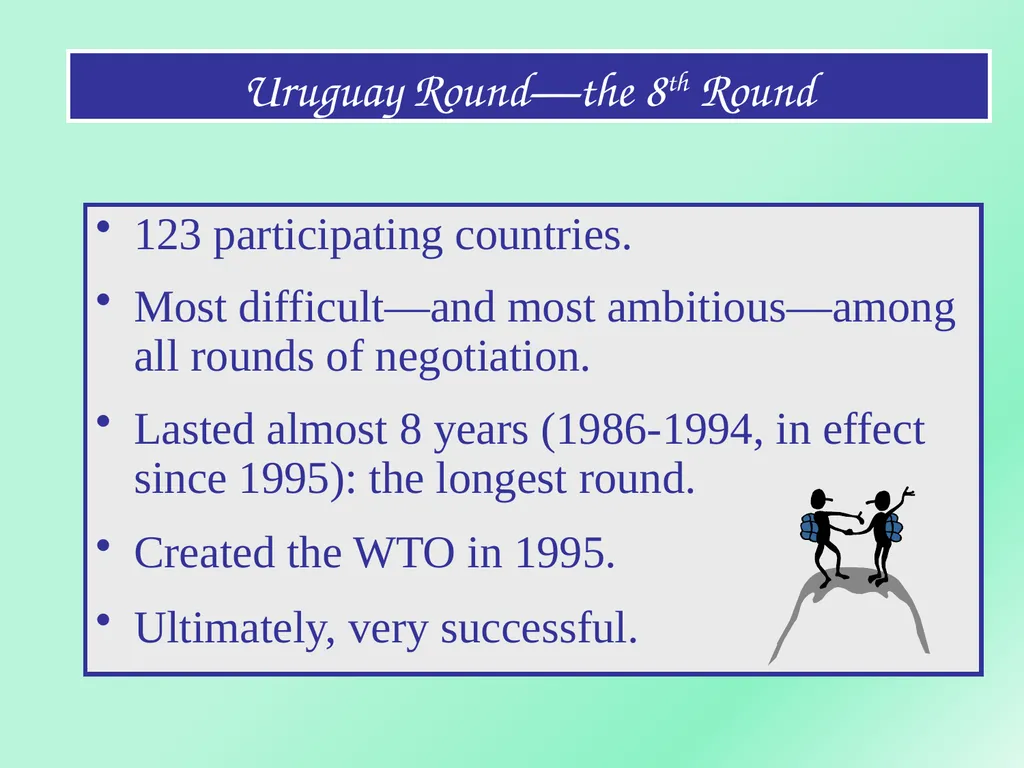
123 participating countries.
Most difficult—and most ambitious—among all rounds of negotiation.
Lasted almost 8 years (1986-1994, in effect since 1995): the longest round.
Created the WTO in 1995.
Ultimately, very successful. Uruguay Round—the 8th Round<br>
Most difficult—and most ambitious—among all rounds of negotiation.
Lasted almost 8 years (1986-1994, in effect since 1995): the longest round.
Created the WTO in 1995.
Ultimately, very successful. Uruguay Round—the 8th Round<br>
07
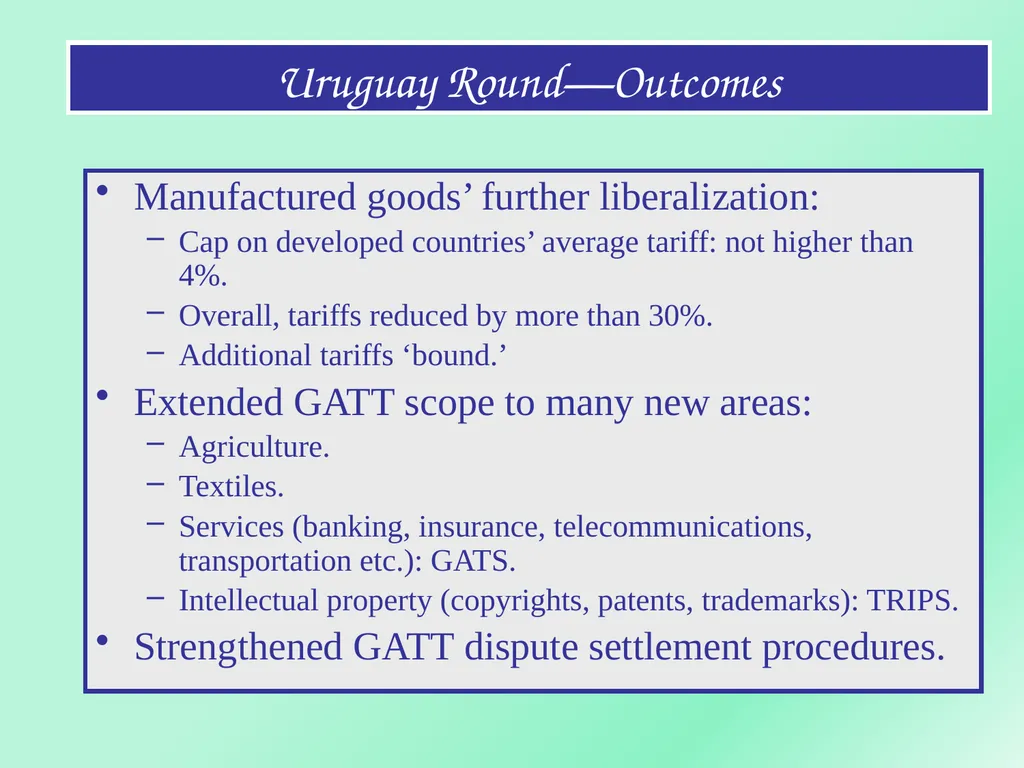
Manufactured goods’ further liberalization:
Cap on developed countries’ average tariff: not higher than 4%.
Overall, tariffs reduced by more than 30%.
Additional tariffs ‘bound.’
Extended GATT scope to many new areas:
Agriculture.
Textiles.
Services (banking, insurance, telecommunications, transportation etc.): GATS.
Intellectual property (copyrights, patents, trademarks): TRIPS.
Strengthened GATT dispute settlement procedures. Uruguay Round—Outcomes<br>
Cap on developed countries’ average tariff: not higher than 4%.
Overall, tariffs reduced by more than 30%.
Additional tariffs ‘bound.’
Extended GATT scope to many new areas:
Agriculture.
Textiles.
Services (banking, insurance, telecommunications, transportation etc.): GATS.
Intellectual property (copyrights, patents, trademarks): TRIPS.
Strengthened GATT dispute settlement procedures. Uruguay Round—Outcomes<br>
08
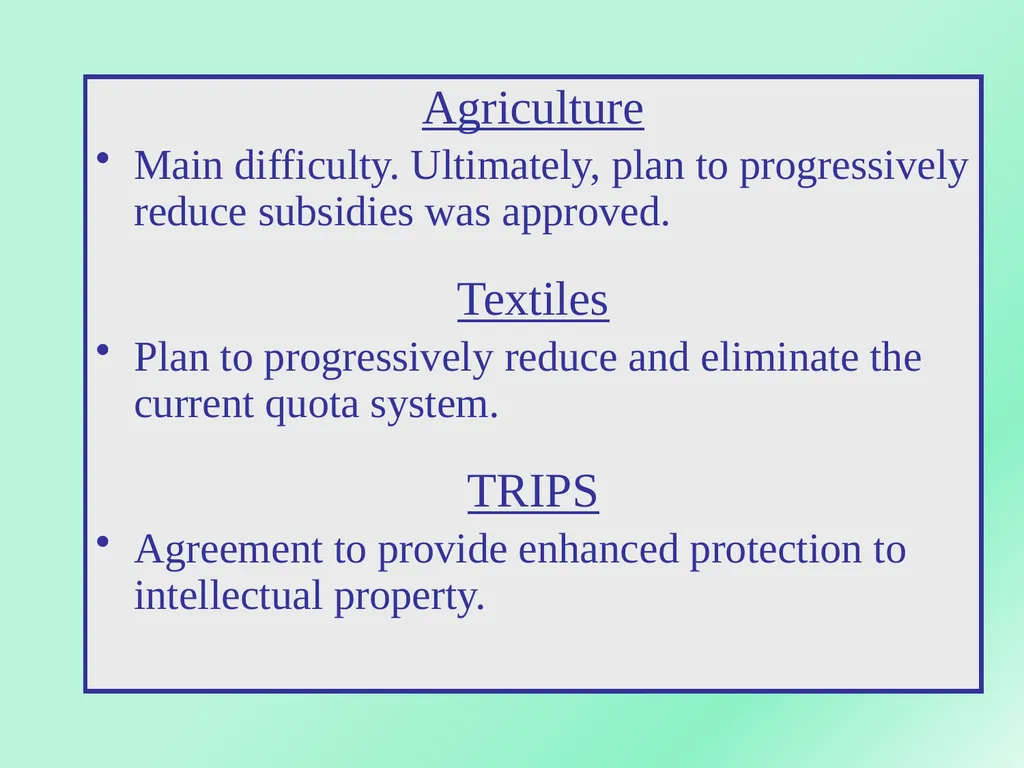
Agriculture
Main difficulty. Ultimately, plan to progressively reduce subsidies was approved.
Textiles
Plan to progressively reduce and eliminate the current quota system.
TRIPS
Agreement to provide enhanced protection to intellectual property.<br>
Main difficulty. Ultimately, plan to progressively reduce subsidies was approved.
Textiles
Plan to progressively reduce and eliminate the current quota system.
TRIPS
Agreement to provide enhanced protection to intellectual property.<br>
09
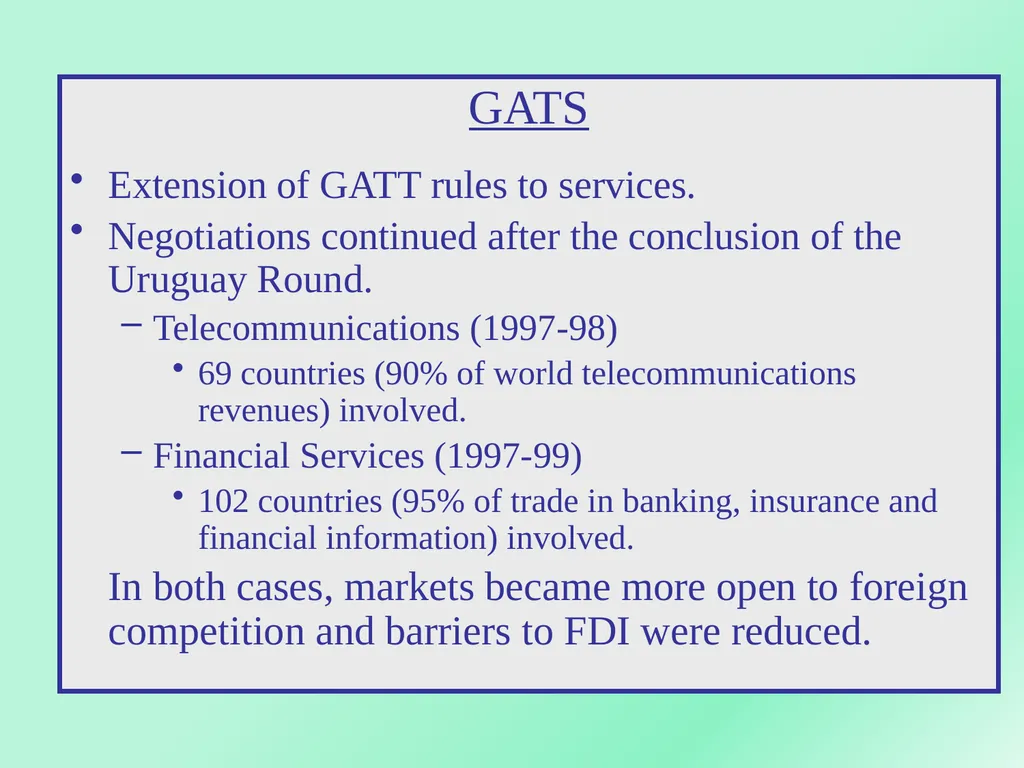
GATS
Extension of GATT rules to services.
Negotiations continued after the conclusion of the Uruguay Round.
Telecommunications (1997-98)
69 countries (90% of world telecommunications revenues) involved.
Financial Services (1997-99)
102 countries (95% of trade in banking, insurance and financial information) involved.
In both cases, markets became more open to foreign competition and barriers to FDI were reduced.<br>
Extension of GATT rules to services.
Negotiations continued after the conclusion of the Uruguay Round.
Telecommunications (1997-98)
69 countries (90% of world telecommunications revenues) involved.
Financial Services (1997-99)
102 countries (95% of trade in banking, insurance and financial information) involved.
In both cases, markets became more open to foreign competition and barriers to FDI were reduced.<br>
10
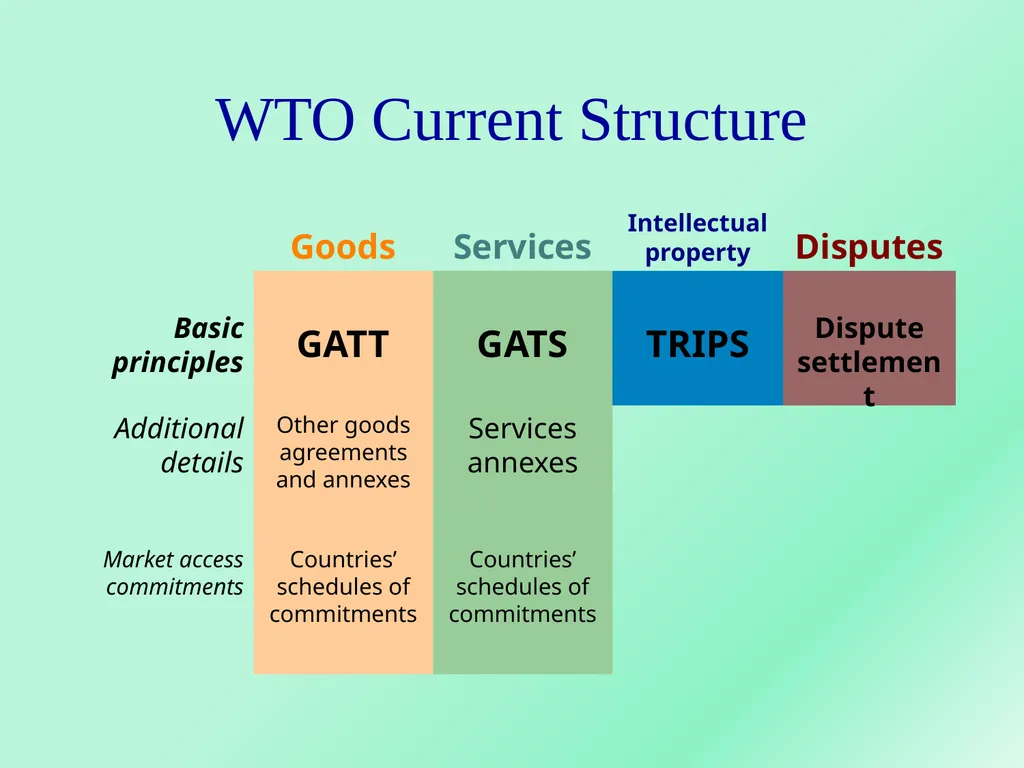
WTO Current Structure<br>
11
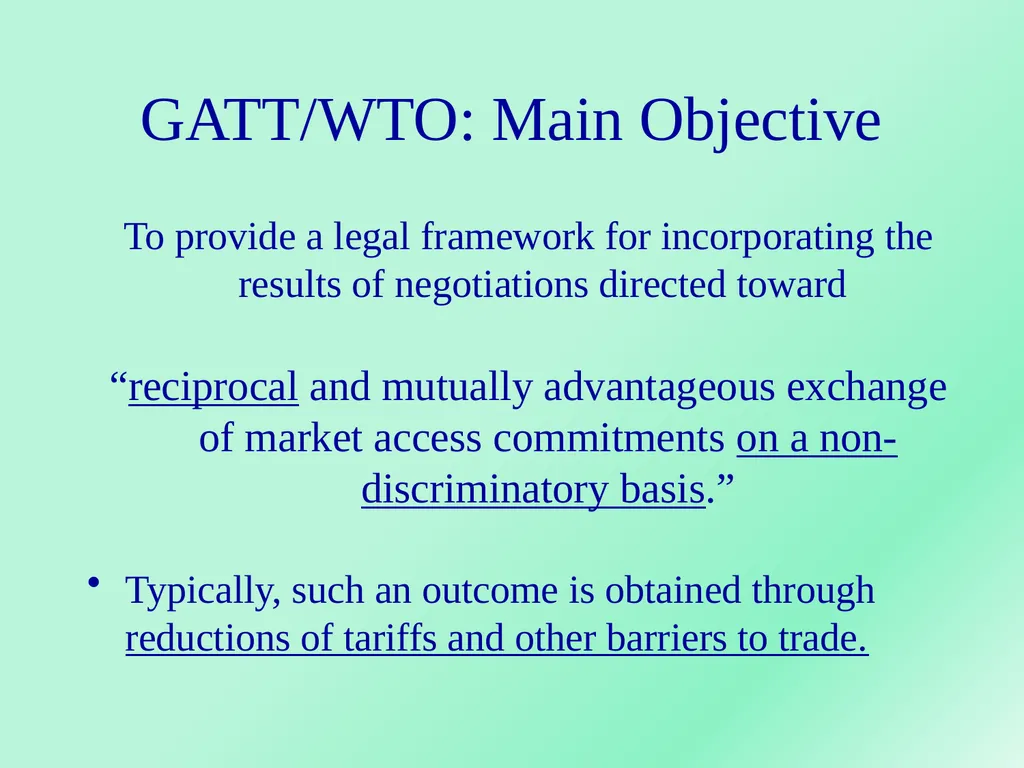
GATT/WTO: Main Objective To provide a legal framework for incorporating the results of negotiations directed toward
“reciprocal and mutually advantageous exchange of market access commitments on a non-discriminatory basis.”
Typically, such an outcome is obtained through reductions of tariffs and other barriers to trade.<br>
“reciprocal and mutually advantageous exchange of market access commitments on a non-discriminatory basis.”
Typically, such an outcome is obtained through reductions of tariffs and other barriers to trade.<br>
12
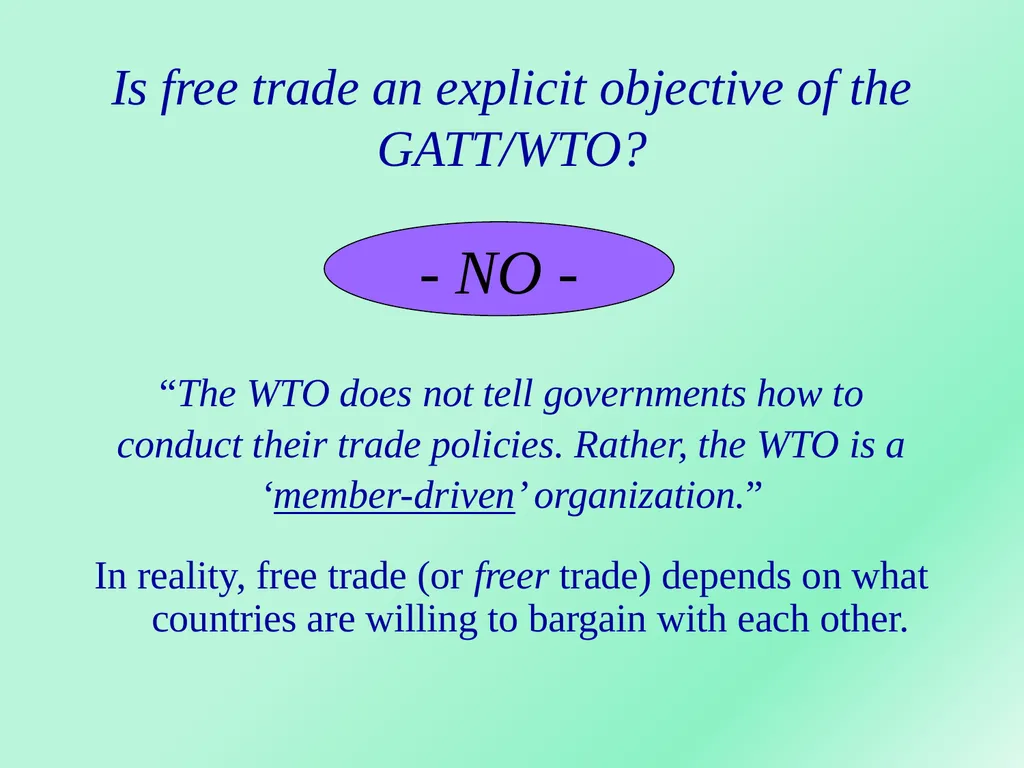
Is free trade an explicit objective of the GATT/WTO? “The WTO does not tell governments how to
conduct their trade policies. Rather, the WTO is a
‘member-driven’ organization.”
In reality, free trade (or freer trade) depends on what countries are willing to bargain with each other. - NO -<br>
conduct their trade policies. Rather, the WTO is a
‘member-driven’ organization.”
In reality, free trade (or freer trade) depends on what countries are willing to bargain with each other. - NO -<br>
13
GATT/WTO Negotiation Rules Governments negotiate only if they want and what they want.
Consensus rule:
if all agree, agreement is implemented; otherwise, it is not. Bottom line: All countries have a voice.<br>
Consensus rule:
if all agree, agreement is implemented; otherwise, it is not. Bottom line: All countries have a voice.<br>
14
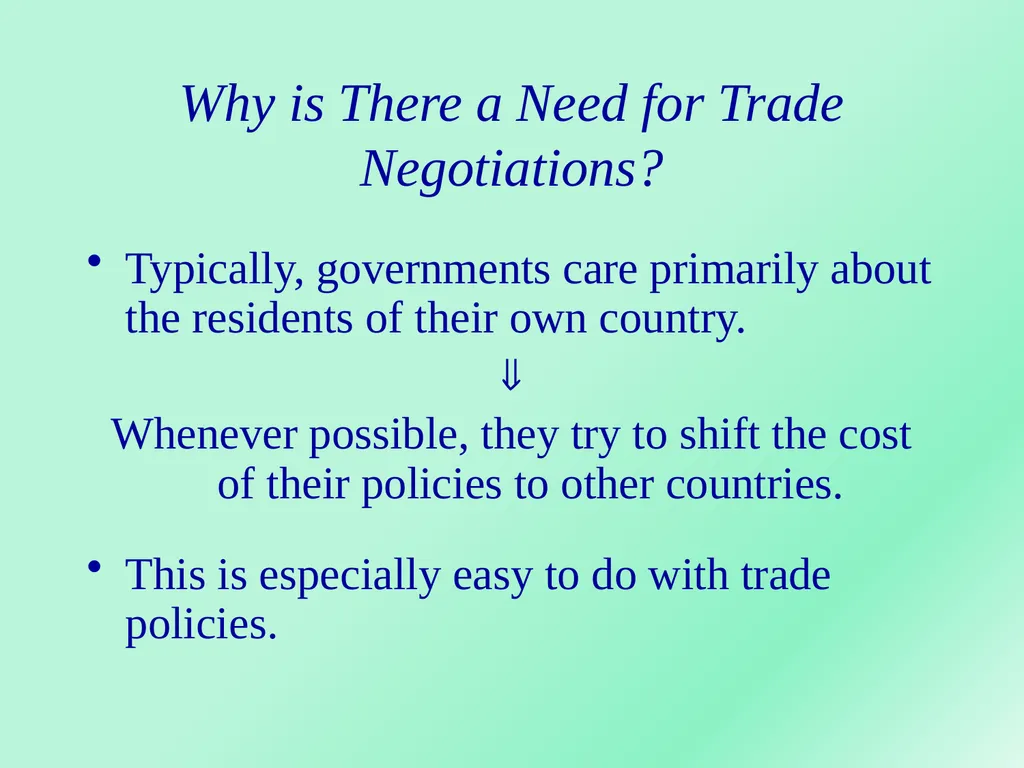
Why is There a Need for Trade Negotiations? Typically, governments care primarily about the residents of their own country.
Whenever possible, they try to shift the cost of their policies to other countries.
This is especially easy to do with trade policies.<br>
Whenever possible, they try to shift the cost of their policies to other countries.
This is especially easy to do with trade policies.<br>
15
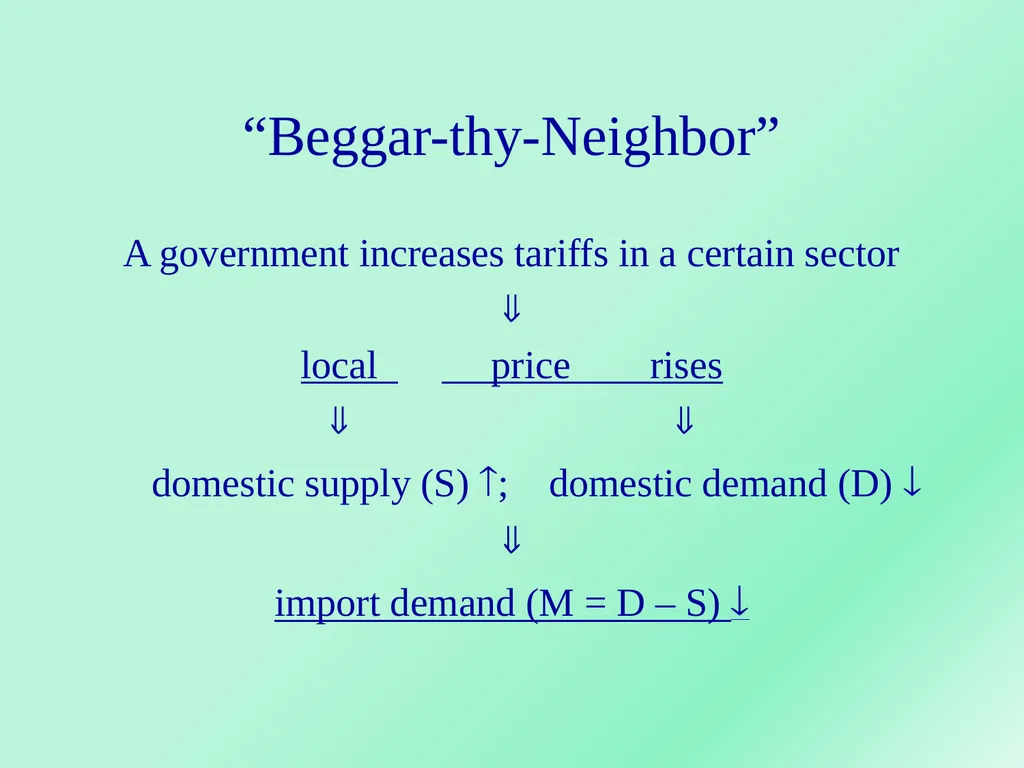
“Beggar-thy-Neighbor” A government increases tariffs in a certain sector
local price rises
domestic supply (S) ; domestic demand (D)
import demand (M = D – S) <br>
local price rises
domestic supply (S) ; domestic demand (D)
import demand (M = D – S) <br>
16
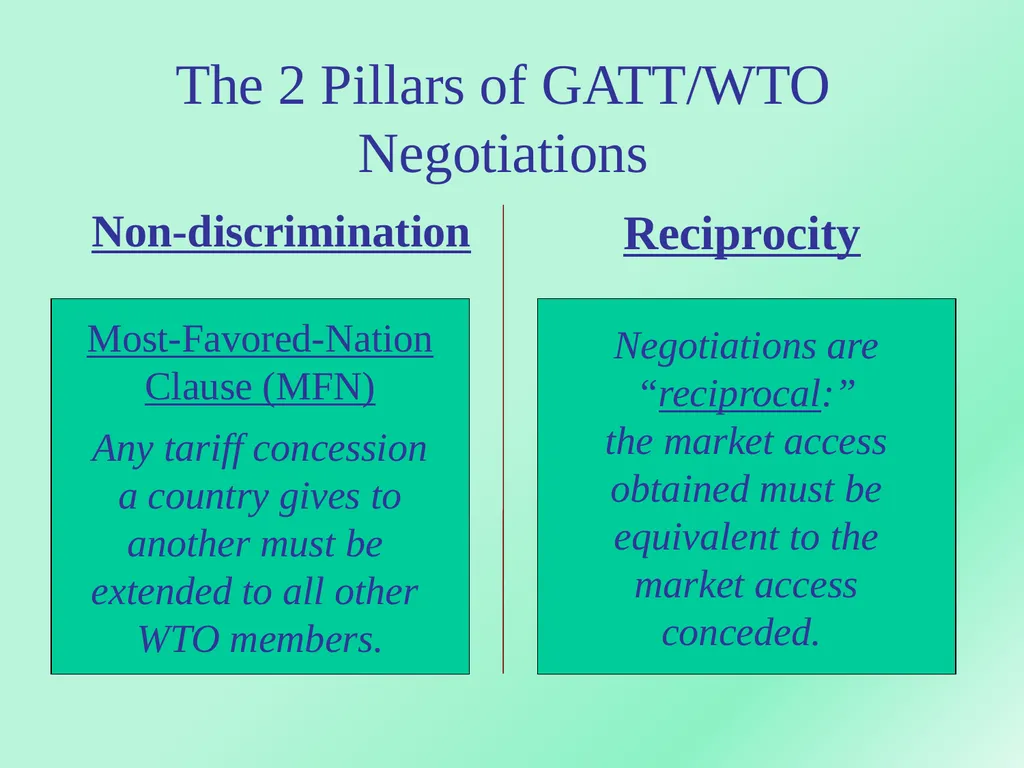
The 2 Pillars of GATT/WTO Negotiations Non-discrimination Reciprocity Most-Favored-Nation
Clause (MFN)
Any tariff concession
a country gives to
another must be
extended to all other
WTO members. Negotiations are
“reciprocal:”
the market access
obtained must be
equivalent to the
market access
conceded.<br>
Clause (MFN)
Any tariff concession
a country gives to
another must be
extended to all other
WTO members. Negotiations are
“reciprocal:”
the market access
obtained must be
equivalent to the
market access
conceded.<br>
17
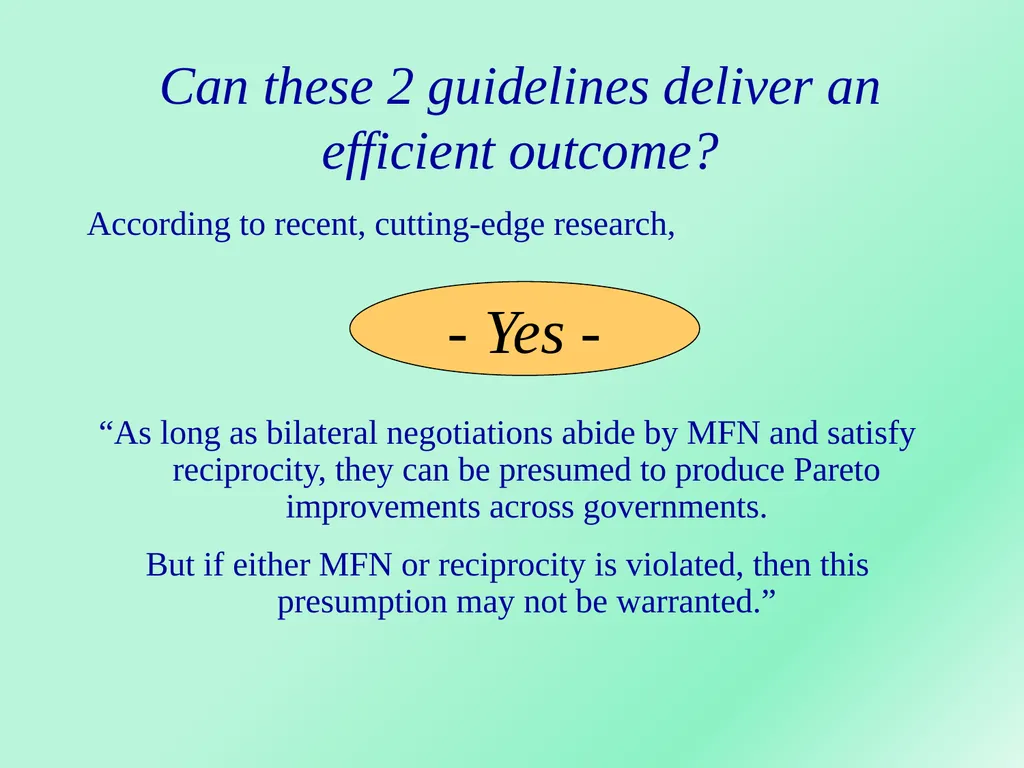
Can these 2 guidelines deliver an efficient outcome? “As long as bilateral negotiations abide by MFN and satisfy reciprocity, they can be presumed to produce Pareto improvements across governments.
But if either MFN or reciprocity is violated, then this presumption may not be warranted.” According to recent, cutting-edge research, - Yes -<br>
But if either MFN or reciprocity is violated, then this presumption may not be warranted.” According to recent, cutting-edge research, - Yes -<br>
18
How can governments enforce an agreement when each individual country has an incentive to disrespect what it had agreed upon? WTO has no police power to enforce the agreements:
The WTO cannot send any country to ‘jail.’
The WTO cannot even indirectly force countries to abide by previous agreement.
By suspending loans, for instance, as the IMF can do.
Agreements need to be self-sustainable.<br>
The WTO cannot send any country to ‘jail.’
The WTO cannot even indirectly force countries to abide by previous agreement.
By suspending loans, for instance, as the IMF can do.
Agreements need to be self-sustainable.<br>
19
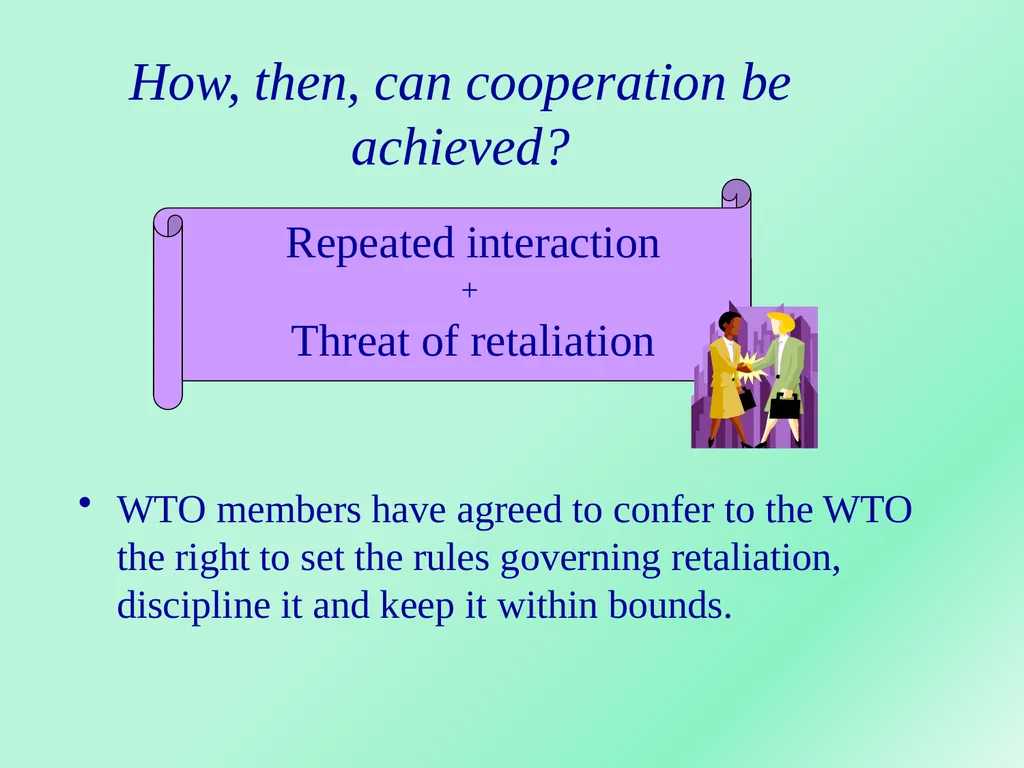
How, then, can cooperation be achieved? Repeated interaction
+
Threat of retaliation WTO members have agreed to confer to the WTO the right to set the rules governing retaliation, discipline it and keep it within bounds.<br>
+
Threat of retaliation WTO members have agreed to confer to the WTO the right to set the rules governing retaliation, discipline it and keep it within bounds.<br>
20
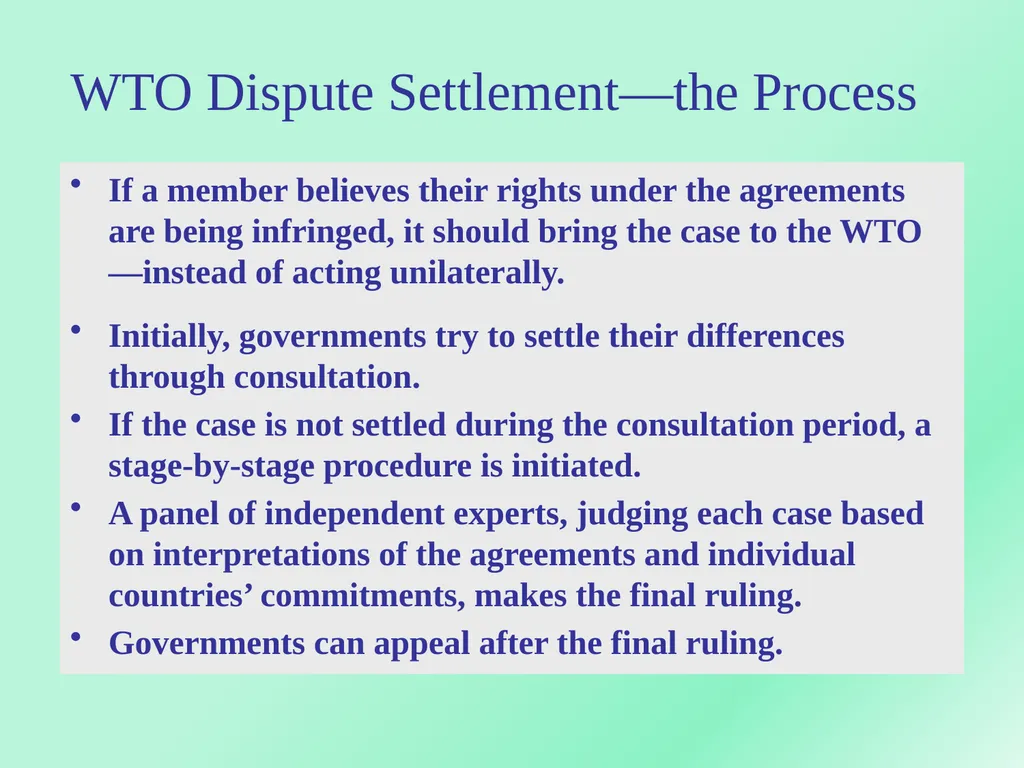
WTO Dispute Settlement—the Process If a member believes their rights under the agreements are being infringed, it should bring the case to the WTO—instead of acting unilaterally.
Initially, governments try to settle their differences through consultation.
If the case is not settled during the consultation period, a stage-by-stage procedure is initiated.
A panel of independent experts, judging each case based on interpretations of the agreements and individual countries’ commitments, makes the final ruling.
Governments can appeal after the final ruling.<br>
Initially, governments try to settle their differences through consultation.
If the case is not settled during the consultation period, a stage-by-stage procedure is initiated.
A panel of independent experts, judging each case based on interpretations of the agreements and individual countries’ commitments, makes the final ruling.
Governments can appeal after the final ruling.<br>
21
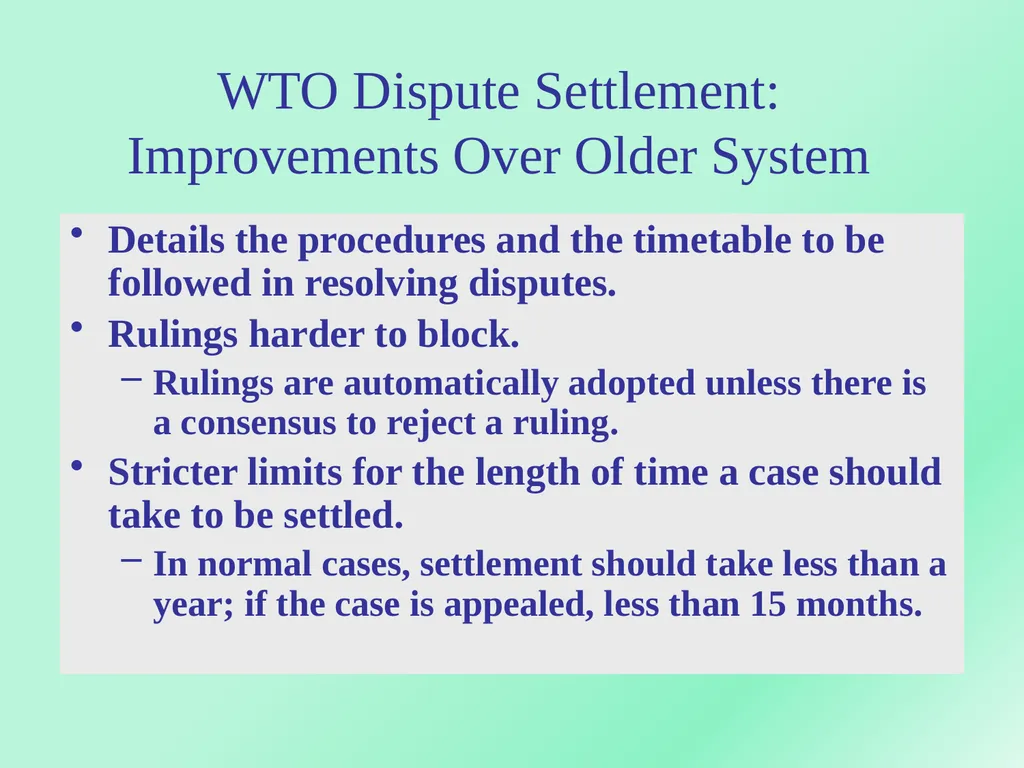
WTO Dispute Settlement:
Improvements Over Older System Details the procedures and the timetable to be followed in resolving disputes.
Rulings harder to block.
Rulings are automatically adopted unless there is a consensus to reject a ruling.
Stricter limits for the length of time a case should take to be settled.
In normal cases, settlement should take less than a year; if the case is appealed, less than 15 months.<br>
Rulings harder to block.
Rulings are automatically adopted unless there is a consensus to reject a ruling.
Stricter limits for the length of time a case should take to be settled.
In normal cases, settlement should take less than a year; if the case is appealed, less than 15 months.<br>
22
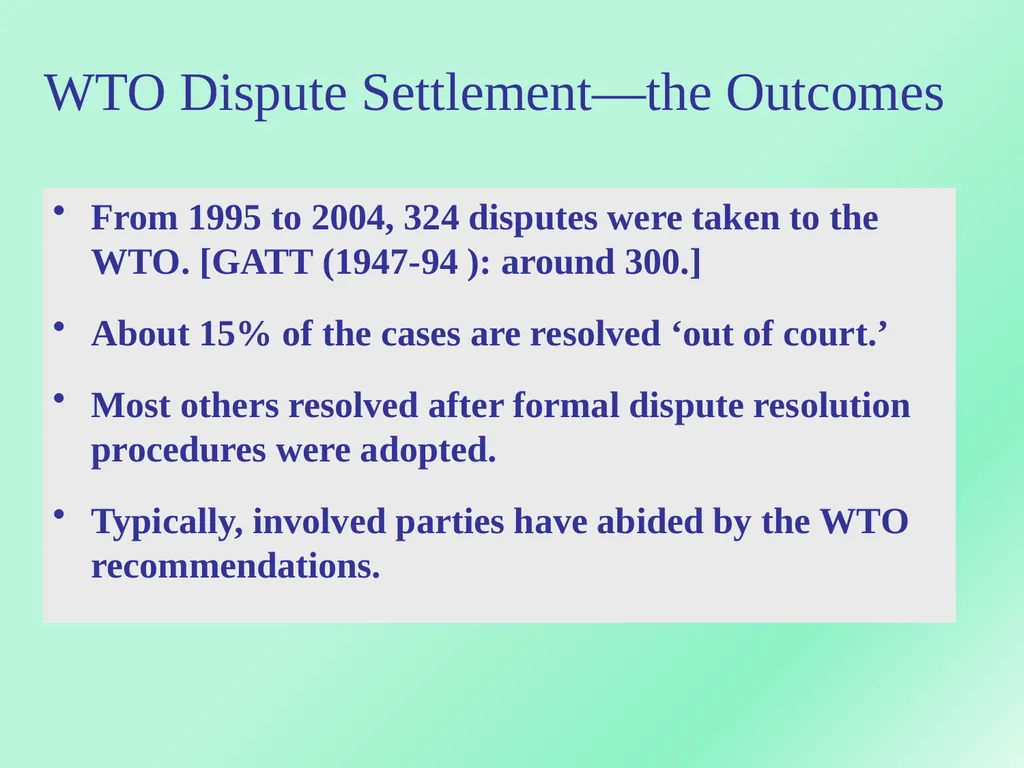
WTO Dispute Settlement—the Outcomes From 1995 to 2004, 324 disputes were taken to the WTO. [GATT (1947-94 ): around 300.]
About 15% of the cases are resolved ‘out of court.’
Most others resolved after formal dispute resolution procedures were adopted.
Typically, involved parties have abided by the WTO recommendations.<br>
About 15% of the cases are resolved ‘out of court.’
Most others resolved after formal dispute resolution procedures were adopted.
Typically, involved parties have abided by the WTO recommendations.<br>
23
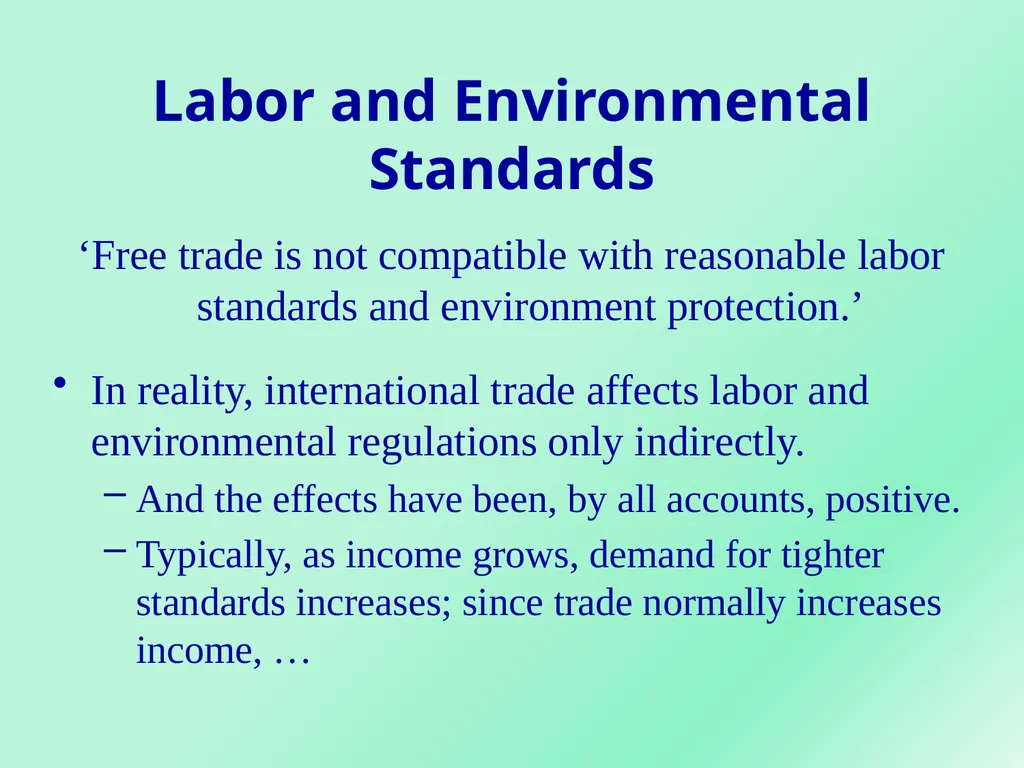
Labor and Environmental Standards ‘Free trade is not compatible with reasonable labor standards and environment protection.’
In reality, international trade affects labor and environmental regulations only indirectly.
And the effects have been, by all accounts, positive.
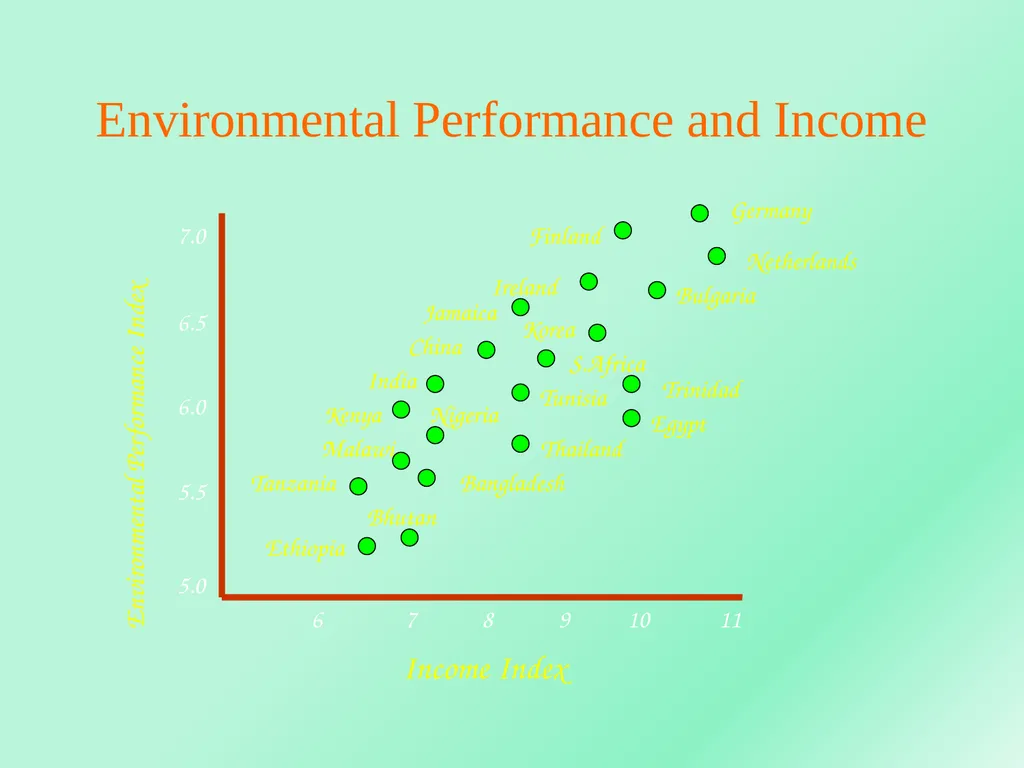
Typically, as income grows, demand for tighter standards increases; since trade normally increases income, …<br>
In reality, international trade affects labor and environmental regulations only indirectly.
And the effects have been, by all accounts, positive.
Typically, as income grows, demand for tighter standards increases; since trade normally increases income, …<br>
24
Environmental Performance and Income<br>
25
2 Standard Critiques of the Implications of the WTO Policies “Regulatory-Chill” “Race-to-the-Bottom”<br>
26
Suppose that a government
has agreed to
hold its tariffs low
as a result of a WTO negotiation.<br>
has agreed to
hold its tariffs low
as a result of a WTO negotiation.<br>
27
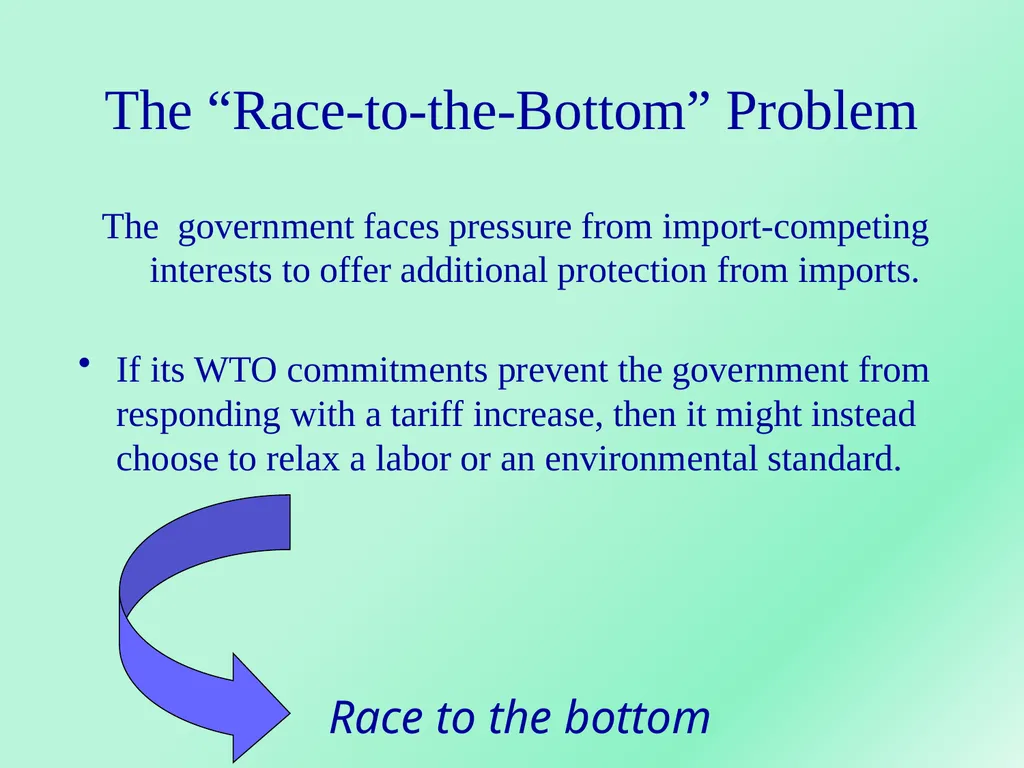
The “Race-to-the-Bottom” Problem The government faces pressure from import-competing interests to offer additional protection from imports.
If its WTO commitments prevent the government from responding with a tariff increase, then it might instead choose to relax a labor or an environmental standard. Race to the bottom<br>
If its WTO commitments prevent the government from responding with a tariff increase, then it might instead choose to relax a labor or an environmental standard. Race to the bottom<br>
28
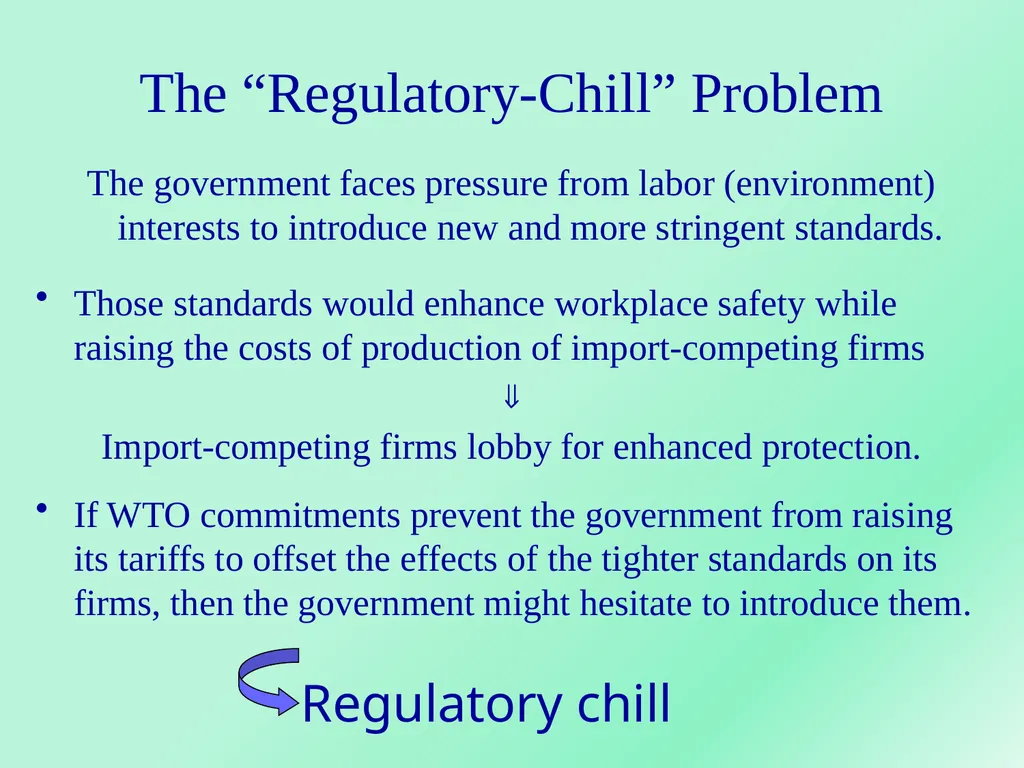
The “Regulatory-Chill” Problem The government faces pressure from labor (environment) interests to introduce new and more stringent standards.
Those standards would enhance workplace safety while raising the costs of production of import-competing firms
Import-competing firms lobby for enhanced protection.
If WTO commitments prevent the government from raising its tariffs to offset the effects of the tighter standards on its firms, then the government might hesitate to introduce them. Regulatory chill<br>
Those standards would enhance workplace safety while raising the costs of production of import-competing firms
Import-competing firms lobby for enhanced protection.
If WTO commitments prevent the government from raising its tariffs to offset the effects of the tighter standards on its firms, then the government might hesitate to introduce them. Regulatory chill<br>
29
Are the “Race-to-the-Bottom” and the “Regulatory-Chill” Problems Inevitable? If property rights over negotiated market access levels were sufficiently complete,
none of these problems would arise. Not really:<br>
none of these problems would arise. Not really:<br>
30
How can these property rights be completed? A Simple Rule:
Once a government has agreed to lower its tariffs in a WTO negotiation:
It should not be permitted to take subsequent unilateral policy actions that undercut its implied market access commitments;
but
It should be otherwise allowed to configure its unilateral policies in anyway it desires.
Existing GATT/WTO principles are not that far away from approximating this simple rule.<br>
Once a government has agreed to lower its tariffs in a WTO negotiation:
It should not be permitted to take subsequent unilateral policy actions that undercut its implied market access commitments;
but
It should be otherwise allowed to configure its unilateral policies in anyway it desires.
Existing GATT/WTO principles are not that far away from approximating this simple rule.<br>
31
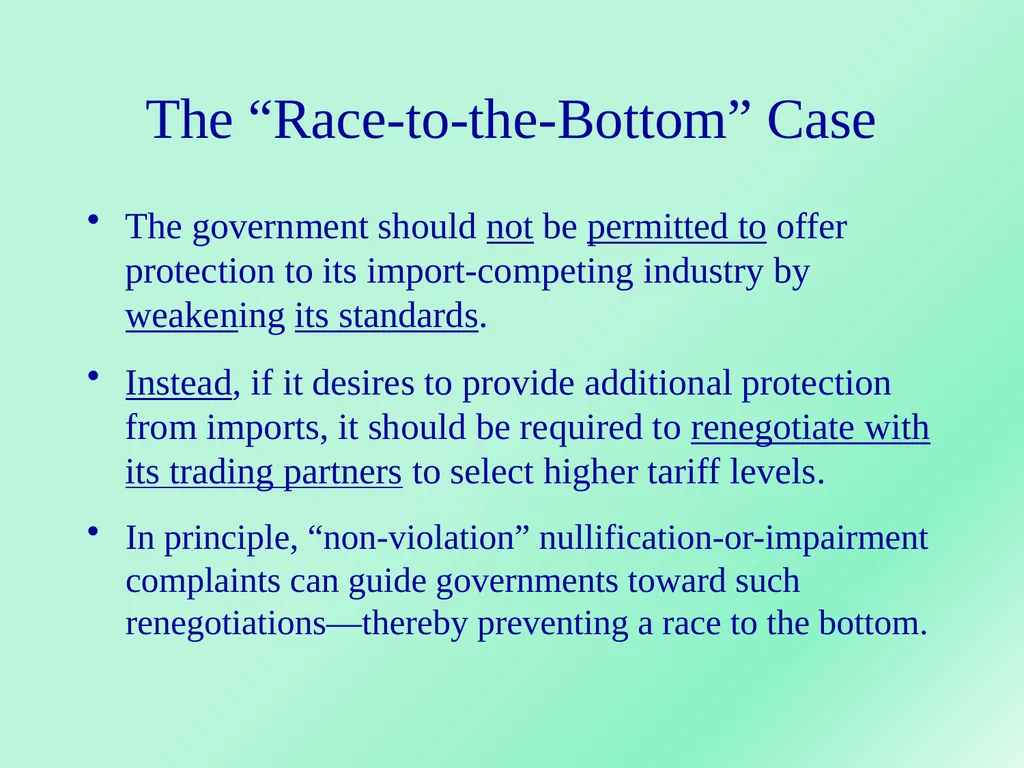
The “Race-to-the-Bottom” Case The government should not be permitted to offer protection to its import-competing industry by weakening its standards.
Instead, if it desires to provide additional protection from imports, it should be required to renegotiate with its trading partners to select higher tariff levels.
In principle, “non-violation” nullification-or-impairment complaints can guide governments toward such renegotiations—thereby preventing a race to the bottom.<br>
Instead, if it desires to provide additional protection from imports, it should be required to renegotiate with its trading partners to select higher tariff levels.
In principle, “non-violation” nullification-or-impairment complaints can guide governments toward such renegotiations—thereby preventing a race to the bottom.<br>
32
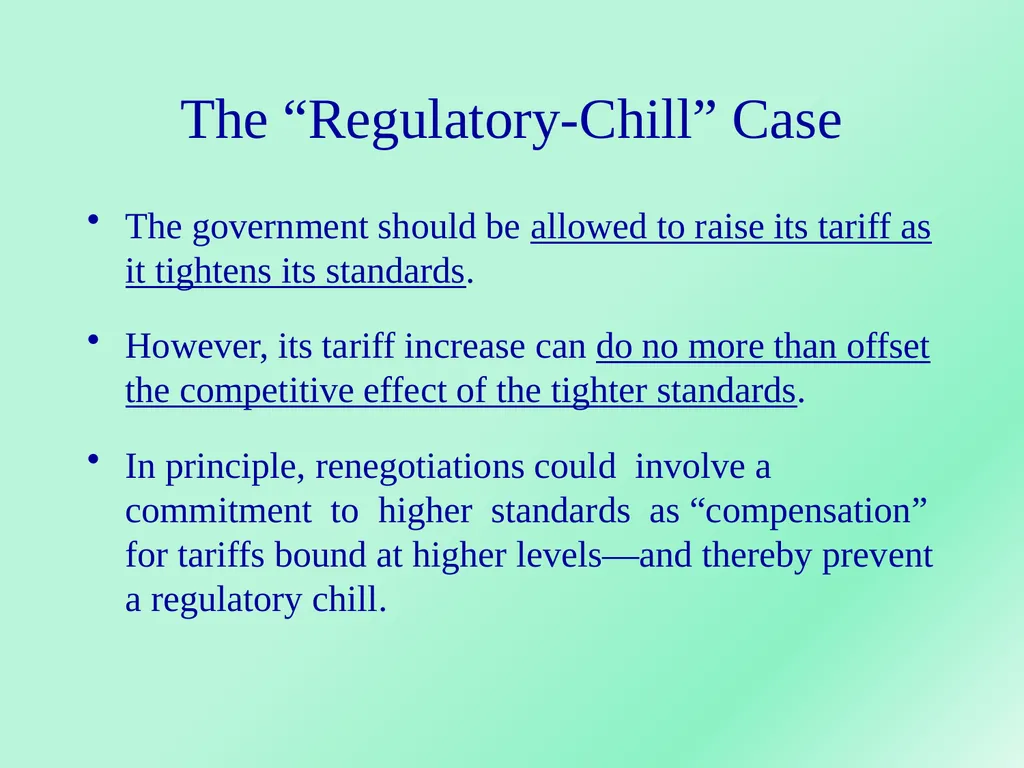
The “Regulatory-Chill” Case The government should be allowed to raise its tariff as it tightens its standards.
However, its tariff increase can do no more than offset the competitive effect of the tighter standards.
In principle, renegotiations could involve a commitment to higher standards as “compensation” for tariffs bound at higher levels—and thereby prevent a regulatory chill.<br>
However, its tariff increase can do no more than offset the competitive effect of the tighter standards.
In principle, renegotiations could involve a commitment to higher standards as “compensation” for tariffs bound at higher levels—and thereby prevent a regulatory chill.<br>
33
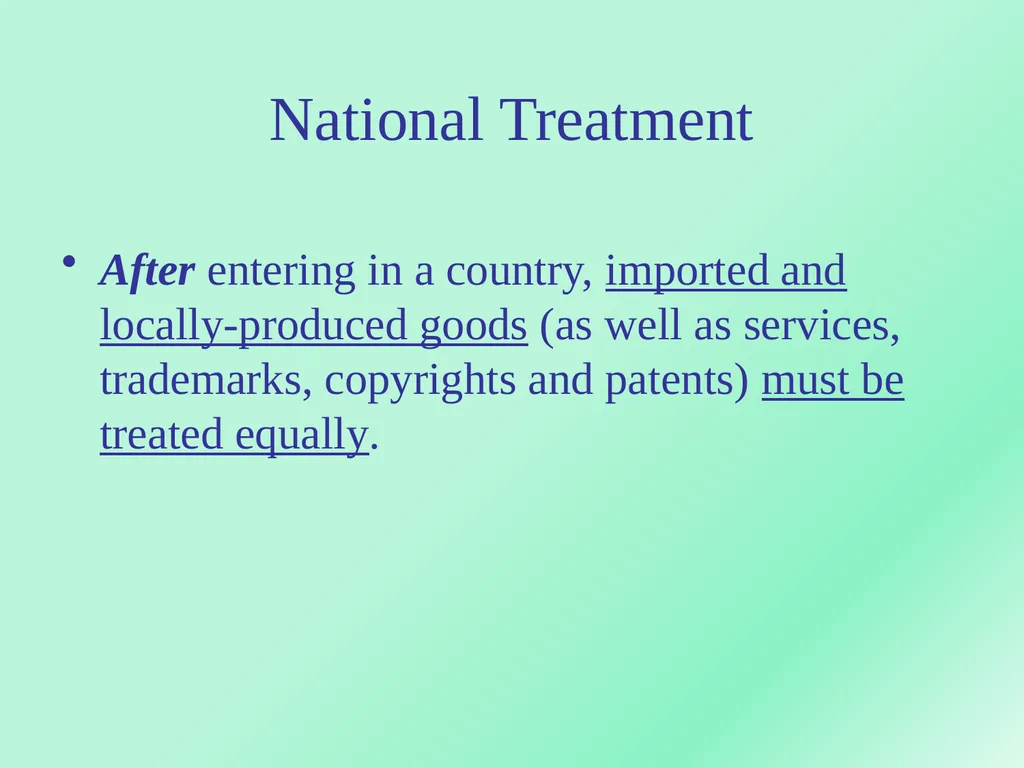
National Treatment After entering in a country, imported and locally-produced goods (as well as services, trademarks, copyrights and patents) must be treated equally.<br>
34
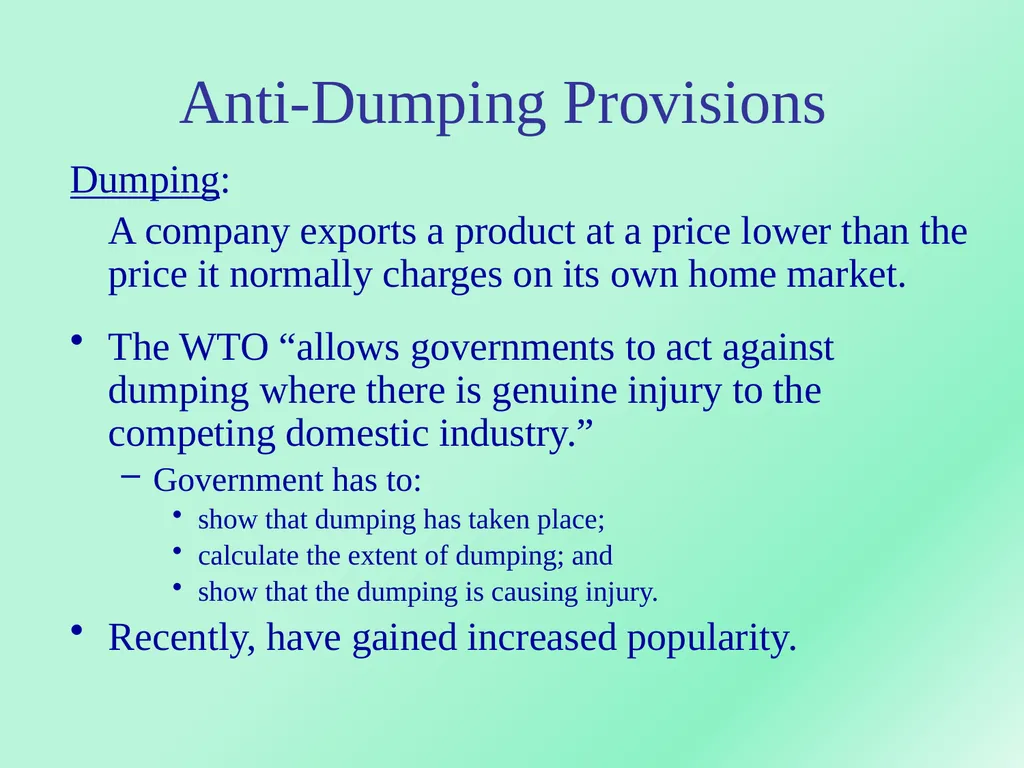
Anti-Dumping Provisions Dumping:
A company exports a product at a price lower than the price it normally charges on its own home market.
The WTO “allows governments to act against dumping where there is genuine injury to the competing domestic industry.”
Government has to:
show that dumping has taken place;
calculate the extent of dumping; and
show that the dumping is causing injury.
Recently, have gained increased popularity.<br>
A company exports a product at a price lower than the price it normally charges on its own home market.
The WTO “allows governments to act against dumping where there is genuine injury to the competing domestic industry.”
Government has to:
show that dumping has taken place;
calculate the extent of dumping; and
show that the dumping is causing injury.
Recently, have gained increased popularity.<br>
35
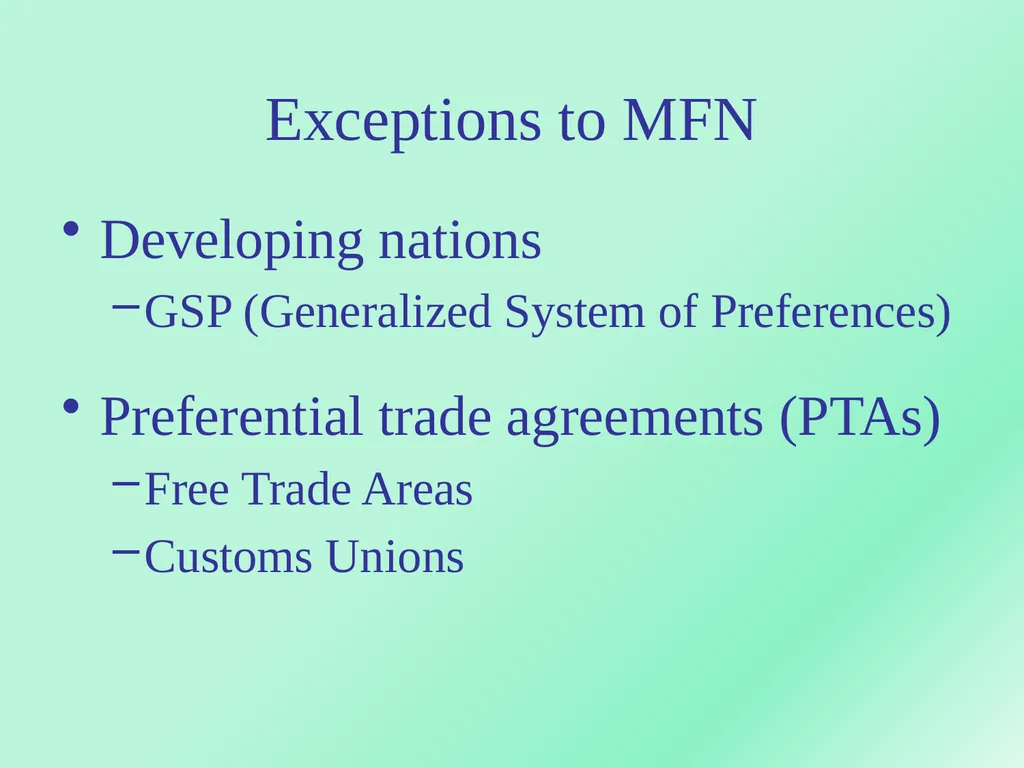
Exceptions to MFN Developing nations
GSP (Generalized System of Preferences)
Preferential trade agreements (PTAs)
Free Trade Areas
Customs Unions<br>
GSP (Generalized System of Preferences)
Preferential trade agreements (PTAs)
Free Trade Areas
Customs Unions<br>
36
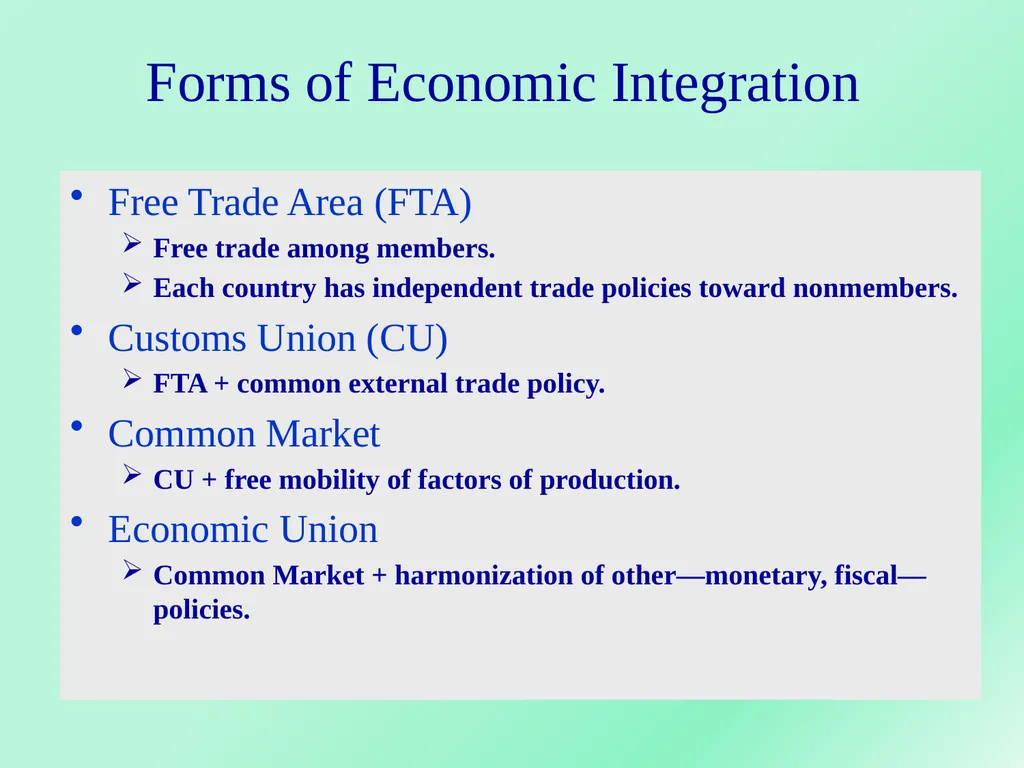
Forms of Economic Integration Free Trade Area (FTA)
Free trade among members.
Each country has independent trade policies toward nonmembers.
Customs Union (CU)
FTA + common external trade policy.
Common Market
CU + free mobility of factors of production.
Economic Union
Common Market + harmonization of other—monetary, fiscal—policies.<br>
Free trade among members.
Each country has independent trade policies toward nonmembers.
Customs Union (CU)
FTA + common external trade policy.
Common Market
CU + free mobility of factors of production.
Economic Union
Common Market + harmonization of other—monetary, fiscal—policies.<br>
37
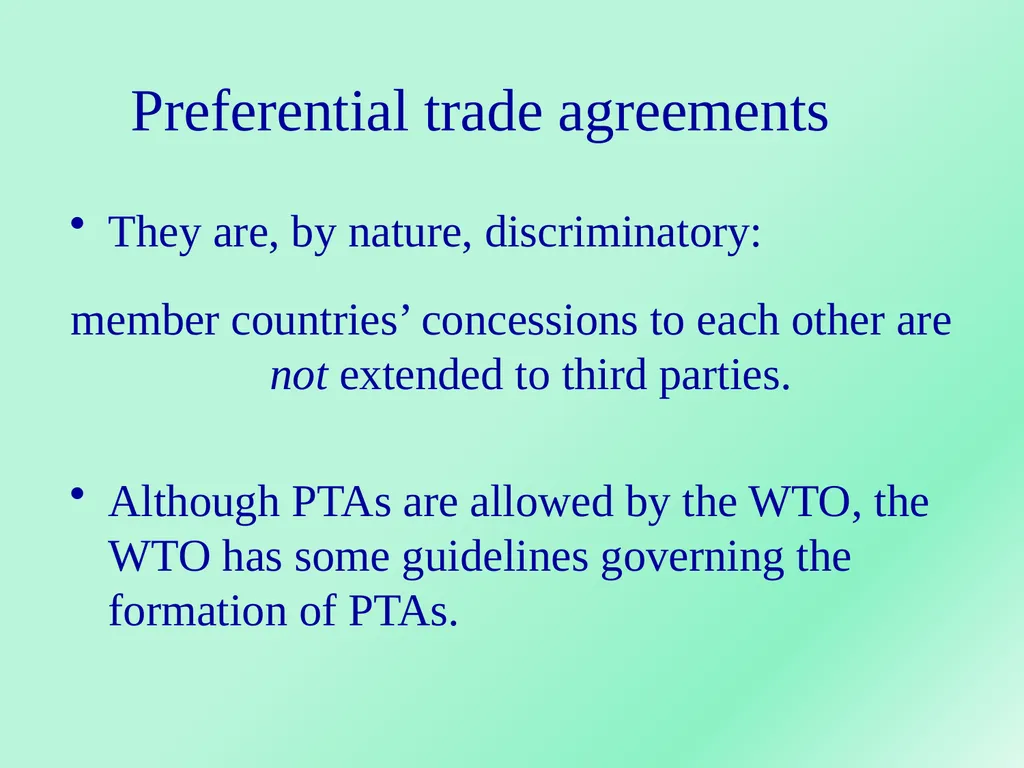
Preferential trade agreements They are, by nature, discriminatory:
member countries’ concessions to each other are not extended to third parties.
Although PTAs are allowed by the WTO, the WTO has some guidelines governing the formation of PTAs.<br>
member countries’ concessions to each other are not extended to third parties.
Although PTAs are allowed by the WTO, the WTO has some guidelines governing the formation of PTAs.<br>
38
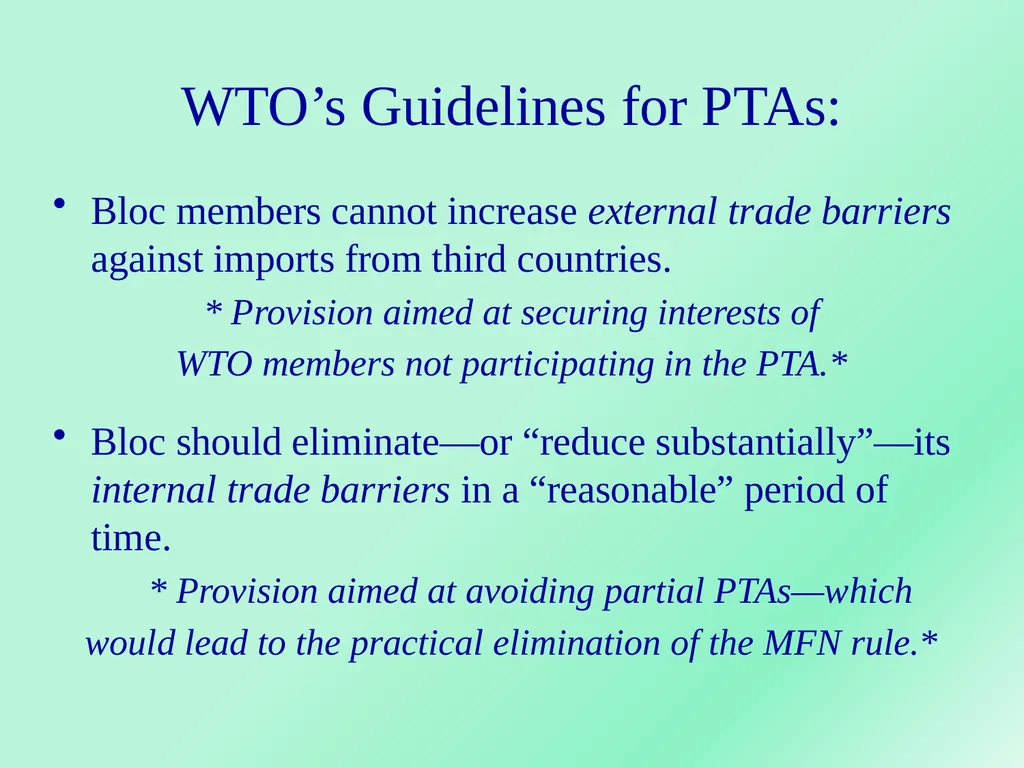
WTO’s Guidelines for PTAs: Bloc members cannot increase external trade barriers against imports from third countries.
* Provision aimed at securing interests of
WTO members not participating in the PTA.*
Bloc should eliminate—or “reduce substantially”—its internal trade barriers in a “reasonable” period of time.
* Provision aimed at avoiding partial PTAs—which
would lead to the practical elimination of the MFN rule.*<br>
* Provision aimed at securing interests of
WTO members not participating in the PTA.*
Bloc should eliminate—or “reduce substantially”—its internal trade barriers in a “reasonable” period of time.
* Provision aimed at avoiding partial PTAs—which
would lead to the practical elimination of the MFN rule.*<br>
39
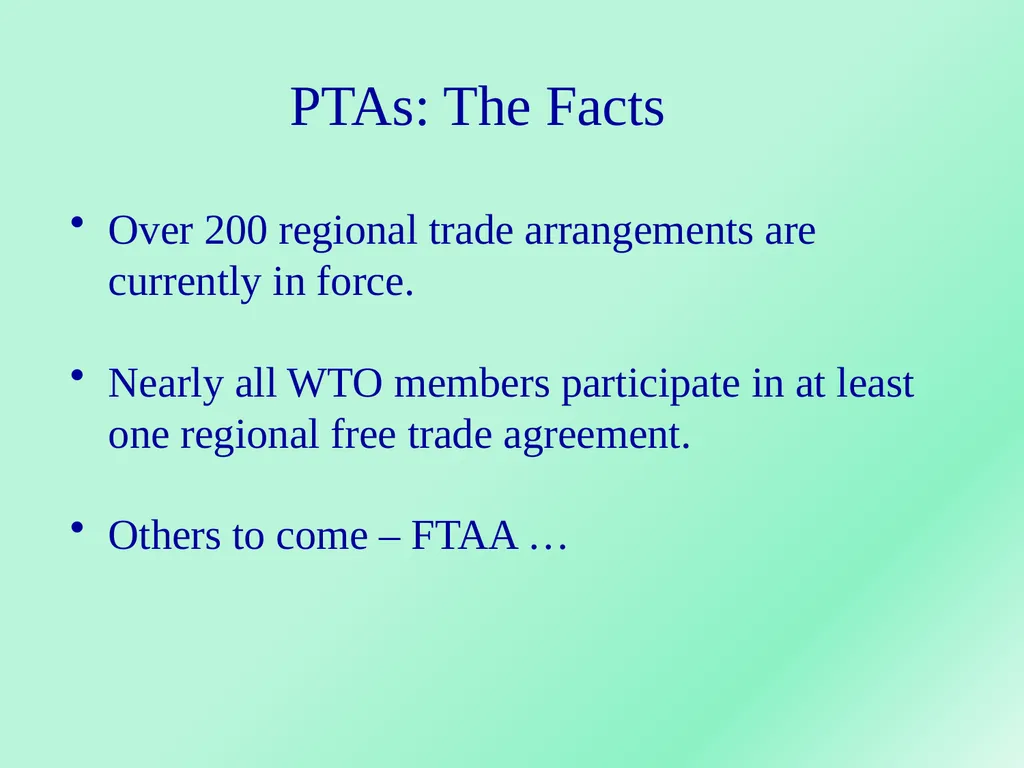
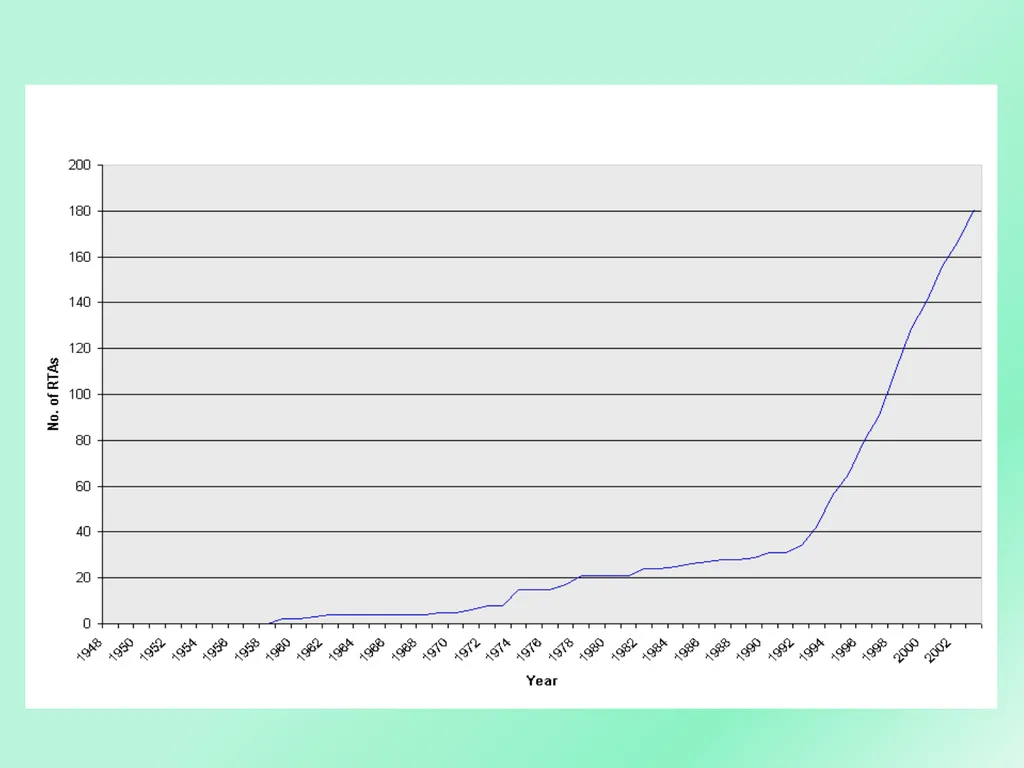
PTAs: The Facts Over 200 regional trade arrangements are currently in force.
Nearly all WTO members participate in at least one regional free trade agreement.
Others to come – FTAA …<br>
Nearly all WTO members participate in at least one regional free trade agreement.
Others to come – FTAA …<br>
40
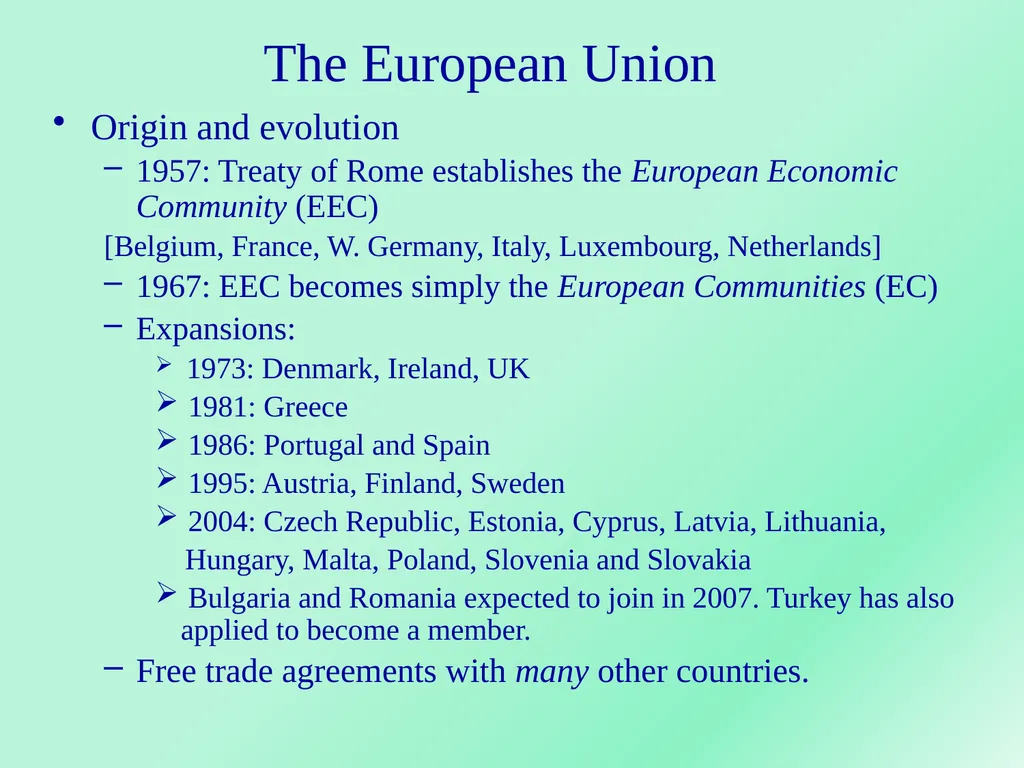
The European Union Origin and evolution
1957: Treaty of Rome establishes the European Economic Community (EEC)
[Belgium, France, W. Germany, Italy, Luxembourg, Netherlands]
1967: EEC becomes simply the European Communities (EC)
Expansions:
1973: Denmark, Ireland, UK
1981: Greece
1986: Portugal and Spain
1995: Austria, Finland, Sweden
2004: Czech Republic, Estonia, Cyprus, Latvia, Lithuania,
Hungary, Malta, Poland, Slovenia and Slovakia
Bulgaria and Romania expected to join in 2007. Turkey has also applied to become a member.
Free trade agreements with many other countries.<br>
1957: Treaty of Rome establishes the European Economic Community (EEC)
[Belgium, France, W. Germany, Italy, Luxembourg, Netherlands]
1967: EEC becomes simply the European Communities (EC)
Expansions:
1973: Denmark, Ireland, UK
1981: Greece
1986: Portugal and Spain
1995: Austria, Finland, Sweden
2004: Czech Republic, Estonia, Cyprus, Latvia, Lithuania,
Hungary, Malta, Poland, Slovenia and Slovakia
Bulgaria and Romania expected to join in 2007. Turkey has also applied to become a member.
Free trade agreements with many other countries.<br>
41
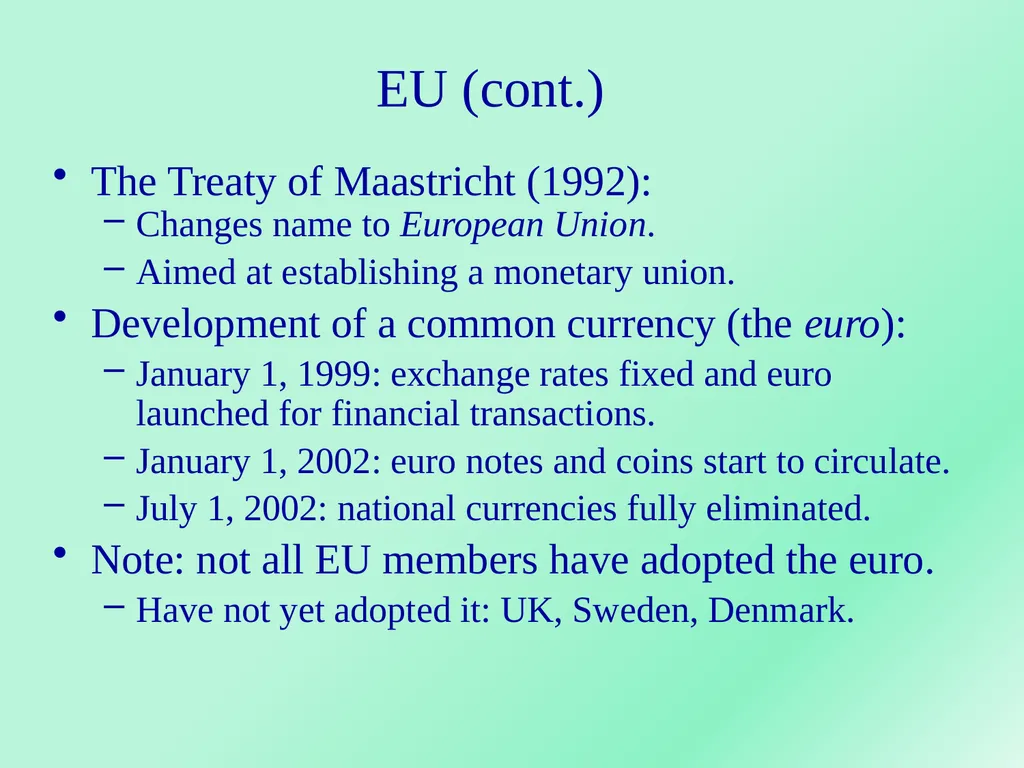
EU (cont.) The Treaty of Maastricht (1992):
Changes name to European Union.
Aimed at establishing a monetary union.
Development of a common currency (the euro):
January 1, 1999: exchange rates fixed and euro launched for financial transactions.
January 1, 2002: euro notes and coins start to circulate.
July 1, 2002: national currencies fully eliminated.
Note: not all EU members have adopted the euro.
Have not yet adopted it: UK, Sweden, Denmark.<br>
Changes name to European Union.
Aimed at establishing a monetary union.
Development of a common currency (the euro):
January 1, 1999: exchange rates fixed and euro launched for financial transactions.
January 1, 2002: euro notes and coins start to circulate.
July 1, 2002: national currencies fully eliminated.
Note: not all EU members have adopted the euro.
Have not yet adopted it: UK, Sweden, Denmark.<br>
42
PTAs in Europe:
The European Free Trade Association (EFTA) Created in 1960.
Lost most of its members—and its importance—to the EU.
Current membership: Iceland, Liechtenstein, Norway, Switzerland.
Also have free trade agreements with several countries/blocs (including the EU).<br>
Lost most of its members—and its importance—to the EU.
Current membership: Iceland, Liechtenstein, Norway, Switzerland.
Also have free trade agreements with several countries/blocs (including the EU).<br>
43
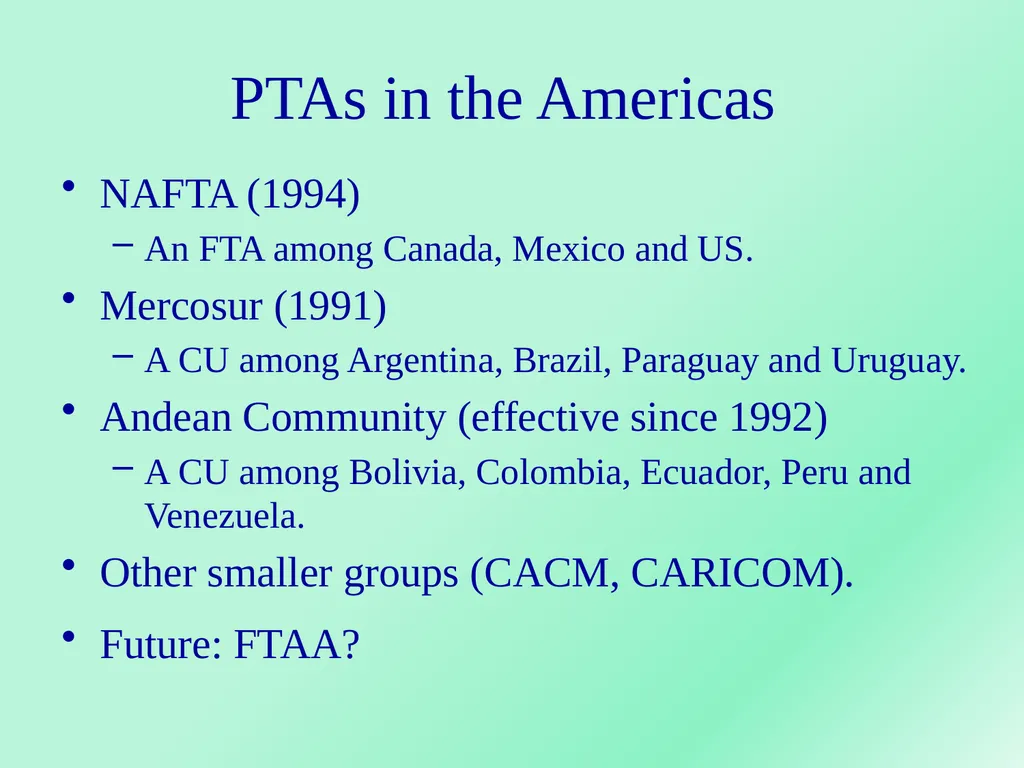
PTAs in the Americas NAFTA (1994)
An FTA among Canada, Mexico and US.
Mercosur (1991)
A CU among Argentina, Brazil, Paraguay and Uruguay.
Andean Community (effective since 1992)
A CU among Bolivia, Colombia, Ecuador, Peru and Venezuela.
Other smaller groups (CACM, CARICOM).
Future: FTAA?<br>
An FTA among Canada, Mexico and US.
Mercosur (1991)
A CU among Argentina, Brazil, Paraguay and Uruguay.
Andean Community (effective since 1992)
A CU among Bolivia, Colombia, Ecuador, Peru and Venezuela.
Other smaller groups (CACM, CARICOM).
Future: FTAA?<br>
44
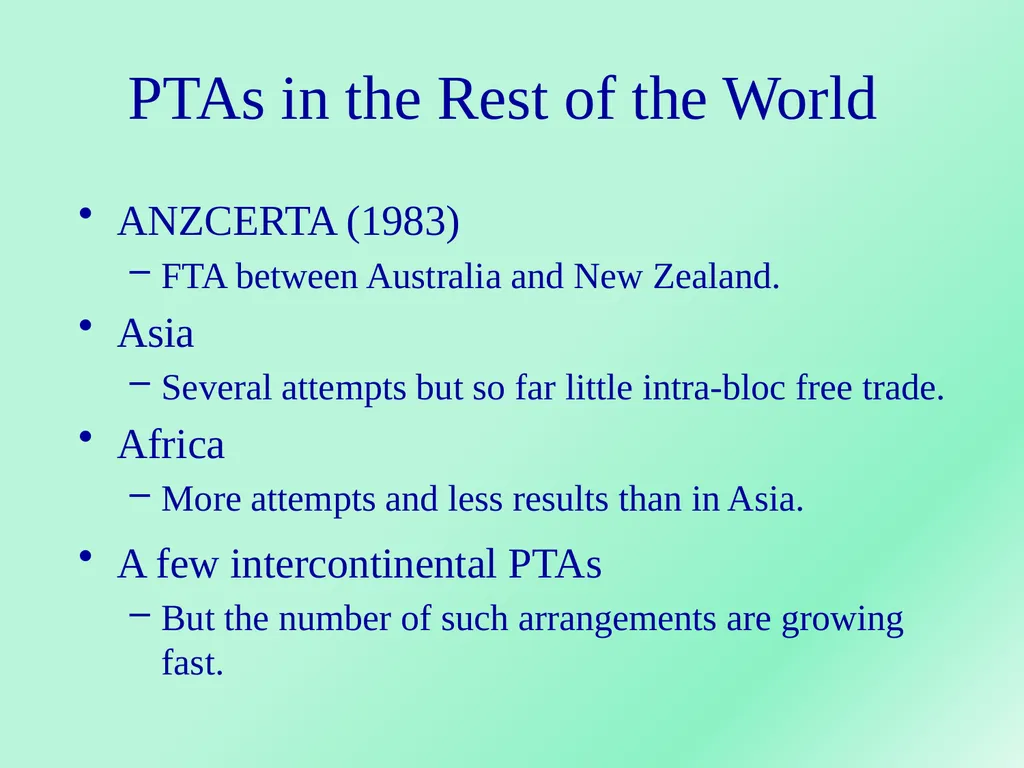
PTAs in the Rest of the World ANZCERTA (1983)
FTA between Australia and New Zealand.
Asia
Several attempts but so far little intra-bloc free trade.
Africa
More attempts and less results than in Asia.
A few intercontinental PTAs
But the number of such arrangements are growing fast.<br>
FTA between Australia and New Zealand.
Asia
Several attempts but so far little intra-bloc free trade.
Africa
More attempts and less results than in Asia.
A few intercontinental PTAs
But the number of such arrangements are growing fast.<br>
45
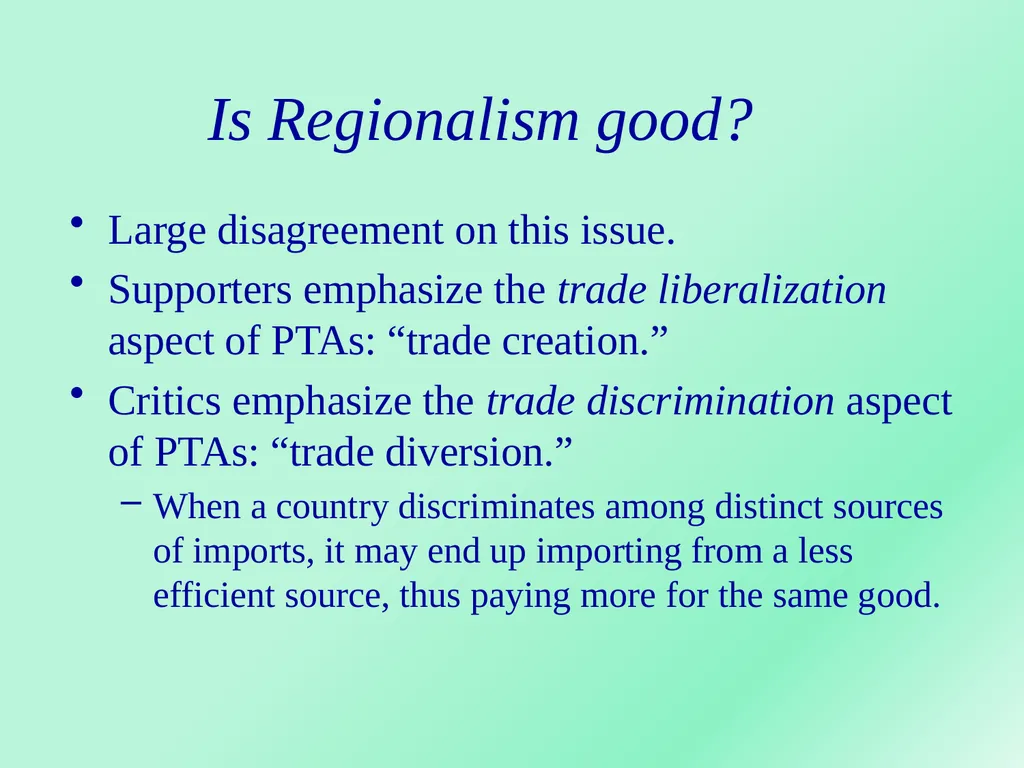
Is Regionalism good? Large disagreement on this issue.
Supporters emphasize the trade liberalization aspect of PTAs: “trade creation.”
Critics emphasize the trade discrimination aspect of PTAs: “trade diversion.”
When a country discriminates among distinct sources of imports, it may end up importing from a less efficient source, thus paying more for the same good.<br>
Supporters emphasize the trade liberalization aspect of PTAs: “trade creation.”
Critics emphasize the trade discrimination aspect of PTAs: “trade diversion.”
When a country discriminates among distinct sources of imports, it may end up importing from a less efficient source, thus paying more for the same good.<br>
46
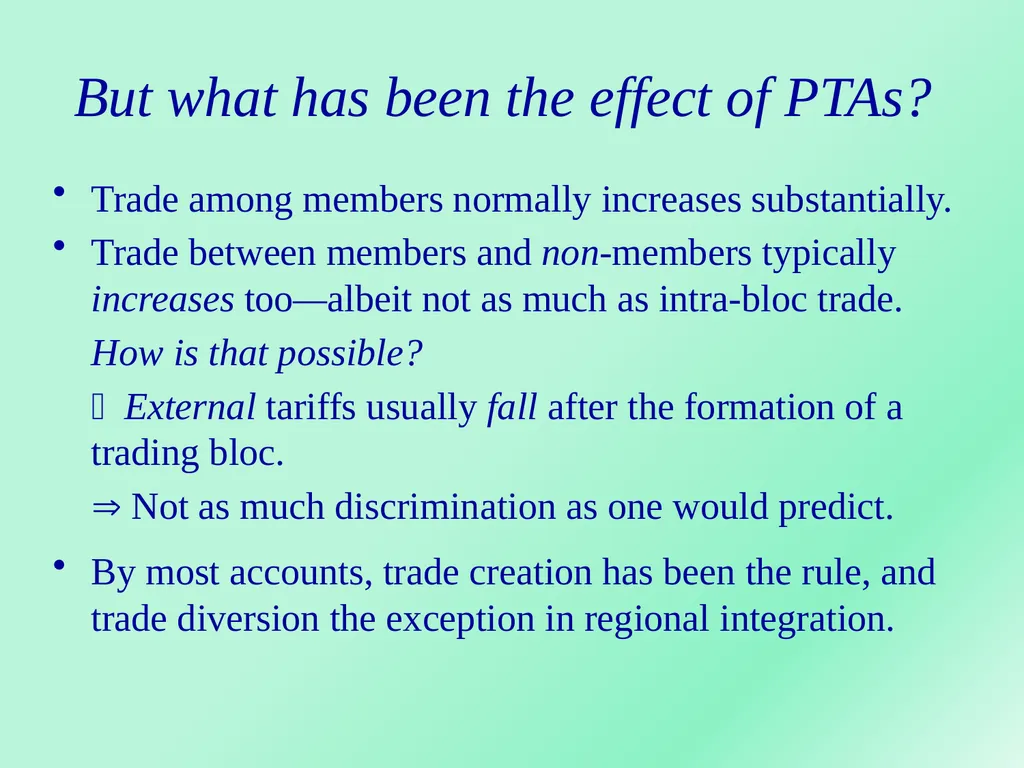
But what has been the effect of PTAs? Trade among members normally increases substantially.
Trade between members and non-members typically increases too—albeit not as much as intra-bloc trade.
How is that possible?
External tariffs usually fall after the formation of a trading bloc.
Not as much discrimination as one would predict.
By most accounts, trade creation has been the rule, and trade diversion the exception in regional integration.<br>
Trade between members and non-members typically increases too—albeit not as much as intra-bloc trade.
How is that possible?
External tariffs usually fall after the formation of a trading bloc.
Not as much discrimination as one would predict.
By most accounts, trade creation has been the rule, and trade diversion the exception in regional integration.<br>
47
Other observed effects of PTAs: Has not reduced (at least not clearly) the interest on liberalization at the multilateral level.
Flows of FDI normally increase after a PTA is created.
Empirical regularities suggest that PTAs can help “consolidate democracy.”
Possible explanation: “rent dissipation.”<br>
Flows of FDI normally increase after a PTA is created.
Empirical regularities suggest that PTAs can help “consolidate democracy.”
Possible explanation: “rent dissipation.”<br>
48
WTO: Recent Developments
Seattle’s Failed “Millennium Round” Main reasons behind the failure
US vs. EU on agricultural subsidies.
US vs. developing countries on labor standards.
“Outside events.”<br>
US vs. EU on agricultural subsidies.
US vs. developing countries on labor standards.
“Outside events.”<br>
49
The Claims “Outside” ‘The WTO is not democratic.’
‘Trade pacts disregard the environment: race to the bottom.’
‘Trade pacts promote child labor and hazardous working conditions.
‘Free trade shifts jobs from high-wage-high-standard countries to low-wage-low-standard countries.’<br>
‘Trade pacts disregard the environment: race to the bottom.’
‘Trade pacts promote child labor and hazardous working conditions.
‘Free trade shifts jobs from high-wage-high-standard countries to low-wage-low-standard countries.’<br>
50
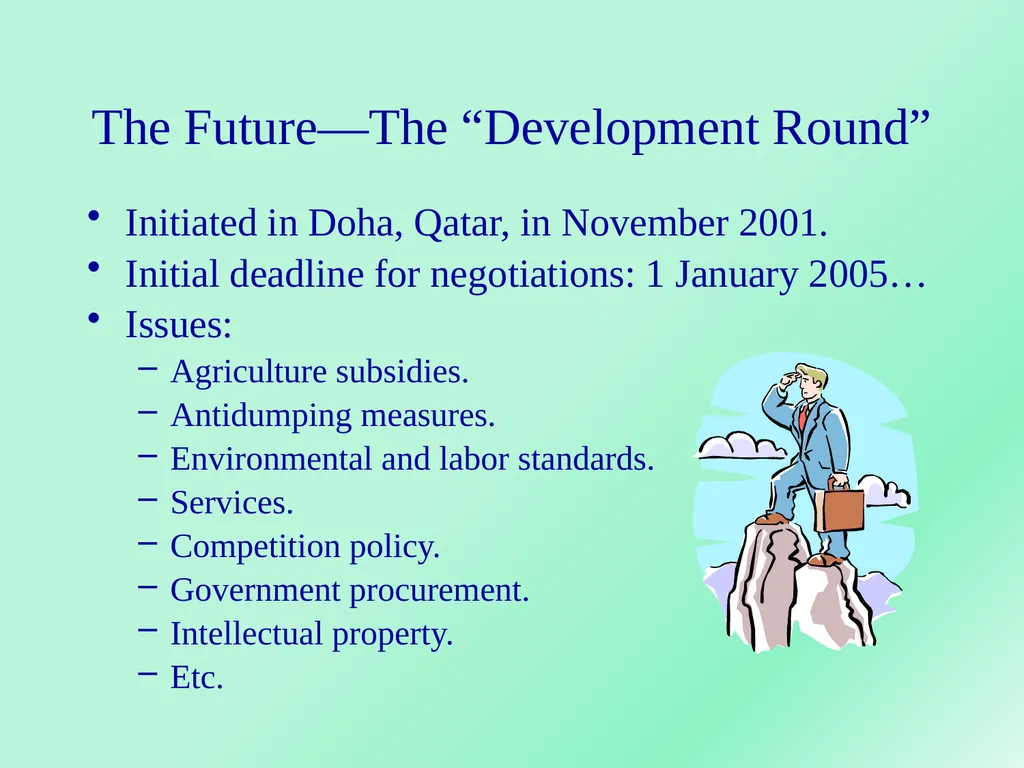
The Future—The “Development Round” Initiated in Doha, Qatar, in November 2001.
Initial deadline for negotiations: 1 January 2005…
Issues:
Agriculture subsidies.
Antidumping measures.
Environmental and labor standards.
Services.
Competition policy.
Government procurement.
Intellectual property.
Etc.<br>
Initial deadline for negotiations: 1 January 2005…
Issues:
Agriculture subsidies.
Antidumping measures.
Environmental and labor standards.
Services.
Competition policy.
Government procurement.
Intellectual property.
Etc.<br>