
Worldview Dóchas Public Engagement Survey Topline
AS
Published · 64 slides · 0 views

1 / 1

Description
Worldview Dóchas Public Engagement Survey Topline findings J.235390 Presented by: Luke Reaper Katie Kirkwood September 2024 Ipsos BA Dóchas Public Engagement Survey Aug 2024 Internal Strictly Confidential Fieldwork on the
Related Topics
Share
Embed code
Download this presentation From Below
"Worldview Dóchas Public Engagement Survey Topline" is the property of its rightful owner. Permission is granted to download and print the materials on this website for personal, non-commercial use only, and to display it on your personal computer provided you do not modify the materials and that you retain all copyright notices contained in the materials. By downloading content from our website, you accept the terms of this agreement.
Presentation Transcript
01
Worldview
Dóchas Public Engagement Survey Topline findings J.235390
Presented by:
Luke Reaper & Katie Kirkwood September 2024 © Ipsos B&A | Dóchas Public Engagement Survey | Aug 2024 | Internal | Strictly Confidential<br>
Presented by:
Luke Reaper & Katie Kirkwood September 2024 © Ipsos B&A | Dóchas Public Engagement Survey | Aug 2024 | Internal | Strictly Confidential<br>
02
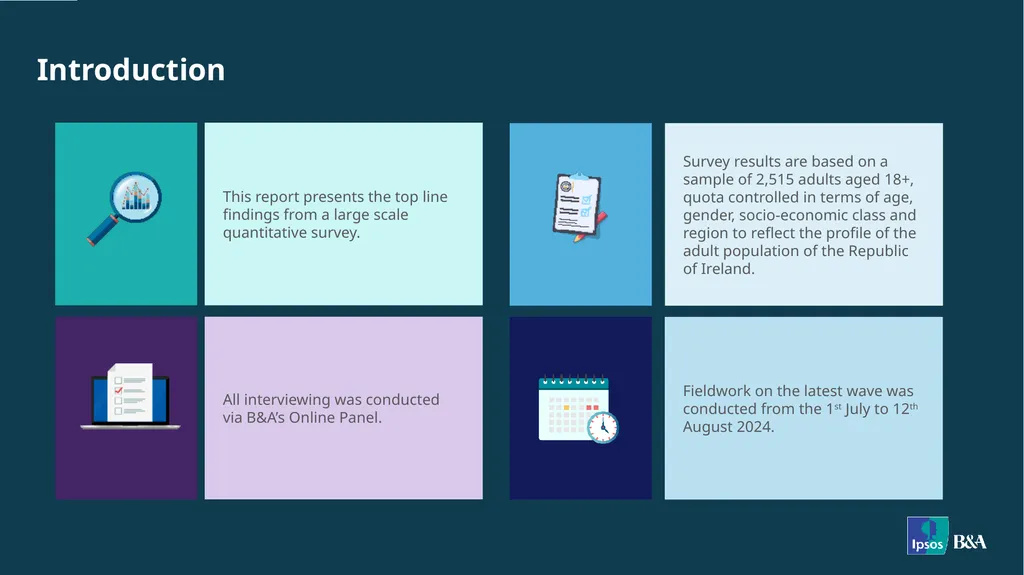
Fieldwork on the latest wave was conducted from the 1st July to 12th August 2024. Survey results are based on a sample of 2,515 adults aged 18+, quota controlled in terms of age, gender, socio-economic class and region to reflect the profile of the adult population of the Republic of Ireland. This report presents the top line findings from a large scale quantitative survey. All interviewing was conducted via B&A’s Online Panel. Introduction<br>
03
Main findings<br>
04
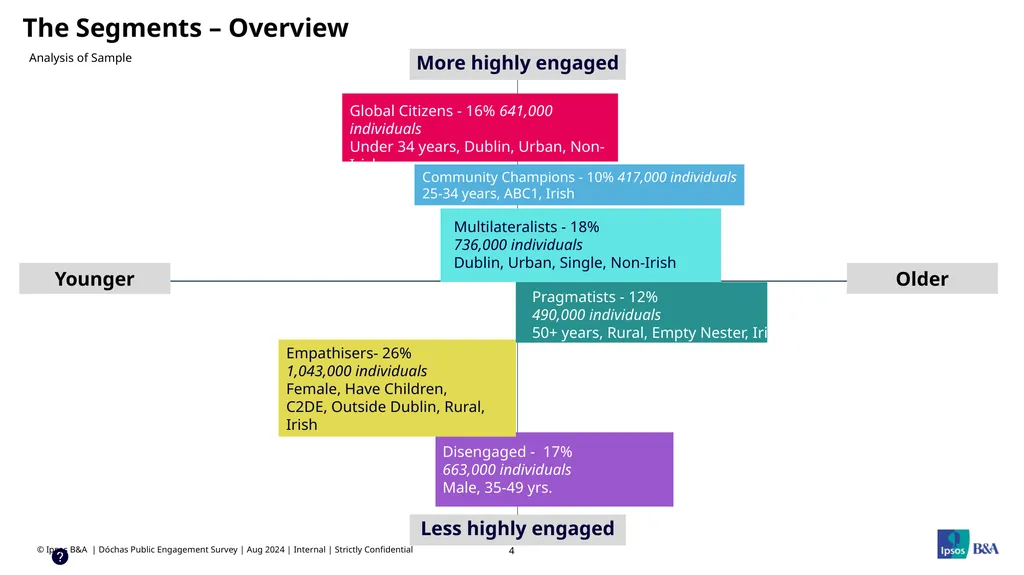
Analysis of Sample The Segments – Overview Younger Older Global Citizens - 16% 641,000 individuals
Under 34 years, Dublin, Urban, Non-Irish Multilateralists - 18%
736,000 individuals
Dublin, Urban, Single, Non-Irish Empathisers- 26%
1,043,000 individuals
Female, Have Children,
C2DE, Outside Dublin, Rural, Irish Disengaged - 17%
663,000 individuals
Male, 35-49 yrs. Community Champions - 10% 417,000 individuals
25-34 years, ABC1, Irish More highly engaged Less highly engaged Pragmatists - 12%
490,000 individuals
50+ years, Rural, Empty Nester, Irish<br>
05
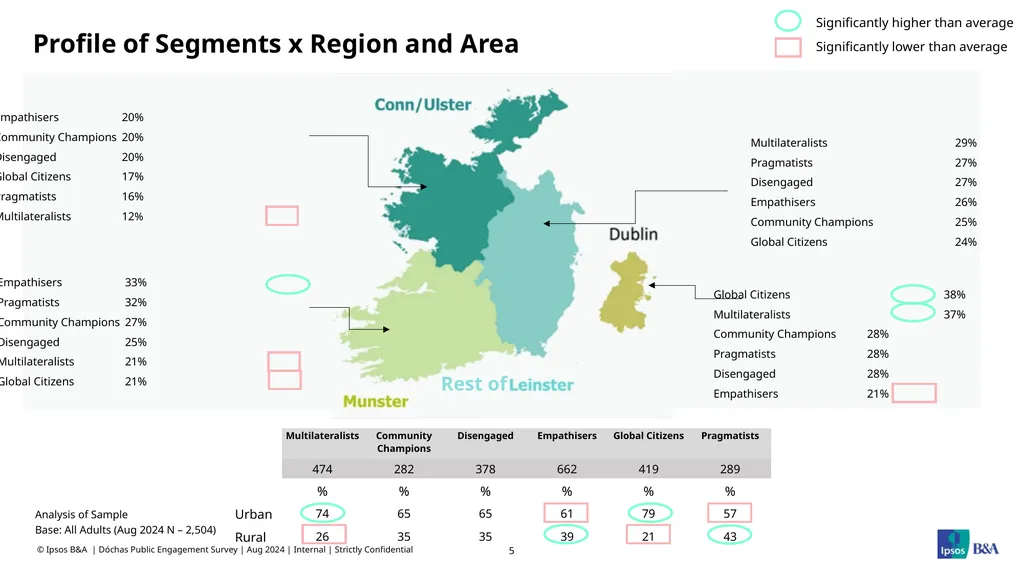
Profile of Segments x Region and Area Analysis of Sample
Base: All Adults (Aug 2024 N – 2,504) Multilateralists 29%
Pragmatists 27%
Disengaged 27%
Empathisers 26%
Community Champions 25%
Global Citizens 24% Empathisers 33%
Pragmatists 32%
Community Champions 27%
Disengaged 25%
Multilateralists 21%
Global Citizens 21% Empathisers 20%
Community Champions 20%
Disengaged 20%
Global Citizens 17%
Pragmatists 16%
Multilateralists 12% Global Citizens 38%
Multilateralists 37%
Community Champions 28%
Pragmatists 28%
Disengaged 28%
Empathisers 21% Rest of<br>
06
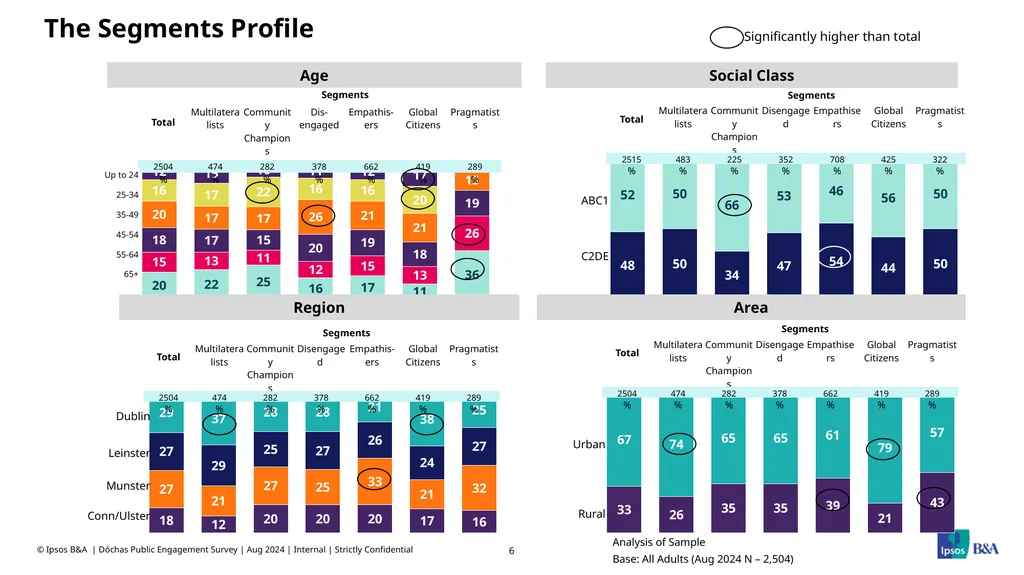
The Segments Profile Analysis of Sample
Base: All Adults (Aug 2024 N – 2,504) Age Social Class Region Area Significantly higher than total<br>
Base: All Adults (Aug 2024 N – 2,504) Age Social Class Region Area Significantly higher than total<br>
07
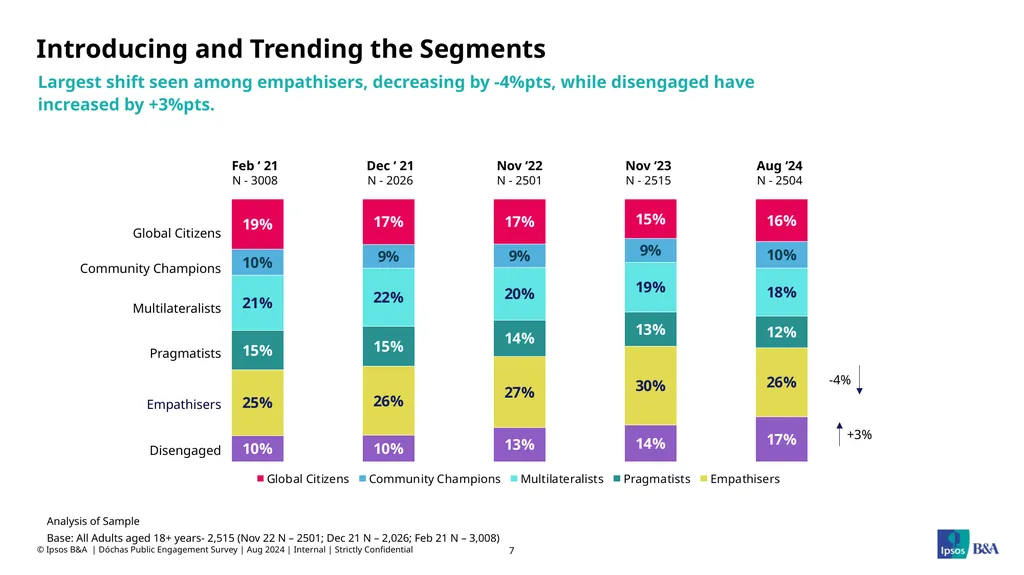
Introducing and Trending the Segments Largest shift seen among empathisers, decreasing by -4%pts, while disengaged have increased by +3%pts. Analysis of Sample
Base: All Adults aged 18+ years- 2,515 (Nov 22 N – 2501; Dec 21 N – 2,026; Feb 21 N – 3,008) Dec ‘ 21
N - 2026 Feb ‘ 21
N - 3008 Nov ‘22
N - 2501 +3% Nov ‘23
N - 2515 Aug ‘24
N - 2504 -4%<br>
Base: All Adults aged 18+ years- 2,515 (Nov 22 N – 2501; Dec 21 N – 2,026; Feb 21 N – 3,008) Dec ‘ 21
N - 2026 Feb ‘ 21
N - 3008 Nov ‘22
N - 2501 +3% Nov ‘23
N - 2515 Aug ‘24
N - 2504 -4%<br>
08
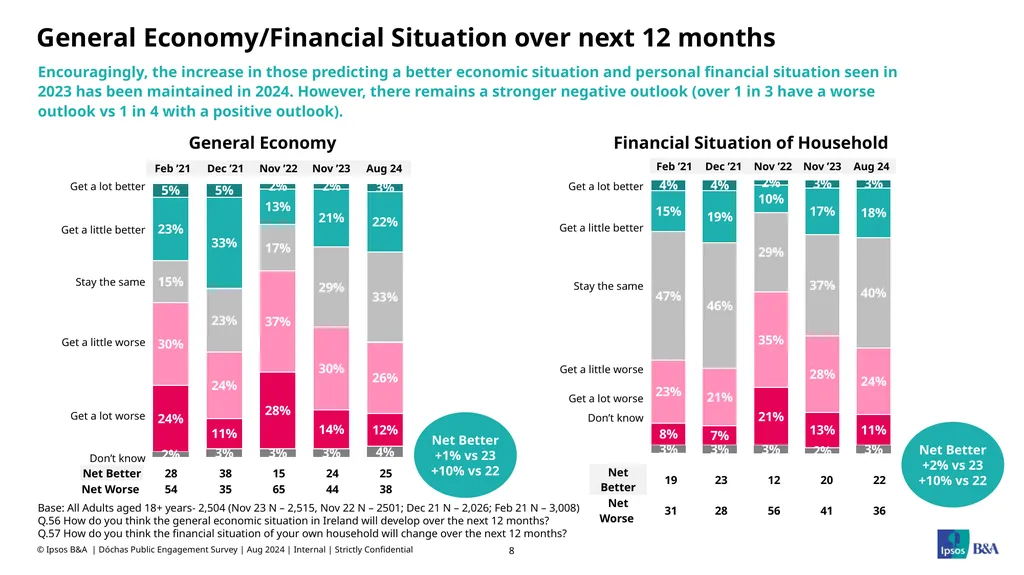
General Economy/Financial Situation over next 12 months Encouragingly, the increase in those predicting a better economic situation and personal financial situation seen in 2023 has been maintained in 2024. However, there remains a stronger negative outlook (over 1 in 3 have a worse outlook vs 1 in 4 with a positive outlook). Base: All Adults aged 18+ years- 2,504 (Nov 23 N – 2,515, Nov 22 N – 2501; Dec 21 N – 2,026; Feb 21 N – 3,008)
Q.56 How do you think the general economic situation in Ireland will develop over the next 12 months?
Q.57 How do you think the financial situation of your own household will change over the next 12 months? General Economy Net Better +1% vs 23
+10% vs 22 Financial Situation of Household Net Better +2% vs 23
+10% vs 22<br>
09
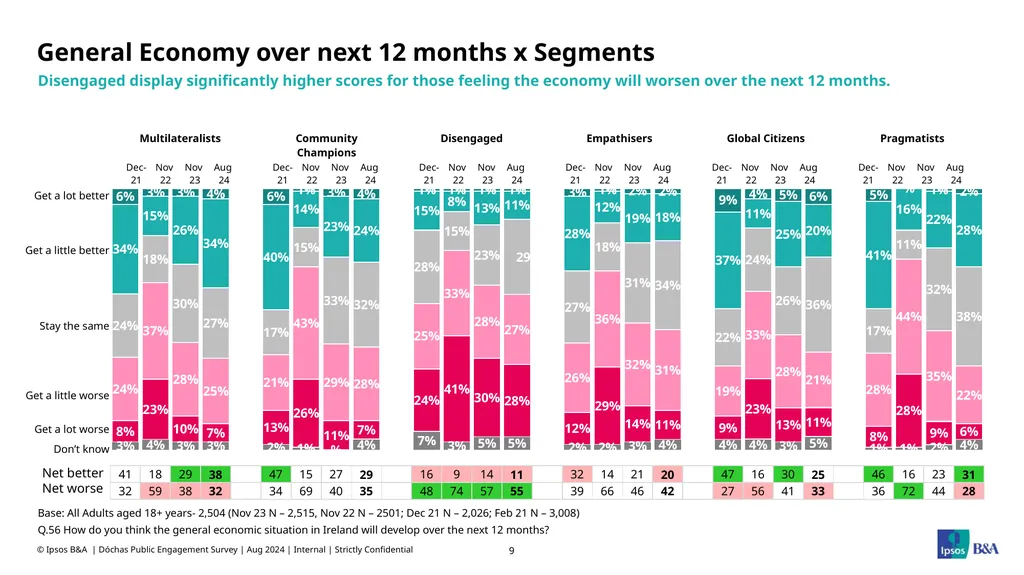
General Economy over next 12 months x Segments Disengaged display significantly higher scores for those feeling the economy will worsen over the next 12 months. Base: All Adults aged 18+ years- 2,504 (Nov 23 N – 2,515, Nov 22 N – 2501; Dec 21 N – 2,026; Feb 21 N – 3,008)
Q.56 How do you think the general economic situation in Ireland will develop over the next 12 months? Net better
Net worse<br>
Q.56 How do you think the general economic situation in Ireland will develop over the next 12 months? Net better
Net worse<br>
10
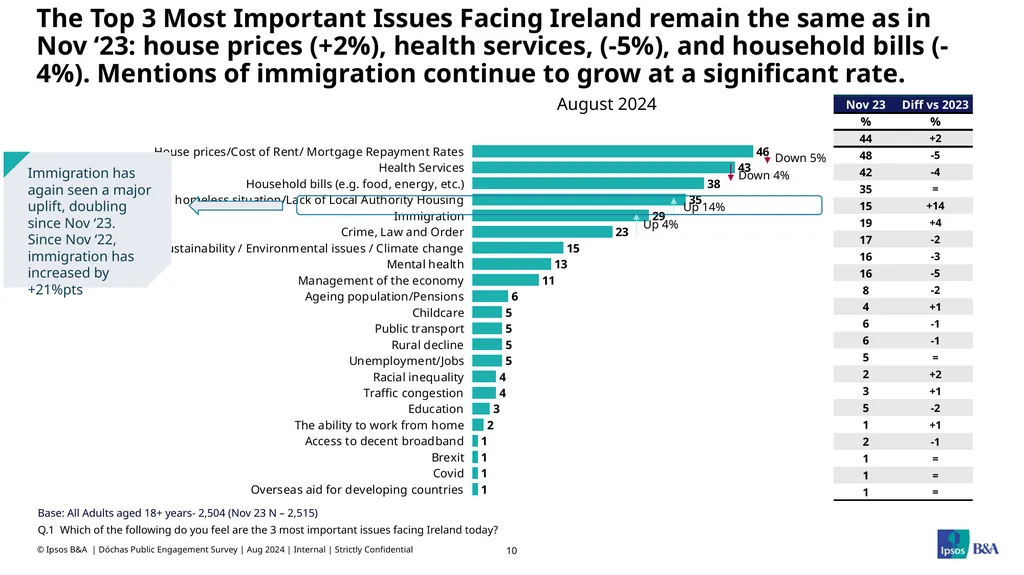
The Top 3 Most Important Issues Facing Ireland remain the same as in Nov ‘23: house prices (+2%), health services, (-5%), and household bills (-4%). Mentions of immigration continue to grow at a significant rate. Base: All Adults aged 18+ years- 2,504 (Nov 23 N – 2,515)
Q.1 Which of the following do you feel are the 3 most important issues facing Ireland today? August 2024 Down 5% Up 4% Up 14% Down 4% Immigration has again seen a major uplift, doubling since Nov ‘23. Since Nov ‘22, immigration has increased by +21%pts<br>
Q.1 Which of the following do you feel are the 3 most important issues facing Ireland today? August 2024 Down 5% Up 4% Up 14% Down 4% Immigration has again seen a major uplift, doubling since Nov ‘23. Since Nov ‘22, immigration has increased by +21%pts<br>
11
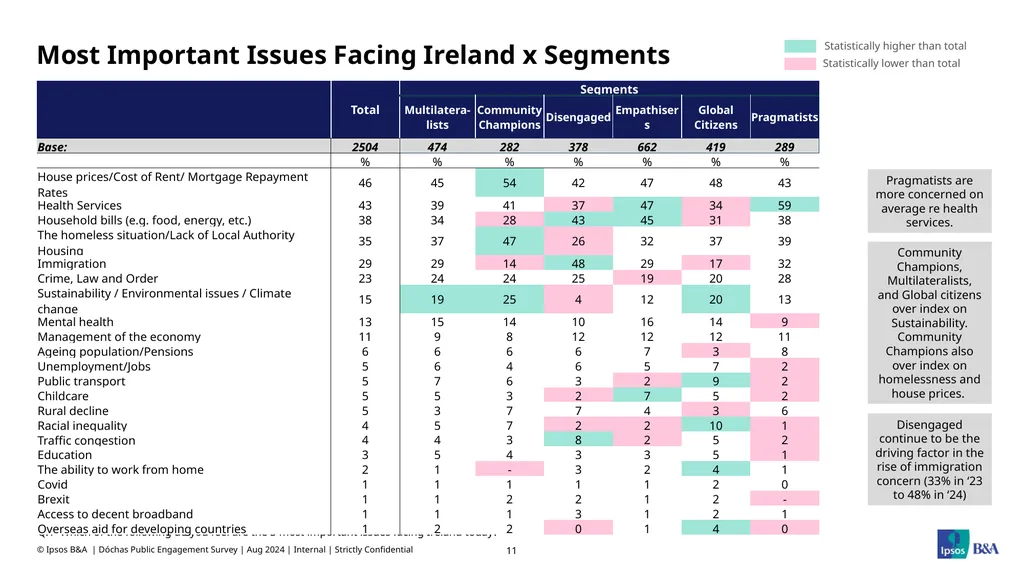
Most Important Issues Facing Ireland x Segments Base: All adults aged 18+ years- 2,504
Q.1 Which of the following do you feel are the 3 most important issues facing Ireland today? Pragmatists are more concerned on average re health services. Community Champions, Multilateralists, and Global citizens over index on Sustainability. Community Champions also over index on homelessness and house prices. Disengaged continue to be the driving factor in the rise of immigration concern (33% in ‘23 to 48% in ‘24)<br>
Q.1 Which of the following do you feel are the 3 most important issues facing Ireland today? Pragmatists are more concerned on average re health services. Community Champions, Multilateralists, and Global citizens over index on Sustainability. Community Champions also over index on homelessness and house prices. Disengaged continue to be the driving factor in the rise of immigration concern (33% in ‘23 to 48% in ‘24)<br>
12
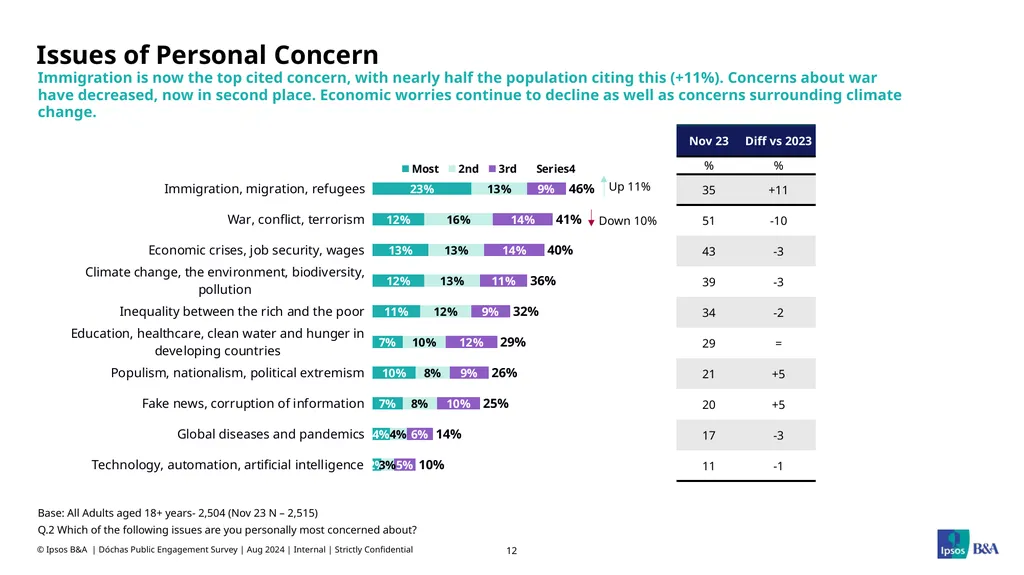
Issues of Personal Concern Immigration is now the top cited concern, with nearly half the population citing this (+11%). Concerns about war have decreased, now in second place. Economic worries continue to decline as well as concerns surrounding climate change. Base: All Adults aged 18+ years- 2,504 (Nov 23 N – 2,515)
Q.2 Which of the following issues are you personally most concerned about? Up 11% Down 10%<br>
Q.2 Which of the following issues are you personally most concerned about? Up 11% Down 10%<br>
13
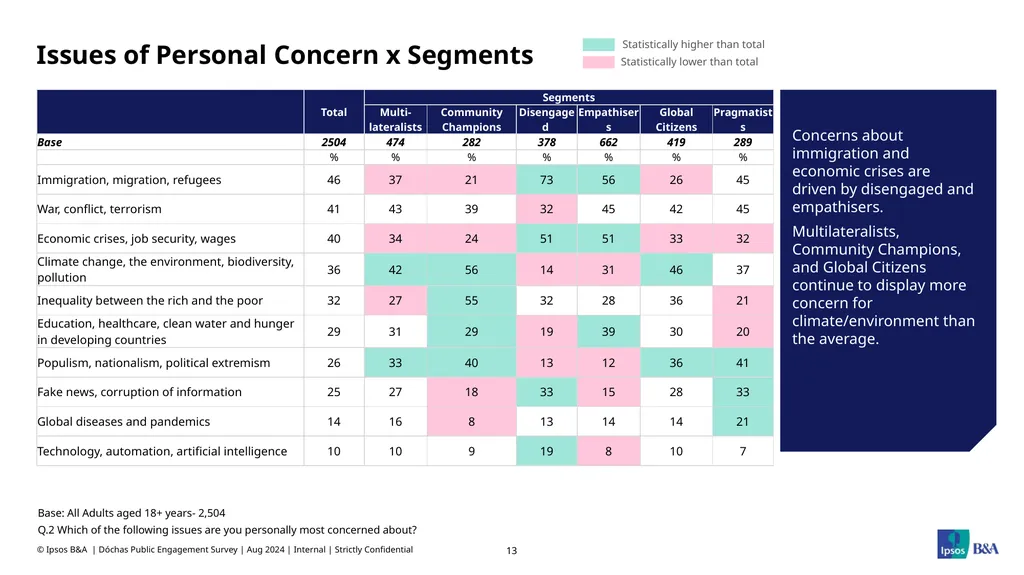
Issues of Personal Concern x Segments Base: All Adults aged 18+ years- 2,504
Q.2 Which of the following issues are you personally most concerned about? Concerns about immigration and economic crises are driven by disengaged and empathisers.
Multilateralists, Community Champions, and Global Citizens continue to display more concern for climate/environment than the average.<br>
14
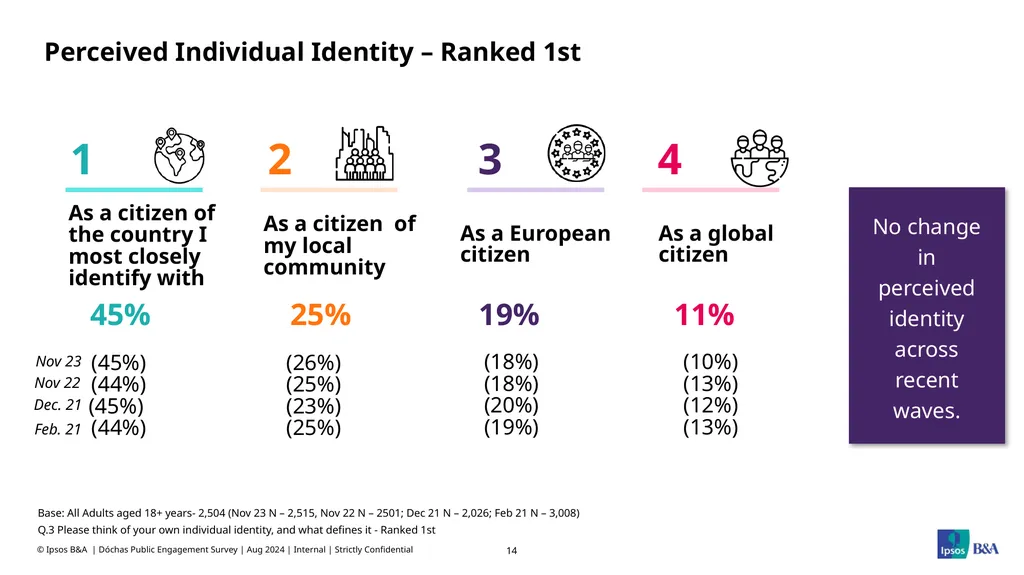
Perceived Individual Identity – Ranked 1st Base: All Adults aged 18+ years- 2,504 (Nov 23 N – 2,515, Nov 22 N – 2501; Dec 21 N – 2,026; Feb 21 N – 3,008)
Q.3 Please think of your own individual identity, and what defines it - Ranked 1st As a global citizen As a European citizen As a citizen of the country I most closely identify with As a citizen of my local community 1 2 3 4 (45%)
(44%)
(45%)
(44%) (26%)
(25%)
(23%)
(25%) (18%)
(18%)
(20%)
(19%) (10%)
(13%)
(12%)
(13%) Feb. 21 Dec. 21 25% 45% 19% 11% No change in perceived identity across recent waves. Nov 22 Nov 23<br>
15
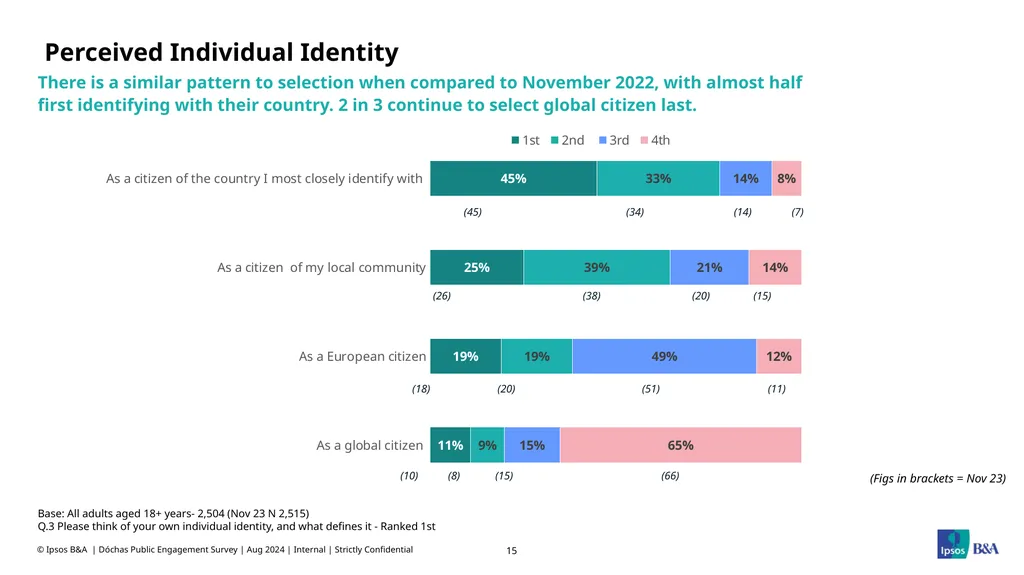
Perceived Individual Identity There is a similar pattern to selection when compared to November 2022, with almost half first identifying with their country. 2 in 3 continue to select global citizen last. Base: All adults aged 18+ years- 2,504 (Nov 23 N 2,515)
Q.3 Please think of your own individual identity, and what defines it - Ranked 1st (Figs in brackets = Nov 23)<br>
Q.3 Please think of your own individual identity, and what defines it - Ranked 1st (Figs in brackets = Nov 23)<br>
16
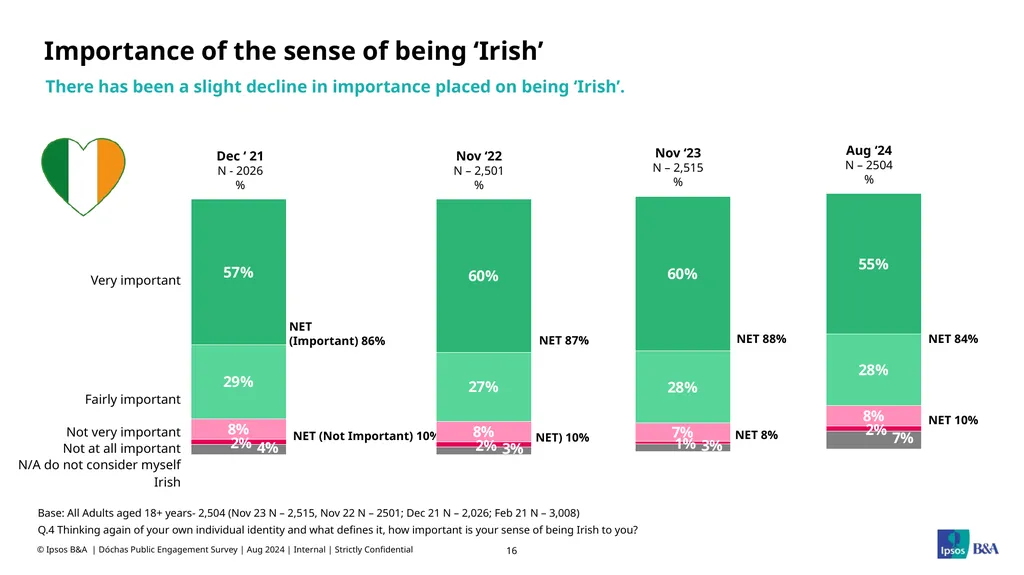
Importance of the sense of being ‘Irish’ There has been a slight decline in importance placed on being ‘Irish’. Base: All Adults aged 18+ years- 2,504 (Nov 23 N – 2,515, Nov 22 N – 2501; Dec 21 N – 2,026; Feb 21 N – 3,008)
Q.4 Thinking again of your own individual identity and what defines it, how important is your sense of being Irish to you? Nov ‘22
N – 2,501
% NET 87% NET) 10% Dec ‘ 21
N - 2026
% NET
(Important) 86% NET (Not Important) 10% Nov ‘23
N – 2,515
% NET 8% NET 88% Aug ‘24
N – 2504
% NET 10% NET 84%<br>
Q.4 Thinking again of your own individual identity and what defines it, how important is your sense of being Irish to you? Nov ‘22
N – 2,501
% NET 87% NET) 10% Dec ‘ 21
N - 2026
% NET
(Important) 86% NET (Not Important) 10% Nov ‘23
N – 2,515
% NET 8% NET 88% Aug ‘24
N – 2504
% NET 10% NET 84%<br>
17
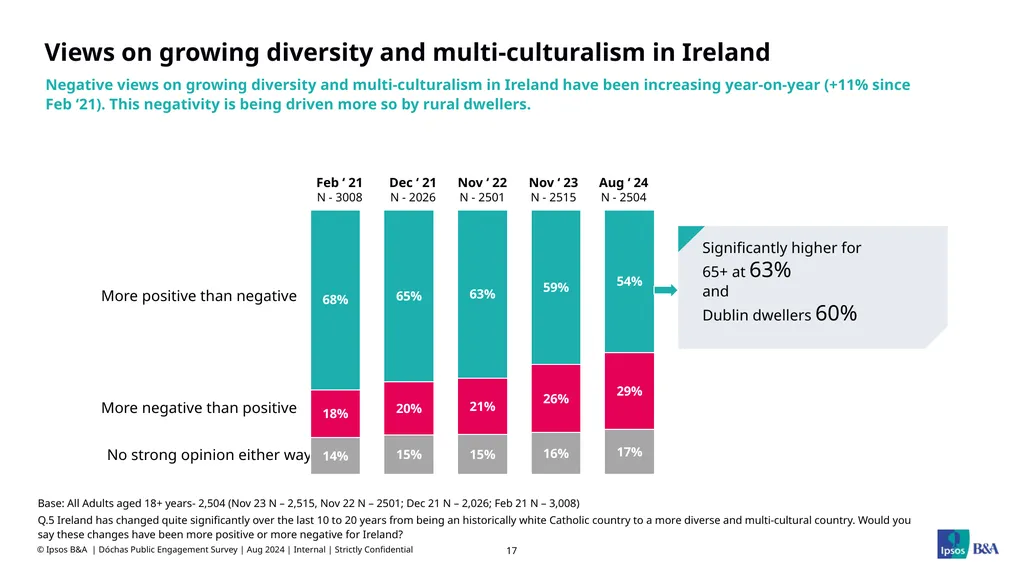
Views on growing diversity and multi-culturalism in Ireland Negative views on growing diversity and multi-culturalism in Ireland have been increasing year-on-year (+11% since Feb ‘21). This negativity is being driven more so by rural dwellers. Base: All Adults aged 18+ years- 2,504 (Nov 23 N – 2,515, Nov 22 N – 2501; Dec 21 N – 2,026; Feb 21 N – 3,008)
Q.5 Ireland has changed quite significantly over the last 10 to 20 years from being an historically white Catholic country to a more diverse and multi-cultural country. Would you say these changes have been more positive or more negative for Ireland? More positive than negative No strong opinion either way More negative than positive Dec ‘ 21
N - 2026 Feb ‘ 21
N - 3008 Nov ‘ 22
N - 2501 Nov ‘ 23
N - 2515 Aug ‘ 24
N - 2504 Significantly higher for
65+ at 63%
and
Dublin dwellers 60%<br>
18
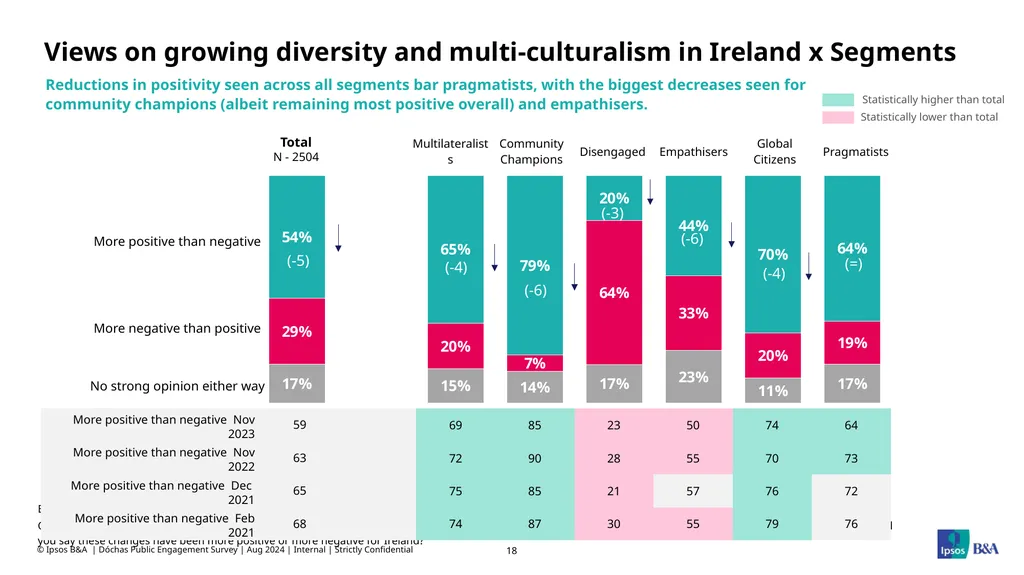
Views on growing diversity and multi-culturalism in Ireland x Segments Reductions in positivity seen across all segments bar pragmatists, with the biggest decreases seen for community champions (albeit remaining most positive overall) and empathisers. Base: All Adults aged 18+ years- 2,504 (Nov 23 N – 2,515, Nov 22 N – 2501; Dec 21 N – 2,026; Feb 21 N – 3,008)
Q.5 Ireland has changed quite significantly over the last 10 to 20 years from being an historically white Catholic country to a more diverse and multi-cultural country. Would you say these changes have been more positive or more negative for Ireland? More positive than negative No strong opinion either way More negative than positive (-4) (-6) (-3) (-4) Total
N - 2504 (-5) (-6) (=)<br>
19
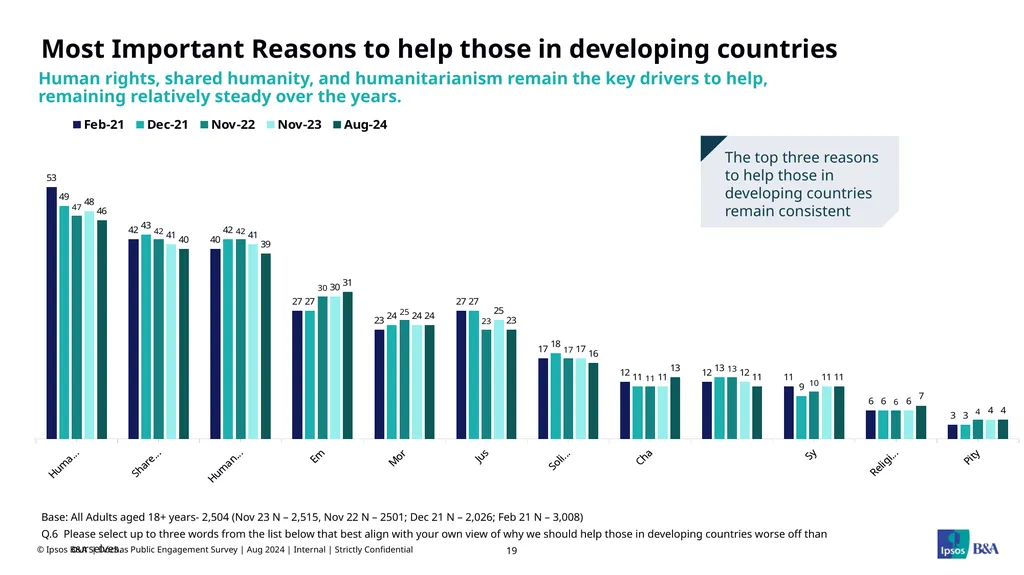
Most Important Reasons to help those in developing countries Human rights, shared humanity, and humanitarianism remain the key drivers to help, remaining relatively steady over the years. Base: All Adults aged 18+ years- 2,504 (Nov 23 N – 2,515, Nov 22 N – 2501; Dec 21 N – 2,026; Feb 21 N – 3,008)
Q.6 Please select up to three words from the list below that best align with your own view of why we should help those in developing countries worse off than ourselves. The top three reasons to help those in developing countries remain consistent<br>
Q.6 Please select up to three words from the list below that best align with your own view of why we should help those in developing countries worse off than ourselves. The top three reasons to help those in developing countries remain consistent<br>
20
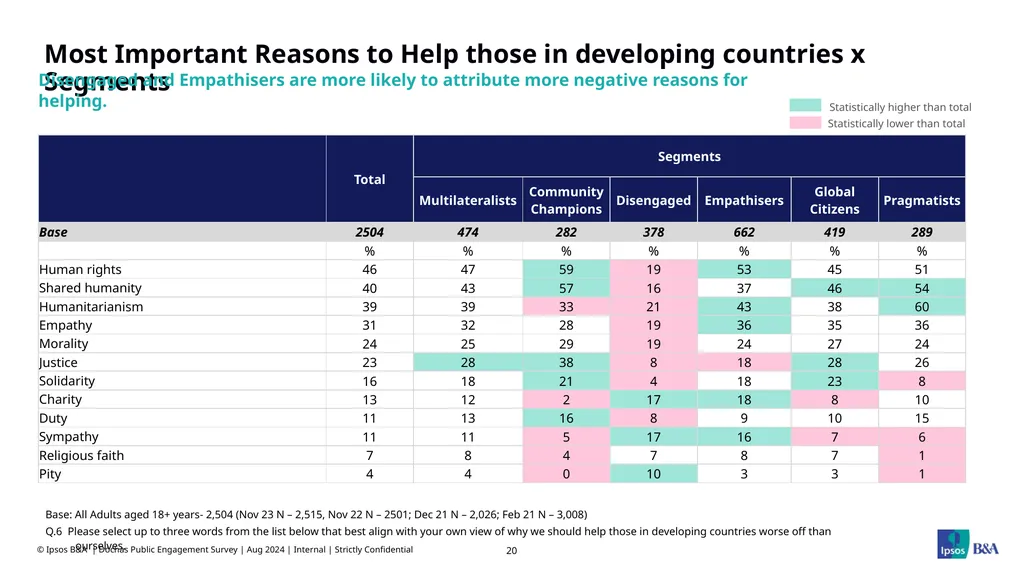
Most Important Reasons to Help those in developing countries x Segments Base: All Adults aged 18+ years- 2,504 (Nov 23 N – 2,515, Nov 22 N – 2501; Dec 21 N – 2,026; Feb 21 N – 3,008)
Q.6 Please select up to three words from the list below that best align with your own view of why we should help those in developing countries worse off than ourselves. Disengaged and Empathisers are more likely to attribute more negative reasons for helping.<br>
Q.6 Please select up to three words from the list below that best align with your own view of why we should help those in developing countries worse off than ourselves. Disengaged and Empathisers are more likely to attribute more negative reasons for helping.<br>
21
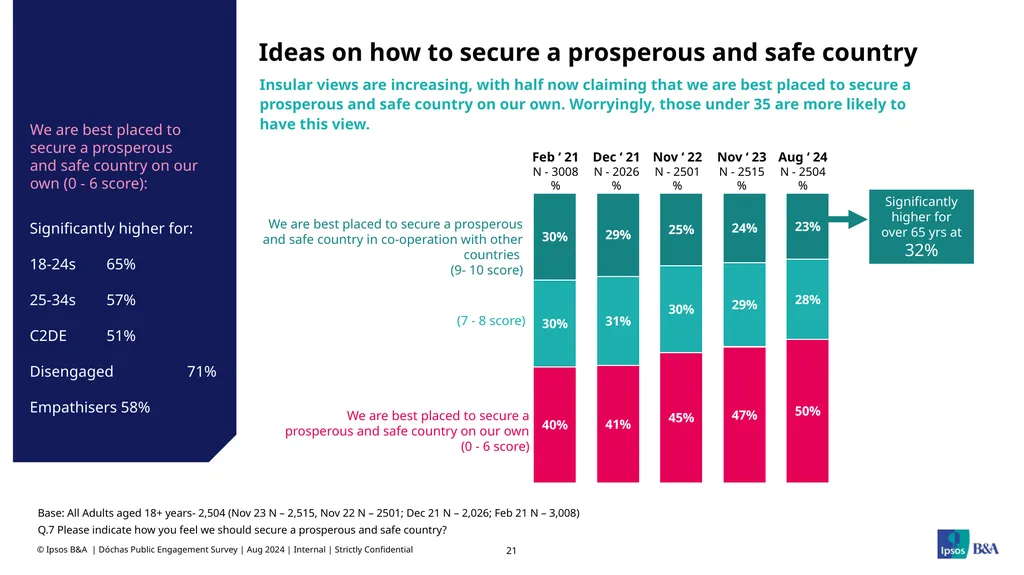
Ideas on how to secure a prosperous and safe country Insular views are increasing, with half now claiming that we are best placed to secure a prosperous and safe country on our own. Worryingly, those under 35 are more likely to have this view. Base: All Adults aged 18+ years- 2,504 (Nov 23 N – 2,515, Nov 22 N – 2501; Dec 21 N – 2,026; Feb 21 N – 3,008)
Q.7 Please indicate how you feel we should secure a prosperous and safe country? We are best placed to secure a prosperous and safe country in co-operation with other countries
(9- 10 score) We are best placed to secure a prosperous and safe country on our own (0 - 6 score) (7 - 8 score) Significantly higher for over 65 yrs at 32% Dec ‘ 21
N - 2026
% Feb ‘ 21
N - 3008
% Nov ‘ 22
N - 2501
% Nov ‘ 23
N - 2515
% Aug ‘ 24
N - 2504
% We are best placed to secure a prosperous and safe country on our own (0 - 6 score): Significantly higher for:
18-24s 65%
25-34s 57%
C2DE 51%
Disengaged 71%
Empathisers 58%<br>
22
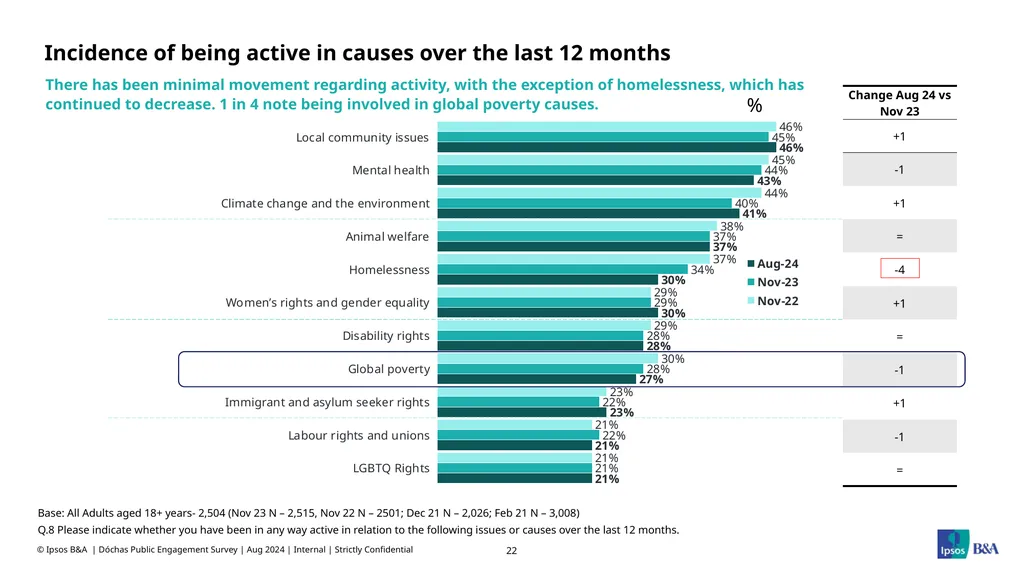
Incidence of being active in causes over the last 12 months There has been minimal movement regarding activity, with the exception of homelessness, which has continued to decrease. 1 in 4 note being involved in global poverty causes. Base: All Adults aged 18+ years- 2,504 (Nov 23 N – 2,515, Nov 22 N – 2501; Dec 21 N – 2,026; Feb 21 N – 3,008)
Q.8 Please indicate whether you have been in any way active in relation to the following issues or causes over the last 12 months. %<br>
Q.8 Please indicate whether you have been in any way active in relation to the following issues or causes over the last 12 months. %<br>
23
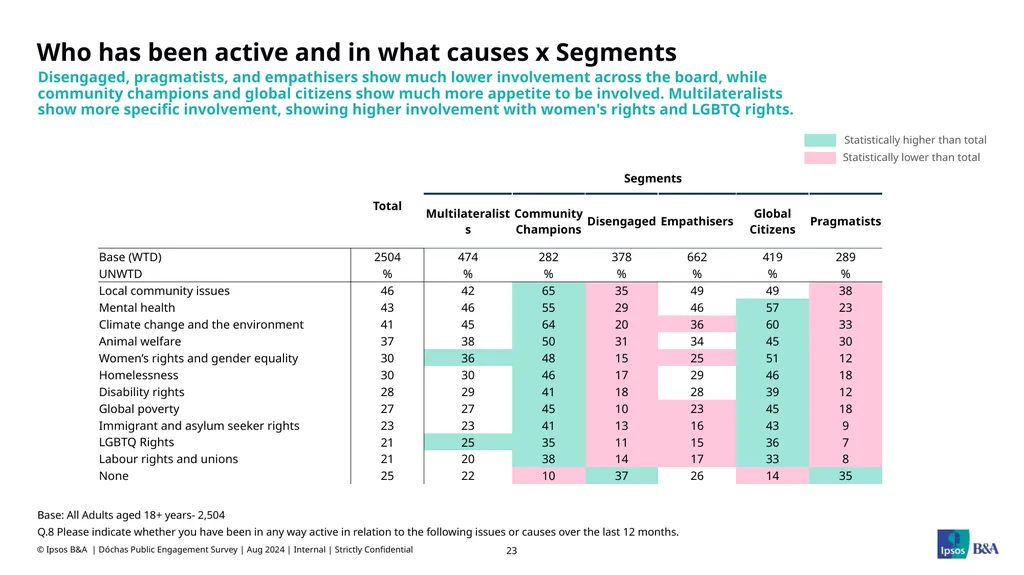
Who has been active and in what causes x Segments Disengaged, pragmatists, and empathisers show much lower involvement across the board, while community champions and global citizens show much more appetite to be involved. Multilateralists show more specific involvement, showing higher involvement with women's rights and LGBTQ rights. Base: All Adults aged 18+ years- 2,504
Q.8 Please indicate whether you have been in any way active in relation to the following issues or causes over the last 12 months.<br>
Q.8 Please indicate whether you have been in any way active in relation to the following issues or causes over the last 12 months.<br>
24
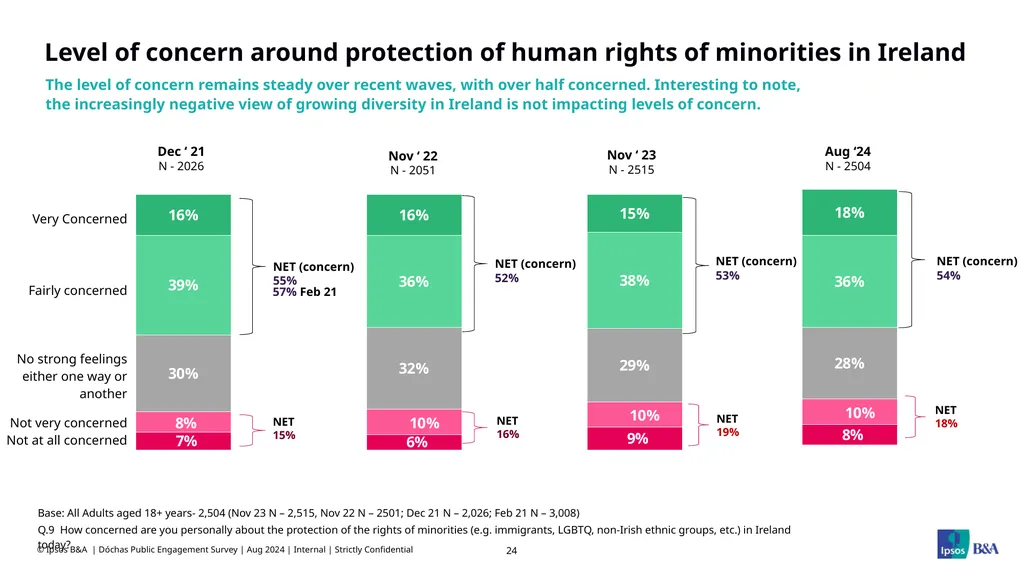
Level of concern around protection of human rights of minorities in Ireland The level of concern remains steady over recent waves, with over half concerned. Interesting to note, the increasingly negative view of growing diversity in Ireland is not impacting levels of concern. Base: All Adults aged 18+ years- 2,504 (Nov 23 N – 2,515, Nov 22 N – 2501; Dec 21 N – 2,026; Feb 21 N – 3,008)
Q.9 How concerned are you personally about the protection of the rights of minorities (e.g. immigrants, LGBTQ, non-Irish ethnic groups, etc.) in Ireland today? Dec ‘ 21
N - 2026 NET (concern)
55% NET
15% 57% Feb 21 Nov ‘ 22
N - 2051 NET (concern)
52% NET
16% NET (concern)
53% NET
19% Nov ‘ 23
N - 2515 NET (concern)
54% NET
18% Aug ‘24
N - 2504<br>
25
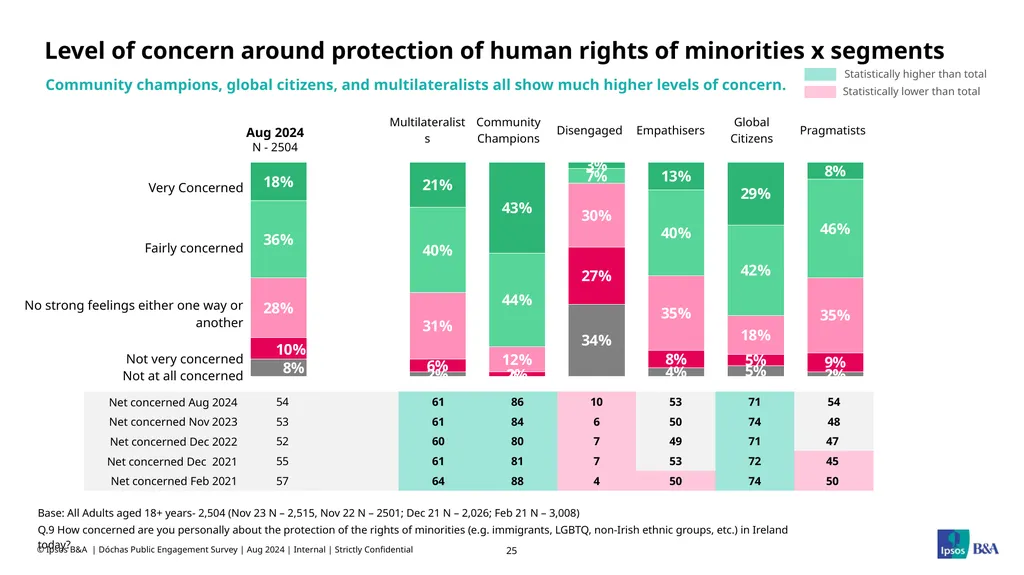
Level of concern around protection of human rights of minorities x segments Community champions, global citizens, and multilateralists all show much higher levels of concern. Base: All Adults aged 18+ years- 2,504 (Nov 23 N – 2,515, Nov 22 N – 2501; Dec 21 N – 2,026; Feb 21 N – 3,008)
Q.9 How concerned are you personally about the protection of the rights of minorities (e.g. immigrants, LGBTQ, non-Irish ethnic groups, etc.) in Ireland today? Aug 2024
N - 2504<br>
Q.9 How concerned are you personally about the protection of the rights of minorities (e.g. immigrants, LGBTQ, non-Irish ethnic groups, etc.) in Ireland today? Aug 2024
N - 2504<br>
26
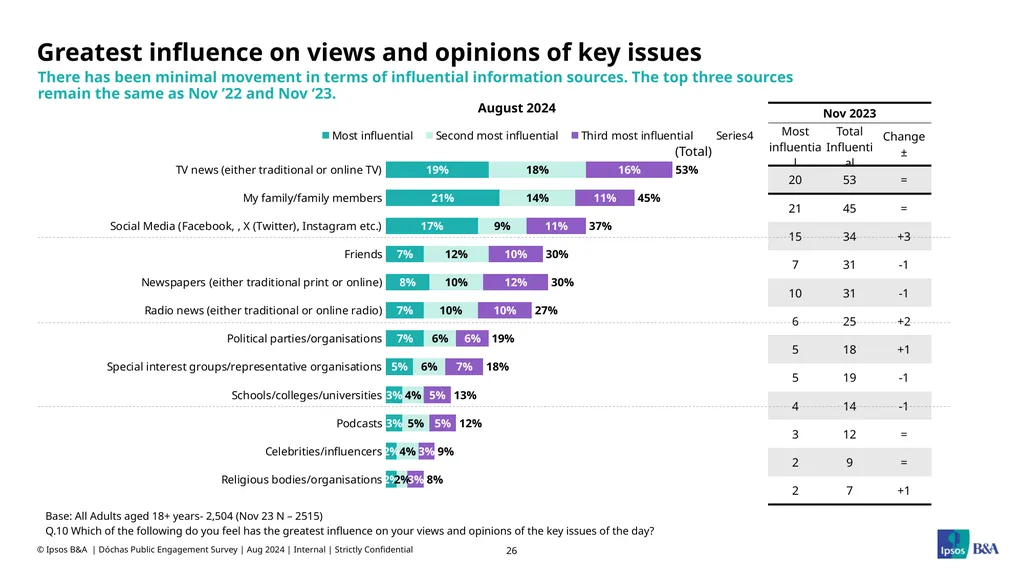
Greatest influence on views and opinions of key issues There has been minimal movement in terms of influential information sources. The top three sources remain the same as Nov ’22 and Nov ‘23. Base: All Adults aged 18+ years- 2,504 (Nov 23 N – 2515)
Q.10 Which of the following do you feel has the greatest influence on your views and opinions of the key issues of the day? August 2024 (Total)<br>
Q.10 Which of the following do you feel has the greatest influence on your views and opinions of the key issues of the day? August 2024 (Total)<br>
27
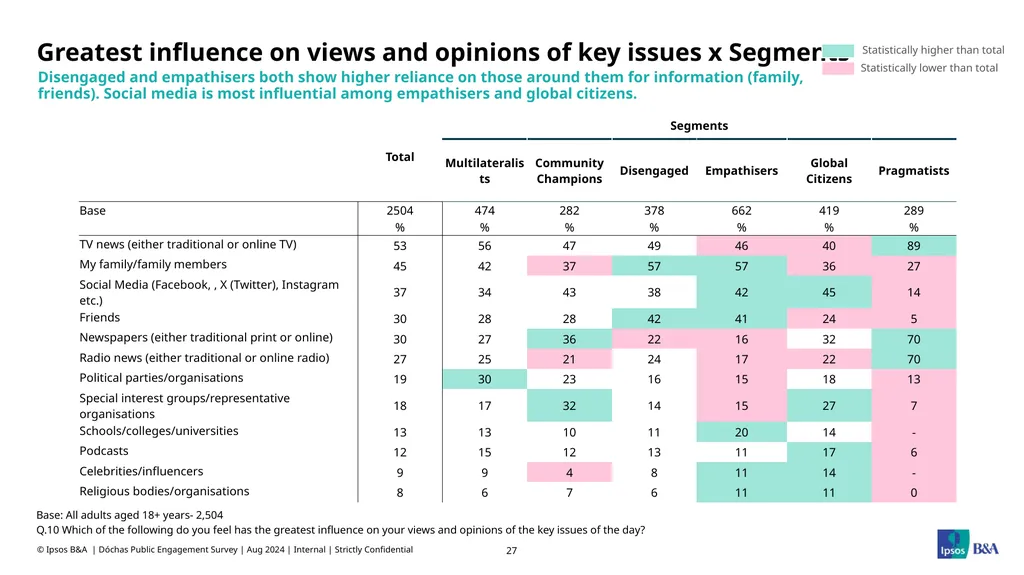
Greatest influence on views and opinions of key issues x Segments Disengaged and empathisers both show higher reliance on those around them for information (family, friends). Social media is most influential among empathisers and global citizens. Base: All adults aged 18+ years- 2,504
Q.10 Which of the following do you feel has the greatest influence on your views and opinions of the key issues of the day?<br>
Q.10 Which of the following do you feel has the greatest influence on your views and opinions of the key issues of the day?<br>
28
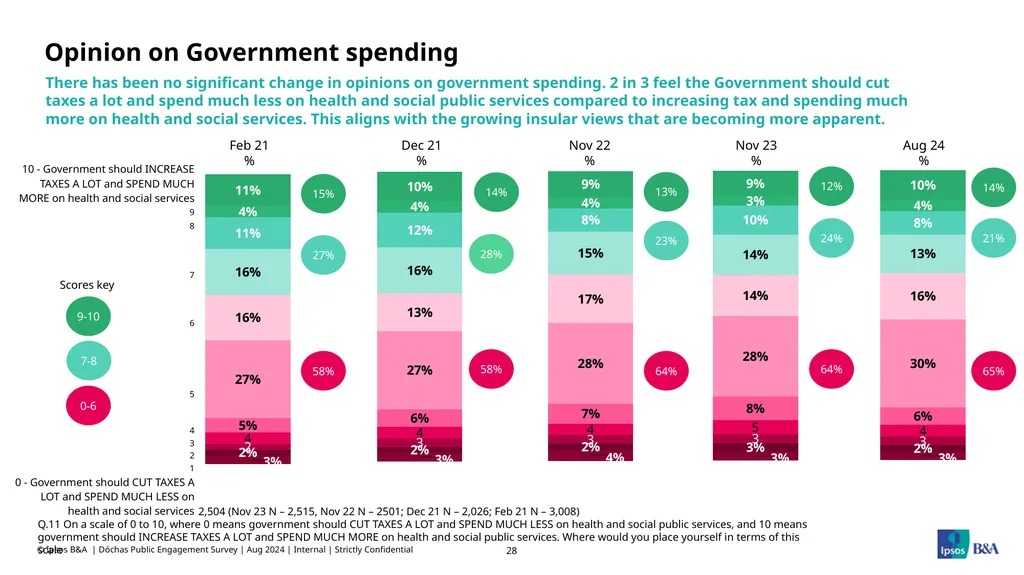
Opinion on Government spending There has been no significant change in opinions on government spending. 2 in 3 feel the Government should cut taxes a lot and spend much less on health and social public services compared to increasing tax and spending much more on health and social services. This aligns with the growing insular views that are becoming more apparent. Base: All Adults aged 18+ years- 2,504 (Nov 23 N – 2,515, Nov 22 N – 2501; Dec 21 N – 2,026; Feb 21 N – 3,008)
Q.11 On a scale of 0 to 10, where 0 means government should CUT TAXES A LOT and SPEND MUCH LESS on health and social public services, and 10 means government should INCREASE TAXES A LOT and SPEND MUCH MORE on health and social public services. Where would you place yourself in terms of this scale Feb 21
% Dec 21
% Nov 22
% 13% 14% 15% 27% 28% 23% 64% 58% 58% 12% 24% 64% Nov 23
% 14% 21% 65% Aug 24
%<br>
29
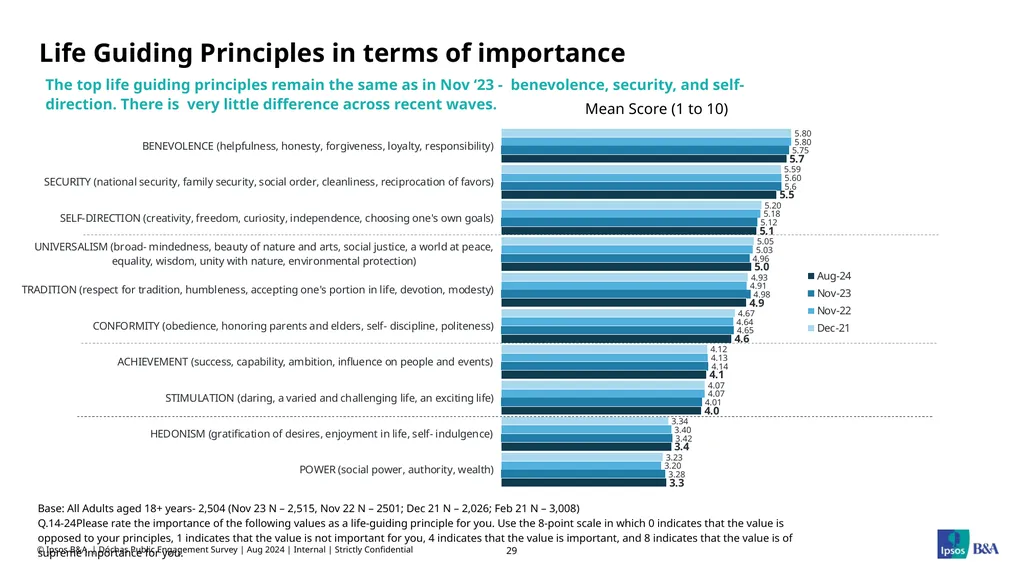
Life Guiding Principles in terms of importance The top life guiding principles remain the same as in Nov ‘23 - benevolence, security, and self-direction. There is very little difference across recent waves. Base: All Adults aged 18+ years- 2,504 (Nov 23 N – 2,515, Nov 22 N – 2501; Dec 21 N – 2,026; Feb 21 N – 3,008)
Q.14-24Please rate the importance of the following values as a life-guiding principle for you. Use the 8-point scale in which 0 indicates that the value is opposed to your principles, 1 indicates that the value is not important for you, 4 indicates that the value is important, and 8 indicates that the value is of supreme importance for you. Mean Score (1 to 10)<br>
Q.14-24Please rate the importance of the following values as a life-guiding principle for you. Use the 8-point scale in which 0 indicates that the value is opposed to your principles, 1 indicates that the value is not important for you, 4 indicates that the value is important, and 8 indicates that the value is of supreme importance for you. Mean Score (1 to 10)<br>
30
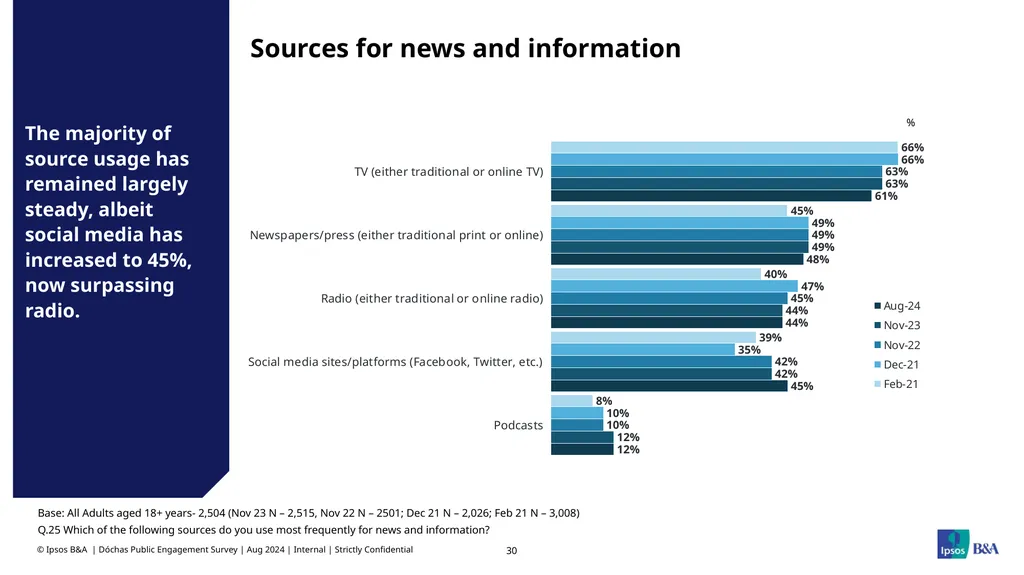
Sources for news and information Base: All Adults aged 18+ years- 2,504 (Nov 23 N – 2,515, Nov 22 N – 2501; Dec 21 N – 2,026; Feb 21 N – 3,008)
Q.25 Which of the following sources do you use most frequently for news and information? % The majority of source usage has remained largely steady, albeit social media has increased to 45%, now surpassing radio.<br>
Q.25 Which of the following sources do you use most frequently for news and information? % The majority of source usage has remained largely steady, albeit social media has increased to 45%, now surpassing radio.<br>
31
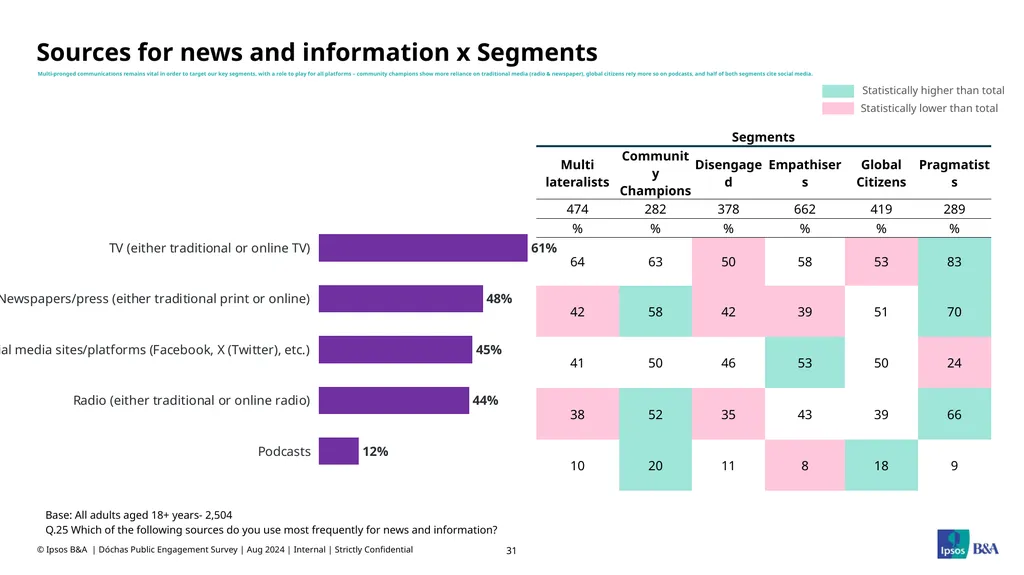
Sources for news and information x Segments Multi-pronged communications remains vital in order to target our key segments, with a role to play for all platforms – community champions show more reliance on traditional media (radio & newspaper), global citizens rely more so on podcasts, and half of both segments cite social media. Base: All adults aged 18+ years- 2,504
Q.25 Which of the following sources do you use most frequently for news and information?<br>
Q.25 Which of the following sources do you use most frequently for news and information?<br>
32
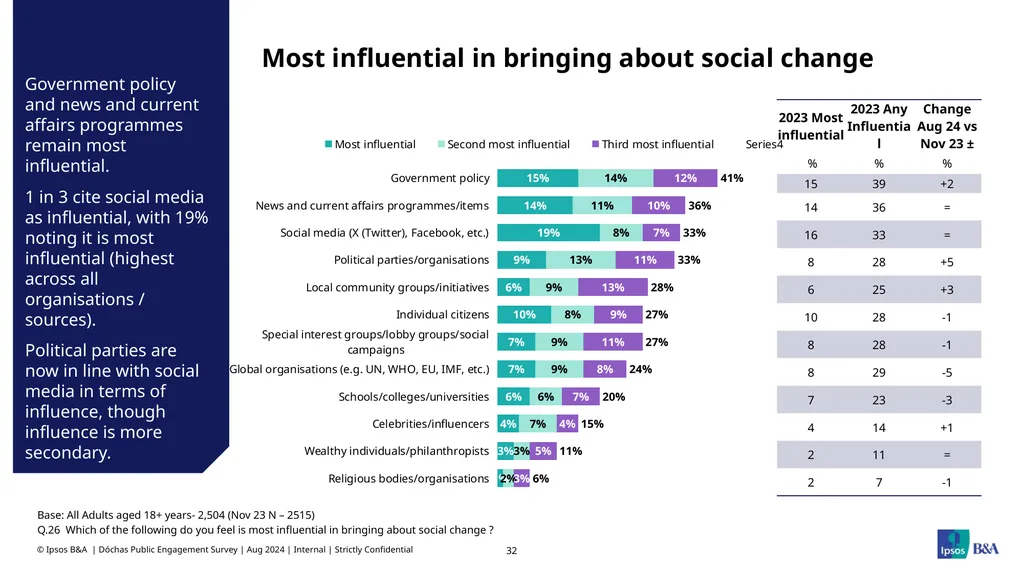
Most influential in bringing about social change Base: All Adults aged 18+ years- 2,504 (Nov 23 N – 2515)
Q.26 Which of the following do you feel is most influential in bringing about social change ? Government policy and news and current affairs programmes remain most influential.
1 in 3 cite social media as influential, with 19% noting it is most influential (highest across all organisations / sources).
Political parties are now in line with social media in terms of influence, though influence is more secondary.<br>
33
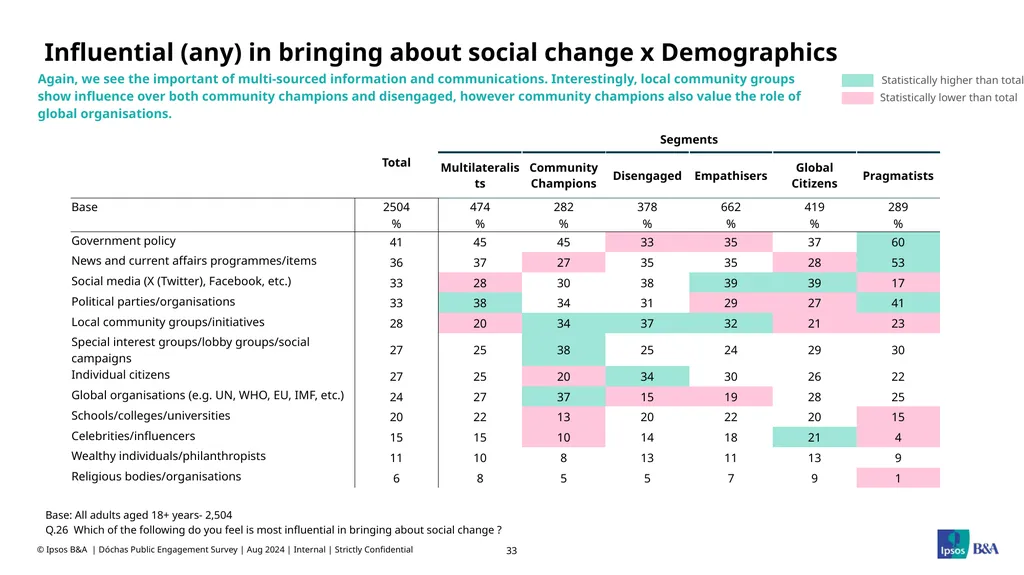
Influential (any) in bringing about social change x Demographics Base: All adults aged 18+ years- 2,504
Q.26 Which of the following do you feel is most influential in bringing about social change ? Again, we see the important of multi-sourced information and communications. Interestingly, local community groups show influence over both community champions and disengaged, however community champions also value the role of global organisations.<br>
Q.26 Which of the following do you feel is most influential in bringing about social change ? Again, we see the important of multi-sourced information and communications. Interestingly, local community groups show influence over both community champions and disengaged, however community champions also value the role of global organisations.<br>
34
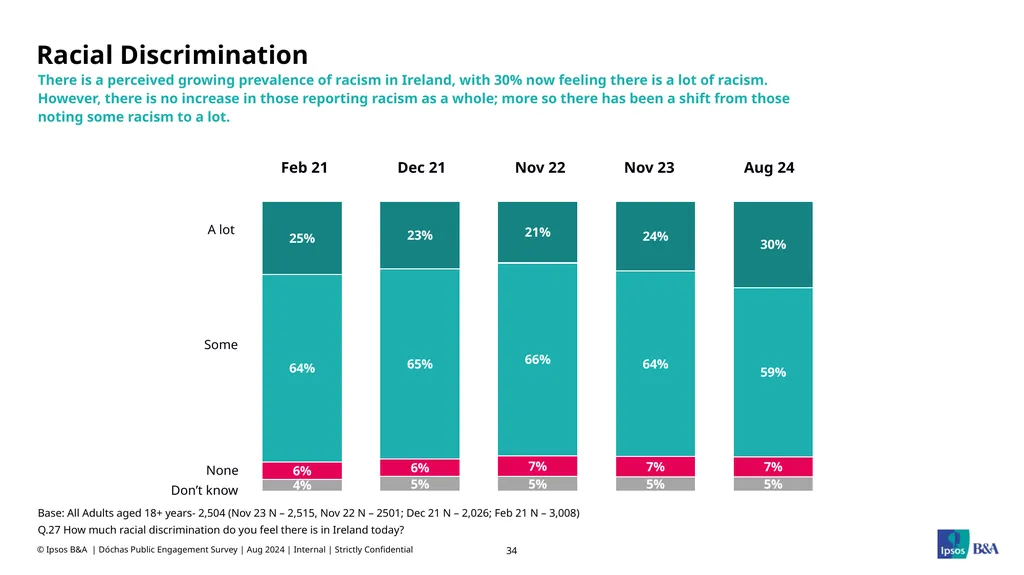
Racial Discrimination There is a perceived growing prevalence of racism in Ireland, with 30% now feeling there is a lot of racism. However, there is no increase in those reporting racism as a whole; more so there has been a shift from those noting some racism to a lot. Base: All Adults aged 18+ years- 2,504 (Nov 23 N – 2,515, Nov 22 N – 2501; Dec 21 N – 2,026; Feb 21 N – 3,008)
Q.27 How much racial discrimination do you feel there is in Ireland today? None Don’t know A lot Some Feb 21 Dec 21 Nov 22 Nov 23 Aug 24<br>
Q.27 How much racial discrimination do you feel there is in Ireland today? None Don’t know A lot Some Feb 21 Dec 21 Nov 22 Nov 23 Aug 24<br>
35
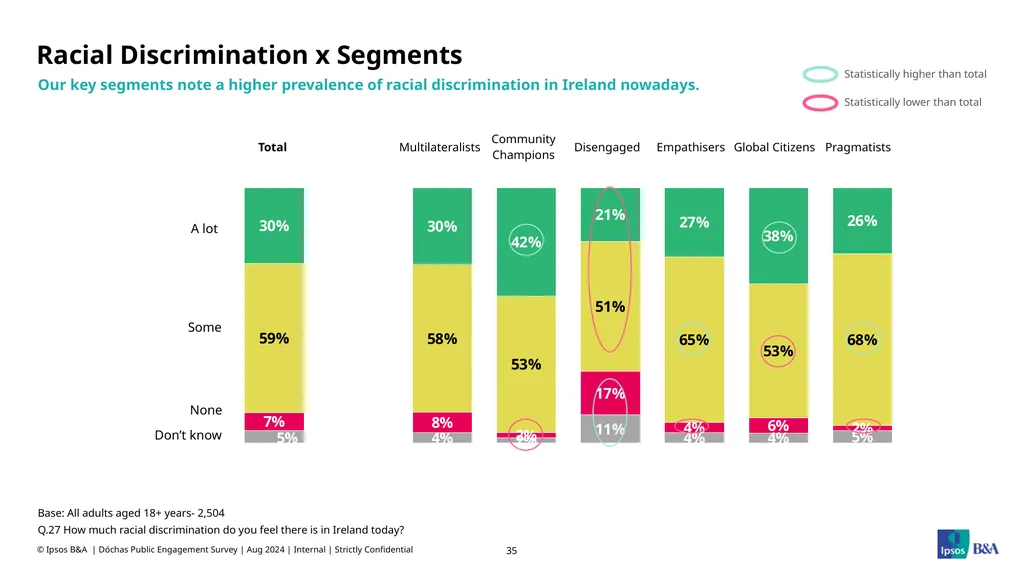
Racial Discrimination x Segments Our key segments note a higher prevalence of racial discrimination in Ireland nowadays. Base: All adults aged 18+ years- 2,504
Q.27 How much racial discrimination do you feel there is in Ireland today? None Don’t know A lot Some<br>
Q.27 How much racial discrimination do you feel there is in Ireland today? None Don’t know A lot Some<br>
36
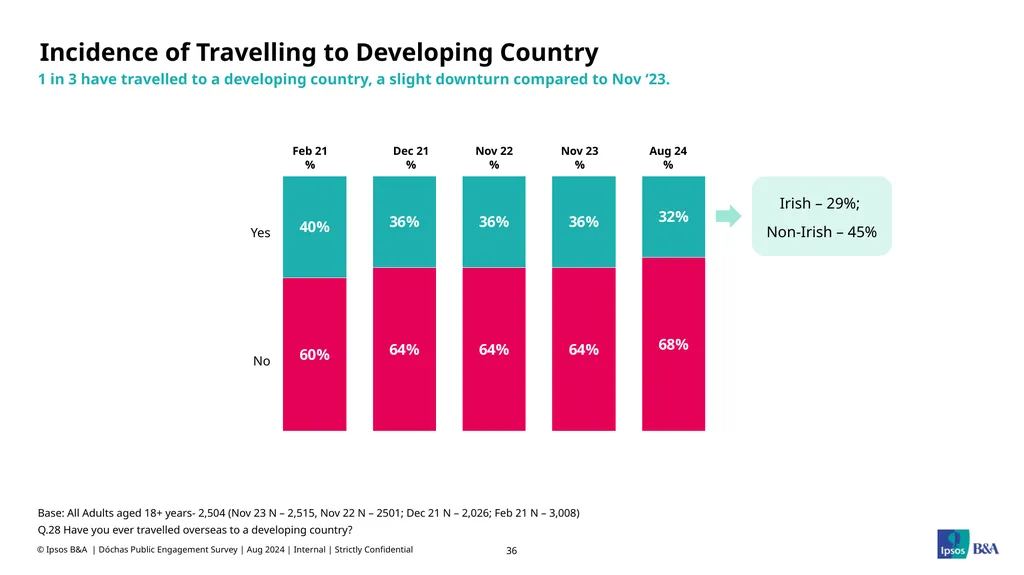
Incidence of Travelling to Developing Country 1 in 3 have travelled to a developing country, a slight downturn compared to Nov ‘23. Base: All Adults aged 18+ years- 2,504 (Nov 23 N – 2,515, Nov 22 N – 2501; Dec 21 N – 2,026; Feb 21 N – 3,008)
Q.28 Have you ever travelled overseas to a developing country? Feb 21
% Dec 21
% Nov 22
% Nov 23
% Aug 24
% Irish – 29%;
Non-Irish – 45%<br>
Q.28 Have you ever travelled overseas to a developing country? Feb 21
% Dec 21
% Nov 22
% Nov 23
% Aug 24
% Irish – 29%;
Non-Irish – 45%<br>
37
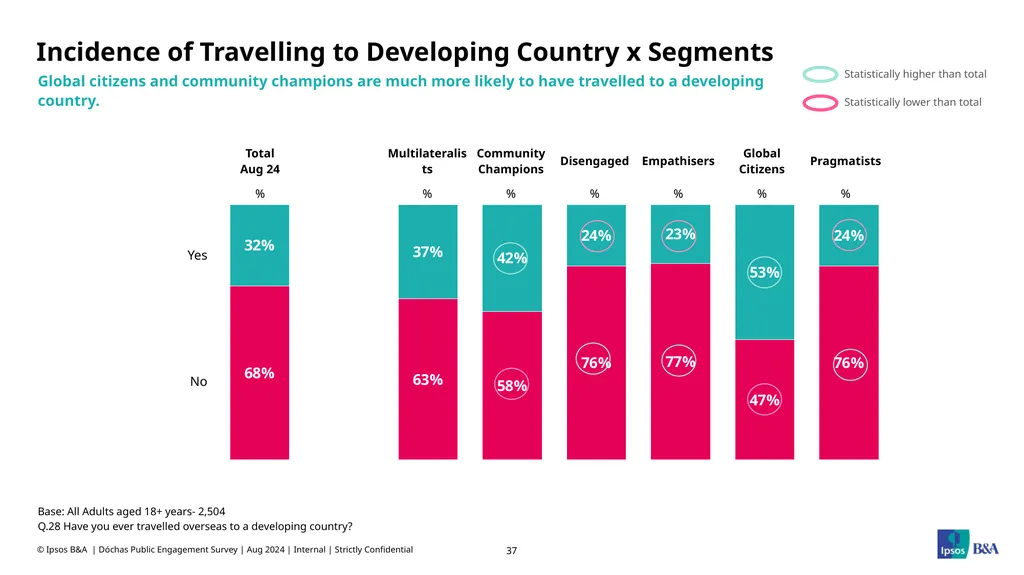
Incidence of Travelling to Developing Country x Segments Global citizens and community champions are much more likely to have travelled to a developing country. Base: All Adults aged 18+ years- 2,504
Q.28 Have you ever travelled overseas to a developing country?<br>
Q.28 Have you ever travelled overseas to a developing country?<br>
38
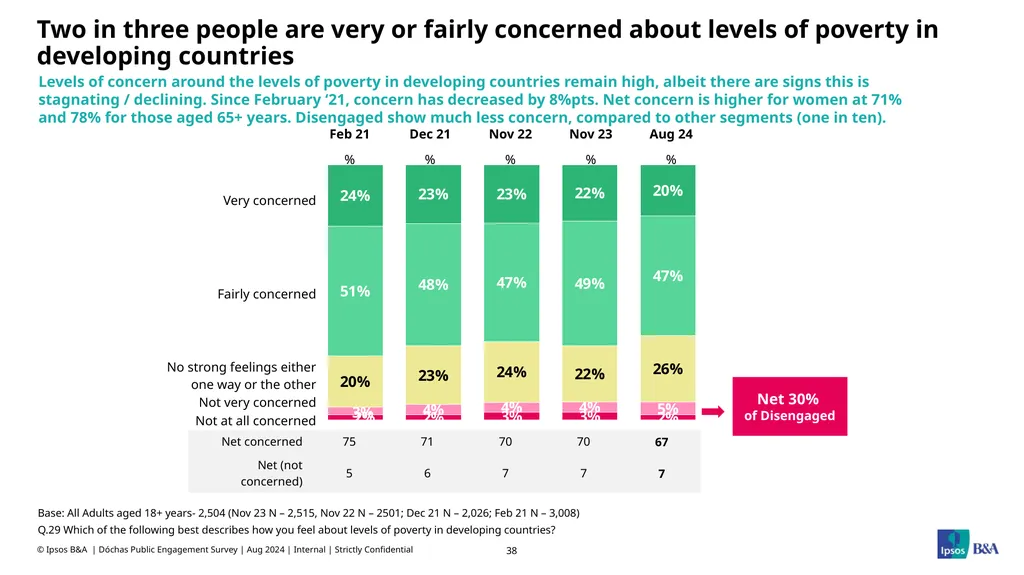
Two in three people are very or fairly concerned about levels of poverty in developing countries Levels of concern around the levels of poverty in developing countries remain high, albeit there are signs this is stagnating / declining. Since February ‘21, concern has decreased by 8%pts. Net concern is higher for women at 71% and 78% for those aged 65+ years. Disengaged show much less concern, compared to other segments (one in ten). Base: All Adults aged 18+ years- 2,504 (Nov 23 N – 2,515, Nov 22 N – 2501; Dec 21 N – 2,026; Feb 21 N – 3,008)
Q.29 Which of the following best describes how you feel about levels of poverty in developing countries? Net 30%
of Disengaged<br>
Q.29 Which of the following best describes how you feel about levels of poverty in developing countries? Net 30%
of Disengaged<br>
39
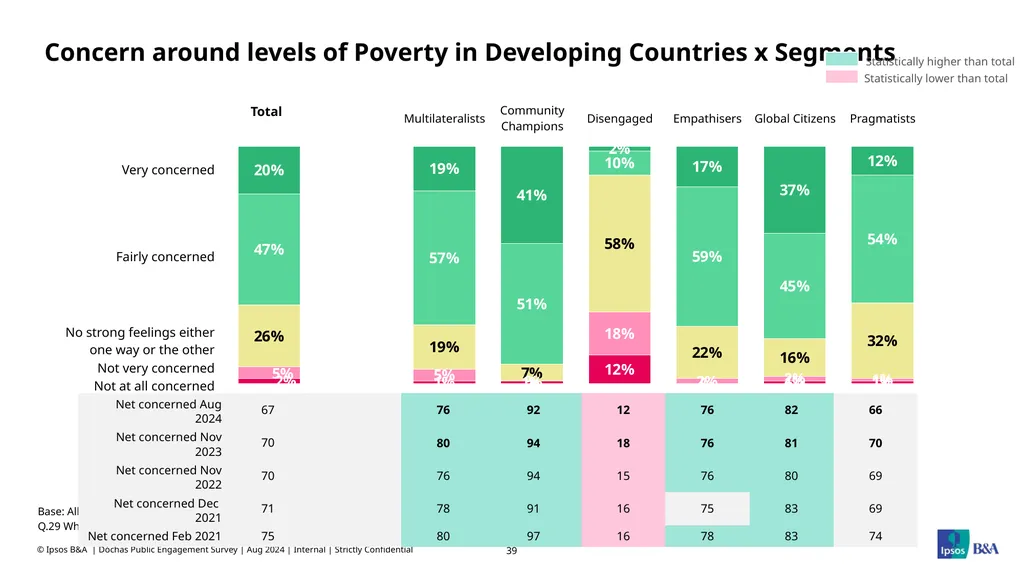
Concern around levels of Poverty in Developing Countries x Segments Base: All Adults aged 18+ years- 2,504 (Nov 23 N – 2,515, Nov 22 N – 2501; Dec 21 N – 2,026; Feb 21 N – 3,008)
Q.29 Which of the following best describes how you feel about levels of poverty in developing countries? Total<br>
Q.29 Which of the following best describes how you feel about levels of poverty in developing countries? Total<br>
40
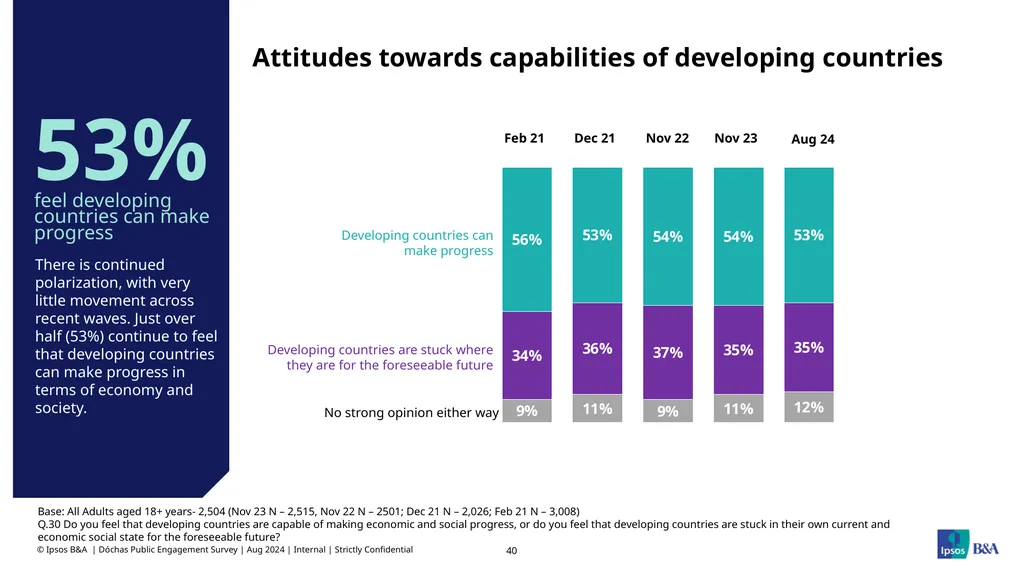
Attitudes towards capabilities of developing countries Base: All Adults aged 18+ years- 2,504 (Nov 23 N – 2,515, Nov 22 N – 2501; Dec 21 N – 2,026; Feb 21 N – 3,008)
Q.30 Do you feel that developing countries are capable of making economic and social progress, or do you feel that developing countries are stuck in their own current and economic social state for the foreseeable future? Developing countries can make progress Developing countries are stuck where they are for the foreseeable future No strong opinion either way Feb 21 Dec 21 Nov 22 Nov 23 53% feel developing countries can make progress There is continued polarization, with very little movement across recent waves. Just over half (53%) continue to feel that developing countries can make progress in terms of economy and society. Aug 24<br>
Q.30 Do you feel that developing countries are capable of making economic and social progress, or do you feel that developing countries are stuck in their own current and economic social state for the foreseeable future? Developing countries can make progress Developing countries are stuck where they are for the foreseeable future No strong opinion either way Feb 21 Dec 21 Nov 22 Nov 23 53% feel developing countries can make progress There is continued polarization, with very little movement across recent waves. Just over half (53%) continue to feel that developing countries can make progress in terms of economy and society. Aug 24<br>
41
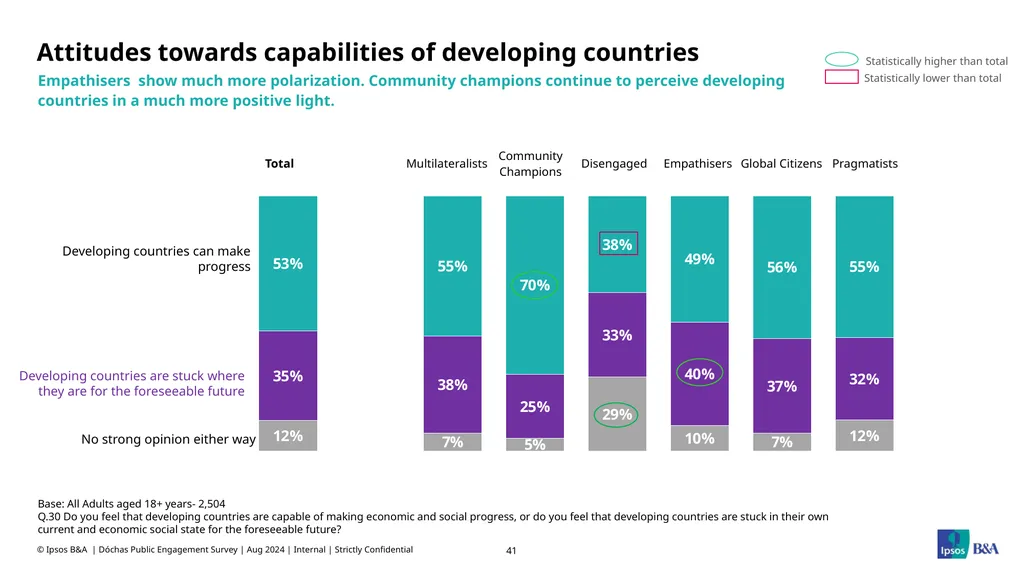
Attitudes towards capabilities of developing countries Empathisers show much more polarization. Community champions continue to perceive developing countries in a much more positive light. Base: All Adults aged 18+ years- 2,504
Q.30 Do you feel that developing countries are capable of making economic and social progress, or do you feel that developing countries are stuck in their own current and economic social state for the foreseeable future? Developing countries can make progress Developing countries are stuck where they are for the foreseeable future No strong opinion either way<br>
Q.30 Do you feel that developing countries are capable of making economic and social progress, or do you feel that developing countries are stuck in their own current and economic social state for the foreseeable future? Developing countries can make progress Developing countries are stuck where they are for the foreseeable future No strong opinion either way<br>
42
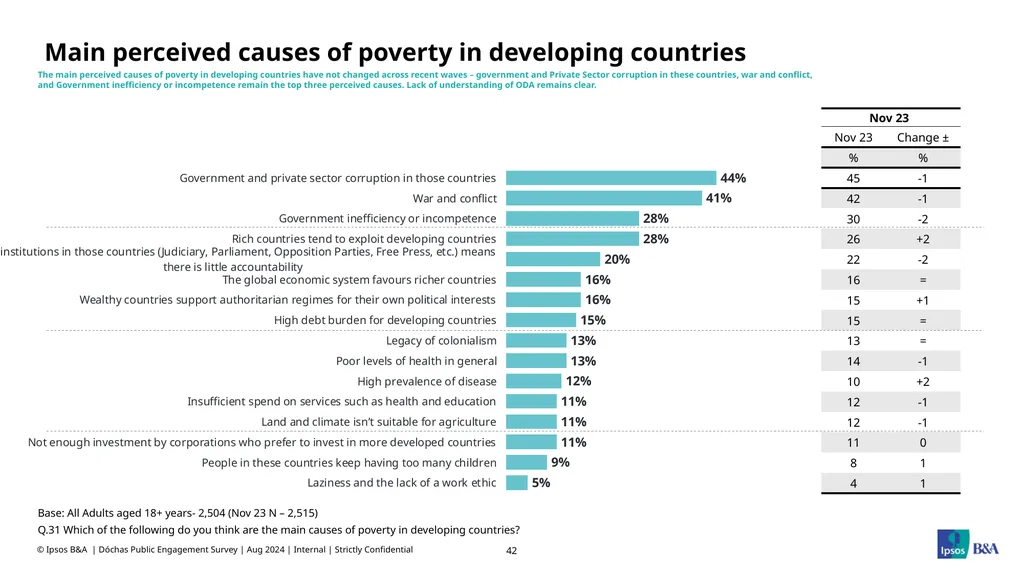
Main perceived causes of poverty in developing countries The main perceived causes of poverty in developing countries have not changed across recent waves – government and Private Sector corruption in these countries, war and conflict, and Government inefficiency or incompetence remain the top three perceived causes. Lack of understanding of ODA remains clear. Base: All Adults aged 18+ years- 2,504 (Nov 23 N – 2,515)
Q.31 Which of the following do you think are the main causes of poverty in developing countries?<br>
Q.31 Which of the following do you think are the main causes of poverty in developing countries?<br>
43
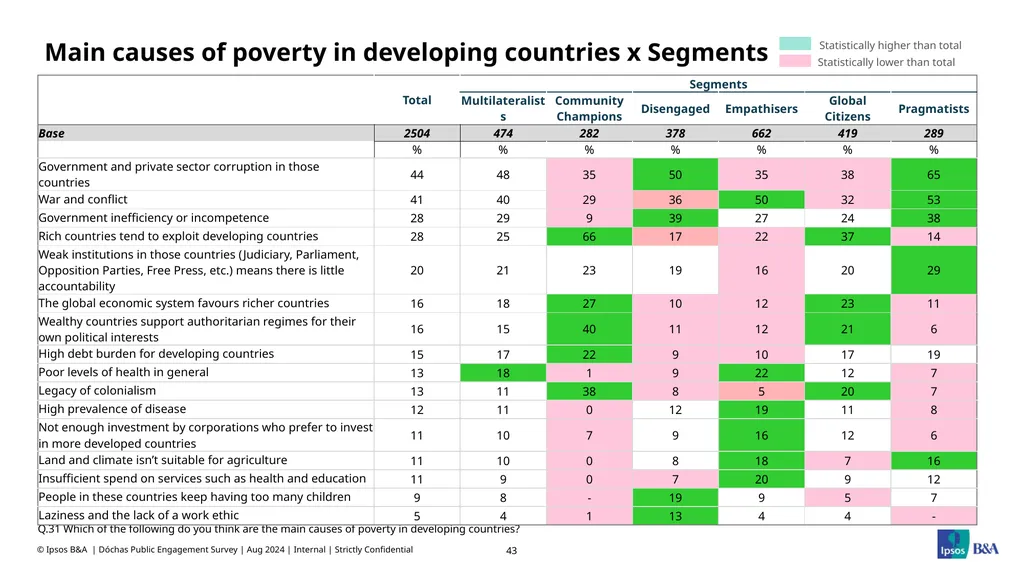
Main causes of poverty in developing countries x Segments Base: All Adults aged 18+ years- 2,504
Q.31 Which of the following do you think are the main causes of poverty in developing countries?<br>
Q.31 Which of the following do you think are the main causes of poverty in developing countries?<br>
44
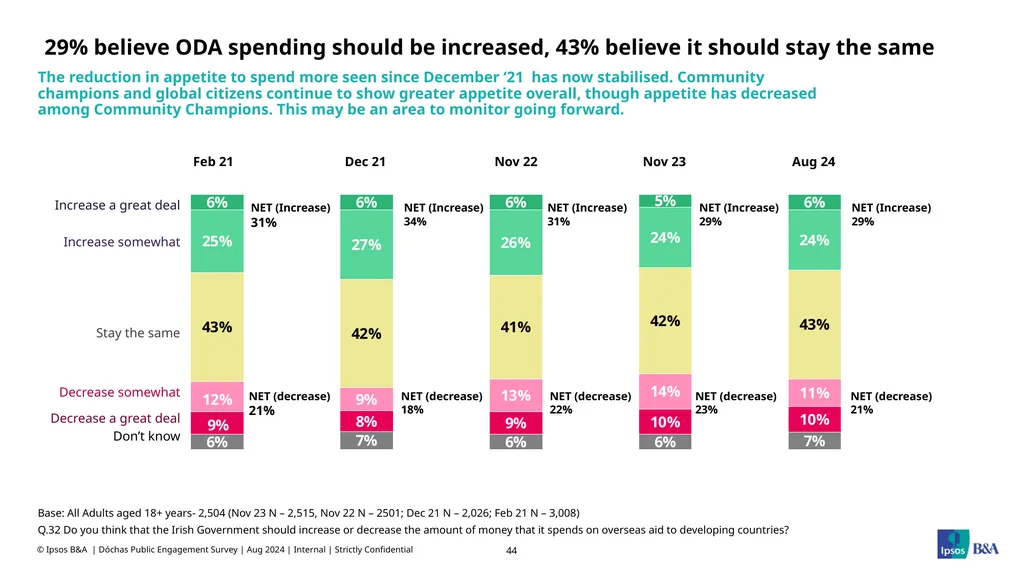
29% believe ODA spending should be increased, 43% believe it should stay the same The reduction in appetite to spend more seen since December ‘21 has now stabilised. Community champions and global citizens continue to show greater appetite overall, though appetite has decreased among Community Champions. This may be an area to monitor going forward. Base: All Adults aged 18+ years- 2,504 (Nov 23 N – 2,515, Nov 22 N – 2501; Dec 21 N – 2,026; Feb 21 N – 3,008)
Q.32 Do you think that the Irish Government should increase or decrease the amount of money that it spends on overseas aid to developing countries? Feb 21 Dec 21 Nov 22 NET (Increase)
31% NET (Increase)
34% NET (Increase)
31% NET (decrease)
21% NET (decrease)
18% NET (decrease)
22% NET (Increase)
29% NET (decrease)
23% Nov 23 Aug 24 NET (Increase)
29% NET (decrease)
21%<br>
45
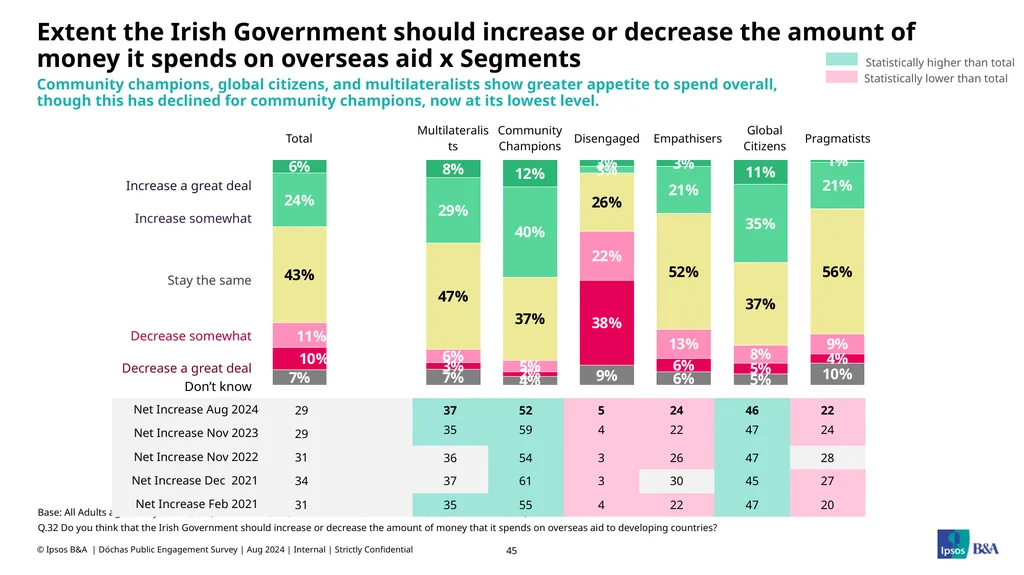
Extent the Irish Government should increase or decrease the amount of money it spends on overseas aid x Segments Community champions, global citizens, and multilateralists show greater appetite to spend overall, though this has declined for community champions, now at its lowest level. Base: All Adults aged 18+ years- 2,504 (Nov 23 N – 2,515, Nov 22 N – 2501; Dec 21 N – 2,026; Feb 21 N – 3,008)
Q.32 Do you think that the Irish Government should increase or decrease the amount of money that it spends on overseas aid to developing countries?<br>
Q.32 Do you think that the Irish Government should increase or decrease the amount of money that it spends on overseas aid to developing countries?<br>
46
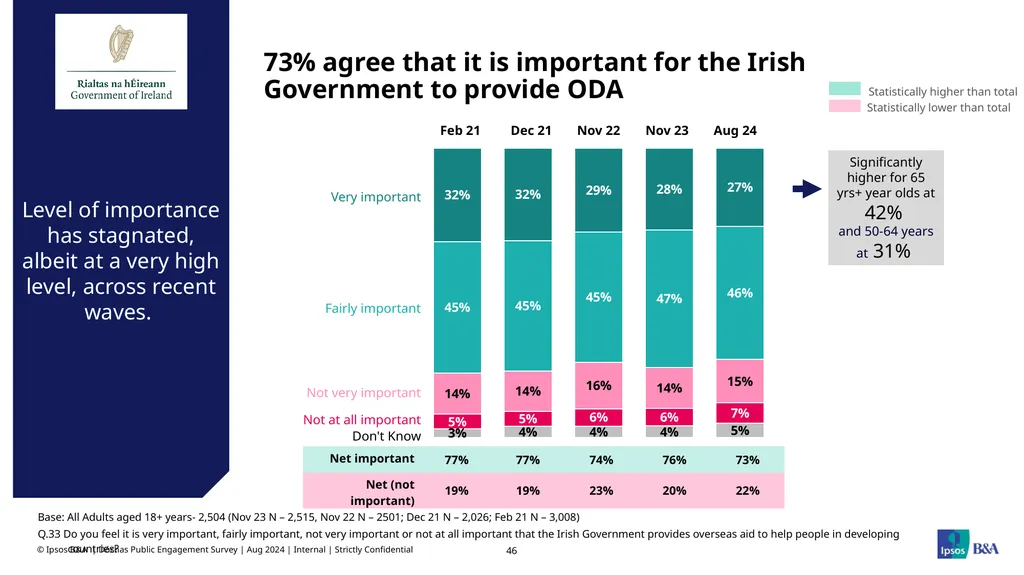
73% agree that it is important for the Irish Government to provide ODA Base: All Adults aged 18+ years- 2,504 (Nov 23 N – 2,515, Nov 22 N – 2501; Dec 21 N – 2,026; Feb 21 N – 3,008)
Q.33 Do you feel it is very important, fairly important, not very important or not at all important that the Irish Government provides overseas aid to help people in developing countries? Feb 21 Dec 21 Nov 22 Significantly higher for 65 yrs+ year olds at 42%
and 50-64 years at 31% Nov 23 Aug 24 Level of importance has stagnated, albeit at a very high level, across recent waves.<br>
47
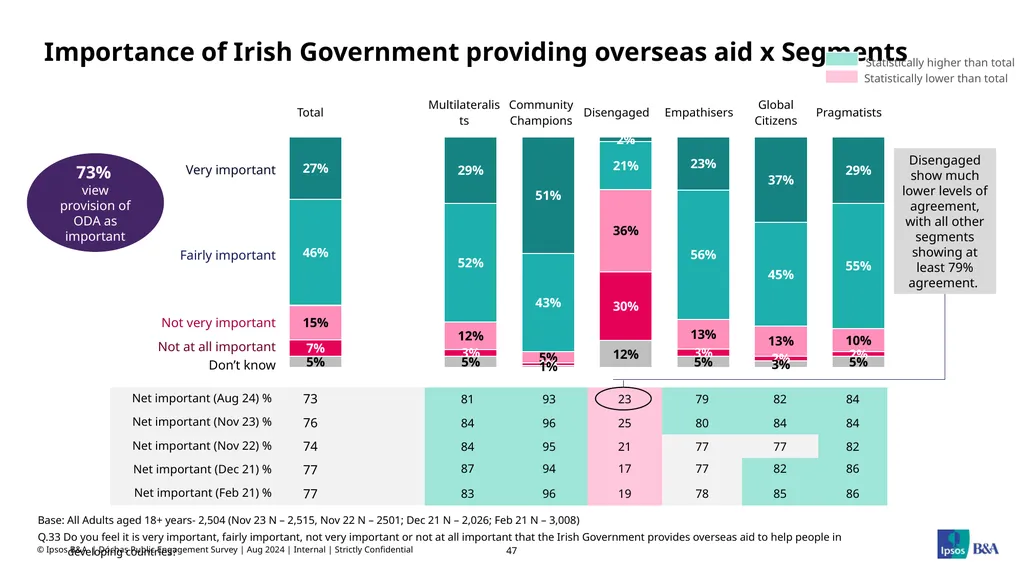
Importance of Irish Government providing overseas aid x Segments Base: All Adults aged 18+ years- 2,504 (Nov 23 N – 2,515, Nov 22 N – 2501; Dec 21 N – 2,026; Feb 21 N – 3,008)
Q.33 Do you feel it is very important, fairly important, not very important or not at all important that the Irish Government provides overseas aid to help people in developing countries? Disengaged show much lower levels of agreement, with all other segments showing at least 79% agreement. 73%
view provision of ODA as important<br>
48
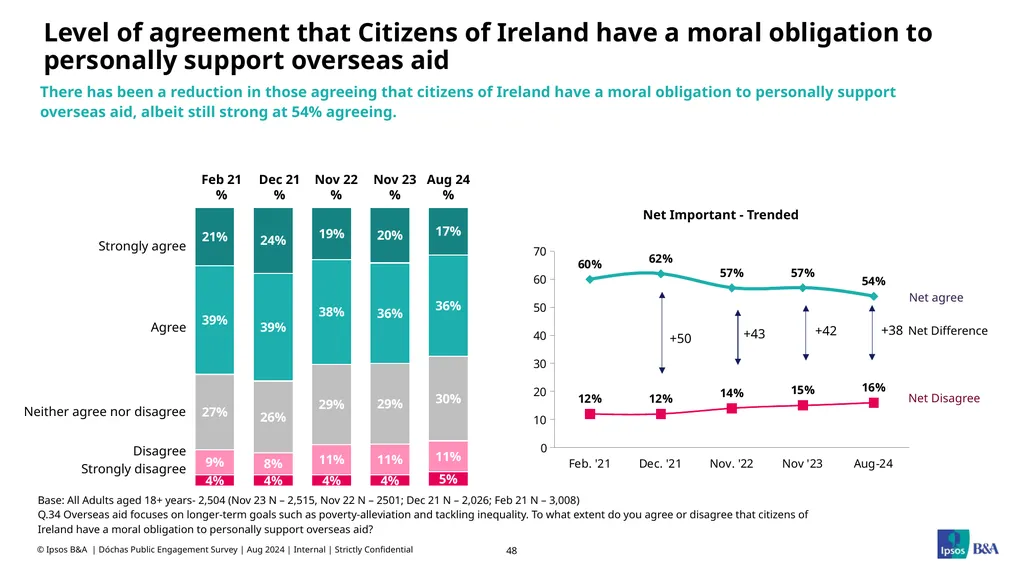
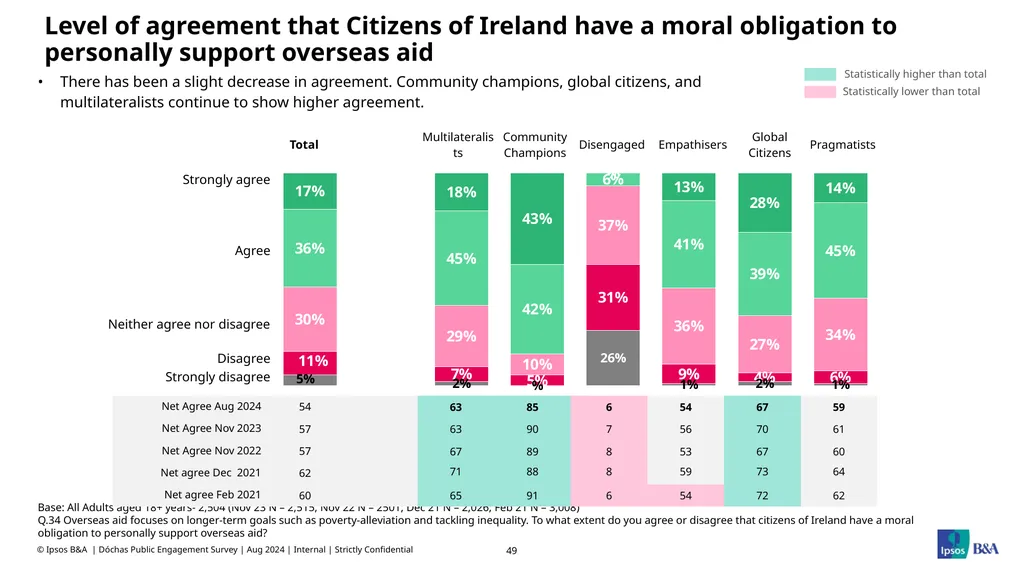
Level of agreement that Citizens of Ireland have a moral obligation to personally support overseas aid There has been a reduction in those agreeing that citizens of Ireland have a moral obligation to personally support overseas aid, albeit still strong at 54% agreeing. Base: All Adults aged 18+ years- 2,504 (Nov 23 N – 2,515, Nov 22 N – 2501; Dec 21 N – 2,026; Feb 21 N – 3,008)
Q.34 Overseas aid focuses on longer-term goals such as poverty-alleviation and tackling inequality. To what extent do you agree or disagree that citizens of Ireland have a moral obligation to personally support overseas aid? Net agree Net Disagree Net Important - Trended Net Difference +50 +43 +42 +38<br>
Q.34 Overseas aid focuses on longer-term goals such as poverty-alleviation and tackling inequality. To what extent do you agree or disagree that citizens of Ireland have a moral obligation to personally support overseas aid? Net agree Net Disagree Net Important - Trended Net Difference +50 +43 +42 +38<br>
49
Level of agreement that Citizens of Ireland have a moral obligation to personally support overseas aid There has been a slight decrease in agreement. Community champions, global citizens, and multilateralists continue to show higher agreement. Base: All Adults aged 18+ years- 2,504 (Nov 23 N – 2,515, Nov 22 N – 2501; Dec 21 N – 2,026; Feb 21 N – 3,008)
Q.34 Overseas aid focuses on longer-term goals such as poverty-alleviation and tackling inequality. To what extent do you agree or disagree that citizens of Ireland have a moral obligation to personally support overseas aid?<br>
Q.34 Overseas aid focuses on longer-term goals such as poverty-alleviation and tackling inequality. To what extent do you agree or disagree that citizens of Ireland have a moral obligation to personally support overseas aid?<br>
50
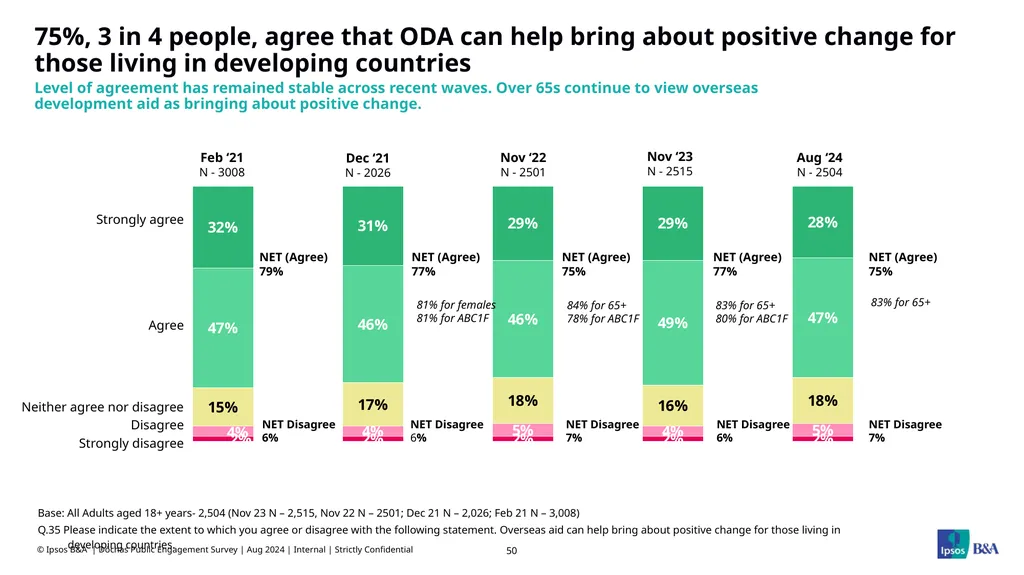
75%, 3 in 4 people, agree that ODA can help bring about positive change for those living in developing countries Level of agreement has remained stable across recent waves. Over 65s continue to view overseas development aid as bringing about positive change. Base: All Adults aged 18+ years- 2,504 (Nov 23 N – 2,515, Nov 22 N – 2501; Dec 21 N – 2,026; Feb 21 N – 3,008)
Q.35 Please indicate the extent to which you agree or disagree with the following statement. Overseas aid can help bring about positive change for those living in developing countries. Feb ‘21
N - 3008 Dec ‘21
N - 2026 Nov ‘22
N - 2501 NET Disagree
6% Nov ‘23
N - 2515 Aug ‘24
N - 2504 NET (Agree)
79% NET Disagree
6% NET (Agree)
77% NET Disagree
6% 81% for females
81% for ABC1F NET (Agree)
75% 84% for 65+
78% for ABC1F NET (Agree)
77% 83% for 65+
80% for ABC1F NET (Agree)
75% NET Disagree
7% 83% for 65+ NET Disagree
7%<br>
51
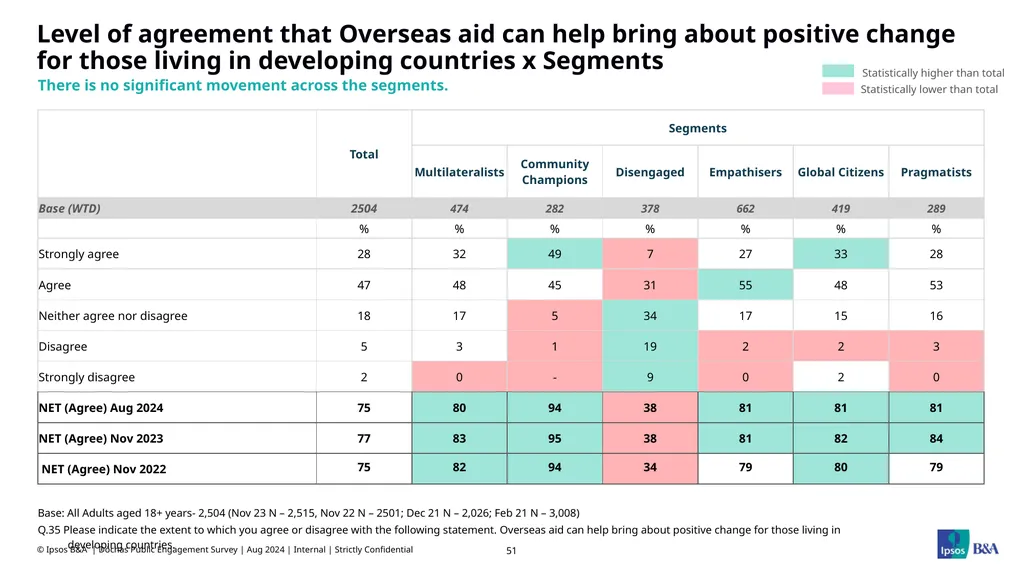
Level of agreement that Overseas aid can help bring about positive change for those living in developing countries x Segments There is no significant movement across the segments. Base: All Adults aged 18+ years- 2,504 (Nov 23 N – 2,515, Nov 22 N – 2501; Dec 21 N – 2,026; Feb 21 N – 3,008)
Q.35 Please indicate the extent to which you agree or disagree with the following statement. Overseas aid can help bring about positive change for those living in developing countries.<br>
Q.35 Please indicate the extent to which you agree or disagree with the following statement. Overseas aid can help bring about positive change for those living in developing countries.<br>
52
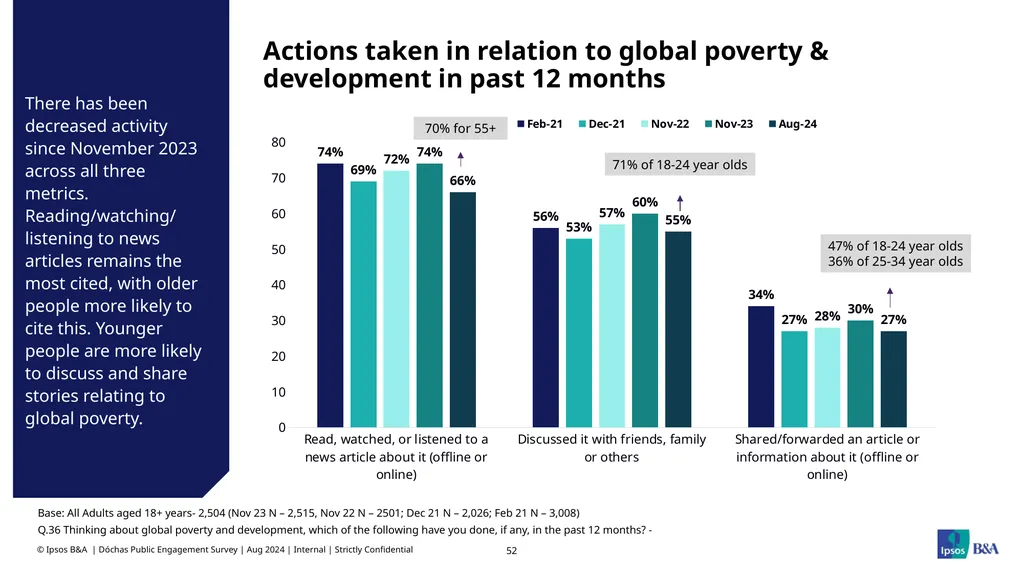
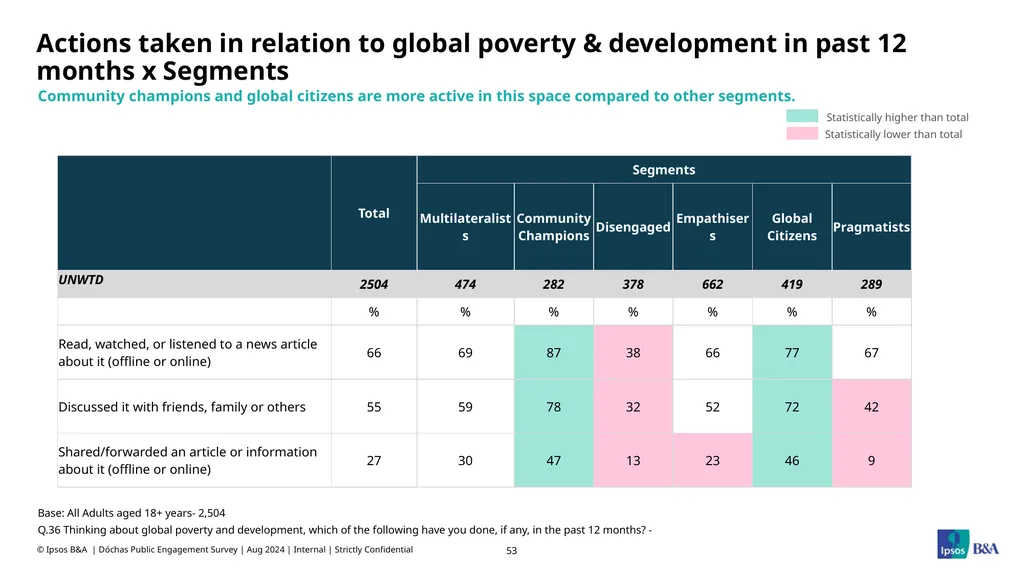
Actions taken in relation to global poverty & development in past 12 months Base: All Adults aged 18+ years- 2,504 (Nov 23 N – 2,515, Nov 22 N – 2501; Dec 21 N – 2,026; Feb 21 N – 3,008)
Q.36 Thinking about global poverty and development, which of the following have you done, if any, in the past 12 months? - 70% for 55+ 71% of 18-24 year olds 47% of 18-24 year olds
36% of 25-34 year olds There has been decreased activity since November 2023 across all three metrics. Reading/watching/ listening to news articles remains the most cited, with older people more likely to cite this. Younger people are more likely to discuss and share stories relating to global poverty.<br>
53
Actions taken in relation to global poverty & development in past 12 months x Segments Community champions and global citizens are more active in this space compared to other segments. Base: All Adults aged 18+ years- 2,504
Q.36 Thinking about global poverty and development, which of the following have you done, if any, in the past 12 months? -<br>
Q.36 Thinking about global poverty and development, which of the following have you done, if any, in the past 12 months? -<br>
54
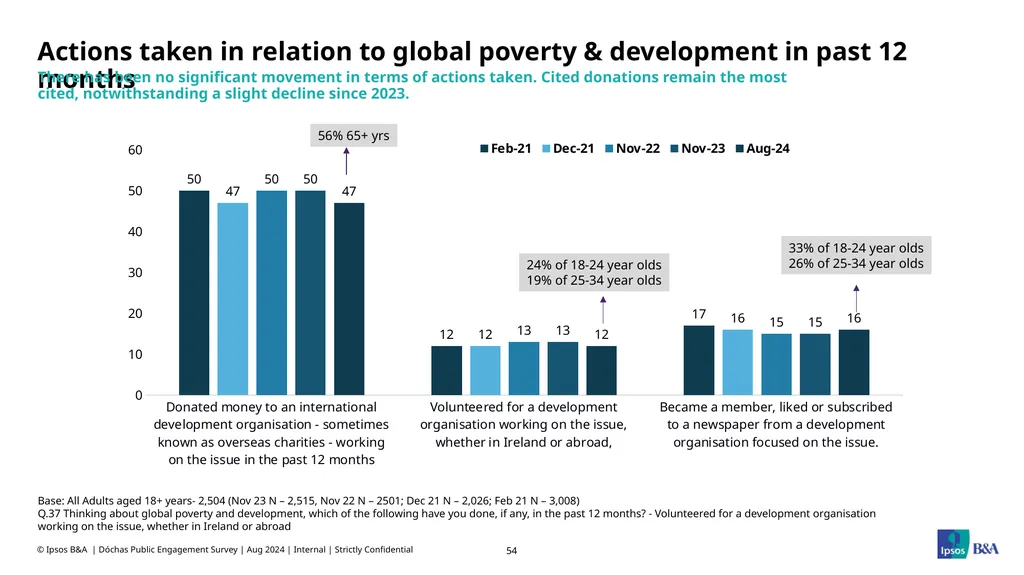
Actions taken in relation to global poverty & development in past 12 months There has been no significant movement in terms of actions taken. Cited donations remain the most cited, notwithstanding a slight decline since 2023. Base: All Adults aged 18+ years- 2,504 (Nov 23 N – 2,515, Nov 22 N – 2501; Dec 21 N – 2,026; Feb 21 N – 3,008)
Q.37 Thinking about global poverty and development, which of the following have you done, if any, in the past 12 months? - Volunteered for a development organisation working on the issue, whether in Ireland or abroad 33% of 18-24 year olds
26% of 25-34 year olds 24% of 18-24 year olds
19% of 25-34 year olds 56% 65+ yrs<br>
55
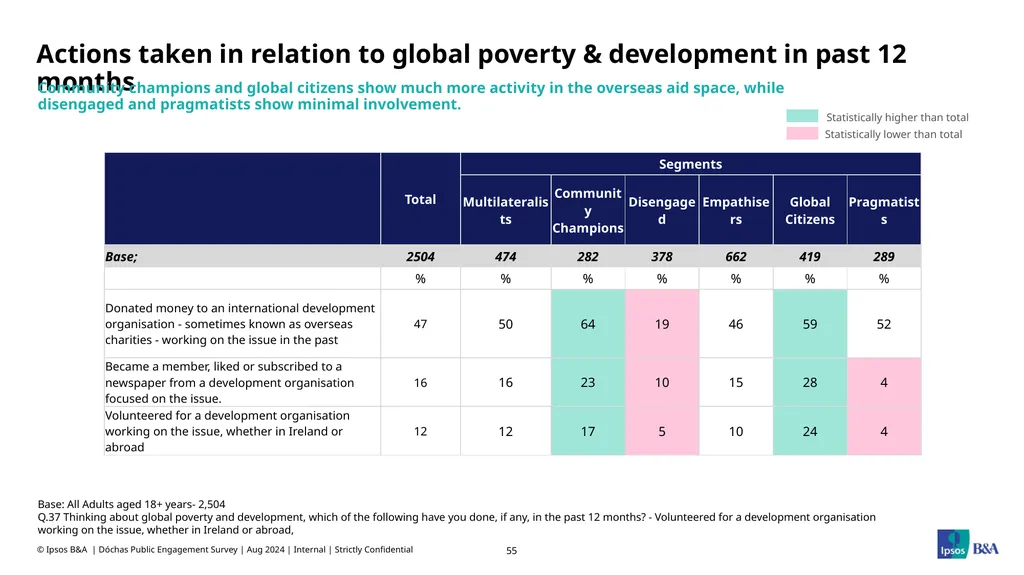
Actions taken in relation to global poverty & development in past 12 months Community champions and global citizens show much more activity in the overseas aid space, while disengaged and pragmatists show minimal involvement. Base: All Adults aged 18+ years- 2,504
Q.37 Thinking about global poverty and development, which of the following have you done, if any, in the past 12 months? - Volunteered for a development organisation working on the issue, whether in Ireland or abroad,<br>
Q.37 Thinking about global poverty and development, which of the following have you done, if any, in the past 12 months? - Volunteered for a development organisation working on the issue, whether in Ireland or abroad,<br>
56
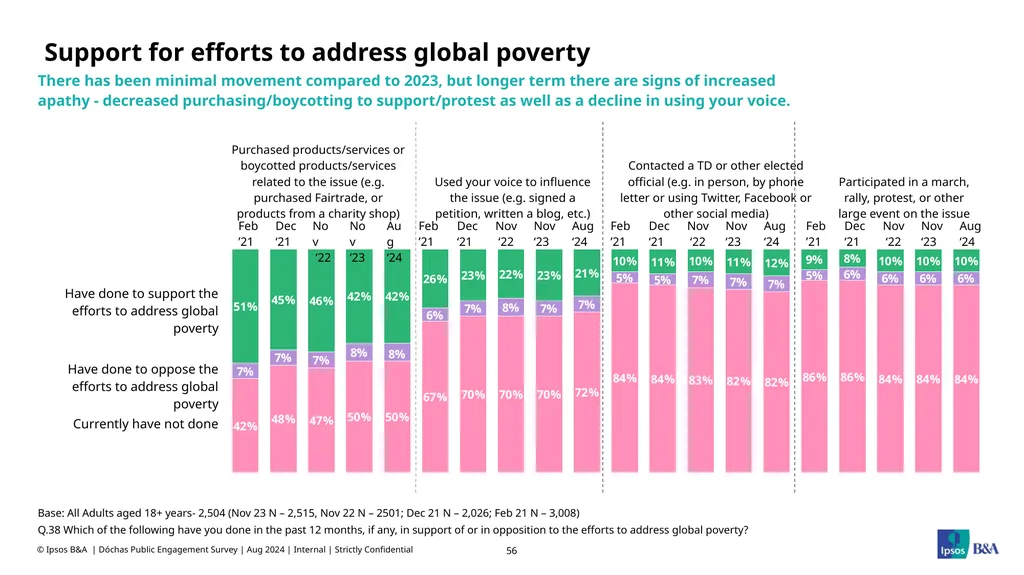
Support for efforts to address global poverty There has been minimal movement compared to 2023, but longer term there are signs of increased apathy - decreased purchasing/boycotting to support/protest as well as a decline in using your voice. Base: All Adults aged 18+ years- 2,504 (Nov 23 N – 2,515, Nov 22 N – 2501; Dec 21 N – 2,026; Feb 21 N – 3,008)
Q.38 Which of the following have you done in the past 12 months, if any, in support of or in opposition to the efforts to address global poverty?<br>
Q.38 Which of the following have you done in the past 12 months, if any, in support of or in opposition to the efforts to address global poverty?<br>
57
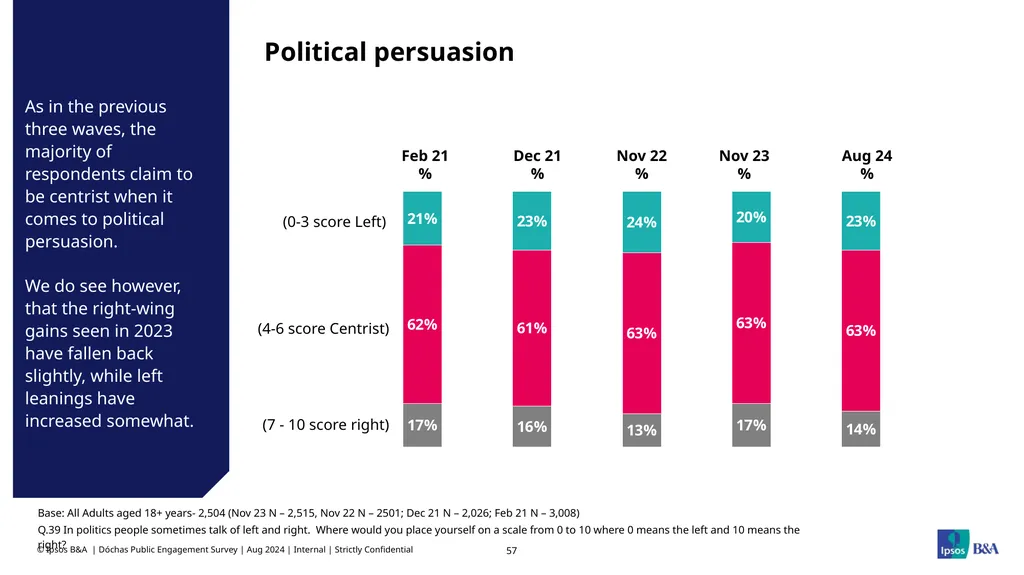
Political persuasion Base: All Adults aged 18+ years- 2,504 (Nov 23 N – 2,515, Nov 22 N – 2501; Dec 21 N – 2,026; Feb 21 N – 3,008)
Q.39 In politics people sometimes talk of left and right. Where would you place yourself on a scale from 0 to 10 where 0 means the left and 10 means the right? Feb 21
% Dec 21
% (7 - 10 score right) (4-6 score Centrist) (0-3 score Left) Nov 22
% Nov 23
% As in the previous three waves, the majority of respondents claim to be centrist when it comes to political persuasion.
We do see however, that the right-wing gains seen in 2023 have fallen back slightly, while left leanings have increased somewhat. Aug 24
%<br>
58
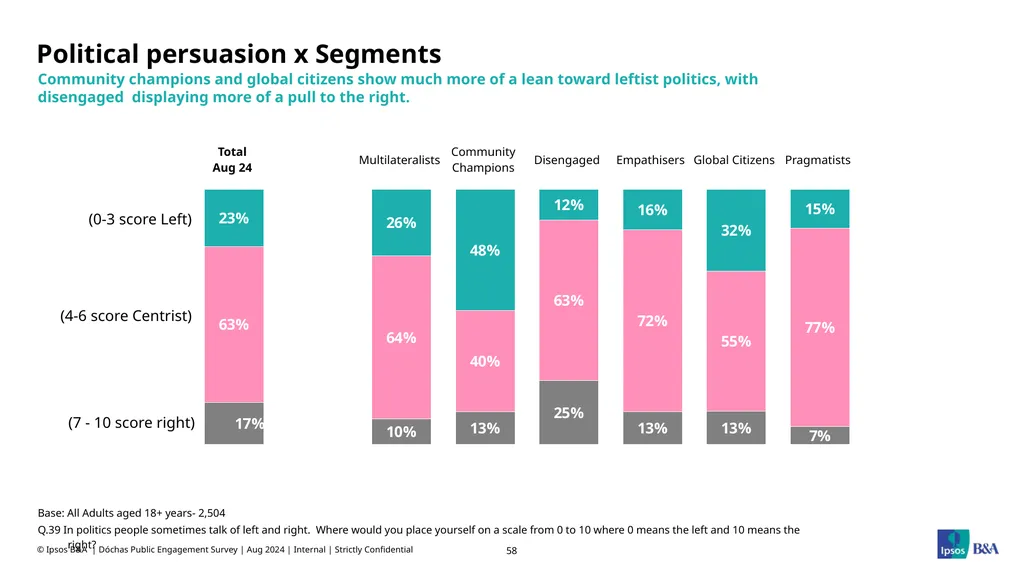
Political persuasion x Segments Community champions and global citizens show much more of a lean toward leftist politics, with disengaged displaying more of a pull to the right. Base: All Adults aged 18+ years- 2,504
Q.39 In politics people sometimes talk of left and right. Where would you place yourself on a scale from 0 to 10 where 0 means the left and 10 means the right? (7 - 10 score right) (4-6 score Centrist) (0-3 score Left)<br>
Q.39 In politics people sometimes talk of left and right. Where would you place yourself on a scale from 0 to 10 where 0 means the left and 10 means the right? (7 - 10 score right) (4-6 score Centrist) (0-3 score Left)<br>
59
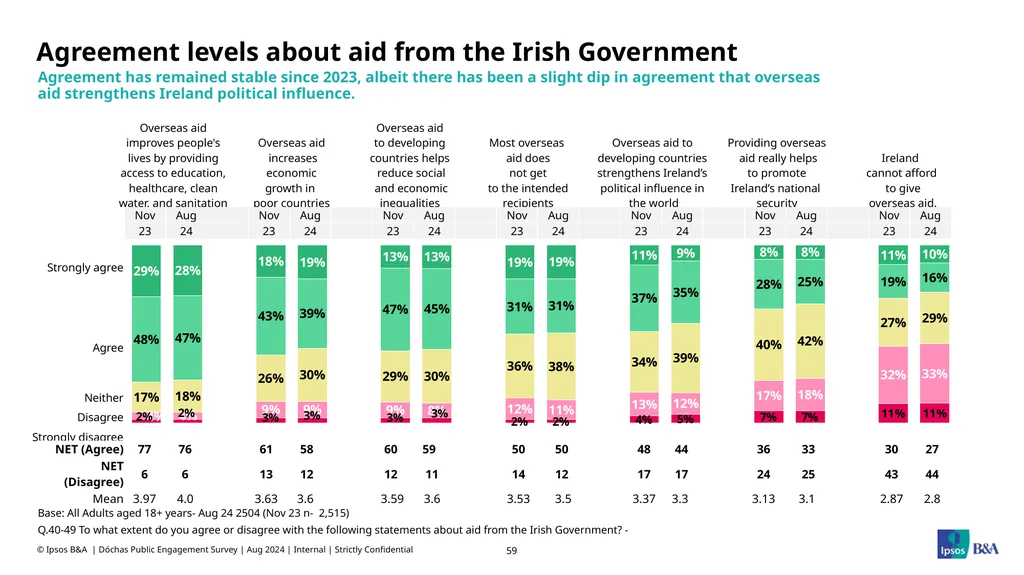
Agreement levels about aid from the Irish Government Agreement has remained stable since 2023, albeit there has been a slight dip in agreement that overseas aid strengthens Ireland political influence. Base: All Adults aged 18+ years- Aug 24 2504 (Nov 23 n- 2,515)
Q.40-49 To what extent do you agree or disagree with the following statements about aid from the Irish Government? -<br>
Q.40-49 To what extent do you agree or disagree with the following statements about aid from the Irish Government? -<br>
60
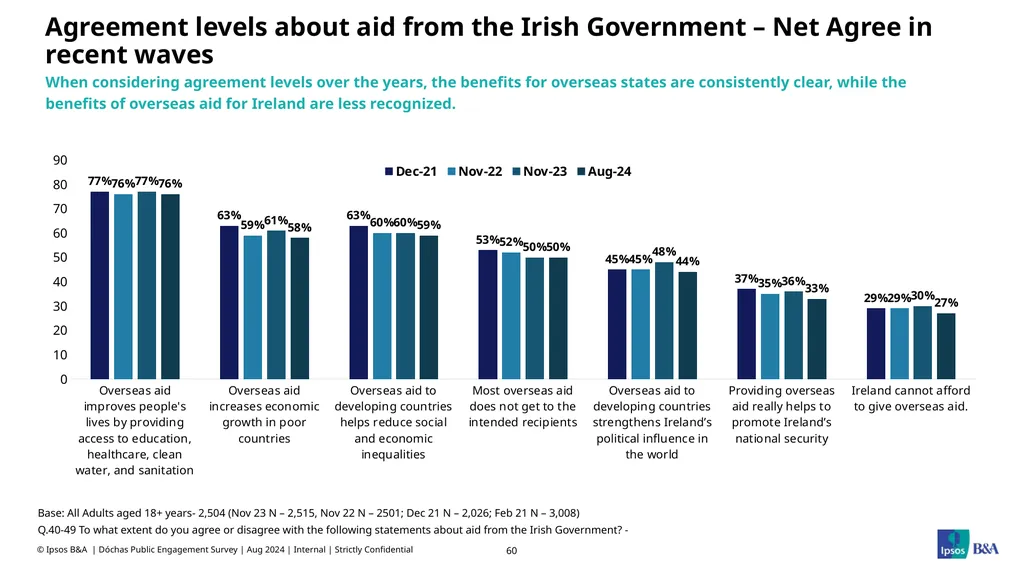
Agreement levels about aid from the Irish Government – Net Agree in recent waves When considering agreement levels over the years, the benefits for overseas states are consistently clear, while the benefits of overseas aid for Ireland are less recognized. Base: All Adults aged 18+ years- 2,504 (Nov 23 N – 2,515, Nov 22 N – 2501; Dec 21 N – 2,026; Feb 21 N – 3,008)
Q.40-49 To what extent do you agree or disagree with the following statements about aid from the Irish Government? -<br>
Q.40-49 To what extent do you agree or disagree with the following statements about aid from the Irish Government? -<br>
61
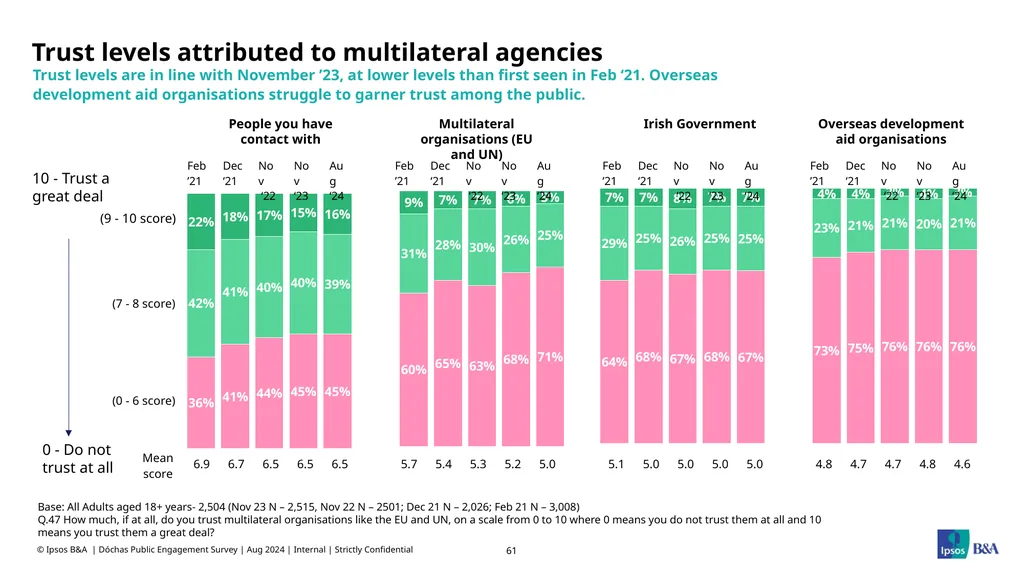
Trust levels attributed to multilateral agencies Trust levels are in line with November ’23, at lower levels than first seen in Feb ‘21. Overseas development aid organisations struggle to garner trust among the public. Base: All Adults aged 18+ years- 2,504 (Nov 23 N – 2,515, Nov 22 N – 2501; Dec 21 N – 2,026; Feb 21 N – 3,008)
Q.47 How much, if at all, do you trust multilateral organisations like the EU and UN, on a scale from 0 to 10 where 0 means you do not trust them at all and 10 means you trust them a great deal? (9 - 10 score) (7 - 8 score) 0 - Do not trust at all 10 - Trust a great deal (0 - 6 score) Overseas development aid organisations Irish Government People you have contact with Multilateral organisations (EU and UN)<br>
Q.47 How much, if at all, do you trust multilateral organisations like the EU and UN, on a scale from 0 to 10 where 0 means you do not trust them at all and 10 means you trust them a great deal? (9 - 10 score) (7 - 8 score) 0 - Do not trust at all 10 - Trust a great deal (0 - 6 score) Overseas development aid organisations Irish Government People you have contact with Multilateral organisations (EU and UN)<br>
62
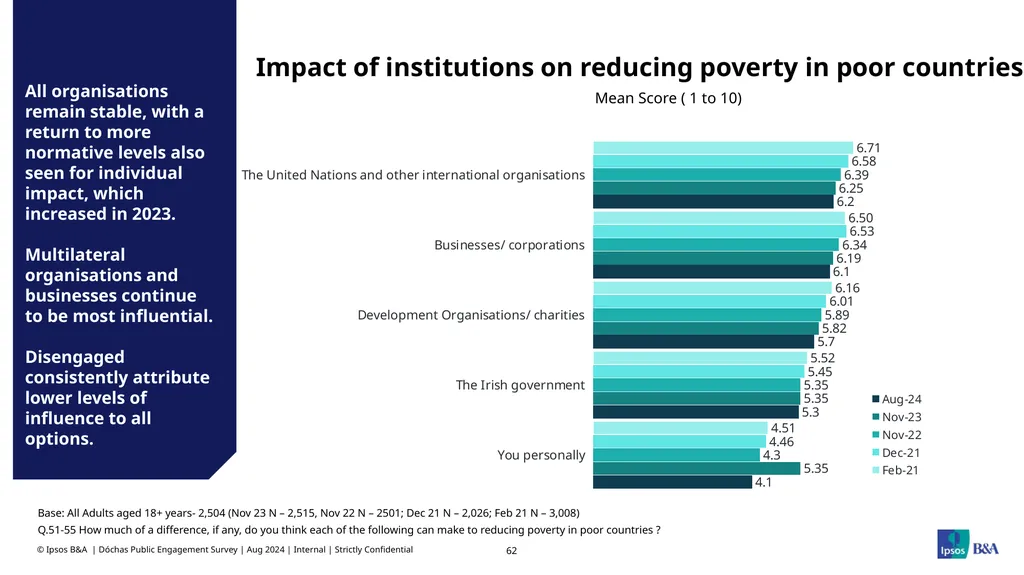
Impact of institutions on reducing poverty in poor countries Base: All Adults aged 18+ years- 2,504 (Nov 23 N – 2,515, Nov 22 N – 2501; Dec 21 N – 2,026; Feb 21 N – 3,008)
Q.51-55 How much of a difference, if any, do you think each of the following can make to reducing poverty in poor countries ? Mean Score ( 1 to 10) All organisations remain stable, with a return to more normative levels also seen for individual impact, which increased in 2023.
Multilateral organisations and businesses continue to be most influential.
Disengaged consistently attribute lower levels of influence to all options.<br>
63
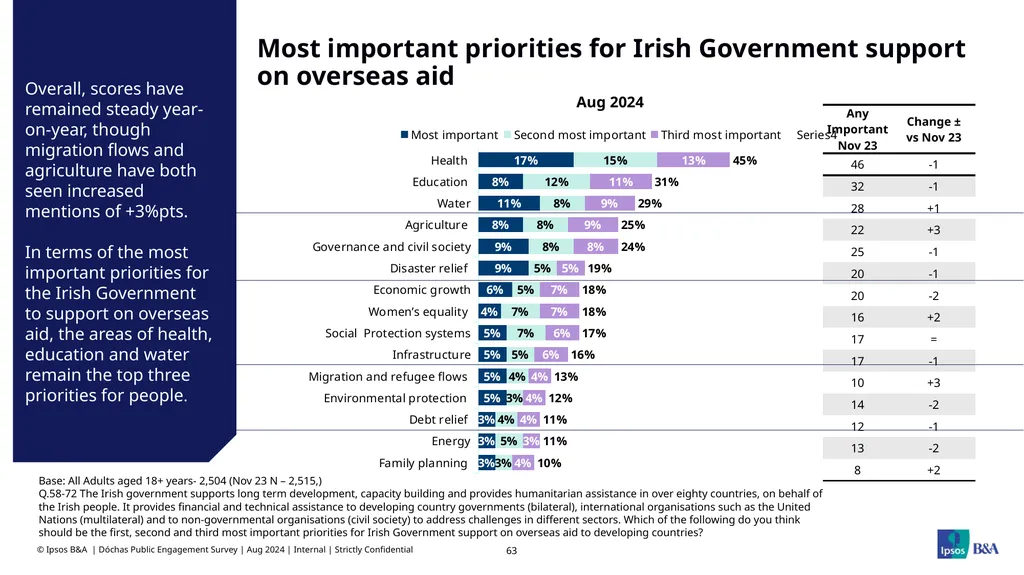
Most important priorities for Irish Government support on overseas aid Base: All Adults aged 18+ years- 2,504 (Nov 23 N – 2,515,)
Q.58-72 The Irish government supports long term development, capacity building and provides humanitarian assistance in over eighty countries, on behalf of the Irish people. It provides financial and technical assistance to developing country governments (bilateral), international organisations such as the United Nations (multilateral) and to non-governmental organisations (civil society) to address challenges in different sectors. Which of the following do you think should be the first, second and third most important priorities for Irish Government support on overseas aid to developing countries? Aug 2024 Overall, scores have remained steady year-on-year, though migration flows and agriculture have both seen increased mentions of +3%pts.
In terms of the most important priorities for the Irish Government to support on overseas aid, the areas of health, education and water remain the top three priorities for people.<br>
64
Thank
you. Name:
LUKE REAPER
Details:
luke.reaper@Ipsos.com
01 205 7500 Milltown House, Mount Saint Annes, Milltown, Dublin 6, D06 Y822
+353 1 205 7500 | info@ipsosbanda.ie
www.ipsosbanda.ie @IpsosBandA Ipsos B&A Ipsos B&A<br>
LUKE REAPER
Details:
luke.reaper@Ipsos.com
01 205 7500 Milltown House, Mount Saint Annes, Milltown, Dublin 6, D06 Y822
+353 1 205 7500 | info@ipsosbanda.ie
www.ipsosbanda.ie @IpsosBandA Ipsos B&A Ipsos B&A<br>