
Writing a History dissertation Professor Susan



Description: Writing a History dissertation Professor Susan Carruthers (s.carrutherswarwick.ac.uk) Very large books in the archives of Prague castle Photo by M. Peterka A BIG task Keep focused on the task in hand What a dissertation is (and isnt): A
Related Topics
Download Presentation
"Writing a History dissertation Professor Susan" is the property of its rightful owner. Permission is granted to download and print the materials on this website for personal, non-commercial use only, and to display it on your personal computer provided you do not modify the materials and that you retain all copyright notices contained in the materials. By downloading content from our website, you accept the terms of this agreement.
Presentation Transcript
slide1. Writing a History dissertation Professor Susan Carruthers (s.carruthers@warwick.ac.uk)<br>
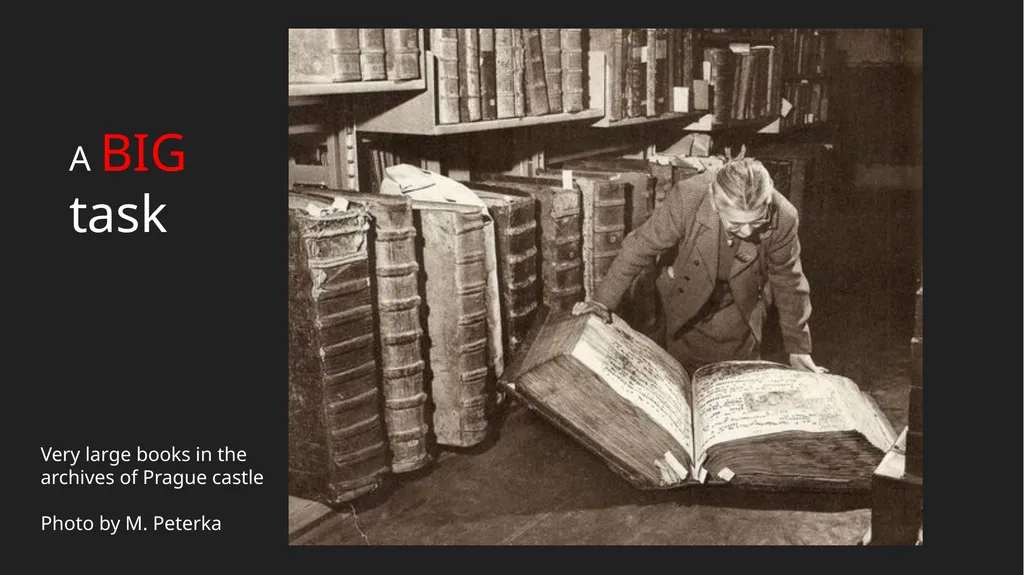
slide2. Very large books in the
archives of Prague castle
Photo by M. Peterka A BIG
task<br>
slide3. Keep focused on the task in hand What a dissertation is (and isn’t):
A 9,000 word-long exploration of a tightly defined historical question, rooted in primary source evidence, but drawing on– and contributing to– existing scholarship in the relevant field(s)
Think of the dissertation as essentially a scholarly journal article– with all the professional trimmings– NOT a PhD thesis or a book; and not a magazine feature, but a work of academic scholarship which will be judged according to recognised conventions
About 35pp of double-spaced A4 (plus bibliography)
Identify historical scholarship you’ve found most engaging and use it as a model and inspiration
Acknowledge the limitations and constraints you’re working under– but embrace this project as a very particular challenge from which you’ll gain or enhance many useful capabilities:
superior research skills; professional writing and editing skills; time-management<br>
slide4. Research/writing TERM I
Locate relevant primary and secondary sources
Analyse them; take good notes
Constantly refine your research idea– write an abstract and keep honing it
Map possible plans for the dissertation
Discuss tentative outline
Complete bulk of research by end of Xmas break TERM 2
Draft a condensed plan– discuss
Start drafting Intro
Start drafting sections– aim for a complete first draft by end of reading week
Re-work all sections– making sure the parts add up to a coherent whole
Easter break: check notes and bibliography; proof read
Revise for exams<br>
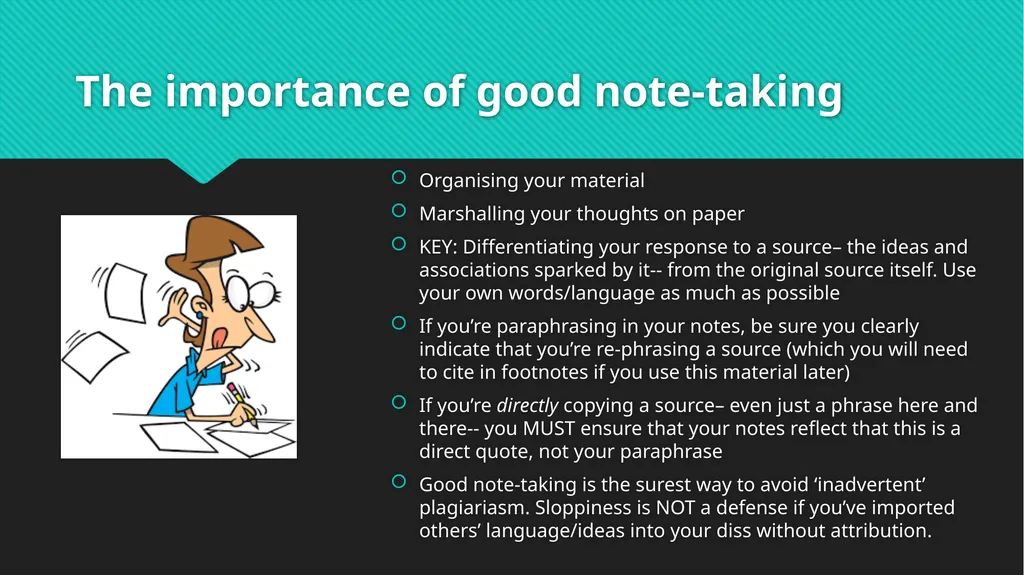
slide5. The importance of good note-taking Organising your material
Marshalling your thoughts on paper
KEY: Differentiating your response to a source– the ideas and associations sparked by it-- from the original source itself. Use your own words/language as much as possible
If you’re paraphrasing in your notes, be sure you clearly indicate that you’re re-phrasing a source (which you will need to cite in footnotes if you use this material later)
If you’re directly copying a source– even just a phrase here and there-- you MUST ensure that your notes reflect that this is a direct quote, not your paraphrase
Good note-taking is the surest way to avoid ‘inadvertent’ plagiariasm. Sloppiness is NOT a defense if you’ve imported others’ language/ideas into your diss without attribution.<br>
slide6. Take a short test https://www.historians.org/teaching-and-learning/teaching-resources-for-historians/plagiarism-curricular-materials-for-history-instructors/exercises Try ’Exercise 3’ from this resource produced by the
American Historical Association to see whether you’ve
correctly mastered the art of citation.<br>
slide7. Organising your dissertation<br>
slide8. Sections Why organise your dissertation into sections?
Helping you– and your reader– stay focused on the argument and the illustrative evidence
Sub-titles
How many??
No ’right number’…
BUT it is possible to break the material into too many ‘bitty’ fragments<br>
slide9. Experiment with different possible plans Get creative!
Brainstorm different ideas for how you might organise your dissertation
Map out 2 or 3 different plans for the structure
Chronological vs. thematic organisation
How best to approach comparative topics
Start playing with possible plans early– stay flexible as your ideas develop
Share plans with adviser<br>
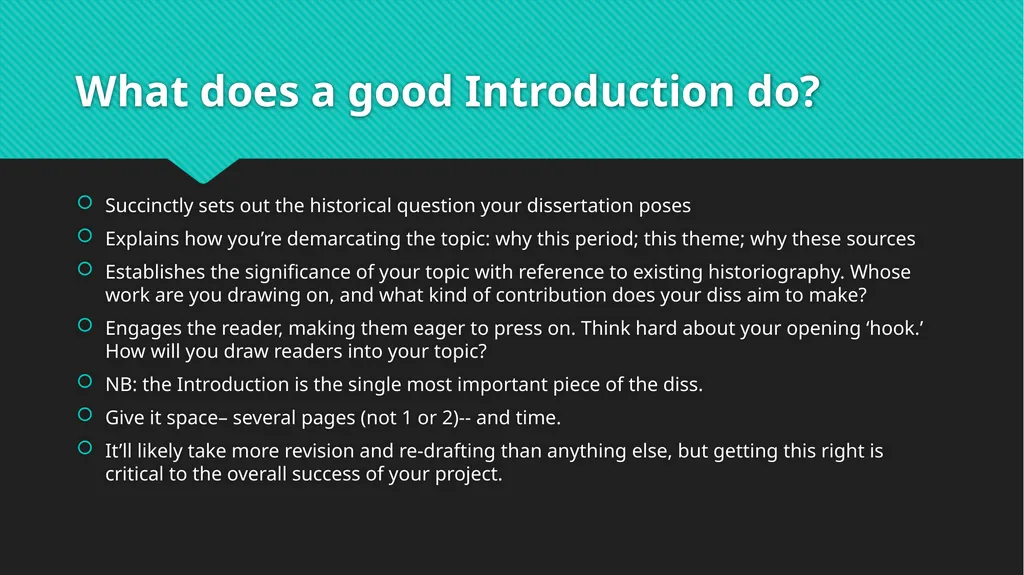
slide10. What does a good Introduction do? Succinctly sets out the historical question your dissertation poses
Explains how you’re demarcating the topic: why this period; this theme; why these sources
Establishes the significance of your topic with reference to existing historiography. Whose work are you drawing on, and what kind of contribution does your diss aim to make?
Engages the reader, making them eager to press on. Think hard about your opening ‘hook.’ How will you draw readers into your topic?
NB: the Introduction is the single most important piece of the diss.
Give it space– several pages (not 1 or 2)-- and time.
It’ll likely take more revision and re-drafting than anything else, but getting this right is critical to the overall success of your project.<br>
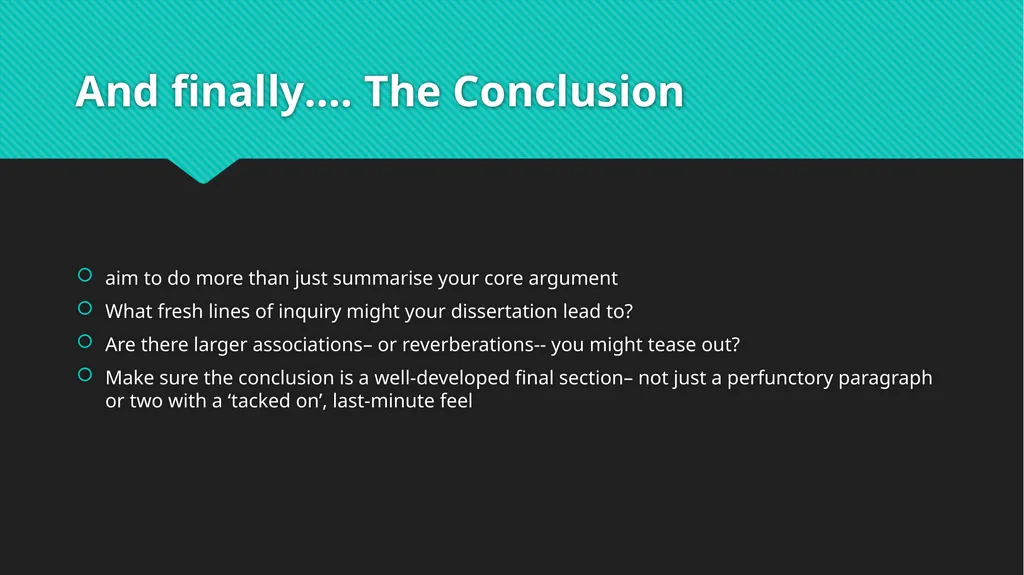
slide11. And finally…. The Conclusion aim to do more than just summarise your core argument
What fresh lines of inquiry might your dissertation lead to?
Are there larger associations– or reverberations-- you might tease out?
Make sure the conclusion is a well-developed final section– not just a perfunctory paragraph or two with a ‘tacked on’, last-minute feel<br>
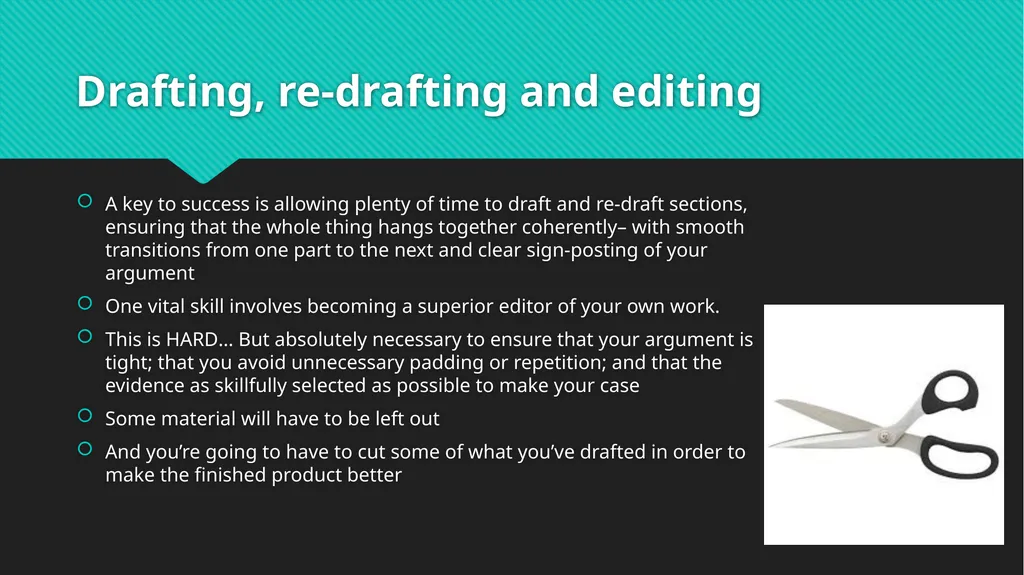
slide12. Drafting, re-drafting and editing A key to success is allowing plenty of time to draft and re-draft sections, ensuring that the whole thing hangs together coherently– with smooth transitions from one part to the next and clear sign-posting of your argument
One vital skill involves becoming a superior editor of your own work.
This is HARD… But absolutely necessary to ensure that your argument is tight; that you avoid unnecessary padding or repetition; and that the evidence as skillfully selected as possible to make your case
Some material will have to be left out
And you’re going to have to cut some of what you’ve drafted in order to make the finished product better<br>
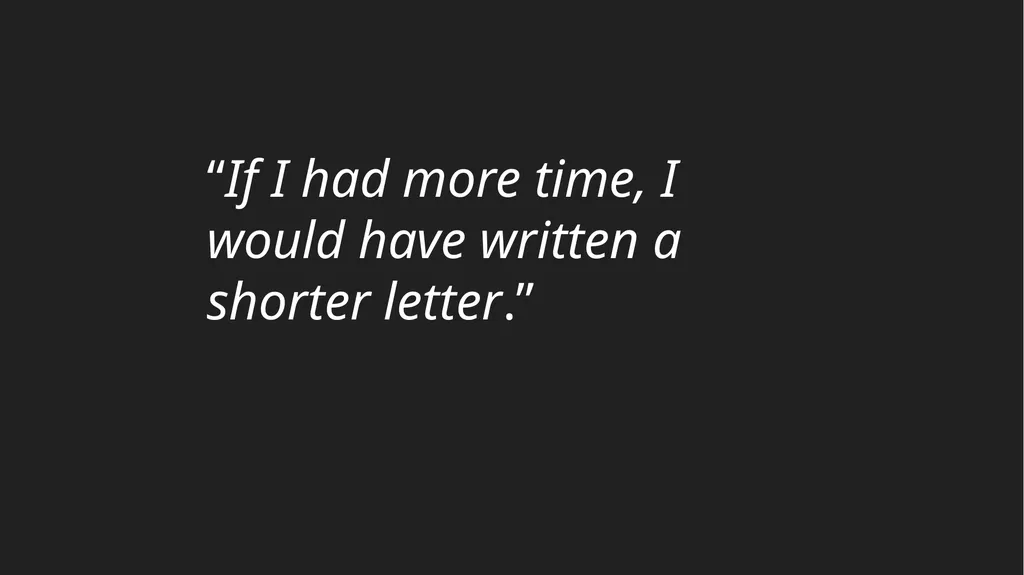
slide13. “If I had more time, I would have written a shorter letter.”<br>
slide14. Finding the right tone The dissertation is a particular exercise in writing ACADEMIC PROSE
But what does that mean exactly?
Your voice should aim to be informed and formal, but also engaging and lively
Writing academic prose doesn’t mean that your text should be stilted, pretentious, laden with buzz words… nor does it mean that you should trash every other scholar in sight. Arrogance on the page– as in real life– is never an appealing quality
Aim to write as clearly– and freshly– as possible
Try reading out your draft work aloud. If your prose seems convoluted– or some of the phraseology makes your toes curl– go back and re-word it.
Academic prose still has to sound recognisable as your own distinctive voice<br>
slide15. Quoting To quote or not to quote?
Use quotations judiciously– when there’s a good reason to introduce other voices than your own– not for the sake of bulking up your footnote count
Frequent short, pithy quotations– expressive phrases-- are generally better than long block quotes that interrupt your flow
When you quote someone else’s words, it’s generally preferable to announce in the text whose language you’ve borrowed, rather than making readers look in your footnotes
Don’t try to let long quotes speak for themselves. They don’t!
It’s your job as the author to tease out the significance of a quotation, making clear how it helps illustrate your case
Remember that whether you’re quoting a source directly or paraphrasing it, you need to provide a citation in your footnotes<br>
slide16. Footnotes Why are historians such footnote fetishists?
What purposes does footnoting serve?
Adding texture and historical depth
Engaging in intellectual exchange with other scholars
Acknowledging your intellectual debts
Showing exactly where you located your source material-- so that others could build on your work in their own research
I.e. your notes should let anyone reading your dissertation reconstruct your research process<br>
slide17. Getting technical<br>
slide18. Footnote do’s and don’ts Do keep footnotes brief, with only occasional longer quotes.
Give full details of the source and, where applicable, the page number(s).
Make sure to insert the superscript numeral indicating a note at the END of the sentence in question. This means the numbers won’t always appear right next to the quotation marks.
You can include more than one citation in a single footnote. But make sure you distinguish clearly what material in the text the citations refer to.
Follow the Department style sheet carefully and consistently. https://warwick.ac.uk/fac/arts/history/students/modules/hi203/resources/styleguide Don’t use footnotes to cheat on the word count!
Don’t write long discursive notes. If you find yourself tempted, ask why? If the material is so important that it has to be included, then it probably belongs in the text itself.
Don’t pass off a source you encountered second-hand as though you saw it first-hand. That’s cheating!
Notes should ALWAYS reflect the exact location in which you found the material. And if that was in another scholar’s work, your note needs to reference both the text you’re quoting from AND the secondary source in which you found this source mentioned.<br>
slide19. The bibliography This should include everything you PERSONALLY consulted– but not those materials you encountered second-hand thanks to others’ scholarship. Include references to the latter but not the former
Divide your bibliography into clearly marked SECTIONS
Begin my listing the PRIMARY SOURCES you used.
You can use subtitles (if you wish) to identify distinct archival collections, on-line resources, and/or different kinds of material consulted (e.g. newspapers, films, memoirs etc.)
In the bibliography, you don’t need to list individual newspaper stories you looked at; you can simply list the titles of different papers you consulted
SECONDARY SOURCES should be listed alphabetically by author’s surname<br>
slide20. Proof-reading Make sure to give your dissertation a thorough read-through before submission.
Ask a friend to read it for you too– and return the favour
Don’t rely on the spellchecker to do this for you. It won’t correct word substitutions
Check the text AND the footnotes– ensuring the latter are in place where they need to be, and are all properly (and consistently) formatted
Professionalism in presentation really matters
It’ll be obvious to readers if you got lazy or bored or ran out of time and neglected to check your work before submission. And if a dissertation shows signs that its author gave up on it, that’s not going to impress readers/markers
So, why squander marks needlessly?<br>
slide21. Submission! Don’t wait until the 59th minute of the 11th hour. Late submissions are penalised.
Rushed submission– bang-up against the deadline-- is an invitation for catastrophe. (Oops. Wrong file uploaded!!! HELP!??!!???!!!)
Make sure you upload the correct– really and truly final– version of your dissertation
Be sure to have a good system in place for labeling your draft finals and for distinguishing the final end product from everything else
HURRAH! You did it…. The most challenging– but also most rewarding and original– piece of your undergraduate degree.<br>
slide2. Very large books in the
archives of Prague castle
Photo by M. Peterka A BIG
task<br>
slide3. Keep focused on the task in hand What a dissertation is (and isn’t):
A 9,000 word-long exploration of a tightly defined historical question, rooted in primary source evidence, but drawing on– and contributing to– existing scholarship in the relevant field(s)
Think of the dissertation as essentially a scholarly journal article– with all the professional trimmings– NOT a PhD thesis or a book; and not a magazine feature, but a work of academic scholarship which will be judged according to recognised conventions
About 35pp of double-spaced A4 (plus bibliography)
Identify historical scholarship you’ve found most engaging and use it as a model and inspiration
Acknowledge the limitations and constraints you’re working under– but embrace this project as a very particular challenge from which you’ll gain or enhance many useful capabilities:
superior research skills; professional writing and editing skills; time-management<br>
slide4. Research/writing TERM I
Locate relevant primary and secondary sources
Analyse them; take good notes
Constantly refine your research idea– write an abstract and keep honing it
Map possible plans for the dissertation
Discuss tentative outline
Complete bulk of research by end of Xmas break TERM 2
Draft a condensed plan– discuss
Start drafting Intro
Start drafting sections– aim for a complete first draft by end of reading week
Re-work all sections– making sure the parts add up to a coherent whole
Easter break: check notes and bibliography; proof read
Revise for exams<br>
slide5. The importance of good note-taking Organising your material
Marshalling your thoughts on paper
KEY: Differentiating your response to a source– the ideas and associations sparked by it-- from the original source itself. Use your own words/language as much as possible
If you’re paraphrasing in your notes, be sure you clearly indicate that you’re re-phrasing a source (which you will need to cite in footnotes if you use this material later)
If you’re directly copying a source– even just a phrase here and there-- you MUST ensure that your notes reflect that this is a direct quote, not your paraphrase
Good note-taking is the surest way to avoid ‘inadvertent’ plagiariasm. Sloppiness is NOT a defense if you’ve imported others’ language/ideas into your diss without attribution.<br>
slide6. Take a short test https://www.historians.org/teaching-and-learning/teaching-resources-for-historians/plagiarism-curricular-materials-for-history-instructors/exercises Try ’Exercise 3’ from this resource produced by the
American Historical Association to see whether you’ve
correctly mastered the art of citation.<br>
slide7. Organising your dissertation<br>
slide8. Sections Why organise your dissertation into sections?
Helping you– and your reader– stay focused on the argument and the illustrative evidence
Sub-titles
How many??
No ’right number’…
BUT it is possible to break the material into too many ‘bitty’ fragments<br>
slide9. Experiment with different possible plans Get creative!
Brainstorm different ideas for how you might organise your dissertation
Map out 2 or 3 different plans for the structure
Chronological vs. thematic organisation
How best to approach comparative topics
Start playing with possible plans early– stay flexible as your ideas develop
Share plans with adviser<br>
slide10. What does a good Introduction do? Succinctly sets out the historical question your dissertation poses
Explains how you’re demarcating the topic: why this period; this theme; why these sources
Establishes the significance of your topic with reference to existing historiography. Whose work are you drawing on, and what kind of contribution does your diss aim to make?
Engages the reader, making them eager to press on. Think hard about your opening ‘hook.’ How will you draw readers into your topic?
NB: the Introduction is the single most important piece of the diss.
Give it space– several pages (not 1 or 2)-- and time.
It’ll likely take more revision and re-drafting than anything else, but getting this right is critical to the overall success of your project.<br>
slide11. And finally…. The Conclusion aim to do more than just summarise your core argument
What fresh lines of inquiry might your dissertation lead to?
Are there larger associations– or reverberations-- you might tease out?
Make sure the conclusion is a well-developed final section– not just a perfunctory paragraph or two with a ‘tacked on’, last-minute feel<br>
slide12. Drafting, re-drafting and editing A key to success is allowing plenty of time to draft and re-draft sections, ensuring that the whole thing hangs together coherently– with smooth transitions from one part to the next and clear sign-posting of your argument
One vital skill involves becoming a superior editor of your own work.
This is HARD… But absolutely necessary to ensure that your argument is tight; that you avoid unnecessary padding or repetition; and that the evidence as skillfully selected as possible to make your case
Some material will have to be left out
And you’re going to have to cut some of what you’ve drafted in order to make the finished product better<br>
slide13. “If I had more time, I would have written a shorter letter.”<br>
slide14. Finding the right tone The dissertation is a particular exercise in writing ACADEMIC PROSE
But what does that mean exactly?
Your voice should aim to be informed and formal, but also engaging and lively
Writing academic prose doesn’t mean that your text should be stilted, pretentious, laden with buzz words… nor does it mean that you should trash every other scholar in sight. Arrogance on the page– as in real life– is never an appealing quality
Aim to write as clearly– and freshly– as possible
Try reading out your draft work aloud. If your prose seems convoluted– or some of the phraseology makes your toes curl– go back and re-word it.
Academic prose still has to sound recognisable as your own distinctive voice<br>
slide15. Quoting To quote or not to quote?
Use quotations judiciously– when there’s a good reason to introduce other voices than your own– not for the sake of bulking up your footnote count
Frequent short, pithy quotations– expressive phrases-- are generally better than long block quotes that interrupt your flow
When you quote someone else’s words, it’s generally preferable to announce in the text whose language you’ve borrowed, rather than making readers look in your footnotes
Don’t try to let long quotes speak for themselves. They don’t!
It’s your job as the author to tease out the significance of a quotation, making clear how it helps illustrate your case
Remember that whether you’re quoting a source directly or paraphrasing it, you need to provide a citation in your footnotes<br>
slide16. Footnotes Why are historians such footnote fetishists?
What purposes does footnoting serve?
Adding texture and historical depth
Engaging in intellectual exchange with other scholars
Acknowledging your intellectual debts
Showing exactly where you located your source material-- so that others could build on your work in their own research
I.e. your notes should let anyone reading your dissertation reconstruct your research process<br>
slide17. Getting technical<br>
slide18. Footnote do’s and don’ts Do keep footnotes brief, with only occasional longer quotes.
Give full details of the source and, where applicable, the page number(s).
Make sure to insert the superscript numeral indicating a note at the END of the sentence in question. This means the numbers won’t always appear right next to the quotation marks.
You can include more than one citation in a single footnote. But make sure you distinguish clearly what material in the text the citations refer to.
Follow the Department style sheet carefully and consistently. https://warwick.ac.uk/fac/arts/history/students/modules/hi203/resources/styleguide Don’t use footnotes to cheat on the word count!
Don’t write long discursive notes. If you find yourself tempted, ask why? If the material is so important that it has to be included, then it probably belongs in the text itself.
Don’t pass off a source you encountered second-hand as though you saw it first-hand. That’s cheating!
Notes should ALWAYS reflect the exact location in which you found the material. And if that was in another scholar’s work, your note needs to reference both the text you’re quoting from AND the secondary source in which you found this source mentioned.<br>
slide19. The bibliography This should include everything you PERSONALLY consulted– but not those materials you encountered second-hand thanks to others’ scholarship. Include references to the latter but not the former
Divide your bibliography into clearly marked SECTIONS
Begin my listing the PRIMARY SOURCES you used.
You can use subtitles (if you wish) to identify distinct archival collections, on-line resources, and/or different kinds of material consulted (e.g. newspapers, films, memoirs etc.)
In the bibliography, you don’t need to list individual newspaper stories you looked at; you can simply list the titles of different papers you consulted
SECONDARY SOURCES should be listed alphabetically by author’s surname<br>
slide20. Proof-reading Make sure to give your dissertation a thorough read-through before submission.
Ask a friend to read it for you too– and return the favour
Don’t rely on the spellchecker to do this for you. It won’t correct word substitutions
Check the text AND the footnotes– ensuring the latter are in place where they need to be, and are all properly (and consistently) formatted
Professionalism in presentation really matters
It’ll be obvious to readers if you got lazy or bored or ran out of time and neglected to check your work before submission. And if a dissertation shows signs that its author gave up on it, that’s not going to impress readers/markers
So, why squander marks needlessly?<br>
slide21. Submission! Don’t wait until the 59th minute of the 11th hour. Late submissions are penalised.
Rushed submission– bang-up against the deadline-- is an invitation for catastrophe. (Oops. Wrong file uploaded!!! HELP!??!!???!!!)
Make sure you upload the correct– really and truly final– version of your dissertation
Be sure to have a good system in place for labeling your draft finals and for distinguishing the final end product from everything else
HURRAH! You did it…. The most challenging– but also most rewarding and original– piece of your undergraduate degree.<br>