Writing More About Less Attaining depth Analyzing Evidence in Depth: 10 on 1 How do you move from (a) making details speak and (b) explaining how evidence confirms and qualifies the claim to composing a paper? Phrased as a general rule 10
"Writing More About Less Attaining depth Analyzing" is the property of its rightful owner. Permission is granted to
download and print the materials on this website for personal, non-commercial use only, and to display it
on your personal computer provided you do not modify the materials and that you retain all copyright
notices contained in the materials. By downloading content from our website, you accept the terms of this
agreement.
Presentation Transcript
01
Writing More About Less Attaining depth<br>
02
Analyzing Evidence in Depth: “10 on 1” How do you move from (a) making details speak and (b) explaining how evidence confirms and qualifies the claim to composing a paper?
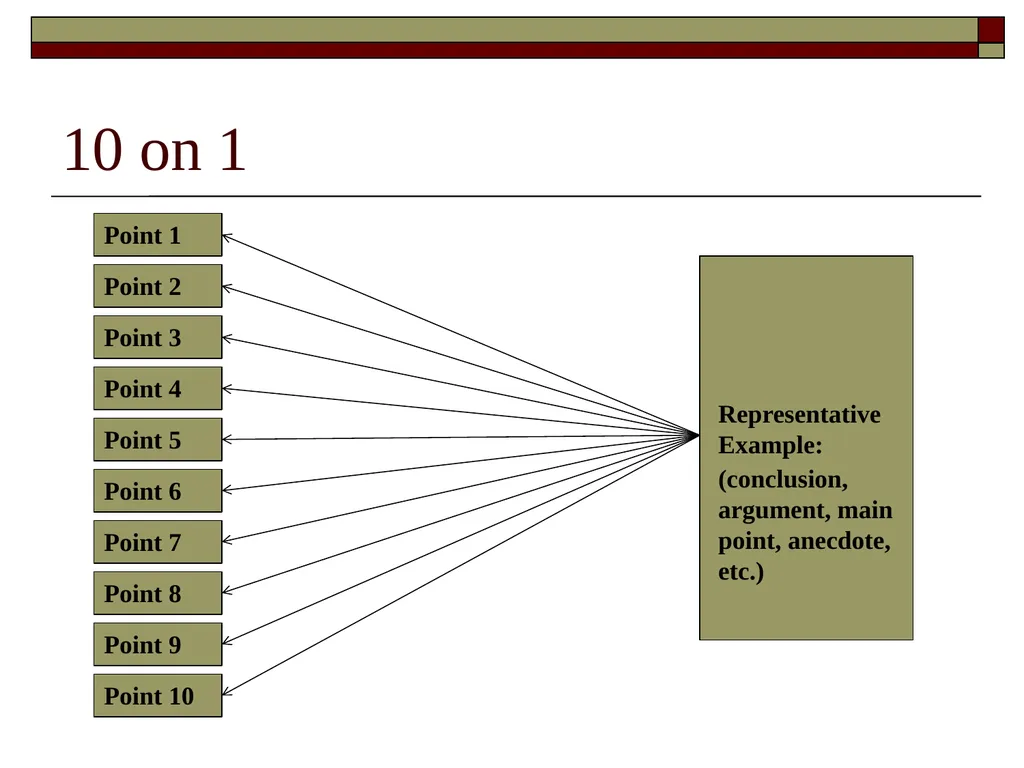
Phrased as a general rule 10 on 1 holds that it is better to make ten observations or points about a single representative issue or example than to make the same basic point about ten related issues or examples (Writing Analytically, p. 207).<br>
03
10 on 1 (conclusion, argument, main point, anecdote, etc.) Point 1 Point 2 Point 3 Point 4 Point 5 Point 6 Point 7 Point 8 Point 9 Point 10 Representative Example:<br>
04
Audience Interest The more interesting claims you can make about your evidence and how it relates to your thesis, the more interesting your paper will be.
The number “10” does not always have to be reached in drawing conclusions about your example; “you should draw out as much meaning as possible from your best examples” (Writing Analytically, p. 211).<br>
05
Goals for 10 on 1 to locate the range of possible meanings your evidence suggests
to zoom in on specific variations within the general pattern of data found
to make you less inclined to cling to your first claim inflexibly
open the way for you to discover a way of representing more fully the complexity of your subject
to slow down the rush to generalization
ensure that when you arrive at a working thesis, it will be more specific and better able to account for your evidence.<br>
06
Outcomes for 10 on 1 Pushes you to start thinking more critically about your topic
Allows you to draw out the implications lying at the heart of your paper
Impels your mind to create as many new and interesting claims as it can<br>
07
Applying 10 on 1 Find 10 examples that share a trait (or as many examples, points, issues as you can).
Focus on one of these for in-depth analysis.
Proceeding in this way will guarantee that your example is representative.
In doing 10 on 1 you will take one part of the whole,
put it under a microscope, and
then generalize about the whole on the basis of your analysis.<br>
08
Writing Development The Four Stages<br>
09
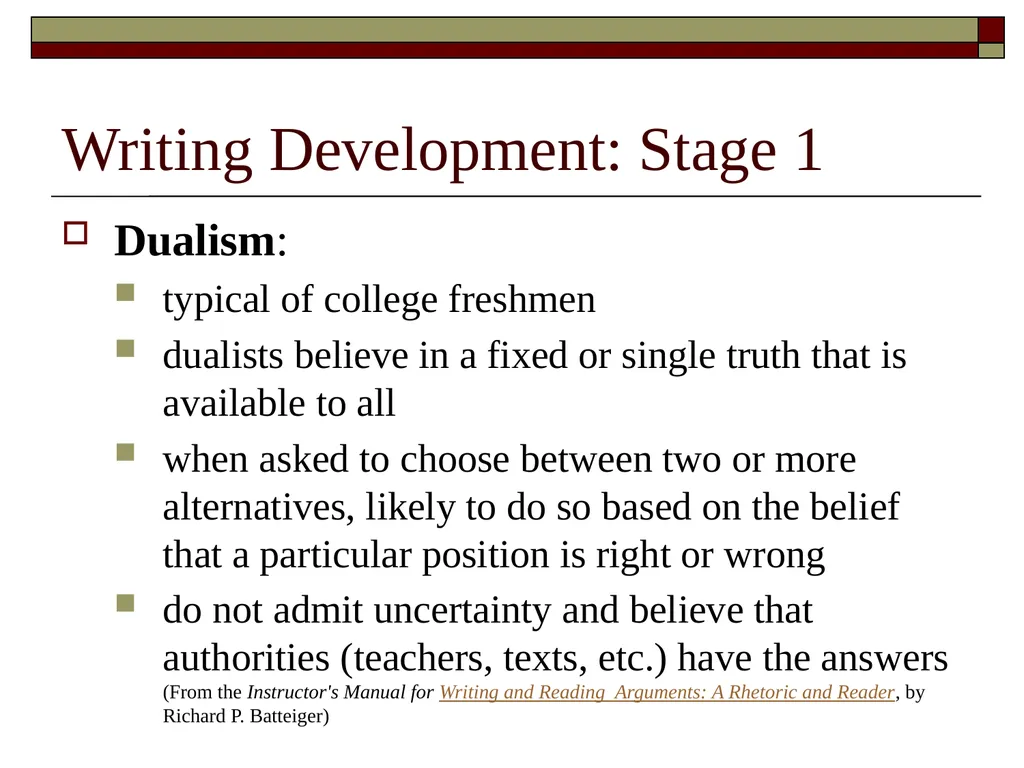
Writing Development: Stage 1 Dualism:
typical of college freshmen
dualists believe in a fixed or single truth that is available to all
when asked to choose between two or more alternatives, likely to do so based on the belief that a particular position is right or wrong
do not admit uncertainty and believe that authorities (teachers, texts, etc.) have the answers
(From the Instructor's Manual for Writing and Reading Arguments: A Rhetoric and Reader, by Richard P. Batteiger)<br>
10
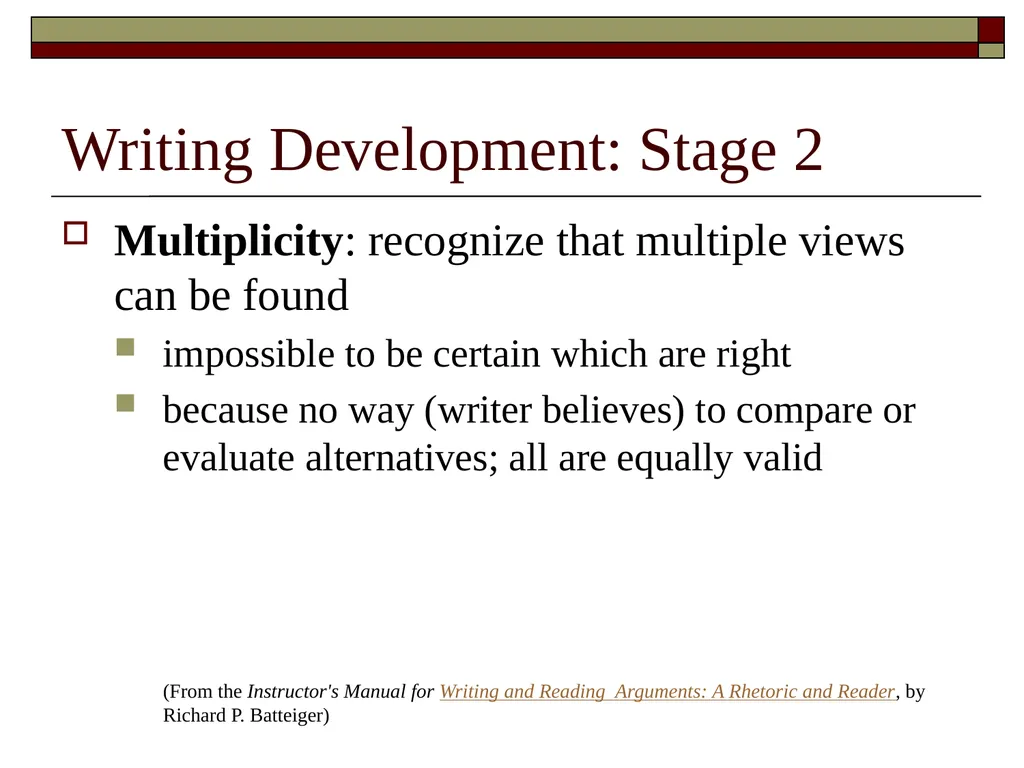
Writing Development: Stage 2 Multiplicity: recognize that multiple views can be found
impossible to be certain which are right
because no way (writer believes) to compare or evaluate alternatives; all are equally valid
(From the Instructor's Manual for Writing and Reading Arguments: A Rhetoric and Reader, by Richard P. Batteiger)<br>
11
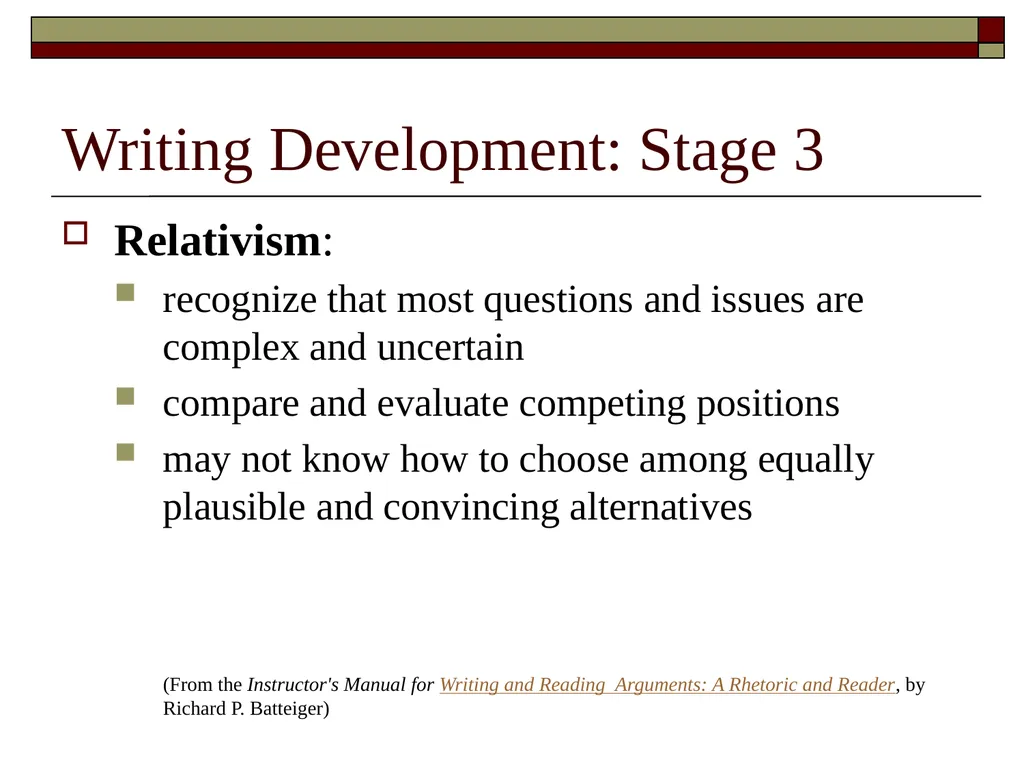
Writing Development: Stage 3 Relativism:
recognize that most questions and issues are complex and uncertain
compare and evaluate competing positions
may not know how to choose among equally plausible and convincing alternatives
(From the Instructor's Manual for Writing and Reading Arguments: A Rhetoric and Reader, by Richard P. Batteiger)<br>
12
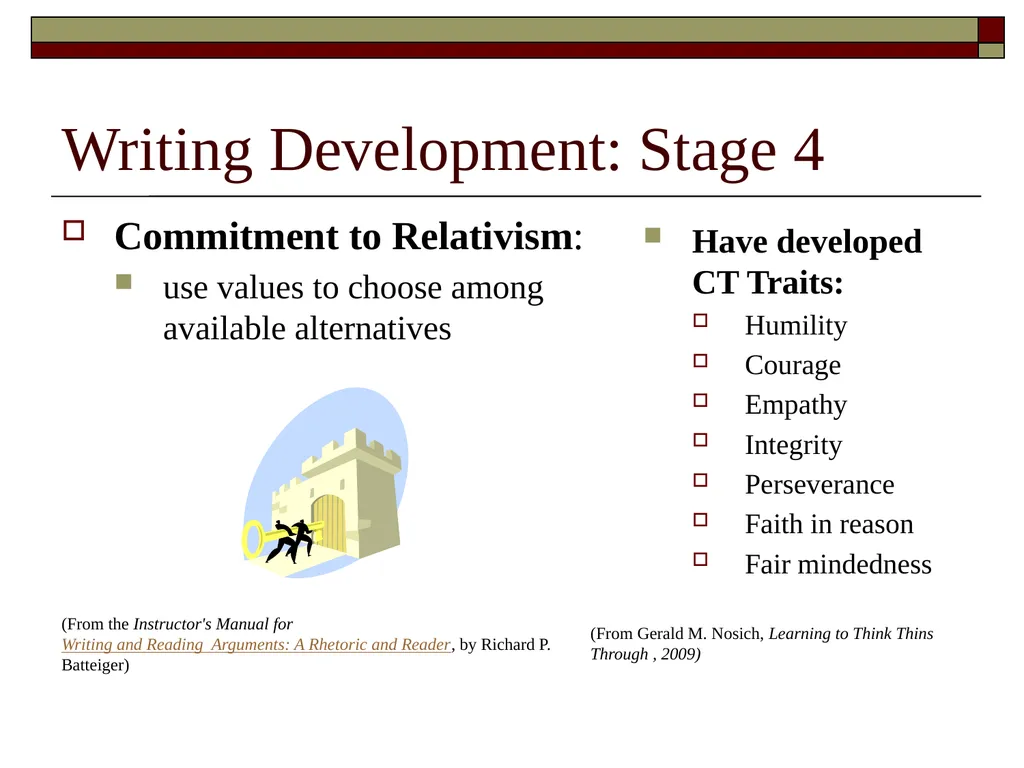
Writing Development: Stage 4 Commitment to Relativism:
use values to choose among available alternatives
(From the Instructor's Manual for Writing and Reading Arguments: A Rhetoric and Reader, by Richard P. Batteiger) Have developed CT Traits:
Humility
Courage
Empathy
Integrity
Perseverance
Faith in reason
Fair mindedness
(From Gerald M. Nosich, Learning to Think Thins Through , 2009)<br>