
XI COMMERCE 1MARK QUIZ chapter 1-18 Presented by
FD
Published · 101 slides · 0 views

1 / 1














Description
XI COMMERCE 1MARK QUIZ chapter 1-18 Presented by D.Chithambararaj MBA,M.COM,B.Ed 9994154393 Padasalai 1.The place where the goods are sold is (a)Angadi (b) Market (c) Nalangadi (d) Allangadi 2.Hindrance of place is removed by
Related Topics
Share
Embed code
Download this presentation From Below
"XI COMMERCE 1MARK QUIZ chapter 1-18 Presented by" is the property of its rightful owner. Permission is granted to download and print the materials on this website for personal, non-commercial use only, and to display it on your personal computer provided you do not modify the materials and that you retain all copyright notices contained in the materials. By downloading content from our website, you accept the terms of this agreement.
Presentation Transcript
01
XI COMMERCE
1MARK QUIZ
chapter 1-18
Presented by D.Chithambararaj MBA,M.COM,B.Ed
9994154393 Padasalai<br>
02
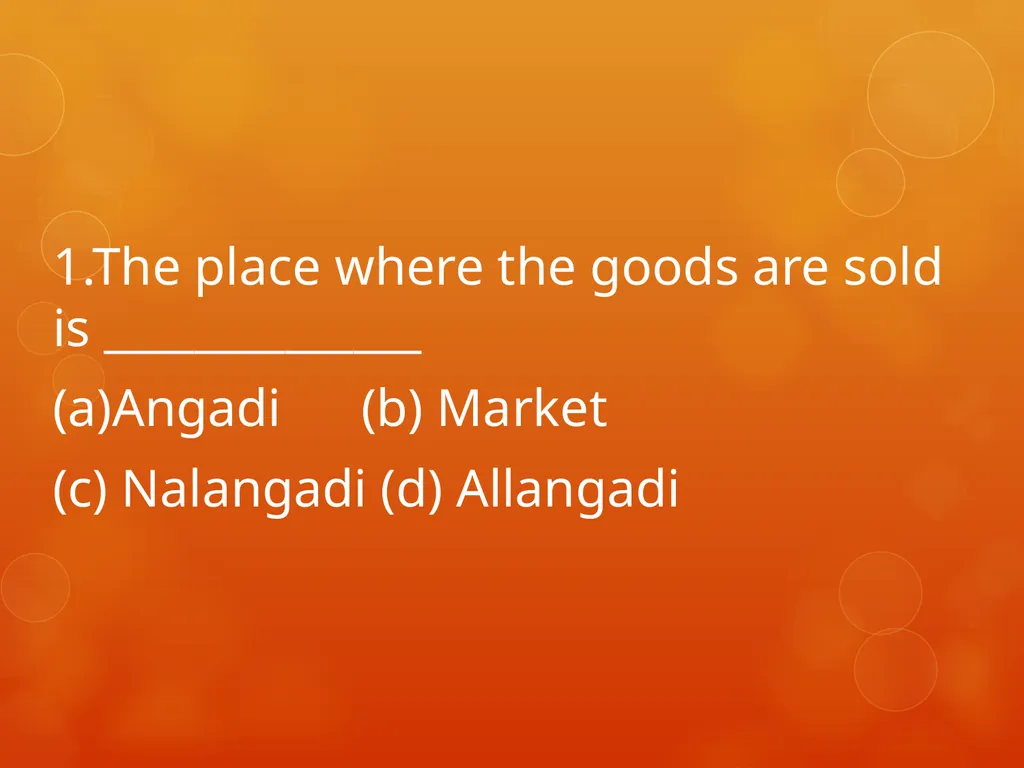
1.The place where the goods are sold is ______________
(a)Angadi (b) Market
(c) Nalangadi (d) Allangadi<br>
(a)Angadi (b) Market
(c) Nalangadi (d) Allangadi<br>
03
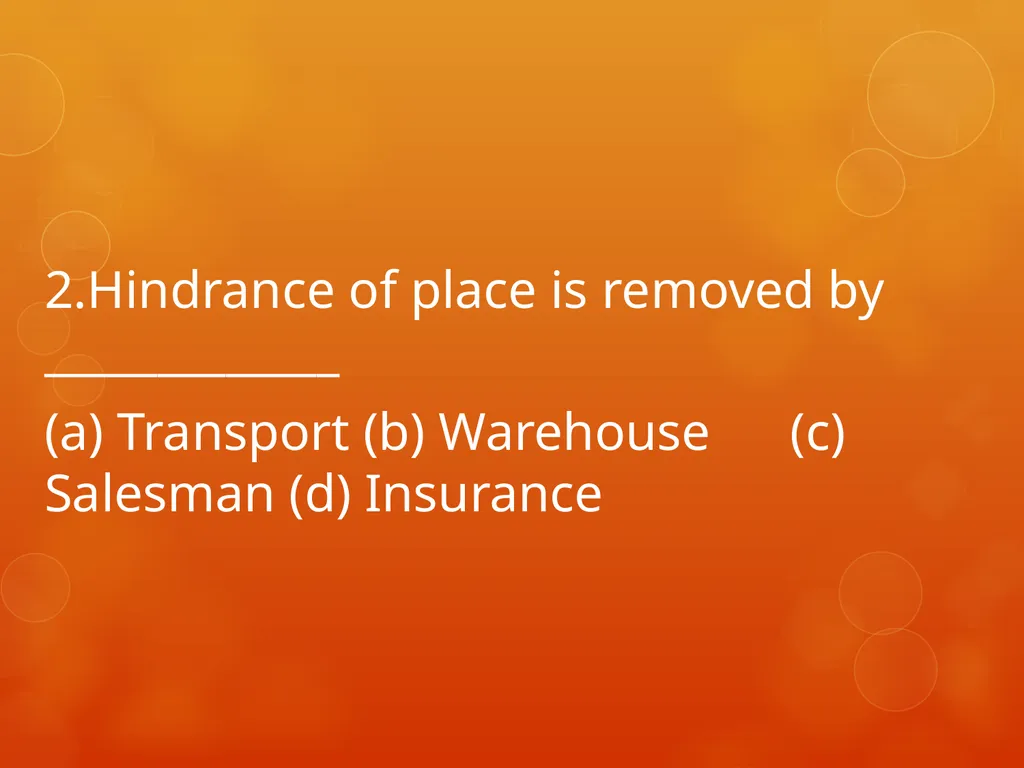
2.Hindrance of place is removed by _____________
(a) Transport (b) Warehouse (c) Salesman (d) Insurance<br>
(a) Transport (b) Warehouse (c) Salesman (d) Insurance<br>
04
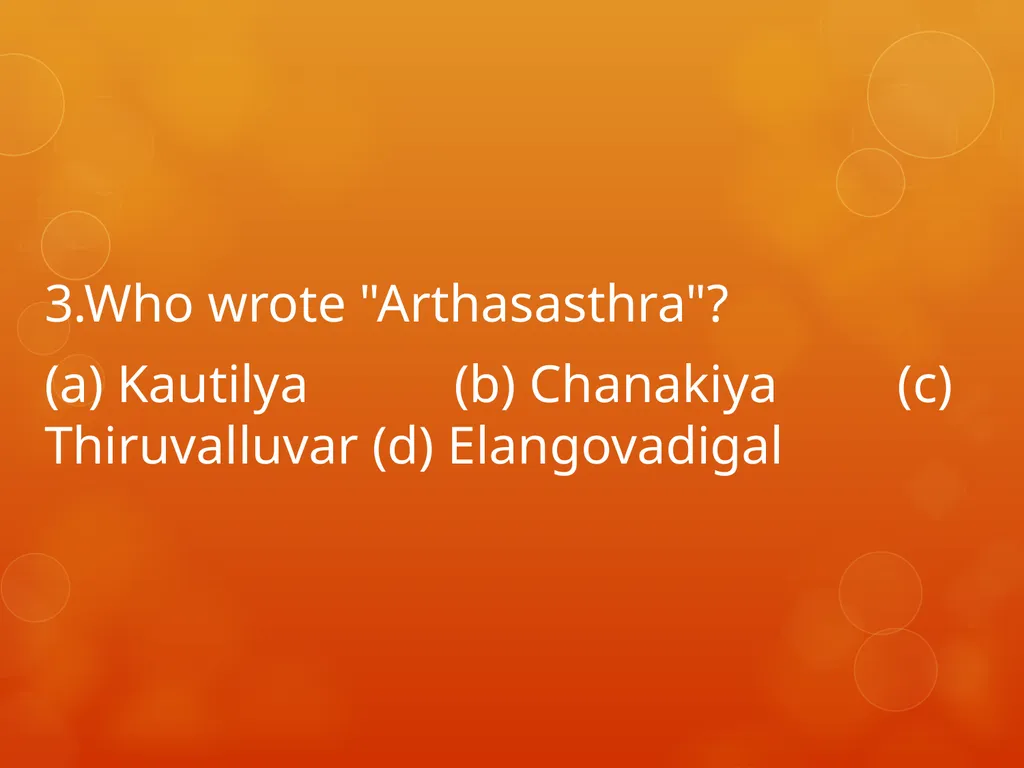
3.Who wrote "Arthasasthra"?
(a) Kautilya (b) Chanakiya (c) Thiruvalluvar (d) Elangovadigal<br>
(a) Kautilya (b) Chanakiya (c) Thiruvalluvar (d) Elangovadigal<br>
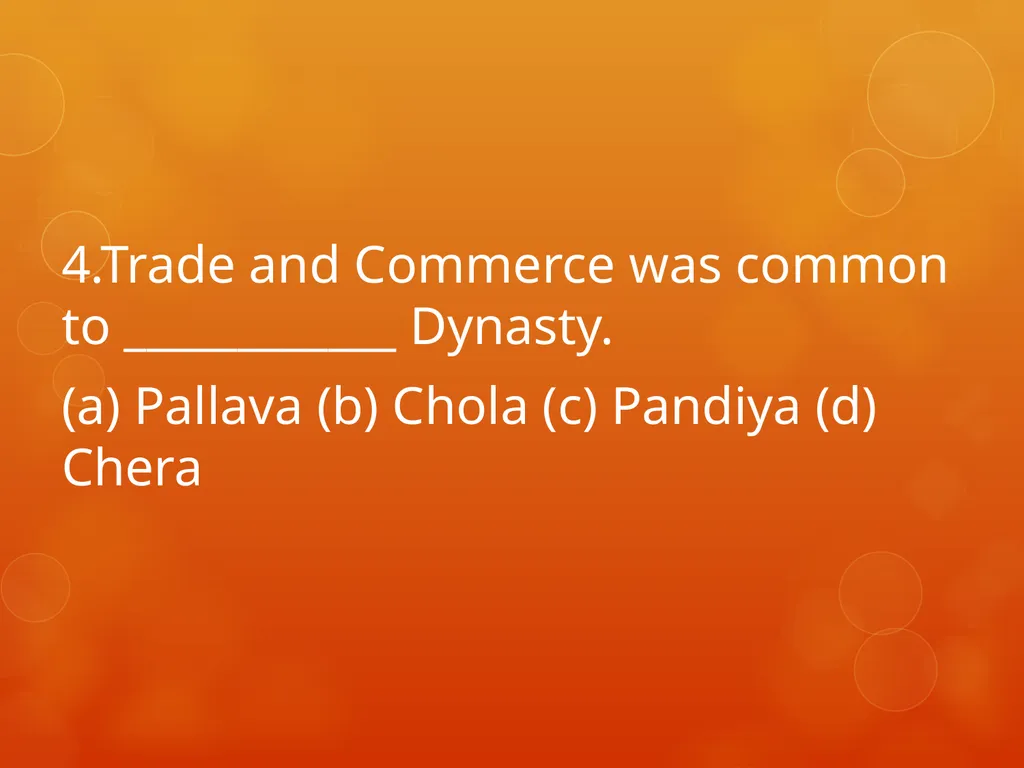
05
4.Trade and Commerce was common to ____________ Dynasty.
(a) Pallava (b) Chola (c) Pandiya (d) Chera<br>
(a) Pallava (b) Chola (c) Pandiya (d) Chera<br>
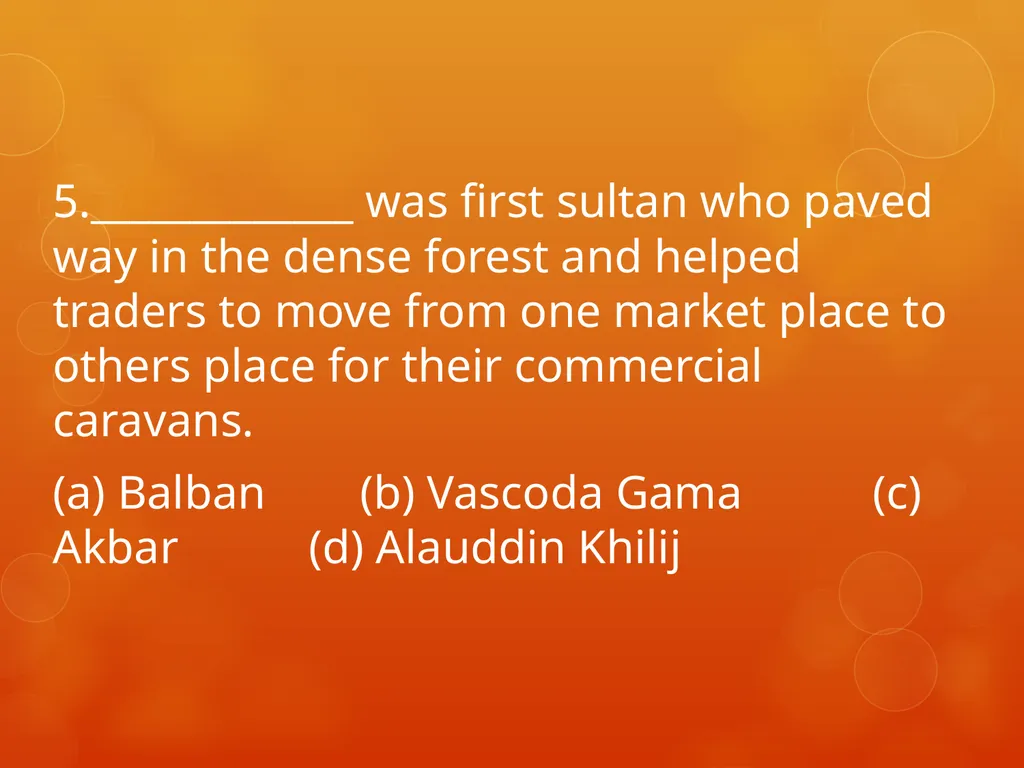
06
5._____________ was first sultan who paved way in the dense forest and helped traders to move from one market place to others place for their commercial caravans.
(a) Balban (b) Vascoda Gama (c) Akbar (d) Alauddin Khilij<br>
(a) Balban (b) Vascoda Gama (c) Akbar (d) Alauddin Khilij<br>
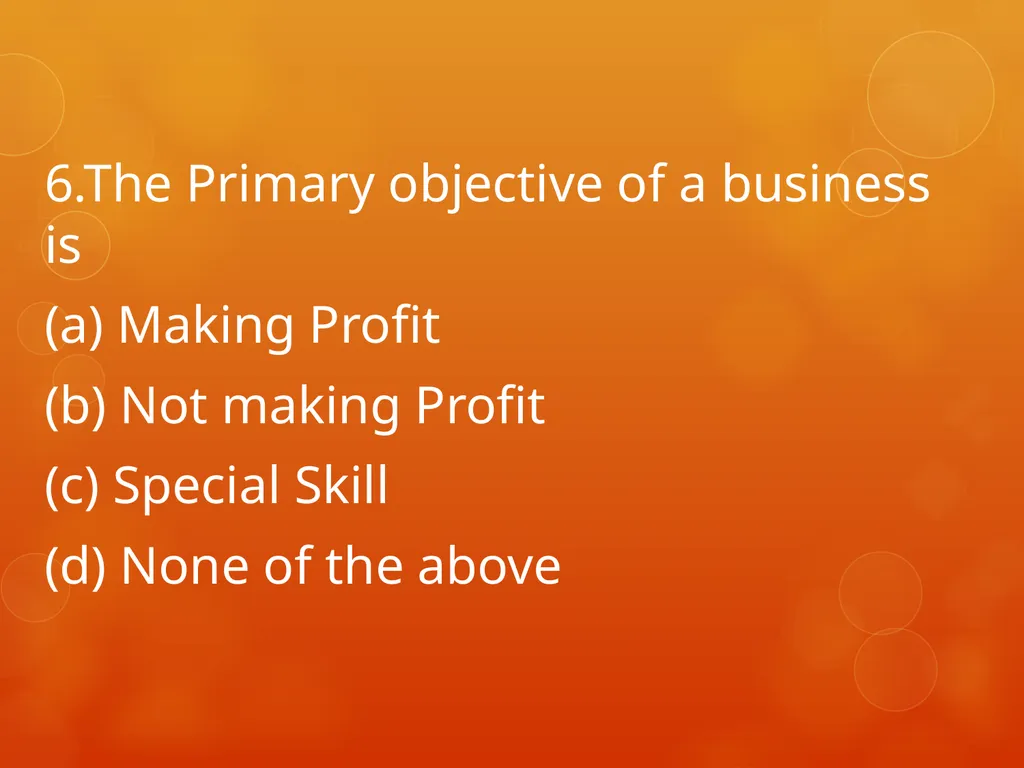
07
6.The Primary objective of a business is
(a) Making Profit
(b) Not making Profit
(c) Special Skill
(d) None of the above<br>
(a) Making Profit
(b) Not making Profit
(c) Special Skill
(d) None of the above<br>
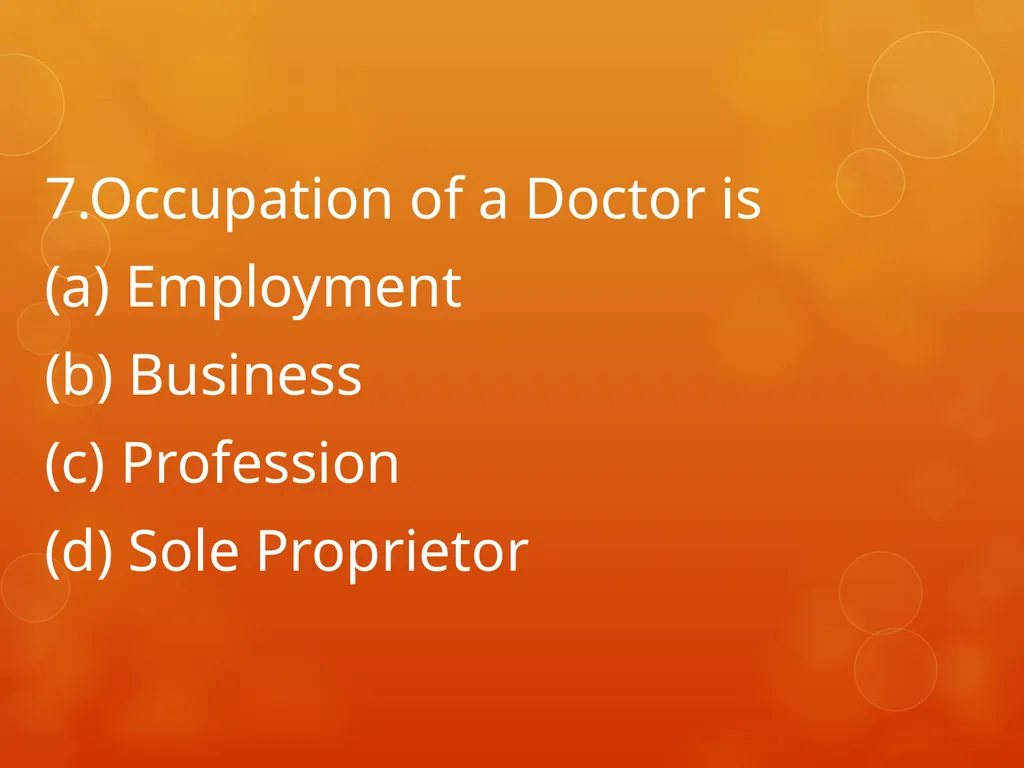
08
7.Occupation of a Doctor is
(a) Employment
(b) Business
(c) Profession
(d) Sole Proprietor<br>
(a) Employment
(b) Business
(c) Profession
(d) Sole Proprietor<br>
09
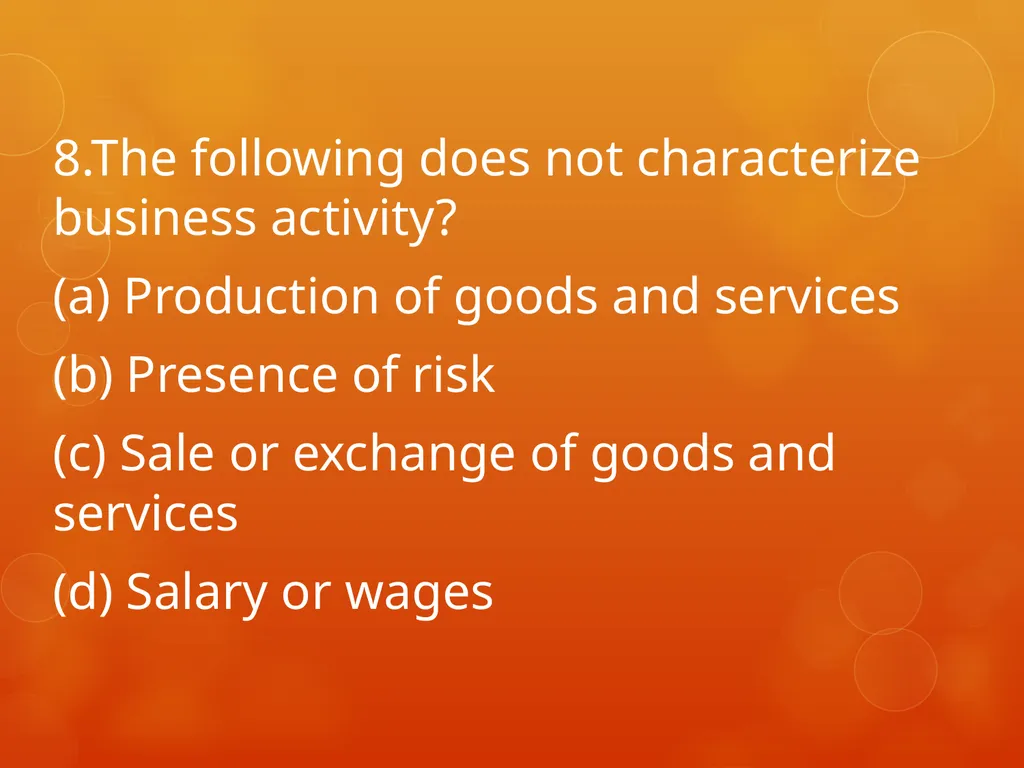
8.The following does not characterize business activity?
(a) Production of goods and services
(b) Presence of risk
(c) Sale or exchange of goods and services
(d) Salary or wages<br>
(a) Production of goods and services
(b) Presence of risk
(c) Sale or exchange of goods and services
(d) Salary or wages<br>
10
9.Activities undertaken out of love and affection or with social service motive are termed as :
(a) Economic activities
(b) Monetary activities
(c) Non-Economic activities
(d) Financial Activities<br>
(a) Economic activities
(b) Monetary activities
(c) Non-Economic activities
(d) Financial Activities<br>
11
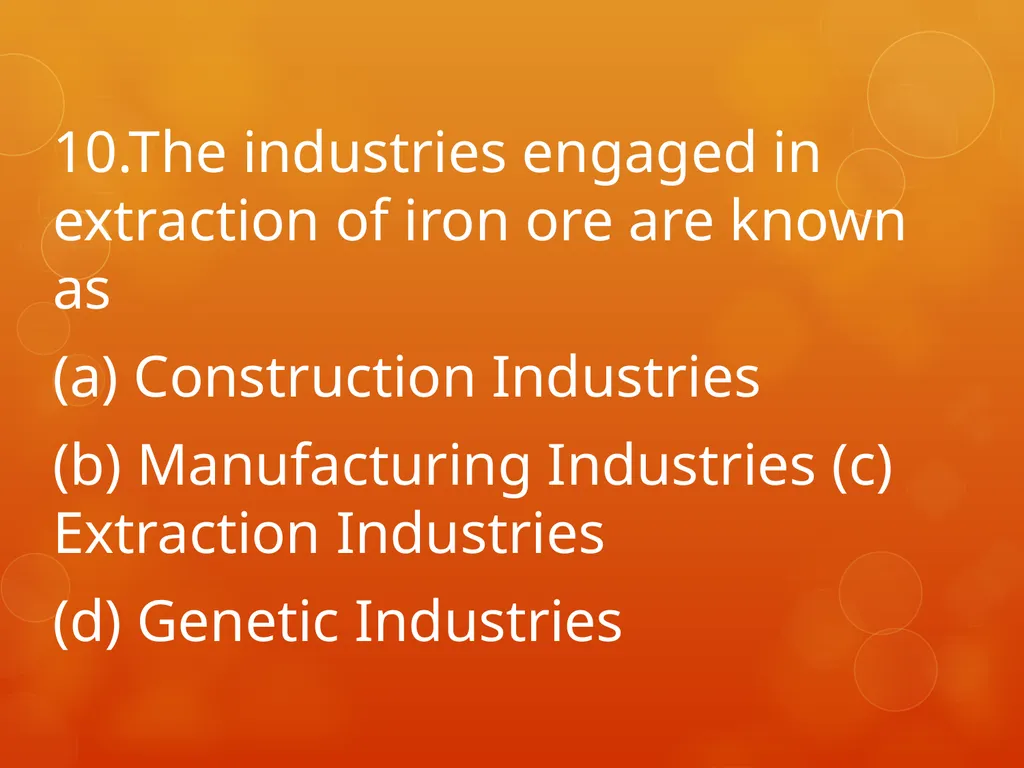
10.The industries engaged in extraction of iron ore are known as
(a) Construction Industries
(b) Manufacturing Industries (c) Extraction Industries
(d) Genetic Industries<br>
(a) Construction Industries
(b) Manufacturing Industries (c) Extraction Industries
(d) Genetic Industries<br>
12
11.Auxiliaries to trade is also called as
(a) Trade
(b) Advertisement
(c) Warehousing
(d) Aids to Trade<br>
(a) Trade
(b) Advertisement
(c) Warehousing
(d) Aids to Trade<br>
13
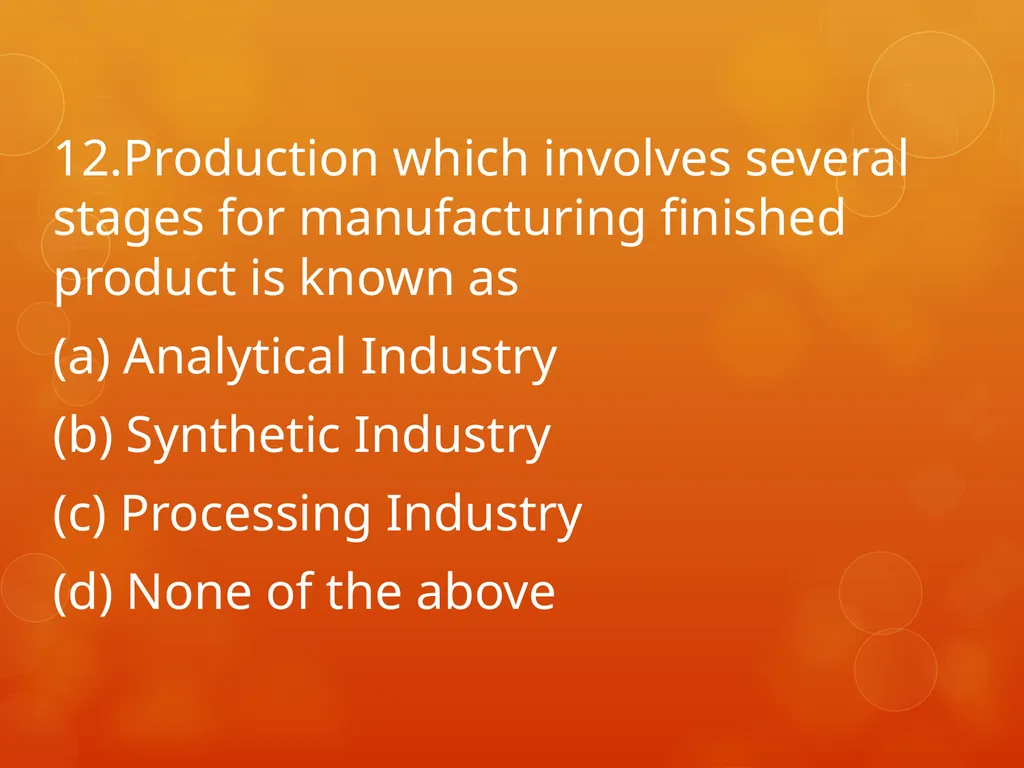
12.Production which involves several stages for manufacturing finished product is known as
(a) Analytical Industry
(b) Synthetic Industry
(c) Processing Industry
(d) None of the above<br>
(a) Analytical Industry
(b) Synthetic Industry
(c) Processing Industry
(d) None of the above<br>
14
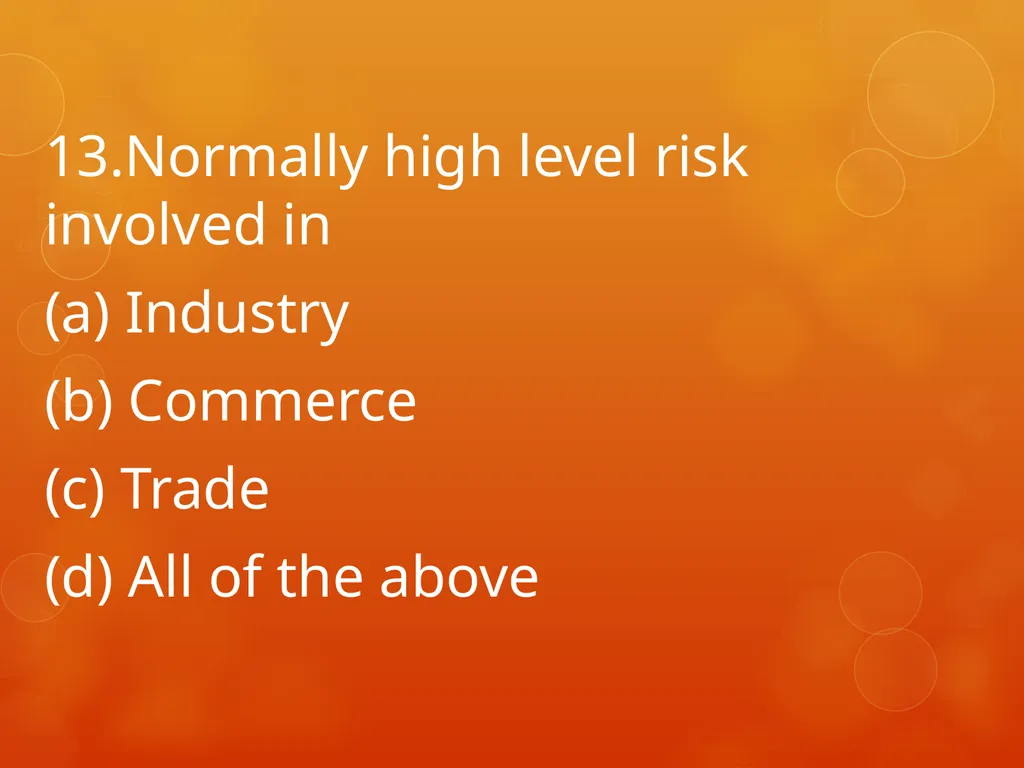
13.Normally high level risk involved in
(a) Industry
(b) Commerce
(c) Trade
(d) All of the above<br>
(a) Industry
(b) Commerce
(c) Trade
(d) All of the above<br>
15
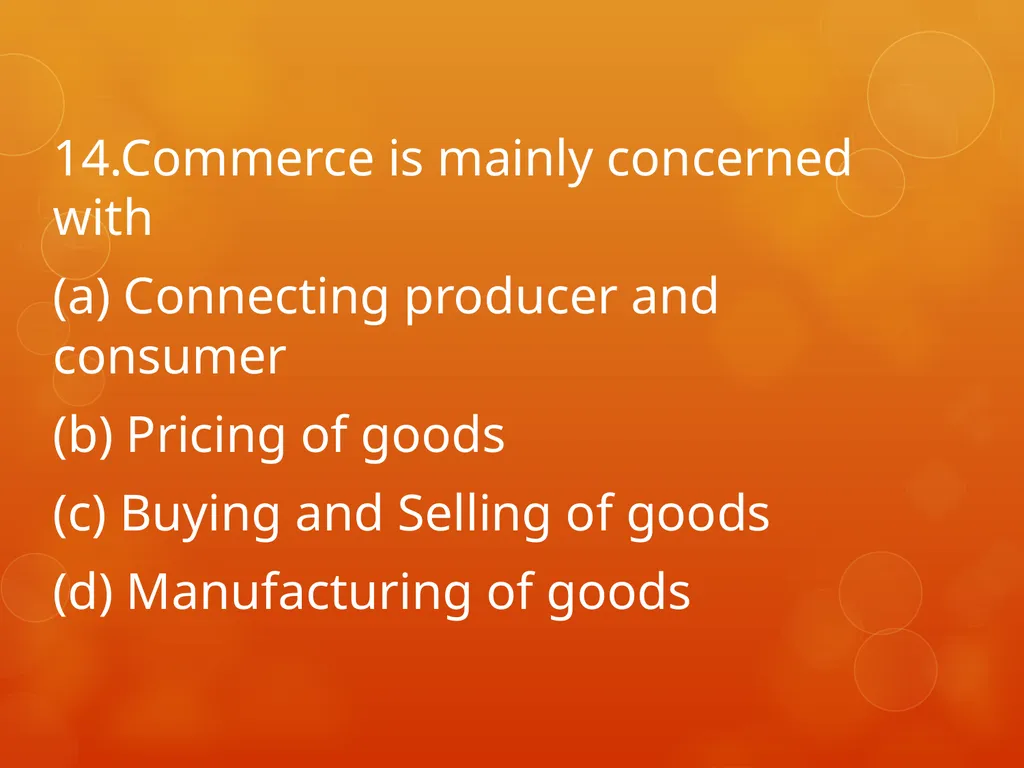
14.Commerce is mainly concerned with
(a) Connecting producer and consumer
(b) Pricing of goods
(c) Buying and Selling of goods
(d) Manufacturing of goods<br>
(a) Connecting producer and consumer
(b) Pricing of goods
(c) Buying and Selling of goods
(d) Manufacturing of goods<br>
16
15.Which is the oldest form of Business organisation?
(a) Sole Proprietorship
(b) Partnership
(c) Co-operative Society
(d) Company<br>
(a) Sole Proprietorship
(b) Partnership
(c) Co-operative Society
(d) Company<br>
17
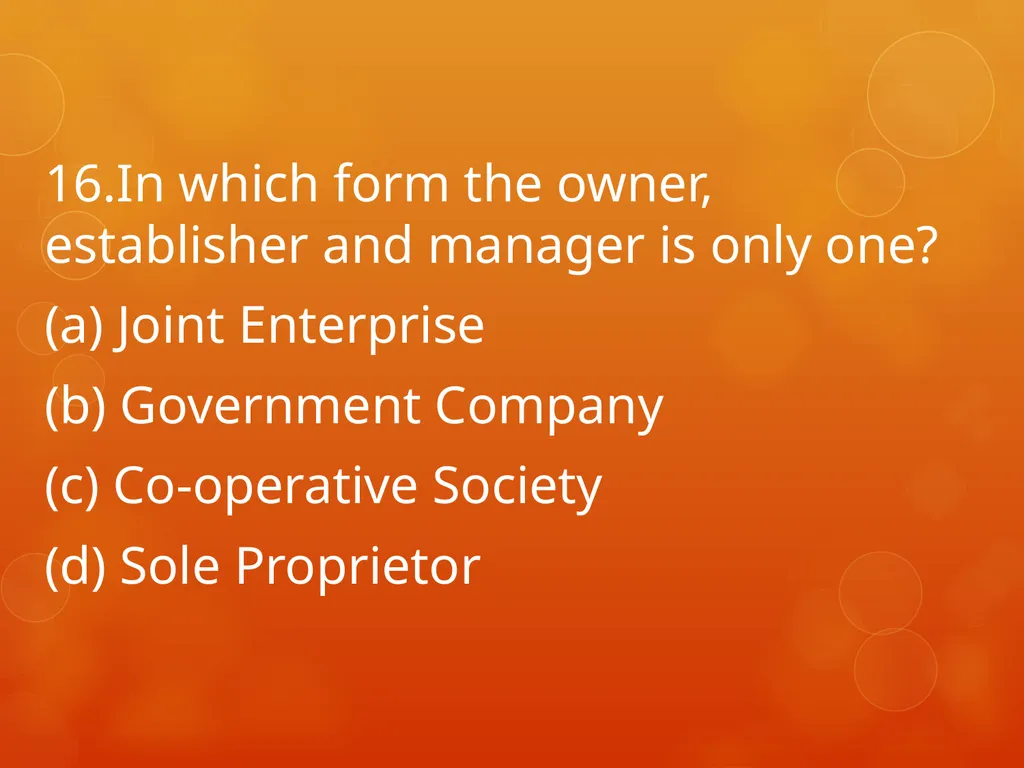
16.In which form the owner, establisher and manager is only one?
(a) Joint Enterprise
(b) Government Company
(c) Co-operative Society
(d) Sole Proprietor<br>
(a) Joint Enterprise
(b) Government Company
(c) Co-operative Society
(d) Sole Proprietor<br>
18
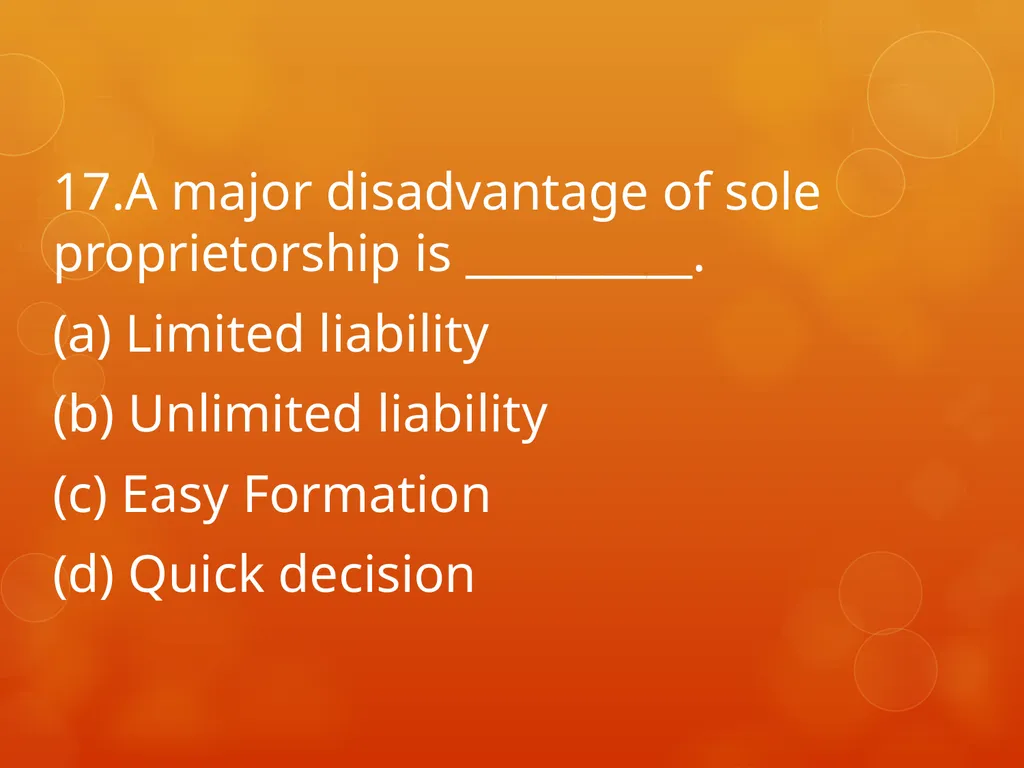
17.A major disadvantage of sole proprietorship is __________.
(a) Limited liability
(b) Unlimited liability
(c) Easy Formation
(d) Quick decision<br>
(a) Limited liability
(b) Unlimited liability
(c) Easy Formation
(d) Quick decision<br>
19
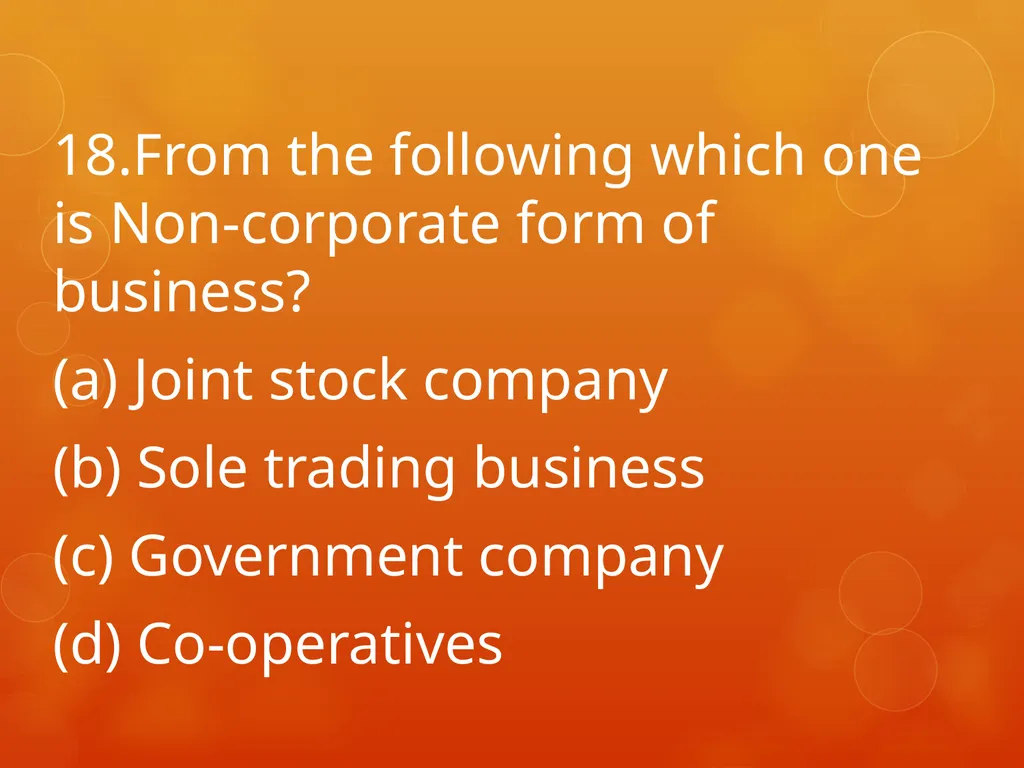
18.From the following which one is Non-corporate form of business?
(a) Joint stock company
(b) Sole trading business
(c) Government company
(d) Co-operatives<br>
(a) Joint stock company
(b) Sole trading business
(c) Government company
(d) Co-operatives<br>
20
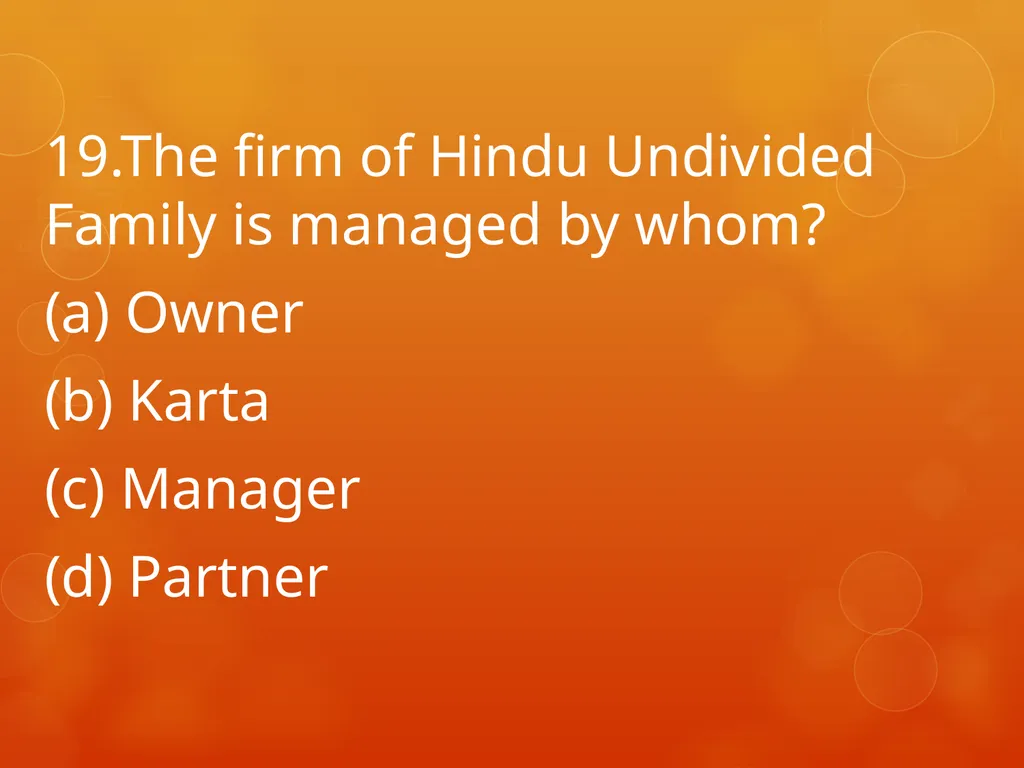
19.The firm of Hindu Undivided Family is managed by whom?
(a) Owner
(b) Karta
(c) Manager
(d) Partner<br>
(a) Owner
(b) Karta
(c) Manager
(d) Partner<br>
21
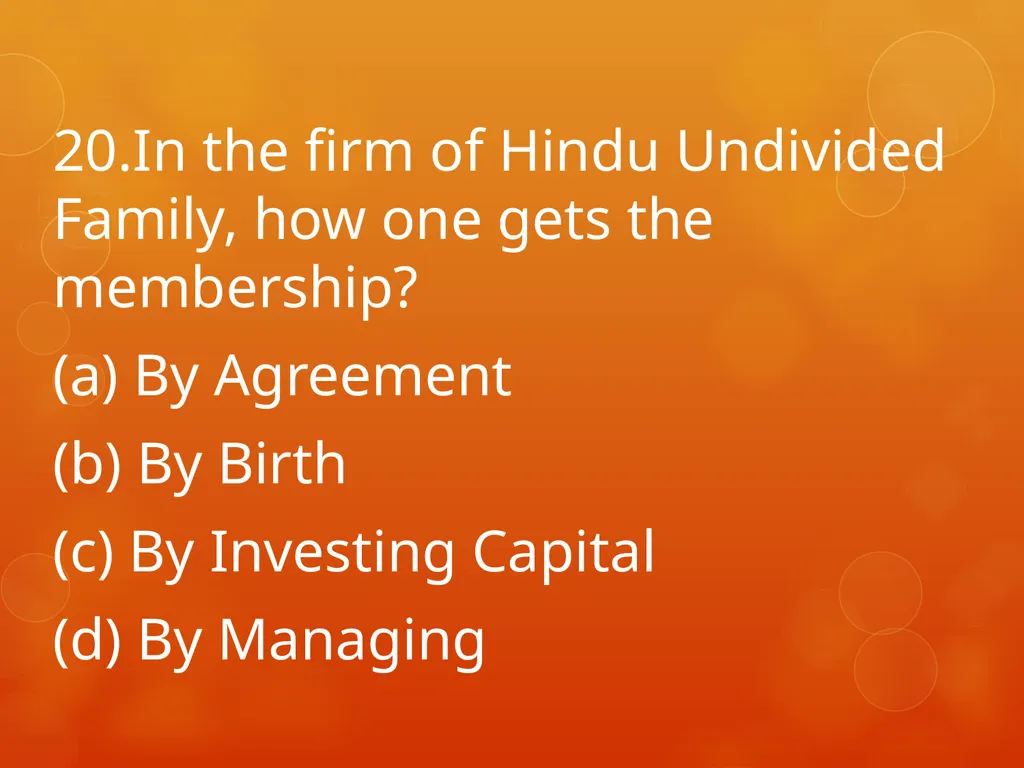
20.In the firm of Hindu Undivided Family, how one gets the membership?
(a) By Agreement
(b) By Birth
(c) By Investing Capital
(d) By Managing<br>
(a) By Agreement
(b) By Birth
(c) By Investing Capital
(d) By Managing<br>
22
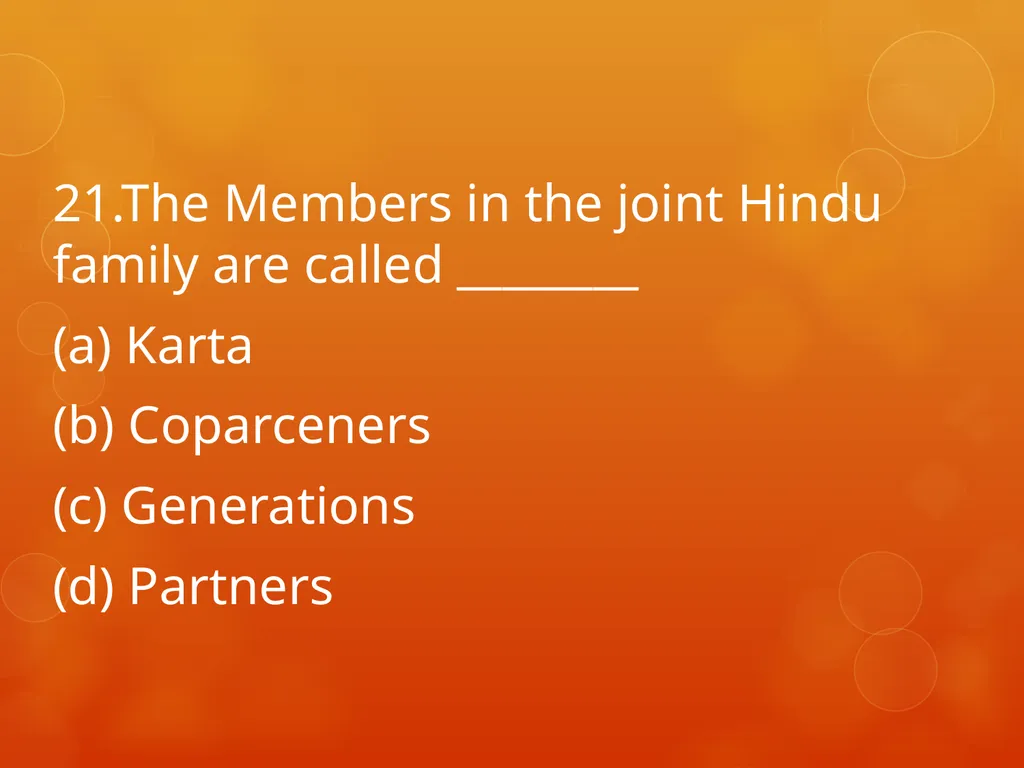
21.The Members in the joint Hindu family are called ________
(a) Karta
(b) Coparceners
(c) Generations
(d) Partners<br>
(a) Karta
(b) Coparceners
(c) Generations
(d) Partners<br>
23
‘22.Only the male members in the family get the right of inheritance by birth' as ________
(a) Hindu law
(b) Mitakshara Law
(c) Dayabhaga law
(d) None of these<br>
(a) Hindu law
(b) Mitakshara Law
(c) Dayabhaga law
(d) None of these<br>
24
23.A partnership is formed by ___________
(a) agreement
(b) relationship among persons (c) the direction of government (d) friendship<br>
(a) agreement
(b) relationship among persons (c) the direction of government (d) friendship<br>
25
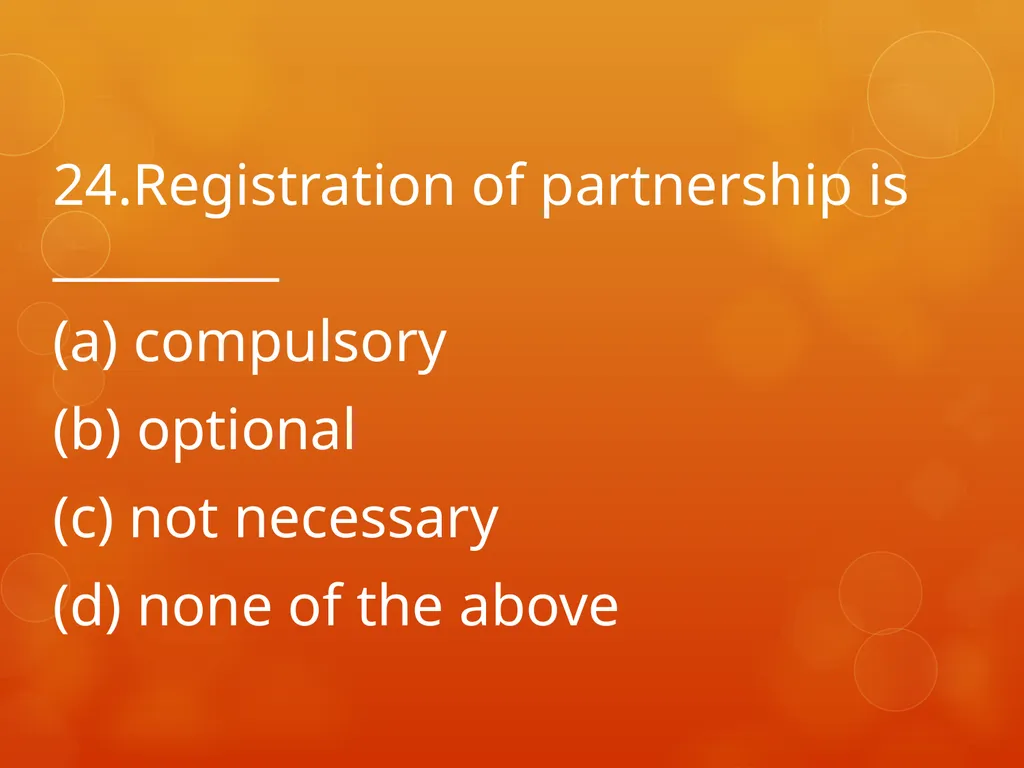
24.Registration of partnership is _________
(a) compulsory
(b) optional
(c) not necessary
(d) none of the above<br>
(a) compulsory
(b) optional
(c) not necessary
(d) none of the above<br>
26
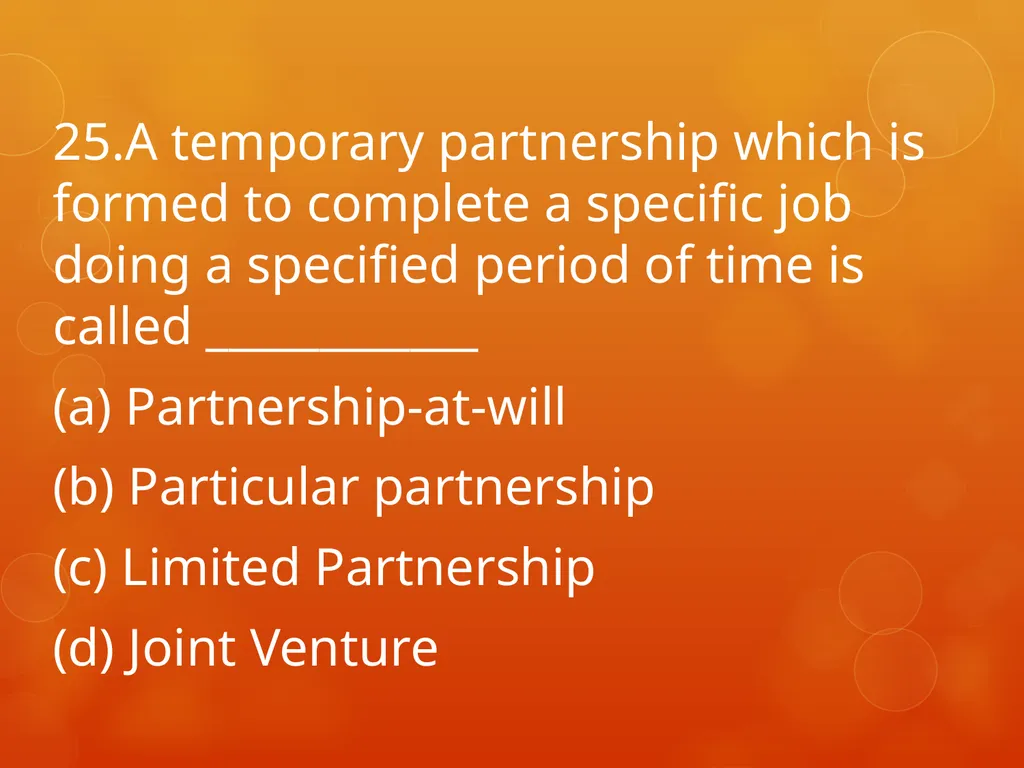
25.A temporary partnership which is formed to complete a specific job doing a specified period of time is called ____________
(a) Partnership-at-will
(b) Particular partnership
(c) Limited Partnership
(d) Joint Venture<br>
(a) Partnership-at-will
(b) Particular partnership
(c) Limited Partnership
(d) Joint Venture<br>
27
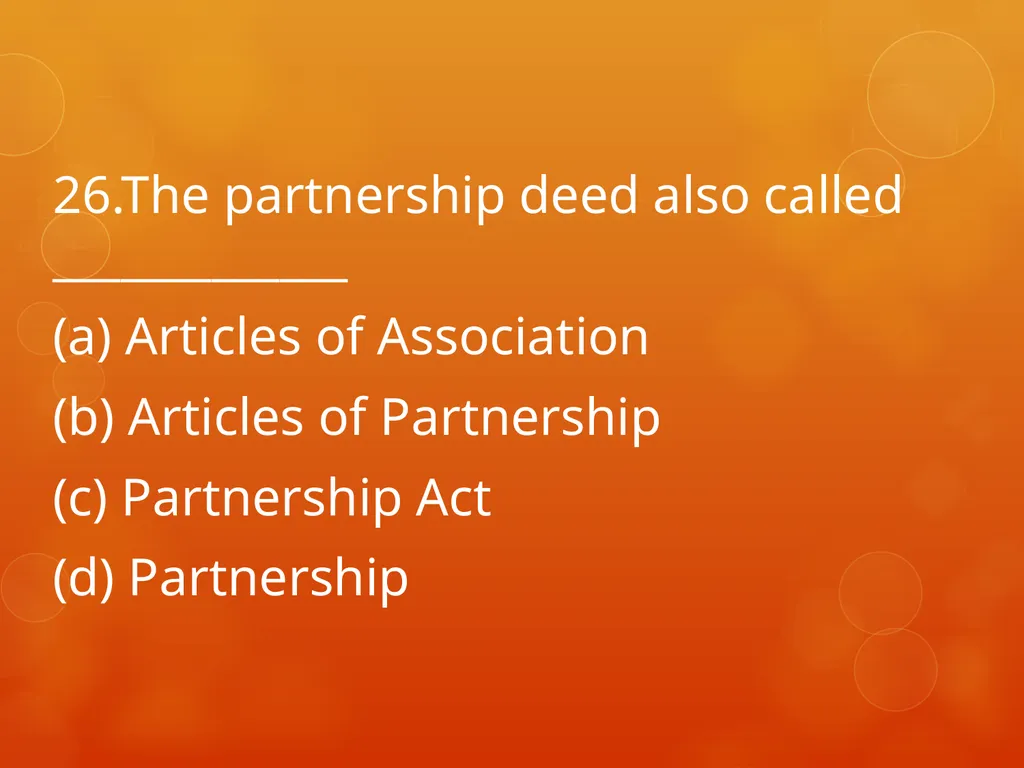
26.The partnership deed also called _____________
(a) Articles of Association
(b) Articles of Partnership
(c) Partnership Act
(d) Partnership<br>
(a) Articles of Association
(b) Articles of Partnership
(c) Partnership Act
(d) Partnership<br>
28
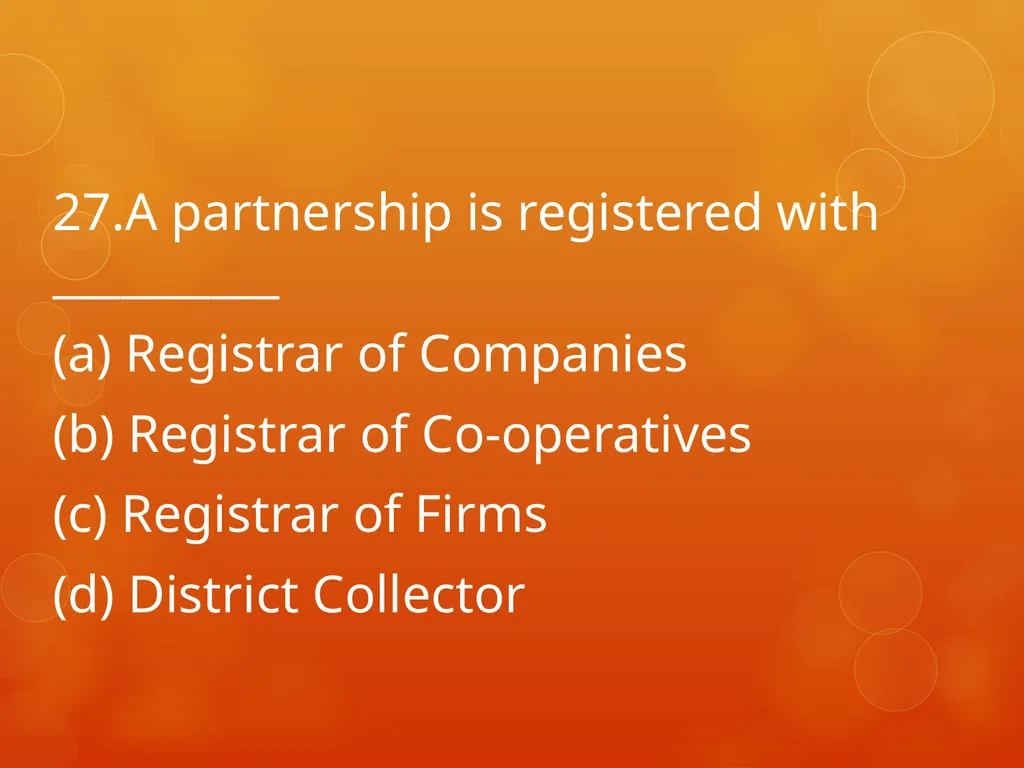
27.A partnership is registered with __________
(a) Registrar of Companies
(b) Registrar of Co-operatives
(c) Registrar of Firms
(d) District Collector<br>
(a) Registrar of Companies
(b) Registrar of Co-operatives
(c) Registrar of Firms
(d) District Collector<br>
29
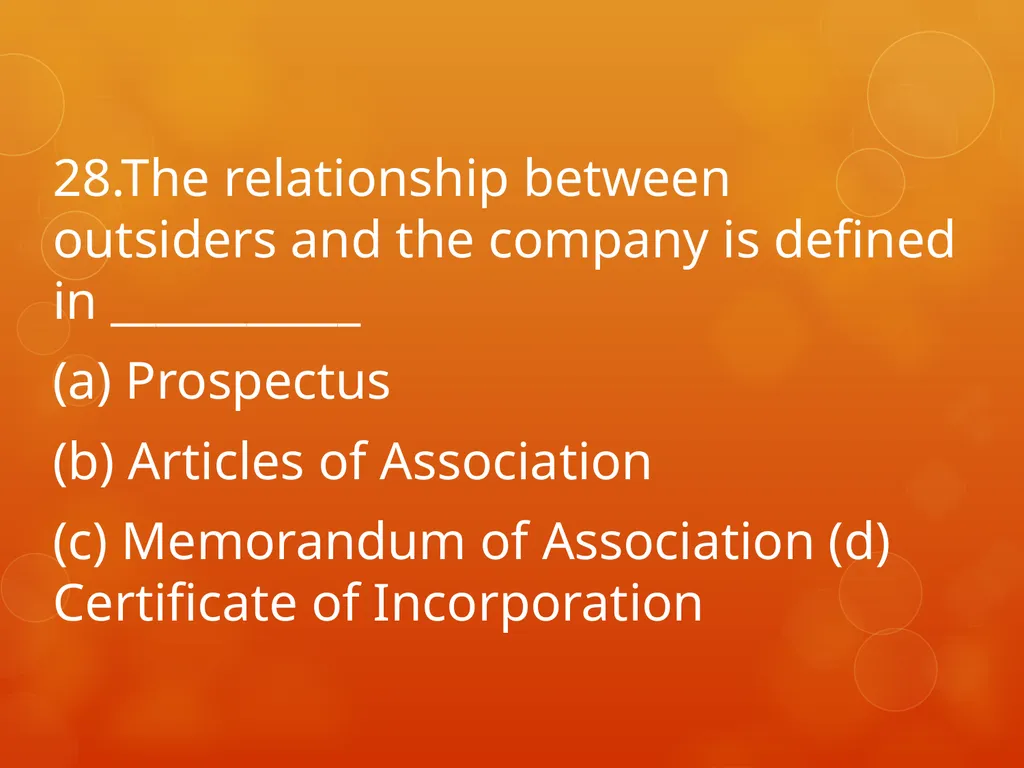
28.The relationship between outsiders and the company is defined in ___________
(a) Prospectus
(b) Articles of Association
(c) Memorandum of Association (d) Certificate of Incorporation<br>
(a) Prospectus
(b) Articles of Association
(c) Memorandum of Association (d) Certificate of Incorporation<br>
30
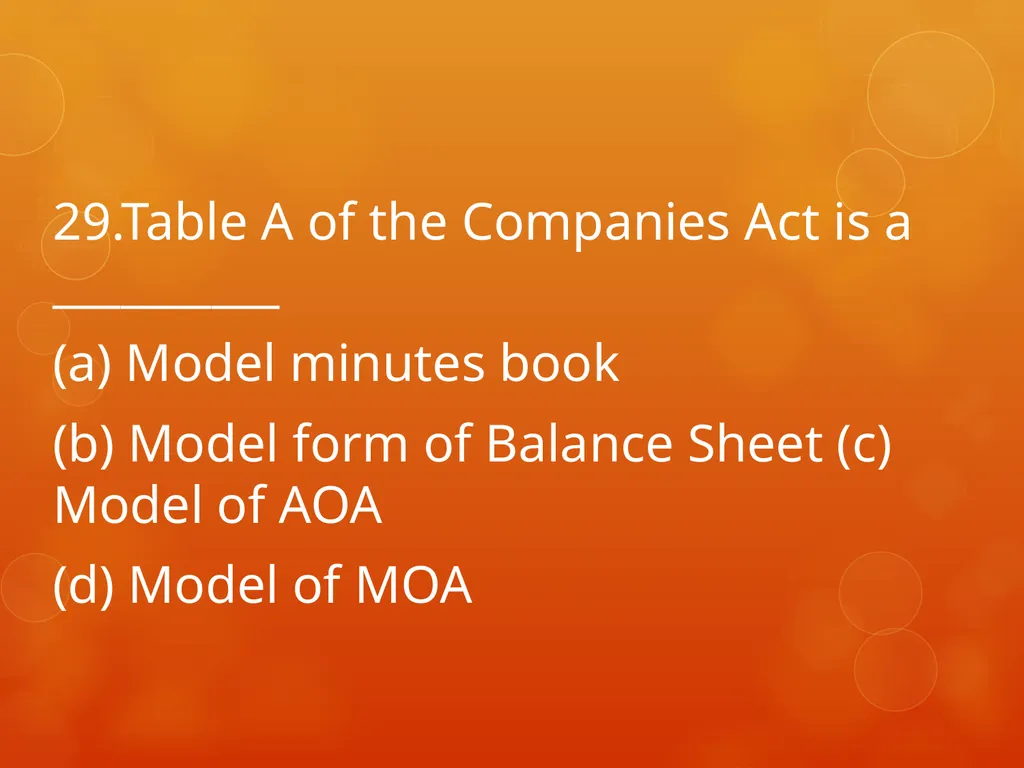
29.Table A of the Companies Act is a __________
(a) Model minutes book
(b) Model form of Balance Sheet (c) Model of AOA
(d) Model of MOA<br>
(a) Model minutes book
(b) Model form of Balance Sheet (c) Model of AOA
(d) Model of MOA<br>
31
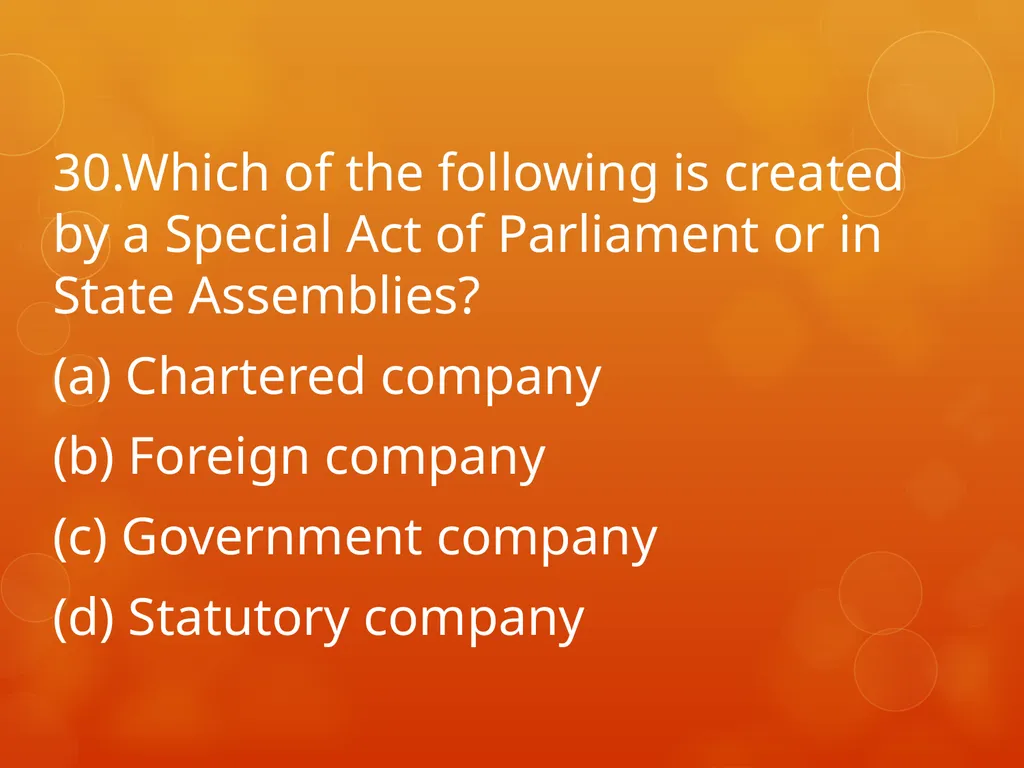
30.Which of the following is created by a Special Act of Parliament or in State Assemblies?
(a) Chartered company
(b) Foreign company
(c) Government company
(d) Statutory company<br>
(a) Chartered company
(b) Foreign company
(c) Government company
(d) Statutory company<br>
32
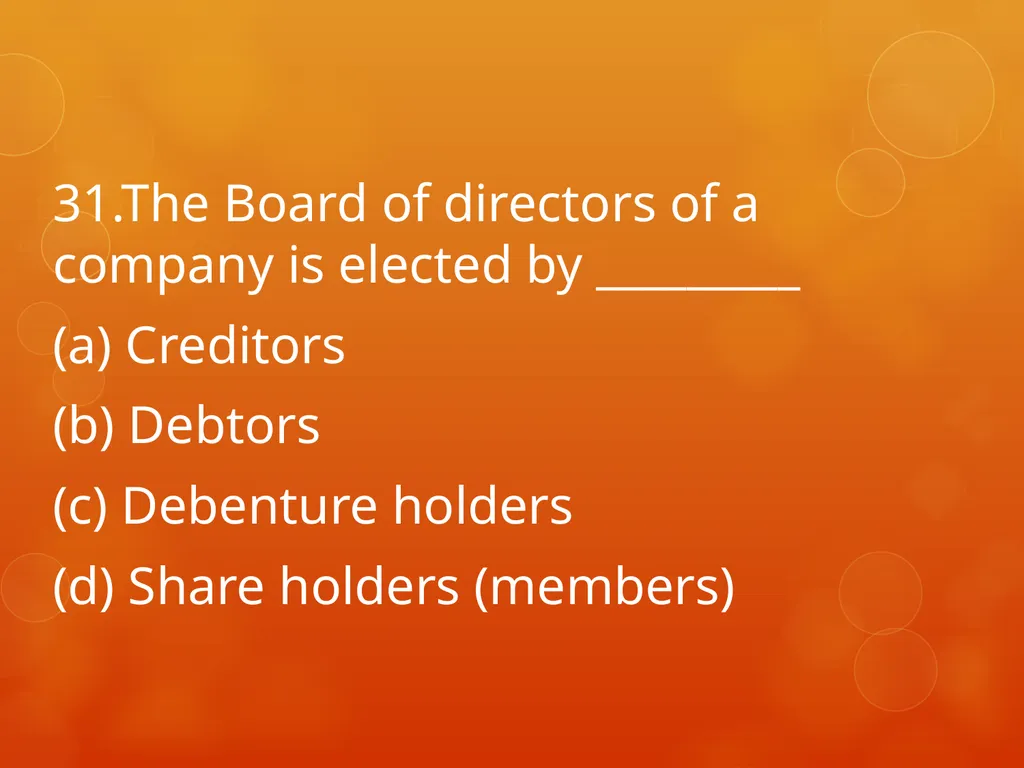
31.The Board of directors of a company is elected by _________
(a) Creditors
(b) Debtors
(c) Debenture holders
(d) Share holders (members)<br>
(a) Creditors
(b) Debtors
(c) Debenture holders
(d) Share holders (members)<br>
33
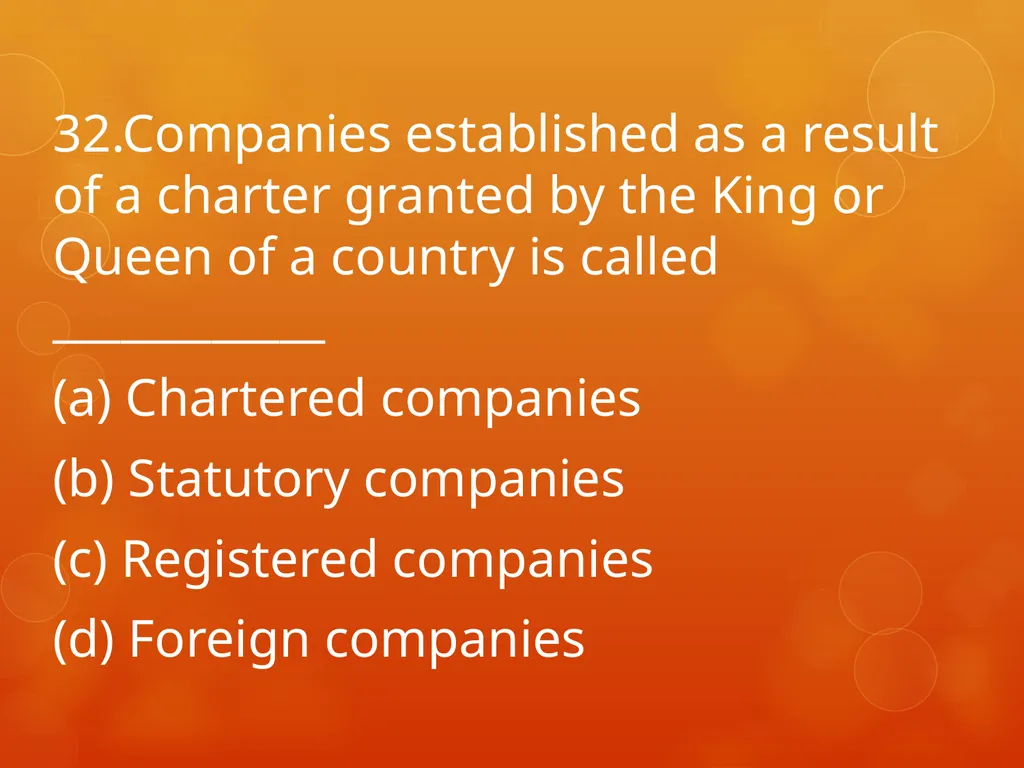
32.Companies established as a result of a charter granted by the King or Queen of a country is called ____________
(a) Chartered companies
(b) Statutory companies
(c) Registered companies
(d) Foreign companies<br>
(a) Chartered companies
(b) Statutory companies
(c) Registered companies
(d) Foreign companies<br>
34
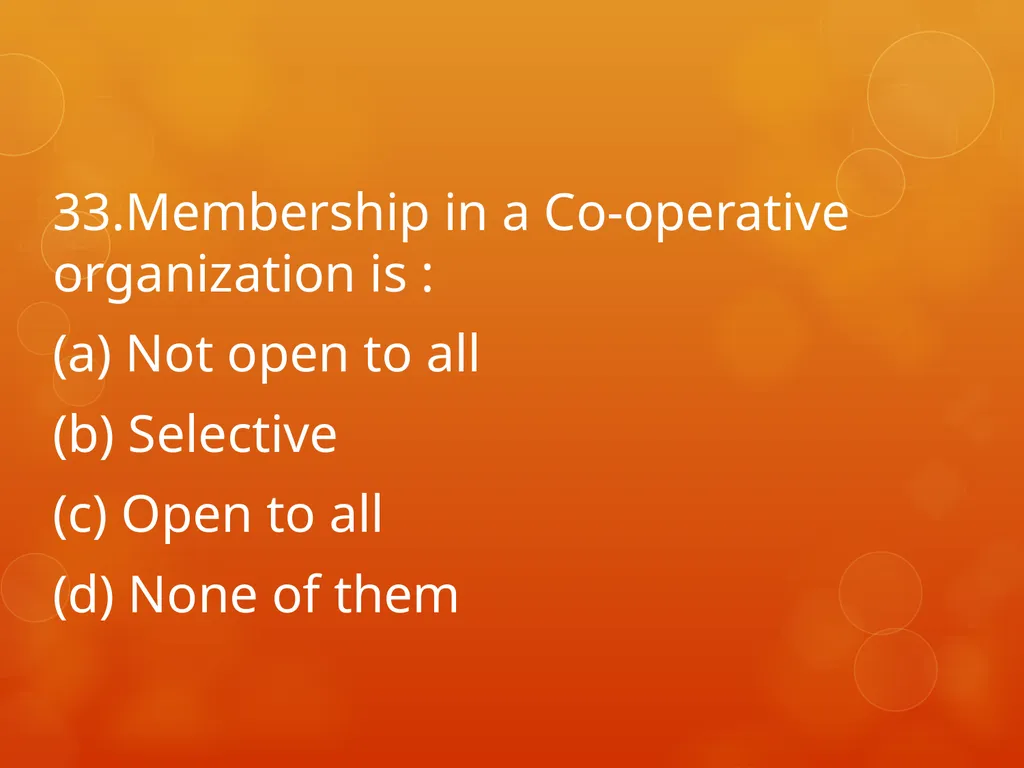
33.Membership in a Co-operative organization is :
(a) Not open to all
(b) Selective
(c) Open to all
(d) None of them<br>
(a) Not open to all
(b) Selective
(c) Open to all
(d) None of them<br>
35
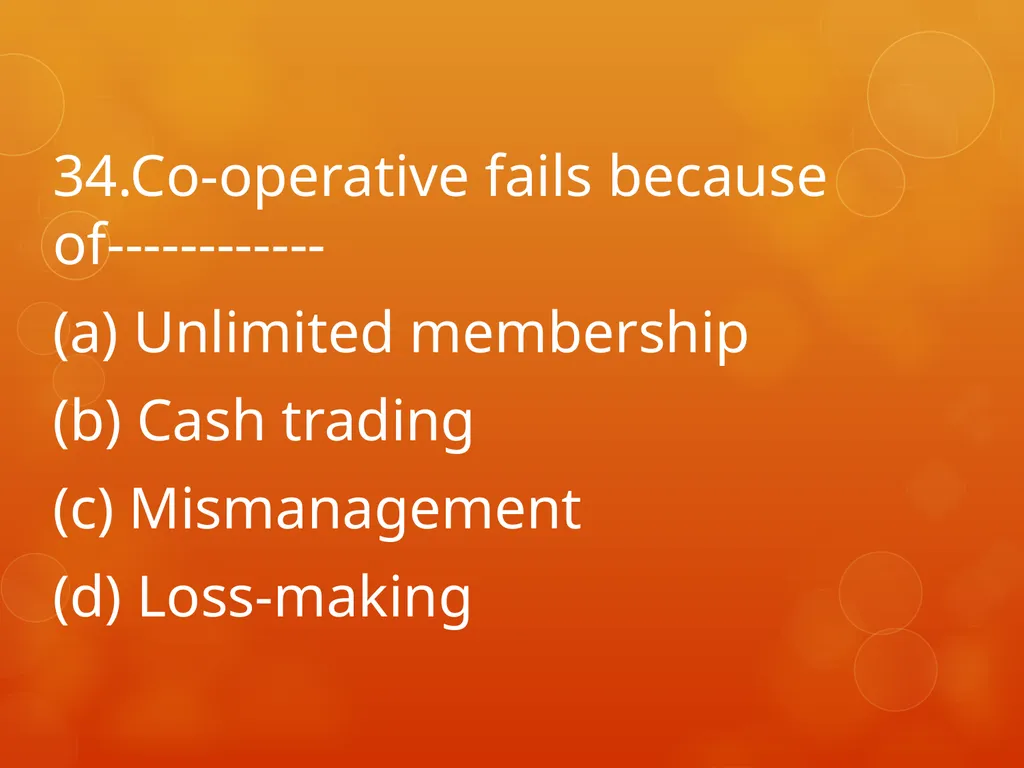
34.Co-operative fails because of------------
(a) Unlimited membership
(b) Cash trading
(c) Mismanagement
(d) Loss-making<br>
(a) Unlimited membership
(b) Cash trading
(c) Mismanagement
(d) Loss-making<br>
36
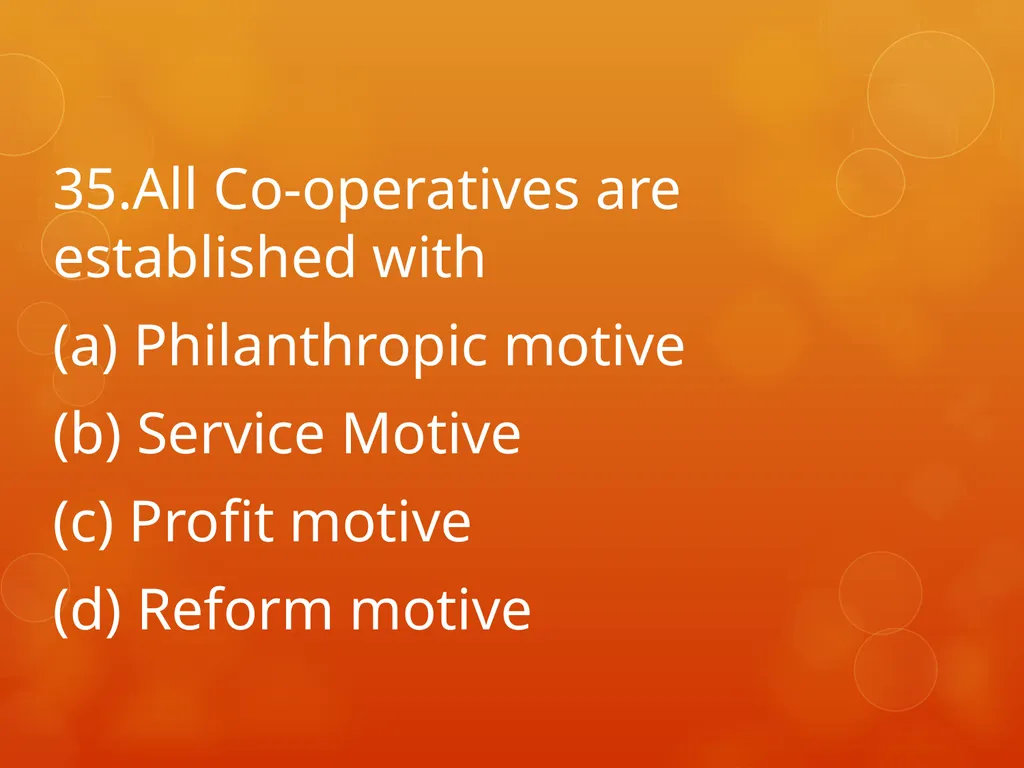
35.All Co-operatives are established with
(a) Philanthropic motive
(b) Service Motive
(c) Profit motive
(d) Reform motive<br>
(a) Philanthropic motive
(b) Service Motive
(c) Profit motive
(d) Reform motive<br>
37
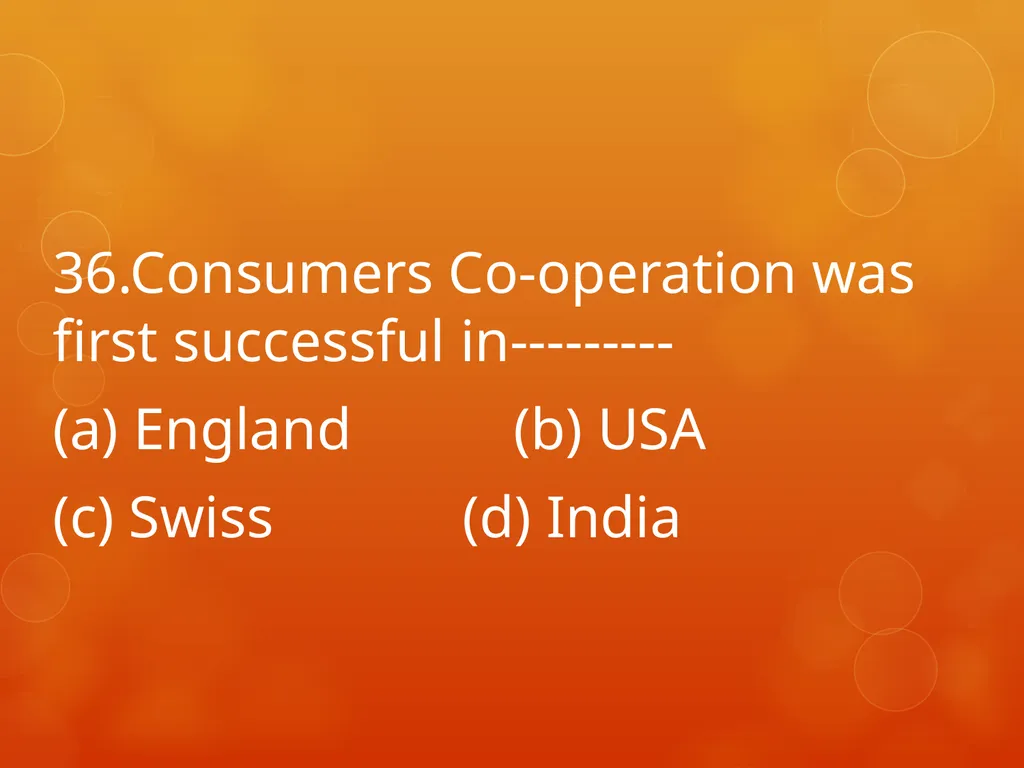
36.Consumers Co-operation was first successful in---------
(a) England (b) USA
(c) Swiss (d) India<br>
(a) England (b) USA
(c) Swiss (d) India<br>
38
37.Rochdale Society of equitable pioneers was started by--------------
(a) Robert Owen
(b) H.C. Calvert
(c) Talmaki
(d) Lambert<br>
(a) Robert Owen
(b) H.C. Calvert
(c) Talmaki
(d) Lambert<br>
39
38.A Multinational Corporation can be defined as a firm which
(a) is beyond the control of any government
(b) is one of the top 200 firms in the world
(c) owns companies in more than one country
(d) All the above<br>
(a) is beyond the control of any government
(b) is one of the top 200 firms in the world
(c) owns companies in more than one country
(d) All the above<br>
40
39.Centralised control in MNC's implies control exercised by
(a) Branches
(b) Subsidiaries
(c) Headquarters
(d) Parliament<br>
(a) Branches
(b) Subsidiaries
(c) Headquarters
(d) Parliament<br>
41
40.Enterprises operating in several countries but managed from one country is termed as ----------
(a) Government company
(b) Multinational company
(c) Private company
(d) Joint Venture<br>
(a) Government company
(b) Multinational company
(c) Private company
(d) Joint Venture<br>
42
41.Dispersal of decision making power to branches/ affiliates/subsidiaries by head office represent ------
(a) Centralisation
(b) Decentralisation
(c) Power
(d) Integration<br>
(a) Centralisation
(b) Decentralisation
(c) Power
(d) Integration<br>
43
42.Coca-Cola company is an example of ----------
(a) MNC
(b) Government company
(c) Joint Venture
(d) Public company<br>
(a) MNC
(b) Government company
(c) Joint Venture
(d) Public company<br>
44
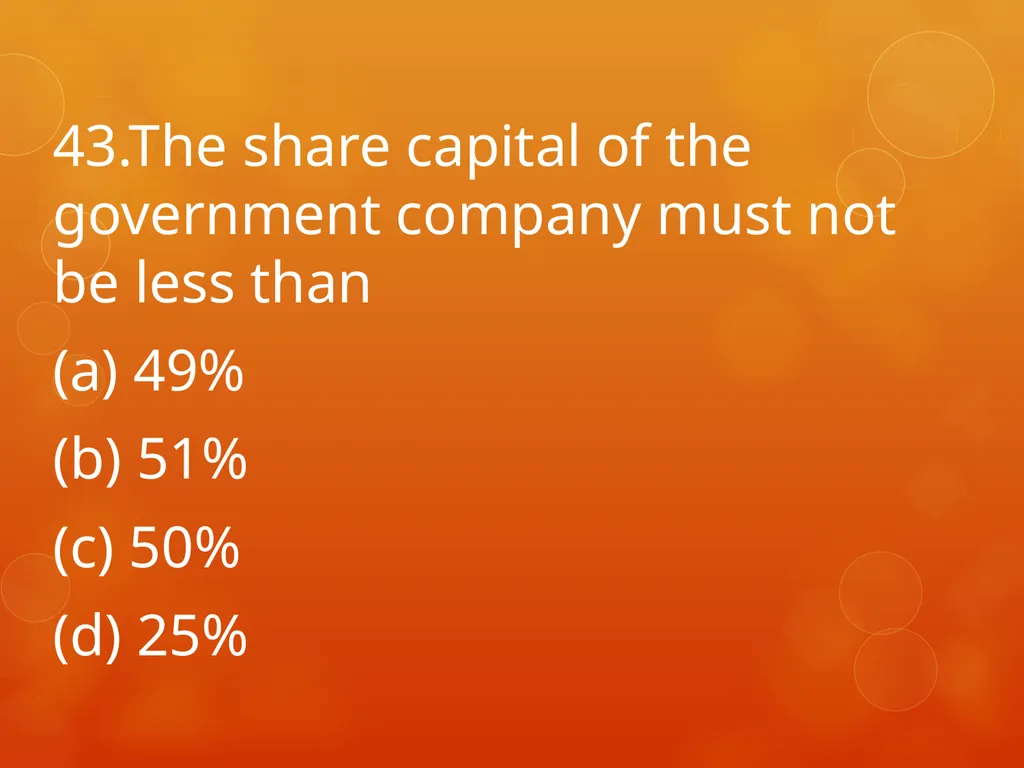
43.The share capital of the government company must not be less than
(a) 49%
(b) 51%
(c) 50%
(d) 25%<br>
(a) 49%
(b) 51%
(c) 50%
(d) 25%<br>
45
44.Airport Authority of India is a public enterprise.Identify the form of organisation
(a) Statutory Corporations
(b) Departmental Undertakings
(c) Multi-National Corporations
(d) State Owned Company<br>
(a) Statutory Corporations
(b) Departmental Undertakings
(c) Multi-National Corporations
(d) State Owned Company<br>
46
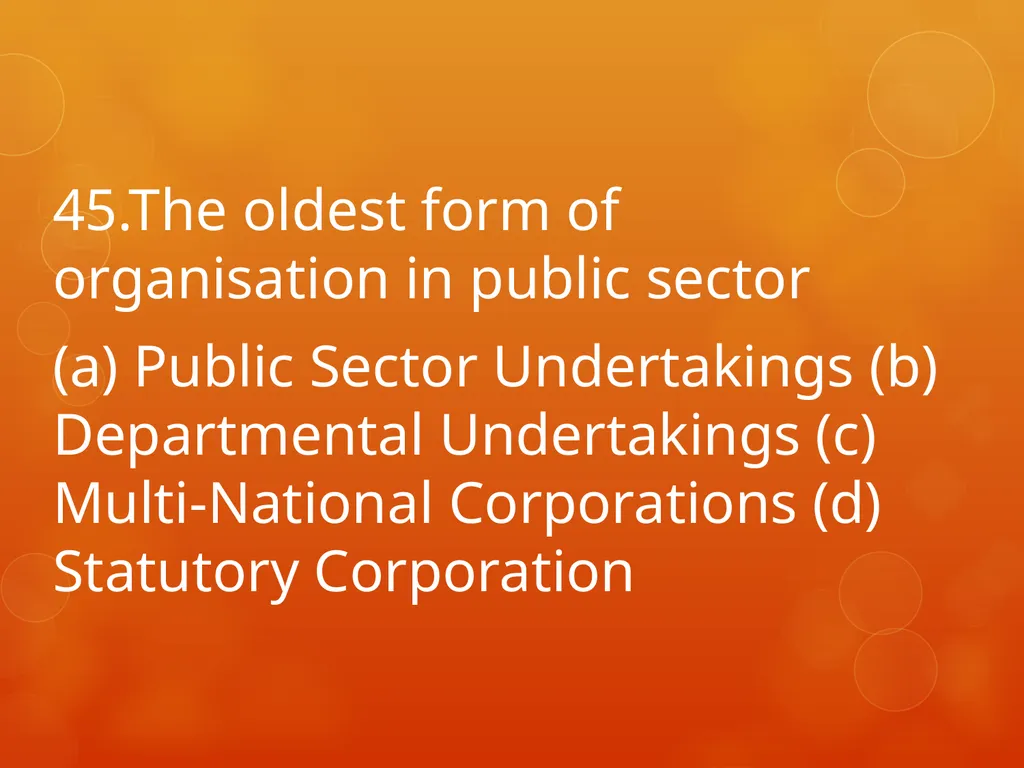
45.The oldest form of organisation in public sector
(a) Public Sector Undertakings (b) Departmental Undertakings (c) Multi-National Corporations (d) Statutory Corporation<br>
(a) Public Sector Undertakings (b) Departmental Undertakings (c) Multi-National Corporations (d) Statutory Corporation<br>
47
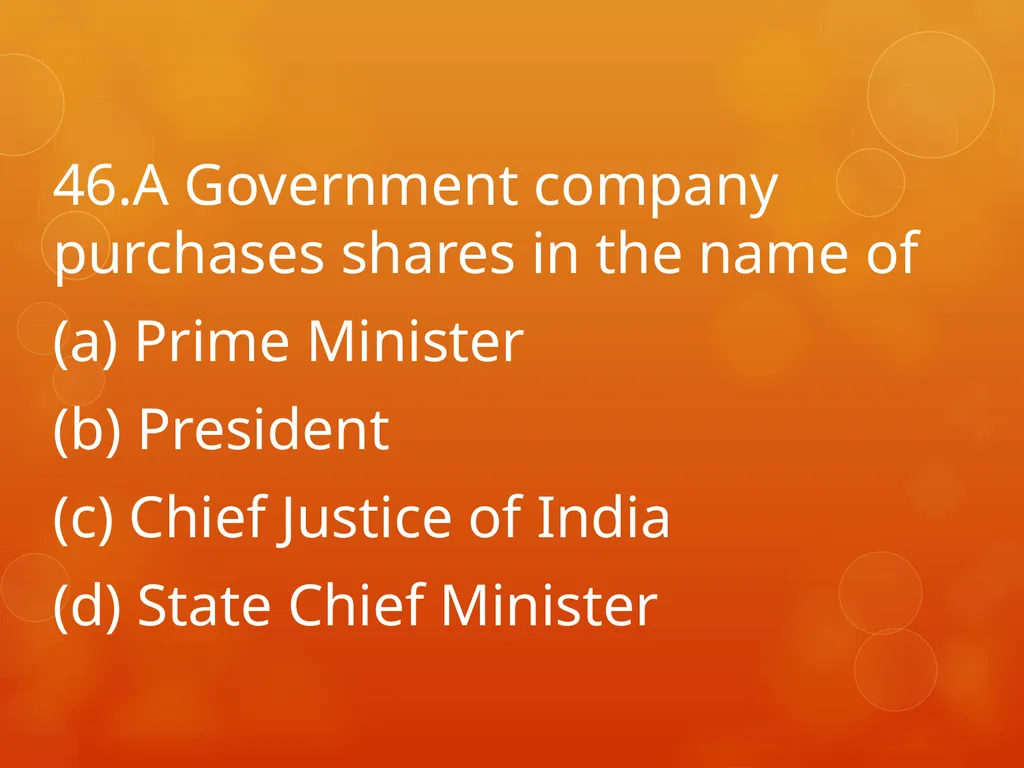
46.A Government company purchases shares in the name of
(a) Prime Minister
(b) President
(c) Chief Justice of India
(d) State Chief Minister<br>
(a) Prime Minister
(b) President
(c) Chief Justice of India
(d) State Chief Minister<br>
48
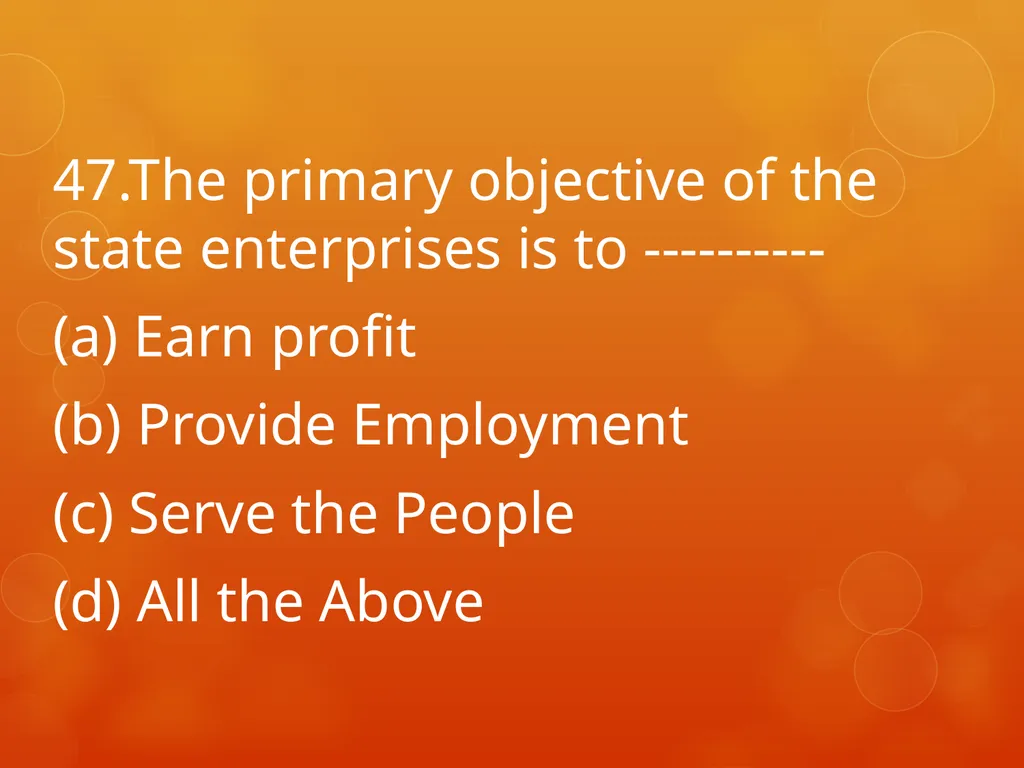
47.The primary objective of the state enterprises is to ----------
(a) Earn profit
(b) Provide Employment
(c) Serve the People
(d) All the Above<br>
(a) Earn profit
(b) Provide Employment
(c) Serve the People
(d) All the Above<br>
49
48.Which bank has the power to issue Bank notes?
(a) Central Bank
(b) Commercial Bank
(c) Co-operative Bank
(d) Foreign Bank<br>
(a) Central Bank
(b) Commercial Bank
(c) Co-operative Bank
(d) Foreign Bank<br>
50
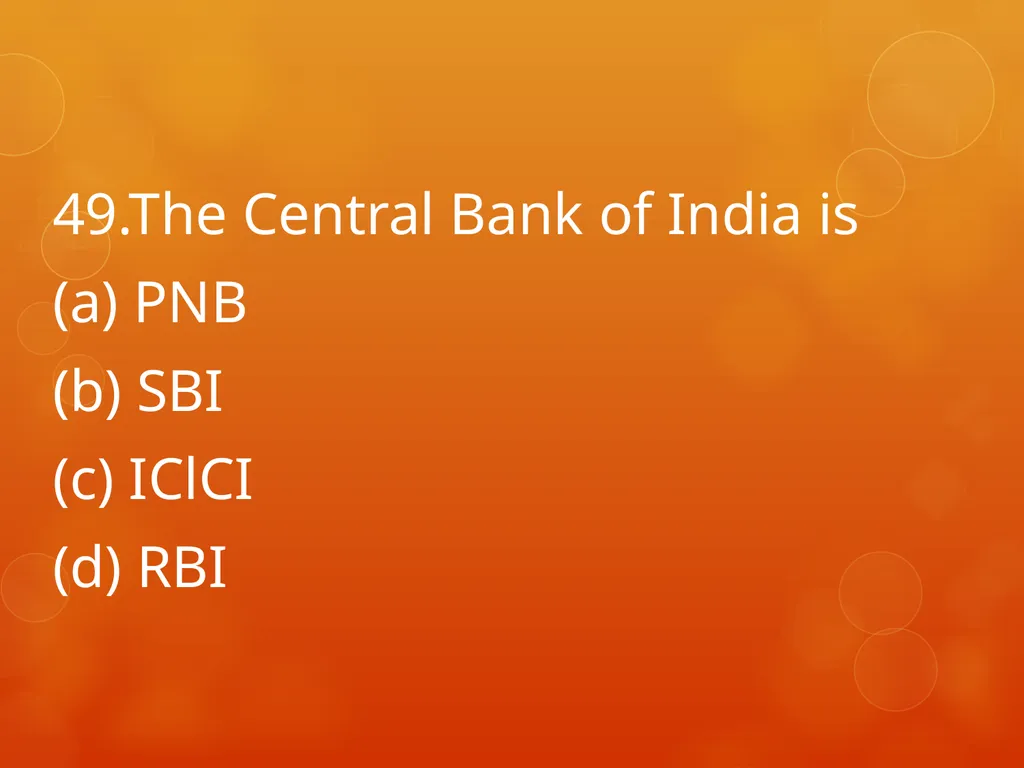
49.The Central Bank of India is
(a) PNB
(b) SBI
(c) IClCI
(d) RBI<br>
(a) PNB
(b) SBI
(c) IClCI
(d) RBI<br>
51
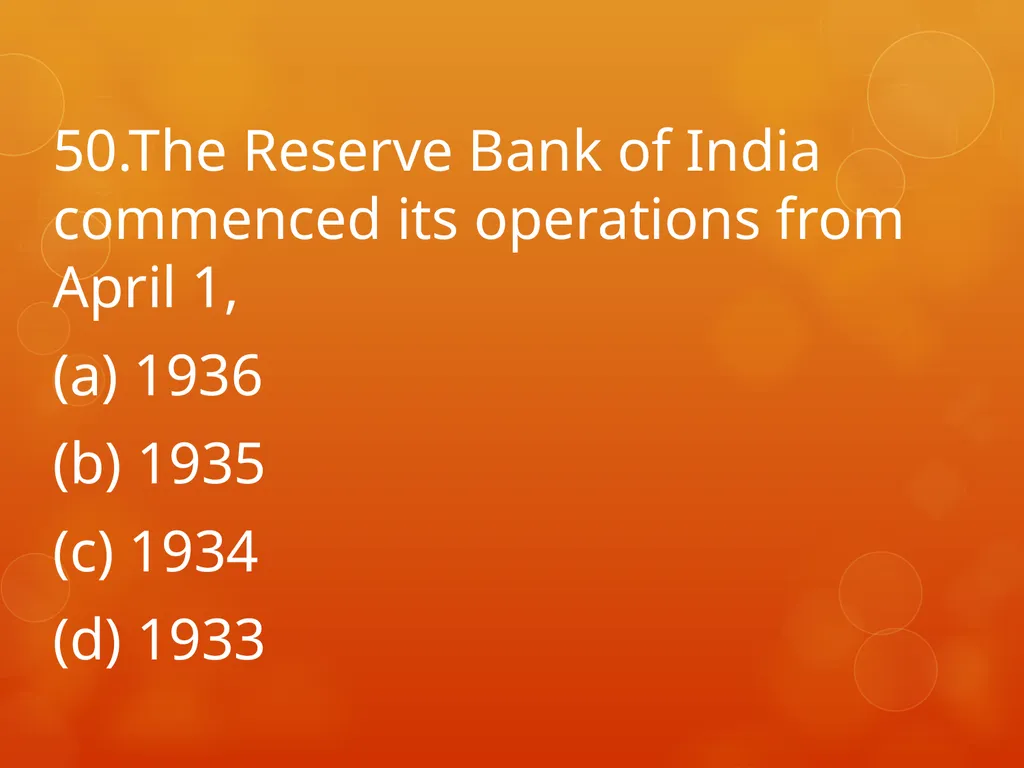
50.The Reserve Bank of India commenced its operations from April 1,
(a) 1936
(b) 1935
(c) 1934
(d) 1933<br>
(a) 1936
(b) 1935
(c) 1934
(d) 1933<br>
52
51.Bankers are not only dealers of money but also leaders in
(a) Economic Development
(b) Trade Development
(c) Industry Development
(d) Service Development<br>
(a) Economic Development
(b) Trade Development
(c) Industry Development
(d) Service Development<br>
53
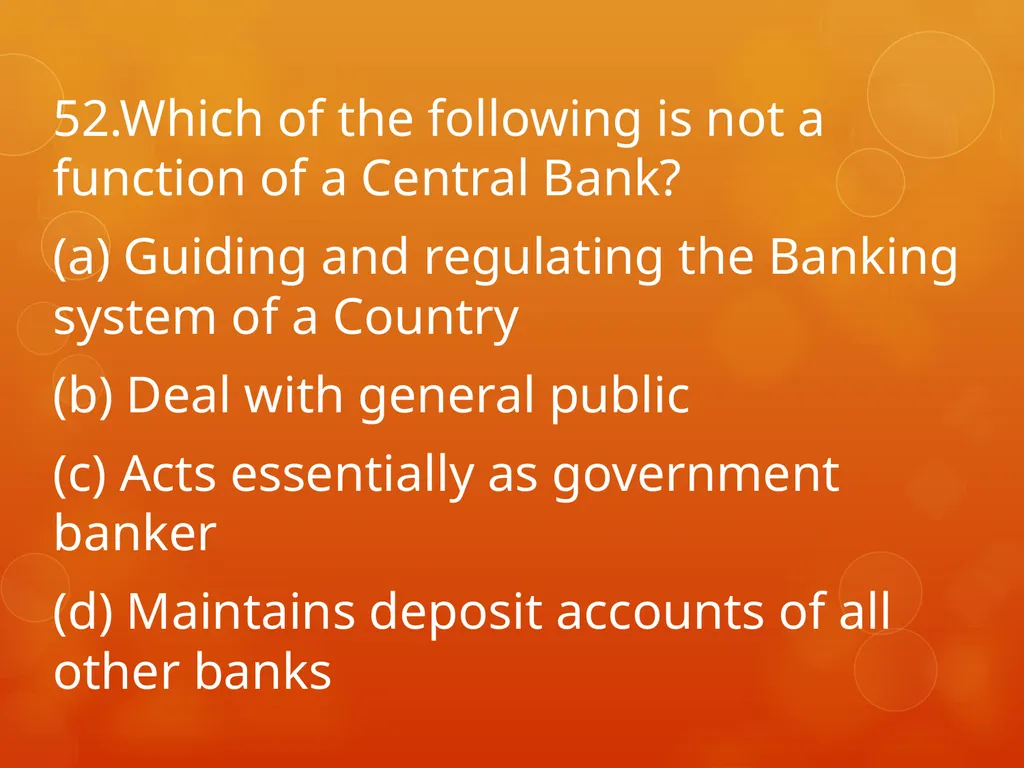
52.Which of the following is not a function of a Central Bank?
(a) Guiding and regulating the Banking system of a Country
(b) Deal with general public
(c) Acts essentially as government banker
(d) Maintains deposit accounts of all other banks<br>
(a) Guiding and regulating the Banking system of a Country
(b) Deal with general public
(c) Acts essentially as government banker
(d) Maintains deposit accounts of all other banks<br>
54
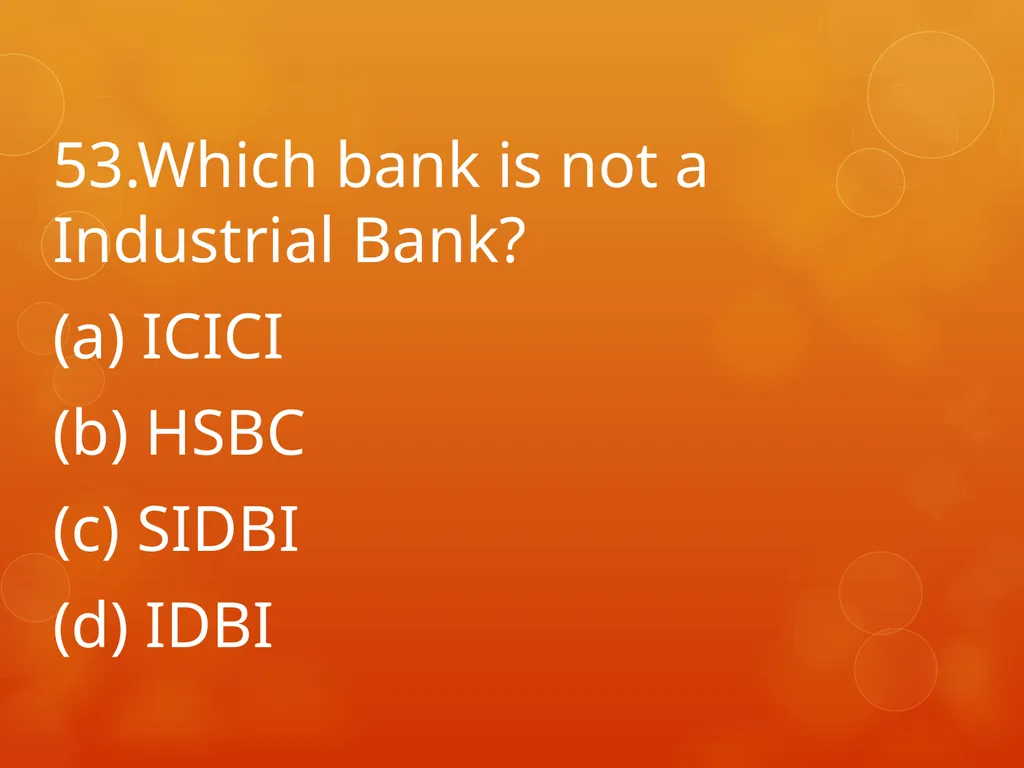
53.Which bank is not a Industrial Bank?
(a) ICICI
(b) HSBC
(c) SIDBI
(d) IDBI<br>
(a) ICICI
(b) HSBC
(c) SIDBI
(d) IDBI<br>
55
54.The Local Area Banks are promoting.
(a) Rural Savings
(b) Business Savings
(c) Industrial development
(d) Agricultural development<br>
(a) Rural Savings
(b) Business Savings
(c) Industrial development
(d) Agricultural development<br>
56
55.Foreign banks are begun their operation since
(a) 1978
(b) 1979
(c) 1980
(d) 1981<br>
(a) 1978
(b) 1979
(c) 1980
(d) 1981<br>
57
56.Electronic banking can be done through
(a) Computers
(b) Mobile Phones
(c) ATM
(d) All of the above<br>
(a) Computers
(b) Mobile Phones
(c) ATM
(d) All of the above<br>
58
57.Minimum how much amount can be transferred through RTGS?
(a) Any Amount
(b) Rs. 50,000
(c) Rs. 2 Lakhs
(d) Rs. 5 Lakhs<br>
(a) Any Amount
(b) Rs. 50,000
(c) Rs. 2 Lakhs
(d) Rs. 5 Lakhs<br>
59
58.The largest commercial bank of India.
(a) ICICI
(b) SBI
(c) PNB
(d) RBI<br>
(a) ICICI
(b) SBI
(c) PNB
(d) RBI<br>
60
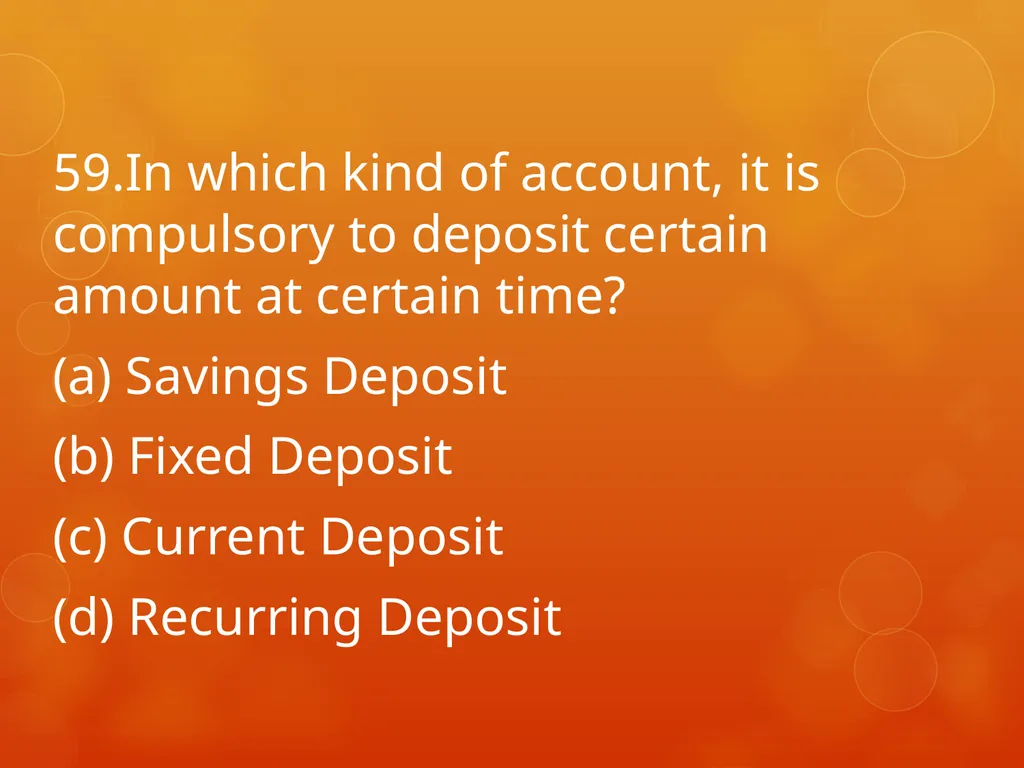
59.In which kind of account, it is compulsory to deposit certain amount at certain time?
(a) Savings Deposit
(b) Fixed Deposit
(c) Current Deposit
(d) Recurring Deposit<br>
(a) Savings Deposit
(b) Fixed Deposit
(c) Current Deposit
(d) Recurring Deposit<br>
61
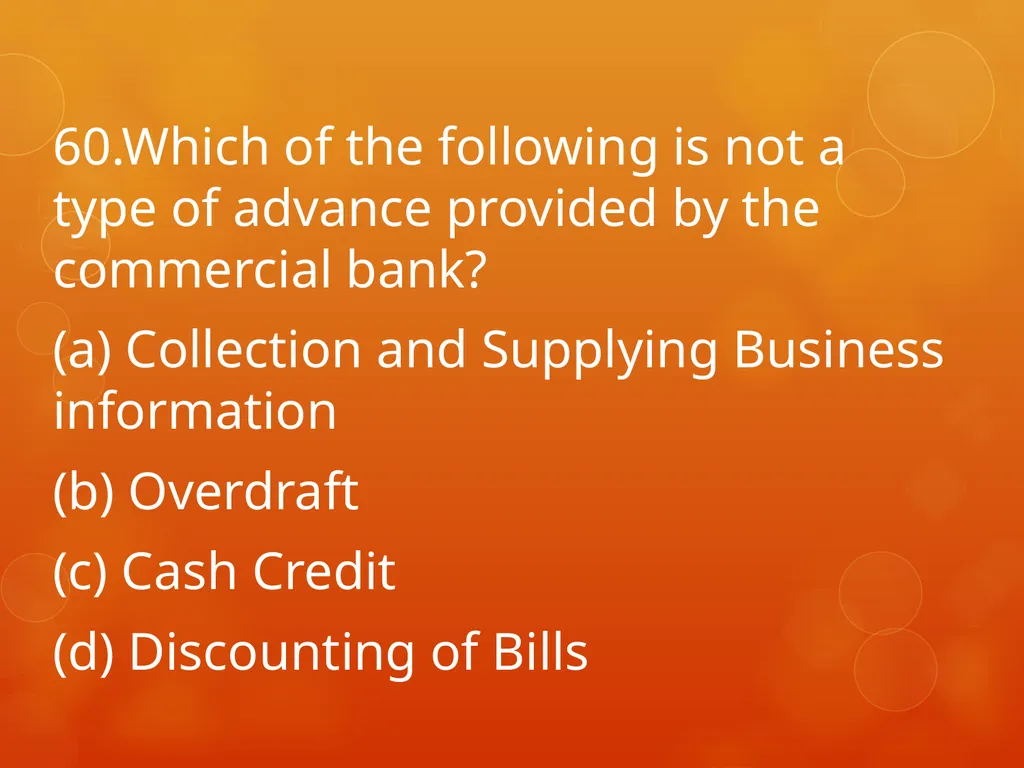
60.Which of the following is not a type of advance provided by the commercial bank?
(a) Collection and Supplying Business information
(b) Overdraft
(c) Cash Credit
(d) Discounting of Bills<br>
(a) Collection and Supplying Business information
(b) Overdraft
(c) Cash Credit
(d) Discounting of Bills<br>
62
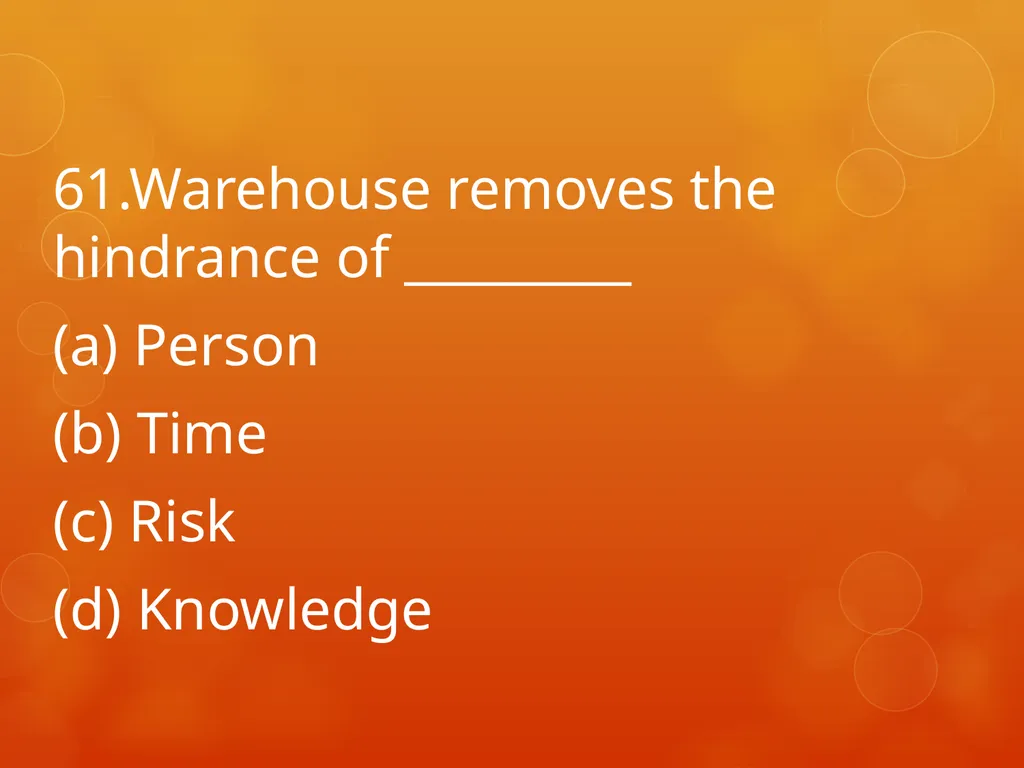
61.Warehouse removes the hindrance of _________
(a) Person
(b) Time
(c) Risk
(d) Knowledge<br>
(a) Person
(b) Time
(c) Risk
(d) Knowledge<br>
63
62.A warehouse holds goods as a __________ centre.
(a) Marketing
(b) Sorting
(c) Distribution
(d) Selling<br>
(a) Marketing
(b) Sorting
(c) Distribution
(d) Selling<br>
64
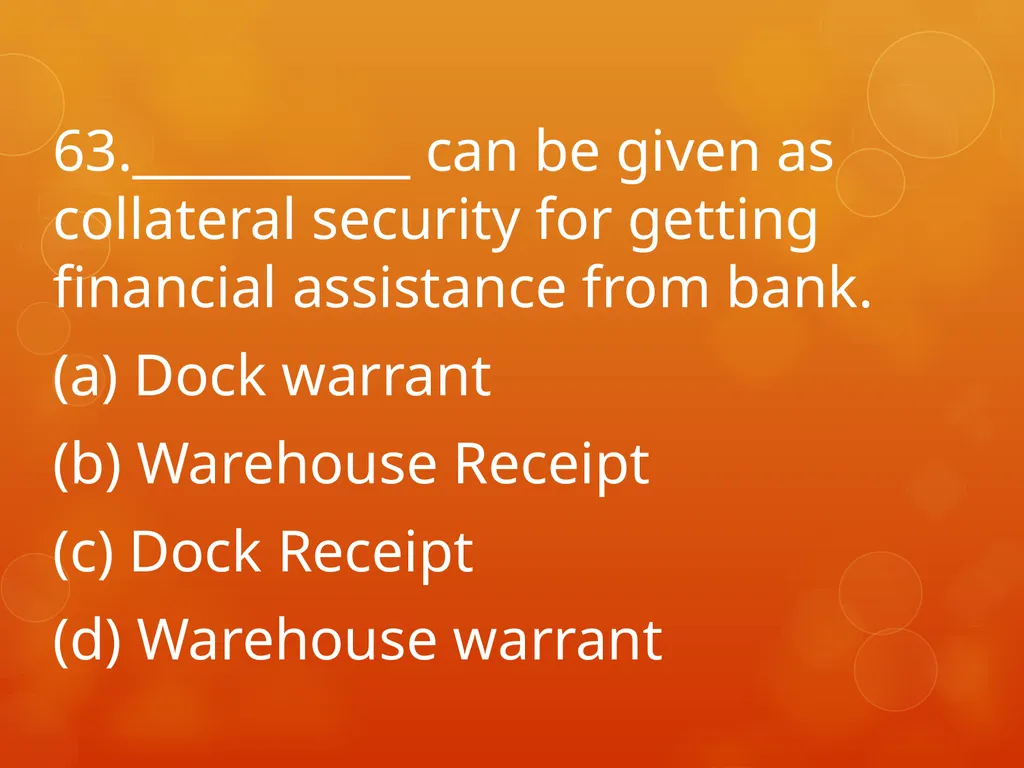
63.___________ can be given as collateral security for getting financial assistance from bank.
(a) Dock warrant
(b) Warehouse Receipt
(c) Dock Receipt
(d) Warehouse warrant<br>
(a) Dock warrant
(b) Warehouse Receipt
(c) Dock Receipt
(d) Warehouse warrant<br>
65
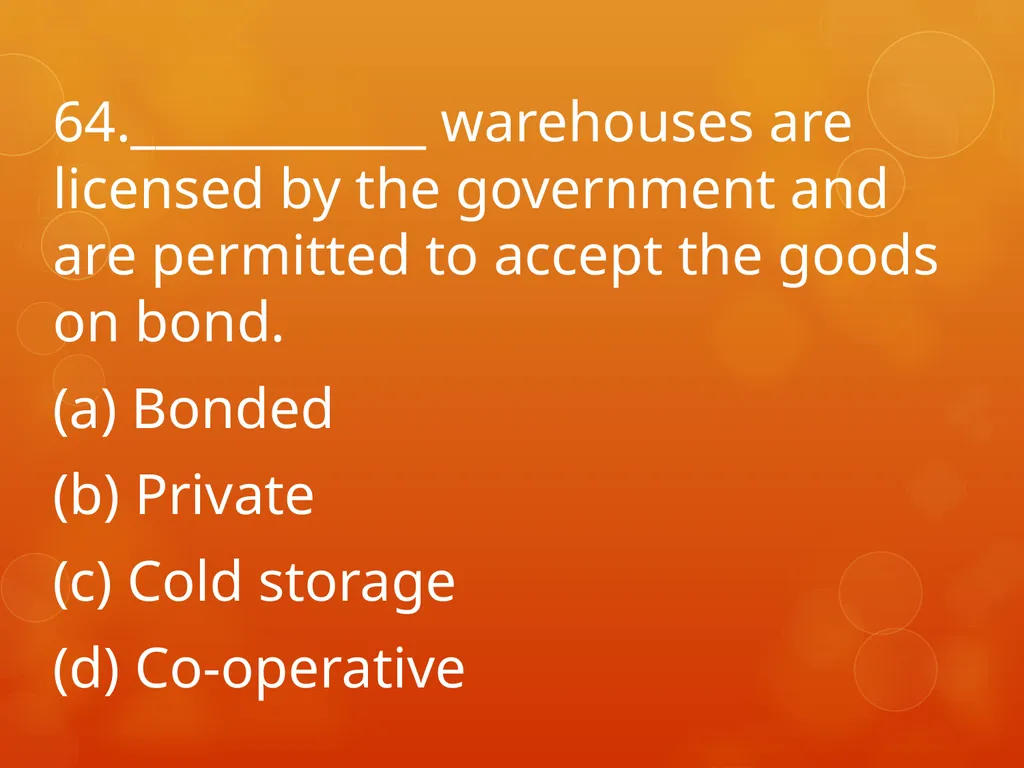
64.____________ warehouses are licensed by the government and are permitted to accept the goods on bond.
(a) Bonded
(b) Private
(c) Cold storage
(d) Co-operative<br>
(a) Bonded
(b) Private
(c) Cold storage
(d) Co-operative<br>
66
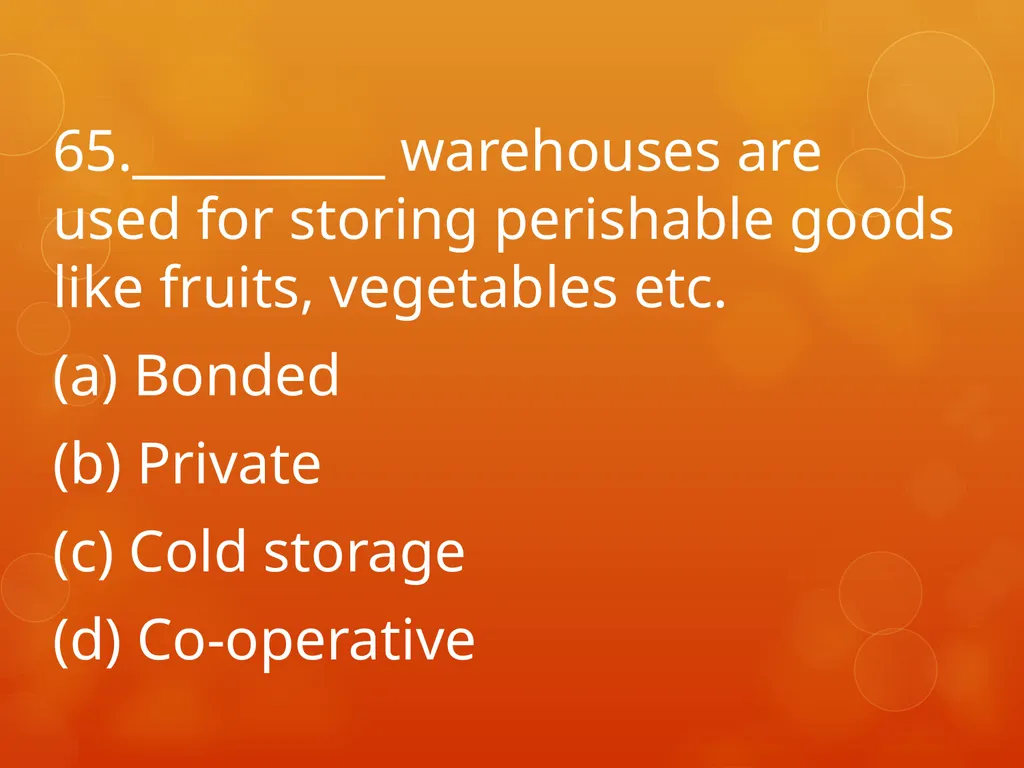
65.__________ warehouses are used for storing perishable goods like fruits, vegetables etc.
(a) Bonded
(b) Private
(c) Cold storage
(d) Co-operative<br>
(a) Bonded
(b) Private
(c) Cold storage
(d) Co-operative<br>
67
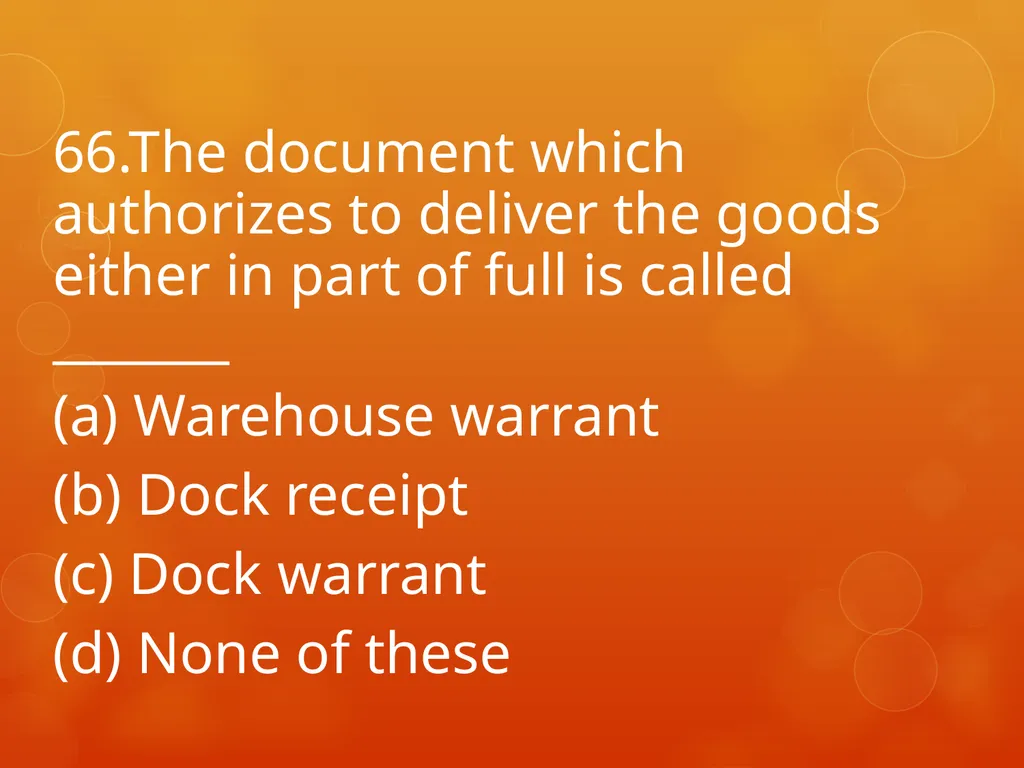
66.The document which authorizes to deliver the goods either in part of full is called _______
(a) Warehouse warrant
(b) Dock receipt
(c) Dock warrant
(d) None of these<br>
(a) Warehouse warrant
(b) Dock receipt
(c) Dock warrant
(d) None of these<br>
68
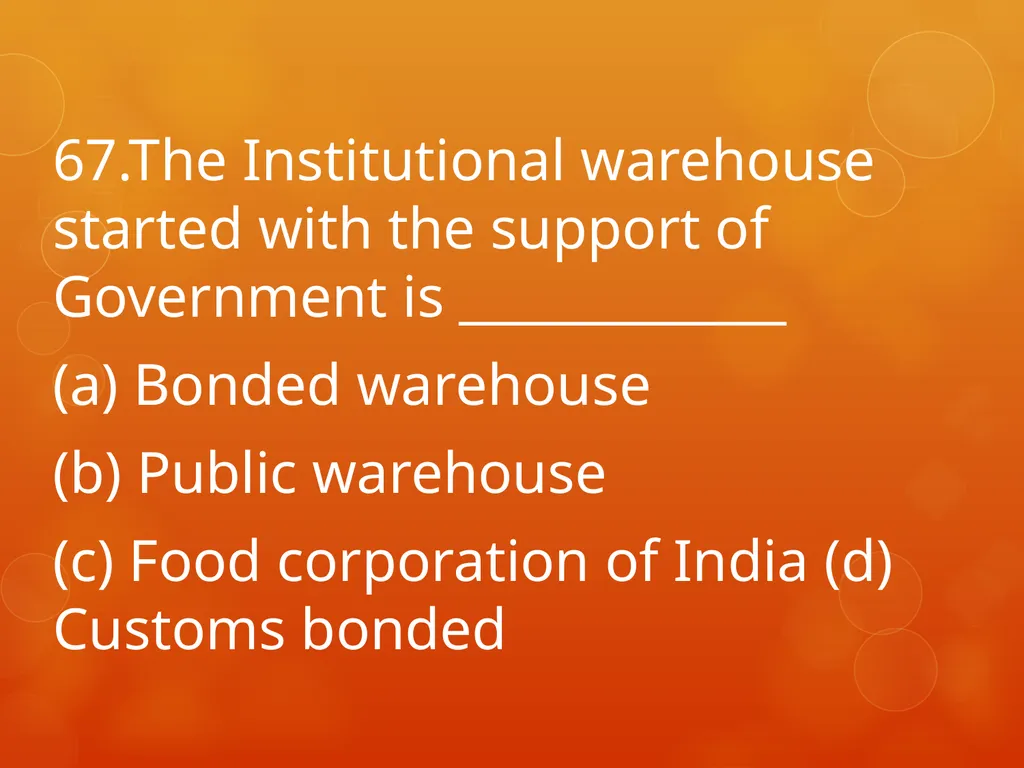
67.The Institutional warehouse started with the support of Government is _____________
(a) Bonded warehouse
(b) Public warehouse
(c) Food corporation of India (d) Customs bonded<br>
(a) Bonded warehouse
(b) Public warehouse
(c) Food corporation of India (d) Customs bonded<br>
69
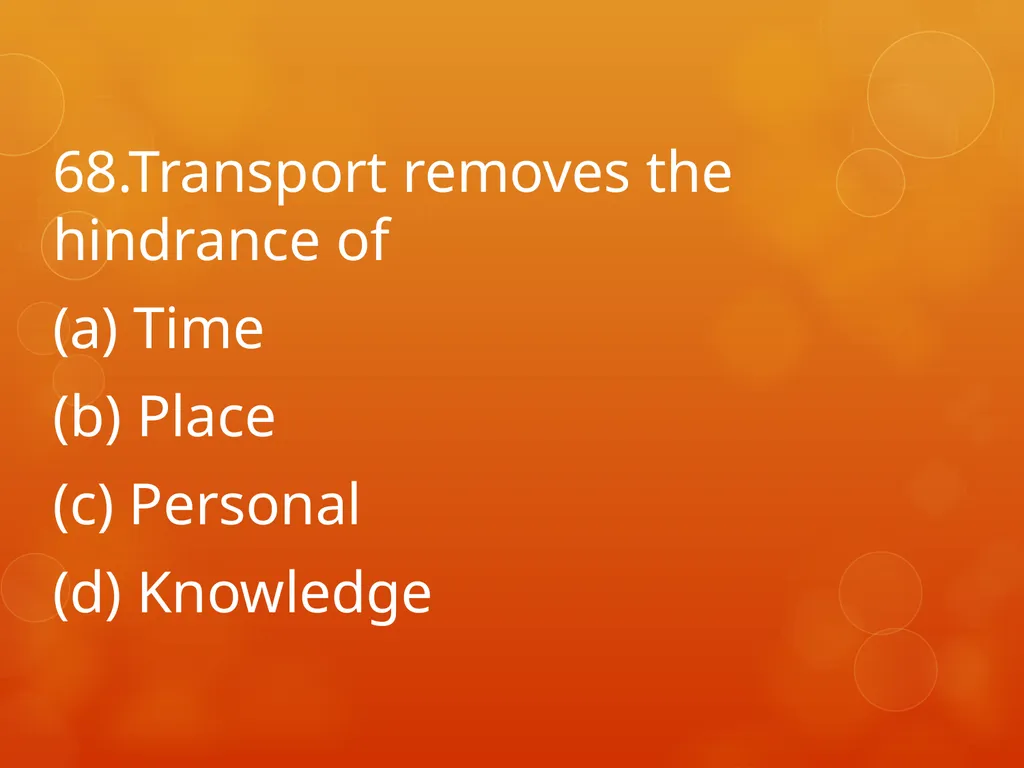
68.Transport removes the hindrance of
(a) Time
(b) Place
(c) Personal
(d) Knowledge<br>
(a) Time
(b) Place
(c) Personal
(d) Knowledge<br>
70
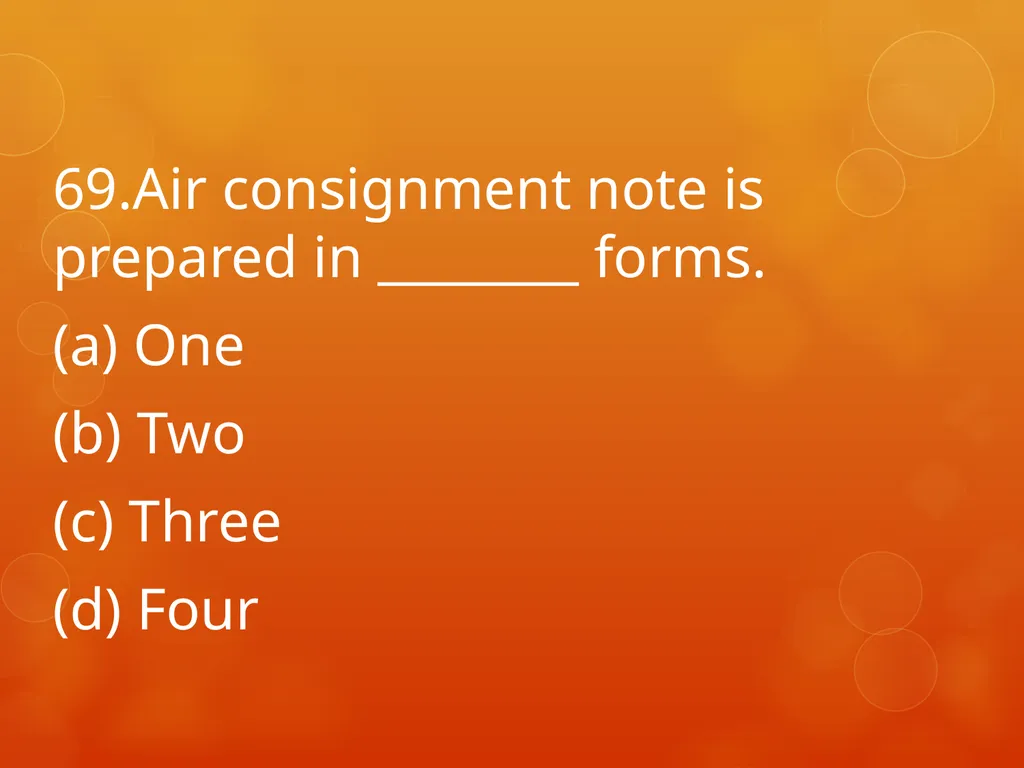
69.Air consignment note is prepared in ________ forms.
(a) One
(b) Two
(c) Three
(d) Four<br>
(a) One
(b) Two
(c) Three
(d) Four<br>
71
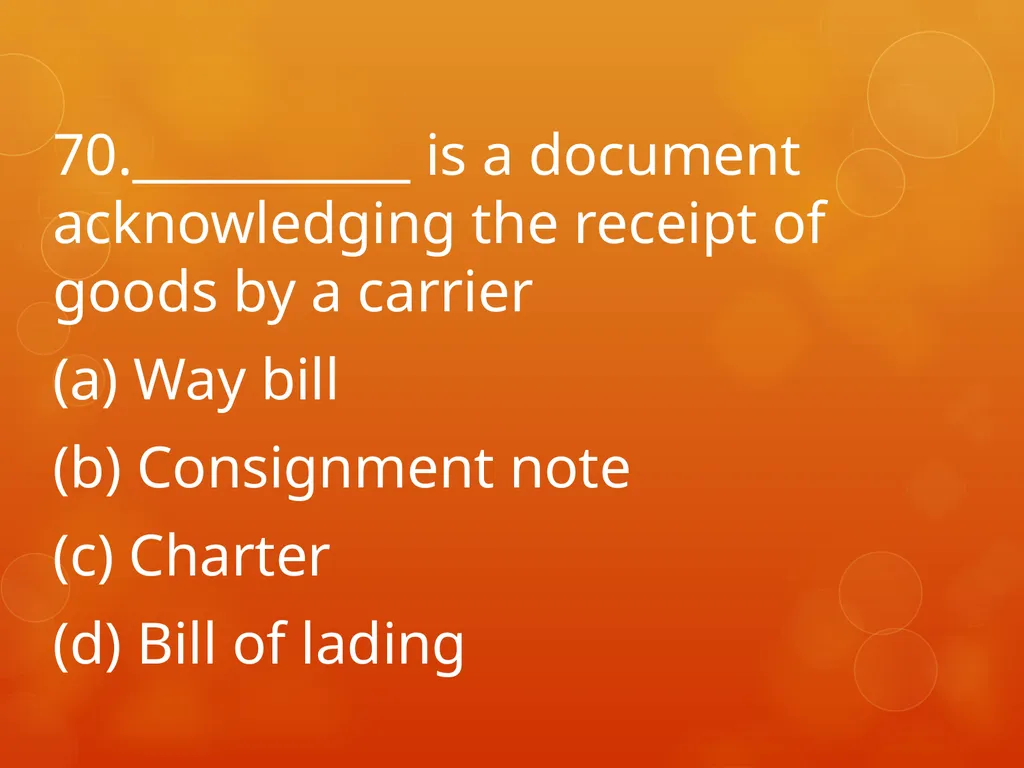
70.___________ is a document acknowledging the receipt of goods by a carrier
(a) Way bill
(b) Consignment note
(c) Charter
(d) Bill of lading<br>
(a) Way bill
(b) Consignment note
(c) Charter
(d) Bill of lading<br>
72
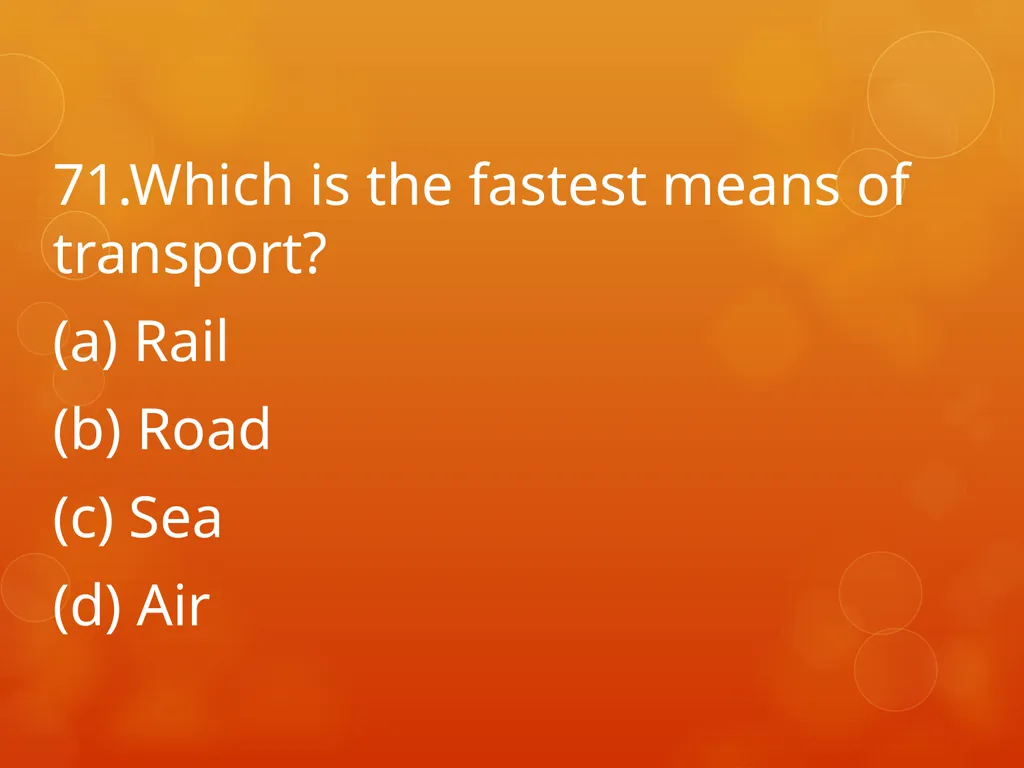
71.Which is the fastest means of transport?
(a) Rail
(b) Road
(c) Sea
(d) Air<br>
(a) Rail
(b) Road
(c) Sea
(d) Air<br>
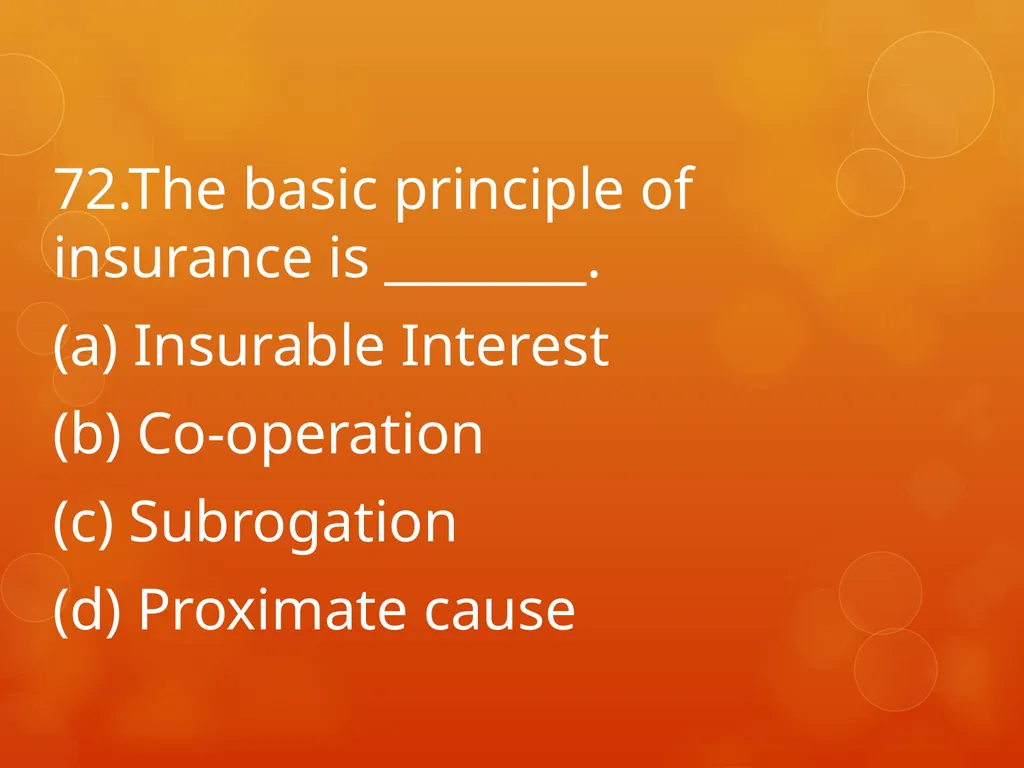
73
72.The basic principle of insurance is ________.
(a) Insurable Interest
(b) Co-operation
(c) Subrogation
(d) Proximate cause<br>
(a) Insurable Interest
(b) Co-operation
(c) Subrogation
(d) Proximate cause<br>
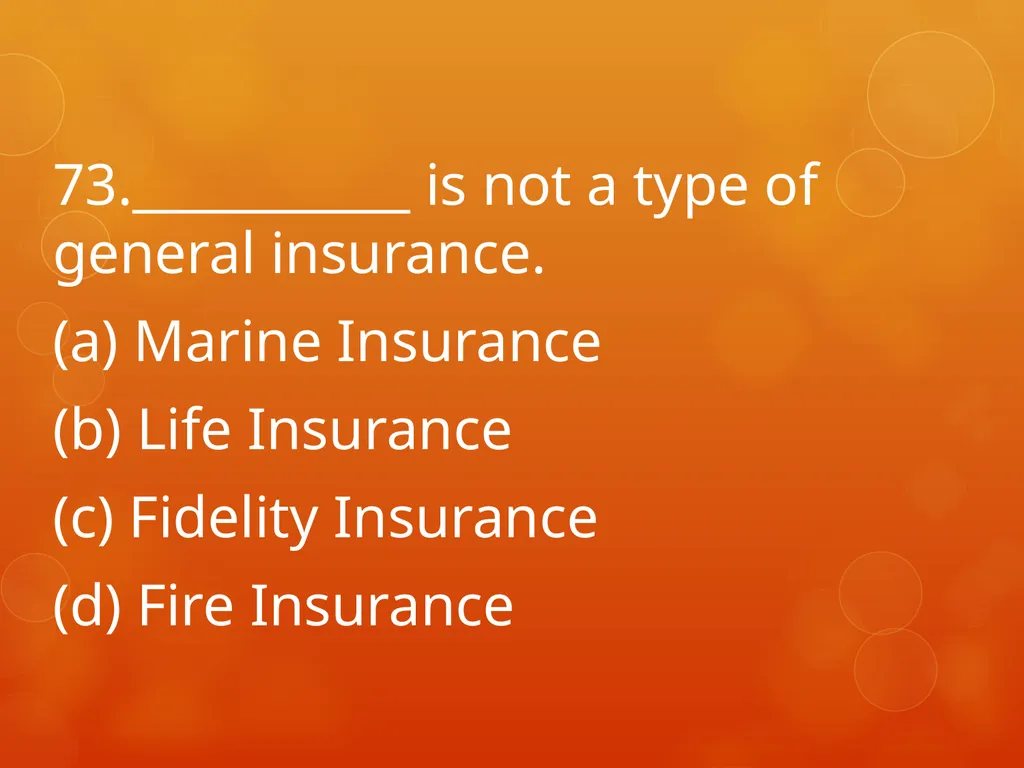
74
73.___________ is not a type of general insurance.
(a) Marine Insurance
(b) Life Insurance
(c) Fidelity Insurance
(d) Fire Insurance<br>
(a) Marine Insurance
(b) Life Insurance
(c) Fidelity Insurance
(d) Fire Insurance<br>
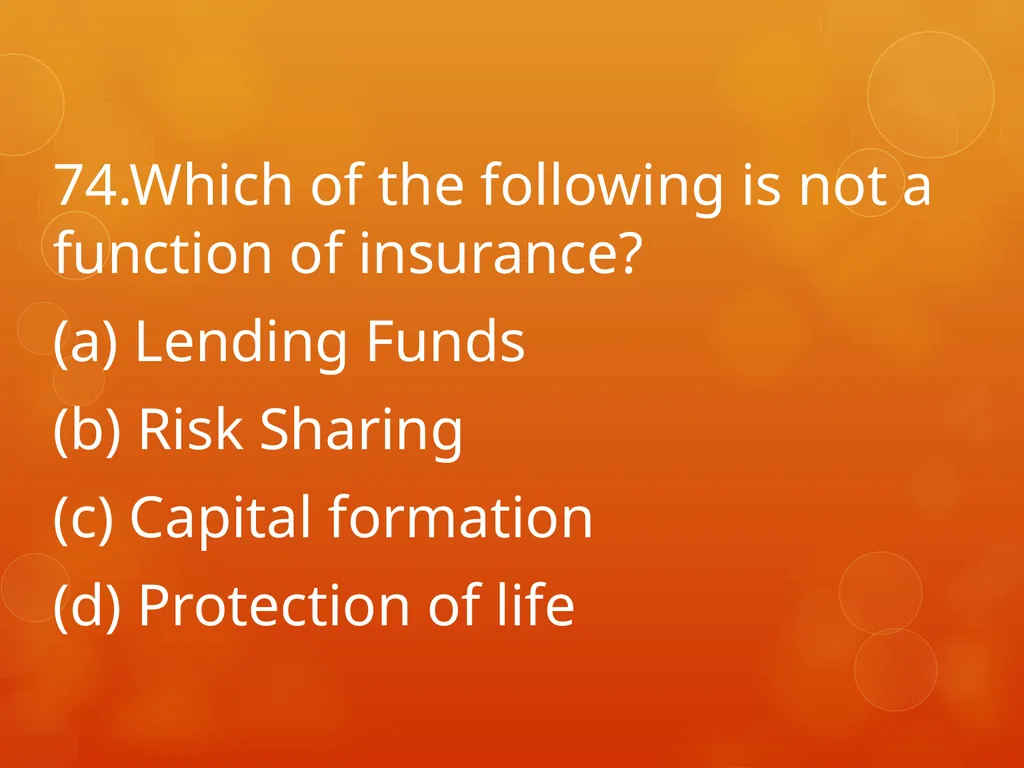
75
74.Which of the following is not a function of insurance?
(a) Lending Funds
(b) Risk Sharing
(c) Capital formation
(d) Protection of life<br>
(a) Lending Funds
(b) Risk Sharing
(c) Capital formation
(d) Protection of life<br>
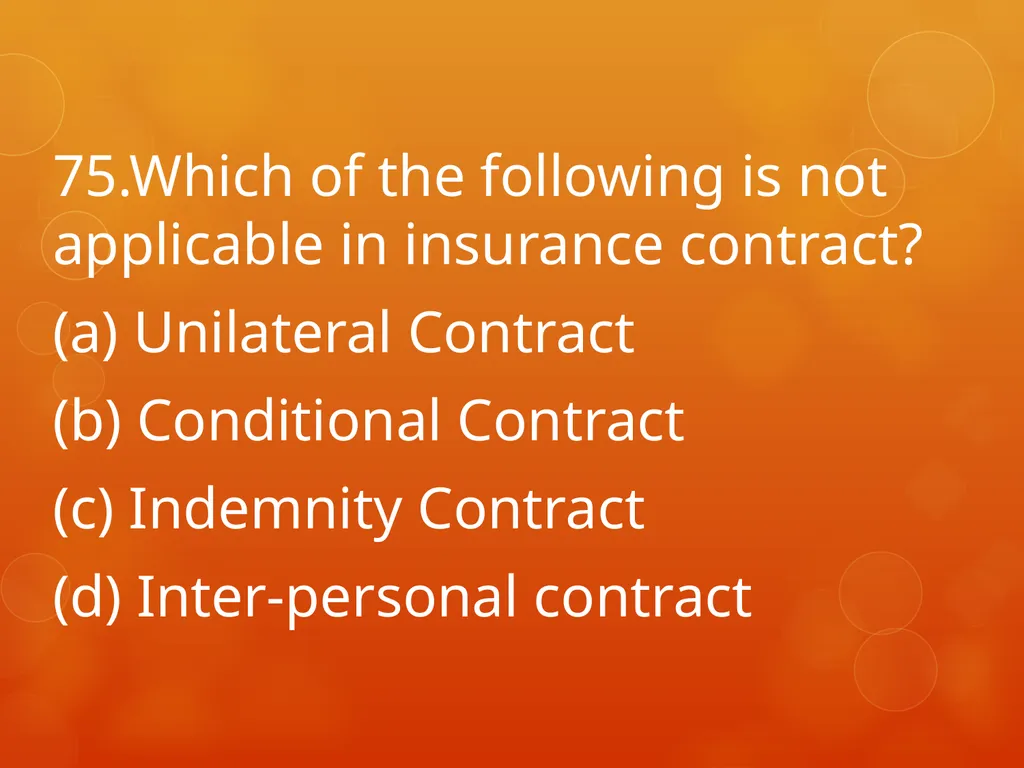
76
75.Which of the following is not applicable in insurance contract?
(a) Unilateral Contract
(b) Conditional Contract
(c) Indemnity Contract
(d) Inter-personal contract<br>
(a) Unilateral Contract
(b) Conditional Contract
(c) Indemnity Contract
(d) Inter-personal contract<br>
77
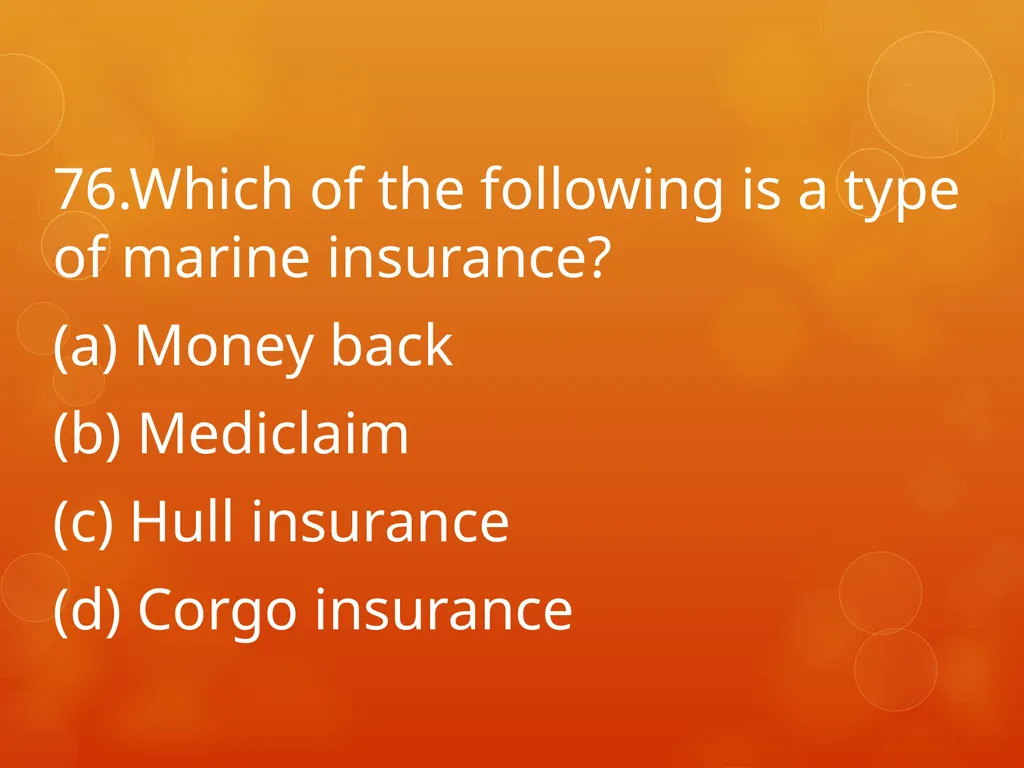
76.Which of the following is a type of marine insurance?
(a) Money back
(b) Mediclaim
(c) Hull insurance
(d) Corgo insurance<br>
(a) Money back
(b) Mediclaim
(c) Hull insurance
(d) Corgo insurance<br>
78
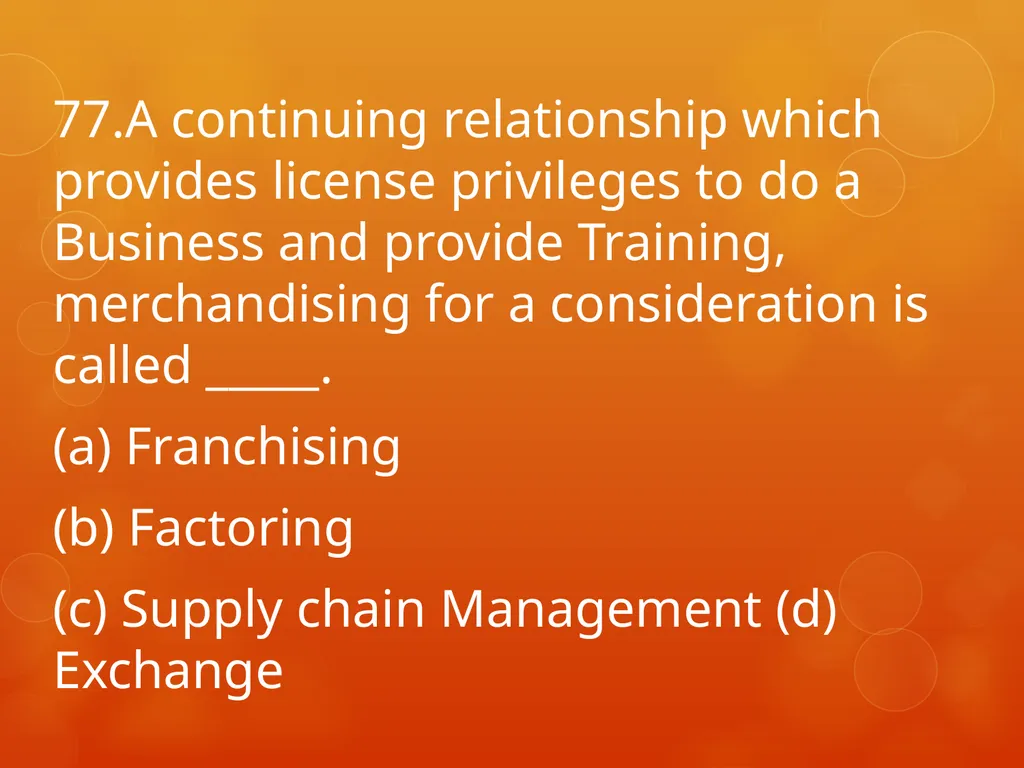
77.A continuing relationship which provides license privileges to do a Business and provide Training, merchandising for a consideration is called _____.
(a) Franchising
(b) Factoring
(c) Supply chain Management (d) Exchange<br>
(a) Franchising
(b) Factoring
(c) Supply chain Management (d) Exchange<br>
79
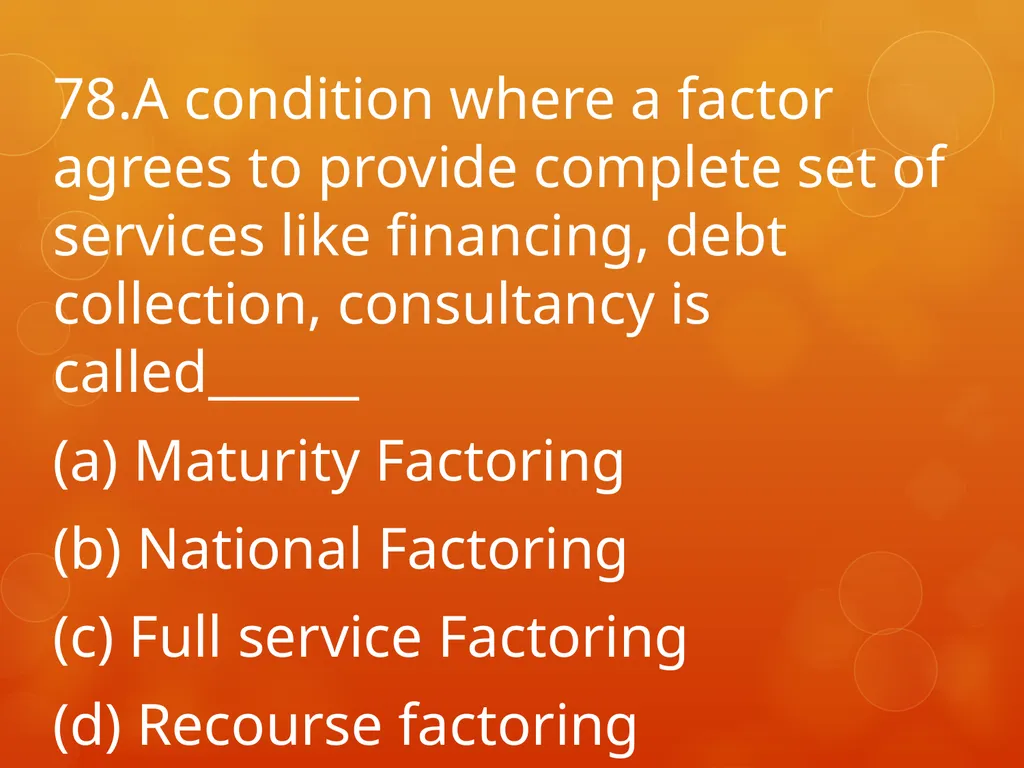
78.A condition where a factor agrees to provide complete set of services like financing, debt collection, consultancy is called______
(a) Maturity Factoring
(b) National Factoring
(c) Full service Factoring
(d) Recourse factoring<br>
(a) Maturity Factoring
(b) National Factoring
(c) Full service Factoring
(d) Recourse factoring<br>
80
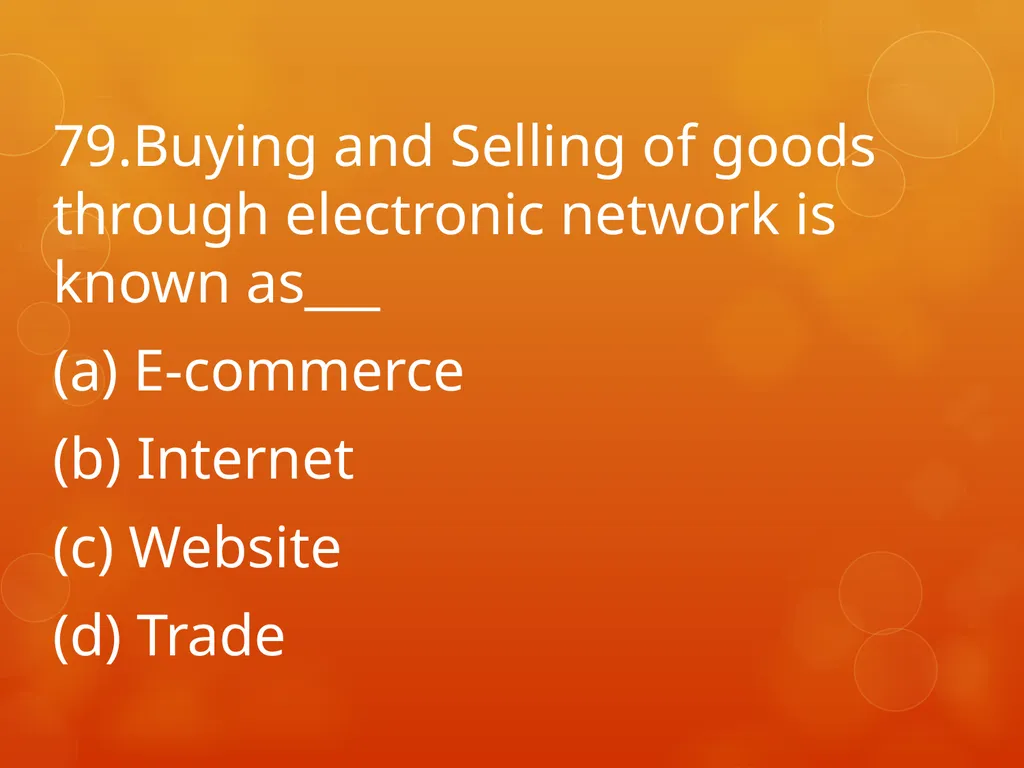
79.Buying and Selling of goods through electronic network is known as___
(a) E-commerce
(b) Internet
(c) Website
(d) Trade<br>
(a) E-commerce
(b) Internet
(c) Website
(d) Trade<br>
81
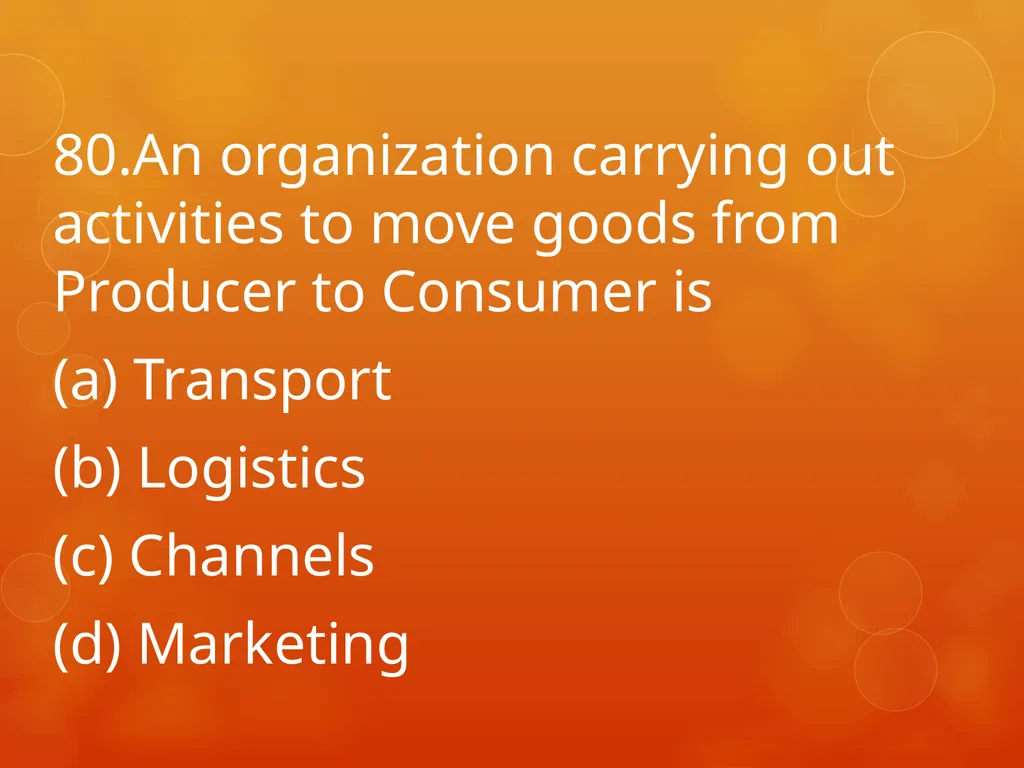
80.An organization carrying out activities to move goods from Producer to Consumer is
(a) Transport
(b) Logistics
(c) Channels
(d) Marketing<br>
(a) Transport
(b) Logistics
(c) Channels
(d) Marketing<br>
82
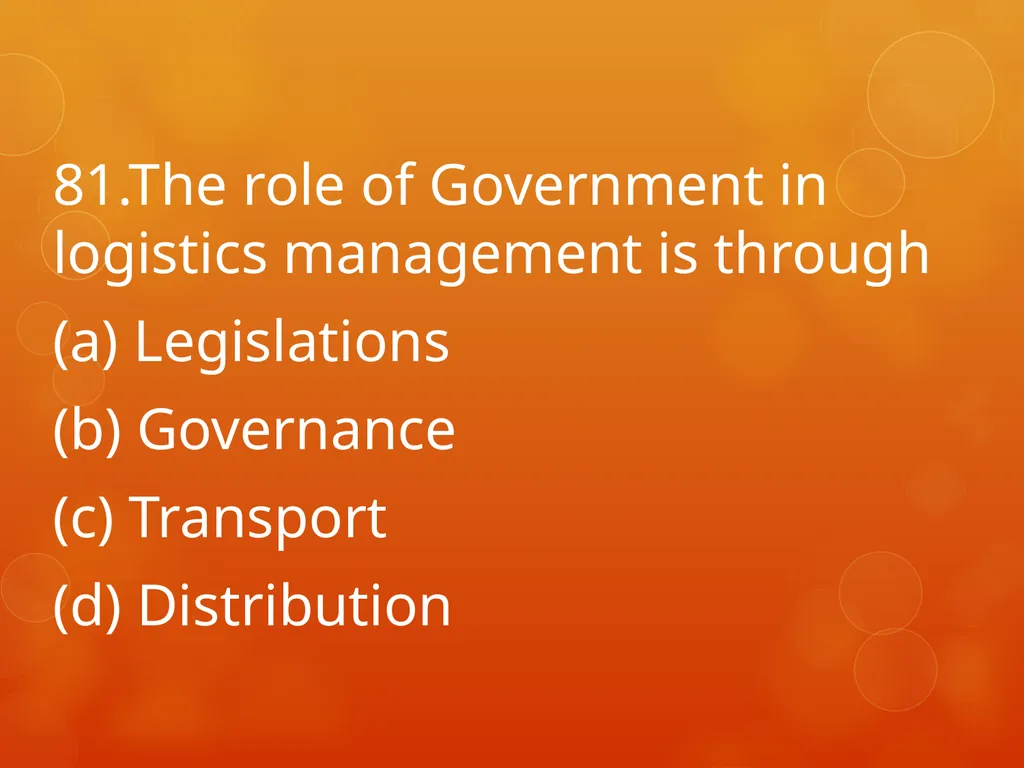
81.The role of Government in logistics management is through
(a) Legislations
(b) Governance
(c) Transport
(d) Distribution<br>
(a) Legislations
(b) Governance
(c) Transport
(d) Distribution<br>
83
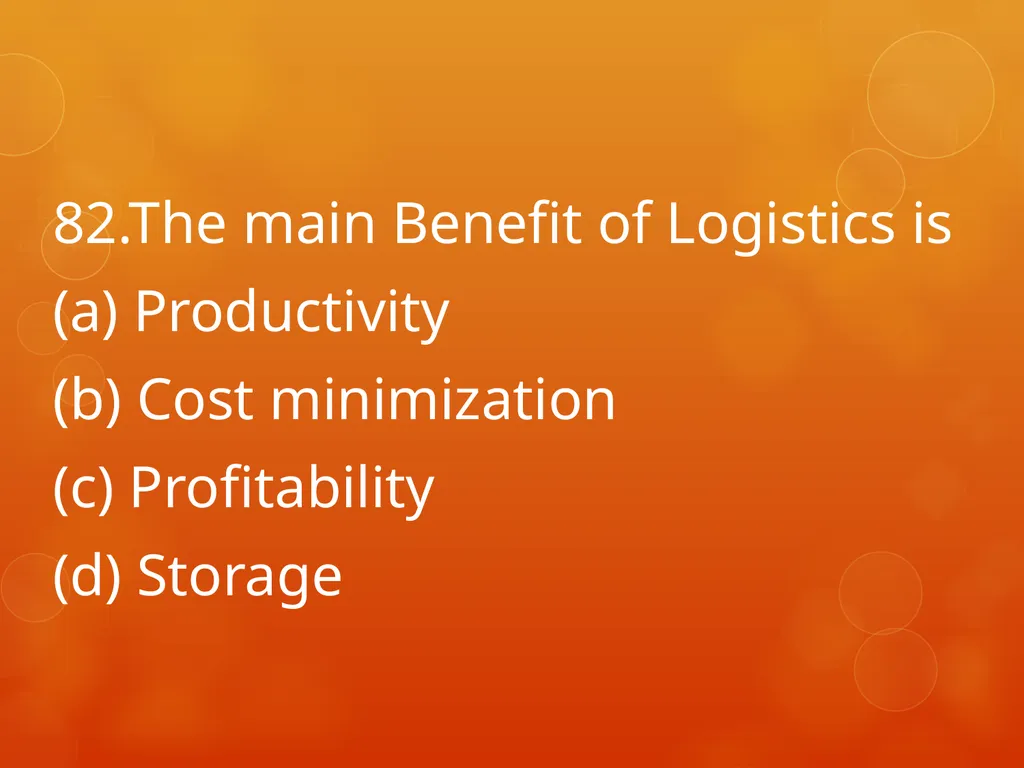
82.The main Benefit of Logistics is
(a) Productivity
(b) Cost minimization
(c) Profitability
(d) Storage<br>
(a) Productivity
(b) Cost minimization
(c) Profitability
(d) Storage<br>
84
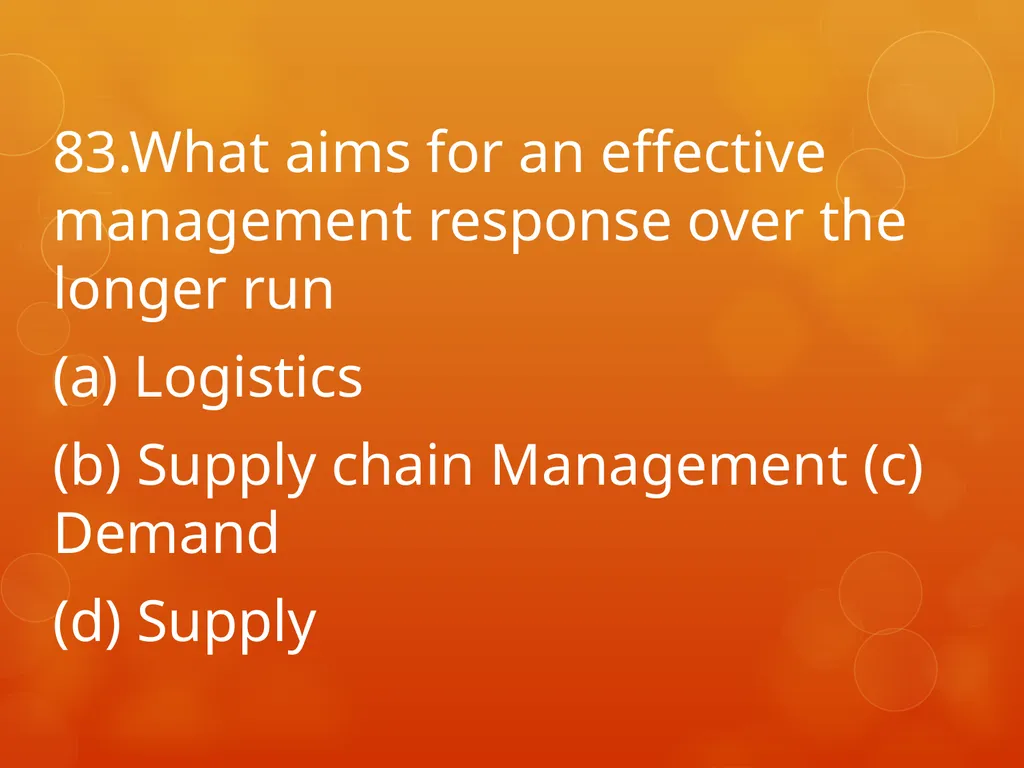
83.What aims for an effective management response over the longer run
(a) Logistics
(b) Supply chain Management (c) Demand
(d) Supply<br>
(a) Logistics
(b) Supply chain Management (c) Demand
(d) Supply<br>
85
84.The model that identifies alternatives, criteria for decision making and analyse alternatives to arrive at the best choice is
(a) Routing Model
(b) Scheduling Model
(c) Inventory Model
(d) Alternative analysis<br>
(a) Routing Model
(b) Scheduling Model
(c) Inventory Model
(d) Alternative analysis<br>
86
85.A Company under outsourcing transfers activities which are
(a) Core
(b) Non-core
(c) Business
(d) Non-Business<br>
(a) Core
(b) Non-core
(c) Business
(d) Non-Business<br>
87
86.Business units can reduce expenditure by outsourcing front office work like
(a) Paper Work
(b) File Work
(c) Billing
(d) Manufacture<br>
(a) Paper Work
(b) File Work
(c) Billing
(d) Manufacture<br>
88
87.The main benefit of outsourcing is
(a) Productivity
(b) Cost reduction
(c) Skill
(d) Units<br>
(a) Productivity
(b) Cost reduction
(c) Skill
(d) Units<br>
89
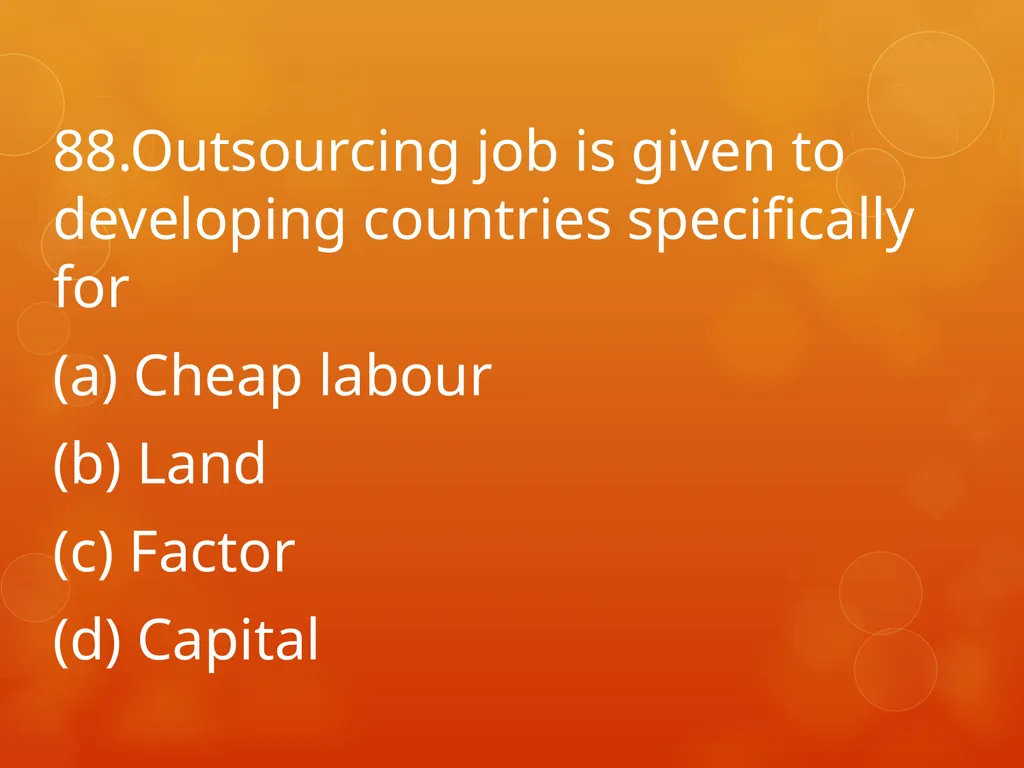
88.Outsourcing job is given to developing countries specifically for
(a) Cheap labour
(b) Land
(c) Factor
(d) Capital<br>
(a) Cheap labour
(b) Land
(c) Factor
(d) Capital<br>
90
89.Outsourcing is carried out for the benefit of
(a) Global Village
(b) Transport
(c) Factory
(d) Time and Money<br>
(a) Global Village
(b) Transport
(c) Factory
(d) Time and Money<br>
91
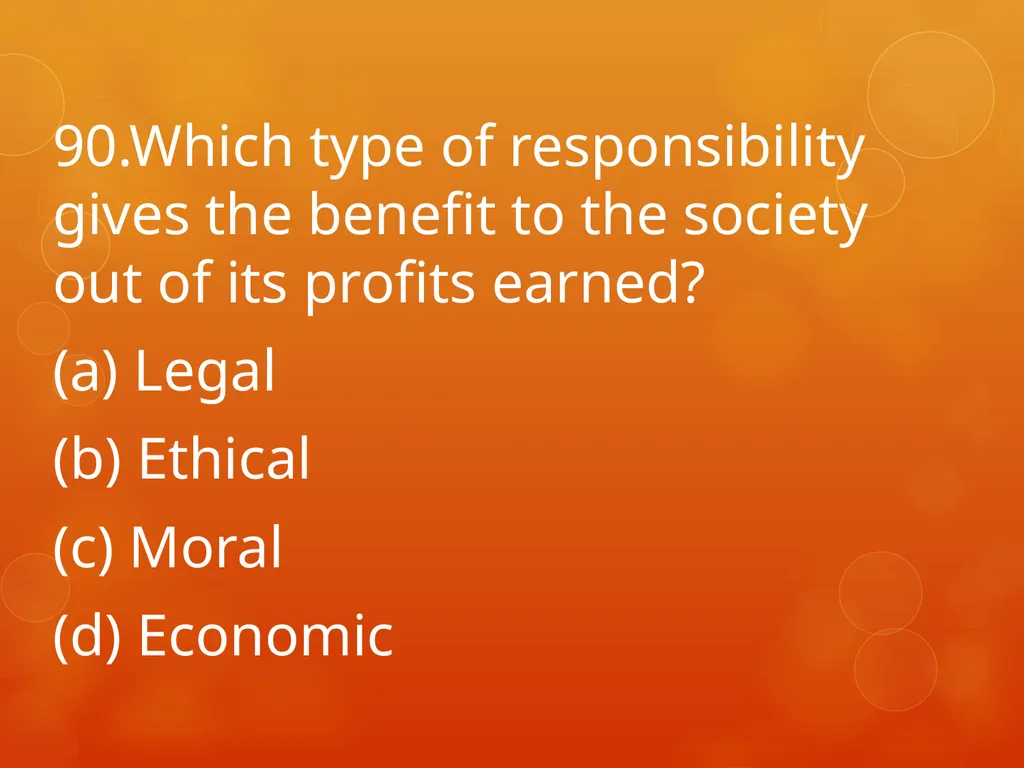
90.Which type of responsibility gives the benefit to the society out of its profits earned?
(a) Legal
(b) Ethical
(c) Moral
(d) Economic<br>
(a) Legal
(b) Ethical
(c) Moral
(d) Economic<br>
92
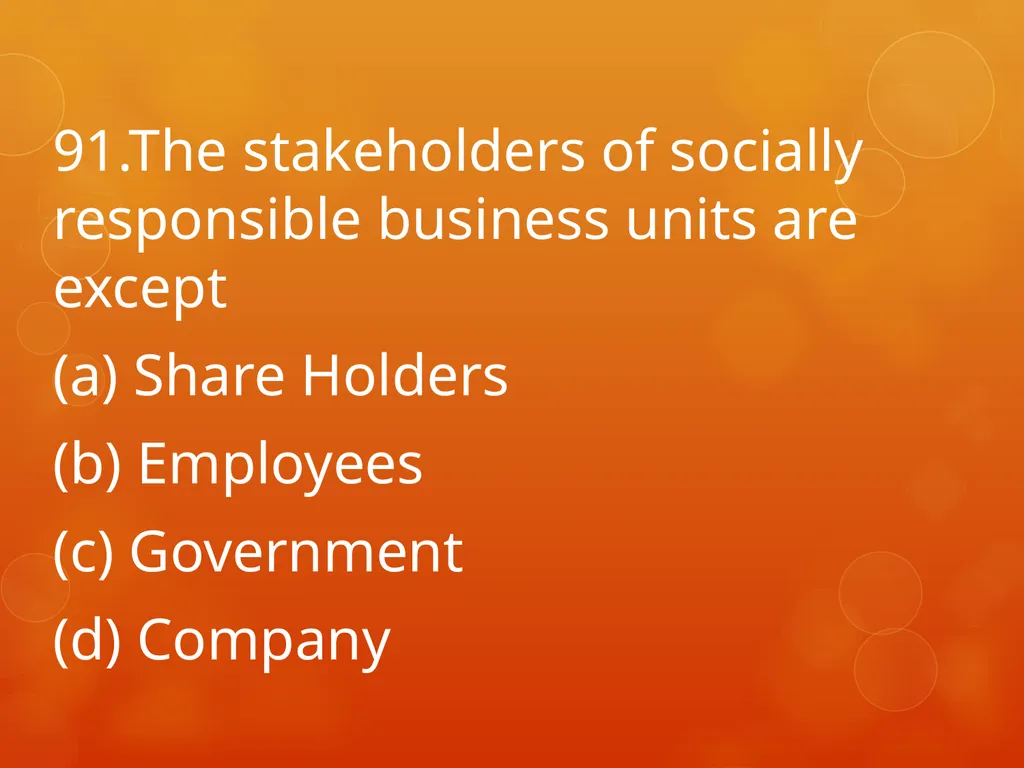
91.The stakeholders of socially responsible business units are except
(a) Share Holders
(b) Employees
(c) Government
(d) Company<br>
(a) Share Holders
(b) Employees
(c) Government
(d) Company<br>
93
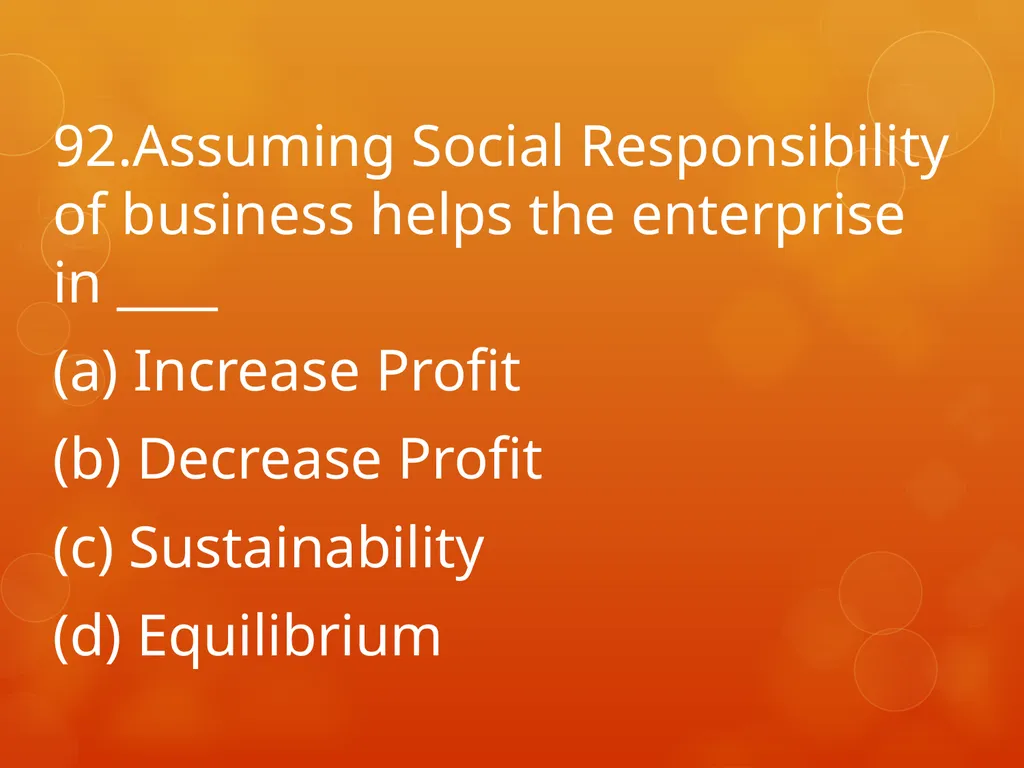
92.Assuming Social Responsibility of business helps the enterprise in ____
(a) Increase Profit
(b) Decrease Profit
(c) Sustainability
(d) Equilibrium<br>
(a) Increase Profit
(b) Decrease Profit
(c) Sustainability
(d) Equilibrium<br>
94
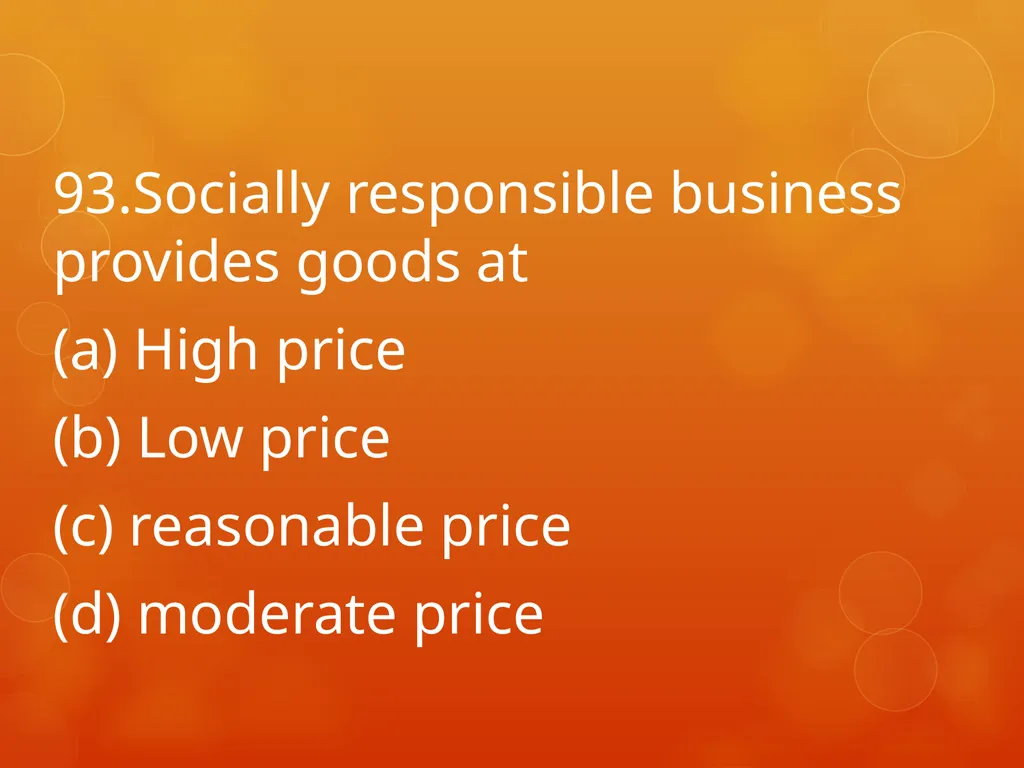
93.Socially responsible business provides goods at
(a) High price
(b) Low price
(c) reasonable price
(d) moderate price<br>
(a) High price
(b) Low price
(c) reasonable price
(d) moderate price<br>
95
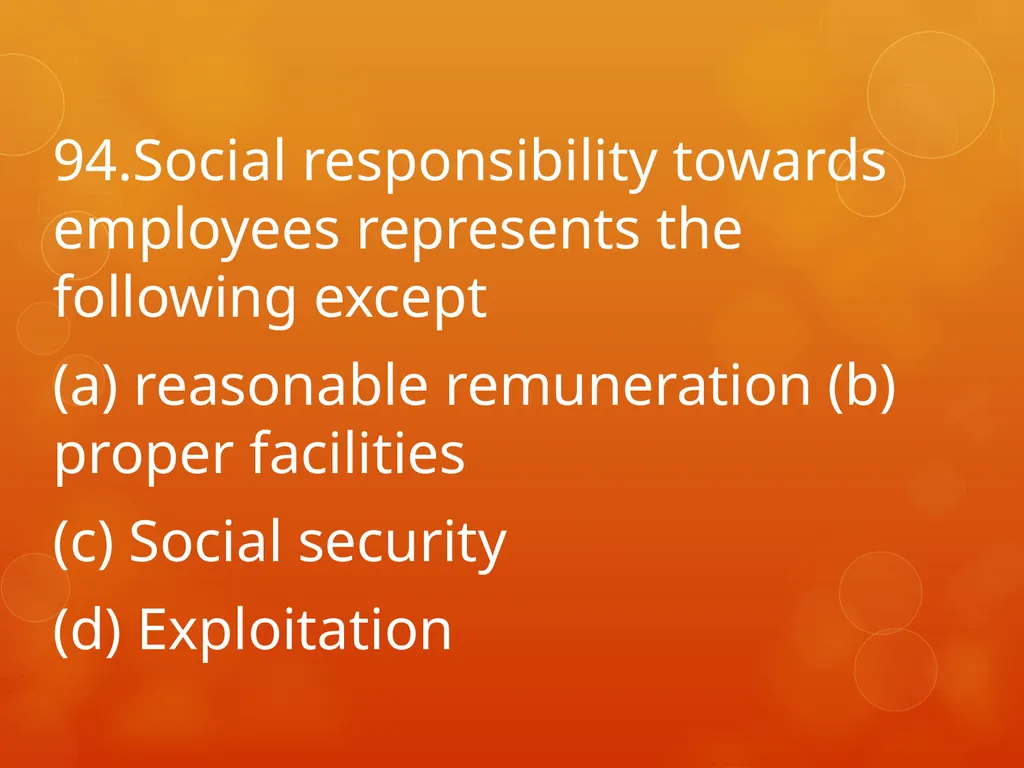
94.Social responsibility towards employees represents the following except
(a) reasonable remuneration (b) proper facilities
(c) Social security
(d) Exploitation<br>
(a) reasonable remuneration (b) proper facilities
(c) Social security
(d) Exploitation<br>
96
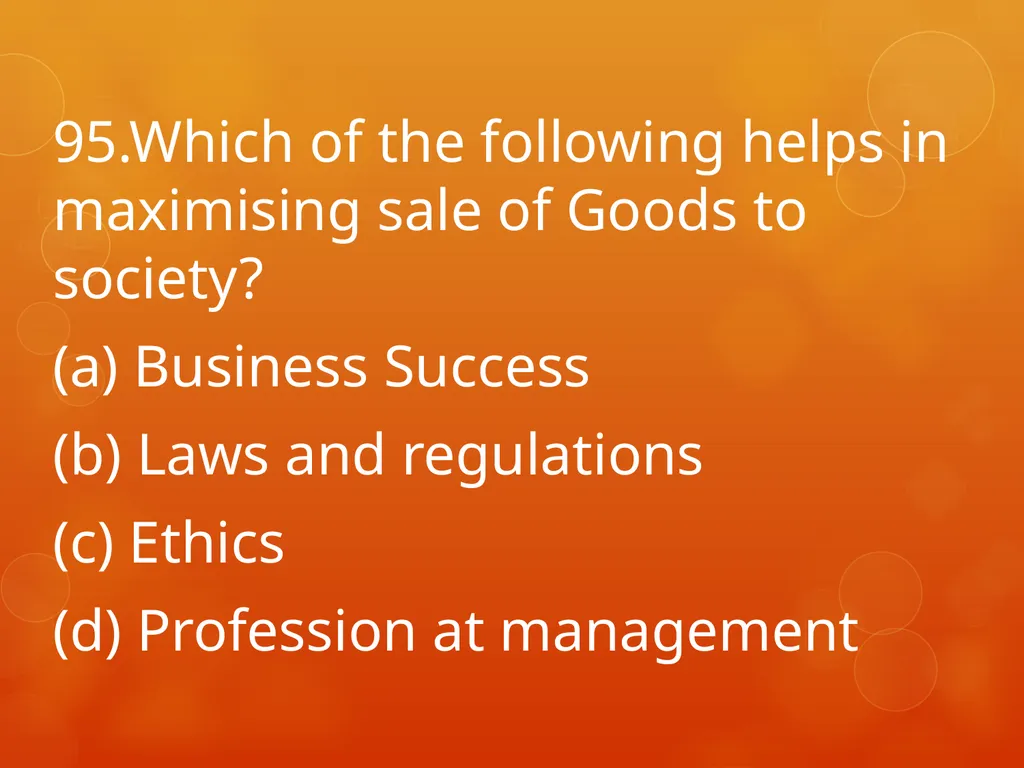
95.Which of the following helps in maximising sale of Goods to society?
(a) Business Success
(b) Laws and regulations
(c) Ethics
(d) Profession at management<br>
(a) Business Success
(b) Laws and regulations
(c) Ethics
(d) Profession at management<br>
97
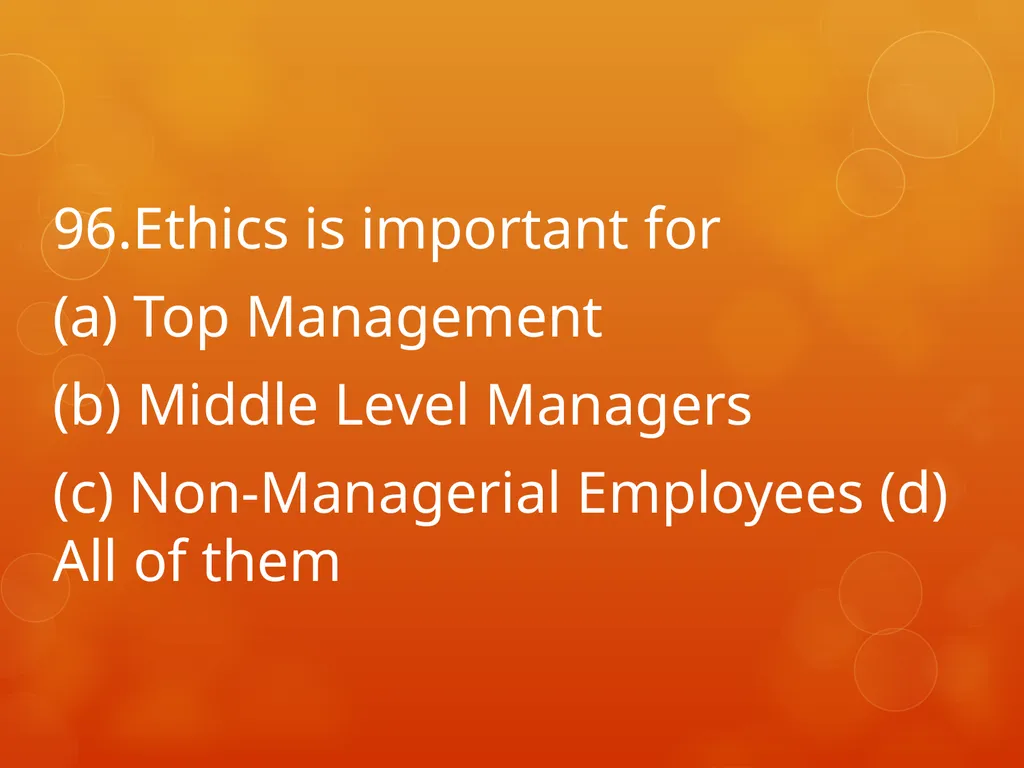
96.Ethics is important for
(a) Top Management
(b) Middle Level Managers
(c) Non-Managerial Employees (d) All of them<br>
(a) Top Management
(b) Middle Level Managers
(c) Non-Managerial Employees (d) All of them<br>
98
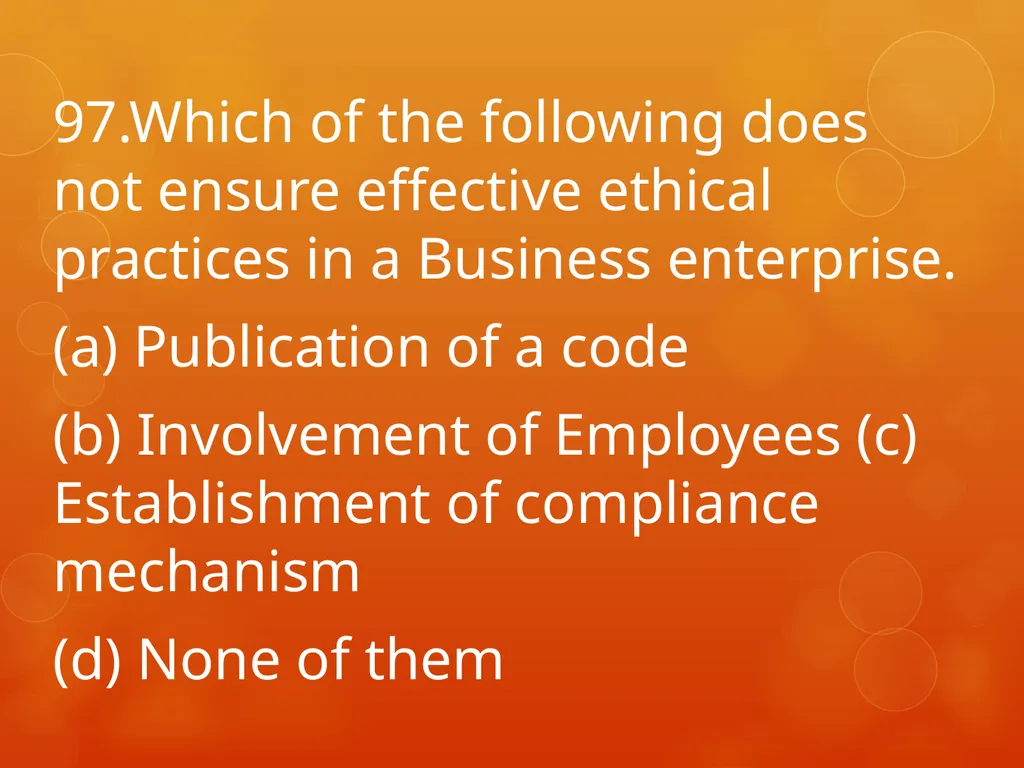
97.Which of the following does not ensure effective ethical practices in a Business enterprise.
(a) Publication of a code
(b) Involvement of Employees (c) Establishment of compliance mechanism
(d) None of them<br>
(a) Publication of a code
(b) Involvement of Employees (c) Establishment of compliance mechanism
(d) None of them<br>
99
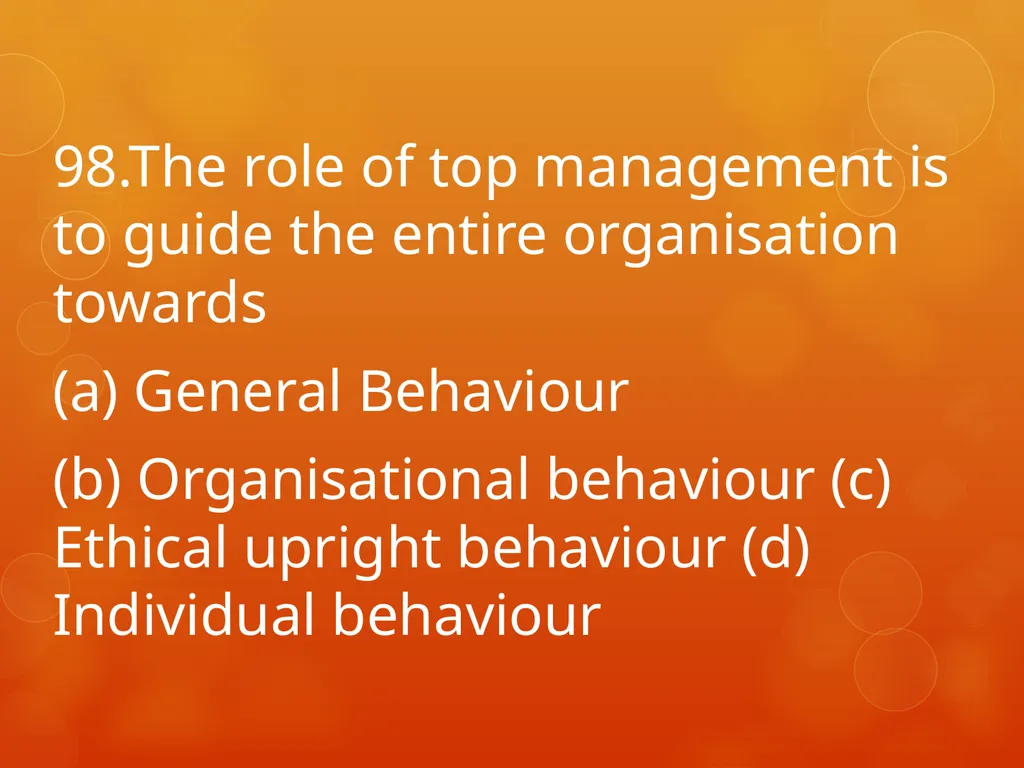
98.The role of top management is to guide the entire organisation towards
(a) General Behaviour
(b) Organisational behaviour (c) Ethical upright behaviour (d) Individual behaviour<br>
(a) General Behaviour
(b) Organisational behaviour (c) Ethical upright behaviour (d) Individual behaviour<br>
100
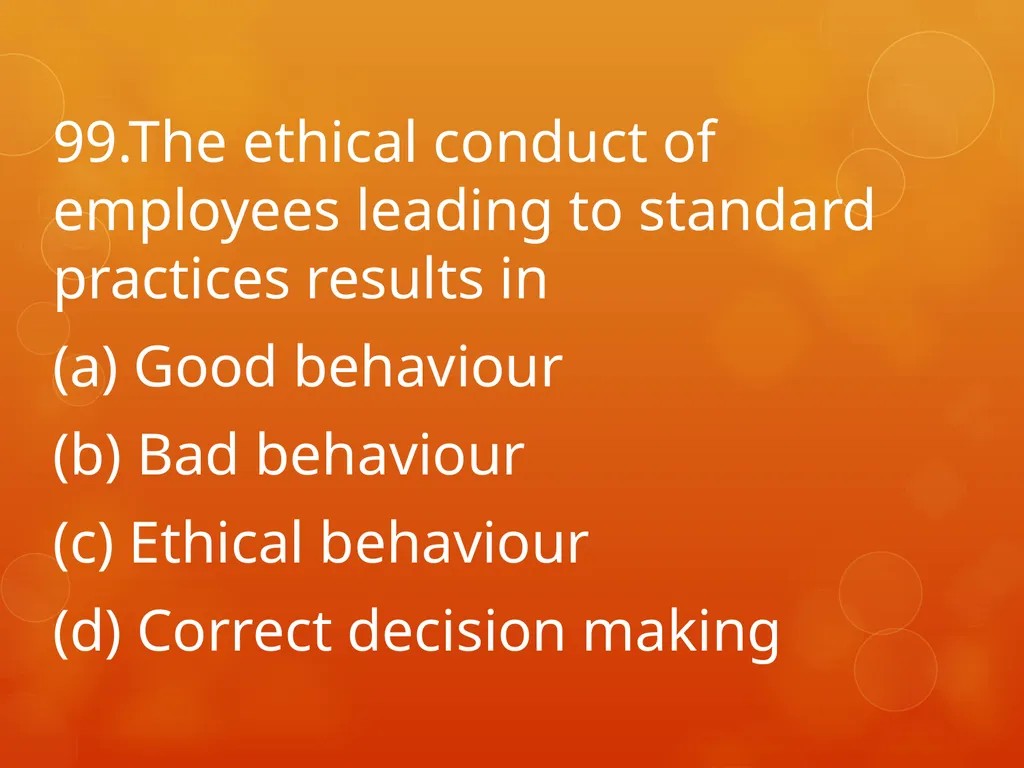
99.The ethical conduct of employees leading to standard practices results in
(a) Good behaviour
(b) Bad behaviour
(c) Ethical behaviour
(d) Correct decision making<br>
(a) Good behaviour
(b) Bad behaviour
(c) Ethical behaviour
(d) Correct decision making<br>
101
THANK YOU……<br>