
XXIX CORSO INTERNAZIONALE DI FORMAZIONE
CM
Published · 12 slides · 0 views
1 / 1
Description
XXIX CORSO INTERNAZIONALE DI FORMAZIONE BIBLIOGRAFICA Medioevo latino. Metodologie e tecniche bibliografiche Firenze, SISMEL 27 31 ottobre 2025 Abstracts always read articles, books and reviews the trick of read only the beginning and the
Related Topics
Share
Embed code
Download this presentation From Below
"XXIX CORSO INTERNAZIONALE DI FORMAZIONE" is the property of its rightful owner. Permission is granted to download and print the materials on this website for personal, non-commercial use only, and to display it on your personal computer provided you do not modify the materials and that you retain all copyright notices contained in the materials. By downloading content from our website, you accept the terms of this agreement.
Presentation Transcript
01
XXIX CORSO INTERNAZIONALE DI
FORMAZIONE BIBLIOGRAFICA
Medioevo latino.
Metodologie e tecniche bibliografiche
Firenze, SISMEL
27 – 31 ottobre 2025<br>
02
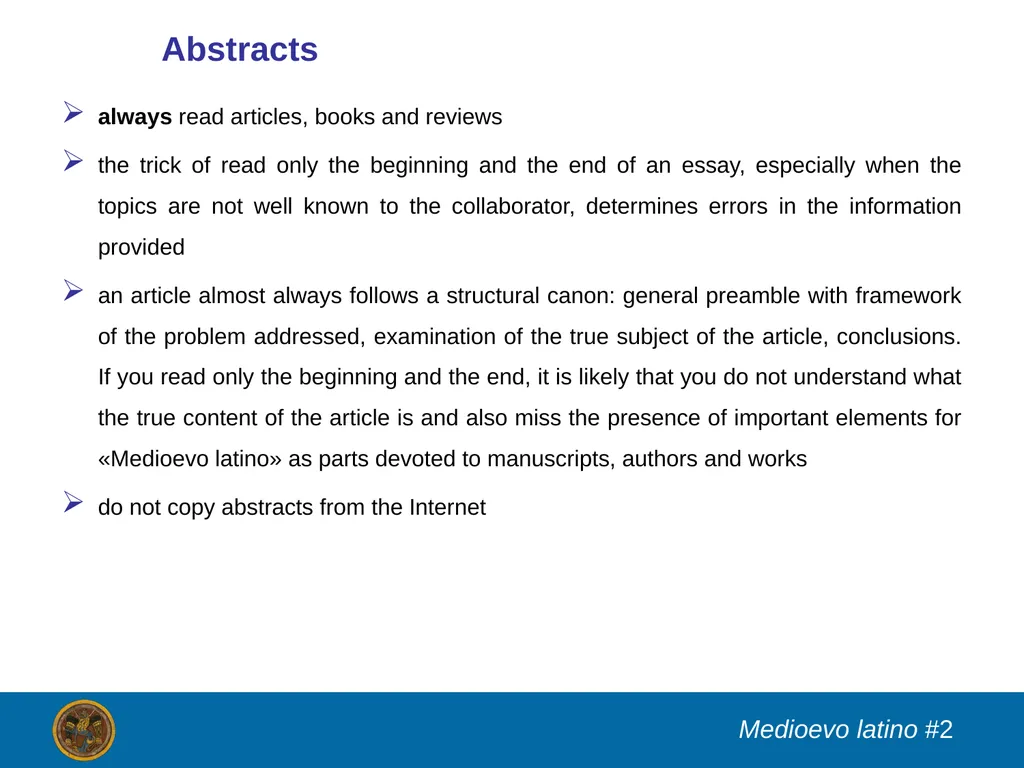
Abstracts always read articles, books and reviews
the trick of read only the beginning and the end of an essay, especially when the topics are not well known to the collaborator, determines errors in the information provided
an article almost always follows a structural canon: general preamble with framework of the problem addressed, examination of the true subject of the article, conclusions. If you read only the beginning and the end, it is likely that you do not understand what the true content of the article is and also miss the presence of important elements for «Medioevo latino» as parts devoted to manuscripts, authors and works
do not copy abstracts from the Internet Medioevo latino #2<br>
the trick of read only the beginning and the end of an essay, especially when the topics are not well known to the collaborator, determines errors in the information provided
an article almost always follows a structural canon: general preamble with framework of the problem addressed, examination of the true subject of the article, conclusions. If you read only the beginning and the end, it is likely that you do not understand what the true content of the article is and also miss the presence of important elements for «Medioevo latino» as parts devoted to manuscripts, authors and works
do not copy abstracts from the Internet Medioevo latino #2<br>
03
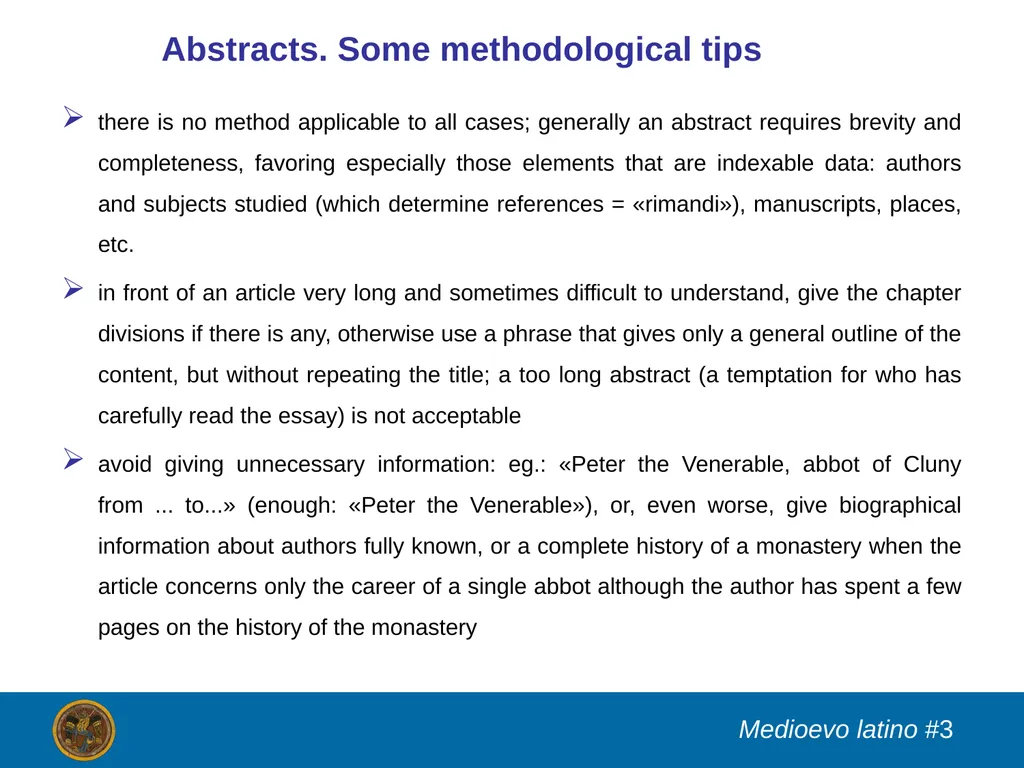
Abstracts. Some methodological tips there is no method applicable to all cases; generally an abstract requires brevity and completeness, favoring especially those elements that are indexable data: authors and subjects studied (which determine references = «rimandi»), manuscripts, places, etc.
in front of an article very long and sometimes difficult to understand, give the chapter divisions if there is any, otherwise use a phrase that gives only a general outline of the content, but without repeating the title; a too long abstract (a temptation for who has carefully read the essay) is not acceptable
avoid giving unnecessary information: eg.: «Peter the Venerable, abbot of Cluny from ... to...» (enough: «Peter the Venerable»), or, even worse, give biographical information about authors fully known, or a complete history of a monastery when the article concerns only the career of a single abbot although the author has spent a few pages on the history of the monastery Medioevo latino #3<br>
in front of an article very long and sometimes difficult to understand, give the chapter divisions if there is any, otherwise use a phrase that gives only a general outline of the content, but without repeating the title; a too long abstract (a temptation for who has carefully read the essay) is not acceptable
avoid giving unnecessary information: eg.: «Peter the Venerable, abbot of Cluny from ... to...» (enough: «Peter the Venerable»), or, even worse, give biographical information about authors fully known, or a complete history of a monastery when the article concerns only the career of a single abbot although the author has spent a few pages on the history of the monastery Medioevo latino #3<br>
04
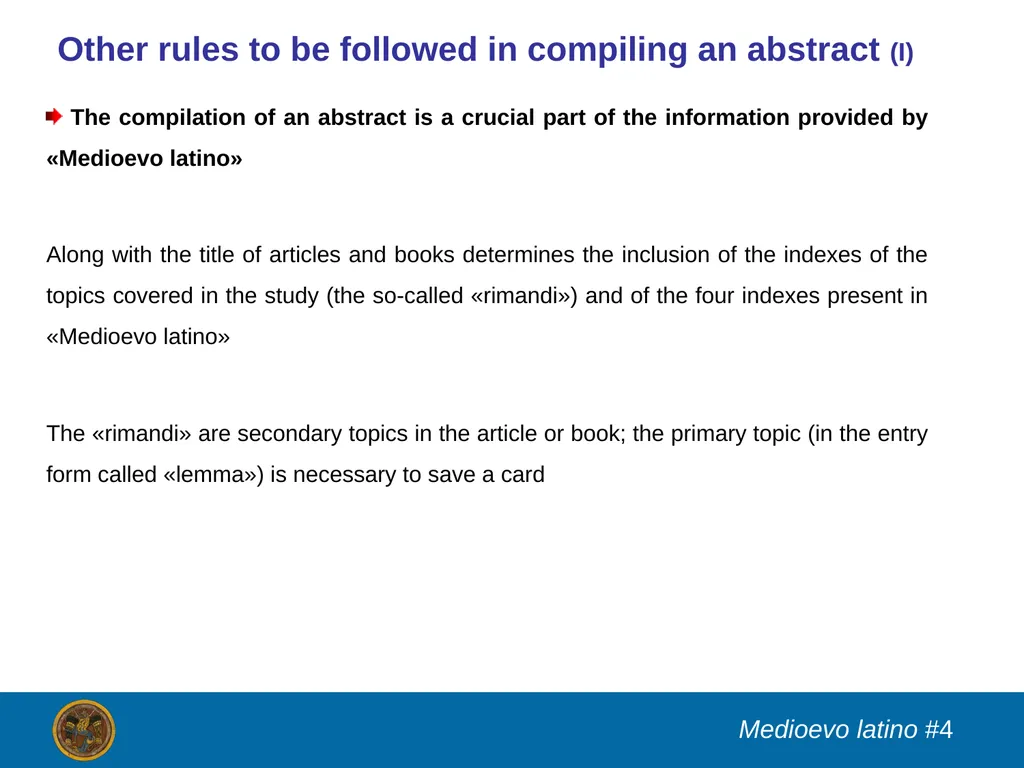
Other rules to be followed in compiling an abstract (I) The compilation of an abstract is a crucial part of the information provided by «Medioevo latino»
Along with the title of articles and books determines the inclusion of the indexes of the topics covered in the study (the so-called «rimandi») and of the four indexes present in «Medioevo latino»
The «rimandi» are secondary topics in the article or book; the primary topic (in the entry form called «lemma») is necessary to save a card Medioevo latino #4<br>
Along with the title of articles and books determines the inclusion of the indexes of the topics covered in the study (the so-called «rimandi») and of the four indexes present in «Medioevo latino»
The «rimandi» are secondary topics in the article or book; the primary topic (in the entry form called «lemma») is necessary to save a card Medioevo latino #4<br>
05
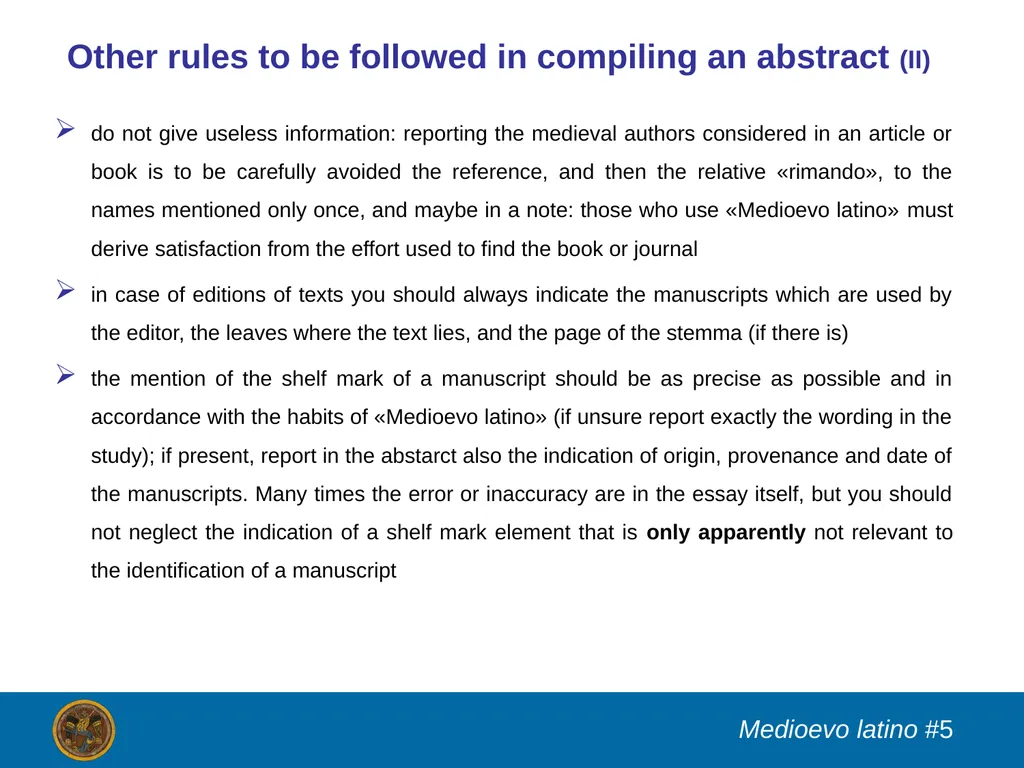
Other rules to be followed in compiling an abstract (II) do not give useless information: reporting the medieval authors considered in an article or book is to be carefully avoided the reference, and then the relative «rimando», to the names mentioned only once, and maybe in a note: those who use «Medioevo latino» must derive satisfaction from the effort used to find the book or journal
in case of editions of texts you should always indicate the manuscripts which are used by the editor, the leaves where the text lies, and the page of the stemma (if there is)
the mention of the shelf mark of a manuscript should be as precise as possible and in accordance with the habits of «Medioevo latino» (if unsure report exactly the wording in the study); if present, report in the abstarct also the indication of origin, provenance and date of the manuscripts. Many times the error or inaccuracy are in the essay itself, but you should not neglect the indication of a shelf mark element that is only apparently not relevant to the identification of a manuscript Medioevo latino #5<br>
in case of editions of texts you should always indicate the manuscripts which are used by the editor, the leaves where the text lies, and the page of the stemma (if there is)
the mention of the shelf mark of a manuscript should be as precise as possible and in accordance with the habits of «Medioevo latino» (if unsure report exactly the wording in the study); if present, report in the abstarct also the indication of origin, provenance and date of the manuscripts. Many times the error or inaccuracy are in the essay itself, but you should not neglect the indication of a shelf mark element that is only apparently not relevant to the identification of a manuscript Medioevo latino #5<br>
06
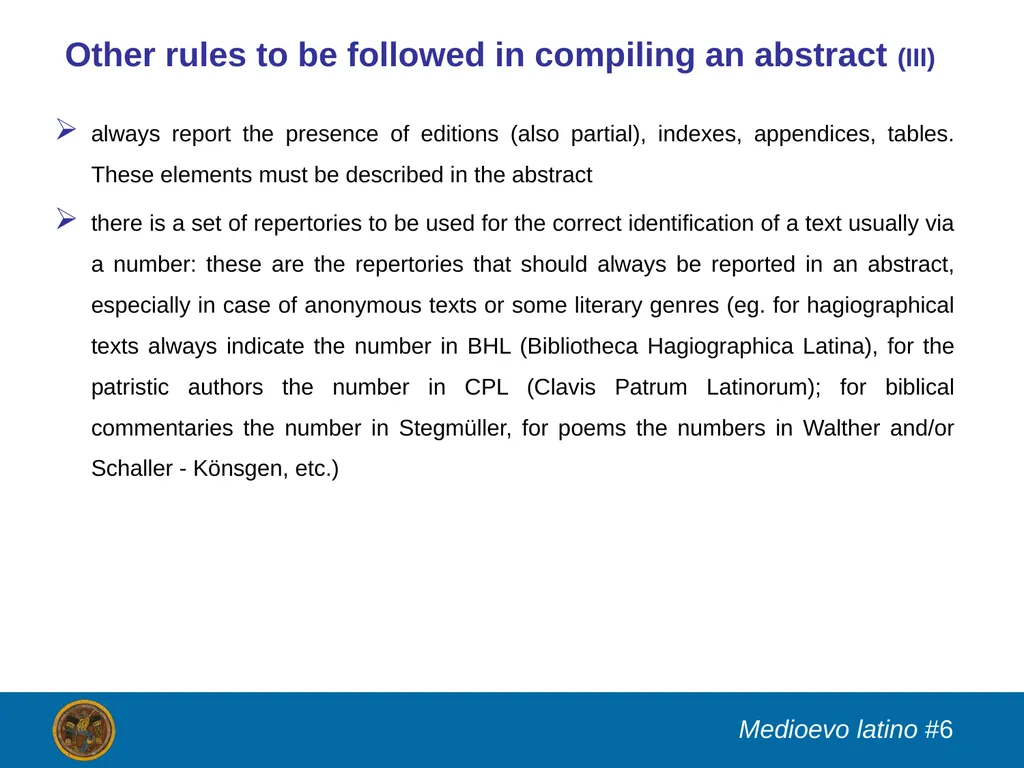
Other rules to be followed in compiling an abstract (III) always report the presence of editions (also partial), indexes, appendices, tables. These elements must be described in the abstract
there is a set of repertories to be used for the correct identification of a text usually via a number: these are the repertories that should always be reported in an abstract, especially in case of anonymous texts or some literary genres (eg. for hagiographical texts always indicate the number in BHL (Bibliotheca Hagiographica Latina), for the patristic authors the number in CPL (Clavis Patrum Latinorum); for biblical commentaries the number in Stegmüller, for poems the numbers in Walther and/or Schaller - Könsgen, etc.) Medioevo latino #6<br>
there is a set of repertories to be used for the correct identification of a text usually via a number: these are the repertories that should always be reported in an abstract, especially in case of anonymous texts or some literary genres (eg. for hagiographical texts always indicate the number in BHL (Bibliotheca Hagiographica Latina), for the patristic authors the number in CPL (Clavis Patrum Latinorum); for biblical commentaries the number in Stegmüller, for poems the numbers in Walther and/or Schaller - Könsgen, etc.) Medioevo latino #6<br>
07
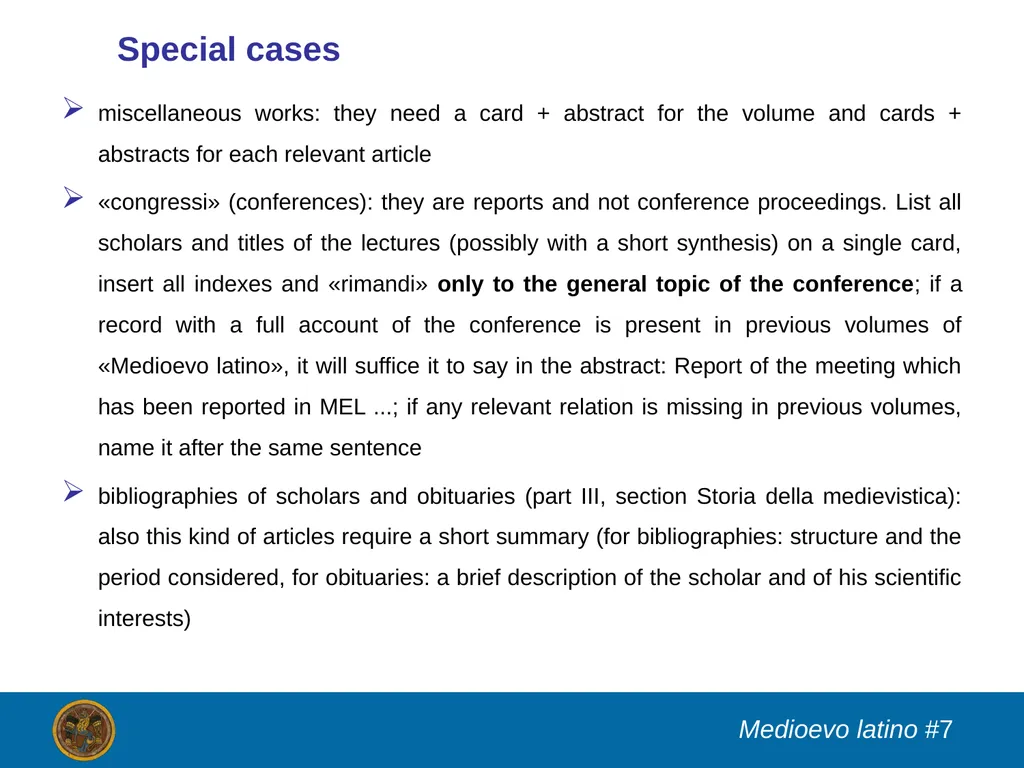
Special cases miscellaneous works: they need a card + abstract for the volume and cards + abstracts for each relevant article
«congressi» (conferences): they are reports and not conference proceedings. List all scholars and titles of the lectures (possibly with a short synthesis) on a single card, insert all indexes and «rimandi» only to the general topic of the conference; if a record with a full account of the conference is present in previous volumes of «Medioevo latino», it will suffice it to say in the abstract: Report of the meeting which has been reported in MEL ...; if any relevant relation is missing in previous volumes, name it after the same sentence
bibliographies of scholars and obituaries (part III, section Storia della medievistica): also this kind of articles require a short summary (for bibliographies: structure and the period considered, for obituaries: a brief description of the scholar and of his scientific interests) Medioevo latino #7<br>
«congressi» (conferences): they are reports and not conference proceedings. List all scholars and titles of the lectures (possibly with a short synthesis) on a single card, insert all indexes and «rimandi» only to the general topic of the conference; if a record with a full account of the conference is present in previous volumes of «Medioevo latino», it will suffice it to say in the abstract: Report of the meeting which has been reported in MEL ...; if any relevant relation is missing in previous volumes, name it after the same sentence
bibliographies of scholars and obituaries (part III, section Storia della medievistica): also this kind of articles require a short summary (for bibliographies: structure and the period considered, for obituaries: a brief description of the scholar and of his scientific interests) Medioevo latino #7<br>
08
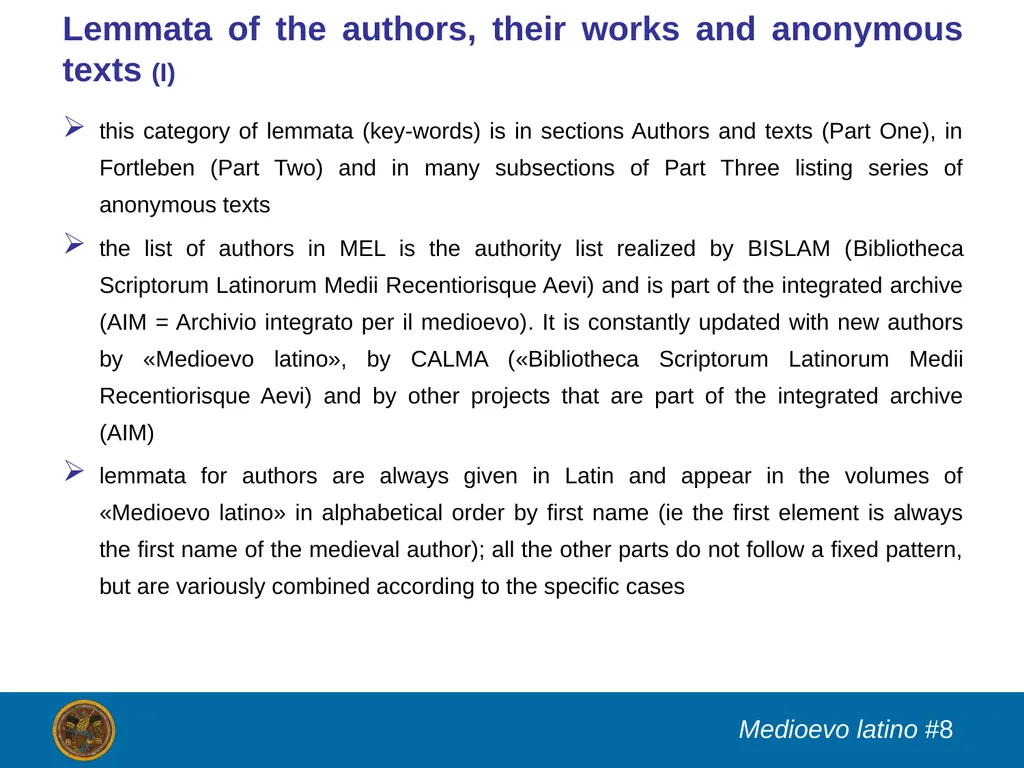
Lemmata of the authors, their works and anonymous texts (I) this category of lemmata (key-words) is in sections Authors and texts (Part One), in Fortleben (Part Two) and in many subsections of Part Three listing series of anonymous texts
the list of authors in MEL is the authority list realized by BISLAM (Bibliotheca Scriptorum Latinorum Medii Recentiorisque Aevi) and is part of the integrated archive (AIM = Archivio integrato per il medioevo). It is constantly updated with new authors by «Medioevo latino», by CALMA («Bibliotheca Scriptorum Latinorum Medii Recentiorisque Aevi) and by other projects that are part of the integrated archive (AIM)
lemmata for authors are always given in Latin and appear in the volumes of «Medioevo latino» in alphabetical order by first name (ie the first element is always the first name of the medieval author); all the other parts do not follow a fixed pattern, but are variously combined according to the specific cases Medioevo latino #8<br>
the list of authors in MEL is the authority list realized by BISLAM (Bibliotheca Scriptorum Latinorum Medii Recentiorisque Aevi) and is part of the integrated archive (AIM = Archivio integrato per il medioevo). It is constantly updated with new authors by «Medioevo latino», by CALMA («Bibliotheca Scriptorum Latinorum Medii Recentiorisque Aevi) and by other projects that are part of the integrated archive (AIM)
lemmata for authors are always given in Latin and appear in the volumes of «Medioevo latino» in alphabetical order by first name (ie the first element is always the first name of the medieval author); all the other parts do not follow a fixed pattern, but are variously combined according to the specific cases Medioevo latino #8<br>
09
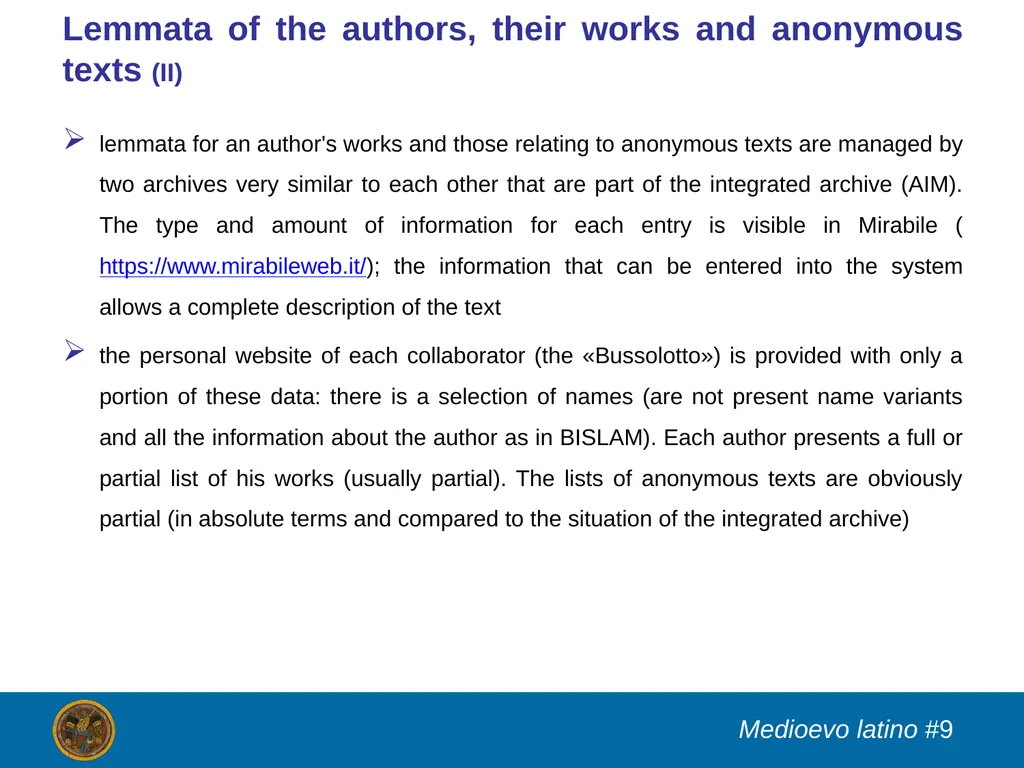
Lemmata of the authors, their works and anonymous texts (II) lemmata for an author's works and those relating to anonymous texts are managed by two archives very similar to each other that are part of the integrated archive (AIM). The type and amount of information for each entry is visible in Mirabile (https://www.mirabileweb.it/); the information that can be entered into the system allows a complete description of the text
the personal website of each collaborator (the «Bussolotto») is provided with only a portion of these data: there is a selection of names (are not present name variants and all the information about the author as in BISLAM). Each author presents a full or partial list of his works (usually partial). The lists of anonymous texts are obviously partial (in absolute terms and compared to the situation of the integrated archive) Medioevo latino #9<br>
the personal website of each collaborator (the «Bussolotto») is provided with only a portion of these data: there is a selection of names (are not present name variants and all the information about the author as in BISLAM). Each author presents a full or partial list of his works (usually partial). The lists of anonymous texts are obviously partial (in absolute terms and compared to the situation of the integrated archive) Medioevo latino #9<br>
10
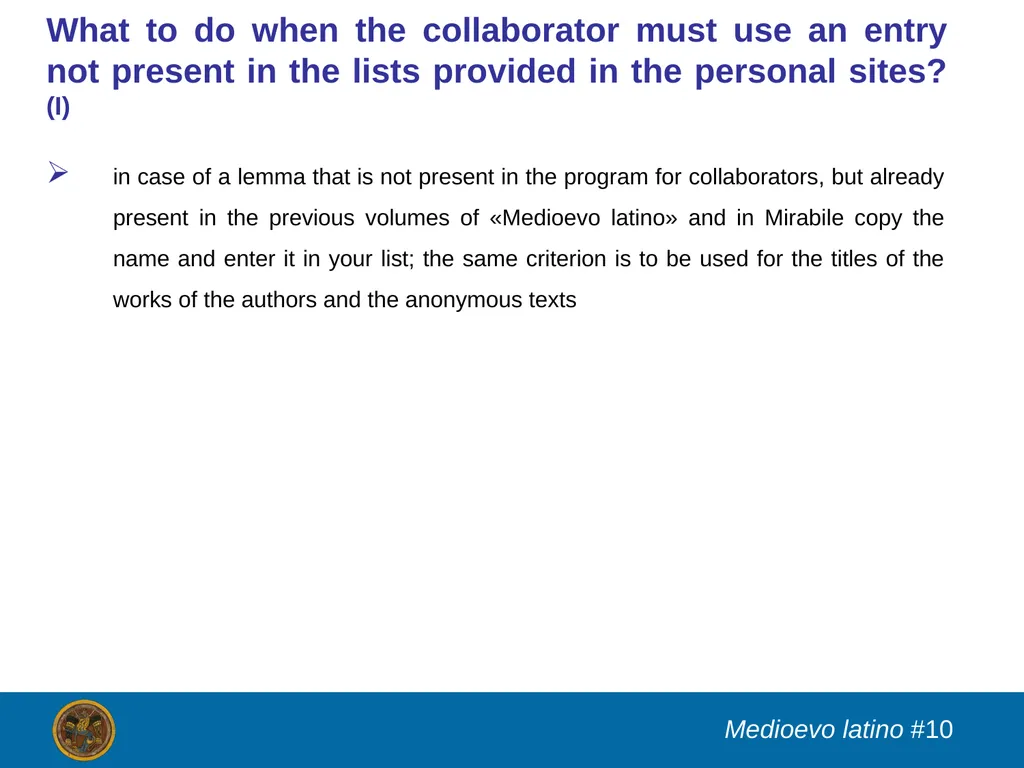
What to do when the collaborator must use an entry not present in the lists provided in the personal sites? (I) in case of a lemma that is not present in the program for collaborators, but already present in the previous volumes of «Medioevo latino» and in Mirabile copy the name and enter it in your list; the same criterion is to be used for the titles of the works of the authors and the anonymous texts Medioevo latino #10<br>
11
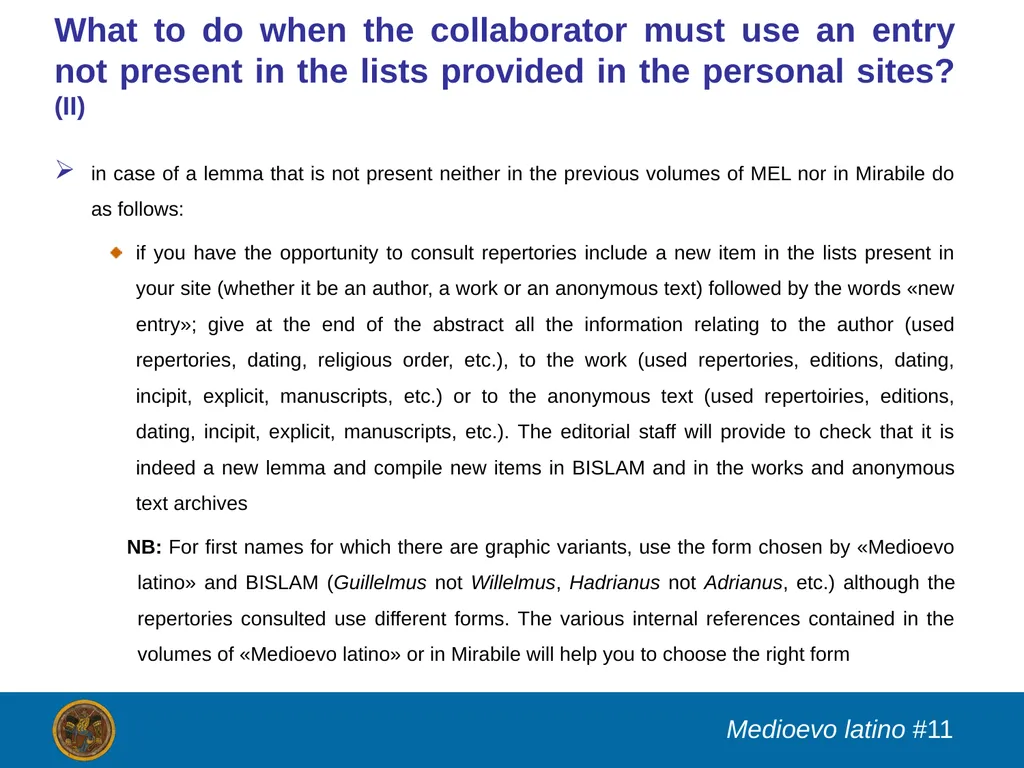
What to do when the collaborator must use an entry not present in the lists provided in the personal sites? (II) in case of a lemma that is not present neither in the previous volumes of MEL nor in Mirabile do as follows:
if you have the opportunity to consult repertories include a new item in the lists present in your site (whether it be an author, a work or an anonymous text) followed by the words «new entry»; give at the end of the abstract all the information relating to the author (used repertories, dating, religious order, etc.), to the work (used repertories, editions, dating, incipit, explicit, manuscripts, etc.) or to the anonymous text (used repertoiries, editions, dating, incipit, explicit, manuscripts, etc.). The editorial staff will provide to check that it is indeed a new lemma and compile new items in BISLAM and in the works and anonymous text archives
NB: For first names for which there are graphic variants, use the form chosen by «Medioevo latino» and BISLAM (Guillelmus not Willelmus, Hadrianus not Adrianus, etc.) although the repertories consulted use different forms. The various internal references contained in the volumes of «Medioevo latino» or in Mirabile will help you to choose the right form Medioevo latino #11<br>
if you have the opportunity to consult repertories include a new item in the lists present in your site (whether it be an author, a work or an anonymous text) followed by the words «new entry»; give at the end of the abstract all the information relating to the author (used repertories, dating, religious order, etc.), to the work (used repertories, editions, dating, incipit, explicit, manuscripts, etc.) or to the anonymous text (used repertoiries, editions, dating, incipit, explicit, manuscripts, etc.). The editorial staff will provide to check that it is indeed a new lemma and compile new items in BISLAM and in the works and anonymous text archives
NB: For first names for which there are graphic variants, use the form chosen by «Medioevo latino» and BISLAM (Guillelmus not Willelmus, Hadrianus not Adrianus, etc.) although the repertories consulted use different forms. The various internal references contained in the volumes of «Medioevo latino» or in Mirabile will help you to choose the right form Medioevo latino #11<br>
12
What to do when the collaborator must use an entry not present in the lists provided in the personal sites? (III) if you do not have the possibility to consult repertories or your research was fruitless do not insert lemmata in the lists and give all possible information about the author, the work or the anonymous text present in the article or book at the end of the abstract (of course that information will help the editorial staff, without appearing in the printed volume). If the new lemma, author or text, is the main key-word for a record attach it to a generic section (eg if the author is a hagiographer to Hagiography in Part Three). If the new lemma is a work of an author associate it only to the name of the author Medioevo latino #12<br>